From Idea to SuccessA guide for first time entrepreneursGaurav OberoiTwitter: @goberoi
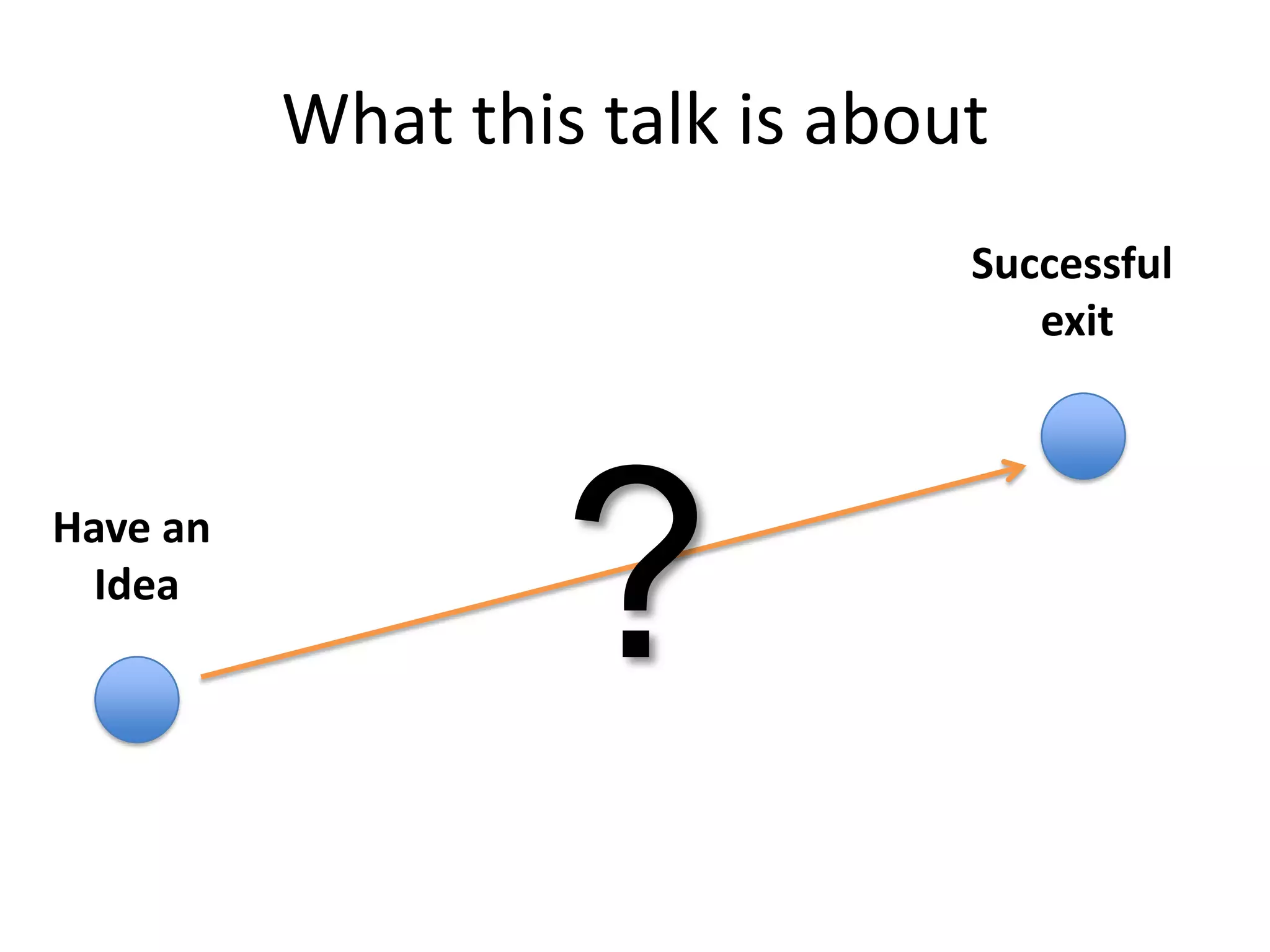
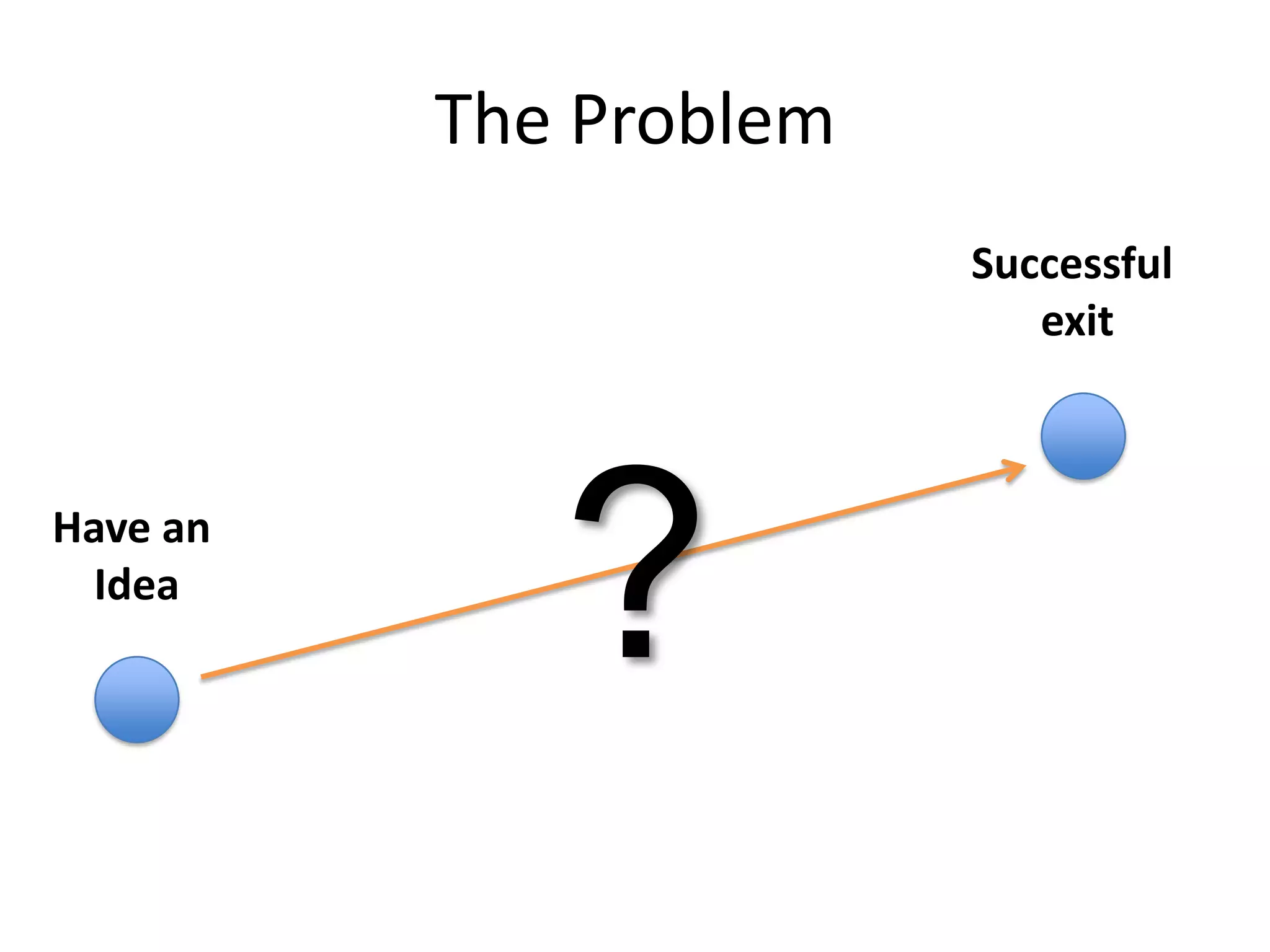
What this talk is aboutSuccessful exit?Have an Idea
What you’ll learnHow to:Evaluate your ideaBuild a product that people pay you forGrow your business
But first, introductions
About MeStarted and sold 2 companiesBillMonk and PrecisionPollingSoftware backgroundAmazon engineer, Computer Science from Rice U.Startup roles in Product and Eng Mgmt.SurveyMonkey (current), Xmarks (Mitch Kapor)Founded 2200+ entrepreneur group in SeattleSeattleTechStartups.comAdvisor to several startups, angel investor
1st company: BillMonkProblem: bill splitting sucksSolution: split bills, track debtsMarket: roommates, students$: fee for settling debts onlineConsumer internet startup
Self-funded, 2 founders
Acquired by Obopay in16 months2nd company: Precision PollingProblem: automated phone surveys costly and slow to setupIdea: self-serve phone pollsMarkets: politics, opinion research (healthcare, govt., call centers)$: pay per callSaaS startup catering to SMB
Self-funded, 2 founders
Acquired by SurveyMonkey in 12 months My employer: SurveyMonkeyBiggest web survey provider in the world10 years old, highly profitableLarge investment from PE firm last yearSingapore love SurveyMonkey
15th largest market But
5th in terms of surveys deployed by all usersOk, let’s begin
The ProblemSuccessful exit?Have an Idea
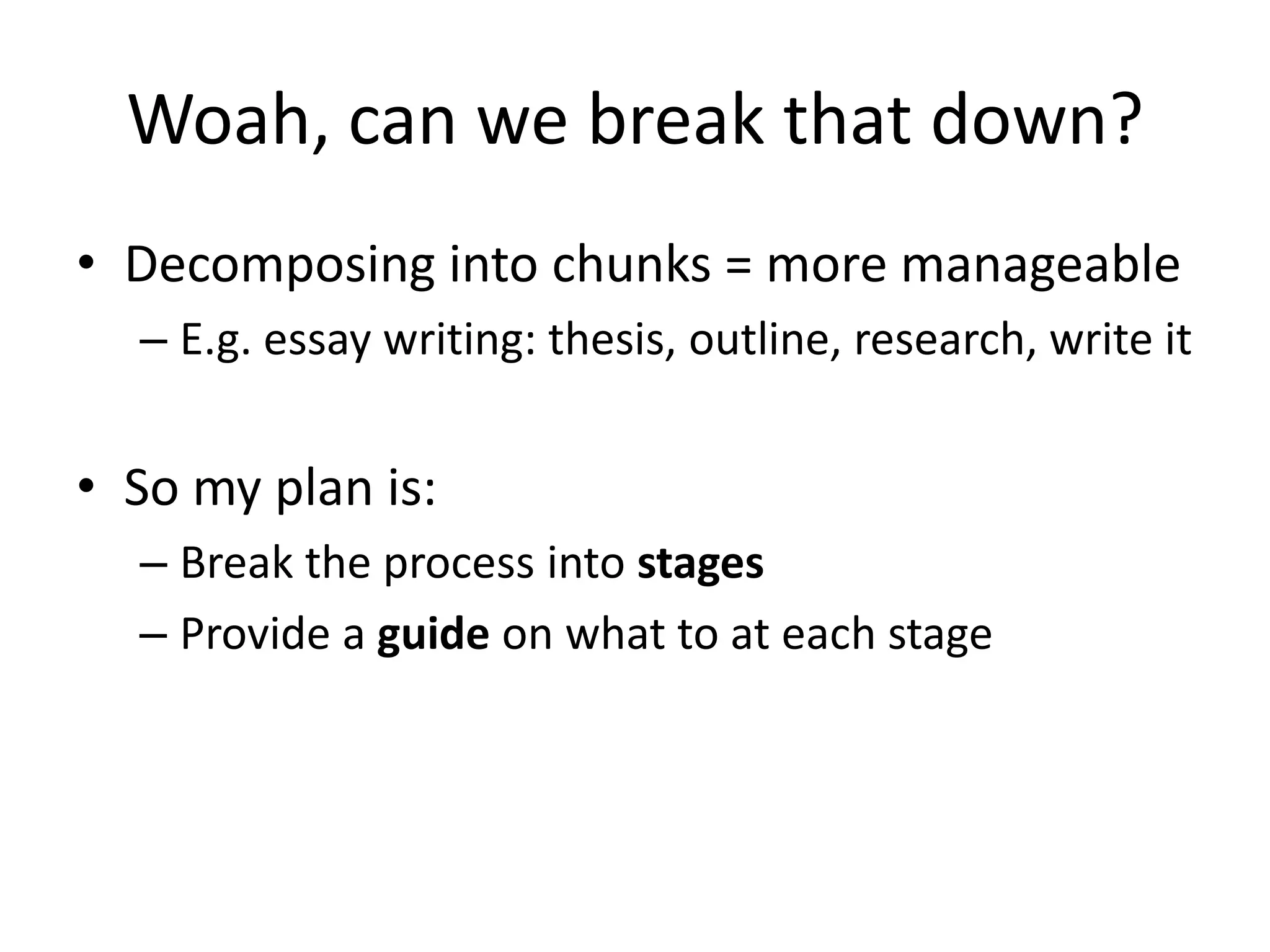
Woah, can we break that down?Decomposing into chunks = more manageableE.g. essay writing: thesis, outline, research, write itSo my plan is:Break the process into stagesProvide a guide on what to at each stage
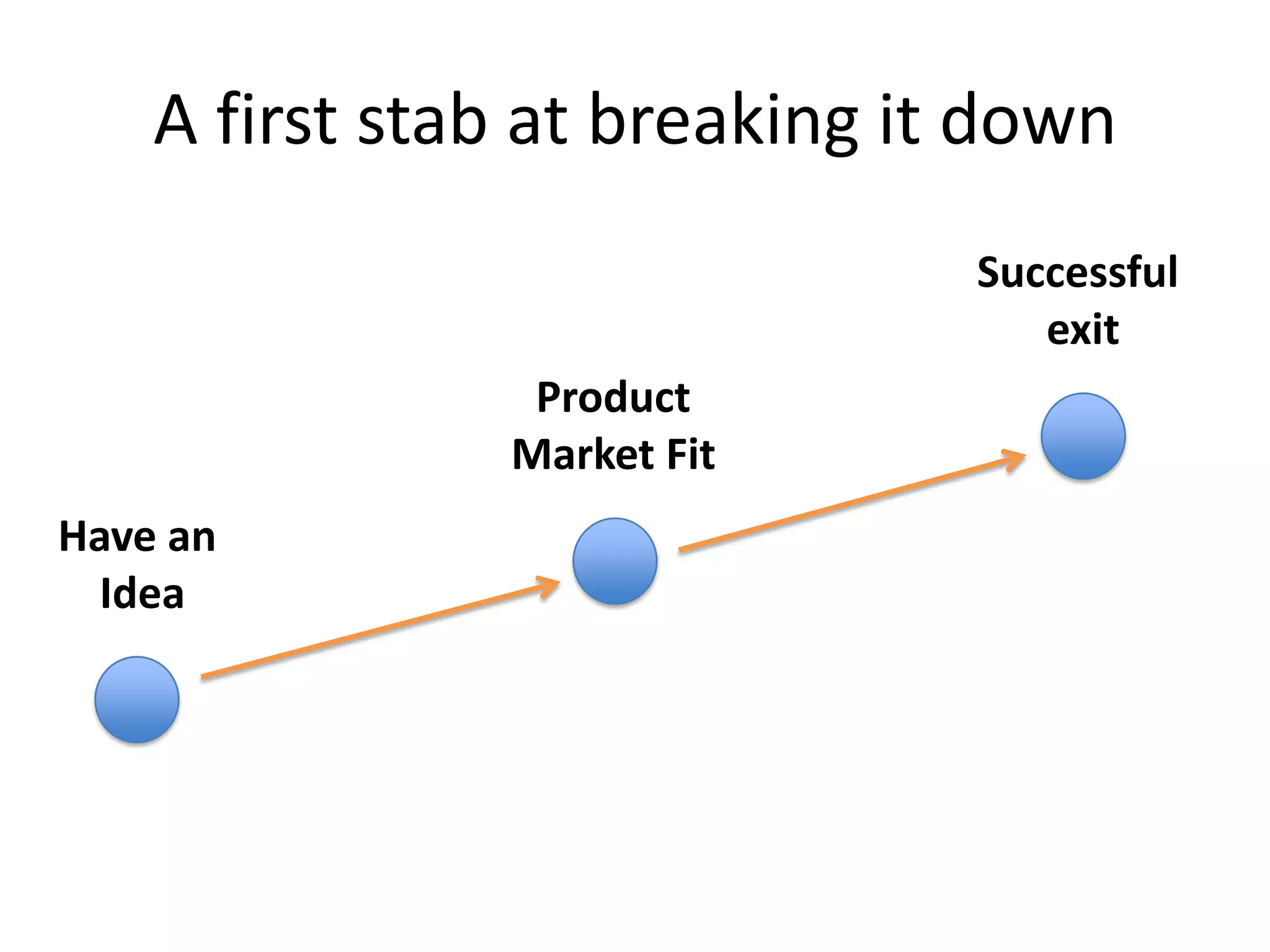
A first stab at breaking it downSuccessful exitProductMarket FitHave an Idea
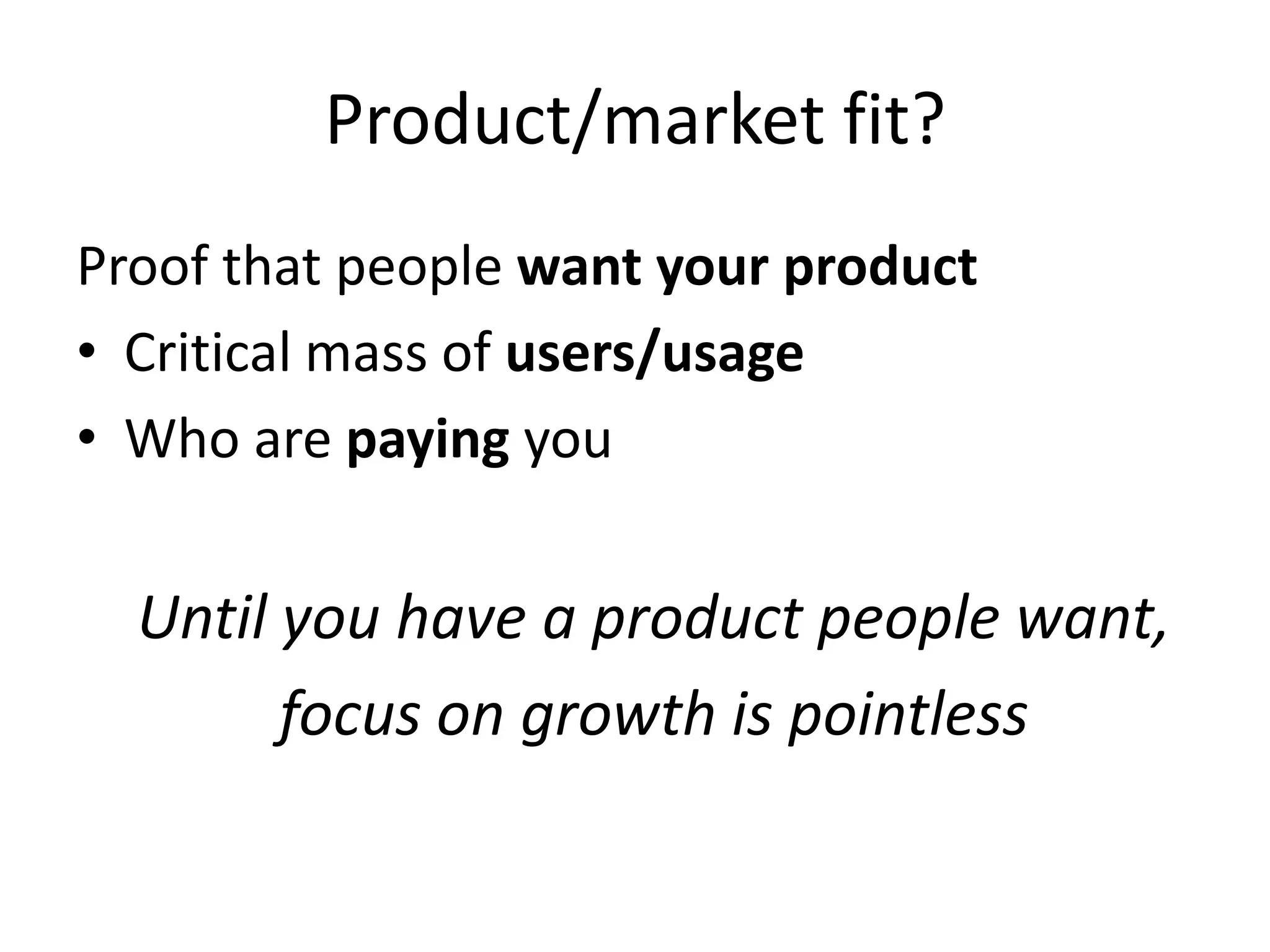
Product/market fit?Proof that people want your productCritical mass of users/usageWho are paying youUntil you have a product people want, focus on growth is pointless
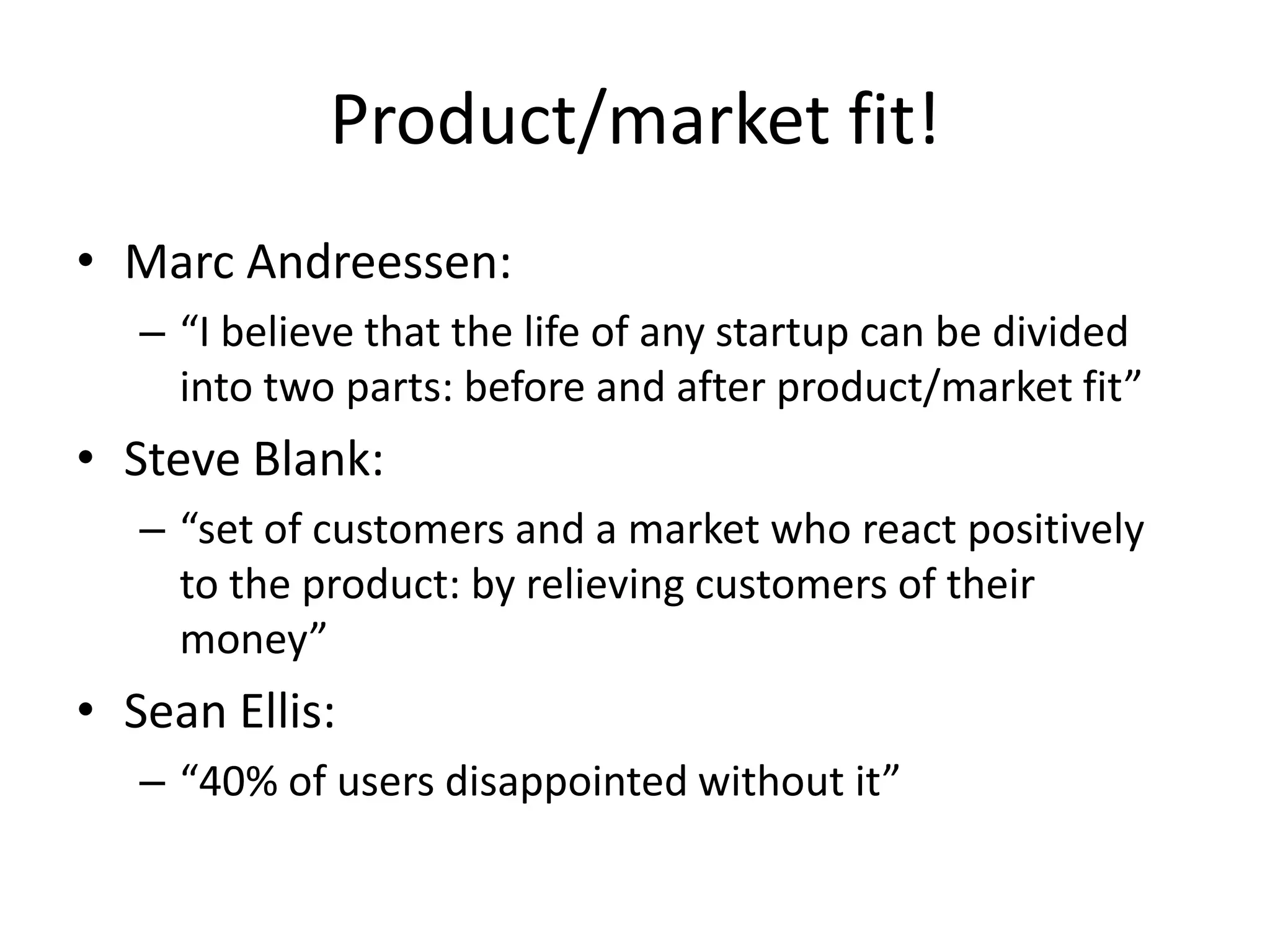
Product/market fit!Marc Andreessen: “I believe that the life of any startup can be divided into two parts: before and after product/market fit”Steve Blank: “set of customers and a market who react positively to the product: by relieving customers of their money”Sean Ellis:“40% of users disappointed without it”
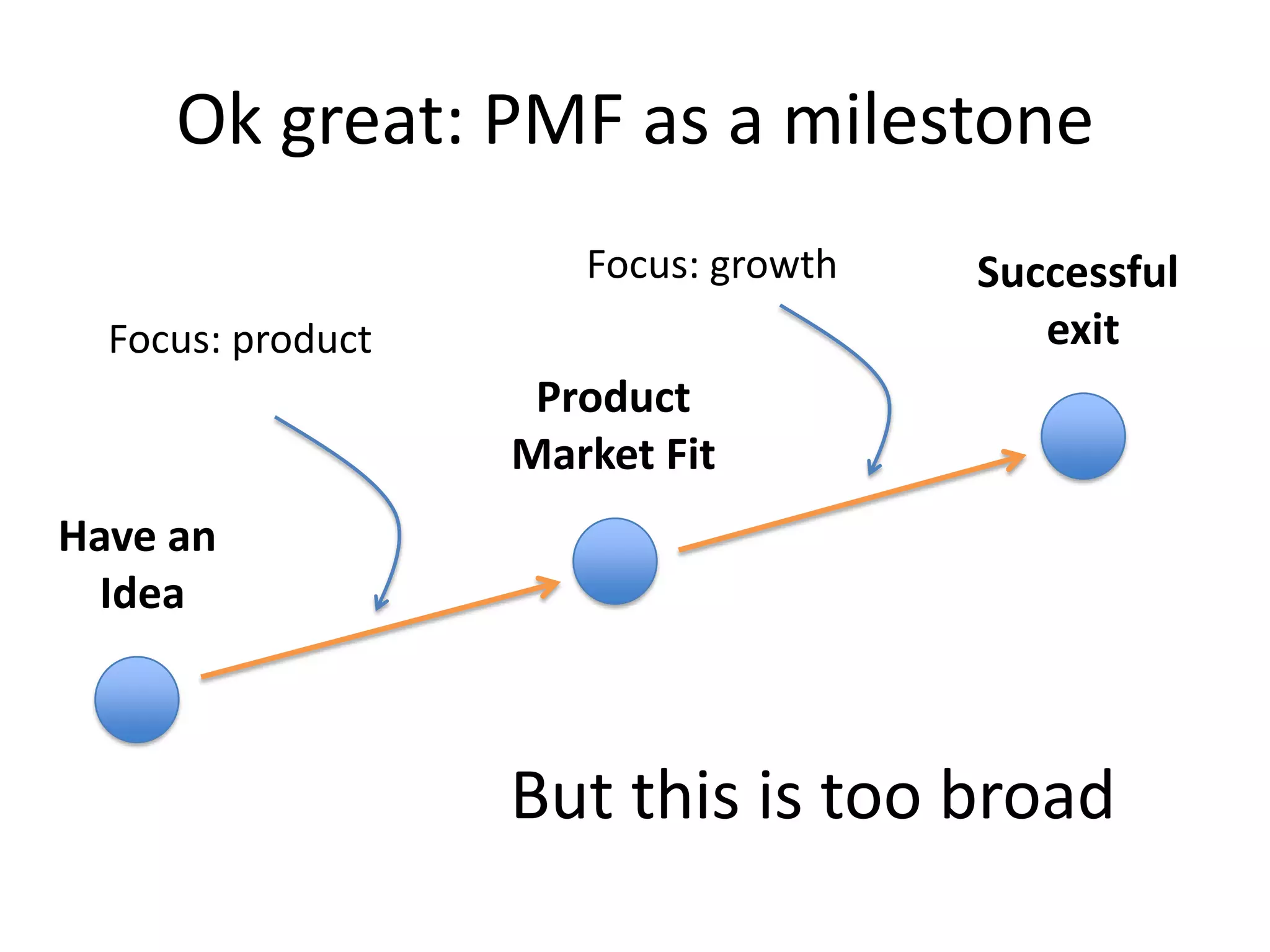
Ok great: PMF as a milestoneFocus: growthSuccessful exitFocus: productProductMarket FitHave an IdeaBut this is too broad
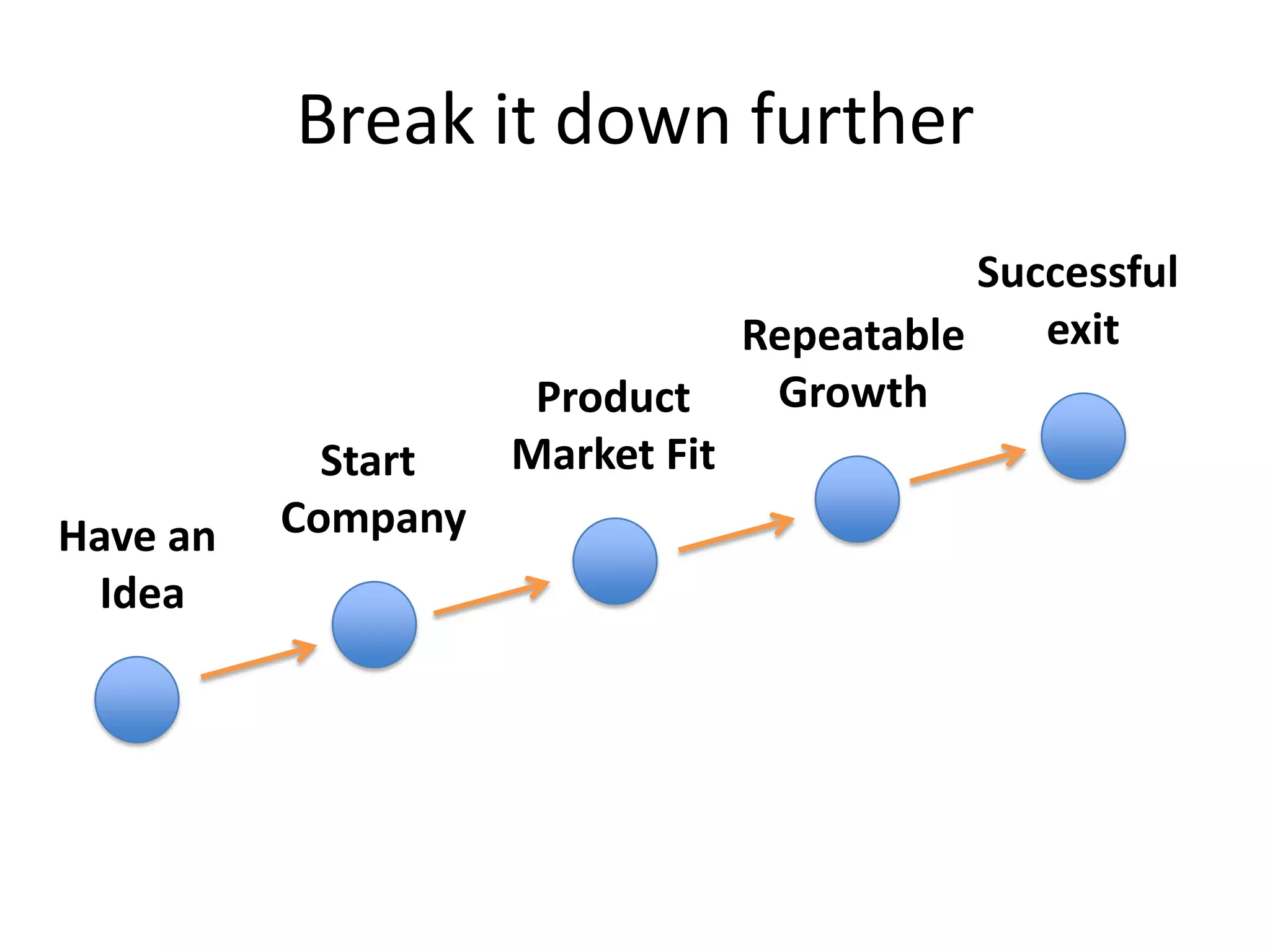
Break it down furtherSuccessful exitRepeatableGrowthProductMarket FitStart CompanyHave an Idea
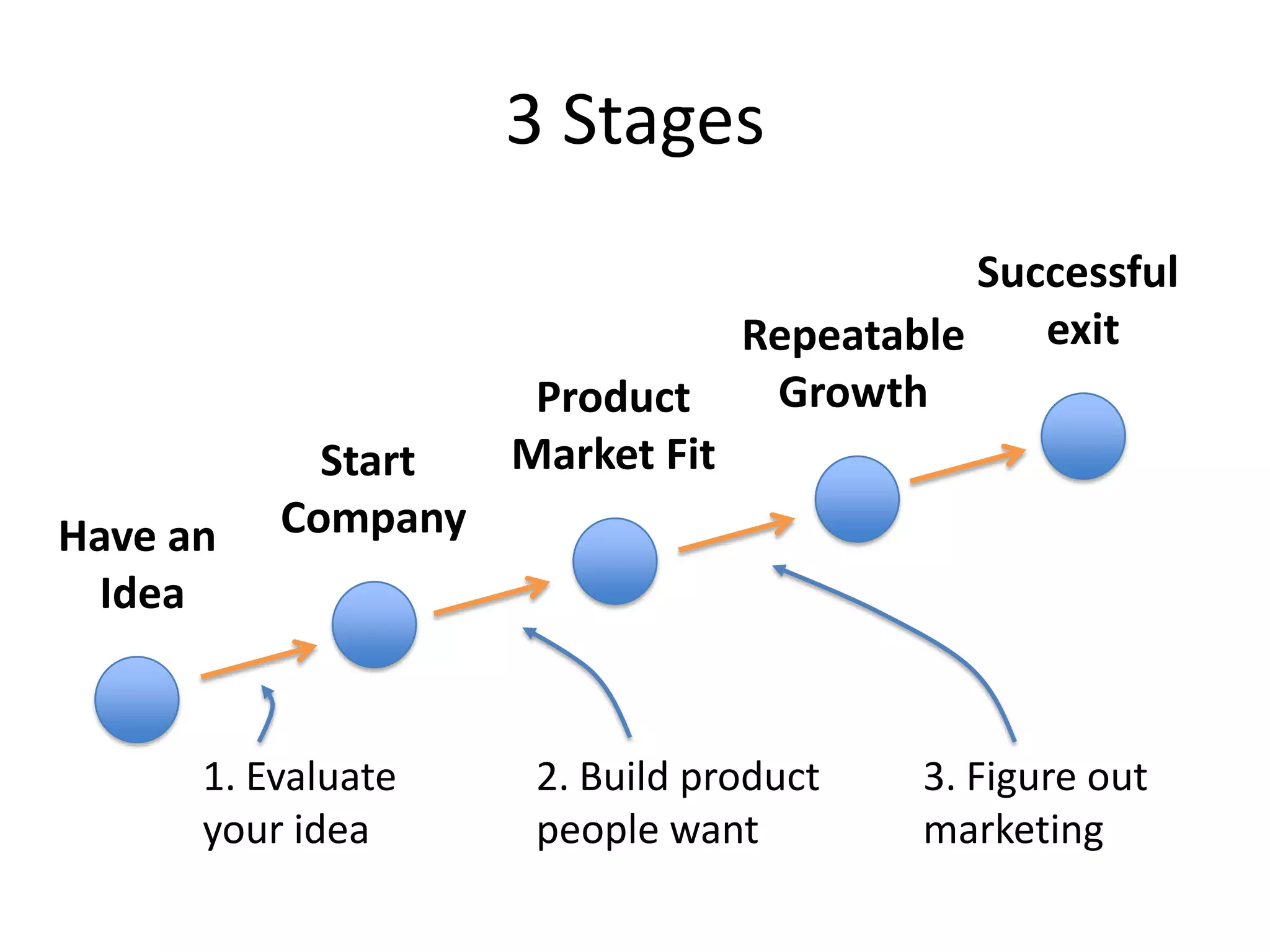
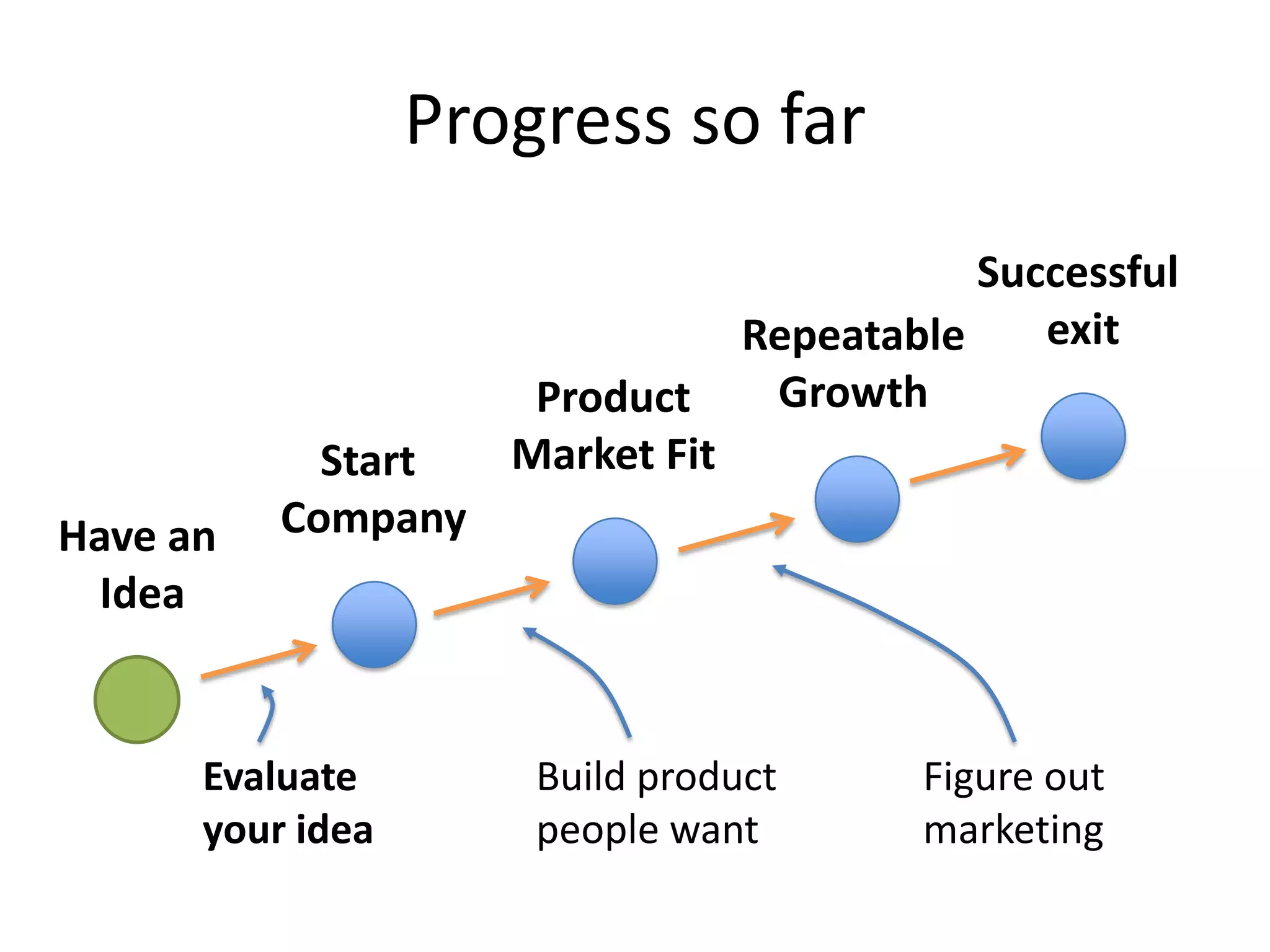
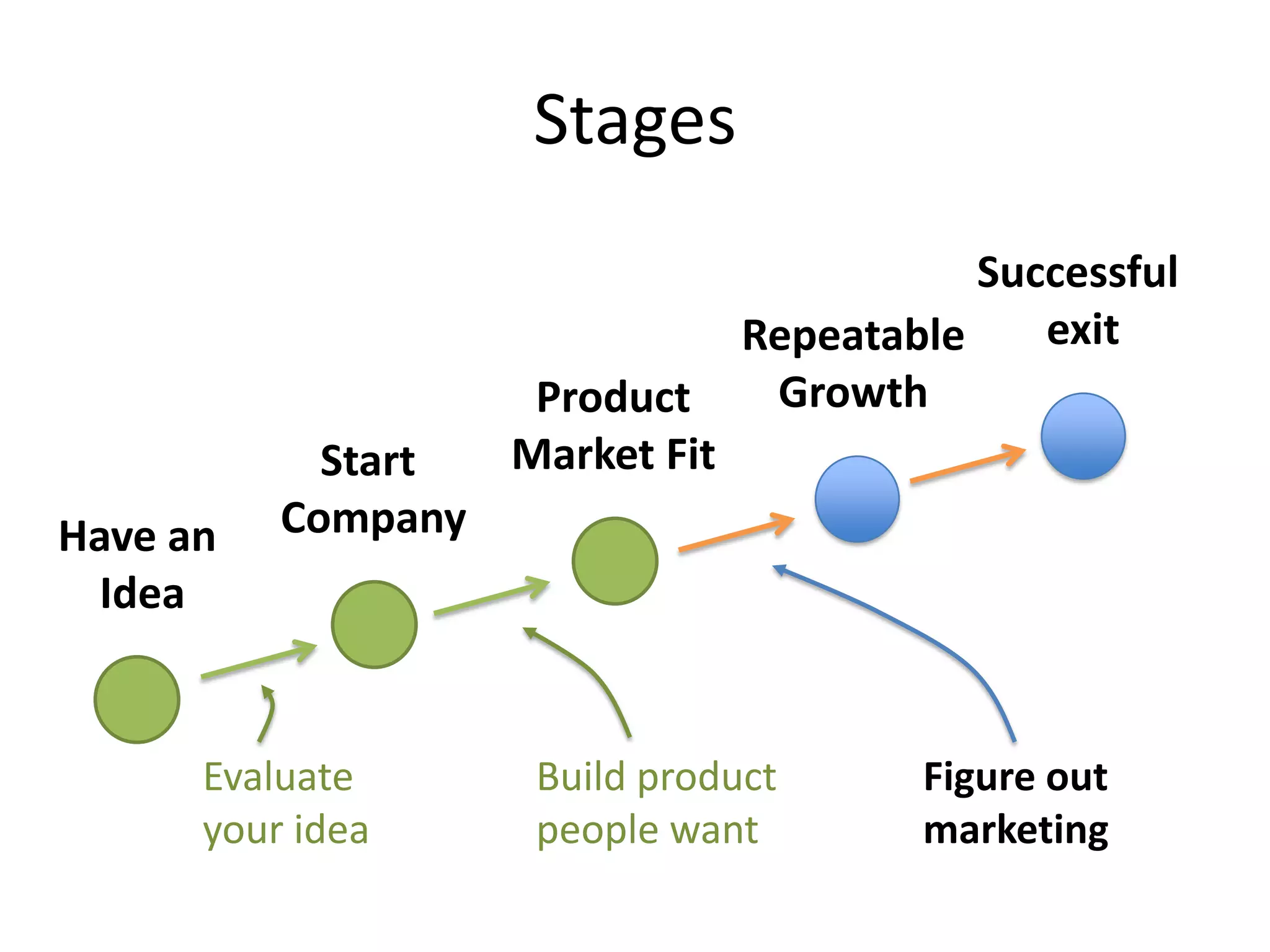
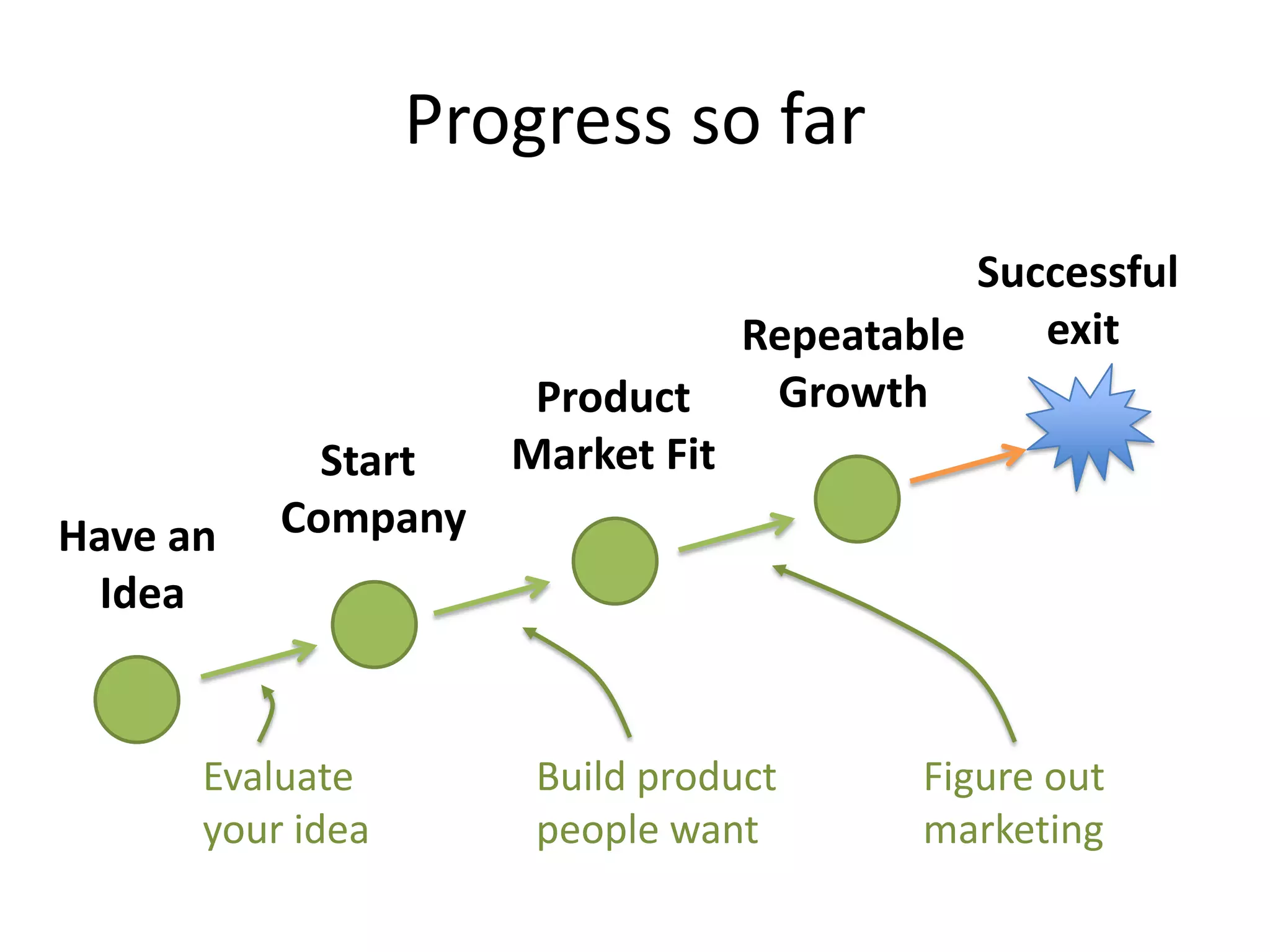
3 StagesSuccessful exitRepeatableGrowthProductMarket FitStart CompanyHave an Idea1. Evaluate your idea2. Build product people want3. Figure out marketing
What do I do at each Stage?I’ll discuss:Your goalsWhat to focus onNot to focus onDetails by area: product, business, marketing
Great, we have a planLet’s dig into details
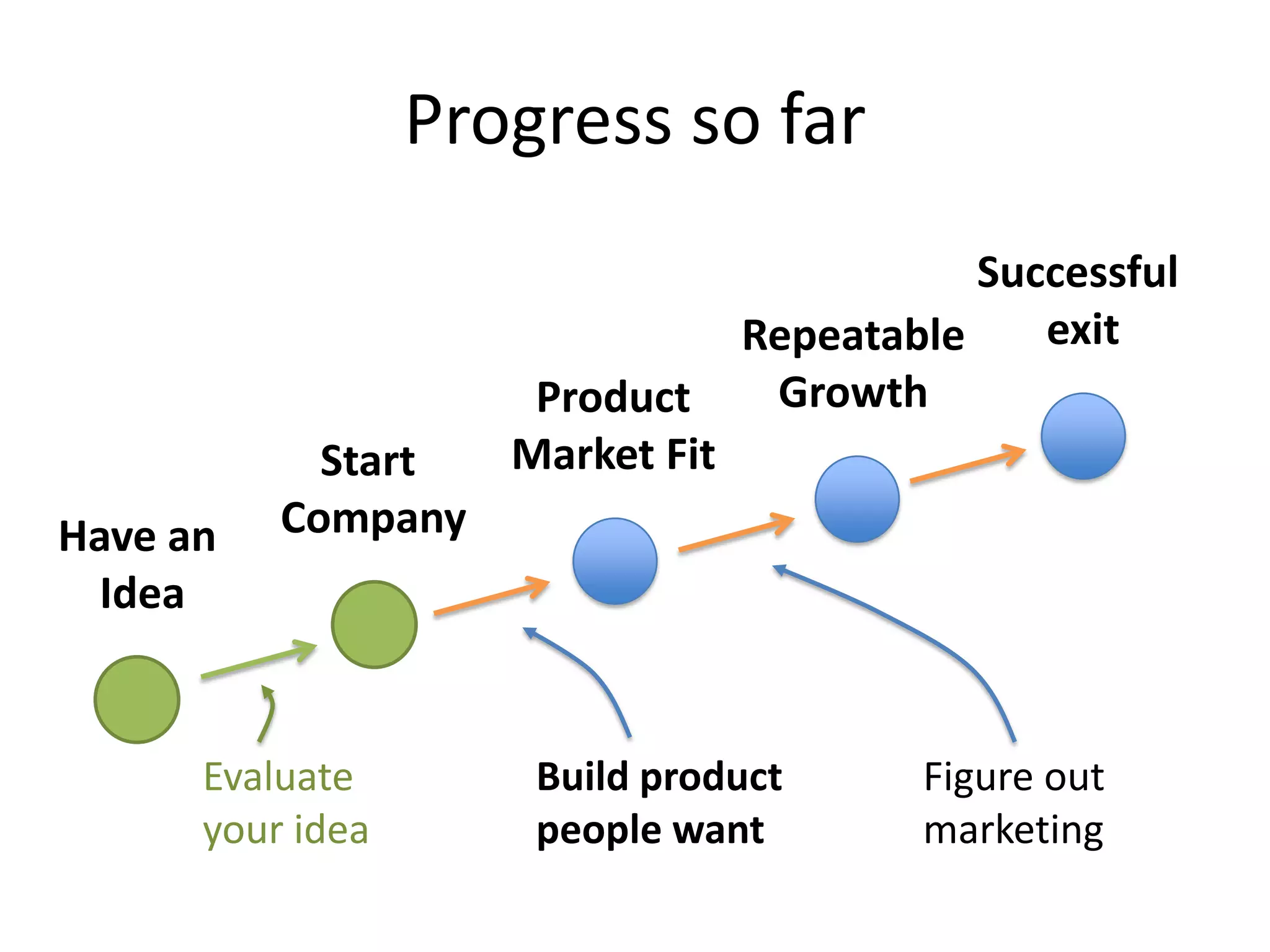
Progress so farSuccessful exitRepeatableGrowthProductMarket FitStart CompanyHave an IdeaEvaluate your ideaBuild product people wantFigure out marketing
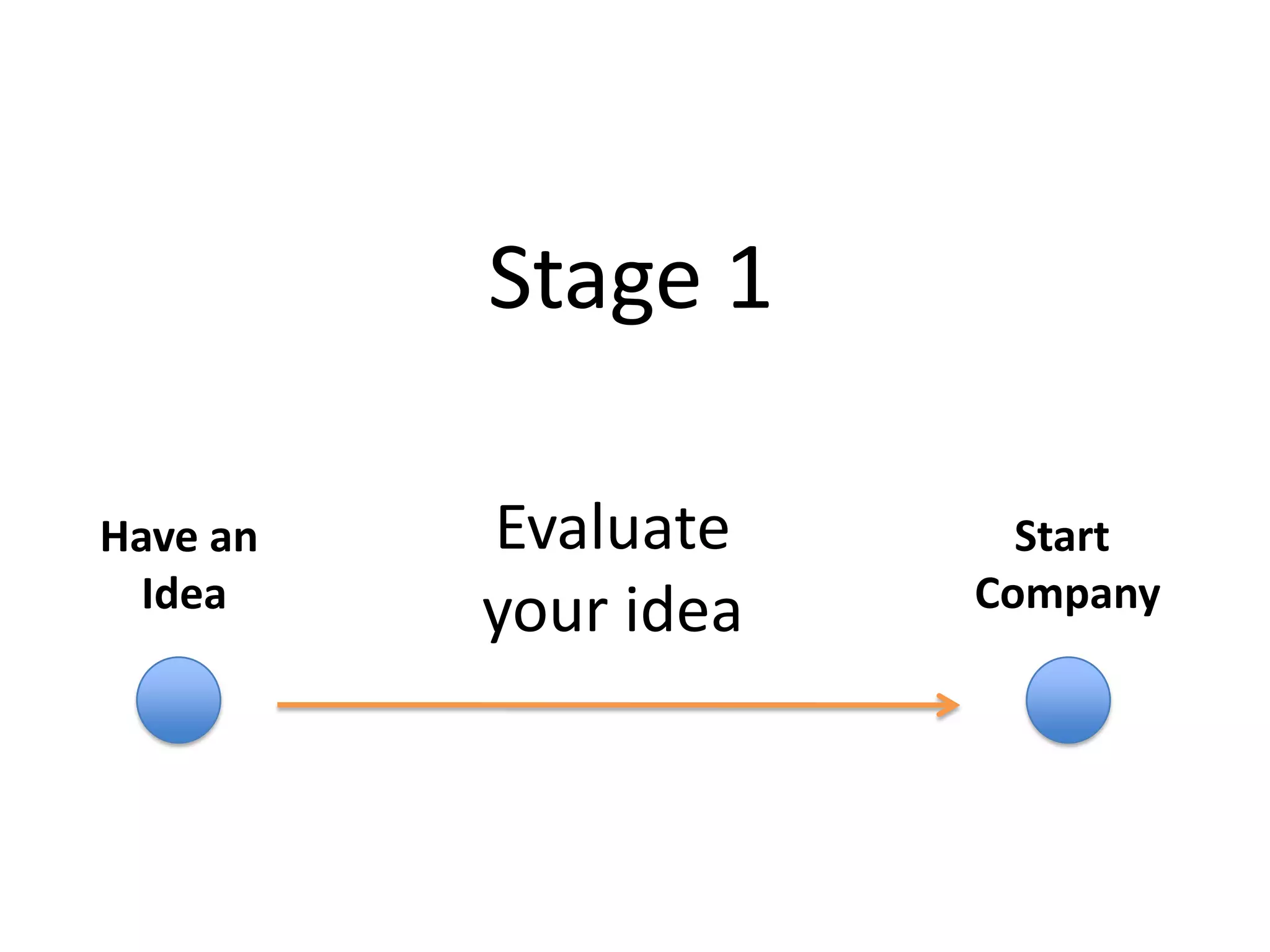
Stage 1Evaluateyour ideaStart CompanyHave an Idea
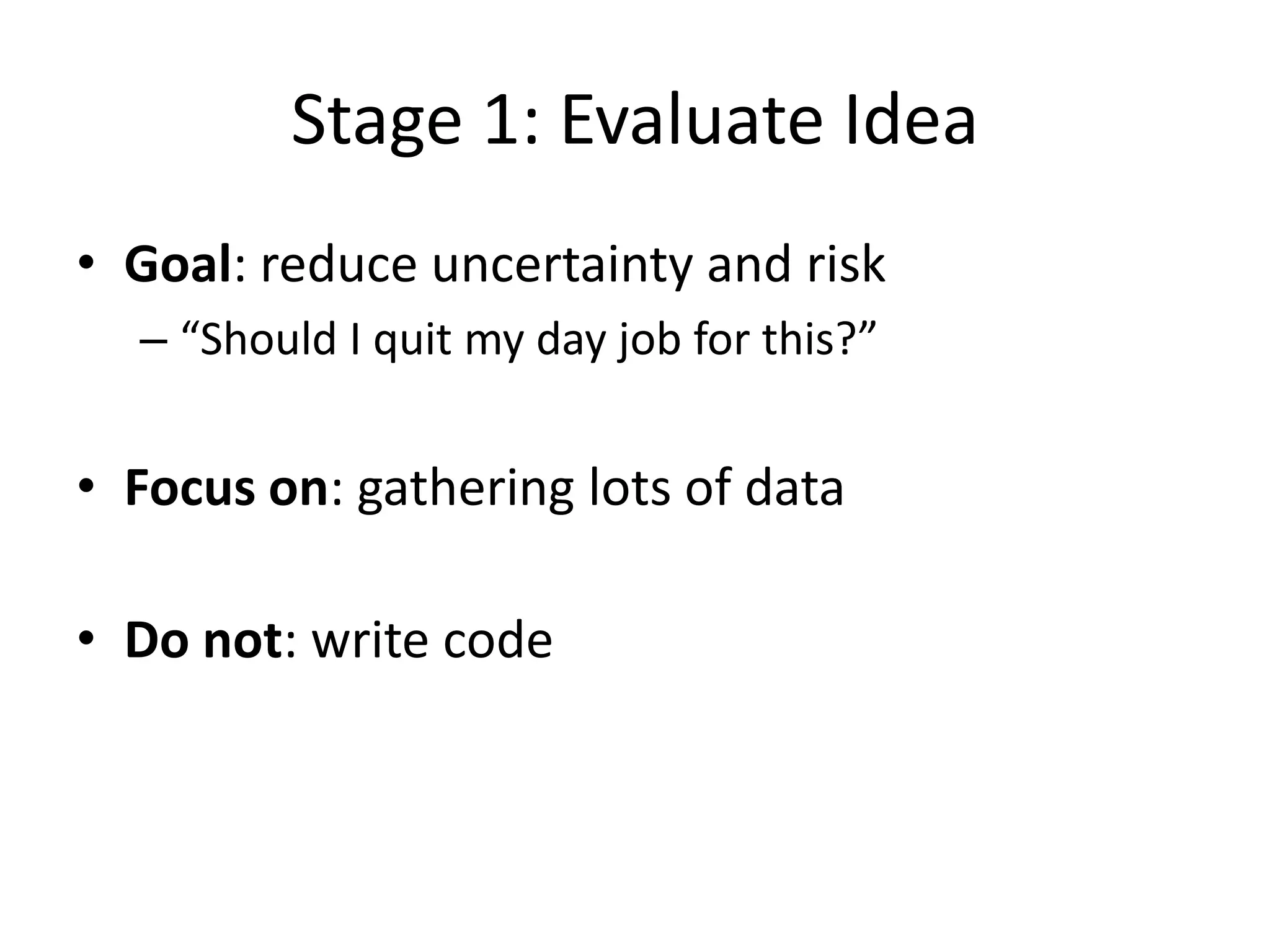
Stage 1: Evaluate IdeaGoal: reduce uncertainty and risk“Should I quit my day job for this?”Focus on: gathering lots of dataDo not: write code
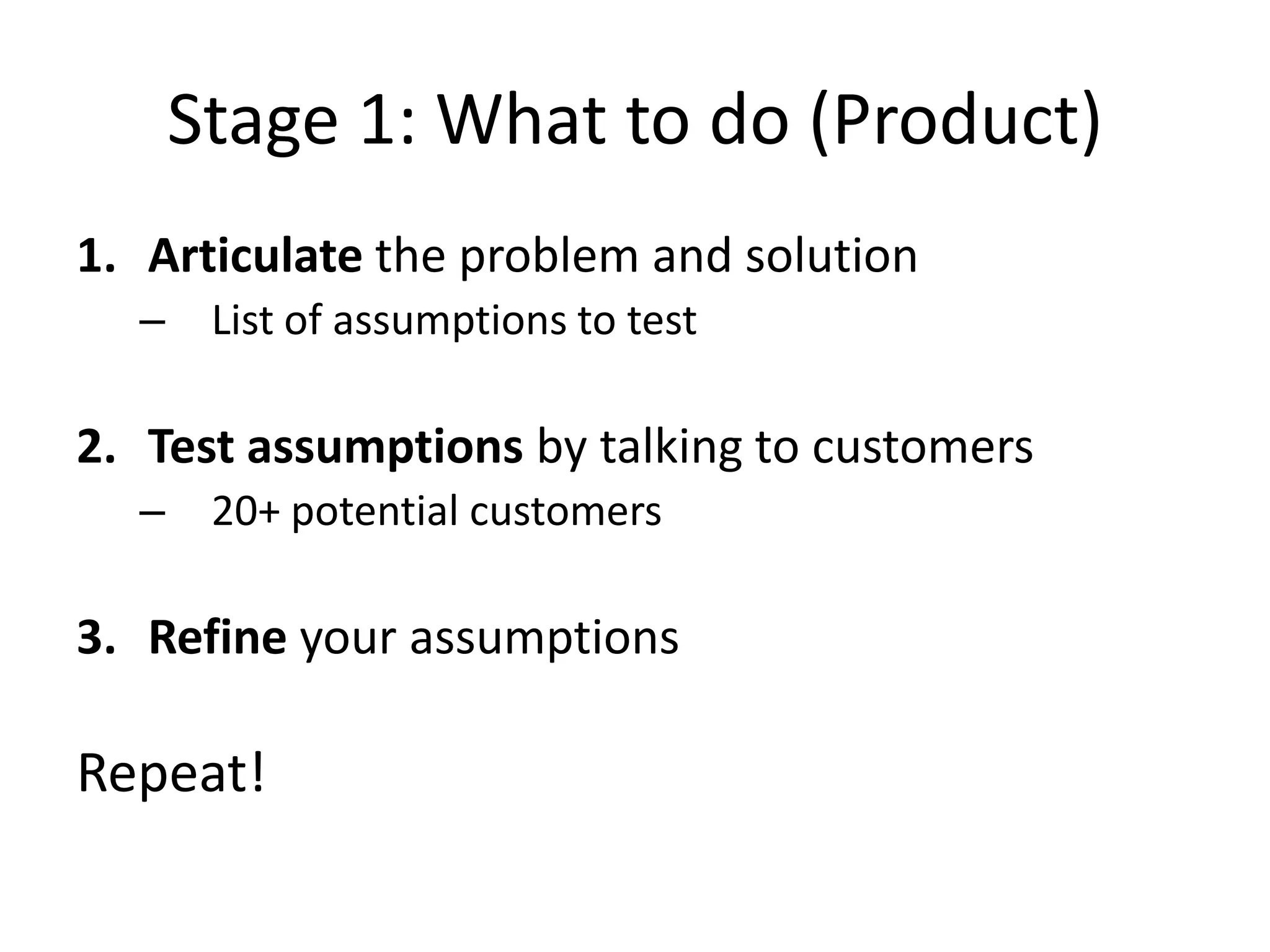
Stage 1: What to do (Product)Articulate the problem and solutionList of assumptions to testTest assumptions by talking to customers20+ potential customersRefine your assumptionsRepeat!
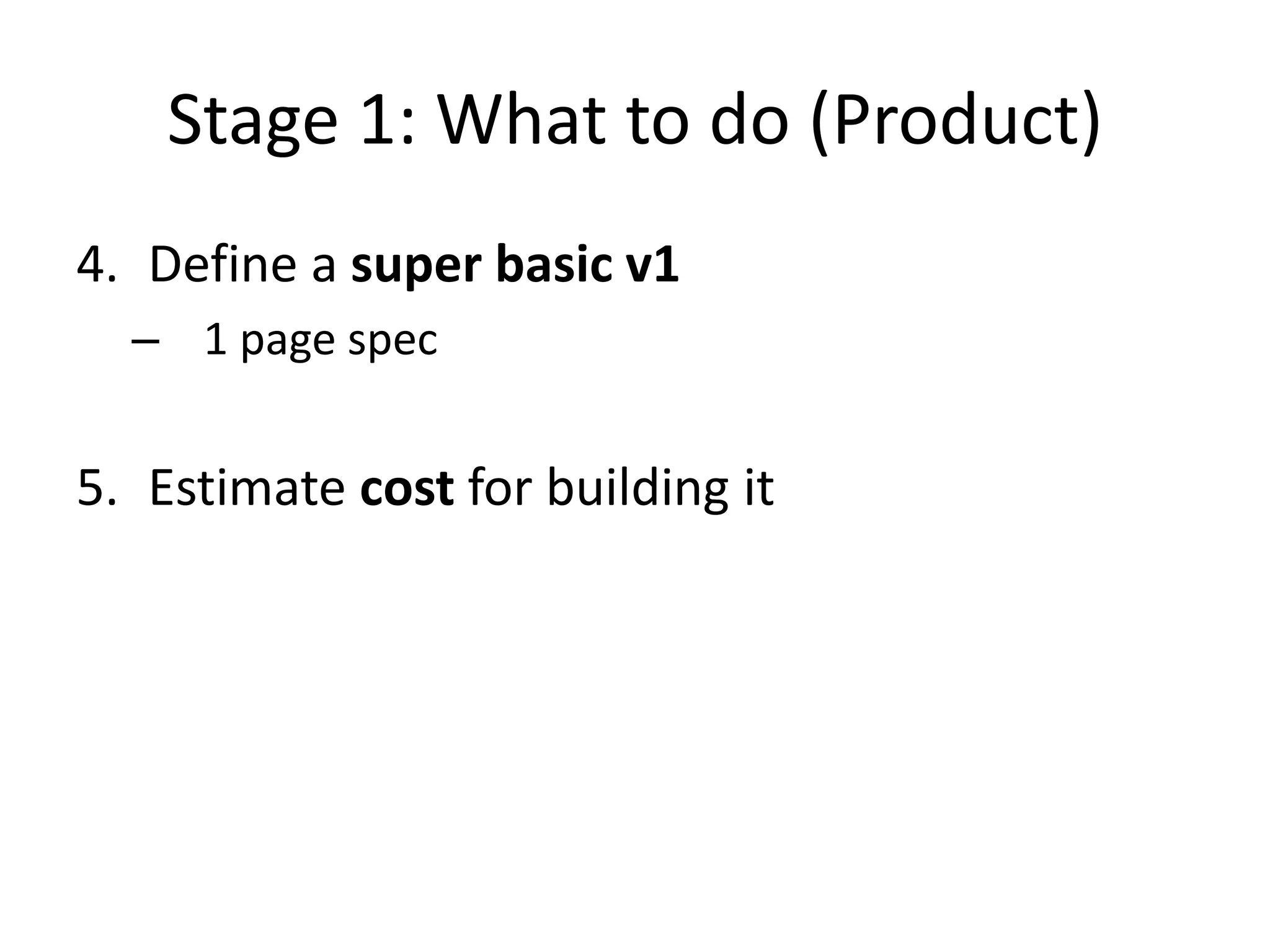
Stage 1: What to do (Product)Define a super basic v11 page specEstimate cost for building it
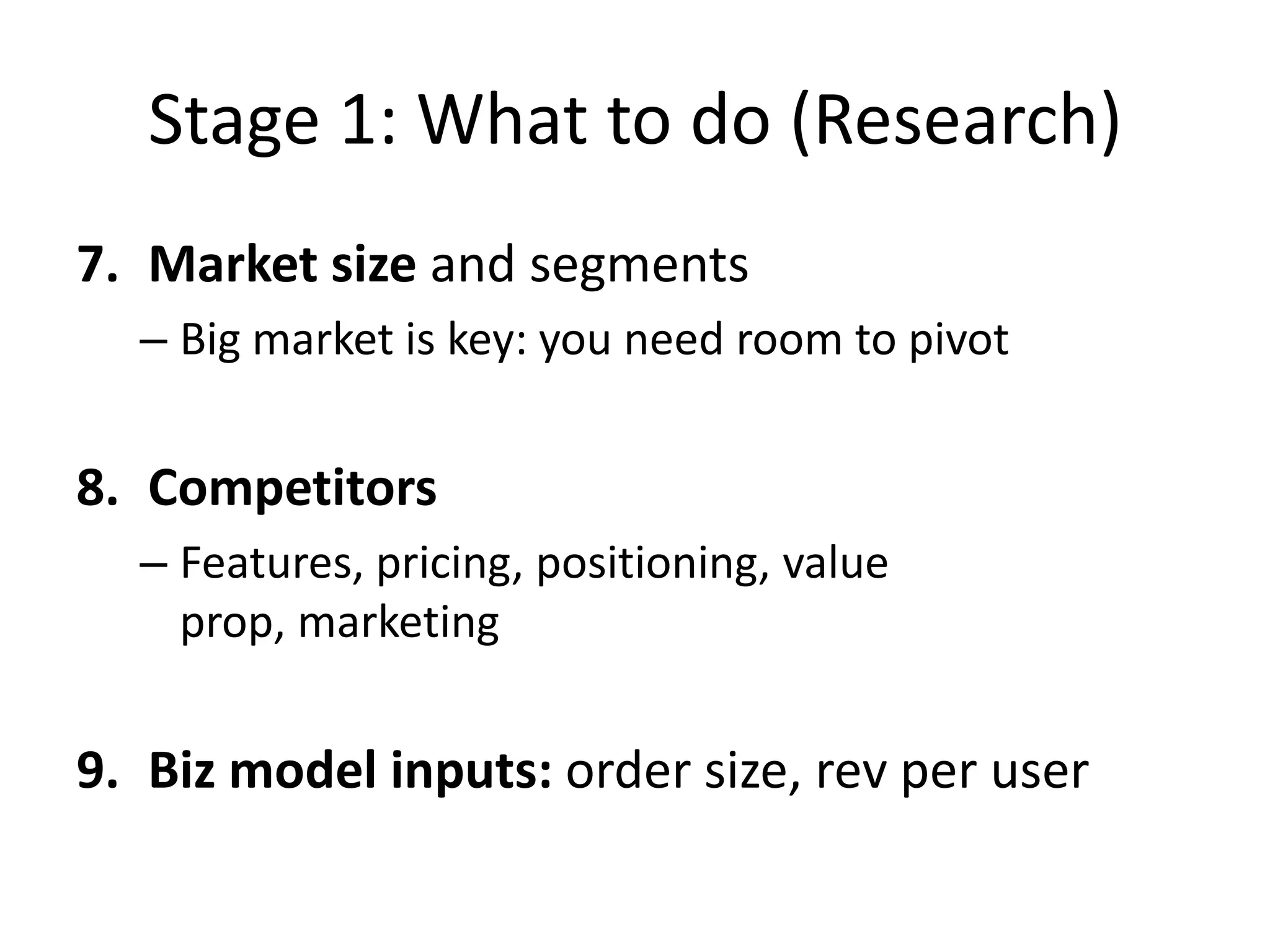
Stage 1: What to do (Research)Market size and segmentsBig market is key: you need room to pivotCompetitorsFeatures, pricing, positioning, value prop, marketingBiz model inputs: order size, rev per user
Stage 1: What to do (Business)Create a basic business modelCalculate fixed costs: salaries, servers, adminRevenue target = costs IF break even this yearUsers needed = rev target / revenue per userThink about cost per acquisitionARPU > cost to serve + cost to acquire userKeep it simpleBe honest! This is to convince YOU
Stage 1: What to do (Marketing)Test and refine your pitch continuouslyWhat do you do?Test value propositionWhy should I care?Test company names and branding“Polling Power” was a fail
Stage 1: SummaryGoal: reduce uncertaintyAccomplished: validated assumptionsAbout productAbout biz modelAnd basic how to sell it (what and why)You have reduced uncertainty and risk. Now: quit job!
Progress so farSuccessful exitRepeatableGrowthProductMarket FitStart CompanyHave an IdeaEvaluate your ideaBuild product people wantFigure out marketing
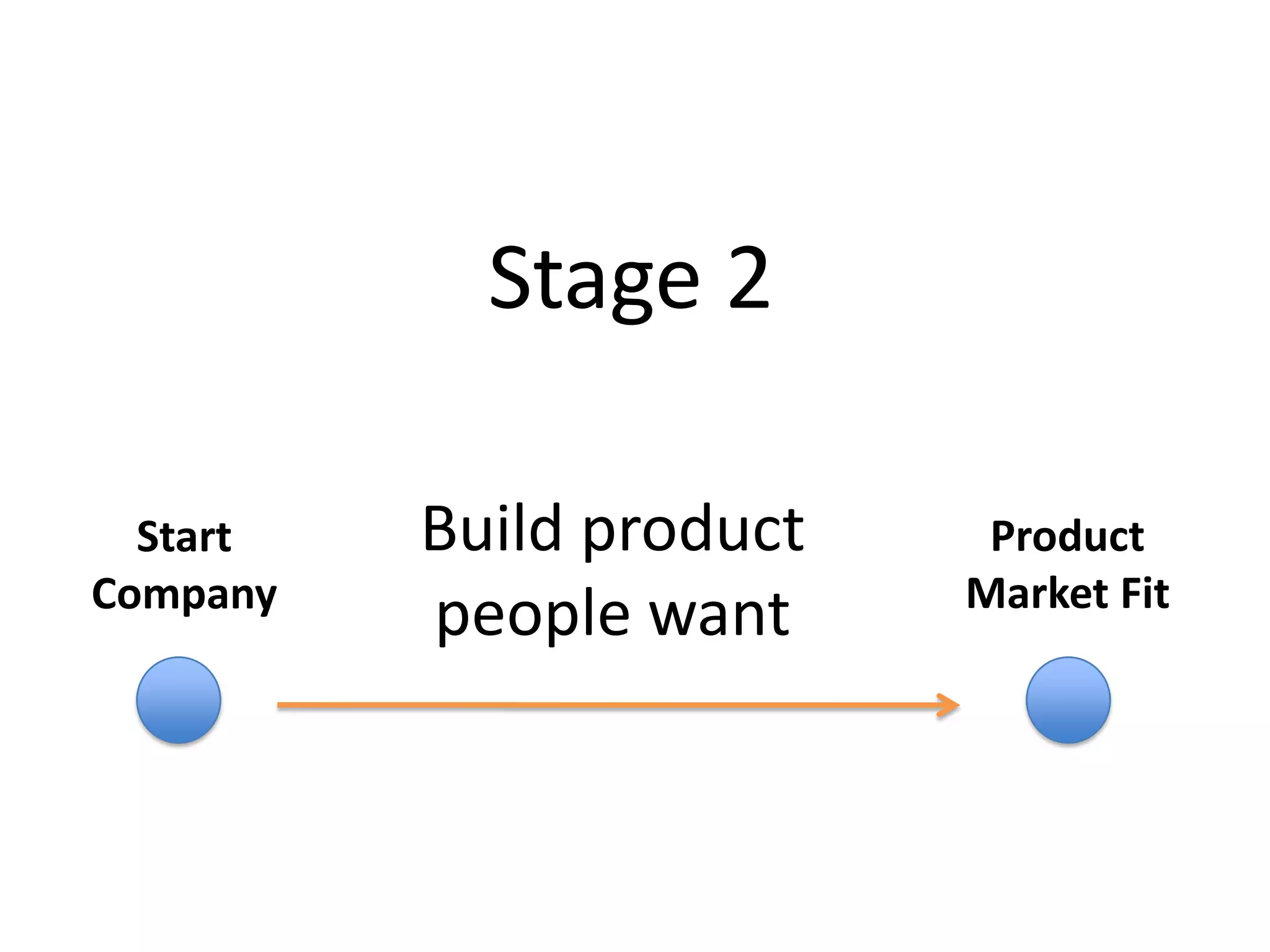
Stage 2Build product people wantProductMarket FitStartCompany
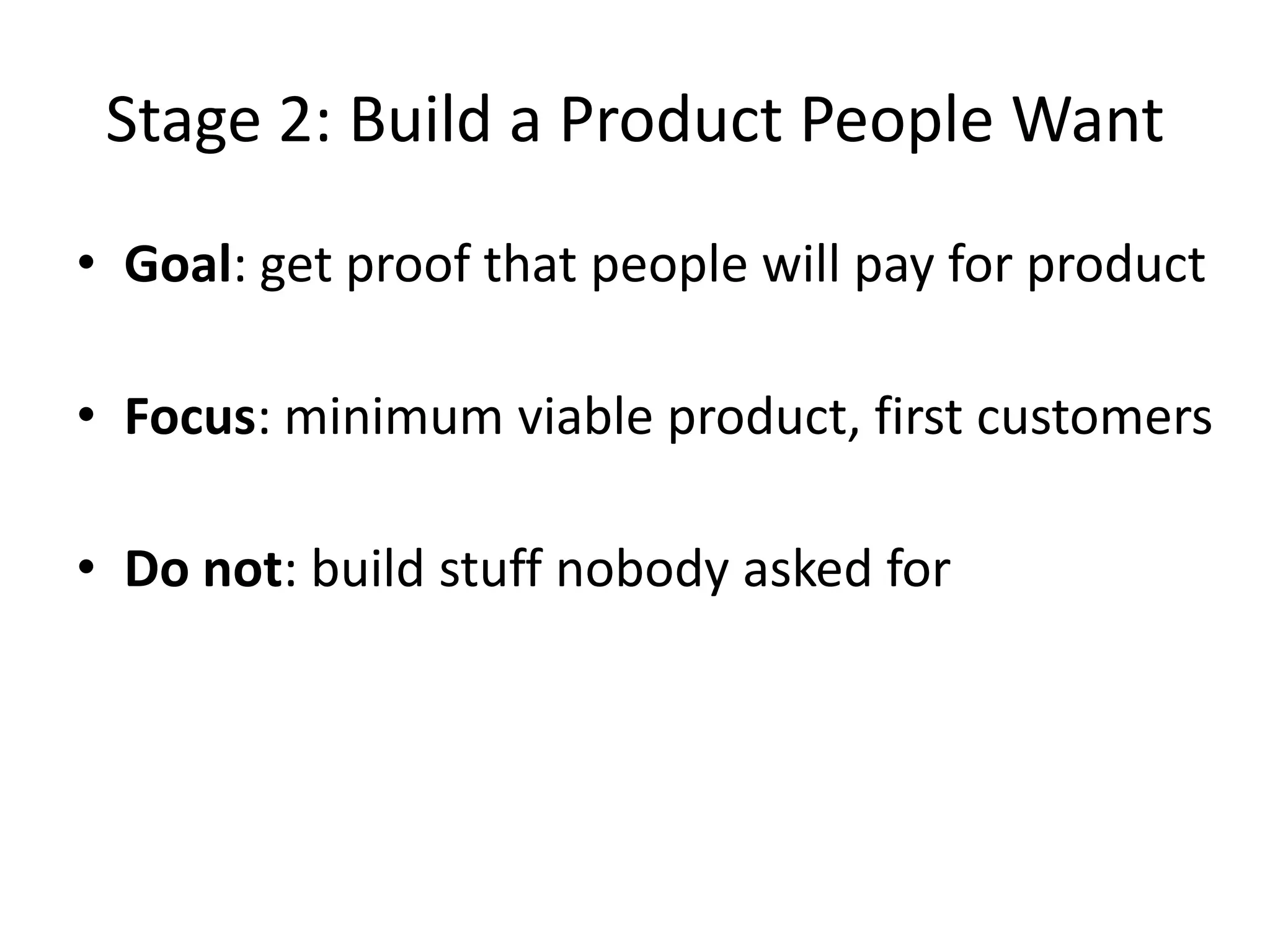
Stage 2: Build a Product People WantGoal: get proof that people will pay for productFocus: minimum viable product, first customersDo not: build stuff nobody asked for
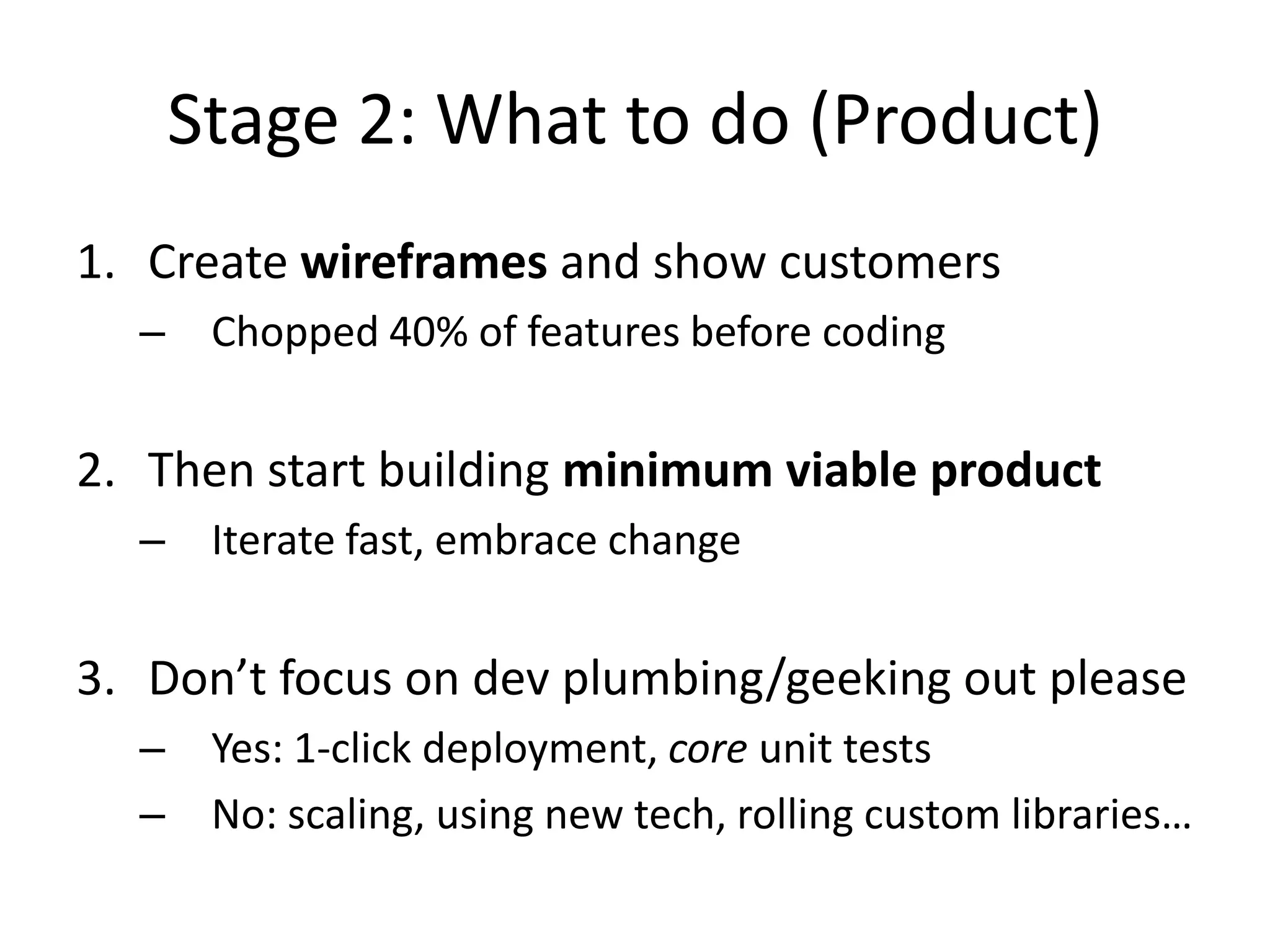
Stage 2: What to do (Product)Create wireframes and show customersChopped 40% of features before codingThen start building minimum viable productIterate fast, embrace changeDon’t focus on dev plumbing/geeking out pleaseYes: 1-click deployment, core unit testsNo: scaling, using new tech, rolling custom libraries…
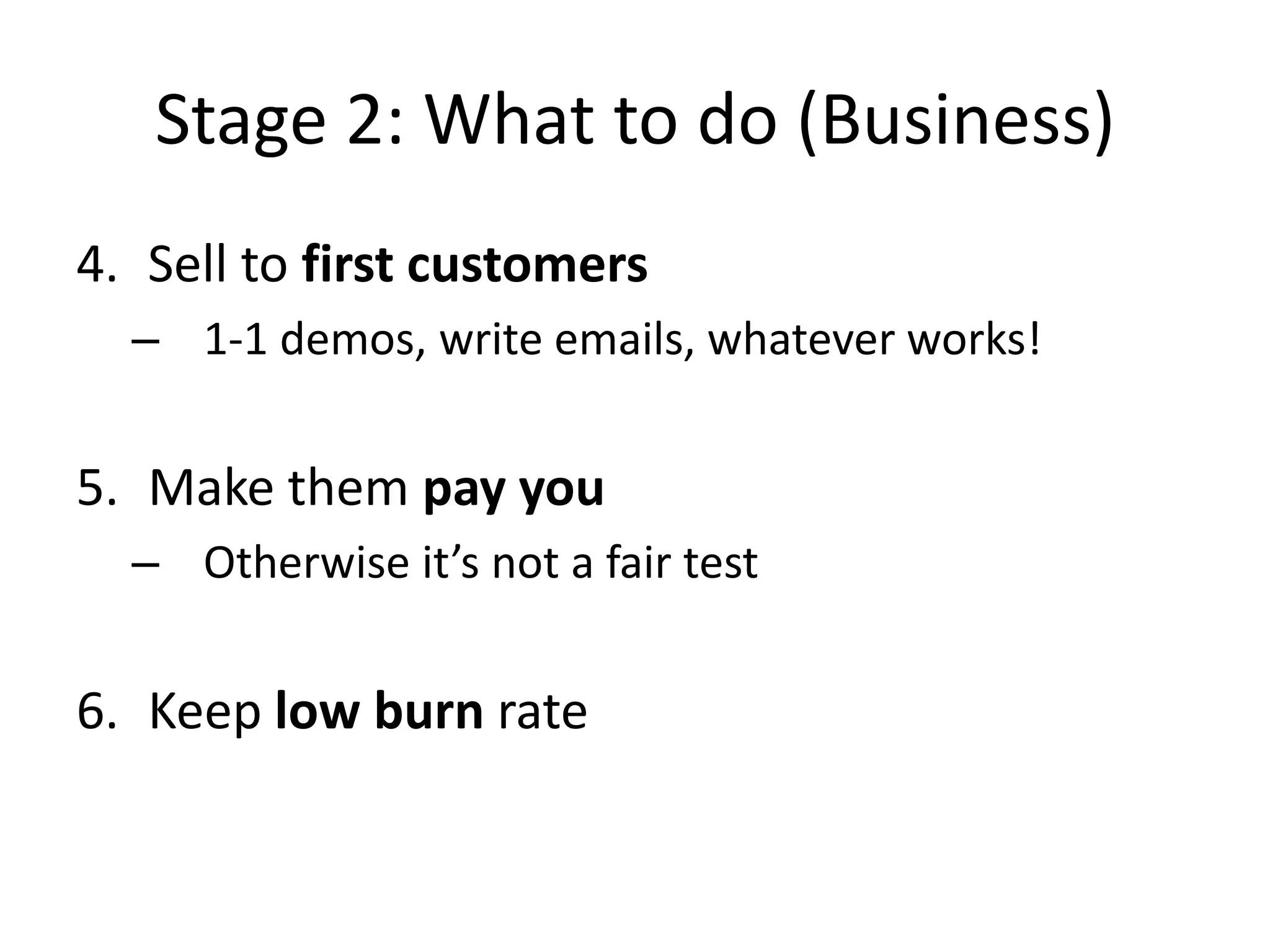
Stage 2: What to do (Business)Sell to first customers1-1 demos, write emails, whatever works!Make them pay youOtherwise it’s not a fair testKeep low burn rate
Stage 2: What to do (Marketing)Create a one-pagerYou will email this a lotCreate a 1-2 minute videoBecause people don’t readAnd some feature pagesWhat, and why customers should care
Stage 2: SummaryGoal: build something people will pay forAccomplished: built something people wantCustomers are using itAnd paying youOMG, you have discovered a goldmine. Now: grow it!
StagesSuccessful exitRepeatableGrowthProductMarket FitStart CompanyHave an IdeaEvaluate your ideaBuild product people wantFigure out marketing
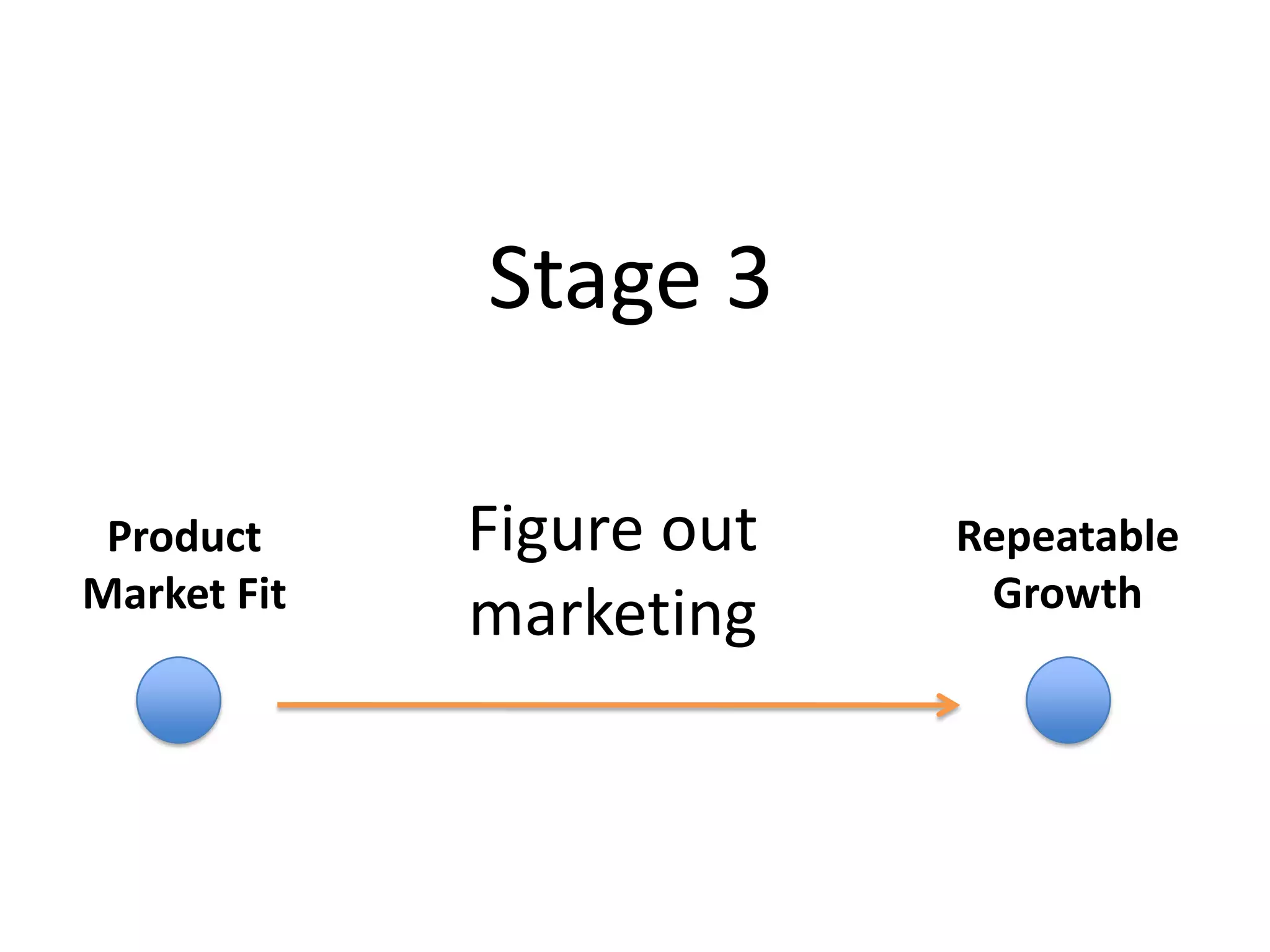
Stage 3Figure outmarketingRepeatableGrowthProductMarket Fit
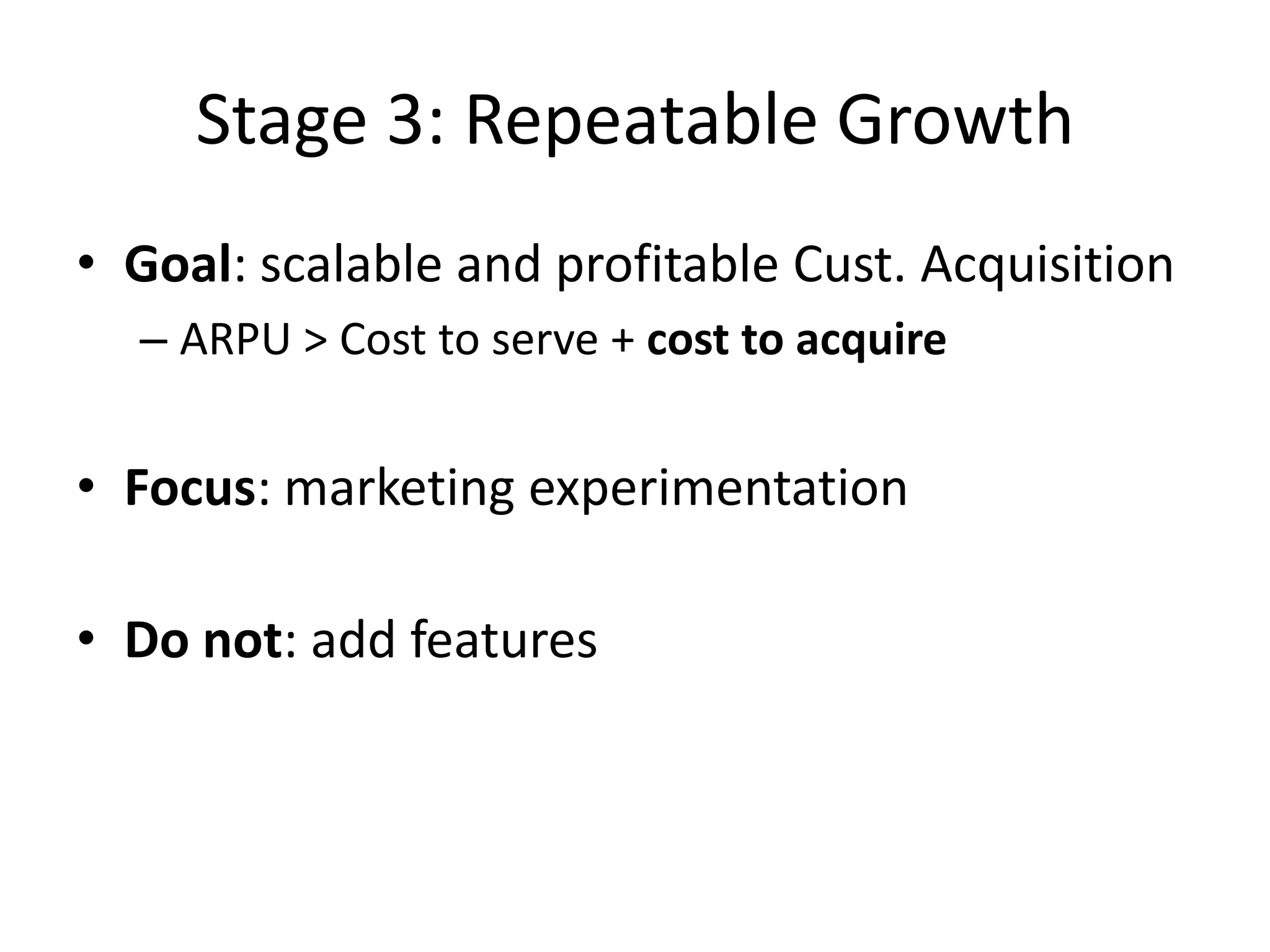
Stage 3: Repeatable GrowthGoal: scalable and profitable Cust. AcquisitionARPU > Cost to serve + cost to acquireFocus: marketing experimentationDo not: add features
Stage 3: What to do (Product)Install metrics that you understandSetup an A/B testing frameworkMaybe: build referral or affiliate programsDo not add features to attract customers
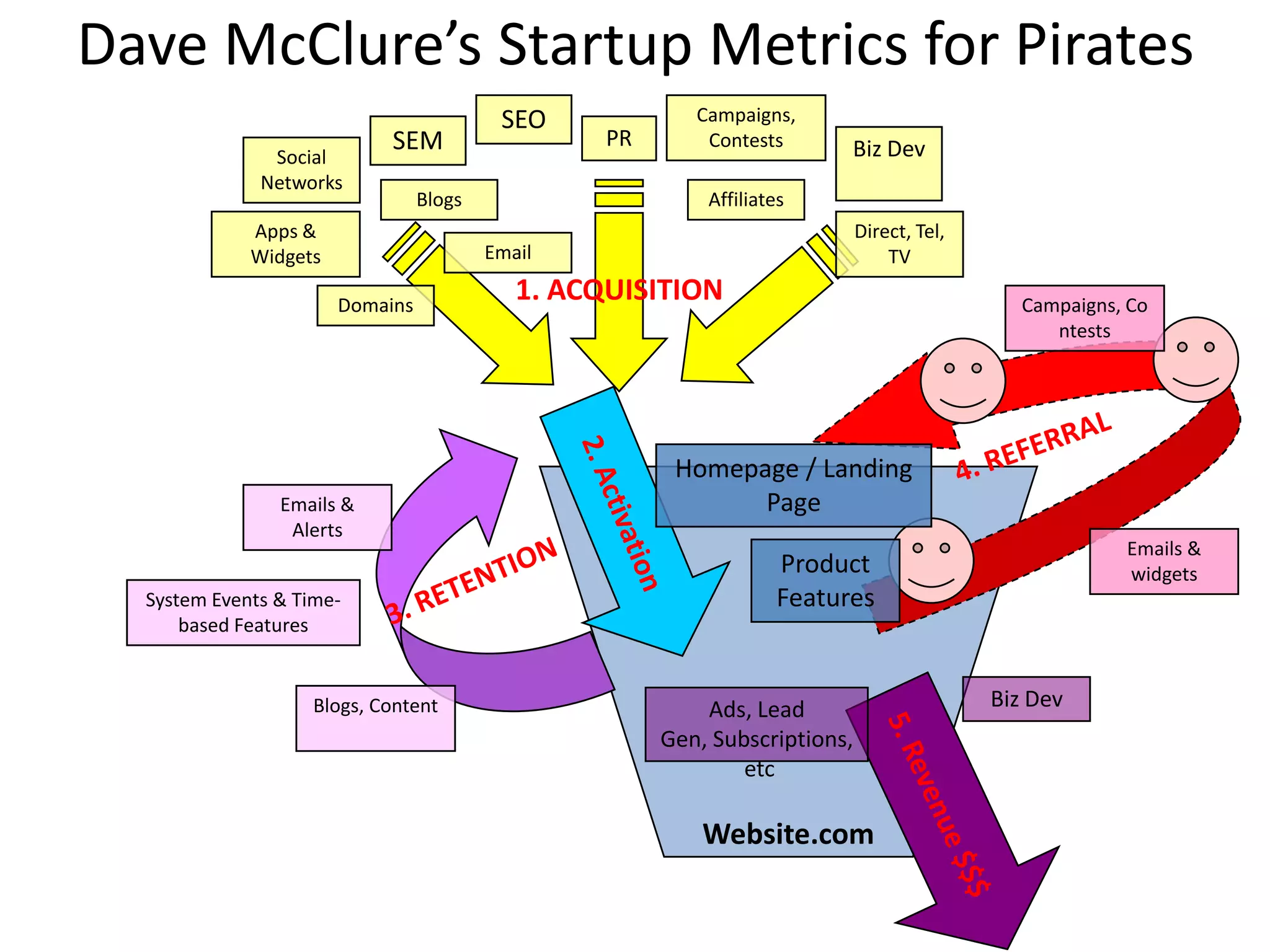
Stage 3: What to do (Marketing)Define your conversion funnel and optimizeLeads  …  convert to paying!Dave McClure’s startup metrics for pirates is an excellent resource.
Dave McClure’s Startup Metrics for PiratesSEOCampaigns, ContestsSEMPRBiz DevSocial NetworksAffiliatesBlogs1. ACQUISITIONApps & WidgetsDirect, Tel, TV4. REFERRALEmailCampaigns, ContestsDomains2. ActivationHomepage / Landing PageEmails & Alerts3. RETENTIONEmails & widgetsProduct FeaturesSystem Events & Time-based FeaturesBiz Dev5. Revenue $$$Blogs, ContentAds, Lead Gen, Subscriptions, etcWebsite.com
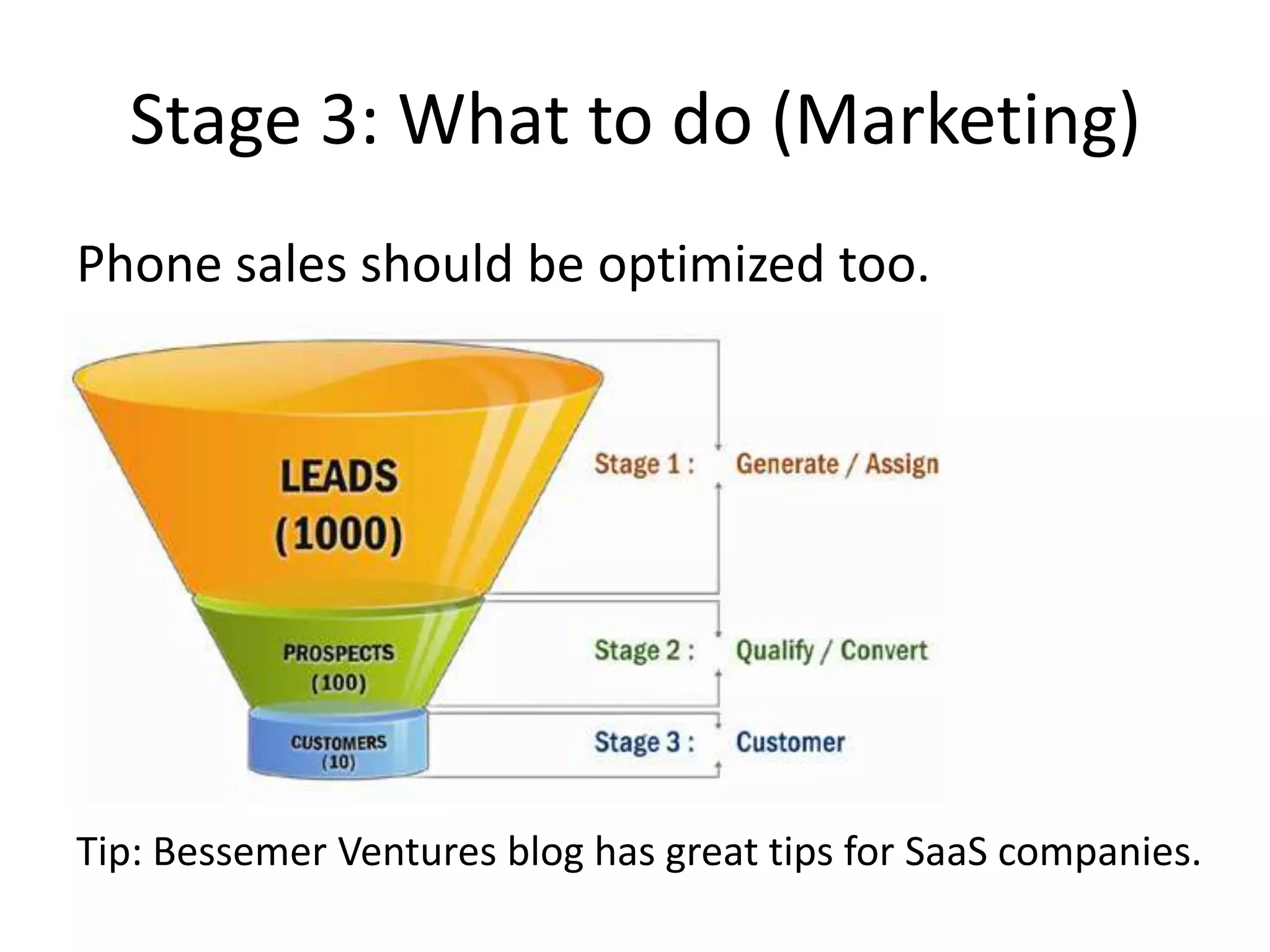
Stage 3: What to do (Marketing)Phone sales should be optimized too.Tip: Bessemer Ventures blog has great tips for SaaS companies.
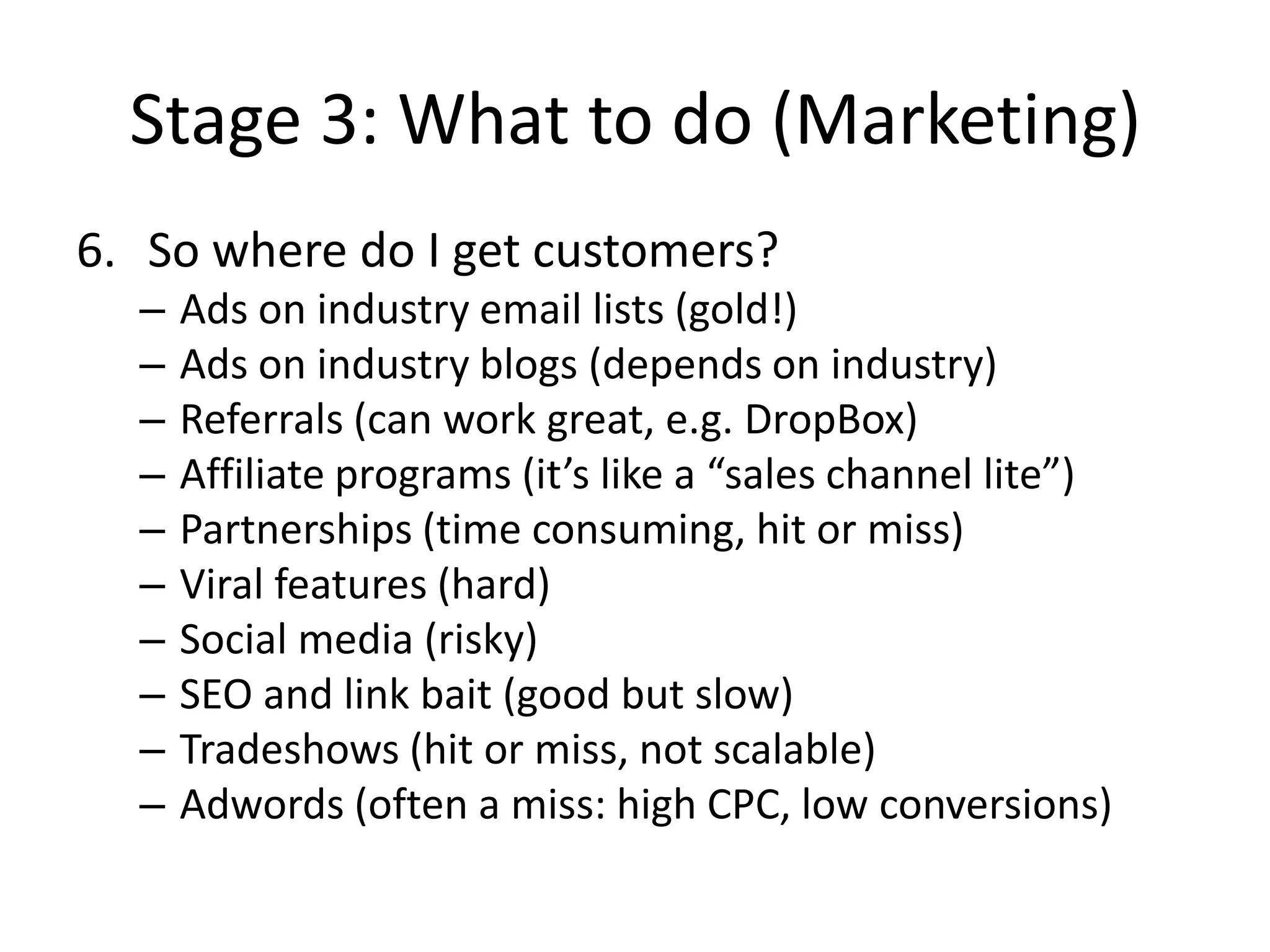
Stage 3: What to do (Marketing)So where do I get customers?Ads on industry email lists (gold!)Ads on industry blogs (depends on industry)Referrals (can work great, e.g. DropBox)Affiliate programs (it’s like a “sales channel lite”)Partnerships (time consuming, hit or miss)Viral features (hard)Social media (risky)SEO and link bait (good but slow)Tradeshows (hit or miss, not scalable)Adwords (often a miss: high CPC, low conversions)
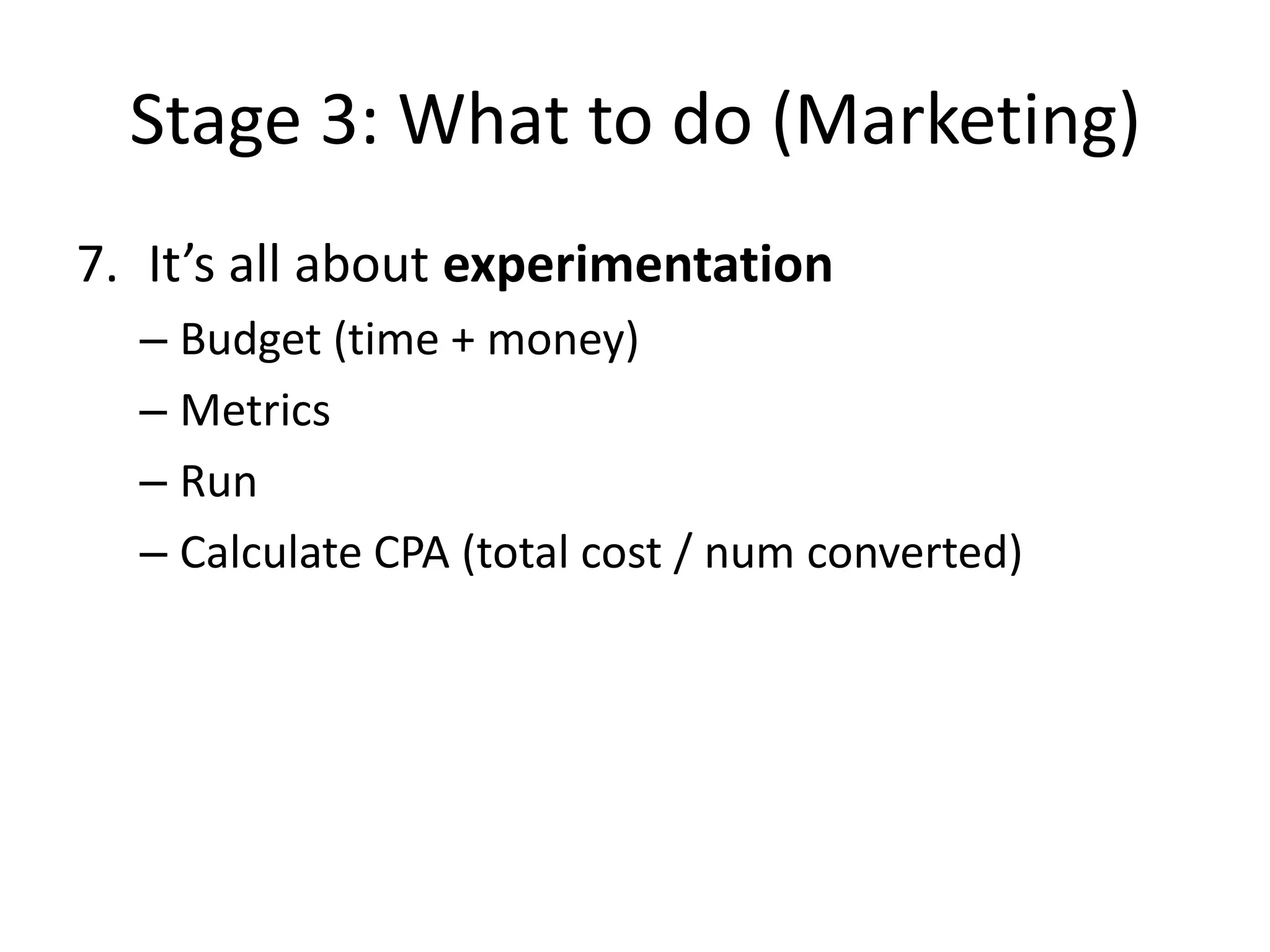
Stage 3: What to do (Marketing)It’s all about experimentationBudget (time + money)MetricsRunCalculate CPA (total cost / num converted)
Stage 3: What to do (Marketing)And some miscellaneous tips:Get 1-3 anchor customers ASAPGet industry awards (silly but valuable)PR is awesome, but NOT a repeatable and scalable growth strategy
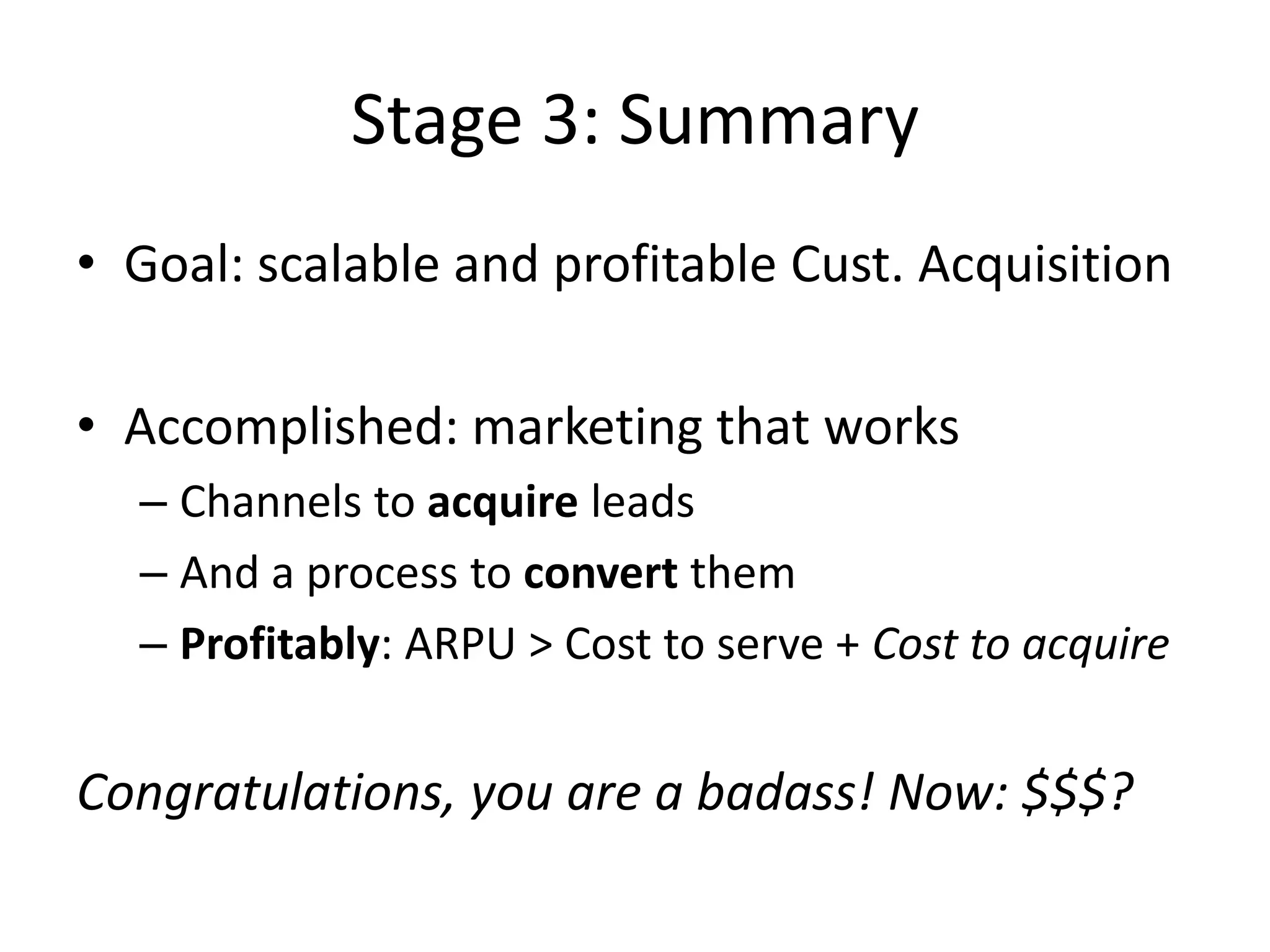
Stage 3: SummaryGoal: scalable and profitable Cust. AcquisitionAccomplished: marketing that worksChannels to acquire leadsAnd a process to convert themProfitably: ARPU > Cost to serve + Cost to acquireCongratulations, you are a badass! Now: $$$?
Progress so farSuccessful exitRepeatableGrowthProductMarket FitStart CompanyHave an IdeaEvaluate your ideaBuild product people wantFigure out marketing
Successful Exit?You are in a great position for the big kaching!But lots can still go wrong:Competition, operational failures, hitting market saturation, inability to hire fast enough… blah blahBtw, there other options too:“Lifestyle” biz: do what you love, decent moneyAnd successful exits without this too:Talent, IP, customer base, biz-deals

Idea to Success, a Guide for First Time Entrepreneurs

  • 1.
    From Idea toSuccessA guide for first time entrepreneursGaurav OberoiTwitter: @goberoi
  • 2.
    What this talkis aboutSuccessful exit?Have an Idea
  • 3.
    What you’ll learnHowto:Evaluate your ideaBuild a product that people pay you forGrow your business
  • 4.
  • 5.
    About MeStarted andsold 2 companiesBillMonk and PrecisionPollingSoftware backgroundAmazon engineer, Computer Science from Rice U.Startup roles in Product and Eng Mgmt.SurveyMonkey (current), Xmarks (Mitch Kapor)Founded 2200+ entrepreneur group in SeattleSeattleTechStartups.comAdvisor to several startups, angel investor
  • 6.
    1st company: BillMonkProblem:bill splitting sucksSolution: split bills, track debtsMarket: roommates, students$: fee for settling debts onlineConsumer internet startup
  • 7.
  • 8.
    Acquired by Obopayin16 months2nd company: Precision PollingProblem: automated phone surveys costly and slow to setupIdea: self-serve phone pollsMarkets: politics, opinion research (healthcare, govt., call centers)$: pay per callSaaS startup catering to SMB
  • 9.
  • 10.
    Acquired by SurveyMonkeyin 12 months My employer: SurveyMonkeyBiggest web survey provider in the world10 years old, highly profitableLarge investment from PE firm last yearSingapore love SurveyMonkey
  • 11.
  • 12.
    5th in termsof surveys deployed by all usersOk, let’s begin
  • 13.
  • 14.
    Woah, can webreak that down?Decomposing into chunks = more manageableE.g. essay writing: thesis, outline, research, write itSo my plan is:Break the process into stagesProvide a guide on what to at each stage
  • 15.
    A first stabat breaking it downSuccessful exitProductMarket FitHave an Idea
  • 16.
    Product/market fit?Proof thatpeople want your productCritical mass of users/usageWho are paying youUntil you have a product people want, focus on growth is pointless
  • 17.
    Product/market fit!Marc Andreessen:“I believe that the life of any startup can be divided into two parts: before and after product/market fit”Steve Blank: “set of customers and a market who react positively to the product: by relieving customers of their money”Sean Ellis:“40% of users disappointed without it”
  • 18.
    Ok great: PMFas a milestoneFocus: growthSuccessful exitFocus: productProductMarket FitHave an IdeaBut this is too broad
  • 19.
    Break it downfurtherSuccessful exitRepeatableGrowthProductMarket FitStart CompanyHave an Idea
  • 20.
    3 StagesSuccessful exitRepeatableGrowthProductMarketFitStart CompanyHave an Idea1. Evaluate your idea2. Build product people want3. Figure out marketing
  • 21.
    What do Ido at each Stage?I’ll discuss:Your goalsWhat to focus onNot to focus onDetails by area: product, business, marketing
  • 22.
    Great, we havea planLet’s dig into details
  • 23.
    Progress so farSuccessfulexitRepeatableGrowthProductMarket FitStart CompanyHave an IdeaEvaluate your ideaBuild product people wantFigure out marketing
  • 24.
  • 25.
    Stage 1: EvaluateIdeaGoal: reduce uncertainty and risk“Should I quit my day job for this?”Focus on: gathering lots of dataDo not: write code
  • 26.
    Stage 1: Whatto do (Product)Articulate the problem and solutionList of assumptions to testTest assumptions by talking to customers20+ potential customersRefine your assumptionsRepeat!
  • 27.
    Stage 1: Whatto do (Product)Define a super basic v11 page specEstimate cost for building it
  • 28.
    Stage 1: Whatto do (Research)Market size and segmentsBig market is key: you need room to pivotCompetitorsFeatures, pricing, positioning, value prop, marketingBiz model inputs: order size, rev per user
  • 29.
    Stage 1: Whatto do (Business)Create a basic business modelCalculate fixed costs: salaries, servers, adminRevenue target = costs IF break even this yearUsers needed = rev target / revenue per userThink about cost per acquisitionARPU > cost to serve + cost to acquire userKeep it simpleBe honest! This is to convince YOU
  • 30.
    Stage 1: Whatto do (Marketing)Test and refine your pitch continuouslyWhat do you do?Test value propositionWhy should I care?Test company names and branding“Polling Power” was a fail
  • 31.
    Stage 1: SummaryGoal:reduce uncertaintyAccomplished: validated assumptionsAbout productAbout biz modelAnd basic how to sell it (what and why)You have reduced uncertainty and risk. Now: quit job!
  • 32.
    Progress so farSuccessfulexitRepeatableGrowthProductMarket FitStart CompanyHave an IdeaEvaluate your ideaBuild product people wantFigure out marketing
  • 33.
    Stage 2Build productpeople wantProductMarket FitStartCompany
  • 34.
    Stage 2: Builda Product People WantGoal: get proof that people will pay for productFocus: minimum viable product, first customersDo not: build stuff nobody asked for
  • 35.
    Stage 2: Whatto do (Product)Create wireframes and show customersChopped 40% of features before codingThen start building minimum viable productIterate fast, embrace changeDon’t focus on dev plumbing/geeking out pleaseYes: 1-click deployment, core unit testsNo: scaling, using new tech, rolling custom libraries…
  • 36.
    Stage 2: Whatto do (Business)Sell to first customers1-1 demos, write emails, whatever works!Make them pay youOtherwise it’s not a fair testKeep low burn rate
  • 37.
    Stage 2: Whatto do (Marketing)Create a one-pagerYou will email this a lotCreate a 1-2 minute videoBecause people don’t readAnd some feature pagesWhat, and why customers should care
  • 38.
    Stage 2: SummaryGoal:build something people will pay forAccomplished: built something people wantCustomers are using itAnd paying youOMG, you have discovered a goldmine. Now: grow it!
  • 39.
    StagesSuccessful exitRepeatableGrowthProductMarket FitStartCompanyHave an IdeaEvaluate your ideaBuild product people wantFigure out marketing
  • 40.
  • 41.
    Stage 3: RepeatableGrowthGoal: scalable and profitable Cust. AcquisitionARPU > Cost to serve + cost to acquireFocus: marketing experimentationDo not: add features
  • 42.
    Stage 3: Whatto do (Product)Install metrics that you understandSetup an A/B testing frameworkMaybe: build referral or affiliate programsDo not add features to attract customers
  • 43.
    Stage 3: Whatto do (Marketing)Define your conversion funnel and optimizeLeads  …  convert to paying!Dave McClure’s startup metrics for pirates is an excellent resource.
  • 44.
    Dave McClure’s StartupMetrics for PiratesSEOCampaigns, ContestsSEMPRBiz DevSocial NetworksAffiliatesBlogs1. ACQUISITIONApps & WidgetsDirect, Tel, TV4. REFERRALEmailCampaigns, ContestsDomains2. ActivationHomepage / Landing PageEmails & Alerts3. RETENTIONEmails & widgetsProduct FeaturesSystem Events & Time-based FeaturesBiz Dev5. Revenue $$$Blogs, ContentAds, Lead Gen, Subscriptions, etcWebsite.com
  • 45.
    Stage 3: Whatto do (Marketing)Phone sales should be optimized too.Tip: Bessemer Ventures blog has great tips for SaaS companies.
  • 46.
    Stage 3: Whatto do (Marketing)So where do I get customers?Ads on industry email lists (gold!)Ads on industry blogs (depends on industry)Referrals (can work great, e.g. DropBox)Affiliate programs (it’s like a “sales channel lite”)Partnerships (time consuming, hit or miss)Viral features (hard)Social media (risky)SEO and link bait (good but slow)Tradeshows (hit or miss, not scalable)Adwords (often a miss: high CPC, low conversions)
  • 47.
    Stage 3: Whatto do (Marketing)It’s all about experimentationBudget (time + money)MetricsRunCalculate CPA (total cost / num converted)
  • 48.
    Stage 3: Whatto do (Marketing)And some miscellaneous tips:Get 1-3 anchor customers ASAPGet industry awards (silly but valuable)PR is awesome, but NOT a repeatable and scalable growth strategy
  • 49.
    Stage 3: SummaryGoal:scalable and profitable Cust. AcquisitionAccomplished: marketing that worksChannels to acquire leadsAnd a process to convert themProfitably: ARPU > Cost to serve + Cost to acquireCongratulations, you are a badass! Now: $$$?
  • 50.
    Progress so farSuccessfulexitRepeatableGrowthProductMarket FitStart CompanyHave an IdeaEvaluate your ideaBuild product people wantFigure out marketing
  • 51.
    Successful Exit?You arein a great position for the big kaching!But lots can still go wrong:Competition, operational failures, hitting market saturation, inability to hire fast enough… blah blahBtw, there other options too:“Lifestyle” biz: do what you love, decent moneyAnd successful exits without this too:Talent, IP, customer base, biz-deals
  • 52.
    ConclusionIt’s not magic,there is a processEvaluate, Build, GrowThe process depends on dataValidate assumptions, MVP, Run marketing experimentsBe honest to yourselfGet cracking! Validate your idea and quit your jobDisclaimer: your mileage may vary
  • 53.
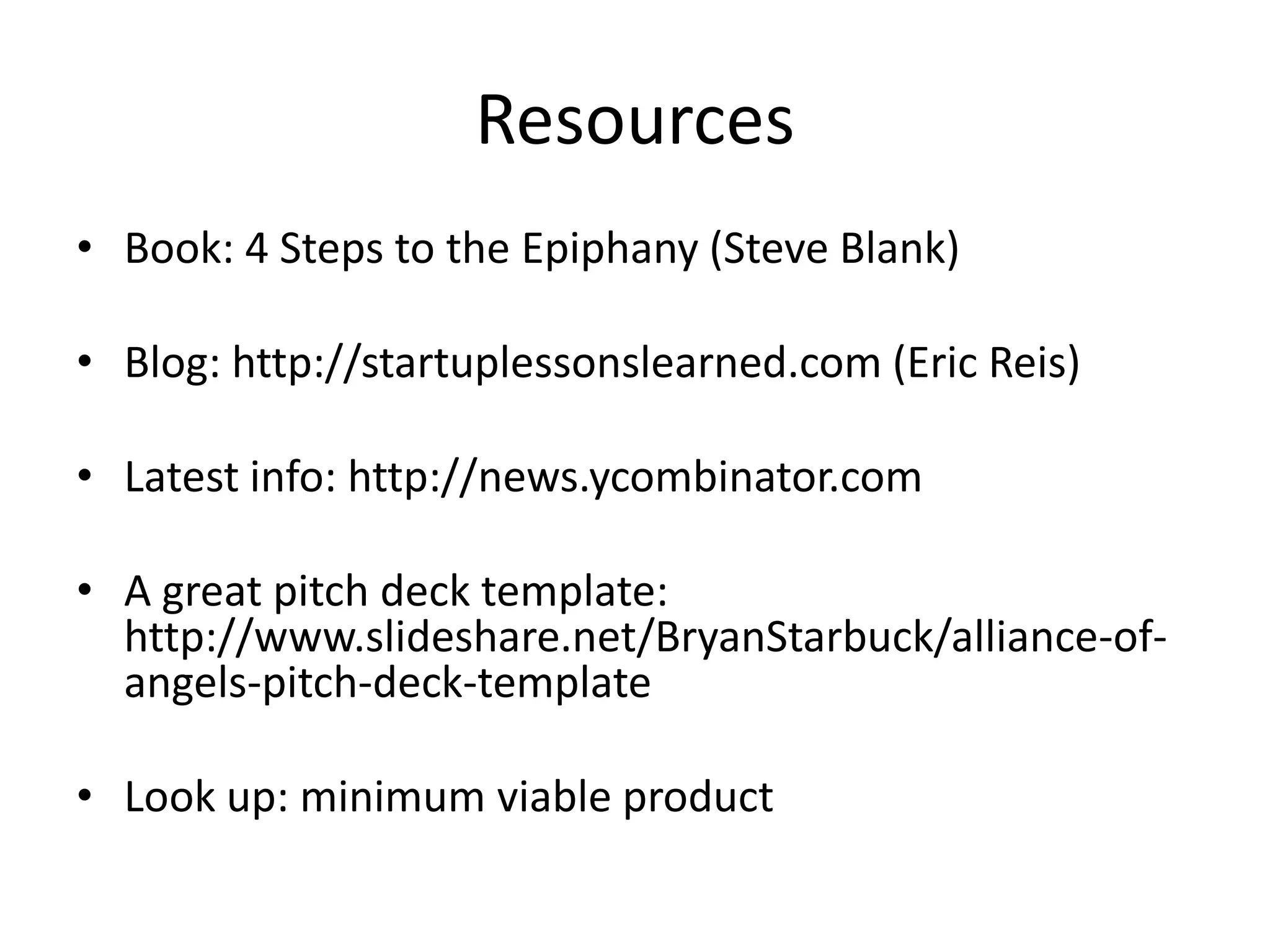
    ResourcesBook: 4 Stepsto the Epiphany (Steve Blank)Blog: http://startuplessonslearned.com (Eric Reis)Latest info: http://news.ycombinator.comA great pitch deck template:http://www.slideshare.net/BryanStarbuck/alliance-of-angels-pitch-deck-templateLook up: minimum viable product
  • 54.
    Q & AFollowme on Twitter: @goberoi