Incubator 2.0: A Silicon Valley Story Engineering Better High-Tech Startups with Incubators, Investment, & Iterative Development Dave McClure  (@DaveMcClure) Founders Fund & GeeksOnaPlane.com Sept-Oct 2009
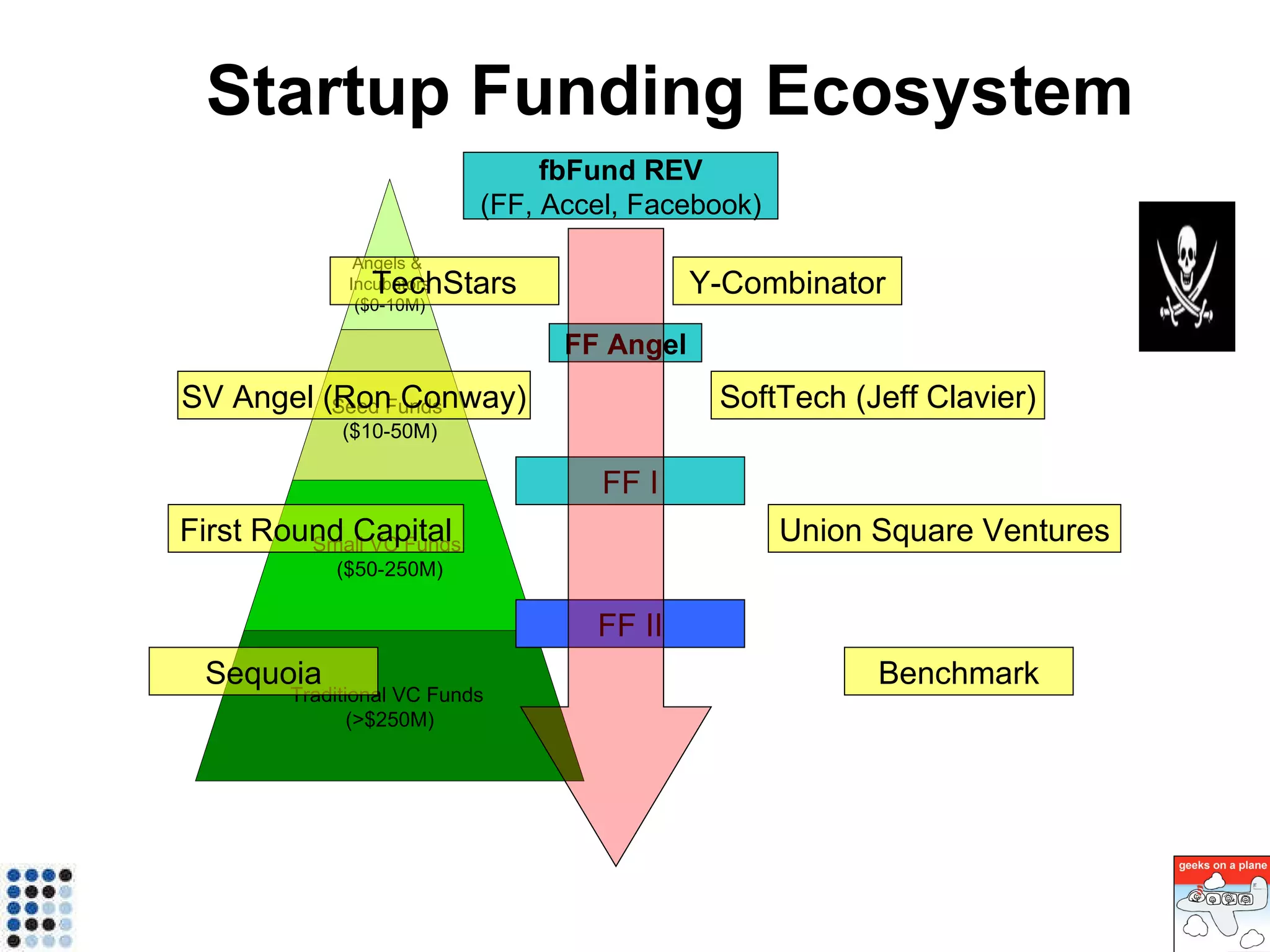
Startup Funding Ecosystem Union Square Ventures First Round Capital SoftTech (Jeff Clavier) SV Angel (Ron Conway) Benchmark Sequoia Y-Combinator TechStars FF Angel FF II fbFund REV (FF, Accel, Facebook) FF I Angels &  Incubators ($0-10M) Seed Funds  ($10-50M) Small VC Funds  ($50-250M) Traditional VC Funds  (>$250M)
[Pardon The Hype]
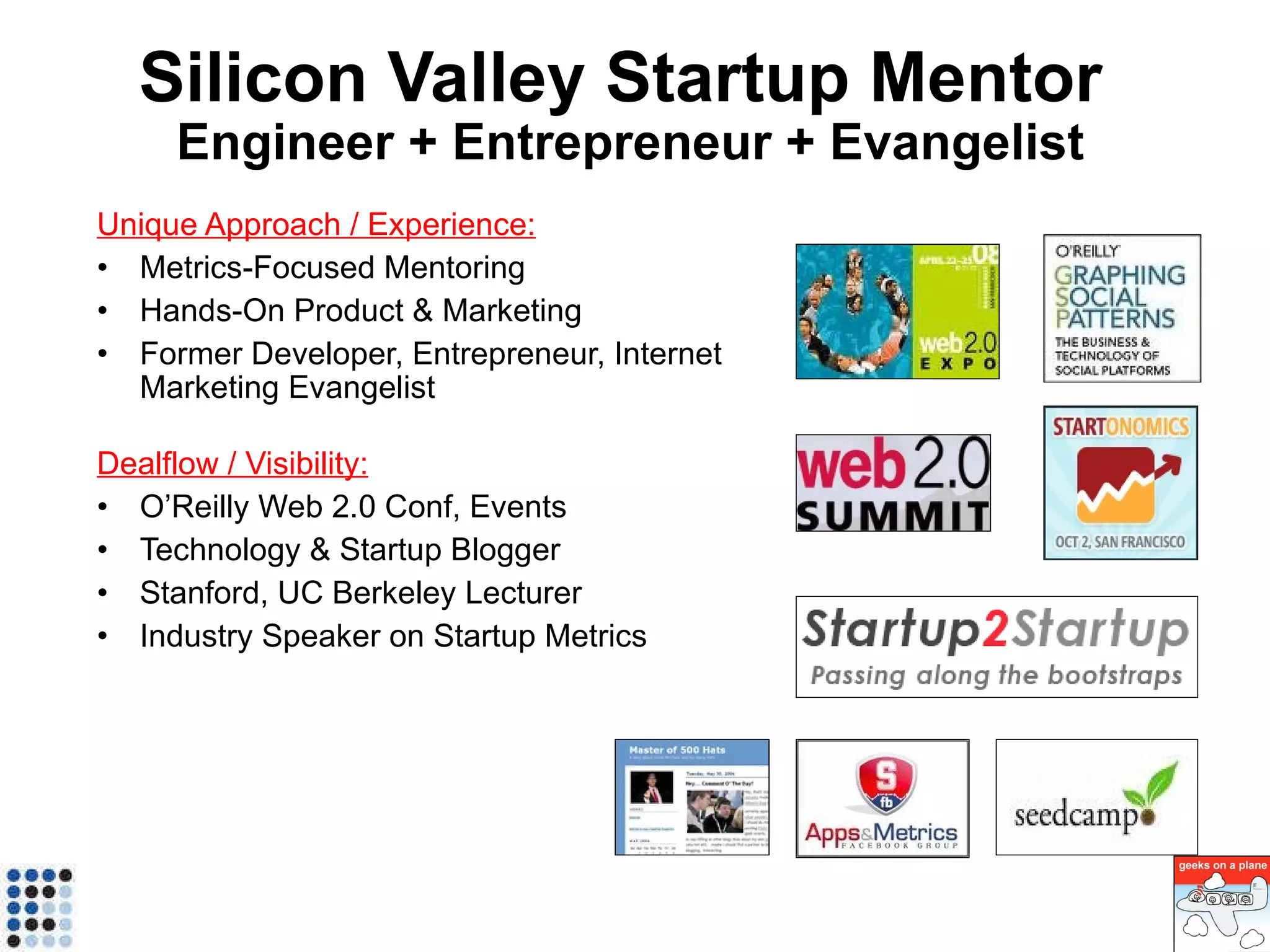
Dave McClure 2001-2009: Startup Investor:  500 Hats LLC, Founders Fund Tech Marketing : PayPal, Simply Hired, Mint Advisor, Angel Investor : 40+ Startups Conf. Organizer :   Web 2.0, O’Reilly, Startonomics Stanford Visiting Lecturer : Facebook, Startup Metrics 80’s & 90’s: Entrepreneur : Founder/CEO Aslan Computing (acq.) Developer : Windows Apps / SQL DB Admin User Groups : E-Commerce, Internet, Client-Server Engineer : Johns Hopkins ‘88, BS Eng / Applied Math GEEK, CODER, ENTREPRENEUR Blogger, Startup Advisor Internet Marketing,  Angel/VC Investor
Angel Investments (Personal, 2004-2008, 13 deals, avg $25K)
Angel Investments (via FF Angel, Q408-Q309, 30+ deals) FF Angel – 12 deals @$50-250K fbFund REV – 22 deals @ ~$15-75K
Founders Fund (2005-2009)
Startup Incubators  (lots of little deals… some of which work :)
Incubator: Hatching Startups Idealab  (Bill Gross, 1996-2001) Goto.com -> Yahoo Search Marketing CitySearch, PayMyBills, Commission Junction, NetZero Y-Combinator   (Paul Graham, 2005-pres.) 9+ “vintages”, 100+ companies Reddit, Scribd, Xobni, Omnisio, DropBox TechStars  (CO),  SeedCamp  (UK),  LaunchBox  (DC) fbFund REV  (Silicon Valley, 2008-2009) Facebook, Founders Fund, Accel
Incubator 2.0 Incubators growing in popularity, acceptance Supportive ecosystem for startups (angels, VCs) Efficient use of investment capital ($25-100K) High fail rate (60-80%)  => large initial sample size
Incubator 2.0 Success based on common platforms, physical proximity, open & collaborative environment Success based on fast fail, iteration & feedback Incremental investment; high-risk, but high-reward
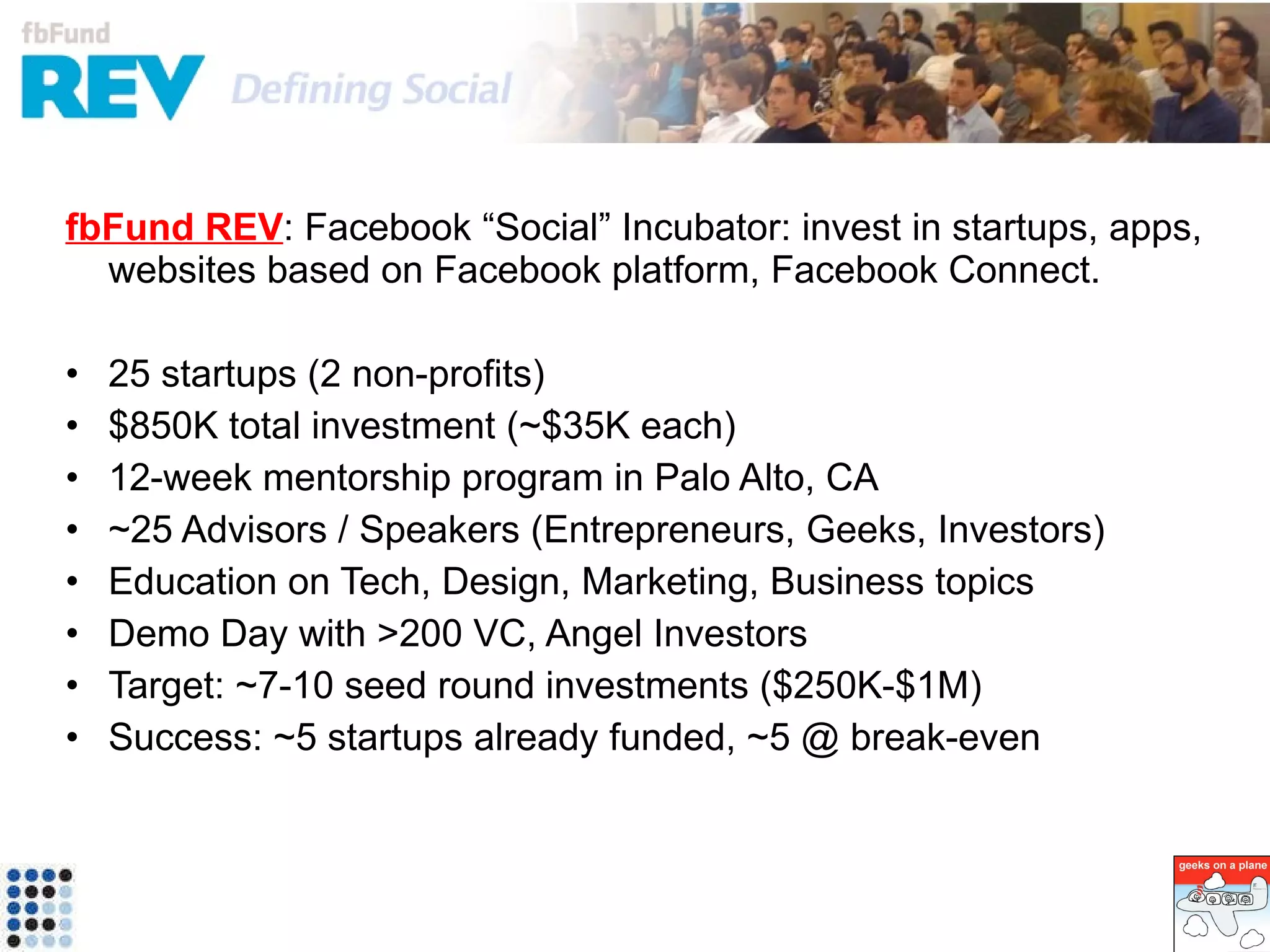
fbFund REV fbFund REV : Facebook “Social” Incubator: invest in startups, apps, websites based on Facebook platform, Facebook Connect. 25 startups (2 non-profits) $850K total investment (~$35K each) 12-week mentorship program in Palo Alto, CA ~25 Advisors / Speakers (Entrepreneurs, Geeks, Investors)
fbFund REV fbFund REV : Facebook “Social” Incubator: invest in startups, apps, websites based on Facebook platform, Facebook Connect. Education on Tech, Design, Marketing, Business topics  Demo Day with >200 VC, Angel Investors Target: ~7-10 seed round investments ($250K-$1M) Success: ~5 startups already funded, ~5 @ break-even
Startup Funding 1, 2, 3: Incubator, Angel, VC.
Startup Funding Ecosystem Union Square Ventures First Round Capital Benchmark Sequoia FF II FF I Angels &  Incubators ($0-10M) Seed Funds  ($10-50M) Small VC Funds  ($50-250M) Traditional VC Funds  (>$250M) Y-Combinator TechStars FF Angel fbFund REV (FF, Accel, Facebook ) SoftTech (Clavier) Maples Investments Felicis (Senkut) SV Angel (Conway)
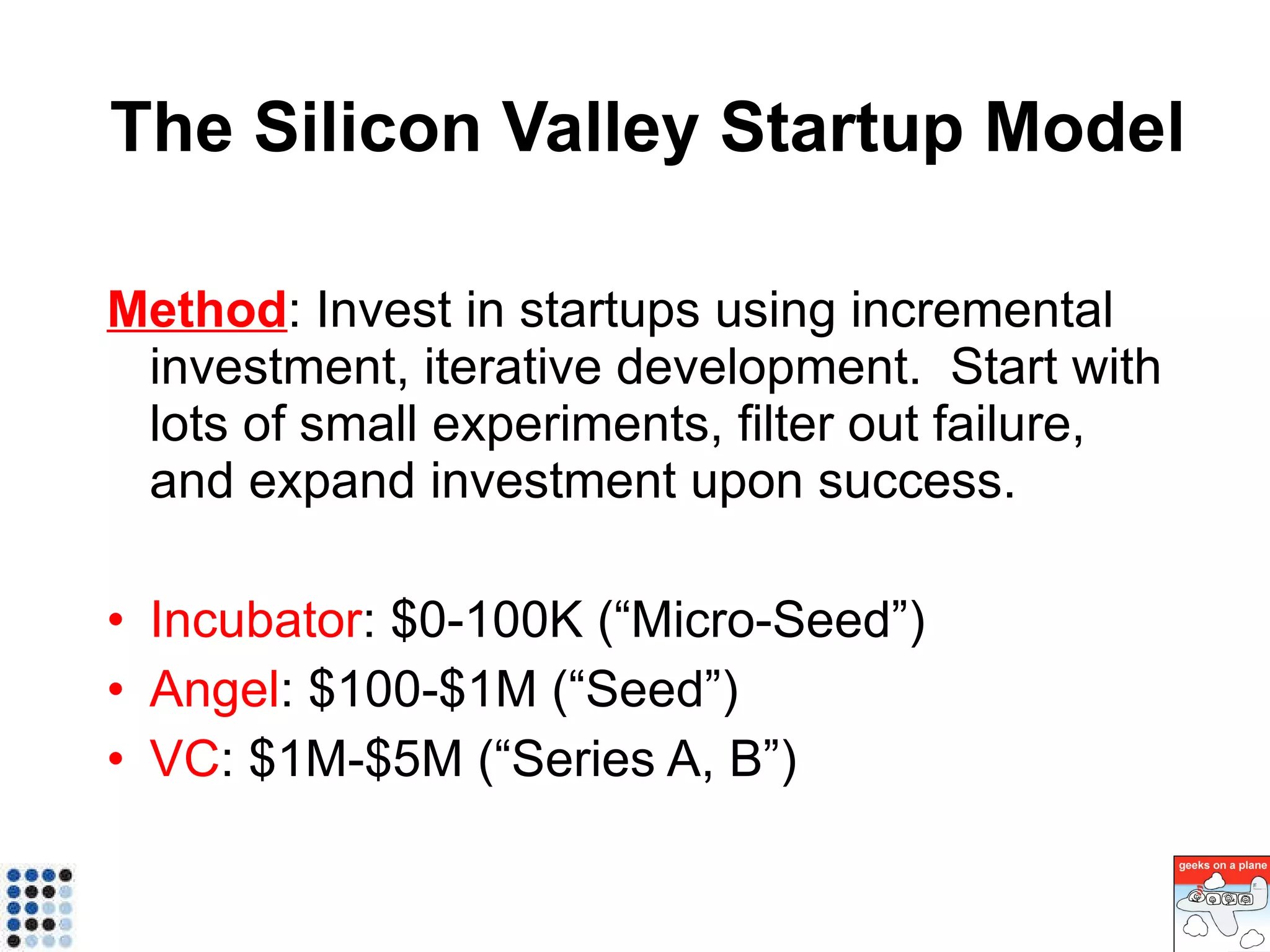
I^3 : Incremental Investment & Iteration Method : Invest in startups using incremental investment, iterative development.  Start with lots of small experiments, filter out failure, and expand investment upon success. Incubator : $0-100K (“Micro-Seed”) Angel : $100-$1M (“Seed”) VC : $1M-$5M (“Series A, B”)
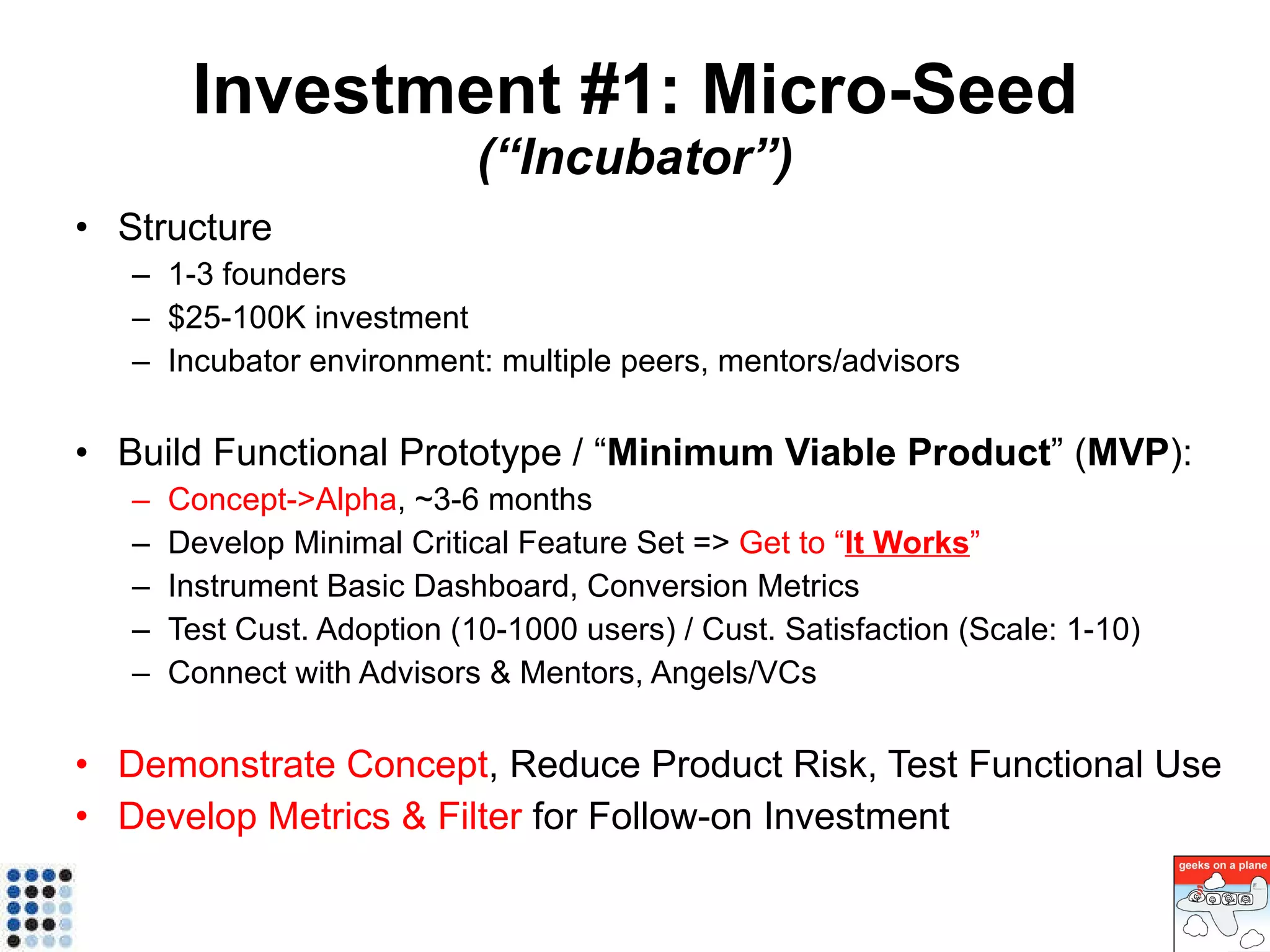
Investment #1: Micro-Seed (“Incubator”) Structure 1-3 founders $25-100K investment Incubator environment: multiple peers, mentors/advisors Build Functional Prototype / “ Minimum Viable Product ” ( MVP ): Concept->Alpha , ~3-6 months Develop Minimal Critical Feature Set =>  Get to “ It Works ” Instrument Basic Dashboard, Conversion Metrics Test Cust. Adoption (10-1000 users) / Cust. Satisfaction (Scale: 1-10) Connect with Advisors & Mentors, Angels/VCs Demonstrate Concept , Reduce Product Risk, Test Functional Use Develop Metrics & Filter  for Follow-on Investment
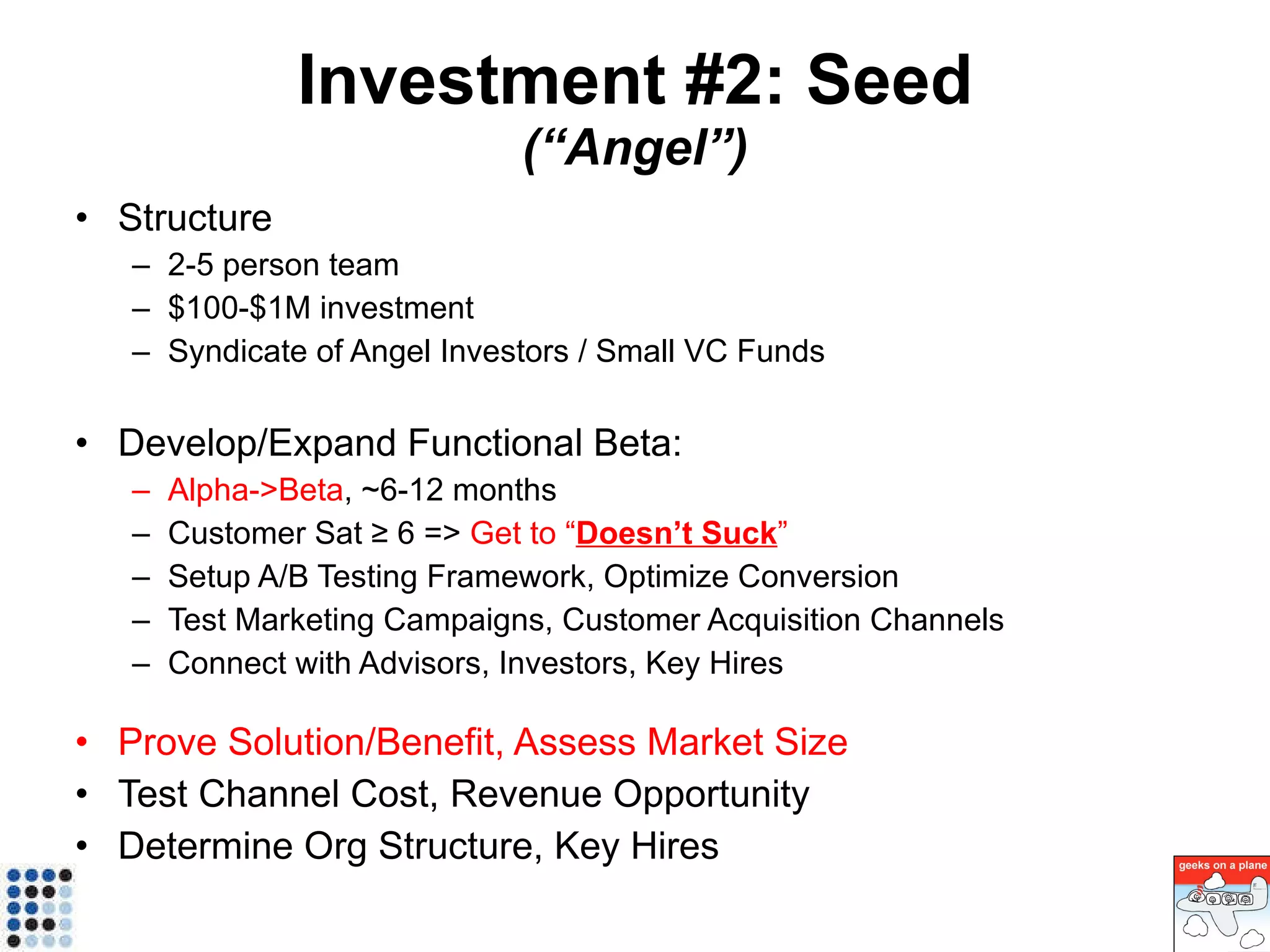
Investment #2: Seed (“Angel”) Structure 2-5 person team $100-$1M investment Syndicate of Angel Investors / Small VC Funds Improve Product, Expand Market, Test Revenue: Alpha->Beta , ~6-12 months Customer Sat ≥ 6 =>  Get to “ Doesn’t Suck ” Setup A/B Testing Framework, Optimize Conversion Test Marketing Campaigns, Customer Acquisition Channels  Connect with Advisors, Investors, Key Hires Prove Solution/Benefit, Assess Market Size Test Channel Cost, Revenue Opportunity Determine Org Structure, Key Hires
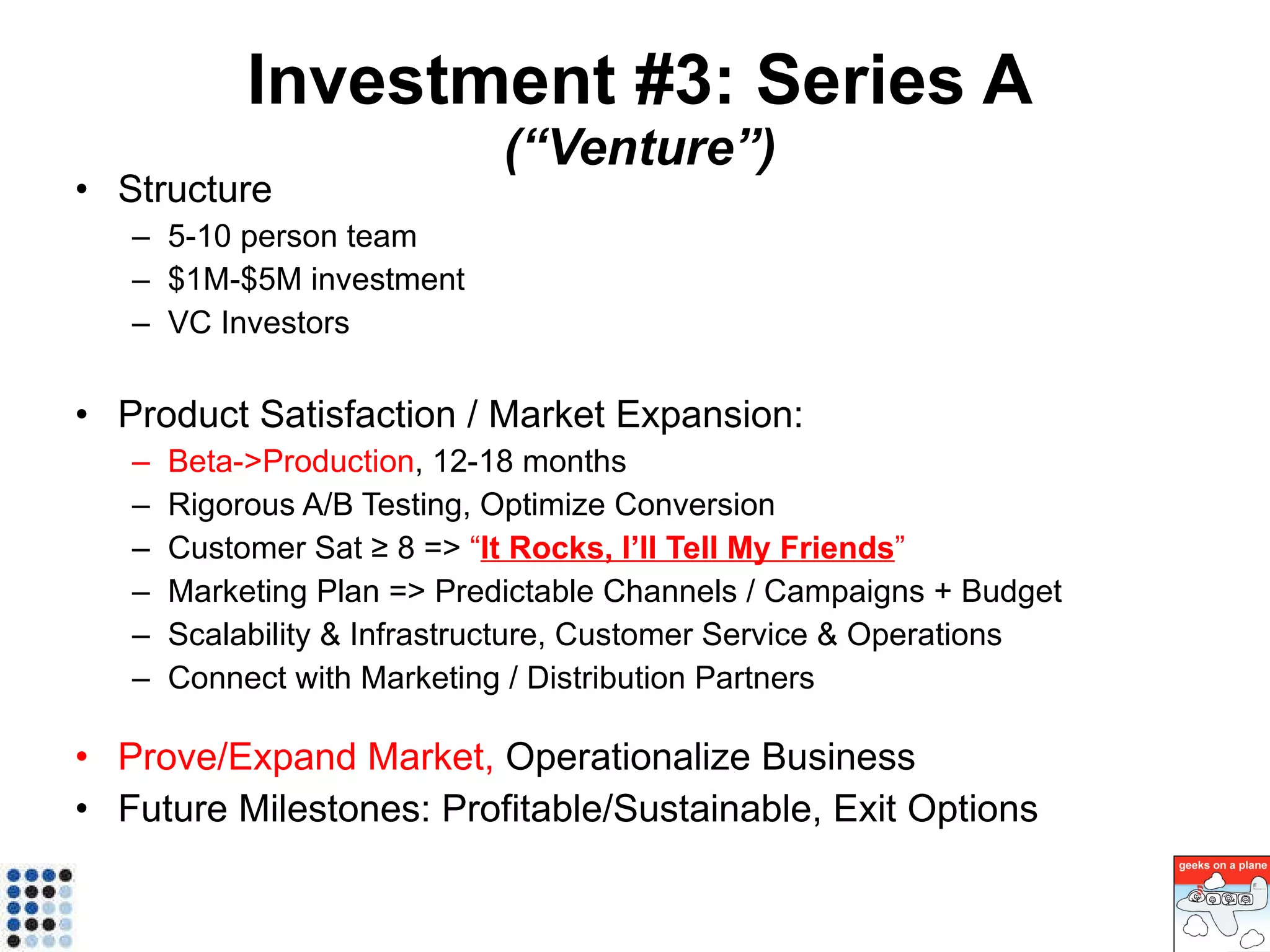
Investment #3: Series A (“Venture”) Structure 5-10 person team $1M-$5M investment VC Investors Scale Business, Get to Sustainability: Beta->Production , 12-18 months Rigorous A/B Testing, Optimize Conversion Customer Sat ≥ 8 =>  “ It Rocks, I’ll Tell My Friends ” MktgPlan => Predictable Channels / Campaigns + Budget Scalability & Infrastructure, Customer Service & Operations Connect with Marketing / Distribution Partners Prove/Expand Market,  Operationalize Business Future Milestones: Profitable/Sustainable, Exit Options
Startup Metrics Create. Measure. Iterate.
Startup Metrics: Lean & Mean Progress ≠ Features ( Less   =  More ) Focus on  User Experience  (&  Distribution ) Measure  Conversion ; Compare 2+ Options Fast, Frequent  Iteration  (+  Feedback Loop ) Keep it  Simple  &  Actionable
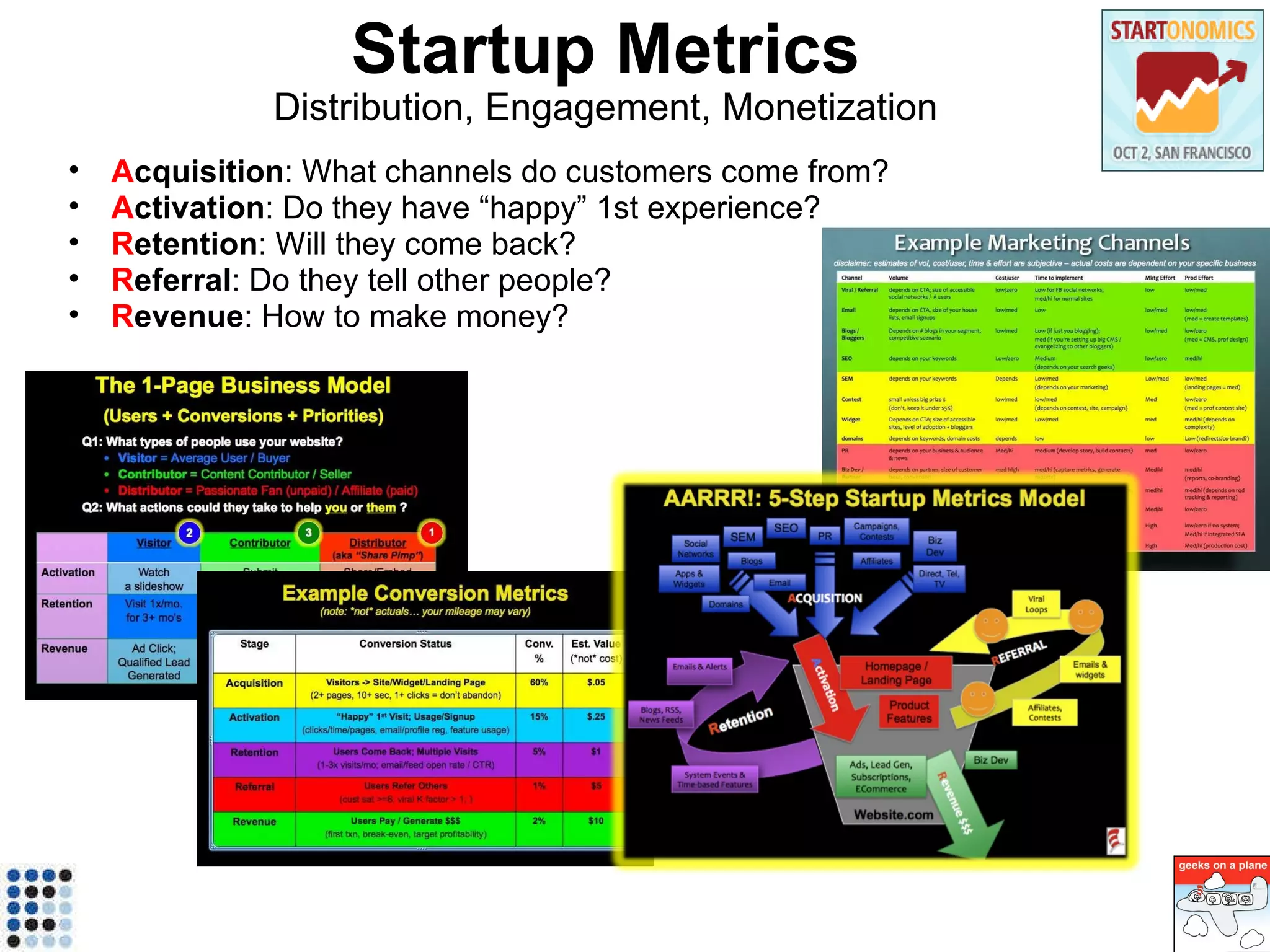
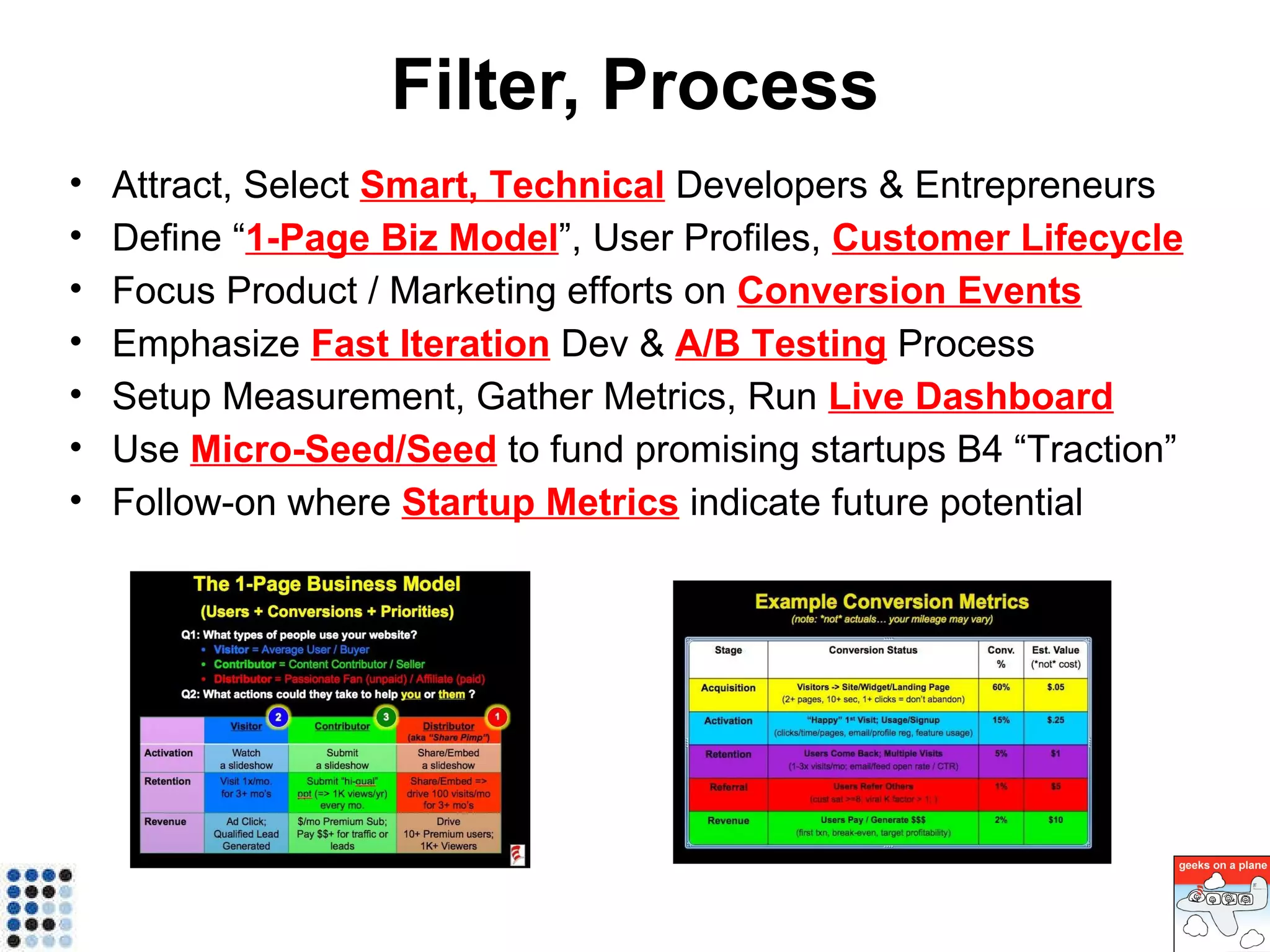
Startup Metrics for Pirates:  AARRR ! A cquisition : What channels do customers come from? A ctivation : Do they have “happy” 1st experience? R etention : Will they come back? R eferral : Do they tell other people? R evenue : How to make money?
Minimize  TOTAL  time through the loop LEARN BUILD MEASURE IDEAS CODE DATA Source: Eric Ries, The Lean Startup
Startup Metrics for Pirates A cquisition:   users come to site from various  channels A ctivation:  users enjoy 1 st  visit: " happy ” experience R etention:  users  come back , visit site multiple times R eferral:   users like product enough to  refer others R evenue:  users conduct some  monetization  behavior (note: If you’re in a hurry, Google “Startup Metrics” & watch 5m video) AARRR !
AARRR!: 5-Step Startup Metrics Model Website.com R evenue $$$ Biz Dev Ads, Lead Gen, Subscriptions, ECommerce A CQUISITION SEO SEM Apps & Widgets Affiliates Email PR Biz Dev Campaigns, Contests Direct, Tel, TV Social Networks Blogs Domains R etention Emails & Alerts System Events & Time-based Features Blogs, RSS, News Feeds
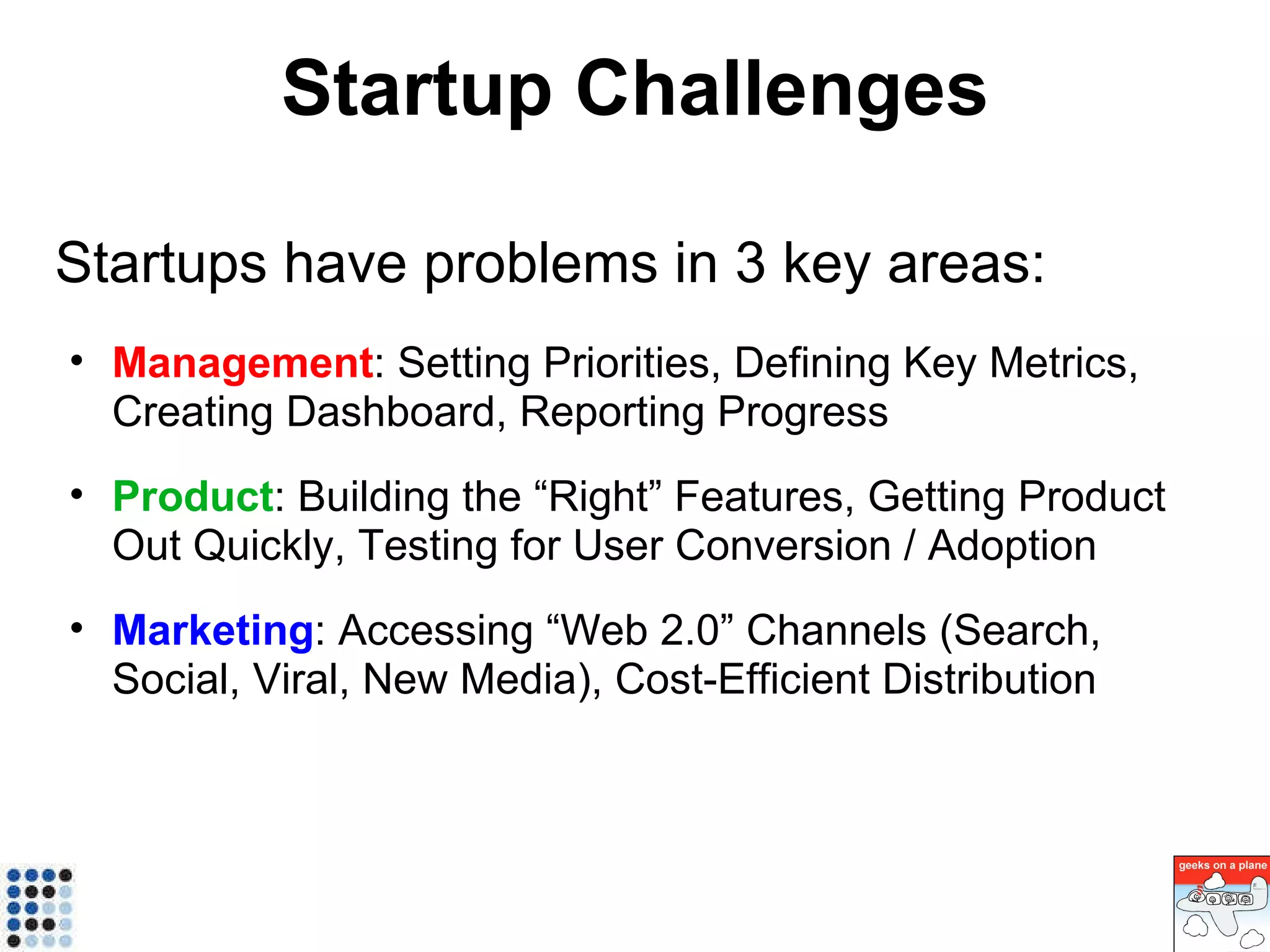
Startup Challenges Startups have problems in 3 key areas: Management : Setting Priorities, Defining Key Metrics, Creating Dashboard, Reporting Progress Product : Building the “Right” Features, Getting Product Out Quickly, Testing for User Conversion / Adoption Marketing : Accessing “Web 2.0” Channels (Search, Social, Viral, New Media), Cost-Efficient Distribution
Role: Founder/CEO Q: Which Metrics? Why? A: Focus on  Critical Few Actionable  Metrics (if you don’t use the metric to make a decision, it’s not actionable) Hypothesize Customer Lifecycle Target ~3-5 Conversion Events  (tip: Less = More) Test, Measure, Iterate to Improve
Role: Product / Engineering Q: What Features to Build?  Why?  When are you “Done”? A:  Easy-to-Find ,  Fun / Useful ,  Unique  Features that   Increase Conversion   (stop iterating when increase decelerates) Wireframes = Conversion Steps Measure, A/B Test, Iterate FAST (daily/weekly) Optimize for Conversion Improvement 80% on existing feature optimization 20% on new feature development
Role: Marketing / Sales Q: What channels?  Which users?  Why? A: High  Volume  (#), Low  Cost  ($), High  Conv  (%) Design & Test Multiple Marketing Channels + Campaigns Select & Focus on Best-Performing Channels & Themes Optimize for conversion to target CTAs, not just site/landing page Match/Drive channel cost to/below revenue potential Low-Hanging Fruit:  Blogs SEO/SEM Landing Pages Automated Emails
Links & Resources Additional References: Influence: The Psychology of Persuasion  Robert Cialdini (book) Putting the Fun in Functional  Amy Jo Kim (etech 2006 preso) Futuristic Play  Andrew Chen (blog) Don’t Make Me Think   Steve Krug (book) Designing for the Social Web  Joshua Porter (book, website)  Startup Lessons Learned  Eric Ries (blog)  Customer Development Methodology   Steve Blank (presentation ,  blog ) Startup-Marketing.com  Sean Ellis (blog) KISSmetrics.com  Hiten Shah / Neil Patel (website) How To Pitch a VC  Dave McClure (slides, NSFW)
Silicon Valley Innovation =  Entrepreneurs + Technology + Immigrants   Immigration as Critical to American Economic Leadership as Technology Innovation
Q: Where are the Startups? Source: TechCrunch.com
A: Where Legal Immigrants Reside. Source: TechCrunch.com
Summary 1) Incubators are capital efficient method for stimulating tech innovation, job creation 2) Metrics & Iteration, Feedback loop key to startup process and success 3) Immigration = Critical to Entrepreneurship as Technology Innovation & Capital

Incubator 2.0: A Silicon Valley Success Story

  • 1.
    Incubator 2.0: ASilicon Valley Story Engineering Better High-Tech Startups with Incubators, Investment, & Iterative Development Dave McClure (@DaveMcClure) Founders Fund & GeeksOnaPlane.com Sept-Oct 2009
  • 2.
    Startup Funding EcosystemUnion Square Ventures First Round Capital SoftTech (Jeff Clavier) SV Angel (Ron Conway) Benchmark Sequoia Y-Combinator TechStars FF Angel FF II fbFund REV (FF, Accel, Facebook) FF I Angels & Incubators ($0-10M) Seed Funds ($10-50M) Small VC Funds ($50-250M) Traditional VC Funds (>$250M)
  • 3.
  • 4.
    Dave McClure 2001-2009:Startup Investor: 500 Hats LLC, Founders Fund Tech Marketing : PayPal, Simply Hired, Mint Advisor, Angel Investor : 40+ Startups Conf. Organizer : Web 2.0, O’Reilly, Startonomics Stanford Visiting Lecturer : Facebook, Startup Metrics 80’s & 90’s: Entrepreneur : Founder/CEO Aslan Computing (acq.) Developer : Windows Apps / SQL DB Admin User Groups : E-Commerce, Internet, Client-Server Engineer : Johns Hopkins ‘88, BS Eng / Applied Math GEEK, CODER, ENTREPRENEUR Blogger, Startup Advisor Internet Marketing, Angel/VC Investor
  • 5.
    Angel Investments (Personal,2004-2008, 13 deals, avg $25K)
  • 6.
    Angel Investments (viaFF Angel, Q408-Q309, 30+ deals) FF Angel – 12 deals @$50-250K fbFund REV – 22 deals @ ~$15-75K
  • 7.
  • 8.
    Startup Incubators (lots of little deals… some of which work :)
  • 9.
    Incubator: Hatching StartupsIdealab (Bill Gross, 1996-2001) Goto.com -> Yahoo Search Marketing CitySearch, PayMyBills, Commission Junction, NetZero Y-Combinator (Paul Graham, 2005-pres.) 9+ “vintages”, 100+ companies Reddit, Scribd, Xobni, Omnisio, DropBox TechStars (CO), SeedCamp (UK), LaunchBox (DC) fbFund REV (Silicon Valley, 2008-2009) Facebook, Founders Fund, Accel
  • 10.
    Incubator 2.0 Incubatorsgrowing in popularity, acceptance Supportive ecosystem for startups (angels, VCs) Efficient use of investment capital ($25-100K) High fail rate (60-80%) => large initial sample size
  • 11.
    Incubator 2.0 Successbased on common platforms, physical proximity, open & collaborative environment Success based on fast fail, iteration & feedback Incremental investment; high-risk, but high-reward
  • 12.
    fbFund REV fbFundREV : Facebook “Social” Incubator: invest in startups, apps, websites based on Facebook platform, Facebook Connect. 25 startups (2 non-profits) $850K total investment (~$35K each) 12-week mentorship program in Palo Alto, CA ~25 Advisors / Speakers (Entrepreneurs, Geeks, Investors)
  • 13.
    fbFund REV fbFundREV : Facebook “Social” Incubator: invest in startups, apps, websites based on Facebook platform, Facebook Connect. Education on Tech, Design, Marketing, Business topics Demo Day with >200 VC, Angel Investors Target: ~7-10 seed round investments ($250K-$1M) Success: ~5 startups already funded, ~5 @ break-even
  • 14.
    Startup Funding 1,2, 3: Incubator, Angel, VC.
  • 15.
    Startup Funding EcosystemUnion Square Ventures First Round Capital Benchmark Sequoia FF II FF I Angels & Incubators ($0-10M) Seed Funds ($10-50M) Small VC Funds ($50-250M) Traditional VC Funds (>$250M) Y-Combinator TechStars FF Angel fbFund REV (FF, Accel, Facebook ) SoftTech (Clavier) Maples Investments Felicis (Senkut) SV Angel (Conway)
  • 16.
    I^3 : IncrementalInvestment & Iteration Method : Invest in startups using incremental investment, iterative development. Start with lots of small experiments, filter out failure, and expand investment upon success. Incubator : $0-100K (“Micro-Seed”) Angel : $100-$1M (“Seed”) VC : $1M-$5M (“Series A, B”)
  • 17.
    Investment #1: Micro-Seed(“Incubator”) Structure 1-3 founders $25-100K investment Incubator environment: multiple peers, mentors/advisors Build Functional Prototype / “ Minimum Viable Product ” ( MVP ): Concept->Alpha , ~3-6 months Develop Minimal Critical Feature Set => Get to “ It Works ” Instrument Basic Dashboard, Conversion Metrics Test Cust. Adoption (10-1000 users) / Cust. Satisfaction (Scale: 1-10) Connect with Advisors & Mentors, Angels/VCs Demonstrate Concept , Reduce Product Risk, Test Functional Use Develop Metrics & Filter for Follow-on Investment
  • 18.
    Investment #2: Seed(“Angel”) Structure 2-5 person team $100-$1M investment Syndicate of Angel Investors / Small VC Funds Improve Product, Expand Market, Test Revenue: Alpha->Beta , ~6-12 months Customer Sat ≥ 6 => Get to “ Doesn’t Suck ” Setup A/B Testing Framework, Optimize Conversion Test Marketing Campaigns, Customer Acquisition Channels Connect with Advisors, Investors, Key Hires Prove Solution/Benefit, Assess Market Size Test Channel Cost, Revenue Opportunity Determine Org Structure, Key Hires
  • 19.
    Investment #3: SeriesA (“Venture”) Structure 5-10 person team $1M-$5M investment VC Investors Scale Business, Get to Sustainability: Beta->Production , 12-18 months Rigorous A/B Testing, Optimize Conversion Customer Sat ≥ 8 => “ It Rocks, I’ll Tell My Friends ” MktgPlan => Predictable Channels / Campaigns + Budget Scalability & Infrastructure, Customer Service & Operations Connect with Marketing / Distribution Partners Prove/Expand Market, Operationalize Business Future Milestones: Profitable/Sustainable, Exit Options
  • 20.
    Startup Metrics Create.Measure. Iterate.
  • 21.
    Startup Metrics: Lean& Mean Progress ≠ Features ( Less = More ) Focus on User Experience (& Distribution ) Measure Conversion ; Compare 2+ Options Fast, Frequent Iteration (+ Feedback Loop ) Keep it Simple & Actionable
  • 22.
    Startup Metrics forPirates: AARRR ! A cquisition : What channels do customers come from? A ctivation : Do they have “happy” 1st experience? R etention : Will they come back? R eferral : Do they tell other people? R evenue : How to make money?
  • 23.
    Minimize TOTAL time through the loop LEARN BUILD MEASURE IDEAS CODE DATA Source: Eric Ries, The Lean Startup
  • 24.
    Startup Metrics forPirates A cquisition: users come to site from various channels A ctivation: users enjoy 1 st visit: " happy ” experience R etention: users come back , visit site multiple times R eferral: users like product enough to refer others R evenue: users conduct some monetization behavior (note: If you’re in a hurry, Google “Startup Metrics” & watch 5m video) AARRR !
  • 25.
    AARRR!: 5-Step StartupMetrics Model Website.com R evenue $$$ Biz Dev Ads, Lead Gen, Subscriptions, ECommerce A CQUISITION SEO SEM Apps & Widgets Affiliates Email PR Biz Dev Campaigns, Contests Direct, Tel, TV Social Networks Blogs Domains R etention Emails & Alerts System Events & Time-based Features Blogs, RSS, News Feeds
  • 26.
    Startup Challenges Startupshave problems in 3 key areas: Management : Setting Priorities, Defining Key Metrics, Creating Dashboard, Reporting Progress Product : Building the “Right” Features, Getting Product Out Quickly, Testing for User Conversion / Adoption Marketing : Accessing “Web 2.0” Channels (Search, Social, Viral, New Media), Cost-Efficient Distribution
  • 27.
    Role: Founder/CEO Q:Which Metrics? Why? A: Focus on Critical Few Actionable Metrics (if you don’t use the metric to make a decision, it’s not actionable) Hypothesize Customer Lifecycle Target ~3-5 Conversion Events (tip: Less = More) Test, Measure, Iterate to Improve
  • 28.
    Role: Product /Engineering Q: What Features to Build? Why? When are you “Done”? A: Easy-to-Find , Fun / Useful , Unique Features that Increase Conversion (stop iterating when increase decelerates) Wireframes = Conversion Steps Measure, A/B Test, Iterate FAST (daily/weekly) Optimize for Conversion Improvement 80% on existing feature optimization 20% on new feature development
  • 29.
    Role: Marketing /Sales Q: What channels? Which users? Why? A: High Volume (#), Low Cost ($), High Conv (%) Design & Test Multiple Marketing Channels + Campaigns Select & Focus on Best-Performing Channels & Themes Optimize for conversion to target CTAs, not just site/landing page Match/Drive channel cost to/below revenue potential Low-Hanging Fruit: Blogs SEO/SEM Landing Pages Automated Emails
  • 30.
    Links & ResourcesAdditional References: Influence: The Psychology of Persuasion Robert Cialdini (book) Putting the Fun in Functional Amy Jo Kim (etech 2006 preso) Futuristic Play Andrew Chen (blog) Don’t Make Me Think Steve Krug (book) Designing for the Social Web Joshua Porter (book, website) Startup Lessons Learned Eric Ries (blog) Customer Development Methodology Steve Blank (presentation , blog ) Startup-Marketing.com Sean Ellis (blog) KISSmetrics.com Hiten Shah / Neil Patel (website) How To Pitch a VC Dave McClure (slides, NSFW)
  • 31.
    Silicon Valley Innovation= Entrepreneurs + Technology + Immigrants Immigration as Critical to American Economic Leadership as Technology Innovation
  • 32.
    Q: Where arethe Startups? Source: TechCrunch.com
  • 33.
    A: Where LegalImmigrants Reside. Source: TechCrunch.com
  • 34.
    A: Where LegalImmigrants Reside. Source: TechCrunch.com
  • 35.
    Summary 1) Incubatorsare capital efficient method for stimulating tech innovation, job creation 2) Metrics & Iteration, Feedback loop key to startup process and success 3) Immigration = Critical to Entrepreneurship as Technology Innovation & Capital

Editor's Notes

  • #24 BUILT TO LEARN This is the core feedback loop that powers startups. Their goal is not to optimize the time it takes to do any one of these steps. There are many specific practices that can power lean startups, and we’ll cover a few in this presentation. But more important than any specific practice is this core idea: startups should be built to learn.