


BUNDLES OF CARE
NPCC
POOJA BHANDARI
BUNDLE OF CARE
A SET OF INTERVENTIONS BETTER OUTCOME.
A CARE BUNDLE IS A GROUP OF THREE TO FIVE EVIDENCE-BASED
INTERVENTIONS WHICH, WHEN PERFORMED TOGETHER, HAVE A
BETTER OUTCOME THAN IF PERFORMED INDIVIDUALLY.(CARE
BUNDLE IN INTENSIVE CARE, ST. JAMES’S UNIVERSITY HOSPITAL ,
UK JULY 2021)
CONT…
CARE “BUNDLES” ARE SIMPLE SETS OF EVIDENCE-
BASED PRACTICES THAT, WHEN IMPLEMENTED
COLLECTIVELY, IMPROVE THE RELIABILITY OF THEIR
DELIVERY AND IMPROVE PATIENT OUTCOMES
(INTERNATIONAL SOCIETY FOR INFECTIOUS DISEASES)
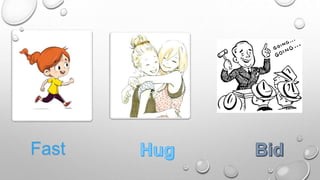
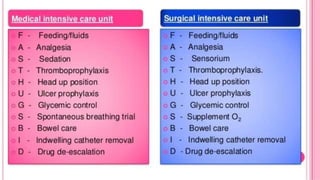
Fast
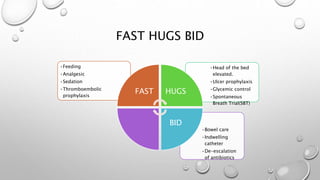
FAST HUGS BID
•Bowel care
•Indwelling
catheter
•De-escalation
of antibiotics
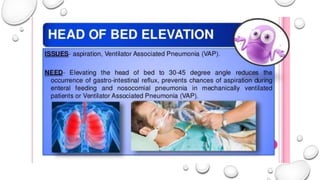
•Head of the bed
elevated.
•Ulcer prophylaxis
•Glycemic control
•Spontaneous
Breath Trial(SBT)
•Feeding
•Analgesic
•Sedation
•Thromboembolic
prophylaxis
FAST HUGS
BID
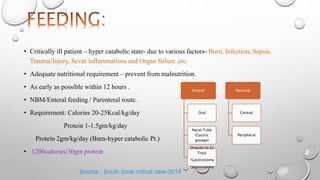
• Critically ill patient – hyper catabolic state- due to various factors- Burn, Infection, Sepsis,
Trauma/Injury, Sever inflammations and Organ failure ,etc.
• Adequate nutritional requirement – prevent from malnutrition.
• As early as possible within 12 hours .
• NBM/Enteral feeding / Parenteral route.
• Requirement: Calories 20-25Kcal/kg/day
Protein 1-1.5gm/kg/day
Protein 2gm/kg/day (Burn-hyper catabolic Pt.)
• 1200calories/30gm protein
Enteral
Oral
Nasal Tube
(Gastric
gavage)
Directly to GI
Tract
*Gastrostomy
*Jejunostomy
Parental
Central
Peripheral
Source : South zone critical care-2018
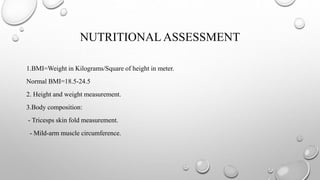
NUTRITIONAL ASSESSMENT
1.BMI=Weight in Kilograms/Square of height in meter.
Normal BMI=18.5-24.5
2. Height and weight measurement.
3.Body composition:
- Tricesps skin fold measurement.
- Mild-arm muscle circumference.
TRICEPS SKIN
FOLDMEASEREMENT Upper arm circumference
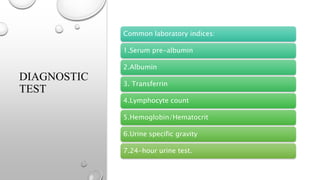
DIAGNOSTIC
TEST
Common laboratory indices:
1.Serum pre-albumin
2.Albumin
3. Transferrin
4.Lymphocyte count
5.Hemoglobin/Hematocrit
6.Urine specific gravity
7.24-hour urine test.
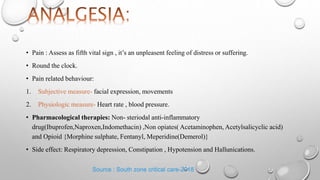
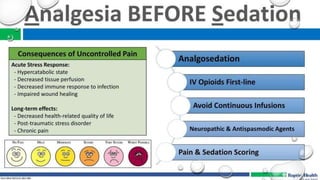
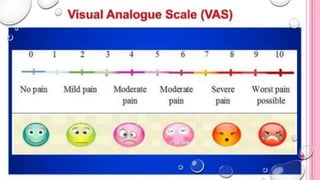
• Pain : Assess as fifth vital sign , it’s an unpleasent feeling of distress or suffering.
• Round the clock.
• Pain related behaviour:
1. Subjective measure- facial expression, movements
2. Physiologic measure- Heart rate , blood pressure.
• Pharmacological therapies: Non- steriodal anti-inflammatory
drug(Ibuprofen,Naproxen,Indomethacin) ,Non opiates( Acetaminophen, Acetylsalicyclic acid)
and Opioid {Morphine sulphate, Fentanyl, Meperidine(Demerol)}
• Side effect: Respiratory depression, Constipation , Hypotension and Hallunications.
Source : South zone critical care-2018
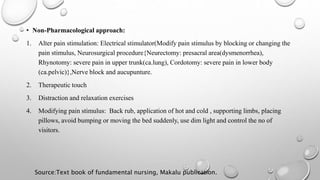
• Non-Pharmacological approach:
1. Alter pain stimulation: Electrical stimulator(Modify pain stimulus by blocking or changing the
pain stimulus, Neurosurgical procedure{Neurectomy: presacral area(dysmenorrhea),
Rhynotomy: severe pain in upper trunk(ca.lung), Cordotomy: severe pain in lower body
(ca.pelvic)},Nerve block and aucupunture.
2. Therapeutic touch
3. Distraction and relaxation exercises
4. Modifying pain stimulus: Back rub, application of hot and cold , supporting limbs, placing
pillows, avoid bumping or moving the bed suddenly, use dim light and control the no of
visitors.
Source:Text book of fundamental nursing, Makalu publication.
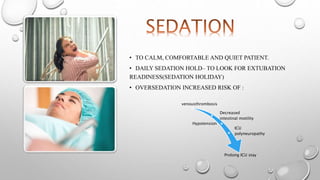
• TO CALM, COMFORTABLE AND QUIET PATIENT.
• DAILY SEDATION HOLD– TO LOOK FOR EXTUBATION
READINESS(SEDATION HOLIDAY)
• OVERSEDATION INCREASED RISK OF :
venousthrombosis
Decreased
intestinal motility
Hypotension
ICU
polyneuropathy
Prolong ICU stay
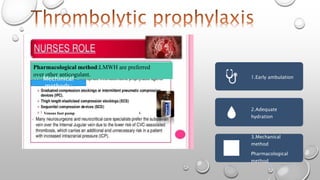
1.Early ambulation
2.Adequate
hydration
3.Mechanical
method
Pharmacological
method
Pharmacological method:LMWH are preferred
over other anticogulant.
Mechinical
methods:
Venous foot pump
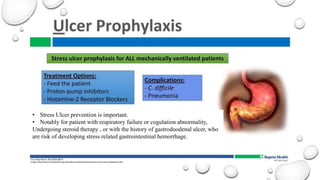
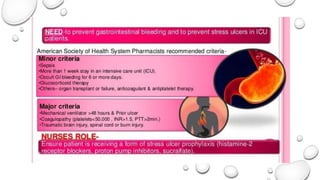
• Stress Ulcer prevention is important.
• Notably for patient with respiratory failure or cogulation abnormality,
Undergoing steroid therapy , or with the history of gastroduodenal ulcer, who
are risk of developing stress related gastrointestinal hemorrhage.
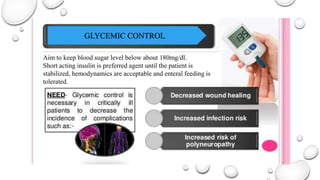
GLYCEMIC CONTROL
Aim to keep blood sugar level below about 180mg/dl.
Short acting insulin is preferred agent until the patient is
stabilized, hemodynamics are acceptable and enteral feeding is
tolerated.
• SBT should be started early once the patients fulfils the criteria for weaning.
• Weaning has two component: 1. Liberation from ventilation and
2. Extubation.
The sooner the patient is liberated from ventilator, the lesser the chance of Ventilator Associated
Pneumonias(VAP) , Ventilatory-induced lung injury, Decreased ICU stay and overall reduced
mortality.
Source: ISCCM-ICU Protocols A stepwise approach
STEPS:
• Weaning should never be hurried as it can be successful only when the patient is physically and
mentally ready.
• Whenever possible, position the patient upright in bed
• Throughly suctioning the endotracheal tube and ensure patency.
• Mode for SBT:
1. T-piece:
Patient are disconnect from ventilator and made to breath humidified oxygen – air mixed through T-
piece connected to the endotracheal / tracheostomy tube for 30-120 min
Source: ISCCM-ICU Protocols A stepwise approach
Increased respiratory load. Dyspnea and fatigue should be carefully avoided.
2. Pressure support:
The pressure support level is to be gradually reduced, titrate to RR and patient comfort.
A level of 6-8 cm H2O pressure support is considered to overcome the tube resistance.
PEEP of 4-6cm H2O.
Duration: 30-120 minutes
• Adequate cough reflex-spontaneous or while suctioning.
• Patient should be able to protect airway, and they should follow simple command.
• No radiological and surgical procedure is being planned in the near future.
• Extubation should not be done at the end of the day.
Source: ISCCM-ICU Protocols A stepwise approach
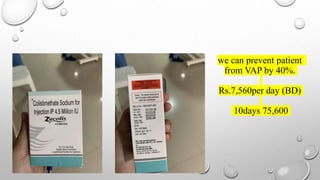
we can prevent patient
from VAP by 40%.
Rs.7,560per day (BD)
10days 75,600
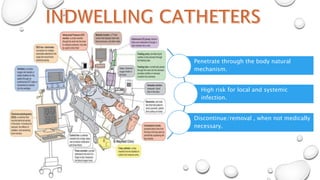
Penetrate through the body natural
mechanism.
High risk for local and systemic
infection.
Discontinue/removal , when not medically
necessary.
• VAP, defined as a new pneumonia occurring > 48 hours after endotracheal
intubation.
• VAP is common and serious hospital-acquired infection.
• It occurs in up to 20% of pt receiving mechinical ventilation, & is associated with
increased antibiotic use, length of hospitalization and healthcare cost.
SOURCE : South zone critical care-2018
• Best hand washing practice.
• Head end to be elevated 30-45 degree.
• Oral care with Chlorexidine solution.
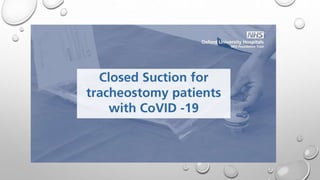
• Suction should be done only when required. Closed suction should be encouraged when increased
secretions are anticipated.
• Sedation vacation (early morning sadation should be hold)
• Prevanting VAP by 40%.
• Provide early exercise and early mobilization.
Source:International Society for Infectious Disease
1. INSERTION BUNDLE:
• Maximal sterile barrier precautions (surgical mask, sterile gloves, cap, sterile gown, and large sterile drape).
• Skin cleaning with alcohol-based chlorhexidine (rather than iodine).
• Avoidance of the femoral vein for central venous access in adult patients; use of subclavian rather than jugular veins.
• Standardized insertion packs.
• Availability of insertion guidelines (including indications for central line use) and use of checklists with trained
observers.
• Use of ultrasound guidance for insertion of internal jugular lines.
Source:International Society for Infectious Disease
• 2. Maintenance bundle:
- Daily review of central line necessity.
- Prompt removal of unnecessary lines.
- Disinfection prior to manipulation of the line.
- Daily chlorhexidine washes (in ICU, patients > 2 months).
- Disinfect catheter hubs, ports, connectors, etc., before using the catheter.
- Change dressings and disinfect site with alcohol-based chlorhexidine every 5-7 days (change
earlier if soiled).
- Replace administration sets within 96 hours(4days) (immediately if used for blood products or
lipids).
- Ensure appropriate nurse-to-patient ratio in ICU (1:2 or 1:1).
• Best hand washing practice.
• Insertion under strict asceptic precaution.
• Catheter to be secured – no pulling from cot.
• Bag should be kept below the bladder level.
• Empty the bag once it reaches 2/3 rd of capacity.
• Avoiding the use of urinary catheters by considering alternative methods for urine
collection.
- methods include: condom catheters, intermittent catheterization, use of nappies.
SOURCE : South zone critical care-2018
• SSIS are infections of the incision or organ or space that occur after surgery.
• Administration of parenteral antibiotic prophylaxis.
- Antibiotic prophylaxis should be administered within 60 minutes prior to incision, including for
caesarean section.
- Re-dosing is recommended for prolonged procedures and in patients with major blood loss or excessive
burns.
• Patients should be washed with soap or an antiseptic agent within a night prior to surgery.
OURCE : International Society for Infectious Disease
• Use alcohol-based disinfectant for skin preparation in the operating room.
• Maintain intraoperative Glycemic control with target blood glucose levels < 200
mg/dl (in patients with and without diabetes).
• Maintain perioperative normothermia.
• Administer increased fraction of inspired oxygen during surgery and
• After extubation in the immediate postoperative period in patients with normal
pulmonary function.
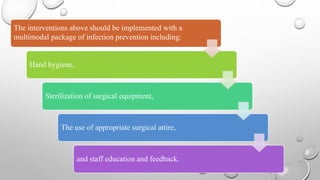
The interventions above should be implemented with a
multimodal package of infection prevention including:
Hand hygiene,
Sterilization of surgical equipment,
The use of appropriate surgical attire,
and staff education and feedback.
BUNDLE OF CARE.pptx

BUNDLE OF CARE.pptx

  • 1.
  • 2.
    BUNDLE OF CARE ASET OF INTERVENTIONS BETTER OUTCOME. A CARE BUNDLE IS A GROUP OF THREE TO FIVE EVIDENCE-BASED INTERVENTIONS WHICH, WHEN PERFORMED TOGETHER, HAVE A BETTER OUTCOME THAN IF PERFORMED INDIVIDUALLY.(CARE BUNDLE IN INTENSIVE CARE, ST. JAMES’S UNIVERSITY HOSPITAL , UK JULY 2021)
  • 3.
    CONT… CARE “BUNDLES” ARESIMPLE SETS OF EVIDENCE- BASED PRACTICES THAT, WHEN IMPLEMENTED COLLECTIVELY, IMPROVE THE RELIABILITY OF THEIR DELIVERY AND IMPROVE PATIENT OUTCOMES (INTERNATIONAL SOCIETY FOR INFECTIOUS DISEASES)
  • 4.
  • 5.
    FAST HUGS BID •Bowelcare •Indwelling catheter •De-escalation of antibiotics •Head of the bed elevated. •Ulcer prophylaxis •Glycemic control •Spontaneous Breath Trial(SBT) •Feeding •Analgesic •Sedation •Thromboembolic prophylaxis FAST HUGS BID
  • 8.
    • Critically illpatient – hyper catabolic state- due to various factors- Burn, Infection, Sepsis, Trauma/Injury, Sever inflammations and Organ failure ,etc. • Adequate nutritional requirement – prevent from malnutrition. • As early as possible within 12 hours . • NBM/Enteral feeding / Parenteral route. • Requirement: Calories 20-25Kcal/kg/day Protein 1-1.5gm/kg/day Protein 2gm/kg/day (Burn-hyper catabolic Pt.) • 1200calories/30gm protein Enteral Oral Nasal Tube (Gastric gavage) Directly to GI Tract *Gastrostomy *Jejunostomy Parental Central Peripheral Source : South zone critical care-2018
  • 10.
    NUTRITIONAL ASSESSMENT 1.BMI=Weight inKilograms/Square of height in meter. Normal BMI=18.5-24.5 2. Height and weight measurement. 3.Body composition: - Tricesps skin fold measurement. - Mild-arm muscle circumference.
  • 11.
  • 12.
    DIAGNOSTIC TEST Common laboratory indices: 1.Serumpre-albumin 2.Albumin 3. Transferrin 4.Lymphocyte count 5.Hemoglobin/Hematocrit 6.Urine specific gravity 7.24-hour urine test.
  • 13.
    • Pain :Assess as fifth vital sign , it’s an unpleasent feeling of distress or suffering. • Round the clock. • Pain related behaviour: 1. Subjective measure- facial expression, movements 2. Physiologic measure- Heart rate , blood pressure. • Pharmacological therapies: Non- steriodal anti-inflammatory drug(Ibuprofen,Naproxen,Indomethacin) ,Non opiates( Acetaminophen, Acetylsalicyclic acid) and Opioid {Morphine sulphate, Fentanyl, Meperidine(Demerol)} • Side effect: Respiratory depression, Constipation , Hypotension and Hallunications. Source : South zone critical care-2018
  • 14.
    • Non-Pharmacological approach: 1.Alter pain stimulation: Electrical stimulator(Modify pain stimulus by blocking or changing the pain stimulus, Neurosurgical procedure{Neurectomy: presacral area(dysmenorrhea), Rhynotomy: severe pain in upper trunk(ca.lung), Cordotomy: severe pain in lower body (ca.pelvic)},Nerve block and aucupunture. 2. Therapeutic touch 3. Distraction and relaxation exercises 4. Modifying pain stimulus: Back rub, application of hot and cold , supporting limbs, placing pillows, avoid bumping or moving the bed suddenly, use dim light and control the no of visitors. Source:Text book of fundamental nursing, Makalu publication.
  • 17.
    • TO CALM,COMFORTABLE AND QUIET PATIENT. • DAILY SEDATION HOLD– TO LOOK FOR EXTUBATION READINESS(SEDATION HOLIDAY) • OVERSEDATION INCREASED RISK OF : venousthrombosis Decreased intestinal motility Hypotension ICU polyneuropathy Prolong ICU stay
  • 18.
    1.Early ambulation 2.Adequate hydration 3.Mechanical method Pharmacological method Pharmacological method:LMWHare preferred over other anticogulant. Mechinical methods: Venous foot pump
  • 20.
    • Stress Ulcerprevention is important. • Notably for patient with respiratory failure or cogulation abnormality, Undergoing steroid therapy , or with the history of gastroduodenal ulcer, who are risk of developing stress related gastrointestinal hemorrhage.
  • 22.
    GLYCEMIC CONTROL Aim tokeep blood sugar level below about 180mg/dl. Short acting insulin is preferred agent until the patient is stabilized, hemodynamics are acceptable and enteral feeding is tolerated.
  • 23.
    • SBT shouldbe started early once the patients fulfils the criteria for weaning. • Weaning has two component: 1. Liberation from ventilation and 2. Extubation. The sooner the patient is liberated from ventilator, the lesser the chance of Ventilator Associated Pneumonias(VAP) , Ventilatory-induced lung injury, Decreased ICU stay and overall reduced mortality. Source: ISCCM-ICU Protocols A stepwise approach
  • 24.
    STEPS: • Weaning shouldnever be hurried as it can be successful only when the patient is physically and mentally ready. • Whenever possible, position the patient upright in bed • Throughly suctioning the endotracheal tube and ensure patency. • Mode for SBT: 1. T-piece: Patient are disconnect from ventilator and made to breath humidified oxygen – air mixed through T- piece connected to the endotracheal / tracheostomy tube for 30-120 min Source: ISCCM-ICU Protocols A stepwise approach
  • 25.
    Increased respiratory load.Dyspnea and fatigue should be carefully avoided. 2. Pressure support: The pressure support level is to be gradually reduced, titrate to RR and patient comfort. A level of 6-8 cm H2O pressure support is considered to overcome the tube resistance. PEEP of 4-6cm H2O. Duration: 30-120 minutes • Adequate cough reflex-spontaneous or while suctioning. • Patient should be able to protect airway, and they should follow simple command. • No radiological and surgical procedure is being planned in the near future. • Extubation should not be done at the end of the day. Source: ISCCM-ICU Protocols A stepwise approach
  • 26.
    we can preventpatient from VAP by 40%. Rs.7,560per day (BD) 10days 75,600
  • 28.
    Penetrate through thebody natural mechanism. High risk for local and systemic infection. Discontinue/removal , when not medically necessary.
  • 30.
    • VAP, definedas a new pneumonia occurring > 48 hours after endotracheal intubation. • VAP is common and serious hospital-acquired infection. • It occurs in up to 20% of pt receiving mechinical ventilation, & is associated with increased antibiotic use, length of hospitalization and healthcare cost.
  • 31.
    SOURCE : Southzone critical care-2018 • Best hand washing practice. • Head end to be elevated 30-45 degree. • Oral care with Chlorexidine solution. • Suction should be done only when required. Closed suction should be encouraged when increased secretions are anticipated. • Sedation vacation (early morning sadation should be hold) • Prevanting VAP by 40%. • Provide early exercise and early mobilization.
  • 33.
    Source:International Society forInfectious Disease 1. INSERTION BUNDLE: • Maximal sterile barrier precautions (surgical mask, sterile gloves, cap, sterile gown, and large sterile drape). • Skin cleaning with alcohol-based chlorhexidine (rather than iodine). • Avoidance of the femoral vein for central venous access in adult patients; use of subclavian rather than jugular veins. • Standardized insertion packs. • Availability of insertion guidelines (including indications for central line use) and use of checklists with trained observers. • Use of ultrasound guidance for insertion of internal jugular lines.
  • 34.
    Source:International Society forInfectious Disease • 2. Maintenance bundle: - Daily review of central line necessity. - Prompt removal of unnecessary lines. - Disinfection prior to manipulation of the line. - Daily chlorhexidine washes (in ICU, patients > 2 months). - Disinfect catheter hubs, ports, connectors, etc., before using the catheter. - Change dressings and disinfect site with alcohol-based chlorhexidine every 5-7 days (change earlier if soiled). - Replace administration sets within 96 hours(4days) (immediately if used for blood products or lipids). - Ensure appropriate nurse-to-patient ratio in ICU (1:2 or 1:1).
  • 35.
    • Best handwashing practice. • Insertion under strict asceptic precaution. • Catheter to be secured – no pulling from cot. • Bag should be kept below the bladder level. • Empty the bag once it reaches 2/3 rd of capacity. • Avoiding the use of urinary catheters by considering alternative methods for urine collection. - methods include: condom catheters, intermittent catheterization, use of nappies. SOURCE : South zone critical care-2018
  • 36.
    • SSIS areinfections of the incision or organ or space that occur after surgery. • Administration of parenteral antibiotic prophylaxis. - Antibiotic prophylaxis should be administered within 60 minutes prior to incision, including for caesarean section. - Re-dosing is recommended for prolonged procedures and in patients with major blood loss or excessive burns. • Patients should be washed with soap or an antiseptic agent within a night prior to surgery.
  • 37.
    OURCE : InternationalSociety for Infectious Disease • Use alcohol-based disinfectant for skin preparation in the operating room. • Maintain intraoperative Glycemic control with target blood glucose levels < 200 mg/dl (in patients with and without diabetes). • Maintain perioperative normothermia. • Administer increased fraction of inspired oxygen during surgery and • After extubation in the immediate postoperative period in patients with normal pulmonary function.
  • 38.
    The interventions aboveshould be implemented with a multimodal package of infection prevention including: Hand hygiene, Sterilization of surgical equipment, The use of appropriate surgical attire, and staff education and feedback.