Name of the Teacher : SHAKEELA L Standard : XII
Name of the School : GOVT TAMIL VHSS CHALAI Strength : 30
Subject : Business Studies Age : 17years
Unit : Directing Duration : 45 minutes
Topic : Barriers to communication Date : 23/09/2015
Content Outline Barriers to communication
Content Analysis
Terms
Facts
Concept
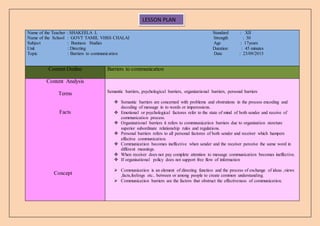
Semantic barriers, psychological barriers, organizational barriers, personal barriers
 Semantic barriers are concerned with problems and obstrutions in the process encoding and
decoding of message in to words or imperessions.
 Emotional or psychological factores refer to the state of mind of both sender and receive of
communication process.
 Organizational barriers it refers to commnunication barriers due to organization stercture
superior subordinate relationship rules and regulations.
 Personal barriers refers to all personal factores of both sender and receiver which hampers
effective communication.
 Communication becomes ineffective when sender and the receiver perceive the same word in
different meanings.
 When receiver does not pay complete attention to message communication becomes ineffective.
 If organisational policy does not support free flow of information
 Communication is an element of directing function and the process of exchange of ideas ,views
,facts,feelings etc.. between or among people to create common understanding.
 Communication barriers are the factors that obstruct the effectiveness of communication.
LESSON PLAN
Curricular objectives
Pre- requisites
Learning materials
Learning strategy
 To develop an idea about the term ‘communication’ and enable them to analysis its
barriers of communication and evaluate its effects in an organization through Brain
storming, Group Discussion, General Discussion role play and enable students to prepare
note based on it.
Learner should have an idea about “communication”
 Usual class room aids like blackboard and chalk.
 Chart showing the barriers to communication.
 Activity sheet.
 Brain storming
 Group Discussion
 General Discussion
 Role play
PHASE I : INTRODUCTORYPHASE
Activity (General Discussion)
After the usual class procedures teacher starts the class by asking questions related to previous
classes
 What you mean by communication?
 What is mean by informal communication ?
 What are the different types of communication network?
After asking questions teacher show a picture and ask them what are they understand the
picture?
Students answer the questions.
CLASS ROOM INTERACTIONPROCEDURE/ACTIVITY PUPIL’S RESPONSE
Students identify the concept “Barriers of communication”then teacher intiate general
discussion .
Teacher gives the following questions for initiating the discussion.
Lead points
 What are the main barriers of communication?
 If you going to another state what are the problems are u faced ?
 What are the problems faced in the organizational communication?
 Emotions and feelings how to effect your communication?
From the above discussion learner arrive at conclusion that “mainly four barriers of
communication”
Students actively respond about the lead points.
Students derived to the conclusion.
Conceptto be consolidated
PHASE II: DEVELOPMENTAL STAGE
Activity: (Group Discussion)
Teacher divides the class in to 4 groups and gives each group have different topic. first group
provide semantic barriers, next group provided psychological barriers, third group gives
organizational barriers, and last group provide personal barrires .
Students are actively participated in the group
discussion.
BARRIERS
SEMANTIC PSYCHOLOGICAL ORGANISATIONAL PERSONAL
Lead points
(Group 1)
a) Semantic barriers
 Badly expressed message:
 Symbols with different meanings
 Faulty transalations
 Unclarified assumptions
 Technical jargon
 Body language and gesture decoding:
Activity: 2 (Group 2)
b) Psychologicalbarriers
 Premature evalution
 Lack of attention
 Loss by transmission and poor retention
 Disturst
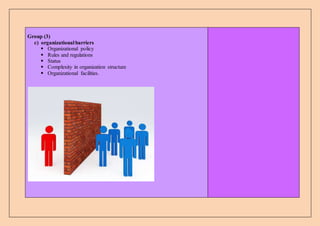
Group (3)
c) organizationalbarriers
 Organizational policy
 Rules and regulations
 Status
 Complexity in organization structure
 Organizational facilities.
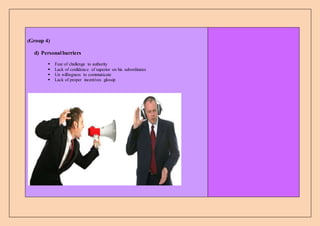
(Group 4)
d) Personalbarriers
 Fear of challenge to authority
 Lack of confidence of superior on his subordinates
 Un willingness to communicate
 Lack of proper incentives glossip
PHASE III : CONCLUDING ACTIVITY
Teacher concluding the topic by showing slids and vedieo related to barriers of communication .
Students raise there douts and techer clarifies that and gives note based on it.
Review Questions
 What do you mean by communication?
 What are the common barriers to effective communication?
 What you mean by semantic barriers?
 What are the main organizational barriers?
 Describe any four personal barriers of communication?
Follow up Activity
Teacher said the students to prepare an assignment on the topic barriers of communication. and
also prepare note based on above questions it.
Students answer to the questions correctly
Ict lessen plan
Ict lessen plan

Ict lessen plan

  • 1.
    Name of theTeacher : SHAKEELA L Standard : XII Name of the School : GOVT TAMIL VHSS CHALAI Strength : 30 Subject : Business Studies Age : 17years Unit : Directing Duration : 45 minutes Topic : Barriers to communication Date : 23/09/2015 Content Outline Barriers to communication Content Analysis Terms Facts Concept Semantic barriers, psychological barriers, organizational barriers, personal barriers  Semantic barriers are concerned with problems and obstrutions in the process encoding and decoding of message in to words or imperessions.  Emotional or psychological factores refer to the state of mind of both sender and receive of communication process.  Organizational barriers it refers to commnunication barriers due to organization stercture superior subordinate relationship rules and regulations.  Personal barriers refers to all personal factores of both sender and receiver which hampers effective communication.  Communication becomes ineffective when sender and the receiver perceive the same word in different meanings.  When receiver does not pay complete attention to message communication becomes ineffective.  If organisational policy does not support free flow of information  Communication is an element of directing function and the process of exchange of ideas ,views ,facts,feelings etc.. between or among people to create common understanding.  Communication barriers are the factors that obstruct the effectiveness of communication. LESSON PLAN
  • 2.
    Curricular objectives Pre- requisites Learningmaterials Learning strategy  To develop an idea about the term ‘communication’ and enable them to analysis its barriers of communication and evaluate its effects in an organization through Brain storming, Group Discussion, General Discussion role play and enable students to prepare note based on it. Learner should have an idea about “communication”  Usual class room aids like blackboard and chalk.  Chart showing the barriers to communication.  Activity sheet.  Brain storming  Group Discussion  General Discussion  Role play
  • 3.
    PHASE I :INTRODUCTORYPHASE Activity (General Discussion) After the usual class procedures teacher starts the class by asking questions related to previous classes  What you mean by communication?  What is mean by informal communication ?  What are the different types of communication network? After asking questions teacher show a picture and ask them what are they understand the picture? Students answer the questions. CLASS ROOM INTERACTIONPROCEDURE/ACTIVITY PUPIL’S RESPONSE
  • 4.
    Students identify theconcept “Barriers of communication”then teacher intiate general discussion . Teacher gives the following questions for initiating the discussion. Lead points  What are the main barriers of communication?  If you going to another state what are the problems are u faced ?  What are the problems faced in the organizational communication?  Emotions and feelings how to effect your communication? From the above discussion learner arrive at conclusion that “mainly four barriers of communication” Students actively respond about the lead points. Students derived to the conclusion.
  • 5.
    Conceptto be consolidated PHASEII: DEVELOPMENTAL STAGE Activity: (Group Discussion) Teacher divides the class in to 4 groups and gives each group have different topic. first group provide semantic barriers, next group provided psychological barriers, third group gives organizational barriers, and last group provide personal barrires . Students are actively participated in the group discussion. BARRIERS SEMANTIC PSYCHOLOGICAL ORGANISATIONAL PERSONAL
  • 6.
    Lead points (Group 1) a)Semantic barriers  Badly expressed message:  Symbols with different meanings  Faulty transalations  Unclarified assumptions  Technical jargon  Body language and gesture decoding:
  • 7.
    Activity: 2 (Group2) b) Psychologicalbarriers  Premature evalution  Lack of attention  Loss by transmission and poor retention  Disturst
  • 8.
    Group (3) c) organizationalbarriers Organizational policy  Rules and regulations  Status  Complexity in organization structure  Organizational facilities.
  • 9.
    (Group 4) d) Personalbarriers Fear of challenge to authority  Lack of confidence of superior on his subordinates  Un willingness to communicate  Lack of proper incentives glossip
  • 10.
    PHASE III :CONCLUDING ACTIVITY Teacher concluding the topic by showing slids and vedieo related to barriers of communication . Students raise there douts and techer clarifies that and gives note based on it. Review Questions  What do you mean by communication?  What are the common barriers to effective communication?  What you mean by semantic barriers?  What are the main organizational barriers?  Describe any four personal barriers of communication? Follow up Activity Teacher said the students to prepare an assignment on the topic barriers of communication. and also prepare note based on above questions it. Students answer to the questions correctly