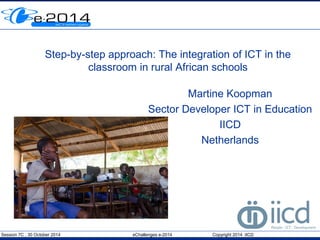
Step-by-step approach: The integration of ICT in the 
classroom in rural African schools 
Martine Koopman 
Sector Developer ICT in Education 
IICD 
Netherlands 
Session 7C , 30 October 2014 eChallenges e-2014 Copyright 2014 IICD
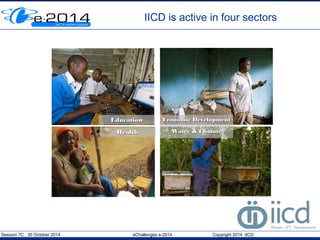
IICD is active in four sectors 
EEccoonnoommiicc DDeevveellooppmmeenntt 
EEdduuccaattiioonn 
HHeeaalltthh WWaatteerr && CClliimmaattee 
Session 7C , 30 October 2014 eChallenges e-2014 Copyright 2014 IICD
IICD Approach 
IICD Video 
Session 7C , 30 October 2014 eChallenges e-2014 Copyright 2014 IICD
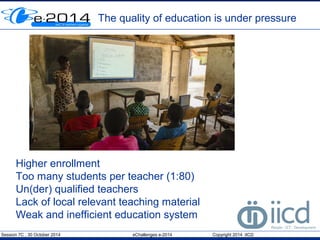
The quality of education is under pressure 
Higher enrollment 
Too many students per teacher (1:80) 
Un(der) qualified teachers 
Lack of local relevant teaching material 
Weak and inefficient education system 
Session 7C , 30 October 2014 eChallenges e-2014 Copyright 2014 IICD
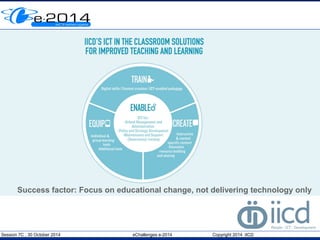
Success factor: Focus on educational change, not delivering technology only 
Session 7C , 30 October 2014 eChallenges e-2014 Copyright 2014 IICD
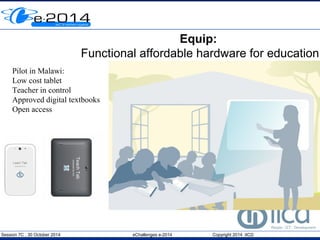
Equip: 
Functional affordable hardware for education 
Pilot in Malawi: 
Low cost tablet 
Teacher in control 
Approved digital textbooks 
Open access 
Session 7C , 30 October 2014 eChallenges e-2014 Copyright 2014 IICD
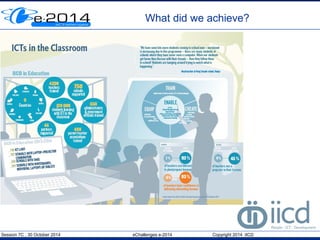
What did we achieve? 
Session 7C , 30 October 2014 eChallenges e-2014 Copyright 2014 IICD
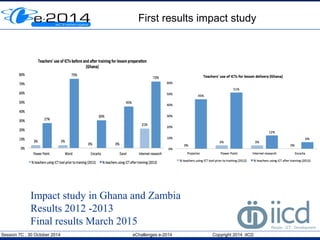
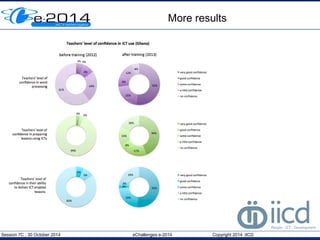
First results impact study 
Impact study in Ghana and Zambia 
Results 2012 -2013 
Final results March 2015 
Session 7C , 30 October 2014 eChallenges e-2014 Copyright 2014 IICD
More results 
Session 7C , 30 October 2014 eChallenges e-2014 Copyright 2014 IICD
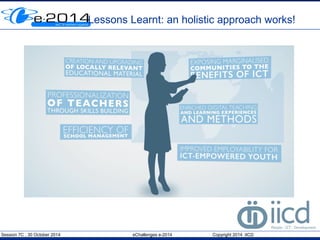
Lessons Learnt: an holistic approach works! 
Session 7C , 30 October 2014 eChallenges e-2014 Copyright 2014 IICD
Questions? 
contact: 
mkoopman@iicd.org 
@martinekoopman 
www.iicd.org 
Session 7C , 30 October 2014 eChallenges e-2014 Copyright 2014 IICD

ICT in African Classroom

  • 1.
    Step-by-step approach: Theintegration of ICT in the classroom in rural African schools Martine Koopman Sector Developer ICT in Education IICD Netherlands Session 7C , 30 October 2014 eChallenges e-2014 Copyright 2014 IICD
  • 2.
    IICD is activein four sectors EEccoonnoommiicc DDeevveellooppmmeenntt EEdduuccaattiioonn HHeeaalltthh WWaatteerr && CClliimmaattee Session 7C , 30 October 2014 eChallenges e-2014 Copyright 2014 IICD
  • 3.
    IICD Approach IICDVideo Session 7C , 30 October 2014 eChallenges e-2014 Copyright 2014 IICD
  • 4.
    The quality ofeducation is under pressure Higher enrollment Too many students per teacher (1:80) Un(der) qualified teachers Lack of local relevant teaching material Weak and inefficient education system Session 7C , 30 October 2014 eChallenges e-2014 Copyright 2014 IICD
  • 5.
    Success factor: Focuson educational change, not delivering technology only Session 7C , 30 October 2014 eChallenges e-2014 Copyright 2014 IICD
  • 6.
    Equip: Functional affordablehardware for education Pilot in Malawi: Low cost tablet Teacher in control Approved digital textbooks Open access Session 7C , 30 October 2014 eChallenges e-2014 Copyright 2014 IICD
  • 7.
    What did weachieve? Session 7C , 30 October 2014 eChallenges e-2014 Copyright 2014 IICD
  • 8.
    First results impactstudy Impact study in Ghana and Zambia Results 2012 -2013 Final results March 2015 Session 7C , 30 October 2014 eChallenges e-2014 Copyright 2014 IICD
  • 9.
    More results Session7C , 30 October 2014 eChallenges e-2014 Copyright 2014 IICD
  • 10.
    Lessons Learnt: anholistic approach works! Session 7C , 30 October 2014 eChallenges e-2014 Copyright 2014 IICD
  • 11.
    Questions? contact: mkoopman@iicd.org @martinekoopman www.iicd.org Session 7C , 30 October 2014 eChallenges e-2014 Copyright 2014 IICD

Editor's Notes

  • #6 Example of holistic approach: Tablet program in Malawi The pilot intervention offers an integrated approach whereby the introduction of the mobile tablets is embedded in an extensive capacity development program in which teachers and students will be supported by IICD and local training partners during the whole project duration. The content and software on the devices are developed based on the local needs and context in combination with the digital textbooks provided by the Malawi Institute of Education. Commitment and local ownership: The high level of commitment and involvement of all partners, stakeholders, users and beneficiaries is a great strength of the pilot. IICD involved all relevant stakeholders from the start of the pilot by including them in IICD’s social innovation process. During this process, stakeholders are actively involved in the different stages of the process from needs assessment and project formulation to ultimately scaling up and systemic change.   The high level of commitment is also reflected in the financial commitment: the involved schools provide their own financial contribution to the pilot: both the Teacher Training College and the Primary School are paying the whole investment back in monthly installments. At the school, the costs will be spread among all the pupils enrolled in the program. One fourth of the places were reserved for well-performing students whose parents weren’t able to afford the one euro per month fee. This commitment will also provide more security for the tablets.   The quality and relevance of the solution (hardware and software) delivered: The software embeds the national curriculum and stimulates interactivity in the classroom. It enables the teacher to monitor his or her students better, especially in overcrowded classrooms. Teachers can also keep track of student performances in a more effective way. The mobility of the hardware makes it easy to adapt in the original classroom setting and its affordability is a great strength.
  • #7 In many Sub Saharan African classrooms, 80 students per teacher is the common reality. IICD recently started a pilot with LearnTabs and TeachTabs in Malawi, where class sizes can reach 150. These android tablets designed by IICD allow the teacher to easily reach all students while they work individually or in small groups for affordable prices (around $100). Teachers are trained on how to use the tablets to design and present content. Students and teachers alike are trained in the use and maintenance of the devices. The larger TeachTab acts partially as a server, able to share information with and monitor the smaller student LearnTabs and giving the teacher control over the whole classroom. The TeachTab also allows the teacher to interact with and prompt questions to the whole classroom at once using the interactive whiteboard functionality. Using the LearnTab, students can work in small groups, collaboratively post answers to quizzes prompted by the teachers or edit the same document or project together. For a demonstration you could come to my table at the exhibition on Wednesday. With these tablets, equipped with materials designated by the Malawi Institute of Education (MIE), classrooms are able to work much more efficiently. Teachers work with the MIE teachers’ guide to develop their own lessons based on this curriculum. While books and other educational materials are not always widely available, the tablets only need one digital copy of a textbook, many of which are freely available from the MIE or other sources. On top of that Teachers could add their own content, e-Books or open educational resources found on the internet.