Defining ICT
[1.1] How to study this unit
[1.2] Defining ICT
[1.3] Defining ICT in language learning
[1.4] History of ICT tools used in the ESL classroom
1
U
N
I
T
ICT Tools Applied to the Learning of English Language
UNIT 1 – Key ideas
Key ideas
1.1. How to study this unit
To study this unit, you need to read the key ideas and the article “ICT in English”, by
Peter Miles, available in the following link:
http://es.scribd.com/doc/73502262/Unit-1-WH-ICT-in-English
Study, from this article, the following pages:
Defining ICT (p. 1-4)
ICT in the English classroom (p. 6-13)
Basic ICT skills (p.18)
English department: Survey of opinions on ICT (p.24)
Audit of ICT skills: English (p.25-27)
In this first unit, as a brief introduction to the course, we are going to remember the
importance of information and communication technology (ICT) in our daily
life and in our teaching practice.
We are also going to define, in a few lines, what ICT is and revise the story of the use of
technology in language classes at school.
1.2. Defining ICT
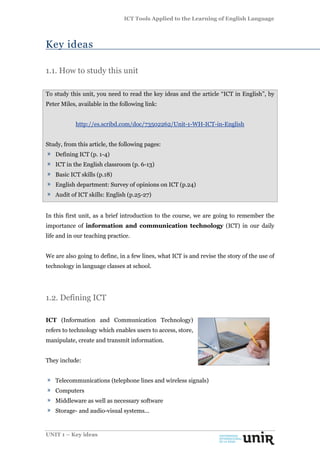
ICT (Information and Communication Technology)
refers to technology which enables users to access, store,
manipulate, create and transmit information.
They include:
Telecommunications (telephone lines and wireless signals)
Computers
Middleware as well as necessary software
Storage- and audio-visual systems...
ICT Tools Applied to the Learning of English Language
UNIT 1 – Key ideas
As you can see, ICT implies much more than just Internet, although it is the most
important tool.
Internet is essential for communication and information nowadays; and for
teachers, it’s also become the most important source of resources and teaching
tools for their work.
1.3. Defining ICT in language learning
Importance of technology
Technology is nowadays a basic element in our personal and professional lives.
It influences the way we perform daily tasks such as banking, shopping and
communicating among many others tasks.
In fact, we could be amazed by the quantity of tasks we perform through these tools in
our ordinary lives. No matter how small or isolated a place seems to be, either to live or
to stay, it’s usually easy to find an Internet cafe to connect us to the world.
And in this technological society, it is a fact that teaching and learning have also
been affected by the use of technology.
English teachers as users of technology at work: too much?
Our work as educators have been flooded with so many
resources and tools to be used in the classroom that we are
sometimes overwhelmed and feel confused about how, when
and where to use them.
Do you agree? Do you think there are too many materials for teachers or do you think
teachers should actually up to date with technology a bit more?
It’s true that in our daily teaching practice we are sometimes a bit reluctant to use
technology. Nevertheless:
ICT Tools Applied to the Learning of English Language
UNIT 1 – Key ideas
All teachers have used technology in their classes at a given moment, not only as
a help in their teaching but also as an invaluable tool to create materials.
1.4. Short history of ICT used in the ESL classroom
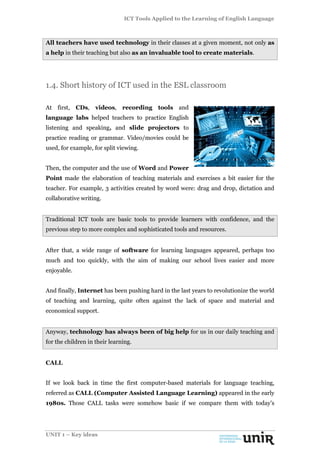
At first, CDs, videos, recording tools and
language labs helped teachers to practice English
listening and speaking, and slide projectors to
practice reading or grammar. Video/movies could be
used, for example, for split viewing.
Then, the computer and the use of Word and Power
Point made the elaboration of teaching materials and exercises a bit easier for the
teacher. For example, 3 activities created by word were: drag and drop, dictation and
collaborative writing.
Traditional ICT tools are basic tools to provide learners with confidence, and the
previous step to more complex and sophisticated tools and resources.
After that, a wide range of software for learning languages appeared, perhaps too
much and too quickly, with the aim of making our school lives easier and more
enjoyable.
And finally, Internet has been pushing hard in the last years to revolutionize the world
of teaching and learning, quite often against the lack of space and material and
economical support.
Anyway, technology has always been of big help for us in our daily teaching and
for the children in their learning.
CALL
If we look back in time the first computer-based materials for language teaching,
referred as CALL (Computer Assisted Language Learning) appeared in the early
1980s. Those CALL tasks were somehow basic if we compare them with today’s
ICT Tools Applied to the Learning of English Language
UNIT 1 – Key ideas
possibilities. Gap-filling, text reconstruction, multiple-choice exercises were among the
typical tasks the learner needed to carry out.
Does it sound familiar? Yes, we still have that format in the typical CD-Rom which
comes with our textbooks. We are not saying that is old-fashioned or that it is
useless but quite the opposite. However, our approach to that format needs to be new,
adapting ourselves to the new possibilities technology offers in the sense of enhancing
and developing our creativity, something we will see in more details in other units of
the course.
As Information and Communications Technology (ICT) became much more
widespread, CALL activities or format has adopted Internet and web-based
tools to offer more possibilities in the language learning. The combination of both
tools is what Nicky Hockley calls TELL (Technology Enhanced Language
Learning) in the 1990s.
What is new about ICT in an English class?
Lots of teachers are not digital natives; they were not born nor grew up with
technology as an integral part of his/her daily life, unlike their students.
But this is not an excuse for not using ICT anymore.
How do we implement ICT tools in the classroom? Implementing doesn’t mean
having a computer in the classroom, nor having a room with computers in the premises
where to go and practice once in a while, but:
Using Internet and other ICT tools to create material, perform tasks and make students
participate in the learning process.
What is new about ICT in an English class?
Our active participation in its usage and its implementation into our teaching
planning.
ICT Tools Applied to the Learning of English Language
UNIT 1 – Key ideas
Technology doesn’t mean neither the tool to fill time in our lessons nor a source to
know about the world with no links to our classes anymore. Technology has become an
integral part in today’s schools and we need to be the catalysts to implement it in
the classroom.
Technology and teachers are not interchangeable but complementary. Both
play different roles in the teaching experience.
Why is applying technology in our teaching practice so important? On the one hand,
it is an essential tool for students’ and teachers’ feedback and assessment; on the other
hand, Internet provides with resources like authentic material for classroom use and
develops collaborative tasks.
In the next units we are going to study all these tools more thoroughly, not only what
they consist of but also and specially their practical use in your the ESL lessons.
ICT Tools Applied to the Learning of English Language
UNIT 1 – In Depth
In Depth
Read
Read these interesting documents about the importance of ICTs in the world of
education.
“El impacto de la Sociedad de la Información en el mundo educativo
Essay about the impact of ICT tools in the world of education and the changes our
educational system has gone through to be updated.
The information is in the virtual classroom or in the following link:
http://www.peremarques.net/impacto.htm
Indicadores del uso de las TIC en Europa y en España en 2009 y
2010.Instituto de Tecnologías Educativas
Read this document about ICTs and its use in the European Union.
The information is in the virtual classroom or in the following link:
http://recursostic.educacion.es/blogs/europa/media/blogs/europa/informes/Indicadores_y_d
atos_de_las_TIC_en_la_%20Educacion_en_Europa_y_Espana_ITE_2009.pdf
ICT Tools Applied to the Learning of English Language
UNIT 1 – In Depth
Watch
Watch these interesting videos about the importance of ICTs in the world of education:
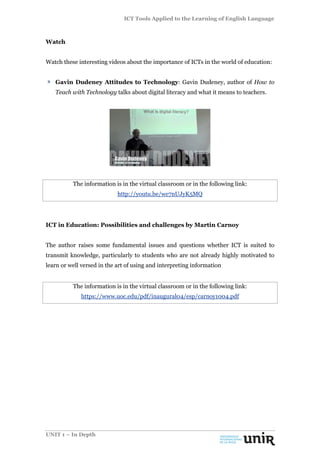
Gavin Dudeney Attitudes to Technology: Gavin Dudeney, author of How to
Teach with Technology talks about digital literacy and what it means to teachers.
The information is in the virtual classroom or in the following link:
http://youtu.be/we7nUJyK5MQ
ICT in Education: Possibilities and challenges by Martin Carnoy
The author raises some fundamental issues and questions whether ICT is suited to
transmit knowledge, particularly to students who are not already highly motivated to
learn or well versed in the art of using and interpreting information
The information is in the virtual classroom or in the following link:
https://www.uoc.edu/pdf/inaugural04/esp/carnoy1004.pdf
ICT Tools Applied to the Learning of English Language
UNIT 1 – In Depth
Nick Peachey’s Learning Technology Blog
Nick Peachey’s blogs teaches how to use and implement technology in our teaching
practice. Lots of tips, videos and up-to-date tools to develop teachers’ creativity.
http://nikpeachey.blogspot.com/
http://www.scoop.it/t/learning-technology
ICT Tools Applied to the Learning of English Language
UNIT 1 – Test
Test
1. What’s the definition of digital native?
A. A person who has taken technology as a way of life.
B. A person who was born and is growing up with technology as an integral part of
his/her daily life.
C. A native speaker of English who uses the computer to learn English.
2. How do we implement ICT tools in the classroom?
A. Having a computer in the classroom.
B. Using Internet, and other ICT tools to create material, perform tasks and make
students participate in the learning process.
C. Having a room with computers in the premises where to go and practice once in
a while.
3. Are technology and teachers interchangeable?
A. Of course. Technology is a great resource for teachers’ stress and burn-out.
B. No, they are complementary. Both play different roles in the teaching
experience.
C. Depends on the age of the students and level of digital literacy.
4. Why is applying technology in our teaching practice so important?
A. Internet provides resources like authentic material for classroom use and
develops collaborative tasks.
B. It is an essential tool for students’ and teachers’ feedback and assessment.
C. Both are correct.
5. 3 main activities created by Word:
A. Drag and drop, dictation and collaborative writing.
B. Listening, creating forms and noticing activity.
C. Creating presentations, inserting images and links and dictation.
6. Traditional ICT tools are not used anymore in the classroom:
A. TRUE. Teachers’ do not know what they are as they are digital natives.
ICT Tools Applied to the Learning of English Language
UNIT 1 – Test
B. FALSE. They are the basic tools we may use to provide confidence in the
learners and the previous step to more complex and sophisticated tools and
resources.
C. TRUE. Nobody uses Word Processors, movies or PowerPoint to enhance their
teaching tasks.
7. Video/movies can be used for:
A. Creating forms.
B. Information gap activity.
C. Split viewing.
8. As you read in the article, ICT combines telecommunications, computing and
broadcasting, and covers any product that will store, manipulate, transmit or receive
information electronically.
A. True.
B. False.
9. According to the article, ICT tools come in two categories:
A. Hardware and software.
B. Computer and Internet.
C. Input and output devices.
10. Moving material between applications (programs) is one of the particular skills you
need to be competent in.
A. True
B. False

unit1.pdf

  • 1.
    Defining ICT [1.1] Howto study this unit [1.2] Defining ICT [1.3] Defining ICT in language learning [1.4] History of ICT tools used in the ESL classroom 1 U N I T
  • 2.
    ICT Tools Appliedto the Learning of English Language UNIT 1 – Key ideas Key ideas 1.1. How to study this unit To study this unit, you need to read the key ideas and the article “ICT in English”, by Peter Miles, available in the following link: http://es.scribd.com/doc/73502262/Unit-1-WH-ICT-in-English Study, from this article, the following pages: Defining ICT (p. 1-4) ICT in the English classroom (p. 6-13) Basic ICT skills (p.18) English department: Survey of opinions on ICT (p.24) Audit of ICT skills: English (p.25-27) In this first unit, as a brief introduction to the course, we are going to remember the importance of information and communication technology (ICT) in our daily life and in our teaching practice. We are also going to define, in a few lines, what ICT is and revise the story of the use of technology in language classes at school. 1.2. Defining ICT ICT (Information and Communication Technology) refers to technology which enables users to access, store, manipulate, create and transmit information. They include: Telecommunications (telephone lines and wireless signals) Computers Middleware as well as necessary software Storage- and audio-visual systems...
  • 3.
    ICT Tools Appliedto the Learning of English Language UNIT 1 – Key ideas As you can see, ICT implies much more than just Internet, although it is the most important tool. Internet is essential for communication and information nowadays; and for teachers, it’s also become the most important source of resources and teaching tools for their work. 1.3. Defining ICT in language learning Importance of technology Technology is nowadays a basic element in our personal and professional lives. It influences the way we perform daily tasks such as banking, shopping and communicating among many others tasks. In fact, we could be amazed by the quantity of tasks we perform through these tools in our ordinary lives. No matter how small or isolated a place seems to be, either to live or to stay, it’s usually easy to find an Internet cafe to connect us to the world. And in this technological society, it is a fact that teaching and learning have also been affected by the use of technology. English teachers as users of technology at work: too much? Our work as educators have been flooded with so many resources and tools to be used in the classroom that we are sometimes overwhelmed and feel confused about how, when and where to use them. Do you agree? Do you think there are too many materials for teachers or do you think teachers should actually up to date with technology a bit more? It’s true that in our daily teaching practice we are sometimes a bit reluctant to use technology. Nevertheless:
  • 4.
    ICT Tools Appliedto the Learning of English Language UNIT 1 – Key ideas All teachers have used technology in their classes at a given moment, not only as a help in their teaching but also as an invaluable tool to create materials. 1.4. Short history of ICT used in the ESL classroom At first, CDs, videos, recording tools and language labs helped teachers to practice English listening and speaking, and slide projectors to practice reading or grammar. Video/movies could be used, for example, for split viewing. Then, the computer and the use of Word and Power Point made the elaboration of teaching materials and exercises a bit easier for the teacher. For example, 3 activities created by word were: drag and drop, dictation and collaborative writing. Traditional ICT tools are basic tools to provide learners with confidence, and the previous step to more complex and sophisticated tools and resources. After that, a wide range of software for learning languages appeared, perhaps too much and too quickly, with the aim of making our school lives easier and more enjoyable. And finally, Internet has been pushing hard in the last years to revolutionize the world of teaching and learning, quite often against the lack of space and material and economical support. Anyway, technology has always been of big help for us in our daily teaching and for the children in their learning. CALL If we look back in time the first computer-based materials for language teaching, referred as CALL (Computer Assisted Language Learning) appeared in the early 1980s. Those CALL tasks were somehow basic if we compare them with today’s
  • 5.
    ICT Tools Appliedto the Learning of English Language UNIT 1 – Key ideas possibilities. Gap-filling, text reconstruction, multiple-choice exercises were among the typical tasks the learner needed to carry out. Does it sound familiar? Yes, we still have that format in the typical CD-Rom which comes with our textbooks. We are not saying that is old-fashioned or that it is useless but quite the opposite. However, our approach to that format needs to be new, adapting ourselves to the new possibilities technology offers in the sense of enhancing and developing our creativity, something we will see in more details in other units of the course. As Information and Communications Technology (ICT) became much more widespread, CALL activities or format has adopted Internet and web-based tools to offer more possibilities in the language learning. The combination of both tools is what Nicky Hockley calls TELL (Technology Enhanced Language Learning) in the 1990s. What is new about ICT in an English class? Lots of teachers are not digital natives; they were not born nor grew up with technology as an integral part of his/her daily life, unlike their students. But this is not an excuse for not using ICT anymore. How do we implement ICT tools in the classroom? Implementing doesn’t mean having a computer in the classroom, nor having a room with computers in the premises where to go and practice once in a while, but: Using Internet and other ICT tools to create material, perform tasks and make students participate in the learning process. What is new about ICT in an English class? Our active participation in its usage and its implementation into our teaching planning.
  • 6.
    ICT Tools Appliedto the Learning of English Language UNIT 1 – Key ideas Technology doesn’t mean neither the tool to fill time in our lessons nor a source to know about the world with no links to our classes anymore. Technology has become an integral part in today’s schools and we need to be the catalysts to implement it in the classroom. Technology and teachers are not interchangeable but complementary. Both play different roles in the teaching experience. Why is applying technology in our teaching practice so important? On the one hand, it is an essential tool for students’ and teachers’ feedback and assessment; on the other hand, Internet provides with resources like authentic material for classroom use and develops collaborative tasks. In the next units we are going to study all these tools more thoroughly, not only what they consist of but also and specially their practical use in your the ESL lessons.
  • 7.
    ICT Tools Appliedto the Learning of English Language UNIT 1 – In Depth In Depth Read Read these interesting documents about the importance of ICTs in the world of education. “El impacto de la Sociedad de la Información en el mundo educativo Essay about the impact of ICT tools in the world of education and the changes our educational system has gone through to be updated. The information is in the virtual classroom or in the following link: http://www.peremarques.net/impacto.htm Indicadores del uso de las TIC en Europa y en España en 2009 y 2010.Instituto de Tecnologías Educativas Read this document about ICTs and its use in the European Union. The information is in the virtual classroom or in the following link: http://recursostic.educacion.es/blogs/europa/media/blogs/europa/informes/Indicadores_y_d atos_de_las_TIC_en_la_%20Educacion_en_Europa_y_Espana_ITE_2009.pdf
  • 8.
    ICT Tools Appliedto the Learning of English Language UNIT 1 – In Depth Watch Watch these interesting videos about the importance of ICTs in the world of education: Gavin Dudeney Attitudes to Technology: Gavin Dudeney, author of How to Teach with Technology talks about digital literacy and what it means to teachers. The information is in the virtual classroom or in the following link: http://youtu.be/we7nUJyK5MQ ICT in Education: Possibilities and challenges by Martin Carnoy The author raises some fundamental issues and questions whether ICT is suited to transmit knowledge, particularly to students who are not already highly motivated to learn or well versed in the art of using and interpreting information The information is in the virtual classroom or in the following link: https://www.uoc.edu/pdf/inaugural04/esp/carnoy1004.pdf
  • 9.
    ICT Tools Appliedto the Learning of English Language UNIT 1 – In Depth Nick Peachey’s Learning Technology Blog Nick Peachey’s blogs teaches how to use and implement technology in our teaching practice. Lots of tips, videos and up-to-date tools to develop teachers’ creativity. http://nikpeachey.blogspot.com/ http://www.scoop.it/t/learning-technology
  • 10.
    ICT Tools Appliedto the Learning of English Language UNIT 1 – Test Test 1. What’s the definition of digital native? A. A person who has taken technology as a way of life. B. A person who was born and is growing up with technology as an integral part of his/her daily life. C. A native speaker of English who uses the computer to learn English. 2. How do we implement ICT tools in the classroom? A. Having a computer in the classroom. B. Using Internet, and other ICT tools to create material, perform tasks and make students participate in the learning process. C. Having a room with computers in the premises where to go and practice once in a while. 3. Are technology and teachers interchangeable? A. Of course. Technology is a great resource for teachers’ stress and burn-out. B. No, they are complementary. Both play different roles in the teaching experience. C. Depends on the age of the students and level of digital literacy. 4. Why is applying technology in our teaching practice so important? A. Internet provides resources like authentic material for classroom use and develops collaborative tasks. B. It is an essential tool for students’ and teachers’ feedback and assessment. C. Both are correct. 5. 3 main activities created by Word: A. Drag and drop, dictation and collaborative writing. B. Listening, creating forms and noticing activity. C. Creating presentations, inserting images and links and dictation. 6. Traditional ICT tools are not used anymore in the classroom: A. TRUE. Teachers’ do not know what they are as they are digital natives.
  • 11.
    ICT Tools Appliedto the Learning of English Language UNIT 1 – Test B. FALSE. They are the basic tools we may use to provide confidence in the learners and the previous step to more complex and sophisticated tools and resources. C. TRUE. Nobody uses Word Processors, movies or PowerPoint to enhance their teaching tasks. 7. Video/movies can be used for: A. Creating forms. B. Information gap activity. C. Split viewing. 8. As you read in the article, ICT combines telecommunications, computing and broadcasting, and covers any product that will store, manipulate, transmit or receive information electronically. A. True. B. False. 9. According to the article, ICT tools come in two categories: A. Hardware and software. B. Computer and Internet. C. Input and output devices. 10. Moving material between applications (programs) is one of the particular skills you need to be competent in. A. True B. False