1
Views expressed in this presentation are those of the staff and do not
necessarily represent the views of the Commission
Advanced Compliance Course
Saint Louis University
April 23, 2014
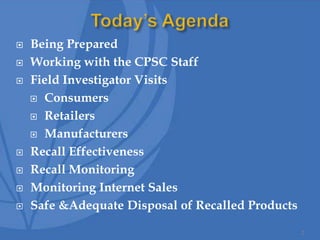
 Being Prepared
 Working with the CPSC Staff
 Field Investigator Visits
 Consumers
 Retailers
 Manufacturers
 Recall Effectiveness
 Recall Monitoring
 Monitoring Internet Sales
 Safe &Adequate Disposal of Recalled Products
2
3
 Recall Handbook – Section 15 – Defects
 March 2012
 Home/Business & Manufacturing/Recall Guidance
 Regulated Products Handbook
 May 2013
 Home/Business & Manufacturing/Recall Guidance
 Handbook For Manufacturing Safer
Consumer Products
 July 2006
 Products
 Voluntary Standards
 Home/Regulations, Law & Standards
4
 Have internal controls and procedures in
place to routinely review and capture data
 Update these frequently
 Disclose required information to Regulators
 Provide employees with training
 written standards and policies
 Document everything in writing and make it
available upon request
 compliance training
 mechanism to report issues
 Empower employees to disclose weaknesses
to Executives
5
Know how to Handle Returns from distribution
chain
 Parts orders
 Consumer complaints, claims, lawsuits
 online product reviews
 Product life testing
 Quality assurance/ product improvement
 Material changes
 Retailer reports/ feedback
 Incidents from CPSC saferproducts.gov
6
7
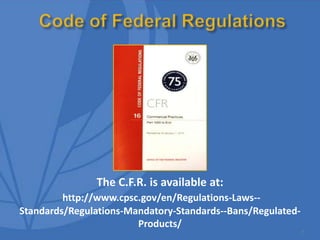
The C.F.R. is available at:
http://www.cpsc.gov/en/Regulations-Laws--
Standards/Regulations-Mandatory-Standards--Bans/Regulated-
Products/
 News Report
 Follow-up to an in-depth investigation
 Potentially hazardous product was identified but
responsible firm is not clear.
 Manufacturer, importer or retailer of possibly
defective product was identified and additional
information is needed to determine whether
substantial product hazard exists.
 Ongoing voluntary and regulated product
standards compliance monitoring
9
• Hot Line reports
• Public Data base
• Civic groups
• Attorneys
• Retailers
• State death certificates
• MECAPS reports
• Consumers
• Internet surveillance
• Medical professionals
• CPSC Field Investigations
• Newspapers, radio, television, Internet, trade blogs, etc.
• Fire & police reports, Non-MECAP coroners, hospitals
10
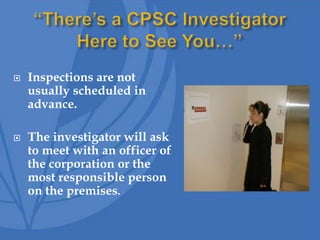
 Inspections are not
usually scheduled in
advance.
 The investigator will ask
to meet with an officer of
the corporation or the
most responsible person
on the premises.
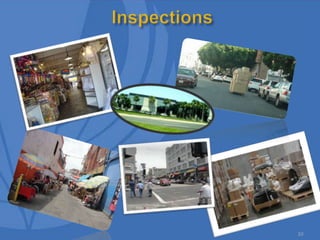
Grants CPSC investigators the right, upon
presenting appropriate credentials and a written
notice from the Commission to the owner,
operator, or agent in charge, to enter and inspect, at
reasonable times and in a reasonable manner:
 (A) any factory, warehouse, or establishment in which
consumer products are manufactured or held, in
connection with distribution in commerce,
 (B) any firewalled conformity assessment bodies
accredited under section 14(f)(2)(D), or
 (C) any conveyance being used to transport consumer
products in connection with distribution in commerce.
12
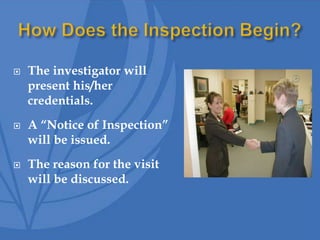
 The investigator will
present his/her
credentials.
 A “Notice of Inspection”
will be issued.
 The reason for the visit
will be discussed.
 Section 16(b) of the CPSA
 All records, reports, books, documents,
papers or labeling which show or relate to
the production, inventory, testing,
distribution, sale, transportation,
importation, or receipt of any product or
component thereof
 Samples of the product
 Any factory area, warehouse area, or office area
in which consumer products are manufactured
or held in connection with distribution into
commerce, or any area where documentation is
held which is needed to complete the
inspection.
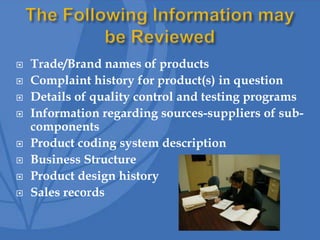
 Trade/Brand names of products
 Complaint history for product(s) in question
 Details of quality control and testing programs
 Information regarding sources-suppliers of sub-
components
 Product coding system description
 Business Structure
 Product design history
 Sales records
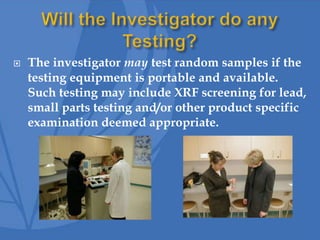
 The investigator may test random samples if the
testing equipment is portable and available.
Such testing may include XRF screening for lead,
small parts testing and/or other product specific
examination deemed appropriate.
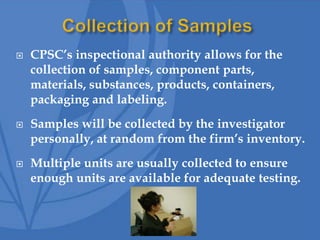
 CPSC’s inspectional authority allows for the
collection of samples, component parts,
materials, substances, products, containers,
packaging and labeling.
 Samples will be collected by the investigator
personally, at random from the firm’s inventory.
 Multiple units are usually collected to ensure
enough units are available for adequate testing.
 Sections 19(a)(3) of the CPSA and 4(e) of the
FHSA: It is unlawful for any person to fail or
refuse to permit access to or copying of
records . . . . or fail or refuse to permit entry or
inspection.
19
 Section 19(a)(3) of the CPSA: It is unlawful for any
person to fail or refuse to permit access to or copying of
records, or fail or refuse to establish or maintain records,
or fail or refuse to make reports or provide information,
or fail or refuse to permit entry or inspection.
 18 U.S.C. Section 1001: (criminal statute)
(1) falsifies, conceals, or covers up by any trick, scheme,
or device, a material fact;
(2) makes any materially false, fictitious, or fraudulent
statement or representation; or
(3) makes or uses any false writing or document knowing
the same to contain any materially false, fictitious, or
fraudulent statement or entry 20
 If you are a manufacturer, retailer, or reseller of consumer
products, know what rules apply to your business. Being
informed is being empowered.
 CPSC wants your business to succeed and your customers
to be safe. We are a resource to educate you on the steps
your business should take to comply with our safety rules.
 Review our Business & Manufacturing guidance on
CPSC.gov, watch our special presentations for industry
from CPSC technical and compliance staff.
 Maintain good records. Document the history of products
from initial design to current QC reviews. Implement a
first-class quality control system to ensure you meet
U.S. consumer product safety requirements.
22
23
 Field investigation conducted
 Compliance initiates contact with the firm
 Epidemiology conducts data search
 Engineering performs testing (both
failure mode and performance testing)
 Preliminary Determination made (for
non- Fast-Track cases)
 Negotiate recall
 Notification to consumers
 Section 15 of the CPSA
 The manufacturer, importer, distributor, or retailer is
required to report immediately upon obtaining
information which reasonably supports the conclusion
that a product:
Fails to meet a rule, regulation, standard, or ban
under the CPSA or any other statute enforced by the
CPSC;
Contains a defect which could create a substantial
product hazard to consumers; or
Creates an unreasonable risk of serious injury or
death.
24
 Covers both Fast Track and non-Fast Track
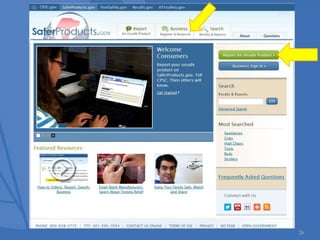
 We encourage reporting under Section 15 on our
website or via e-mail to the Section 15 mailbox.
 Faster, easier to track and route
 Add photos and other documents
 On our website at: www.cpsc.gov
 On right hand side under “Businesses”
 Or via email to: Section15@cpsc.gov
 We discourage reporting via phone, mailed letter, or
fax.
 Much slower, harder to track, and much easier to
get lost or duplicated during routing
26
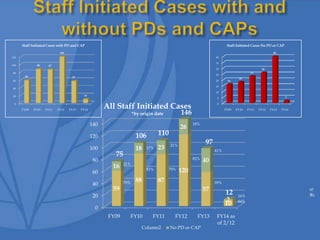
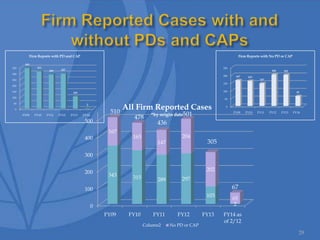
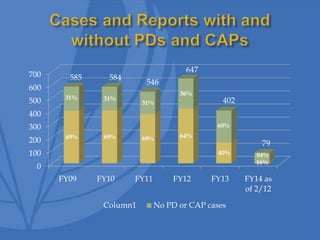
 Not all Section15(b) reports result in recalls.
 Approximately 40% of the Section15 reports
received, result in no action by the staff.
 Where the staff initiates its own
investigation, the likelihood of eventual
recall increases.
 Don’t wait for us to call you – you should be
calling us first!
27
0
20
40
60
80
100
120
FY09 FY10 FY11 FY12 FY13 FY14
59
88 87
120
57
10
Staff Initiated Cases with PD and CAP
0
5
10
15
20
25
30
35
40
FY09 FY10 FY11 FY12 FY13 FY14
16
18
23
26
40
2
Staff Initiated Cases No PD or CAP
0
20
40
60
80
100
120
140
FY09 FY10 FY11 FY12 FY13 FY14 as
of 2/12
59
88 87
120
57
10
16
18 23
26
40
2
75
106 110
146
97
12
All Staff Initiated Cases
*by origin date
Column2 No PD or CAP
21%
79%
17%
83%
21%
79%
18%
82%
41%
59%
16%
84%
97
%3%
29
0
50
100
150
200
250
300
350
FY09 FY10 FY11 FY12 FY13 FY14
343
315
289 297
103
2
Firm Reports with PD and CAP
0
50
100
150
200
250
FY09 FY10 FY11 FY12 FY13 FY14
167 163
147
204 202
65
Firm Reports with No PD or CAP
0
100
200
300
400
500
FY09 FY10 FY11 FY12 FY13 FY14 as
of 2/12
343 315 289 297
103
2
167
163
147
204
202
65
510
478
436
501
305
67
All Firm Reported Cases
*by origin date
Column2 No PD or CAP
0
100
200
300
400
500
600
700
FY09 FY10 FY11 FY12 FY13 FY14 as
of 2/12
69% 69% 69% 64%
40%
16%
31% 31%
31%
36%
60%
84%
585 584
546
647
402
79
Column1 No PD or CAP cases
0
50
100
150
200
250
300
350
400
450
500
FY10 FY11 FY12 FY13 FY14 as of
1/30
414 378 412
345
96
62
30
32
28
6
476
408
444
373
102
Series 3 Regulated
31
 Corrective action is not over when recall is announced
 Investigator will likely be visiting to review recall
progress
 Report any changes to the corrective action plan
agreement
 Have all possible distributors and customers been
notified? How/ When? Review documentation. Should
a second effort to contact customers be done? Should
other means of notification be considered?
32
 Are there final numbers regarding the number of
units involved? Additional models? Should the
recall be expanded due to new information
received due to publicity?
 Examination and rough inventory of units
already under firm’s control and not distributed.
Properly segregated?
 Reverse logistics: How are returned units being
tracked? Proof of consumer destruction
documented? Where are they being stored?
Segregated from new units?
33
 Have you been submitting required monthly reports?
 Records? Who is responsible for overall tracking? Have
you taken steps to prevent previously returned recalled
units from being sold?
 Have you worked out a repair verification procedure?
How will consumers/ retailers/ investigators know that
future stock in store does not include non-refurbished/
old units that were recalled?
 How many units have been returned/ corrected to-date?
By what measure will you be satisfied?
 Are products quarantined?
34
35
 The purpose of the recall is to alert the public,
and specifically the purchasers of the product,
that the product may pose a hazard and what
action should be taken
 Comprehensive and continuing efforts must be
made to reach all relevant consumers as quickly
as possible
 Some recalls have different success rates than
others. Why? What creative methods have you
used to reach your customers?
36
37
 Know if you will need special disposal for items like
batteries or electronics (federal, state, or local laws.)
 If retailers will be disposing or destroying the product
or if you are using a 3rd party, we need to know.
 Before you destroy, dispose, or recycle recalled products
notify CPSC staff via e-mail to
recallproductdisposal@cpsc.gov
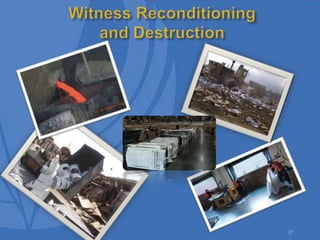
 Field staff may witness destruction/disposal/recycling
or require an affidavit to verify process.
 Notify us of plan as early as possible.
38
 Monthly progress reports – focus on post-
recall injuries
 Conduct Recall Verification Inspection at
recalling company
 Execute recall checks at points of sale
conducted by CPSC and/or State
Investigators
 Internet Surveillance Unit identifies sale of
recalled products reported to
websafety@cpsc.gov and through other sources
39
40
sect15@cpsc.gov
recalledproductdisposal@cpsc.gov
www.websafety@cpsc.gov
www.cpsc.gov
www.saferproducts.gov
Marc Schoem
301-504-7520
mschoem@cpsc.gov
Dennis Blasius
262-650-1216
dblasius@cpsc.gov

ICPHSO 2014 Advanced Compliance Course

  • 1.
    1 Views expressed inthis presentation are those of the staff and do not necessarily represent the views of the Commission Advanced Compliance Course Saint Louis University April 23, 2014
  • 2.
     Being Prepared Working with the CPSC Staff  Field Investigator Visits  Consumers  Retailers  Manufacturers  Recall Effectiveness  Recall Monitoring  Monitoring Internet Sales  Safe &Adequate Disposal of Recalled Products 2
  • 3.
  • 4.
     Recall Handbook– Section 15 – Defects  March 2012  Home/Business & Manufacturing/Recall Guidance  Regulated Products Handbook  May 2013  Home/Business & Manufacturing/Recall Guidance  Handbook For Manufacturing Safer Consumer Products  July 2006  Products  Voluntary Standards  Home/Regulations, Law & Standards 4
  • 5.
     Have internalcontrols and procedures in place to routinely review and capture data  Update these frequently  Disclose required information to Regulators  Provide employees with training  written standards and policies  Document everything in writing and make it available upon request  compliance training  mechanism to report issues  Empower employees to disclose weaknesses to Executives 5
  • 6.
    Know how toHandle Returns from distribution chain  Parts orders  Consumer complaints, claims, lawsuits  online product reviews  Product life testing  Quality assurance/ product improvement  Material changes  Retailer reports/ feedback  Incidents from CPSC saferproducts.gov 6
  • 7.
    7 The C.F.R. isavailable at: http://www.cpsc.gov/en/Regulations-Laws-- Standards/Regulations-Mandatory-Standards--Bans/Regulated- Products/
  • 8.
     News Report Follow-up to an in-depth investigation  Potentially hazardous product was identified but responsible firm is not clear.  Manufacturer, importer or retailer of possibly defective product was identified and additional information is needed to determine whether substantial product hazard exists.  Ongoing voluntary and regulated product standards compliance monitoring
  • 9.
    9 • Hot Linereports • Public Data base • Civic groups • Attorneys • Retailers • State death certificates • MECAPS reports • Consumers • Internet surveillance • Medical professionals • CPSC Field Investigations • Newspapers, radio, television, Internet, trade blogs, etc. • Fire & police reports, Non-MECAP coroners, hospitals
  • 10.
  • 11.
     Inspections arenot usually scheduled in advance.  The investigator will ask to meet with an officer of the corporation or the most responsible person on the premises.
  • 12.
    Grants CPSC investigatorsthe right, upon presenting appropriate credentials and a written notice from the Commission to the owner, operator, or agent in charge, to enter and inspect, at reasonable times and in a reasonable manner:  (A) any factory, warehouse, or establishment in which consumer products are manufactured or held, in connection with distribution in commerce,  (B) any firewalled conformity assessment bodies accredited under section 14(f)(2)(D), or  (C) any conveyance being used to transport consumer products in connection with distribution in commerce. 12
  • 13.
     The investigatorwill present his/her credentials.  A “Notice of Inspection” will be issued.  The reason for the visit will be discussed.
  • 14.
     Section 16(b)of the CPSA  All records, reports, books, documents, papers or labeling which show or relate to the production, inventory, testing, distribution, sale, transportation, importation, or receipt of any product or component thereof  Samples of the product
  • 15.
     Any factoryarea, warehouse area, or office area in which consumer products are manufactured or held in connection with distribution into commerce, or any area where documentation is held which is needed to complete the inspection.
  • 16.
     Trade/Brand namesof products  Complaint history for product(s) in question  Details of quality control and testing programs  Information regarding sources-suppliers of sub- components  Product coding system description  Business Structure  Product design history  Sales records
  • 17.
     The investigatormay test random samples if the testing equipment is portable and available. Such testing may include XRF screening for lead, small parts testing and/or other product specific examination deemed appropriate.
  • 18.
     CPSC’s inspectionalauthority allows for the collection of samples, component parts, materials, substances, products, containers, packaging and labeling.  Samples will be collected by the investigator personally, at random from the firm’s inventory.  Multiple units are usually collected to ensure enough units are available for adequate testing.
  • 19.
     Sections 19(a)(3)of the CPSA and 4(e) of the FHSA: It is unlawful for any person to fail or refuse to permit access to or copying of records . . . . or fail or refuse to permit entry or inspection. 19
  • 20.
     Section 19(a)(3)of the CPSA: It is unlawful for any person to fail or refuse to permit access to or copying of records, or fail or refuse to establish or maintain records, or fail or refuse to make reports or provide information, or fail or refuse to permit entry or inspection.  18 U.S.C. Section 1001: (criminal statute) (1) falsifies, conceals, or covers up by any trick, scheme, or device, a material fact; (2) makes any materially false, fictitious, or fraudulent statement or representation; or (3) makes or uses any false writing or document knowing the same to contain any materially false, fictitious, or fraudulent statement or entry 20
  • 21.
     If youare a manufacturer, retailer, or reseller of consumer products, know what rules apply to your business. Being informed is being empowered.  CPSC wants your business to succeed and your customers to be safe. We are a resource to educate you on the steps your business should take to comply with our safety rules.  Review our Business & Manufacturing guidance on CPSC.gov, watch our special presentations for industry from CPSC technical and compliance staff.  Maintain good records. Document the history of products from initial design to current QC reviews. Implement a first-class quality control system to ensure you meet U.S. consumer product safety requirements.
  • 22.
  • 23.
    23  Field investigationconducted  Compliance initiates contact with the firm  Epidemiology conducts data search  Engineering performs testing (both failure mode and performance testing)  Preliminary Determination made (for non- Fast-Track cases)  Negotiate recall  Notification to consumers
  • 24.
     Section 15of the CPSA  The manufacturer, importer, distributor, or retailer is required to report immediately upon obtaining information which reasonably supports the conclusion that a product: Fails to meet a rule, regulation, standard, or ban under the CPSA or any other statute enforced by the CPSC; Contains a defect which could create a substantial product hazard to consumers; or Creates an unreasonable risk of serious injury or death. 24
  • 25.
     Covers bothFast Track and non-Fast Track  We encourage reporting under Section 15 on our website or via e-mail to the Section 15 mailbox.  Faster, easier to track and route  Add photos and other documents  On our website at: www.cpsc.gov  On right hand side under “Businesses”  Or via email to: Section15@cpsc.gov  We discourage reporting via phone, mailed letter, or fax.  Much slower, harder to track, and much easier to get lost or duplicated during routing
  • 26.
  • 27.
     Not allSection15(b) reports result in recalls.  Approximately 40% of the Section15 reports received, result in no action by the staff.  Where the staff initiates its own investigation, the likelihood of eventual recall increases.  Don’t wait for us to call you – you should be calling us first! 27
  • 28.
    0 20 40 60 80 100 120 FY09 FY10 FY11FY12 FY13 FY14 59 88 87 120 57 10 Staff Initiated Cases with PD and CAP 0 5 10 15 20 25 30 35 40 FY09 FY10 FY11 FY12 FY13 FY14 16 18 23 26 40 2 Staff Initiated Cases No PD or CAP 0 20 40 60 80 100 120 140 FY09 FY10 FY11 FY12 FY13 FY14 as of 2/12 59 88 87 120 57 10 16 18 23 26 40 2 75 106 110 146 97 12 All Staff Initiated Cases *by origin date Column2 No PD or CAP 21% 79% 17% 83% 21% 79% 18% 82% 41% 59% 16% 84% 97 %3%
  • 29.
    29 0 50 100 150 200 250 300 350 FY09 FY10 FY11FY12 FY13 FY14 343 315 289 297 103 2 Firm Reports with PD and CAP 0 50 100 150 200 250 FY09 FY10 FY11 FY12 FY13 FY14 167 163 147 204 202 65 Firm Reports with No PD or CAP 0 100 200 300 400 500 FY09 FY10 FY11 FY12 FY13 FY14 as of 2/12 343 315 289 297 103 2 167 163 147 204 202 65 510 478 436 501 305 67 All Firm Reported Cases *by origin date Column2 No PD or CAP
  • 30.
    0 100 200 300 400 500 600 700 FY09 FY10 FY11FY12 FY13 FY14 as of 2/12 69% 69% 69% 64% 40% 16% 31% 31% 31% 36% 60% 84% 585 584 546 647 402 79 Column1 No PD or CAP cases
  • 31.
    0 50 100 150 200 250 300 350 400 450 500 FY10 FY11 FY12FY13 FY14 as of 1/30 414 378 412 345 96 62 30 32 28 6 476 408 444 373 102 Series 3 Regulated 31
  • 32.
     Corrective actionis not over when recall is announced  Investigator will likely be visiting to review recall progress  Report any changes to the corrective action plan agreement  Have all possible distributors and customers been notified? How/ When? Review documentation. Should a second effort to contact customers be done? Should other means of notification be considered? 32
  • 33.
     Are therefinal numbers regarding the number of units involved? Additional models? Should the recall be expanded due to new information received due to publicity?  Examination and rough inventory of units already under firm’s control and not distributed. Properly segregated?  Reverse logistics: How are returned units being tracked? Proof of consumer destruction documented? Where are they being stored? Segregated from new units? 33
  • 34.
     Have youbeen submitting required monthly reports?  Records? Who is responsible for overall tracking? Have you taken steps to prevent previously returned recalled units from being sold?  Have you worked out a repair verification procedure? How will consumers/ retailers/ investigators know that future stock in store does not include non-refurbished/ old units that were recalled?  How many units have been returned/ corrected to-date? By what measure will you be satisfied?  Are products quarantined? 34
  • 35.
  • 36.
     The purposeof the recall is to alert the public, and specifically the purchasers of the product, that the product may pose a hazard and what action should be taken  Comprehensive and continuing efforts must be made to reach all relevant consumers as quickly as possible  Some recalls have different success rates than others. Why? What creative methods have you used to reach your customers? 36
  • 37.
  • 38.
     Know ifyou will need special disposal for items like batteries or electronics (federal, state, or local laws.)  If retailers will be disposing or destroying the product or if you are using a 3rd party, we need to know.  Before you destroy, dispose, or recycle recalled products notify CPSC staff via e-mail to recallproductdisposal@cpsc.gov  Field staff may witness destruction/disposal/recycling or require an affidavit to verify process.  Notify us of plan as early as possible. 38
  • 39.
     Monthly progressreports – focus on post- recall injuries  Conduct Recall Verification Inspection at recalling company  Execute recall checks at points of sale conducted by CPSC and/or State Investigators  Internet Surveillance Unit identifies sale of recalled products reported to websafety@cpsc.gov and through other sources 39
  • 40.