What Businesses Need to Know About 
Product Safety in North America: 
Regulations, Recalls, and Best Practices 
for Children’s Products 
Note: Presentation Available for Download: www.slideshare.net/USCPSC 
VIEWS EXPRESSED IN THIS PRESENTATION ARE THOSE OF THE STAFF AND DO NOT NECESSARILY REPRESENT THE VIEWS OF THE COMMISSION, HEALTH CANADA, 
OR PROFECO.
Today’s Presentation 
• Provide an overview of consumer product safety 
legislation and authorities in the three jurisdictions 
• Highlight similarities and differences in requirements 
for industry, using strollers as a case study 
• Outline the benefits of joint recalls to encourage 
industry to engage with the North American 
Regulators simultaneously 
2
Health Canada 
United States 
Consumer Product 
Safety Commission 
Mexico 
MISSION STATEMENTS 
PRODUCT SAFETY: NORTH AMERICA 
The mission of Health Canada (HC)’s Consumer Product 
Safety Program is to identify, assess, manage and 
communicate health or safety risks to Canadians, 
associated with consumer products and cosmetics. 
Protecting the public against unreasonable risks of injury 
from consumer products through education, safety 
standards activities, regulation, and enforcement. 
Protect and promote the rights of consumers, ensuring 
fair trade relationships that strengthen the culture of 
responsible consumption and access to better market 
products and services, ensuring certainty, legality and 
legal security within the normative framework of human 
rights recognized for the consumer. 
3
IMPORTANCE OF NORTH AMERICAN MARKETS 
PRODUCT SAFETY: NORTH AMERICA 
4 
The North American Free Trade Agreement has led to integrated markets and 
enhanced trade among Canada, United States, and Mexico. 
In 2012, Canada imported over $68 billion (USD) worth of consumer products 
from the United States and $6 billion (USD) from Mexico. 
• $960 million (USD) in Toys from the United States. 
• $146 million (USD) in Toys from Mexico. 
The United States imported more than $81 billion (USD) worth of consumer 
products from the Mexico in 2012 and over $38 billion (USD) from Canada: 
• The United States imported $605 million (USD) worth of Toys, Games, & 
Children’s Vehicles from Mexico in 2012. 
• The United States imported $200 million (USD) worth of Toys, Games, & 
Children’s Vehicles from Canada in 2012. 
• Mexico imports $199 million (USD) in Toys from United States of America. 
• Mexico imports $18 million (USD) in Toys from Canada. 
(Sources: OECD, CPSC, INEGI. Due to different sources & product coding, figures may not correlate 
exactly.)
WHAT ARE WE TRYING TO ACCOMPLISH? 
PRODUCT SAFETY: NORTH AMERICA 
Increasing integration of the North American market is driving 
greater cooperation among consumer product safety regulators. 
All three countries are working to: 
• Enhance and maintain ongoing communication, cooperation, and 
information exchange between North American regulators, including 
consultations on proposed regulations and voluntary standards. 
• Increase cooperation on product recalls. 
• Enhance cooperation on industry training and outreach within North 
America. 
5
Consumer Product Safety 
Legislation in North America 
6
KEY LEGISLATION 
Canada Consumer Product Safety Act (CCPSA) 
• Addresses or prevents dangers to human health or safety that are 
posed by consumer products in Canada, including those that 
circulate within Canada and those that are imported. 
• “General Prohibition” against the supply of consumer products that pose a 
danger to human health or safety 
• Onus is on suppliers to ensure products they bring to market 
comply with the Act and regulations: 
• Establishes responsibilities for manufacturers, importers, 
advertisers, and retailers of consumer products, including: 
• Mandatory Incident Reporting; 
• Record-keeping to allow traceability of products within the distribution 
chain 
7
KEY POWERS AVAILABLE TO HC 
• Seize product, documents or materials 
• Require tests and studies necessary to verify 
compliance or prevent non-compliance 
• Order suppliers to carry out recalls and to take other 
corrective actions 
• Fines and Administrative monetary penalties scheme 
(AMPS) 
• Disclose personal or business information necessary to 
identify or address a serious danger to human health or 
safety 
• Issue public communications 
8
KEY LEGISLATION 
Consumer Product Safety Act (CPSA) 
• Manufacturers and importers must third party test and certify 
children’s products to ensure products they bring to market 
comply with the Act and regulations. 
• Industry self-reporting through Section 15. 
Federal Hazardous Substances Act (FHSA) 
• Requires precautionary labeling on the immediate container of 
hazardous household products to help consumers safely store and 
use those products and to give them information about immediate 
first aid steps to take if an accident happens. 
• Bans certain products that are so dangerous or the nature of the 
hazard is such that the labeling the act requires is not adequate to 
protect consumers. 9
KEY POWERS AVAILABLE TO CPSC 
• Order a manufacturer to cease distribution, repair, 
replace, or refund the purchase price of a product 
• Seize and destroy product at the port of entry 
• Issue public communications and warnings re: a 
product and a recall/corrective action plan 
• Investigate for civil and criminal penalties for failure to 
report in a timely and adequate manner; other 
violations 
• Injunctive relief 
• Above can be via court or administrative proceedings or 
voluntary, in cooperation with the manufacturer. 
10
KEY LEGISLATION 
FEDERAL CONSUMER PROTECTION LAW 
Federal Law on Metrology and Standardization 
Federal Law for Public Service 
Customs Law 
• Onus on suppliers to ensure products they bring to market comply with the Act 
and regulations. 
• Modern tools to strengthen protection of human health and safety: 
• regulates the manufacture, import, sale and advertisement of all consumer 
products. 
• expands the definition of “consumer product”: 
• including its components, parts or accessories, 
• reasonably be expected to be obtained by an individual to be used for 
non-commercial purposes, 
• domestic, recreational and sports products 
• includes its packaging. 
11
KEY POWERS AVAILABLE TO PROFECO 
• Seize product, documents or materials 
• Order corrective measures (e.g. stop importation) 
• Order recall 
• Carry out recalls and/or corrective measures (on behalf 
of company) 
• Issue Notices of Violation (AMPs) 
• Issue public communications 
• Investigation for prosecution 
• Apply for Injunction – by authority of Magistrate 
12
Regulations, Best Practices, and 
Recalls for Children’s Products 
13
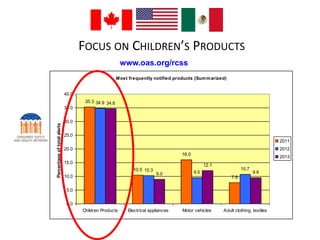
FOCUS ON CHILDREN’S PRODUCTS 
Most frequently notified products (Summarized) 
35.3 
10.5 
16.0 
7.8 
34.9 
10.3 9.5 
10.7 
34.6 
9.0 
12.1 
9.6 
40.0 
35.0 
30.0 
25.0 
20.0 
15.0 
10.0 
5.0 
0.0 
Children Products Electrical appliances Motor vehicles Adult clothing, textiles 
Percentage of total alerts 
2011 
2012 
2013 
www.oas.org/rcss
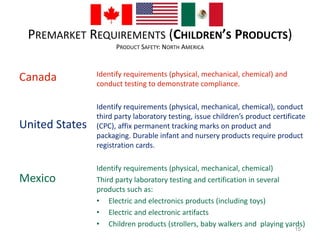
PREMARKET REQUIREMENTS (CHILDREN’S PRODUCTS) 
PRODUCT SAFETY: NORTH AMERICA 
Canada 
United States 
Mexico 
Identify requirements (physical, mechanical, chemical) and 
conduct testing to demonstrate compliance. 
Identify requirements (physical, mechanical, chemical), conduct 
third party laboratory testing, issue children’s product certificate 
(CPC), affix permanent tracking marks on product and 
packaging. Durable infant and nursery products require product 
registration cards. 
Identify requirements (physical, mechanical, chemical) 
Third party laboratory testing and certification in several 
products such as: 
• Electric and electronics products (including toys) 
• Electric and electronic artifacts 
• Children products (strollers, baby walkers and playing yards) 
15
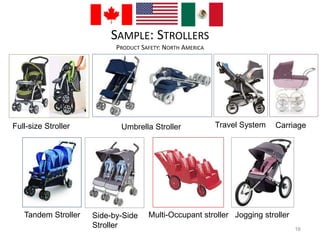
SAMPLE: STROLLERS 
PRODUCT SAFETY: NORTH AMERICA 
Full-size Stroller Umbrella Stroller Travel System Carriage 
16 
Tandem Stroller Side-by-Side 
Stroller 
Multi-Occupant stroller Jogging stroller
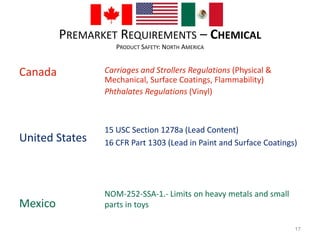
PREMARKET REQUIREMENTS – CHEMICAL 
PRODUCT SAFETY: NORTH AMERICA 
Canada 
United States 
Mexico 
Carriages and Strollers Regulations (Physical & 
Mechanical, Surface Coatings, Flammability) 
Phthalates Regulations (Vinyl) 
15 USC Section 1278a (Lead Content) 
16 CFR Part 1303 (Lead in Paint and Surface Coatings) 
NOM-252-SSA-1.- Limits on heavy metals and small 
parts in toys 
17
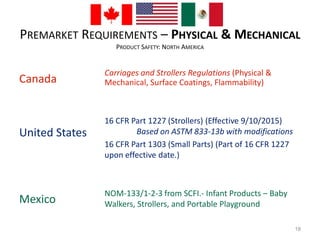
PREMARKET REQUIREMENTS – PHYSICAL & MECHANICAL 
PRODUCT SAFETY: NORTH AMERICA 
Canada 
United States 
Mexico 
Carriages and Strollers Regulations (Physical & 
Mechanical, Surface Coatings, Flammability) 
16 CFR Part 1227 (Strollers) (Effective 9/10/2015) 
Based on ASTM 833-13b with modifications 
16 CFR Part 1303 (Small Parts) (Part of 16 CFR 1227 
upon effective date.) 
NOM-133/1-2-3 from SCFI.- Infant Products – Baby 
Walkers, Strollers, and Portable Playground 
18
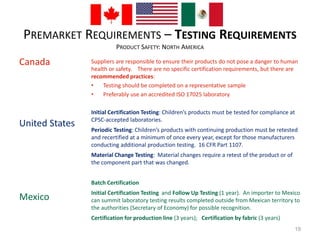
PREMARKET REQUIREMENTS – TESTING REQUIREMENTS 
PRODUCT SAFETY: NORTH AMERICA 
Canada 
United States 
Mexico 
Suppliers are responsible to ensure their products do not pose a danger to human 
health or safety. There are no specific certification requirements, but there are 
recommended practices: 
• Testing should be completed on a representative sample 
• Preferably use an accredited ISO 17025 laboratory 
Initial Certification Testing: Children’s products must be tested for compliance at 
CPSC-accepted laboratories. 
Periodic Testing: Children’s products with continuing production must be retested 
and recertified at a minimum of once every year, except for those manufacturers 
conducting additional production testing. 16 CFR Part 1107. 
Material Change Testing: Material changes require a retest of the product or of 
the component part that was changed. 
Batch Certification 
Initial Certification Testing and Follow Up Testing (1 year). An importer to Mexico 
can summit laboratory testing results completed outside from Mexican territory to 
the authorities (Secretary of Economy) for possible recognition. 
Certification for production line (3 years); Certification by fabric (3 years) 
19
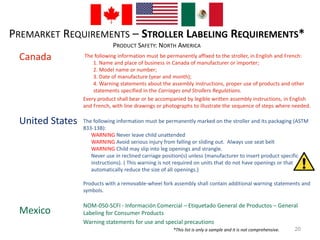
PREMARKET REQUIREMENTS – STROLLER LABELING REQUIREMENTS* 
PRODUCT SAFETY: NORTH AMERICA 
Canada 
United States 
Mexico 
The following information must be permanently affixed to the stroller, in English and French: 
1. Name and place of business in Canada of manufacturer or importer; 
2. Model name or number; 
3. Date of manufacture (year and month); 
4. Warning statements about the assembly instructions, proper use of products and other 
statements specified in the Carriages and Strollers Regulations. 
Every product shall bear or be accompanied by legible written assembly instructions, in English 
and French, with line drawings or photographs to illustrate the sequence of steps where needed. 
The following information must be permanently marked on the stroller and its packaging (ASTM 
833-13B): 
WARNING Never leave child unattended 
WARNING Avoid serious injury from falling or sliding out. Always use seat belt 
WARNING Child may slip into leg openings and strangle. 
Never use in reclined carriage position(s) unless (manufacturer to insert product specific 
instructions). ( This warning is not required on units that do not have openings or that 
automatically reduce the size of all openings.) 
Products with a removable-wheel fork assembly shall contain additional warning statements and 
symbols. 
NOM-050-SCFI - Información Comercial – Etiquetado General de Productos – General 
Labeling for Consumer Products 
Warning statements for use and special precautions 
*This list is only a sample and it is not comprehensive. 20
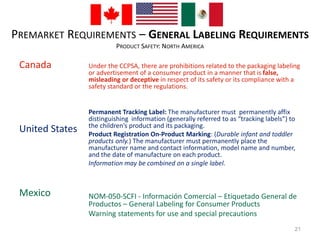
PREMARKET REQUIREMENTS – GENERAL LABELING REQUIREMENTS 
PRODUCT SAFETY: NORTH AMERICA 
Canada 
United States 
Mexico 
Under the CCPSA, there are prohibitions related to the packaging labeling 
or advertisement of a consumer product in a manner that is false, 
misleading or deceptive in respect of its safety or its compliance with a 
safety standard or the regulations. 
Permanent Tracking Label: The manufacturer must permanently affix 
distinguishing information (generally referred to as “tracking labels”) to 
the children’s product and its packaging. 
Product Registration On-Product Marking: (Durable infant and toddler 
products only.) The manufacturer must permanently place the 
manufacturer name and contact information, model name and number, 
and the date of manufacture on each product. 
Information may be combined on a single label. 
NOM-050-SCFI - Información Comercial – Etiquetado General de 
Productos – General Labeling for Consumer Products 
Warning statements for use and special precautions 
21
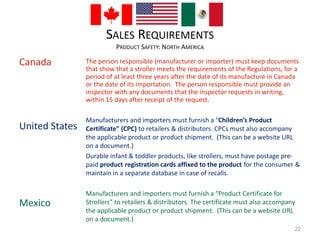
SALES REQUIREMENTS 
PRODUCT SAFETY: NORTH AMERICA 
Canada 
United States 
Mexico 
The person responsible (manufacturer or importer) must keep documents 
that show that a stroller meets the requirements of the Regulations, for a 
period of at least three years after the date of its manufacture in Canada 
or the date of its importation. The person responsible must provide an 
inspector with any documents that the inspector requests in writing, 
within 15 days after receipt of the request. 
Manufacturers and importers must furnish a “Children’s Product 
Certificate” (CPC) to retailers & distributors. CPCs must also accompany 
the applicable product or product shipment. (This can be a website URL 
on a document.) 
Durable infant & toddler products, like strollers, must have postage pre-paid 
product registration cards affixed to the product for the consumer & 
maintain in a separate database in case of recalls. 
Manufacturers and importers must furnish a “Product Certificate for 
Strollers” to retailers & distributors. The certificate must also accompany 
the applicable product or product shipment. (This can be a website URL 
on a document.) 
22
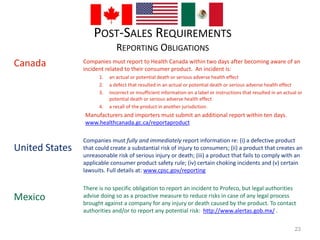
POST-SALES REQUIREMENTS 
REPORTING OBLIGATIONS 
Canada 
United States 
Mexico 
Companies must report to Health Canada within two days after becoming aware of an 
incident related to their consumer product. An incident is: 
1. an actual or potential death or serious adverse health effect 
2. a defect that resulted in an actual or potential death or serious adverse health effect 
3. incorrect or insufficient information on a label or instructions that resulted in an actual or 
potential death or serious adverse health effect 
4. a recall of the product in another jurisdiction. 
Manufacturers and importers must submit an additional report within ten days. 
www.healthcanada.gc.ca/reportaproduct 
Companies must fully and immediately report information re: (i) a defective product 
that could create a substantial risk of injury to consumers; (ii) a product that creates an 
unreasonable risk of serious injury or death; (iii) a product that fails to comply with an 
applicable consumer product safety rule; (iv) certain choking incidents and (v) certain 
lawsuits. Full details at: www.cpsc.gov/reporting 
There is no specific obligation to report an incident to Profeco, but legal authorities 
advise doing so as a proactive measure to reduce risks in case of any legal process 
brought against a company for any injury or death caused by the product. To contact 
authorities and/or to report any potential risk: http://www.alertas.gob.mx/ . 
23
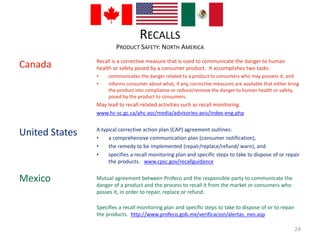
RECALLS 
PRODUCT SAFETY: NORTH AMERICA 
Canada 
United States 
Mexico 
Recall is a corrective measure that is used to communicate the danger to human 
health or safety posed by a consumer product. It accomplishes two tasks: 
• communicates the danger related to a product to consumers who may possess it; and 
• informs consumer about what, if any, corrective measures are available that either bring 
the product into compliance or reduce/remove the danger to human health or safety, 
posed by the product to consumers. 
May lead to recall-related activities such as recall monitoring. 
www.hc-sc.gc.ca/ahc-asc/media/advisories-avis/index-eng.php 
A typical corrective action plan (CAP) agreement outlines: 
• a comprehensive communication plan (consumer notification), 
• the remedy to be implemented (repair/replace/refund/ warn), and 
• specifies a recall monitoring plan and specific steps to take to dispose of or repair 
the products. www.cpsc.gov/recallguidance 
Mutual agreement between Profeco and the responsible party to communicate the 
danger of a product and the process to recall it from the market or consumers who 
posses it, in order to repair, replace or refund. 
Specifies a recall monitoring plan and specific steps to take to dispose of or to repair 
the products. http://www.profeco.gob.mx/verificacion/alertas_nvo.asp 
24
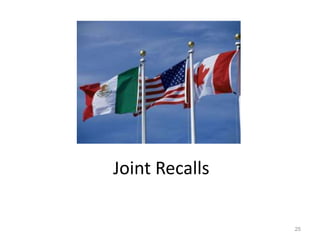
Joint Recalls 
25
JOINT RECALLS: CRITERIA 
• Product sold in at least 2 or all 3 countries 
• Product must also be under the jurisdiction 
of both agencies 
• Corrective measures and customer support 
extended to customers in affected countries 
• Timing works for regulator & company 
• Have agreement from company to share all 
information with both jurisdictions early in 
the process 
• Recall is conducted voluntarily 
26
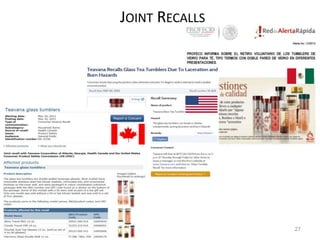
27 
JJoOiInNtT RReEcCaAlLlLsS
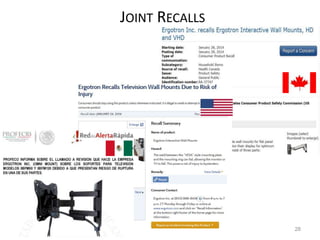
28 
JJoOiInNtT RReEcCaAlLlLsS
CONCLUSION 
• Although consumer product safety requirements 
may vary, we share the goal of safe products in the 
North American market. 
• Greater cooperation between regulators and 
industry can help to ensure the efficient flow of 
goods between jurisdictions while respecting 
product safety requirements. 
• Joint recalls present an opportunity for industry to 
efficiently address one of the requirements in each 
jurisdiction with minimal additional efforts. 
29
KEY RESOURCES 
Health Canada 
www.healthcanada.gc.ca/cps 
www.healthcanada.gc.ca/reportaproduct 
www.hc-sc.gc.ca/cps-spc/pubs/indust/index-eng.php 
www.hc-sc.gc.ca/ahc-asc/media/advisories-avis/index-eng. 
php 
Consumer Product Safety Commission 
www.cpsc.gov/BusinessEducation 
www.cpsc.gov/DesktopGuide 
www.cpsc.gov/Testing 
www.cpsc.gov/DurableInfantProducts 
Profeco 
www.profeco.gob.mx 
www.profeco.gob.mx/Servicios/tel_cons.as 
www.profeco.gob.mx/verificacion/est_comer.asp 
www.profeco.gob.mx/verificacion/laboratorio.asp 
Mexico
Thank You / Merci / Gracias 
Panelists: 
Sonia Douglas 
Consumer Product Safety Program 
Health Canada 
cps-spc@hc-sc.gc.ca 
Neal S. Cohen 
Small Business Ombudsman 
U.S Consumer Product Safety Commission 
ncohen@cpsc.gov @CPSCSmallBiz 
Agustín Adame 
Subprocuraduría de Verificación 
Profeco 
aadames@profeco.gob.mx 
Health Canada 
United States 
Consumer Product 
Safety Commission 
Mexico

What Businesses Need to Know About Product Safety in North America: Regulations, Recalls, and Best Practices for Children’s Products

  • 1.
    What Businesses Needto Know About Product Safety in North America: Regulations, Recalls, and Best Practices for Children’s Products Note: Presentation Available for Download: www.slideshare.net/USCPSC VIEWS EXPRESSED IN THIS PRESENTATION ARE THOSE OF THE STAFF AND DO NOT NECESSARILY REPRESENT THE VIEWS OF THE COMMISSION, HEALTH CANADA, OR PROFECO.
  • 2.
    Today’s Presentation •Provide an overview of consumer product safety legislation and authorities in the three jurisdictions • Highlight similarities and differences in requirements for industry, using strollers as a case study • Outline the benefits of joint recalls to encourage industry to engage with the North American Regulators simultaneously 2
  • 3.
    Health Canada UnitedStates Consumer Product Safety Commission Mexico MISSION STATEMENTS PRODUCT SAFETY: NORTH AMERICA The mission of Health Canada (HC)’s Consumer Product Safety Program is to identify, assess, manage and communicate health or safety risks to Canadians, associated with consumer products and cosmetics. Protecting the public against unreasonable risks of injury from consumer products through education, safety standards activities, regulation, and enforcement. Protect and promote the rights of consumers, ensuring fair trade relationships that strengthen the culture of responsible consumption and access to better market products and services, ensuring certainty, legality and legal security within the normative framework of human rights recognized for the consumer. 3
  • 4.
    IMPORTANCE OF NORTHAMERICAN MARKETS PRODUCT SAFETY: NORTH AMERICA 4 The North American Free Trade Agreement has led to integrated markets and enhanced trade among Canada, United States, and Mexico. In 2012, Canada imported over $68 billion (USD) worth of consumer products from the United States and $6 billion (USD) from Mexico. • $960 million (USD) in Toys from the United States. • $146 million (USD) in Toys from Mexico. The United States imported more than $81 billion (USD) worth of consumer products from the Mexico in 2012 and over $38 billion (USD) from Canada: • The United States imported $605 million (USD) worth of Toys, Games, & Children’s Vehicles from Mexico in 2012. • The United States imported $200 million (USD) worth of Toys, Games, & Children’s Vehicles from Canada in 2012. • Mexico imports $199 million (USD) in Toys from United States of America. • Mexico imports $18 million (USD) in Toys from Canada. (Sources: OECD, CPSC, INEGI. Due to different sources & product coding, figures may not correlate exactly.)
  • 5.
    WHAT ARE WETRYING TO ACCOMPLISH? PRODUCT SAFETY: NORTH AMERICA Increasing integration of the North American market is driving greater cooperation among consumer product safety regulators. All three countries are working to: • Enhance and maintain ongoing communication, cooperation, and information exchange between North American regulators, including consultations on proposed regulations and voluntary standards. • Increase cooperation on product recalls. • Enhance cooperation on industry training and outreach within North America. 5
  • 6.
    Consumer Product Safety Legislation in North America 6
  • 7.
    KEY LEGISLATION CanadaConsumer Product Safety Act (CCPSA) • Addresses or prevents dangers to human health or safety that are posed by consumer products in Canada, including those that circulate within Canada and those that are imported. • “General Prohibition” against the supply of consumer products that pose a danger to human health or safety • Onus is on suppliers to ensure products they bring to market comply with the Act and regulations: • Establishes responsibilities for manufacturers, importers, advertisers, and retailers of consumer products, including: • Mandatory Incident Reporting; • Record-keeping to allow traceability of products within the distribution chain 7
  • 8.
    KEY POWERS AVAILABLETO HC • Seize product, documents or materials • Require tests and studies necessary to verify compliance or prevent non-compliance • Order suppliers to carry out recalls and to take other corrective actions • Fines and Administrative monetary penalties scheme (AMPS) • Disclose personal or business information necessary to identify or address a serious danger to human health or safety • Issue public communications 8
  • 9.
    KEY LEGISLATION ConsumerProduct Safety Act (CPSA) • Manufacturers and importers must third party test and certify children’s products to ensure products they bring to market comply with the Act and regulations. • Industry self-reporting through Section 15. Federal Hazardous Substances Act (FHSA) • Requires precautionary labeling on the immediate container of hazardous household products to help consumers safely store and use those products and to give them information about immediate first aid steps to take if an accident happens. • Bans certain products that are so dangerous or the nature of the hazard is such that the labeling the act requires is not adequate to protect consumers. 9
  • 10.
    KEY POWERS AVAILABLETO CPSC • Order a manufacturer to cease distribution, repair, replace, or refund the purchase price of a product • Seize and destroy product at the port of entry • Issue public communications and warnings re: a product and a recall/corrective action plan • Investigate for civil and criminal penalties for failure to report in a timely and adequate manner; other violations • Injunctive relief • Above can be via court or administrative proceedings or voluntary, in cooperation with the manufacturer. 10
  • 11.
    KEY LEGISLATION FEDERALCONSUMER PROTECTION LAW Federal Law on Metrology and Standardization Federal Law for Public Service Customs Law • Onus on suppliers to ensure products they bring to market comply with the Act and regulations. • Modern tools to strengthen protection of human health and safety: • regulates the manufacture, import, sale and advertisement of all consumer products. • expands the definition of “consumer product”: • including its components, parts or accessories, • reasonably be expected to be obtained by an individual to be used for non-commercial purposes, • domestic, recreational and sports products • includes its packaging. 11
  • 12.
    KEY POWERS AVAILABLETO PROFECO • Seize product, documents or materials • Order corrective measures (e.g. stop importation) • Order recall • Carry out recalls and/or corrective measures (on behalf of company) • Issue Notices of Violation (AMPs) • Issue public communications • Investigation for prosecution • Apply for Injunction – by authority of Magistrate 12
  • 13.
    Regulations, Best Practices,and Recalls for Children’s Products 13
  • 14.
    FOCUS ON CHILDREN’SPRODUCTS Most frequently notified products (Summarized) 35.3 10.5 16.0 7.8 34.9 10.3 9.5 10.7 34.6 9.0 12.1 9.6 40.0 35.0 30.0 25.0 20.0 15.0 10.0 5.0 0.0 Children Products Electrical appliances Motor vehicles Adult clothing, textiles Percentage of total alerts 2011 2012 2013 www.oas.org/rcss
  • 15.
    PREMARKET REQUIREMENTS (CHILDREN’SPRODUCTS) PRODUCT SAFETY: NORTH AMERICA Canada United States Mexico Identify requirements (physical, mechanical, chemical) and conduct testing to demonstrate compliance. Identify requirements (physical, mechanical, chemical), conduct third party laboratory testing, issue children’s product certificate (CPC), affix permanent tracking marks on product and packaging. Durable infant and nursery products require product registration cards. Identify requirements (physical, mechanical, chemical) Third party laboratory testing and certification in several products such as: • Electric and electronics products (including toys) • Electric and electronic artifacts • Children products (strollers, baby walkers and playing yards) 15
  • 16.
    SAMPLE: STROLLERS PRODUCTSAFETY: NORTH AMERICA Full-size Stroller Umbrella Stroller Travel System Carriage 16 Tandem Stroller Side-by-Side Stroller Multi-Occupant stroller Jogging stroller
  • 17.
    PREMARKET REQUIREMENTS –CHEMICAL PRODUCT SAFETY: NORTH AMERICA Canada United States Mexico Carriages and Strollers Regulations (Physical & Mechanical, Surface Coatings, Flammability) Phthalates Regulations (Vinyl) 15 USC Section 1278a (Lead Content) 16 CFR Part 1303 (Lead in Paint and Surface Coatings) NOM-252-SSA-1.- Limits on heavy metals and small parts in toys 17
  • 18.
    PREMARKET REQUIREMENTS –PHYSICAL & MECHANICAL PRODUCT SAFETY: NORTH AMERICA Canada United States Mexico Carriages and Strollers Regulations (Physical & Mechanical, Surface Coatings, Flammability) 16 CFR Part 1227 (Strollers) (Effective 9/10/2015) Based on ASTM 833-13b with modifications 16 CFR Part 1303 (Small Parts) (Part of 16 CFR 1227 upon effective date.) NOM-133/1-2-3 from SCFI.- Infant Products – Baby Walkers, Strollers, and Portable Playground 18
  • 19.
    PREMARKET REQUIREMENTS –TESTING REQUIREMENTS PRODUCT SAFETY: NORTH AMERICA Canada United States Mexico Suppliers are responsible to ensure their products do not pose a danger to human health or safety. There are no specific certification requirements, but there are recommended practices: • Testing should be completed on a representative sample • Preferably use an accredited ISO 17025 laboratory Initial Certification Testing: Children’s products must be tested for compliance at CPSC-accepted laboratories. Periodic Testing: Children’s products with continuing production must be retested and recertified at a minimum of once every year, except for those manufacturers conducting additional production testing. 16 CFR Part 1107. Material Change Testing: Material changes require a retest of the product or of the component part that was changed. Batch Certification Initial Certification Testing and Follow Up Testing (1 year). An importer to Mexico can summit laboratory testing results completed outside from Mexican territory to the authorities (Secretary of Economy) for possible recognition. Certification for production line (3 years); Certification by fabric (3 years) 19
  • 20.
    PREMARKET REQUIREMENTS –STROLLER LABELING REQUIREMENTS* PRODUCT SAFETY: NORTH AMERICA Canada United States Mexico The following information must be permanently affixed to the stroller, in English and French: 1. Name and place of business in Canada of manufacturer or importer; 2. Model name or number; 3. Date of manufacture (year and month); 4. Warning statements about the assembly instructions, proper use of products and other statements specified in the Carriages and Strollers Regulations. Every product shall bear or be accompanied by legible written assembly instructions, in English and French, with line drawings or photographs to illustrate the sequence of steps where needed. The following information must be permanently marked on the stroller and its packaging (ASTM 833-13B): WARNING Never leave child unattended WARNING Avoid serious injury from falling or sliding out. Always use seat belt WARNING Child may slip into leg openings and strangle. Never use in reclined carriage position(s) unless (manufacturer to insert product specific instructions). ( This warning is not required on units that do not have openings or that automatically reduce the size of all openings.) Products with a removable-wheel fork assembly shall contain additional warning statements and symbols. NOM-050-SCFI - Información Comercial – Etiquetado General de Productos – General Labeling for Consumer Products Warning statements for use and special precautions *This list is only a sample and it is not comprehensive. 20
  • 21.
    PREMARKET REQUIREMENTS –GENERAL LABELING REQUIREMENTS PRODUCT SAFETY: NORTH AMERICA Canada United States Mexico Under the CCPSA, there are prohibitions related to the packaging labeling or advertisement of a consumer product in a manner that is false, misleading or deceptive in respect of its safety or its compliance with a safety standard or the regulations. Permanent Tracking Label: The manufacturer must permanently affix distinguishing information (generally referred to as “tracking labels”) to the children’s product and its packaging. Product Registration On-Product Marking: (Durable infant and toddler products only.) The manufacturer must permanently place the manufacturer name and contact information, model name and number, and the date of manufacture on each product. Information may be combined on a single label. NOM-050-SCFI - Información Comercial – Etiquetado General de Productos – General Labeling for Consumer Products Warning statements for use and special precautions 21
  • 22.
    SALES REQUIREMENTS PRODUCTSAFETY: NORTH AMERICA Canada United States Mexico The person responsible (manufacturer or importer) must keep documents that show that a stroller meets the requirements of the Regulations, for a period of at least three years after the date of its manufacture in Canada or the date of its importation. The person responsible must provide an inspector with any documents that the inspector requests in writing, within 15 days after receipt of the request. Manufacturers and importers must furnish a “Children’s Product Certificate” (CPC) to retailers & distributors. CPCs must also accompany the applicable product or product shipment. (This can be a website URL on a document.) Durable infant & toddler products, like strollers, must have postage pre-paid product registration cards affixed to the product for the consumer & maintain in a separate database in case of recalls. Manufacturers and importers must furnish a “Product Certificate for Strollers” to retailers & distributors. The certificate must also accompany the applicable product or product shipment. (This can be a website URL on a document.) 22
  • 23.
    POST-SALES REQUIREMENTS REPORTINGOBLIGATIONS Canada United States Mexico Companies must report to Health Canada within two days after becoming aware of an incident related to their consumer product. An incident is: 1. an actual or potential death or serious adverse health effect 2. a defect that resulted in an actual or potential death or serious adverse health effect 3. incorrect or insufficient information on a label or instructions that resulted in an actual or potential death or serious adverse health effect 4. a recall of the product in another jurisdiction. Manufacturers and importers must submit an additional report within ten days. www.healthcanada.gc.ca/reportaproduct Companies must fully and immediately report information re: (i) a defective product that could create a substantial risk of injury to consumers; (ii) a product that creates an unreasonable risk of serious injury or death; (iii) a product that fails to comply with an applicable consumer product safety rule; (iv) certain choking incidents and (v) certain lawsuits. Full details at: www.cpsc.gov/reporting There is no specific obligation to report an incident to Profeco, but legal authorities advise doing so as a proactive measure to reduce risks in case of any legal process brought against a company for any injury or death caused by the product. To contact authorities and/or to report any potential risk: http://www.alertas.gob.mx/ . 23
  • 24.
    RECALLS PRODUCT SAFETY:NORTH AMERICA Canada United States Mexico Recall is a corrective measure that is used to communicate the danger to human health or safety posed by a consumer product. It accomplishes two tasks: • communicates the danger related to a product to consumers who may possess it; and • informs consumer about what, if any, corrective measures are available that either bring the product into compliance or reduce/remove the danger to human health or safety, posed by the product to consumers. May lead to recall-related activities such as recall monitoring. www.hc-sc.gc.ca/ahc-asc/media/advisories-avis/index-eng.php A typical corrective action plan (CAP) agreement outlines: • a comprehensive communication plan (consumer notification), • the remedy to be implemented (repair/replace/refund/ warn), and • specifies a recall monitoring plan and specific steps to take to dispose of or repair the products. www.cpsc.gov/recallguidance Mutual agreement between Profeco and the responsible party to communicate the danger of a product and the process to recall it from the market or consumers who posses it, in order to repair, replace or refund. Specifies a recall monitoring plan and specific steps to take to dispose of or to repair the products. http://www.profeco.gob.mx/verificacion/alertas_nvo.asp 24
  • 25.
  • 26.
    JOINT RECALLS: CRITERIA • Product sold in at least 2 or all 3 countries • Product must also be under the jurisdiction of both agencies • Corrective measures and customer support extended to customers in affected countries • Timing works for regulator & company • Have agreement from company to share all information with both jurisdictions early in the process • Recall is conducted voluntarily 26
  • 27.
  • 28.
  • 29.
    CONCLUSION • Althoughconsumer product safety requirements may vary, we share the goal of safe products in the North American market. • Greater cooperation between regulators and industry can help to ensure the efficient flow of goods between jurisdictions while respecting product safety requirements. • Joint recalls present an opportunity for industry to efficiently address one of the requirements in each jurisdiction with minimal additional efforts. 29
  • 30.
    KEY RESOURCES HealthCanada www.healthcanada.gc.ca/cps www.healthcanada.gc.ca/reportaproduct www.hc-sc.gc.ca/cps-spc/pubs/indust/index-eng.php www.hc-sc.gc.ca/ahc-asc/media/advisories-avis/index-eng. php Consumer Product Safety Commission www.cpsc.gov/BusinessEducation www.cpsc.gov/DesktopGuide www.cpsc.gov/Testing www.cpsc.gov/DurableInfantProducts Profeco www.profeco.gob.mx www.profeco.gob.mx/Servicios/tel_cons.as www.profeco.gob.mx/verificacion/est_comer.asp www.profeco.gob.mx/verificacion/laboratorio.asp Mexico
  • 31.
    Thank You /Merci / Gracias Panelists: Sonia Douglas Consumer Product Safety Program Health Canada cps-spc@hc-sc.gc.ca Neal S. Cohen Small Business Ombudsman U.S Consumer Product Safety Commission ncohen@cpsc.gov @CPSCSmallBiz Agustín Adame Subprocuraduría de Verificación Profeco aadames@profeco.gob.mx Health Canada United States Consumer Product Safety Commission Mexico