October 25, 2016
Stephanee Synnott, Ph.D.
Compliance Officer, Chemical Hazards Team
The views expressed in this presentation are those of the CPSC staff, have not been
reviewed or approved by, and may not necessarily reflect the views of, the Commission.
 Packages that contain single dosages or
usages.
2
2
 The package configuration that results in the
“worst-case scenario”
 Units in the form in which they will enter the
home
◦ Example: Do not test separated units if the units
will enter the home as an intact group of units,
unless testing separated units presents the worst-
case scenario
3
 The number of units that the consumer will
typically bring into the home at one time.
 Tools
◦ The tool should be given to children, if the tool
will be provided to consumers with the package.
◦ The tool should be provided for adults if
instructions are given to use a tool.
4
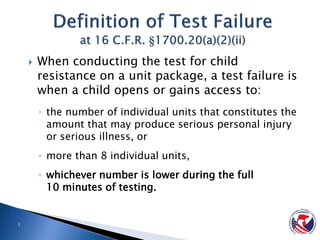
 When conducting the test for child
resistance on a unit package, a test failure is
when a child opens or gains access to:
◦ the number of individual units that constitutes the
amount that may produce serious personal injury
or serious illness, or
◦ more than 8 individual units,
◦ whichever number is lower during the full
10 minutes of testing.
5
 Interpreted as the individual units from
which the product has been removed or can
be removed in whole or in part.
6
Example: A blister is breached.
Even if the contents are not
removed, this should generally
be considered access gained.
 The number of individual units to which
access is considered a test failure is
commonly and unofficially referred to as “F.”
◦ Example: If the toxicity of a substance requires
access to 3 units to be considered a test failure,
the substance is said to require an F=3 package.
7
Serious Injury/Serious Illness
 The determination of the amount of a
substance that may produce serious
personal injury or serious illness shall be
based on a 25-pound child.
 Manufacturers or packagers intending to
use unit packaging for a substance
requiring special packaging are requested
to submit such toxicological data to the
CPSC Office of Compliance.
8
 In cases where more than one PPPA-regulated
substance is packaged in one unit-dose
package arrangement, the failure level is
determined by the most toxic unit contents.
9
Drug A is F=2, Drug B is F=4,
and Drug C is F=8.
The most toxic PPPA regulated
drug should determine the
level of child-resistance: F=2.
 Some unit packages comply with
child-resistant requirements if the package
contains fewer units of substances than the
determined F value.
◦ Example: The substance is F=5, but fewer than
5 units are in the retail package.
10
 The following slides are examples of two
different test report formats for reporting for
the same set of data.
 Sample data: There were 50 children tested
for 10 minutes.
◦ 18 children failed to open or gain access to the
package
◦ 19 children opened/accessed only 1 unit each
◦ 8 children opened/accessed a total of 2 units each
◦ 5 children opened/accessed a total of 3 units each
◦ No children opened/accessed 4 or more units
11
 50 children tested in each example below.
 Example 1 –
◦ Reports exactly how many units were opened by each child.
 Example 2 –
◦ Reports the total number of children to open that number of units.
12
Children assessing exactly
0 units 1 unit 2 units 3 units 4 units
10 minutes 18 19 8 5 0
Children assessing at least
0 units 1 unit 2 units 3 units 4 units
10 minutes 18 32 13 5 0
 To determine how the package would perform at
F=1, the value cannot be taken directly from the
table.
 The sum would need to be calculated for F=1:
◦ Exactly 1 unit (19 children) + exactly 2 units (8 children)
+ exactly 3 units (5 children)
 In this example, 32 children were able to access
at least one unit.
13
Children assessing exactly
0 units 1 unit 2 units 3 units 4 units
10 minutes 18 19 8 5 0
Pass Continue Fail
1 50 0-5 6-14 15+
2 100 6-15 16-24 25+
3 150 16-25 26-34 35+
4 200 26-40 - 41+
Test Panel
Package Openings (10 minutes)Total Children
Tested
14
 If F=1, the package fails because 32 children
(19 + 8 + 5 children) accessed at least 1 unit.
 If F=2, you would continue to test the package, because
13 children (8 + 5 children) accessed at least 2 units.
 If F=3 or greater, the package would pass the test,
because only 5 children accessed 3 or more units.
15
Children assessing exactly
0 units 1 unit 2 units 3 units 4 units
10 minutes 18 19 8 5 0
 To determine how the package would perform at
F=1, the value can be taken directly from the table
 If F=1, the package fails because 32 children accessed at
least 1 unit.
 If F=2, you would continue to test the package, because 13
children accessed at least 2 units.
 If F=3 or greater, the package would pass the test, because
only 5 children accessed 3 or more units.
16
Children assessing at least
0 units 1 unit 2 units 3 units 4 units
10 minutes 18 32
(19 + 8 + 5)
13
(8 + 5)
5 0
 Either report format is acceptable; however,
staff requests that the report explicitly state if
data represents exactly the number of units
accessed or at least the number of units
accessed.
 The advantages of this include:
◦ having a more complete picture of how the package
performed in the test
◦ having the potential to use the data to support the use
of the package for other drugs of different toxicity
17
 If the number of units children access is not
reported, you only know whether the
packaged passed or failed at a certain
F level.
◦ Example: If test data show that a package passes
with a given substance at F=3, you have no way of
knowing whether the packaging would pass if you
wanted to package a similar substance requiring a
F=1 package.
18
 When developing/designing a new package
 When you receive incident reports or
complaints
 When you become aware of a
manufacturing or materials defect
19
 A change in the package may result in a
change in the child-resistance:
◦ If the cavity size of the blister changes
◦ If the materials used in the package change
◦ If a change in the manufacturing process occurs
Example: cutting blades that dull over time,
resulting in substantially different perforations
between blisters.
20
 A change in the substance to be packaged:
◦ If the new substance is of a different form, size,
shape, hardness, etc. such that it might impact
the child-resistance of the package.
◦ If the F value of the new substance differs from
that of the substance the package was tested
with, and the test report does not provide
enough information to determine if the package
is suitable for the new substance.
Depends on test report format.
21

PPPA Workshop - Unit Packaging Presentation 2016

  • 1.
    October 25, 2016 StephaneeSynnott, Ph.D. Compliance Officer, Chemical Hazards Team The views expressed in this presentation are those of the CPSC staff, have not been reviewed or approved by, and may not necessarily reflect the views of, the Commission.
  • 2.
     Packages thatcontain single dosages or usages. 2 2
  • 3.
     The packageconfiguration that results in the “worst-case scenario”  Units in the form in which they will enter the home ◦ Example: Do not test separated units if the units will enter the home as an intact group of units, unless testing separated units presents the worst- case scenario 3
  • 4.
     The numberof units that the consumer will typically bring into the home at one time.  Tools ◦ The tool should be given to children, if the tool will be provided to consumers with the package. ◦ The tool should be provided for adults if instructions are given to use a tool. 4
  • 5.
     When conductingthe test for child resistance on a unit package, a test failure is when a child opens or gains access to: ◦ the number of individual units that constitutes the amount that may produce serious personal injury or serious illness, or ◦ more than 8 individual units, ◦ whichever number is lower during the full 10 minutes of testing. 5
  • 6.
     Interpreted asthe individual units from which the product has been removed or can be removed in whole or in part. 6 Example: A blister is breached. Even if the contents are not removed, this should generally be considered access gained.
  • 7.
     The numberof individual units to which access is considered a test failure is commonly and unofficially referred to as “F.” ◦ Example: If the toxicity of a substance requires access to 3 units to be considered a test failure, the substance is said to require an F=3 package. 7
  • 8.
    Serious Injury/Serious Illness The determination of the amount of a substance that may produce serious personal injury or serious illness shall be based on a 25-pound child.  Manufacturers or packagers intending to use unit packaging for a substance requiring special packaging are requested to submit such toxicological data to the CPSC Office of Compliance. 8
  • 9.
     In caseswhere more than one PPPA-regulated substance is packaged in one unit-dose package arrangement, the failure level is determined by the most toxic unit contents. 9 Drug A is F=2, Drug B is F=4, and Drug C is F=8. The most toxic PPPA regulated drug should determine the level of child-resistance: F=2.
  • 10.
     Some unitpackages comply with child-resistant requirements if the package contains fewer units of substances than the determined F value. ◦ Example: The substance is F=5, but fewer than 5 units are in the retail package. 10
  • 11.
     The followingslides are examples of two different test report formats for reporting for the same set of data.  Sample data: There were 50 children tested for 10 minutes. ◦ 18 children failed to open or gain access to the package ◦ 19 children opened/accessed only 1 unit each ◦ 8 children opened/accessed a total of 2 units each ◦ 5 children opened/accessed a total of 3 units each ◦ No children opened/accessed 4 or more units 11
  • 12.
     50 childrentested in each example below.  Example 1 – ◦ Reports exactly how many units were opened by each child.  Example 2 – ◦ Reports the total number of children to open that number of units. 12 Children assessing exactly 0 units 1 unit 2 units 3 units 4 units 10 minutes 18 19 8 5 0 Children assessing at least 0 units 1 unit 2 units 3 units 4 units 10 minutes 18 32 13 5 0
  • 13.
     To determinehow the package would perform at F=1, the value cannot be taken directly from the table.  The sum would need to be calculated for F=1: ◦ Exactly 1 unit (19 children) + exactly 2 units (8 children) + exactly 3 units (5 children)  In this example, 32 children were able to access at least one unit. 13 Children assessing exactly 0 units 1 unit 2 units 3 units 4 units 10 minutes 18 19 8 5 0
  • 14.
    Pass Continue Fail 150 0-5 6-14 15+ 2 100 6-15 16-24 25+ 3 150 16-25 26-34 35+ 4 200 26-40 - 41+ Test Panel Package Openings (10 minutes)Total Children Tested 14
  • 15.
     If F=1,the package fails because 32 children (19 + 8 + 5 children) accessed at least 1 unit.  If F=2, you would continue to test the package, because 13 children (8 + 5 children) accessed at least 2 units.  If F=3 or greater, the package would pass the test, because only 5 children accessed 3 or more units. 15 Children assessing exactly 0 units 1 unit 2 units 3 units 4 units 10 minutes 18 19 8 5 0
  • 16.
     To determinehow the package would perform at F=1, the value can be taken directly from the table  If F=1, the package fails because 32 children accessed at least 1 unit.  If F=2, you would continue to test the package, because 13 children accessed at least 2 units.  If F=3 or greater, the package would pass the test, because only 5 children accessed 3 or more units. 16 Children assessing at least 0 units 1 unit 2 units 3 units 4 units 10 minutes 18 32 (19 + 8 + 5) 13 (8 + 5) 5 0
  • 17.
     Either reportformat is acceptable; however, staff requests that the report explicitly state if data represents exactly the number of units accessed or at least the number of units accessed.  The advantages of this include: ◦ having a more complete picture of how the package performed in the test ◦ having the potential to use the data to support the use of the package for other drugs of different toxicity 17
  • 18.
     If thenumber of units children access is not reported, you only know whether the packaged passed or failed at a certain F level. ◦ Example: If test data show that a package passes with a given substance at F=3, you have no way of knowing whether the packaging would pass if you wanted to package a similar substance requiring a F=1 package. 18
  • 19.
     When developing/designinga new package  When you receive incident reports or complaints  When you become aware of a manufacturing or materials defect 19
  • 20.
     A changein the package may result in a change in the child-resistance: ◦ If the cavity size of the blister changes ◦ If the materials used in the package change ◦ If a change in the manufacturing process occurs Example: cutting blades that dull over time, resulting in substantially different perforations between blisters. 20
  • 21.
     A changein the substance to be packaged: ◦ If the new substance is of a different form, size, shape, hardness, etc. such that it might impact the child-resistance of the package. ◦ If the F value of the new substance differs from that of the substance the package was tested with, and the test report does not provide enough information to determine if the package is suitable for the new substance. Depends on test report format. 21