Schedule Adherence: Learn How to Stop Guessing on GoalsPresented by:Wendy Fowler and Brent HaferkampSenior Consultants, ICMI
Schedule Adherence: Learn How to Stop Guessing on GoalsDefine – Schedule AdherenceFactors to Consider When Setting Your GoalHow Can You Improve Schedule AdherenceThe Impact of Non-AdherenceQuestions
Adherence to Schedule:A general term that refers to how well agents adhere to their schedules. Can include: how much time they were logged in compared to scheduled log in time (% log in time/availability)
when they were logged in compared to scheduled time to be logged in(compliance/conformance)Note: Most WFM systems do not impact you if you are working when you should not be…but all systems impact you if you are not working and you should be.
Polling Questions:Do you measure adherence to schedule?
What is your schedule adherence goal?
95% or higher
91% - 94%
90%
Less than 90%
How did you come up with your schedule adherence goal?Polling Questions:How many participants are currently meeting their schedule adherence goal?
If you are not meeting your goal, what do       you suspect is wrong?Lack of understanding
Too rigid
Too Flexible
Wrong Goal
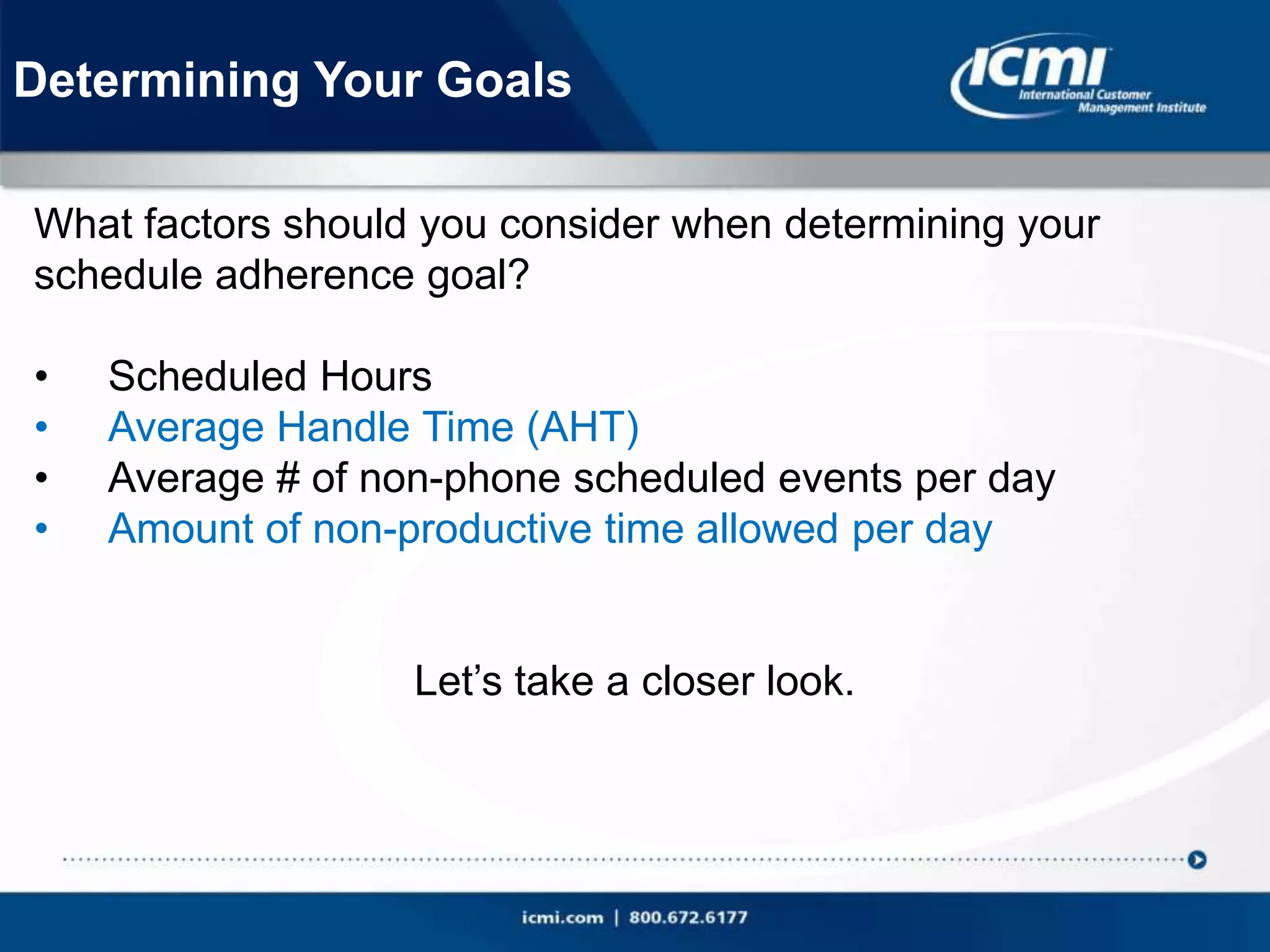
Poor Exception Management ProcessesDetermining Your GoalsWhat factors should you consider when determining yourschedule adherence goal?Scheduled Hours

Icmi calculating schedule adherence

  • 2.
    Schedule Adherence: LearnHow to Stop Guessing on GoalsPresented by:Wendy Fowler and Brent HaferkampSenior Consultants, ICMI
  • 3.
    Schedule Adherence: LearnHow to Stop Guessing on GoalsDefine – Schedule AdherenceFactors to Consider When Setting Your GoalHow Can You Improve Schedule AdherenceThe Impact of Non-AdherenceQuestions
  • 4.
    Adherence to Schedule:Ageneral term that refers to how well agents adhere to their schedules. Can include: how much time they were logged in compared to scheduled log in time (% log in time/availability)
  • 5.
    when they werelogged in compared to scheduled time to be logged in(compliance/conformance)Note: Most WFM systems do not impact you if you are working when you should not be…but all systems impact you if you are not working and you should be.
  • 6.
    Polling Questions:Do youmeasure adherence to schedule?
  • 7.
    What is yourschedule adherence goal?
  • 8.
  • 9.
  • 10.
  • 11.
  • 12.
    How did youcome up with your schedule adherence goal?Polling Questions:How many participants are currently meeting their schedule adherence goal?
  • 13.
    If you arenot meeting your goal, what do you suspect is wrong?Lack of understanding
  • 14.
  • 15.
  • 16.
  • 17.
    Poor Exception ManagementProcessesDetermining Your GoalsWhat factors should you consider when determining yourschedule adherence goal?Scheduled Hours
  • 18.
  • 19.
    Average # ofnon-phone scheduled events per day
  • 20.
    Amount of non-productivetime allowed per dayLet’s take a closer look.
  • 21.
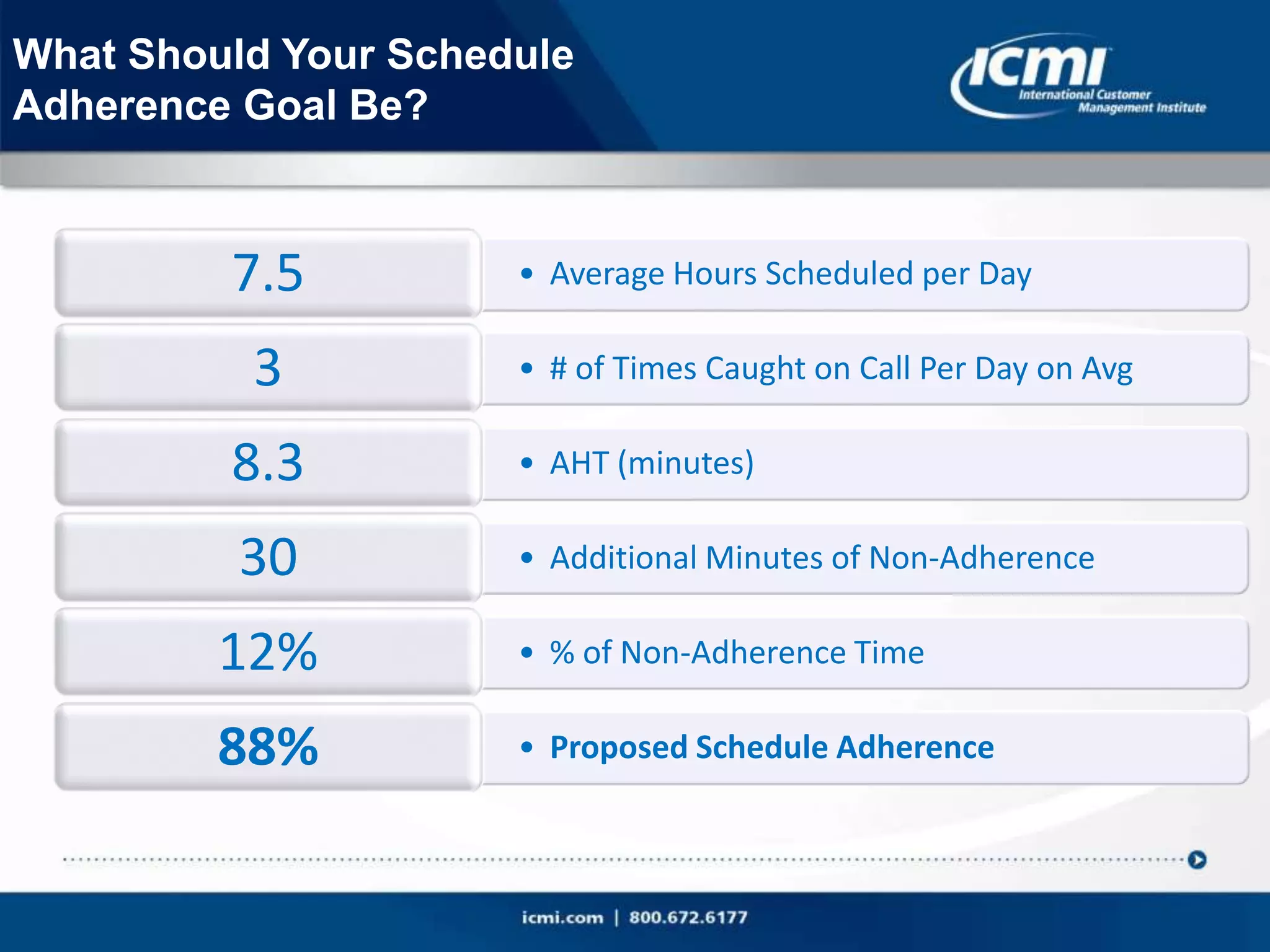
    What Should YourSchedule Adherence Goal Be?
  • 22.
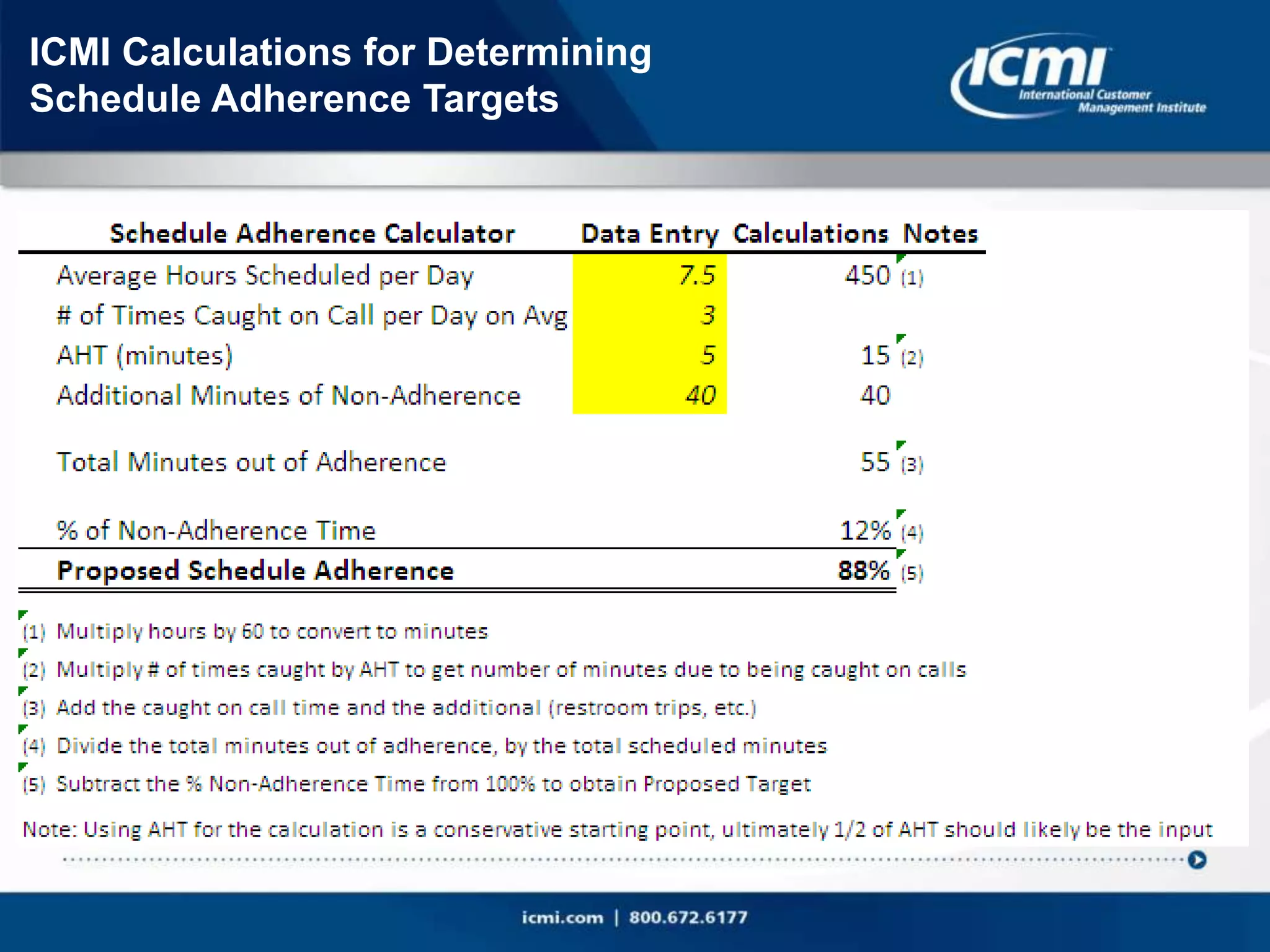
    ICMI Calculations forDetermining Schedule Adherence Targets
  • 23.
    What Happens ifWe Change AHT?
  • 24.
    Questions:Do you havedifferent schedule adherence goals for different queues/skills?
  • 25.
  • 26.
    Do you havedifferent schedule adherence goals for full-time staff vs. part-time staff?
  • 27.
    Should you?What ShouldBe Your Schedule Adherence Goal?
  • 28.
    What Should BeYour Schedule Adherence Goal?Additional things to consider when determining you adherence goal:Only use half the average handle time
  • 29.
    Allow agents totransition to a non-phone activity when they are within a window equivalent to half the handle time.What Can You Do to Improve Schedule Adherence?Set realistic goals and expectationsCreate accurate forecastsSchedule efficiently - optimize breaks and lunchesTrain agents on how their individual performance impacts your customers and their peers – ever hear of “The Power of One”?Train everyone in your contact center on the importance of schedule adherence.Hold everyone accountable – employees, supervisors and managers
  • 30.
    Talk Time inSeconds = 180After Call Work in Seconds =30Calls per Half Hour =250Service Level Objective in Secs = 20AgentsService LevelASAOccupancy3024%20997%3145%7594%3261%3891%213373%88%3482%1386%3588%883%53692%81%3795%379%3897%277%3998%175%4099%73%14199%71%1042100%69%Erlang C CalculationHow many agents do you need to meet your service objective?What happens to service if you lose one agent because they are out of adherence?What happens to occupancy?
  • 31.
    The Impact ofNon-AdherenceTo do the same work with less adherence requires more FTEs
  • 32.
  • 33.
  • 34.
    Real-time team changingthe past verses focusing on the futureSchedule Adherence: Learn How to Stop Guessing on GoalsJust Released!ICMI Workforce Management Research Report• 545 contact center professionals surveyed• Representing wide range of industries and geographic • Evaluation of contact centers’ workforce management technologies and tools• Examination of the various staffing strategies employed to manage a dynamic workloadicmi.com/wfmreport

Editor's Notes

  • #4 Wendy
  • #5 Most systems do not impact you if you are working when you should not be but all systems impact you if you are not working and you should be.
  • #7 Wendy – 7 minutes
  • #8 Now that we have an idea of where everyone is at, how you came up with goals, who is meeting their goals, who is not, who is awake and who isn’t, let’s talk a little about…
  • #10 Brent – 11 minutes
  • #12 If different queues/skills have different handle times, it may be worth exploring whether they should have different schedule adherence goals as well. As we just seen in the previous example, all things being equal, a person in a queue that has an AHT of 8.3 minutes is more likely to achieve a schedule adherence score of 88% while the person in the queue that averages a 5 minute AHT can achieve a score of 90%.
  • #13 Interesting that a part-timer who is working only 4 hours per day in the skill that has a 5 minutes AHT and only receives half the additional minutes of non-adherence time is still more likely to hit a 92% SA. This is because they are less likely to be caught on the phone during a scheduled non-phone activity since they are scheduled for fewer of them on average. (Fewer breaks and lunches.)
  • #14 Brent – 15 minutes
  • #16 This is a good example of “The Power of One”. One agent means the difference in meeting and not meeting service levels.
  • #17 In this scenario, the workload does not change, however, in order to do the same amount of work with less adherent staff, requires more people. You must continue to increase staff to offset the loss in productivity due to non-adherence.