Workforce Management
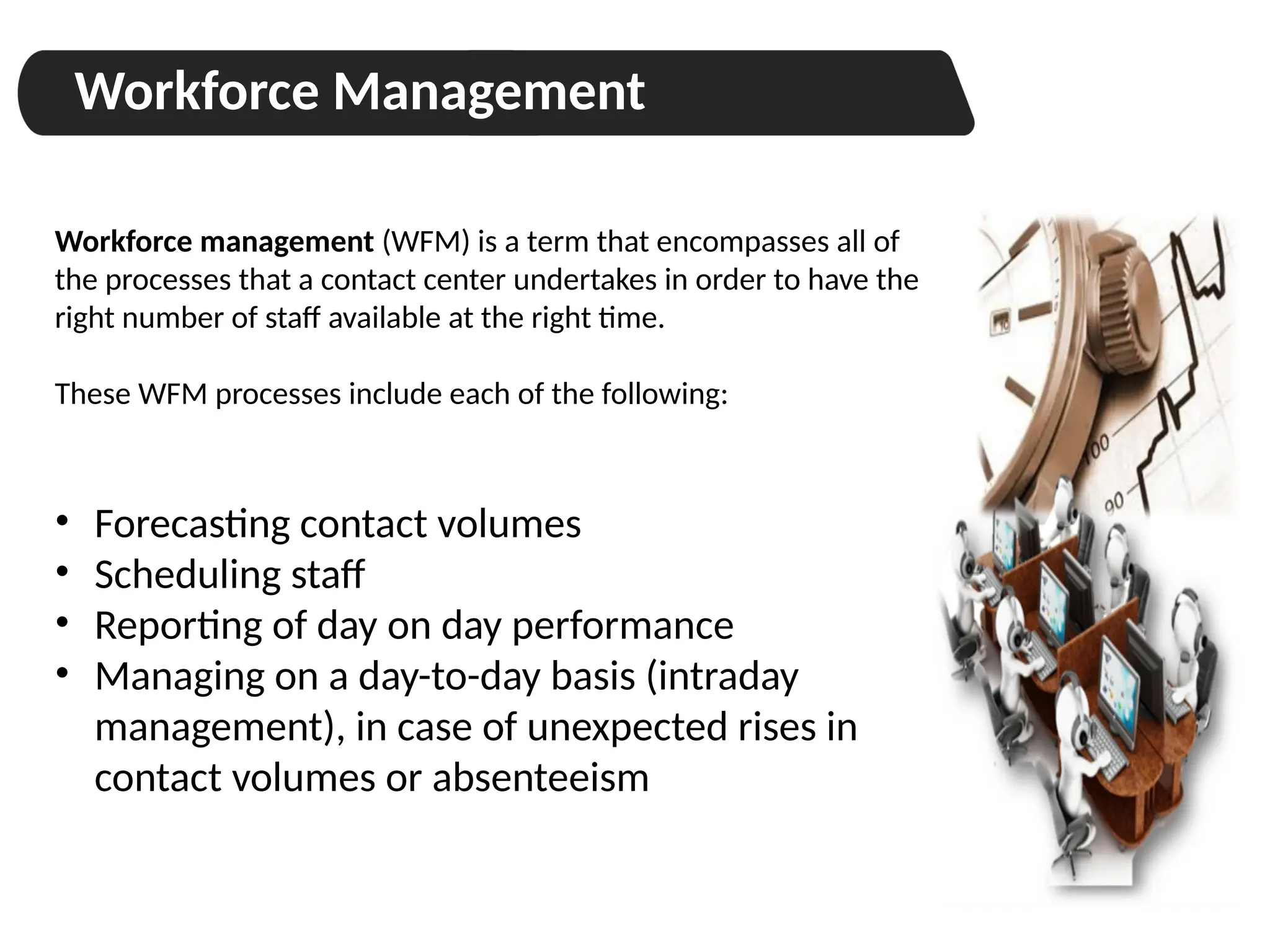
Workforce management (WFM) is a term that encompasses all of
the processes that a contact center undertakes in order to have the
right number of staff available at the right time.
These WFM processes include each of the following:
• Forecasting contact volumes
• Scheduling staff
• Reporting of day on day performance
• Managing on a day-to-day basis (intraday
management), in case of unexpected rises in
contact volumes or absenteeism
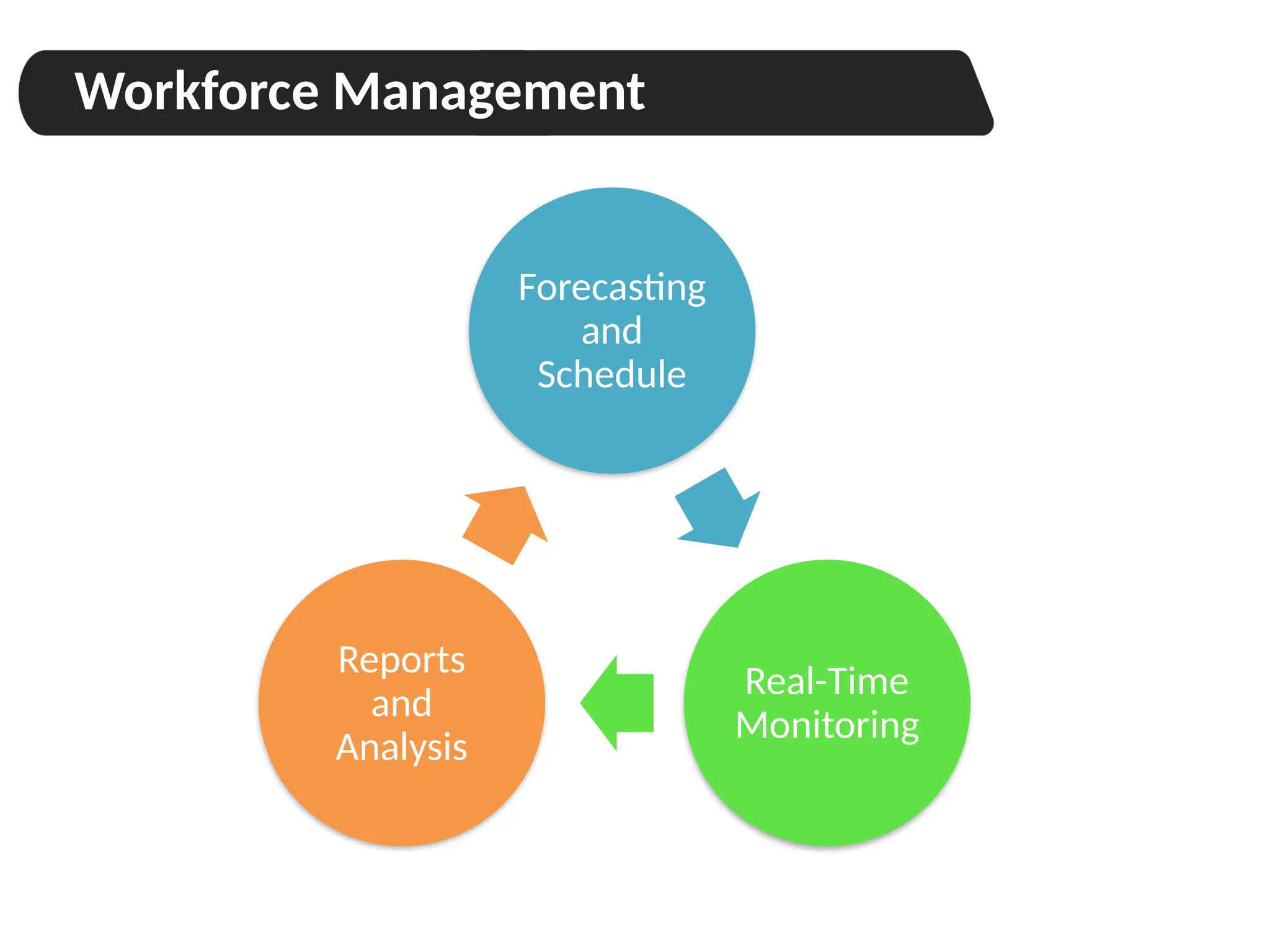
Workforce Management
Forecasting
and
Schedule
Real-Time
Monitoring
Reports
and
Analysis
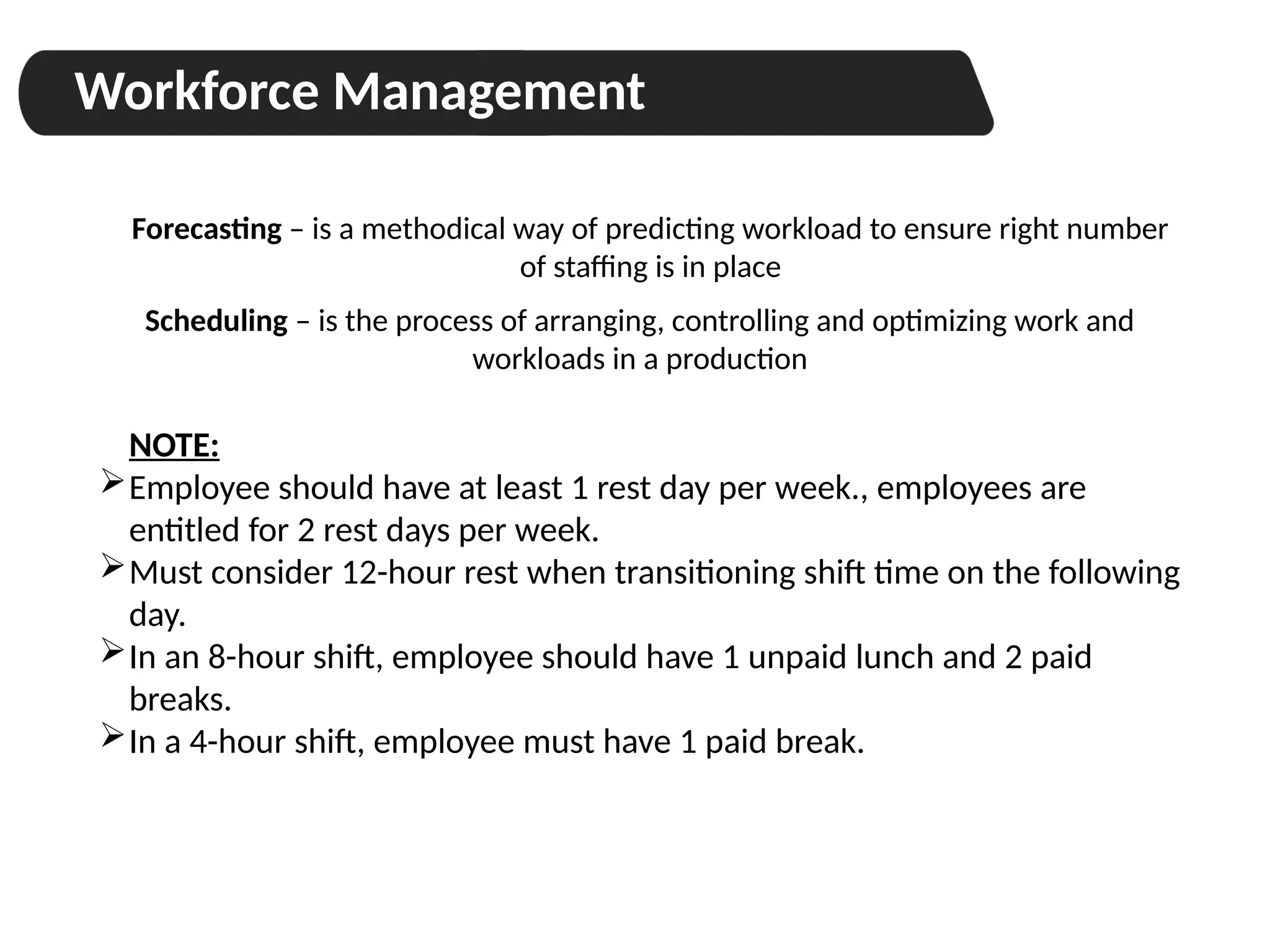
Workforce Management
Forecasting – is a methodical way of predicting workload to ensure right number
of staffing is in place
Scheduling – is the process of arranging, controlling and optimizing work and
workloads in a production
NOTE:
Employee should have at least 1 rest day per week., employees are
entitled for 2 rest days per week.
Must consider 12-hour rest when transitioning shift time on the following
day.
In an 8-hour shift, employee should have 1 unpaid lunch and 2 paid
breaks.
In a 4-hour shift, employee must have 1 paid break.
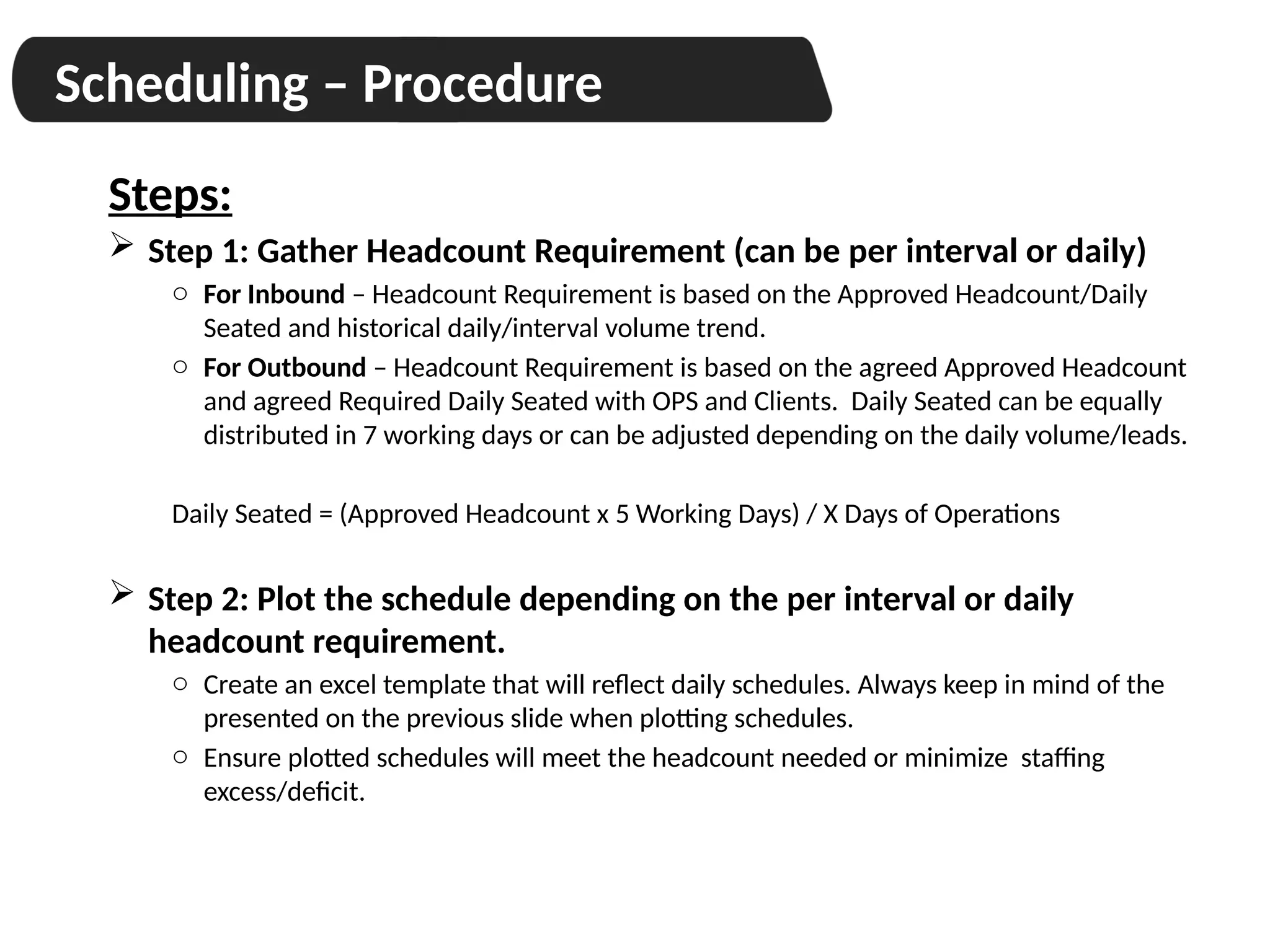
Scheduling – Procedure
Steps:
 Step 1: Gather Headcount Requirement (can be per interval or daily)
o For Inbound – Headcount Requirement is based on the Approved Headcount/Daily
Seated and historical daily/interval volume trend.
o For Outbound – Headcount Requirement is based on the agreed Approved Headcount
and agreed Required Daily Seated with OPS and Clients. Daily Seated can be equally
distributed in 7 working days or can be adjusted depending on the daily volume/leads.
Daily Seated = (Approved Headcount x 5 Working Days) / X Days of Operations
 Step 2: Plot the schedule depending on the per interval or daily
headcount requirement.
o Create an excel template that will reflect daily schedules. Always keep in mind of the
presented on the previous slide when plotting schedules.
o Ensure plotted schedules will meet the headcount needed or minimize staffing
excess/deficit.
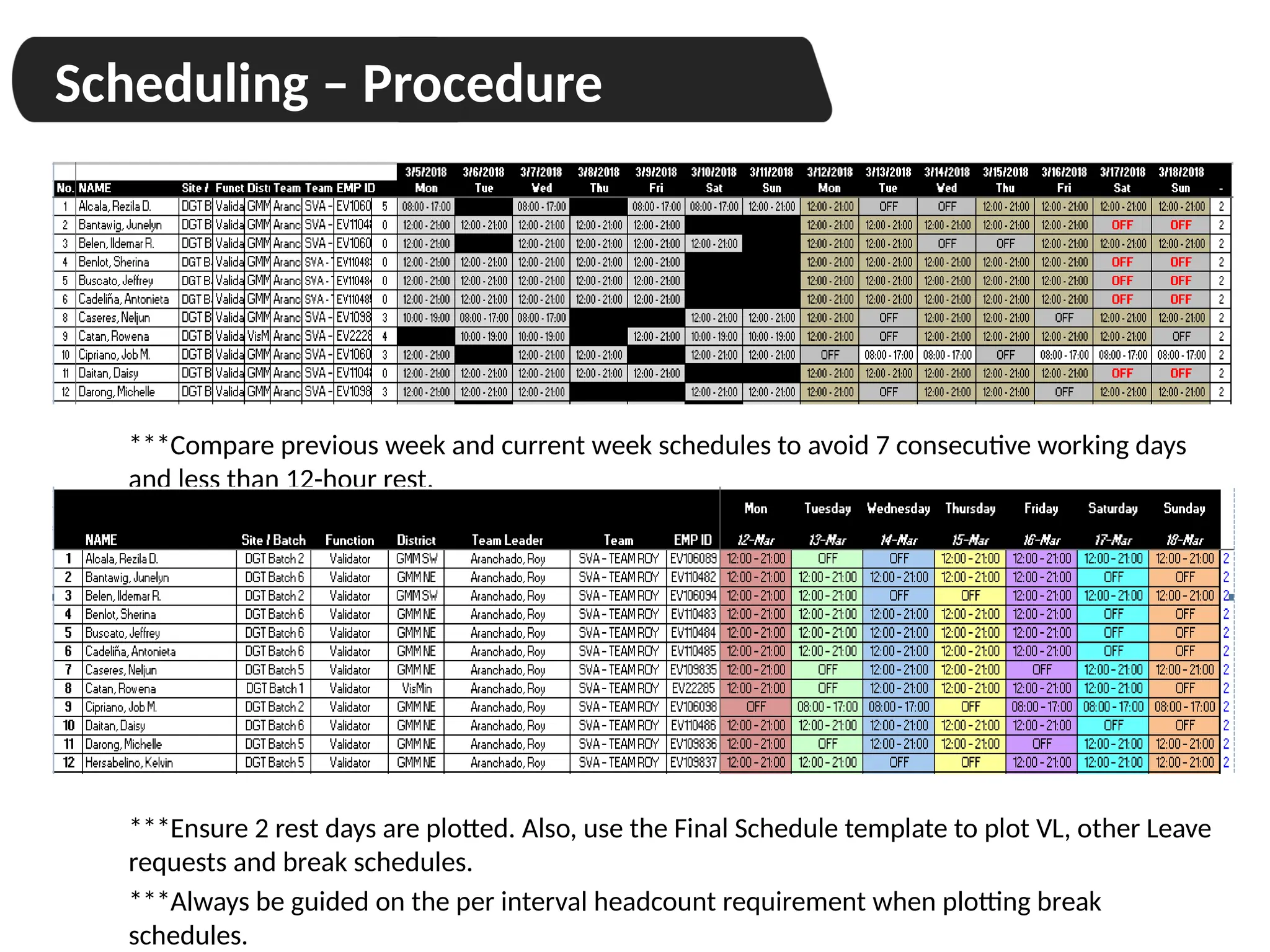
Scheduling – Procedure
***Compare previous week and current week schedules to avoid 7 consecutive working days
and less than 12-hour rest.
***Ensure 2 rest days are plotted. Also, use the Final Schedule template to plot VL, other Leave
requests and break schedules.
***Always be guided on the per interval headcount requirement when plotting break
schedules.
Workforce Management
Agent Monitoring – Operational Metric
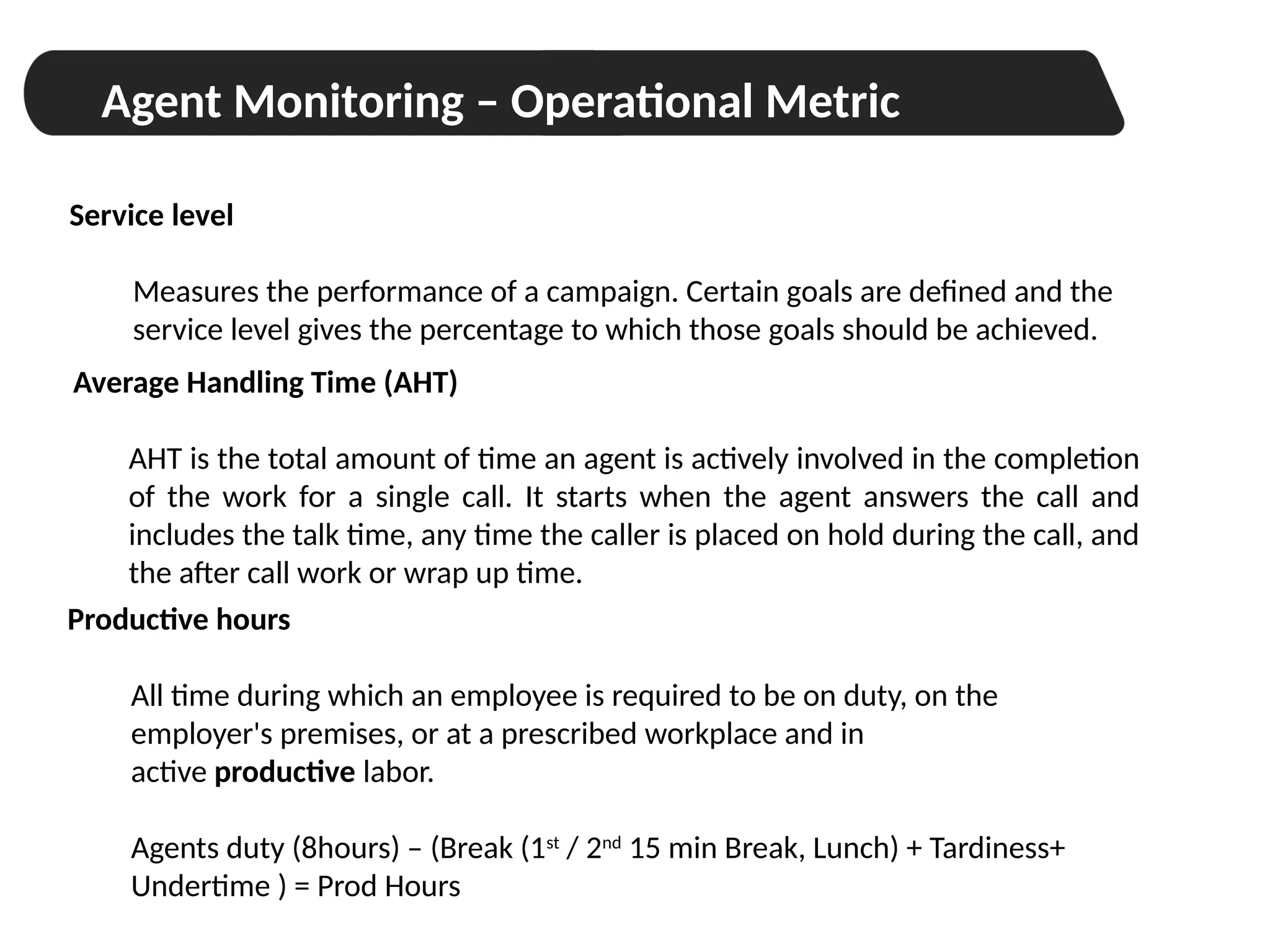
Service level
Measures the performance of a campaign. Certain goals are defined and the
service level gives the percentage to which those goals should be achieved.
Productive hours
All time during which an employee is required to be on duty, on the
employer's premises, or at a prescribed workplace and in
active productive labor.
Agents duty (8hours) – (Break (1st
/ 2nd
15 min Break, Lunch) + Tardiness+
Undertime ) = Prod Hours
Average Handling Time (AHT)
AHT is the total amount of time an agent is actively involved in the completion
of the work for a single call. It starts when the agent answers the call and
includes the talk time, any time the caller is placed on hold during the call, and
the after call work or wrap up time.
Agent Monitoring – Operational Metric
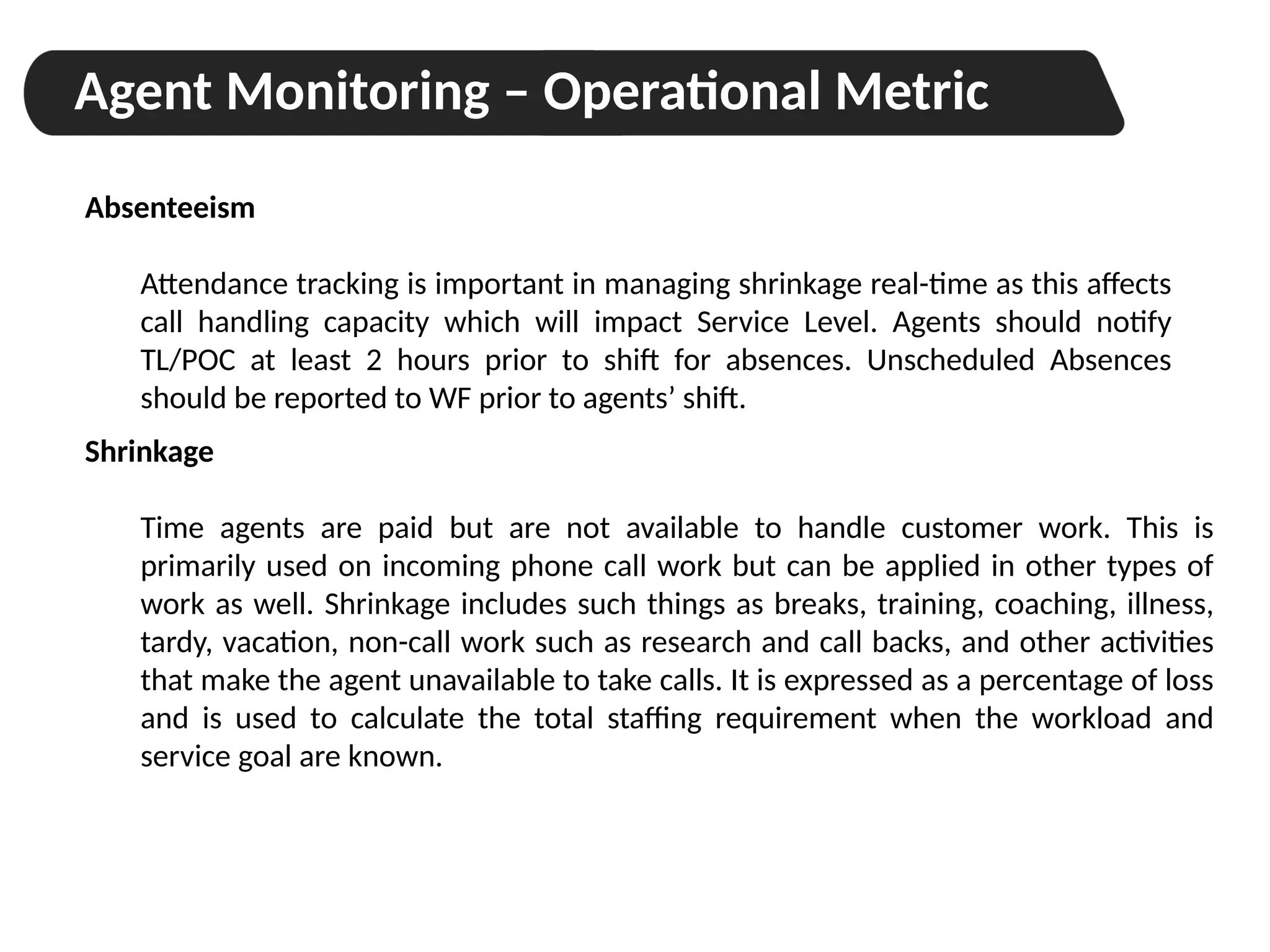
Absenteeism
Attendance tracking is important in managing shrinkage real-time as this affects
call handling capacity which will impact Service Level. Agents should notify
TL/POC at least 2 hours prior to shift for absences. Unscheduled Absences
should be reported to WF prior to agents’ shift.
Shrinkage
Time agents are paid but are not available to handle customer work. This is
primarily used on incoming phone call work but can be applied in other types of
work as well. Shrinkage includes such things as breaks, training, coaching, illness,
tardy, vacation, non-call work such as research and call backs, and other activities
that make the agent unavailable to take calls. It is expressed as a percentage of loss
and is used to calculate the total staffing requirement when the workload and
service goal are known.
Agent Monitoring - AUX
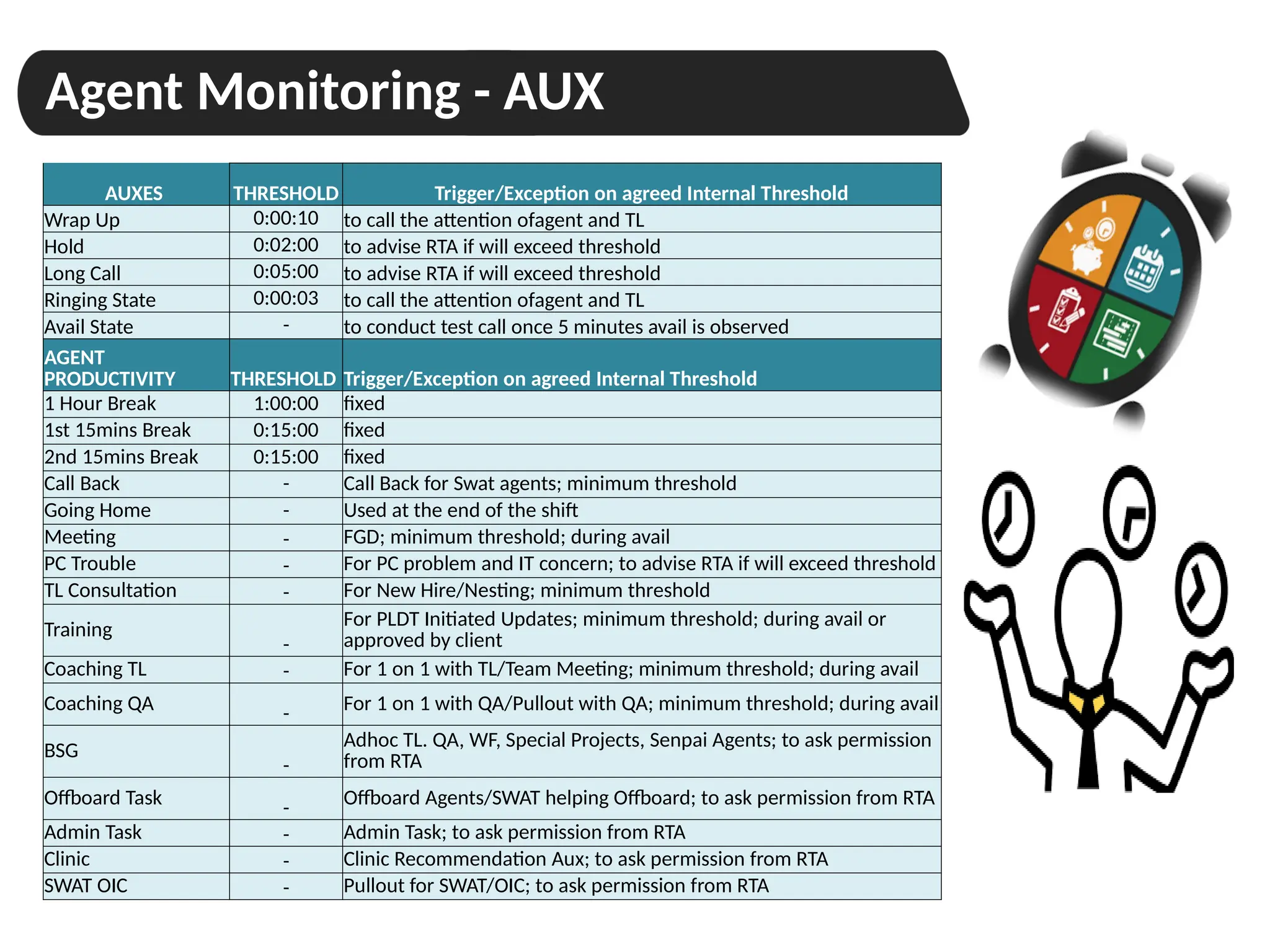
AUXES THRESHOLD Trigger/Exception on agreed Internal Threshold
Wrap Up 0:00:10 to call the attention ofagent and TL
Hold 0:02:00 to advise RTA if will exceed threshold
Long Call 0:05:00 to advise RTA if will exceed threshold
Ringing State 0:00:03 to call the attention ofagent and TL
Avail State - to conduct test call once 5 minutes avail is observed
AGENT
PRODUCTIVITY THRESHOLD Trigger/Exception on agreed Internal Threshold
1 Hour Break 1:00:00 fixed
1st 15mins Break 0:15:00 fixed
2nd 15mins Break 0:15:00 fixed
Call Back - Call Back for Swat agents; minimum threshold
Going Home - Used at the end of the shift
Meeting - FGD; minimum threshold; during avail
PC Trouble - For PC problem and IT concern; to advise RTA if will exceed threshold
TL Consultation - For New Hire/Nesting; minimum threshold
Training
-
For PLDT Initiated Updates; minimum threshold; during avail or
approved by client
Coaching TL - For 1 on 1 with TL/Team Meeting; minimum threshold; during avail
Coaching QA - For 1 on 1 with QA/Pullout with QA; minimum threshold; during avail
BSG
-
Adhoc TL. QA, WF, Special Projects, Senpai Agents; to ask permission
from RTA
Offboard Task - Offboard Agents/SWAT helping Offboard; to ask permission from RTA
Admin Task - Admin Task; to ask permission from RTA
Clinic - Clinic Recommendation Aux; to ask permission from RTA
SWAT OIC - Pullout for SWAT/OIC; to ask permission from RTA
Agent Monitoring - AUX
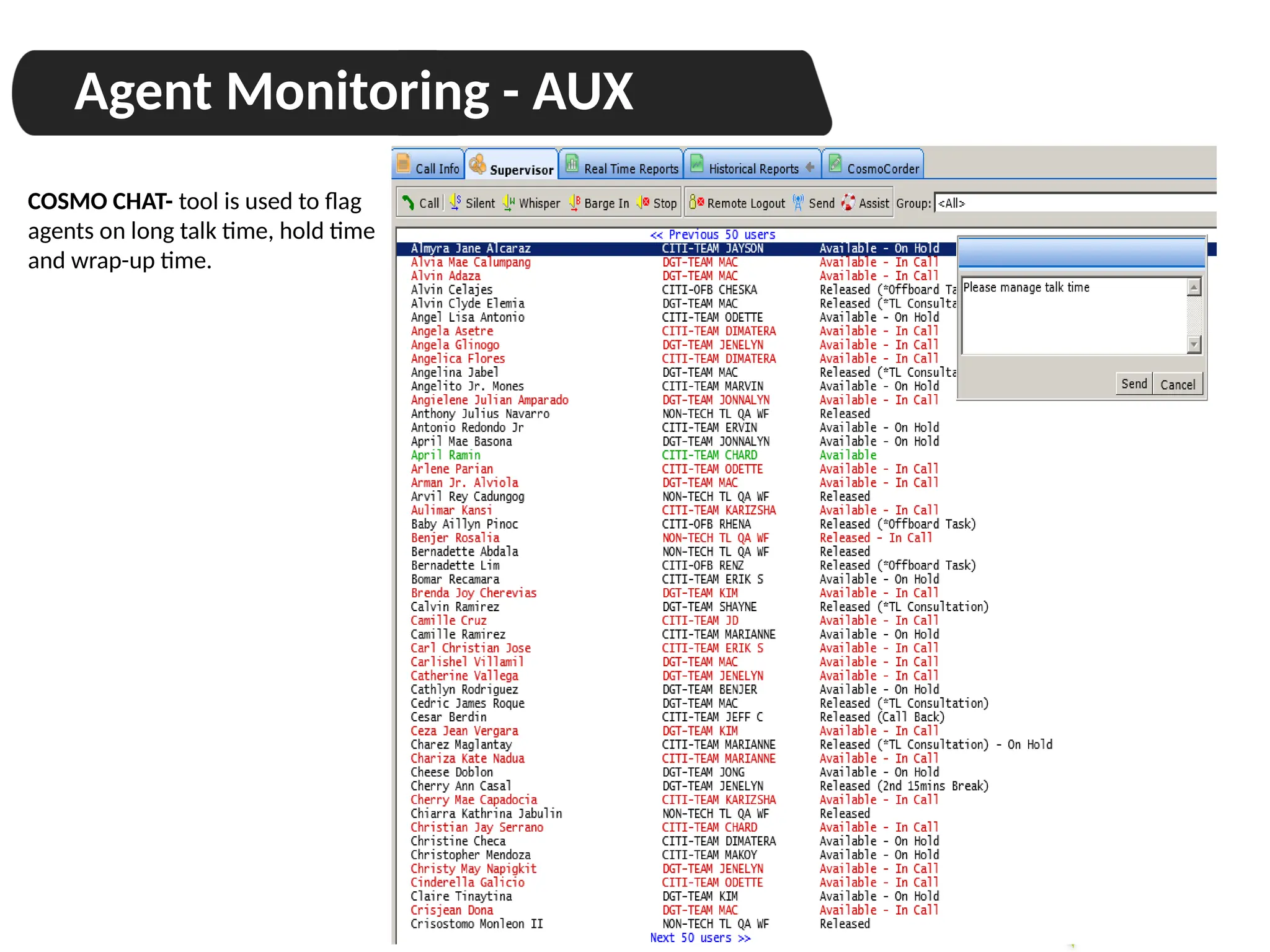
COSMO CHAT- tool is used to flag
agents on long talk time, hold time
and wrap-up time.
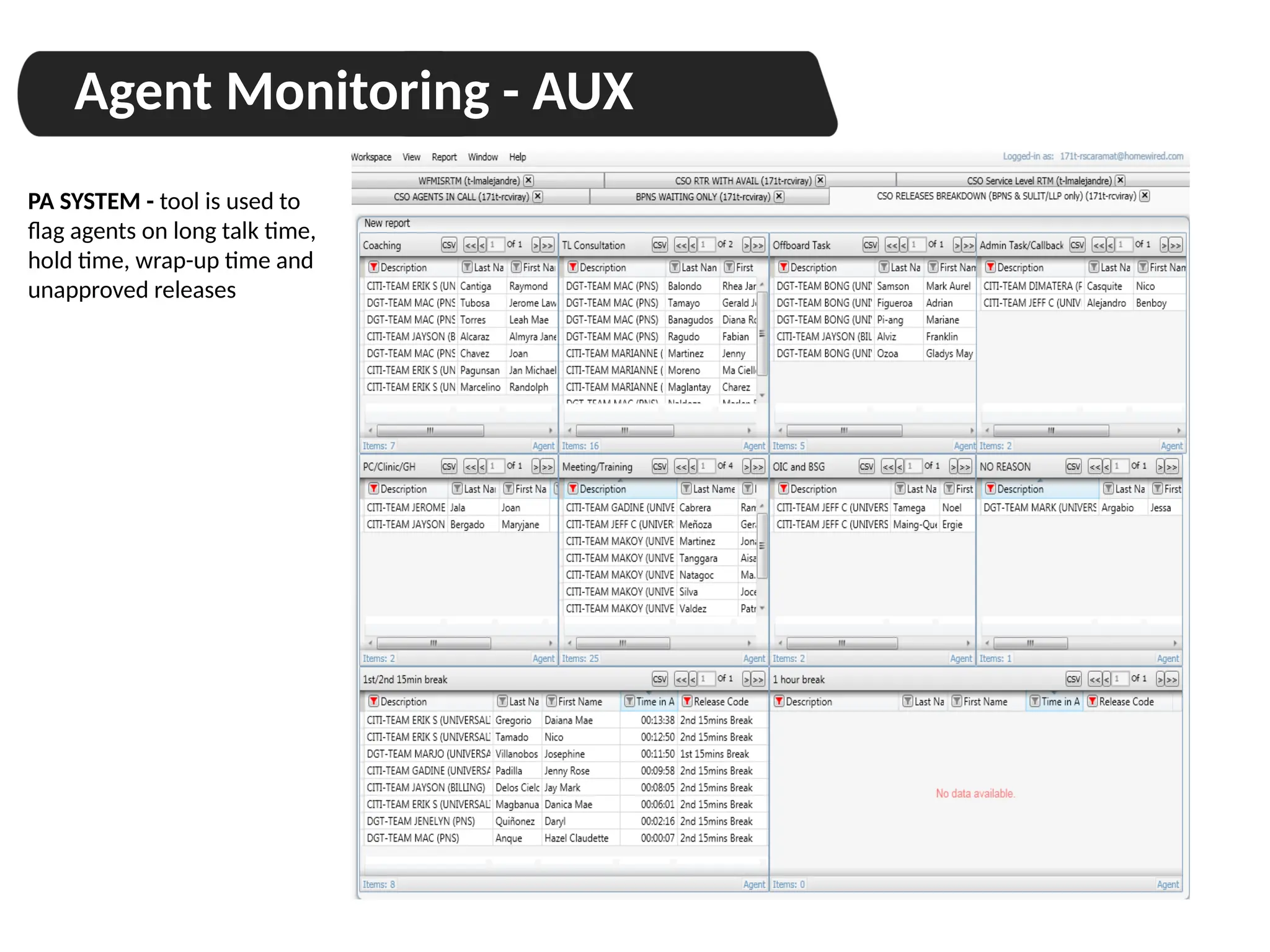
Agent Monitoring - AUX
PA SYSTEM - tool is used to
flag agents on long talk time,
hold time, wrap-up time and
unapproved releases

Workforce Management
The End

Pre Hire Workforce Orientation slideshow

  • 1.
  • 2.
    Workforce Management Workforce management(WFM) is a term that encompasses all of the processes that a contact center undertakes in order to have the right number of staff available at the right time. These WFM processes include each of the following: • Forecasting contact volumes • Scheduling staff • Reporting of day on day performance • Managing on a day-to-day basis (intraday management), in case of unexpected rises in contact volumes or absenteeism
  • 3.
  • 4.
    Workforce Management Forecasting –is a methodical way of predicting workload to ensure right number of staffing is in place Scheduling – is the process of arranging, controlling and optimizing work and workloads in a production NOTE: Employee should have at least 1 rest day per week., employees are entitled for 2 rest days per week. Must consider 12-hour rest when transitioning shift time on the following day. In an 8-hour shift, employee should have 1 unpaid lunch and 2 paid breaks. In a 4-hour shift, employee must have 1 paid break.
  • 5.
    Scheduling – Procedure Steps: Step 1: Gather Headcount Requirement (can be per interval or daily) o For Inbound – Headcount Requirement is based on the Approved Headcount/Daily Seated and historical daily/interval volume trend. o For Outbound – Headcount Requirement is based on the agreed Approved Headcount and agreed Required Daily Seated with OPS and Clients. Daily Seated can be equally distributed in 7 working days or can be adjusted depending on the daily volume/leads. Daily Seated = (Approved Headcount x 5 Working Days) / X Days of Operations  Step 2: Plot the schedule depending on the per interval or daily headcount requirement. o Create an excel template that will reflect daily schedules. Always keep in mind of the presented on the previous slide when plotting schedules. o Ensure plotted schedules will meet the headcount needed or minimize staffing excess/deficit.
  • 6.
    Scheduling – Procedure ***Compareprevious week and current week schedules to avoid 7 consecutive working days and less than 12-hour rest. ***Ensure 2 rest days are plotted. Also, use the Final Schedule template to plot VL, other Leave requests and break schedules. ***Always be guided on the per interval headcount requirement when plotting break schedules.
  • 7.
    Workforce Management Agent Monitoring– Operational Metric Service level Measures the performance of a campaign. Certain goals are defined and the service level gives the percentage to which those goals should be achieved. Productive hours All time during which an employee is required to be on duty, on the employer's premises, or at a prescribed workplace and in active productive labor. Agents duty (8hours) – (Break (1st / 2nd 15 min Break, Lunch) + Tardiness+ Undertime ) = Prod Hours Average Handling Time (AHT) AHT is the total amount of time an agent is actively involved in the completion of the work for a single call. It starts when the agent answers the call and includes the talk time, any time the caller is placed on hold during the call, and the after call work or wrap up time.
  • 8.
    Agent Monitoring –Operational Metric Absenteeism Attendance tracking is important in managing shrinkage real-time as this affects call handling capacity which will impact Service Level. Agents should notify TL/POC at least 2 hours prior to shift for absences. Unscheduled Absences should be reported to WF prior to agents’ shift. Shrinkage Time agents are paid but are not available to handle customer work. This is primarily used on incoming phone call work but can be applied in other types of work as well. Shrinkage includes such things as breaks, training, coaching, illness, tardy, vacation, non-call work such as research and call backs, and other activities that make the agent unavailable to take calls. It is expressed as a percentage of loss and is used to calculate the total staffing requirement when the workload and service goal are known.
  • 9.
    Agent Monitoring -AUX AUXES THRESHOLD Trigger/Exception on agreed Internal Threshold Wrap Up 0:00:10 to call the attention ofagent and TL Hold 0:02:00 to advise RTA if will exceed threshold Long Call 0:05:00 to advise RTA if will exceed threshold Ringing State 0:00:03 to call the attention ofagent and TL Avail State - to conduct test call once 5 minutes avail is observed AGENT PRODUCTIVITY THRESHOLD Trigger/Exception on agreed Internal Threshold 1 Hour Break 1:00:00 fixed 1st 15mins Break 0:15:00 fixed 2nd 15mins Break 0:15:00 fixed Call Back - Call Back for Swat agents; minimum threshold Going Home - Used at the end of the shift Meeting - FGD; minimum threshold; during avail PC Trouble - For PC problem and IT concern; to advise RTA if will exceed threshold TL Consultation - For New Hire/Nesting; minimum threshold Training - For PLDT Initiated Updates; minimum threshold; during avail or approved by client Coaching TL - For 1 on 1 with TL/Team Meeting; minimum threshold; during avail Coaching QA - For 1 on 1 with QA/Pullout with QA; minimum threshold; during avail BSG - Adhoc TL. QA, WF, Special Projects, Senpai Agents; to ask permission from RTA Offboard Task - Offboard Agents/SWAT helping Offboard; to ask permission from RTA Admin Task - Admin Task; to ask permission from RTA Clinic - Clinic Recommendation Aux; to ask permission from RTA SWAT OIC - Pullout for SWAT/OIC; to ask permission from RTA
  • 10.
    Agent Monitoring -AUX COSMO CHAT- tool is used to flag agents on long talk time, hold time and wrap-up time.
  • 11.
    Agent Monitoring -AUX PA SYSTEM - tool is used to flag agents on long talk time, hold time, wrap-up time and unapproved releases
  • 12.