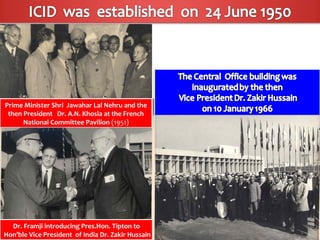
Prime Minister Shri Jawahar Lal Nehru and the
 Prime Minister Shri Jawahar Lal Nehru and the
 then President Dr. A.N. Khosla at the French
  then President Dr. A.N. Khosla at the French
      National Committee Pavilion (1951)
       National Committee Pavilion (1951)


   Dr. Framji introducing Pres.Hon. Tipton to
    Dr. Framji introducing Pres.Hon. Tipton to
Hon’ble Vice President of India Dr. Zakir Hussain
 Hon’ble Vice President of India Dr. Zakir Hussain
Dedicated to enhancing the
worldwide supply of food and fibre
for all people by improving water
and land management and the
productivity of irrigated and
drained lands through appropriate
management of water,
environment and application of
irrigation, drainage and flood
management techniques.
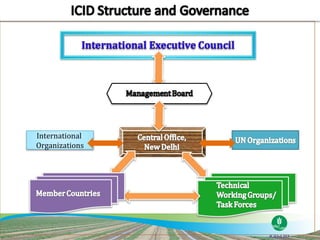
International
Organizations
MEMBERSHIP

Country Membership
Direct Members (New))
      Individuals, Companies , Institutions

       Facilities/ Benefits:
        Exposure to an international platform;
        Make your voice heard;
        Stay informed on recent irrigation, drainage and flood management
       news and events;
       Influence policy makers to develop sound irrigation-related policies;
       Play an active role in determining strategies;
       Avail the opportunity to engage in professional networking and
       information exchange activities through participation in National
       Committees.
       Receive one copy of the ICID Journal on Irrigation and Drainage;
       Special discount on ICID publications, etc.
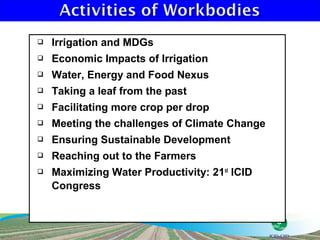
   Irrigation and MDGs
   Economic Impacts of Irrigation
   Water, Energy and Food Nexus
   Taking a leaf from the past
   Facilitating more crop per drop
   Meeting the challenges of Climate Change
   Ensuring Sustainable Development
   Reaching out to the Farmers
   Maximizing Water Productivity: 21st ICID
    Congress
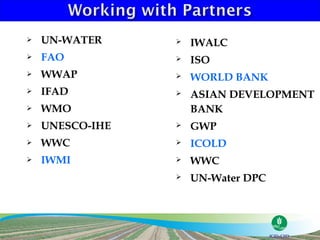
   UN-WATER        IWALC
   FAO             ISO
   WWAP            WORLD BANK
   IFAD            ASIAN DEVELOPMENT
   WMO              BANK
   UNESCO-IHE      GWP
   WWC             ICOLD
   IWMI            WWC
                    UN-Water DPC
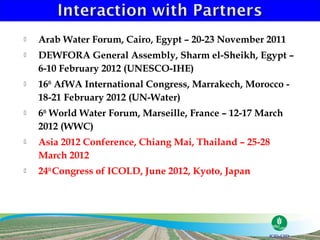
   Arab Water Forum, Cairo, Egypt – 20-23 November 2011
   DEWFORA General Assembly, Sharm el-Sheikh, Egypt –
    6-10 February 2012 (UNESCO-IHE)
   16th AfWA International Congress, Marrakech, Morocco -
    18-21 February 2012 (UN-Water)
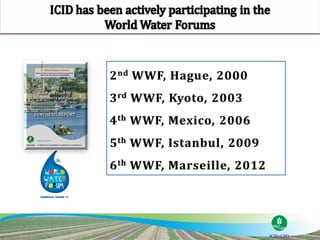
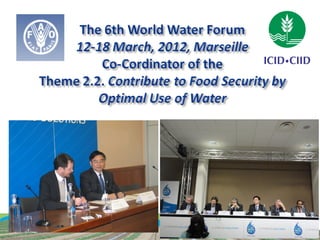
   6th World Water Forum, Marseille, France – 12-17 March
    2012 (WWC)
   Asia 2012 Conference, Chiang Mai, Thailand – 25-28
    March 2012
   24th Congress of ICOLD, June 2012, Kyoto, Japan
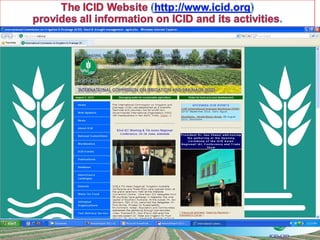
   Website, Internet and Social Media
   Technical Library & Text Delivery Service
    (TDS)
   Publications
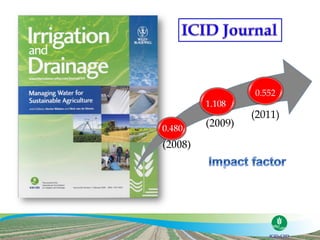
   ICID Journal
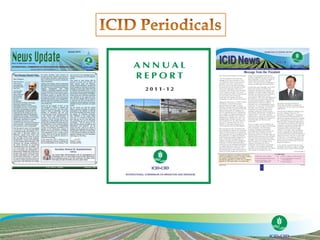
   ICID News & News Update
   Publications, Newsletters
    and Periodicals from the NCs
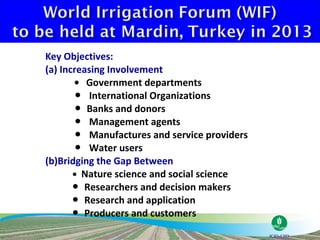
Key Objectives:
(a) Increasing Involvement
       ● Government departments
        ● International Organizations
        ● Banks and donors
        ● Management agents
        ● Manufactures and service providers
        ● Water users
(b)Bridging the Gap Between
       ● Nature science and social science
       ● Researchers and decision makers
       ● Research and application
       ● Producers and customers
0.552

(2011)
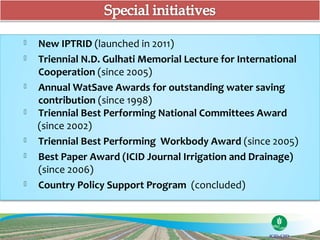
   New IPTRID (launched in 2011)
   Triennial N.D. Gulhati Memorial Lecture for International
    Cooperation (since 2005)
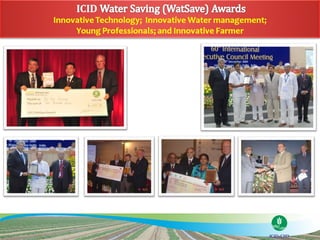
   Annual WatSave Awards for outstanding water saving
    contribution (since 1998)
   Triennial Best Performing National Committees Award
    (since 2002)
   Triennial Best Performing Workbody Award (since 2005)
   Best Paper Award (ICID Journal Irrigation and Drainage)
    (since 2006)
   Country Policy Support Program (concluded)
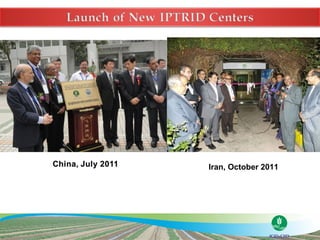
Iran, October 2011
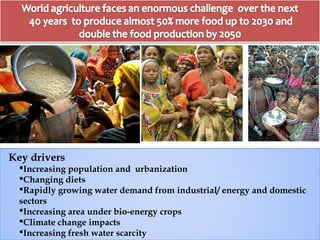
Key drivers
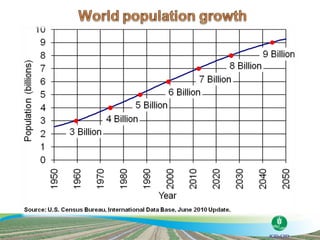
  Increasing population and urbanization
  Changing diets
  Rapidly growing water demand from industrial/ energy and domestic
  sectors
  Increasing area under bio-energy crops
  Climate change impacts
  Increasing fresh water scarcity
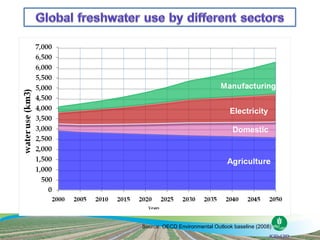
Electricity

                                  Domestic


Source: OECD Environmental Outlook baseline (2008)
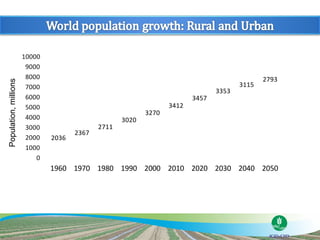
10000
                        9000
                        8000                                                                  2793
Population, millions


                        7000                                                           3115
                                                                                3353
                        6000                                             3457
                        5000                                      3412
                                                           3270
                        4000                        3020
                        3000                 2711                                      5709   6398
                                      2367                                      4965
                        2000   2036                                      4210
                                                           2854   3495
                        1000                 1741   2275
                               996    1332
                           0
                               1960 1970 1980 1990 2000 2010 2020 2030 2040 2050
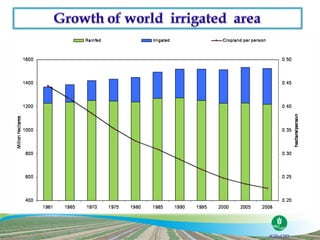
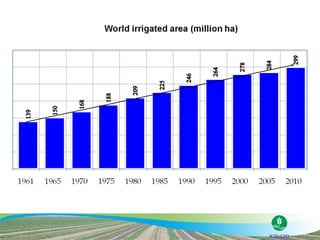
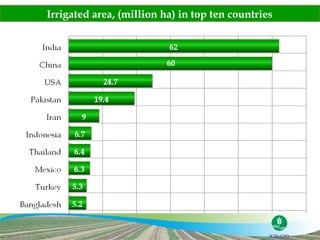
Irrigated area, (million ha) in top ten countries
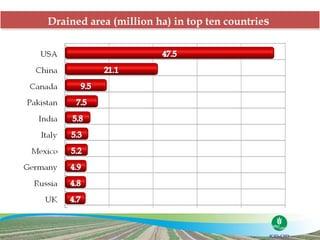
Drained area (million ha) in top ten countries
Irrigated
 Agriculture,
300 million ha
    (20%)
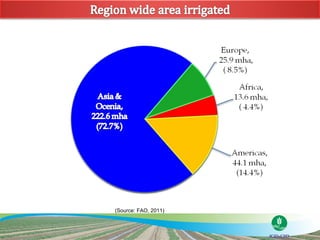
(Source: FAO, 2011)
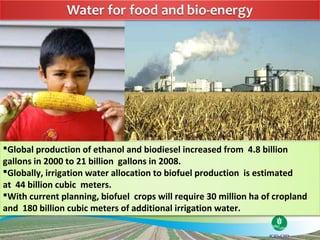
Global production of ethanol and biodiesel increased from 4.8 billion
gallons in 2000 to 21 billion gallons in 2008.
Globally, irrigation water allocation to biofuel production is estimated
at 44 billion cubic meters.
With current planning, biofuel crops will require 30 million ha of cropland
and 180 billion cubic meters of additional irrigation water.
(Source; CRIDA)
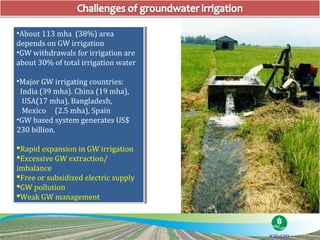
••About113 mha (38%) area
 About 113 mha (38%) area
depends on GW irrigation
 depends on GW irrigation
••GWwithdrawals for irrigation are
 GW withdrawals for irrigation are
about 30% of total irrigation water
 about 30% of total irrigation water

••MajorGW irrigating countries:
 Major GW irrigating countries:
 India (39 mha). China (19 mha),
  India (39 mha). China (19 mha),
  USA(17 mha), Bangladesh,
   USA(17 mha), Bangladesh,
  Mexico (2.5 mha), Spain
   Mexico (2.5 mha), Spain
••GWbased system generates US$
 GW based system generates US$
230 billion.
 230 billion.

Rapidexpansion in GW irrigation
  Rapid expansion in GW irrigation
ExcessiveGW extraction/
  Excessive GW extraction/
imbalance
 imbalance
Freeor subsidized electric supply
  Free or subsidized electric supply
GWpollution
  GW pollution
WeakGW management
  Weak GW management
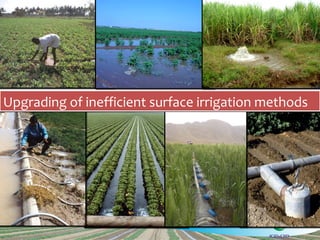
Upgrading of inefficient surface irrigation methods
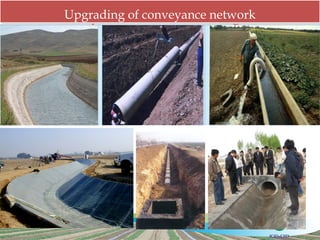
Upgrading of conveyance network
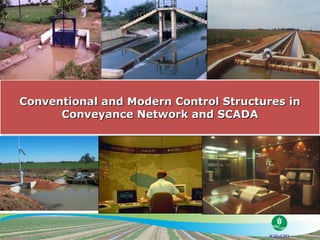
Conventional and Modern Control Structures in
      Conveyance Network and SCADA
      Conveyance Network and SCADA
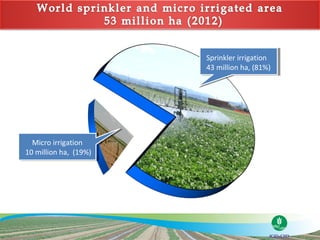
Sprinkler irrigation
                        43 million ha, (81%)


  Micro irrigation
   Micro irrigation
10 million ha, (19%)
 10 million ha, (19%)
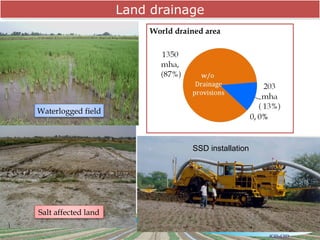
Land drainage
                     Land drainage
                         World drained area


Waterlogged field
                          Saline soil


                                        SSD installation


Salt affected land
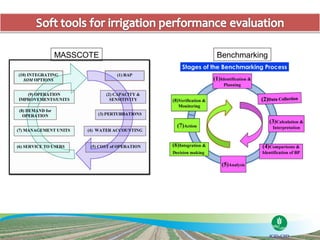
MASSCOTE   Benchmarking
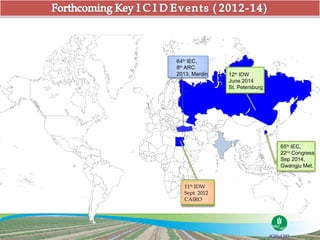
64th IEC,
8th ARC
2013, Mardin    12th IDW
                June 2014
                St. Petersburg


                                 65th IEC,
                                 22nd Congress
                                 Sep 2014,
                                 Gwangju Met.


   11th IDW
   Sept. 2012
   CAIRO
ICID Presentation

ICID Presentation

  • 2.
    Prime Minister ShriJawahar Lal Nehru and the Prime Minister Shri Jawahar Lal Nehru and the then President Dr. A.N. Khosla at the French then President Dr. A.N. Khosla at the French National Committee Pavilion (1951) National Committee Pavilion (1951) Dr. Framji introducing Pres.Hon. Tipton to Dr. Framji introducing Pres.Hon. Tipton to Hon’ble Vice President of India Dr. Zakir Hussain Hon’ble Vice President of India Dr. Zakir Hussain
  • 3.
    Dedicated to enhancingthe worldwide supply of food and fibre for all people by improving water and land management and the productivity of irrigated and drained lands through appropriate management of water, environment and application of irrigation, drainage and flood management techniques.
  • 4.
  • 7.
    MEMBERSHIP Country Membership Direct Members(New)) Individuals, Companies , Institutions Facilities/ Benefits:  Exposure to an international platform;  Make your voice heard;  Stay informed on recent irrigation, drainage and flood management news and events; Influence policy makers to develop sound irrigation-related policies; Play an active role in determining strategies; Avail the opportunity to engage in professional networking and information exchange activities through participation in National Committees. Receive one copy of the ICID Journal on Irrigation and Drainage; Special discount on ICID publications, etc.
  • 10.
    Irrigation and MDGs  Economic Impacts of Irrigation  Water, Energy and Food Nexus  Taking a leaf from the past  Facilitating more crop per drop  Meeting the challenges of Climate Change  Ensuring Sustainable Development  Reaching out to the Farmers  Maximizing Water Productivity: 21st ICID Congress
  • 11.
    UN-WATER  IWALC  FAO  ISO  WWAP  WORLD BANK  IFAD  ASIAN DEVELOPMENT  WMO BANK  UNESCO-IHE  GWP  WWC  ICOLD  IWMI  WWC  UN-Water DPC
  • 12.
    Arab Water Forum, Cairo, Egypt – 20-23 November 2011  DEWFORA General Assembly, Sharm el-Sheikh, Egypt – 6-10 February 2012 (UNESCO-IHE)  16th AfWA International Congress, Marrakech, Morocco - 18-21 February 2012 (UN-Water)  6th World Water Forum, Marseille, France – 12-17 March 2012 (WWC)  Asia 2012 Conference, Chiang Mai, Thailand – 25-28 March 2012  24th Congress of ICOLD, June 2012, Kyoto, Japan
  • 13.
    Website, Internet and Social Media  Technical Library & Text Delivery Service (TDS)  Publications  ICID Journal  ICID News & News Update  Publications, Newsletters and Periodicals from the NCs
  • 18.
    Key Objectives: (a) IncreasingInvolvement ● Government departments ● International Organizations ● Banks and donors ● Management agents ● Manufactures and service providers ● Water users (b)Bridging the Gap Between ● Nature science and social science ● Researchers and decision makers ● Research and application ● Producers and customers
  • 22.
  • 24.
    New IPTRID (launched in 2011)  Triennial N.D. Gulhati Memorial Lecture for International Cooperation (since 2005)  Annual WatSave Awards for outstanding water saving contribution (since 1998)  Triennial Best Performing National Committees Award (since 2002)  Triennial Best Performing Workbody Award (since 2005)  Best Paper Award (ICID Journal Irrigation and Drainage) (since 2006)  Country Policy Support Program (concluded)
  • 25.
  • 27.
    Key drivers Increasing population and urbanization Changing diets Rapidly growing water demand from industrial/ energy and domestic sectors Increasing area under bio-energy crops Climate change impacts Increasing fresh water scarcity
  • 28.
    Electricity Domestic Source: OECD Environmental Outlook baseline (2008)
  • 30.
    10000 9000 8000 2793 Population, millions 7000 3115 3353 6000 3457 5000 3412 3270 4000 3020 3000 2711 5709 6398 2367 4965 2000 2036 4210 2854 3495 1000 1741 2275 996 1332 0 1960 1970 1980 1990 2000 2010 2020 2030 2040 2050
  • 33.
    Irrigated area, (millionha) in top ten countries
  • 34.
    Drained area (millionha) in top ten countries Drained area (million ha) in top ten countries
  • 35.
  • 36.
  • 37.
    Global production ofethanol and biodiesel increased from 4.8 billion gallons in 2000 to 21 billion gallons in 2008. Globally, irrigation water allocation to biofuel production is estimated at 44 billion cubic meters. With current planning, biofuel crops will require 30 million ha of cropland and 180 billion cubic meters of additional irrigation water.
  • 38.
  • 39.
    ••About113 mha (38%)area About 113 mha (38%) area depends on GW irrigation depends on GW irrigation ••GWwithdrawals for irrigation are GW withdrawals for irrigation are about 30% of total irrigation water about 30% of total irrigation water ••MajorGW irrigating countries: Major GW irrigating countries: India (39 mha). China (19 mha), India (39 mha). China (19 mha), USA(17 mha), Bangladesh, USA(17 mha), Bangladesh, Mexico (2.5 mha), Spain Mexico (2.5 mha), Spain ••GWbased system generates US$ GW based system generates US$ 230 billion. 230 billion. Rapidexpansion in GW irrigation Rapid expansion in GW irrigation ExcessiveGW extraction/ Excessive GW extraction/ imbalance imbalance Freeor subsidized electric supply Free or subsidized electric supply GWpollution GW pollution WeakGW management Weak GW management
  • 40.
    Upgrading of inefficientsurface irrigation methods Upgrading of inefficient surface irrigation methods
  • 41.
    Upgrading of conveyancenetwork Upgrading of conveyance network
  • 42.
    Conventional and ModernControl Structures in Conventional and Modern Control Structures in Conveyance Network and SCADA Conveyance Network and SCADA
  • 43.
    Sprinkler irrigation 43 million ha, (81%) Micro irrigation Micro irrigation 10 million ha, (19%) 10 million ha, (19%)
  • 44.
    Land drainage Land drainage World drained area Waterlogged field Saline soil SSD installation Salt affected land
  • 45.
    MASSCOTE Benchmarking
  • 46.
    64th IEC, 8th ARC 2013,Mardin 12th IDW June 2014 St. Petersburg 65th IEC, 22nd Congress Sep 2014, Gwangju Met. 11th IDW Sept. 2012 CAIRO