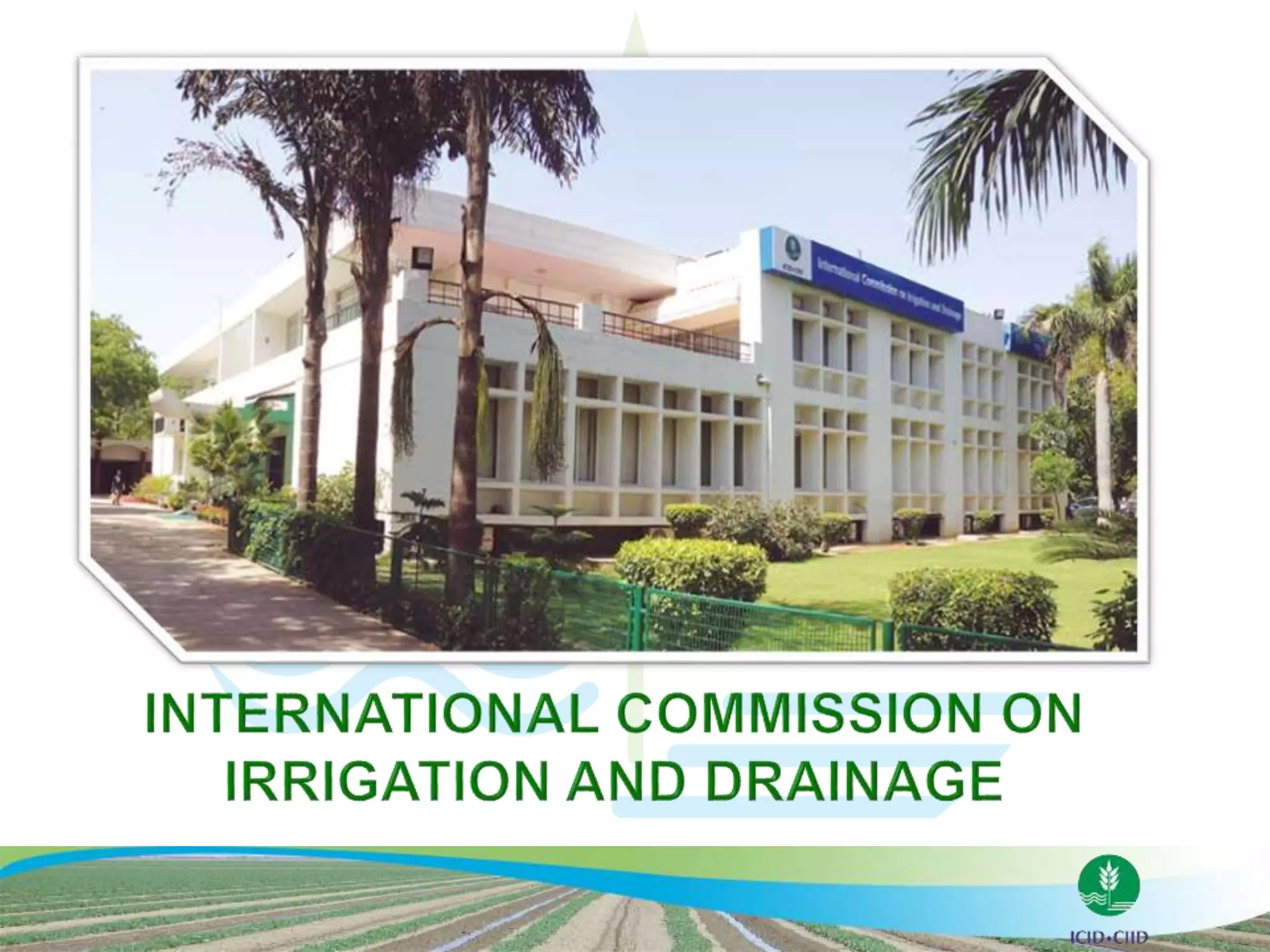
 International Commission on Irrigation and Drainage
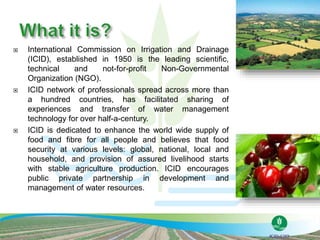
(ICID), established in 1950 is the leading scientific,
technical and not-for-profit Non-Governmental
Organization (NGO).
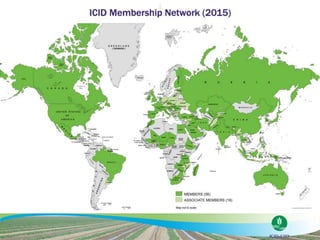
 ICID network of professionals spread across more than
a hundred countries, has facilitated sharing of
experiences and transfer of water management
technology for over half-a-century.
 ICID is dedicated to enhance the world wide supply of
food and fibre for all people and believes that food
security at various levels: global, national, local and
household, and provision of assured livelihood starts
with stable agriculture production. ICID encourages
public private partnership in development and
management of water resources.
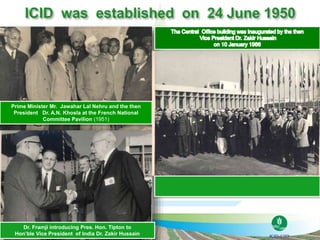
Prime Minister Mr. Jawahar Lal Nehru and the then
President Dr. A.N. Khosla at the French National
Committee Pavilion (1951)
Dr. Framji introducing Pres. Hon. Tipton to
Hon’ble Vice President of India Dr. Zakir Hussain
Source:
Note:
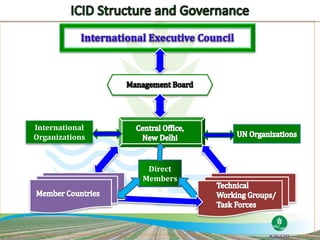
Direct
Members
International
Organizations
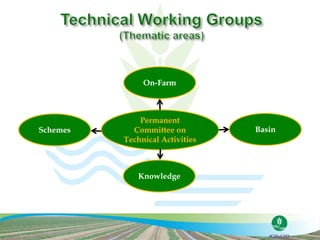
Permanent
Committee on
Technical Activities
Knowledge
On-Farm
BasinSchemes
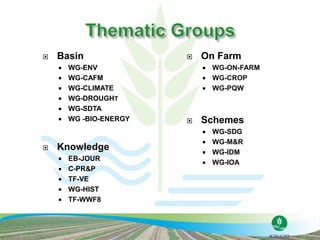
 Basin
 WG-ENV
 WG-CAFM
 WG-CLIMATE
 WG-DROUGHT
 WG-SDTA
 WG -BIO-ENERGY
 Knowledge
 EB-JOUR
 C-PR&P
 TF-VE
 WG-HIST
 TF-WWF8
 On Farm
 WG-ON-FARM
 WG-CROP
 WG-PQW
 Schemes
 WG-SDG
 WG-M&R
 WG-IDM
 WG-IOA
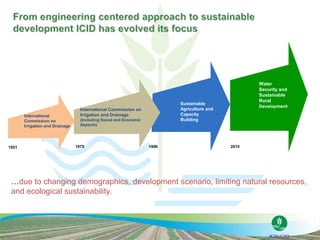
Water
Security and
Sustainable
Rural
Development
Sustainable
Agriculture and
Capacity
Building
International Commission on
Irrigation and Drainage
(Including Social and Economic
Aspects)
International
Commission on
Irrigation and Drainage
1951 1975 1996 2015
…due to changing demographics, development scenario, limiting natural resources,
and ecological sustainability.
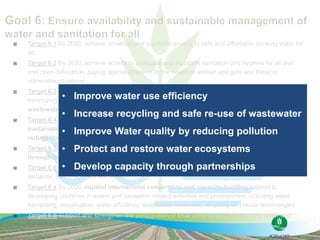
 Target 6.1 By 2030, achieve universal and equitable access to safe and affordable drinking water for
all.
 Target 6.2 By 2030, achieve access to adequate and equitable sanitation and hygiene for all and
end open defecation, paying special attention to the needs of women and girls and those in
vulnerable situations.
 Target 6.3 By 2030, improve water quality by reducing pollution, eliminating dumping and
minimizing release of hazardous chemicals and materials, halving the proportion of untreated
wastewater and substantially increasing recycling and safe reuse globally.
 Target 6.4 By 2030, substantially increase water-use efficiency across all sectors and ensure
sustainable withdrawals and supply of freshwater to address water scarcity and substantially
reduce the number of people suffering from water scarcity.
 Target 6.5 By 2030, implement integrated water resources management at all levels, including
through transboundary cooperation as appropriate
 Target 6.6 By 2020, protect and restore water-related ecosystems, including mountains, forests,
wetlands, rivers, aquifers and lakes.
 Target 6.a By 2030, expand international cooperation and capacity-building support to
developing countries in water- and sanitation related activities and programmes, including water
harvesting, desalination, water efficiency, wastewater treatment, recycling and reuse technologies
 Target 6.b Support and strengthen the participation of local communities in improving water and
sanitation management.
• Improve water use efficiency
• Increase recycling and safe re-use of wastewater
• Improve Water quality by reducing pollution
• Protect and restore water ecosystems
• Develop capacity through partnerships
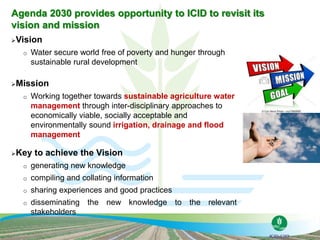
Vision
o Water secure world free of poverty and hunger through
sustainable rural development
Mission
o Working together towards sustainable agriculture water
management through inter-disciplinary approaches to
economically viable, socially acceptable and
environmentally sound irrigation, drainage and flood
management
Key to achieve the Vision
o generating new knowledge
o compiling and collating information
o sharing experiences and good practices
o disseminating the new knowledge to the relevant
stakeholders
Agenda 2030 provides opportunity to ICID to revisit its
vision and mission
ICID is a unique platform for the exchange of
knowledge and information related to agricultural
water management. ICID organizes International
Congresses on Irrigation and Drainage, and World
Irrigation Forum, Regional Conferences, Micro
Irrigation Congresses, International Drainage
Workshops, Symposia and Workshops, Seminar
and Special Sessions, etc. to address and discuss
issues of global/regional importance.
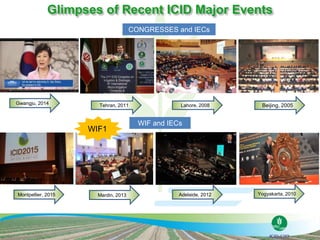
Glimpses of Recent ICID Major Events
CONGRESSES and IECs
WIF and IECs
Gwangju, 2014 Tehran, 2011 Lahore, 2008 Beijing, 2005
Mardin, 2013 Adelaide, 2012 Yogyakarta, 2010Montpellier, 2015
WIF1
 4th African Regional Conferences on Irrigation and
Drainage (ARCID), 26-28 April 2016, Cairo, Egypt. Theme:
Agricultural Land and Water Management for Sustainability
under Climate Variability
 67th IEC and 2nd World Irrigation Forum, Chiang Mai,
Thailand, 6-12 November 2016. Theme: Water
management in a changing world: Role of Irrigation for
sustainable food production.
 13th International Drainage Workshop (IDW), 4-7 March
2017, Ahvaz City, Iran. Theme: Drainage and
Environmental Sustainability.
 23rd International Congress on Irrigation and Drainage,
8-14 October 2017, Mexico City, Mexico. Theme:
Modernizing Irrigation and Drainage for a new Green
Revolution.
 Provides a unique platform for all stakeholders for sharing and learning by engaging
in issues of global interest.
 Gathers a wide range of experts from various disciplines to provide different
perspectives.
 Stimulates and promotes multi- disciplinary discussions towards sustainable
solution to water management in agriculture through:
 Exchange of latest irrigation and drainage policies, practices, innovations and technologies;
 Exploring and formulating concrete inter-disciplinary proposals;
 Development of liaison/collaboration among various national/international institutions/
organizations/private sector working for irrigated agriculture; and
 Advocacy for political commitments.
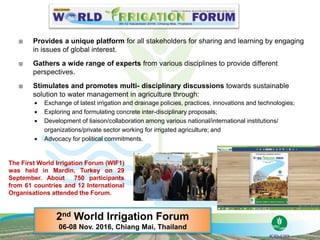
2nd World Irrigation Forum
06-08 Nov. 2016, Chiang Mai, Thailand
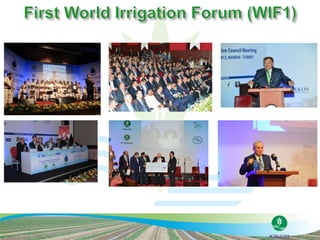
The First World Irrigation Forum (WIF1)
was held in Mardin, Turkey on 29
September. About 750 participants
from 61 countries and 12 International
Organisations attended the Forum.
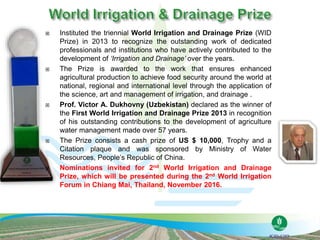
 Instituted the triennial World Irrigation and Drainage Prize (WID
Prize) in 2013 to recognize the outstanding work of dedicated
professionals and institutions who have actively contributed to the
development of ‘Irrigation and Drainage’ over the years.
 The Prize is awarded to the work that ensures enhanced
agricultural production to achieve food security around the world at
national, regional and international level through the application of
the science, art and management of irrigation, and drainage .
 Prof. Victor A. Dukhovny (Uzbekistan) declared as the winner of
the First World Irrigation and Drainage Prize 2013 in recognition
of his outstanding contributions to the development of agriculture
water management made over 57 years.
 The Prize consists a cash prize of US $ 10,000, Trophy and a
Citation plaque and was sponsored by Ministry of Water
Resources, People’s Republic of China.
 Nominations invited for 2nd World Irrigation and Drainage
Prize, which will be presented during the 2nd World Irrigation
Forum in Chiang Mai, Thailand, November 2016.
 Direct Membership
 Direct Members participate in ICID activities. A special section was
covered in ICID Annual Report.
 World Irrigation Forum
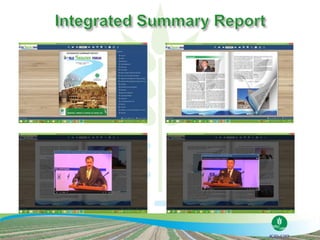
 Brought out a Summary Report and Integrated Summary Report
 World Irrigation and Drainage Prize: Established Prize and presented
the first World Irrigation and Drainage Prize 2013 to Prof. Victor A.
Dukhovny (Uzbekistan)
 Heritage Irrigation Structures (HIS): Prepare a “ICID Register of
Heritage Irrigation Structures”
 Knowledge Management: e-learning, e-Publications, web version of
Multilingual Technical Dictionary (MTD), and Digitization of old
publications
 Enhancing participation of Young Professionals in ICID activities.
Providing scholarships to young professionals to attend ICID events and
training programs. Established a new ICID Young Professional e-Forum
(IYPeF) on LinkedIn
 Approved establishing Technical Support Unit (TSU) at Central Office
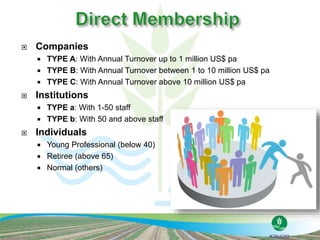
 Companies
 TYPE A: With Annual Turnover up to 1 million US$ pa
 TYPE B: With Annual Turnover between 1 to 10 million US$ pa
 TYPE C: With Annual Turnover above 10 million US$ pa
 Institutions
 TYPE a: With 1-50 staff
 TYPE b: With 50 and above staff
 Individuals
 Young Professional (below 40)
 Retiree (above 65)
 Normal (others)
 Be part of International Platform
 Benefit from world wide exposure
 Stay Informed
 Influence policy making
 Participate in determining strategies
 Avail the opportunity of networking
 Receive
 One free copy of ICID Journal, ICID newsletters, e-Bulletins
 Receive 2,4, or 6 copies of ICID Journal at 50% price
 Special Discount on all other Publications and special 35% discount
on all the Wiley printed publications under the Society Discount
 Special registration fee, advertisement rates, exhibition rates, etc
 No charges for making announcements in Newsletters and website
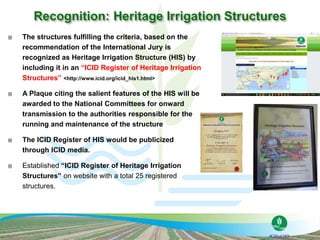
 The structures fulfilling the criteria, based on the
recommendation of the International Jury is
recognized as Heritage Irrigation Structure (HIS) by
including it in an “ICID Register of Heritage Irrigation
Structures” <http://www.icid.org/icid_his1.html>
 A Plaque citing the salient features of the HIS will be
awarded to the National Committees for onward
transmission to the authorities responsible for the
running and maintenance of the structure
 The ICID Register of HIS would be publicized
through ICID media.
 Established “ICID Register of Heritage Irrigation
Structures” on website with a total 25 registered
structures.
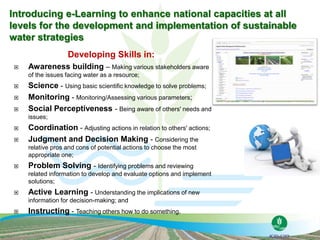
Developing Skills in:
 Awareness building – Making various stakeholders aware
of the issues facing water as a resource;
 Science - Using basic scientific knowledge to solve problems;
 Monitoring - Monitoring/Assessing various parameters;
 Social Perceptiveness - Being aware of others' needs and
issues;
 Coordination - Adjusting actions in relation to others' actions;
 Judgment and Decision Making - Considering the
relative pros and cons of potential actions to choose the most
appropriate one;
 Problem Solving - Identifying problems and reviewing
related information to develop and evaluate options and implement
solutions;
 Active Learning - Understanding the implications of new
information for decision-making; and
 Instructing - Teaching others how to do something.
Introducing e-Learning to enhance national capacities at all
levels for the development and implementation of sustainable
water strategies
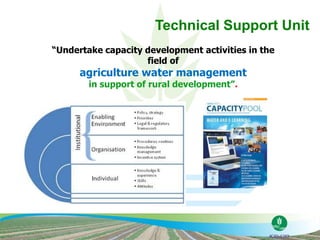
“Undertake capacity development activities in the
field of
agriculture water management
in support of rural development”.
Technical Support Unit
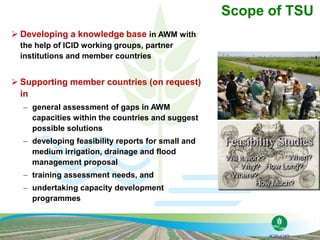
 Developing a knowledge base in AWM with
the help of ICID working groups, partner
institutions and member countries
 Supporting member countries (on request)
in
 general assessment of gaps in AWM
capacities within the countries and suggest
possible solutions
 developing feasibility reports for small and
medium irrigation, drainage and flood
management proposal
 training assessment needs, and
 undertaking capacity development
programmes
Scope of TSU
 ICID has taken initiative to upgrade some of the
existing services and introduced few new technologies
to meet the requirement:
 New ICID Website
 Integrated Library Management System (ILMS)
 Text Delivery System (TDS)
 Digitization: Publications and documents from the year 1950
onwards are now available in digital format. Central Office is in the
process of placing these publications in the ‘Members only’ section for
free download.
 e-Publications
 e-Learning
 Virtual Communication Tools: Web and Tele-conferencing
 Managing the knowledge process is the key to the
success of any professional network
 Knowledge Management consists of generation,
extraction, consolidation / compilation, synthesis,
packaging and dissemination of the knowledge plays a
critical role in the field of irrigation, drainage and flood
management.
 The various technical Working Groups of ICID, through
their activities help extract, compile, and synthesize this
knowledge.
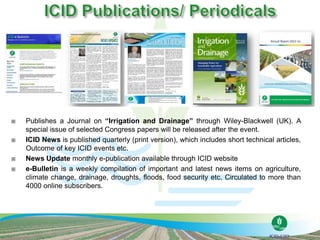
 Publishes a Journal on “Irrigation and Drainage” through Wiley-Blackwell (UK). A
special issue of selected Congress papers will be released after the event.
 ICID News is published quarterly (print version), which includes short technical articles,
Outcome of key ICID events etc.
 News Update monthly e-publication available through ICID website
 e-Bulletin is a weekly compilation of important and latest news items on agriculture,
climate change, drainage, droughts, floods, food security etc. Circulated to more than
4000 online subscribers.
 The ICID Journal ‘Irrigation and Drainage’ is a technical peer-
reviewed specialized international flagship publication of ICID.
 The Journal is published through M/s. Wiley-Blackwell (UK)
and is widely distributed among ICID members and others.
 The full text of the Journal is available through Wiley Online
Library
 Under the Research4Lifeprogramme local, not-for-profit
institutions of select countries can access Irrigation and
Drainage for free under AGORA (agora@fao.org) and OARE
(oare@oaresciences.org) system. More than 5200 institutions
from developing countries were provided free access. Patrons
are encouraged to register.
 Instituted 'Best Paper Award' to recognise the outstanding
paper published
 Members will get special 35% discount on all the Wiley printed
publications under the Society Discount
0
0.2
0.4
0.6
0.8
1
1.2
2008
2009
2010
2011
2012
2013
2014
0.48
1.108
0.552
0.922
0.685 0.717
0.510
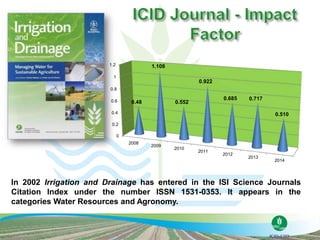
In 2002 Irrigation and Drainage has entered in the ISI Science Journals
Citation Index under the number ISSN 1531-0353. It appears in the
categories Water Resources and Agronomy.
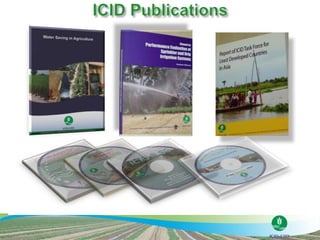
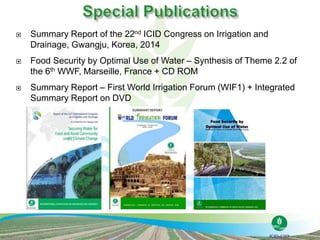
 Summary Report of the 22nd ICID Congress on Irrigation and
Drainage, Gwangju, Korea, 2014
 Food Security by Optimal Use of Water – Synthesis of Theme 2.2 of
the 6th WWF, Marseille, France + CD ROM
 Summary Report – First World Irrigation Forum (WIF1) + Integrated
Summary Report on DVD
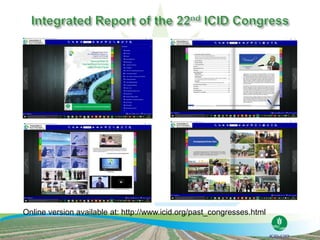
Online version available at: http://www.icid.org/past_congresses.html
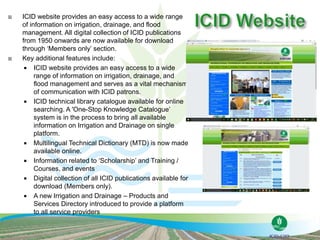
 ICID website provides an easy access to a wide range
of information on irrigation, drainage, and flood
management. All digital collection of ICID publications
from 1950 onwards are now available for download
through ‘Members only’ section.
 Key additional features include:
 ICID website provides an easy access to a wide
range of information on irrigation, drainage, and
flood management and serves as a vital mechanism
of communication with ICID patrons.
 ICID technical library catalogue available for online
searching. A 'One-Stop Knowledge Catalogue’
system is in the process to bring all available
information on Irrigation and Drainage on single
platform.
 Multilingual Technical Dictionary (MTD) is now made
available online.
 Information related to ‘Scholarship’ and Training /
Courses, and events
 Digital collection of all ICID publications available for
download (Members only).
 A new Irrigation and Drainage – Products and
Services Directory introduced to provide a platform
to all service providers
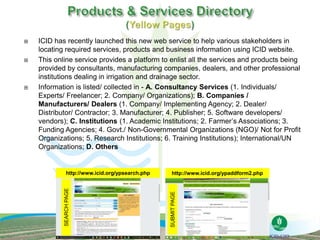
 ICID has recently launched this new web service to help various stakeholders in
locating required services, products and business information using ICID website.
 This online service provides a platform to enlist all the services and products being
provided by consultants, manufacturing companies, dealers, and other professional
institutions dealing in irrigation and drainage sector.
 Information is listed/ collected in - A. Consultancy Services (1. Individuals/
Experts/ Freelancer; 2. Company/ Organizations); B. Companies /
Manufacturers/ Dealers (1. Company/ Implementing Agency; 2. Dealer/
Distributor/ Contractor; 3. Manufacturer; 4. Publisher; 5. Software developers/
vendors); C. Institutions (1. Academic Institutions; 2. Farmer’s Associations; 3.
Funding Agencies; 4. Govt./ Non-Governmental Organizations (NGO)/ Not for Profit
Organizations; 5. Research Institutions; 6. Training Institutions); International/UN
Organizations; D. Others
SEARCHPAGE
SUBMITPAGEhttp://www.icid.org/ypsearch.php http://www.icid.org/ypaddform2.php
 Members are requested to encourage
companies/institutions/consultants to upload
their information for wider reach.
 Members can also suggest details of the
companies/institutions for inclusion.
 Helps in finding right – Product, Brand,
Company, etc.
 Only the account holder can manage the
contents. Hence, data accuracy is assured.
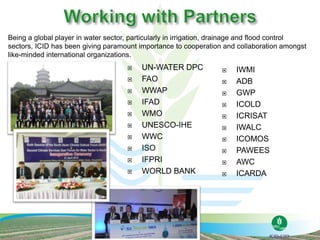
 UN-WATER DPC
 FAO
 WWAP
 IFAD
 WMO
 UNESCO-IHE
 WWC
 ISO
 IFPRI
 WORLD BANK
 IWMI
 ADB
 GWP
 ICOLD
 ICRISAT
 IWALC
 ICOMOS
 PAWEES
 AWC
 ICARDA
Being a global player in water sector, particularly in irrigation, drainage and flood control
sectors, ICID has been giving paramount importance to cooperation and collaboration amongst
like-minded international organizations.
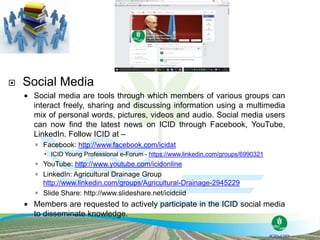
 Social Media
 Social media are tools through which members of various groups can
interact freely, sharing and discussing information using a multimedia
mix of personal words, pictures, videos and audio. Social media users
can now find the latest news on ICID through Facebook, YouTube,
LinkedIn. Follow ICID at –
 Facebook: http://www.facebook.com/icidat
 ICID Young Professional e-Forum - https://www.linkedin.com/groups/6990321
 YouTube: http://www.youtube.com/icidonline
 LinkedIn: Agricultural Drainage Group
http://www.linkedin.com/groups/Agricultural-Drainage-2945229
 Slide Share: http://www.slideshare.net/icidciid
 Members are requested to actively participate in the ICID social media
to disseminate knowledge.

ICID Presentation_2016

  • 3.
     International Commissionon Irrigation and Drainage (ICID), established in 1950 is the leading scientific, technical and not-for-profit Non-Governmental Organization (NGO).  ICID network of professionals spread across more than a hundred countries, has facilitated sharing of experiences and transfer of water management technology for over half-a-century.  ICID is dedicated to enhance the world wide supply of food and fibre for all people and believes that food security at various levels: global, national, local and household, and provision of assured livelihood starts with stable agriculture production. ICID encourages public private partnership in development and management of water resources.
  • 4.
    Prime Minister Mr.Jawahar Lal Nehru and the then President Dr. A.N. Khosla at the French National Committee Pavilion (1951) Dr. Framji introducing Pres. Hon. Tipton to Hon’ble Vice President of India Dr. Zakir Hussain
  • 6.
  • 8.
  • 11.
  • 12.
     Basin  WG-ENV WG-CAFM  WG-CLIMATE  WG-DROUGHT  WG-SDTA  WG -BIO-ENERGY  Knowledge  EB-JOUR  C-PR&P  TF-VE  WG-HIST  TF-WWF8  On Farm  WG-ON-FARM  WG-CROP  WG-PQW  Schemes  WG-SDG  WG-M&R  WG-IDM  WG-IOA
  • 13.
    Water Security and Sustainable Rural Development Sustainable Agriculture and Capacity Building InternationalCommission on Irrigation and Drainage (Including Social and Economic Aspects) International Commission on Irrigation and Drainage 1951 1975 1996 2015 …due to changing demographics, development scenario, limiting natural resources, and ecological sustainability.
  • 15.
     Target 6.1By 2030, achieve universal and equitable access to safe and affordable drinking water for all.  Target 6.2 By 2030, achieve access to adequate and equitable sanitation and hygiene for all and end open defecation, paying special attention to the needs of women and girls and those in vulnerable situations.  Target 6.3 By 2030, improve water quality by reducing pollution, eliminating dumping and minimizing release of hazardous chemicals and materials, halving the proportion of untreated wastewater and substantially increasing recycling and safe reuse globally.  Target 6.4 By 2030, substantially increase water-use efficiency across all sectors and ensure sustainable withdrawals and supply of freshwater to address water scarcity and substantially reduce the number of people suffering from water scarcity.  Target 6.5 By 2030, implement integrated water resources management at all levels, including through transboundary cooperation as appropriate  Target 6.6 By 2020, protect and restore water-related ecosystems, including mountains, forests, wetlands, rivers, aquifers and lakes.  Target 6.a By 2030, expand international cooperation and capacity-building support to developing countries in water- and sanitation related activities and programmes, including water harvesting, desalination, water efficiency, wastewater treatment, recycling and reuse technologies  Target 6.b Support and strengthen the participation of local communities in improving water and sanitation management. • Improve water use efficiency • Increase recycling and safe re-use of wastewater • Improve Water quality by reducing pollution • Protect and restore water ecosystems • Develop capacity through partnerships
  • 16.
    Vision o Water secureworld free of poverty and hunger through sustainable rural development Mission o Working together towards sustainable agriculture water management through inter-disciplinary approaches to economically viable, socially acceptable and environmentally sound irrigation, drainage and flood management Key to achieve the Vision o generating new knowledge o compiling and collating information o sharing experiences and good practices o disseminating the new knowledge to the relevant stakeholders Agenda 2030 provides opportunity to ICID to revisit its vision and mission
  • 17.
    ICID is aunique platform for the exchange of knowledge and information related to agricultural water management. ICID organizes International Congresses on Irrigation and Drainage, and World Irrigation Forum, Regional Conferences, Micro Irrigation Congresses, International Drainage Workshops, Symposia and Workshops, Seminar and Special Sessions, etc. to address and discuss issues of global/regional importance.
  • 18.
    Glimpses of RecentICID Major Events CONGRESSES and IECs WIF and IECs Gwangju, 2014 Tehran, 2011 Lahore, 2008 Beijing, 2005 Mardin, 2013 Adelaide, 2012 Yogyakarta, 2010Montpellier, 2015 WIF1
  • 19.
     4th AfricanRegional Conferences on Irrigation and Drainage (ARCID), 26-28 April 2016, Cairo, Egypt. Theme: Agricultural Land and Water Management for Sustainability under Climate Variability  67th IEC and 2nd World Irrigation Forum, Chiang Mai, Thailand, 6-12 November 2016. Theme: Water management in a changing world: Role of Irrigation for sustainable food production.  13th International Drainage Workshop (IDW), 4-7 March 2017, Ahvaz City, Iran. Theme: Drainage and Environmental Sustainability.  23rd International Congress on Irrigation and Drainage, 8-14 October 2017, Mexico City, Mexico. Theme: Modernizing Irrigation and Drainage for a new Green Revolution.
  • 20.
     Provides aunique platform for all stakeholders for sharing and learning by engaging in issues of global interest.  Gathers a wide range of experts from various disciplines to provide different perspectives.  Stimulates and promotes multi- disciplinary discussions towards sustainable solution to water management in agriculture through:  Exchange of latest irrigation and drainage policies, practices, innovations and technologies;  Exploring and formulating concrete inter-disciplinary proposals;  Development of liaison/collaboration among various national/international institutions/ organizations/private sector working for irrigated agriculture; and  Advocacy for political commitments. 2nd World Irrigation Forum 06-08 Nov. 2016, Chiang Mai, Thailand The First World Irrigation Forum (WIF1) was held in Mardin, Turkey on 29 September. About 750 participants from 61 countries and 12 International Organisations attended the Forum.
  • 23.
     Instituted thetriennial World Irrigation and Drainage Prize (WID Prize) in 2013 to recognize the outstanding work of dedicated professionals and institutions who have actively contributed to the development of ‘Irrigation and Drainage’ over the years.  The Prize is awarded to the work that ensures enhanced agricultural production to achieve food security around the world at national, regional and international level through the application of the science, art and management of irrigation, and drainage .  Prof. Victor A. Dukhovny (Uzbekistan) declared as the winner of the First World Irrigation and Drainage Prize 2013 in recognition of his outstanding contributions to the development of agriculture water management made over 57 years.  The Prize consists a cash prize of US $ 10,000, Trophy and a Citation plaque and was sponsored by Ministry of Water Resources, People’s Republic of China.  Nominations invited for 2nd World Irrigation and Drainage Prize, which will be presented during the 2nd World Irrigation Forum in Chiang Mai, Thailand, November 2016.
  • 24.
     Direct Membership Direct Members participate in ICID activities. A special section was covered in ICID Annual Report.  World Irrigation Forum  Brought out a Summary Report and Integrated Summary Report  World Irrigation and Drainage Prize: Established Prize and presented the first World Irrigation and Drainage Prize 2013 to Prof. Victor A. Dukhovny (Uzbekistan)  Heritage Irrigation Structures (HIS): Prepare a “ICID Register of Heritage Irrigation Structures”  Knowledge Management: e-learning, e-Publications, web version of Multilingual Technical Dictionary (MTD), and Digitization of old publications  Enhancing participation of Young Professionals in ICID activities. Providing scholarships to young professionals to attend ICID events and training programs. Established a new ICID Young Professional e-Forum (IYPeF) on LinkedIn  Approved establishing Technical Support Unit (TSU) at Central Office
  • 25.
     Companies  TYPEA: With Annual Turnover up to 1 million US$ pa  TYPE B: With Annual Turnover between 1 to 10 million US$ pa  TYPE C: With Annual Turnover above 10 million US$ pa  Institutions  TYPE a: With 1-50 staff  TYPE b: With 50 and above staff  Individuals  Young Professional (below 40)  Retiree (above 65)  Normal (others)
  • 26.
     Be partof International Platform  Benefit from world wide exposure  Stay Informed  Influence policy making  Participate in determining strategies  Avail the opportunity of networking  Receive  One free copy of ICID Journal, ICID newsletters, e-Bulletins  Receive 2,4, or 6 copies of ICID Journal at 50% price  Special Discount on all other Publications and special 35% discount on all the Wiley printed publications under the Society Discount  Special registration fee, advertisement rates, exhibition rates, etc  No charges for making announcements in Newsletters and website
  • 27.
     The structuresfulfilling the criteria, based on the recommendation of the International Jury is recognized as Heritage Irrigation Structure (HIS) by including it in an “ICID Register of Heritage Irrigation Structures” <http://www.icid.org/icid_his1.html>  A Plaque citing the salient features of the HIS will be awarded to the National Committees for onward transmission to the authorities responsible for the running and maintenance of the structure  The ICID Register of HIS would be publicized through ICID media.  Established “ICID Register of Heritage Irrigation Structures” on website with a total 25 registered structures.
  • 28.
    Developing Skills in: Awareness building – Making various stakeholders aware of the issues facing water as a resource;  Science - Using basic scientific knowledge to solve problems;  Monitoring - Monitoring/Assessing various parameters;  Social Perceptiveness - Being aware of others' needs and issues;  Coordination - Adjusting actions in relation to others' actions;  Judgment and Decision Making - Considering the relative pros and cons of potential actions to choose the most appropriate one;  Problem Solving - Identifying problems and reviewing related information to develop and evaluate options and implement solutions;  Active Learning - Understanding the implications of new information for decision-making; and  Instructing - Teaching others how to do something. Introducing e-Learning to enhance national capacities at all levels for the development and implementation of sustainable water strategies
  • 29.
    “Undertake capacity developmentactivities in the field of agriculture water management in support of rural development”. Technical Support Unit
  • 30.
     Developing aknowledge base in AWM with the help of ICID working groups, partner institutions and member countries  Supporting member countries (on request) in  general assessment of gaps in AWM capacities within the countries and suggest possible solutions  developing feasibility reports for small and medium irrigation, drainage and flood management proposal  training assessment needs, and  undertaking capacity development programmes Scope of TSU
  • 31.
     ICID hastaken initiative to upgrade some of the existing services and introduced few new technologies to meet the requirement:  New ICID Website  Integrated Library Management System (ILMS)  Text Delivery System (TDS)  Digitization: Publications and documents from the year 1950 onwards are now available in digital format. Central Office is in the process of placing these publications in the ‘Members only’ section for free download.  e-Publications  e-Learning  Virtual Communication Tools: Web and Tele-conferencing
  • 32.
     Managing theknowledge process is the key to the success of any professional network  Knowledge Management consists of generation, extraction, consolidation / compilation, synthesis, packaging and dissemination of the knowledge plays a critical role in the field of irrigation, drainage and flood management.  The various technical Working Groups of ICID, through their activities help extract, compile, and synthesize this knowledge.
  • 33.
     Publishes aJournal on “Irrigation and Drainage” through Wiley-Blackwell (UK). A special issue of selected Congress papers will be released after the event.  ICID News is published quarterly (print version), which includes short technical articles, Outcome of key ICID events etc.  News Update monthly e-publication available through ICID website  e-Bulletin is a weekly compilation of important and latest news items on agriculture, climate change, drainage, droughts, floods, food security etc. Circulated to more than 4000 online subscribers.
  • 34.
     The ICIDJournal ‘Irrigation and Drainage’ is a technical peer- reviewed specialized international flagship publication of ICID.  The Journal is published through M/s. Wiley-Blackwell (UK) and is widely distributed among ICID members and others.  The full text of the Journal is available through Wiley Online Library  Under the Research4Lifeprogramme local, not-for-profit institutions of select countries can access Irrigation and Drainage for free under AGORA (agora@fao.org) and OARE (oare@oaresciences.org) system. More than 5200 institutions from developing countries were provided free access. Patrons are encouraged to register.  Instituted 'Best Paper Award' to recognise the outstanding paper published  Members will get special 35% discount on all the Wiley printed publications under the Society Discount
  • 35.
    0 0.2 0.4 0.6 0.8 1 1.2 2008 2009 2010 2011 2012 2013 2014 0.48 1.108 0.552 0.922 0.685 0.717 0.510 In 2002Irrigation and Drainage has entered in the ISI Science Journals Citation Index under the number ISSN 1531-0353. It appears in the categories Water Resources and Agronomy.
  • 38.
     Summary Reportof the 22nd ICID Congress on Irrigation and Drainage, Gwangju, Korea, 2014  Food Security by Optimal Use of Water – Synthesis of Theme 2.2 of the 6th WWF, Marseille, France + CD ROM  Summary Report – First World Irrigation Forum (WIF1) + Integrated Summary Report on DVD
  • 39.
    Online version availableat: http://www.icid.org/past_congresses.html
  • 40.
     ICID websiteprovides an easy access to a wide range of information on irrigation, drainage, and flood management. All digital collection of ICID publications from 1950 onwards are now available for download through ‘Members only’ section.  Key additional features include:  ICID website provides an easy access to a wide range of information on irrigation, drainage, and flood management and serves as a vital mechanism of communication with ICID patrons.  ICID technical library catalogue available for online searching. A 'One-Stop Knowledge Catalogue’ system is in the process to bring all available information on Irrigation and Drainage on single platform.  Multilingual Technical Dictionary (MTD) is now made available online.  Information related to ‘Scholarship’ and Training / Courses, and events  Digital collection of all ICID publications available for download (Members only).  A new Irrigation and Drainage – Products and Services Directory introduced to provide a platform to all service providers
  • 41.
     ICID hasrecently launched this new web service to help various stakeholders in locating required services, products and business information using ICID website.  This online service provides a platform to enlist all the services and products being provided by consultants, manufacturing companies, dealers, and other professional institutions dealing in irrigation and drainage sector.  Information is listed/ collected in - A. Consultancy Services (1. Individuals/ Experts/ Freelancer; 2. Company/ Organizations); B. Companies / Manufacturers/ Dealers (1. Company/ Implementing Agency; 2. Dealer/ Distributor/ Contractor; 3. Manufacturer; 4. Publisher; 5. Software developers/ vendors); C. Institutions (1. Academic Institutions; 2. Farmer’s Associations; 3. Funding Agencies; 4. Govt./ Non-Governmental Organizations (NGO)/ Not for Profit Organizations; 5. Research Institutions; 6. Training Institutions); International/UN Organizations; D. Others SEARCHPAGE SUBMITPAGEhttp://www.icid.org/ypsearch.php http://www.icid.org/ypaddform2.php
  • 42.
     Members arerequested to encourage companies/institutions/consultants to upload their information for wider reach.  Members can also suggest details of the companies/institutions for inclusion.  Helps in finding right – Product, Brand, Company, etc.  Only the account holder can manage the contents. Hence, data accuracy is assured.
  • 43.
     UN-WATER DPC FAO  WWAP  IFAD  WMO  UNESCO-IHE  WWC  ISO  IFPRI  WORLD BANK  IWMI  ADB  GWP  ICOLD  ICRISAT  IWALC  ICOMOS  PAWEES  AWC  ICARDA Being a global player in water sector, particularly in irrigation, drainage and flood control sectors, ICID has been giving paramount importance to cooperation and collaboration amongst like-minded international organizations.
  • 44.
     Social Media Social media are tools through which members of various groups can interact freely, sharing and discussing information using a multimedia mix of personal words, pictures, videos and audio. Social media users can now find the latest news on ICID through Facebook, YouTube, LinkedIn. Follow ICID at –  Facebook: http://www.facebook.com/icidat  ICID Young Professional e-Forum - https://www.linkedin.com/groups/6990321  YouTube: http://www.youtube.com/icidonline  LinkedIn: Agricultural Drainage Group http://www.linkedin.com/groups/Agricultural-Drainage-2945229  Slide Share: http://www.slideshare.net/icidciid  Members are requested to actively participate in the ICID social media to disseminate knowledge.