
1 
The Changing Role of Corporate Information Services Lu Potter ICIC 2014, Heidelberg
2 
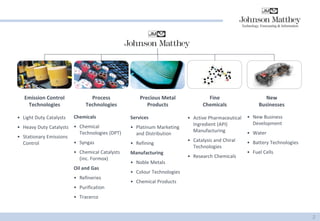
Chemicals 
•Chemical Technologies (DPT) 
•Syngas 
•Chemical Catalysts (inc. Formox) Oil and Gas 
•Refineries 
•Purification 
•Tracerco 
Services 
•Platinum Marketing and Distribution 
•Refining Manufacturing 
•Noble Metals 
•Colour Technologies 
•Chemical Products 
•Active Pharmaceutical Ingredient (API) Manufacturing 
•Catalysis and Chiral Technologies 
•Research Chemicals 
•New Business Development 
•Water 
•Battery Technologies 
•Fuel Cells 
•Light Duty Catalysts 
•Heavy Duty Catalysts 
•Stationary Emissions Control 
Emission Control Technologies 
Process Technologies 
Precious Metal Products 
Fine Chemicals 
New Businesses
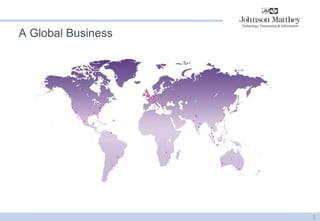
A Global Business 
3
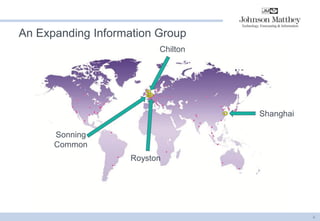
An Expanding Information Group 
4 
Royston 
Shanghai 
Sonning Common 
Chilton 
Royston
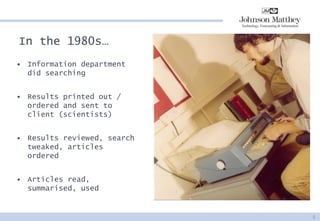
In the 1980s… 
•Information department did searching 
•Results printed out / ordered and sent to client (scientists) 
•Results reviewed, search tweaked, articles ordered 
•Articles read, summarised, used 
5
Technology Forecasting & Information (TFI) 
6 
Supports JM business and research on a global basis 
Expert searching 
End user interface 
Subscriptions to publications and databases 
Project work and analysis 
Newsfeeds 
Peer reviewed journal
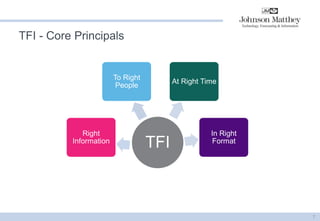
TFI - Core Principals 
7 
TFI 
Right Information 
To Right People 
At Right Time 
In Right Format
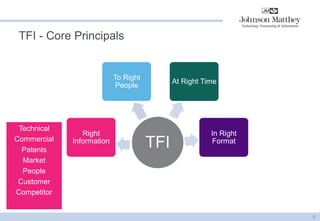
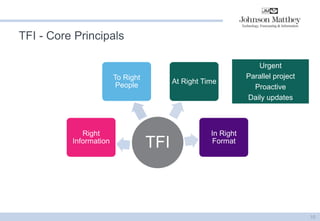
TFI - Core Principals 
8 
TFI 
Right Information 
To Right People 
At Right Time 
In Right Format 
Technical Commercial Patents Market People Customer Competitor
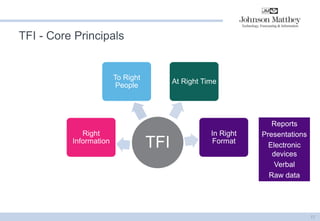
TFI - Core Principals 
9 
TFI 
Right Information 
To Right People 
At Right Time 
In Right Format 
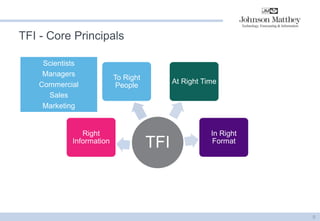
Scientists Managers Commercial Sales Marketing
TFI - Core Principals 
10 
TFI 
Right Information 
To Right People 
At Right Time 
In Right Format 
Urgent Parallel project Proactive Daily updates
TFI - Core Principals 
11 
TFI 
Right Information 
To Right People 
At Right Time 
In Right Format 
Reports 
Presentations 
Electronic devices 
Verbal 
Raw data
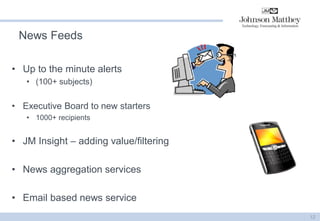
News Feeds 
•Up to the minute alerts 
•(100+ subjects) 
•Executive Board to new starters 
•1000+ recipients 
•JM Insight – adding value/filtering 
•News aggregation services 
•Email based news service 
12
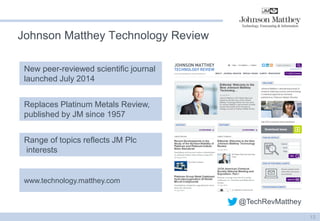
Johnson Matthey Technology Review 
Replaces Platinum Metals Review, published by JM since 1957 
Range of topics reflects JM Plc 
interests 
www.technology.matthey.com 
New peer-reviewed scientific journal launched July 2014 
13 
@TechRevMatthey
End User Resources 
14 
Subscriptions 
End User Searching 
Library Catalogue 
Document Delivery 
Intranet Interface
Projects 
15 
Adding Value 
Turning data to knowledge 
Visualisations 
Integration with teams 
Added insight on JM
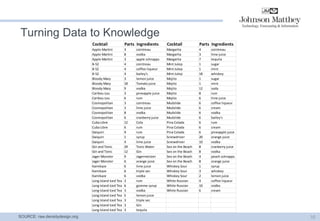
Turning Data to Knowledge 
16 
Cocktail Parts Ingredients Cocktail Parts Ingredients 
Apple Martini 3 cointreau Margarita 4 cointreau 
Apple Martini 8 vodka Margarita 3 lime juice 
Apple Martini 3 apple schnapps Margarita 7 tequila 
B-52 4 cointreau Mint Julep 1 sugar 
B-52 4 coffee liqueur Mint Julep 1 mint 
B-52 4 bailey's Mint Julep 18 whiskey 
Bloody Mary 3 lemon juice Mojito 1 sugar 
Bloody Mary 18 Tomato juice Mojito 1 mint 
Bloody Mary 9 vodka Mojito 12 soda 
Caribou Lou 3 pineapple juice Mojito 8 rum 
Caribou Lou 6 rum Mojito 6 lime juice 
Cosmopolitan 3 cointreau Mudslide 6 coffee liqueur 
Cosmopolitan 3 lime juice Mudslide 6 cream 
Cosmopolitan 8 vodka Mudslide 6 vodka 
Cosmopolitan 6 cranberry juice Mudslide 6 bailey's 
Cuba Libre 12 Cola Pina Colada 6 rum 
Cuba Libre 6 rum Pina Colada 6 cream 
Daiquiri 9 rum Pina Colada 6 pineapple juice 
Daiquiri 1 syrup Screwdriver 20 orange juice 
Daiquiri 4 lime juice Screwdriver 10 vodka 
Gin and Tonic 29 Tonic Water Sex on the Beach 8 cranberry juice 
Gin and Tonic 12 Gin Sex on the Beach 8 vodka 
Jager Monster 9 Jagermeister Sex on the Beach 4 peach schnapps 
Jager Monster 6 orange juice Sex on the Beach 8 orange juice 
Kamikaze 6 lime juice Whiskey Sour 1 syrup 
Kamikaze 6 triple sec Whiskey Sour 3 whiskey 
Kamikaze 6 vodka Whiskey Sour 2 lemon juice 
Long Island Iced Tea 3 rum White Russian 4 coffee liqueur 
Long Island Iced Tea 6 gomme syrup White Russian 10 vodka 
Long Island Iced Tea 3 vodka White Russian 6 cream 
Long Island Iced Tea 5 lemon juice 
Long Island Iced Tea 3 triple sec 
Long Island Iced Tea 3 Gin 
Long Island Iced Tea 3 tequila 
SOURCE: raw.densitydesign.org
17 
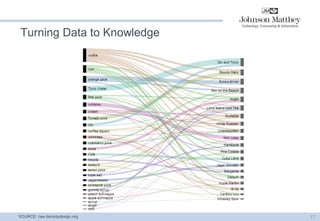
Turning Data to Knowledge 
SOURCE: raw.densitydesign.org
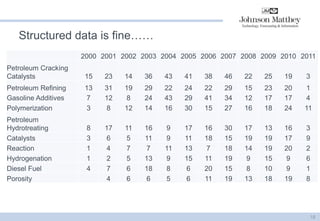
Structured data is fine…… 
2000 
2001 
2002 
2003 
2004 
2005 
2006 
2007 
2008 
2009 
2010 
2011 
Petroleum Cracking Catalysts 
15 
23 
14 
36 
43 
41 
38 
46 
22 
25 
19 
3 
Petroleum Refining 
13 
31 
19 
29 
22 
24 
22 
29 
15 
23 
20 
1 
Gasoline Additives 
7 
12 
8 
24 
43 
29 
41 
34 
12 
17 
17 
4 
Polymerization 
3 
8 
12 
14 
16 
30 
15 
27 
16 
18 
24 
11 
Petroleum Hydrotreating 
8 
17 
11 
16 
9 
17 
16 
30 
17 
13 
16 
3 
Catalysts 
3 
6 
5 
11 
9 
11 
18 
15 
19 
19 
17 
9 
Reaction 
1 
4 
7 
7 
11 
13 
7 
18 
14 
19 
20 
2 
Hydrogenation 
1 
2 
5 
13 
9 
15 
11 
19 
9 
15 
9 
6 
Diesel Fuel 
4 
7 
6 
18 
8 
6 
20 
15 
8 
10 
9 
1 
Porosity 
4 
6 
6 
5 
6 
11 
19 
13 
18 
19 
8 
18
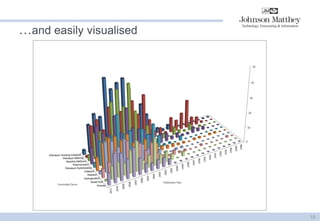
…and easily visualised 
19
Unstructured Data 
20 
Hard to categorise sort and manipulate manually 
 Semi-structured data 
Time consuming 
Accuracy 
Flexibility
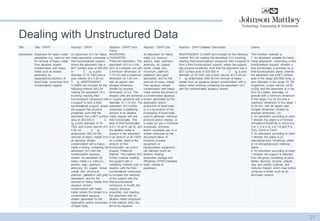
Dealing with Unstructured Data 
21 
Title 
Title - DWPI 
Abstract - DWPI 
Abstract - DWPI Tech Focus 
Abstract - DWPI Use 
Abstract - DWPI Detailed Description 
Claims 
Adsorbents 
Adsorbent for heavy metal adsorption e.g. mercury and for removal of heavy metal from aqueous stream contaminated with heavy metal such as stream generated by exploration/production of fossil fuels, comprises thiol functionalized support 
An adsorbent (A1) for heavy metal adsorption comprises a thiol functionalized support, where the adsorbent has a BET surface area of 200-500 m 2 /g, a pore diameter of 70-150Å and a pore volume of ≥ 0.25 cm 3 /g. INDEPENDENT CLAIMS are included for the following:method (M1) for making the adsorbent (A1) involving reacting thiol- functionalized compound with a support to form a thiol- functionalized support, where the support has physical properties such that the adsorbent has a BET surface area of 200-500 m 2 /g, a pore diameter of 70- 150Å and a pore volume of ≥ 0.25 cm 3 /g; andprocess (M2) for the removal of heavy metals from an aqueous stream contaminated with a heavy metal involving contacting the adsorbent (A1) with the contaminated aqueous stream. As adsorbent for heavy metal (i.e. mercury, arsenic, lead, cadmium, antimony, tin, copper, nickel, cobalt, zinc, chromium, platinum, palladium and gold) adsorption; and for the removal of heavy metals from aqueous stream contaminated with heavy metal (where the stream is a contaminated aqueous stream generated by the exploration and/or production of fossil fuels, 
INORGANIC CHEMISTRY - Preferred Adsorbent: The adsorbent (A1) is in the form of a shaped unit with a minimum dimension of 1-15 mm and a maximum dimension of 1-25 mm, with an aspect ratio (longest dimension divided by shortest dimension) of ≤ 4. The shaped units are spherical or roughly spherical with a diameter of 1-15 mm. The adsorbent (A1) further comprises a stabilizing amount of an alkaline metal reacted with the thiol functionality. The level of thiol functionality is 0.1-10 wt.% (as S), and the alkaline metal is present in the adsorbent in an amount of 20-100% on a molar basis to the amount of thiol functionality (as sulfur) present. Preferred Method: The method (M1) further involves treating the support with a modifying material prior to reaction with the thiol- functionalized compound, to increase the reactivity of the support with the thiol-functionalized compound or modify the support physical properties; and reacting the adsorbent with an alkaline metal compound. In the method (M2), the pH of the aqueous 
As adsorbent for heavy metal (i.e. mercury, arsenic, lead, cadmium, antimony, tin, copper, nickel, cobalt, zinc, chromium, platinum, palladium and gold) adsorption; and for the removal of heavy metals from aqueous stream contaminated with heavy metal (where the stream is a contaminated aqueous stream generated by the exploration and/or production of fossil fuels, or is a by-product of the processing of fossil fuels used to generate chemical products and/or energy, or is water for use in industrial processes, domestic and/or municipal use, or is stream produced by the decontamination of industrial process equipment or transportation equipment (all claimed) (such as tankers, floating, production storage and offloading (FPSO) facilities, static vessels or pipelines)). 
INDEPENDENT CLAIMS are included for the following: method (M1) for making the adsorbent (A1) involving reacting thiol-functionalized compound with a support to form a thiol-functionalized support, where the support has physical properties such that the adsorbent has a BET surface area of 200-500 m 2 /g, a pore diameter of 70-150Å and a pore volume of ≥ 0.25 cm 3 /g; andprocess (M2) for the removal of heavy metals from an aqueous stream contaminated with a heavy metal involving contacting the adsorbent (A1) with the contaminated aqueous stream. 
The invention claimed is: 1. An adsorbent suitable for heavy metal adsorption, comprising a thiol functionalised support, wherein a thiol functionality is provided by a thiol-functionalised silane, wherein the adsorbent has a BET surface area in the range 200-500 m2/g, a pore diameter in the range 70-150 Angstroms, a pore volume ≧0.50 cm3/g, and the adsorbent is in the form of a tablet, extrudate, or granule with a minimum dimension in the range 1 to 15 mm and a maximum dimension in the range 1 to 25 mm, with an aspect ratio (longest dimension divided by shortest dimension) ≦4. 2. An adsorbent according to claim 1 wherein the silane is of formula (RO)aSi((CH2)xSH)b in which a is 2 or 3, b is 4−a, x is 1-6 and R is CH3, C2H5 or C3H7. 3. An adsorbent according to claim 1 wherein the silane is (3- mercaptopropyl) trimethoxy silane or (3-mercaptopropyl) triethoxy silane. 4. An adsorbent according to claim 1 wherein the support is selected from the group consisting of silica, titania, alumina, zirconia, pillared clay, and zeolitic material, and mixtures thereof, which may further comprise a binder such as an aluminate cement.
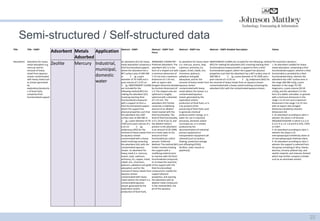
Semi-structured / Self-structured data 
22 
Title 
Title - DWPI 
Adsorbent 
Metals Adsorbed 
Application 
Abstract - DWPI 
Abstract - DWPI Tech Focus 
Abstract - DWPI Use 
Abstract - DWPI Detailed Description 
Claims 
Adsorbents 
Adsorbent for heavy metal adsorption e.g. mercury and for removal of heavy metal from aqueous stream contaminated with heavy metal such as stream generated by exploration/production of fossil fuels, comprises thiol functionalized support 
Zeolite 
Mercury 
Industrial, municipal, domestic water 
An adsorbent (A1) for heavy metal adsorption comprises a thiol functionalized support, where the adsorbent has a BET surface area of 200-500 m 2 /g, a pore diameter of 70-150Å and a pore volume of ≥ 0.25 cm 3 /g. INDEPENDENT CLAIMS are included for the following:method (M1) for making the adsorbent (A1) involving reacting thiol- functionalized compound with a support to form a thiol-functionalized support, where the support has physical properties such that the adsorbent has a BET surface area of 200-500 m 2 /g, a pore diameter of 70- 150Å and a pore volume of ≥ 0.25 cm 3 /g; andprocess (M2) for the removal of heavy metals from an aqueous stream contaminated with a heavy metal involving contacting the adsorbent (A1) with the contaminated aqueous stream. As adsorbent for heavy metal (i.e. mercury, arsenic, lead, cadmium, antimony, tin, copper, nickel, cobalt, zinc, chromium, platinum, palladium and gold) adsorption; and for the removal of heavy metals from aqueous stream contaminated with heavy metal (where the stream is a contaminated aqueous stream generated by the exploration and/or production of fossil fuels, 
INORGANIC CHEMISTRY - Preferred Adsorbent: The adsorbent (A1) is in the form of a shaped unit with a minimum dimension of 1-15 mm and a maximum dimension of 1-25 mm, with an aspect ratio (longest dimension divided by shortest dimension) of ≤ 4. The shaped units are spherical or roughly spherical with a diameter of 1-15 mm. The adsorbent (A1) further comprises a stabilizing amount of an alkaline metal reacted with the thiol functionality. The level of thiol functionality is 0.1-10 wt.% (as S), and the alkaline metal is present in the adsorbent in an amount of 20-100% on a molar basis to the amount of thiol functionality (as sulfur) present. Preferred Method: The method (M1) further involves treating the support with a modifying material prior to reaction with the thiol- functionalized compound, to increase the reactivity of the support with the thiol-functionalized compound or modify the support physical properties; and reacting the adsorbent with an alkaline metal compound. In the method (M2), the pH of the aqueous 
As adsorbent for heavy metal (i.e. mercury, arsenic, lead, cadmium, antimony, tin, copper, nickel, cobalt, zinc, chromium, platinum, palladium and gold) adsorption; and for the removal of heavy metals from aqueous stream contaminated with heavy metal (where the stream is a contaminated aqueous stream generated by the exploration and/or production of fossil fuels, or is a by-product of the processing of fossil fuels used to generate chemical products and/or energy, or is water for use in industrial processes, domestic and/or municipal use, or is stream produced by the decontamination of industrial process equipment or transportation equipment (all claimed) (such as tankers, floating, production storage and offloading (FPSO) facilities, static vessels or pipelines)). 
INDEPENDENT CLAIMS are included for the following: method (M1) for making the adsorbent (A1) involving reacting thiol- functionalized compound with a support to form a thiol- functionalized support, where the support has physical properties such that the adsorbent has a BET surface area of 200-500 m 2 /g, a pore diameter of 70-150Å and a pore volume of ≥ 0.25 cm 3 /g; andprocess (M2) for the removal of heavy metals from an aqueous stream contaminated with a heavy metal involving contacting the adsorbent (A1) with the contaminated aqueous stream. 
The invention claimed is: 1. An adsorbent suitable for heavy metal adsorption, comprising a thiol functionalised support, wherein a thiol functionality is provided by a thiol- functionalised silane, wherein the adsorbent has a BET surface area in the range 200-500 m2/g, a pore diameter in the range 70-150 Angstroms, a pore volume ≧0.50 cm3/g, and the adsorbent is in the form of a tablet, extrudate, or granule with a minimum dimension in the range 1 to 15 mm and a maximum dimension in the range 1 to 25 mm, with an aspect ratio (longest dimension divided by shortest dimension) ≦4. 2. An adsorbent according to claim 1 wherein the silane is of formula (RO)aSi((CH2)xSH)b in which a is 2 or 3, b is 4−a, x is 1-6 and R is CH3, C2H5 or C3H7. 3. An adsorbent according to claim 1 wherein the silane is (3- mercaptopropyl) trimethoxy silane or (3-mercaptopropyl) triethoxy silane. 4. An adsorbent according to claim 1 wherein the support is selected from the group consisting of silica, titania, alumina, zirconia, pillared clay, and zeolitic material, and mixtures thereof, which may further comprise a binder such as an aluminate cement.
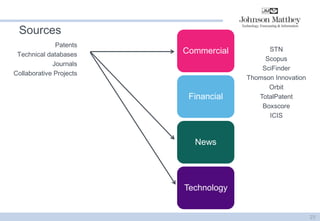
Sources 
Commercial 
Financial 
News 
Technology 
Patents 
Technical databases 
Journals 
Collaborative Projects 
23 
STN 
Scopus 
SciFinder 
Thomson Innovation 
Orbit 
TotalPatent 
Boxscore 
ICIS
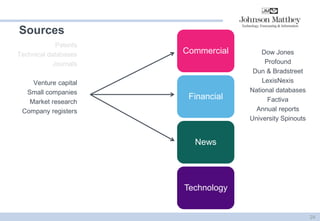
Sources 
Commercial 
Financial 
News 
Technology 
Patents 
Technical databases 
Journals 
Venture capital 
Small companies 
Market research 
Company registers 
24 
Dow Jones 
Profound 
Dun & Bradstreet 
LexisNexis 
National databases 
Factiva 
Annual reports 
University Spinouts
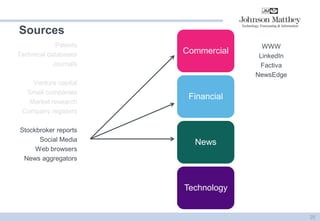
Sources 
Commercial 
Financial 
News 
Technology 
Patents 
Technical databases 
Journals 
Venture capital 
Small companies 
Market research 
Company registers 
Stockbroker reports 
Social Media 
Web browsers 
News aggregators 
25 
WWW 
LinkedIn 
Factiva 
NewsEdge
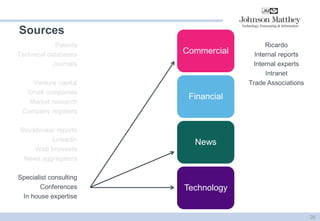
Sources 
Commercial 
Financial 
News 
Technology 
Patents 
Technical databases 
Journals 
Venture capital 
Small companies 
Market research 
Company registers 
Stockbroker reports 
LinkedIn 
Web browsers 
News aggregators 
Specialist consulting 
Conferences 
In house expertise 
26 
Ricardo 
Internal reports 
Internal experts 
Intranet 
Trade Associations
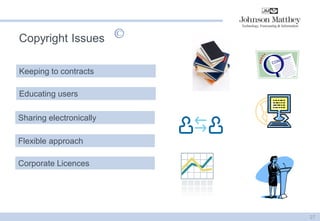
Copyright Issues 
27 
Keeping to contracts 
Corporate Licences 
Sharing electronically 
Flexible approach 
Educating users
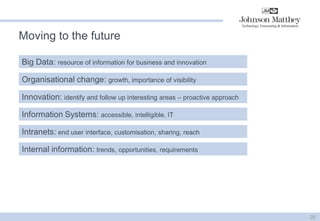
Moving to the future 
28 
Big Data: resource of information for business and innovation 
Organisational change: growth, importance of visibility 
Innovation: identify and follow up interesting areas – proactive approach 
Information Systems: accessible, intelligible, IT 
Intranets: end user interface, customisation, sharing, reach 
Internal information: trends, opportunities, requirements
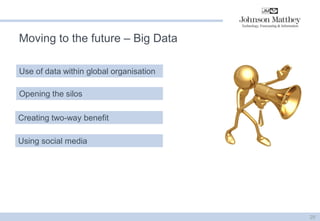
Moving to the future – Big Data 
29 
Use of data within global organisation 
Creating two-way benefit 
Using social media 
Opening the silos
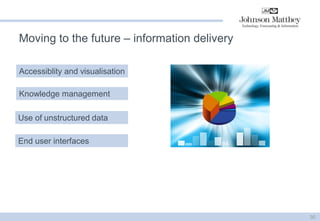
Moving to the future – information delivery 
30 
Accessiblity and visualisation 
Use of unstructured data 
End user interfaces 
Knowledge management
Moving to the future – fostering innovation 
31 
Central resource 
Internal/external resources 
Proactive approach 
Expert team
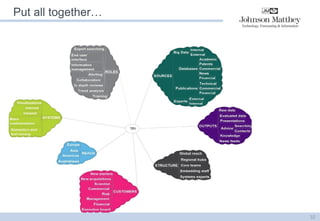
Put all together… 
32
33

ICIC 2014 The Changing Role of Corporate Information Services at Johnson Matthey

  • 1.
    1 The ChangingRole of Corporate Information Services Lu Potter ICIC 2014, Heidelberg
  • 2.
    2 Chemicals •ChemicalTechnologies (DPT) •Syngas •Chemical Catalysts (inc. Formox) Oil and Gas •Refineries •Purification •Tracerco Services •Platinum Marketing and Distribution •Refining Manufacturing •Noble Metals •Colour Technologies •Chemical Products •Active Pharmaceutical Ingredient (API) Manufacturing •Catalysis and Chiral Technologies •Research Chemicals •New Business Development •Water •Battery Technologies •Fuel Cells •Light Duty Catalysts •Heavy Duty Catalysts •Stationary Emissions Control Emission Control Technologies Process Technologies Precious Metal Products Fine Chemicals New Businesses
  • 3.
  • 4.
    An Expanding InformationGroup 4 Royston Shanghai Sonning Common Chilton Royston
  • 5.
    In the 1980s… •Information department did searching •Results printed out / ordered and sent to client (scientists) •Results reviewed, search tweaked, articles ordered •Articles read, summarised, used 5
  • 6.
    Technology Forecasting &Information (TFI) 6 Supports JM business and research on a global basis Expert searching End user interface Subscriptions to publications and databases Project work and analysis Newsfeeds Peer reviewed journal
  • 7.
    TFI - CorePrincipals 7 TFI Right Information To Right People At Right Time In Right Format
  • 8.
    TFI - CorePrincipals 8 TFI Right Information To Right People At Right Time In Right Format Technical Commercial Patents Market People Customer Competitor
  • 9.
    TFI - CorePrincipals 9 TFI Right Information To Right People At Right Time In Right Format Scientists Managers Commercial Sales Marketing
  • 10.
    TFI - CorePrincipals 10 TFI Right Information To Right People At Right Time In Right Format Urgent Parallel project Proactive Daily updates
  • 11.
    TFI - CorePrincipals 11 TFI Right Information To Right People At Right Time In Right Format Reports Presentations Electronic devices Verbal Raw data
  • 12.
    News Feeds •Upto the minute alerts •(100+ subjects) •Executive Board to new starters •1000+ recipients •JM Insight – adding value/filtering •News aggregation services •Email based news service 12
  • 13.
    Johnson Matthey TechnologyReview Replaces Platinum Metals Review, published by JM since 1957 Range of topics reflects JM Plc interests www.technology.matthey.com New peer-reviewed scientific journal launched July 2014 13 @TechRevMatthey
  • 14.
    End User Resources 14 Subscriptions End User Searching Library Catalogue Document Delivery Intranet Interface
  • 15.
    Projects 15 AddingValue Turning data to knowledge Visualisations Integration with teams Added insight on JM
  • 16.
    Turning Data toKnowledge 16 Cocktail Parts Ingredients Cocktail Parts Ingredients Apple Martini 3 cointreau Margarita 4 cointreau Apple Martini 8 vodka Margarita 3 lime juice Apple Martini 3 apple schnapps Margarita 7 tequila B-52 4 cointreau Mint Julep 1 sugar B-52 4 coffee liqueur Mint Julep 1 mint B-52 4 bailey's Mint Julep 18 whiskey Bloody Mary 3 lemon juice Mojito 1 sugar Bloody Mary 18 Tomato juice Mojito 1 mint Bloody Mary 9 vodka Mojito 12 soda Caribou Lou 3 pineapple juice Mojito 8 rum Caribou Lou 6 rum Mojito 6 lime juice Cosmopolitan 3 cointreau Mudslide 6 coffee liqueur Cosmopolitan 3 lime juice Mudslide 6 cream Cosmopolitan 8 vodka Mudslide 6 vodka Cosmopolitan 6 cranberry juice Mudslide 6 bailey's Cuba Libre 12 Cola Pina Colada 6 rum Cuba Libre 6 rum Pina Colada 6 cream Daiquiri 9 rum Pina Colada 6 pineapple juice Daiquiri 1 syrup Screwdriver 20 orange juice Daiquiri 4 lime juice Screwdriver 10 vodka Gin and Tonic 29 Tonic Water Sex on the Beach 8 cranberry juice Gin and Tonic 12 Gin Sex on the Beach 8 vodka Jager Monster 9 Jagermeister Sex on the Beach 4 peach schnapps Jager Monster 6 orange juice Sex on the Beach 8 orange juice Kamikaze 6 lime juice Whiskey Sour 1 syrup Kamikaze 6 triple sec Whiskey Sour 3 whiskey Kamikaze 6 vodka Whiskey Sour 2 lemon juice Long Island Iced Tea 3 rum White Russian 4 coffee liqueur Long Island Iced Tea 6 gomme syrup White Russian 10 vodka Long Island Iced Tea 3 vodka White Russian 6 cream Long Island Iced Tea 5 lemon juice Long Island Iced Tea 3 triple sec Long Island Iced Tea 3 Gin Long Island Iced Tea 3 tequila SOURCE: raw.densitydesign.org
  • 17.
    17 Turning Datato Knowledge SOURCE: raw.densitydesign.org
  • 18.
    Structured data isfine…… 2000 2001 2002 2003 2004 2005 2006 2007 2008 2009 2010 2011 Petroleum Cracking Catalysts 15 23 14 36 43 41 38 46 22 25 19 3 Petroleum Refining 13 31 19 29 22 24 22 29 15 23 20 1 Gasoline Additives 7 12 8 24 43 29 41 34 12 17 17 4 Polymerization 3 8 12 14 16 30 15 27 16 18 24 11 Petroleum Hydrotreating 8 17 11 16 9 17 16 30 17 13 16 3 Catalysts 3 6 5 11 9 11 18 15 19 19 17 9 Reaction 1 4 7 7 11 13 7 18 14 19 20 2 Hydrogenation 1 2 5 13 9 15 11 19 9 15 9 6 Diesel Fuel 4 7 6 18 8 6 20 15 8 10 9 1 Porosity 4 6 6 5 6 11 19 13 18 19 8 18
  • 19.
  • 20.
    Unstructured Data 20 Hard to categorise sort and manipulate manually  Semi-structured data Time consuming Accuracy Flexibility
  • 21.
    Dealing with UnstructuredData 21 Title Title - DWPI Abstract - DWPI Abstract - DWPI Tech Focus Abstract - DWPI Use Abstract - DWPI Detailed Description Claims Adsorbents Adsorbent for heavy metal adsorption e.g. mercury and for removal of heavy metal from aqueous stream contaminated with heavy metal such as stream generated by exploration/production of fossil fuels, comprises thiol functionalized support An adsorbent (A1) for heavy metal adsorption comprises a thiol functionalized support, where the adsorbent has a BET surface area of 200-500 m 2 /g, a pore diameter of 70-150Å and a pore volume of ≥ 0.25 cm 3 /g. INDEPENDENT CLAIMS are included for the following:method (M1) for making the adsorbent (A1) involving reacting thiol- functionalized compound with a support to form a thiol- functionalized support, where the support has physical properties such that the adsorbent has a BET surface area of 200-500 m 2 /g, a pore diameter of 70- 150Å and a pore volume of ≥ 0.25 cm 3 /g; andprocess (M2) for the removal of heavy metals from an aqueous stream contaminated with a heavy metal involving contacting the adsorbent (A1) with the contaminated aqueous stream. As adsorbent for heavy metal (i.e. mercury, arsenic, lead, cadmium, antimony, tin, copper, nickel, cobalt, zinc, chromium, platinum, palladium and gold) adsorption; and for the removal of heavy metals from aqueous stream contaminated with heavy metal (where the stream is a contaminated aqueous stream generated by the exploration and/or production of fossil fuels, INORGANIC CHEMISTRY - Preferred Adsorbent: The adsorbent (A1) is in the form of a shaped unit with a minimum dimension of 1-15 mm and a maximum dimension of 1-25 mm, with an aspect ratio (longest dimension divided by shortest dimension) of ≤ 4. The shaped units are spherical or roughly spherical with a diameter of 1-15 mm. The adsorbent (A1) further comprises a stabilizing amount of an alkaline metal reacted with the thiol functionality. The level of thiol functionality is 0.1-10 wt.% (as S), and the alkaline metal is present in the adsorbent in an amount of 20-100% on a molar basis to the amount of thiol functionality (as sulfur) present. Preferred Method: The method (M1) further involves treating the support with a modifying material prior to reaction with the thiol- functionalized compound, to increase the reactivity of the support with the thiol-functionalized compound or modify the support physical properties; and reacting the adsorbent with an alkaline metal compound. In the method (M2), the pH of the aqueous As adsorbent for heavy metal (i.e. mercury, arsenic, lead, cadmium, antimony, tin, copper, nickel, cobalt, zinc, chromium, platinum, palladium and gold) adsorption; and for the removal of heavy metals from aqueous stream contaminated with heavy metal (where the stream is a contaminated aqueous stream generated by the exploration and/or production of fossil fuels, or is a by-product of the processing of fossil fuels used to generate chemical products and/or energy, or is water for use in industrial processes, domestic and/or municipal use, or is stream produced by the decontamination of industrial process equipment or transportation equipment (all claimed) (such as tankers, floating, production storage and offloading (FPSO) facilities, static vessels or pipelines)). INDEPENDENT CLAIMS are included for the following: method (M1) for making the adsorbent (A1) involving reacting thiol-functionalized compound with a support to form a thiol-functionalized support, where the support has physical properties such that the adsorbent has a BET surface area of 200-500 m 2 /g, a pore diameter of 70-150Å and a pore volume of ≥ 0.25 cm 3 /g; andprocess (M2) for the removal of heavy metals from an aqueous stream contaminated with a heavy metal involving contacting the adsorbent (A1) with the contaminated aqueous stream. The invention claimed is: 1. An adsorbent suitable for heavy metal adsorption, comprising a thiol functionalised support, wherein a thiol functionality is provided by a thiol-functionalised silane, wherein the adsorbent has a BET surface area in the range 200-500 m2/g, a pore diameter in the range 70-150 Angstroms, a pore volume ≧0.50 cm3/g, and the adsorbent is in the form of a tablet, extrudate, or granule with a minimum dimension in the range 1 to 15 mm and a maximum dimension in the range 1 to 25 mm, with an aspect ratio (longest dimension divided by shortest dimension) ≦4. 2. An adsorbent according to claim 1 wherein the silane is of formula (RO)aSi((CH2)xSH)b in which a is 2 or 3, b is 4−a, x is 1-6 and R is CH3, C2H5 or C3H7. 3. An adsorbent according to claim 1 wherein the silane is (3- mercaptopropyl) trimethoxy silane or (3-mercaptopropyl) triethoxy silane. 4. An adsorbent according to claim 1 wherein the support is selected from the group consisting of silica, titania, alumina, zirconia, pillared clay, and zeolitic material, and mixtures thereof, which may further comprise a binder such as an aluminate cement.
  • 22.
    Semi-structured / Self-structureddata 22 Title Title - DWPI Adsorbent Metals Adsorbed Application Abstract - DWPI Abstract - DWPI Tech Focus Abstract - DWPI Use Abstract - DWPI Detailed Description Claims Adsorbents Adsorbent for heavy metal adsorption e.g. mercury and for removal of heavy metal from aqueous stream contaminated with heavy metal such as stream generated by exploration/production of fossil fuels, comprises thiol functionalized support Zeolite Mercury Industrial, municipal, domestic water An adsorbent (A1) for heavy metal adsorption comprises a thiol functionalized support, where the adsorbent has a BET surface area of 200-500 m 2 /g, a pore diameter of 70-150Å and a pore volume of ≥ 0.25 cm 3 /g. INDEPENDENT CLAIMS are included for the following:method (M1) for making the adsorbent (A1) involving reacting thiol- functionalized compound with a support to form a thiol-functionalized support, where the support has physical properties such that the adsorbent has a BET surface area of 200-500 m 2 /g, a pore diameter of 70- 150Å and a pore volume of ≥ 0.25 cm 3 /g; andprocess (M2) for the removal of heavy metals from an aqueous stream contaminated with a heavy metal involving contacting the adsorbent (A1) with the contaminated aqueous stream. As adsorbent for heavy metal (i.e. mercury, arsenic, lead, cadmium, antimony, tin, copper, nickel, cobalt, zinc, chromium, platinum, palladium and gold) adsorption; and for the removal of heavy metals from aqueous stream contaminated with heavy metal (where the stream is a contaminated aqueous stream generated by the exploration and/or production of fossil fuels, INORGANIC CHEMISTRY - Preferred Adsorbent: The adsorbent (A1) is in the form of a shaped unit with a minimum dimension of 1-15 mm and a maximum dimension of 1-25 mm, with an aspect ratio (longest dimension divided by shortest dimension) of ≤ 4. The shaped units are spherical or roughly spherical with a diameter of 1-15 mm. The adsorbent (A1) further comprises a stabilizing amount of an alkaline metal reacted with the thiol functionality. The level of thiol functionality is 0.1-10 wt.% (as S), and the alkaline metal is present in the adsorbent in an amount of 20-100% on a molar basis to the amount of thiol functionality (as sulfur) present. Preferred Method: The method (M1) further involves treating the support with a modifying material prior to reaction with the thiol- functionalized compound, to increase the reactivity of the support with the thiol-functionalized compound or modify the support physical properties; and reacting the adsorbent with an alkaline metal compound. In the method (M2), the pH of the aqueous As adsorbent for heavy metal (i.e. mercury, arsenic, lead, cadmium, antimony, tin, copper, nickel, cobalt, zinc, chromium, platinum, palladium and gold) adsorption; and for the removal of heavy metals from aqueous stream contaminated with heavy metal (where the stream is a contaminated aqueous stream generated by the exploration and/or production of fossil fuels, or is a by-product of the processing of fossil fuels used to generate chemical products and/or energy, or is water for use in industrial processes, domestic and/or municipal use, or is stream produced by the decontamination of industrial process equipment or transportation equipment (all claimed) (such as tankers, floating, production storage and offloading (FPSO) facilities, static vessels or pipelines)). INDEPENDENT CLAIMS are included for the following: method (M1) for making the adsorbent (A1) involving reacting thiol- functionalized compound with a support to form a thiol- functionalized support, where the support has physical properties such that the adsorbent has a BET surface area of 200-500 m 2 /g, a pore diameter of 70-150Å and a pore volume of ≥ 0.25 cm 3 /g; andprocess (M2) for the removal of heavy metals from an aqueous stream contaminated with a heavy metal involving contacting the adsorbent (A1) with the contaminated aqueous stream. The invention claimed is: 1. An adsorbent suitable for heavy metal adsorption, comprising a thiol functionalised support, wherein a thiol functionality is provided by a thiol- functionalised silane, wherein the adsorbent has a BET surface area in the range 200-500 m2/g, a pore diameter in the range 70-150 Angstroms, a pore volume ≧0.50 cm3/g, and the adsorbent is in the form of a tablet, extrudate, or granule with a minimum dimension in the range 1 to 15 mm and a maximum dimension in the range 1 to 25 mm, with an aspect ratio (longest dimension divided by shortest dimension) ≦4. 2. An adsorbent according to claim 1 wherein the silane is of formula (RO)aSi((CH2)xSH)b in which a is 2 or 3, b is 4−a, x is 1-6 and R is CH3, C2H5 or C3H7. 3. An adsorbent according to claim 1 wherein the silane is (3- mercaptopropyl) trimethoxy silane or (3-mercaptopropyl) triethoxy silane. 4. An adsorbent according to claim 1 wherein the support is selected from the group consisting of silica, titania, alumina, zirconia, pillared clay, and zeolitic material, and mixtures thereof, which may further comprise a binder such as an aluminate cement.
  • 23.
    Sources Commercial Financial News Technology Patents Technical databases Journals Collaborative Projects 23 STN Scopus SciFinder Thomson Innovation Orbit TotalPatent Boxscore ICIS
  • 24.
    Sources Commercial Financial News Technology Patents Technical databases Journals Venture capital Small companies Market research Company registers 24 Dow Jones Profound Dun & Bradstreet LexisNexis National databases Factiva Annual reports University Spinouts
  • 25.
    Sources Commercial Financial News Technology Patents Technical databases Journals Venture capital Small companies Market research Company registers Stockbroker reports Social Media Web browsers News aggregators 25 WWW LinkedIn Factiva NewsEdge
  • 26.
    Sources Commercial Financial News Technology Patents Technical databases Journals Venture capital Small companies Market research Company registers Stockbroker reports LinkedIn Web browsers News aggregators Specialist consulting Conferences In house expertise 26 Ricardo Internal reports Internal experts Intranet Trade Associations
  • 27.
    Copyright Issues 27 Keeping to contracts Corporate Licences Sharing electronically Flexible approach Educating users
  • 28.
    Moving to thefuture 28 Big Data: resource of information for business and innovation Organisational change: growth, importance of visibility Innovation: identify and follow up interesting areas – proactive approach Information Systems: accessible, intelligible, IT Intranets: end user interface, customisation, sharing, reach Internal information: trends, opportunities, requirements
  • 29.
    Moving to thefuture – Big Data 29 Use of data within global organisation Creating two-way benefit Using social media Opening the silos
  • 30.
    Moving to thefuture – information delivery 30 Accessiblity and visualisation Use of unstructured data End user interfaces Knowledge management
  • 31.
    Moving to thefuture – fostering innovation 31 Central resource Internal/external resources Proactive approach Expert team
  • 32.
  • 33.