
Internet-Based Products in Islamic
Commercial Banks in Indonesia
Y. Andriansyah
The 2015 International Congress on Economics,
Social Sciences and Information Management
(ICESSIM 2015)
Introduction
 Islamic banks in Indonesia: two decades developments
 establishment of Bank Muamalat Indonesia in 1992
 issuance of fatwa on interest bank prohibition by Council of
Indonesia Ulama in 2003
 issuance of national law on Islamic bank and launching of Islamic
banking (iB) as social and economic trend in societies in 2008
 number of bank has increased significantly and reached 12 banks
fully operating under Islamic banking system, 22 Islamic branches as
part of conventional banks (November 2014)
Introduction
 Limited research in internet products of Islamic banks
 Purwanegara, Apriningsih, & Andika (2014) for example noted
unfamiliarity to the law and regulation regarding fraud and claiming
procedure in internet banking makes consumers feel unsafe to use
the products when it come to a problem
 Thuiner (2015, p. 104) pointed online banking with internet as its
front product will be the best option for both consumers and
bankers
 for Indonesian context, the rapid development in the
telecommunications sector has made it important player to
stimulate economic growth in the country recently. It grew higher
than that of other sectors along with rapid diffusion especially in
cellular telephony in the last decade (Rohman & Bohlin, 2014)
Introduction
 This paper
 aims to analyze internet-based products offered by Islamic banks in
Indonesia
 availability, types, and factors affecting bank to or not to provide it to
consumers
 results will be expected as an early effort to study Islamic banking
from its capacity in digital economy
Methodology
 Data
 Source: secondary: Bank’s annual report, Bank’s websites, Government and
authority report
 Financial Services Authority, Republic of Indonesia (2015): 34 banks
operating under Islamic law on finance
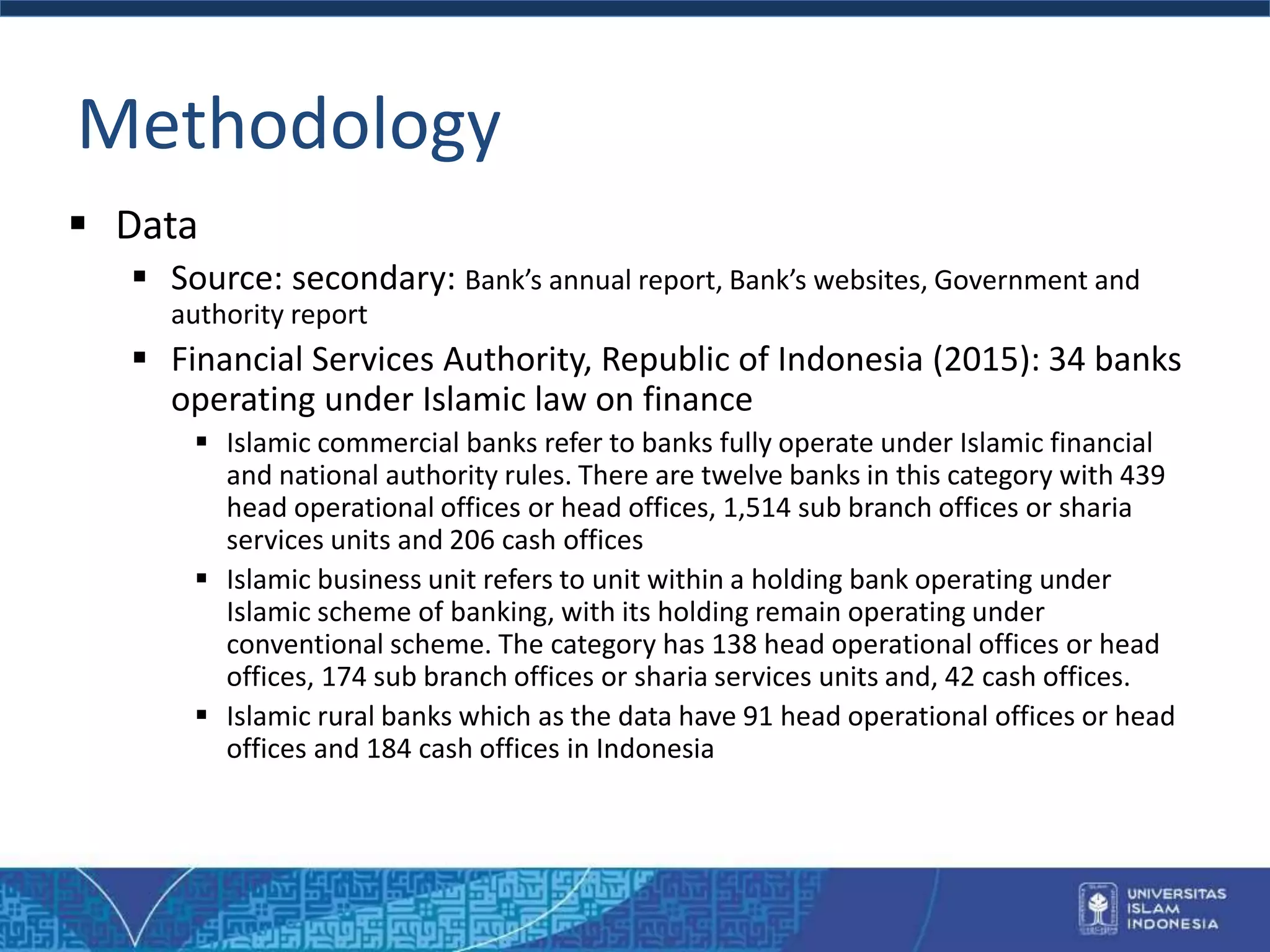
 Islamic commercial banks refer to banks fully operate under Islamic financial
and national authority rules. There are twelve banks in this category with 439
head operational offices or head offices, 1,514 sub branch offices or sharia
services units and 206 cash offices
 Islamic business unit refers to unit within a holding bank operating under
Islamic scheme of banking, with its holding remain operating under
conventional scheme. The category has 138 head operational offices or head
offices, 174 sub branch offices or sharia services units and, 42 cash offices.
 Islamic rural banks which as the data have 91 head operational offices or head
offices and 184 cash offices in Indonesia
Methodology
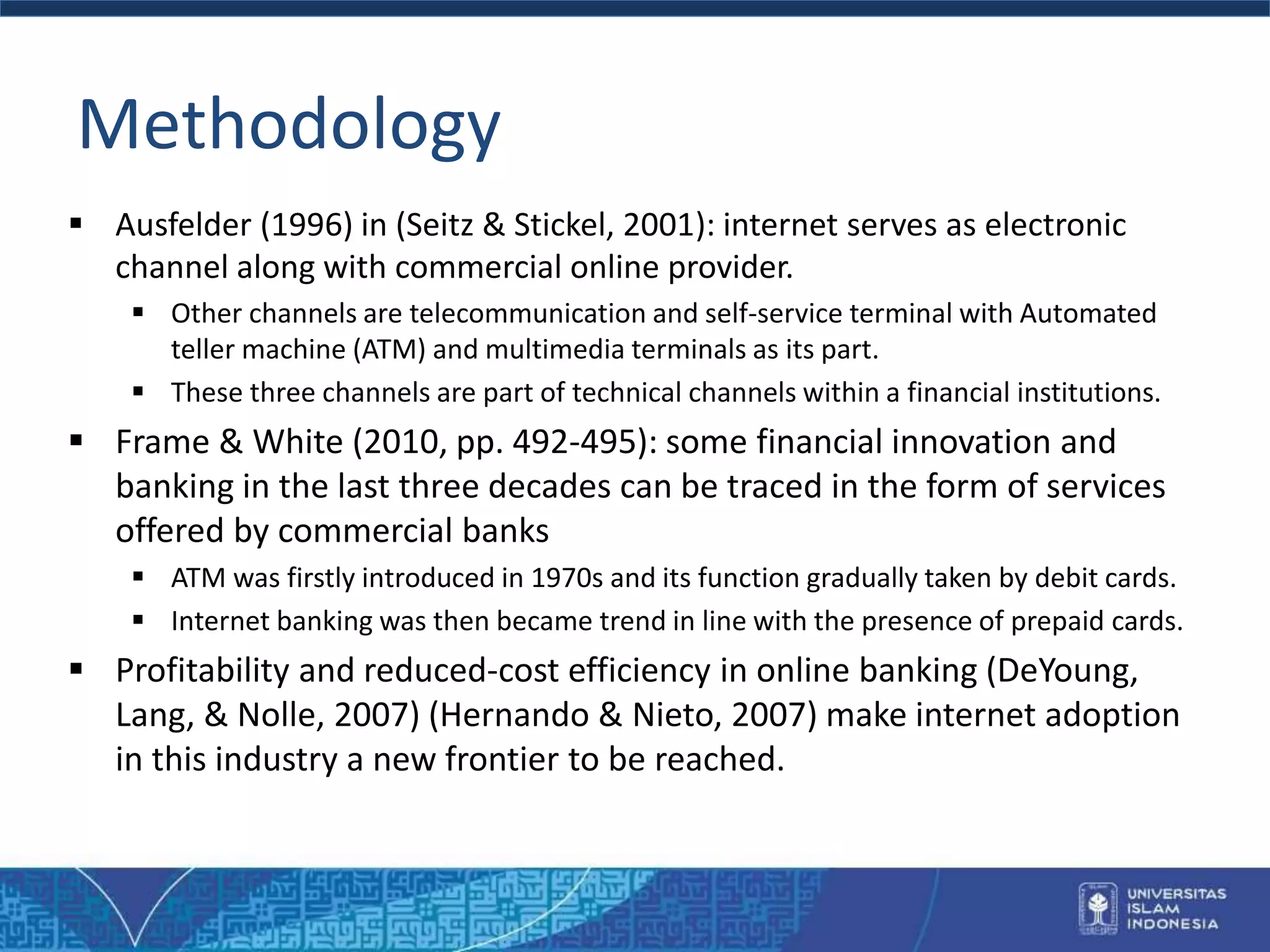
 Ausfelder (1996) in (Seitz & Stickel, 2001): internet serves as electronic
channel along with commercial online provider.
 Other channels are telecommunication and self-service terminal with Automated
teller machine (ATM) and multimedia terminals as its part.
 These three channels are part of technical channels within a financial institutions.
 Frame & White (2010, pp. 492-495): some financial innovation and
banking in the last three decades can be traced in the form of services
offered by commercial banks
 ATM was firstly introduced in 1970s and its function gradually taken by debit cards.
 Internet banking was then became trend in line with the presence of prepaid cards.
 Profitability and reduced-cost efficiency in online banking (DeYoung,
Lang, & Nolle, 2007) (Hernando & Nieto, 2007) make internet adoption
in this industry a new frontier to be reached.
Result and Discussion
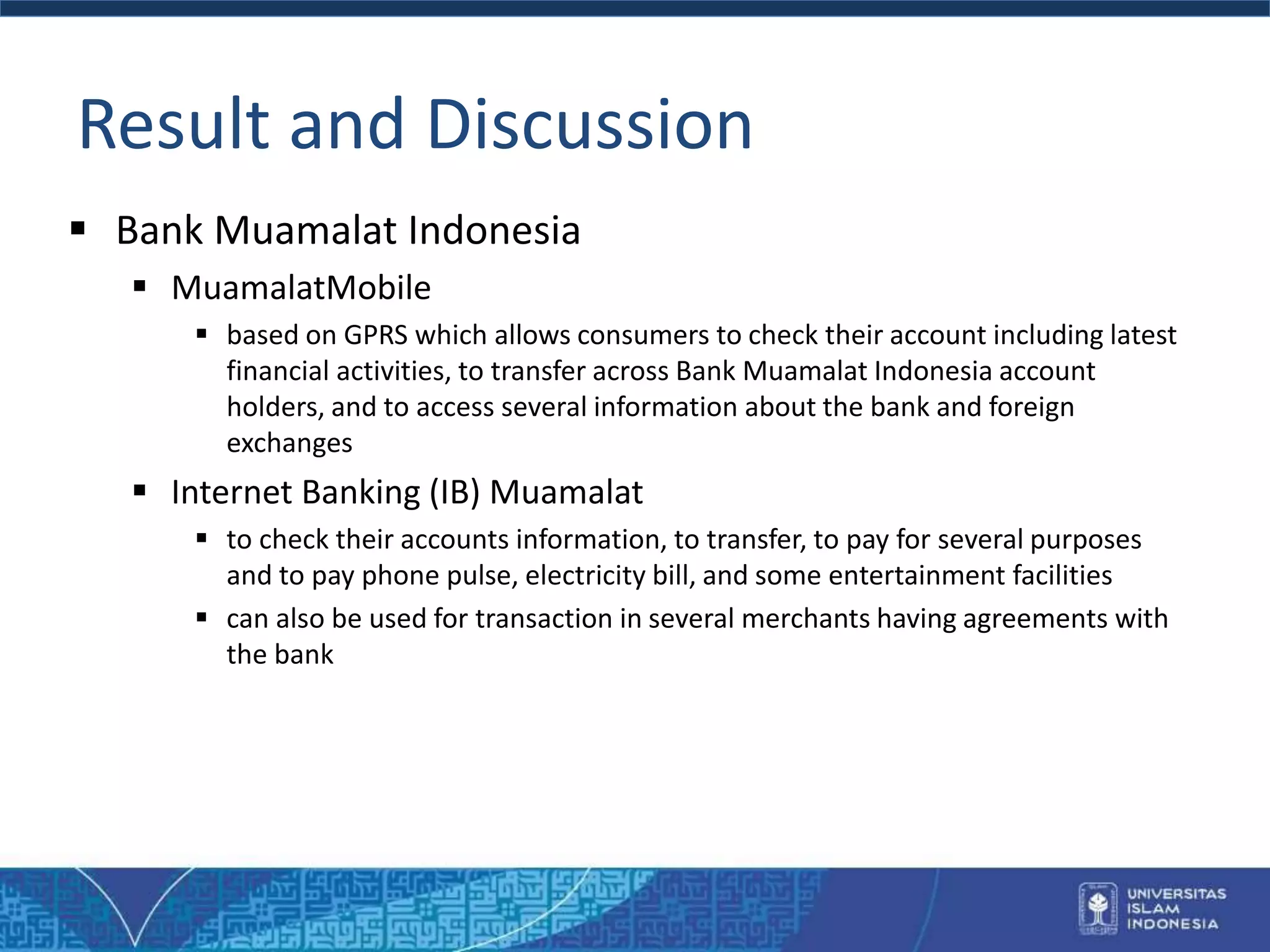
 Bank Muamalat Indonesia
 MuamalatMobile
 based on GPRS which allows consumers to check their account including latest
financial activities, to transfer across Bank Muamalat Indonesia account
holders, and to access several information about the bank and foreign
exchanges
 Internet Banking (IB) Muamalat
 to check their accounts information, to transfer, to pay for several purposes
and to pay phone pulse, electricity bill, and some entertainment facilities
 can also be used for transaction in several merchants having agreements with
the bank
Result and Discussion
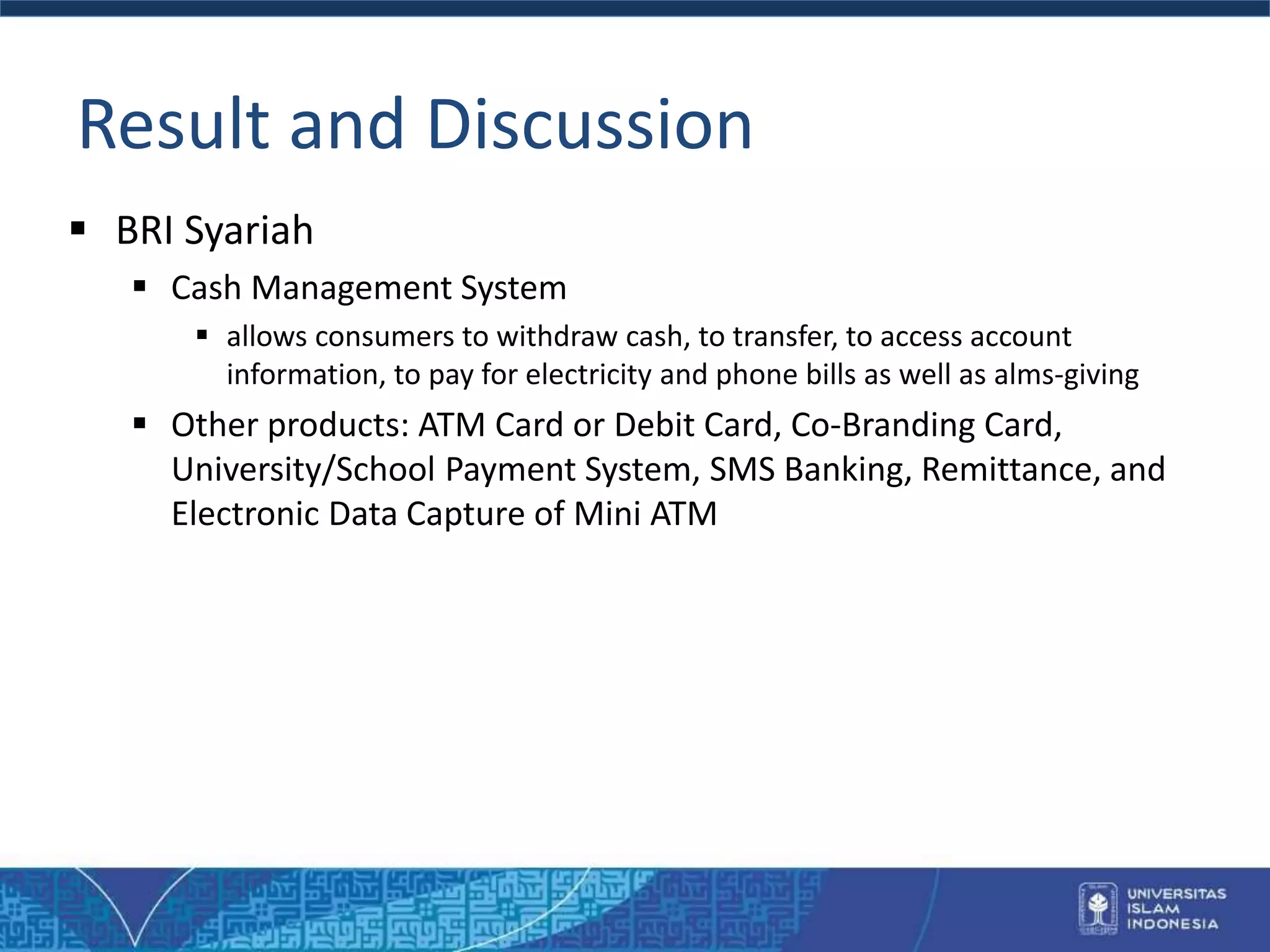
 BRI Syariah
 Cash Management System
 allows consumers to withdraw cash, to transfer, to access account
information, to pay for electricity and phone bills as well as alms-giving
 Other products: ATM Card or Debit Card, Co-Branding Card,
University/School Payment System, SMS Banking, Remittance, and
Electronic Data Capture of Mini ATM
Result and Discussion
 BPD Jawa Barat Banten Syariah
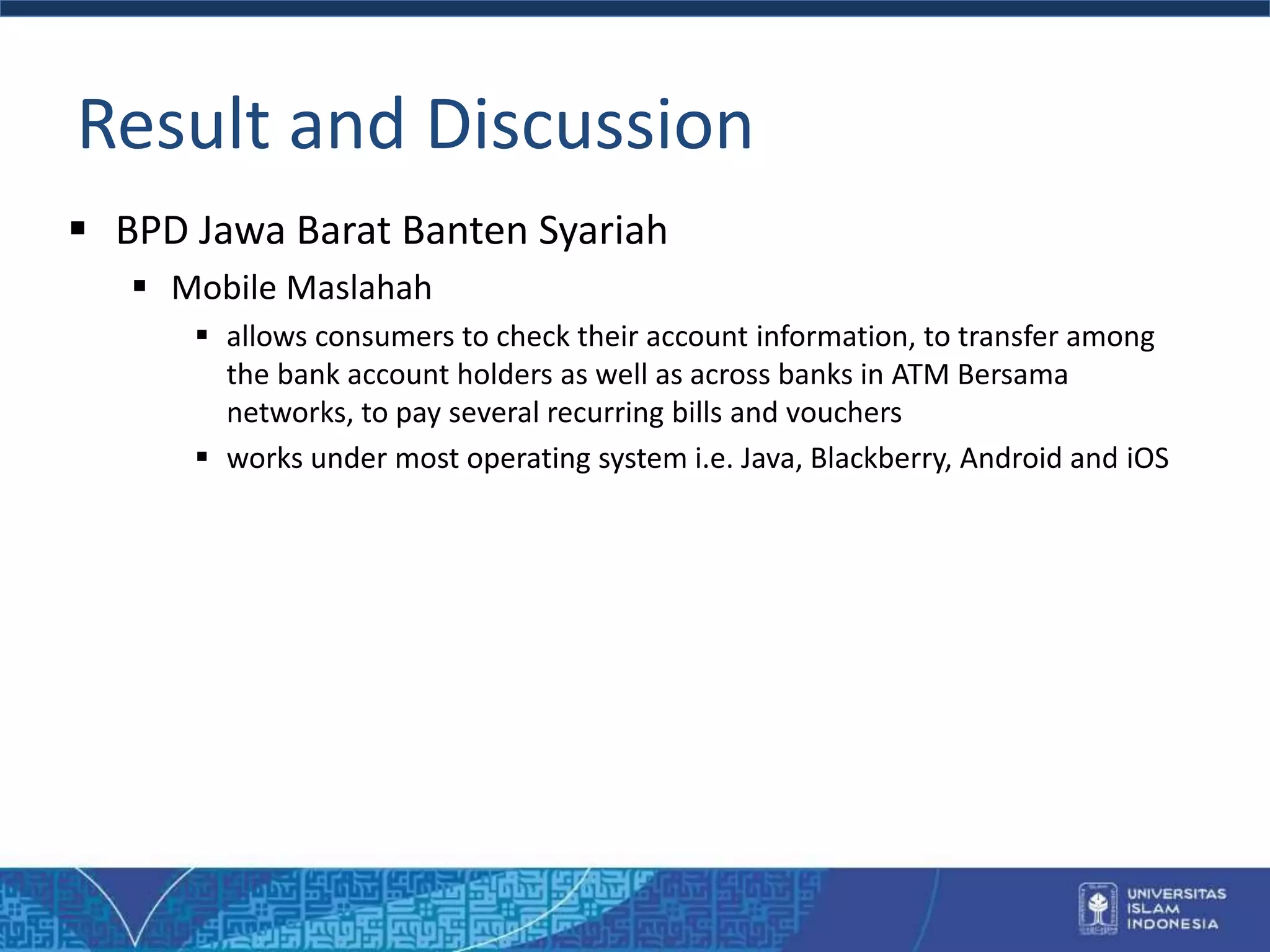
 Mobile Maslahah
 allows consumers to check their account information, to transfer among
the bank account holders as well as across banks in ATM Bersama
networks, to pay several recurring bills and vouchers
 works under most operating system i.e. Java, Blackberry, Android and iOS
Result and Discussion
 BNI Syariah
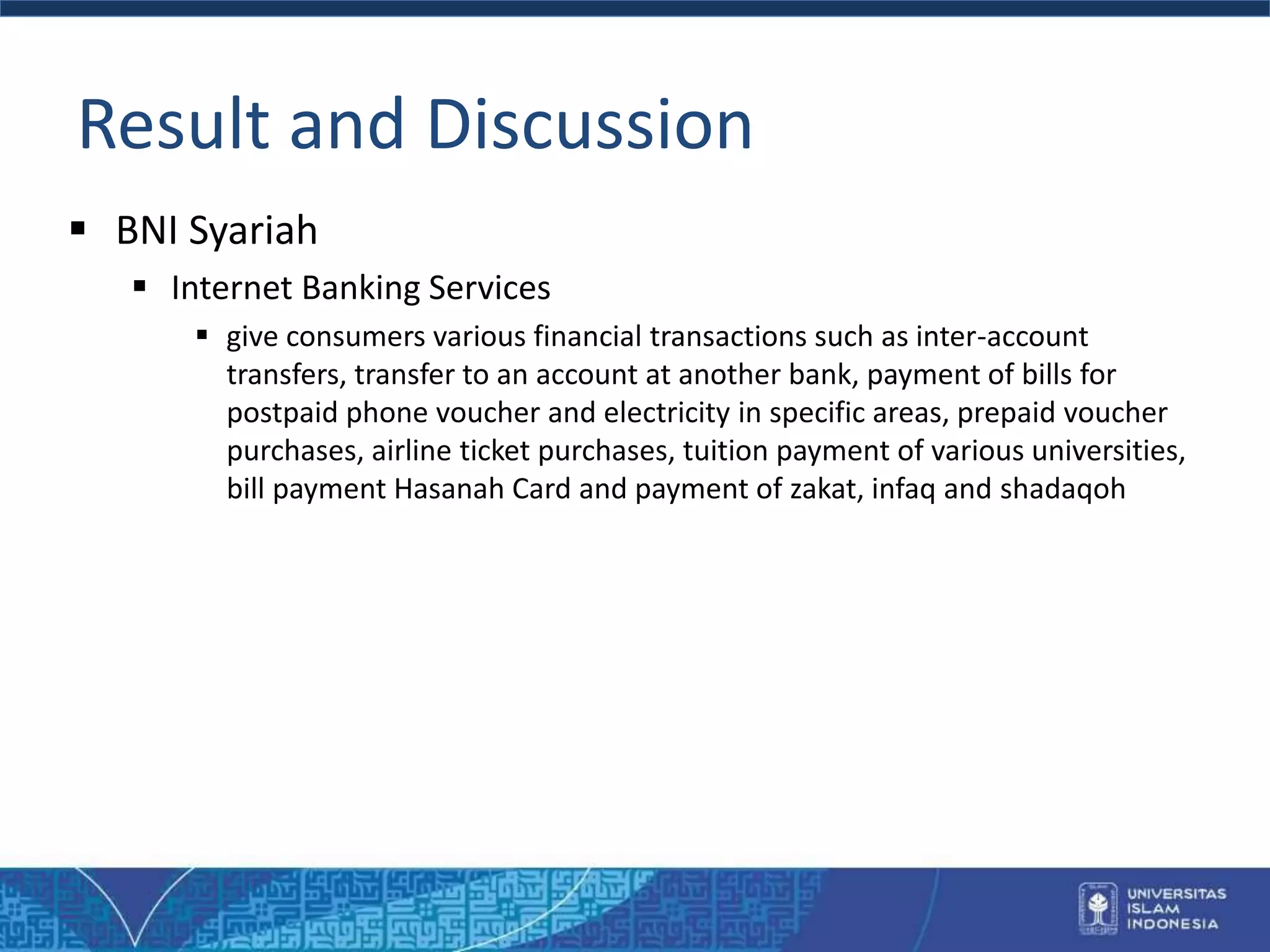
 Internet Banking Services
 give consumers various financial transactions such as inter-account
transfers, transfer to an account at another bank, payment of bills for
postpaid phone voucher and electricity in specific areas, prepaid voucher
purchases, airline ticket purchases, tuition payment of various universities,
bill payment Hasanah Card and payment of zakat, infaq and shadaqoh
Result and Discussion
 Bank Syariah Mandiri
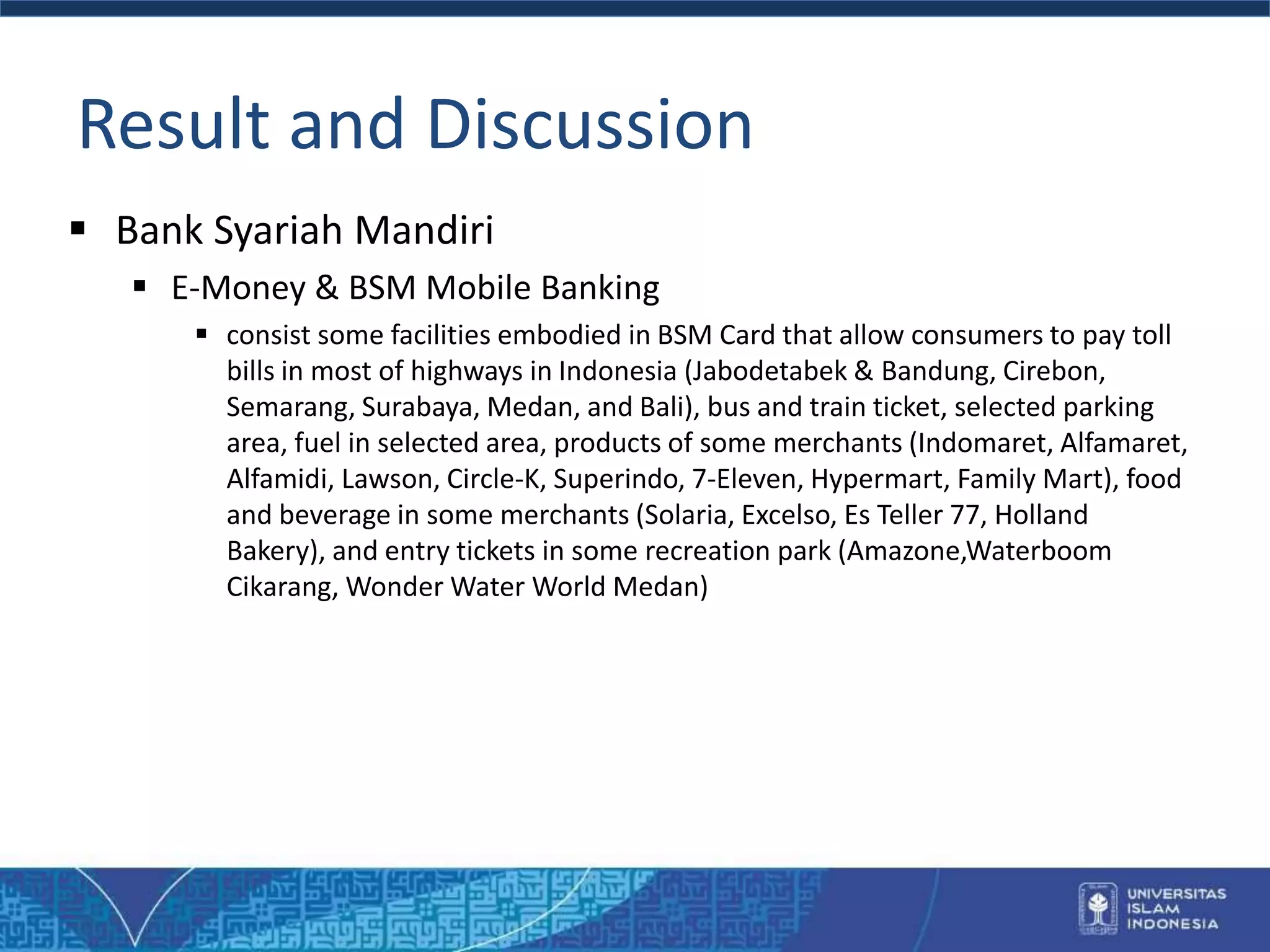
 E-Money & BSM Mobile Banking
 consist some facilities embodied in BSM Card that allow consumers to pay toll
bills in most of highways in Indonesia (Jabodetabek & Bandung, Cirebon,
Semarang, Surabaya, Medan, and Bali), bus and train ticket, selected parking
area, fuel in selected area, products of some merchants (Indomaret, Alfamaret,
Alfamidi, Lawson, Circle-K, Superindo, 7-Eleven, Hypermart, Family Mart), food
and beverage in some merchants (Solaria, Excelso, Es Teller 77, Holland
Bakery), and entry tickets in some recreation park (Amazone,Waterboom
Cikarang, Wonder Water World Medan)
Result and Discussion
 Bank Syariah Bukopin
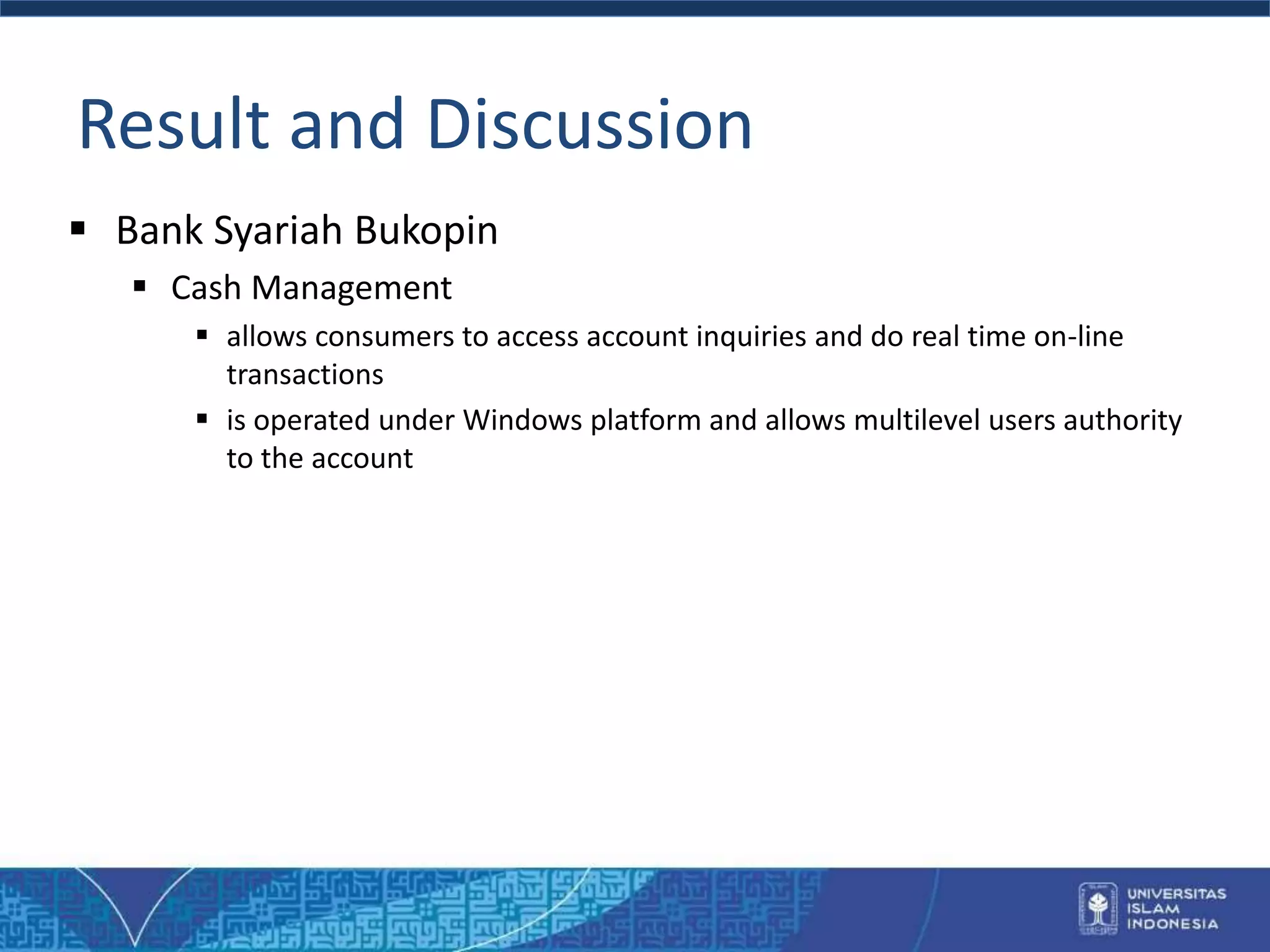
 Cash Management
 allows consumers to access account inquiries and do real time on-line
transactions
 is operated under Windows platform and allows multilevel users authority
to the account
Result and Discussion
 BCA Syariah
 BCA Syariah Mobile
 accessible from mostly used smartphones: BlackBerry, Android, and
iPhone
 allow consumers to check information on and administrate their accounts,
and to transfer for various purposes such as transfer to the same or
different banks and paying religious financial duties in form of zakat,
shadaqah and infaq
Result and Discussion
 Discussion: Limited products
 other Islamic commercial banks, financial product offered to
consumers with internet as its base is very limited
 may be caused by the relatively new bank operating which imply
the limited need to such products
 Bank Victoria Syariah was established in April 1, 2010
 Bank Mega Syariah started its operation in August 25, 2004
 Bank Panin Syariah operated from December 2, 2009
 Bank Maybank Syariah Indonesia operated on October 2010
 Bank Tabungan Pensiunan Nasional Syariah operated on May 22, 2014
Result and Discussion
 Discussion: Limited products
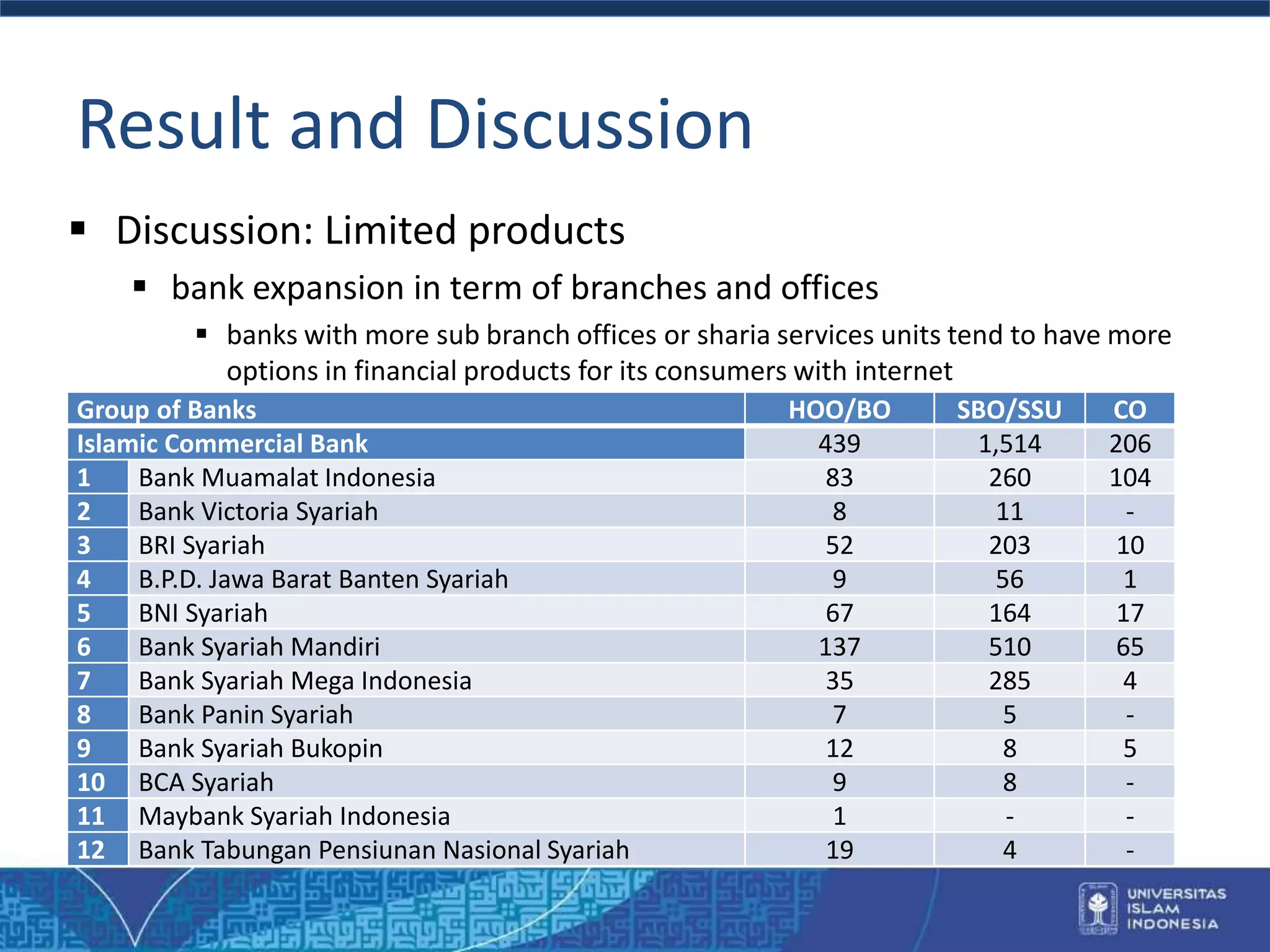
 bank expansion in term of branches and offices
 banks with more sub branch offices or sharia services units tend to have more
options in financial products for its consumers with internet
Group of Banks HOO/BO SBO/SSU CO
Islamic Commercial Bank 439 1,514 206
1 Bank Muamalat Indonesia 83 260 104
2 Bank Victoria Syariah 8 11 -
3 BRI Syariah 52 203 10
4 B.P.D. Jawa Barat Banten Syariah 9 56 1
5 BNI Syariah 67 164 17
6 Bank Syariah Mandiri 137 510 65
7 Bank Syariah Mega Indonesia 35 285 4
8 Bank Panin Syariah 7 5 -
9 Bank Syariah Bukopin 12 8 5
10 BCA Syariah 9 8 -
11 Maybank Syariah Indonesia 1 - -
12 Bank Tabungan Pensiunan Nasional Syariah 19 4 -
Result and Discussion
 Discussion: Cost Effect on Internet Banking
 these findings imply how the cost of internet-based financial
product might play important role in bank decision whether to use
it or not
 adoption and implementation of information and communication
technology in banking industry requires a high level of investment
in infrastructure as well as in workforce
 without enough preparation and capitalization, it is obviously a
hard task for banks to fulfill.
Result and Discussion
 Discussion: Financial Inclusion
 increasing internet-based products in Islamic banks as well as in
conventional one have important role in accelerating Indonesia’s
financial inclusion
 the financial inclusion is fundamentally believed as the next source
for capitalization in domestic market especially in its emerging path
 with less than 20% of its population having access to financial
institution (World Bank, 2011), internet may be the right answer to
address the challenge of financial inclusion in Indonesia.
Result and Discussion
 Discussion: Banking competition
 more internet-based products for Islamic commercial bank can
prospectively increase consumers awareness of the banks
 many researchers suggest financial performances of Islamic
commercial banks in Indonesia are highly related to its counterpart
of conventional ones (Kasri & Kassim, 2009) (Hutapea & Kasri, 2010)
 increasing quality in internet-based financial product may lead to a
better competition with conventional banks
 Bank of Indonesia campaign on non-cash transaction may also be
inspiring factor to accelerate the initiation of internet as base for
financial services in Islamic commercial banks
Conclusion
 relatively limited adoption of information and
communication technology in term of financial products by
Islamic commercial banks in Indonesia
 only bank with large capitalization and big market share
tend to provide consumers with such products
 as the technology develops fast and most consumers grow
familiarity with many technological devices along with trend
in e-commerce it is noteworthy that Islamic commercial
banks in Indonesia are suggested to take the opportunity to
enhance its products
Conclusion
 Limitations
 coverage only to product details and not on its application according
consumers’ experience
 Further research
 internet banking products in Islamic banks in relation with
conventional banks
 implementing of internet reception by consumers of Islamic banks
THANK YOU

Internet-Based Products in Islamic Commercial Banks in Indonesia

  • 1.
    Internet-Based Products inIslamic Commercial Banks in Indonesia Y. Andriansyah The 2015 International Congress on Economics, Social Sciences and Information Management (ICESSIM 2015)
  • 2.
    Introduction  Islamic banksin Indonesia: two decades developments  establishment of Bank Muamalat Indonesia in 1992  issuance of fatwa on interest bank prohibition by Council of Indonesia Ulama in 2003  issuance of national law on Islamic bank and launching of Islamic banking (iB) as social and economic trend in societies in 2008  number of bank has increased significantly and reached 12 banks fully operating under Islamic banking system, 22 Islamic branches as part of conventional banks (November 2014)
  • 3.
    Introduction  Limited researchin internet products of Islamic banks  Purwanegara, Apriningsih, & Andika (2014) for example noted unfamiliarity to the law and regulation regarding fraud and claiming procedure in internet banking makes consumers feel unsafe to use the products when it come to a problem  Thuiner (2015, p. 104) pointed online banking with internet as its front product will be the best option for both consumers and bankers  for Indonesian context, the rapid development in the telecommunications sector has made it important player to stimulate economic growth in the country recently. It grew higher than that of other sectors along with rapid diffusion especially in cellular telephony in the last decade (Rohman & Bohlin, 2014)
  • 4.
    Introduction  This paper aims to analyze internet-based products offered by Islamic banks in Indonesia  availability, types, and factors affecting bank to or not to provide it to consumers  results will be expected as an early effort to study Islamic banking from its capacity in digital economy
  • 5.
    Methodology  Data  Source:secondary: Bank’s annual report, Bank’s websites, Government and authority report  Financial Services Authority, Republic of Indonesia (2015): 34 banks operating under Islamic law on finance  Islamic commercial banks refer to banks fully operate under Islamic financial and national authority rules. There are twelve banks in this category with 439 head operational offices or head offices, 1,514 sub branch offices or sharia services units and 206 cash offices  Islamic business unit refers to unit within a holding bank operating under Islamic scheme of banking, with its holding remain operating under conventional scheme. The category has 138 head operational offices or head offices, 174 sub branch offices or sharia services units and, 42 cash offices.  Islamic rural banks which as the data have 91 head operational offices or head offices and 184 cash offices in Indonesia
  • 6.
    Methodology  Ausfelder (1996)in (Seitz & Stickel, 2001): internet serves as electronic channel along with commercial online provider.  Other channels are telecommunication and self-service terminal with Automated teller machine (ATM) and multimedia terminals as its part.  These three channels are part of technical channels within a financial institutions.  Frame & White (2010, pp. 492-495): some financial innovation and banking in the last three decades can be traced in the form of services offered by commercial banks  ATM was firstly introduced in 1970s and its function gradually taken by debit cards.  Internet banking was then became trend in line with the presence of prepaid cards.  Profitability and reduced-cost efficiency in online banking (DeYoung, Lang, & Nolle, 2007) (Hernando & Nieto, 2007) make internet adoption in this industry a new frontier to be reached.
  • 7.
    Result and Discussion Bank Muamalat Indonesia  MuamalatMobile  based on GPRS which allows consumers to check their account including latest financial activities, to transfer across Bank Muamalat Indonesia account holders, and to access several information about the bank and foreign exchanges  Internet Banking (IB) Muamalat  to check their accounts information, to transfer, to pay for several purposes and to pay phone pulse, electricity bill, and some entertainment facilities  can also be used for transaction in several merchants having agreements with the bank
  • 8.
    Result and Discussion BRI Syariah  Cash Management System  allows consumers to withdraw cash, to transfer, to access account information, to pay for electricity and phone bills as well as alms-giving  Other products: ATM Card or Debit Card, Co-Branding Card, University/School Payment System, SMS Banking, Remittance, and Electronic Data Capture of Mini ATM
  • 9.
    Result and Discussion BPD Jawa Barat Banten Syariah  Mobile Maslahah  allows consumers to check their account information, to transfer among the bank account holders as well as across banks in ATM Bersama networks, to pay several recurring bills and vouchers  works under most operating system i.e. Java, Blackberry, Android and iOS
  • 10.
    Result and Discussion BNI Syariah  Internet Banking Services  give consumers various financial transactions such as inter-account transfers, transfer to an account at another bank, payment of bills for postpaid phone voucher and electricity in specific areas, prepaid voucher purchases, airline ticket purchases, tuition payment of various universities, bill payment Hasanah Card and payment of zakat, infaq and shadaqoh
  • 11.
    Result and Discussion Bank Syariah Mandiri  E-Money & BSM Mobile Banking  consist some facilities embodied in BSM Card that allow consumers to pay toll bills in most of highways in Indonesia (Jabodetabek & Bandung, Cirebon, Semarang, Surabaya, Medan, and Bali), bus and train ticket, selected parking area, fuel in selected area, products of some merchants (Indomaret, Alfamaret, Alfamidi, Lawson, Circle-K, Superindo, 7-Eleven, Hypermart, Family Mart), food and beverage in some merchants (Solaria, Excelso, Es Teller 77, Holland Bakery), and entry tickets in some recreation park (Amazone,Waterboom Cikarang, Wonder Water World Medan)
  • 12.
    Result and Discussion Bank Syariah Bukopin  Cash Management  allows consumers to access account inquiries and do real time on-line transactions  is operated under Windows platform and allows multilevel users authority to the account
  • 13.
    Result and Discussion BCA Syariah  BCA Syariah Mobile  accessible from mostly used smartphones: BlackBerry, Android, and iPhone  allow consumers to check information on and administrate their accounts, and to transfer for various purposes such as transfer to the same or different banks and paying religious financial duties in form of zakat, shadaqah and infaq
  • 14.
    Result and Discussion Discussion: Limited products  other Islamic commercial banks, financial product offered to consumers with internet as its base is very limited  may be caused by the relatively new bank operating which imply the limited need to such products  Bank Victoria Syariah was established in April 1, 2010  Bank Mega Syariah started its operation in August 25, 2004  Bank Panin Syariah operated from December 2, 2009  Bank Maybank Syariah Indonesia operated on October 2010  Bank Tabungan Pensiunan Nasional Syariah operated on May 22, 2014
  • 15.
    Result and Discussion Discussion: Limited products  bank expansion in term of branches and offices  banks with more sub branch offices or sharia services units tend to have more options in financial products for its consumers with internet Group of Banks HOO/BO SBO/SSU CO Islamic Commercial Bank 439 1,514 206 1 Bank Muamalat Indonesia 83 260 104 2 Bank Victoria Syariah 8 11 - 3 BRI Syariah 52 203 10 4 B.P.D. Jawa Barat Banten Syariah 9 56 1 5 BNI Syariah 67 164 17 6 Bank Syariah Mandiri 137 510 65 7 Bank Syariah Mega Indonesia 35 285 4 8 Bank Panin Syariah 7 5 - 9 Bank Syariah Bukopin 12 8 5 10 BCA Syariah 9 8 - 11 Maybank Syariah Indonesia 1 - - 12 Bank Tabungan Pensiunan Nasional Syariah 19 4 -
  • 16.
    Result and Discussion Discussion: Cost Effect on Internet Banking  these findings imply how the cost of internet-based financial product might play important role in bank decision whether to use it or not  adoption and implementation of information and communication technology in banking industry requires a high level of investment in infrastructure as well as in workforce  without enough preparation and capitalization, it is obviously a hard task for banks to fulfill.
  • 17.
    Result and Discussion Discussion: Financial Inclusion  increasing internet-based products in Islamic banks as well as in conventional one have important role in accelerating Indonesia’s financial inclusion  the financial inclusion is fundamentally believed as the next source for capitalization in domestic market especially in its emerging path  with less than 20% of its population having access to financial institution (World Bank, 2011), internet may be the right answer to address the challenge of financial inclusion in Indonesia.
  • 18.
    Result and Discussion Discussion: Banking competition  more internet-based products for Islamic commercial bank can prospectively increase consumers awareness of the banks  many researchers suggest financial performances of Islamic commercial banks in Indonesia are highly related to its counterpart of conventional ones (Kasri & Kassim, 2009) (Hutapea & Kasri, 2010)  increasing quality in internet-based financial product may lead to a better competition with conventional banks  Bank of Indonesia campaign on non-cash transaction may also be inspiring factor to accelerate the initiation of internet as base for financial services in Islamic commercial banks
  • 19.
    Conclusion  relatively limitedadoption of information and communication technology in term of financial products by Islamic commercial banks in Indonesia  only bank with large capitalization and big market share tend to provide consumers with such products  as the technology develops fast and most consumers grow familiarity with many technological devices along with trend in e-commerce it is noteworthy that Islamic commercial banks in Indonesia are suggested to take the opportunity to enhance its products
  • 20.
    Conclusion  Limitations  coverageonly to product details and not on its application according consumers’ experience  Further research  internet banking products in Islamic banks in relation with conventional banks  implementing of internet reception by consumers of Islamic banks
  • 21.