LMC Project/Activity/Lesson Plan


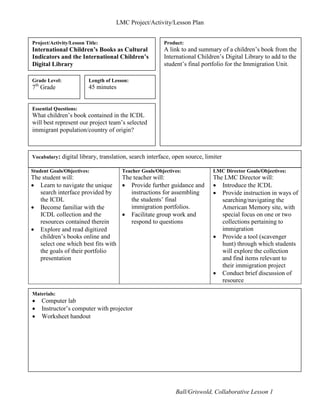
Project/Activity/Lesson Title:                            Product:
International Children’s Books as Cultural                A link to and summary of a children’s book from the
Indicators and the International Children’s               International Children’s Digital Library to add to the
Digital Library                                           student’s final portfolio for the Immigration Unit.

Grade Level:              Length of Lesson:
7th Grade                 45 minutes


Essential Questions:
What children’s book contained in the ICDL
will best represent our project team’s selected
immigrant population/country of origin?


Vocabulary: digital    library, translation, search interface, open source, limiter

Student Goals/Objectives:               Teacher Goals/Objectives:              LMC Director Goals/Objectives:
The student will:                  The teacher will:                           The LMC Director will:
 Learn to navigate the unique      Provide further guidance and               Introduce the ICDL
   search interface provided by       instructions for assembling               Provide instruction in ways of
   the ICDL                           the students’ final                         searching/navigating the
 Become familiar with the            immigration portfolios.                     American Memory site, with
   ICDL collection and the          Facilitate group work and                    special focus on one or two
   resources contained therein        respond to questions                        collections pertaining to
 Explore and read digitized                                                      immigration
   children’s books online and                                                  Provide a tool (scavenger
   select one which best fits with                                                hunt) through which students
   the goals of their portfolio                                                   will explore the collection
   presentation                                                                   and find items relevant to
                                                                                  their immigration project
                                                                                Conduct brief discussion of
                                                                                  resource

Materials:
   Computer lab
   Instructor’s computer with projector
   Worksheet handout


                                                               Ball/Griswold, Collaborative Lesson 1
LMC Project/Activity/Lesson Plan


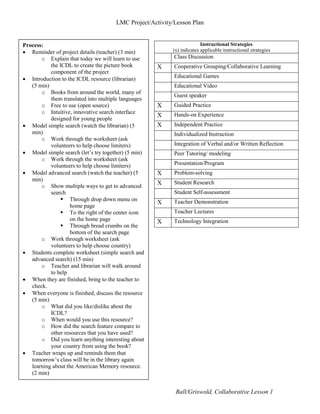
Process:                                                                Instructional Strategies
 Reminder of project details (teacher) (3 min)           (x) indicates applicable instructional strategies
       o Explain that today we will learn to use           Class Discussion
           the ICDL to create the picture book       X     Cooperative Grouping/Collaborative Learning
           component of the project
 Introduction to the ICDL resource (librarian)            Educational Games
   (5 min)                                                 Educational Video
       o Books from around the world, many of
                                                           Guest speaker
           them translated into multiple languages
       o Free to use (open source)                   X     Guided Practice
       o Intuitive, innovative search interface            Hands-on Experience
                                                     X
           designed for young people
 Model simple search (watch the librarian) (5       X     Independent Practice
   min)                                                    Individualized Instruction
       o Work through the worksheet (ask
           volunteers to help choose limiters)             Integration of Verbal and/or Written Reflection
 Model simple search (let’s try together) (5 min)         Peer Tutoring/ modeling
       o Work through the worksheet (ask
           volunteers to help choose limiters)             Presentation/Program
 Model advanced search (watch the teacher) (5       X     Problem-solving
   min)
                                                     X     Student Research
       o Show multiple ways to get to advanced
           search                                          Student Self-assessment
                Through drop down menu on                 Teacher Demonstration
                                                     X
                    home page
                To the right of the center icon           Teacher Lectures
                    on the home page                 X     Technology Integration
                Through bread crumbs on the
                    bottom of the search page
       o Work through worksheet (ask
           volunteers to help choose country)
 Students complete worksheet (simple search and
   advanced search) (15 min)
       o Teacher and librarian will walk around
           to help
 When they are finished, bring to the teacher to
   check.
 When everyone is finished, discuss the resource
   (5 min)
       o What did you like/dislike about the
           ICDL?
       o When would you use this resource?
       o How did the search feature compare to
           other resources that you have used?
       o Did you learn anything interesting about
           your country from using the book?
 Teacher wraps up and reminds them that
   tomorrow’s class will be in the library again
   learning about the American Memory resource.
   (2 min)


                                                           Ball/Griswold, Collaborative Lesson 1
LMC Project/Activity/Lesson Plan


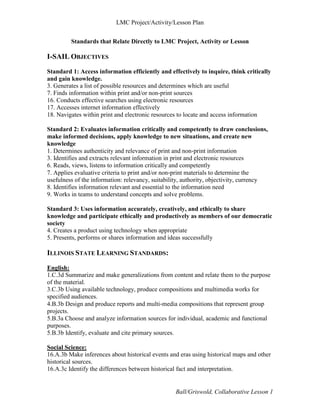
         Standards that Relate Directly to LMC Project, Activity or Lesson

I-SAIL OBJECTIVES
Standard 1: Access information efficiently and effectively to inquire, think critically
and gain knowledge.
3. Generates a list of possible resources and determines which are useful
7. Finds information within print and/or non-print sources
16. Conducts effective searches using electronic resources
17. Accesses internet information effectively
18. Navigates within print and electronic resources to locate and access information

Standard 2: Evaluates information critically and competently to draw conclusions,
make informed decisions, apply knowledge to new situations, and create new
knowledge
1. Determines authenticity and relevance of print and non‐print information
3. Identifies and extracts relevant information in print and electronic resources
6. Reads, views, listens to information critically and competently
7. Applies evaluative criteria to print and/or non‐print materials to determine the
usefulness of the information: relevancy, suitability, authority, objectivity, currency
8. Identifies information relevant and essential to the information need
9. Works in teams to understand concepts and solve problems.

Standard 3: Uses information accurately, creatively, and ethically to share
knowledge and participate ethically and productively as members of our democratic
society
4. Creates a product using technology when appropriate
5. Presents, performs or shares information and ideas successfully

ILLINOIS STATE LEARNING STANDARDS:

English:
1.C.3d Summarize and make generalizations from content and relate them to the purpose
of the material.
3.C.3b Using available technology, produce compositions and multimedia works for
specified audiences.
4.B.3b Design and produce reports and multi‐media compositions that represent group
projects.
5.B.3a Choose and analyze information sources for individual, academic and functional
purposes.
5.B.3b Identify, evaluate and cite primary sources.

Social Science:
16.A.3b Make inferences about historical events and eras using historical maps and other
historical sources.
16.A.3c Identify the differences between historical fact and interpretation.


                                                  Ball/Griswold, Collaborative Lesson 1
LMC Project/Activity/Lesson Plan


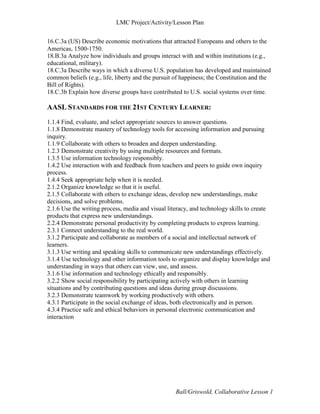
16.C.3a (US) Describe economic motivations that attracted Europeans and others to the
Americas, 1500‐1750.
18.B.3a Analyze how individuals and groups interact with and within institutions (e.g.,
educational, military).
18.C.3a Describe ways in which a diverse U.S. population has developed and maintained
common beliefs (e.g., life, liberty and the pursuit of happiness; the Constitution and the
Bill of Rights).
18.C.3b Explain how diverse groups have contributed to U.S. social systems over time.

AASL STANDARDS FOR THE 21ST CENTURY LEARNER:
1.1.4 Find, evaluate, and select appropriate sources to answer questions.
1.1.8 Demonstrate mastery of technology tools for accessing information and pursuing
inquiry.
1.1.9 Collaborate with others to broaden and deepen understanding.
1.2.3 Demonstrate creativity by using multiple resources and formats.
1.3.5 Use information technology responsibly.
1.4.2 Use interaction with and feedback from teachers and peers to guide own inquiry
process.
1.4.4 Seek appropriate help when it is needed.
2.1.2 Organize knowledge so that it is useful.
2.1.5 Collaborate with others to exchange ideas, develop new understandings, make
decisions, and solve problems.
2.1.6 Use the writing process, media and visual literacy, and technology skills to create
products that express new understandings.
2.2.4 Demonstrate personal productivity by completing products to express learning.
2.3.1 Connect understanding to the real world.
3.1.2 Participate and collaborate as members of a social and intellectual network of
learners.
3.1.3 Use writing and speaking skills to communicate new understandings effectively.
3.1.4 Use technology and other information tools to organize and display knowledge and
understanding in ways that others can view, use, and assess.
3.1.6 Use information and technology ethically and responsibly.
3.2.2 Show social responsibility by participating actively with others in learning
situations and by contributing questions and ideas during group discussions.
3.2.3 Demonstrate teamwork by working productively with others.
4.3.1 Participate in the social exchange of ideas, both electronically and in person.
4.3.4 Practice safe and ethical behaviors in personal electronic communication and
interaction


                                                   Ball/Griswold, Collaborative Lesson 1

ICDL Lesson Plan

  • 1.
    LMC Project/Activity/Lesson Plan Project/Activity/LessonTitle: Product: International Children’s Books as Cultural A link to and summary of a children’s book from the Indicators and the International Children’s International Children’s Digital Library to add to the Digital Library student’s final portfolio for the Immigration Unit. Grade Level: Length of Lesson: 7th Grade 45 minutes Essential Questions: What children’s book contained in the ICDL will best represent our project team’s selected immigrant population/country of origin? Vocabulary: digital library, translation, search interface, open source, limiter Student Goals/Objectives: Teacher Goals/Objectives: LMC Director Goals/Objectives: The student will: The teacher will: The LMC Director will:  Learn to navigate the unique  Provide further guidance and  Introduce the ICDL search interface provided by instructions for assembling  Provide instruction in ways of the ICDL the students’ final searching/navigating the  Become familiar with the immigration portfolios. American Memory site, with ICDL collection and the  Facilitate group work and special focus on one or two resources contained therein respond to questions collections pertaining to  Explore and read digitized immigration children’s books online and  Provide a tool (scavenger select one which best fits with hunt) through which students the goals of their portfolio will explore the collection presentation and find items relevant to their immigration project  Conduct brief discussion of resource Materials:  Computer lab  Instructor’s computer with projector  Worksheet handout Ball/Griswold, Collaborative Lesson 1
  • 2.
    LMC Project/Activity/Lesson Plan Process: Instructional Strategies  Reminder of project details (teacher) (3 min) (x) indicates applicable instructional strategies o Explain that today we will learn to use Class Discussion the ICDL to create the picture book X Cooperative Grouping/Collaborative Learning component of the project  Introduction to the ICDL resource (librarian) Educational Games (5 min) Educational Video o Books from around the world, many of Guest speaker them translated into multiple languages o Free to use (open source) X Guided Practice o Intuitive, innovative search interface Hands-on Experience X designed for young people  Model simple search (watch the librarian) (5 X Independent Practice min) Individualized Instruction o Work through the worksheet (ask volunteers to help choose limiters) Integration of Verbal and/or Written Reflection  Model simple search (let’s try together) (5 min) Peer Tutoring/ modeling o Work through the worksheet (ask volunteers to help choose limiters) Presentation/Program  Model advanced search (watch the teacher) (5 X Problem-solving min) X Student Research o Show multiple ways to get to advanced search Student Self-assessment  Through drop down menu on Teacher Demonstration X home page  To the right of the center icon Teacher Lectures on the home page X Technology Integration  Through bread crumbs on the bottom of the search page o Work through worksheet (ask volunteers to help choose country)  Students complete worksheet (simple search and advanced search) (15 min) o Teacher and librarian will walk around to help  When they are finished, bring to the teacher to check.  When everyone is finished, discuss the resource (5 min) o What did you like/dislike about the ICDL? o When would you use this resource? o How did the search feature compare to other resources that you have used? o Did you learn anything interesting about your country from using the book?  Teacher wraps up and reminds them that tomorrow’s class will be in the library again learning about the American Memory resource. (2 min) Ball/Griswold, Collaborative Lesson 1
  • 3.
    LMC Project/Activity/Lesson Plan Standards that Relate Directly to LMC Project, Activity or Lesson I-SAIL OBJECTIVES Standard 1: Access information efficiently and effectively to inquire, think critically and gain knowledge. 3. Generates a list of possible resources and determines which are useful 7. Finds information within print and/or non-print sources 16. Conducts effective searches using electronic resources 17. Accesses internet information effectively 18. Navigates within print and electronic resources to locate and access information Standard 2: Evaluates information critically and competently to draw conclusions, make informed decisions, apply knowledge to new situations, and create new knowledge 1. Determines authenticity and relevance of print and non‐print information 3. Identifies and extracts relevant information in print and electronic resources 6. Reads, views, listens to information critically and competently 7. Applies evaluative criteria to print and/or non‐print materials to determine the usefulness of the information: relevancy, suitability, authority, objectivity, currency 8. Identifies information relevant and essential to the information need 9. Works in teams to understand concepts and solve problems. Standard 3: Uses information accurately, creatively, and ethically to share knowledge and participate ethically and productively as members of our democratic society 4. Creates a product using technology when appropriate 5. Presents, performs or shares information and ideas successfully ILLINOIS STATE LEARNING STANDARDS: English: 1.C.3d Summarize and make generalizations from content and relate them to the purpose of the material. 3.C.3b Using available technology, produce compositions and multimedia works for specified audiences. 4.B.3b Design and produce reports and multi‐media compositions that represent group projects. 5.B.3a Choose and analyze information sources for individual, academic and functional purposes. 5.B.3b Identify, evaluate and cite primary sources. Social Science: 16.A.3b Make inferences about historical events and eras using historical maps and other historical sources. 16.A.3c Identify the differences between historical fact and interpretation. Ball/Griswold, Collaborative Lesson 1
  • 4.
    LMC Project/Activity/Lesson Plan 16.C.3a(US) Describe economic motivations that attracted Europeans and others to the Americas, 1500‐1750. 18.B.3a Analyze how individuals and groups interact with and within institutions (e.g., educational, military). 18.C.3a Describe ways in which a diverse U.S. population has developed and maintained common beliefs (e.g., life, liberty and the pursuit of happiness; the Constitution and the Bill of Rights). 18.C.3b Explain how diverse groups have contributed to U.S. social systems over time. AASL STANDARDS FOR THE 21ST CENTURY LEARNER: 1.1.4 Find, evaluate, and select appropriate sources to answer questions. 1.1.8 Demonstrate mastery of technology tools for accessing information and pursuing inquiry. 1.1.9 Collaborate with others to broaden and deepen understanding. 1.2.3 Demonstrate creativity by using multiple resources and formats. 1.3.5 Use information technology responsibly. 1.4.2 Use interaction with and feedback from teachers and peers to guide own inquiry process. 1.4.4 Seek appropriate help when it is needed. 2.1.2 Organize knowledge so that it is useful. 2.1.5 Collaborate with others to exchange ideas, develop new understandings, make decisions, and solve problems. 2.1.6 Use the writing process, media and visual literacy, and technology skills to create products that express new understandings. 2.2.4 Demonstrate personal productivity by completing products to express learning. 2.3.1 Connect understanding to the real world. 3.1.2 Participate and collaborate as members of a social and intellectual network of learners. 3.1.3 Use writing and speaking skills to communicate new understandings effectively. 3.1.4 Use technology and other information tools to organize and display knowledge and understanding in ways that others can view, use, and assess. 3.1.6 Use information and technology ethically and responsibly. 3.2.2 Show social responsibility by participating actively with others in learning situations and by contributing questions and ideas during group discussions. 3.2.3 Demonstrate teamwork by working productively with others. 4.3.1 Participate in the social exchange of ideas, both electronically and in person. 4.3.4 Practice safe and ethical behaviors in personal electronic communication and interaction Ball/Griswold, Collaborative Lesson 1