Borderlands Theory in Service-Learning
 Research: Remapping the Metaphor
  Rachael Wendler, University of Arizona
        rwendler@u.arizona.edu
             IARSLCE 2012
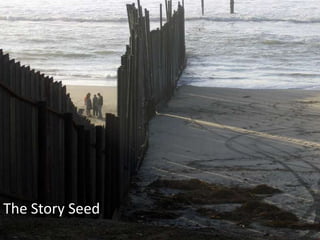
The Story Seed
Taylor, J. (2002). Metaphors we serve by: Investigating
   the conceptual metaphors framing national and
        community service and service-learning.


 • Conceptual metaphors “structure what we perceive,
   how we get around in the world, and how we relate
   to other people” (Lakoff & Johnson, 1980).
 • Service is Citizenship; Service is War; Service is
   Business
 • Taylor’s suggestion: Service is Borderlands
Service-Learning as Borderlands?


    Butin, 2005; Chesler, Ford, Galura, & Chareneau,
    2011; Delgado Bernal, Aleman & Garavito, 2001;
    Hayes & Cuban, 1997; Keith, 1998; Taylor, 2002;
    Williams & Van Cleave, 2011.
Mapping Metaphors


           SERVICE-LEARNING IS WAR
  Source: War          Target: Service-
Learning
  Soldiers                     Students
  General                      Teacher

     Community Members as Enemy? Fellow
      Soldiers? Innocent Civilians? Captains?
Mapping Metaphors


     SERVICE-LEARNING IS BORDER CROSSING
Source: Borderlands    Target: Service-Learning
        Theory

Border Crossers       All Students?
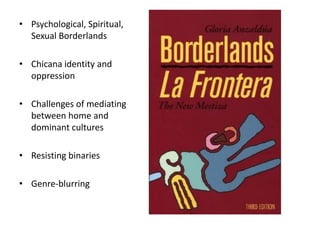
• Psychological, Spiritual,
  Sexual Borderlands

• Chicana identity and
  oppression

• Challenges of mediating
  between home and
  dominant cultures

• Resisting binaries

• Genre-blurring
“The prohibited and forbidden are its [the Borderlands’] inhabitants. Los
atravesados live here: the squint-eyed, the perverse, the queer, the
troublesome, the mongrel, the mulatto, the half-breed, the half dead; in
short, those who cross over, pass over, or go through the confines of the
‘normal’” (pp. 25-26).
Giroux and McLaren’s Border Pedagogy


“First, the category of border signals a recognition of
those epistemological, political, cultural, and social
margins that structure the language of history, power,
and difference . . . Second, it also speaks to the need to
create pedagogical conditions in which students become
border crossers in order to understand otherness in its
own terms . . . Third, border pedagogy makes visible the
historically and socially constructed strengths and
limitations of those places and borders we inherit and
that frame our discourses and social relations.”
(Giroux,1992, p. 28)
C. Alejandra Elenas: Stretching
the Borderlands frame to apply to
all students “raises the
problematic of appropriation and
erasure of difference” (1997,
para. 30).
Erasure of Difference?


• “…university tutors left campus and entered places in the
  community and community agencies that they ordinarily
  would never go” (Hayes & Cuban, 1997, p. 75)
• “Crossing these physical borders…exposed tutors to the
  effects of poverty and racism on individual lives” (Hayes &
  Cuban, 1997, p. 75)
• “Challenging students’ prior homogenous experiences, the
  agencies and sites in which community service learning
  students work and learn typically serve populations marked
  by racial and economic disadvantage” (Chesler et al., 2011,
  p. 342)
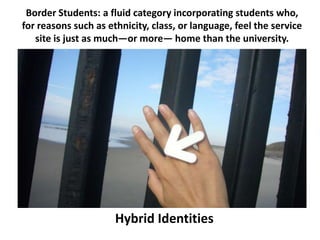
Border Students: a fluid category incorporating students who,
for reasons such as ethnicity, class, or language, feel the service
   site is just as much—or more— home than the university.


                      Hybrid Identities
Belonging at the Service Site


• Sites are Comfortable: “home away from home” (Lee, 2005,
  p. 6); “more comfortable at their service sites than on
  campus” (Green, 2001, p. 25).
• Identification with Clients: “I was once one of them”
  (Delgado Bernal, Aleman, & Garavito, 2001, p. 575); “I have
  something in common … with them because *we’re+
  minorities, most of [us] are from low-income families, and
  most of them *would be+ first generation in college” (Lee,
  2005, p. 6).
• Stronger Service (McCollum, 2003; Green, 2001): “There is
  a sense of validity in what I have to say. I am not pretending
  to understand, I do understand” (Shadduck-Hernandez,
  2006, p. 30).
Not Belonging at Service Site


• Intersectionality: “I knew my advice only ran so deep because of
  the differences between our lives” (Lee, 2005, p. 6)

• Internalized Racism: “a black woman . . .opened the door . . . I
  knew she was wondering who I was. If her mind could tell this story,
  she was probably thinking, ‘Who is this young black girl . . .That’s all
  it takes, that split second for one member of the black race to doubt
  the other. I knew this is what she was thinking by her facial
  expression and how it changed when Elsa’s white face came into
  view of the doorway, and all of a sudden this 40-year-old woman
  seemed welcoming.” (Green, 2001, p. 23)
University Affiliation: “One of the classes said, oh, did
your parents buy you a BMW for Christmas and are you
from New Jersey? I was like, no what, no. . . . I wanted to
be, I am just like you I am not your typical Bucknell student
. . . . It kind of made me feel like. . . I don't fit in
anywhere. Like you see Bucknell students as this, and I am
not that.” (Henry, 2005, p. 57)
Not Belonging at the University


• Culture Shock: (Yeh, 2010)
• Service as “White”: (Gilbride-Brown, 2011; Coles, 1999)
• Curriculum to help privileged students understand
  privilege: “This isn’t written for me” (Wendler, 2010).
• Exhaustion at Educating Dominant Students: “I do more
  service in this class than I ever do at my site” (Mitchell &
  Donahue, 2009); “Sometimes I get real tired of
  hearing White people talk about the conditions of Black
  people” (Tatum, 1992, p. 7); (Chesler et al., 2011).
• Anger: Personal experiences placed in larger context of
  inequality (Tatum, 1992).
Belonging at the University
ce-Learning Class as “Safe Space”: (Delgado-Bernal, Aleman, &
vito, 2001; Gilbride-Brown, 2011; Shadduck-Hernandez, 2006).
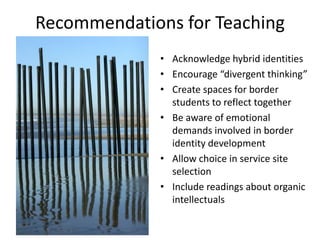
Recommendations for Teaching
              • Acknowledge hybrid identities
              • Encourage “divergent thinking”
              • Create spaces for border
                students to reflect together
              • Be aware of emotional
                demands involved in border
                identity development
              • Allow choice in service site
                selection
              • Include readings about organic
                intellectuals
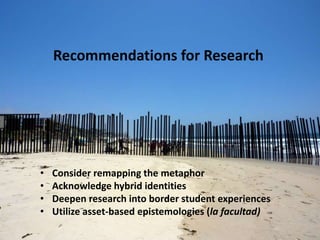
Recommendations for Research


•   Consider remapping the metaphor
•   Acknowledge hybrid identities
•   Deepen research into border student experiences
•   Utilize asset-based epistemologies (la facultad)
Creative Commons Image Credits: Jcarter, ZareK, Nathan Gibbs, Tricia Wang

IARSLCE 2012: Borderlands Theory in Service-Learning Research

  • 1.
    Borderlands Theory inService-Learning Research: Remapping the Metaphor Rachael Wendler, University of Arizona rwendler@u.arizona.edu IARSLCE 2012
  • 2.
  • 3.
    Taylor, J. (2002).Metaphors we serve by: Investigating the conceptual metaphors framing national and community service and service-learning. • Conceptual metaphors “structure what we perceive, how we get around in the world, and how we relate to other people” (Lakoff & Johnson, 1980). • Service is Citizenship; Service is War; Service is Business • Taylor’s suggestion: Service is Borderlands
  • 4.
    Service-Learning as Borderlands? Butin, 2005; Chesler, Ford, Galura, & Chareneau, 2011; Delgado Bernal, Aleman & Garavito, 2001; Hayes & Cuban, 1997; Keith, 1998; Taylor, 2002; Williams & Van Cleave, 2011.
  • 5.
    Mapping Metaphors SERVICE-LEARNING IS WAR Source: War Target: Service- Learning Soldiers  Students General  Teacher Community Members as Enemy? Fellow Soldiers? Innocent Civilians? Captains?
  • 6.
    Mapping Metaphors SERVICE-LEARNING IS BORDER CROSSING Source: Borderlands Target: Service-Learning Theory Border Crossers  All Students?
  • 7.
    • Psychological, Spiritual, Sexual Borderlands • Chicana identity and oppression • Challenges of mediating between home and dominant cultures • Resisting binaries • Genre-blurring
  • 8.
    “The prohibited andforbidden are its [the Borderlands’] inhabitants. Los atravesados live here: the squint-eyed, the perverse, the queer, the troublesome, the mongrel, the mulatto, the half-breed, the half dead; in short, those who cross over, pass over, or go through the confines of the ‘normal’” (pp. 25-26).
  • 9.
    Giroux and McLaren’sBorder Pedagogy “First, the category of border signals a recognition of those epistemological, political, cultural, and social margins that structure the language of history, power, and difference . . . Second, it also speaks to the need to create pedagogical conditions in which students become border crossers in order to understand otherness in its own terms . . . Third, border pedagogy makes visible the historically and socially constructed strengths and limitations of those places and borders we inherit and that frame our discourses and social relations.” (Giroux,1992, p. 28)
  • 10.
    C. Alejandra Elenas:Stretching the Borderlands frame to apply to all students “raises the problematic of appropriation and erasure of difference” (1997, para. 30).
  • 11.
    Erasure of Difference? •“…university tutors left campus and entered places in the community and community agencies that they ordinarily would never go” (Hayes & Cuban, 1997, p. 75) • “Crossing these physical borders…exposed tutors to the effects of poverty and racism on individual lives” (Hayes & Cuban, 1997, p. 75) • “Challenging students’ prior homogenous experiences, the agencies and sites in which community service learning students work and learn typically serve populations marked by racial and economic disadvantage” (Chesler et al., 2011, p. 342)
  • 12.
    Border Students: afluid category incorporating students who, for reasons such as ethnicity, class, or language, feel the service site is just as much—or more— home than the university. Hybrid Identities
  • 13.
    Belonging at theService Site • Sites are Comfortable: “home away from home” (Lee, 2005, p. 6); “more comfortable at their service sites than on campus” (Green, 2001, p. 25). • Identification with Clients: “I was once one of them” (Delgado Bernal, Aleman, & Garavito, 2001, p. 575); “I have something in common … with them because *we’re+ minorities, most of [us] are from low-income families, and most of them *would be+ first generation in college” (Lee, 2005, p. 6). • Stronger Service (McCollum, 2003; Green, 2001): “There is a sense of validity in what I have to say. I am not pretending to understand, I do understand” (Shadduck-Hernandez, 2006, p. 30).
  • 14.
    Not Belonging atService Site • Intersectionality: “I knew my advice only ran so deep because of the differences between our lives” (Lee, 2005, p. 6) • Internalized Racism: “a black woman . . .opened the door . . . I knew she was wondering who I was. If her mind could tell this story, she was probably thinking, ‘Who is this young black girl . . .That’s all it takes, that split second for one member of the black race to doubt the other. I knew this is what she was thinking by her facial expression and how it changed when Elsa’s white face came into view of the doorway, and all of a sudden this 40-year-old woman seemed welcoming.” (Green, 2001, p. 23)
  • 15.
    University Affiliation: “Oneof the classes said, oh, did your parents buy you a BMW for Christmas and are you from New Jersey? I was like, no what, no. . . . I wanted to be, I am just like you I am not your typical Bucknell student . . . . It kind of made me feel like. . . I don't fit in anywhere. Like you see Bucknell students as this, and I am not that.” (Henry, 2005, p. 57)
  • 16.
    Not Belonging atthe University • Culture Shock: (Yeh, 2010) • Service as “White”: (Gilbride-Brown, 2011; Coles, 1999) • Curriculum to help privileged students understand privilege: “This isn’t written for me” (Wendler, 2010). • Exhaustion at Educating Dominant Students: “I do more service in this class than I ever do at my site” (Mitchell & Donahue, 2009); “Sometimes I get real tired of hearing White people talk about the conditions of Black people” (Tatum, 1992, p. 7); (Chesler et al., 2011). • Anger: Personal experiences placed in larger context of inequality (Tatum, 1992).
  • 17.
    Belonging at theUniversity ce-Learning Class as “Safe Space”: (Delgado-Bernal, Aleman, & vito, 2001; Gilbride-Brown, 2011; Shadduck-Hernandez, 2006).
  • 18.
    Recommendations for Teaching • Acknowledge hybrid identities • Encourage “divergent thinking” • Create spaces for border students to reflect together • Be aware of emotional demands involved in border identity development • Allow choice in service site selection • Include readings about organic intellectuals
  • 19.
    Recommendations for Research • Consider remapping the metaphor • Acknowledge hybrid identities • Deepen research into border student experiences • Utilize asset-based epistemologies (la facultad)
  • 20.
    Creative Commons ImageCredits: Jcarter, ZareK, Nathan Gibbs, Tricia Wang

Editor's Notes

  • #2 The sea cannot be fenced, visual backdrop for this presentation
  • #11 In other words, as the Borderlands metaphor is universalized to discuss the complex identities of all people, it becomes difficult to recognize the particular struggles that come with internal conflicts between subaltern and dominant cultures.
  • #14 Interestingly, identification with the community can occur even when students do not share key characteristics like race with the clients; having a border dweller identity may allow students to understand aspects of oppression even if the type of otherization is different. For example, Henry narrates the experience of a white, low-income student who made connections between class-based discrimination she had experienced at the university and the obstacles her ESL service-learning partners faced; these affinities fostered empathy even though the social borders she and her service-learning partners struggled against were not the same (Henry 58). However, Anzaldua’s frame of the Borderlandspushes a more complex analysis: border dwellers also face dissonance within “home” communities; belonging in two (or more) places, they belong nowhere fully.
  • #15 Lee– Middle Class Latino