What’s Their Stake?: Non-Profit Clients
for Professional Writing Classes

Rachael Wendler, March 3rd, 2014
The Study
Sarah Gonzales
Taylor Johnson
Ethan Cox
Deanna Hasman
Denise Spartanos
Christine Hill
Roxana Matiella
Brad Jacobson
Renee Kirkpatrick
Shareholder
vs
Stakeholder
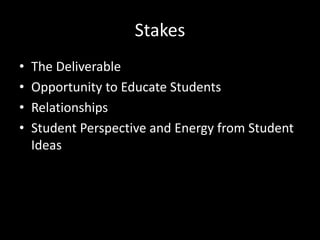
Stakes
•
•
•
•

The Deliverable
Opportunity to Educate Students
Relationships
Student Perspective and Energy from Student
Ideas
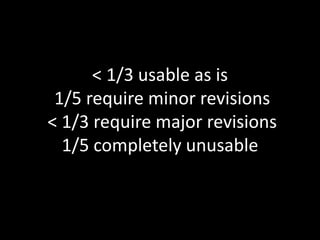
< 1/3 usable as is
1/5 require minor revisions
< 1/3 require major revisions
1/5 completely unusable
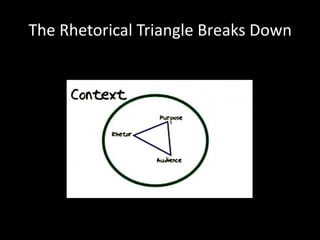
The Rhetorical Triangle Breaks Down
Distributed Cognition
Students’ Writing
Should Be in the System
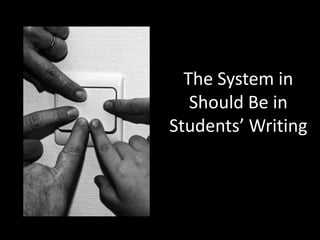
The System in
Should Be in
Students’ Writing
Student Research
“Know us before you even come
back to us. Take that initial
interview and use that as the fuel
for further investigation”
-Christine Hill
Interviews
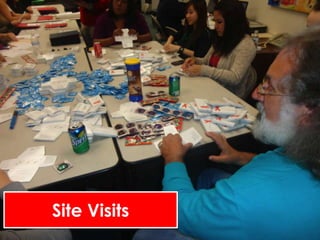
Site Visits
Consultant Stance
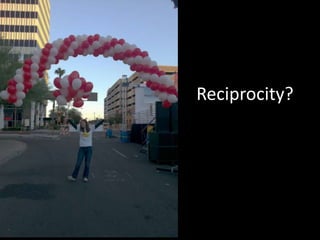
Reciprocity?

Community Perspectives on Professional Writing

Editor's Notes

  • #3 KarstenPlanzhttp://www.flickr.com/photos/kplanz/6855919503/sizes/m/in/photostream/The nine clients who participated in this study collectively have experience partnering with five different instructors and forty-three student deliverable groups. ----- Meeting Notes (2/20/14 15:11) -----43 groups
  • #5 Milton FriedmanDodge Brothers v. Ford Motor Company case in 1919. HyperpragmatismEdward FreemanAsk them to guess stakes
  • #8 ----- Meeting Notes (2/20/14 15:11) -----&quot;They&apos;re not the speaker. That&apos;s the hardest part.”Jim HenryIn Sarah’s words, students have to constantly ask, “Am I thinking from my own knowledge on this, or am I thinking from the client’s perspective?” (interview transcript).
  • #9 Raging wireCognitive anthropologist Edwin Hutchins
  • #10 Kalense KidTaylor in-kind letterIn contrast, Roxana Matiela brochureTaylor technologyRenee Technology
  • #12  Sarah Gonzalez suggested researching not only the particular organization and client contact, but also the field as a whole—in her case, the field of social justice education.
  • #13 GVAHIMhttp://www.flickr.com/photos/gvahim/6430960461/sizes/z/in/photostream/, “as I’m talking, their mind is going, Taylor Johnson “intuitive digging” through follow-up questions (interview transcript). Roxana Matiela suggested that instructors guide students in asking different kinds of questions to different members of the client organization, in order to gather various knowledges. For example, students can ask vision questions to leaders in an organization, such as the presiding judge who came with Roxana to the first set of interviews with students. Christine Hill stressed the importance of helping students understand forces that impact non-profits, and she suggested that students ask about the funders of a non-profit in order to better understand the rhetorical situation they are entering.Other questions from Sarah that help students step into the perspective of the client and understand the context include, “What are two short-term goals that you have for your [organization], and what’s a long-term goal that you have?” and “Who are three other people in your field that you admire? And who is one person that you don’t admire?” (interview transcript). Interviewing Practices for Technical Writers Sarah advised that students ask, “What are three good websites we should look at that show work similar to yours?” (interview questions). These artifacts allow students to access the field-specific knowledge stored in genres, images, and past documents, in addition to giving students insight
  • #14 “needed to see” Wildcat Writers in action she “could see the light bulb above their head go off when they were talking with my kids” (“If this [organization] were yours and you needed an adoption application, what would be important? Look at these animals. Look at these animals. They all deserve the best. What questions do you want to ask? You love these animals.” “If an individual can come to the facility, meet the animals, go in, play with the dogs, play with the cats, groom a horse, get to know [them], and really feel what I feel, even a sliver of what I feel, maybe those questions [for the adoption application] will come better than just sitting there going, okay, I&apos;ve never owned a dog, I&apos;ve never owned a cat. What do I care?” (interview transcript)“People come into the building, and it&apos;s a really big building, and they say, ‘Oh my gosh I had no idea it was this big,’ and that&apos;s when the questions start happening, like, ‘Why is it this big’? Ethan also explained that the site visit served as an opportunity for him to integrate students into the larger staff network of his organization“was going to work in the bigger scheme of things” (…it’s really hard as an outsider to anything to come in and be the ultimate ethnographer, to know enough that you can insert yourself seamlessly into a context and be able to ask the right sorts of questions to get more information. There&apos;s a lot of research and immersion in a community that goes into that before you can really do that super successfully. Given the gap between our schools just geographically and also the nature of, it&apos;s only a semester-long project and they have a limited time frame, I have a sense that it&apos;s not really their fault that they wouldn&apos;t be able to know more. There&apos;s a sense of needing to give them a quick crash course. And [there’s] the limited context they have--the limited shared context with the kind of community we work for, and there&apos;s just so many communities that are intersecting there. There&apos;s the community of Wildcat Writers as a program, and all the layers of complexity there, and there&apos;s also the community of students we work with that makes it hard, so there&apos;s just a lot of layers that make it hard for them to do their research. (Interview transcript)Roxana Matiela, for example, shared a story of several students who arrived at their site visit to the court in inappropriate clothing,Renee. Research like a job interview
  • #15 Both Sarah and Ethan observed that this posture permeated emails, which were professional, but they had phrases such as “I’m so sorry if I’m disturbing you” (Gonzalez interview transcript) and “Only if you can, if you can make time” (Cox interview transcript). The assertiveness clients were looking for extended to the deliverable itself. Sarah was disappointed with how the students she worked with “cut and pasted” content Sarah had sent rather than taking an active role in rearranging or improving it.In Ethan’s words, “Assertiveness, while too much of it is really off-putting, it&apos;s like salting something. What&apos;s that perfect amount salt? What&apos;s that perfect amount of assertiveness to show you&apos;re not really trying to dominate but that you have the confidence to put yourself out there?” (interview transcript). As Ethan Cox observed, identity factors such as age and gender can play a role in levels of student assertiveness. engagement“there for the grade” valued clear student communication, especially around potential problems. NOT micromanageIn other words, while clients do not expect perfection, they do expect communicationInstructors can help:For example, Roxana Matiela mentioned that at the beginning of her partnership, multiple students frequently emailed her with the same questionSeveral clients expressed appreciating when instructors wrote them directly at key moments in the partnership in order to facilitate communication with students. For example, Sarah Gonzalez explained how her instructor partner not only provided a timeline at the beginning of the course, but also emailed right before important points where students would be contacting her, such as before the proposal was delivered, telling her that she should expect to hear from students and offering guidelines and sample paragraphs for responding to studentsWriting instructors and non-profit staff may not anticipate the extent to which working with service-learning students requires teaching the intangibles of assertiveness, engagement, and communication. Grading rubrics in technical and professional writing classes are often largely focused on deliverables themselves, as instructors push students toward mastery of design skills and clarity of prose.