Share this
Intelligence Applied
Making me.gov happen
© TNS 1
Political & Social
Inspiring the world’s policymakers
Share this Intelligence Applied
2
Making me.gov happen
Digital technology has the power
to transform relationships between
governments and their citizens. But only
if it has the right insight to guide it.
Share this Intelligence Applied
3
Making me.gov happen
Desiree Lopez
CEO of TNS BMRB
Digital government has come a long way in recent
years. Countries are making the move from simply
providing information online to using digital as a
primary engagement channel. In many cases, digital
government is already providing a wider range of
services online. However, the next big leap forward
will involve the experience created around those
services. And several governments are already leading
the way here.
The UAE has built on its success in developing a single
point of digital contact across 39 federal departments
to develop m-government applications, allowing
citizens to engage with government through their
mobiles. In Singapore, the government is exploring
how digital can deliver a personalised experience of
government services.
When people can pay their taxes, apply for licenses
and register for benefits through digital platforms,
it doesn’t just save them time. It can also impact their
perception of government, and their relationship
with it. They can feel more in control – and
more empowered. Both government and citizen
expectations of the digital government experience are
evolving. As consumers, people expect their digital
experiences to be personalised and intuitive; and this
influences the way they want to experience digital
government as well. Simply providing a functional
service may no longer be enough; government must
move towards demonstrating their understanding
of individuals’ needs – and building relevant digital
experiences around them.
When people can pay
their taxes, apply for
licenses and register
for benefits through
digital platforms, it
doesn’t just save them
time. It can also impact
their perception of
government, and their
relationship with it.
Share this Intelligence Applied
4
Making me.gov happen
This isn’t just a case of smoother online journeys.
Personalised experiences for citizens have the power
to transform their relationship to government
from a largely transactional one (based on a few
specific interactions each year) to an on-going one;
a relationship that lasts a lifetime and in which
government is seen as providing on-going support
and value. However, such an individualised experience
of government can only develop at the pace of
people’s appetite for it, and governments need deep
insight around the nuances of citizens’ relationships
with them, in order to guide it.
These are the challenges and opportunities for what
has been termed (in a recent report by WPP) the era
of ‘me.gov’. The future of digital government is an
exciting prospect. However, its potential can only
be fulfilled if the government understands the
ways citizens feel about their digital government
experience and how these expectations can be
shaped and changed.
Here are seven fundamental questions that
government will need answers for, as they seek to
navigate the transition to me.gov:
Share this Intelligence Applied
5
Making me.gov happen
What appetite and capabilities does the
government have to engage with its citizens?
Every government stands at a different stage of the
digital journey. Some are still spreading the word
that people can find useful information on their
departmental websites. Others have already built
portals that are personalised to meet individual
citizens’ own needs. As both governments and
citizens have different levels of openness to an
on-going, personalised relationship, establishing
the right form of me.gov for each national policy
and audience is essential for an effective digital
government strategy. Deep insight and behavioural
understanding are vital to get this right.
What information do individuals need from
government in order to live their lives?
Behavioural insight already plays a key role in
understanding why and how people use different
government services. The era of me.gov needs
answers to a slightly broader set of questions:
which information and services do people actually
need to live their lives better. Governments need
holistic thinking on digital that breaks down silos
between departments and services, and integrates
different aspects of government to suit each
individual’s needs. And moving from a “citizens” to
an “individual” perspective also requires a different
approach to understanding the audience.
Share this Intelligence Applied
6
Making me.gov happen
How capable and willing are citizens when it
comes to using digital tools?
Governments have tended to assess their
population’s readiness for digital government by
whether they have access to the internet, and how
they are using earlier forms of digital government.
In the era of me.gov, they will need to look beyond
the structural aspects of digital readiness and ask
about people’s appetite and aptitude for digital
services they haven’t yet experienced. What type of
activities are they comfortable carrying out online –
and for which do they need more traditional face-
to-face or over-the-phone contact during a period
of transition? Answering such questions can help
to reveal where the real efficiency opportunities
for digital government are, whilst also highlighting
where blended service offerings and offline
support are still seen as an important part of the
government’s duty of care.
What type of activities
are they comfortable
carrying out online – and
for which do they need
more traditional face-to-
face or over-the-phone
contact during a period
of transition?
Share this Intelligence Applied
7
Making me.gov happen
What are people’s perceptions of the different
government services they encounter – and what
types of relationship do they want with them?
One arm of government can generate very different
emotive and cognitive responses to another. The
police, the health service, and tax collection all
come with their own associations and expectations
where citizens are concerned. When delivering
digital government as a holistic experience, as
me.gov strives to do, it’s important to differentiate
between these different aspects of government
– and design the brand and service experiences
to fit. Governments must be prepared to explore
what tone and type of relationship a person may
want from each, using behavioural methods to help
unpick when, why and how people act.
Understanding the role of different departments can
also help to identify flagship areas of government
that can bring the benefits of digital government
to life. In the UK, for example, HM Revenue and
Customs (HMRC) handles more than a third of all
online transactions between citizens and central
government. Prioritising the development of a
service such as this, which touches the vast majority
of people in the country, can help to change
perceptions around digital government as a whole.
To what extent are people open to sharing data
in order to improve their experiences?
Ultimately, the degree to which the experience of
digital government can be personalised will also
depend upon each individual’s willingness to share
their personal data. This is as true of digital citizen
experiences as it is of digital consumer experiences.
Privacy concerns make this a sensitive area – and
governments need research to help them frame the
right terms for data exchange. The most appropriate
approach will depend upon each country’s history
and culture, general attitudes to privacy, but also
perceptions of what is appropriate for different
services, and the success of communications in
bringing the potential benefits of data sharing to
life. Governments can also plan campaigns and
public engagement programmes to take this
debate forward, re-shape expectations and help
to build consensus.
Share this Intelligence Applied
8
Making me.gov happen
What are the investment costs and the
likely returns?
Like the other phases in the digital government
evolution, me.gov will require investment. Before
deciding whether that investment is justified,
governments need a robust framework for
projecting the likely returns. More personalised
digital government promises greater efficiencies
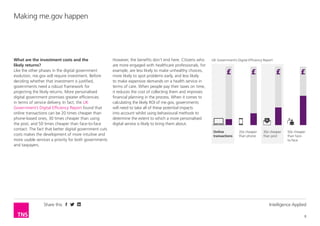
in terms of service delivery. In fact, the UK
Government’s Digital Efficiency Report found that
online transactions can be 20 times cheaper than
phone-based ones, 30 times cheaper than using
the post, and 50 times cheaper than face-to-face
contact. The fact that better digital government cuts
costs makes the development of more intuitive and
more usable services a priority for both governments
and taxpayers.
However, the benefits don’t end here. Citizens who
are more engaged with healthcare professionals, for
example, are less likely to make unhealthy choices,
more likely to spot problems early, and less likely
to make expensive demands on a health service in
terms of care. When people pay their taxes on time,
it reduces the cost of collecting them and improves
financial planning in the process. When it comes to
calculating the likely ROI of me.gov, governments
will need to take all of these potential impacts
into account whilst using behavioural methods to
determine the extent to which a more personalised
digital service is likely to bring them about.
UK Government’s Digital Efficiency Report
Online
transactions
20x cheaper
than phone
30x cheaper
than post
50x cheaper
than face-
to-face
Share this Intelligence Applied
9
Making me.gov happen
What happens if me.gov doesn’t?
The transition to me.gov, like all evolutionary stories,
comes with costs and opportunities. Decision-makers
must evaluate the risks of not innovating to allow
for deeper digital engagement with citizens.
When citizen engagement is a growing concern,
and when those citizens have raised expectations
of their digital experiences, what risks do
governments run by sticking to a transactional,
one-size-fits-all approach?
In the absence of greater engagement on the part
of government, will other providers of information
and advice emerge to fill the void? And could those
alternative voices ultimately serve to undermine
respect for, and trust in, the institutions of
government? The move from the functional to the
experiential raises the stakes when it comes to the
relationship between governments and their citizens,
but the refusal to do so will increasingly look like a
statement of its own.
Governments need deep insight to help illuminate
the risks and opportunities that me.gov involves.
Only through such insight can we identify the right
opportunities for more personalised services, the most
effective areas on which to focus investment, and the
shape of more meaningful citizen experiences.
In doing so, researchers can make a major
contribution to re-positioning the relationship
between citizens and government.
Share this Intelligence Applied
10
Making me.gov happen
About Intelligence Applied
Intelligence Applied is the home of the latest thinking from TNS, where we discuss the issues impacting
our clients, explore what makes people tick and spotlight how these insights can create opportunities for
business growth.
Please visit www.tnsglobal.com/intelligence-applied for more information.
About TNS
TNS advises clients on specific growth strategies around new market entry, innovation, brand switching and
customer strategies, based on long established expertise and market leading solutions. With a presence in
over 80 countries, TNS has more conversations with the world’s consumers than anyone else and understands
individual human behaviours and attitudes across every cultural, economic and political region of the world.
TNS is part of Kantar, the data investment management division of WPP and one of the world’s largest insight,
information and consultancy groups.
Please visit www.tnsglobal.com for more information.
Get in touch
If you would like to talk to us about anything you have read in this report, please get in touch via
enquiries@tnsglobal.com or via Twitter @tns_global
About the author
Desiree Lopez, CEO of TNS BMRB,
has 20 years’ of international
experience in social research.
She specialises in mixed methods
research to inform the development and
evaluation of programmes and policy for public
sector, private and third sector clients.
To find out more about how our Political & Social
experts can help guide the transformation of
digital government, contact Desiree at
desiree.lopez@tnsglobal.com.
You may be interested in...
What could politics learn from brands? >

Making me.gov happen

  • 1.
    Share this Intelligence Applied Makingme.gov happen © TNS 1 Political & Social Inspiring the world’s policymakers
  • 2.
    Share this IntelligenceApplied 2 Making me.gov happen Digital technology has the power to transform relationships between governments and their citizens. But only if it has the right insight to guide it.
  • 3.
    Share this IntelligenceApplied 3 Making me.gov happen Desiree Lopez CEO of TNS BMRB Digital government has come a long way in recent years. Countries are making the move from simply providing information online to using digital as a primary engagement channel. In many cases, digital government is already providing a wider range of services online. However, the next big leap forward will involve the experience created around those services. And several governments are already leading the way here. The UAE has built on its success in developing a single point of digital contact across 39 federal departments to develop m-government applications, allowing citizens to engage with government through their mobiles. In Singapore, the government is exploring how digital can deliver a personalised experience of government services. When people can pay their taxes, apply for licenses and register for benefits through digital platforms, it doesn’t just save them time. It can also impact their perception of government, and their relationship with it. They can feel more in control – and more empowered. Both government and citizen expectations of the digital government experience are evolving. As consumers, people expect their digital experiences to be personalised and intuitive; and this influences the way they want to experience digital government as well. Simply providing a functional service may no longer be enough; government must move towards demonstrating their understanding of individuals’ needs – and building relevant digital experiences around them. When people can pay their taxes, apply for licenses and register for benefits through digital platforms, it doesn’t just save them time. It can also impact their perception of government, and their relationship with it.
  • 4.
    Share this IntelligenceApplied 4 Making me.gov happen This isn’t just a case of smoother online journeys. Personalised experiences for citizens have the power to transform their relationship to government from a largely transactional one (based on a few specific interactions each year) to an on-going one; a relationship that lasts a lifetime and in which government is seen as providing on-going support and value. However, such an individualised experience of government can only develop at the pace of people’s appetite for it, and governments need deep insight around the nuances of citizens’ relationships with them, in order to guide it. These are the challenges and opportunities for what has been termed (in a recent report by WPP) the era of ‘me.gov’. The future of digital government is an exciting prospect. However, its potential can only be fulfilled if the government understands the ways citizens feel about their digital government experience and how these expectations can be shaped and changed. Here are seven fundamental questions that government will need answers for, as they seek to navigate the transition to me.gov:
  • 5.
    Share this IntelligenceApplied 5 Making me.gov happen What appetite and capabilities does the government have to engage with its citizens? Every government stands at a different stage of the digital journey. Some are still spreading the word that people can find useful information on their departmental websites. Others have already built portals that are personalised to meet individual citizens’ own needs. As both governments and citizens have different levels of openness to an on-going, personalised relationship, establishing the right form of me.gov for each national policy and audience is essential for an effective digital government strategy. Deep insight and behavioural understanding are vital to get this right. What information do individuals need from government in order to live their lives? Behavioural insight already plays a key role in understanding why and how people use different government services. The era of me.gov needs answers to a slightly broader set of questions: which information and services do people actually need to live their lives better. Governments need holistic thinking on digital that breaks down silos between departments and services, and integrates different aspects of government to suit each individual’s needs. And moving from a “citizens” to an “individual” perspective also requires a different approach to understanding the audience.
  • 6.
    Share this IntelligenceApplied 6 Making me.gov happen How capable and willing are citizens when it comes to using digital tools? Governments have tended to assess their population’s readiness for digital government by whether they have access to the internet, and how they are using earlier forms of digital government. In the era of me.gov, they will need to look beyond the structural aspects of digital readiness and ask about people’s appetite and aptitude for digital services they haven’t yet experienced. What type of activities are they comfortable carrying out online – and for which do they need more traditional face- to-face or over-the-phone contact during a period of transition? Answering such questions can help to reveal where the real efficiency opportunities for digital government are, whilst also highlighting where blended service offerings and offline support are still seen as an important part of the government’s duty of care. What type of activities are they comfortable carrying out online – and for which do they need more traditional face-to- face or over-the-phone contact during a period of transition?
  • 7.
    Share this IntelligenceApplied 7 Making me.gov happen What are people’s perceptions of the different government services they encounter – and what types of relationship do they want with them? One arm of government can generate very different emotive and cognitive responses to another. The police, the health service, and tax collection all come with their own associations and expectations where citizens are concerned. When delivering digital government as a holistic experience, as me.gov strives to do, it’s important to differentiate between these different aspects of government – and design the brand and service experiences to fit. Governments must be prepared to explore what tone and type of relationship a person may want from each, using behavioural methods to help unpick when, why and how people act. Understanding the role of different departments can also help to identify flagship areas of government that can bring the benefits of digital government to life. In the UK, for example, HM Revenue and Customs (HMRC) handles more than a third of all online transactions between citizens and central government. Prioritising the development of a service such as this, which touches the vast majority of people in the country, can help to change perceptions around digital government as a whole. To what extent are people open to sharing data in order to improve their experiences? Ultimately, the degree to which the experience of digital government can be personalised will also depend upon each individual’s willingness to share their personal data. This is as true of digital citizen experiences as it is of digital consumer experiences. Privacy concerns make this a sensitive area – and governments need research to help them frame the right terms for data exchange. The most appropriate approach will depend upon each country’s history and culture, general attitudes to privacy, but also perceptions of what is appropriate for different services, and the success of communications in bringing the potential benefits of data sharing to life. Governments can also plan campaigns and public engagement programmes to take this debate forward, re-shape expectations and help to build consensus.
  • 8.
    Share this IntelligenceApplied 8 Making me.gov happen What are the investment costs and the likely returns? Like the other phases in the digital government evolution, me.gov will require investment. Before deciding whether that investment is justified, governments need a robust framework for projecting the likely returns. More personalised digital government promises greater efficiencies in terms of service delivery. In fact, the UK Government’s Digital Efficiency Report found that online transactions can be 20 times cheaper than phone-based ones, 30 times cheaper than using the post, and 50 times cheaper than face-to-face contact. The fact that better digital government cuts costs makes the development of more intuitive and more usable services a priority for both governments and taxpayers. However, the benefits don’t end here. Citizens who are more engaged with healthcare professionals, for example, are less likely to make unhealthy choices, more likely to spot problems early, and less likely to make expensive demands on a health service in terms of care. When people pay their taxes on time, it reduces the cost of collecting them and improves financial planning in the process. When it comes to calculating the likely ROI of me.gov, governments will need to take all of these potential impacts into account whilst using behavioural methods to determine the extent to which a more personalised digital service is likely to bring them about. UK Government’s Digital Efficiency Report Online transactions 20x cheaper than phone 30x cheaper than post 50x cheaper than face- to-face
  • 9.
    Share this IntelligenceApplied 9 Making me.gov happen What happens if me.gov doesn’t? The transition to me.gov, like all evolutionary stories, comes with costs and opportunities. Decision-makers must evaluate the risks of not innovating to allow for deeper digital engagement with citizens. When citizen engagement is a growing concern, and when those citizens have raised expectations of their digital experiences, what risks do governments run by sticking to a transactional, one-size-fits-all approach? In the absence of greater engagement on the part of government, will other providers of information and advice emerge to fill the void? And could those alternative voices ultimately serve to undermine respect for, and trust in, the institutions of government? The move from the functional to the experiential raises the stakes when it comes to the relationship between governments and their citizens, but the refusal to do so will increasingly look like a statement of its own. Governments need deep insight to help illuminate the risks and opportunities that me.gov involves. Only through such insight can we identify the right opportunities for more personalised services, the most effective areas on which to focus investment, and the shape of more meaningful citizen experiences. In doing so, researchers can make a major contribution to re-positioning the relationship between citizens and government.
  • 10.
    Share this IntelligenceApplied 10 Making me.gov happen About Intelligence Applied Intelligence Applied is the home of the latest thinking from TNS, where we discuss the issues impacting our clients, explore what makes people tick and spotlight how these insights can create opportunities for business growth. Please visit www.tnsglobal.com/intelligence-applied for more information. About TNS TNS advises clients on specific growth strategies around new market entry, innovation, brand switching and customer strategies, based on long established expertise and market leading solutions. With a presence in over 80 countries, TNS has more conversations with the world’s consumers than anyone else and understands individual human behaviours and attitudes across every cultural, economic and political region of the world. TNS is part of Kantar, the data investment management division of WPP and one of the world’s largest insight, information and consultancy groups. Please visit www.tnsglobal.com for more information. Get in touch If you would like to talk to us about anything you have read in this report, please get in touch via enquiries@tnsglobal.com or via Twitter @tns_global About the author Desiree Lopez, CEO of TNS BMRB, has 20 years’ of international experience in social research. She specialises in mixed methods research to inform the development and evaluation of programmes and policy for public sector, private and third sector clients. To find out more about how our Political & Social experts can help guide the transformation of digital government, contact Desiree at desiree.lopez@tnsglobal.com. You may be interested in... What could politics learn from brands? >