I will save water!!!
There is belief, that, Human is the beautiful creation of GOD. As they keep on evolving, they become
more sharp & intelligent. They learnt different ways for living, from hunting to farming to inventing. As
their desire keep on increasing, they keep on discovering various resources for their usage.
There are five basic elements for human existence called panch bhoot. These are:
1. Mother Earth (Prathavi): She has all minerals viz. metals, fossil fuels, nutritious land etc.
2. Water (Jal): We have rivers, sea, underground water etc. as source of water.
3. Air (Vayu): We have atmosphere around us with components in such ratio so as to support life.
4. Sun (Surya): This resembles energy. All living and many non-living process require solar energy
for their existence. This regulates earth’s temperature.
5. Sky (Akaash): Akaash resembles the divine power or our consciousness to deal with ecosystem
all around.
All five elements are equally important. A right balance in all of these will give us a healthy ecosystem to
live.
As human society evolved & developed, they started using natural resources to grow faster & at pace
more, Mother Earth can replenish.
This has resulted in imbalance of our ecosystem, which can be wetted from various statistical data of
last century. We are facing critical issues like depletion of ozone layer, Global warming, water
scarcity/pollution, floods, Air pollution, depletion of natural resources viz. minerals, fossil fuels etc.
These issues are being discussed at highest level in the world. Nations are coming together to sort out
the way to tackle with changes, without hampering the growth. Various measures like Kyoto protocol
are being developed, supported & followed by every nation very seriously.
Water is also one of the basic necessities of existence of life. Water covers 70% of our planet, and it is
easy to think that it will always be plentiful. However, freshwater—that we drink, bathe in, irrigate our
farm fields is incredibly rare. Only 3% of the world’s water is fresh water, and two-thirds of that is
tucked away in frozen glaciers or otherwise unavailable for our use.
As a result, some 1.1 billion people worldwide lack access to water. Inadequate sanitation is also a
problem for 2.4 billion people—they are exposed to diseases, such as cholera and typhoid fever, and
other water-borne illnesses. Two million people, mostly children, die each year from diarrheal diseases
alone.
Many of the water systems that keep ecosystems thriving and feed a growing human population have
become stressed. Rivers, lakes and aquifers are drying up or becoming too polluted to use. Agriculture
consumes more water than any other source and wastes much of that through inefficiencies.
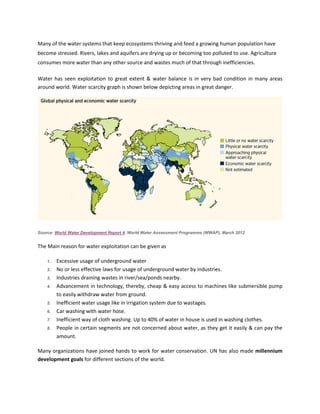
Water has seen exploitation to great extent & water balance is in very bad condition in many areas
around world. Water scarcity graph is shown below depicting areas in great danger.
Source: World Water Development Report 4. World Water Assessment Programme (WWAP), March 2012
The Main reason for water exploitation can be given as
1. Excessive usage of underground water
2. No or less effective laws for usage of underground water by industries.
3. Industries draining wastes in river/sea/ponds nearby.
4. Advancement in technology, thereby, cheap & easy access to machines like submersible pump
to easily withdraw water from ground.
5. Inefficient water usage like in irrigation system due to wastages.
6. Car washing with water hose.
7. Inefficient way of cloth washing. Up to 40% of water in house is used in washing clothes.
8. People in certain segments are not concerned about water, as they get it easily & can pay the
amount.
Many organizations have joined hands to work for water conservation. UN has also made millennium
development goals for different sections of the world.
I would not focus on what are the different programs/schemes for water conservation, rather I will
share how each individual can help & develop a culture where everyone understand the importance of
water & act decisively .
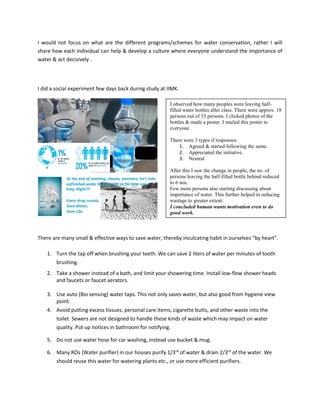
I did a social experiment few days back during study at IIMK.
There are many small & effective ways to save water, thereby inculcating habit in ourselves “by heart”.
1. Turn the tap off when brushing your teeth. We can save 2 liters of water per minutes of tooth
brushing.
2. Take a shower instead of a bath, and limit your showering time. Install low-flow shower heads
and faucets or faucet aerators.
3. Use auto (Bio sensing) water taps. This not only saves water, but also good from hygiene view
point.
4. Avoid putting excess tissues, personal care items, cigarette butts, and other waste into the
toilet. Sewers are not designed to handle these kinds of waste which may impact on water
quality. Put up notices in bathroom for notifying.
5. Do not use water hose for car washing, instead use bucket & mug.
6. Many ROs (Water purifier) in our houses purify 1/3rd
of water & drain 2/3rd
of the water. We
should reuse this water for watering plants etc., or use more efficient purifiers.
I observed how many peoples were leaving half-
filled water bottles after class. There were approx. 18
persons out of 33 persons. I clicked photos of the
bottles & made a poster. I mailed this poster to
everyone.
There were 3 types if responses:
1. Agreed & started following the same.
2. Appreciated the initiative.
3. Neutral
After this I saw the change in people, the no. of
persons leaving the half-filled bottle behind reduced
to 6 nos.
Few more persons also starting discussing about
importance of water. This further helped in reducing
wastage to greater extent.
I concluded human wants motivation even to do
good work.
7. We should accumulate cloths and use washing machine at full capacities. Also, front loaders
uses less water than top loaders, up to 70% less in some cases or 36,000 liters per year for a
typical household. They also use less detergent and less energy if you wash with warm or hot
water.
8. Put Posters around work place & motivate everyone to report water leakage issues.
9. In case of classrooms, student can take their water bottles with them, rather than provision of
new water bottles in classroom. Common water cooler could be provided for the same.
10. Harvest rainwater, recycle, reuse wherever possible.
11. There are very good things going in small regions in many places. Let’s gather & share best
things around, with everyone.
Everyone knows, charity starts at home. Similarly responsibility too starts at home. Responsibility, to
save our Mother earth.
All these things may be very small, but solve very important purpose of inculcating the feeling of
importance & conservation of water, other natural resource. A child brought up with inherited
sacrament for respect to Mother Earth and natural resources, will always care for nature & put best
effort to save them. He may be in big industries, government services, or any other segment in future,
but his respect for nature will influence people around him to act decisively.
I have small story to share. This is a story of a couple, Mike Mobbs, a Sydney environmental lawyer, and
his lawyer wife Heather Armstrong who wanted to renovate their house. Rather than beautification,
they give importance to natural sustainability. They put 30% of renovation budget of $ 165000, only in
sustainable systems. They studied & framed the action plan, and what they did is really fascinating. This
is an example of how a little creativity and perseverance can change a house from a waste-belching brick
box into a self-contained, sustainable home, without huge sacrifices in lifestyle, routine or comfort. The
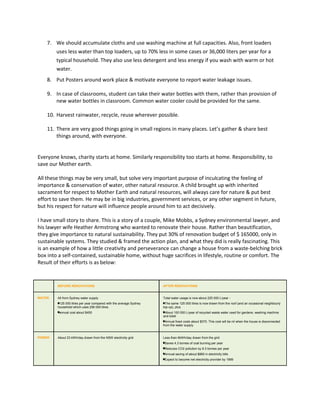
Result of their efforts is as below:
BEFORE RENOVATIONS AFTER RENOVATIONS
WATER All from Sydney water supply
125 000 litres per year compared with the average Sydney
household which uses 256 000 litres
annual cost about $450
Total water usage is now about 225 000 L/year -
The same 125 000 litres is now drawn from the roof (and an occasional neighbourly
top-up), plus
About 100 000 L/year of recycled waste water used for gardens, washing machine
and toilet
Annual fixed costs about $370. This cost will be nil when the house is disconnected
from the water supply.
POWER About 23 kWh/day drawn from the NSW electricity grid Less than 6kWh/day drawn from the grid
Saves 4.3 tonnes of coal burning per year
Reduces CO2 pollution by 8.3 tonnes per year
Annual saving of about $860 in electricity bills
Expect to become net electricity provider by 1999
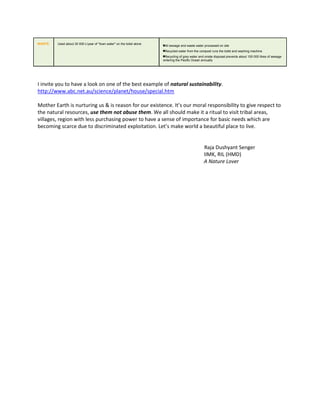
WASTE Used about 30 000 L/year of "town water" on the toilet alone
All sewage and waste water processed on site
Recycled water from the compost runs the toilet and washing machine
Recycling of grey water and onsite disposal prevents about 100 000 litres of sewage
entering the Pacific Ocean annually
I invite you to have a look on one of the best example of natural sustainability.
http://www.abc.net.au/science/planet/house/special.htm
Mother Earth is nurturing us & is reason for our existence. It’s our moral responsibility to give respect to
the natural resources, use them not abuse them. We all should make it a ritual to visit tribal areas,
villages, region with less purchasing power to have a sense of importance for basic needs which are
becoming scarce due to discriminated exploitation. Let’s make world a beautiful place to live.
Raja Dushyant Senger
IIMK, RIL (HMD)
A Nature Lover

I will save water!!!

  • 1.
    I will savewater!!! There is belief, that, Human is the beautiful creation of GOD. As they keep on evolving, they become more sharp & intelligent. They learnt different ways for living, from hunting to farming to inventing. As their desire keep on increasing, they keep on discovering various resources for their usage. There are five basic elements for human existence called panch bhoot. These are: 1. Mother Earth (Prathavi): She has all minerals viz. metals, fossil fuels, nutritious land etc. 2. Water (Jal): We have rivers, sea, underground water etc. as source of water. 3. Air (Vayu): We have atmosphere around us with components in such ratio so as to support life. 4. Sun (Surya): This resembles energy. All living and many non-living process require solar energy for their existence. This regulates earth’s temperature. 5. Sky (Akaash): Akaash resembles the divine power or our consciousness to deal with ecosystem all around. All five elements are equally important. A right balance in all of these will give us a healthy ecosystem to live. As human society evolved & developed, they started using natural resources to grow faster & at pace more, Mother Earth can replenish. This has resulted in imbalance of our ecosystem, which can be wetted from various statistical data of last century. We are facing critical issues like depletion of ozone layer, Global warming, water scarcity/pollution, floods, Air pollution, depletion of natural resources viz. minerals, fossil fuels etc. These issues are being discussed at highest level in the world. Nations are coming together to sort out the way to tackle with changes, without hampering the growth. Various measures like Kyoto protocol are being developed, supported & followed by every nation very seriously. Water is also one of the basic necessities of existence of life. Water covers 70% of our planet, and it is easy to think that it will always be plentiful. However, freshwater—that we drink, bathe in, irrigate our farm fields is incredibly rare. Only 3% of the world’s water is fresh water, and two-thirds of that is tucked away in frozen glaciers or otherwise unavailable for our use. As a result, some 1.1 billion people worldwide lack access to water. Inadequate sanitation is also a problem for 2.4 billion people—they are exposed to diseases, such as cholera and typhoid fever, and other water-borne illnesses. Two million people, mostly children, die each year from diarrheal diseases alone.
  • 2.
    Many of thewater systems that keep ecosystems thriving and feed a growing human population have become stressed. Rivers, lakes and aquifers are drying up or becoming too polluted to use. Agriculture consumes more water than any other source and wastes much of that through inefficiencies. Water has seen exploitation to great extent & water balance is in very bad condition in many areas around world. Water scarcity graph is shown below depicting areas in great danger. Source: World Water Development Report 4. World Water Assessment Programme (WWAP), March 2012 The Main reason for water exploitation can be given as 1. Excessive usage of underground water 2. No or less effective laws for usage of underground water by industries. 3. Industries draining wastes in river/sea/ponds nearby. 4. Advancement in technology, thereby, cheap & easy access to machines like submersible pump to easily withdraw water from ground. 5. Inefficient water usage like in irrigation system due to wastages. 6. Car washing with water hose. 7. Inefficient way of cloth washing. Up to 40% of water in house is used in washing clothes. 8. People in certain segments are not concerned about water, as they get it easily & can pay the amount. Many organizations have joined hands to work for water conservation. UN has also made millennium development goals for different sections of the world.
  • 3.
    I would notfocus on what are the different programs/schemes for water conservation, rather I will share how each individual can help & develop a culture where everyone understand the importance of water & act decisively . I did a social experiment few days back during study at IIMK. There are many small & effective ways to save water, thereby inculcating habit in ourselves “by heart”. 1. Turn the tap off when brushing your teeth. We can save 2 liters of water per minutes of tooth brushing. 2. Take a shower instead of a bath, and limit your showering time. Install low-flow shower heads and faucets or faucet aerators. 3. Use auto (Bio sensing) water taps. This not only saves water, but also good from hygiene view point. 4. Avoid putting excess tissues, personal care items, cigarette butts, and other waste into the toilet. Sewers are not designed to handle these kinds of waste which may impact on water quality. Put up notices in bathroom for notifying. 5. Do not use water hose for car washing, instead use bucket & mug. 6. Many ROs (Water purifier) in our houses purify 1/3rd of water & drain 2/3rd of the water. We should reuse this water for watering plants etc., or use more efficient purifiers. I observed how many peoples were leaving half- filled water bottles after class. There were approx. 18 persons out of 33 persons. I clicked photos of the bottles & made a poster. I mailed this poster to everyone. There were 3 types if responses: 1. Agreed & started following the same. 2. Appreciated the initiative. 3. Neutral After this I saw the change in people, the no. of persons leaving the half-filled bottle behind reduced to 6 nos. Few more persons also starting discussing about importance of water. This further helped in reducing wastage to greater extent. I concluded human wants motivation even to do good work.
  • 4.
    7. We shouldaccumulate cloths and use washing machine at full capacities. Also, front loaders uses less water than top loaders, up to 70% less in some cases or 36,000 liters per year for a typical household. They also use less detergent and less energy if you wash with warm or hot water. 8. Put Posters around work place & motivate everyone to report water leakage issues. 9. In case of classrooms, student can take their water bottles with them, rather than provision of new water bottles in classroom. Common water cooler could be provided for the same. 10. Harvest rainwater, recycle, reuse wherever possible. 11. There are very good things going in small regions in many places. Let’s gather & share best things around, with everyone. Everyone knows, charity starts at home. Similarly responsibility too starts at home. Responsibility, to save our Mother earth. All these things may be very small, but solve very important purpose of inculcating the feeling of importance & conservation of water, other natural resource. A child brought up with inherited sacrament for respect to Mother Earth and natural resources, will always care for nature & put best effort to save them. He may be in big industries, government services, or any other segment in future, but his respect for nature will influence people around him to act decisively. I have small story to share. This is a story of a couple, Mike Mobbs, a Sydney environmental lawyer, and his lawyer wife Heather Armstrong who wanted to renovate their house. Rather than beautification, they give importance to natural sustainability. They put 30% of renovation budget of $ 165000, only in sustainable systems. They studied & framed the action plan, and what they did is really fascinating. This is an example of how a little creativity and perseverance can change a house from a waste-belching brick box into a self-contained, sustainable home, without huge sacrifices in lifestyle, routine or comfort. The Result of their efforts is as below: BEFORE RENOVATIONS AFTER RENOVATIONS WATER All from Sydney water supply 125 000 litres per year compared with the average Sydney household which uses 256 000 litres annual cost about $450 Total water usage is now about 225 000 L/year - The same 125 000 litres is now drawn from the roof (and an occasional neighbourly top-up), plus About 100 000 L/year of recycled waste water used for gardens, washing machine and toilet Annual fixed costs about $370. This cost will be nil when the house is disconnected from the water supply. POWER About 23 kWh/day drawn from the NSW electricity grid Less than 6kWh/day drawn from the grid Saves 4.3 tonnes of coal burning per year Reduces CO2 pollution by 8.3 tonnes per year Annual saving of about $860 in electricity bills Expect to become net electricity provider by 1999
  • 5.
    WASTE Used about30 000 L/year of "town water" on the toilet alone All sewage and waste water processed on site Recycled water from the compost runs the toilet and washing machine Recycling of grey water and onsite disposal prevents about 100 000 litres of sewage entering the Pacific Ocean annually I invite you to have a look on one of the best example of natural sustainability. http://www.abc.net.au/science/planet/house/special.htm Mother Earth is nurturing us & is reason for our existence. It’s our moral responsibility to give respect to the natural resources, use them not abuse them. We all should make it a ritual to visit tribal areas, villages, region with less purchasing power to have a sense of importance for basic needs which are becoming scarce due to discriminated exploitation. Let’s make world a beautiful place to live. Raja Dushyant Senger IIMK, RIL (HMD) A Nature Lover