Innovation platforms, Power,
Representation & Participation:
Lessons from Blue Nile Basin,
Ethiopia
Beth Cullen, Josephine Tucker, Katherine Snyder,
Zelalem Lema, Alan Duncan
New M odels of Innovation for Development
University of Manchester
4 July 2013
Research focus
• Paper focuses on manifestations of power within
Innovation Platforms (IPs) for natural resource
management (NRM) in Ethiopia

• We analyse relationships between actors and the
impact that these dynamics have on NRM
interventions piloted by the platforms.

• Framed within Ethiopian context to assess the
effectiveness of IPs in a politically restrictive
environment
Research Aims
• Contribute to understanding of power dynamics
in Innovation Platform processes

• Provide analysis and critique of the use of IPs
for ‘pro-poor innovation’

• Demonstrate implications for platform
implementation, impact, scaling up and policy
Outline
•
•
•
•

Research design and methods
Ethiopian context
NBDC overview: Why Innovation platforms?
IP’s, Power & Representation:

•
•

Membership & interactions between stakeholders
Decision making and implementation
Role of ‘innovation brokers’
Concepts of participation
Implications for future work

Reflections
Conclusion
Research design & methods

• R4D project, Ethiopian highlands, 3 study sites
• Based on work from 2010 to present
• Paper synthesizes lessons from initial phase of
platform operation

• Qualitative research: focus group discussions,
participatory community engagement exercises,
meeting minutes, researcher observations, key
informant interviews, independent review of
platforms
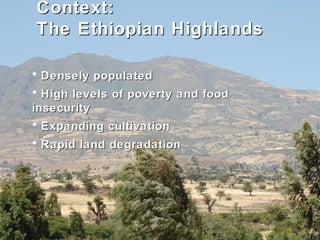
Context:
The Ethiopian Highlands
• Densely populated
• High levels of poverty and food
insecurity

• Expanding cultivation
• Rapid land degradation
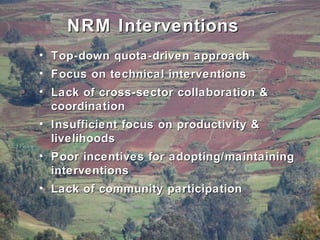
NRM Interventions
• Top-down quota-driven approach
• Focus on technical interventions
• Lack of cross-sector collaboration &
coordination
• Insufficient focus on productivity &
livelihoods
• Poor incentives for adopting/maintaining
interventions
• Lack of community participation
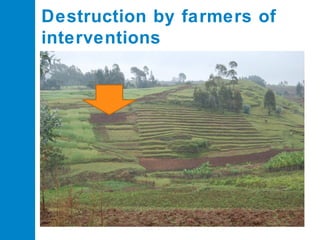
Destruction by farmers of
interventions
NBDC Overview
• Nile Basin Development Challenge (NBDC) Program
aims to improve the resilience of rural livelihoods in
the Ethiopian highlands through a landscape
approach to natural resource management.

• Hypothesis: development of integrated strategies
which consider technologies, policies and institutions
identified by a range of stakeholders will lead to
improved NRM, providing alternative approaches to
top-down implementation.
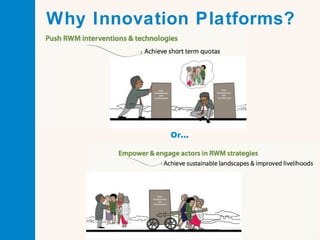
Why Innovation Platforms?

Or...
Areas of innovation
• Addressing NRM challenges requires innovation in
institutions that structure interactions between
resource users

• NBDC IP’s intended to prompt innovation in:
• Joint identification of issues and interventions
• Improved linkages between actors
• Increased community participation
• Co-design of interventions tailored to local
contexts
IP’s, Power &
Representation
•

Innovation platforms: ‘equitable dynamic spaces
designed to bring together stakeholders from
different interest groups to take action to solve a
common problem’

•

In theory, platform members are equal and can
articulate their needs. In practice, that may be far
from the case...

•

NRM planning and implementation in Ethiopia is a
‘closed’ or at best ‘invited’ space

• How equitable can platforms be in such a
context?
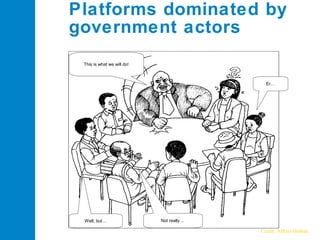
Platforms dominated by
government actors
This is what we will do!

Er…

Well, but…

Not really…

Credit: Alfred Ombati
Platform membership &
representation
• Government influence in the selection of IP
members, particularly ‘community
representatives’

• Significant for NRM activities because
communities are the main implementers of NRM
interventions

• Example of ‘false homogenization’ (farmer
diversity not represented), difficult for facilitators
to address
Interactions between
stakeholders
• Community members not free to express
alternative views

• Farmer knowledge not equally valued
• Hierarchical interactions firmly entrenched:
significant barrier to innovation

• Initial attempts by facilitators to address unequal
dynamics was met with resistance

• Project sought to provoke joint learning through
active engagement
Decision-making
• Starting point: identification of commonly
agreed upon NRM issue/entry point for
interventions

• Different priorities between farmers and
decision makers: short term vs. long term,
livelihoods vs. NRM

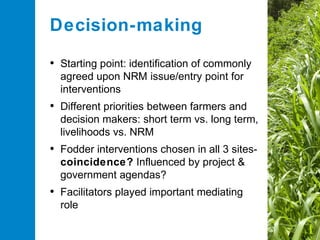
• Fodder interventions chosen in all 3 sitescoincidence? Influenced by project &
government agendas?

• Facilitators played important mediating
role
Implementation
• Farmers seen as ‘implementers’, lack of genuine
involvement

• Different levels of engagement (and understanding)
between different actors- reflecting existing
interactions

• Community members perceived platform activities
as another ‘arm of government’

• In some sites community members
destroyed/abandoned activities: ‘weapons of the
weak’

• Highlights importance of community participation:
evidence of the need for a ‘bottom-up approach’
‘Innovation brokers’
• Innovation brokers (Klerkx 2009) important, but
dilemmas about ‘insider’ or ‘outsider’ brokers:

- Outsiders: overview of context and challenges
but define research/project objectives so
powerful actors, problems of trust/partnership

- Insiders: limited understanding of innovation
concepts, part of existing power structure which
leads to limitations (e.g. NGOs)

• NBDC started with ‘outsider’ facilitators and
gradually devolved responsibility to ‘insiders’, not
an easy process
Role of facilitators
•

Should platform facilitators play a neutral role or
try to empower marginalized members?

•

‘Dialogue’ versus ‘critical’ vision of power
(Faysse 2006)

•

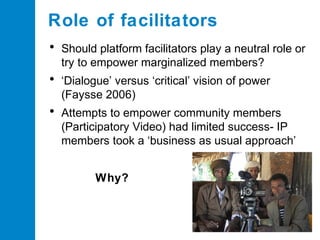
Attempts to empower community members
(Participatory Video) had limited success- IP
members took a ‘business as usual approach’
Why?
Concepts of participation
• Different understandings between platform
members and researchers about ‘participation’

• Is lack of capacity and resources the main issue?
• Capacity building events organised with limited
success

• Hierarchical social and political environment
seems not to support ‘error-embracing
participatory approaches’

• Lower level government officials & farmers
equally constrained by this context
Implications for future work
• Limited attention to constraints faced by lower
level decision makers

• Poorly designed incentives & structural problems:
requires influence at higher level

• Local platforms can help make these dynamics
visible but unlikely to change them: could
‘nested platforms’ be successful?

• NBDC project needs to demonstrate how local
level lessons can help achieve national
objectives
Reflections
• Too early to draw conclusions about impact: a
problem for innovation processes!

• Some changes in knowledge, attitudes and
practice among IP members but may not lead to
wide-scale change

• Continuous engagement and capacity building
of local actors important for longer term success

• Engagement with higher level decision makers
critical but depends on political will
Conclusion
• Failure to resolve power and representation
issues within IPs may affect:
- Priority given to issues,
- Selection of entry points,
- Design of interventions,
- Adoption of interventions
• If some members’ voices are ignored – or if
some groups are not represented at all – they
may start to disengage from or resist
interventions
Implications
• Danger that IPs give illusion of increased
participation whilst replicating and masking
existing power dynamics

• If issues of power and representation are not
considered IPs may aggravate poverty and
environmental decline rather than provide
innovative solutions
Questions?

Innovation platforms, power, representation and participation: Lessons from Blue Nile Basin, Ethiopia

  • 1.
    Innovation platforms, Power, Representation& Participation: Lessons from Blue Nile Basin, Ethiopia Beth Cullen, Josephine Tucker, Katherine Snyder, Zelalem Lema, Alan Duncan New M odels of Innovation for Development University of Manchester 4 July 2013
  • 2.
    Research focus • Paperfocuses on manifestations of power within Innovation Platforms (IPs) for natural resource management (NRM) in Ethiopia • We analyse relationships between actors and the impact that these dynamics have on NRM interventions piloted by the platforms. • Framed within Ethiopian context to assess the effectiveness of IPs in a politically restrictive environment
  • 3.
    Research Aims • Contributeto understanding of power dynamics in Innovation Platform processes • Provide analysis and critique of the use of IPs for ‘pro-poor innovation’ • Demonstrate implications for platform implementation, impact, scaling up and policy
  • 4.
    Outline • • • • Research design andmethods Ethiopian context NBDC overview: Why Innovation platforms? IP’s, Power & Representation: • • Membership & interactions between stakeholders Decision making and implementation Role of ‘innovation brokers’ Concepts of participation Implications for future work Reflections Conclusion
  • 5.
    Research design &methods • R4D project, Ethiopian highlands, 3 study sites • Based on work from 2010 to present • Paper synthesizes lessons from initial phase of platform operation • Qualitative research: focus group discussions, participatory community engagement exercises, meeting minutes, researcher observations, key informant interviews, independent review of platforms
  • 6.
    Context: The Ethiopian Highlands •Densely populated • High levels of poverty and food insecurity • Expanding cultivation • Rapid land degradation
  • 7.
    NRM Interventions • Top-downquota-driven approach • Focus on technical interventions • Lack of cross-sector collaboration & coordination • Insufficient focus on productivity & livelihoods • Poor incentives for adopting/maintaining interventions • Lack of community participation
  • 8.
    Destruction by farmersof interventions
  • 9.
    NBDC Overview • NileBasin Development Challenge (NBDC) Program aims to improve the resilience of rural livelihoods in the Ethiopian highlands through a landscape approach to natural resource management. • Hypothesis: development of integrated strategies which consider technologies, policies and institutions identified by a range of stakeholders will lead to improved NRM, providing alternative approaches to top-down implementation.
  • 10.
  • 11.
    Areas of innovation •Addressing NRM challenges requires innovation in institutions that structure interactions between resource users • NBDC IP’s intended to prompt innovation in: • Joint identification of issues and interventions • Improved linkages between actors • Increased community participation • Co-design of interventions tailored to local contexts
  • 12.
    IP’s, Power & Representation • Innovationplatforms: ‘equitable dynamic spaces designed to bring together stakeholders from different interest groups to take action to solve a common problem’ • In theory, platform members are equal and can articulate their needs. In practice, that may be far from the case... • NRM planning and implementation in Ethiopia is a ‘closed’ or at best ‘invited’ space • How equitable can platforms be in such a context?
  • 13.
    Platforms dominated by governmentactors This is what we will do! Er… Well, but… Not really… Credit: Alfred Ombati
  • 14.
    Platform membership & representation •Government influence in the selection of IP members, particularly ‘community representatives’ • Significant for NRM activities because communities are the main implementers of NRM interventions • Example of ‘false homogenization’ (farmer diversity not represented), difficult for facilitators to address
  • 15.
    Interactions between stakeholders • Communitymembers not free to express alternative views • Farmer knowledge not equally valued • Hierarchical interactions firmly entrenched: significant barrier to innovation • Initial attempts by facilitators to address unequal dynamics was met with resistance • Project sought to provoke joint learning through active engagement
  • 16.
    Decision-making • Starting point:identification of commonly agreed upon NRM issue/entry point for interventions • Different priorities between farmers and decision makers: short term vs. long term, livelihoods vs. NRM • Fodder interventions chosen in all 3 sitescoincidence? Influenced by project & government agendas? • Facilitators played important mediating role
  • 17.
    Implementation • Farmers seenas ‘implementers’, lack of genuine involvement • Different levels of engagement (and understanding) between different actors- reflecting existing interactions • Community members perceived platform activities as another ‘arm of government’ • In some sites community members destroyed/abandoned activities: ‘weapons of the weak’ • Highlights importance of community participation: evidence of the need for a ‘bottom-up approach’
  • 18.
    ‘Innovation brokers’ • Innovationbrokers (Klerkx 2009) important, but dilemmas about ‘insider’ or ‘outsider’ brokers: - Outsiders: overview of context and challenges but define research/project objectives so powerful actors, problems of trust/partnership - Insiders: limited understanding of innovation concepts, part of existing power structure which leads to limitations (e.g. NGOs) • NBDC started with ‘outsider’ facilitators and gradually devolved responsibility to ‘insiders’, not an easy process
  • 19.
    Role of facilitators • Shouldplatform facilitators play a neutral role or try to empower marginalized members? • ‘Dialogue’ versus ‘critical’ vision of power (Faysse 2006) • Attempts to empower community members (Participatory Video) had limited success- IP members took a ‘business as usual approach’ Why?
  • 20.
    Concepts of participation •Different understandings between platform members and researchers about ‘participation’ • Is lack of capacity and resources the main issue? • Capacity building events organised with limited success • Hierarchical social and political environment seems not to support ‘error-embracing participatory approaches’ • Lower level government officials & farmers equally constrained by this context
  • 21.
    Implications for futurework • Limited attention to constraints faced by lower level decision makers • Poorly designed incentives & structural problems: requires influence at higher level • Local platforms can help make these dynamics visible but unlikely to change them: could ‘nested platforms’ be successful? • NBDC project needs to demonstrate how local level lessons can help achieve national objectives
  • 22.
    Reflections • Too earlyto draw conclusions about impact: a problem for innovation processes! • Some changes in knowledge, attitudes and practice among IP members but may not lead to wide-scale change • Continuous engagement and capacity building of local actors important for longer term success • Engagement with higher level decision makers critical but depends on political will
  • 23.
    Conclusion • Failure toresolve power and representation issues within IPs may affect: - Priority given to issues, - Selection of entry points, - Design of interventions, - Adoption of interventions • If some members’ voices are ignored – or if some groups are not represented at all – they may start to disengage from or resist interventions
  • 24.
    Implications • Danger thatIPs give illusion of increased participation whilst replicating and masking existing power dynamics • If issues of power and representation are not considered IPs may aggravate poverty and environmental decline rather than provide innovative solutions
  • 25.