Welcome to iMasterclass-Episode 2
Hume Region presents: Student Learning Goals – Part 2
  Brendan OBrien, Gail Stanley and Libby Delbridge
Purpose of these Sessions


These online professional learning sessions will:


 Build a community of teacher/learners beyond your school

 Provide a framework for effective PLTs

 Develop an effective process for Student Goal Setting

 Provide confidence and skills in using Ultranet
The Learning Intention for today is......
   How do my students create SMART learning goals

   The Success Criteria will include........

6.I will be able to explain SMART learning goals and their
benefits to my students and my colleagues
7.I will learn how to model SMART goals
3. I will be able to understand how a PLT can effectively
use the SMART goals framework to plan student goal
setting
In Episode 1 we learnt what are
   personal learning goals and why are
              they important


Personal learning goals are about improving
students’ learning and achievement and building
their capacity to learn. Students become active
participants in the learning process, empowered
to become independent learners, and motivated
to achieve their full potential.
“Learning Goals and the Ultranet” DEECD January 2010
POLL

As part of the series of sequential PL did you
participate in iMasterclasses Learning Goals
            part 1 last Thursday?
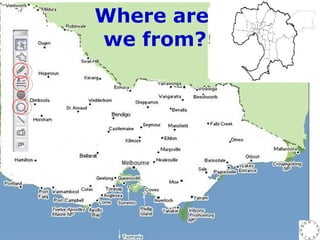
Where are
we from?
Poll-Whole School using an agreed
     framework to create Learning
                Goals
A. All our students use a framework to support them to create
   specific, measurable, action-based, realistic and timely goals
B. Some classes use a framework to support goal creation
C. Students at risk use a framework to support goal creation
D. No, ad hoc at best, some teachers only use a framework
E. Just before report time, maybe, not at all
What frameworks have you used
 to support students to create
            goals?
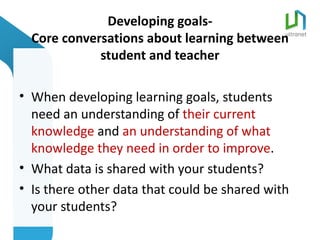
Developing goals-
  Core conversations about learning between
             student and teacher

• When developing learning goals, students
  need an understanding of their current
  knowledge and an understanding of what
  knowledge they need in order to improve.
• What data is shared with your students?
• Is there other data that could be shared with
  your students?
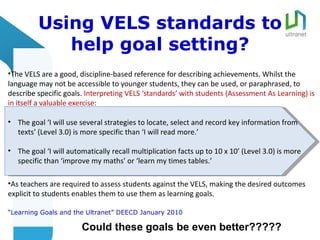
Using VELS standards to
            help goal setting?
•The VELS are a good, discipline-based reference for describing achievements. Whilst the
language may not be accessible to younger students, they can be used, or paraphrased, to
describe specific goals. Interpreting VELS ‘standards’ with students (Assessment As Learning) is
in itself a valuable exercise:

• The goal ‘I will use several strategies to locate, select and record key information from
  texts’ (Level 3.0) is more specific than ‘I will read more.’

• The goal ‘I will automatically recall multiplication facts up to 10 x 10’ (Level 3.0) is more
  specific than ‘improve my maths’ or ‘learn my times tables.’

•As teachers are required to assess students against the VELS, making the desired outcomes
explicit to students enables them to use them as learning goals.

“Learning Goals and the Ultranet” DEECD January 2010

                       Could these goals be even better?????
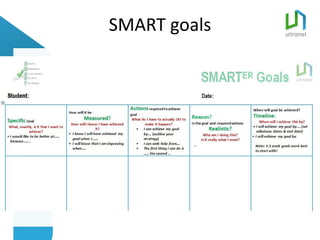
SMART goals
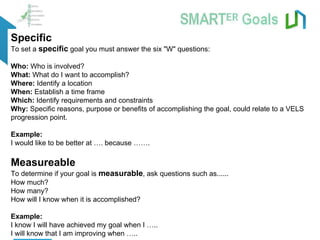
Specific
To set a specific goal you must answer the six "W" questions:

Who: Who is involved?
What: What do I want to accomplish?
Where: Identify a location
When: Establish a time frame
Which: Identify requirements and constraints
Why: Specific reasons, purpose or benefits of accomplishing the goal, could relate to a VELS
progression point.

Example:
I would like to be better at …. because …….

Measureable
To determine if your goal is measurable, ask questions such as......
How much?
How many?
How will I know when it is accomplished?

Example:
I know I will have achieved my goal when I …..
I will know that I am improving when …..
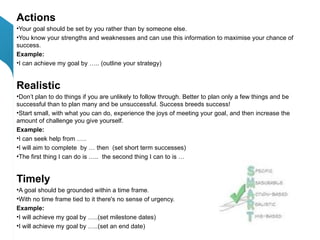
Actions
•Your goal should be set by you rather than by someone else.
•You know your strengths and weaknesses and can use this information to maximise your chance of
success.
Example:
•I can achieve my goal by ….. (outline your strategy)


Realistic
•Don’t plan to do things if you are unlikely to follow through. Better to plan only a few things and be
successful than to plan many and be unsuccessful. Success breeds success!
•Start small, with what you can do, experience the joys of meeting your goal, and then increase the
amount of challenge you give yourself.
Example:
•I can seek help from …..
•I will aim to complete by … then (set short term successes)
•The first thing I can do is ….. the second thing I can to is …


Timely
•A goal should be grounded within a time frame.
•With no time frame tied to it there's no sense of urgency.
Example:
•I will achieve my goal by …..(set milestone dates)
•I will achieve my goal by …..(set an end date)
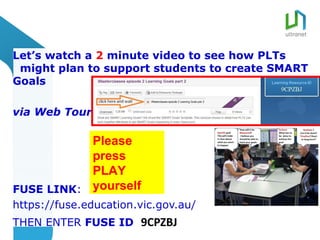
Let’s watch a 2 minute video to see how PLTs
 might plan to support students to create SMART
Goals

via Web Tour

           Please
           press
           PLAY
FUSE LINK: yourself
https://fuse.education.vic.gov.au/
THEN ENTER FUSE ID 9CPZBJ
Response to the Video

Put your hand up to grab the microphone

e)What did you learn about SMART goals?

g)How can the PLT benefit teachers to support
students to create SMART goals?
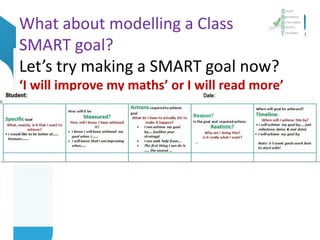
What about modelling a Class
SMART goal?
Let’s try making a SMART goal now?
‘I will improve my maths’ or I will read more’
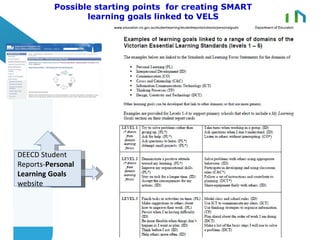
Possible starting points for creating SMART
                 learning goals linked to VELS


DEECD Student
Reports-Personal
Learning Goals
website
How to join
        iMasterclasses
        Design space...

•   Join the Hume Region iMasterclass Design Space
•   Go to Design Spaces
•   Click Available Spaces tab
•   Search by Space ID number (139211104)
•   The space is Open access so click the Actions
    box and Join
•   After you have joined click on the title to open
    the space
In Episode 3…
•Make SMART Goals available to students, teacher and
parents 24/7..
•Share how students put their SMART Goals into Ultranet
Wikis
•Link students short-term SMART Goals to Student digital
portfolios in Ultranet
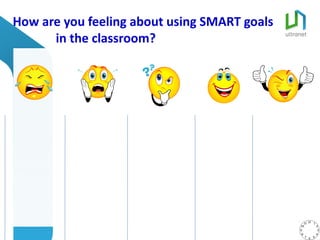
How are you feeling about using SMART goals
      in the classroom?
Open microphone/Questions
Thank You!

•Libby Delbridge
delbridge.elizabeth.n@edumail.vic.gov.au


•Brendan O’Brien           @brendano
obrien.brendan.p@edumail.vic.gov.au


•Gail Stanley
stanley.gail.d@edumail.vic.gov.au

i Masterclasses episode 2 Learning Goals part 2

  • 1.
    Welcome to iMasterclass-Episode2 Hume Region presents: Student Learning Goals – Part 2 Brendan OBrien, Gail Stanley and Libby Delbridge
  • 2.
    Purpose of theseSessions These online professional learning sessions will:  Build a community of teacher/learners beyond your school  Provide a framework for effective PLTs  Develop an effective process for Student Goal Setting  Provide confidence and skills in using Ultranet
  • 3.
    The Learning Intentionfor today is...... How do my students create SMART learning goals The Success Criteria will include........ 6.I will be able to explain SMART learning goals and their benefits to my students and my colleagues 7.I will learn how to model SMART goals 3. I will be able to understand how a PLT can effectively use the SMART goals framework to plan student goal setting
  • 4.
    In Episode 1we learnt what are personal learning goals and why are they important Personal learning goals are about improving students’ learning and achievement and building their capacity to learn. Students become active participants in the learning process, empowered to become independent learners, and motivated to achieve their full potential. “Learning Goals and the Ultranet” DEECD January 2010
  • 5.
    POLL As part ofthe series of sequential PL did you participate in iMasterclasses Learning Goals part 1 last Thursday?
  • 6.
  • 7.
    Poll-Whole School usingan agreed framework to create Learning Goals A. All our students use a framework to support them to create specific, measurable, action-based, realistic and timely goals B. Some classes use a framework to support goal creation C. Students at risk use a framework to support goal creation D. No, ad hoc at best, some teachers only use a framework E. Just before report time, maybe, not at all
  • 8.
    What frameworks haveyou used to support students to create goals?
  • 9.
    Developing goals- Core conversations about learning between student and teacher • When developing learning goals, students need an understanding of their current knowledge and an understanding of what knowledge they need in order to improve. • What data is shared with your students? • Is there other data that could be shared with your students?
  • 10.
    Using VELS standardsto help goal setting? •The VELS are a good, discipline-based reference for describing achievements. Whilst the language may not be accessible to younger students, they can be used, or paraphrased, to describe specific goals. Interpreting VELS ‘standards’ with students (Assessment As Learning) is in itself a valuable exercise: • The goal ‘I will use several strategies to locate, select and record key information from texts’ (Level 3.0) is more specific than ‘I will read more.’ • The goal ‘I will automatically recall multiplication facts up to 10 x 10’ (Level 3.0) is more specific than ‘improve my maths’ or ‘learn my times tables.’ •As teachers are required to assess students against the VELS, making the desired outcomes explicit to students enables them to use them as learning goals. “Learning Goals and the Ultranet” DEECD January 2010 Could these goals be even better?????
  • 11.
  • 12.
    Specific To set aspecific goal you must answer the six "W" questions: Who: Who is involved? What: What do I want to accomplish? Where: Identify a location When: Establish a time frame Which: Identify requirements and constraints Why: Specific reasons, purpose or benefits of accomplishing the goal, could relate to a VELS progression point. Example: I would like to be better at …. because ……. Measureable To determine if your goal is measurable, ask questions such as...... How much? How many? How will I know when it is accomplished? Example: I know I will have achieved my goal when I ….. I will know that I am improving when …..
  • 13.
    Actions •Your goal shouldbe set by you rather than by someone else. •You know your strengths and weaknesses and can use this information to maximise your chance of success. Example: •I can achieve my goal by ….. (outline your strategy) Realistic •Don’t plan to do things if you are unlikely to follow through. Better to plan only a few things and be successful than to plan many and be unsuccessful. Success breeds success! •Start small, with what you can do, experience the joys of meeting your goal, and then increase the amount of challenge you give yourself. Example: •I can seek help from ….. •I will aim to complete by … then (set short term successes) •The first thing I can do is ….. the second thing I can to is … Timely •A goal should be grounded within a time frame. •With no time frame tied to it there's no sense of urgency. Example: •I will achieve my goal by …..(set milestone dates) •I will achieve my goal by …..(set an end date)
  • 14.
    Let’s watch a2 minute video to see how PLTs might plan to support students to create SMART Goals via Web Tour Please press PLAY FUSE LINK: yourself https://fuse.education.vic.gov.au/ THEN ENTER FUSE ID 9CPZBJ
  • 15.
    Response to theVideo Put your hand up to grab the microphone e)What did you learn about SMART goals? g)How can the PLT benefit teachers to support students to create SMART goals?
  • 16.
    What about modellinga Class SMART goal? Let’s try making a SMART goal now? ‘I will improve my maths’ or I will read more’
  • 17.
    Possible starting pointsfor creating SMART learning goals linked to VELS DEECD Student Reports-Personal Learning Goals website
  • 18.
    How to join iMasterclasses Design space... • Join the Hume Region iMasterclass Design Space • Go to Design Spaces • Click Available Spaces tab • Search by Space ID number (139211104) • The space is Open access so click the Actions box and Join • After you have joined click on the title to open the space
  • 19.
    In Episode 3… •MakeSMART Goals available to students, teacher and parents 24/7.. •Share how students put their SMART Goals into Ultranet Wikis •Link students short-term SMART Goals to Student digital portfolios in Ultranet
  • 20.
    How are youfeeling about using SMART goals in the classroom?
  • 21.
  • 22.
    Thank You! •Libby Delbridge delbridge.elizabeth.n@edumail.vic.gov.au •BrendanO’Brien @brendano obrien.brendan.p@edumail.vic.gov.au •Gail Stanley stanley.gail.d@edumail.vic.gov.au

Editor's Notes

  • #5 Metacognitive skills We all know that the motivation and efficiency of students has indicated that students who set their own working goals tend to achieve more than when working on goals set for them by the teacher. Students who set their own learning goals have more confidence to take on more challenging tasks, regardless of their ability. Their motivation to improve and master a task is improved and their self-esteem remains strong, even in the case of failure. When students are assisted to delve into their own thinking and learning processes, they are drawn to think about the effectiveness of the strategies they used to achieve the learning goals they set. Planning what to do, monitoring progress towards achieving it and evaluating the outcome can help students take more control over their thinking and learning processes and equip them with learning to learn skills. Developing, monitoring and reporting on personal learning goals DEECD Nov 2006
  • #9 In the case of generic learning and behaviour skills there are a variety of frameworks that can be used: Habits of Mind, You Can Do it, Multiple Intelligences and social competencies
  • #10 the process is ongoing and cyclical developing, monitoring and reporting on learning goals will generally work best when the process is clear and common across the school. The process of developing, monitoring and reporting on a student’s personal learning goals involves conversations about learning between the student and the teacher. Planning for such conversations to occur in a productive and purposeful manner is at the core of this process. These conversations should be carried out in a spirit of openness and cooperation and should allow for student diversity. Developing, monitoring and reporting on personal learning goals DEECD Nov 2006
  • #11 Personal learning goals at the centre of student learning. Personal learning goals are an integral component of the Victorian Essential Learning Standards (VELS). Underpinning the VELS is the notion that students need to develop three broad capacities: the capacity to manage themselves as individuals and in relation to others the capacity to understand the world in which they live the capacity to act effectively in that world. The process of developing, monitoring and reporting on personal learning goals is integral to all domains and helps students achieve standards across the domains, but in particular there is a close connection between this process and the personal learning domain. This domain is about supporting the development of autonomous learners with a positive sense of themselves as learners who can ‘increasingly manage their own learning and growth by monitoring their learning, and setting and reflecting on their learning goals’ (Victorian Essential Learning Standards 2005). Developing, monitoring and reporting on personal learning goals DEECD Nov 2006
  • #12 Where do they come from??? Sentence stems to support goal creation, goals should be modelled
  • #13 To set a specific goal you must answer the six "W" questions: Specific Who:  Who is involved? What: What do I want to accomplish? Where: Identify a location When:  Establish a time frame Which: Identify requirements and constraints Why:  Specific reasons, purpose or benefits of accomplishing the goal, could relate to a VELS progression point. Example: I would like to be better at …. because ……. Measureable To determine if your goal is measurable , ask questions such as...... How much? How many? How will I know when it is accomplished? Example: I know I will have achieved my goal when I ….. I will know that I am improving when …..
  • #14 Actions Your goal should be set by you rather than by someone else. You know your strengths and weaknesses and can use this information to maximise your chance of success. Example: I can achieve my goal by ….. (outline your strategy)   Realistic Don’t plan to do things if you are unlikely to follow through. Better to plan only a few things and be successful than to plan many and be unsuccessful. Success breeds success! Start small, with what you can do, experience the joys of meeting your goal, and then increase the amount of challenge you give yourself. Example: I can seek help from ….. I will aim to complete by … then (set short term successes) The first thing I can do is ….. the second thing I can to is … Timely A goal should be grounded within a time frame. With no time frame tied to it there's no sense of urgency. Example: I will achieve my goal by …..(set milestone dates) I will achieve my goal by …..(set an end date)
  • #17 Model goal-setting by setting Class Goals and displaying them in the classroom. Review the class progress against meeting the goal; Template is there as a prompt we don’t write in it ‘ I will improve my maths’ ‘ I will read more.’ Actions Your goal should be set by you rather than by someone else. You know your strengths and weaknesses and can use this information to maximise your chance of success. Eg: I can achieve my goal by ….. (outline your strategy)   Realistic Don’t plan to do things if you are unlikely to follow through. Better to plan only a few things and be successful than to plan many and be unsuccessful. Success breeds success! Start small, with what you can do, experience the joys of meeting your goal, and then increase the amount of challenge you give yourself. Example: I can seek help from ….. I will aim to complete by … then (set short term successes) The first thing I can do is ….. the second thing I can to is … Timely A goal should be grounded within a time frame. With no time frame tied to it there's no sense of urgency. Example: I will achieve my goal by …..(set milestone dates) I will achieve my goal by …..(set an end date) Actions Your goal should be set by you rather than by someone else. You know your strengths and weaknesses and can use this information to maximise your chance of success. Example: I can achieve my goal by ….. (outline your strategy)   Realistic Don’t plan to do things if you are unlikely to follow through. Better to plan only a few things and be successful than to plan many and be unsuccessful. Success breeds success! Start small, with what you can do, experience the joys of meeting your goal, and then increase the amount of challenge you give yourself. Example: I can seek help from ….. I will aim to complete by … then (set short term successes) The first thing I can do is ….. the second thing I can to is … Timely A goal should be grounded within a time frame. With no time frame tied to it there's no sense of urgency. Example: I will achieve my goal by …..(set milestone dates) I will achieve my goal by …..(set an end date)
  • #18 Link to DEECD Student Reports Personal Learning Goals – this is in iMasterclass Design Space http://www.education.vic.gov.au/studentlearning/studentreports/schools/personalgoals/suppdevplg.htm http://www.eduweb.vic.gov.au/edulibrary/public/teachlearn/student/learninggoalsexamples.pdf Sentence stems linked to VELS domains –need SMARTING DEECD Student Reports Personal Learning goals has a link to Examples of learning goals linked to a range of domains of the Victorian Essential Learning Standards (levels 1 – 6) document. Also scroll down for more information: Self assessment strategies and tools from the Assessment Professional Learning modules Graphic organisers and other assessment tools availalble on the student learning website
  • #20 Show for a short time.