paramedicfoundation.org
twitter.com/paramedicfound
facebook.com/ParamedicFoundation
I Am Not Paid Enough To Do
That!
Nick Nudell, MS, NRP, FACPE
Wyoming’s 47th Annual Trauma & EMS Conference
August 2017
Cheyenne, WY
W h o a m I ?
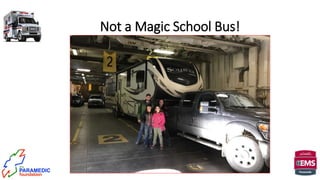
Not a Magic School Bus!
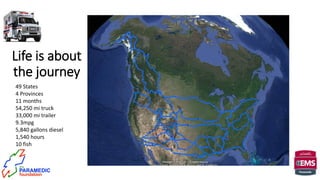
Life is about
the journey
49 States
4 Provinces
11 months
54,250 mi truck
33,000 mi trailer
9.3mpg
5,840 gallons diesel
1,540 hours
10 fish
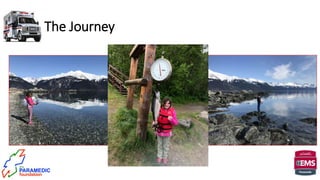
The Journey
W h o a r e y o u ?
Objectives
How to 'hack' the data world without having a computer expert on
standby
Why the professionalization of paramedicine is important?
When will we be professionals?
How will professionalization affect the future of EMS?
What do you want?
W h a t d o y o u w a n t ?
How do you?
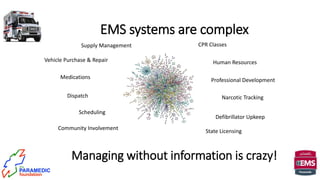
EMS systems are complex
Managing without information is crazy!
Supply Management
Vehicle Purchase & Repair
Medications
Dispatch
CPR Classes
Human Resources
Professional Development
Narcotic Tracking
Defibrillator Upkeep
Community Involvement
Scheduling
State Licensing
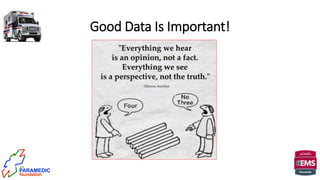
Good Data Is Important!
Every EMS agency needs a PIMP!
Paramedic Information - Management Practitioner
• Paramedic Data Analyst (PDA)
• Paramedic Data Forensics (PDF)
• Paramedic Data Governance (PDG)
• Paramedic Data Integration (PDI)
• Paramedic Data Manager (PDM)
• Paramedic Data Protection (PDP)
• Paramedic Decision Support (PDS)
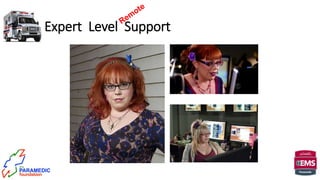
Expert Level Support
Differing Perspectives – Context Matters
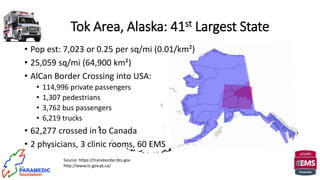
Tok Area, Alaska: 41st Largest State
• Pop est: 7,023 or 0.25 per sq/mi (0.01/km²)
• 25,059 sq/mi (64,900 km²)
• AlCan Border Crossing into USA:
• 114,996 private passengers
• 1,307 pedestrians
• 3,762 bus passengers
• 6,219 trucks
• 62,277 crossed in to Canada
• 2 physicians, 3 clinic rooms, 60 EMS
Source: https://transborder.bts.gov
http://www.tc.gov.yk.ca/
Tok Area, Alaska: 41st Largest State
Source: https://transborder.bts.gov
http://www.tc.gov.yk.ca/
• Pop est: 7,023 or 0.25 per sq/mi (0.01/km²)
• 25,059 sq/mi (64,900 km²)
• AlCan Border Crossing into USA:
• 114,996 private passengers
• 1,307 pedestrians
• 3,762 bus passengers
• 6,219 trucks
• 62,277 crossed in to Canada
• 2 physicians, 3 clinic rooms, 60 EMS
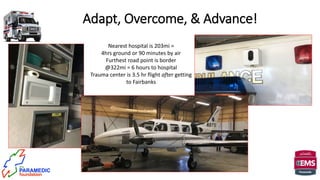
Adapt, Overcome, & Advance!
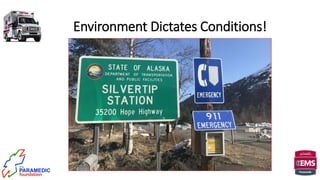
Nearest hospital is 203mi =
4hrs ground or 90 minutes by air
Furthest road point is border
@322mi = 6 hours to hospital
Trauma center is 3.5 hr flight after getting
to Fairbanks
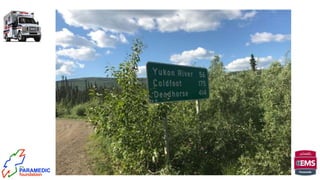
Environment Dictates Conditions!
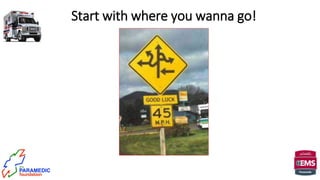
Start with where you wanna go!
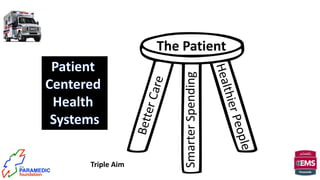
The Patient
SmarterSpending
Triple Aim
W h a t i s p a t i e n t c e n t r i c p a r a m e d i c i n e ?
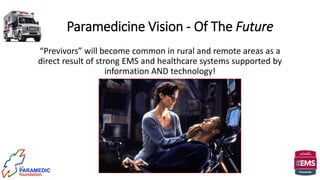
Paramedicine Vision - Of The Future
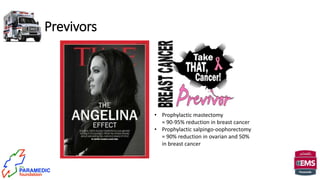
Previvors
• Prophylactic mastectomy
= 90-95% reduction in breast cancer
• Prophylactic salpingo-oophorectomy
= 90% reduction in ovarian and 50%
in breast cancer
W h a t i s t h e k e y t o p a r a m e d i c i n e ?
H I N T : I t i s t e a m - b a s e d H e a l t h C a r e D e l i v e r y
Teamwork does not mean
a strict division of labor,
it means using the combined
skills and judgment of the team
to potentiate one another’s skills.
- Howard Backer, MD, MPH, FACEP
How do we get there?
149 million records since 2006 in National EMS Information
System national database (as of August 2017)
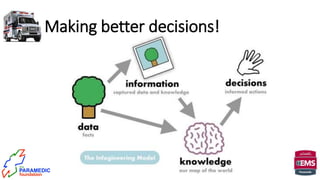
Making better decisions!
The Future of 1966
L e a v e t h e p a s t b e h i n d !
• 30 minutes per ePCR x 40 million calls = 20 million hours
• 20M x $100 = $2,000,000,000 spent on writing ePCRs
• $50 per call!
• What can be improved? Let’s:
• Better use the data to show our value to our communities
• Ask data vendors to show us the value of their services
Data entry is expensive
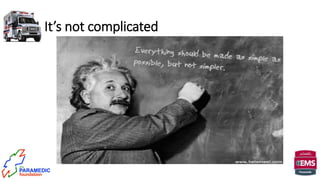
It’s not complicated
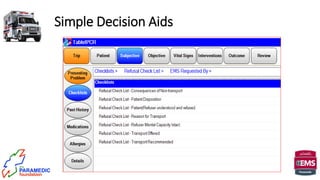
Simple Decision Aids
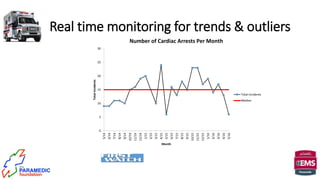
Real time monitoring for trends & outliers
0
5
10
15
20
25
30
5/14
6/14
7/14
8/14
9/14
10/14
11/14
12/14
1/15
2/15
3/15
4/15
5/15
6/15
7/15
8/15
9/15
10/15
11/15
12/15
1/16
2/16
3/16
4/16
5/16
TotalIncidents
Month
Number of Cardiac Arrests Per Month
Total Incidents
Median
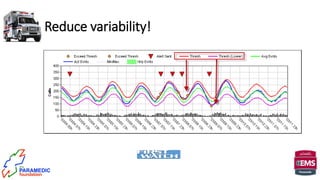
Reduce variability!
Visual analysis & reporting
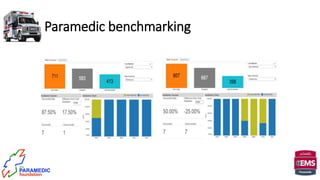
Paramedic benchmarking
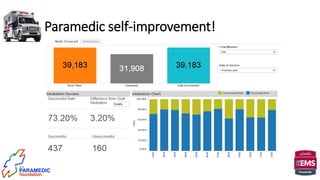
Paramedic self-improvement!
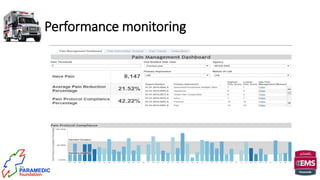
Performance monitoring
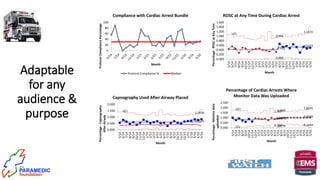
Adaptable
for any
audience &
purpose
0
20
40
60
80
100
ProtocolCompliancePercentage
Month
Compliance with Cardiac Arrest Bundle
Protocol Compliance % Median
CL 0.412
0.5273
UCL
0.946
1.1315
0.0000.000
0.200
0.400
0.600
0.800
1.000
1.200
1.400
1.600
5/14
6/14
7/14
8/14
9/14
10/14
11/14
12/14
1/15
2/15
3/15
4/15
5/15
6/15
7/15
8/15
9/15
10/15
11/15
12/15
1/16
2/16
3/16
4/16
5/16
Percentage-ROSCatAnyTime
Month
ROSC at Any Time During Cardiac Arrest
CL 0.6125
UCL
1.2636
0.000
0.500
1.000
1.500
2.000
5/14
6/14
7/14
8/14
9/14
10/14
11/14
12/14
1/15
2/15
3/15
4/15
5/15
6/15
7/15
8/15
9/15
10/15
11/15
12/15
1/16
2/16
3/16
4/16
5/16
Percentage-Capnography
AfterAirway
Month
Capnography Used After Airway Placed
CL 0.8380.838 0.9939
UCL
1.5251.600
1.8235
LCL 0.1520.076 0.1644
0.000
0.500
1.000
1.500
2.000
2.500
5/14
6/14
7/14
8/14
9/14
10/14
11/14
12/14
1/15
2/15
3/15
4/15
5/15
6/15
7/15
8/15
9/15
10/15
11/15
12/15
1/16
2/16
3/16
4/16
5/16
Percentage-Monitordata
uploaded
Month
Percentage of Cardiac Arrests Where
Monitor Data Was Uploaded
Performance Measures!
• EMS Compass 1.0 got us started in defining what should be measured
• Also developed a process to develop evidence based performance measures
in the future
• EMS Compass 2.0 is now getting started as the EMS Quality Alliance
with broad based participation. More to come!
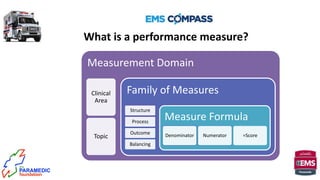
What is a performance measure?
Measurement Domain
Clinical
Area
Topic
Family of Measures
Structure
Process
Outcome
Balancing
Measure Formula
Denominator Numerator =Score
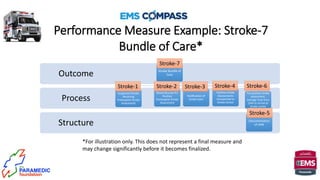
Structure
Process
Outcome Stroke Bundle of
Care
For positive stroke
assessment,
average time from
LKW to arrival at
stroke center
Documentation
of LKW
Positive stroke
Assessments
transported to
Stroke Center
Blood Glucose for
Positive
Prehospital Stroke
Assessment
Notification of
stroke team
Suspected Stroke
Receiving
Prehospital Stroke
Assessment
Performance Measure Example: Stroke-7
Bundle of Care*
Stroke-1 Stroke-2 Stroke-3 Stroke-4
Stroke-7
Stroke-5
Stroke-6
*For illustration only. This does not represent a final measure and
may change significantly before it becomes finalized.
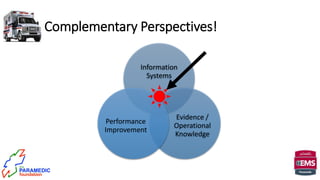
Complementary Perspectives!
Information
Systems
Evidence /
Operational
Knowledge
Performance
Improvement
National EMS Management Association (NEMSMA) Information and
Technology Committee seeks broad participation to
Develop standard competencies and credential for Paramedic Information
Practitioners
To manage the data collection, sensemaking, knowledge building,
decision support of paramedic agencies of the future!
What Is needed?
Paramedic Information Specialists!
What else is needed?
Evidence!
Prehospital Guidelines Consortium identifying evidence for new
evidence based guidelines
Medical Director Council publishing new guidelines
BUT:
Need to understand implications of evidence in rural vs urban areas and ensure
the perspectives are incorporated
Rapidly disseminating new guidelines for rapid widespread adoption is critical
“Previvors” will become common in rural and remote areas as a
direct result of strong EMS and healthcare systems supported by
information AND technology!
Paramedicine Vision - Of The Future
Contact
Nick Nudell, MS, NRP, FACPE
UCHealth EMS
Chief Data Officer & Board Member of The Paramedic Foundation
Board Member of the National EMS Management Association
nikiah.nudell@uchealth.org
(760) 405-6869
emsnerd.com
twitter.com/runmedic
KK6TYY 

I don't get paid enough for this!

  • 1.
    paramedicfoundation.org twitter.com/paramedicfound facebook.com/ParamedicFoundation I Am NotPaid Enough To Do That! Nick Nudell, MS, NRP, FACPE Wyoming’s 47th Annual Trauma & EMS Conference August 2017 Cheyenne, WY
  • 2.
    W h oa m I ?
  • 3.
    Not a MagicSchool Bus!
  • 4.
    Life is about thejourney 49 States 4 Provinces 11 months 54,250 mi truck 33,000 mi trailer 9.3mpg 5,840 gallons diesel 1,540 hours 10 fish
  • 5.
  • 6.
    W h oa r e y o u ?
  • 7.
    Objectives How to 'hack'the data world without having a computer expert on standby Why the professionalization of paramedicine is important? When will we be professionals? How will professionalization affect the future of EMS?
  • 8.
    What do youwant? W h a t d o y o u w a n t ?
  • 9.
  • 11.
    EMS systems arecomplex Managing without information is crazy! Supply Management Vehicle Purchase & Repair Medications Dispatch CPR Classes Human Resources Professional Development Narcotic Tracking Defibrillator Upkeep Community Involvement Scheduling State Licensing
  • 12.
    Good Data IsImportant!
  • 13.
    Every EMS agencyneeds a PIMP! Paramedic Information - Management Practitioner • Paramedic Data Analyst (PDA) • Paramedic Data Forensics (PDF) • Paramedic Data Governance (PDG) • Paramedic Data Integration (PDI) • Paramedic Data Manager (PDM) • Paramedic Data Protection (PDP) • Paramedic Decision Support (PDS)
  • 14.
  • 15.
  • 17.
    Tok Area, Alaska:41st Largest State • Pop est: 7,023 or 0.25 per sq/mi (0.01/km²) • 25,059 sq/mi (64,900 km²) • AlCan Border Crossing into USA: • 114,996 private passengers • 1,307 pedestrians • 3,762 bus passengers • 6,219 trucks • 62,277 crossed in to Canada • 2 physicians, 3 clinic rooms, 60 EMS Source: https://transborder.bts.gov http://www.tc.gov.yk.ca/
  • 18.
    Tok Area, Alaska:41st Largest State Source: https://transborder.bts.gov http://www.tc.gov.yk.ca/ • Pop est: 7,023 or 0.25 per sq/mi (0.01/km²) • 25,059 sq/mi (64,900 km²) • AlCan Border Crossing into USA: • 114,996 private passengers • 1,307 pedestrians • 3,762 bus passengers • 6,219 trucks • 62,277 crossed in to Canada • 2 physicians, 3 clinic rooms, 60 EMS
  • 19.
    Adapt, Overcome, &Advance! Nearest hospital is 203mi = 4hrs ground or 90 minutes by air Furthest road point is border @322mi = 6 hours to hospital Trauma center is 3.5 hr flight after getting to Fairbanks
  • 21.
  • 22.
    Start with whereyou wanna go!
  • 23.
  • 24.
    W h at i s p a t i e n t c e n t r i c p a r a m e d i c i n e ?
  • 25.
    Paramedicine Vision -Of The Future
  • 26.
    Previvors • Prophylactic mastectomy =90-95% reduction in breast cancer • Prophylactic salpingo-oophorectomy = 90% reduction in ovarian and 50% in breast cancer
  • 27.
    W h at i s t h e k e y t o p a r a m e d i c i n e ? H I N T : I t i s t e a m - b a s e d H e a l t h C a r e D e l i v e r y
  • 28.
    Teamwork does notmean a strict division of labor, it means using the combined skills and judgment of the team to potentiate one another’s skills. - Howard Backer, MD, MPH, FACEP
  • 29.
    How do weget there? 149 million records since 2006 in National EMS Information System national database (as of August 2017)
  • 30.
  • 31.
  • 32.
    L e av e t h e p a s t b e h i n d !
  • 33.
    • 30 minutesper ePCR x 40 million calls = 20 million hours • 20M x $100 = $2,000,000,000 spent on writing ePCRs • $50 per call! • What can be improved? Let’s: • Better use the data to show our value to our communities • Ask data vendors to show us the value of their services Data entry is expensive
  • 34.
  • 35.
  • 37.
    Real time monitoringfor trends & outliers 0 5 10 15 20 25 30 5/14 6/14 7/14 8/14 9/14 10/14 11/14 12/14 1/15 2/15 3/15 4/15 5/15 6/15 7/15 8/15 9/15 10/15 11/15 12/15 1/16 2/16 3/16 4/16 5/16 TotalIncidents Month Number of Cardiac Arrests Per Month Total Incidents Median
  • 38.
  • 39.
  • 40.
  • 41.
  • 42.
  • 43.
    Adaptable for any audience & purpose 0 20 40 60 80 100 ProtocolCompliancePercentage Month Compliancewith Cardiac Arrest Bundle Protocol Compliance % Median CL 0.412 0.5273 UCL 0.946 1.1315 0.0000.000 0.200 0.400 0.600 0.800 1.000 1.200 1.400 1.600 5/14 6/14 7/14 8/14 9/14 10/14 11/14 12/14 1/15 2/15 3/15 4/15 5/15 6/15 7/15 8/15 9/15 10/15 11/15 12/15 1/16 2/16 3/16 4/16 5/16 Percentage-ROSCatAnyTime Month ROSC at Any Time During Cardiac Arrest CL 0.6125 UCL 1.2636 0.000 0.500 1.000 1.500 2.000 5/14 6/14 7/14 8/14 9/14 10/14 11/14 12/14 1/15 2/15 3/15 4/15 5/15 6/15 7/15 8/15 9/15 10/15 11/15 12/15 1/16 2/16 3/16 4/16 5/16 Percentage-Capnography AfterAirway Month Capnography Used After Airway Placed CL 0.8380.838 0.9939 UCL 1.5251.600 1.8235 LCL 0.1520.076 0.1644 0.000 0.500 1.000 1.500 2.000 2.500 5/14 6/14 7/14 8/14 9/14 10/14 11/14 12/14 1/15 2/15 3/15 4/15 5/15 6/15 7/15 8/15 9/15 10/15 11/15 12/15 1/16 2/16 3/16 4/16 5/16 Percentage-Monitordata uploaded Month Percentage of Cardiac Arrests Where Monitor Data Was Uploaded
  • 45.
    Performance Measures! • EMSCompass 1.0 got us started in defining what should be measured • Also developed a process to develop evidence based performance measures in the future • EMS Compass 2.0 is now getting started as the EMS Quality Alliance with broad based participation. More to come!
  • 46.
    What is aperformance measure? Measurement Domain Clinical Area Topic Family of Measures Structure Process Outcome Balancing Measure Formula Denominator Numerator =Score
  • 47.
    Structure Process Outcome Stroke Bundleof Care For positive stroke assessment, average time from LKW to arrival at stroke center Documentation of LKW Positive stroke Assessments transported to Stroke Center Blood Glucose for Positive Prehospital Stroke Assessment Notification of stroke team Suspected Stroke Receiving Prehospital Stroke Assessment Performance Measure Example: Stroke-7 Bundle of Care* Stroke-1 Stroke-2 Stroke-3 Stroke-4 Stroke-7 Stroke-5 Stroke-6 *For illustration only. This does not represent a final measure and may change significantly before it becomes finalized.
  • 49.
  • 50.
    National EMS ManagementAssociation (NEMSMA) Information and Technology Committee seeks broad participation to Develop standard competencies and credential for Paramedic Information Practitioners To manage the data collection, sensemaking, knowledge building, decision support of paramedic agencies of the future! What Is needed? Paramedic Information Specialists!
  • 51.
    What else isneeded? Evidence! Prehospital Guidelines Consortium identifying evidence for new evidence based guidelines Medical Director Council publishing new guidelines BUT: Need to understand implications of evidence in rural vs urban areas and ensure the perspectives are incorporated Rapidly disseminating new guidelines for rapid widespread adoption is critical
  • 52.
    “Previvors” will becomecommon in rural and remote areas as a direct result of strong EMS and healthcare systems supported by information AND technology! Paramedicine Vision - Of The Future
  • 53.
    Contact Nick Nudell, MS,NRP, FACPE UCHealth EMS Chief Data Officer & Board Member of The Paramedic Foundation Board Member of the National EMS Management Association nikiah.nudell@uchealth.org (760) 405-6869 emsnerd.com twitter.com/runmedic KK6TYY 

Editor's Notes

  • #3 optimal specific PRECISE care based on genetics, history, research, current trends, cell phone data, demographics, & outcome studies Prevents injury or disease from occurring Ability to access and update their health record anywhere anytime Provide all care providers appropriate access anywhere anytime Accountability by all providers for the ultimate continuity of care
  • #7 optimal specific PRECISE care based on genetics, history, research, current trends, cell phone data, demographics, & outcome studies Prevents injury or disease from occurring Ability to access and update their health record anywhere anytime Provide all care providers appropriate access anywhere anytime Accountability by all providers for the ultimate continuity of care
  • #25 optimal specific PRECISE care based on genetics, history, research, current trends, cell phone data, demographics, & outcome studies Prevents injury or disease from occurring Ability to access and update their health record anywhere anytime Provide all care providers appropriate access anywhere anytime Accountability by all providers for the ultimate continuity of care
  • #28 Data= words, numbers, code, tables, databases. Data can be stored, copied, deleted, transmitted, & stolen. Data alone and without context, like a solitary puzzle piece, is practically worthless. Data will always change as there is always more coming in. Data is always correct – a tidbit of truth, a thing that has happened. Information = sentences, paragraphs, equations, concepts, ideas, questions, simple stories. Information is knowledge that has used and processed certain data and has rendered it useful. Information is a snapshot of patterns found in data at a single point. Information can be wrong. Interestingness is usually taken as an overall measure of pattern value, combining validity, novelty, usefulness, and simplicity. Knowledge = chapters, theories, axioms, conceptual frameworks, complex stories, facts = useful information. Puts information to use. Example or Case Based Methods. Probabilistic methods. Relational or Inductive learning methods Wisdom = books, paradigms, systems, philosophies, schools of thought, poetry, belief systems, traditions, principles, truths. The body of knowledge and principles that develops within a specified society or period. The quality of having experience, knowledge, and good judgment.
  • #30 Data= words, numbers, code, tables, databases. Data can be stored, copied, deleted, transmitted, & stolen. Data alone and without context, like a solitary puzzle piece, is practically worthless. Data will always change as there is always more coming in. Data is always correct – a tidbit of truth, a thing that has happened. Information = sentences, paragraphs, equations, concepts, ideas, questions, simple stories. Information is knowledge that has used and processed certain data and has rendered it useful. Information is a snapshot of patterns found in data at a single point. Information can be wrong. Interestingness is usually taken as an overall measure of pattern value, combining validity, novelty, usefulness, and simplicity. Knowledge = chapters, theories, axioms, conceptual frameworks, complex stories, facts = useful information. Puts information to use. Example or Case Based Methods. Probabilistic methods. Relational or Inductive learning methods Wisdom = books, paradigms, systems, philosophies, schools of thought, poetry, belief systems, traditions, principles, truths. The body of knowledge and principles that develops within a specified society or period. The quality of having experience, knowledge, and good judgment.
  • #33 PAST: Required symptom based “protocols” to protect physicians providing “delegated practice” to subordinates: Designed for lowest common denominator Some states still rely heavily and some do not PRESENT DAY: Evidence Based Guidelines (problem based protocols) Relies on cohorts – studies of similar conditions Pattern recognition (similar to facial recognition) Reactionary and works best when situations are static