









ICT
BASED
MEDIA

Presented
By
ELMY
1101120644
Definition of ICT
ICT Stands for "Information and
Communication Technologies" refers
to technologies that provide access
to information through
telecommunications
Kinds of ICT Media
Using the Web for language
learning

the Web offers sites which contain
material produced for native speakers
and these sites fall roughly into three
categories :


material not written for the Internet,
which has been transferred to it either
directly or in abridged form. Poetry,
song lyrics, books, film scripts and
some journal articles all fall into this
category



material not written originally for
the Internet but adapted for it. This
includes newspapers and journals, many
of which publish adapted online versions
in conjunction with their hard copy
versions



material written specifically for the
Internet, such as the material found on
personal, institutional, commercial and
informative sites e.g. government
sites, medical, financial and tourist
information, and so on
Culture on The Web
The Web is a repository of a huge range of cultural products in
electronic form, and as such is an invaluable resource of authentic
texts for teachers and learners. Samples of all the cultural products
covered in this book can be found online:








Literature http://www.bibliomania.com/
The broadcast media http://www.bbc.co.uk/
http://www.rte.ie/
http://www.cnn.com/
Newspapers http://www.newsd.com/
Advertising http://www.adslogans.co.uk/
Songs http://www.lyrics.com/
Film (film scripts and clips) http://www.script-orama.com/table.shtml

The Web offers students ‘the opportunity for virtual travelling without
having to pay for a ticket’, as Vogel puts it (2001:135). The many ‘selfconscious’ culture sites with ‘tourist level’ cultural information
(heritage, folk lore, folk songs, recipes, etc)
E-mail is a means of sending a letter sent through the
Internet. By regular mail senders usually need to pay per
delivery (by buying stamps), but electronic mail is generally
the cost is the cost to pay for the Internet connection
E-mail allows for communication between students in a context
where the teacher's role is no longer at the center (. In e-mail
communication, foreign language learners can experience
increased control over their own learning, since they can
choose the topic and change the direction of the discussion
Corpora and Concordancing
The corpus - a computer database storing a collection of
texts, and the concordancer – the program which
manipulates it, are probably the ICT systems least
exploited for language learning (Rézeau 2001: 147). Yet a
TL corpus provides the largest single resource of
authentic language available to the language learner, and
the concordancer constitutes a flexible, user-directed
and user-friendly tool for exploring it. The reasons why
teachers (and learners) are so circumspect about using
corpora and concordancing - and the arguments in favour
of their use – will become apparent below. Corpora are
electronic databases containing texts which have been
either downloaded from other electronic sources (the
Internet, CD ROM etc.),
(USEFUL
WEBSTES)
8

Let’s check it ou
8
7
6
5
4
3
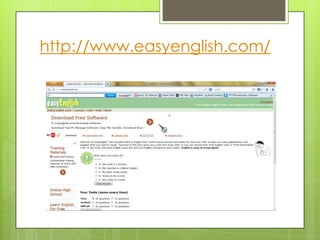
http://www.easyenglish.com/
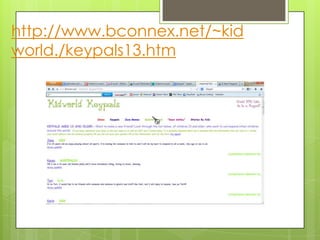
http://www.bconnex.net/~kid
world./keypals13.htm
“the more practice we do, the more we
get something new” (Elmy)
…have a try 

I c t ppt (ICT Based Media)

  • 1.
  • 2.
    Definition of ICT ICTStands for "Information and Communication Technologies" refers to technologies that provide access to information through telecommunications
  • 3.
    Kinds of ICTMedia Using the Web for language learning the Web offers sites which contain material produced for native speakers and these sites fall roughly into three categories :  material not written for the Internet, which has been transferred to it either directly or in abridged form. Poetry, song lyrics, books, film scripts and some journal articles all fall into this category  material not written originally for the Internet but adapted for it. This includes newspapers and journals, many of which publish adapted online versions in conjunction with their hard copy versions  material written specifically for the Internet, such as the material found on personal, institutional, commercial and informative sites e.g. government sites, medical, financial and tourist information, and so on
  • 4.
    Culture on TheWeb The Web is a repository of a huge range of cultural products in electronic form, and as such is an invaluable resource of authentic texts for teachers and learners. Samples of all the cultural products covered in this book can be found online:       Literature http://www.bibliomania.com/ The broadcast media http://www.bbc.co.uk/ http://www.rte.ie/ http://www.cnn.com/ Newspapers http://www.newsd.com/ Advertising http://www.adslogans.co.uk/ Songs http://www.lyrics.com/ Film (film scripts and clips) http://www.script-orama.com/table.shtml The Web offers students ‘the opportunity for virtual travelling without having to pay for a ticket’, as Vogel puts it (2001:135). The many ‘selfconscious’ culture sites with ‘tourist level’ cultural information (heritage, folk lore, folk songs, recipes, etc)
  • 5.
    E-mail is ameans of sending a letter sent through the Internet. By regular mail senders usually need to pay per delivery (by buying stamps), but electronic mail is generally the cost is the cost to pay for the Internet connection E-mail allows for communication between students in a context where the teacher's role is no longer at the center (. In e-mail communication, foreign language learners can experience increased control over their own learning, since they can choose the topic and change the direction of the discussion
  • 6.
    Corpora and Concordancing Thecorpus - a computer database storing a collection of texts, and the concordancer – the program which manipulates it, are probably the ICT systems least exploited for language learning (Rézeau 2001: 147). Yet a TL corpus provides the largest single resource of authentic language available to the language learner, and the concordancer constitutes a flexible, user-directed and user-friendly tool for exploring it. The reasons why teachers (and learners) are so circumspect about using corpora and concordancing - and the arguments in favour of their use – will become apparent below. Corpora are electronic databases containing texts which have been either downloaded from other electronic sources (the Internet, CD ROM etc.),
  • 7.
  • 8.
  • 9.
  • 10.
  • 11.
  • 12.
  • 13.
  • 14.
  • 17.
  • 18.
  • 20.
    “the more practicewe do, the more we get something new” (Elmy) …have a try 

Editor's Notes