Hypertension Guidelines:
ESH/ESC 2013
Dr. Akshay Mehta
Nanavati Hospital
Asian Heart Institute
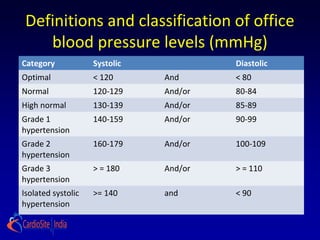
Definitions and classification of office
blood pressure levels (mmHg)
Category Systolic Diastolic
Optimal < 120 And < 80
Normal 120-129 And/or 80-84
High normal 130-139 And/or 85-89
Grade 1
hypertension
140-159 And/or 90-99
Grade 2
hypertension
160-179 And/or 100-109
Grade 3
hypertension
> = 180 And/or > = 110
Isolated systolic
hypertension
>= 140 and < 90
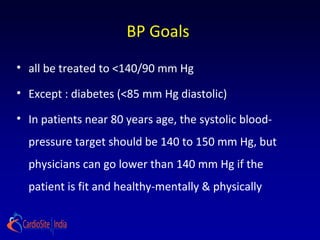
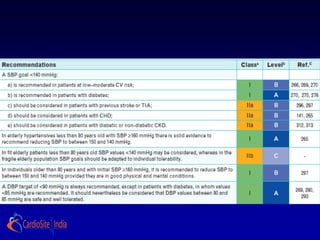
BP Goals
• all be treated to <140/90 mm Hg
• Except : diabetes (<85 mm Hg diastolic)
• In patients near 80 years age, the systolic blood-
pressure target should be 140 to 150 mm Hg, but
physicians can go lower than 140 mm Hg if the
patient is fit and healthy-mentally & physically
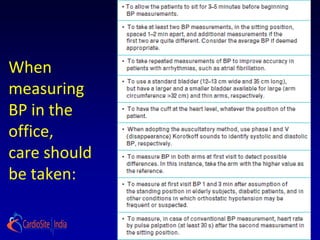
When
measuring
BP in the
office,
care should
be taken:
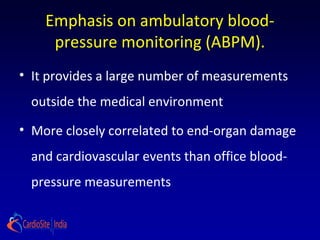
Emphasis on ambulatory blood-
pressure monitoring (ABPM).
• It provides a large number of measurements
outside the medical environment
• More closely correlated to end-organ damage
and cardiovascular events than office blood-
pressure measurements
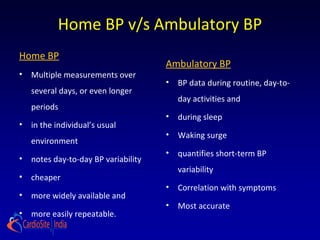
Home BP v/s Ambulatory BP
Home BP
• Multiple measurements over
several days, or even longer
periods
• in the individual’s usual
environment
• notes day-to-day BP variability
• cheaper
• more widely available and
• more easily repeatable.
Ambulatory BP
• BP data during routine, day-to-
day activities and
• during sleep
• Waking surge
• quantifies short-term BP
variability
• Correlation with symptoms
• Most accurate
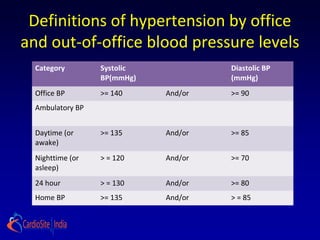
Definitions of hypertension by office
and out-of-office blood pressure levels
Category Systolic
BP(mmHg)
Diastolic BP
(mmHg)
Office BP >= 140 And/or >= 90
Ambulatory BP
Daytime (or
awake)
>= 135 And/or >= 85
Nighttime (or
asleep)
> = 120 And/or >= 70
24 hour > = 130 And/or >= 80
Home BP >= 135 And/or > = 85
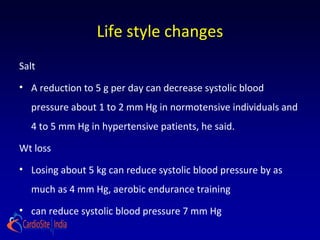
Life style changes
Salt
• A reduction to 5 g per day can decrease systolic blood
pressure about 1 to 2 mm Hg in normotensive individuals and
4 to 5 mm Hg in hypertensive patients, he said.
Wt loss
• Losing about 5 kg can reduce systolic blood pressure by as
much as 4 mm Hg, aerobic endurance training
• can reduce systolic blood pressure 7 mm Hg
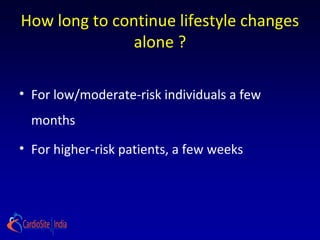
How long to continue lifestyle changes
alone ?
• For low/moderate-risk individuals a few
months
• For higher-risk patients, a few weeks
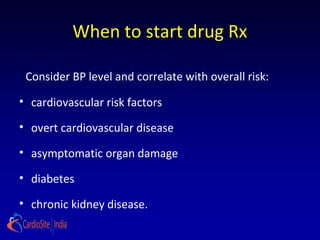
When to start drug Rx
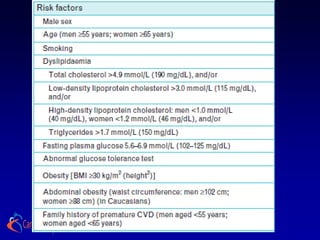
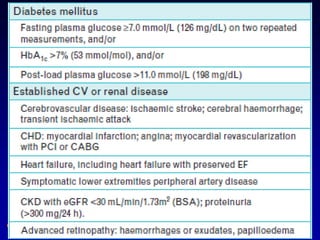
Consider BP level and correlate with overall risk:
• cardiovascular risk factors
• overt cardiovascular disease
• asymptomatic organ damage
• diabetes
• chronic kidney disease.
Asymptomatic Target Organ Damage
(TOD)
√
√
Pulse pressure ( in the elderly) >= 60 mmHg
Electrocardiograhic LVH( Sokolow-Lyon index > 3.5 mV; RaVL > 1.` mV; Cornell
voltage duration product> 244 mV* ms), or
Echocardiographic LVH [ LVM index: men > 115 g/m2; women > 95 g/m2
(BSA)]a
Carotid wall thickening (IMT > 0.9 mm) or plaque
Carotid- femoral PWV > 10 m/s
Ankle- brachial index < 0.9
CKD with Egfr 30-60 ml/min/1.73 m2 (BSA)
Microalbuminuria (30-300 mg/24 h), or albumin- creatinine ratio(30-300
mg/g; 3.4-34 mg/mmol) (preferentially on morning spot urine)
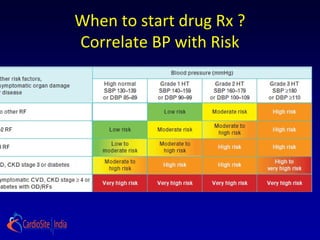
When to start drug Rx ?
Correlate BP with Risk
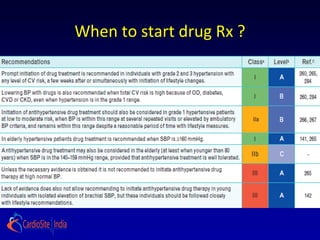
When to start drug Rx ?
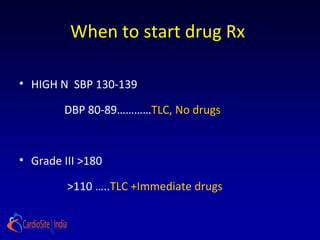
When to start drug Rx
• HIGH N SBP 130-139
DBP 80-89…………TLC, No drugs
• Grade III >180
>110 …..TLC +Immediate drugs
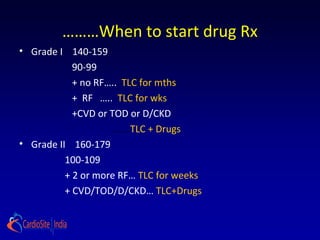
………When to start drug Rx
• Grade I 140-159
90-99
+ no RF….. TLC for mths
+ RF ….. TLC for wks
+CVD or TOD or D/CKD
…….TLC + Drugs
• Grade II 160-179
100-109
+ 2 or more RF… TLC for weeks
+ CVD/TOD/D/CKD… TLC+Drugs
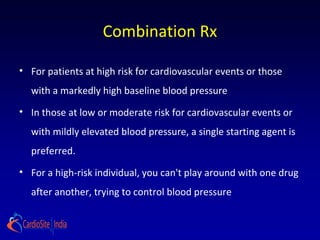
Combination Rx
• For patients at high risk for cardiovascular events or those
with a markedly high baseline blood pressure
• In those at low or moderate risk for cardiovascular events or
with mildly elevated blood pressure, a single starting agent is
preferred.
• For a high-risk individual, you can't play around with one drug
after another, trying to control blood pressure
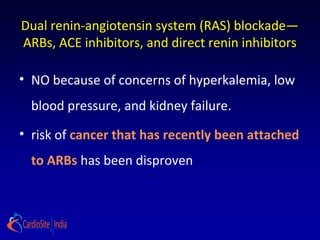
Dual renin-angiotensin system (RAS) blockade—
ARBs, ACE inhibitors, and direct renin inhibitors
• NO because of concerns of hyperkalemia, low
blood pressure, and kidney failure.
• risk of cancer that has recently been attached
to ARBs has been disproven
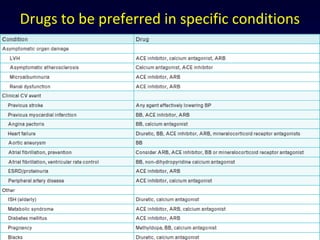
Drugs to be preferred in specific conditions
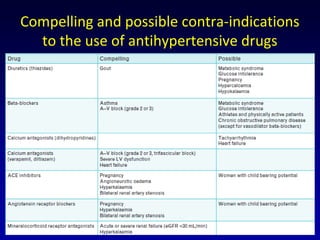
Compelling and possible contra-indications
to the use of antihypertensive drugs
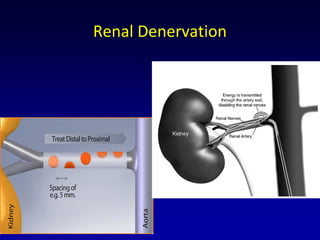
Renal Denervation
Renal denervation- ESH/ECS 2013
• Simply labeled as "promising" therapy
• Yet to establish safety and efficacy against the best
possible drug regimens
• Will it translate into reductions in cardiovascular
morbidity and mortality ?
THANK YOU!!!

Hypertension guidelines ESH ESC 2013

  • 1.
    Hypertension Guidelines: ESH/ESC 2013 Dr.Akshay Mehta Nanavati Hospital Asian Heart Institute
  • 2.
    Definitions and classificationof office blood pressure levels (mmHg) Category Systolic Diastolic Optimal < 120 And < 80 Normal 120-129 And/or 80-84 High normal 130-139 And/or 85-89 Grade 1 hypertension 140-159 And/or 90-99 Grade 2 hypertension 160-179 And/or 100-109 Grade 3 hypertension > = 180 And/or > = 110 Isolated systolic hypertension >= 140 and < 90
  • 3.
    BP Goals • allbe treated to <140/90 mm Hg • Except : diabetes (<85 mm Hg diastolic) • In patients near 80 years age, the systolic blood- pressure target should be 140 to 150 mm Hg, but physicians can go lower than 140 mm Hg if the patient is fit and healthy-mentally & physically
  • 5.
  • 6.
    Emphasis on ambulatoryblood- pressure monitoring (ABPM). • It provides a large number of measurements outside the medical environment • More closely correlated to end-organ damage and cardiovascular events than office blood- pressure measurements
  • 8.
    Home BP v/sAmbulatory BP Home BP • Multiple measurements over several days, or even longer periods • in the individual’s usual environment • notes day-to-day BP variability • cheaper • more widely available and • more easily repeatable. Ambulatory BP • BP data during routine, day-to- day activities and • during sleep • Waking surge • quantifies short-term BP variability • Correlation with symptoms • Most accurate
  • 9.
    Definitions of hypertensionby office and out-of-office blood pressure levels Category Systolic BP(mmHg) Diastolic BP (mmHg) Office BP >= 140 And/or >= 90 Ambulatory BP Daytime (or awake) >= 135 And/or >= 85 Nighttime (or asleep) > = 120 And/or >= 70 24 hour > = 130 And/or >= 80 Home BP >= 135 And/or > = 85
  • 10.
    Life style changes Salt •A reduction to 5 g per day can decrease systolic blood pressure about 1 to 2 mm Hg in normotensive individuals and 4 to 5 mm Hg in hypertensive patients, he said. Wt loss • Losing about 5 kg can reduce systolic blood pressure by as much as 4 mm Hg, aerobic endurance training • can reduce systolic blood pressure 7 mm Hg
  • 11.
    How long tocontinue lifestyle changes alone ? • For low/moderate-risk individuals a few months • For higher-risk patients, a few weeks
  • 12.
    When to startdrug Rx Consider BP level and correlate with overall risk: • cardiovascular risk factors • overt cardiovascular disease • asymptomatic organ damage • diabetes • chronic kidney disease.
  • 14.
    Asymptomatic Target OrganDamage (TOD) √ √ Pulse pressure ( in the elderly) >= 60 mmHg Electrocardiograhic LVH( Sokolow-Lyon index > 3.5 mV; RaVL > 1.` mV; Cornell voltage duration product> 244 mV* ms), or Echocardiographic LVH [ LVM index: men > 115 g/m2; women > 95 g/m2 (BSA)]a Carotid wall thickening (IMT > 0.9 mm) or plaque Carotid- femoral PWV > 10 m/s Ankle- brachial index < 0.9 CKD with Egfr 30-60 ml/min/1.73 m2 (BSA) Microalbuminuria (30-300 mg/24 h), or albumin- creatinine ratio(30-300 mg/g; 3.4-34 mg/mmol) (preferentially on morning spot urine)
  • 16.
    When to startdrug Rx ? Correlate BP with Risk
  • 17.
    When to startdrug Rx ?
  • 18.
    When to startdrug Rx • HIGH N SBP 130-139 DBP 80-89…………TLC, No drugs • Grade III >180 >110 …..TLC +Immediate drugs
  • 19.
    ………When to startdrug Rx • Grade I 140-159 90-99 + no RF….. TLC for mths + RF ….. TLC for wks +CVD or TOD or D/CKD …….TLC + Drugs • Grade II 160-179 100-109 + 2 or more RF… TLC for weeks + CVD/TOD/D/CKD… TLC+Drugs
  • 20.
    Combination Rx • Forpatients at high risk for cardiovascular events or those with a markedly high baseline blood pressure • In those at low or moderate risk for cardiovascular events or with mildly elevated blood pressure, a single starting agent is preferred. • For a high-risk individual, you can't play around with one drug after another, trying to control blood pressure
  • 21.
    Dual renin-angiotensin system(RAS) blockade— ARBs, ACE inhibitors, and direct renin inhibitors • NO because of concerns of hyperkalemia, low blood pressure, and kidney failure. • risk of cancer that has recently been attached to ARBs has been disproven
  • 22.
    Drugs to bepreferred in specific conditions
  • 23.
    Compelling and possiblecontra-indications to the use of antihypertensive drugs
  • 24.
  • 25.
    Renal denervation- ESH/ECS2013 • Simply labeled as "promising" therapy • Yet to establish safety and efficacy against the best possible drug regimens • Will it translate into reductions in cardiovascular morbidity and mortality ?
  • 26.