1
By: Komal Yaseen
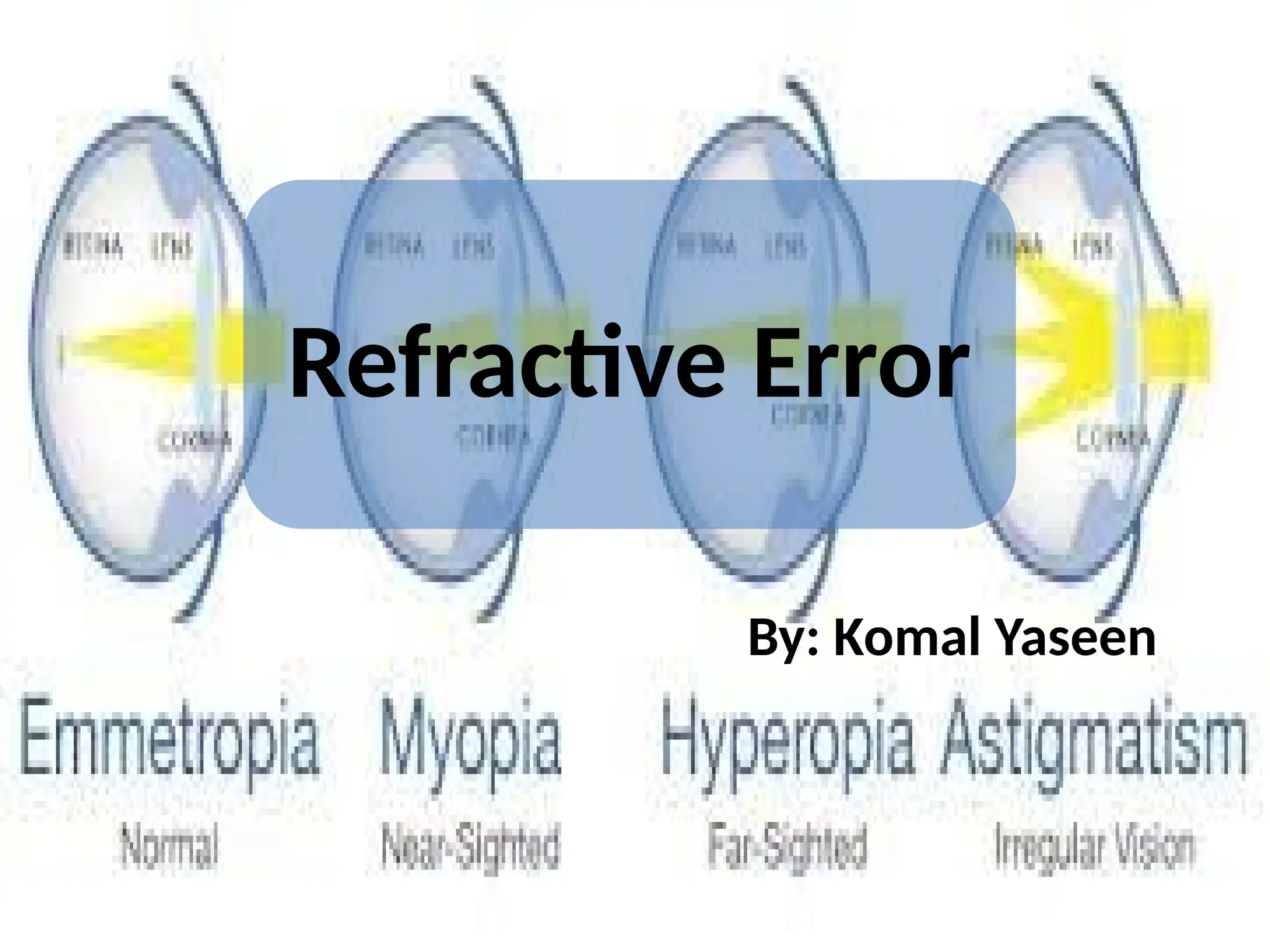
Refractive Error
2
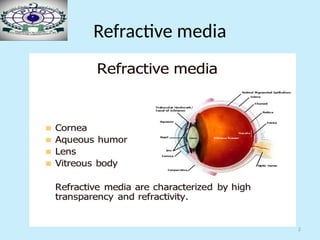
Refractive media
3
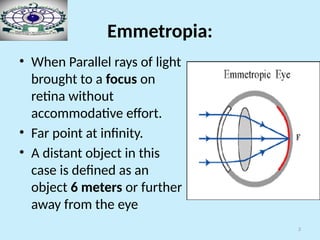
Emmetropia:
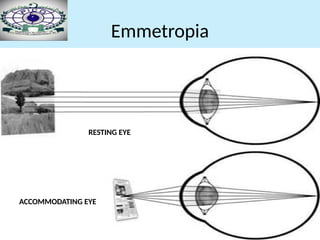
• When Parallel rays of light
brought to a focus on
retina without
accommodative effort.
• Far point at infinity.
• A distant object in this
case is defined as an
object 6 meters or further
away from the eye
4
Emmetropia
RESTING EYE
ACCOMMODATING EYE
5
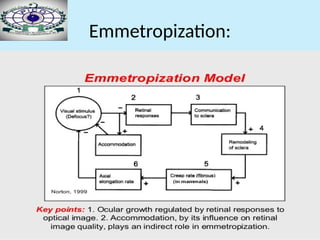
Emmetropization:
6
Ametropia:
• An eye that has refractive error when the
rays of light (light from distant objects)
coming from infinity and dose not focus
on the retina without using any
accommodation.
• The word "ametropia" can be used
interchangeably with "refractive error" as
they refer to the same thing.
7
Refractive Error
• ALL ERRORS ARE DEFINED WITH THE
FOLLOWING CONDITIONS:
– Light rays are parallel (coming from distance)
– The eye is at rest (not accommodating)
– The error is defined based on where the light
focuses
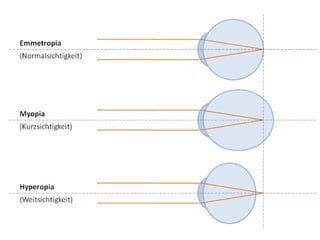
• Hyperopia/ Hypermetropia (Long measure)
• Myopia (Short measure)
8
9
Types of Refractive Error
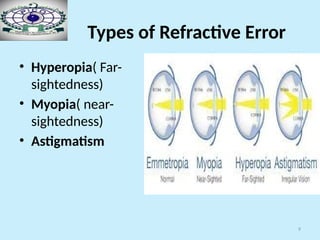
• Hyperopia( Far-
sightedness)
• Myopia( near-
sightedness)
• Astigmatism
10
Hypermetropia
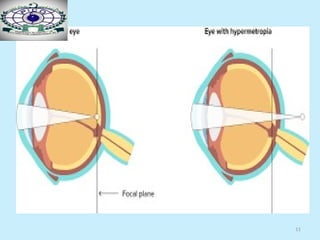
• Parallel rays of light brought to a focus
behind retina with relaxed accommodation.
•At birth practically all eyes are hypermetropic
to the extent of 2.5 to 3.0 Diopters.
•Emmetropisation result as the eye grows.
•Emmetropia may not be reached and
hypermetropia may persist.
11
12
Etiology:
• Axial hyperopia: 1mm=(3D of Error)
• Curvature hyperopia: 1mm=(6D of Error)
• Index hyperopia: cornea, aqueous, lens,
vitreous.
• Positional hyperopia: lens dislocation/lens
sublocation
• Absence of crystalline lens: Aphakia
• Loss of accomodation: age and
medication
13
Types of Hypermetropia
• Simple hyperopia
- Biological variance in the shape of the eye and
position of the lens.
-Axial or Curvatural
• Pathological hyperopia
- Abnormal eye anatomy.
- Caused by injury to the eye, Maldevelopment
of eye, Orbital inflammation /neoplasm.
• Functional hyperopia
This is caused by the inability of the eye to
accommodate.
- 3rd
nerve palsy/internal ophthalmoplegia
14
HYPEROPIA ACCORDING TO THE AMOUNT
OF ACCOMMODATION
• Total hyperopia may therefore be divided in
to
• 1) latent hyperopia =Overcome
physiologically by the tone of the cilliary
muscle. Usually 1D.
• 2) Manifest hyperopia
• a) Facultative hyperopia=Over come by an
effort of accommodation.
• b) Absolute hyperopia =Which cannot be
overcome by accommodation .
15
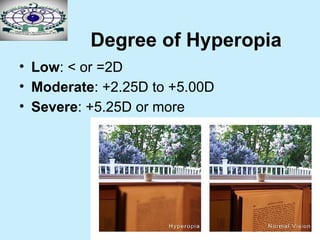
Degree of Hyperopia
• Low: < or =2D
• Moderate: +2.25D to +5.00D
• Severe: +5.25D or more
16
Symptoms:
• Blurry vision at near
• Rubbing
• Headache/ frontal
• Eye strain
• Watering
• Deviation of eye
17
Signs:
• Eyeball size= small
• Cornea= small/ flat
• A/C= shallow/ narrow angle
• Esophoria: Inward deviation of eye
• With accomodation eye tend to converge
• V/A: depends on degree of hyperopia and
power of accomodation
18
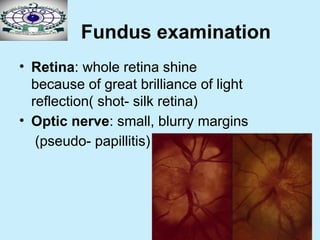
Fundus examination
• Retina: whole retina shine
because of great brilliance of light
reflection( shot- silk retina)
• Optic nerve: small, blurry margins
(pseudo- papillitis)
19
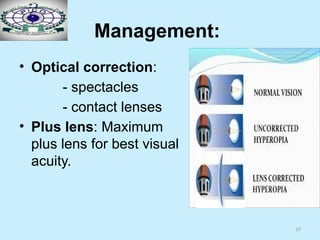
Management:
• Optical correction:
- spectacles
- contact lenses
• Plus lens: Maximum
plus lens for best visual
acuity.
20
• Contact lens:
• Resist to wear spectacles.
• Improve Cosmosis.
• Aniseikonia, anisometropia.
• Unilateral high hypermetropia.
21
Management strategies:
• Young children( Birth to 10 year)
• NO Treatment - error with in physiological
limits, asymptomatic.
• Treatment require:
- 05year = >3D (not according to age)
-Squint condition( full correction)
• School going : visual demand for near work
( Cycloplegic refraction)
22
• Amblyopia therapy: Patching exercise
• Occlusion therapy: 6 hrs alternate use of both
eyes, initial follow up 15 days or 1month.
23
Older children & Pre – Presbyopic
adults (10 -40 yrs)
• Low/ moderate hypermetropia – optical
correction after cycloplegia and subjective
refraction.
• Uncorrected hypermetropia lead to near
vision problem in early age (30 to 35)
• Needs subjective correction after cycloplegic
retinoscopy & require higher near addition
than age.
24
Continue…..
• High hypermetropia:
If not accepting high / strongest lens:
undercorrect at first then strengthen the
lens at interval of few months ( in which
weaker lens for distant & full correction for
near is given ) -untill the full correction is
comfortably borne
25
• Pathological hyperopia:
• Treat the underline cause.
• Manage hyperopia with best possible option.
• Patient education:
• Avoid stress and eye strain
• Use appropriate lens
• Use good light at work
• Proper diet
26
• Prognosis and follow up:
• Physiological hyperopia= No progress
• Children with hyperopia= 3 to 6 months
• Adults with asymptomatic: 1 to 2 years
27

refractive error.pptx . . . . . . . .

  • 1.
  • 2.
  • 3.
    3 Emmetropia: • When Parallelrays of light brought to a focus on retina without accommodative effort. • Far point at infinity. • A distant object in this case is defined as an object 6 meters or further away from the eye
  • 4.
  • 5.
  • 6.
    6 Ametropia: • An eyethat has refractive error when the rays of light (light from distant objects) coming from infinity and dose not focus on the retina without using any accommodation. • The word "ametropia" can be used interchangeably with "refractive error" as they refer to the same thing.
  • 7.
    7 Refractive Error • ALLERRORS ARE DEFINED WITH THE FOLLOWING CONDITIONS: – Light rays are parallel (coming from distance) – The eye is at rest (not accommodating) – The error is defined based on where the light focuses • Hyperopia/ Hypermetropia (Long measure) • Myopia (Short measure)
  • 8.
  • 9.
    9 Types of RefractiveError • Hyperopia( Far- sightedness) • Myopia( near- sightedness) • Astigmatism
  • 10.
    10 Hypermetropia • Parallel raysof light brought to a focus behind retina with relaxed accommodation. •At birth practically all eyes are hypermetropic to the extent of 2.5 to 3.0 Diopters. •Emmetropisation result as the eye grows. •Emmetropia may not be reached and hypermetropia may persist.
  • 11.
  • 12.
    12 Etiology: • Axial hyperopia:1mm=(3D of Error) • Curvature hyperopia: 1mm=(6D of Error) • Index hyperopia: cornea, aqueous, lens, vitreous. • Positional hyperopia: lens dislocation/lens sublocation • Absence of crystalline lens: Aphakia • Loss of accomodation: age and medication
  • 13.
    13 Types of Hypermetropia •Simple hyperopia - Biological variance in the shape of the eye and position of the lens. -Axial or Curvatural • Pathological hyperopia - Abnormal eye anatomy. - Caused by injury to the eye, Maldevelopment of eye, Orbital inflammation /neoplasm. • Functional hyperopia This is caused by the inability of the eye to accommodate. - 3rd nerve palsy/internal ophthalmoplegia
  • 14.
    14 HYPEROPIA ACCORDING TOTHE AMOUNT OF ACCOMMODATION • Total hyperopia may therefore be divided in to • 1) latent hyperopia =Overcome physiologically by the tone of the cilliary muscle. Usually 1D. • 2) Manifest hyperopia • a) Facultative hyperopia=Over come by an effort of accommodation. • b) Absolute hyperopia =Which cannot be overcome by accommodation .
  • 15.
    15 Degree of Hyperopia •Low: < or =2D • Moderate: +2.25D to +5.00D • Severe: +5.25D or more
  • 16.
    16 Symptoms: • Blurry visionat near • Rubbing • Headache/ frontal • Eye strain • Watering • Deviation of eye
  • 17.
    17 Signs: • Eyeball size=small • Cornea= small/ flat • A/C= shallow/ narrow angle • Esophoria: Inward deviation of eye • With accomodation eye tend to converge • V/A: depends on degree of hyperopia and power of accomodation
  • 18.
    18 Fundus examination • Retina:whole retina shine because of great brilliance of light reflection( shot- silk retina) • Optic nerve: small, blurry margins (pseudo- papillitis)
  • 19.
    19 Management: • Optical correction: -spectacles - contact lenses • Plus lens: Maximum plus lens for best visual acuity.
  • 20.
    20 • Contact lens: •Resist to wear spectacles. • Improve Cosmosis. • Aniseikonia, anisometropia. • Unilateral high hypermetropia.
  • 21.
    21 Management strategies: • Youngchildren( Birth to 10 year) • NO Treatment - error with in physiological limits, asymptomatic. • Treatment require: - 05year = >3D (not according to age) -Squint condition( full correction) • School going : visual demand for near work ( Cycloplegic refraction)
  • 22.
    22 • Amblyopia therapy:Patching exercise • Occlusion therapy: 6 hrs alternate use of both eyes, initial follow up 15 days or 1month.
  • 23.
    23 Older children &Pre – Presbyopic adults (10 -40 yrs) • Low/ moderate hypermetropia – optical correction after cycloplegia and subjective refraction. • Uncorrected hypermetropia lead to near vision problem in early age (30 to 35) • Needs subjective correction after cycloplegic retinoscopy & require higher near addition than age.
  • 24.
    24 Continue….. • High hypermetropia: Ifnot accepting high / strongest lens: undercorrect at first then strengthen the lens at interval of few months ( in which weaker lens for distant & full correction for near is given ) -untill the full correction is comfortably borne
  • 25.
    25 • Pathological hyperopia: •Treat the underline cause. • Manage hyperopia with best possible option. • Patient education: • Avoid stress and eye strain • Use appropriate lens • Use good light at work • Proper diet
  • 26.
    26 • Prognosis andfollow up: • Physiological hyperopia= No progress • Children with hyperopia= 3 to 6 months • Adults with asymptomatic: 1 to 2 years
  • 27.