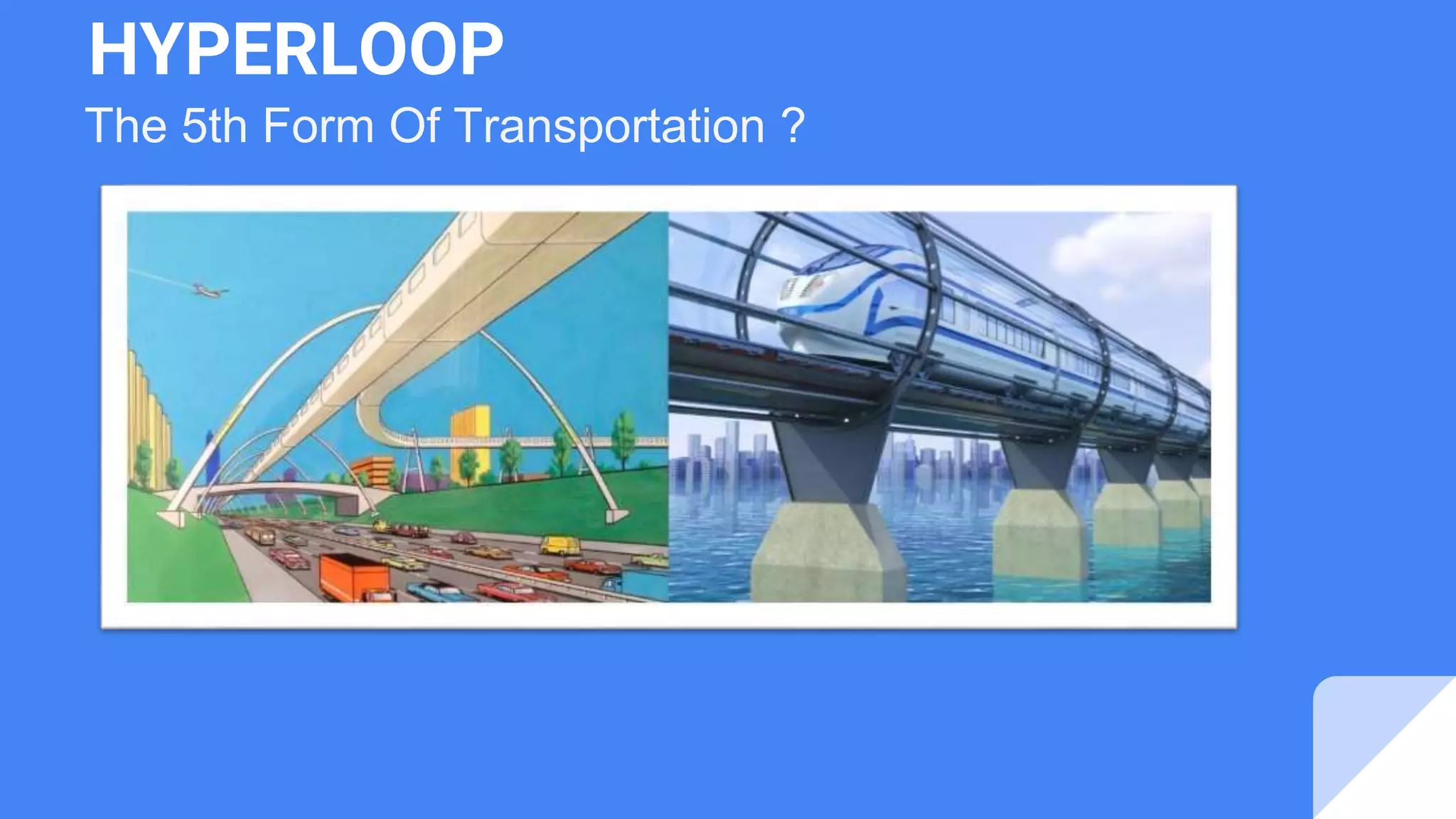
HYPERLOOP
The 5th Form Of Transportation ?
Related Projects
● In 1812 the British mechanical engineer and inventor George Medhurst wrote a
book detailing his idea of transporting passengers and goods through air-tight
tubes using air propulsion.
● Atmospheric railways were built in Ireland and England, most notably the
London and Croydon Railway, the first stage opening in 1846.
● The Crystal Palace pneumatic railway operated around 1864 and used large
fans, some 22 feet (6.7 m) in diameter,that were powered by a steam engine.
The tunnels are now lost but the line operated successfully for over a year.
Cont...
● In the 1910s, vacuum trains were first described by rocket pioneer Robert
Goddard. While Hyperloop has significant innovations over early proposals for
reduced pressure or vacuum-tube transportation apparatus, the work of
Goddard"appears to have the greatest overlap with the Hyperloop."
● Swissmetro was a proposal to run a maglev train in a low pressure
environment. Concessions were granted to Swissmetro in the early 2000s to
connect the Swiss cities ofSt. Gallen, Zurich, Basel and Geneva. Studies of
commercial feasibility reached differing conclusions and the vactrain was
never built.
The Hyperloop
● Proposed by ELON MUSK American business magnate, investor, and inventor.
He is currently the CEO & CTO of SpaceX and CEO & Chief Product Architect of
Tesla Motors.
● A high-speed train that promises travel at twice the speed of a commercial
aircraft, transporting passengers from Los Angeles to San Francisco in just 30
minutes.
● A high-level alpha design for the system was published on August 12, 2013, in a
whitepaper posted to the Tesla and SpaceX blogs.
● A Hyperloop would be "an elevated, reduced-pressure tube that contains
pressurized capsules driven within the tube by a number of linear electric
motors. ”
Cont...
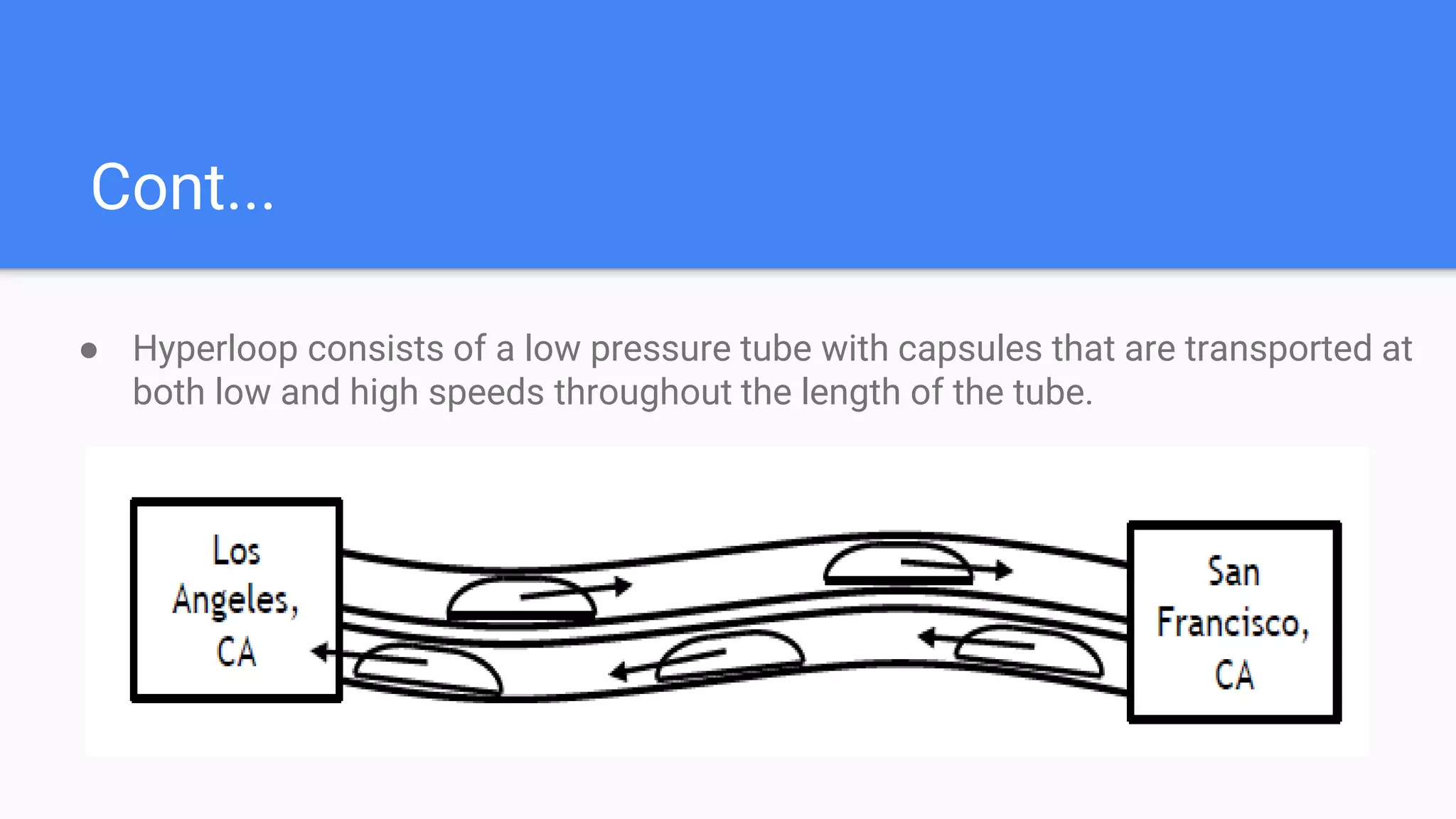
● Hyperloop consists of a low pressure tube with capsules that are transported at
both low and high speeds throughout the length of the tube.
Cont...
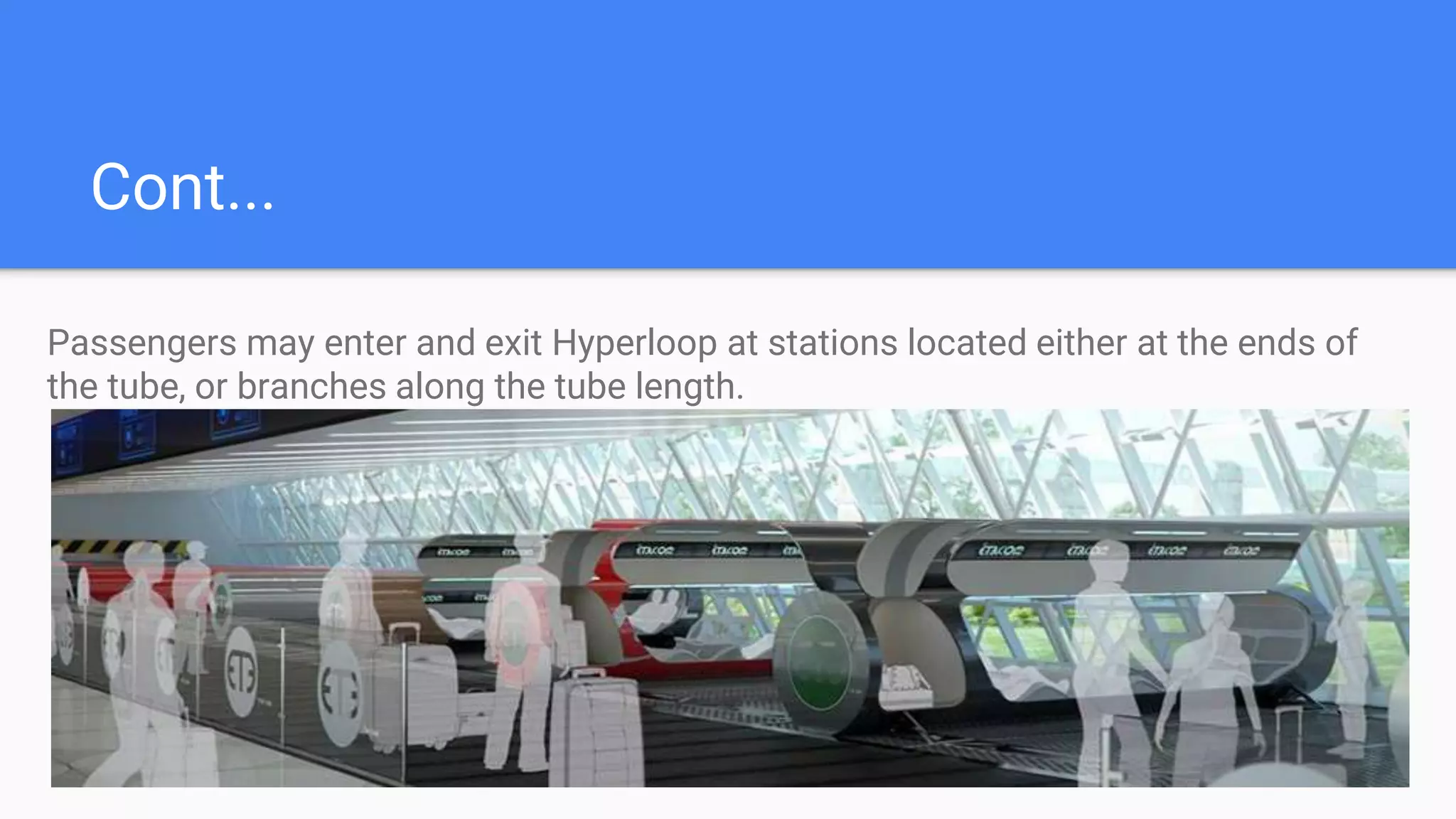
Passengers may enter and exit Hyperloop at stations located either at the ends of
the tube, or branches along the tube length.
Components of Hyperloop
Transportation System
● Capsule
● Tube
● Propulsion
● Route
The Capsule
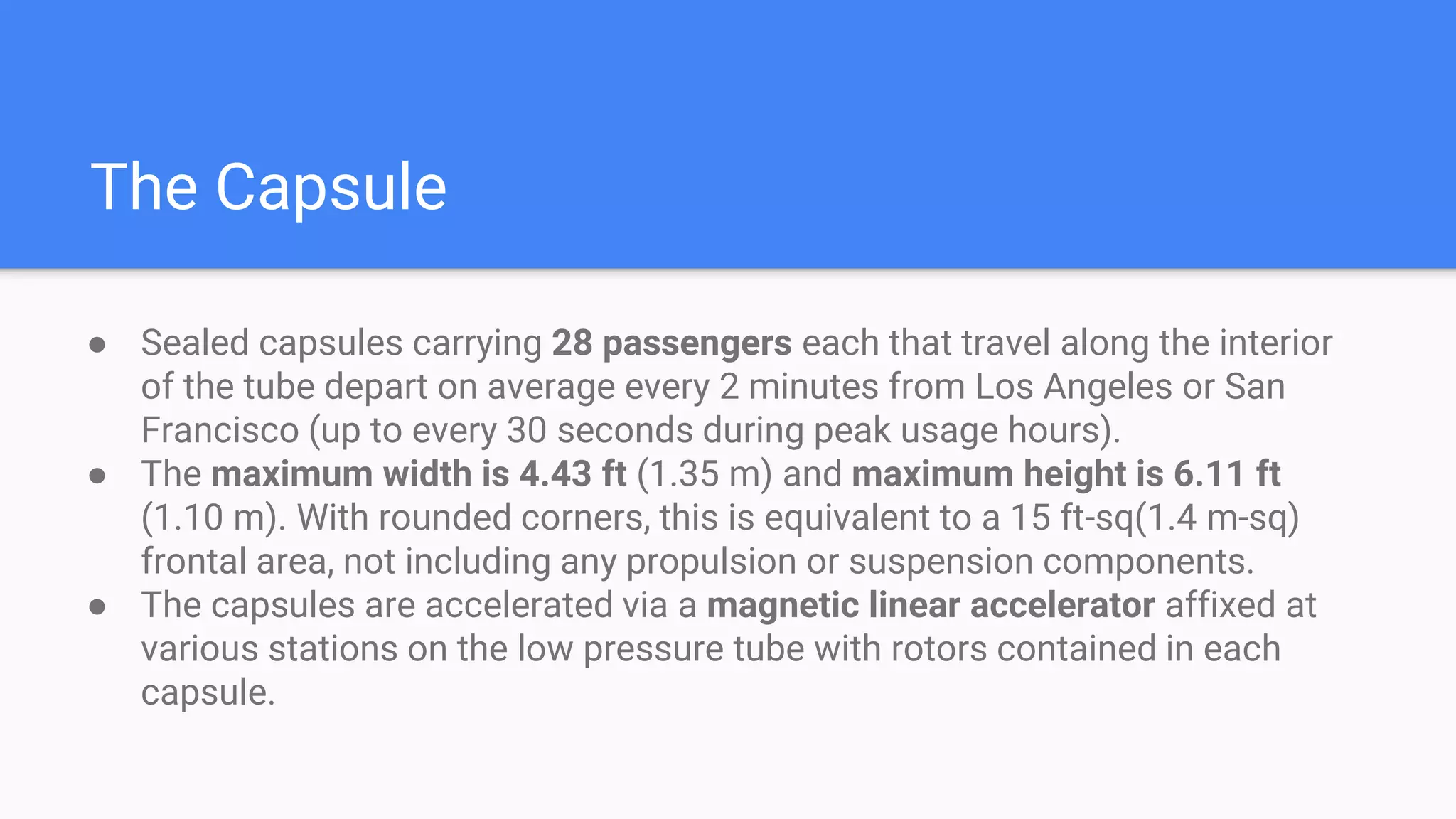
● Sealed capsules carrying 28 passengers each that travel along the interior
of the tube depart on average every 2 minutes from Los Angeles or San
Francisco (up to every 30 seconds during peak usage hours).
● The maximum width is 4.43 ft (1.35 m) and maximum height is 6.11 ft
(1.10 m). With rounded corners, this is equivalent to a 15 ft-sq(1.4 m-sq)
frontal area, not including any propulsion or suspension components.
● The capsules are accelerated via a magnetic linear accelerator affixed at
various stations on the low pressure tube with rotors contained in each
capsule.
Cont...
● For travel at high speeds, the greatest power requirement is normally to
overcome air resistance.This system can achieve an average speed of 598
mph(962 km/h), and a top speed of 760 mph (1,220 km/h).
● Aerodynamic drag increases with the square of speed, and thus the power
requirement increases with the cube of speed.For example, to travel twice as
fast a vehicle must overcome four times the aerodynamic resistance, and input
eight times the power.
● Just as aircraft climb to high altitudes to travel through less dense air,
Hyperloop encloses the capsules in a reduced pressure tube.
Cont...
● The pressure of air in Hyperloop is about 1/6 the pressure of the atmosphere
on Mars.
● This is an operating pressure of 100 Pascal’s, which reduces the drag force of
the air by 1,000 times relative to sea level conditions and would be equivalent
to flying above 150,000 feet altitude
● The capsules are separated within the tube by approx 23 miles (37 km) on
average during operation and are supported via air bearings that operate using
a compressed air reservoir and aerodynamic lift.
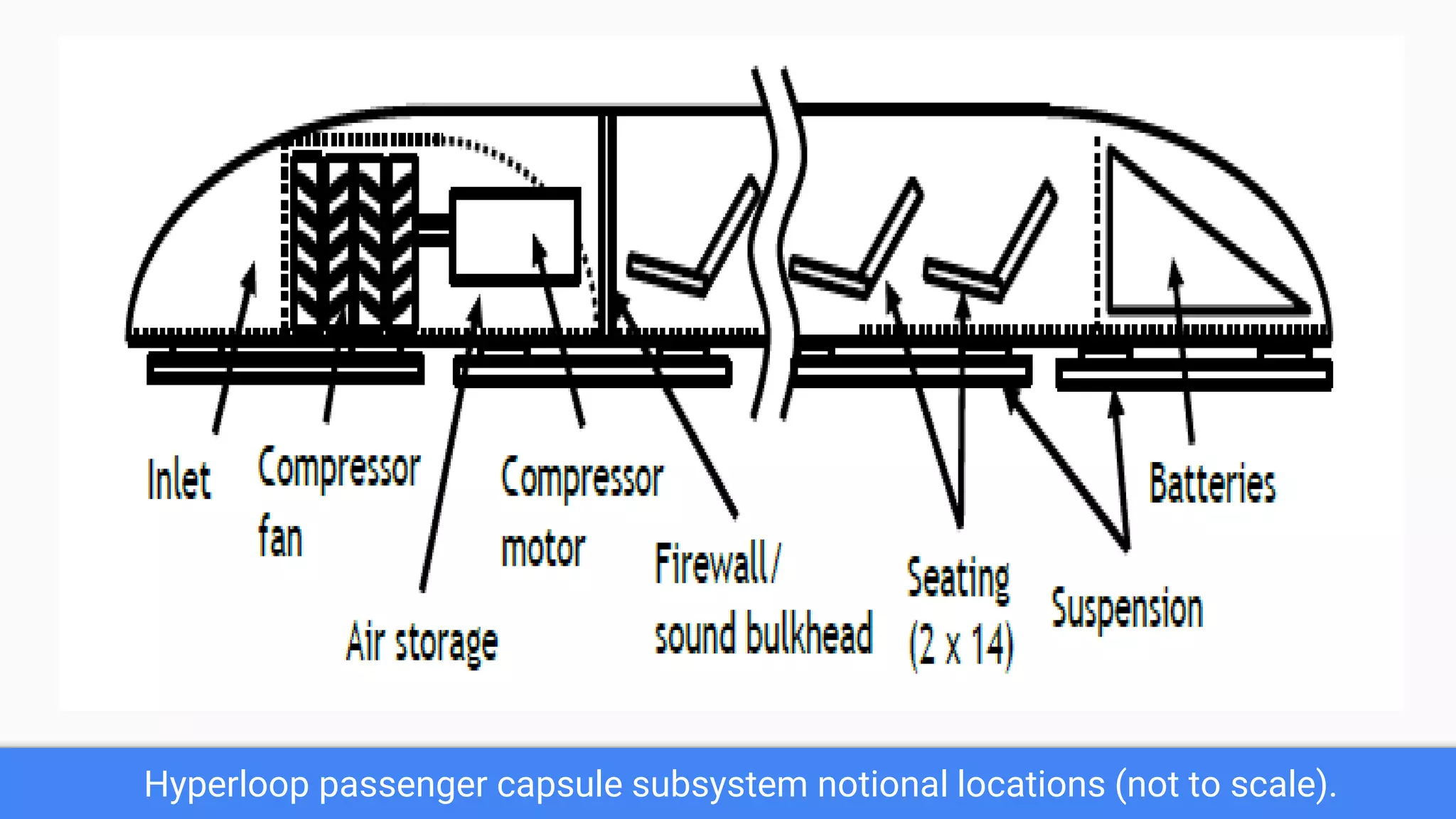
Hyperloop passenger capsule subsystem notional locations (not to scale).
Tube
The tube is made of steel. Two tubes will be
welded together in a side by side configuration
to allow the capsules to travel both directions.
Pylons are placed every 100 ft (30 m) to support
the tube.
Solar arrays will cover the top of the tubes in
order to provide power to the system.
Hyperloop capsule in tube cutaway with attached solar arrays.
Cont...
The inner diameter of the tube is optimized to be 7 ft 4 in. (2.23 m) which is
small enough to keep material cost low while large enough to provide some
alleviation of choked air flow around the capsule.
The tube cross-sectional area is 42.2 ft sq (3.91 msq) giving a capsule/tube
area ratio of 36% or a diameter ratio of 60%.
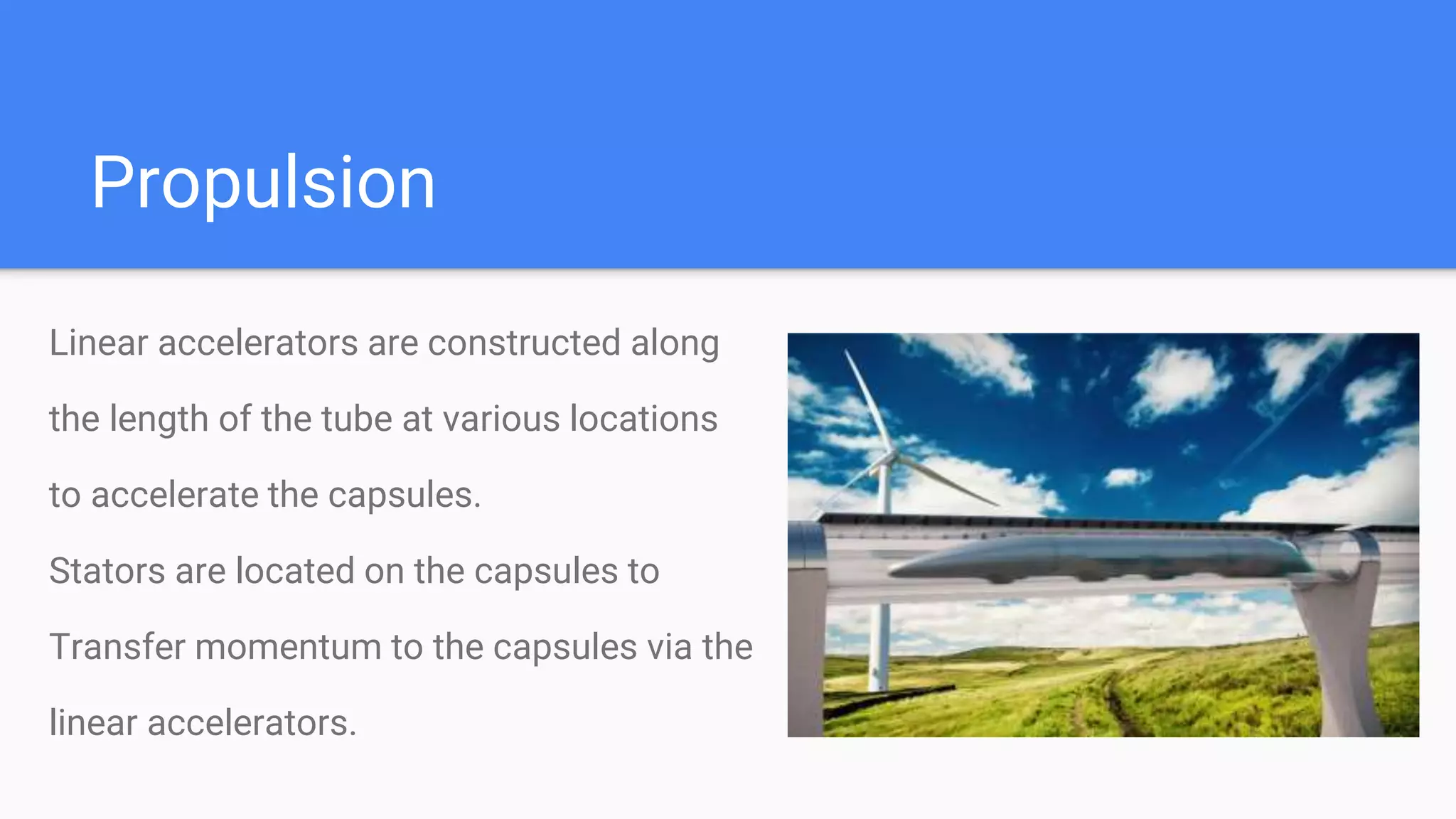
Linear accelerators are constructed along
the length of the tube at various locations
to accelerate the capsules.
Stators are located on the capsules to
Transfer momentum to the capsules via the
linear accelerators.
Propulsion
Route
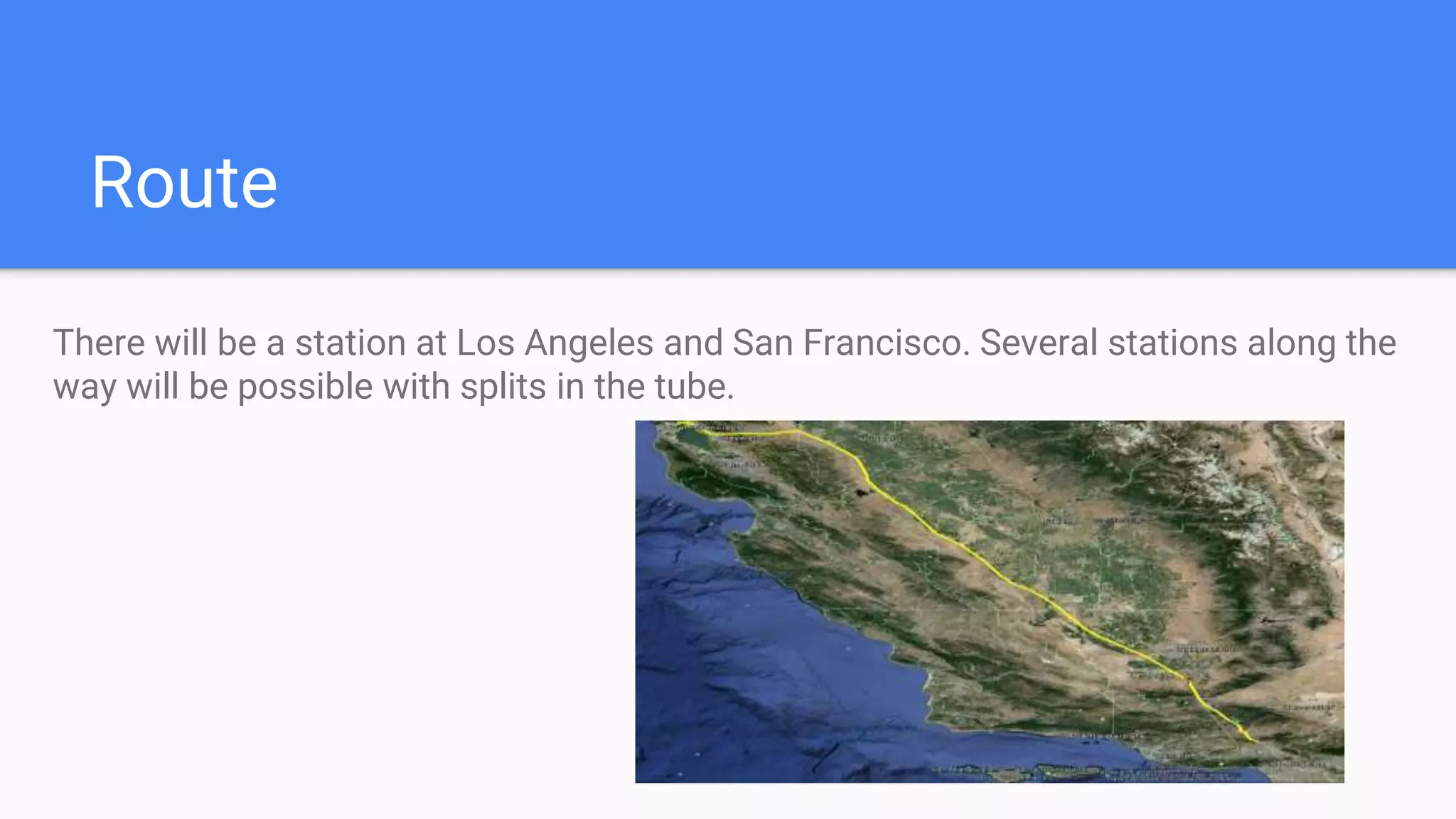
There will be a station at Los Angeles and San Francisco. Several stations along the
way will be possible with splits in the tube.
Cont...
Hyperloop high-speed transport system proposed for 5 Indian routes among 30
others across the world were unveiled at The Hyperloop One Vision For India summit
in New Delhi on Feb-28,2017.
● Bengaluru-to-Chennai: 334km in 20 min.
● Bengaluru-to-Thiruvananthapuram: 736km in 41 min.
● Delhi-to-Mumbai via Jaipur and Indore: 1,317km in 55 min.
● Mumbai-to-Chennai via Bengaluru: 1,102km 50 min.
● Mumbai-to-Kolkata: 2057km in 123 min.
Advantages
● Safe
● Fast
● Low cost
● Immune to weather
● Energy saving
● Sustainably self-powering
● Resistant to earthquakes
● Not disruptive to those along the route
● Environmentally friendly
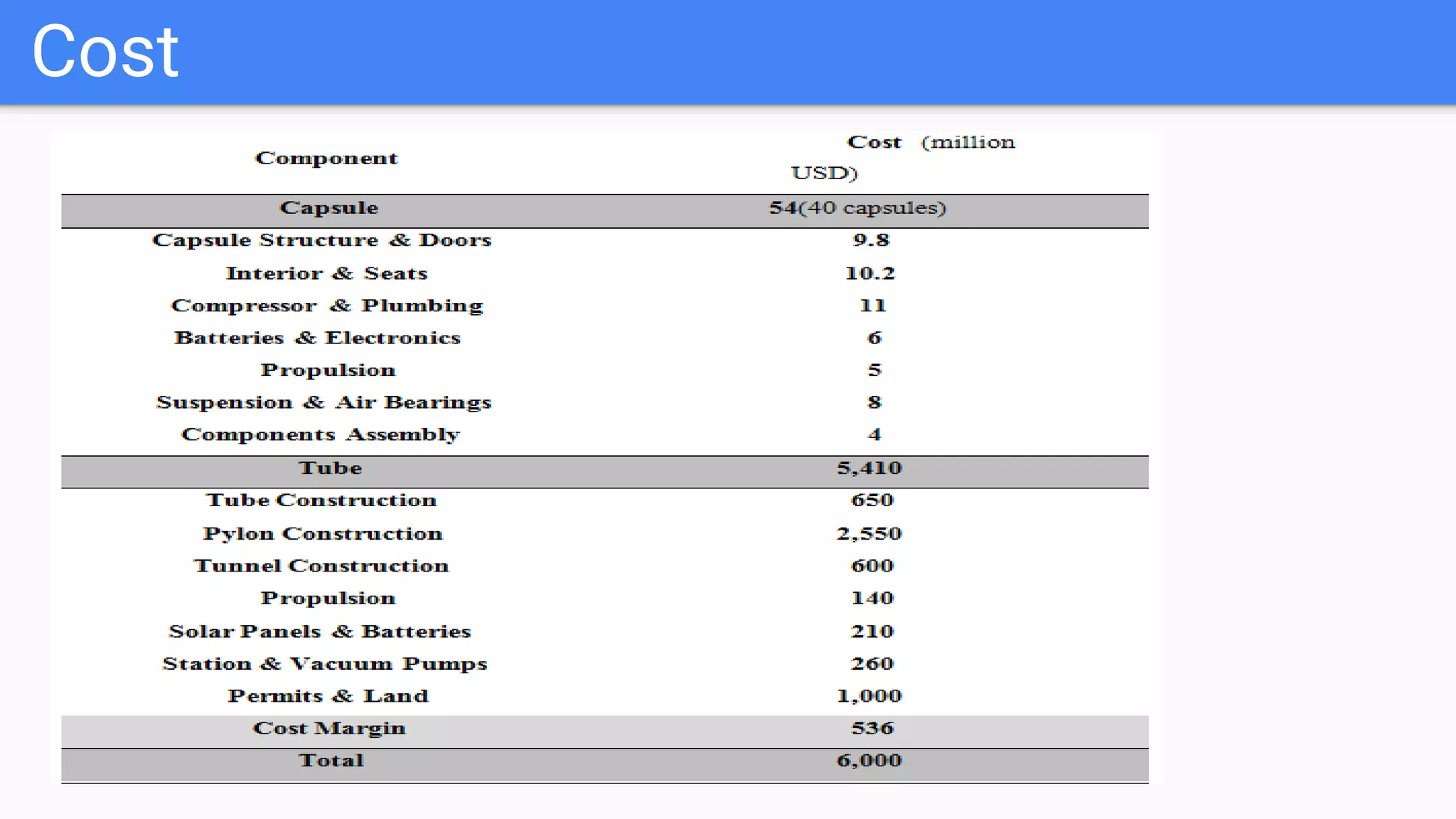
Cost
Cont...
● 1/10th of the cost of the high speed California Rail System.
● Cost of ride from LA to San Francisco will be around $20 bucks.
Critics
● Motion Sickness.
● Experience could be frightening.
● Fast acceleration and noisy vibrations.
● Malfunctions and emergency evacuations.
● The cost may be high as anticipated.
Companies Funding Hyperloop
1) Hyperloop Transportation Technologies.
2) SpaceX
3) Hyperloop One(Formerly known as Hyperloop Technologies)
Hyperloop Prototype First Successful Test
The MIT Hyperloop team developed the first Hyperloop pod prototype which they
unveiled at the MIT museum on May11, 2016.Their design was based on
electrodynamic suspension for levitating and used eddy current braking.
On Jan, 2017, the MIT hyperloop pod demonstrated the first ever low pressure
Hyperloop run in the world.
Hyperloop

Hyperloop

  • 1.
    HYPERLOOP The 5th FormOf Transportation ?
  • 2.
    Related Projects ● In1812 the British mechanical engineer and inventor George Medhurst wrote a book detailing his idea of transporting passengers and goods through air-tight tubes using air propulsion. ● Atmospheric railways were built in Ireland and England, most notably the London and Croydon Railway, the first stage opening in 1846. ● The Crystal Palace pneumatic railway operated around 1864 and used large fans, some 22 feet (6.7 m) in diameter,that were powered by a steam engine. The tunnels are now lost but the line operated successfully for over a year.
  • 3.
    Cont... ● In the1910s, vacuum trains were first described by rocket pioneer Robert Goddard. While Hyperloop has significant innovations over early proposals for reduced pressure or vacuum-tube transportation apparatus, the work of Goddard"appears to have the greatest overlap with the Hyperloop." ● Swissmetro was a proposal to run a maglev train in a low pressure environment. Concessions were granted to Swissmetro in the early 2000s to connect the Swiss cities ofSt. Gallen, Zurich, Basel and Geneva. Studies of commercial feasibility reached differing conclusions and the vactrain was never built.
  • 4.
    The Hyperloop ● Proposedby ELON MUSK American business magnate, investor, and inventor. He is currently the CEO & CTO of SpaceX and CEO & Chief Product Architect of Tesla Motors. ● A high-speed train that promises travel at twice the speed of a commercial aircraft, transporting passengers from Los Angeles to San Francisco in just 30 minutes. ● A high-level alpha design for the system was published on August 12, 2013, in a whitepaper posted to the Tesla and SpaceX blogs. ● A Hyperloop would be "an elevated, reduced-pressure tube that contains pressurized capsules driven within the tube by a number of linear electric motors. ”
  • 5.
    Cont... ● Hyperloop consistsof a low pressure tube with capsules that are transported at both low and high speeds throughout the length of the tube.
  • 6.
    Cont... Passengers may enterand exit Hyperloop at stations located either at the ends of the tube, or branches along the tube length.
  • 7.
    Components of Hyperloop TransportationSystem ● Capsule ● Tube ● Propulsion ● Route
  • 8.
    The Capsule ● Sealedcapsules carrying 28 passengers each that travel along the interior of the tube depart on average every 2 minutes from Los Angeles or San Francisco (up to every 30 seconds during peak usage hours). ● The maximum width is 4.43 ft (1.35 m) and maximum height is 6.11 ft (1.10 m). With rounded corners, this is equivalent to a 15 ft-sq(1.4 m-sq) frontal area, not including any propulsion or suspension components. ● The capsules are accelerated via a magnetic linear accelerator affixed at various stations on the low pressure tube with rotors contained in each capsule.
  • 9.
    Cont... ● For travelat high speeds, the greatest power requirement is normally to overcome air resistance.This system can achieve an average speed of 598 mph(962 km/h), and a top speed of 760 mph (1,220 km/h). ● Aerodynamic drag increases with the square of speed, and thus the power requirement increases with the cube of speed.For example, to travel twice as fast a vehicle must overcome four times the aerodynamic resistance, and input eight times the power. ● Just as aircraft climb to high altitudes to travel through less dense air, Hyperloop encloses the capsules in a reduced pressure tube.
  • 10.
    Cont... ● The pressureof air in Hyperloop is about 1/6 the pressure of the atmosphere on Mars. ● This is an operating pressure of 100 Pascal’s, which reduces the drag force of the air by 1,000 times relative to sea level conditions and would be equivalent to flying above 150,000 feet altitude ● The capsules are separated within the tube by approx 23 miles (37 km) on average during operation and are supported via air bearings that operate using a compressed air reservoir and aerodynamic lift.
  • 11.
    Hyperloop passenger capsulesubsystem notional locations (not to scale).
  • 12.
    Tube The tube ismade of steel. Two tubes will be welded together in a side by side configuration to allow the capsules to travel both directions. Pylons are placed every 100 ft (30 m) to support the tube. Solar arrays will cover the top of the tubes in order to provide power to the system.
  • 13.
    Hyperloop capsule intube cutaway with attached solar arrays.
  • 14.
    Cont... The inner diameterof the tube is optimized to be 7 ft 4 in. (2.23 m) which is small enough to keep material cost low while large enough to provide some alleviation of choked air flow around the capsule. The tube cross-sectional area is 42.2 ft sq (3.91 msq) giving a capsule/tube area ratio of 36% or a diameter ratio of 60%.
  • 15.
    Linear accelerators areconstructed along the length of the tube at various locations to accelerate the capsules. Stators are located on the capsules to Transfer momentum to the capsules via the linear accelerators. Propulsion
  • 16.
    Route There will bea station at Los Angeles and San Francisco. Several stations along the way will be possible with splits in the tube.
  • 17.
    Cont... Hyperloop high-speed transportsystem proposed for 5 Indian routes among 30 others across the world were unveiled at The Hyperloop One Vision For India summit in New Delhi on Feb-28,2017. ● Bengaluru-to-Chennai: 334km in 20 min. ● Bengaluru-to-Thiruvananthapuram: 736km in 41 min. ● Delhi-to-Mumbai via Jaipur and Indore: 1,317km in 55 min. ● Mumbai-to-Chennai via Bengaluru: 1,102km 50 min. ● Mumbai-to-Kolkata: 2057km in 123 min.
  • 18.
    Advantages ● Safe ● Fast ●Low cost ● Immune to weather ● Energy saving ● Sustainably self-powering ● Resistant to earthquakes ● Not disruptive to those along the route ● Environmentally friendly
  • 19.
  • 20.
    Cont... ● 1/10th ofthe cost of the high speed California Rail System. ● Cost of ride from LA to San Francisco will be around $20 bucks.
  • 21.
    Critics ● Motion Sickness. ●Experience could be frightening. ● Fast acceleration and noisy vibrations. ● Malfunctions and emergency evacuations. ● The cost may be high as anticipated.
  • 22.
    Companies Funding Hyperloop 1)Hyperloop Transportation Technologies. 2) SpaceX 3) Hyperloop One(Formerly known as Hyperloop Technologies)
  • 23.
    Hyperloop Prototype FirstSuccessful Test The MIT Hyperloop team developed the first Hyperloop pod prototype which they unveiled at the MIT museum on May11, 2016.Their design was based on electrodynamic suspension for levitating and used eddy current braking. On Jan, 2017, the MIT hyperloop pod demonstrated the first ever low pressure Hyperloop run in the world.