HyperLogLog
in Hive How to count
sheep efficiently?
Phillip Capper: Whitecliffs Sheep
@bzamecnik
Agenda
● the problem – count distinct elements
● exact counting
● fast approximate counting – using HLL in Hive
● comparing performance and accuracy
● appendix – a bit of theory of probabilistic counting
○ how it works?
The problem: count distinct elements
● eg. the number of unique visitors
● each visitor can make a lot of clicks
● typically grouped in various ways
● "set cardinality estimation" problem
Small data solutions
● sort the data O(N*log(N)) and skip duplicates O(N)
○ O(N) space
● put data into a hash or tree set and iterate
○ hash set: O(N^2) worst case build, O(N) iteration
○ tree set: O(N*log(N)) build, O(N) iteration
○ both O(N) space
● but: we have big data
Example:
~100M unique values in 5B rows each day
32 bytes per value -> 3 GB unique, 150 GB total
Problems with counting big data
● data is partitioned
○ across many machines
○ in time
● we can't sum cardinality of each partition
○ since the subsets are generally not disjoint
○ we would overestimate
count(part1) + count(part1) >= count(part1 ∪ part2)
● we need to merge estimators and then estimate
cardinality
count(estimator(part1) ∪ estimator(part2))
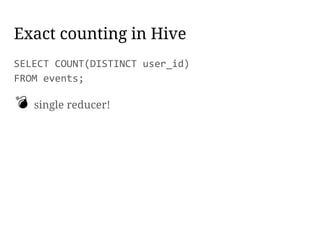
SELECT COUNT(DISTINCT user_id)
FROM events;
single reducer!
Exact counting in Hive
Exact counting in Hive – subquery
SELECT COUNT(*) FROM (
SELECT 1 FROM events
GROUP BY user_id
) unique_guids;
Or more concisely:
SELECT COUNT(*) FROM (
SELECT DISTINCT user_id
FROM events
) unique_guids;
many reducers
two phases
cannot combine
more aggregations
Exact counting in Hive
● hive.optimize.distinct.rewrite
○ allows to rewrite COUNT(DISTINCT) to subquery
○ since Hive 1.2.0
Probabilistic counting
● fast results, but approximate
● practical example of using HLL in Hive
● more theory in the appendix
● klout/brickhouse
○ single option
○ no JAR, some tests
○ based on HLL++ from stream-lib (quite fast)
● jdmaturen/hive-hll
○ no options (they are in API, but not implemented!)
○ no JAR, no tests
○ compatible with java-hll, pg-hll, js-hll
● t3rmin4t0r/hive-hll-udf
○ no options, no JAR, no tests
Implementations of HLL as Hive UDFs
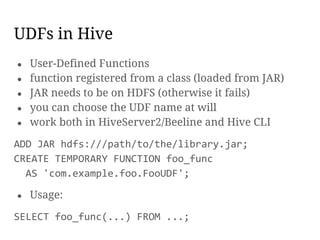
● User-Defined Functions
● function registered from a class (loaded from JAR)
● JAR needs to be on HDFS (otherwise it fails)
● you can choose the UDF name at will
● work both in HiveServer2/Beeline and Hive CLI
ADD JAR hdfs:///path/to/the/library.jar;
CREATE TEMPORARY FUNCTION foo_func
AS 'com.example.foo.FooUDF';
● Usage:
SELECT foo_func(...) FROM ...;
UDFs in Hive
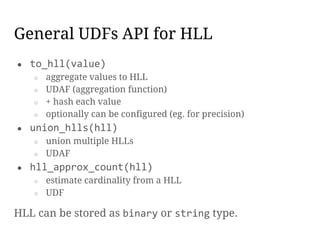
● to_hll(value)
○ aggregate values to HLL
○ UDAF (aggregation function)
○ + hash each value
○ optionally can be configured (eg. for precision)
● union_hlls(hll)
○ union multiple HLLs
○ UDAF
● hll_approx_count(hll)
○ estimate cardinality from a HLL
○ UDF
HLL can be stored as binary or string type.
General UDFs API for HLL
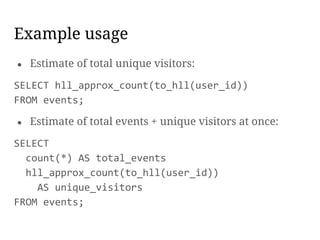
● Estimate of total unique visitors:
SELECT hll_approx_count(to_hll(user_id))
FROM events;
● Estimate of total events + unique visitors at once:
SELECT
count(*) AS total_events
hll_approx_count(to_hll(user_id))
AS unique_visitors
FROM events;
Example usage
Example usage
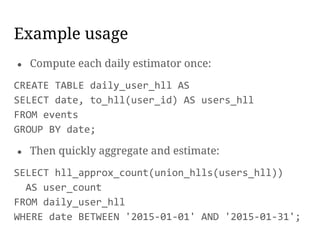
● Compute each daily estimator once:
CREATE TABLE daily_user_hll AS
SELECT date, to_hll(user_id) AS users_hll
FROM events
GROUP BY date;
● Then quickly aggregate and estimate:
SELECT hll_approx_count(union_hlls(users_hll))
AS user_count
FROM daily_user_hll
WHERE date BETWEEN '2015-01-01' AND '2015-01-31';
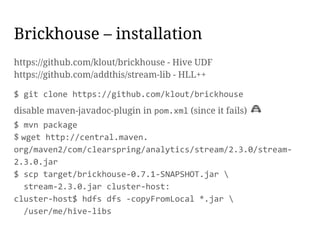
https://github.com/klout/brickhouse - Hive UDF
https://github.com/addthis/stream-lib - HLL++
$ git clone https://github.com/klout/brickhouse
disable maven-javadoc-plugin in pom.xml (since it fails)
$ mvn package
$ wget http://central.maven.
org/maven2/com/clearspring/analytics/stream/2.3.0/stream-
2.3.0.jar
$ scp target/brickhouse-0.7.1-SNAPSHOT.jar 
stream-2.3.0.jar cluster-host:
cluster-host$ hdfs dfs -copyFromLocal *.jar 
/user/me/hive-libs
Brickhouse – installation
Brickhouse – usage
ADD JAR /user/zamecnik/lib/brickhouse-0.7.1-15f5e8e.jar;
ADD JAR /user/zamecnik/lib/stream-2.3.0.jar;
CREATE TEMPORARY FUNCTION to_hll AS 'brickhouse.udf.hll.
HyperLogLogUDAF';
CREATE TEMPORARY FUNCTION union_hlls AS 'brickhouse.udf.
hll.UnionHyperLogLogUDAF';
CREATE TEMPORARY FUNCTION hll_approx_count AS 'brickhouse.
udf.hll.EstimateCardinalityUDF';
to_hll(value, [bit_precision])
● bit_precision: 4 to 16 (default 6)
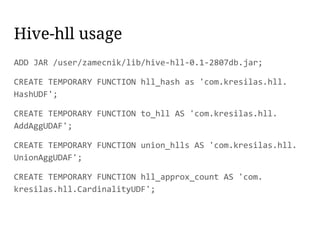
Hive-hll usage
ADD JAR /user/zamecnik/lib/hive-hll-0.1-2807db.jar;
CREATE TEMPORARY FUNCTION hll_hash as 'com.kresilas.hll.
HashUDF';
CREATE TEMPORARY FUNCTION to_hll AS 'com.kresilas.hll.
AddAggUDAF';
CREATE TEMPORARY FUNCTION union_hlls AS 'com.kresilas.hll.
UnionAggUDAF';
CREATE TEMPORARY FUNCTION hll_approx_count AS 'com.
kresilas.hll.CardinalityUDF';
We have to explicitly hash the value:
SELECT
hll_approx_count(to_hll(hll_hash(user_id)))
FROM events;
Options for creating HLL:
to_hll(x, [log2m, regwidth, expthresh, sparseon])
hardcoded to:
[log2m=11, regwidth=5, expthresh=-1, sparseon=true]
Hive-hll usage
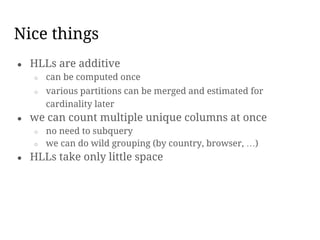
Nice things
● HLLs are additive
○ can be computed once
○ various partitions can be merged and estimated for
cardinality later
● we can count multiple unique columns at once
○ no need to subquery
○ we can do wild grouping (by country, browser, …)
● HLLs take only little space
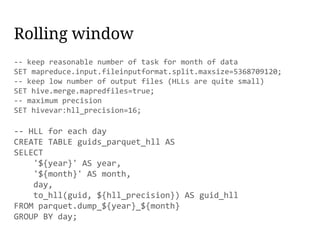
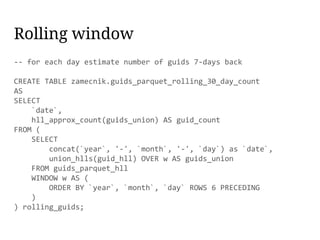
Rolling window
-- keep reasonable number of task for month of data
SET mapreduce.input.fileinputformat.split.maxsize=5368709120;
-- keep low number of output files (HLLs are quite small)
SET hive.merge.mapredfiles=true;
-- maximum precision
SET hivevar:hll_precision=16;
-- HLL for each day
CREATE TABLE guids_parquet_hll AS
SELECT
'${year}' AS year,
'${month}' AS month,
day,
to_hll(guid, ${hll_precision}) AS guid_hll
FROM parquet.dump_${year}_${month}
GROUP BY day;
-- for each day estimate number of guids 7-days back
CREATE TABLE zamecnik.guids_parquet_rolling_30_day_count
AS
SELECT
`date`,
hll_approx_count(guids_union) AS guid_count
FROM (
SELECT
concat(`year`, '-', `month`, '-', `day`) as `date`,
union_hlls(guid_hll) OVER w AS guids_union
FROM guids_parquet_hll
WINDOW w AS (
ORDER BY `year`, `month`, `day` ROWS 6 PRECEDING
)
) rolling_guids;
Rolling window
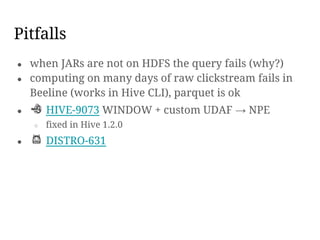
● when JARs are not on HDFS the query fails (why?)
● computing on many days of raw clickstream fails in
Beeline (works in Hive CLI), parquet is ok
● HIVE-9073 WINDOW + custom UDAF → NPE
○ fixed in Hive 1.2.0
● DISTRO-631
Pitfalls
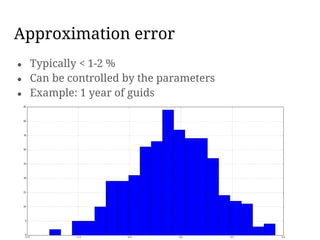
Approximation error
● Typically < 1-2 %
● Can be controlled by the parameters
● Example: 1 year of guids
Appendix – more interesting things
● trade-off: some approximation error for far better
performance and memory consumption
● sketch - streaming & probabilistic algorithm
● KMV - k minimal values
● linear counter
● loglog counter
Probabilistic counting
LogLog counter
● run length of initial zeros
● multiple estimators (registers)
● stochastic averaging
○ single hash function
○ multiple buckets
● hash → (register index, run length)
Linear counter
m = 20 # size of the register
register = bitarray(m) # register, m bits
def add(value):
h = mmh3.hash(value) % m # select bit index
register[h] = 1 # = max(1, register[h])
def cardinality():
u_n = register.count(0) # number of zeros
v_n = u_n / m # relative number of zeros
n_hat = -m * math.log(v_n) # estimate of the set cardinality
return n_hat
● structure like loglog counter
● harmonic mean to combine registers
● correction for small and large cardinalities
● values needs to be hashed well – murmur3
HyperLogLog (HLL)
HLL union
● just take max of each register value
● no loss – same result as HLL of union of streams
● parallelizable
● union preserves error bound, intersection/diff do not
Further reading
● very nice explanation of HLL
● Probabilistic Data Structures For Web Analytics And
Data Mining
● Sketch of the Day: HyperLogLog — Cornerstone of a
Big Data Infrastructure
● HyperLogLog in Pure SQL
● Use Subqueries to Count Distinct 50X Faster
● It is possible to combine HLL of different sizes
Papers
● HyperLogLog in Practice: Algorithmic Engineering of
a State of The Art Cardinality Estimation Algorithm
● https://github.com/addthis/stream-lib#cardinality
Other problems & structures
● set membership – bloom filter
● top-k elements – count-min-sketch, stream-summary

HyperLogLog in Hive - How to count sheep efficiently?

  • 1.
    HyperLogLog in Hive Howto count sheep efficiently? Phillip Capper: Whitecliffs Sheep @bzamecnik
  • 2.
    Agenda ● the problem– count distinct elements ● exact counting ● fast approximate counting – using HLL in Hive ● comparing performance and accuracy ● appendix – a bit of theory of probabilistic counting ○ how it works?
  • 3.
    The problem: countdistinct elements ● eg. the number of unique visitors ● each visitor can make a lot of clicks ● typically grouped in various ways ● "set cardinality estimation" problem
  • 4.
    Small data solutions ●sort the data O(N*log(N)) and skip duplicates O(N) ○ O(N) space ● put data into a hash or tree set and iterate ○ hash set: O(N^2) worst case build, O(N) iteration ○ tree set: O(N*log(N)) build, O(N) iteration ○ both O(N) space ● but: we have big data Example: ~100M unique values in 5B rows each day 32 bytes per value -> 3 GB unique, 150 GB total
  • 5.
    Problems with countingbig data ● data is partitioned ○ across many machines ○ in time ● we can't sum cardinality of each partition ○ since the subsets are generally not disjoint ○ we would overestimate count(part1) + count(part1) >= count(part1 ∪ part2) ● we need to merge estimators and then estimate cardinality count(estimator(part1) ∪ estimator(part2))
  • 6.
    SELECT COUNT(DISTINCT user_id) FROMevents; single reducer! Exact counting in Hive
  • 7.
    Exact counting inHive – subquery SELECT COUNT(*) FROM ( SELECT 1 FROM events GROUP BY user_id ) unique_guids; Or more concisely: SELECT COUNT(*) FROM ( SELECT DISTINCT user_id FROM events ) unique_guids; many reducers two phases cannot combine more aggregations
  • 8.
    Exact counting inHive ● hive.optimize.distinct.rewrite ○ allows to rewrite COUNT(DISTINCT) to subquery ○ since Hive 1.2.0
  • 10.
    Probabilistic counting ● fastresults, but approximate ● practical example of using HLL in Hive ● more theory in the appendix
  • 11.
    ● klout/brickhouse ○ singleoption ○ no JAR, some tests ○ based on HLL++ from stream-lib (quite fast) ● jdmaturen/hive-hll ○ no options (they are in API, but not implemented!) ○ no JAR, no tests ○ compatible with java-hll, pg-hll, js-hll ● t3rmin4t0r/hive-hll-udf ○ no options, no JAR, no tests Implementations of HLL as Hive UDFs
  • 12.
    ● User-Defined Functions ●function registered from a class (loaded from JAR) ● JAR needs to be on HDFS (otherwise it fails) ● you can choose the UDF name at will ● work both in HiveServer2/Beeline and Hive CLI ADD JAR hdfs:///path/to/the/library.jar; CREATE TEMPORARY FUNCTION foo_func AS 'com.example.foo.FooUDF'; ● Usage: SELECT foo_func(...) FROM ...; UDFs in Hive
  • 13.
    ● to_hll(value) ○ aggregatevalues to HLL ○ UDAF (aggregation function) ○ + hash each value ○ optionally can be configured (eg. for precision) ● union_hlls(hll) ○ union multiple HLLs ○ UDAF ● hll_approx_count(hll) ○ estimate cardinality from a HLL ○ UDF HLL can be stored as binary or string type. General UDFs API for HLL
  • 14.
    ● Estimate oftotal unique visitors: SELECT hll_approx_count(to_hll(user_id)) FROM events; ● Estimate of total events + unique visitors at once: SELECT count(*) AS total_events hll_approx_count(to_hll(user_id)) AS unique_visitors FROM events; Example usage
  • 15.
    Example usage ● Computeeach daily estimator once: CREATE TABLE daily_user_hll AS SELECT date, to_hll(user_id) AS users_hll FROM events GROUP BY date; ● Then quickly aggregate and estimate: SELECT hll_approx_count(union_hlls(users_hll)) AS user_count FROM daily_user_hll WHERE date BETWEEN '2015-01-01' AND '2015-01-31';
  • 16.
    https://github.com/klout/brickhouse - HiveUDF https://github.com/addthis/stream-lib - HLL++ $ git clone https://github.com/klout/brickhouse disable maven-javadoc-plugin in pom.xml (since it fails) $ mvn package $ wget http://central.maven. org/maven2/com/clearspring/analytics/stream/2.3.0/stream- 2.3.0.jar $ scp target/brickhouse-0.7.1-SNAPSHOT.jar stream-2.3.0.jar cluster-host: cluster-host$ hdfs dfs -copyFromLocal *.jar /user/me/hive-libs Brickhouse – installation
  • 17.
    Brickhouse – usage ADDJAR /user/zamecnik/lib/brickhouse-0.7.1-15f5e8e.jar; ADD JAR /user/zamecnik/lib/stream-2.3.0.jar; CREATE TEMPORARY FUNCTION to_hll AS 'brickhouse.udf.hll. HyperLogLogUDAF'; CREATE TEMPORARY FUNCTION union_hlls AS 'brickhouse.udf. hll.UnionHyperLogLogUDAF'; CREATE TEMPORARY FUNCTION hll_approx_count AS 'brickhouse. udf.hll.EstimateCardinalityUDF'; to_hll(value, [bit_precision]) ● bit_precision: 4 to 16 (default 6)
  • 18.
    Hive-hll usage ADD JAR/user/zamecnik/lib/hive-hll-0.1-2807db.jar; CREATE TEMPORARY FUNCTION hll_hash as 'com.kresilas.hll. HashUDF'; CREATE TEMPORARY FUNCTION to_hll AS 'com.kresilas.hll. AddAggUDAF'; CREATE TEMPORARY FUNCTION union_hlls AS 'com.kresilas.hll. UnionAggUDAF'; CREATE TEMPORARY FUNCTION hll_approx_count AS 'com. kresilas.hll.CardinalityUDF';
  • 19.
    We have toexplicitly hash the value: SELECT hll_approx_count(to_hll(hll_hash(user_id))) FROM events; Options for creating HLL: to_hll(x, [log2m, regwidth, expthresh, sparseon]) hardcoded to: [log2m=11, regwidth=5, expthresh=-1, sparseon=true] Hive-hll usage
  • 20.
    Nice things ● HLLsare additive ○ can be computed once ○ various partitions can be merged and estimated for cardinality later ● we can count multiple unique columns at once ○ no need to subquery ○ we can do wild grouping (by country, browser, …) ● HLLs take only little space
  • 21.
    Rolling window -- keepreasonable number of task for month of data SET mapreduce.input.fileinputformat.split.maxsize=5368709120; -- keep low number of output files (HLLs are quite small) SET hive.merge.mapredfiles=true; -- maximum precision SET hivevar:hll_precision=16; -- HLL for each day CREATE TABLE guids_parquet_hll AS SELECT '${year}' AS year, '${month}' AS month, day, to_hll(guid, ${hll_precision}) AS guid_hll FROM parquet.dump_${year}_${month} GROUP BY day;
  • 22.
    -- for eachday estimate number of guids 7-days back CREATE TABLE zamecnik.guids_parquet_rolling_30_day_count AS SELECT `date`, hll_approx_count(guids_union) AS guid_count FROM ( SELECT concat(`year`, '-', `month`, '-', `day`) as `date`, union_hlls(guid_hll) OVER w AS guids_union FROM guids_parquet_hll WINDOW w AS ( ORDER BY `year`, `month`, `day` ROWS 6 PRECEDING ) ) rolling_guids; Rolling window
  • 23.
    ● when JARsare not on HDFS the query fails (why?) ● computing on many days of raw clickstream fails in Beeline (works in Hive CLI), parquet is ok ● HIVE-9073 WINDOW + custom UDAF → NPE ○ fixed in Hive 1.2.0 ● DISTRO-631 Pitfalls
  • 24.
    Approximation error ● Typically< 1-2 % ● Can be controlled by the parameters ● Example: 1 year of guids
  • 25.
    Appendix – moreinteresting things
  • 26.
    ● trade-off: someapproximation error for far better performance and memory consumption ● sketch - streaming & probabilistic algorithm ● KMV - k minimal values ● linear counter ● loglog counter Probabilistic counting
  • 27.
    LogLog counter ● runlength of initial zeros ● multiple estimators (registers) ● stochastic averaging ○ single hash function ○ multiple buckets ● hash → (register index, run length)
  • 28.
    Linear counter m =20 # size of the register register = bitarray(m) # register, m bits def add(value): h = mmh3.hash(value) % m # select bit index register[h] = 1 # = max(1, register[h]) def cardinality(): u_n = register.count(0) # number of zeros v_n = u_n / m # relative number of zeros n_hat = -m * math.log(v_n) # estimate of the set cardinality return n_hat
  • 29.
    ● structure likeloglog counter ● harmonic mean to combine registers ● correction for small and large cardinalities ● values needs to be hashed well – murmur3 HyperLogLog (HLL)
  • 30.
    HLL union ● justtake max of each register value ● no loss – same result as HLL of union of streams ● parallelizable ● union preserves error bound, intersection/diff do not
  • 31.
    Further reading ● verynice explanation of HLL ● Probabilistic Data Structures For Web Analytics And Data Mining ● Sketch of the Day: HyperLogLog — Cornerstone of a Big Data Infrastructure ● HyperLogLog in Pure SQL ● Use Subqueries to Count Distinct 50X Faster ● It is possible to combine HLL of different sizes
  • 32.
    Papers ● HyperLogLog inPractice: Algorithmic Engineering of a State of The Art Cardinality Estimation Algorithm ● https://github.com/addthis/stream-lib#cardinality
  • 33.
    Other problems &structures ● set membership – bloom filter ● top-k elements – count-min-sketch, stream-summary