Group Members:
Ghazanfar Perdakh (2015-CS-13)
Afraz Khan (2015-CS-27)
Ali Abid (2015-CS-60)
Hassan Tariq (2015-CS-67)
Supervisor:
“Dr. Awais Hassan”
Overview
Problem Statement
Existing Systems
Solution
Methodology
Facial Recognition
Block Chain
Practical Demo
References
Problem Statement
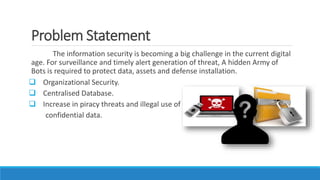
The information security is becoming a big challenge in the current digital
age. For surveillance and timely alert generation of threat, A hidden Army of
Bots is required to protect data, assets and defense installation.
 Organizational Security.
 Centralised Database.
 Increase in piracy threats and illegal use of
confidential data.
Existing System
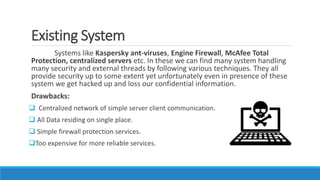
Systems like Kaspersky ant-viruses, Engine Firewall, McAfee Total
Protection, centralized servers etc. In these we can find many system handling
many security and external threads by following various techniques. They all
provide security up to some extent yet unfortunately even in presence of these
system we get hacked up and loss our confidential information.
Drawbacks:
 Centralized network of simple server client communication.
 All Data residing on single place.
 Simple firewall protection services.
Too expensive for more reliable services.
Army Of Hidden Bots
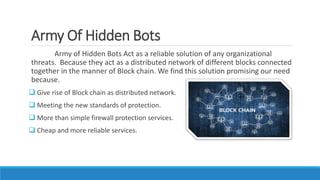
Army of Hidden Bots Act as a reliable solution of any organizational
threats. Because they act as a distributed network of different blocks connected
together in the manner of Block chain. We find this solution promising our need
because.
 Give rise of Block chain as distributed network.
 Meeting the new standards of protection.
 More than simple firewall protection services.
 Cheap and more reliable services.
Proof Of Concept
Implementation of blockchain on multiple computers.
Communication between python and node.js
Face recognition on each system.
Communication between node.js and python.
Transfer of image from one system to another system.
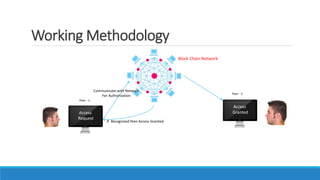
Working Methodology
Access
Request
Communicate with Network
For Authorization
Peer - 1
If Recognized then Access Granted
Access
Granted
Peer - 2
Block Chain Network
Facial Recognition
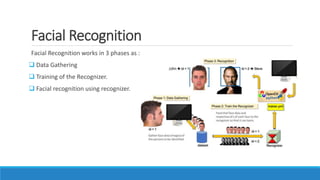
Facial Recognition works in 3 phases as :
 Data Gathering
 Training of the Recognizer.
 Facial recognition using recognizer.
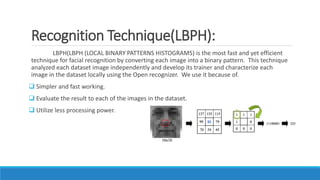
Recognition Technique(LBPH):
LBPH(LBPH (LOCAL BINARY PATTERNS HISTOGRAMS) is the most fast and yet efficient
technique for facial recognition by converting each image into a binary pattern. This technique
analyzed each dataset image independently and develop its trainer and characterize each
image in the dataset locally using the Open recognizer. We use it because of.
 Simpler and fast working.
 Evaluate the result to each of the images in the dataset.
 Utilize less processing power.
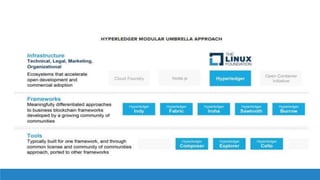
 Open source collaborative effort to advance cross-industry blockchain technologies
 Hosted by Linux Foundation
 Has a global collaboration with finance, banking, supply chain, manufacturing and te
chnology companies
 Works to standardize the protocols
 Launched in 2015
 Goal is to “Create an enterprise grade, open source distributed ledger framework a
nd code base"
Hyperledger:
• Private and Permissioned Blockchain
• Nodes are run by known whitelisted organizations
• High transaction throughput performance
• Privacy and confidentiality of transactions and data pertaining to business
transactions
• No 51% attack
• PBFT consensus mechanism used
• No mining is involved - but basics of blockchain is followed
○ It has block immutability
○ Eliminating double spending
Hyperledger Fabric :
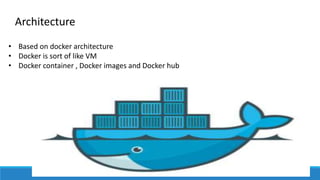
• Based on docker architecture
• Docker is sort of like VM
• Docker container , Docker images and Docker hub
Architecture
• Fabric-CA (Certificate Authority)
• Fabric Peers
• Fabric Orderers
Fabric components:
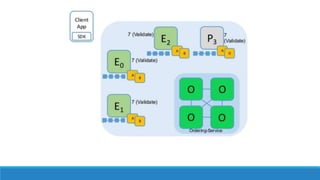
• Peer is where the Ledger is present
• It also maintains the world state
• Peer can add or query the data from the ledger
• We can have more than one peer - On production we need more than one
• All peers synchronize - Once connected to the network
• Couchdb is used as database
Fabric Peers:
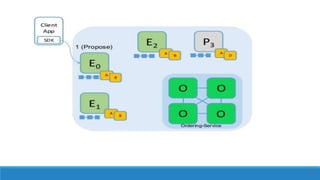
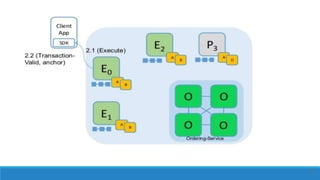
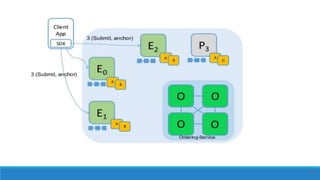
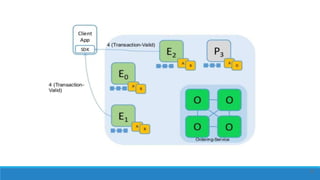
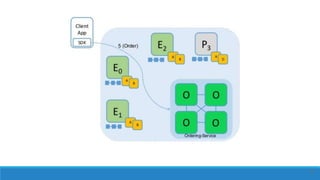
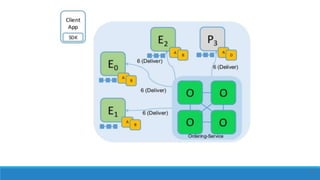
• Ordering service is the heart of the consensus process
• Anything that has to be committed needs to be processed through the ordering servi
ce
• Ordering service creates the Blocks
• This sends the block to the peer to update
Fabric Orderers:
• Define policies around the execution of transactions
• Define which peers need to agree on the results of a transaction before it can be
added to the ledger (endorsing peers)
• Peers A, B, C, and F must all endorse transactions of type T
• A majority of peers in the channel must endorse transactions of type U
• At least 3 peers of A, B, C, D, E, F, G must endorse transactions of type V
Endorsement Policy:
19
20
21
22
23
24
25
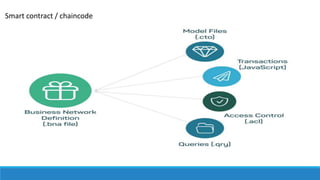
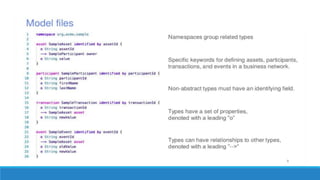
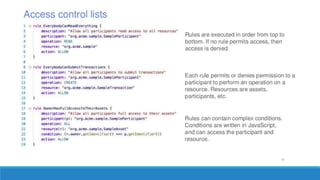
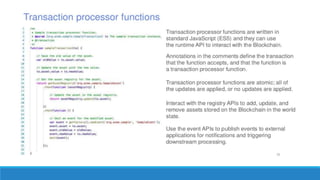
• Built in Javascript
• Works on top of fabric
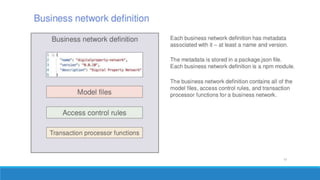
• Model your business blockchain network
• Deploy Smart contracts / chaincode on fabric network
• Generate REST APIs for interacting with your blockchain network
• Generate a skeleton Angular application.
• Generates playground to test business logic
Hyperledger Composer:
Smart contract / chaincode
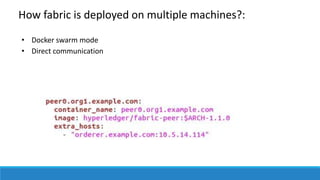
• Docker swarm mode
• Direct communication
How fabric is deployed on multiple machines?:
References
LBPH
https://en.wikipedia.org/wiki/Local_binary_patterns
The Project repository
https://github.com/AfrazKhan4183/An-Army-of-Hidden-Bots/tree/master/Trojan Computing/Backdoor-
Python3

Hyperledger Blockchain

  • 2.
    Group Members: Ghazanfar Perdakh(2015-CS-13) Afraz Khan (2015-CS-27) Ali Abid (2015-CS-60) Hassan Tariq (2015-CS-67) Supervisor: “Dr. Awais Hassan”
  • 3.
    Overview Problem Statement Existing Systems Solution Methodology FacialRecognition Block Chain Practical Demo References
  • 4.
    Problem Statement The informationsecurity is becoming a big challenge in the current digital age. For surveillance and timely alert generation of threat, A hidden Army of Bots is required to protect data, assets and defense installation.  Organizational Security.  Centralised Database.  Increase in piracy threats and illegal use of confidential data.
  • 5.
    Existing System Systems likeKaspersky ant-viruses, Engine Firewall, McAfee Total Protection, centralized servers etc. In these we can find many system handling many security and external threads by following various techniques. They all provide security up to some extent yet unfortunately even in presence of these system we get hacked up and loss our confidential information. Drawbacks:  Centralized network of simple server client communication.  All Data residing on single place.  Simple firewall protection services. Too expensive for more reliable services.
  • 6.
    Army Of HiddenBots Army of Hidden Bots Act as a reliable solution of any organizational threats. Because they act as a distributed network of different blocks connected together in the manner of Block chain. We find this solution promising our need because.  Give rise of Block chain as distributed network.  Meeting the new standards of protection.  More than simple firewall protection services.  Cheap and more reliable services.
  • 7.
    Proof Of Concept Implementationof blockchain on multiple computers. Communication between python and node.js Face recognition on each system. Communication between node.js and python. Transfer of image from one system to another system.
  • 8.
    Working Methodology Access Request Communicate withNetwork For Authorization Peer - 1 If Recognized then Access Granted Access Granted Peer - 2 Block Chain Network
  • 9.
    Facial Recognition Facial Recognitionworks in 3 phases as :  Data Gathering  Training of the Recognizer.  Facial recognition using recognizer.
  • 10.
    Recognition Technique(LBPH): LBPH(LBPH (LOCALBINARY PATTERNS HISTOGRAMS) is the most fast and yet efficient technique for facial recognition by converting each image into a binary pattern. This technique analyzed each dataset image independently and develop its trainer and characterize each image in the dataset locally using the Open recognizer. We use it because of.  Simpler and fast working.  Evaluate the result to each of the images in the dataset.  Utilize less processing power.
  • 11.
     Open sourcecollaborative effort to advance cross-industry blockchain technologies  Hosted by Linux Foundation  Has a global collaboration with finance, banking, supply chain, manufacturing and te chnology companies  Works to standardize the protocols  Launched in 2015  Goal is to “Create an enterprise grade, open source distributed ledger framework a nd code base" Hyperledger:
  • 13.
    • Private andPermissioned Blockchain • Nodes are run by known whitelisted organizations • High transaction throughput performance • Privacy and confidentiality of transactions and data pertaining to business transactions • No 51% attack • PBFT consensus mechanism used • No mining is involved - but basics of blockchain is followed ○ It has block immutability ○ Eliminating double spending Hyperledger Fabric :
  • 14.
    • Based ondocker architecture • Docker is sort of like VM • Docker container , Docker images and Docker hub Architecture
  • 15.
    • Fabric-CA (CertificateAuthority) • Fabric Peers • Fabric Orderers Fabric components:
  • 16.
    • Peer iswhere the Ledger is present • It also maintains the world state • Peer can add or query the data from the ledger • We can have more than one peer - On production we need more than one • All peers synchronize - Once connected to the network • Couchdb is used as database Fabric Peers:
  • 17.
    • Ordering serviceis the heart of the consensus process • Anything that has to be committed needs to be processed through the ordering servi ce • Ordering service creates the Blocks • This sends the block to the peer to update Fabric Orderers:
  • 18.
    • Define policiesaround the execution of transactions • Define which peers need to agree on the results of a transaction before it can be added to the ledger (endorsing peers) • Peers A, B, C, and F must all endorse transactions of type T • A majority of peers in the channel must endorse transactions of type U • At least 3 peers of A, B, C, D, E, F, G must endorse transactions of type V Endorsement Policy:
  • 19.
  • 20.
  • 21.
  • 22.
  • 23.
  • 24.
  • 25.
  • 26.
    • Built inJavascript • Works on top of fabric • Model your business blockchain network • Deploy Smart contracts / chaincode on fabric network • Generate REST APIs for interacting with your blockchain network • Generate a skeleton Angular application. • Generates playground to test business logic Hyperledger Composer:
  • 27.
  • 32.
    • Docker swarmmode • Direct communication How fabric is deployed on multiple machines?:
  • 34.