0 Copyright 2017 FUJITSU
Hyper-Converged –
The Only Way to
the Software-
Defined Data
Center?
Fujitsu World Tour 2017
#FujitsuWorldTour
1 Copyright 2017 FUJITSU
Hyper-Convergence – The Only Way to SDDC?
A Reality Check of Hyper-Converged Infrastructures
Gernot Fels
Head of Integrated Systems
International Product Marketing, Fujitsu
2 Copyright 2017 FUJITSU
Impact of digitalization on DC infrastructures
 Digital world  More data
 Collect
 Transport
 Process
 Store
Needs: Fast and flexible scalability, resilience, simplicity, efficiency.
Digital world More data More challenges to IT
Network StorageServers
3 Copyright 2017 FUJITSU
Traditional DC infrastructure
Network
Storage
Server Server Server
App App App
Compute Compute Compute
HW defined
Rigid
Manual ops
Silos
Slow
Complex, inflexible, expensive and skills demanding.
4 Copyright 2017 FUJITSU
How to Change the Game?
5 Copyright 2017 FUJITSU
Hyper-converged infrastructure
 Characteristics
 Interconnected standard servers
 Local DAS, no external storage
 Virtual instead of physical SAN
 Data services
(e.g. replication, deduplication)
 HA built-in
 Unified central management
 Scale-out (performance, capacity)
 Auto-discovery
 SW-defined Network
Software-Defined Compute
Software-Defined Storage
Server Server Server
App
Compute
Disks
App
Compute
Disks
App
Compute
Disks
VirtualSAN
6 Copyright 2017 FUJITSU
Hyper-converged infrastructure
 Characteristics
 Interconnected standard servers
 Local DAS, no external storage
 Virtual instead of physical SAN
 Data services
(e.g. replication, deduplication)
 HA built-in
 Unified central management
 Scale-out (performance, capacity)
 Auto-discovery
 SW-defined
 Benefits
 Less components, less space
 Less energy and cooling
 Simplicity (less admin efforts)
 Lower skills (lower-paid staff)
 Start small and grow as you go
 Flexible alignment to business
 Great responsiveness
 Business continuity
 Lower TCO
Network
Software-Defined Compute
Software-Defined Storage
Server Server Server
App
Compute
Disks
App
Compute
Disks
App
Compute
Disks
VirtualSAN
7 Copyright 2017 FUJITSU
Hyper-converged infrastructure
 Characteristics
 Interconnected standard servers
 Local DAS, no external storage
 Virtual instead of physical SAN
 Data services
(e.g. replication, deduplication)
 HA built-in
 Unified central management
 Scale-out (performance, capacity)
 Auto-discovery
 SW-defined
 Benefits
 Less components, less space
 Less energy and cooling
 Simplicity (less admin efforts)
 Lower skills (lower-paid staff)
 Start small and grow as you go
 Flexible alignment to business
 Great responsiveness
 Business continuity
 Lower TCO
Network
Software-Defined Compute
Software-Defined Storage
Server Server Server
App
Compute
Disks
App
Compute
Disks
App
Compute
Disks
VirtualSAN
Hyper-converged – Silver bullet of IT?
8 Copyright 2017 FUJITSU
Architectures in comparison
Classical
 Servers, LAN, storage, SAN
 LCM for multiple components (different LC)
 2 separate networks to maintain
 HW-defined
 Scalability by adding multiple components,
primarily separately
 Storage activities are separated from servers
 Established for many years
Hyper-converged
 Servers (storage included), LAN
 LCM for less components
 More powerful LAN required
 SW-defined
 Scalability by adding servers,
primarily linearly (compute & storage)
 Servers are involved in storage activities
 To be considered when sizing compute resources
 Entered the market some 3 years ago
9 Copyright 2017 FUJITSU
What do these differences mean for you?
Classical
 To be used for general purposes
 Physical, virtual, multi-hypervisor
 HW dependence, primarily related to storage
 Well-known SW licensing (e.g. DB)
 Higher operational complexity
 Possibly higher HW cost, but lower SW cost
 Mainly well established vendors
Hyper-converged
 Less usable for general purposes
 Virtualization is quasi a must
 SW dependence (related to virtualization SW)
 Commercial restrictions (e.g. DB licensing)
 Lower operational complexity
 Possibly higher SW cost, but lower HW cost
 Established vendors and newcomers
10 Copyright 2017 FUJITSU
What do these differences mean for you?
Classical
 To be used for general purposes
 Physical, virtual, multi-hypervisor
 HW dependence, primarily related to storage
 Well-known SW licensing (e.g. DB)
 Higher operational complexity
 Possibly higher HW cost, but lower SW cost
 Primarily well established vendors
Hyper-converged
 Less usable for general purposes
 Virtualization is quasi a must
 SW dependence (related to virtualization SW)
 Commercial restrictions (e.g. DB licensing)
 Lower operational complexity
 Possibly higher SW cost, but lower HW cost
 Established vendors and newcomers
Both approaches provide unique advantages. Good reasons for coexistence.
11 Copyright 2017 FUJITSU
Classical or hyper-converged? –
Aspects to be considered
 Workloads need scale-out / scale-up?
 Compute & storage needs scale in tandem?
 Granular expansion on component level?
 Expected growth
 ROBO
 Mixed operation
 Multi-hypervisor, bare-metal
 Workloads benefit from data services?
 Benefit from unified management?
 Existing skills, staff roles
 Utilize or replace existing storage
 Storage capacity
 SW licensing
 CAPEX and OPEX
12 Copyright 2017 FUJITSU
Classical or hyper-converged? –
Aspects to be considered
 Workloads need scale-out / scale-up?
 Compute & storage needs scale in tandem?
 Granular expansion on component level?
 Expected growth
 ROBO
 Mixed operation
 Multi-hypervisor, bare-metal
 Workloads benefit from data services?
 Benefit from unified management?
 Existing skills, staff roles
 Utilize or replace existing storage
 Storage capacity
 SW licensing
 CAPEX and OPEX
Use cases matter. Business requirements determine the optimum approach.
Recommendation: Decide per each use case;
Go for hyper-converged, if benefits outweigh drawbacks.
13 Copyright 2017 FUJITSU
The next step: Software-Defined DC
 Characteristics
 Virtualized everything (compute, storage, NW)
 Deployable on any HW (components interchangeable)
 Unified management
 Automation (provisioning, configuration, operation)
 Policy-driven (adaptive) resource orchestration
 Hyper-converged or converged
 Scalable
 Optional
 Self-service portal
 Metering and charging
Simple, fast, flexible, efficient: The right answer to digitalization.
Any IP network
Any storage
Any x86 server
SDDC Platform
Any app
14 Copyright 2017 FUJITSU
How to Get Your Infrastructure
Up and Running?
15 Copyright 2017 FUJITSU
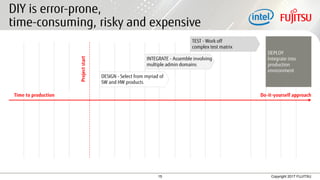
DIY is error-prone,
time-consuming, risky and expensive
DESIGN - Select from myriad of
SW and HW products
INTEGRATE - Assemble involving
multiple admin domains
TEST - Work off
complex test matrix
DEPLOY
Integrate into
production
environment
Do-it-yourself approachTime to production
Projectstart
16 Copyright 2017 FUJITSU
Integrated Systems reduce
complexity, time, risk and cost
DESIGN - Select from myriad of
SW and HW products
INTEGRATE - Assemble involving
multiple admin domains
TEST - Work off
complex test matrix
DEPLOY
Integrate into
production
environment
Do-it-yourself approachTime to production
DEPLOY
Integrate into
production
environment
Integrated Systems approach
DESIGN - Based on
best practices
INTEGRATE - Pre-integrated
single order delivery
TEST
End-to-end quality assurance
Projectstart
Solution Development in factory At customer's site
17 Copyright 2017 FUJITSU
FUJITSU Integrated System PRIMEFLEX
Pre-configured
Pre-integrated
Pre-tested
Reduce complexity, time, risk and cost. Increase operational efficiency. Focus on business.
Ready-to-run and
Reference Architectures
18 Copyright 2017 FUJITSU
FUJITSU Integrated System PRIMEFLEX –
Your fast track to DC infrastructures
Characteristics
 Addressing business-critical use cases
 Converged and hyper-converged
 Standard sizes ready-to-run and
customizable reference architectures
 Best practices and experience
 Own and partner technologies
 Pay as you grow through scaling up and out
 Flexible services options
Reduce complexity, time, risk and cost. Increase operational efficiency. Focus on business.
19 Copyright 2017 FUJITSU
FUJITSU Integrated System PRIMEFLEX:
Line-up
 Focused on what our customers demand for
Your fast track to data center infrastructures.
Virtualization
Big Data &
Analytics
SAP
Private Cloud HPC
20 Copyright 2017 FUJITSU
FUJITSU Integrated System PRIMEFLEX:
Line-up
 Focused on what our customers demand for
Your fast track to data center infrastructures.
Virtualization
Big Data &
Analytics
SAP
Private Cloud HPC
21 Copyright 2017 FUJITSU
PRIMEFLEX and virtualization
Storage
Spaces
Direct
Storage
Spaces
Direct
VMware
Cloud
Foundation
Hyper-converged
Classic converged
22 Copyright 2017 FUJITSU
PRIMEFLEX and virtualization
Storage
Spaces
Direct
Storage
Spaces
Direct
VMware
Cloud
Foundation
Hyper-converged
Classic converged
2-(3x)64 2-16
23 Copyright 2017 FUJITSU
Most powerful virtualization platform with
excellent price / performance ratio
#1positionsofVMwareVMmark2.x
24 Copyright 2017 FUJITSU
PRIMEFLEX: SDDC options
Hyper-converged Converged
25 Copyright 2017 FUJITSU
Summary
26 Copyright 2017 FUJITSU
Key take-aways
 Hyper-converged is a rising star
 Many benefits
 Springboard to SDDC
 But use cases matter
 Integrated Systems
 Reduce complexity, time, risk, costs
 Increase operational efficiency
 FUJITSU Integrated System PRIMEFLEX
 Converged and hyper-converged
 Ideal solution for your use case
Wondering if hyper-converged is your way to go? Have a word with Fujitsu.
27 Copyright 2017 FUJITSU
28 Copyright 2017 FUJITSU
Abstract
Hyper-converged infrastructures are the rising stars in data centers.
What is behind this hype?
What are its key benefits and what does it mean in practice?
Is hyper-convergence always preferable a classic IT architecture?
For which use cases is hyper-converged strongly recommended or even a must?
And in which way is hyper-convergence fitting in software-defined data centers?
This session provides appropriate answers.

Hyper-convergence – The only way to the software-defined data center? - Gernot Fels, Head of Integrated Systems, Global Product Marketing, Fujitsu

  • 1.
    0 Copyright 2017FUJITSU Hyper-Converged – The Only Way to the Software- Defined Data Center? Fujitsu World Tour 2017 #FujitsuWorldTour
  • 2.
    1 Copyright 2017FUJITSU Hyper-Convergence – The Only Way to SDDC? A Reality Check of Hyper-Converged Infrastructures Gernot Fels Head of Integrated Systems International Product Marketing, Fujitsu
  • 3.
    2 Copyright 2017FUJITSU Impact of digitalization on DC infrastructures  Digital world  More data  Collect  Transport  Process  Store Needs: Fast and flexible scalability, resilience, simplicity, efficiency. Digital world More data More challenges to IT Network StorageServers
  • 4.
    3 Copyright 2017FUJITSU Traditional DC infrastructure Network Storage Server Server Server App App App Compute Compute Compute HW defined Rigid Manual ops Silos Slow Complex, inflexible, expensive and skills demanding.
  • 5.
    4 Copyright 2017FUJITSU How to Change the Game?
  • 6.
    5 Copyright 2017FUJITSU Hyper-converged infrastructure  Characteristics  Interconnected standard servers  Local DAS, no external storage  Virtual instead of physical SAN  Data services (e.g. replication, deduplication)  HA built-in  Unified central management  Scale-out (performance, capacity)  Auto-discovery  SW-defined Network Software-Defined Compute Software-Defined Storage Server Server Server App Compute Disks App Compute Disks App Compute Disks VirtualSAN
  • 7.
    6 Copyright 2017FUJITSU Hyper-converged infrastructure  Characteristics  Interconnected standard servers  Local DAS, no external storage  Virtual instead of physical SAN  Data services (e.g. replication, deduplication)  HA built-in  Unified central management  Scale-out (performance, capacity)  Auto-discovery  SW-defined  Benefits  Less components, less space  Less energy and cooling  Simplicity (less admin efforts)  Lower skills (lower-paid staff)  Start small and grow as you go  Flexible alignment to business  Great responsiveness  Business continuity  Lower TCO Network Software-Defined Compute Software-Defined Storage Server Server Server App Compute Disks App Compute Disks App Compute Disks VirtualSAN
  • 8.
    7 Copyright 2017FUJITSU Hyper-converged infrastructure  Characteristics  Interconnected standard servers  Local DAS, no external storage  Virtual instead of physical SAN  Data services (e.g. replication, deduplication)  HA built-in  Unified central management  Scale-out (performance, capacity)  Auto-discovery  SW-defined  Benefits  Less components, less space  Less energy and cooling  Simplicity (less admin efforts)  Lower skills (lower-paid staff)  Start small and grow as you go  Flexible alignment to business  Great responsiveness  Business continuity  Lower TCO Network Software-Defined Compute Software-Defined Storage Server Server Server App Compute Disks App Compute Disks App Compute Disks VirtualSAN Hyper-converged – Silver bullet of IT?
  • 9.
    8 Copyright 2017FUJITSU Architectures in comparison Classical  Servers, LAN, storage, SAN  LCM for multiple components (different LC)  2 separate networks to maintain  HW-defined  Scalability by adding multiple components, primarily separately  Storage activities are separated from servers  Established for many years Hyper-converged  Servers (storage included), LAN  LCM for less components  More powerful LAN required  SW-defined  Scalability by adding servers, primarily linearly (compute & storage)  Servers are involved in storage activities  To be considered when sizing compute resources  Entered the market some 3 years ago
  • 10.
    9 Copyright 2017FUJITSU What do these differences mean for you? Classical  To be used for general purposes  Physical, virtual, multi-hypervisor  HW dependence, primarily related to storage  Well-known SW licensing (e.g. DB)  Higher operational complexity  Possibly higher HW cost, but lower SW cost  Mainly well established vendors Hyper-converged  Less usable for general purposes  Virtualization is quasi a must  SW dependence (related to virtualization SW)  Commercial restrictions (e.g. DB licensing)  Lower operational complexity  Possibly higher SW cost, but lower HW cost  Established vendors and newcomers
  • 11.
    10 Copyright 2017FUJITSU What do these differences mean for you? Classical  To be used for general purposes  Physical, virtual, multi-hypervisor  HW dependence, primarily related to storage  Well-known SW licensing (e.g. DB)  Higher operational complexity  Possibly higher HW cost, but lower SW cost  Primarily well established vendors Hyper-converged  Less usable for general purposes  Virtualization is quasi a must  SW dependence (related to virtualization SW)  Commercial restrictions (e.g. DB licensing)  Lower operational complexity  Possibly higher SW cost, but lower HW cost  Established vendors and newcomers Both approaches provide unique advantages. Good reasons for coexistence.
  • 12.
    11 Copyright 2017FUJITSU Classical or hyper-converged? – Aspects to be considered  Workloads need scale-out / scale-up?  Compute & storage needs scale in tandem?  Granular expansion on component level?  Expected growth  ROBO  Mixed operation  Multi-hypervisor, bare-metal  Workloads benefit from data services?  Benefit from unified management?  Existing skills, staff roles  Utilize or replace existing storage  Storage capacity  SW licensing  CAPEX and OPEX
  • 13.
    12 Copyright 2017FUJITSU Classical or hyper-converged? – Aspects to be considered  Workloads need scale-out / scale-up?  Compute & storage needs scale in tandem?  Granular expansion on component level?  Expected growth  ROBO  Mixed operation  Multi-hypervisor, bare-metal  Workloads benefit from data services?  Benefit from unified management?  Existing skills, staff roles  Utilize or replace existing storage  Storage capacity  SW licensing  CAPEX and OPEX Use cases matter. Business requirements determine the optimum approach. Recommendation: Decide per each use case; Go for hyper-converged, if benefits outweigh drawbacks.
  • 14.
    13 Copyright 2017FUJITSU The next step: Software-Defined DC  Characteristics  Virtualized everything (compute, storage, NW)  Deployable on any HW (components interchangeable)  Unified management  Automation (provisioning, configuration, operation)  Policy-driven (adaptive) resource orchestration  Hyper-converged or converged  Scalable  Optional  Self-service portal  Metering and charging Simple, fast, flexible, efficient: The right answer to digitalization. Any IP network Any storage Any x86 server SDDC Platform Any app
  • 15.
    14 Copyright 2017FUJITSU How to Get Your Infrastructure Up and Running?
  • 16.
    15 Copyright 2017FUJITSU DIY is error-prone, time-consuming, risky and expensive DESIGN - Select from myriad of SW and HW products INTEGRATE - Assemble involving multiple admin domains TEST - Work off complex test matrix DEPLOY Integrate into production environment Do-it-yourself approachTime to production Projectstart
  • 17.
    16 Copyright 2017FUJITSU Integrated Systems reduce complexity, time, risk and cost DESIGN - Select from myriad of SW and HW products INTEGRATE - Assemble involving multiple admin domains TEST - Work off complex test matrix DEPLOY Integrate into production environment Do-it-yourself approachTime to production DEPLOY Integrate into production environment Integrated Systems approach DESIGN - Based on best practices INTEGRATE - Pre-integrated single order delivery TEST End-to-end quality assurance Projectstart Solution Development in factory At customer's site
  • 18.
    17 Copyright 2017FUJITSU FUJITSU Integrated System PRIMEFLEX Pre-configured Pre-integrated Pre-tested Reduce complexity, time, risk and cost. Increase operational efficiency. Focus on business. Ready-to-run and Reference Architectures
  • 19.
    18 Copyright 2017FUJITSU FUJITSU Integrated System PRIMEFLEX – Your fast track to DC infrastructures Characteristics  Addressing business-critical use cases  Converged and hyper-converged  Standard sizes ready-to-run and customizable reference architectures  Best practices and experience  Own and partner technologies  Pay as you grow through scaling up and out  Flexible services options Reduce complexity, time, risk and cost. Increase operational efficiency. Focus on business.
  • 20.
    19 Copyright 2017FUJITSU FUJITSU Integrated System PRIMEFLEX: Line-up  Focused on what our customers demand for Your fast track to data center infrastructures. Virtualization Big Data & Analytics SAP Private Cloud HPC
  • 21.
    20 Copyright 2017FUJITSU FUJITSU Integrated System PRIMEFLEX: Line-up  Focused on what our customers demand for Your fast track to data center infrastructures. Virtualization Big Data & Analytics SAP Private Cloud HPC
  • 22.
    21 Copyright 2017FUJITSU PRIMEFLEX and virtualization Storage Spaces Direct Storage Spaces Direct VMware Cloud Foundation Hyper-converged Classic converged
  • 23.
    22 Copyright 2017FUJITSU PRIMEFLEX and virtualization Storage Spaces Direct Storage Spaces Direct VMware Cloud Foundation Hyper-converged Classic converged 2-(3x)64 2-16
  • 24.
    23 Copyright 2017FUJITSU Most powerful virtualization platform with excellent price / performance ratio #1positionsofVMwareVMmark2.x
  • 25.
    24 Copyright 2017FUJITSU PRIMEFLEX: SDDC options Hyper-converged Converged
  • 26.
    25 Copyright 2017FUJITSU Summary
  • 27.
    26 Copyright 2017FUJITSU Key take-aways  Hyper-converged is a rising star  Many benefits  Springboard to SDDC  But use cases matter  Integrated Systems  Reduce complexity, time, risk, costs  Increase operational efficiency  FUJITSU Integrated System PRIMEFLEX  Converged and hyper-converged  Ideal solution for your use case Wondering if hyper-converged is your way to go? Have a word with Fujitsu.
  • 28.
  • 29.
    28 Copyright 2017FUJITSU Abstract Hyper-converged infrastructures are the rising stars in data centers. What is behind this hype? What are its key benefits and what does it mean in practice? Is hyper-convergence always preferable a classic IT architecture? For which use cases is hyper-converged strongly recommended or even a must? And in which way is hyper-convergence fitting in software-defined data centers? This session provides appropriate answers.