Hyper
Automation
01 What is Hyper Automation?
Table of contents
02 Overview of Hyper Automation
03 Evolution of Automation
04 Benefits of Hyper Automation
05 Key Components of Hyper Automation
06 Hyper Automation Process
Table of contents
07 Use Cases of Hyper Automation
08 Challenges and Risks
09 Future Trends in Hyper Automation
10 Conclusion
What is Hyper
Automation?
01
Hyper Automation
Hyper automation refers to the combination of robotic
process automation (RPA) with artificial intelligence
(AI), machine learning (ML), natural language
processing (NLP), and other advanced technologies.
It aims to automate not just routine and repetitive
tasks but also complex decision-making processes
and workflows.
Hyper automation leverages AI and ML algorithms to
learn, adapt, and continuously improve the
automation process, enabling organizations to
achieve higher levels of efficiency and agility.
Automation has played a significant role in
streamlining processes and increasing efficiency in
various industries. However, a new wave of
automation, known as hyper automation, is set to
revolutionize the future of work.
Hyper automation also reduces errors and improves
accuracy, resulting in improved operational
efficiency.
Overview of Hyper
Automation
02
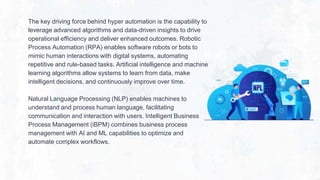
The key driving force behind hyper automation is the capability to
leverage advanced algorithms and data-driven insights to drive
operational efficiency and deliver enhanced outcomes. Robotic
Process Automation (RPA) enables software robots or bots to
mimic human interactions with digital systems, automating
repetitive and rule-based tasks. Artificial intelligence and machine
learning algorithms allow systems to learn from data, make
intelligent decisions, and continuously improve over time.
Natural Language Processing (NLP) enables machines to
understand and process human language, facilitating
communication and interaction with users. Intelligent Business
Process Management (iBPM) combines business process
management with AI and ML capabilities to optimize and
automate complex workflows.
Evolution of Automation
03
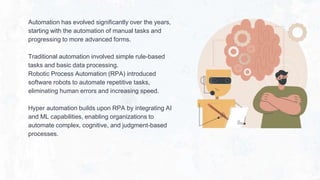
Automation has evolved significantly over the years,
starting with the automation of manual tasks and
progressing to more advanced forms.
Traditional automation involved simple rule-based
tasks and basic data processing.
Robotic Process Automation (RPA) introduced
software robots to automate repetitive tasks,
eliminating human errors and increasing speed.
Hyper automation builds upon RPA by integrating AI
and ML capabilities, enabling organizations to
automate complex, cognitive, and judgment-based
processes.
Benefits of Hyper Automation
04
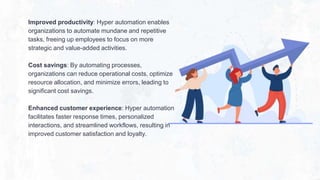
Improved productivity: Hyper automation enables
organizations to automate mundane and repetitive
tasks, freeing up employees to focus on more
strategic and value-added activities.
Cost savings: By automating processes,
organizations can reduce operational costs, optimize
resource allocation, and minimize errors, leading to
significant cost savings.
Enhanced customer experience: Hyper automation
facilitates faster response times, personalized
interactions, and streamlined workflows, resulting in
improved customer satisfaction and loyalty.
Key Components of Hyper
Automation
05
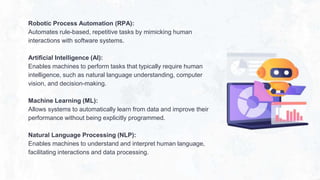
Robotic Process Automation (RPA):
Automates rule-based, repetitive tasks by mimicking human
interactions with software systems.
Artificial Intelligence (AI):
Enables machines to perform tasks that typically require human
intelligence, such as natural language understanding, computer
vision, and decision-making.
Machine Learning (ML):
Allows systems to automatically learn from data and improve their
performance without being explicitly programmed.
Natural Language Processing (NLP):
Enables machines to understand and interpret human language,
facilitating interactions and data processing.
Hyper Automation
Process
06
Identification: Identify the processes suitable for automation by evaluating their complexity, volume,
and potential benefits.
Automation: Implement Robotic Process Automation (RPA) and other automation tools to automate
the identified processes.
Orchestration: Integrate and orchestrate various automation components to enable seamless end-
to-end automation.
Monitoring: Continuously monitor and analyze the automated processes, gather insights, and
identify areas for further improvement.
Use Cases of Hyper
Automation
07
Healthcare: Automation can streamline patient data management, claims processing, and
appointment scheduling, leading to improved operational efficiency and better patient care.
Manufacturing: Hyper automation can optimize supply chain management, inventory tracking,
and quality control processes, resulting in increased productivity and reduced errors.
Customer Service: Automation can be applied to customer inquiries, chatbots, and sentiment
analysis, enabling faster response times and personalized customer experiences.
Human Resources: Hyper automation can automate employee onboarding, payroll processing,
and performance management, enhancing HR efficiency and reducing administrative burden.
Challenges and Risks
08
Job displacement: Hyper automation may lead to concerns about job
losses as routine tasks are automated. However, it can also create new
roles that require advanced skills in managing automated processes.
Ethical considerations: As automation becomes more prevalent,
ethical considerations such as data privacy, bias in AI algorithms, and
responsible use of automation need to be addressed.
Data security: Automation involves handling sensitive data, and
organizations must ensure robust security measures to protect against
potential breaches.
Integration complexities: Integrating multiple technologies and systems
can be complex and may require significant effort and expertise.
Future Trends in Hyper
Automation
09
Quantum Computing:
Quantum computing holds the potential to revolutionize hyper automation by exponentially
increasing processing power and enabling more complex algorithms and simulations.
Edge Computing:
Edge computing brings automation closer to the data source, reducing latency and enabling
real-time decision-making, making it well-suited for hyper automation applications.
Hyper automation as a Service:
Cloud-based hyper automation platforms and services are expected to emerge, offering
flexibility, scalability, and accessibility for organizations of all sizes.
Conclusion
10
● Hyper automation combines advanced technologies to automate complex business
processes, tasks, and workflows.
● Benefits of hyper automation include enhanced productivity, improved customer
experiences, and cost savings.
● Challenges to consider include workforce displacement, data privacy, ethical considerations,
and change management.
● Strategic implementation is crucial, including investing in upskilling and reskilling programs.
● Hyper automation augments human capabilities, enabling them to focus on higher-value
activities.
● Embracing hyper automation unlocks opportunities, drives innovation, and creates an
efficient, agile, and human-centric future of work.
Q&A
We invite you to ask any questions or share your thoughts on hyper automation
Thank You 
(AI)

Hyper Automation.pptx

  • 1.
  • 2.
    01 What isHyper Automation? Table of contents 02 Overview of Hyper Automation 03 Evolution of Automation 04 Benefits of Hyper Automation 05 Key Components of Hyper Automation
  • 3.
    06 Hyper AutomationProcess Table of contents 07 Use Cases of Hyper Automation 08 Challenges and Risks 09 Future Trends in Hyper Automation 10 Conclusion
  • 4.
  • 5.
    Hyper Automation Hyper automationrefers to the combination of robotic process automation (RPA) with artificial intelligence (AI), machine learning (ML), natural language processing (NLP), and other advanced technologies. It aims to automate not just routine and repetitive tasks but also complex decision-making processes and workflows.
  • 6.
    Hyper automation leveragesAI and ML algorithms to learn, adapt, and continuously improve the automation process, enabling organizations to achieve higher levels of efficiency and agility. Automation has played a significant role in streamlining processes and increasing efficiency in various industries. However, a new wave of automation, known as hyper automation, is set to revolutionize the future of work. Hyper automation also reduces errors and improves accuracy, resulting in improved operational efficiency.
  • 7.
  • 8.
    The key drivingforce behind hyper automation is the capability to leverage advanced algorithms and data-driven insights to drive operational efficiency and deliver enhanced outcomes. Robotic Process Automation (RPA) enables software robots or bots to mimic human interactions with digital systems, automating repetitive and rule-based tasks. Artificial intelligence and machine learning algorithms allow systems to learn from data, make intelligent decisions, and continuously improve over time. Natural Language Processing (NLP) enables machines to understand and process human language, facilitating communication and interaction with users. Intelligent Business Process Management (iBPM) combines business process management with AI and ML capabilities to optimize and automate complex workflows.
  • 9.
  • 10.
    Automation has evolvedsignificantly over the years, starting with the automation of manual tasks and progressing to more advanced forms. Traditional automation involved simple rule-based tasks and basic data processing. Robotic Process Automation (RPA) introduced software robots to automate repetitive tasks, eliminating human errors and increasing speed. Hyper automation builds upon RPA by integrating AI and ML capabilities, enabling organizations to automate complex, cognitive, and judgment-based processes.
  • 11.
    Benefits of HyperAutomation 04
  • 12.
    Improved productivity: Hyperautomation enables organizations to automate mundane and repetitive tasks, freeing up employees to focus on more strategic and value-added activities. Cost savings: By automating processes, organizations can reduce operational costs, optimize resource allocation, and minimize errors, leading to significant cost savings. Enhanced customer experience: Hyper automation facilitates faster response times, personalized interactions, and streamlined workflows, resulting in improved customer satisfaction and loyalty.
  • 13.
    Key Components ofHyper Automation 05
  • 14.
    Robotic Process Automation(RPA): Automates rule-based, repetitive tasks by mimicking human interactions with software systems. Artificial Intelligence (AI): Enables machines to perform tasks that typically require human intelligence, such as natural language understanding, computer vision, and decision-making. Machine Learning (ML): Allows systems to automatically learn from data and improve their performance without being explicitly programmed. Natural Language Processing (NLP): Enables machines to understand and interpret human language, facilitating interactions and data processing.
  • 15.
  • 16.
    Identification: Identify theprocesses suitable for automation by evaluating their complexity, volume, and potential benefits. Automation: Implement Robotic Process Automation (RPA) and other automation tools to automate the identified processes. Orchestration: Integrate and orchestrate various automation components to enable seamless end- to-end automation. Monitoring: Continuously monitor and analyze the automated processes, gather insights, and identify areas for further improvement.
  • 17.
    Use Cases ofHyper Automation 07
  • 18.
    Healthcare: Automation canstreamline patient data management, claims processing, and appointment scheduling, leading to improved operational efficiency and better patient care. Manufacturing: Hyper automation can optimize supply chain management, inventory tracking, and quality control processes, resulting in increased productivity and reduced errors. Customer Service: Automation can be applied to customer inquiries, chatbots, and sentiment analysis, enabling faster response times and personalized customer experiences. Human Resources: Hyper automation can automate employee onboarding, payroll processing, and performance management, enhancing HR efficiency and reducing administrative burden.
  • 19.
  • 20.
    Job displacement: Hyperautomation may lead to concerns about job losses as routine tasks are automated. However, it can also create new roles that require advanced skills in managing automated processes. Ethical considerations: As automation becomes more prevalent, ethical considerations such as data privacy, bias in AI algorithms, and responsible use of automation need to be addressed. Data security: Automation involves handling sensitive data, and organizations must ensure robust security measures to protect against potential breaches. Integration complexities: Integrating multiple technologies and systems can be complex and may require significant effort and expertise.
  • 21.
    Future Trends inHyper Automation 09
  • 22.
    Quantum Computing: Quantum computingholds the potential to revolutionize hyper automation by exponentially increasing processing power and enabling more complex algorithms and simulations. Edge Computing: Edge computing brings automation closer to the data source, reducing latency and enabling real-time decision-making, making it well-suited for hyper automation applications. Hyper automation as a Service: Cloud-based hyper automation platforms and services are expected to emerge, offering flexibility, scalability, and accessibility for organizations of all sizes.
  • 23.
  • 24.
    ● Hyper automationcombines advanced technologies to automate complex business processes, tasks, and workflows. ● Benefits of hyper automation include enhanced productivity, improved customer experiences, and cost savings. ● Challenges to consider include workforce displacement, data privacy, ethical considerations, and change management. ● Strategic implementation is crucial, including investing in upskilling and reskilling programs. ● Hyper automation augments human capabilities, enabling them to focus on higher-value activities. ● Embracing hyper automation unlocks opportunities, drives innovation, and creates an efficient, agile, and human-centric future of work.
  • 25.
    Q&A We invite youto ask any questions or share your thoughts on hyper automation
  • 26.