HyperAutomation
Meet Barasara
2nd CSD
12102130501005
Topics of Discussion
• What is HyperAutomation
• Introduction to Hyperautomation
• The Role of Artificial Intelligence in Hyperautomation
• Robotic Process Automation in Hyperautomation
• The Benefits of Hyperautomation
• Implementation Challenges
• The Future of Hyperautomation
What is Hyperautomation?
• Hyperautomation is the concept of
automating everything in an organization
that can be automated.
Introduction to
HyperAutomation
• Hyperautomation helps organizations
automate complex business processes
that were previously done manually.
• It is beyond automation,where we are
trying to automate every process.
Introduction to
HyperAutomation
• Hyperautomation can also help
organizations to identify areas where they
can improve their processes and make
them more efficient.
• All parts of a process can be
automated, from data extraction to
decision-making.
Robotic Process Automation in
Hyperautomation
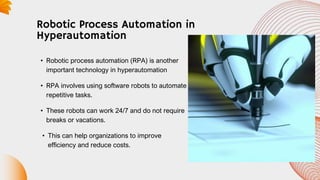
• Robotic process automation (RPA) is another
important technology in hyperautomation
• RPA involves using software robots to automate
repetitive tasks.
• These robots can work 24/7 and do not require
breaks or vacations.
• This can help organizations to improve
efficiency and reduce costs.
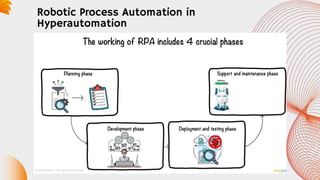
Robotic Process Automation in
Hyperautomation
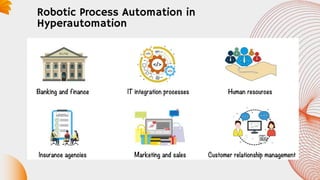
Robotic Process Automation in
Hyperautomation
Robotic Process Automation in
Hyperautomation
• RPA can be used to automate a wide range of
tasks, including data entry, invoice processing,
and customer service.
• By automating these tasks, organizations can
free up employees to focus on more important
tasks that require human interference.
• Platforms to Create RPA Bot
• Uipath
• Automation Anywhere
• Pega
• WorkFusion
The Role of Artificial Intelligence
in Hyperautomation
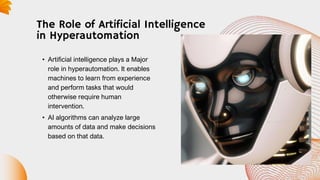
• Artificial intelligence plays a Major
role in hyperautomation. It enables
machines to learn from experience
and perform tasks that would
otherwise require human
intervention.
• AI algorithms can analyze large
amounts of data and make decisions
based on that data.
The Role of Artificial Intelligence
in Hyperautomation
• Example, ChatBox
• AI can also be used to improve customer service.
• can be programmed to answer common
customer questions and provide support.
• This can help organizations to save time and
resources while improving customer satisfaction.
Benefits of Hyperautomation
• Hyperautomation offers many benefits to
organizations, including improved efficiency,
reduced costs, and increased productivity.
• Hyperautomation can also help organizations to
stay competitive in today's fast-paced business
environment.
• By automating processes, organizations can
respond quickly to changes in the market and stay
ahead of the competition.
Challenges of Implementing
Hyperautomation
• One of the biggest challenges is the need for
skilled workers who can design and implement the
technology.
• Another challenge is the need to integrate
different technologies into a system.
• Hyperautomation involves combining multiple
technologies, which can be difficult to manage.
The Future of Hyperautomation
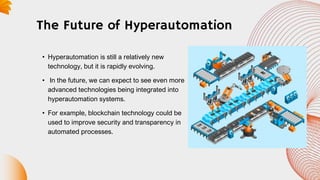
• Hyperautomation is still a relatively new
technology, but it is rapidly evolving.
• In the future, we can expect to see even more
advanced technologies being integrated into
hyperautomation systems.
• For example, blockchain technology could be
used to improve security and transparency in
automated processes.
HyperAutomation (3).pptx

HyperAutomation (3).pptx

  • 1.
  • 2.
    Topics of Discussion •What is HyperAutomation • Introduction to Hyperautomation • The Role of Artificial Intelligence in Hyperautomation • Robotic Process Automation in Hyperautomation • The Benefits of Hyperautomation • Implementation Challenges • The Future of Hyperautomation
  • 3.
    What is Hyperautomation? •Hyperautomation is the concept of automating everything in an organization that can be automated.
  • 4.
    Introduction to HyperAutomation • Hyperautomationhelps organizations automate complex business processes that were previously done manually. • It is beyond automation,where we are trying to automate every process.
  • 5.
    Introduction to HyperAutomation • Hyperautomationcan also help organizations to identify areas where they can improve their processes and make them more efficient. • All parts of a process can be automated, from data extraction to decision-making.
  • 6.
    Robotic Process Automationin Hyperautomation • Robotic process automation (RPA) is another important technology in hyperautomation • RPA involves using software robots to automate repetitive tasks. • These robots can work 24/7 and do not require breaks or vacations. • This can help organizations to improve efficiency and reduce costs.
  • 7.
    Robotic Process Automationin Hyperautomation
  • 8.
    Robotic Process Automationin Hyperautomation
  • 9.
    Robotic Process Automationin Hyperautomation • RPA can be used to automate a wide range of tasks, including data entry, invoice processing, and customer service. • By automating these tasks, organizations can free up employees to focus on more important tasks that require human interference. • Platforms to Create RPA Bot • Uipath • Automation Anywhere • Pega • WorkFusion
  • 10.
    The Role ofArtificial Intelligence in Hyperautomation • Artificial intelligence plays a Major role in hyperautomation. It enables machines to learn from experience and perform tasks that would otherwise require human intervention. • AI algorithms can analyze large amounts of data and make decisions based on that data.
  • 11.
    The Role ofArtificial Intelligence in Hyperautomation • Example, ChatBox • AI can also be used to improve customer service. • can be programmed to answer common customer questions and provide support. • This can help organizations to save time and resources while improving customer satisfaction.
  • 12.
    Benefits of Hyperautomation •Hyperautomation offers many benefits to organizations, including improved efficiency, reduced costs, and increased productivity. • Hyperautomation can also help organizations to stay competitive in today's fast-paced business environment. • By automating processes, organizations can respond quickly to changes in the market and stay ahead of the competition.
  • 13.
    Challenges of Implementing Hyperautomation •One of the biggest challenges is the need for skilled workers who can design and implement the technology. • Another challenge is the need to integrate different technologies into a system. • Hyperautomation involves combining multiple technologies, which can be difficult to manage.
  • 14.
    The Future ofHyperautomation • Hyperautomation is still a relatively new technology, but it is rapidly evolving. • In the future, we can expect to see even more advanced technologies being integrated into hyperautomation systems. • For example, blockchain technology could be used to improve security and transparency in automated processes.