Heat stroke
/Hyper thermia
DR AMBER MUSHTAQ
MBBS.FCCP MRCGP
CONSULTANT FAMILY PHYSICIAN
DEPARTMENT OF MEDICINE
Objectives :
 Types of heat related injuries
 To understand how to work safely in the sun
 Who is affected
 Management
8
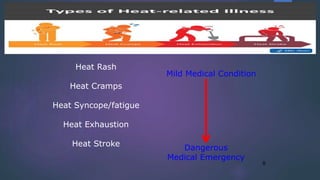
Types of Heat Injuries/Illnesses
Heat Rash
Heat Cramps
Heat Syncope/fatigue
Heat Exhaustion
Heat Stroke
Mild Medical Condition
Dangerous
Medical Emergency
9
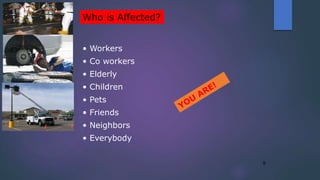
• Workers
• Co workers
• Elderly
• Children
• Pets
• Friends
• Neighbors
• Everybody
Who is Affected?
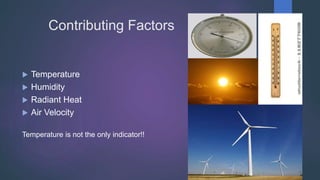
Contributing Factors
 Temperature
 Humidity
 Radiant Heat
 Air Velocity
Temperature is not the only indicator!!
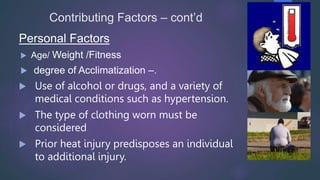
Contributing Factors – cont’d
Personal Factors
 Age/ Weight /Fitness
 degree of Acclimatization –.
 Use of alcohol or drugs, and a variety of
medical conditions such as hypertension.
 The type of clothing worn must be
considered
 Prior heat injury predisposes an individual
to additional injury.
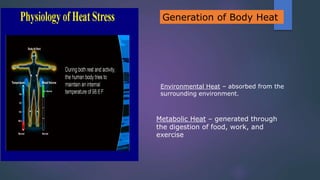
Metabolic Heat – generated through
the digestion of food, work, and
exercise
Environmental Heat – absorbed from the
surrounding environment.
Generation of Body Heat
6
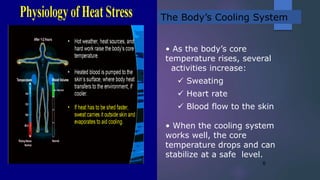
The Body’s Cooling System
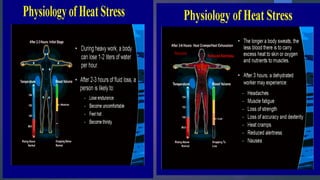
• As the body’s core
temperature rises, several
activities increase:
 Sweating
 Heart rate
 Blood flow to the skin
• When the cooling system
works well, the core
temperature drops and can
stabilize at a safe level.
7
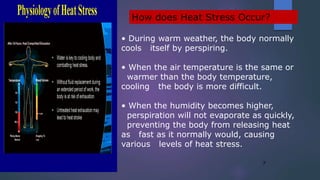
How does Heat Stress Occur?
• During warm weather, the body normally
cools itself by perspiring.
• When the air temperature is the same or
warmer than the body temperature,
cooling the body is more difficult.
• When the humidity becomes higher,
perspiration will not evaporate as quickly,
preventing the body from releasing heat
as fast as it normally would, causing
various levels of heat stress.
TYPES OF HYPER THERMIA
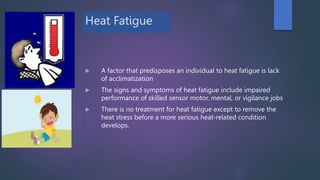
Heat Fatigue
 A factor that predisposes an individual to heat fatigue is lack
of acclimatization
 The signs and symptoms of heat fatigue include impaired
performance of skilled sensor motor, mental, or vigilance jobs
 There is no treatment for heat fatigue except to remove the
heat stress before a more serious heat-related condition
develops.
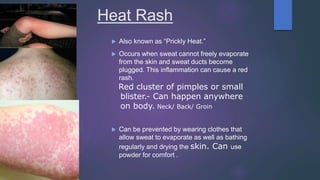
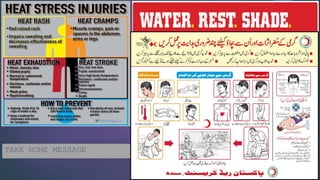
Heat Rash
 Also known as “Prickly Heat.”
 Occurs when sweat cannot freely evaporate
from the skin and sweat ducts become
plugged. This inflammation can cause a red
rash.
Red cluster of pimples or small
blister.- Can happen anywhere
on body. Neck/ Back/ Groin
 Can be prevented by wearing clothes that
allow sweat to evaporate as well as bathing
regularly and drying the skin. Can use
powder for comfort .
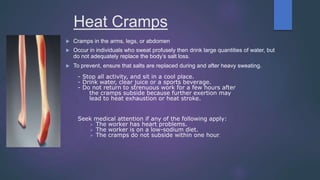
Heat Cramps
 Cramps in the arms, legs, or abdomen
 Occur in individuals who sweat profusely then drink large quantities of water, but
do not adequately replace the body’s salt loss.
 To prevent, ensure that salts are replaced during and after heavy sweating.
- Stop all activity, and sit in a cool place.
- Drink water, clear juice or a sports beverage.
- Do not return to strenuous work for a few hours after
the cramps subside because further exertion may
lead to heat exhaustion or heat stroke.
Seek medical attention if any of the following apply:
 The worker has heart problems.
 The worker is on a low-sodium diet.
 The cramps do not subside within one hour.
27
Heat Syncope/fainting/collapse
• Symptoms:
- the onset of heat collapse is rapid and
unpredictable
Fainting/- Dizzy/- Light Headed
• Causes :
• In heat collapse, the brain does not receive enough
oxygen because blood pools in the extremities
• lack of acclimatization
Treatment:
- Sit or lie down in cool place when
they begin
to feel symptoms.
- Slowly drink water, clear juice, or a
sports
beverage.
19
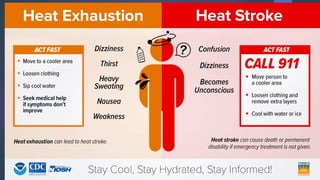
Heat Exhaustion –
Heat Exhaustion is considered a Medical
Emergency! If not treated on time
• Weakness
• Heavy sweating
• Extreme weakness
or fatigue
• Dizziness, confusion
• Nausea
• Clammy, moist skin
• Pale or flushed
complexion
• Muscle cramps
• Slightly elevated
body
temperature
• Fast and shallow
breathing
Heat Exhaustion - Treatment
 Do not leave the person alone.
 Move to a cool place to rest.
 Drink water or electrolyte fluids.
 Treat for shock, if necessary.
 If unconscious, fails to recover rapidly, has other injuries, or has a history
of medical problems, seek medical attention.
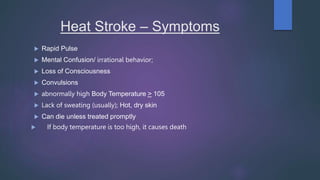
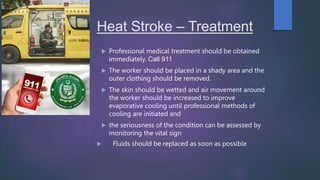
Heat Stroke - Cause
 Severe and sometimes fatal condition resulting from the failure
of the body to regulate its core temperature. body temperature
rises to critical levels
 The body’s normal cooling mechanisms stop functioning,
sweating stops.
 This condition is caused by a combination of highly variable
factors, and its occurrence is difficult to predict
 True medical emergency requiring immediate medical
attention.
Heat Stroke – Symptoms
 Rapid Pulse
 Mental Confusion/ irrational behavior;
 Loss of Consciousness
 Convulsions
 abnormally high Body Temperature > 105
 Lack of sweating (usually); Hot, dry skin
 Can die unless treated promptly
 If body temperature is too high, it causes death
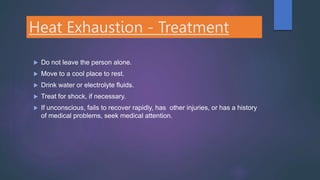
Heat Stroke – Treatment
 Professional medical treatment should be obtained
immediately. Call 911
 The worker should be placed in a shady area and the
outer clothing should be removed.
 The skin should be wetted and air movement around
the worker should be increased to improve
evaporative cooling until professional methods of
cooling are initiated and
 the seriousness of the condition can be assessed by
monitoring the vital sign
 Fluids should be replaced as soon as possible
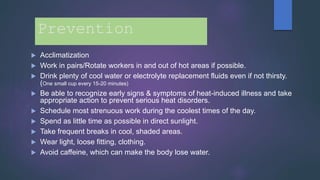
Prevention
 Acclimatization
 Work in pairs/Rotate workers in and out of hot areas if possible.
 Drink plenty of cool water or electrolyte replacement fluids even if not thirsty.
(One small cup every 15-20 minutes)
 Be able to recognize early signs & symptoms of heat-induced illness and take
appropriate action to prevent serious heat disorders.
 Schedule most strenuous work during the coolest times of the day.
 Spend as little time as possible in direct sunlight.
 Take frequent breaks in cool, shaded areas.
 Wear light, loose fitting, clothing.
 Avoid caffeine, which can make the body lose water.
TAKE HOME MESSAGE
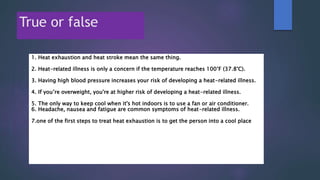
True or false
1. Heat exhaustion and heat stroke mean the same thing.
2. Heat-related illness is only a concern if the temperature reaches 100°F (37.8°C).
3. Having high blood pressure increases your risk of developing a heat-related illness.
4. If you’re overweight, you're at higher risk of developing a heat-related illness.
5. The only way to keep cool when it's hot indoors is to use a fan or air conditioner.
6. Headache, nausea and fatigue are common symptoms of heat-related illness.
7.one of the first steps to treat heat exhaustion is to get the person into a cool place
.
Short quiz
Which of the following is a sign of heat stroke, but not heat
exhaustion?
A. really fast heart beat
B .coma
C. Dizziness
D. continuous heavy sweating
Short quiz
1. Normal body temperature is _____ and heat stroke occurs at
a body temperature of _____.
a. 98.6 degrees F, at or above 104 degrees F
b. 98.6 degrees F, anything above 98.6 degrees F
c. 98.6 degrees F, 100 degrees F
d. 100 degrees F, at or above 104 degrees F
Short quiz
 2. Which of the following statements is true?
a. a heat stroke is a medical emergency
b. heat exhaustion is a medical emergency
c. heat stroke can lead to heat exhaustion
d. neither condition is considered to be an emergency
THANK YOU
DR AMBER MUSHTAQ
MBBS.FCCP MRCGP
CONSULTANT FAMILY PHYSICIAN
DEPARTMENT OF MEDICINE

HYPER THERMIA DR AMBER.pptx

  • 1.
    Heat stroke /Hyper thermia DRAMBER MUSHTAQ MBBS.FCCP MRCGP CONSULTANT FAMILY PHYSICIAN DEPARTMENT OF MEDICINE
  • 2.
    Objectives :  Typesof heat related injuries  To understand how to work safely in the sun  Who is affected  Management
  • 3.
    8 Types of HeatInjuries/Illnesses Heat Rash Heat Cramps Heat Syncope/fatigue Heat Exhaustion Heat Stroke Mild Medical Condition Dangerous Medical Emergency
  • 4.
    9 • Workers • Coworkers • Elderly • Children • Pets • Friends • Neighbors • Everybody Who is Affected?
  • 5.
    Contributing Factors  Temperature Humidity  Radiant Heat  Air Velocity Temperature is not the only indicator!!
  • 6.
    Contributing Factors –cont’d Personal Factors  Age/ Weight /Fitness  degree of Acclimatization –.  Use of alcohol or drugs, and a variety of medical conditions such as hypertension.  The type of clothing worn must be considered  Prior heat injury predisposes an individual to additional injury.
  • 7.
    Metabolic Heat –generated through the digestion of food, work, and exercise Environmental Heat – absorbed from the surrounding environment. Generation of Body Heat
  • 8.
    6 The Body’s CoolingSystem • As the body’s core temperature rises, several activities increase:  Sweating  Heart rate  Blood flow to the skin • When the cooling system works well, the core temperature drops and can stabilize at a safe level.
  • 10.
    7 How does HeatStress Occur? • During warm weather, the body normally cools itself by perspiring. • When the air temperature is the same or warmer than the body temperature, cooling the body is more difficult. • When the humidity becomes higher, perspiration will not evaporate as quickly, preventing the body from releasing heat as fast as it normally would, causing various levels of heat stress.
  • 11.
  • 12.
    Heat Fatigue  Afactor that predisposes an individual to heat fatigue is lack of acclimatization  The signs and symptoms of heat fatigue include impaired performance of skilled sensor motor, mental, or vigilance jobs  There is no treatment for heat fatigue except to remove the heat stress before a more serious heat-related condition develops.
  • 13.
    Heat Rash  Alsoknown as “Prickly Heat.”  Occurs when sweat cannot freely evaporate from the skin and sweat ducts become plugged. This inflammation can cause a red rash. Red cluster of pimples or small blister.- Can happen anywhere on body. Neck/ Back/ Groin  Can be prevented by wearing clothes that allow sweat to evaporate as well as bathing regularly and drying the skin. Can use powder for comfort .
  • 14.
    Heat Cramps  Crampsin the arms, legs, or abdomen  Occur in individuals who sweat profusely then drink large quantities of water, but do not adequately replace the body’s salt loss.  To prevent, ensure that salts are replaced during and after heavy sweating. - Stop all activity, and sit in a cool place. - Drink water, clear juice or a sports beverage. - Do not return to strenuous work for a few hours after the cramps subside because further exertion may lead to heat exhaustion or heat stroke. Seek medical attention if any of the following apply:  The worker has heart problems.  The worker is on a low-sodium diet.  The cramps do not subside within one hour.
  • 15.
    27 Heat Syncope/fainting/collapse • Symptoms: -the onset of heat collapse is rapid and unpredictable Fainting/- Dizzy/- Light Headed • Causes : • In heat collapse, the brain does not receive enough oxygen because blood pools in the extremities • lack of acclimatization Treatment: - Sit or lie down in cool place when they begin to feel symptoms. - Slowly drink water, clear juice, or a sports beverage.
  • 16.
    19 Heat Exhaustion – HeatExhaustion is considered a Medical Emergency! If not treated on time • Weakness • Heavy sweating • Extreme weakness or fatigue • Dizziness, confusion • Nausea • Clammy, moist skin • Pale or flushed complexion • Muscle cramps • Slightly elevated body temperature • Fast and shallow breathing
  • 17.
    Heat Exhaustion -Treatment  Do not leave the person alone.  Move to a cool place to rest.  Drink water or electrolyte fluids.  Treat for shock, if necessary.  If unconscious, fails to recover rapidly, has other injuries, or has a history of medical problems, seek medical attention.
  • 18.
    Heat Stroke -Cause  Severe and sometimes fatal condition resulting from the failure of the body to regulate its core temperature. body temperature rises to critical levels  The body’s normal cooling mechanisms stop functioning, sweating stops.  This condition is caused by a combination of highly variable factors, and its occurrence is difficult to predict  True medical emergency requiring immediate medical attention.
  • 19.
    Heat Stroke –Symptoms  Rapid Pulse  Mental Confusion/ irrational behavior;  Loss of Consciousness  Convulsions  abnormally high Body Temperature > 105  Lack of sweating (usually); Hot, dry skin  Can die unless treated promptly  If body temperature is too high, it causes death
  • 20.
    Heat Stroke –Treatment  Professional medical treatment should be obtained immediately. Call 911  The worker should be placed in a shady area and the outer clothing should be removed.  The skin should be wetted and air movement around the worker should be increased to improve evaporative cooling until professional methods of cooling are initiated and  the seriousness of the condition can be assessed by monitoring the vital sign  Fluids should be replaced as soon as possible
  • 22.
    Prevention  Acclimatization  Workin pairs/Rotate workers in and out of hot areas if possible.  Drink plenty of cool water or electrolyte replacement fluids even if not thirsty. (One small cup every 15-20 minutes)  Be able to recognize early signs & symptoms of heat-induced illness and take appropriate action to prevent serious heat disorders.  Schedule most strenuous work during the coolest times of the day.  Spend as little time as possible in direct sunlight.  Take frequent breaks in cool, shaded areas.  Wear light, loose fitting, clothing.  Avoid caffeine, which can make the body lose water.
  • 23.
  • 24.
    True or false 1.Heat exhaustion and heat stroke mean the same thing. 2. Heat-related illness is only a concern if the temperature reaches 100°F (37.8°C). 3. Having high blood pressure increases your risk of developing a heat-related illness. 4. If you’re overweight, you're at higher risk of developing a heat-related illness. 5. The only way to keep cool when it's hot indoors is to use a fan or air conditioner. 6. Headache, nausea and fatigue are common symptoms of heat-related illness. 7.one of the first steps to treat heat exhaustion is to get the person into a cool place .
  • 25.
    Short quiz Which ofthe following is a sign of heat stroke, but not heat exhaustion? A. really fast heart beat B .coma C. Dizziness D. continuous heavy sweating
  • 26.
    Short quiz 1. Normalbody temperature is _____ and heat stroke occurs at a body temperature of _____. a. 98.6 degrees F, at or above 104 degrees F b. 98.6 degrees F, anything above 98.6 degrees F c. 98.6 degrees F, 100 degrees F d. 100 degrees F, at or above 104 degrees F
  • 27.
    Short quiz  2.Which of the following statements is true? a. a heat stroke is a medical emergency b. heat exhaustion is a medical emergency c. heat stroke can lead to heat exhaustion d. neither condition is considered to be an emergency
  • 28.
    THANK YOU DR AMBERMUSHTAQ MBBS.FCCP MRCGP CONSULTANT FAMILY PHYSICIAN DEPARTMENT OF MEDICINE

Editor's Notes

  • #4 The higher on the list, the more dangerous it is to the individual. An untreated Heat stroke case can lead to DEATH. Heat Rash can easily be handled by first aid.
  • #5 Those affected concerning heat related injuries and illnesses include: Workers Co-workers Elderly Children Pets Friends Neighbors Everybody YOU
  • #9 As the body’s core temperature rises, several activities increase: Sweating Heart rate Blood flow to the skin When the body’s cooling system works well, the core temperature drops and can stabilize at a safe level.
  • #11 Heat stress occurs because during warm weather, the body normally cools itself by perspiring. When the air temperature is the same or warmer than the body temperature, cooling the body is more difficult. When the humidity becomes higher, perspiration will not evaporate as quickly, preventing the body from releasing heat as fast as it normally would, causing various levels of heat stress. Don’t be fooled by the outside temperature as heat related illnesses/injuries can occur during cold weather as well depending upon what the person is wearing, what task(s) they are accomplishing, how long they’re doing the task(s), etc.
  • #16 Heat Syncope (sink-a-pee) Heat syncope is a fainting episode or dizziness that usually occurs due to prolonged standing or sudden rising from a sitting or lying position. Factors that may contribute to heat syncope include dehydration and lack of acclimatization. Staying Quiet means no cell phone usage or other work related activity like still directing the work. Staying quiet will allow both yourself and others to evaluate your condition and its seriousness.
  • #17 When thinking about heat exhaustion, pick things up by watching co-workers. They may be asking for or just taking aspirin or drinking caffeine drinks. They may be holding their stomachs or look miserable more than usual. They may be making multiple trips because they can’t lift the normal load. They may respond to you in a unusual way.