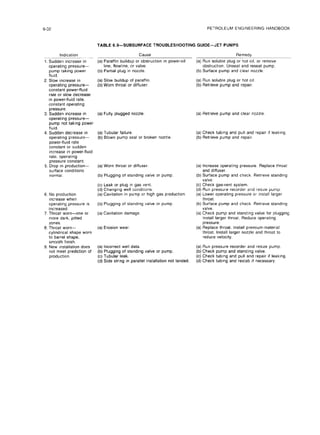
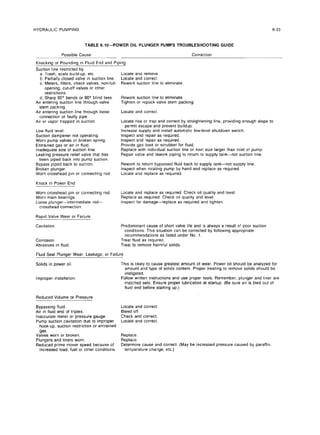
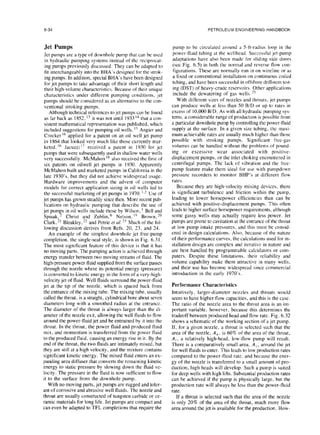
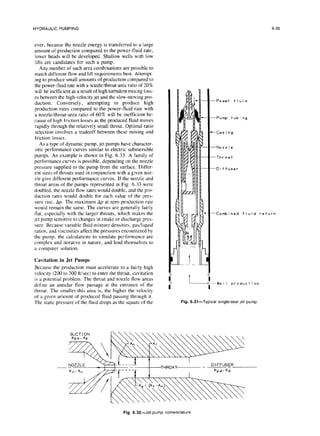
Chapter 6
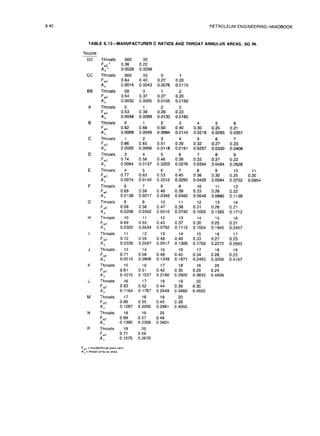
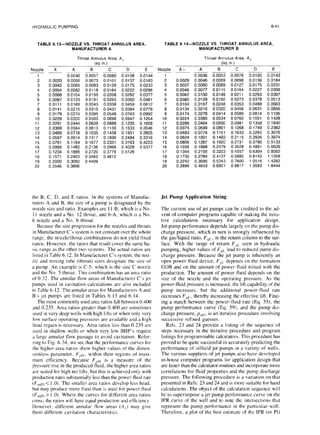
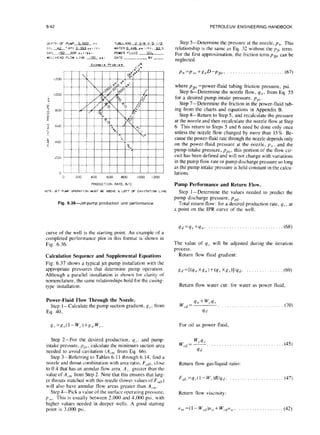
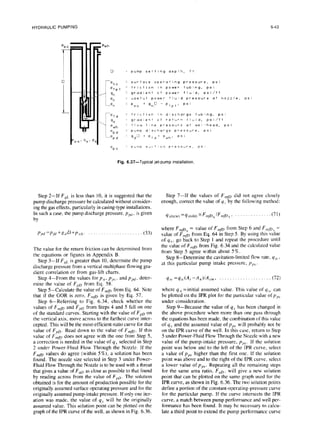
Hydraulic Pumping
Hal Petrie, National-Oilwell*
Introduction
A well will flow if it has sufficient reservoir potential ener-
gy (pressure) to lift fluid to the surface. Artificial lift is
applied to a well if the reservoir pressure is not sufficient
to cause the well to flow, or when more production is
desired in a flowing well. In either case, energy must be
transmitted downhole and added to the produced fluid.
Hydraulic pumping systems transmit power downhole by
means of pressurized power fluid that flows in wellbore
tubulars. Hydraulic transmission of power downhole can
be accomplished with good efficiency. With 30”API oil
at 2,500 psi in 27/,-in. tubing, 100 surface hhp can be trans-
mitted to a depth of 8,000 ft with a flow rate of 2,353
B/D and with a frictional pressure drop of 188 psi. This
pressure loss is 7.5 % of the applied power. If the trans-
mission pressure is raised to 4,000 psi, the required flow
rate drops to 1,47 1 B/D and the frictional pressure loss
declines to only 88 psi. This is 2.2% of the applied sur-
face power. Even higher efficiencies can be achieved with
water as the hydraulic medium because of its lower vis-
cosity .
The downhole pump acts as a transformer to convert
the energy of the power fluid to potential energy or pres-
sure in the produced fluids. The most common form of
hydraulic downhole pump consists of a set of coupled
reciprocating pistons, one driven by the power fluid and
the other pumping the well fluids. Another form of
hydraulic downhole pump that has become more popular
is the jet pump, which converts the pressurized power
fluid to a high-velocity jet that mixes directly with the well
fluids. ‘.2 In the turbulent mixing process, momentum and
energy from the power fluid are added to the produced
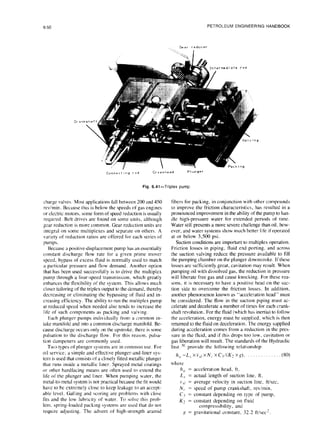
fluids. Rotatin hydraulic equipment has also been tested
in oil wells. ‘,9 In this case, a hydraulic turbine driven
by the power fluid rotates a shaft on which a multistage
centrifugal or axial-flow pump is mounted. This type of
‘The origlnat chapter on this top% m the 1962 edltion was written by C J. Coberly and
F Barton Brown.
pump has not had widespread commercial use. The “free
pump” feature, common to most designs, allows the pump
to be circulated in and out of the well hydraulically without
pulling tubing or using wircline services.
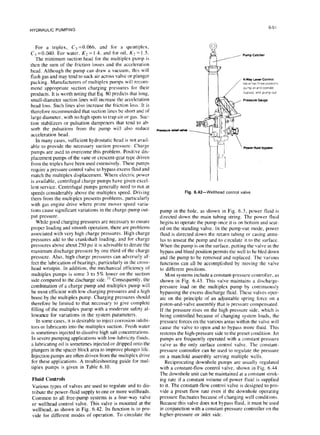
The operating pressures used in hydraulic pumping sys-
tems usually range from 2,000 to 4,000 psi. The most
common pump used to generate this pressure on the sur-
face is a triplex or quintiplex positive-displacement pump
driven by an electric motor or a multicylinder gas or diesel
engine. Multistage centrifugal pumps have also been
used,5 and some systems have operated with the excess
capacity in water-injection systems. ’ The hydraulic fluid
usually comes from the well and can be produced oil or
water. A fluid reservoir at the surface provides surge ca-
pacity and is usually part of the cleaning system used to
condition the well fluids for use as power fluid. Appro-
priate control valves and piping complete the system. A
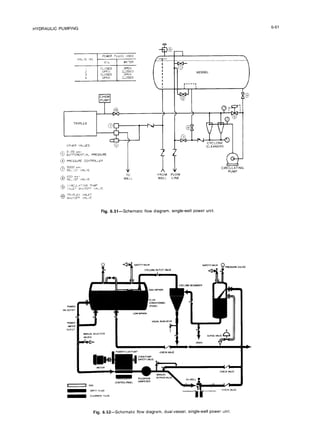
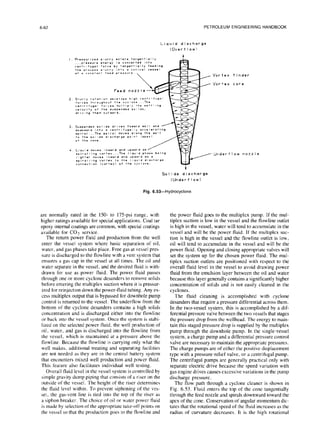
schematic of a typical hydraulic pumping system is shown
in Fig. 6.1.
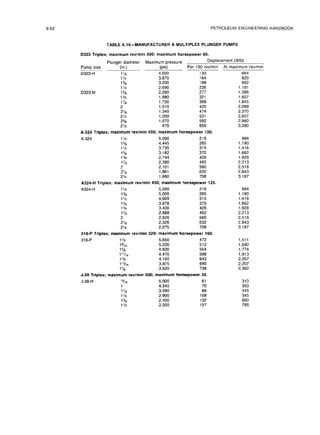
A wide variety of well conditions can be handled by
hydraulic pumping systems. Successful applications have
included setting depths ranging from 1,000 to 18,000 ft. ’
Production rates can vary from less than 100 to more than
10,000 B/D. Surface packages are available in sizes rang-
ing from 30 to 625 hp. The systems are flexible because
the downhole pumping rate can be regulated over a wide
range with fluid controls on the surface. Chemicals to con-
trol corrosion, paraffin, and emulsions can be injected
downhole with the power fluid. Fresh water can also be
injected to dissolve salt deposits. When pumping heavy
crudes, the power fluid can serve as an effective diluent
to reduce the viscosity of the produced fluids. The power
fluid can also be heated for handling heavy crudes or low-
pour-point crudes. Hydraulic pumping systems are suita-
ble for wells with deviated or crooked holes that cause
problems for conventional rod pumping. The surface fa-
cilities have a low profile and can be clustered into a cen-
tral battery to service numerous wells. This can be
6-2 PETROLEUM ENGINEERING HANDBOOK
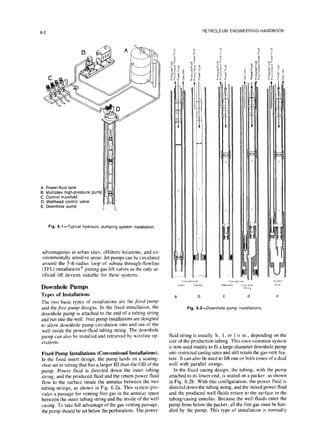
A. Power-fluid
tank
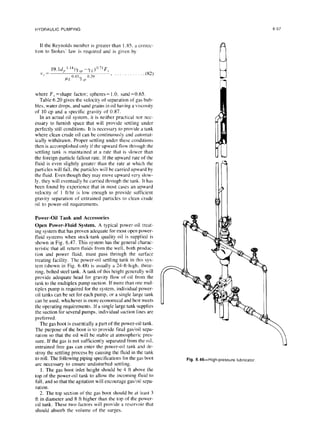
B. Multiplexhigh-pressurepump
C. Control manifold
D. Wellhead controlvalve
E. Downhole pump
Fig. &i-Typical hydraulicpumping system mstallation
advantageous in urban sites,offshore locations, and en-
VirOnmentally sensitive areas. Jet pumps can be circulated
around the 5-ft-radius loop of subsea through-flowline
(TFL) installations8 joining gas-lift valves as the only ar-
tificial lift devices suitable for these systems.
Downhole Pumps
Types of Installations
The two basic types of installations are the fixed pump
and the free pump designs. In the fixed installation, the
downhole pump is attached to the end of a tubing string
and run into the well, Free pump installations are designed
to allow downhole pump circulation into and out of the
well inside the power-fluid tubing string. The downhole
pump can also be installed and retrieved by wireline op-
erations.
Fixed Pump Installations (Conventional Installations).
In the fixed insert design, the pump lands on a seating-
shoe set in tubing that has a larger ID than the OD of the
pump. Power fluid is directed down the inner tubing
string, and the produced fluid and the return power fluid
flow to the surface inside the annulus between the two
tubing strings, as shown in Fig. 6.2a. This system pro-
vides a passage for venting free gas in the annular space
between the outer tubing string and the inside of the well
casing. To take full advantage of the gas venting passage,
the pump should be set below the perforations. The power-
Fig. 6.2-Downhole pump installations.
fluid string is usually ?4, I, or I U in., depending on the
size of the production tubing. This once-common system
is now used mainly to fit a large-diameter downhole pump
into restricted casing sizes and still retain the gas-vent fea-
ture. It can also be used to lift one or both zones of a dual
well with parallel strings.
In the fixed casing design, the tubing, with the pump
attached to its lower end, is seated on a packer, as shown
in Fig. 6.2b. With this configuration. the power fluid is
directed down the tubing string, and the mixed power fluid
and the produced well fluids return to the surface in the
tubing/casing annulus. Because the well fluids enter the
pump from below the packer, all the free gas must be han-
dled by the pump. This type of installation is normally
6-3
HYDRAULIC
PUMPING
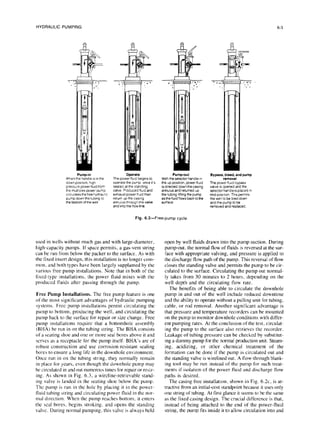
Pump-in
When the handle is I” the
down positron. high
pressure power Huld Irom
the multiplex power pump
c~rculalesthelree hydraulic
pump down the tubing to
the bottom of the well
The pow&flu~d begIns lo
operate the pump once it’s
seated at the standing
valve Produced fluId and
exhaust power fluld then
return up the casing
annulus through the valve
and Into the flow Ilne.
Pump-out
With the selector handle in
the up posItion, power fluld
is drected down the casing
annulus and returned up
the tubing lifting the pump
as the fluid flows back to the
surface
Bypass. bleed, and pump
removal
The power fluld bypass
valve IS opened and the
selector handle IS placed I”
m!d-posItton This permits
the well to be bled dawn
and the pump to be
removed and replaced.
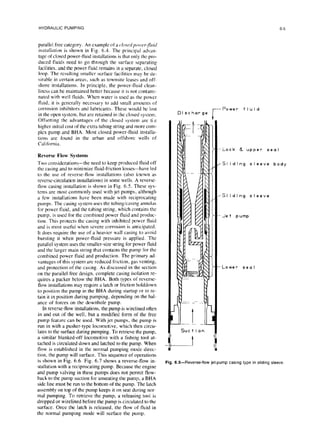
Fig. 6.3-Free-pump cycle.
used in wells without much gas and with large-diameter,
high-capacity pumps. If space permits, a gas-vent string
can be run from below the packer to the surface. As with
the fixed insert design, this installation is no longer com-
mon, and both types have been largely supplanted by the
various free pump installations. Note that in both of the
fixed-type installations, the power fluid mixes with the
produced fluids after passing through the pump.
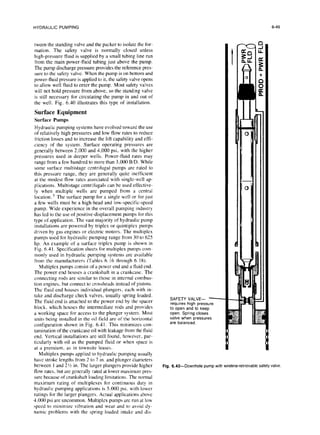
Free Pump Installations. The free pump feature is one
of the most significant advantages of hydraulic pumping
systems. Free pump installations permit circulating the
pump to bottom, producing the well, and circulating the
pump back to the surface for repair or size change. Free
pump installations require that a bottomhole assembly
(BHA) be run in on the tubing string. The BHA consists
of a acating shoe and one or more seal bores above it and
scrvcs as a receptacle for the pump itself. BHA’s are of
robust construction and USCcorrosion-resistant sealing
bores to ensure a long life in the downhole environment.
Once run in on the tubing string. they normally remain
in place for years, even though the downhole pump may
be circulated in and out numerous times for repair or resiz-
ing. As shown in Fig. 6.3, a wireline-retrievable stand-
ing valve ib landed in the seating shoe below the pump.
The pump is run in the hole by placing it in the power-
fluid tubing string and circulating power fluid in the nor-
mal direction. When the pump reaches bottom, it enters
the seal bores. begins stroking. and opens the standing
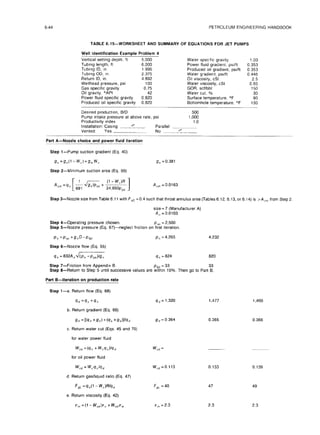
valve. During normal pumping, this valve is always held
open by well fluids drawn into the pump suction. During
pump-out, the normal flow of fluids is reversed at the sur-
face with appr.opriate valving, and pressure is applied to
the discharge flow path of the pump. This reversal of flow
closes the standing valve and permits the pump to be cir-
culated to the surface. Circulating the pump out normal-
ly takes from 30 minutes to 2 hours. depending on the
well depth and the circulating flow rate.
The benefits of being able to circulate the downhole
pump in and out of the well include reduced downtime
and the ability to operate without a pulling unit for tubing.
cable, or rod removal. Another significant advantage is
that pressure and temperature recorders can be mounted
on the pump to monitor downhole conditions with differ-
ent pumping rates. At the conclusion of the test, circulat-
ing the pump to the surface also retrieves the recorder.
Leakage of tubing pressure can be checked by substitut-
ing a dummy pump for the normal production unit. Steam-
ing, acidizing, or other chemical treatment of the
formation can be done if the pump is circulated out and
the standing valve is wirelined out. A flow-through blank-
ing tool may be run instead of the pump for such treat-
ments if isolation of the power fluid and discharge flow
paths is desired.
The casing free installation, shown in Fig. 6.2~. is at-
tractive from an initial-cost standpoint because it uses only
one string of tubing. At first glance it seems to be the same
as the fixed casing design. The crucial difference is that,
instead of being attached to the end of the power-fluid
string, the pump fits inside it to allow circulation into and
6-4 PETROLEUM ENGINEERING HANDBOOK
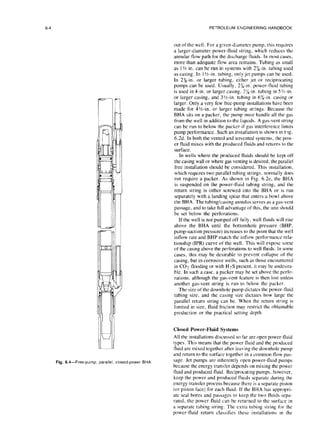
Fig. 6.4-Free-pump, parallel,
closed-power BHA.
out of the well. For a given-diameter pump, this requires
a larger-diameter power-fluid string, which reduces the
annular flow path for the discharge fluids. In most cases,
more than adequate flow area remains. Tubing as small
as I % in. can be run in systems with 2%.in. tubing used
as casing. In 1‘/z-in. tubing, only jet pumps can be used.
In 2%.in. or larger tubing, either jet or reciprocating
pumps can be used. Usually, 26-m. power-fluid tubing
is used in 4-in. or larger casing, 2x-m. tubing in 5 %-in.
or larger casing, and 3%-in. tubing in 6X-in. casing or
larger. Only a very few free-pump installations have been
made for 41/2-in. or larger tubing strings. Because the
BHA sits on a packer, the pump must handle all the gas
from the well in addition to the liquids. A gas-vent string
can be run to below the packer if gas interference limits
pump performance. Such an installation ISshown rn big.
6.2d. In both the vented and unvented systems, the pow-
er fluid mixes with the produced fluids and returns to the
surface.
In wells where the produced fluids should be kept off
the casing wall or where gas venting is desired, the parallel
free installation should be considered. This installation,
which requires two parallel tubing strings, normally does
not require a packer. As shown in Fig. 6.2e, the BHA
is suspended on the power-fluid tubing string, and the
return string is either screwed into the BHA or is run
separately with a landing spear that enters a bowl above
the BHA. The tubing/casing annulus serves as a gas-vent
passage. and to take full advantage of this, the unit should
be set below the perforations.
If the well is not pumped off fully, well fluids will rise
above the BHA until the bottomhole pressure (BHP,
pump-suction pressure) increases to the point that the well
inflow rate and BHP match the inflow performance rela-
tionship (IPR) curve of the well. This will expose some
of the casing above the perforations to well fluids. In some
cases, this may be desirable to prevent collapse of the
casing, but in corrosive wells, such as those encountered
in CO2 flooding or with H2.S present, it may be undesira-
ble. In such a case, a packer may be set above the perfo-
rations, although the gas-vent feature is then lost unless
another gas-vent string is run to below the packer.
The size of the downhole pump dictates the power-tluid
tubing size, and the casing size dictates how large the
parallel return string can be. When the return string is
limited in size, fluid friction may restrict the obtainable
production or the practical setting depth.
Closed Power-Fluid Systems
All the installations discussed so far are open power-fluid
types. This means that the power fluid and the produced
fluid are mixed together after leaving the downhole pump
and return to the surface together in a common flow pas-
sage. Jet pumps are inherently open power-fluid pumps
because the energy transfer depends on mixing the power
fluid and produced fluid. Reciprocating pumps. however,
keep the power and produced fluids separate during the
energy transfer process because there is a separate piston
(or piston face) for each fluid. If the BHA has appropri-
ate seal bores and passages to keep the two tluids sepa-
rated, the power fluid can be returned to the surface in
a separate tubing string. The extra tubing string for the
power-fluid return classifies these installations in the
HYDRAULIC PUMPING
parallel free category. An example of a c,lo.r~dpo,l,~~~~~~;~~
instufhtion is shown in Fig. 6.4. The principal advan-
tage of closed power-fluid installations is that only the pro-
duced fluids need to go through the surface separating
facilities. and the power fluid remains in a separate, closed
loop. The resulting smaller surface facilities may be de-
sirable in certain areas, such as townsite leases and off-
shore installations. In principle, the power-fluid clean-
liness can be maintained better because it is not contami-
nated with well fluids. When water is used as the power
fluid, it is generally necessary to add small amounts of
corrosion inhibitors and lubricants. These would be lost
in the open system, but arc retained in the closed system.
Offsetting the advantages of the closed system are ti e
higher initial cost of the extra tubing string and more com-
plex pump and BHA. Most closed power-fluid installa-
tions are found in the urban and offshore wells of
California.
Reverse Flow Systems
Two considerations-the need to keep produced fluid off
the casing and to minimize fluid-friction losses-have led
to the use of reverse-flow installations (also known as
reverse-circulation installations) in some wells. A reverse-
flow casing installation is shown in Fig. 6.5. These sys-
tems are most commonly used with jet pumps, although
a few installations have been made with reciprocating
pumps. The casing system uses the tubing/casing annulus
for power fluid, and the tubing string, which contains the
pump, is used for the combined power fluid and produc-
tion. This protects the casing with inhibited power fluid
and is most useful when severe corrosion is anticipated.
It does require the use of a heavier wall casing to avoid
bursting it when power-fluid pressure is applied. The
parallel system uses the smaller-size string for power fluid
and the larger main string that contains the pump for the
combined power fluid and production. The primary ad-
vantages of this system are reduced friction, gas venting,
and protection of the casing. As discussed in the section
on the parallel free design. complete casing isolation re-
quires a packer below the BHA. Both types of reverse-
flow installations may require a latch or friction holddown
to position the pump in the BHA during startup or to re-
tain it in position during pumping, depending on the bal-
ance of forces on the downhole pump.
In reverse-flow installations. the pump is wirelined often
in and out of the well, but a modified form of the free
pump feature can be used. With jet pumps, the pump is
run in with a pusher-type locomotive, which then circu-
lates to the surface during pumping. To retrieve the pump,
a similar blanked-off locomotive with a fishing tool at-
tached is circulated down and latched to the pump. When
flow is established in the normal pumping mode direc-
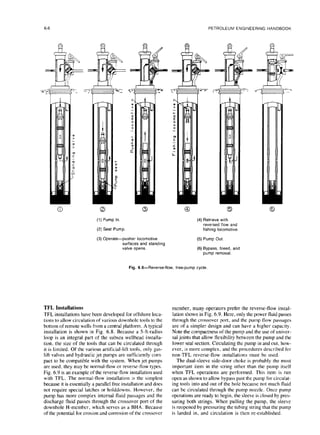
tion, the pump will surface. This sequence of operations
is shown in Fig. 6.6. Fig. 6.7 shows a reverse-flow in-
stallation with a reciprocating pump. Because the engine
and pump valving in these pumps does not permit flow-
back to the pump suction for unseating the pump, a BHA
side line must be run to the bottom of the pump. The latch
assembly on top of the pump keeps it on seat during nor-
mal pumping. To retrieve the pump, a releasing tool is
dropped or wirelined before the pump is circulated to the
surface. Once the latch is released, the flow of fluid in
the normal pumping mode will surface the pump.
r Power
Discharge
6-5
fluid
-Lock A upper seal
~51 iding sleeve body
*SI iding sleeve
-Jet pump
-Lower sea I
Suet ion
tI
Fig. 6.5~-Reverse-flowjet-pump casing type in sliding
sleeve.
PETROLEUM ENGINEERING HANDBOOK
(1)Pump In.
(2)Seat Pump.
(4)Retrievewith
reversed flow and
fishinglocomotive.
(5)Pump Out.
(6)Bypass, bleed,and
pump removal.
(3)Operate-pusher locomotive
surfaces and standing
valve opens.
Fig. &B--Reverse-flow, free-pump cycle.
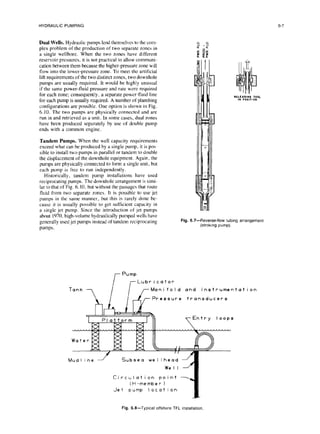
TFL Installations
TFL installations have been developed for offshore loca-
tions to allow circulation of various downhole tools to the
bottom of remote wells from a central platform. A typical
installation is shown in Fig. 6.8. Because a Sft-radius
loop is an integral part of the subsea wellhead installa-
tion, the size of the tools that can be circulated through
it is limited. Of the various artificial-lift tools, only gas-
lift valves and hydraulic jet pumps are sufficiently corn-
pact to be compatible with the system. When jet pumps
are used, they may be normal-flow or reverse-flow types.
Fig. 6.9 is an example of the reverse-flow installation used
with TFL. The normal-flow installation is the simplest
because it is essentially a parallel free installation and does
not require special latches or holddowns. However, the
pump has more complex internal fluid passages and the
discharge fluid passes through the crossover port of the
downhole H-member, which serves as a BHA. Because
of the potential for erosion and corrosion of the crossover
member, many operators prefer the reverse-flow instal-
lation shown in Fig. 6.9. Here, only the power fluid passes
through the crossover port, and the pump flow passages
are of a simpler design and can have a higher capacity.
Note the compactness of the pump and the use of univer-
sal joints that allow flexibility between the pump and the
lower seal section. Circulating the pump in and out. how-
ever, is more complex, and the procedures described for
non-TFL reverse-flow installations must be used.
The dual-sleeve side-door choke is probably the most
important item in the string other than the pump itself
when TFL operations are performed. This item is run
open as shown to allow bypass past the pump for circulat-
ing tools into and out of the hole because not much fluid
can be circulated through the pump nozzle. Once pump
operations are ready to begin, the sleeve is closed by pres-
suring both strings. When pulling the pump, the sleeve
is reopened by pressuring the tubing string that the pump
is landed in, and circulation is then re-established.
HYDRAULIC PUMPING
Dual Wells. Hydraulic pumps lend themselves to the com-
plex problem of the production of two separate zones in
a single wellbore. When the two zones have different
reservoir pressures. it is not practical to allow communi-
cation between them because the higher-pressure zone will
flow into the lower-pressure zone. To meet the artificial
lift requirements of the two distinct zones, two downhole
pumps are usually required. It would be highly unusual
if the same power-tluid pressure and rate were required
for each zone; consequently, a separate power-fluid line
for each pump is usually required. A number of plumbing
configurations are possible. One option is shown in Fig.
6.10. The two pumps are physically connected and are
run in and retrieved as a unit. In some cases, dual zones
have been produced separately by use of double pump
ends with a common engine.
Tandem Pumps. When the well capacity requirements
exceed what can be produced by a single pump, it is pas-
sible to install two pumps in parallel or tandem to double
the displacement of the downhole equipment. Again, the
pumps are physically connected to form a single unit, but
each pump is free to run independently.
Historically, tandem pump installations have used
reciprocating pumps. The downhole arrangement is simi-
lar to that of Fig. 6.10, but without the passages that route
fluid from two separate zones. It is possible to use jet
pumps in the same manner, but this is rarely done be-
cause it is usually possible to get sufficient capacity in
a single jet pump. Since the introduction of jet pumps
about 1970, high-volume hydraulically pumped wells have
generally used jet pumps instead of tandem reciprocating
pumps.
6-7
Fig. 6.7~-Reverse-flowtubing arrangement
(stroking
pump).
Lubr i cator
Manifold and instrumen
Pressure transducers
Entry loops
Subsea we I lhead
Circulation point
(H-member 1
Jet pump location
tat ion
Fig. 6.6-Typical offshoreTFL installation.
6-8 PETROLEUM ENGINEERING HANDBOOK
Production
Latch
Seals
Side door
choke
Universal
joint
Diffuser
Throat
Nozzle
Power
fluid
I
1'
1
;i
+ Suction
Production
discharge
Pump
-
plunger
Pump
- discharge
valve
Pump
- barrel
- Pump intake
valve
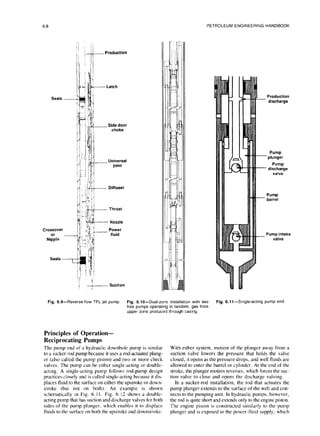
Fig. 6.9--Reverse-flowTFL jetpump. Fig. 6.10-Dual-zone installation
with two
free pumps operatingintandem, gas from
upper zone produced through casing.
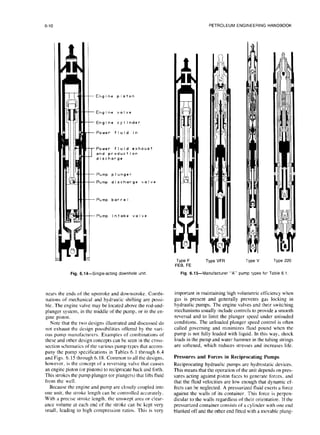
Fig. 6.11--Single-acting
pump end
Principles of Operation-
Reciprocating Pumps
The pump end of a hydraulic downhole pump is similar
to a sucker-rod pump because it uses a rod-actuated plung-
er (also called the pump piston) and two or more check
valves. The pump can be either single-acting or double-
acting. A single-acting pump follows rod-pump design
practices closely and is called single-acting because it dis-
places fluid to the surface on either the upstroke or down-
stroke (but not on both). An example is shown
schematically in Fig. 6.11. Fig. 6.12 shows a double-
acting pump that has suction and discharge valves for both
sides of the pump plunger. which enables it to displace
fluidsto the surface on both the upstroke and downstroke.
With either system, motion of the plunger away from a
suction valve lowers the pressure that holds the valve
closed, it opens as the pressure drops, and well fluids are
allowed to enter the barrel or cylinder. At the end of the
stroke, the plunger motion reverses, which forces the suc-
tion valve to close and opens the discharge valving.
In a sucker-rod installation. the rod that actuates the
pump plunger extends to the surface of the well and con-
nects to the pumping unit. In hydraulic pumps. however,
the rod is quite short and extends only to the engine piston.
The engine piston is constructed similarly to the pump
plunger and is exposed to the power-fluid supply, which
PETROLEUM ENGINEERING HANDBOOK
-Engine piston
-Engine valve
-Engine cylinder
-Power fluid in
rPower fluid exhaust
i and production
discharge
-Pump plunger
-Pump d ischarge va Ive
-Pump barre I
-Pump intake valve
Type F
FEB, FE
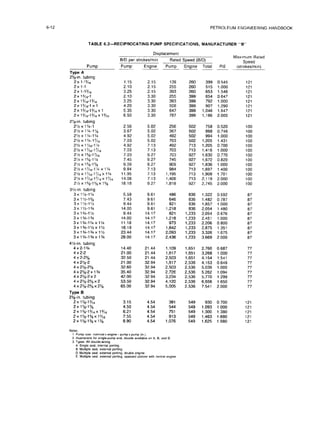
Fig. 6.14--Single-acting
downhole unit
nears the ends of the upstroke and downstroke. Combi-
nations of mechanical and hydraulic shifting are possi-
ble. The engine valve may be located above the rod-and-
plunger system, in the middle of the pump, or in the en-
gine piston.
Note that the two designs illustrated and discussed do
not exhaust the design possibilities offered by the vari-
ous pump manufacturers. Examples of combinations of
these and other design concepts can be seen in the cross-
section schematics of the various pump types that accom-
pany the pump specifications in Tables 6. I through 6.4
and Figs. 6.15 through 6.18. Common to all the designs,
however. is the concept of a reversing valve that causes
an engine piston (or pistons) to reciprocate back and forth.
This strokes the pump plunger (or plungers) that lifts fluid
from the well.
Because the engine and pump are closely coupled into
one unit, the stroke length can be controlled accurately.
With a precise stroke length, the unswept area or clear-
ance volume at each end of the stroke can be kept very
small, leading to high compression ratios. This is very
Type VFR Type V Type 220
Fig.6.15-Manufacturer “A” pump types forTable 6.1
important in maintaining high volumetric efficiency when
gas is present and generally prevents gas locking in
hydraulic pumps. The engine valves and their switching
mechanisms usually include controls to provide a smooth
reversal and to limit the plunger speed under unloaded
conditions. The unloaded plunger speed control is often
called governing and minimizes fluid pound when the
pump is not fully loaded with liquid. In this way, shock
loads in the pump and water hammer in the tubing strings
are softened, which reduces stresses and increases life.
Pressures and Forces in Reciprocating Pumps
Reciprocating hydraulic pumps are hydrostatic devices.
This means that the operation of the unit depends on pres-
sures acting against piston faces to generate forces. and
that the fluid velocities are low enough that dynamic ef-
fects can be neglected. A pressurized fluid exerts a force
against the walls of its container. This force is perpen-
dicular to the walls regardless of their orientation. If the
pressurized container consists of a cylinder with one end
blanked off and the other end fitted with a movable plung-
HYDRAULIC PUMPING 6-11
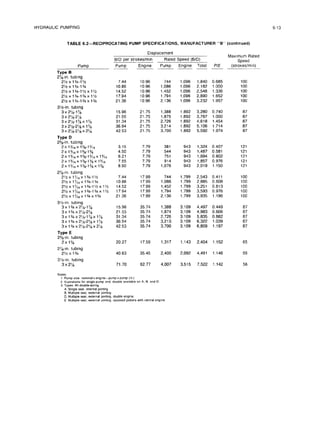
TABLE 6.1~-RECIPROCATING PUMP SPECIFICATIONS. MANUFACTURER “A”
Puma
Type F, Fe, FEB
23/8-in.
tubing
F201311
F201313
F201611
F201613
FE8201613
FE6201616
27/g-h.
tubing
F251611
F251613
F251616
FE252011
FE252013
FE252016
Type VFR
23/8-h.
tubing
VFR201611
VFR201613
VFR201616
VFR20161613
VFR20161616
27/8-h.
tubing
VFR252015
VFR252017
VFR252020
VFR25202015
VFR25202017
VFR25202020
Type V
27/-/n.
tubing
V-25-11-1
i-8
V-25-11-095
V-25-11-076
V-25-11-061
V-25-21-075
V-25-21-063
V-25-21-050
V-25-21-041
Type 220
23/-h. tubing
330-201610
330-201612
530-201615
27/-h. tubing
348-252012
348-252015
548-252017
548-252019
536-252020
Note Pump Size
F. FE, FEB. VFR Types
F
Disolacement
B/D oer strokeslmin
Puma
3.0 4.2
4.2 4.2
3.0 6.4
4.2 6.4
6.2 9.4
9.4 9.4
3.3 7.0
4.6 7.0
7.0 7.0
5.0 16.5
7.0 16.5
10.6 16.5
2.12 4.24
2.96 4.24
4.49 4.24
2.96 6.86
4.49 6.86
5.25 8.89
7.15 8.89
9.33 8.89
5.25 15.16
7.15 15.16
9.33 15.16
6.31 5.33
6.31 6.66
3.93 5.33
3.93 6.66
6.31 8.38
6.31 10.00
3.93 8.38
3.93 10.00
4.22 8.94
5.46 8.94
7.86 8.94
8.73 22.35
12.57 22.35
17.11 22.35
20.17 22.35
25.18 25.18
V Types
v
220 Sertes
3 Number of seals
20 Nommal tubing (2 I” ) 25 Nommal tubmg (2% I” ) 48 Stroke length p,
13 Engme (1 3 I” ) 11 Single engme (double = 21) 25 Nomlnal tubing (2% in.]
XX Second engine (VFR only) 118PIE 20 Engine (2 000 IO.)
11 Pump (1 1 in ) 12 Pump (1 200 m.)
Types F. FE. FEB are slngle-seal, internal-portmg; 220, VFR, and V are multiple-seal, external-pomng.
Engine
Rated Speed (B/D)
Enaine Total PIE
Puma
204
285
204
285
340
517
214
299
455
255
357
540
318
444
673
444
673
630
8.58
1,119
630
858
1,119
1,229
1,299
550
550
1,173
1,072
550
550
422
546
786
629
905
1,232
1,452
2,014
286 490 0.71
286 571 1.00
435 639 0.47
435 720 0.66
517 857 0.66
517 1,034 1.00
455 669 0.47
455 754 0.66
455 910 1.00
842 1,097 0.30
842 1,199 0.42
842 1.382 0.64
636 954 0.62
636 1,080 0.87
636 1,309 1.32
1,029 1,473 0.54
1,029 1,702 0.81
1,067 1,697 0.74
1,067 1,925 1.00
1,067 2,186 1.32
1,819 2,449 0.41
1,819 2,677 0.56
1,819 2,938 0.73
1,098 2,397 1.18
1,372 2,671 0.96
746 1,296 0.76
932 1,482 0.61
1,559 2,732 0.75
I;700 23772 0.63
1,173 1,723 0.50
1,400 1,950 0.41
894 1,316 0.49
894 1,440 0.63
894 1.680 0.89
1,609 2,238 0.40
1.609 2.514 0.57
11609 2,841 0.78
1,609 3,061 0.93
2,014 4,028 1.00
Maximum Rated
Speed
(strokes/min)
68
68
68
68
ii;
65
65
65
51
51
51
150
150
150
150
150
120
120
120
120
120
120
206
206
140
140
186
170
140
140
100
100
100
72
72
72
72
80
6-12 PETROLEUM ENGINEERING HANDBOOK
TABLE 6.2--RECIPROCATING PUMP SPECIFICATIONS, MANUFACTURER “B“
Pump
Type A
23/8-in.
tubing
2x l-13/16
2x1-1
2x l-1$&
2x 13/16-l
2x 1%6-l%
2x13/16-1x1
2x13/16-13/16x1
2x 1%6-1%6x1%6
2x-in. tubing
2% x 1x-1
2% x IV-l'/8
2'/2
x IX-1%
2% x l'h-l'/,Fj
2% x l%e-1%
2% x 15/8-l%
2% x 15/s-15/8
2% x 1%6-l% x 1%
2% x 1%,-l%, x 1%
2% x i&-l'/,6x 1'/,6
2'/2
x 15/E-15/8x
15/s
3Yz-in.
tubing
3x 1%-l%
3x l'h-lJ/B
3 x 1%1%
3x 1'/2-1%
3 x 13/4-i%
3x 1%-l%
3 x 13/i-IV4
x 1%
3 x 13/4-l%x 1%
3x 13/i-13/9x 1%
3X 1%.-l% x 1%
4Win. tubing
4x2-1%
4x2-2
4X2-23/8
4X23/8-2
4 x23/0-23/s
4X2%-2X 1%
4x2$&2x2
4 X23/-23/n
x 2
4 x 23&23/g x 23/
We B
23/s-h.
tubing
2x 13/s-13/16
2x 13/s-13/s
2X13/-13/j~Xl3/,,6
2 x 13/a-13/8
x 1y,#j
2~13/g-i3/~13/g
Notes
Displacement
B/D per strokes/min Rated Speed (B/D)
Pump Engine Pump Engine Total PIE
-~__~
Maxlmum Rated
Speed
(strokeslmln)
1.15 2.15 139
2.10 2.15 255
3.25 2.15 393
2.10 3.30 255
3.25 3.30 393
4.20 3.30 508
5.35 3.30 647
6.50 3.30 787
260 399 0.545
260 515 1.000
260 653 1.546
399 654 0.647
399 792 1.000
399 907 1.290
399 1,046 1.647
399 1,186 2.000
121
121
121
121
121
121
121
121
2.56 5.02 256 502 758 0.520
3.67 5.02 367 502 868 0.746
4.92 5.02 492 502 994 1.000
7.03 5.02 703 502 1,205 1.431
4.92 7.13 492 713 1,205 0.700
7.03 7.13 703 713 1,416 1.000
7.03 9.27 703 927 1,630 0.770
7.45 9.27 745 927 1,672 0.820
9.09 9.27 909 927 1,836 1.000
9.84 7.13 984 713 1,697 1.400
11.95 7.13 1,195 713 1,908 1.701
14.06 7.13 1,406 713 2,119 2.000
18.18 9.27 1.818 927 2,745 2.000
100
100
100
100
100
100
100
100
100
100
100
100
100
5.59 9.61 486
7.43 9.61 646
9.44 9.61 821
14.00 9.61 1,218
9.44 14.17 821
14.00 14.17 1,218
11.18 14.17 973
18.18 14.17 1,642
23.44 14.17 2,093
28.00 14.17 2,436
836 1,322 0.592
836 1,482 0.787
836 1,657 1.000
836 2,054 1.480
1,233 2,054 0.676
1,233 2,451 1.000
1,233 2,206 0.800
1,233 2,875 1.351
1,233 3,326 1.675
1,233 3,669 2.000
87
87
87
87
87
87
87
87
87
87
14.40 21.44 1,109
21.00 21.44 1,617
32.50 21.44 2,503
21.00 32.94 1,617
32.60 32.94 2,503
35.40 32.94 2,726
42.00 32.94 3,234
53.50 32.94 4,120
65.00 32.94 5,005
1,651 2,760 0.687
1,651 3,268 1.000
1,651 4,154 1.541
2,536 4,153 0.649
2,536 5,039 1.000
2,538 5,262 1.094
2,536 5,770 1.299
2,536 6,656 1.650
2,536 7,541 2.000
77
77
77
77
77
77
77
77
77
3.15 4.54 381 549 930 0700 121
4.50 4.54 544 549 1,093 1.000 121
6.21 4.54 751 549 1,300 1.380 121
7.55 4.54 913 549 1,463 1.680 121
8.90 4.54 1,076 549 1,625 1.980 121
1 Pump sue nominalx
engine-pumpx
pump (in.).
2 Illustrations
for smgle-pump
end.
double
available
onA.S,and0.
3. Types-
All
double-aclmg.
A Smgleseal,
internal
poning
B Multiple
seal,
external
porting
D Muliple
seal,
external
porting,
double
engine
E MuWe seal.
external
porting,
opposed
pistons
with
central
engine
HYDRAULIC PUMPING 6-13
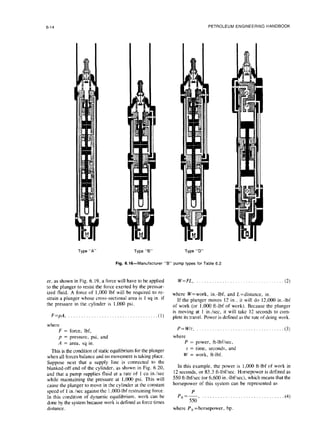
TABLE 6.2~-RECIPROCATING PUMP SPECIFICATIONS, MANUFACTURER “8" (continued)
Pump
Type 0
27/,-h.
tubing
2% x l%-1%
2% x 1%1%
2% x 13/4-1'/2
x 1%
2% x 1%1% x l'h
2% x 1%-1%x 1%
3%-h tubing
3 x21/g-17/
3 x 21/8-21/s
3x2'/,-1',f0xX17/8
3x21/8-21/8x17/
3x 21/8-21/,x
2'/,
Type D
23/8-in.
tubing
2 x 13/,6X
13/&i%
2x13/16x13/s-13/
2x13/,~xl3/~-13/,~xl3/,~
2 x 13&jx 13/s-13/8
x 1%
2x13/l~x13/8-13/8x13/8
27/-in.
tubing
2% x 17/,6X
l%-1%
2% x 1%6 x 1%-l %
2'/2xl~,~x13/4-1'/2x1'/2
2%x1~,~x13/4-13/qx1%
2%x17/,~x13hx13/4
3Win. tubing
3 x 1% x 21/,-l%
3x 1% x 2'/*-2'/8
3xl3/4x2'/~-17/8x17/~
3Xl%X2'/&2'/8X17/
3 x 1% x 2'/8-2'/8
x 2'/8
Type E
23/,-in.
tubing
2x13/8
27/8-in.
tubing
2% x 1%
3%In. tubing
3x21/8
BID per strokes/min
Enqine
Pump
A
Pump Engine Total PIE
7.44 10.96
10.86 10.96
14.52 10.96
17.94 10.96
21.36 10.96
15.96 21.75
21.55 21.75
31.34 21.75
36.94 21.75
42.53 21.75
3.15 7.79
4.50 7.79
6.21 7.79
7.55 7.79
8.90 7.79
7.44 17.99
1086 17.99
14.52 17.99
1794 17.99
21.36 17.99
15.96 35.74
21.55 35.74
31.34 35.74
36.94 35.74
42.53 35.74
20.27 17.59
40.63 35.45
71.70 62.77
1 Pump sue nomlnalrenglne-pumpxpump (in )
2 Itiustrat~onsfor Sinale~DumD end, double wallable on A, 8. and D
Displacement
Rated Speed (BID)
744
1,086
1,452
1,794
2,136
100
100
100
100
100
1,388
1,875
2,726
3,214
3,700
1,096 1,840 0.685
1,096 2,182 1.000
1,096 2,548 1.336
1,096 2,890 1.652
1,096 3,232 1.957
1,892 3,280 0.740
1,892 3,787 1.000
1,892 4,618 1.454
1,892 5,106 1.714
1,892 5,592 1.974
87
87
87
87
87
381 943 1,324 0.407 121
544 943 1,487 0.581 121
751 943 1,694 0.802 121
914 943 1,857 0.976 121
1,076 943 2,019 1.150 121
744
1,086
1,452
1,794
2,136
1,799 2,543 0.411
1,799 2,885 0.608
1,799 3,251 0.813
1,799 3,593 0.976
1,799 3,935 1.196
3,109 4,497 0.449
3,109 4,983 0.606
3,109 5,835 0.882
3,109 6,322 1.039
3,109 6,809 1.197
100
100
100
100
100
1,388
1,874
2,726
3,213
3,700
87
87
87
87
87
1,317 1,143 2,454 1.152
2,092 4,491 1.146
3,515 7,522 1.142
65
2,400 59
4,007 56
Maximum Rated
Speed
(strokes/min)
3. Types All double-&g
A Sinale seal, internal portina
B Muliple seal, exlernil p&g
D. Mulbple seal, ewlernal porting, double engme.
E Mulbpte seal. external pottmg. opposed pistons with central engine
6-14 PETROLEUM ENGINEERING HANDBOOK
Type “A” Type “6” Type “D”
Fig. 6.16-Manufacturer “B” pump types forTable 6.2
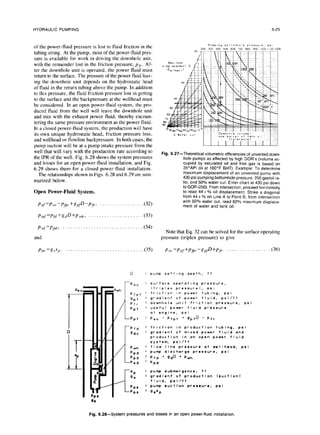
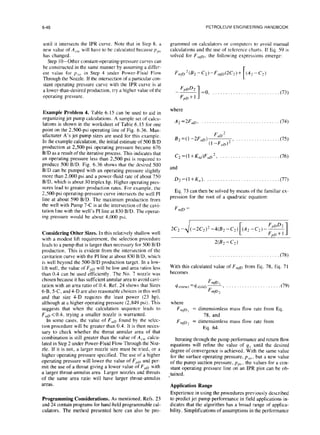
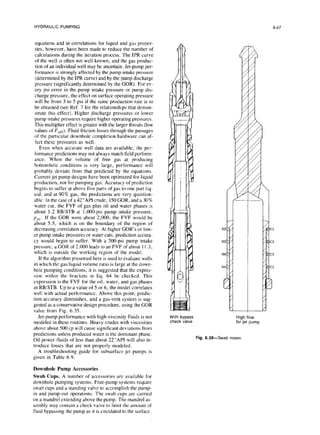
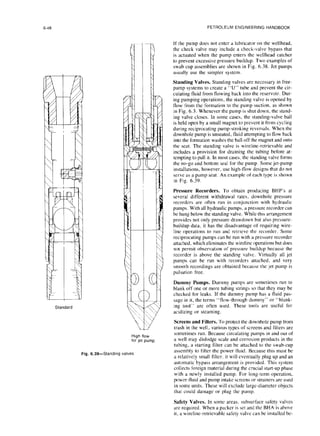
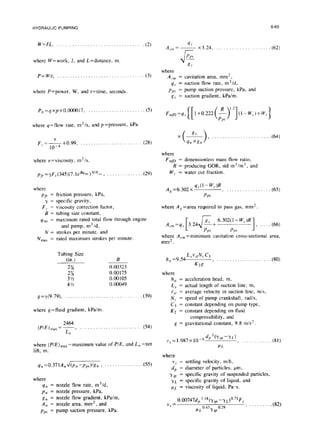
er, as shown in Fig. 6.19, a force will have to be applied W=FL, .,,...,...........................(2)
to the plunger to resist the force exerted by the pressur-
ized fluid. A force of 1,000 lbf will be required to re-
strain a plunger whose cross-sectional area is 1 sq in. if
where W=work, in.-lbf, and L=distance, in.
the pressure in the cylinder is 1,000 psi.
If the plunger moves 12 in., it will do 12,000 in.-lbf
of work (or 1,000 ft-lbf of work). Because the plunger
F=pA, . . . . . . . . . . . . . . . . . . . . . . . . . . . . . . . . ...(I)
is moving at 1 in./sec. it will take 12 seconds to com-
plete its travel. Power is defined as the rate of doing work.
where
F = force, Ibf, P=Wit, . . . . . . . . . . . . . . . . . . . . . . . . . . . . .
p = pressure, psi, and where
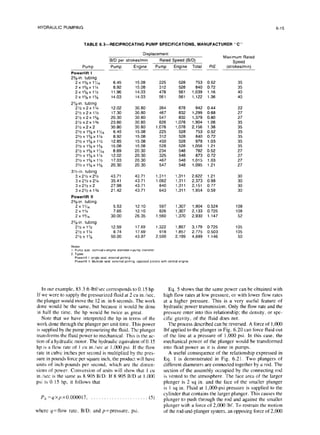
A = area, sq in. P = power, ft-lbfisec,
This is the condition of static equilibrium for the plunger
t = time, seconds, and
when all forces balance and no movement is taking place. W = work, ft-lbf.
Suppose next that a supply line is connected to the
blanked-off end of the cylinder, as shown in Fig. 6.20, In this example, the power is 1,000 ft-lbf of work in
and that a pump supplies fluid at a rate of 1 cu in.isec 12 seconds, or 83.3 ft-lbf/sec. Horsepower is defined as
while maintaining the pressure at 1,000 psi. This will 550 ft-lbf/sec (or 6,600 in.-lbf/sec), which means that the
cause the plunger to move in the cylinder at the constant horsepower of this system can be represented as
speed of I’in./sec against the 1,OO&lbf restraining force.
In this condition of dynamic equilibrium. work can be
done by the system because work is defined as force times
Ph’&, . . . . . . . . . . . . . . . . . . . . . . . . . . . . . ...(4)
distance. where Ph =horsepower, hp.
HYDRAULIC PUMPING 6-15
TABLE 6.3~RECIPROCATING PUMP SPECIFICATIONS, MANUFACTURER “C”
Puma
PowerliftI
23/&in.
tubing
2 x 15/B
X 1'/,6
2X15/X1'/4
2 x 15/8
X 1%
2X15/8X15/8
2%-in. tubing
2%X2X1%
2'/2X2Xl'h
2%X2X15/&
2%X2X13/4
2%X2X2
2% x 15/e
x l'/,fj
2'/2
x 15/gx1'/4
2’/2 x 15/8x1%
2% x 15/gx15/8
21/2x IS/*xI'/,6
2% x 15/e
x 1%
2% x IS/,x1%
2% x 15/gx15/s
31/z-in.
iubing
3 x 2'h x 2%
3 x 2% x 2%
3x2%x2
3x2'/zxl%
PowerliftII
23/8-in.
tubing
2X1%6
2 x 1%
2x 1%
27/8-in.
tubing
2% x 1%
2’i2 x I'/4
2% x 1'h
Disolacement
B/D oer strokeslmin
Pump
6.45 15.08 225 528 753 0.52 35
8.92 15.08 312 528 840 0.72 35
11.96 14.03 478 561 1,039 1.16 40
14.03 14.03 561 561 1,122 1.36 40
12.02
17.30
20.30
23.60
30.80
6.45
8.92
12.85
15.08
8.69
12.02
17.03
20.30
43.71 43.71 1,311 1,311 2,622 1.21 30
35.41 43.71 1,062 1,311 2,373 0.98 30
27.98 43.71 840 1,311 2,151 0.77 30
21.42 43.71 643 1,311 1,954 0.59 30
5.53 12.10 597 1,307 1,904 0.524 108
7.65 12.10 826 1,307 2,133 0.725 108
30.00 26.35 1,560 1,370 2.930 1.147 52
12.59 17.69 1,322 1,857 3,179 0.725 105
8.74 17.69 918 1,857 2,775 0.503 105
50.00 43.97 2,500 2,199 4,699 1.146 50
Engine
Rated Speed (B/D)
Pumo Enaine Total PIE
30.80 264
30.80 467
30.80 547
30.80 826
30.80 1,078
15.08 225
15.08 312
15.08 450
15.08 528
20.30 234
20.30 325
20.30 467
20.30 547
678 942 0.44
832 1,299 0.68
832 1,379 0.80
1,078 1,904 1.06
1,078 2,156 1.38
528 753 0.52
528 840 0.72
528 978 1.03
528 1,056 1.21
548 782 0.52
548 873 0.72
548 1,015 1.03
548 1.095 1.21
Maximum Rated
Speed
(strokes/min)
22
27
27
35
35
35
35
35
35
27
27
27
27
In our example, 83.3 ft-lbf/sec corresponds to 0.15 hp.
If we were to supply the pressurized fluid at 2 cu in./sec,
the plunger would move the 12 in. in 6 seconds. The work
done would be the same, but because it would be done
in half the time. the hp would be twice as great.
Note that we have interpreted the hp in terms of the
work done through the plunger per unit time. This power
is supplied by the pump pressurizing the fluid. The plunger
transforms the fluid power to mechanical. This is the ac-
tion of a hydraulic motor. The hydraulic equivalent of 0. I5
hp is a flow rate of 1 cu in./sec at 1,000 psi. If the flow
rate in cubic inches per second is multiplied by the pres-
sure in pounds force per square inch, the product will have
units of inch-pounds per second, which are the dimen-
sions of power. Conversion of units will show that 1 cu
in./sec is the same as 8.905 B/D. If 8.905 B/D at 1,000
psi is 0. IS hp. it follows that
P,,=yxpx0.000017; (5)
where q=flow rate, B/D, and p-pressure, psi.
Eq. 5 shows that the same power can be obtained with
high flow rates at low pressure, or with lower flow rates
at a higher pressure. This is a very useful feature of
hydraulic power transmission. Only the flow rate and the
pressure enter into this relationship; the density, or spe-
cific gravity, of the fluid does not.
The process described can be reversed. A force of 1,000
lbf applied to the plunger in Fig. 6.20 can force fluid out
of the line at a pressure of 1,000 psi. In this case, the
mechanical power of the plunger would be transformed
into fluid power as it is done in pumps.
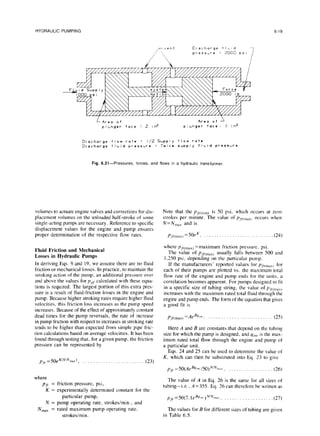
A useful consequence of the relationship expressed in
Eq. 1 is demonstrated in Fig. 6.21. Two plungers of
different diameters are connected together by a rod. The
section of the assembly occupied by the connecting rod
is vented to the atmosphere. The face area of the larger
plunger is 2 sq in. and the face of the smaller plunger
is I sq in. Fluid at l,OOO-psi pressure is supplied to the
cylinder that contains the larger plunger. This causes the
plunger to push through the rod and against the smaller
plunger with a force of 2,000 lbf. To restrain the motion
of the rod-and-plunger system, an opposing force of 2,000
6-16 PETROLEUM ENGINEERING HANDBOOK
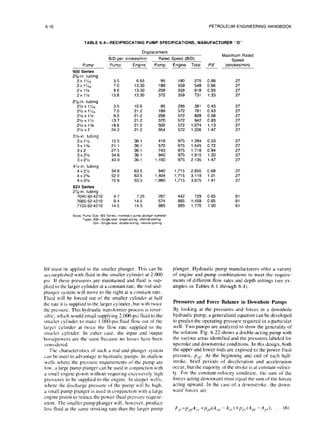
TABLE 6.4--RECIPROCATING PUMP SPECIFICATIONS, MANUFACTURER “D”
Displacement
BIDper strokes/min Rated Speed (B/D)
Maximum Rated
SDeed
Total PIE (strokeslmin)
Engine
Pump Engine Pump
Pump
900 Series
23/-in.
tubing
2x 1%
2x 1%6
2 x 1%
2 x l'h
3.5 6.65 95 180 275 0.66 27
7.0 13.30 189 359 548 0.66 27
9.6 13.30 259 359 618 0.93 27
13.8 13.30 372 359 731 1.33 27
2y8-in.tubing
2'/2
x l’h6
2% x 1'/j6
2% x 1%
2x! x 1'/2
2'/2
x 1%
2% x 2
3.5 10.6 95 266 381 0.43 27
7.0 21.2 189 572 761 0.43 27
9.5 21.2 256 572 828 0.58 27
13.7 21.2 370 572 942 0.83 27
18.6 21.2 502 572 1,074 1.13 27
24.2 21.2 654 572 1,226 1.47 27
3Win. tubing
3 x 1%
3x1%
3x2
3 x 2%
3 x 2%
4Win. tubing
4x2s
4~2%
4 x3%
924 Series
2%~in. tubing
7045-92-4210
7065-92-4210
7100-92-4210
15.5 36.1 419 975 1,394 0.53 27
36.1 570 975 1,545 0.72 27
36.1 743 975 1,718 0.94 27
36.1 940 975 1,915 1.20 27
36.1 1,160 975 2,135 1.47 27
21.1
27.5
34.8
43.0
34.8 63.5 940 1.715 2,655 0.68 27
52.0 63.5 1,404 1,715 3,119 1.01 27
72.6 63.5 1,960 1,715 3,675 1.41 27
4.7 7.25 287 442 729 0.65 61
9.4 14.5 574 885 1,459 0.65 61
14.5 14.5 885 885 1,770 1.00 61
Notes Pump SIX 900 Sews-nominal x pump plunger
diameter
Types 900-Smgle-seal, single-aclmg. Internal-portmg.
924-Single-seal. dO”bbact,ng, Internal-parling.
Ibf must be applied to the smaller plunger. This can be
accomplished with fluid in the smaller cylinder at 2.000
psi, If these pressures are maintained and fluid is sup-
plied to the larger cylinder at a constant rate, the rod-and-
plunger system will move to the right at a constant rate.
Fluid will be forced out of the smaller cylinder at half
the rate it is supplied to the larger cylinder, but with twice
the pressure. This hydraulic transformer process is rever-
siblc. which would entail supplying 2,(M)-psi fluid to the
smaller cylinder to make I.OOO-psifluid flow out of the
larger cylinder at twice the tlow rate supplied to the
smaller cylinder. In either case, the input and output
horsepowers are the same because no losses have been
considered.
The characteristics of such a rod-and-plunger system
can be used to advantage in hydraulic pumps. In shallow
wells where the pressure requirements of the pump arc
low. a large pump plunger can be used in conjunction with
a small engine piston without requiring cxccssivcly high
prcsaurcs to be supplied to the engine. In deeper wells,
where the discharge pressure of the pump will be high,
a small pump plunger is used in conjunction with a large
engine piston to reduce the power-fluid pressure require-
ment. The smaller pump plunger will, howev,cr. produce
less fluid at the same stroking rate than the larger pump
plunger. Hydraulic pump manufacturers otter a variety
of engine and pump combinations to meet the require-
ments of different flow rates and depth settings (see ex-
amples in Tables 6.1 through 6.4).
Pressures and Force Balance in Downhole Pumps
By looking at the pressures and forces in a downhole
hydraulic pump, a generalized equation can be developed
to predict the operating pressure required in a particular
well. Two pumps are analyzed to show the generality of
the solution. Fig. 6.22 shows a double-acting pump with
the various areas identified and the pressures labeled for
upstroke and downstroke conditions. In this design. both
the upper and lower rods are exposed to the power-fluid
pressure, pi,/. At the beginning and end of each half-
stroke, brief periods of decclcration and acceleration
occur, but the majority of the stroke is at constant veloci-
ty. For the constant-velocity condition. the sum of the
forces acting downward must equal the sum of the forces
acting upward. In the cast of a downstroke, the down-
ward forces arc
Fc/ =~,yAcr +P,>#,,, -A,., 1+p,,.,(A,,,, -A,,,), (6)
HYDRAULIC PUMPING 6-17
Powerlift
I Powerlift
II
Fig. 6.17-Manufacturer “C” pump types forTable 6.3
where
F,, = downward force, Ibf,
P,]~ = power-fluid pressure, psi,
A<‘r-
- cross-sectional area of engine rod, sq in.,
AL’,’= cross-sectional area of engine piston.
sq in.,
PP> = pump suction pressure, psi,
A PP = cross-sectional area of pump plunger,
sq in., and
AP’ = cross-sectional area of pump rod, sq in.
The upward forces are
where
F,, = upward force, Ibf,
pcl/ = engine discharge pressure, psi, and
p,,‘l = pump discharge pressure. psi.
900 Series
Fig. &la-Manufacturer “D” pump types forTable 6.4
924 Series
Equating the upward and downward forces and solving
for the power-fluid pressure at the pump gives
P,,~=P<,<I
+P~JA,,~ -A,rY(A,, -A,,.)
-p,u(A, -A,,Y(A, -A<,,). . .(8)
If PPCi
=pF/, as is the case in open power-fluid systems,
then
~,>t.=~,d’ +(A, -A,,V(*,,,, -*,,)I
-P,JA, -A,,V(A, -A,,). .(9)
Eq. 8 can also be written as
P/~=P~,~/+(P~~-P,,~)[(A,,~ -A,,V(A, -Aw)l.
. . . . . . . . . . . . . . . . . . . . . ..__.. (10)
6-18 PETROLEUM ENGINEERING HANDBOOK
-Force : lb
/
L Area of face of plunger : I in2
f!Fluid pressure = 1000 psi i Fluid pressure : 1000 psi
Fig. 6.19-Pressure and force ina static
plunger and cylinder
assembly.
Fig. 6.20-Pressure, force,and flow ina dynamic plunger and
cylinderassembly.
The same analysis for the upstroke would give the same
answer because this double-acting pump is completely
symmetrical.
Fig. 6.23 shows a balanced downhole unit with a single-
acting pump end. First, for the downstroke. the down-
ward forces are
F,I =P,>~(A,,J +p,,, (A,,,, -A,,), __, .(]I)
and the upward forces arc
F,, =P,,/(A,,, -A,,-) +/~,,/(A,,. -AP’.)+p,dA,,,‘)
. . . . . . . . . . . . . . . . . . . . . . . . . . (12)
In this pump. the areas of the engine and pump rods are
half that of their respective pistons and plungers:
A,,.=A,,/2 . . ..(13)
and
A,],.=A,,,J2. (14)
Equating the upward and downward forces, substituting
Eqs. 13 and 14, and solving for the power-fluid pressure.
P,,/ 8 g*ves
~,,~=~,dl +A,~,,IA,)-p,,,(A,,IA,). (15)
Evaluating the force balance for the upstroke gives
F,/ =P c,r/
(Ac,>
)i-p,> (A,,,I-A,,.) _. (16)
and
..,....,,....,,,,.,.,.,.,,, (17)
Eqs. 13. 14, 16, and 17 give
~pr = 21’,></
-p,d 1-A ,,,I/A e,,)-I’,” (A,,, /Ac/l). (18)
Note that if prcf =ppn, which is the case in an open
power-fluid installation, Eqs. 1.5and 18 become the same:
p,,/=~,x/(l +A,/*,,,)-p,,,,(A,,,,IA,). .(19)
Eq. 19 for the single-acting pump shown in Fig. 6.23 can
be made identical to Eq. 9 for the double-acting pump
shown in Fig. 6.22 by observing that, because of Eqs.
13 and 14,
A,/A, =(A,,,, -A,,)/(A, -A,,). . (20)
Because it appears frequently in pressure calculations
with hydraulic pumps, the term (A,,p -A,,,.)/(A,,,l -A,,)
is frequently simplified to P/E. This is sometimes called
the “P over E ratio” of the pump and is the ratio of the
net area of the pump plunger to the net area of the engine
piston. With this nomenclature. Eq. 8 for a closed power-
fluid installation becomes
P/f=Ped +p~d(PIE)-p,,,~(PIE), (21)
where PIE=(A, -*,,.)/(A, -A,,.).
Eq. 9 for an open power-fluid installation becomes
~,,~=p,,(,[ 1+ (PIE)] -pps(PIE). . . (22)
This approach has found widespread acceptance among
the manufacturers of downhole pumps, and the ratio P/E
is included in all their pump specifications (see examples
in Tables 6.1 through 6.4).
P/E values greater than 1.Oindicate that a pump plunger
is larger than the engine piston. This would be appropri-
ate for shallow, low-lift wells. P/E values less than 1.0
are typical of pumps used in deeper. higher-lift wells. In
some pumps, the P/E value is also the ratio of pump dis-
placement to engine displacement, but corrections for fluid
HYDRAULIC PUMPING 6-19
Eischarge f IbId
press,re : 2000 PSI
Area of
plLnger face = 2 In*
Area of
plL;nger face: I in’
Discharge flow rate : I/Z %pply flow rate
Discharge fIbid pressure : Twice supply fILid pressure
Fig. 6.21-Pressures, forces,and flows in a hydraulictransformer
volumes to actuate engine valves and corrections for dis-
placement volumes on the unloaded half-stroke of some
single-acting pumps are necessary. Reference to specific
displacement values for the engine and pump ensures
proper determination of the respective flow rates.
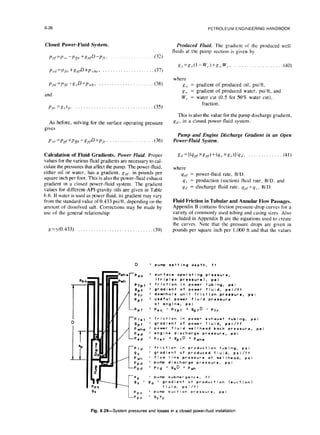
Fluid Friction and Mechanical
Losses in Hydraulic Pumps
In deriving Eqs. 9 and 19, we assume there are no fluid
friction or mechanical losses. In practice, to maintain the
stroking action of the pump. an additional pressure over
and above the values for p,,f calculated with these equa-
tions is required. The largest portion of this extra pres-
sure is a result of fluid-friction losses in the engine and
pump. Because higher stroking rates require higher fluid
velocities, this friction loss increases as the pump speed
increases. Because of the effect of approximately constant
dead times for the pump reversals, the rate of increase
in pump friction with respect to increases in stroking rate
tends to be higher than expected from simple pipe fric-
tion calculations based on average velocities. It has been
found through testing that, for a given pump, the friction
pressure can be represented by
pf,.=50eK(N’Nn,,,), . (23)
where
pfr = friction pressure, psi,
K = experimentally determined constant for the
particular pump,
N = pump operating rate, strokesimin., and
Nmax = rated maximum pump operating rate.
strokesimin.
Note that the pfri,,,,,,) is 50 psi, which occurs at zero
strokes per minute. The value of P.~,.~,,,~~,
occurs when
N=N,,, and is
~/j.(,,,~~)
=50fK, . . .(24)
where P,-,.(~~~)
=maximum friction pressure, psi.
The value of pfrcmdx) usually falls between 500 and
1.250 psi. depending on the particular pump.
If the manufacturers’ reported values for pfrcmaxj for
each of their pumps are plotted vs. the maximum total
flow rate of the engine and pump ends for the units. a
correlation becomes apparent. For pumps designed to fit
in a specific size of tubing string, the value of P,,-,,,,~~,
increases with the maximum rated total fluid through the
engine and pump ends. The form of the equation that gives
a good fit is
p,Mmaxj=A&,,,, . . (25)
Here A and B are constants that depend on the tubing
size for which the pump is designed. and LJ,,,,is the max-
imum rated total flow through the engine and pump of
a particular unit.
Eqs. 24 and 25 can be used to determine the value of
K, which can then be substituted into Eq. 23 to give
p/,. =50(AeB4~~”
/50)N’N”~‘~~
. . (26)
The value of A in Eq. 26 is the same for all sizes of
tubing-i.e.. A=355. Eq. 26 can therefore be written as
pfr =50(7. leBY~~~I
)N’Nmdr
. (27)
The values for B for different sizes of tubing are given
in Table 6.5.
6-20 PETROLEUM ENGINEER!NG HANDBOOK
Pressure
Downstroke
Fig. 6.22-Pressures actingon a double-acting downhole unit.
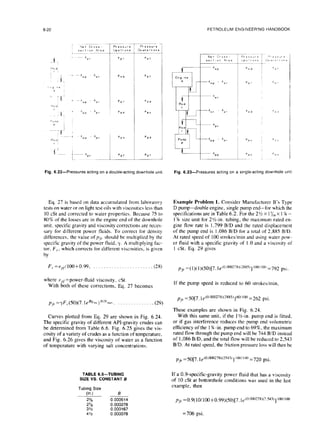
Eq. 27 is based on data accumulated from laboratory
tests on water or on light test oils with viscosities less than
10 cSt and corrected to water properties. Because 75 to
80% of the losses are in the engine end of the downhole
unit, specific gravity and viscosity corrections are neces-
sary for different power fluids. To correct for density
differences, the value of pk should be multiplied by the
specific gravity of the power fluid, y. A multiplying fac-
tor, F,, , which corrects for different viscosities, is given
by
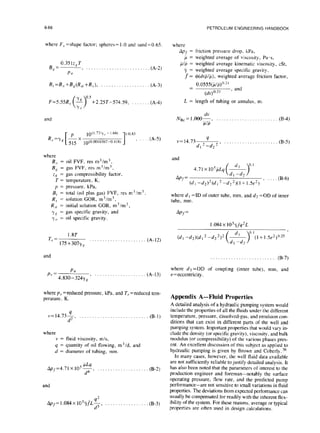
F,.=vpf./100+0.99, . . . . . . . . . . . . . . . . . . . . . ..(28)
where ~,,f=power-fluid viscosity, cSt.
With both of these corrections, Eq. 27 becomes
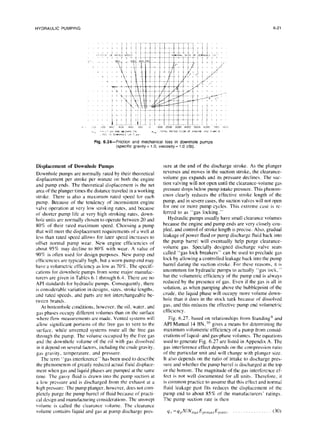
P~~=~F(~O)(~.~~~Y~~I)~'~I,I,,. . . . . . . . . . . . . ..(29)
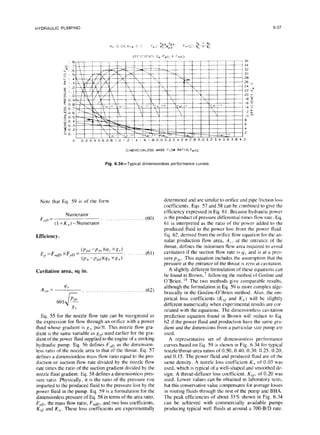
Curves plotted from Eq. 29 are shown in Fig. 6.24.
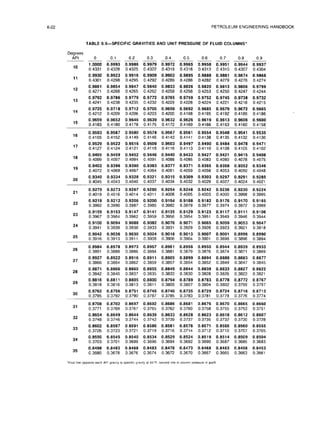
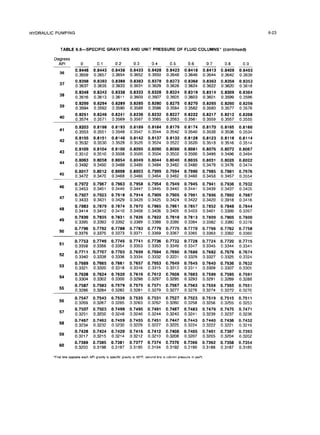
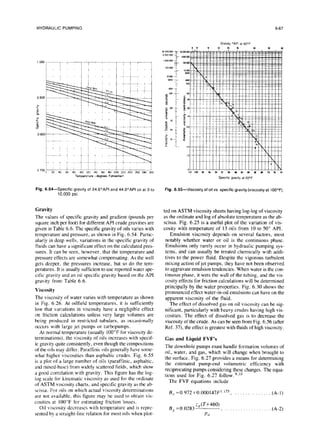
The specific gravity of different API-gravity crudes can
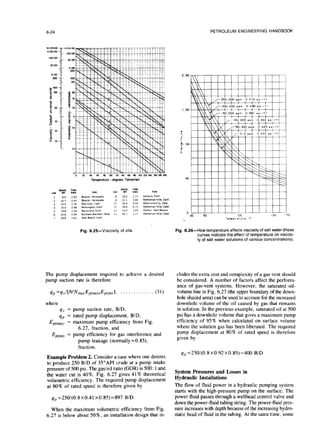
be determined from Table 6.6. Fig. 6.25 gives the vis-
cosity of a variety of crudes as a function of temperature,
and Fig. 6.26 gives the viscosity of water as a function
of temperature with varying salt concentrations.
TABLE 6.5-TUBING
SIZE VS. CONSTANT B
Tubing Size
(in.) B
2% 0.000514
2% 0.000278
3% 0.000167
4% 0.000078
Fig. 6.23-Pressures actingon a single-acting
downhole unit.
Example Problem 1. Consider Manufacturer B’s Type
D pump-double engine, single pump end-for which the
specifications are in Table 6.2. For the 2 % x 1x6 x 1% -
1% size unit for 2 s-in. tubing, the maximum rated en-
gine flow rate is 1,799 B/D and the rated displacement
of the pump end is 1,086 B/D for a total of 2,885 BID.
At rated speed of 100 strokes/min and using water pow-
er fluid with a specific gravity of 1.O and a viscosity of
1 cSt, Eq. 29 gives
If the pump speed is reduced to 60 strokes/min,
~f~=5~[7,1e(0.~0278)(2X85)160!100=2
psi,
These examples are shown in Fig. 6.24.
With this same unit. if the 1%-in. pump end is fitted,
or if gas interference reduces the pump end volumetric
efficiency of the 1X-in. pump end to 69 %. the maximum
rated flow through the pump end will be 744 B/D instead
of 1,086 B/D, and the total flow will be reduced to 2,543
BID. At rated speed, the friction pressure loss will then be
If a 0.9-specific-gravity power fluid that has a viscosity
of 10 cSt at bottomhole conditions was used in the last
example, then
=706 psi.
HYDRAULIC
PUMPING 6-21
Fig. 6.24-Friction and mechanical loss in downhole pumps
(specific gravity= 1.O,viscosity= 1.OcSt).
Displacement of Downhole Pumps
Downhole pumps are normally rated by their theoretical
displacement per stroke per minute on both the engine
and pump ends. The theoretical displacement is the net
area of the plunger times the distance traveled in a working
stroke. There is also a maxlmum rated speed for each
pump. Because of the tendency of inconsistent engine
valve operation at very low stroking rates. and because
of shorter pump life at very high stroking rates, down-
hole units are normally chosen to operate between 20 and
80% of their rated maximum speed. Choosing a pump
that will meet the displacement requirements of a well at
less than rated speed allows for later speed incrcascs to
offset normal pump wear. New engine efficiencies of
about 9.5% may decline to 80% with wear. A value of
90% is often used for design purposes. New pump end
efficiencies arc typically high, but a worn pump end may
have a volumetric efficiency as low as 70%. The specifi-
cations for downhole pumps from some ma.jor manufac-
turers are given in Tables 6. I through 6.4. There are no
API standards for hydraulic pumps. Consequently, there
is considerable variation in designs. sizes. stroke lengths.
and rated speeds. and parts are not interchangeable be-
tween brands.
At bottomhole conditions, however, the oil, water, and
gas phases occupy different volumes than on the surface
where flow measurements are made. Vented systems will
allow significant portions of the free gas to vent to the
surface. while unvented systems route all the free gas
through the pump. The volume occupied by the free gas
and the downhole volume of the oil with gas dissolved
in it dcpcnd on several factors, including the crude gravity,
gas gravity. temperature. and pressure.
The term “gas interference” has been used to describe
the phenomenon of greatly reduced actual fluid displace-
ment when gas and liquid phases are pumped at the same
time, The gassy tluid is drawn into the pump suction at
a low pressure and is discharged from the exhaust at a
high pressure. The pump plunger. however. does not com-
plctcly purge the pump barrel of fluid because of practi-
cal design and manufacturing considerations. The unswept
volume is called the clearance volume. The clearance
volume contains liquid and gas at pump discharge prcs-
sure at the end of the discharge stroke. As the plunger
reverses and moves in the suction stroke, the clearance-
volume gas expands and its pressure declines. The suc-
tion valving will not open until the clearance-volume gas
pressure drops below pump intake pressure. This phenom-
enon clearly reduces the effective stroke length of the
pump, and in severe cases, the suction valves will not open
for one or more pump cycles. This extreme case is re-
ferred to as “gas locking.”
Hydraulic pumps usually have small clearance volumes
because the engine and pump ends are very closely cou-
pled, and control of stroke length is precise. Also, gradual
leakage of power fluid or pump discharge fluid back into
the pump barrel will eventually help purge clearance-
volume gas, Specially designed discharge valve seats
called “gas lock breakers” can be used to preclude gas
lock by allowing a controlled leakage back into the pump
barrel during the suction stroke. For these reasons, it is
uncommon for hydraulic pumps to actually “gas lock,”
but the volumetric efficiency of the pump end is always
reduced by the presence of gas. Even if the gas is all in
solution, as when pumping above the bubblepoint of the
crude, the liquid phase will occupy more volume down-
hole than it does in the stock tank because of dissolved
gas. and this reduces the effcctivc pump end volumetric
efficiency.
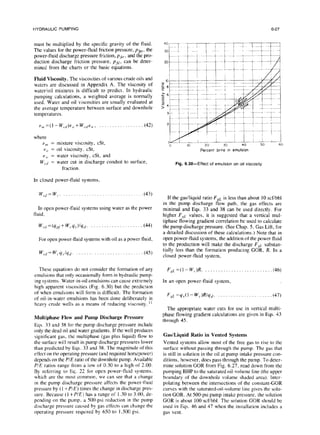
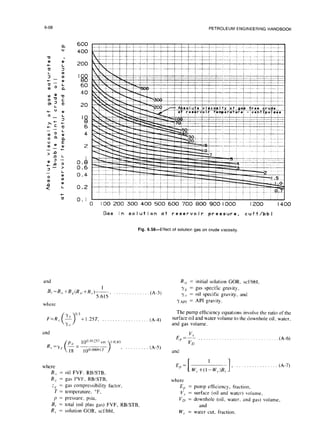
Fig. 6.27. based on relationships from Standing’ and
API Manual 14 BN, ” gives a means for determining the
maximum volumetric efficiency of a pump from consid-
erations of liquid- and gas-phase volumes. The equations
used to generate Fig. 6.27 are listed in Appendix A. The
gas interference effect depends on the compression ratio
of the particular unit and will change with plunger size.
It also depends on the ratio of intake to discharge pres-
sure and whether the pump barrel is discharged at the top
or the bottom. The magnitude of the gas interference cf-
feet is not well documented for all units. Therefore. it
is common practice to assume that this effect and normal
fluid leakage past tits reduces the displacement of the
pump end to about 85% of the manufacturers’ ratings.
The pump suction rate is then
Y =4,~~~,,,,,~ E
,Nrn‘iX, 00)
,I(,,‘,, _
6-22 PETROLEUM ENGINEERING HANDBOOK
TABLE &L-SPECIFIC GRAVITIES AND UNIT PRESSURE OF FLUID COLUMNS*
Degrees
API 0.1 0.6 0.7 0.9
0
1.0000
0.4331
0.9930
0.4301
0.9861
0.4271
0.9792
0.4241
0.9725
0.4212
0.9659
0.2 0.3 0.4 0.5
0.9986 0.9979 0.9972 0.9965
0.4325 0.4322 0.4319 0.4316
0.9916 0.9909 0.9902 0.9895
0.4295 0.4292 0.4289 0.4286
0.9847 0.9840 0.9833 0.9826
0.4265 0.4262 0.4259 0.4256
0.9779 0.9772 0.9765 0.9759
0.4235 0.4232 0.4229 0.4226
0.9712 0.9705 0.9698 0.9692
0.4206 0.4203 0.4200 0.4198
0.9646 0.9639 0.9632 0.9626
0.8
0.9944
0.4307
0.9874
0.4276
0.9806
0.4247
0.9738
0.4218
0.9672
0.4189
0.9606
10
11
0.9993
0.4328
0.9923
0.4298
0.9854
0.4268
0.9786
0.4238
0.9718
0.4209
0.9652
0.9958 0.9951
0.4313 0.4310
0.9888 0.9881
0.4282 0.4279
0.9820 0.9813
0.4253 0.4250
0.9752 0.9745
0.4224 0.4221
0.9685 0.9679
0.4195 0.4192
0.9619 0.9613
0.9937
04304
0.9868
0.4274
0.9799
0.4244
0.9732
0.4215
0.9665
0.4186
0.9600
12
13
14
15
16
17
0.4183 0.4180 0.4178 0.4175 0.4172 0.4169 0.4166 0.4163 0.4160 0.4158
0.9593 0.9587 0.9580 0.9574 0.9567 0.9561 0.9554 0.9548 0.9541 0.9535
0.4155 0.4152 0.4149 0.4146 0.4143 0.4141 0.4138 0.4135 0.4132 0.4130
0.9529 0.9522 0.9516 0.9509 0.9503 0.9497 0.9490 0.9484 0.9478 0.9471
0.4127 0.4124 0.4121 0.4116 0.4116 0.4113 0.4110 0.4106 0.4105 0.4102
0.9465 0.9459 0.9452 0.9446 0.9440 0.9433 0.9427 0.9421 0.9415 0.9408
0.4099 0.4097 0.4094 0.4091 0.4088 0.4085 0.4083 0.4080 0.4078 0.4075
0.9402 0.9396 0.9390 0.9383 0.9377 0.9371 0.9365 0.9358 0.9352 0.9346
0.4072 0.4069 0.4067 0.4064 0.4061 0.4059 0.4056 0.4053 0.4050 0.4048
0.9340 0.9334 0.9328 0.9321 0.9315 0.9309 0.9303 0.9297 0.9291 0.9285
0.4045 0.4043 0.4040 0.4037 0.4034 0.4032 0.4029 0.4027 0.4024 0.4021
18
19
20
0.9273 0.9267 0.9260 0.9254 0.9248 0.9242 0.9236 0.9230 0.9224
0.4016 0.4014 0.4011 0.4008 0.4005 0.4003 0.4000 0.3998 0.3995
0.9212 0.9206 0.9200 0.9194 0.9188 0.9182 0.9176 0.9170 0.9165
0.3990 0.3987 0.3985 0.3982 0.3979 0.3977 0.3974 0.3972 0.3969
0.9153 0.9147 0.9141 0.9135 0.9129 0.9123 0.9117 0.9111 0.9106
0.3964 0.3962 0.3959 0.3956 0.3954 0.3951 0.3949 0.3946 0.3944
0.9094 0.9088 0.9082 0.9076 0.9071 0.9065 0.9059 0.9053 0.9047
0.3939 0.3936 0.3933 0.3931 0.3929 0.3926 0.3923 0.3921 0.3918
0.9036 0.9030 0.9024 0.9018 0.9013 0.9007 0.9001 0.8996 0.8990
0.3913 0.3911 0.3908 0.3906 0.3904 0.3901 0.3898 0.3896 0 3894
0.8978 0.8973 0.8967 0.8961 0.8956 0.8950 0.8944
0.3888 0.3886 0.3884 0.3881 0.3879 0.3876 0.3874
0.8922 0.8916 0.8911 0.8905 0.8899 0.8894 0.8888
0.3864 0.3862 0.3859 0.3857 0.3854 0.3852 0.3849
0.8866 0.8860 0.8855 0.8849 0.8844 0.8838 0.8833
0.3840 0.3837 0.3835 0.3833 0.3830 0.3828 0.3826
0.8811 0.8805 0.8800 0.8794 0.8789 0.8783 0.8778
0.3816 0.3813 0.3811 0.3809 0.3807 0.3804 0.3802
0.8756 0.8751 0.8745 0.8740 0.8735 0.8729 0.8724
0.3792 0.3790 0.3787 0.3785 0.3783 0.3781 0.3778
0.8939 0.8933
0.3871 03869
0.8883 0.8877
0.3847 0.3845
0.8827 0.8822
0.3823 0.3821
0.8772 0.8767
0.3799 0.3797
0.8718 0.8713
0.3776 0.3774
21
0.9279
0.4019
22
0.9218
0.3992
23
0.9159
0.3967
24
0.9100
0.3941
25
0.9042
0.3916
26
0.8984
0.3891
27
0.8927
0.3866
28
0.8871
0.3842
29
0.8816
0.3818
30
0.8762
0.3795
31
0.8708 0.8702
0.3771 0.3769
32
0.8654 0.8649
0.3748 0.3746
33
0.8602 0.8597
0.3726 0.3723
34
0.8550 0.8545
0.3703 0.3701
35
0.8498 0.8493
0.3680 0.3678
0.8697 0.8692 0.8686 0.8681 0.8676 0.8670 0.8665 0.8660
0.3767 0.3765 0.3762 0.3760 0.3758 0.3755 0.3753 0.3751
0.8644 0.8639 0.8633 0.8628 0.8623 0.8618 0.8612 0.8607
0.3744 0.3742 0.3739 0.3737 0.3735 0.3732 0.3730 0.3728
0.8591 0.8586 0.8581 0.8576 0.8571 0.8565 0.8560 0.8555
0.3721 0.3719 0.3716 0.3714 0.3712 0.3710 0.3707 0.3705
0.8540 0.8534 0.8529 0.8524 0.8519 0.8514 0.8509 0.8504
0.3699 0.3696 0.3694 0.3692 0.3690 0.3687 0.3685 0.3683
0.8488 0.8483 0.8478 0.8473 0.8468 0.8463 0.8458 0.8453
0.3676 0.3674 0.3672 0.3670 0.3667 0.3665 0.3663 0.3661
,,fy at 60°F.
HYDRAULIC PUMPING 6-23
TABLE 6.6--SPECIFIC GRAVITIES AND UNIT PRESSURE OF FLUID COLUMNS’ (continued)
API 0
36
0.8448
0.3659
37
0.8398
0.3637
38
0.8348
0.3616
39
0.8299
0.3594
40
0.8251
0.3574
41
0.8203
0.3553
42
0.8155
0.3532
43
0.8109
0.3512
44
0.8063
0.3492
45
0.8017
0.3472
46
0.7972
0.3453
47
0.7927
0.3433
48
0.7883
0.3414
49
0.7839
0.3395
50
0.7796
0.3376
51
52
53
54
55
56
57
58
59
60
0.7753
0.3358
0.7711
0.3340
0.7669
0.3321
0.7628
0.3304
0.7587
0.3286
0.7547 0.7543 0.7539 0.7535 0.7531 0.7527 0.7523 0.7519 0.7515 0.7511
0.3269 0.3267 0.3265 0.3263 0.3262 0.3260 0.3258 0.3256 0.3255 0.3253
0.7507 0.7503 0.7499 0.7495 0.7491 0.7487 0.7483 0.7479 0.7475 0.7471
0.3251 0.3250 0.3248 0.3246 0.3244 0.3243 0.3241 0.3239 0.3237 0.3236
0.7467 0.7463 0.7459 0.7455 0.7451 0.7447 0.7443 0.7440 0.7436 0.7432
0.3234 0.3232 03230 0.3229 0.3227 0.3225 0.3224 0.3222 0.3221 0.3219
0.7428 0.7424 0.7420 0.7416 0.7412 0.7408 0.7405 0.7401 0.7397 0.7393
0.3217 0.3215 0.3214 0.3212 0.3210 0.3208 0.3207 0.3205 0.3204 0.3202
0.7389 0.7385 0.7381 0.7377 0.7374 0.7370 0.7366 0.7362 0.7358 0.7354
0.3200 0.3198 0.3197 0.3195 0.3194 0.3192 0.3190 0.3188 0.3187 0.3185
0.1 0.2 0.3 0.4 0.5 0.6
0.8443 0.8438 0.8433 0.8428 0.8423 0.8418
0.3657 0.3654 0.3652 0.3650 0.3648 0.3646
0.8393 0.8388 0.8383 0.8378 0.8373 0.8368
0.3635 0.3633 0.3631 0.3629 0.3626 0.3624
0.8343 0.8338 0.8333 0.8328 0.8324 0.8319
0.3613 0.3611 0.3609 0.3607 0.3605 0.3603
0.8294 0.8289 0.8285 0.8280 0.8275 0.8270
0.3592 0.3590 0.3588 0.3586 0.3584 0.3582
0.8246 0.8241 0.8236 0.8232 0.8227 0.8222
0.3571 0.3569 0.3567 0.3565 0.3563 0.3561
0.8198
0.3551
0.8151
0.3530
0.8104
0.3510
0.8058
0.3490
0.8012
0.3470
0.8193
0.3546
0.8146
0.3528
0.8100
0.3508
0.8054
0.3488
0.8008
0.3468
0.8189 0.8184 0.8179 0.8174 0.8170
0.3547 0.3544 0.3542 0.3540 0.3538
0.8142 0.8137 0.8132 0.8128 0.8123
0.3526 0.3524 0.3522 0.3520 0.3518
0.8095 0.8090 0.8086 0.8081 0.8076
0.3506 0.3504 0.3502 0.3500 0.3498
0.8049 0.8044 0.8040 0.8035 0.8031
0.3486 0.3484 0.3482 0.3480 0.3478
0.8003 0.7999 0.7994 0.7990 0.7985
0.3466 0.3464 0.3462 0.3460 0.3456
0.7967 0.7963 0.7958 0.7954 0.7949 0.7945 0.7941 0.7936 0.7932
0.3451 0.3449 0.3447 0.3445 0.3443 0.3441 0.3439 0.3437 0.3435
0.7923 0.7918 0.7914 0.7909 0.7905 0.7901 0.7896 0.7892 0.7887
0.3431 0.3429 0.3426 0.3425 0.3424 0.3422 0.3420 0.3918 0.3416
0.7879 0.7874 0.7870 0.7865 0.7861 0.7857 0.7852 0.7848 0.7844
0.3412 0.3410 0.3408 0.3406 0.3405 0.3403 0.3401 0.3399 0.3397
0.7835 0.7831 0.7826 0.7822 0.7818 0.7813 0.7809 0.7805 0.7800
0.3393 0.3392 0.3389 0.3388 0.3386 0.3384 0.3382 0.3380 0.3378
0.7792 0.7788 0.7783 0.7779 0.7775 0.7770 0.7766 0.7762 0.7758
0.3375 0.3373 0.3371 0.3369 0.3367 0.3365 0.3363 0.3362 0.3360
0.7749 0.7745 0.7741 0.7736 0.7732 0.7728
0.3356 0.3354 0.3353 0.3350 0.3349 0.3347
0.7707 0.7703 0.7699 0.7694 0.7890 0.7686
0.3338 0.3336 0.3334 0.3332 0.3331 0.3329
0.7665 0.7661 0.7657 0.7653 0.7649 0.7645
0.3320 0.3318 0.3316 0.3315 0.3313 0.3311
0.7624 0.7620 0.7616 0.7612 0.7608 0.7603
0.3302 0.3300 0.3298 0.3297 0.3295 0.3293
0.7583 0.7579 0.7575 0.7571 0.7567 0.7563
0.3284 0.3282 0.3281 0.3279 0.3277 0.3276
0.7 0.8 0.9
0.8413 0.8408 0.8403
0.3644 0.3642 0.3639
0.8363 0.8358 0.8353
0.3622 0.3620 0.3618
0.8314 0.8309 0.8304
0.3601 0.3599 0.3596
0.8265 0.8260 0.8256
0.3580 0.3577 0.3576
0.8217 0.8212 0.8208
0.3559 0.3557 0.3555
0.8165
0.3536
0.8118
0.3516
0.8072
0.3496
0.8026
0.3476
0.8160
0.3534
0.8114
0.3514
0.8067
0.3494
0.8022
0.3474
0.7981 0.7976
0.3457 0.3554
0.7724 0.7720
0.3345 0.3344
0.7682 0.7678
0.3327 0.3325
0.7640 0.7636
0.3309 0.3307
0.7599 0.7595
0.3291 0.3289
0.7559 0.7555 0.7551
0.3274 0.3272 0.3270
0.7715
0.3341
0.7674
0.3324
0.7632
0.3305
0.7591
0.3288
6-24 PETROLEUM ENGINEERING HANDBOOK
Fig. 6.25-Viscosity of oils.
The pump displacement required to achieve a desired
pump suction rate is therefore
qp =4sl[NINmaxEp(max)Ep(i”l)l, . . . . (31)
where
qs = pump suction rate, B/D,
qp = rated pump displacement, B/D,
ENmx) = maximum pump efficiency from Fig.
6.27, fraction, and
Ep(int) = pump efficiency for gas interference and
pump leakage (normally =0.85),
fraction.
Example Problem 2. Consider a case where one desires
to produce 250 B/D of 35”API crude at a pump intake
pressure of 500 psi. The gas/oil ratio (GOR) is 500 : 1and
the water cut is 40%. Fig. 6.27 gives 41% theoretical
volumetric efficiency. The required pump displacement
at 80% of rated speed is therefore given by
qp =250/(0.8x0.41 x0.85)=897 B/D.
When the maximum volumetric efficiency from Fig.
6.27 is below about SO%, an installation design that in-
Fig. 6.26-How temperature affectsviscosityofsalt
water(these
curves indicate
the effect
of temperature on viscose-
tyof saltwater solutions
ofvariousconcentrations).
eludes the extra cost and complexity of a gas vent should
be considered. A number of factors affect the perform-
ance of gas-vent systems. However, the saturated oil-
volume line in Fig. 6.27 (the upper boundary of the down-
hole shaded area) can be used to account for the increased
downhole volume of the oil caused by gas that remains
in solution. In the previous example, saturated oil at 500
psi has a downhole volume that gives a maximum pump
efficiency of 95% when calculated on surface volume
where the solution gas has been liberated. The required
pump displacement at 80% of rated speed is therefore
given by
q,=250/(0.8x0.92x0.85)=400 B/D.
System Pressures and Losses in
Hydraulic Installations
The flow of fluid power in a hydraulic pumping system
starts with the high-pressure pump on the surface. The
power fluid passes through a wellhead control valve and
down the power-fluid tubing string. The power-fluid pres-
sure increases with depth because of the increasing hydro-
static head of fluid in the tubing. At the same time, some
HYDRAULIC PUMPING 6-25
of the power-fluid pressure is lost to fluid friction in the
tubing string. At the pump, most of the power-fluid pres-
sure is available for work in driving the downhole unit.
with the remainder lost in the friction pressure, pfr. Af-
ter the downhole unit is operated. the power fluid must
return to the surface. The pressure of the power fluid leav-
ing the downhole unit depends on the hydrostatic head
of fluid in the return tubing above the pump. In addition
to this pressure, the fluid friction pressure lost in getting
to the surface and the backpressure at the wellhead must
be considered. In an open power-fluid system, the pro-
duced fluid from the well will leave the downhole unit
and mix with the exhaust power fluid, thereby encoun-
tering the same pressure environment as the power fluid.
In a closed power-fluid system, the production will have
its own unique hydrostatic head, friction pressure loss,
and wellhead or flowline backpressure. In both cases, the
pump suction will be at a pump intake pressure from the
well that will vary with the production rate according to
the IPR of the well. Fig. 6.28 shows the system pressures
and losses for an open power-fluid installation, and Fig.
6.29 shows them for a closed power-fluid installation.
The relationships shown in Figs. 6.28 and 6.29 are sum-
marized below.
Open Power-Fluid System.
~,,~=p~<,-pb, +g,fo-pfr, ................. (32)
pBd =pfd +gdD+p,,zh, ..................... (33)
Fig. 6.27-Theoreticalvolumetric
efficiencies
ofunvented down-
hole pumps as affectedby high GOR’s (volume oc-
cupied by saturatedoiland free gas is based on
35OAPI oilat 160°F BHT). Example: To determine
maximum displacement of an unvented pump with
430-psipumping bottomholepressure,
250 gas/oil
ra-
tio,
and 50% water cut.Enter chart at 430 psi down
toGOR (250).
From intersectlon.
proceed horizontally
to read 44 + % oildisplacement. Strikea dragonal
from 44+ % on Lme A to Pointt3,
from intersection
with50% water cut,read 62% maximum displace-
ment of water and tank oil.
ppd ‘p@, . . . . . . . (34)
Note that Eq. 32 can be solved for the surface operating
and pressure (triplex pressure) to give
pps =gssp. . . . . . . . . (35) pso =P,,~ +pfi, -gPjD+pfr. . . . (36)
I
:
PP*
9s
wh
0 1 pump setting depth, ft
-p,, = surface operating pressure.
(triplex pressurel. ps
pfpt
: friction in power tubing. psi
gPf
Pfr
PPf
: gradient of power fluid, psi/ft
: downhole unit friction pressure, psi
= useful power fluid pressure
-Ppf
-pfd
gdo
pwh
Ppd
Ppd
-pad
at engine, psi
= pso - ptpt + gpfD - pfr
= friction in production tubing, psi
z gradient of mired power f’luid and
production in an open power fluid
system, psi/ft
= flow line pressure at wellhead, psi
= pump discharge pressure, psi
= Pfd + 9,jD + P,,+,
’ Ppd
= pump submergence, ft
2 gradient of production (suctIonI
fluid, psi/ft
= pump suction pressure. psi
= 9*sp
Fig. 6.28--System pressures and losses in an open power-fluid
mstallation
6-26 PETROLEUM ENGINEERING HANDBOOK
Closed Power-Fluid System. Produced fluid. The gradient of the produced well
fluids at the pump suction is given by
P,f=P >o-P,~, •g,,~D-p~~, (32)
PC</
=p,f<,,+g,fD+p ,,,,,
p, (37)
s,,=g,,(l-W,.)+KI,,W~. ,(40)
ppt, =P,~(,+~,,D+P,,,~, . . . (38)
and
where
Ro =
g,,. =
w,. =
pp. =gsp. . . . . (35)
gradient of produced oil, psiift,
gradient of produced water, psi/ft. and
water cut (0.5 for 50% water cut),
fraction.
As before, solving for the surface operating pressure
gives
This is also the value for the pump discharge gradient,
g,,, in a closed power-fluid system.
pso =pllf +pfi, -R,,~D+~P~~. (36)
Pump and Engine Discharge Gradient in an Open
Power-Fluid System.
Calculation of Fluid Gradients. Power EZuid. Proper
values for the various fluid gradients are necessary to cal-
culate the pressures that affect the pump. The power-fluid,
either oil or water, has a gradient, g,,~, in pounds per
square inch per foot. This is also the power-fluid exhaust
gradient in a closed power-fluid system. The gradient
values for different-API-gravity oils are given in Table
6.6. If water is used as power fluid, its gradient may vary
from the standard value of 0.433 psi/ft, depending on the
amount of dissolved salt. Corrections may be made by
use of the general relationship:
gd =[kfpfxg,f)+(q., xg,v)vq,i> ” ” . (41)
where
q,,f = power-fluid rate, B/D.
q, = production (suction) fluid rate, BID, and
Ed = discharge fluid rate. ypf+q,, BID.
g=y(O.433). . . . . ,(39)
Fluid Friction in Tubular and Annular Flow Passages.
Appendix B contains friction pressure-drop curves for a
variety of commonly used tubing and casing sizes. Also
included in Appendix B are the equations used to create
the curves. Note that the pressure drops are given in
pounds per square inch per 1,000 ft and that the values
PPS
9s
nhc
wh
/
D = pump setting depth, tt
-PEO = surface operating pressure,
ftriplex pressural. psi
pfpt = friction in power tubing, psi
gPf
= gradient of power fluid. psi/ft
pfr
= downhole unit friction pressure. psi
PPf
= useful pow.r fluid pr.ssur.
at engine, psi
-Ppf = pso. - pfpt + gpfD - ptr
‘pfat =
gpf =
pwhe =
pod q
-Ped =
-Pfd =
9* =
pwh =
ppd ’
-ppd =
friction in power exhaust tubing, psi
gradient of power fluid. psi/ft
power fluid wellhead back pressure, psi
engine discharge pressure. psi
Pfet + gpfD + pwhe
friction in production tubing, ps i
gradient of produced fluid, psi/ft
flow I ine pressure at weI Ihead. psi
pump discharge pressure. psi
pfd + g,D + P,,,
-c
sP
= pump submergence, ft
9, = gd = gradient of production Isuction)
fluid, psi/ft
PPS
= pump suction pressure. psi
PPS
q 9,sp
Fig. 6.29-System pressures and losses in a closed power-fluid
installation
HYDRAULIC PUMPING 6-27
must be multiplied by the specific gravity of the fluid.
The values for the power-fluid friction pressure, phi, the
power-fluid discharge pressure friction, pfer, and the pro-
duction discharge friction pressure, pfd, can be deter-
mined from the charts or the basic equations.
Fluid Viscosity. The viscosities of various crude oils and
waters are discussed in Appendix A. The viscosity of
water/oil mixtures is difficult to predict. In hydraulic
pumping calculations, a weighted average is normally
used. Water and oil viscosities are usually evaluated at
the average temperature between surface and downhole
temperatures.
v,,~=(I--~.~,)u,,+W~.~Y ,,‘, . (42)
where
lJ,,I = mixture viscosity, cSt,
Vfl = oil viscosity, cSt,
un = water viscosity, cSt, and
Wc.ll = water cut in discharge conduit to surface,
fraction.
In closed power-fluid systems,
Wrl,=Wc. . . . . . . . . . . . . . . . . . . . . . . . . . . . . . ..(43)
In open power-fluid systems using water as the power
fluid,
W,.,l=(q,S+W,.q.,)/q,,. . . (44)
For open power-fluid systems with oil as a power fluid,
w,.,,=w,.q,/q,,. . .(45)
These equations do not consider the formation of any
emulsions that only occasionally form in hydraulic pump-
ing systems. Water-in-oil emulsions can cause extremely
high apparent viscosities (Fig. 6.30) but the prediction
of when emulsions will form is difficult. The formation
of oil-in-water emulsions has been done deliberately in
heavy crude wells as a means of reducing viscosity. ”
Multiphase Flow and Pump Discharge Pressure
Eqs. 33 and 38 for the pump discharge pressure include
only the dead oil and water gradients. If the well produces
significant gas, the multiphase (gas plus liquid) flow to
the surface will result in pump discharge pressures lower
than predicted by Eqs. 33 and 38. The magnitude of this
effect on the operating pressure (and required horsepower)
depends on the P/E ratio ofthe downhole pump. Available
P/E ratios range from a low of 0.30 to a high of 2.00.
By referring to Eq. 22 for open power-fluid systems,
which are the most common, we can see that a change
in the pump discharge pressure affects the power-fluid
pressure by (I + P/E) times the change in discharge pres-
sure. Because (I +P/E) has a range of 1.30 to 3.00, de-
pending on the pump, a 500.psi reduction in the pump
discharge pressure caused by gas effects can change the
operating pressure required by 650 to 1,500 psi.
Percent brineIn emulsion
Fig. 6.30-Effect of emulsion on oilviscosity.
If the gas/liquid ratio FXL is less than about IO scfibbl
in the pump discharge flow path, the gas effects are
minimal and Eqs. 33 and 38 can be used directly. For
higher FRY values, it is suggested that a vertical mul-
tiphase flowing gradient correlation be used to calculate
the pump discharge pressure. (See Chap. 5~Gas Lift, for
a detailed discussion of these calculations.) Note that in
open power-fluid systems, the addition of the power fluid
to the production will make the discharge FcsLsubstan-
tially less than the formation producing GOR, R. In a
closed power-fluid system,
FgL=(l-IV,.)!?. . . . . . . . . . . . . . . . . . . . . . . . . . . (46)
In an open power-fluid system,
FR,=q,(l-W,.)RIqd. . .(47)
The appropriate water cuts for use in vertical multi-
phase flowing gradient calculations are given in Eqs. 43
through 45.
Gas/Liquid Ratio in Vented Systems
Vented systems allow most of the free gas to rise to the
surface without passing through the pump. The gas that
is still in solution in the oil at pump intake pressure con-
ditions, however, does pass through the pump. To deter-
mine solution GOR from Fig. 6.27, read down from the
pumping BHP to the saturated oil-volume line (the upper
boundary of the downhole volume shaded area). Inter-
polating between the intersections of the constant-GOR
curves with the saturated-oil-volume line gives the solu-
tion GOR. At 500-psi pump intake pressure, the solution
GOR is about 100 scfibbl. The solution GOR should be
used in Eqs. 46 and 47 when the installation includes a
gas vent.
6-28 PETROLEUM ENGINEERING HANDBOOK
Pressure Relationships Used
To Estimate Producing BHP
The pressure relationships of Eqs. 2 1and 22 can be rear-
ranged to give the pump intake pressure p,,, in terms of
the other system pressures and the PIE ratio of the pump.
For the closed power-fluid system,*
For the open power-fluid system,
j7,' =p,,‘/-(p,l,-p,,,,)/(P/E). (49)
If the appropriate relationships from Eqs. 32 through
38 are used. the equation for the closed power-tluid system
becomes**
-(plr,+X,,l.D+P,,h~,)]I(PIE), (50)
where g, =x(1 in a closed power-fluid system.
For the open power-tluid system, the relationship is
-(pf;,+g,,D+P,,,,)]/(P/E). ., ..(51)
These equations can be used directly. but several prob-
lems arise. Several friction terms must be evaluated, each
with a degree of uncertainty. The term p,. for the losses
in the pump is the least accurate number because pump
wear and loading can affect it. To avoid the uncertainty
in friction values. a technique called the “last-stroke
method” is often used. With this method. the power-tluid
supply to the well is shut off. As the pressure in the sys-
tem bleeds down. the pump will continue to stroke at slow-
er rates until it takes its last stroke before stalling out.
The strokes can be observed as small kicks on the power-
fluid pressure gauge at the wellhead. The power-fluid
pressure at the time of the last stroke is that required to
balance all the fluid pressures with zero flow and zero
pump speed. At zero speed. all the friction terms are zero,
cxccpt p/,., which has a minimum value of SOpsi. which
simplifies Eqs. 50 and 5 I. With the friction terms re-
moved, the last stroke relationship for the closed power-
fluid system becomes
(g,,tD+P,,,lrc,)]/(P/E). (52)
For the open power-fluid system the relationship is
-(,~I,D+l,,,.,,)II(PIE). (53)
‘Eq 48 IS dewed from Eq 21 and Eq 49 IS dewed from Eq 22
“Eq 50 IS dewed lrom Eq 21 and Eq 51 IS dewed from Eq 22
These relationships have proved to be very effective in
determining BHP’s. ” However, they are limited to wells
that produce little or no gas for the reasons discussed in
the section on Multiphase Flow and Pump Discharge Pres-
sure. Eqs. 50 and 51 can be used in gassy wells if the
hydrostatic-pressure and flowline-pressure terms arc re-
placed by a pump discharge pressure from a vertical mul-
tiphase flowing gradient correlation. The equations for
the last-stroke method, however, present a further prob-
lem because they require the gradient at a no-flow condi-
tion. The multiphase-flow correlations show a significant
variation of pressure with velocity. Wilson, in Brown,’
suggests subtracting the friction terms from the flowing
gradient for evaluating Eqs. 52 and 53 or attempting to
determine pf,. more accurately for use in the evaluation
of Eqs. 50 and 5 I, The method suggested here is to use
a multiphase-flow correlation for determining ~~~~1
at the
normal operating point of the pump. With the same cor-
relation for the same proportions of liquid and gas, de-
termine what the pPll pressure would be at a low tlow
rate, corresponding to the conditions when the pump is
slowing down to its last stroke. By plotting the two values
of p,,(/ obtained, we can extrapolate to what pprl would
be at zero flow. This value can be used to replace the
hydrostatic-head and flowline-pressure terms.
Selecting an Appropriate PIE Ratio. As previously dis-
cussed, large values of P/E are used in shallow wells and
small values in deeper wells. The larger the value of P/E,
the higher the surface operating pressure to lift fluid
against a given head will be. The multiplex pumps offered
by the manufacturers are rated up to 5,000 psi, but few
hydraulic installations use more than 4,000 psi except in
very deep wells. About 80 to 90% of the installations use
operating pressures between 2,200 and 3,700 psi. With
the simplifying assumptions of an all-water system, no
friction, 500-psi pump friction, 4,000-psi operating pres-
sure. and a pumped-off well, Eqs. 22, 33, and 36 lead to
(P/E),,,, =3,500/0.433/l,, =8.000/L,,, . . . . . . ..(54)
where L,, =net lift, ft.
Eq. 54 is useful in initial selection of an appropriate
PIE ratio in installation design. The actual final determi-
nation of the surface operating pressure will depend on
calculation of the actual gradients and losses in the sys-
tem and on the particular pump’s P/E ratio.
Equipment Selection and Performance Calculations
Equipment selection involves matching the characteris-
tics of hydraulic pumping systems to the parameters of
a particular well or group of wells. A worksheet and sum-
mary of equations are given in Table 6.7.
Once a downhole unit has been selected and its power-
fluid pressure and rate determined. an appropriate power
supply pump must be matched to it. The section on sur-
face equipment and pumps provides a detailed descrip-
tion of the types of pumps used for powering hydraulic
pumping systems. Specifications for some of the pumps
typically used can be found in Tables 6. I through 6.4
(Figs. 6.15 through 6.18).
A troubleshooting guide is provided in Tables 6.8
through 6. IO.
HYDRAULIC PUMPING 6-29
TABLE 6.7-WORKSHEET AND SUMMARY OF EQUATIONS FOR RECIPROCATING PUMPS
Well Identification
Example Problem 3
Vertical
setting
depth, ft 9,000
Tubing length,ft 9000
Tubing ID,in. 2.441
Tubrng OD, In. 2.875
Return ID, in. 4.892
Wellhead pressure,psi 100
Gas specific
gravity 0.75
011gravity,
“API 40
Power fluid
specific
gravity 0.82
Produced 011specific
gravtty 0.82
Water specific
gravity
Power fluid
gradient,
psiift
Produced oilgradient,psilft
Water gradient,psilft
Oilviscosity,
cSt
Water viscosity,
cSt
GOR, scflbbl
Water cut,%
Surface temperature, OF
Bottomhole temperature, OF
1.03
0.357
0.357
0.446
2
0.485
100
70
100
200
Expected net lift,
ft 7,800 Vented? Yes- No2
Desired production,B/D 250
Pump intakepressure at above rate,psi 500
Installation:
Casing i/ Parallel
_
OPF r, CPF
Step 1 -(P/O max
=8,000/L, = 1.03 (Eq. 54)
Step a--Maximum pump efficiency
Eprmax,
(Fig.6.27)
97
% (Vented)
% (Unvented)
Step 3-Minimum recommended pump displacement (Eq. 31):
qp =9,/; ~Epmax, xEp~,nt,
= 250/(0.8x0.97 x 0.85)= 379 B/D
max
Step 4-Select pump from Tables 6.1 through 6.4 with P/E lessthan or equal to value from Step 1 and a maximum rated
pump displacement equal to or greaterthan the value from Step 3
Pump designation:
Manufacturer B Type A 2% x 11/4-11/4
in.
PIE 1.oo
Rated displacement, B/D 492
Pump, BIDlstrokeslmin 4.92
Engine, BIDlstrokeslmin 5.02
Maximum rated speed, strokes/min 100
Step S-Pump speed:
N= qsW,~,,xl x Epc,ntr)l2WO.97xO.W
q,lN,,x =
= 61.6 strokes/min
4921100
Step B-Calculate power-fluid
rate(assume 90% engine efficiency,
E,)
qpf= N(q,/N,,,)/E, = 61.6(502/100)/0.90
= 344 B/D
Step 7-Return fluid
rateand properties-OPF system
a. Totalfluid
rate: power fluid
rate,
qp, = 344 BID
+ productronrate,9r = 250 BID
= totalrate,
qd = 594 BID
b.Water cut:
Water power fluid
(Eq. 44)
WC, = (9Pf+ W,q,)J9, =
Oil power fluid
(Eq. 45)
wcd=wcq,/q,=07x250/594=o.29
c. Vscosity (Eq.42)
v,,,
=(I - Wcd)vo + Wcdvw =(I -0.29)2+0.29x0.485= 1.56 cSt
d. Suction gradient(Eq. 40)
gs=g~(l-W,)+g,W,=0.357(1-0.7)+0.446x0.7=0.419psl/fi
e. Return gradient(Eq 41)
gd = [(9,(
xg,,) +(9s xg,)]/q, =[(344x 0.357)+(250 x0.419)1/594=0.383 psrlft
f. Gas/liquidratro
(Eq. 47)
F,, =q,(l - W,)R/q,=250(1 -0.7)100/594=12.6 scilbbl
Note: For vented installations,
use solutionGOR (Frg.6.27)
6-30 PETROLEUM ENGINEERING HANDBOOK
TABLE 6.7-WORKSHEET AND SUMMARY OF EQUATIONS FOR RECIPROCATING PUMPS (continued)
Step B-Return fluid
ratesand properties-closed power-fluid
systems. Because the power fluid
and produced fluid
are kept
separate,the power returnconduit carriesthe flow ratefrom Step 6, with power-fluid
gradientand viscosity.
The production
returnconduit carriesthe desired production ratewith productiongradient,
water cut,viscosity,
and GOR.
a. Power-fluid
returnrate BID
b. Production returnrate BID
Step g--Return friction:
Ifa gas lift
chart or vertical
multiphase flowinggradientcorrelation
(see Chap. 5) isused forreturn
flow calculations,
itwill
already includefriction
values and the flowline
backpressure. Use of gas lift
chartsor correlations
is
suggested if
the gas/liquid
ratio
from Step 7 isgreaterthan IO.The value from such a correlation
can be used directly
in Step
llc withoutcalculating
friction
values. Ifa gas-lift
chart or vertical
flow correlation
isnot used, then with the values from Steps
7 and 8, as appropriate,
determine the returnconduit friction(s)
from the chartsor equations inAppendix 6.
1.Open power-fluid
friction
pfd = psi.
2. Closed power-fluid
friction
a. power returnpter
=- psi.
b. production returnptd=- psi.
Step lo-Power-fluid friction:
With the power-fluid
ratefrom Step 6, use the appropriatechartsor equations in Appendix B to
determine the power-fluid
friction
loss.
Power fluid
friction
prpt= 4.4 psi.
Step 11-Return pressures:
a.Open power-fluid
system (Eq. 33)
Ppd=Pfd+i?dD+P,= psi.
b.Closed power-fluid
system (Eqs. 37 and 38)
1.P ed=Plet+!?~D+Pwhe=--- psi
2.P,d=P,+!7,D+P,= psi
c. Ifa vertical
multiphase flowinggradientcorrelation
ISused insteadof Eqs. 33, 37, or 38, then ppd =3,500 psi,
Step 12-Required engine pressure ppf:
a. Open power-fluid
system (Eq. 22)
p,,=ppd[l+(P/E)]-pps(P/E)=3,500[1+1]-500(1)=6,500psi.
b.Closed power-fluid
system (Eq. 21)
Ppf ‘Ped +Ppd(PIE)-Pp,(PIE)= psi
Step 13-Calculate pump friction
a. Rated pump displacement,qp =492 B/D
b. Rated engine displacement,qe = 502 B/D
c.Totaldisplacement,qtm = 994 B/D
d. “8” value (Table 6.5)= 0.000278
e. N/N,,, = 61.61100=0.616
f.f,=~/100+0.99=2/100+0.99=1.01 (Eq. 28)
g. Pump friction
(Eq. 29 or Fig.6.24)
pb =yF,(50)(7.1ee9” jNINmax
plr=0.82(1.01)(50)[7.1eoooo278~994~]06’6
= 164 psi.
Step 14-Required surface operatingpressure p, (Eq. 36):
pso =pp, +ptpf-gprD+pr, =6,500+4.4-0.357(9,000)+ 164=3:455 psi
Step 15-Required surface horsepower, assuming 90% surface efficiency
(Eq. 5):
P, =qp,xp,, x0.000017/E, =344x3,455x0.000017/0.9=22.4 hp.
Step 16-Summary:
Pump designation-Manufacturer B Type A 21/z
x 1X-1% in.
Pump speed, strokeslmin 61.6
Production rate,B/D 250
Power fluid
rate,B/D 344
Power fluid
pressure,psi 3,455
Surface horsepower 22.4
Step 17-Triplex options (from manufacturer specification
sheet,Tables 6.16 through 6.18):
Type
J-30 D-323-H
Plunger size,in. 1% 1‘/a
Revolutionslmin 450 300
Flow rateat revolutionslmin
(B/D) 400 399
Maximum pressure rating,
psi 3,590 4.000
Horseoower 26 26
HYDRAULIC PUMPING
TABLE 6.6~-SUBSURFACE TROUBLESHOOTING GUIDE-RECIPROCATING PUMP
Indication
1.Sudden increase in
operatingpressure-
pump stroking.
2. Gradual increase in
operatingpressure-
pump stroking.
3. Sudden increase in
operatingpressure-
pump not stroking.
4. Sudden decrease in
operatingpressure-
pump stroking.
(Speed
could be increased or
reduced.)
5. Sudden decrease in
operatingpressure-
pump not stroking.
6. Drop in production-
pump speed constant.
7.Gradual or sudden
increase in power oil
requiredto maintain
pump speed. Low
engine efficiency.
8. Erratic
strokingat
widely varying-
pressures.
9. Stroke “downkicking”
insteadof
“upkicking.”
IO.Apparent lossof,or
unable to account for,
system fluid.
Cause
(a)Lowered fluid
level,
which causes more net
lift.
(b)Paraffin
buildup or obstructioninpower-oil
line,
flow line,
or valve.
(c)Pumping heavy material,
such as saltwater
or mud.
(d)Pump beginning to fail.
(a)Gradually loweringfluid
level.
Standing valve
or formationplugging up.
(b)Slow buildup of paraffin.
(c)Increasingwater production
(a)Pump stuck or stalled.
(b)Sudden change in wellconditionsrequiring
operatingpressure in excess of triplex
relief
valve setting.
(c)Sudden change in power-oilemulsion, etc.
(d)Closed valve or obstruction
in production
line.
(a)Rising fluld
level-pump efficiency
up.
(b)Failureof pump so thatpartof power
oilisbypassed.
(c)Gas passing through pump.
(d)Tubular failure-downhole or in surface
power-oilline.
Speed reduced.
(e)Broken plunger rod.Increased speed.
(f)Seal sleeve in BHA washed or failed.
Speed
reduced.
(a)Pump not on seat.
(b)Failureof productionunitor
externalseal.
(c)Bad leak in power-oiltubing string.
(d)Bad leak in surface power-oilline.
(e)Not enough power-oilsupply at manifold.
(a)Failureof pump end of productionunit.
(b)Leak in gas-vent tubing string.
(c)Well pumped off-pump speeded up.
(d)Leak in productionreturnline.
(e)Change in wellconditions.
(f)Pump or standing valve plugging.
(g)Pump handling freegas.
(a)Engine wear.
(b)Leak in tubulars-power-oiltubing,BHA
seals,or power-oilline.
(a)Caused by failure
or plugging of engine.
(a)Well pumped off-pump speeded up.
(b)Pump intakeor downhole equipment
plugged.
(c)Pump failure
(balls
and seats)
(d)Pump handling freegas.
(a)System not full
of oilwhen pump was started
due to water in annulus U-tubingafter
circulating,
wellflowingor standing valve
leaking.
(b)Inaccuratemeters or measurement.
6-31
Remedy
(a)Ifnecessary, slow pump down.
(b)Run solubleplug or hot oil,
or remove
obstruction
(c)Keep pump stroking-do not shut down.
(d)Retrievepump and repair.
(a)Surface pump and check. Retrievestanding
valve.
(b)Run solubleplug or hot oil.
(c)Raise pump strokes/minand watch pressure.
(a)Alternately
increaseand decrease pressure.
Ifnecessary, unseat and reseatpump. Ifthis
fails
to start
pump, surface and repair.
(b)Raise settingon relief
valve.
(c)Check power-oilsupply
(d)Locate and correct.
(a)Increase pump speed ifdesired.
(b)Surface pump and repair.
(d)Check tubulars.
(e)Surface pump and repair.
(f)Pulltubing and repairBHA.
(a)Circulatepump back on seat.
(b)Surface pump and repair.
(c)Check tubing and pulland repairifleaking.
(d)Locate and repair.
(e)Check volume of fluid
discharged from
triplex.
Valve failure,
plugged supply line,
low
power-oilsupply,excess bypassing, etc.,
all
of which could reduce available
volume.
(a)Surface pump and repair.
(b)Check gas-vent system.
(c)Decrease pump speed.
(d)Locate and repair.
(f)Surface pump and check. Retrievestanding
valve.
(g)Test to determine best operatingspeed.
(a)Surface pump and repair
(b)Locate and repair.
(a)Surface pump and repair.
(a)Decrease pump speed. Consider changing to
smaller pump end.
(b)Surface pump and clean up. Ifin downhole
equipment, pullstanding valve and backflush
well.
(c)Surface pump and repair.
(a)Continue pumping to fill
up system. Pull
standing valve ifpump surfacingisslow and
cups look good.
(b)Recheck meters. Repair ifnecessary.
6-32
Indication
1.Sudden increase in
operatingpressure-
pump taking power
fluid.
2. Slow increase in
operatingpressure-
constant power-fluid
rateor slow decrease
in power-fluid
rate,
constant operating
pressure.
3.Sudden increase in
operatingpressure-
pump not takingpower
fluid.
4.Sudden decrease in
operatingpressure-
power-fluid
rate
constant or sudden
increase in power-fluid
rate,
operating
pressure constant.
5.Drop in production-
surface conditions
normal.
6. No production
increasewhen
operatingpressure is
increased.
7.Throat worn-one or
more dark, pitted
zones.
6.Throat worn-
cylindrical
shape worn
to barrelshape,
smooth finish.
9. New Installation
does
not meet prediction
of
production.
PETROLEUM ENGINEERING HANDBOOK
TABLE 6.9-SUBSURFACE TROUBLESHOOTING GUIDE-JET PUMPS
Cause
(a)Paraffin
buildup or obstruction
in power-oil
line,
flowline,
or valve.
(b)Partial
plug in nozzle.
(a)Slow buildup of paraffin
(b)Worn throator diffuser.
(a)Fullyplugged nozzle.
(a)Tubular failure.
(b)Blown pump seal or broken nozzle
(a)Worn throator diffuser.
(b)Plugging of standing valve or pump
(c)Leak or plug in gas vent.
(d)Changing wellconditions.
(a)Cavitationin pump or high gas production
(b)Plugging of standing valve or pump
(a)Cavitation
damage.
(a)Erosion wear
(a)Incorrect
welldata.
(b)Plugging of standing valve or pump
(c)Tubular leak.
Remedv
(a)Run solubleplug or hot 011,
or remove
obstructton.
Unseat and reseat pump.
(b)Surface pump and clearnozzle.
(a)Run solubleplug or hot 011.
(b)Retrievepump and repair.
(a)Retrievepump and clearnozzle
(a)Check tubing and pulland repairIfleaklng.
(b)Retrievepump and repair.
(a)Increase operatingpressure.Replace throat
and diffuser.
(b)Surface pump and check. Retrievestanding
valve.
(c)Check gas-vent system.
(d)Run pressure recorderand resizepump.
(a)Lower operatingpressure or install
larger
throat.
(b)Surface pump and check Retrievestanding
valve.
(a)Check pump and standlng valve forplugging.
Install
largerthroat.
Reduce operating
pressure.
(a)Replace throat.
Install
premium-material
throat.
Install
largernozzle and throatto
reduce velocity.
(a)Run pressure recorderand resizepump.
(b)Check pump and standing valve.
(c)Check tubing and pulland repairifleaking.
(d)Side stringin parallel
installation
not landed. (d)Check tubing and restab ifnecessary
6-33
HYDRAULIC PUMPING
TABLE B.lO-POWER OIL PLUNGER PUMPS TROUBLESHOOTING GUIDE
Possible Cause Correction
Knocking or Pounding in FluidEnd and Piping
Suction hne restricted
by
a.Trash, scale build-up,
etc. Locate and remove.
b. Partially
closed valve in suctionline. Locate and correct.
c. Meters, filters,
check valves,non-full- Rework suctionlineto eliminate.
opening, cut-off
valves or other
restrictions.
d. Sharp 90° bends or 90“ blindtees.
Airenteringsuctionlinethrough valve
stem packing.
Airenteringsuctionlinethrough loose
connection or faulty
pipe.
Airor vapor trapped in suction.
Low fluid
level.
Suction dampener not operating.
Worn pump valves or broken spring.
Entramed gas or airin fluid.
Inadequate size of suctionline.
Leaking pressure relief
valve thathas
been piped back intopump suction.
Bypass piped back to suction.
Broken plunger.
Worn crosshead pm or connecting rod.
Knock in Power End
Worn crosshead pin or connecting rod.
Worn main bearings.
Loose plunger-intermediate rod-
crosshead connection
Rapld Valve Wear or Failure
Cavitation
Corrosion.
Abrasives in fluid.
Rework suctionlineto eliminate.
Tighten or repack valve stem packing.
Locate and correct.
Locate riseor trap and correctby straightening
line,
providingenough slope to
permit escape and prevent buildup.
Increase supply and install
automatic low-level
shutdown switch.
Inspectand repairas required.
Provide gas boot or scrubber forfluid.
Replace with individual
suctionlineor next size largerthan inlet
of pump.
Repair valve and rework pipingto returnto supply tank-not suction line.
Rework to returnbypassed fluid
back to supply tank-not supply line.
Inspectwhen rotating
pump by hand and replaceas required.
Locate and replace as required.
Locate and replaceas required.
Check oilquality
and level
Replace as required.Check oilquality
and level
Inspectfordamage-replace as requiredand tighten.
Predominant cause of shortvalve life
and ISalways a resultof poor suction
conditions.
This situation
can be correctedby following
appropriate
recommendations as listed
under No. 1.
Treat fluid
as required.
Treat to remove harmful solids.
FluidSeal Plunger Wear, Leakage, or Failure
Solidsin power oil
Improper installation.
Reduced Volume or Pressure
Bypassing fluid.
Air influid
end of triplex.
Inaccuratemeter or pressure gauge.
Pump suctioncavitation
due to improper
hook-up, suctionrestriction
or entrained
gas.
Valves worn or broken.
Plungers and liners
worn.
Reduced prime mover speed because of
increased load,fuelor other conditions.
This islikely
to cause greatestamount of wear. Power oilshould be analyzed for
amount and type of solidscontent.Proper treating
to remove solidsshould be
instigated.
Follow writteninstructions
and use proper tools.
Remember, plunger and liner
are
matched sets.Ensure proper lubrication
at startup.
(Be sure airisbled out of
fluid
end before starting
up.)
Locate and correct.
Bleed off.
Check and correct.
Locate and correct.
Replace.
Replace.
Determine cause and correct.
(May be increased pressure caused by paraffin
temperature change, etc.)
6-34 PETROLEUM ENGINEERING HANDBOOK
Jet Pumps
Jet pumps are a type of downhole pump that can be used
in hydraulic pumping systems instead of the reciprocat-
ing pumps previously discussed. They can be adapted to
fit interchangeably into the BHA’s designed for the strok-
ing pumps. In addition, special BHA’s have been designed
for jet pumps to take advantage of their short length and
their high-volume characteristics. Because of their unique
characteristics under different pumping conditions, .jet
pumps should be considered as an alternative to the con-
ventional stroking pumps.
Although technical references to jet pumps can be found
as far back as 1852. ” it was not until 1933 ” that a con-
sistent mathematical representation was published, which
included suggestions for pumping oil wells. ‘s Angier and
Cracker I6 applied for a patent on an oil well jet pump
in I864 that looked very much like those currently mar-
keted. ” Jacuzzi ” received a patent in 1930 for jet
pumps that were subsequently used in shallow water wells
very successfully. McMahon ‘s also received the first of
six patents on oilwell jet pumps in 1930. Apparently
McMahon built and marketed pumps in California in the
late 1930’s. but they did not achieve widespread usage.
Hardware improvements and the advent of computer
models for correct application sizing in oil wells led to
the successful marketing of jet pumps in 1970. I,2 Use of
jet pumps has grown steadily since then. More recent pub-
lications on hydraulic pumping that describe the use of
jet pump in oil wells include those by Wilson. ’ Bell and
Spisak, - Christ and Zublin6 Nelson, I’) Brown, ?O
Clark,” Bleakley.” and Petrie et ul. ” Much of the fol-
lowing discussion derives from Refs. 20, 23. and 24.
An example of the simplest downhole jet free-pump
completion, the single-seal style, is shown in Fig. 6.31.
The most significant feature of this device is that it has
no moving parts. The pumping action is achieved through
energy transfer between two moving streams of fluid. The
high-pressure power fluid supplied from the surface passes
through the nozzle where its potential energy (pressure)
is converted to kinetic energy in the form of a very-high-
velocity jet of fluid. Well fluids surround the power-fluid
jet at the tip of the nozzle, which is spaced back from
the entrance of the mixing tube. The mixing tube. usually
called the throat, is a straight, cylindrical bore about seven
diameters long with a smoothed radius at the entrance.
The diameter of the throat is always larger than the dim
ameter of the nozzle exit, allowing the well fluids to flow
around the power-fluid jet and be entrained by it into the
throat. In the throat, the power fluid and produced fluid
mix, and momentum is transferred from the power fluid
to the produced fluid, causing an energy rise in it. By the
end of the throat, the two fluids are intimately mixed, but
they are still at a high velocity, and the mixture contains
significant kinetic energy. The mixed fluid enters an ex-
panding area diffuser that converts the remaining kinetic
energy to static pressure by slowing down the fluid ve-
locity. The pressure in the fluid is now sufficient to flow
it to the surface from the downhole pump.
With no moving parts, jet pumps are rugged and toler-
ant of corrosive and abrasive well fluids. The nozzle and
throat are usually constructed of tungsten carbide or ce-
ramic materials for long life. Jet pumps are compact and
can even be adapted to TFL completions that require the
pump to be circulated around a 5ft-radius loop in the
power-fluid tubing at the wellhead. Succcscful jet-pump
adaptations have also been made for sliding side doors
(see Fig. 6.5) in both the normal and reverse flow con-
figurations. These are normally run in on wireline or as
a fixed or conventional installation on continuous coiled
tubing, and have been successful in offshore drillstcm tcst-
ing (DST) of heavy-crude reservoirs. Other applications
include the dewatering of gas wells.”
With different sizes of nozzles and throats, jet pumps
can produce wells at less than 50 B/D or up to rates in
excess of 10,000 B/D. As with all hydraulic pumping sys-
tems, a considerable range of production is possible from
a particular downhole pump by controlling the power-fluid
supply at the surface. In a given size tubing, the maxi-
mum achievable rates are usually much higher than those
possible with stroking pumps. Significant free-gas
volumes can be handled without the problems of pound-
ing or excessive wear associated with positive-
displacement pumps, or the inlet choking encountered in
centrifugal pumps. The lack of vibration and the free-
pump feature make them ideal for use with pumpdown
pressure recorders to monitor BHP’s at different flow
rates.
Because they are high-velocity mixing devices, there
is significant turbulence and friction within the pump,
leading to lower horsepower efficiencies than can be
achieved with positive-displacement pumps. This often
leads to higher surface horsepower requirements. although
some gassy wells may actually require less power. Jet
pumps are prone to cavitation at the entrance of the throat
at low pump intake pressures, and this must be consid-
ered in design calculations. Also, because of the nature
of their performance curves, the calculations used for in-
stallation design are complex and iterative in nature and
are best handled by programmable calculators or com-
puters. Despite these limitations. their reliability and
volume capability make them attractive in many wells,
and their use has become widespread since commercial
introduction in the early 1970’s.
Performance Characteristics
Intuitively, larger-diameter nozzles and throats would
seem to have higher flow capacities, and this is the case.
The ratio of the nozzle area to the throat area is an im-
portant variable, however, because this determines the
tradeoff between produced head and flow rate. Fig. 6.32
shows a schematic of the working section of a jet pump.
If, for a given nozzle, a throat is selected such that the
area of the nozzle, A,,, is 60% of the area of the throat,
A,, a relatively high-head, low-flow pump will result.
There is a comparatively small area. A(, around the jet
for well fluids to enter. This leads to low production rates
compared to the power-fluid rate. and because the ener-
gy of the nozzle is transferred to a small amount of pro-
duction, high heads will develop. Such a pump is suited
for deep wells with high lifts. Substantial production rates
can be achieved if the pump is physically large, but the
production rate will always be less than the power-fluid
rate.
If a throat is selected such that the area of the nozzle
is only 20% of the area of the throat, much more flow
area around the jet is available for the production. How-
HYDRAULIC PUMPING
ever, because the nozzle energy is transferred to a large
amount of production compared to the power-fluid rate,
lower heads will be developed. Shallow wells with low
lifts are candidates for such a pump.
Any number of such area combinations are possible to
match different flow and lift requirements best. Attempt-
ing to produce small amounts of production compared to
the power-fluid rate with a nozzle/throat-area ratio of 20%
will be inefficient as a result of high turbulent mixing loss-
es between the high-velocity jet and the slow-moving pro-
duction. Conversely, attempting to produce high
production rates compared to the power-fluid rate with
a nozzle/throat-area ratio of 60% will be inefficient be-
cause of high friction losses as the produced fluid moves
rapidly through the relatively small throat. Optimal ratio
selection involves a tradeoff between these mixing and
friction losses.
As a type of dynamic pump, jet pumps have character-
istic performance curves similar to electric submersible
pumps. An example is shown in Fig. 6.33. A family of
performance curves is possible, depending on the nozzle
pressure supplied to the pump from the surface. Differ-
ent sizes of throats used in conjunction with a given noz-
zle give different performance curves. If the nozzle and
throat areas of the pumps represented in Fig. 6.33 were
doubled, the nozzle flow rates would double, and the pro-
duction rates would double for each value of the pres-
sure rise. Ap. The maximum AI, at zero production rate
would remain the same. The curves are generally fairly
flat. especially with the larger throats, which makes the
jet pump sensitive to changes in intake or discharge pres-
sure. Because variable fluid mixture densities, gas/liquid
ratios, and viscosities affect the pressures encountered by
the pump, the calculations to simulate performance are
complex and iterative in nature, and lend themselves to
a computer solution.
Cavitation in Jet Pumps
Because the production must accelerate to a fairly high
velocity (200 to 300 ftisec) to enter the throat, cavitation
is a potential problem. The throat and nozzle flow areas
define an annular tlow passage at the entrance of the
throat. The smaller this area is, the higher the velocity
of a given amount of produced fluid passing through it.
The static pressure of the fluid drops as the square of the
t
6-35
-Power fluid
-Pump tub i ng
-Gas i ng
-N022l.?
-Throat
-0i ffuser
-Combined fluid return
-WeI I product ion
Fig. 6.31-Typical single-seal
let pump
DIFFUSER
HROAV - ~ -
Fig. 6.32-Jet-pump nomenclature
6-36 PETROLEUMENGINEERING
HANDBOOK
Fig. 6.33-Typical jet-pump performance
velocity increases and will decline to the vapor pressure
of the fluid at high velocities. This low pressure will cause
vapor cavities to form, a process called cavitation. This
results in choked flow into the throat. and production in-
crease are not possible at that pump-intake pressure, even
if the power-fluid rate and pressure arc increased. Sub-
sequent collapse of the vapor cavities as pressure is built
up in the pump may cause erosion known as cavitation
damage. Thus, for a given production flow rate and pump
intake pressure, there will be a minimum annular flow
arca required to keep the velocity low enough to avoid
cavitation. This phenomenon has been the subject of
numerous investigations. Notable is that of Cunningham
and Brown.” who used actual oilwell pump designs at
the high pressures used in deep wells.
The description of the cavitation phenomenon previous-
ly discussed suggests that if the production flow rate ap-
proaches zero, the potential for cavitation will disappear
because the fluid velocities arc very low. Under these con-
ditions. however, the velocity difference between the
power-fluid jet and the slow-moving production is at a
maximum. which creates an intense shear zone on the
boundary between them. Such a shear zone constantly
generates vortices, the cores of which are at a reduced
pressure. Vapor cavities may form in the vortex cores,
leading to erosion of the throat walls as the bubbles col-
lapse because of vortex decay and pressure rise in the
pump. Although no theoretical treatments of this phcnom-
enon have been published, it has been the sub,ject of ex-
perimental work. This has led to the inclusion of potential
damage zones on performance prediction plots by some
suppliers. This experimental correlation predicts cavita-
tion damage at low flow rates and low pump-intake prcs-
sures before the choked flow condition occurs. Field
experience has shown, however, that in most real oil
wells. the erosion rate in this operating region is very low,
probably because of produced gas cushioning the system
by reducing the propagation velocity of the bubble-
collapse shock waves. It is generally agreed that this phc-
nomcnon is of concern only in very-high-water-cut wells
with virtually no gas present. Under these conditions,
cavitation erosion has been observed cvcn at very low pro-
duction rates. If a jet pump is operated near its best effi-
ciency point, the shear vortices are a distinctly
second-order effect in the cavitation process.
Mathematical Presentation
The manufacturers of oilfield jet pumps offer a large num-
ber of nozzle and throat combinations for various pump-
ing conditions. For each nozzle size, five or more throats
can be used to give different head-flow characteristics.
There is no standardization of sizes, however, leading to
a very large number of performance curves. Because each
curve is really a family of curves that depend on the noz-
zle pressure, selection of the proper pump for a particu-
lar well is confusing. This problem can be greatly
simplified with a unifying mathematical representation.
Cunningham’7%‘8 has expanded on the original Gosline-
O’Brien presentation ” in writing a set of equations
describing the performance of geometrically similar
pumps. If the equations are written nondimensionally. they
will apply to all sizes of pumps as long as the operating
Reynolds numbers are close or sufficiently high that vis-
cosity effects are negligible. Because oilwell jet pumps
necessarily require high pressures and velocities because
of the large lifts involved, this latter condition is usually
met.
By considering the energy and momentum equations for
the nozzle, suction passage, throat (mixing tube). and
diffuser, the following equations can be derived for a jet
pump of the configuration shown in Fig. 6.32.
Nozzle Flow Rate (B/D).
q,! =832.4,, d(p,, -pr,)/g,, , (55)
where P,~=nozzle pressure, psi, and g,, =nozzle flow
gradient, psilft.
Dimensionless Area Ratio. *
Flrn =A,,IA,. (56)
Dimensionless Mass Flow Ratio.*
F f,,,n=(qj Xg,)/(y,, Xg,,), .(57)
where y., =suction flow rate. B/D. and g, =suction gra-
dient, psiift.
Dimensionless Pressure Ratio.*
F,,n =(p,,<, -p ,n V(p,, -p,,</ ): (58)
F,,D=W,,I, +l(l -~F,,D)(F,,,,~‘F,,D’)~(~ -F,,n)‘l
-(~+K,,,)F,,D’(~+F,,,~~)‘)~((~+K,,)-{ZF,,I,
+I(1 -~F,,I,)(F,,,~~‘F,,~,‘)~(I -F,,r,‘l
-(I +K,,,)F,,$( I +F,,,,1~)2}), (59)
HYDRAULIC PUMPING 6-37
EFFICIFYCY,Ep~Fp~ X F,,D
.e 36
0, 7 34
k&l .6 32
d I.5 30
Cl4 26
2 I.3 26 s
w I.2 24 h
9 /.I 22 w
M I.0 20 i
f+ 0.9 18 9
a 0.a 16 !i
$ 0.7 14 0
Ifl 0.6 I2 k
5 0.5 10 IA
; 0.4 8
3 0.3 6
5 0.2 4
a 0.1 I l-1 2
I I
Ill u, !Y.‘hXI
I 
i
FaC LX
.. ian 00
Iy-t.-FL-t--b--;~ I I
0~0 0-02 F g-0
I
!
0 0.2 0.4 0.6 0.0 I.0 1.2 1.4 6 1.8 2.0 2.2 2.4 2.6 2.E 3.0 3.2 3.4 3.6 3.8 4.0
DlMENSlONLESS MASS FLOW RATIO.Fm,~
Fig. 6.34-Typical dimensionless performance curves.
Note that Eq. 59 is of the form
Numerator
F,,D =
(l+K,,)-Numerator “““““‘..’
(60)
Efficiency.
E,, =F,,,p X F,,D =
(P,,d -Ppv )@!AXRY)
(P,, -P,x/N/,, XK,,) ”
.(61)
Cavitation area, sq in.
A,.,,,
= y. . .. ... ...~.............. (62)
Eq. 55 for the nozzle flow rate can be recognized as
the expression for flow through an orifice with a power
fluid whose gradient is g,, psiift. This nozzle flow gra-
dient is the same variable as gpf used earlier for the gra-
dient of the power fluid supplied to the engine of a stroking
hydraulic pump. Eq. 56 defines Fr,n as the dimension-
less ratio of the nozzle area to that of the throat. Eq. 57
defines a dimensionless mass flow ratio equal to the pro-
duction or suction flow rate divided by the nozzle flow
rate times the ratio of the suction gradient divided by the
nozzle fluid gradient. Eq. 58 defines a dimensionless pres-
sure ratio. Physically, it is the ratio of the pressure rise
imparted to the produced fluid to the pressure lost by the
power fluid in the pump. Eq. 59 is a formulation for the
dimensionless pressure of Eq. 58 in terms of the area ratio,
F,D, the mass flow ratio, F+, and two loss coefficients,
Kid and K,,. These loss coefficients are experimentally
determined and are similar to orifice and pipe friction loss
coefficients. Eqs. 57 and 58 can be combined to give the
efficiency expressed in Eq. 61. Because hydraulic power
is the product of pressure differential times flow rate. Eq.
61 is interpreted as the ratio of the power added to the
produced fluid to the power lost from the power fluid.
Eq. 62, derived from the orifice flow equation for the an-
nular production flow area, A,,, at the entrance of the
throat, defines the minimum flow area required to avoid
cavitation if the suction flow rate is q, and is at a pres-
sure pps. This equation includes the assumption that the
pressure at the entrance of the throat is zero at cavitation.
A slightly different formulation of these equations can
be found in Brown,’ following the method of Gosline and
O’Brien. ” The two methods give comparable results,
although the formulation in Eq. 59 is more complex alge-
braically in the Gosline-O’Brien method. Also, the em-
pirical loss coefficients (K,,I and K,,) will be slightly
different numerically when experimental results are cor-
related with the equations. The dimensionless cavitation
prediction equation found in Brown will reduce to Eq.
62 if the power fluid and production have the same gra-
dient and the dimensions from a particular size pump are
used.
A representative set of dimensionless performance
curves based on Eq. 59 is shown in Fig. 6.34 for typical
nozzle/throat-area ratios of 0.50, 0.40. 0.30. 0.25. 0.20.
and 0.15. The power fluid and produced fluid are of the
same density. A nozzle loss coefficient K,, of 0.03 was
used, which is typical of a well-shaped and smoothed de-
sign. A throat-diffuser loss coefficient, K,,, of 0.20 was
used. Lower values can be obtained in laboratory tests.
but this conservative value compensates for average losses
in routing fluids through the rest of the pump and BHA.
The peak efficiencies of about 33% shown in Fig. 6.34
can be achieved with commercially available pumps
producing typical well fluids at around a 700-B/D rate.
6-38 PETROLEUM ENGINEERING HANDBOOK
PPS - PUMP INTAKE PRESSURE, ps
value of F,,, and will product the most tluid. If a much
larger nozzle were used that supplies I.000 B/D of power
fluid, a jet pump with an area ratio of Frrn =0.3 would
produce 620 B/D of production if the system pressures
were such that FpD =0.50. The many ratios available
from the suppliers are not always the same as those shown
in Fig. 6.34. Therefore, a calculation scheme that will
consider all the possible available ratios should be based
on the basic equations. This will become more apparent
when the effects of gas are considered.
Approximations for Handling Gas
The equations previously presented are for liquids. The
free gas present in many oil wells affects pump perform-
ance. A rigorous treatment of the pumping of multiphase
and compressible fluids is outside the scope of this chap-
ter. It has been found, however, that simple but useful
approximations can be made. Cunningham” found that
if the free-gas volume is added to the liquid volume as
if it were liquid, pump performance follows the standard
curves reasonably well. Eq. 57 then becomes
, .,...............,,.
Fig. 6.35-GOR for gas-vented production
Much larger or smaller pumps producing fluids of very
low or high viscosity can result in pumps with somewhat
higher or lower efficiencies, respectively. Note that each
area-ratio curve has an associated efficiency curve, and
that there is a most-efficient ratio for a given value of the
dimensionless mass flow ratio, F,,,p. These curves rep-
resent the type of noncavitating performance obtainable
from the jet pumps available for oilwell production. Fig.
6.34 shows that the jet pumps with area ratios, F,D, of
0.30 and 0.25 have the highest peak efficiencies. Pumps
with an F,, value greater than 0.50 or less than 0. IO WIII
have noticeably reduced peak efficiencies. This effect is
predicted by Eq. 59. Operating under cavitating condi-
tions will result in deviations from these curves.
By presentation of jet-pump performance in the dimen-
sionless form of Fig. 6.34. a significant simplification has
been achieved. Any jet pump, regardless of its size, will
have a performance curve that corresponds to the stan-
dard one for the particular area ratio of the pump. If the
pressure environment the pump encounters leads to a cal-
culated value for F,D of 0.50, the mass ratio the unit will
deliver can be read from Fig. 6.34. For power and pro-
duced fluids of equal density (or gradient), the mass ra-
tio is also the volume ratio of produced fluid to power
fluid. If FaD =0.5, then F,,m =0.47. This means that if
a nozzle size is used that supplies 100 B/D of power fluid,
47 B/D of production will be obtained. If F,D =0.4, then
F + =0.60. and 60 B/D production could be obtained
with 100 B/D power fluid. If F,~=0.3, then
F ,,,fl =0.62, and 62 B/D production would be pumped.
If F,, =0.25, then F,,,p drops to 0.52, and the produc-
tion to only 52 B/D. This illustrates that the pump with
an area ratio of F,D =0.3 is the most efficient for this
where qn is the flow rate of free gas in BID at pump-
intake pressure conditions.
A review of Standing’s” work by F.C. Christ for a var-
iety of bottomhole conditions results in an empirical cor-
relation for the gas-plus-liquid FVF. When this is
substituted into Eq. 63, the following relationship is ob-
tained: *
(64)
where R=producing GOR, scfibbl.
The relationship expressed in Eq. 64 is similar to that
used to generate Fig. 6.27 for the stroking-pump volu-
metric efficiency. This simplified expression is suggest-
ed for use with jet pump calculations, however, because
its simplicity is helpful if the relationships are fitted into
the limited memory of hand-held programmable calcula-
tors. It was found to give very reasonable results in con-
junction with the other jet pump equations in over 8 years
of comparisons between predicted jet pump performance
and the actual field results.
A cavitation correction for gas is also required.* If the
assumption of choked flow into the throat annulus around
the power fluid jet is made and the downhole fluid prop-
erties are typical, the additional area required to pass the
gas is
A = 4s(l - w,.v
K 24,650p,,s
‘Personal communicalton wth F C Chrlst, Natl. Supply Co
HYDRAULIC PUMPING 6-39
TABLEB.ll-NOZZLEANDTHROAT SIZES
Manufacturer A Manufacturer B
Nozzle Throat Nozzle Throat
Number Area Number Area Number Area Number Area
1 0.0024 1 0.0064 1 0.0024
2 0.0031 2 0.0081 2 0.0031
3 0.0039 3 0.0104 3 0.0040
4 0.0050 4 0.0131 4 0.0052
5 0.0064 5 0.0167 5 0.0067
6 0.0081 6 0.0212 6 0.0086
7 0.0103 7 0.0271 7 0.0111
a 0.0131 a 0.0346 8 0.0144
9 0.0167 9 0.0441 9 0.0186
10 0.0212 10 0.0562 10 0.0240
11 0.0271 11 0.0715 11 0.0310
12 0.0346 12 0.0910 12 0.0400
13 0.0441 13 0.1159 13 0.0517
14 0.0562 14 0.1476 14 0.0668
15 0.0715 15 0.1879 15 0.0863
16 0.0910 16 0.2392 16 0.1114
17 0.1159 17 0.3046 17 0.1439
la 0.1476 ia 0.3878 18 0.1858
19 0.1879 19 0.4938 19 0.2400
20 0.2392 20 0.6287 20 0.3100
1 0.0060
2 0.0077
3 0.0100
4 0.0129
5 0.0167
6 0.0215
7 0.0278
8 0.0359
9 0.0464
10 0.0599
11 0.0774
12 0.1000
13 0.1292
14 0.1668
15 0.2154
16 0.2783
17 0 3594
18 0.4642
19 0 5995
20 0.7743
21 1.0000
22 1.2916
23 1.6681
24 2.1544
Ratio
Nozzle Throat (Fa,1
N N-l- 0.483 X
N N 0.380 A
N N+l 0.299 B
N N+2 0.235 C
N N+3 0.184 D
N N+4 0145 E
Eq. 62 considering gas then becomes
Nozzle Throat
N N-i
N N
N N+l
N N+2
N N+3
N N+4
L+
(l-w,)R
. ” “....
p,,, 24,65Op,,, 1 (66)
If provisions for venting free gas are made, the solu-
tion GOR at pump suction conditions rather than the to-
tal GOR should be used in Eqs. 64 through 66. Fig. 6.35
shows the appropriate solution GOR for different values
OfP,n and various API gravities in vented systems. Fig.
6.35 is based on Muskat’s work’” and shows higher
GOR value!, at low pump-intake pressures than does Fig.
6.27. which is based on Standing’s’ work. It has been
found from field testing that the Muskat correlation gives
better results in conjunction with the other approxima-
tions used in the jet-pump equations. If the total GOR is
less than the value from Fig. 6.35, it indicates that all
the gas is in solution (p,,, is above the bubblepoint) and
the total GOR should be used. A vent system is not nec-
essary in such a case. As mentioned previously, parallel
installations automatically provide a gas vent unless a
packer has been set or the casing outlet is shut off.
Nozzle and Throat Sizes
Each manufacturer has different sizes and combinations
of nozzles and throats. Manufacturers A and B increase
the arcas of nozzles and throats in a geometric
Ratio
G=a,)
0.517A-
0.400 A
0.310 B
0.240 C
0.186 D
0.144 E
Manufacturer C
Nozzle
Number
Throat
l?
00
A
0
C
D
E
F
G
H
I
J
K
L
M
N
P
Area Number
0.0016 000 0.0044
0.0071
0.0104
0.0143
0.0199
0.0241
0.0314
0.0380
0.0452
0.0531
0.0661
0.0804
0.0962
0.1195
0.1452
0.1772
0.2165
0.2606
0.3127
0.3750
0.4513
0.5424
0.6518
0.0028 00
0.0038 0
0.0055 1
0.0095 2
0.0123 3
0.0177 4
0.0241 5
0.0314 6
0.0452 7
0.0661 8
0.0855 9
0.1257 10
0.1590 11
0.1963 12
0.2463 13
0.3117 14
0.3848 15
16
17
18
19
20
Area
Manufacturer C ratios
listed
in Table 6.12.
progression-i.e., the flow area of any nozzle or throat
is a constant multiple of the area of the next smaller size.
Manufacturer B’s factor is 10 “’ = 1.29155 and Manufac-
turer A’s factor is 4/r= 1.27324. The system of sizes
offered by Manufacturer C uses a similar geometric
progression concept, but does not use the same factor over
the total range. In the smaller sizes, where the change
in horsepower per size is small, the rate of increase in
area is more rapid than in the systems of Manufacturers
A and B. In the larger, higher-horsepower sizes, the per-
cent increase in size is less rapid than in the other sys-
tems to limit the incremental increase in horsepower. The
sizes offered by Manufacturer C cover a slightly larger
range than those of Manufacturers A and B. The sizes
from these manufacturers are listed in Table 6. I I. The
maximum sizes of nozzles and throats that are practical
in pumps for a given tubing size depend on the fluid pas-
sages of the particular pump, BHA, swab nose. and stand-
ing valve. Single-seal pumps cannot use nozzles as large
as those practical in higher-flow, multiple-seal pumps. In
general, nozzles larger than 0.035 sq in. in flow area are
used only in pumps for 2%- and 3%-in. tubing.
The strict progression used by Manufacturers A and B
establishes fixed area ratios between the nozzles and
different throats. A given nozzle matched with the same
number throat will always give the same area ratio: 0.380
in Manufacturer A’s system, and 0.400 in Manufacturer
B’s system (Table 6.1 I). This is called the A ratio. Suc-
cessively larger throats matched with a given nozzle give
6-40 PETROLEUM ENGINEERING HANDBOOK
TABLE 6.1Z-MANUFACTURER C RATIOS AND THROAT ANNULUS AREAS, SQ IN.
Nozzle
DD
CC
Throats
F =
Aa,D.
Throats
F aLJ
AS
BB Throats
F aD
AS
A
B
C
D
E
F
G
H
I
J
K
L
M
N
P
Throats
Fm
AS
Throats
Fm
AS
Throats
F .3D
AS
Throats
F SD
A*
Throats
F aD
AS
Throats
FeD
AS
Throats
FaD
AS
Throats
FaD
AS
Throats
FaD
AS
Throats
FaD
AS
Throats
Fm
AS
Throats
FaD
AS
Throats
F a0
AS
Throats
FaL3
AS
Throats
Fa0
AS
000
0.36
0.0028
000
0.64
0.0016
00
0.54
0.0032
0
0.53
0.0048
0
0.92
0.0009
0.86
0.0020
3
074
0.0064
4
0.77
0.0074
0.:9
0.0138
8
0.68
0.0208
10
0.69
0.0302
11
0.72
0.0339
13
0.71
0.0515
15
0.61
0.1015
16
0.63
0.1164
17
0.66
0.1287
18
0.69
0.1395
19
0.71
0.1575
00
0.22
0.0056
00
0.40
0.0043
0
0.37
0.0065
0.39
0.0088
0.:6
0.0048
2
0.65
0.0066
0.26
0.0137
5
0.63
0.0140
0.59
0.0217
9
0.56
0.0352
11
0.55
0.0534
12
0.59
0.0597
14
0.58
0.0908
16
0.51
0.1537
17
0.52
01787
18
0.55
0.2050
19
0.57
0.2306
20
0.59
0.2670
0
0.27
0.0076
0.27
0.0105
2
0.29
0.0133
2
0.50
0.0094
3
0.51
0.0118
0.26
0.0203
6
0.53
0.0212
8
0.48
0.0346
10
0.47
0.0510
12
0.45
0.0792
13
0.48
0.0917
15
0.48
0.1349
17
0.42
0.2160
18
0.44
0.2549
19
0.45
0.2961
20
0.48
0.3401
1
0.20
0.0115
o.:o
0.0150
3
0.23
0.0185
3
0.40
0.0145
4
0.39
0.0191
6
0.39
0.0276
7
0.45
0.0290
9
0.39
0.0490
0.G
0.0742
13
0.37
0.1112
14
0.40
0.1309
16
0.40
0.1871
18
0.35
0.2922
19
0.36
0.3460
20
0.38
0.4055
4
0.30
0.0219
5
0.32
0.0257
0.;3
0.0354
a
036
0.0420
10
0.33
0.0648
12
0.31
0.1000
0.2
0.1504
15
0.33
0.1750
17
0.34
0.2493
0.;:
0.3833
20
0.30
0.4555
5
0.25
0.0285
6
0.27
0.0330
8
0.27
0.0484
o.zo
0.0564
0.2
0.0880
13
0.26
0.1320
0.:;
0.1945
16
0.27
0.2272
0.::
0.3256
20
0.24
0.4928
6
0.21
0.0357
0.23
0.0408
9
0.22
0.0628
10
0.25 0.l
0.0722 0.0954
12
0.22
0.1138
14
0.21
0.1712
16
0.21
0.2467
0.:;
0.2895
19
0.23
0.4167
F,, = nozzle/throat-area ratio
A I = throat annulus area
HYDRAULIC
PUMPING 6-41
TABLE 6.13-NOZZLEVS.THROATANNULUS AREA, TABLE6.14-NOZZLEVS.THROAT ANNULUSAREA,
Nozzle
1
2
3
4
5
6
7
8
9
10
11
12
13
14
15
16
17
16
19
20
MANUFACTURER A
Throat Annulus Area, As
(sq in.)
X
0.0033
0.0042
0.0054
0.0068
0.0087
0.0111
0.0141
A B C D E
0.0040 0.0057 0.0080 0.0108 0.0144
0.0050 0.0073 0.0101 0.0137 0.0183
0.0065 0.0093 0.0129 0.0175 0.0233
0.0082 0.0118 0.0164 0.0222 0.0296
0.0104 00150 0.0208 0.0282 0.0377
0.0133 0.0191 0.0265 0.0360 0.0481
0.0169 00243 0.0338 0.0459 0.0612
0.0215 0.0310 0.0431 0.0584 0.0779
Nozzle
0.0179 0.0274 0.0395 0.0548 0.0743 0.0992 9
0.0229 0.0350 0.0503 0.0698 0.0947 0.1264 10
0.0291 0.0444
0.0369 0.0564
0.0469 0.0718
0.0597 0.0914
0.0761 0.1164
0.0969 0.1482
0.1234 0.1888
0.1571 0.2403
0.2000 0.3060
0.2546 0.3896
0.0639
0.0813
0.1035
0.1317
0.1677
0.2136
0.2720
0.3463
0.4409
0.0888
0.1130
0.1438
0.1830
0.2331
0.2968
0.3779
0.4812
0.1205 0.1608 11
0.1533 0.2046 12
0.1951 0.2605 13
0.2484 0.3316 14
0.3163 0.4223 15
0.4028 0.5377 16
0.5126 17
18
19
20
the B. C. D. and E ratios. In the systems of Manufac-
turers A and B. the size of a pump is designated by the
nozzle size and ratio. Examples are 1I-B, which is a No.
1I nozzle and a No. 12 throat, and 6-A. which is a No.
6 nozzle and a No. 6 throat.
Because the size progression for the nozzles and throats
in Manufacturer C’s system is not constant over the whole
range. the nozzle/throat combinations do not yield fixed
ratios. However. the ratios that result cover the same ba-
sic range as the other two systems. The actual ratios are
listed in Table 6.12. In Manufacturer C’s system, the noz-
zle and mlxlng tube (throat) sizes designate the size of
a pump. An example is C-5. which is the size C nozzle
and the No. 5 throat. This combination has an area ratio
of 0.32. The annular flow areas of Manufacturer C’s jet
pumps used in cavitation calculations are also included
in Table 6.12. The annular areas for Manufacturers A and
B’s jet pumps arc listed in Tables 6.13 and 6.14.
The most commonly used area ratios fall between 0.400
and 0.235. Area ratios greater than 0.400 are sometimes
used in very deep wells with high lifts or when only very
low surface operating pressures are available and a high
head regain is necessary. Area ratios less than 0.235 are
used in shallow wells or when very low BHP‘s require
a large annular flow passage to avoid cavitation. Refer-
ring to Fig. 6.34, we see that the performance curves for
the higher area ratios show higher values of the dimen-
sionless parameter. F,,“, within their regions of maxi-
mum efficiency. Because F,,D is a measure of the
pressure rise in the produced fluid. the higher area ratios
are suited for high net lifts. but this is achieved only with
production rates substantially less than the power-fluid rate
(F/u/n < 1.O). The smaller area ratios develop less head,
but may produce more fluid than is used for power fluid
(F,,,/TI > 1.0). Where the curves for different area ratios
cross, the ratios will have equal production and efficiency.
However. different annular flow areas (A,) may give
them different cavitation characteristics.
MANUFACTURER 0
Throat Annulus Area, A,
(sq In.)
A- A 0 C 0 E
~ o.0036 o.0053 o.0076 0.0105 0.0143
0.0029 0.0046 0.0069 0.0098 0.0136 0.0184
0.0037 0.0060 0.0089 0.0127 0.0175 0.0231
0.0048 0.0077 0.0115 0.0164 0.0227 0.0308
0.0062 0.0100 0.0149 0.0211 0.0293 0.0397
0.0080 0.0129 0.0192 0.0273 0.0378 0.0513
0.0104 0.0167 0.0248 0.0353 0.0488 0.0663
0.0134 0.0216 0.0320 0.0456 0.0631 0.0856
0.0174 0.0278 0.0414 0.0589 0.0814 0.1106
0.0224 0.0360 0.0534 0.0760 0.1051 0.1428
0.0289 0.0464 0.0690 0.0981 0.1358 0.1840
0.0374 0.0599 0.0891 0.1268 0.1749 0.2382
0.0483 0.0774 0.1151 0.1633 0.2265 0.3076
0.0624 0.1001 0.1482 0.2115 0.2926 0.3974
0.0806 0.1287 0.1920 0.2731 0.3780 0.5133
0.1036 0.1668 0.2479 0.3528 0.4681 0.6629
0.1344 0.2155 0.3203 0.4557 0.6304 0.8562
0.1735 0.2784 0.4137 0.5885 0.8142 1.1058
0.2242 0.3595 0.5343 0.7600 1.0516 1.4282
0.2896 0.4643 0.6901 0.9817 1.3583 1.8444
Jet Pump Application Sizing
The current use of jet pumps can be credited to the ad-
vent of computer programs capable of making the itera-
tive calculations necessary for application design.
Jet-pump performance depends largely on the pump dis-
charge pressure, which in turn is strongly influenced by
the gas/liquid ratio, F,+, in the return column to the sur-
face. With the range of return FR,* seen in hydraulic
pumping. higher values of FsL lead to reduced pump dis-
charge pressure. Because the jet pump is inherently an
open power-fluid device, Fe, depends on the formation
GOR and on the amount ot power fluid mixed with the
production. The amount of power fluid depends on the
size of the nozzle and the operating pressure. As the
power-fluid pressure is increased, the lift capability of the
pump increases, but the additional power-fluid rate
decreases F,qI,, thereby increasing the effective lift. Find-
ing a match between the power-fluid rate (Eq. 55). the
pump performance curve (Eq. 59), and the pump dis-
charge pressure, p,,(/, is an iterative procedure involving
successive refined guesses.
Refs. 23 and 24 provide a listing of the sequence of
steps necessary in the iterative procedure and program
listings for programmable calculators. This procedure has
proved to be quite successful in accurately predicting the
performance of oilfield jet pumps in a variety of wells.
The various suppliers of jet pumps also have developed
in-house computer programs for application design that
are faster than the calculator routines and incorporate more
correlations for fluid properties and the pump discharge
pressure. The following procedure is a variation on that
presented in Refs. 23 and 24 and is more suitable for hand
calculations. The object of the calculation sequence will
be to superimpose a jet pump performance curve on the
IPR curve of the well and to note the intersections that
represent the pump performance in the particular well.
Therefore, a plot of the best estimate of the IPR (or PI)
6-42 PETROLEUM ENGINEERING HANDBOOK
DEPTH OF PUMP 5.000 f + TUBULAR5 2 3/E X 5 I/2
olLL*hPI Lzapr,/tt WhTER0.446pri/ft. JQ-77
GAS 150 GOR SC f /bb I POWER FLUID OIL
WELLHEAD FLOW LINE AQ!Lps> DATE BY-
Exam?,. Problwm r4
.’ .
0
0 200 400 600 BOO IO00I200
PRODUCT I ON RATE. B/O
Fig. 6.36-Jet-pump production unitperformance
Step 5-Determine the pressure at the nozzle, pn. This
relationship is the same as Eq. 32 without thelJfr term.
For the first approximation, the friction term pbr can be
neglected.
pn =pso +g,D-pfi,, . (67)
where pb, =power-fluid tubing friction pressure, psi.
Step 6-Determine the nozzle flow, qn, from Eq. 55
for a desired pump-intake pressure, pP,
Step 7-Determine the friction in the power-fluid tub-
ing from the charts and equations in Appendix B.
Step 8-Return to Step 5, and recalculate the pressure
at the nozzle and then recalculate the nozzle flow at Step
6. This return to Steps 5 and 6 need be done only once
unless the nozzle flow changed by more than 15% Be-
cause the power-fluid rate through the nozzle depends only
on the power-fluid pressure at the nozzle, p,,, and the
pump-intake pressure, p,,$, this portion of the flow cir-
cuit has been defined and will not change with variations
in the pump flow rate or pump discharge pressure so long
as the pump intake pressure is held constant in the calcu-
lations.
Pump Performance and Return Flow.
Step l-Determine the values needed to predict the
pump discharge pressure, ppd.
Total return flow: for a desired production rate, q,, at
a point on the IPR curve of the well.
curve of the well is the starting point. An example of a
completed performance plot in this format is shown in
Fig. 6.36.
Calculation Sequence and Supplemental Equations
Fig. 6.37 shows a typical jet pump installation with the
appropriate pressures that determine pump operation.
Although a parallel installation is shown for clarity of
nomenclature, the same relationships hold for the casing-
type installation.
qd=qs+q,,. . . . . . . . . . . . . . . . . . . . . . . . . . . . ..(68)
The value of q, will be adjusted during the iteration
process.
Return flow fluid gradient:
c?d=[(q,, Xg,,)+(q, X&‘.s)liq,/. . (69)
Return flow water cut: for water as power fluid,
Power-Fluid Flow Through the Nozzle.
Step I-Calculate the pump suction gradient, g,. from
Eq. 40,
w,, =
4,, + w,.4.,
(70)
qd
R =x0(1 -W,.)+g,,.W, For oil as power fluid,
Step 2-For the desired production, q,, , and pump-
intake pressure, P,,.~,calculate the minimum suction area
needed to avoid cavitation (A,.,,, from Eq. 66).
Step 3-Referring to Tables 6. I I through 6.14, find a
w,.q.
Wed= -. ..,,....,_...,..........~... (45)
4d
nozzle and throat combination with area ratio. Frrn, close
to 0.4 that has an annular flow area. A /, greater than the
value of A,.,,, from Step 2. Note that this ensures that larg-
er throats matched with this nozzle (lower values of F,,i,)
will also have annular flow areas greater than A,.,,,.
Return flow gas/liquid ratio:
F,&,L
=q,?(l - W,.)RIq,,. (47)
Step 4-Pick a value of the surface operating pressure,
1-7
,,,. This is usually between 2,000 and 4.000 psi, with
Return flow viscosity:
higher values needed in deeper wells. A good starting
point is 3,000 psi. v,,~=(I-W~~)V~,+W~.~,Y ,,I. . . . . . . . . . . . . . . . . . (42)
HYDRAULIC
PUMPING 6-43
pwh
D : pump setting depth, ft
-p, 0
1 surface operating pressure, ps i
Pfpt
: friction in power tubing, psi
9”
z gradient of power fluId, psi/ft
P,
: useful power flwd pressure at nozzle, PS 1
L-p, = p*o + gno - P fpt’ PS’
-
-‘f d
= friction in discharge tubing, ps!
gd
1 gradlent of return fluid, psi/fi
‘wh
1 flow I ,ne pressure at wel Ihead, ps i
‘P d
: puma discharge pressure, psi
ii
.Ppd 9d” + Ptd+ P,h. P* ’
PP s
= OUrncl sdic’lon pressure, PS
Fig. 6.37-Typical jet-pump installation.
Step 2-If FfiL is less than 10, it is suggested that the
pump discharge pressure be calculated without consider-
ing the gas effects, particularly in casing-type installations.
In such a case, the pump discharge pressure, ppi, is given
by
ppd=pfil+gdD+p ,,.,
I. (33)
The value for the return friction can be determined from
the equations or figures in Appendix B.
Step 3-If FR, is greater than 10, determine the pump
discharge pressure from a vertical multiphase flowing gra-
dient correlation or from gas-lift charts.
Step 4-From the values for pn, pps , and ppd, deter-
mine the value of F,,D from Eq. 58.
Step 5-Calculate the value of F,,p from Eq. 64. Note
that if the GOR is zero, F,,,JJ is given by Eq. 57.
Step &-Referring to Fig. 6.34, check whether the
values of F,p and F,,D from Steps 4 and 5 fall on one
of the standard curves. Starting with the value of F,,D on
the vertical axis, move across to the farthest curve inter-
cepted. This will be the most-efficient-ratio curve for that
value of F,,D. Read down to the value of F,,,D. If this
value of F,,lt~ does not agree with the one frdm Step 5,
a correction is needed in the value of q,, selected in Step
2 under Power-Fluid Flow Through the Nozzle. If the
F ,np values do agree (within 5%), a solution has been
found. The nozzle size selected in Step 3 under Power-
Fluid Flow Through the Nozzle is to be used with a throat
that gives a value of F,D as close as possible to that found
by reading across from the value of FPo. The solution
obtained is for the amount of production possible for the
originally assumed surface operating pressure and for the
originally assumed pump-intake pressure. If only one iter-
ation was made, the value of qs will be the originally
assumed value. This solution point can be plotted on the
graph of the IPR curve of the well, as shown in Fig. 6.36.
Step 7-If the values of F,,p did not agree closely
enough, correct the value of y, by the following method:
q(new) =%(old) XF,,~~6 /F,,,p, 1 (71)
where F,fo6 = value of F,,m from Step 6 and F,,,fn, =
value of F,,,o from Eq. 64 in Step 5. By using this value
of qs, go back to Step 1 and repeat the procedure until
the value of F+J from Fig. 6.34 and the calculated value
from Step 5 agree within about 5 %
Step g--Determine the cavitation-limited flow rate, y,,<,
,
at this particular pump intake pressure, p,,,.
qvc =qs;(A, -An)IA,.,,, . (72)
where q.,; =initial assumed value. This value of q,,, can
be plotted on the IPR plot for the particular value of pp.,
under consideration.
Step 9-Because the value of qs has been changed in
the above procedure when more than one pass through
the equations has been made, the combination of this value
of q,, and the assumed value of p,,$ will probably not be
on the IPR curve of the well. In this case, return to Step
5 under Power-Fluid Flow Through the Nozzle with a new
value of the pump-intake pressure, p,,,. If the solution
point was below and to the left of the IPR curve, select
a value of pps higher than the first one. If the solution
point was above and to the right of the IPR curve, select
a lower value of pp.,. Repeating all the remaining steps
for the same area ratio, FuD, will give a new solution
point that can be plotted on the same graph used for the
IPR curve, as shown in Fig. 6.36. The two solution points
define a portion of the constant-operating-pressure curve
for the particular pump. If the curve intersects the IPR
curve, a match between pump performance and well per-
formance has been found. It may be necessary to calcu-
late a third point to extend the pump performance curve
6-44 PETROLEUM ENGINEERING HANDBOOK
TABLE 6.15-WORKSHEET AND SUMMARY OF EQUATIONS FOR JET PUMPS
Well Identification
Example Problem 4
Vertical
settingdepth. ft 5,000
Tubing lengthyft
Tubing ID, in.
Tubing OD, in.
Return ID,in.
Wellhead pressure,psi
Gas specific
gravity
Oilgravity,
OAPl
Power fluid
specific
gravity
Produced oilspecific
gravity
6,000
1 995
2.375
4.892
100
0.75
O.BE
0.820
Water speclflc
gravity 1.03
Power fluid
gradient,psi/ft 0.353
Produced oilgradient,pstlft 0.353
Water gradient,
psllft 0.446
Oilviscosity,
cSt 2.5
Water viscosity,
cSt 0.65
GOR, scflbbl 150
Water cut,% 30
Surface temperature, OF 90
Bottomhole temperature, OF 130
Desired productIon,B/D 500
Pump intakepressure at above rate,psi 1,000
Productivity
index 1.o
Installation:
Casing I/ Parallel
Vented: Yes No J
Part A-Nozzle choice and power fluiditeration
Step l-Pump suctiongradient(Eq. 40)
cl,=9,(1- W,)+s,W,
Step 2-Minimum suctionarea (Eq. 66)
g, = 0.381
Am
=qs A Cm = 0.0163
Step 3-Nozzle sizefrom Table 6.11 withF,, =0.4 such thatthroat
annulus area (Tables6.12,6.13,or 6.14)is >Acm from Step 2.
size= 7 (ManufacturerA)
A,,= 0.0103
Step 4-Operating pressure chosen. pso = 2,500
Step 5-Nozzle pressure (Eq. 67)-neglect friction
on first
iteration.
Pn =Pso+SnD-Ptp,
Step L-Nozzle flow (Eq. 55)
pn = 4,265 4,232
qn =832A,J(~, -p&n qn ~824 820
Step 7-Friction from Appendix 6. Ptpr
= 33 33
Step t&-Return to Step 5 until
successive values are within15%. Then go to Part B.
Part B-Iteration on DrOduCtiOn rate
Step l-a. Return flow (Eq. 68)
qd =qs +qn
b. Return gradient(Eq. 69)
gd =bn xg,)+(q, xg,)j/qd
c. Return water cut (Eqs. 45 and 70)
forwater power fluid
WCd =(q, + W,q,Yq,
foroilpower fluid
WGd = Wcqsh,
d. Return gas/liquid
ratio
(Eq. 47)
f,, =q,u - w,m7,
e. Return viscosity
(Eq. 42)
v, = (1- WCdP, + WCdVW
qd = 1,320
gd = 0.364
wed
=
WC,=0 113
Fg, = 40
v,,,
=2.3
1,477
0.365
1,490
0.366
0.133 0.139
47 49
2.3 2.3
HYDRAULIC PUMPING 6-45
TABLE 6.15-WORKSHEET AND SUMMARY OF EQUATIONS FOR JET PUMPS (continued)
Step P-Discharge pressure (Eq. 31) ifF,, i 10
pld from Appendix B. Pfd =-
P/,d =/‘fd +SdD+Pwh Ppd =
Step 3-Use vertical
multiphase flow correlation
ifFg, > IO to determine ppd
ppd = 1,780
Step 4-Calculate pressure ratio
(Eq. 58)
Fpo =(ppd -P~~Y(P~ -P& F,, = 0.318
Step 5-Calculate mass flow ratio
(Eq. 64)
F ~~~[1+~~8(~~“]~~-~,1+~~~~~
mm = F m,D,=0.791
9,X9”
1,756
0.305
1.04
1,746
0.300
1.09
Step g--Use value of F,, in Fig.6.34 to findF,,D from farthest
curve to right
at thatvalue of F,,. Note value of F,,.
F,, = 0.25 0.25 0.25
F mKJg =1.04 1.06 1.10
Step 7-Compare Fmfog from Step 5 with FmfDs from Step 6. IfwithinV/o, go to Step 8. Ifnot,correctqs by Eq. 71.
qspew)= q,~o,,,FmrD,
‘Fnm5
then returnto Step 6.1.a
9 sinewi
= 657 670 676
Part C-Hardware and finalcalculations
Step l-Pick throatsizeclosestto
A, = F =0.0412 sq in. Actual throatarea = 0.0441
al? size= 9
Step 2-Cavitation limited
flow (Eq. 72)
A,-An
9,,=4s,xy-
cm
qsc = 1,037
Step 3-Hydraulic horsepower (Eq. 5)
P, =q* xp,, x0.000017
Step 4-Triplex power at 90% efficiency
P, =35
=39
A, =0.0103 p so= 2,500 qs= 676
A, = 0.0441 qn= 820 P ps= 1,000
I= = 0.235
aD P,= 39
Triplexoptions(from manufacturer specification
sheet,Tables 6.16 through 6.18)
Type
D-323-H J-60
Plunger size,in. 1% 1%
revlmin 400 400
Flow rateat revlmin,B/D 945 945
Maximum rating,
pressure psi 2,690 2,690
Horsepower 44.6 44.6
K-l00
1a/4
221
945
2,740
44.6
6-46
until it intersects the IPR curve. Note that in Step 8. a
new value of A,.,,, will have to be calculated because p,,,,
has changed.
Step IO-Other constant-operating-pressure curves can
be constructed in the same manner by assuming a differ-
ent value for p,(, in Step 4 under Power-Fluid Flow
Through the Nozzle. If the intersection of a particular con-
stant operating pressure curve with the IPR curve is at
a lower-than-desired production, try a higher value of the
operating pressure.
Example Problem 4. Table 6. I5 can be used to aid in
organizing jet pump calculations. A sample set of calcu-
lations is shown in the worksheet of Table 6. I5 for one
point on the 2,500-psi operating line of Fig. 6.36. Man-
ufacturer A’s jet pump sizes are used for this example.
In the example calculation, the initial estimate of 500 B/D
production at 2,5O@psi operating pressure became 676
B/D as a result of the iterative process. This indicates that
an operating pressure less than 2,500 psi is required to
produce 500 B/D. Fig. 6.36 shows that the desired 500
BID can be pumped with an operating pressure slightly
more than 2,000 psi and a power-fluid rate of about 750
B/D, which is about 30 triplex hp. Higher operating pres-
sures lead to greater production rates. For example. the
2,5O@psi operating-pressure curve intersects the well PI
line at about 590 B/D. The maximum production from
the well with Pump 7-C is at the intersection of the cavi-
tation line with the well’s PI line at 830 B/D. The operat-
ing pressure would be about 4,000 psi.
Considering Other Sizes. In this relatively shallow well
with a modest lift requirement, the selection procedure
leads to a pump that is larger than necessary for 500 B/D
production. This is evident from the intersection of the
cavitation curve with the PI line at about 830 B/D, which
is well beyond the 500-B/D production target. In a low-
lift well, the value of F,o will be low and area ratios less
than 0.4 can be used efficiently. The No. 7 nozzle was
chosen because it has sufficient annular area to avoid cavi-
tation with an area ratio of 0.4. Ref. 24 shows that Sizes
6-B, 5-C, and 4-D are also reasonable choices in this well
and that size 4-D requires the least power (23 hp),
although at a higher operating pressure (2,849 psi). This
suggests that when the calculation sequence leads to
FuD <0.4. trying a smaller nozzle is warranted.
In some cases, the value of F,D found by the selec-
tion procedure will be greater than 0.4. It is then neces-
sary to check whether the throat annular area of that
combination is still greater than the value of A,,,, calcu-
lated in Step 2 under Power-Fluid Flow Through the Noz-
zle. If it is not, a larger nozzle size must be tried, or a
higher operating pressure specified. The use of a higher
operating pressure will lower the value of F,,D and per-
mit the use of a throat giving a lower value of F,D with
a larger throat-annulus area. Larger nozzles and throats
of the same area ratio will have larger throat-annulus
areas.
Programming Considerations. As mentioned, Refs. 23
and 24 contain programs for hand-held programmable cal-
culators. The method presented here can also be pro-
PETROLEUM ENGINEERING HANDBOOK
grammed on calculators or computers to avoid manual
calculations and the use of reference charts. If Eq. 59 is
solved for F,,p, the following expressions emerge:
F vp2& -G-F,nfd2C,)+ (AZ -C2)
Fp~Dz
~
-F&l I
=o, . .
where
A2=2FoD, .
F 2
B2 =(l -2F,D) ”
(l-F,D)* )
C2 =(I +K,,,)FoD2, .
and
Dz=(l+K,,). . . ._ .
(73)
(74)
(75)
. (76)
(77)
Eq. 73 can then be solved by means of the familiar ex-
pression for the root of a quadratic equation:
F mp =
2C2- (-2C,)‘-4(82 -C,)
F,D&
(~42-cz)--
F,D+~ 1
w2 - c2 1
. . . . . . . . . . . . . . . . . . . (78)
With this calculated value of F,,,p from Eq. 78, Eq. 71
becomes
F
~s(new)=qs(old)
mP1
, . . .. . .. . . . .. .
F
mfD2
(791
where
F
MPI = dimensionless mass flow rate from Eq.
78, and
F rnP? = dimensionless mass flow rate from
Eq. 64.
Iterating through the pump performance and return flow
equations will refine the value of qs until the desired
degree of convergence is achieved. With the same value
for the surface operating pressure, P,~~,
, but a new value
of the pump suction pressure, pps, the values for a con-
stant operating pressure line on an IPR plot can be ob-
-tained.
Application Range
Experience in using the procedures previously described
to predict jet pump performance in field applications in-
dicates that the algorithm has a broad range of applica-
bility. Simplifications of assumptions in the performance
HYDRAULIC PUMPING
equations and in correlations for liquid and gas proper-
ties, however, have been made to reduce the number of
calculations during the iteration process. The IPR curve
of the well is often not well known, and the gas produc-
tion of an individual well may be uncertain. Jet-pump per-
formance is strongly affected by the pump intake pressure
(determined by the IPR curve) and by the pump discharge
pressure (significantly determined by the GOR). For ev-
ery psi error in the pump intake pressure or pump dis-
charge pressure, the effect on surface operating pressure
will be from 3 to 5 psi if the same production rate is to
be obtained (see Ref. 7 for the relationships that demon-
strate this effect). Higher discharge pressures or lower
pump intake pressures require higher operating pressures.
This multiplier effect is greater with the larger throats (low
values of Fan). Fluid friction losses through the passages
of the particular downhole completion hardware can af-
fect these pressures as well.
Even when accurate well data are available, the per-
formance predictions may not always match field perform-
ance. When the volume of free gas at producing
bottomhole conditions is very large, performance will
probably deviate from that predicted by the equations.
Current jet pump designs have been optimized for liquid
production, not for pumping gas. Accuracy of prediction
begins to suffer at above five parts of gas to one part liq-
uid, and at 90% gas, the predictions are very question-
able. In the case of a 42”API crude, I.50GOR, and a 30%
water cut, the FVF of gas plus oil and water phases is
about I .2 RBiSTB at I.OOO-psipump intake pressure,
p,,,,, If the GOR were about 2,000, the FVF would be
about 5.5, which is on the boundary of the region of
decreasing correlation accuracy. At higher GOR’s or low-
er pump intake pressures or water cuts, prediction accura-
cy would begin to suffer. With a 500-psi pump intake
pressure, a GOR of 2.000 leads to an FVF of about I I.3,
which is outside the working region of the model.
If the algorithm presented here is used to evaluate wells
in which the gas/liquid volume ratio is large at the down-
hole pumping conditions, it is suggested that the expres-
sion within the brackets in Eq. 64 be checked. This
expression is the FVF for the oil, water, and gas phases
in RBISTB. Up to a value of 5 or 6, the model correlates
well with actual performance. Above this point, predic-
tion accuracy diminishes, and a gas-vent system is sug-
gested as a conservative design procedure, using the GOR
value from Fig. 6.35.
Jet-pump performance with high-viscosity fluids is not
modeled in these routines. Heavy crudes with viscosities
above about 500 cp will cause significant deviations from
predictions unless produced water is the dominant phase.
Oil power fluids of less than about 22”API will also in-
troduce losses that are not properly modeled.
A troubleshooting guide for subsurface jet pumps is
given in Table 6.9.
Downhole Pump Accessories
Swab Cups. A number of accessories are available for
downhole pumping systems. Free-pump systems require
swab cups and a standing valve to accomplish the pump-
in and pump-out operations. The swab cups are carried
on a mandrel extending above the pump. The mandrel as-
sembly may contain a check valve to limit the amount of
fluid bypassing the pump as it is circulated to the surface.
With bypass
check valve
High flow
for jet pump
Fig. 6.38-Swab noses
6-48
Standard
High flow
forjet pump
Fig. 6.39-Standing valves
PETROLEUMENGINEERING
HANDBOOK
If the pump does not enter a lubricator on the wellhead,
the check valve may include a check-valve bypass that
is actuated when the pump enters the wellhead catcher
to prevent excessive pressure buildup. Two examples of
swab cup assemblies are shown in Fig. 6.38. Jet pumps
usually use the simpler system.
Standing Valves. Standing valves are necessary in free-
pump systems to create a “U” tube and prevent the cir-
culating fluid from flowing back into the reservoir. Dur-
ing pumping operations, the standing valve is opened by
flow from the formation to the pump suction, as shown
in Fig. 6.3. Whenever the pump is shut down, the stand-
ing valve closes. In some cases, the standing-valve ball
is held open by a small magnet to prevent it from cycling
during reciprocating pump-stroking reversals. When the
downhole pump is unseated, fluid attempting to flow back
into the formation washes the ball off the magnet and onto
the seat. The standing valve is wireline-retrievable and
includes a provision for draining the tubing before at-
tempting to pull it. In most cases, the standing valve forms
the no-go and bottom seal for the pump. Some jet-pump
installations, however, use high-flow designs that do not
serve as a pump seat. An example of each type is shown
in Fig. 6.39.
Pressure Recorders. To obtain producing BHP’s at
several different withdrawal rates, downhole pressure
recorders are often run in conjunction with hydraulic
pumps. With all hydraulic pumps, a pressure recorder can
be hung below the standing valve. While this arrangement
provides not only pressure drawdown but also pressure-
buildup data, it has the disadvantage of requiring wire-
line operations to run and retrieve the recorder. Some
reciprocating pumps can be run with a pressure recorder
attached, which eliminates the wireline operations but does
not permit observation of pressure buildup because the
recorder is above the standing valve. Virtually all jet
pumps can be run with recorders attached, and very
smooth recordings are obtained because the jet pump is
pulsation free.
Dummy Pumps. Dummy pumps are sometimes run to
blank off one or more tubing strings so that they may be
checked for leaks. If the dummy pump has a fluid pas-
sage in it, the terms “flow-through dummy” or “blank-
ing tool” are often used. These tools are useful for
acidizing or steaming.
Screens and Filters. To protect the downhole pump from
trash in the well, various types of screens and filters are
sometimes run. Because circulating pumps in and out of
a well may dislodge scale and corrosion products in the
tubing, a starting filter can be attached to the swab-cup
assembly to filter the power fluid. Because this must be
a relatively small filter. it will eventually plug up and an
automatic bypass arrangement is provided. This system
collects foreign material during the crucial start-up phase
with a newly installed pump. For long-term operation,
power-fluid and pump intake screens or strainers are used
in some units. These will exclude large-diameter objects
that could damage or plug the pump.
Safety Valves. In some areas, subsurface safety valves
are required. When a pnckcr is set and the BHA is above
it, a wireline-retrievable safety valve can be installed bc-
HYDRAULIC PUMPING
tween the standing valve and the packer to isolate the for-
mation. The safety valve is normally closed unless
high-pressure fluid is supplied by a small tubing line run
from the main power-fluid tubing just above the pump.
The pump discharge pressure provides the reference pres-
sure to the safety valve. When the pump is on bottom and
power-tluid pressure is applied to it, the safety valve opens
to allow well fluid to enter the pump. Most safety valves
will not hold pressure from above, so the standing valve
is still necessary for circulating the pump in and out of
the well. Fig. 6.40 illustrates this type of installation.
Surface Equipment
Surface Pumps
Hydraulic pumping systems have evolved toward the use
of relatively high pressures and low flow rates to reduce
friction losses and to increase the lift capability and effi-
ciency of the system. Surface operating pressures are
generally between 2.000 and 4,000 psi, with the higher
pressures used in deeper wells. Power-fluid rates may
range from a few hundred to more than 3.000 B/D. While
some surface multistage centrifugal pumps are rated to
this pressure range, they are generally quite inefficient
at the modest flow rates associated with single-well ap-
plications. Multistage centrifugals can be used effective-
ly when multiple wells are pumped from a central
location. 5 The surface pump for a single well or for just
a few wells must be a high-head and low-specific-speed
pump. Wide experience in the overall pumping industry
has led to the use of positive-displacement pumps for this
type of application. The vast majority of hydraulic pump
installations are powered by triplex or quintiplex pumps
driven by gas engines or electric motors. The multiplex
pumps used for hydraulic pumping range from 30 to 625
hp. An example of a surface triplex pump is shown in
Fig. 6.41. Specification sheets for multiplex pumps corn
manly used in hydraulic pumping systems are available
from the manufacturers (Tables 6.16 through 6.18).
Multiplex pumps consist of a power end and a fluid end.
The power end houses a crankshaft in a crankcase. The
connecting rods are similar to those in internal combus-
tion engines, but connect to crossheads instead of pistons.
The fluid end houses individual plungers, each with in-
take and discharge check valves, usually spring loaded.
The fluid end is attached to the power end by the spacer
block. which houses the intermediate rods and provides
a working space for access to the plunger system. Most
units being installed in the oil field are of the horizontal
configuration shown in Fig. 6.41. This minimizes con-
tamination of the crankcase oil with leakage from the fluid
end. Vertical installations are still found, however, par-
ticularly with oil as the pumped fluid or when space is
at a premium, as in townsite leases.
Multiplex pumps applied to hydraulic pumping usually
have stroke lengths from 2 to 7 in. and plunger diameters
between 1 and 2% in. The larger plungers provide higher
flow rates, but are generally rated at lower maximum pres-
sure because of crankshaft loading limitations. The normal
maximum rating of multiplexes for continuous duty in
hydraulic pumping applications is 5.000 psi, with lower
ratings for the larger plungers. Actual applications above
4.000 psi are uncommon. Multiplex pumps are run at low
speed to minimize vibration and wear and to avoid dy-
namic problems with the spring-loaded intake and dis-
SAFETY VALVE- -
requires high pressure
to open and to keep
open. Spring closes
valve when pressures
are balanced.
6-49
Fig.6.40-Downhole pump withwireline-retrievable
safety
valve
6-50
Cr onk shof

PETROLEUM ENGINEERING HANDBOOK
Gear reducer
Connecting rod Crosshead Plunger
Fig. 6.41-Triplex pump.
charge valves. Most applicationsfall between 200 and 450
rev/mm. Because this is below the speeds of gas engines
or electric motors. some form of speed reduction is usually
required. Belt drives are found on some units, although
gear reduction is more common. Gear reduction units are
integral on some multiplexes and separate on others. A
variety of reduction ratios are offered for each series of
pumps.
Because a positive-displacement pump has an essentially
constant discharge flow rate for a given prime mover
speed. bypass of excess fluid is normally used to match
a particular pressure and flow demand. Another option
that has been used successfully is to drive the multiplex
pump through a four-speed transmission. which greatly
enhances the flexibility of the system. This allows much
closer tailoring of the triplex output to the demand. thereby
decreasing or eliminating the bypassing of lluid and in-
creasing efficiency. The ability to run the multiplex pump
at reduced speed when needed also tends to increase the
life of such components as packing and valving.
Each plunger pumps individually from a common in-
take manifold and into a common discharge manifold. Be-
cause discharge occurs only on the upstroke, there is some
pulsation to the discharge flow For this reason. pulsa-
tion dampeners are commonly used.
Two types of plunger systems are in common use. For
oil service, a simple and effective plunger-and-liner sys-
tem is used that consists of a closely fitted metallic plunger
that runs inside a metallic liner. Sprayed metal coatings
or other hardfacing means are often used to extend the
life of the plunger and liner. When pumping water, the
metal-to-metai system is not practical because the fit would
have to be extremely close to keep leakage to an acccpt-
able level. Galling and scoring are problems with close
fits and the low lubricity of water. To solve this prob-
lem. spring-loaded packing systems are used that do not
require adjusting. The advent of high-strength at-amid
fibers for packing, in conjunction with other compounds
to improve the friction characteristics, has resulted in a
pronounced improvement in the ability of the pump to han-
dle high-pressure water for extended periods of time.
Water still presents a more severe challenge than oil, how-
ever, and water systems show much better life if operated
at or below 3,500 psi.
Suction conditions are important to multiplex operation.
Friction losses in piping, fluid end porting. and across
the suction valving reduce the pressure available to fill
the pumping chamber on the plunger downstroke. If these
losses are sufficiently great, cavitation may result. When
pumping oil with dissolved gas, the reduction in pressure
will liberate free gas and cause knocking. For these rea-
sons, it is necessary to have a positive head on the suc-
tion side to overcome the friction losses. In addition,
another phenomenon known as “acceleration head” must
be considered. The flow in the suction piping must ac-
celerate and decelerate a number of times for each crank-
shaft revolution. For the fluid (which has inertia) to follow
the acceleration, energy must be supplied, which is then
returned to the fluid on deceleration. The energy supplied
during acceleration comes from a reduction in the pres-
sure in the fluid, and if this drops too low, cavitation or
gas liberation will result. The standards of the Hydraulic
Inst. X’ provide the following relationship:
h,, =t, xv,,,xN,.xC3/(Kz xx). (80)
where
h,, = acceleration head, ft,
L,, = actual length of suction line, ft,
‘,I = average velocity in suction line. ft/sec,
N,. = speed of pump crankshaft, revimin.
Cj = constant depending on type of pump.
K? = constant depending on fluid
compressibility, and
g = gravitational constant, 32.2 ft/sec’.
HYDRAULIC PUMPING
6-51
For a triplex, C3 =0.066, and for a quintiplex.
C3 =0.040. For water, Kz = 1.4, and for oil, Kl= 1.5.
The minimum suction head for the multiplex pump is
then the sum of the friction losses and the acceleration
head. Although the pump can draw a vacuum, this will
flash gas and may tend to suck air across valve or plunger
packing. Manufacturers of multiplex pumps will recom-
mend appropriate suction charging pressures for their
products. It is worth noting that Eq. 80 predicts that long,
small-diameter suction lines will increase the acceleration
head loss. Such lines also increase the friction loss. It is
therefore recommended that suction lines be short and of
large diameter, with no high spots to trap air or gas. Suc-
tion stabilizers or pulsation dampeners that tend to ab-
sorb the pulsations from the pump will also reduce
acceleration head.
In many cases, sufficient hydrostatic head is not avail-
able to provide the necessary suction pressure. Charge
pumps are used to overcome this problem. Positive dis-
placement pumps of the vane or crescent-gear type driven
from the triplex have been used extensively. These pumps
require a pressure control valve to bypass excess fluid and
match the multiplex displacement. Where electric power
is available, centrifugal charge pumps have given excel-
lent service. Centrifugal pumps generally need to run at
speeds considerably above the multiplex speed. Driving
them from the multiplex presents problems. particularly
with gas engine drive where prime mover speed varia-
tions cause significant variations in the charge-pump out-
put pressure.
While good charging pressures are necessary to ensure
proper loading and smooth operation, there are problems
associated with very high charge pressures. High charge
pressures add to the crankshaft loading, and for charge
pressures above about 250 psi it is advisable to derate the
maximum discharge pressure by one third of the charge
pressure. Also, high charge pressures can adversely af-
fect the lubrication of bearings, particularly in the cross-
head wristpin. In addition, the mechanical efficiency of
multiplex pumps is some 3 to 5% lower on the suction
side compared to the discharge side. ” Consequently. the
combination of a charge pump and multiplex pump will
be most efficient with low charging pressures and a high
boost by the multiplex pump. Charging pressures should
therefore be limited to that necessary to give complete
filling of the multiplex pump with a moderate safety al-
lowance for variations in the system parameters.
In some cases, it is desirable to inject corrosion inhibi-
tors or lubricants into the multiplex suction. Fresh water
is sometimes injected to dissolve high salt concentrations.
In severe pumping applications with low-lubricity fluids,
a lubricating oil is sometimes injected or dripped onto the
plungers in the spacer block area to improve plunger life.
Injection pumps are often driven from the multiplex drive
for these applications. A troubleshooting guide for mul-
tiplex pumps is given in Table 6.10.
Fluid Conlrols
Various types of valves are used to regulate and to dis-
tribute the power-fluid supply to one or more wellheads.
Common to all free-pump systems is a four-way valve
or wellhead control valve. This valve is mounted at the
wellhead, as shown in Fig. 4.42. Its function is to pro-
vide for different modes of operation. To circulate the
Fig.6.42-Wellhead control valve
pump in the hole. as shown in Fig. 6.3, power fluid is
directed down the main tubing string. The power fluid
begins to operate the pump once it is on bottom and seat-
ed on the standing valve. In the pump-out mode, power
fluid is directed down the return tubing or casing annu-
lus to unseat the pump and to circulate it to the surface.
When the pump is on the surface, putting the valve in the
bypass and bleed position permits the well to be bled down
and the pump to be removed and replaced. The various
functions can all be accomplished by moving the valve
to different positions.
Most systems include a constant-pressure controller, as
shown in Fig. 6.43. This valve maintains a discharge-
pressure load on the multiplex pump by continuously
bypassing the excess discharge fluid. These valves oper-
ate on the principle of an adjustable spring force on a
piston-and-valve assembly that is pressure compensated.
If the pressure rises on the high-pressure side. which is
being controlled because of changing system loads, the
pressure forces on the various areas within the valve will
cause the valve to open and to bypass more fluid. This
restores the high-pressure side to the preset condition. Jet
pumps are frequently operated with a constant-pressure
valve as the only surface control valve. The constant-
pressure controller can be used to regulate the pressure
on a manifold assembly serving multiple wells.
Reciprocating downhole pumps are usually regulated
with a constant-flow control valve, shown in Fig. 6.44.
The downhole unit can be maintained at a constant strok-
ing rate if a constant volume of power fluid is supplied
to it. The constant-flow control valve is designed to pro-
vide a preset flow rate even if the downhole operating
pressure fluctuates because of changing well conditions.
Because this valve does not bypass fluid, it must be used
in conjunction with a constant-pressure controller on the
higher-pressure or inlet side.
6-52 PETROLEUM ENGINEERING HANDBOOK
TABLE 6.16--MANUFACTURER A MULTIPLEX PLUNGER PUMPS
D323 Triplex;maximum revlmin 500; maximum horsepower 60.
Plunaer diameter Maximum Dressure
Displacement (B/D)
Pump size
D323-H
- (in.) (psi) Per 100 revlmin
1'h 4,000 133
1'/4 3,870 164
1% 3,200 198
1% 2,690 236
0323-M 1% 2,290 277
1% 1,980 321
1% 1,720 369
2 1,510 420
2% 1,340 474
2% 1,200 531
w8 1,070 592
2% 970 656
A-324 Triplex;maximum revlmin 450; maximum horsepower 100.
A-324 1'/4 5,000 219
1% 4,445 265
1'h 3,735 315
1% 3,182 370
1% 2,744 429
1% 2,390 492
2 2,101 560
2% 1,861 632
2% 1,660 708
A324-H Triplex;maximum revlmin 450; maximum horsepower 125.
A324-H 1% 5,000 219
1% 5,000 265
1'h 4,669 315
1% 3,978 370
13/4 3,430 429
1% 2,988 492
2 2,626 560
2% 2,326 632
2% 2,075 708
316-P Triplex;maximum rev/min 320; maximum horsepower 160.
316-P 1% 5,650 472
1% 5,220 512
1% 4,820 554
1'%6 4,470 598
1% 4,160 643
1'%6 3,875 690
1x3 3,620 738
J-30 Triplex;maximum revlmin 500; maximum horsepower 30.
J-30-H ‘%6 5,000 61
1 4,540 70
1'/a 3,590 89
1% 2,900 109
1% 2,400 132
1% 2,000 157
At maximum revimin
664
820
992
1,181
1,386
1,607
1,845
2,099
2.370
2,657
2,960
3,280
984
1,190
1,416
1,662
1,928
2,213
2,518
2,843
3,187
984
1,190
1,416
1,662
1,928
2,213
2,518
2,843
3,187
1,511
1,640
1,774
1,913
2,057
2,207
2.362
310
350
445
545
660
785
HYDRAULIC PUMPING 6-53
TABLE 6.16--MANUFACTURER A MULTIPLEX PLUNGER PUMPS (continued)
J-60 Triplex;maximum revlmin 500; maximum horsepower 60.
Plunger diameter Maximum pressure Displacement (B/D)
Pump size (in.) (psi) Per 100 revlmin
J-60-H 1 5,000 105
1‘h 4,780 133
1’/4 3,870 164
1% 3,200 198
J-60-M 1% 3,200 198
1% 2,690 236
1% 2,290 277
1% 1,975 321
2 1,500 420
J-100 Triplex;maximum revlmin 450; maximum horsepower 100.
J-100-H 1'/4 5,000 219
1% 4,440 264
1% 3,730 315
1% 3,180 369
1% 2,740 428
J-100-M 1x3 3,180 369
1% 2,740 428
1% 2,390 492
2 2,100 560
2% 1,860 632
J-165 Triplex;maximum revlmin 400; maximum horsepower 165.
J-165-H I'h 5,000 393
1% 4,725 462
1% 4,075 536
1% 3,550 615
2 3,120 699
J-165-M 2 3,120 699
2% 2,765 790
21% 2,465 885
2% 2,210 986
2% 2,000 1,093
8!9 1,810 1,202
2% 1,650 1,322
J-275 Quintiplex;maximum revlmin 400; maximum horsepower 275.
J-275-H 1'/z 5,000 655
1% 4,725 768
1% 4,075 891
1% 3,550 1,025
2 3,120 1,166
J-275-M 2 3,120 1,166
2% 2,765 1,317
2% 2,465 1,474
2% 2,210 1,642
2% 2,000 1,821
w? 1,810 2,009
2% 1,650 2,205
At maximum revlmin
525
665
820
990
990
1,180
1,385
1,605
2.100
980
1,190
1,415
1,660
1,925
11660
1,925
2,210
2,515
2,840
1,575
1,845
2,140
2,460
2.800
21800
3,160
3,540
3,945
4,370
4,820
5,290
2.620
3,070
3,565
4,100
4,665
4,665
5,265
5,895
6,570
7,280
8,035
8,820
6-54 PETROLEUM ENGINEERING HANDBOOK
TABLE 6.17--MANUFACTURER E MULTIPLEX PLUNGER PUMPS
B-200; maximum revlmin 400; maximum horsepower 200.
AREA
Pump size
33/4x6
3x6
2% x6
Plunger diameter
(in.)
2%
2%
2%
3
1‘/2
1J/4
2
2%
Maximum pressure
(psi)
2,037
1,684
1,415
1,205
1,039
905
3,183
2,515
2,037
1,684
1,415
5,650
4,160
3,183
2,515
Displacement (B/D)
Per 100 rev/min At maximum revlmin
1,313 5,245
Control Manifolds
1,587 6,349
1,889 7,552
2,215 8,859
2,571 10,285
2,952 11,807
840 3,356
1,063 4,248
1,313 5,245
1,587 6,349
1,889 7,552
473 1,889
641 2,571
840 3,356
1,063 4,248
Fig. 6.43-Constant-pressure controller
Where a number of wells are to be pumped from a cen-
tral battery, a control manifold is used to direct the flows
to and from the individual wells. Control manifolds are
designed to be built up in a modular fashion to match the
number of wells pumped and are generally rated for a
5,000-psi working pressure. Fig. 6.45 shows a power con-
trol manifold module. A constant-pressure control valve
regulates the pressure on the common power-tluid side
of the manifold. This pressure is generally a few hundred
pounds per square inch greater than the highest pressure
demanded by any well to allow proper operation of the
individual well control valves. Individual constant-flow
control valves regulate the amount of power fluid going
to each well in the case of reciprocating pumps. Constant-
pressure control valves or manual throttling valves are
often used to regulate those wells on jet pumps. Meter
loops or individual meters for each station can be integrat-
ed into the manifold.
Lubricator
Some wells will flow or kick back when the operator is
attempting to remove or to insert a pump in the wellhead.
Also, the presence of H2S may make it inadvisable to
open up the entire tubing string for pump insertion and
removal. The use of a lubricator allows the master valve
below the wellhead to be closed and the entire lubricator
with the pump in it to be removed from the wellhead. The
lubricator is essentially an extended piece of tubing with
a side line to allow fluid flow when the pump is circulated
up into it. A latch mechanism at the bottom prevents the
pump from falling out when the lubricator is removed
from the wellhead. An example of a lubricator is shown
in Fig. 6.46.
Power-Fluid Systems
The function of the surface treating system is to provide
a constant supply of suitable power fluid to be used to
operate the subsurface production units. The successful
and economical operation of any hydraulic pumping sys-
tem is to a large extent dependent on the effectiveness of
the treating system in supplying high-quality power fluid.
HYDRAULIC PUMPING 6-55
TABLE 6.18--MANUFACTURER B MULTIPLEX PLUNGER PUMPS
3K-100 Triplex;maximum rev/min 450; maximum horsepower 100.
Plunger diameter MaxImum pressure
Displacement (BID)
Pump size (in.) (psi) Per 100 revlmin At maximum revlmln
5,000-psi vi 5,000 79 355
fluid
end % 5,000 107 481
1 5,000 140 630
1‘/B 5,000 177 796
1‘I4 5,000 219 984
1% 4,446 265 1,191
1% 3,735 315 1,416
1% 3,174 369 1,666
1314 2,740 428 1,929
3.000.PSI 1% 2,395 490 2,206
fluid
end 2 2,102 559 2,515
2% 1,863 631 2,839
2% 1,655 710 3,194
2% 1,490 789 3,549
2% 1,339 874 3,934
4K-200 Triplex;maximum revlmin 400; maximum horsepower 200.
5,000.psi
fluid
end
3,000.psi
fluid
end
27h
3
3%
3%
5,000 394 1.577
5,000 463 1.851
5,000 535 2,139
4,309 614 2,455
3,781 700 2,798
3,354 789 3,154
2,990 885 3,538
2,678 988 3,950
2.418 1,094 4,375
2,197 1,203 4,814
1,998 1,323 5,294
1,828 1,447 5,787
1,680 1,574 6,295
1,579 1,707 6,830
1.431 1,848 7,392
The presence of gas. solids, or abrasive materials in the
power fluid will seriously affect the operation and wear
life of the surface and downhole units. Therefore, the
primary objective in treating crude oil or water for use
as power fluid is to make it as free of gas and solids as
possible. In addition, chemical treatment of the power
fluid may be beneficial to the life of the engine end or
pump end of the production unit.
On the basis of an analysis of more than 50 power-oil
samples from the Permian Basin, the maximums in Table
6. I9 have been established as ideal for a quality power
oil in the 30 to 40”API range. j’
It has been observed. however, that acceptable perform-
ance has been achieved in many instances where these
limits were exceeded moderately. Because leakage past
close fits in the downhole unit is often the limiting fac-
tor, heavier power oils can perform satisfactorily with
more solids because the resulting wear does not increase
leakage to the same degree. The periodic analysis of pow-
er oil indicates the steps to be taken for improved opera-
tions. For example, if the power oil analysis shows that
iron sulfide or sulfate compounds make up the bulk of
the total solids, then a corrosion or scale problem exists
that would require the use of chemical inhibitors to cor-
rect the problem.
Water is being used more frequently as a power fluid,
particularly in congested locations such as townsite leases
and offshore platforms where the safety and environmental
advantages of water are important. Water, however,
usually requires that a lubricant be added for use with
reciprocating downhole pumps, that corrosion inhibitors
be added, and that all oxygen be scavenged. Because of
these costly considerations, the closed power-fluid sys-
tem is often used with water power fluid to minimize the
amount of water treated. Filtering of water power fluid
to 10 pm is recommended. particularly with reciprocating
downhole pumps.
Other considerations in the choice of water or oil as
a power fluid include the following.
I. Maintenance on surface pumps is usually less with
oil power fluid. The lower bulk modulus of oil also con-
tributes to reduced pressure pulsations and vibrations.
which can affect all the surface equipment.
2. Well testing for oil production is simpler with water
power fluid because all the oil coming back is produced
oil. With oil power fluid, the power oil rate must be me-
tered and subtracted from the total oil returning to the sur-
face. This can be a source of considerable error in
TABLE 6.19-QUALITY POWER OIL IN THE
30- to 40”API-RANGE MAXIMUMS
Maximum total
solids,
* ppm
Maximum saltcontent,lbm/l,OOO bbl oil
Maximum particle
size,pm
‘If the maprity IS not pnmary one kind of solld
20
12
15
6-56 PETROLEUM ENGINEERING HANDBOOK
HOW IT WORKS
As tllustrated at left, there are three
separatepressuresInvolved m the opera-
tlon of a constant flow controller--inlet, I”-
termediate. and outlet. The spring acts on
the diaphragm with a force equivalent to
100.psi pressure; therefore the diaphragm
IS in equilibrium when the mtermedlate
pressure IS 100 PSI greater than the outlet
pressure. The outlet valve thus has a
loo-psi pressure drop maintalned across it
at all ttmes. whvzh ensures a constant flow
rate. The characterized
outlet
valve IS
shaped to allow, at this 100.PSI pressure
drop, the rate of flow selected by the
handwheel.
Fig. 6.44-Constant-flow controlvalve.
high-water-cut wells where the power-oil rate is large
compared with the net oil production. This particular ob-
jection to oil power fluid does not hold, however, with
the single-well power units to be discussed later.
3. In high-friction systems, as sometimes occur with
jet pumps in restricted tubulars, the lower viscosity of
water can increase efficiency. With no moving parts, the
jet pump is not adversely affected by the poor lubricating
properties of water.
4. In deep casing-type installations, particularly with
jet pumps, water power fluid can “load up” in the casing
annulus return, negating any beneficial gas-lifting effects
from produced gas.
Fig. 6.45-Power control manifold module
The use of filters with oil power fluid has not been found
to be practical unless heat and chemicals are used to elim-
inate waxing and emulsion plugging. and a settling proc-
ess is normally used. The basic purpose of the settling
process is to remove foreign particles from lease crude
oil by gravity separation or settling in a continuous-flow
system. All the tanking and piping specifications for an
adequate power-oil system are dictated by this settling re-
quirement. In a tank of static fluid, all the foreign parti-
cles contained in the oil would fall or settle to the bottom.
Some of the particles, such as fine sand and small water
droplets, will fall slowly. Heavier solids and larger water
drops will fall more rapidly. This difference in rate of
fall is partially because of the difference in density of the
oil, water. and solids. The density, or specific gravity,
of most of the solids is considerably greater than that of
the oil and they will tend to settle quickly in oil. The den-
sities of water and oil are much closer, and gravity sepa-
ration will be slower. Other factors that influence the rate
of separation are related to the resistance the particles en-
counter in dropping through oil and depend on both the
size of the particles and the viscosity of the oil.
Gravity separation of small bubbles of gas, drops of
water, or sand grains follows Stokes’ law when the Rey-
nolds number is less than or equal to 1.85. Stokes’ law
is given by
v, =4.146
d/l‘(Ysp
-YL)
, . . . . . . . . . ..___ (81)
where
v,~ = settling velocity, ftihr,
d, = diameter of particles, thousandths of an
inch,
PL = viscosity of liquid, cp,
Y.sp = specific gravity of suspended particles, and
ye = specific gravity of liquid.
HYDRAULIC PUMPING 6-57
If the Reynolds number is greater than 1.85. a correc-
tion to Stokes’ law is required and is given by
1’,=
19.ld, ‘.‘5(Y.,,,-yL)o”F,
IILo.43yi,~ 0 2’) ’ w-9
where F, =shape factor; spheres= 1.0, sand=0.65.
Table 6.20 gives the velocity of separation of gas bub-
bles, water drops, and sand grains in oil having a viscosity
of 10 cp and a specific gravity of 0.87.
In an actual oil system, it is neither practical nor nec-
essary to furnish space that will provide settling under
perfectly still conditions. It is necessary to provide a tank
where clean crude oil can be continuously and automat-
ically withdrawn. Proper settling under these conditions
then is accomplished only if the upward flow through the
settling tank is maintained at a rate that is slower than
the foreign-particle fallout rate. If the upward rate of the
fluid is even slightly greater than the rate at which the
particles will fall. the particles will be carried upward by
the fluid. Even though they may move upward very slow-
ly, they will eventually be carried through the tank. It has
been found by experience that in most cases an upward
velocity of I ftihr is low enough to provide sufficient
gravity separation of entrained particles to clean crude
oil to power-oil requirements.
Power-Oil Tank and Accessories
Open Power-Fluid System. A typical power-oil treat-
ing system that has proven adequate for most open power-
fluid systems when stock-tank quality oil is supplied is
shown in Fig. 6.47. This system has the general charac-
teristic that all return fluids from the well, both produc-
tion and power fluid, must pass through the surface
treating facility. The power-oil settling tank in this sys-
tem (shown in Fig. 6.48) is usually a 24-ft-high, three-
ring. bolted steel tank. A tank of this height generally will
provide adequate head for gravity flow of oil from the
tank to the multiplex pump suction. If more than one mul-
tiplex pump is required for the system. individual power-
oil tanks can be set for each pump. or a single large tank
can be used, whichever is more economical and best meets
the operating requirements. If a single large tank supplies
the suction for several pumps, individual suction lines are
preferred.
The gas boot is essentially a part of the power-oil tank.
The purpose of the boot is to provide final gas/oil sepa-
ration so that the oil will be stable at atmospheric pres-
sure. If the gas is not sufficiently separated from the oil.
entrained free gas can enter the power-oil tank and de-
stroy the settling process by causing the fluid in the tank
to roll. The following piping specifications for the gas boot
are necessary to ensure undisturbed settling.
1. The gas boot inlet height should be 4 ft above the
top of the power-oil tank to allow the incoming fluid to
fall, and so that the agitation will encourage gas/oil sepa-
ration.
2. The top section of the gas boot should be at least 3
ft in diameter and 8 ft higher than the top of the power-
oil tank. These two factors will provide a reservoir that
should absorb the volume of the surges.
Fig. 6.46-High-pressure lubricator
6-58 PETROLEUM ENGINEERING HANDBOOK
TABLE 6.20-GRAVITY SEPARATION, SETTLING VELOCITY IN OIL,
ft/hr(p=lO cp; y=O.87)
Particle
diameter:
in.
x 10 -’
w
Type 5 Y~~-Y~
Gas’ 0.0 -0.87
Water 1.0 0.13
1.05 0.1a
1.10 0.23
1.15 0.28
Solids 2.0 1.13
2.5 1.63
3.0 2.13
4.0 3.13
100 50 10 5
2,540 1,270 254 127
1,276
331
417
496
571
1,000
1,295
1,565
2.060
579
135
186
224
258
453
587
709
‘For this table the denslly of gas IS assumed lo be 0 0
3. The gas line out of the top of the boot should be tied
into the power-oil tank and stock-tank vent line with a
riser on the top of the power-oil tank. In the event the
gas boot does become overloaded and kicks fluid over
through the gas line. this arrangement will prevent the
raw or unsettled fluid from being dumped in the top of
the power-oil tank where it may contaminate the oil drawn
off to the multiplex. A minimum diameter of 3 in. is rec-
ommended for the gas line.
4. The line connecting the gas boot to the power-oil tank
should be at least 4 in. in diameter. This is necessary to
minimize restrictions to flow during surge loadings of the
boot.
Oil entering a large tank at the bottom and rising to be
drawn off the top tends to channel from the tank inlet to
the outlet.The purpose of the spreader is to reduce the
velocity of the incoming fluid by distributing the incoming
volume over a large area. This allows the fluid to rise
36.0 9.00 0.360 0.0900 0.00360
5.4 1.35 0.054 0.0135 0.00054
7.5 1.86 0.075 0.0186 0.00075
9.5 2.38 0.095 0.0238 0.00095
11.6 2.90 0.116 0.0290 0.00116
30.8 7.60 0.308 0.0760 0.00308
43.9 10.98 0.439 0.1100 0.00439
57.4 14.35 0.574 0.1430 0.00574
84.4 21.20 0.844 0.2120 0.00844
22.40.5 0.1
12.7 2 54
upward at a more uniform rate. The recommended spread-
er consists of a round, flat plate. approximately half the
diameter of the tank, with a 4-in. skirt that has 60”, tri-
angular, saw-tooth slots cut in it. The slots provide auto-
matic opening adjustment for varying amounts of flow.
It is essential that they be cut to uniform depth to obtain
an even distribution of flow. This type of spreader must
be installed with the tops of all the slots in a level plane
to prevent fluid from dumping out under a high side. The
spreader should be mounted about 2 ft above the bottom
rim of the tank,
The location of the stock-tank take-off and level con-
trol is important because it establishes the effective settling
interval of the power-oil tank and controls the fluid level.
All fluid coming from the spreader rises to the stock take-
off level where stock-tank oil is drawn off. Fluid rising
above this level is only that amount required to replace
the fluid withdrawn by the multiplex pump, and it is in
Fig. 6.47-Surface facilities
foropen power-fluid
system.
HYDRAULIC PUMPING 6-59
this region that the power-oil settling process takes place.
The light solids settled out are carried with the produc-
tion through the stock-tank takeoff, and the heavier par-
ticles settle to the bottom where they must be periodically
removed. The location of the stock take-off point should
be within 6 ft of the spreader. The height to which the
stock oil must rise in the piping to overflow into the stock
tank determines the fluid level in the power-oil tank. For
this reason, the level control should be placed a minimum
of 18 in. from the top of the power-oil tank and the di-
ameter of piping used should be sufficient to provide
negligible resistance for the required volume of flow (4-in.
minimum diameter recommended). The extension at the
top of the level control is connected to the gas line to pro-
vide a vent that keeps oil in the power-oil tank from being
siphoned down to the level of the top of the stock tank.
The power-oil outlet should be located on the opposite
side of the power-oil tank from the stock take-off outlet
to balance the flow distribution within the tank. Because
the fluid level in the tank is maintained approximately 18
in. from the top of the tank. the upper outlet should be
located 3 ft below the top of the tank to ensure an oil level
above it at all times. The second, or emergency, power-
oil outlet should be located below the upper outlet for use
in starting up or filling tubing strings. The location of this
outlet will depend on estimated emergency requirements
and the capacity per foot of tank. A distance of 7 ft from
the top ofthe tank is usually sufficient. This lower outlet
line contains a shutoff valve that is to be kept closed during
normal operations so that the full settling interval will be
used.
Closed Power-Fluid Systems. In the closed power-fluid
system, the power fluid returns to the surface in a separate
conduit and need not go through the surface treating fa-
cilities. The reduction in surface treating facilities can tend
to offset the additional downhole cost of the system. Vir-
tually all closed power-fluid systems are in California be-
cause of the large number of townsite leases and offshore
platforms, and water is usually the power fluid. The sur-
Fig.6.48--Recommended gas-boot/settling-tank
system.
face facilities for a closed power-fluid central system are
shown in Fig. 6.49. Note the addition of a power-fluid
tank, which is part of a closed loop including the mul-
tiplex pump and the engine end of the downhole produc-
tion unit. Gravity settling separation in the power-fluid
tank ensures that the power fluid remains clean despite
the addition of solids from power-fluid makeup, corro-
sion products, and contamination during pump-in and
pump-out operations. The power-fluid makeup is required
to replace the small amount of fluid lost through fits and
seals in the downhole pump and wellhead control valve.
A certain amount of power fluid is lost during circulat-
ing operations as well. As before, if gravity separation
is used, the upward velocity of the fluid in the tank should
be kept below 1 ftihr. If filtration of power water is used,
the power-fluid tank size can be reduced considerably.
It should be remembered that this system is not possible
with the downhole jet pump because it is inherently a
power-fluid and production mixing device.
Fig.
6.49-Surface facilities
forclosed power-fluid
system
6-60 PETROLEUM ENGINEERING HANDBOOK
Single-Well Systems
The central battery systems previously discussed have
been used successfully for years and provide a number
of benefits. The use of lease fluid treating facilities as part
ofthe hydraulic system ensures good. low-pressure sepa-
ration of the gas. oil. water, and solid phases present in
any system. Good triplex charging of clean, gas-free oil
and consistently clean power fluid supplied to the down-
hole pump are desirable features of this system. The lease
treating facilities, however, must have sufficient capacity
to process both the well production and the return power
tluid. When the wells are closely spaced, the clustering
of power generation, fluid treating. and control functions
in one location is very efficient and allows good use of
the installed horsepower. Because the system is not llmited
by production variations on any one well, an adequate sup-
ply of the desired power fluid is ensured by the size of
the system. A further benefit associated with use of the
lease separation facilities is the option of a closed power-
fluid system. When well spacing is large, however. long,
high-pressure power-fluid lines must be run. Also, in-
dividual well testing is complicated by the need to meter
the power-fluid rate to each well, which can introduce
measurement errors. As a final consideration. only a few
wells in a field may be best suited to artificial lift by
hydraulic pumping. and the installation of a central system
is difficult to justify.
To address the limitations of the central battery system,
single-well systems have been designed. 323 Many of the
requirements of a single-well system arc the same as for
a central battery. The oil. water, gas, and solld phases
must be separated to provide a consistent source of pow-
er fluid. Hydraulic power to run the system must be gener-
ated. A choice of water or oil power fluid should be
possible. and the fluid used as power fluid must be suffi-
ciently clean to ensure reliable operation and be gas-free
at the multiplex suction to prevent cavitation and partial
fluid end-loading. An adequate reservoir of fluid must be
present to allow continuous operation and the various cir-
culating functions associated with the free-pump proce-
dures. Finally, a means of disposing of and measuring
the well production to the lease treating and storage fa-
cilities must be provided.
To achieve these objectives, several of the manufac-
turers of hydraulic pumping units offer packaged single-
well systems that include all the control. metering, and
pumping equipment necessary All components are skid-
mounted on one or two skids to facilitate installation at
the well and to make the system easily portable if the unit
needs to be moved to a different well. Usually, the only
plumbing required at the wellsite is for power-fluid and
return-line hookup at the wellhead, and connection of the
vessel outlet to the flowline.
An example of a typical single-well power unit is shown
in Fig. 6.50. All units of this type share certain design
concepts, with small variations depending on manufac-
turer preference. Two other designs are shown in Figs.
6.51 and 6.52. Either one or two pressure vessels are lo-
cated at the wellsite. The size of the main reservoir vessel
depends on the nature of the well and the tubular com-
pletion. The reservoir size should ensure that if the well
heads and partially empties the return conduit to the
flowline, adequate capacity remains to operate the down-
hole unit until production returns re-enter the vessel. Even
if the well does not head, extra capacity is needed. When
the unit is shut down for maintenance or pump changeout.
that portion of the return conduit occupied by gas will
need to be filled from the vessel to unseat the pump and
to circulate it to the surface. The vessel sizes normally
used range from 42 x 120 to 60~240 in. In some wells.
even the largest vessel may not be able to compensate fully
for heading. In these cases. it is common to backpres-
sure the well to stabilize heading. The vessels themselves
Fig. 6.50-Schematic flow diagram. smgle-wellpower unit.
HYDRAULIC PUMPING
6-61
0
F
.-__
I
1
I
i
8
I
1 
VESSEL
- CYCLONE - 1
CLEANERS
if
FROM FLOW
CIRCULATING
PUMP
WELL LINE
Fig.6.51-Schematic flow diagram, single-well
power unit.
Fig. 6.52-SchematIc flow diagram. dual-vessel,
single-well
power unit.
6-62 PETROLEUM ENGINEERING HANDBOOK
Fig. 6.53-Hydrocyclone
are normally rated in the 150- to 175psi range, with
higher ratings available for special applications. Coal tar
epoxy internal coatings are common, with special coatings
available for CO2 service.
The return power fluid and production from the well
enter the vessel system where basic separation of oil,
water, and gas phases take place. Free gas at vessel pres
sure is discharged to the flowline with a vent system that
ensures a gas cap in the vessel at all times. The oil and
water separate in the vessel, and the desired fluid is with-
drawn for use as power fluid. The power fluid passes
through one or more cyclone desanders to remove solids
before entering the multiplex suction where it is pressur-
ized for reinjection down the power-fluid tubing. Any ex-
cess multiplex output that is bypassed for downhole pump
control is returned to the vessel. The underflow from the
bottom of the cyclone desanders contains a high solids
concentration and is discharged either into the flowline
or back into the vessel system. Once the system is stabi-
lized on the selected power fluid. the well production of
oil. water, and gas is discharged into the flowline from
the vessel, which is maintained at a pressure above the
flowline. Because the flowline is carrying only what the
well makes, additional treating and separating facilities
are not needed as they are in the central battery system
that encounters mixed well production and power fluid.
This feature also facilitates individual well testing.
Overall fluid level in the vessel system is controlled by
simple gravity dump piping that consists of a riser on the
outside of the vessel. The height of the riser determines
the fluid level within. To prevent siphoning of the ves-
sel. the gas-vent line is tied into the top of the riser as
a siphon breaker. The choice of oil or water power fluid
is made by selection of the appropriate take-off points on
the vessel so that the production goes to the flowline and
the power fluid goes to the multiplex pump. If the mul-
tiplex suction is low in the vessel and the flowline outlet
is high in the vessel, water will tend to accumulate in the
vessel and will be the power fluid. If the multiplex suc-
tion is high in the vessel and the flowline outlet is low.
oil will tend to accumulate in the vessel and will be the
power fluid. Opening and closing appropriate valves will
set the system up for the chosen power fluid. The mul-
tiplex suction outlets are positioned with respect to the
overall fluid level in the vessel to avoid drawing power
fluid from the emulsion layer between the oil and water
because this layer generally contains a significantly higher
concentration of solids and is not easily cleaned in the
cyclones.
The fluid cleaning is accomplished with cyclone
desanders that require a pressure differential across them.
In the two-vessel system, this is accomplished by a dif-
ferential pressure valve between the two vessels that stages
the pressure drop from the wellhead. The energy to main-
tain this staged pressure drop is supplied by the multiplex
pump through the downhole pump. In the single-vessel
system, a charge pump and a differential pressure control
valve are necessary to maintain the appropriate pressures.
The charge pumps are of either the positive-displacement
type with a pressure-relief valve, or a centrifugal pump.
The centrifugal pumps are generally practical only with
separate electric drive because the speed variation with
gas engine drives causes excessive variations in the pump
discharge pressure.
The flow path through a cyclone cleaner is shown in
Fig. 6.53. Fluid enters the top of the cone tangentially
through the feed nozzle and spirals downward toward the
apex of the cone. Conservation of angular momentum dic-
tates that the rotational speed of the fluid increases as the
radius of curvature decreases. It is the high rotational
HYDRAULIC PUMPING 6-63
speed that cleans the fluid by centrifugal force. The clean
fluid, called the overflow, spirals back upward through
the vortex core to the vortex finder, while the dirty fluid
exits downward at the apex through the underflow nozzle.
The cones are usually constructed of cast iron with an
elastomer interior. Different feed-nozzle and vortex-finder
sizes and shapes are available to alter the performance
characteristics of the cyclone. Different sizes of cyclones
are available, with the smaller sizes having lower flow
rates but somewhat higher cleaning efficiencies.
Maintaining the proper flows through the cyclone to en-
sure good cleaning depends on correctly adjusting the
pressures at the feed nozzle, overflow, and underflow.
At the design flow rates. a 40-to-50-psi drop normally
occurs from the feed nozzle to the overflow. In a single-
vessel system, the pressure is supplied by a charge pump.
In a dual-vessel system, the pressure is supplied by higher
backpressure on the returns from the well. Because of the
centrifugal head, the cyclone overflow pressure is gener-
ally 5 to 1.5psi higher than the underflow pressure. An
underflow restrictor is commonly used to adjust the
amount of underflow from 5 to 10% of the overflow. This
ensures good cleaning without circulating excessive fluid
volumes. It should be noted that the volume flow rates
through a cyclone vary inversely with the specific gravity
of the fluid, and that within the range of normal power
fluids, increased viscosity leads to increased flow rates.
This latter effect is caused by the viscosity that suppresses
the internal vortex action. Therefore, proper cyclone siz-
ing to match the charge and multiplex pump characteris-
tics must be done carefully and with knowledge of the
fluid to be processed. The manufacturers of the packaged
systems will supply appropriate cyclones for the installa-
tion. Moving the portable unit to another well may re-
quire resizing of the cyclone system. A discussion of field
experience and proper cyclone sizing is given by
Justus. 3s
The routing of the dirty underflow varies with differ-
ent systems, and may be an adjustable option in some sys-
tems. Two basic choices are available: return of underflow
to the vessel or routing of the underflow to the flowline.
In a dual-vessel system, the underflow must be returned
to the flowline downstream of the backpressure valve to
provide sufficient pressure differential to ensure under-
flow. Discharging the solids to the flowline is attractive
because they are disposed of immediately and are excluded
from possible entry into the power fluid. Under some con-
ditions, however, continuous operation may not be pos-
sible. If. for any length of time, the net well production
is less than the underflow from the cyclone. the level of
fluid in the vessel will drop. Over an extended period of
time, this can result in shutdown of the system. Shutting
off the cyclone underflow during these periods will stop
the loss of fluid, but apex plugging may occur during the
shutoff period. Returning the underflow to the vessel elim-
inates the problem of running the vessel dry. but does
potentially reintroduce some of the solids into the power
fluid. In single-vessel units, the underflow is generally
plumbed back to the vessel in a baffled section adjacent
to the flowline outlet. This provides for the maximum con-
servation of fluid, but requires a differential pressure valve
between the cyclone overflow and the vessel. This valve
is normally set at about 20 psi to ensure a positive pres-
sure to the underflow fluid.
As mentioned previously. the vessel pressure is held
above the flowline pressure to ensure flow into the
flowline. A differential-pressure control valve is some-
times used for this purpose. This will keep the vessel pres-
sure, which is backpressure on the well, at a minimum
during flowline pressure changes that may occur during
normal field operation. When water is the power fluid.
ridding the flowline in this manner is acceptable. How-
ever, when oil is the power fluid, changing vessel pres-
sures will cause flashing of gas in the power oil and will
adversely affect the multiplex suction. When oil is used
as power fluid, it is recommended that a pressure-control
valve be used to keep the vessel at a steady pressure some
IO to I5 psi above the highest expected flowline pressure.
Although the single-well system was developed for ap-
plications involving widely spaced wells. two- or three-
well installations have been successfully operated from
a single-vessel system. This installation design is very at-
tractive on offshore platforms. With a large number of
highly deviated wells, offshore production is well-suited
to hydraulic pumping with free pumps. but the extra fluid
treating facilities required with an open power-fluid sys-
tem are a drawback when severe weight and space limi-
tations exist. The closed power-fluid system answers this
problem, but the extra tubulars in deviated holes create
their own set of problems and expense. Furthermore, the
use of jet pumps, which are quite attractive offshore. is
not possible with the closed power-fluid system. For safety
and environmental reasons, water is almost always the
power fluid of choice offshore. A single large vessel of
the type used for single-well installations can receive the
returns from all the wells and separate the power water
necessary for reinjection to power downholc units. Full
100% separation of the oil from the power water is not
necessary, and, in fact, some minor oil carryover will con-
tribute to the power fluid lubricity. The platform separa-
tion facilities then have to handle only the actual
production from the wells. A compact bank of cyclone
cleaners completes the power fluid separation and cleaning
unit.
Nomenclature
A = pump friction constant
A,.,, = minimum cavitation cross-sectional area,
sq in.
A CP = cross-sectional area of engine piston,
sq in.
A = cross-sectional area of engine rod, sq in.
A:: = cross-sectional area of nozzle, sq in.
APP = cross-sectional area of pump plunger,
sq in.
A = cross-sectional area of pump rod. sq in.
i: = cross-sectional area of annulus between
throat and jet, sq in.
A, = cross-sectional area of throat, sq in.
A2 = constant defined by Eq. 74
B = pump friction constant depending on
tubing-size pump designed for
B, = total FVF, RB/STB
B2 = constant defined by Eq. 75
C2 = constant defined by Eq. 76
6-64 PETROLEUM ENGINEERING HANDBOOK
C3 = constant depending on type of multiplex
pump, Eq. 80
d = diameter of tubing. in.
d, = diameter of particles, thousandths of
an in.
dt = ID of outer tube, in.
d2 = OD of inner tube, in.
d3 = OD of coupling, in.
D = pump setting depth. ft
Dz = constant defined by Eq. 77
e = eccentricity; also base of natural
logarithm
E, = efficiency of engine, fraction
E, = efficiency of pump, fraction
Ep(int) = pump efficiency for gas interference and
pump leakage. fraction
E p(max) = maximum pump efficiency under
downhole conditions, fraction
E, = efficiency of surface pump, fraction
f = weighted average friction factor
F OD = dimensionless area ratio
F,l = downward forces, Ibf
F ,qL = gas/liquid ratio, scfibbl
F f@ = dimensionless mass flow ratio
F PD = dimensionless pressure ratio
F, = shape factor
F,, = upward forces, Ibf
F,. = multiplying factor correcting for viscosity
I: = gravitational constant
gd = gradient of discharge fluid, psiift
g,, = nozzle flow gradient, psi/ft
go = gradient of produced oil, psiift
g,,~ = gradient of power fluid, psiift
K,, = gradient of production (suction) fluid,
psi/ft
xa = gradient of produced water, psi/ft
h,, = acceleration head, ft
K = experimentally determined constant for
particular pump
K,, = nozzle loss coefficient
K,,, = throat-diffuser loss coefficient
K? = constant depending on fluid
compressibility
L = length of annulus or tubing, ft
L,, = net lift, ft
L, = actual length of suction line, ft
N = pump rate, strokesimin
N, = speed of pump crankshaft, revimin
Nmax = rated maximum pump rate, strokesimin
NRC = Reynolds number
p = pressure, psi
pcd = engine discharge pressure, psi
P,~, = friction pressure in discharge tubing, psi
P fCV = friction pressure in power exhaust
tubing, psi
P&l1= friction pressure in power tubing, psi
pfr = pump friction pressure, psi
pfrcmax, = maximum friction pressure, psi
Pn = pressure at the nozzle, psi
I>,,~~
= pump discharge pres~urc, psi
p,,, = power fluid pressure, psi
P/J = pump suction pressure. psi
P,. = reduced pressure. psi
Pw = surface operating pressure. psi
p,,,,, = flowline pressure at wellhead, psi
P uhc, = power-fluid exhaust wellhead
backpressure. psi
Ap = pressure rise, psi
Apf = friction pressure drop, psi
P = power, ft-lbf/sec
PI, = horsepower, hp
q = flow of oil, B/D
qd = discharge-fluid rate, BID
qc = maximum rated engine displacement.
B/D
4n = nozzle flow rate, B/D
q, = maximum rated pump displacement. BID
q,,f = power-fluid rate, BID
q,r = production (suction) fluid rate. BID
q,,(. = cavitation limited flow rate. BID
q,yj = initial assumed value of y,,
q,l?I = maximum rated total flow through engine
and pump, B/D
R = producing GOR, scfibbl
R, = solution GOR, scfibbl
R,,; = initial solution GOR, scfibbl
SP = pump submergence, ft
T = temperature, “F
T, = reduced temperature, “F
v,~ = settling velocity, ftihr
vsl = average velocity in suction line, ftisec
V, = surface volume
VD = downhole volume
W,. = water cut, fraction
WCC,= water cut in discharge conduit to surface
zg = gas compressibility factor
y.sp = specific gravity of suspended particles
7 = weighted average specific gravity
yAPl = API specific gravity
yx = gas specific gravity
yr. = liquid specific gravity
Yo = oil specific gravity
pLL= viscosity of liquid, cp
p = weighted average viscosity, cp
vm = mixture viscosity, cSt
vo = oil viscosity, cSt
“d = power-fluid viscosity, cSt
B,,. = water viscosity, cSt
p = weighted average density, g/cm”
Key Equations in SI Metric Units
F=pA, . . . . . . . . . . ..~......................(I)
where
F = force, N,
p = pressure. Pa, and
A = area, m2.
HYDRAULIC PUMPING 6-65
W=FL. . . . . ... . . ... .. . .. ... . .. . . . ... .. ...(2)
~ x3.24, _. _. _. (62)
where W=work, J, and L=distance, m.
P=W/r, . . . . . . . . . . . . . . . . . . . . . . . . . . . . . . . ...(3)
where P=power. W, and t=time, seconds.
where
A,., =
4s =
Pp.7 =
Rv =
cavitation area, mm*,
suction flow rate, m3/d,
pump suction pressure, kPa, and
suction gradient, kPa/m.
P,,=qxpxo.oooo17, . . . (5)
where q=flow rate, m3/s, and p=pressure, kPa.
F,,= ’
-+0.99, ,...................
10-4
(28)
where
F mP = dimensionless mass flow ratio,
R = producing GOR, std m 3/m3, and
W,. = water cut fraction.
where v=viscosity, m*ls.
~~~=yF,,(345)(7.le~Y’m)~‘~~‘~, , . . (29)
where
Pfr =
-Y=
F,. =
B=
4 ,m =
N=
N max =
friction pressure, kPa,
specific gravity,
viscosity correction factor,
tubing size constant,
maximum rated total flow through engine
and pump, m3/d,
strokes per minute, and
rated maximum strokes per minute.
Tubing Size
(in.)
2x7
2%
3 %
4%
g=y(9.79), . . .
where g=fluid gradient, kPa/m.
2464
(PIE),,, = 7,
n
B
0.00323
0.00175
0.00105
0.00049
. . . . . . . . . (39)
., . . . . . . . . . (54)
where (PIE) max~
-maximum value of P/E, and L, =net
lift, m.
qn =0.371A,+/(p, -pps)/g, ) . . . . . . .(55)
where
4n = nozzle flow rate, m3/d,
pn = nozzle pressure, kPa,
gtl = nozzle flow gradient, kPa/m,
A, = nozzle area, mm2, and
pps = pump suction pressure, kPa.
A,=6,302x qy(l-wc)R, . . . . . (65)
Pps
where A, =area required to pass gas, mm’.
A
[ 4 6.302( 1- W,.)R
cm=qs 3.24 8”+
w-9
PPA Pp.5
where A,., =minimum cavitation cross-sectional area,
mm2.
h =9 54kJW,J3
a . ) . . . .... ..... ...
K2g U30)
where
h, = acceleration head, m,
L, = actual length of suction line, m,
V,~I= average velocity in suction line, m/s,
N, = speed of pump crankshaft, rad/s,
C3 = constant depending on pump type,
K2 = constant depending on fluid
compressibility, and
g = gravitational constant, 9.8 m/s*.
v,=1.987~10-~~~~(~~‘-~~), .____....___ (81)
P1
where
V.7= settling velocity, m/h,
dp = diameter of particles, pm,
Ysp = specific gravity of suspended particles,
yL = specific gravity of liquid, and
pL = viscosity of liquid, Pa-s.
v, =
O.O0747d, ‘-14(ysp -yt)o.7’F,
0.43 0.29
) . .......m
PL -fSP
6-66
where F,, =shape factor; spheres= 1.0 and sand=0.65 where
B, =
0.351z,T
( . . . . . . . . . . . . . . . . . . . . . . . . (A-2)
Pu
Apf = friction pressure drop. kPa,
p = weighted average of viscosity, Pa.s,
,uLIp= weighted average kinematic viscosity, cSt,
7 = weighted average specific gravity,
f = 4(dvplp), weighted average friction factor,
0.0555(~/p)n-2’
=
(dv)“.2’
, and
B,=B, +Bcg(R,yi+R,T), . .
+2.25T-574.59,
and
1
110.83
R.s
=Y ’
where
13
B, = oil FVF, res m- /m ,
B, = gas FVF, res m’im”,
zh’ = gas compressibility factor,
T = temperature, K,
p = pressure, kPa,
B, = total (oil plus gas) FVF, res m”/m’
R,y = solution GOR, m’/m’,
Rsi = initial solution GOR, m3/m3,
YR = gas specific gravity, and
YO = oil specific gravity.
1.8T
T,. = 175+307y, I....................
and
prz Pa
4,*30-324y, ,
(A-3)
. (A-4)
(A-5)
(A-12)
(A-13)
where p r = reduced pressure, kPa, and T, = reduced tem-
perature, K
v=14.734
d2 ’
. . . . . . . . . . . . . . . . . . . . . . . . (B-1)
where
v = fluid viscosity, m/s,
q = quantity of oil flowing, m3/d, and
d = diameter of tubing, mm.
Aps=4.71 X IO”&, . . . . .
d4
and
Appf= 1.084x 1053L$, . . . .
(B-2)
(B-3)
PETROLEUM ENGINEERING HANDBOOK
L = length of tubing or annulus, m.
NKi=l;OOO~, . . . . . . . .._. ._..__.., (B-4)
v= 14.73
4
d,2-d22’ . . . . . . . . . . . . . . . . . . . . .
and
AP,=
Cdl -dd2@, * -d2’)(1+1.5e2) ’ “’
(B-6)
where d t =ID of outer tube, mm, and d2 =OD of inner
tube. mm.
Apf=
1.084x 10”~fq2L
. . . . . . . . . . . . . . . . . . . . . . . . . . (B-7)
where d3=OD of coupling (inner tube), mm, and
e=eccentricity.
Appendix A-Fluid Properties
A detailed analysis of a hydraulic pumping system would
include the properties of all the fluids under the different
temperature, pressure, dissolved-gas, and emulsion con-
ditions that can exist in different parts of the well and
pumping system. Important properties that would vary in-
clude the density (or specific gravity), viscosity, and bulk
modulus (or compressibility) of the various phases pres-
ent. An excellent discussion of this subject as applied to
hydraulic pumping is given by Brown and Coberly.36
In many cases, however, the well fluid data available
are not sufficiently reliable to justify detailed analysis. It
has also been noted that the parameters of interest to the
production engineer and foreman-notably the surface
operating pressure, flow rate, and the predicted pump
performance-are not sensitive to small variations in fluid
properties. The deviations from expected performance can
usually be compensated for readily with the inherent flex-
ibility of the system. For these reasons, average or typical
properties are often used in design calculations.
HYDRAULIC PUMPING 6-67
Temperature -degrees Fahrenhat
Fig. 6.54-Specific gravity
of24.6’API and 44.0”API oil
at0 to
10,000 psi.
Fig.6.55-Viscosityofoil
vs.specific
gravity
(viscosity
at1OOOF).
Gravity
The values of specific gravity and gradient (pounds per
square inch per foot) for different API crude gravities are
given in Table 6.6. The specific gravity of oils varies with
temperature and pressure, as shown in Fig. 6.54. Partic-
ularly in deep wells, variations in the specific gravity of
fluids can have a significant effect on the calculated pres-
sures. It can be seen, however, that the temperature and
pressure effects are somewhat compensating. As the well
gets deeper, the pressures increase, but so do the tem-
peratures. It is usually sufficient to use reported water spe-
cific gravity and an oil specific gravity based on the API
gravity from Table 6.6.
Viscosity
The viscosity of water varies with temperature as shown
in Fig. 6.26. At oilfield temperatures, it is sufficiently
low that variations in viscosity have a negligible effect
on friction calculations unless very large volumes are
being produced in restricted tubulars, as occasjonally
occurs with large jet pumps or turbopumps.
At normal temperature (usually 100°F for viscosity de-
terminations), the viscosity of oils increases with specif-
ic gravity quite consistently, even though the compositions
of the oils may differ. Paraffinic oils generally have some-
what higher viscosities than asphaltic crudes. Fig. 6.55
is a plot of a large number of oils (paraffinic, asphaltic,
and mixed-base) from widely scattered fields, which show
a good correlation with gravity. This figure has the log-
log scale for kinematic viscosity as used for the ordinate
of ASTM viscosity charts, and specific gravity as the ab-
scissa. For oils on which actual viscosity determinations
are not available, this figure may be used to obtain vis-
cosities at 100°F for estimating friction losses.
Oil viscosity decreases with temperature and is repre-
sented by a straight-line relation for most oils when plot-
ted on ASTM viscosity sheets having log-log of viscosity
as the ordinate and log of absolute temperature as the ab-
scissa. Fig. 6.25 is a useful plot of the variation of vis-
cosity with temperature of I3 oils from 10 to 50” API.
Emulsion viscosity depends on several factors, most
notably whether water or oil is the continuous phase.
Emulsions only rarely occur in hydraulic pumping sys-
tems, and can usually be treated chemically with addi-
tives to the power fluid. Despite the vigorous turbulent
mixing action of jet pumps, they have not been observed
to aggravate emulsion tendencies. When water is the con-
tinuous phase, it wets the wall of the tubing. and the vis-
cosity effects for friction calculations will be determined
principally by the water properties. Fig. 6.30 shows the
pronounced effect water-in-oil emulsions can have on the
apparent viscosity of the fluid.
The effect of dissolved gas on oil viscosity can be sig-
nificant, particularly with heavy crudes having high vis-
cosities. The effect of dissolved gas is to decrease the
viscosity of the crude. As can be seen from Fig. 6.56 (after
Ref. 37), the effect is greatest with fluids of high viscosity.
Gas and Liquid FVF’s
The downhole pumps must handle formation volumes of
oil, water, and gas, which will change when brought to
the surface. Fig. 6.27 provides a means for determining
the estimated pump-end volumetric efficiency with
reciprocating pumps considering these changes. The equa-
tions used for Fig. 6.27 follow.“,‘o
The FVF equations include
B~,=0.972+0.000147F’~““, _. (A-l)
B, =0.0283
z,(T+460)
(
PN
(A-2)
6-66
a
v
u .
w w
+
b :
:
10
v)
t- w
0
.-
mo ii
low-0
g: 6
+t w
o- L
Y
3:;
.- .- L
$L”
2
:w w
.- - +
>a
II L
Y .-
ZP 0
Y
- >
i
-
::
w
lo
W
2 L
+
u
600
400
200
IO
88
60
40
20
‘8
6
4
2
0-A
0.6
0.4
0.2
0. I
and
PETROLEUM ENGINEERING HANDBOOK
Gas in
300 400 500 600 700 800 900 1000
solution at reservoir pressure,
and
I
B,=B,,+B,q(R,y;+R,)-- 5,615 1
where
Fig. 6.56-Effect of solution
gas on crude viscosity.
+ 1.25T, (A-4)
where
B,, = oil FVF, RBLSTB,
B, = gas FVF. RB/STB,
Z,S = gas compressibility factor.
T = temperature, “F.
p = pressure, psia.
B, = total (oil plus gas) FVF, RB/STB,
R, = solution GOR, scfibbl,
(A-3)
(A-5)
cuft/bbl
R,yi = initial solution GOR, scf/bbl,
yh’ = gas specific gravity,
YO = oil specific gravity, and
YAPI = API gravity.
The pump efficiency equations involve the ratio of the
surface oil and water volume to the downhole oil, water,
and gas volume.
Ep,VI . . . . . . . . . . . . . . . . . . . . . . . . . . . . . ..(A-6)
“D
and
I
E,= , .
w,.+(l -w,.)B,
I
where
E,, = pump efficiency, fraction,
V,, = surface (oil and water) volume,
V, = downhole (oil, water, and gas) volume,
and
W,. = water cut, fraction.
HYDRAULIC PUMPING
6-69
The compressibility of gas is a function of three
variables-gas specific gravity. temperature. and pressure.
for turbulent tlow, where
Q =f(yK, T, p). . .(A-@
A gas compressibility equation programmed for the
computer relates these variables as follows:
i,=A+Bp,+(l-A)e-‘-H(p,/10)~, _. (A-9)
where
AP, =
p=
pip =
L=
9=
d=
yP=
f=
=
=
friction pressure drop, psi,
weighted average viscosity. up.
weighted average kinematic viscosity, cSt,
length of tubing. ft,
quantity of oil flowing, B/D.
ID of tubing, in.,
weighted average specific gravity,
weighted average friction factor
WwG)
0.0361 (~I~)".z'/(dv)O~l'.
A=-0.101-0.36T,+1.3868(T,-0.919)”5. (A-10)
Transition from laminar to turbulent flow occurs when
the Reynolds number (NR~) is greater than 1,200.
B=0.021+0.04275/(7--0.65).
r,=(T+460)/(175+307y,),
p,=p~~/(701-47y,).
C=p,(D+Ep,+Fpr4). .
D=0.6222-0.224T,.. . . . .
E=O.O657/(T,-0.86)-0.037,
~=0.32~l-19.53’r~-1)1, _.
and
...... (A-l 1)
...... (A- 12)
...... (A-13)
...... (A-14)
...... (A-15)
...... (A-16)
...... (A-17)
H=0.]22e]-ll.“‘TI-~“I , .,,,........,.... (A-18)
where
Pi- = reduced pressure, and
T, = reduced temperature.
Appendix B-Friction Relationships
Because hydraulic pumping systems require greater cir-
culating volumes of fluid than other artificial lift systems,
the proper determination of friction losses is important.
This subject is thoroughly covered by F.B. Brown and
C.J. Coberly38 and includes the effect of viscosity gra-
dients, laminar to turbulent transitions, proper equivalent
diameters for annulus passages, and tubing eccentricity
in casing/tubing annular flow passages. Their results are
summarized in the following equations.
Circular Sections-Tubing
~=0.01191~. . . . . . . . . . . . . . . . . . . . . . . . ..(B-1)
where
v = velocity, ftisec,
q = quantity of oil flowing, B/D, and
d = diameter of tubing, in.
Ap/=7.95x10-6$ . . . . . . .(B-2)
for laminar flow and
Ap~=N46&~$ . . ..t...... (B-3)
G-4)
Annular Sections-Flow Between Tubing and Casing
Laminar flow:
~=0.01191
9
d,2-d22
and
APT=
(d, -d2)2(dl’ -dzz)(1+l.5e’)’ “’
(B-6)
where
Ap, = friction pressure drop, psi,
p = weighted average viscosity, cp.
L = length of annulus, ft,
q = flow, B/D.
d, = ID of outer tube, in.,
dz = OD of inner tube, in.,
e = eccentricity of tubes=2d3/(d I -d?), and
d3 = distance inner tube is off center, in.
Turbulent Flow:
Ap’.f
=
(d, -d*)(d, 2-dz2)2
where
Appt.=
GE
L=
yQ=
friction pressure drop, psi,
flow, B/D,
length of annulus, ft,
weighted average specific gravity
(water= 1.O),
dl = ID of outer tube, in.,
dz = OD of inner tube, in.,
d3 = OD of coupling (inner tube), in..
e= eccentricity=(d, -d3)/(d1 -d2),
J‘= @(dvplp) =0.0361(Flp)“~2’ /(dv)“,2’, and
dP = weighted average kinematic viscosity, cSt.
. . . . . . . . . . . . . . . . . . . . . . . . . . (B-7)
6-70 PETROLEUM ENGINEERING HANDBOOK
Fig. 6.56-Pressure drop in tubing,annular flow.
6-72 PETROLEUM ENGINEERING HANDBOOK
In calculating Reynolds numbers, NR~. for annular sec-
tions. the characteristic diameter becomes (d I -dI) in
Eq. B-4. However, the velocity, v, is calculated from the
actual annular cross-sectional area between d, and dz .
These relationships have been used to construct Figs.
6.57 and 6.58. The viscosity in these figures refers to the
weighted average viscosity of Eq. 42 and are for liquid
flow only. Vertical or horizontal multiphase flowing gra-
dient calculations or curves should be used when signifi-
cant gas is present. Figs. 6.57 and 6.58 were constructed
with values of the eccentricity, e, of one-half of its maxi-
mum value, which occurs when the tubing is against the
casing.
References
I, Wdson. P M: “Jet Free Pump, A Progress Report on Two Years
of Field Performance.” Southwestern- Petrolehm Short Course,
Texas Tech U., Lubbock (April 26-27, 1973).
2. Bell, C.A. and Splsak, C.D.: “Unique Artificial Lift System.” paper
SPE 4.539 preacnted at the 1973 SPE Annual Mcetmg, Las Vegas.
Sept. 30.Oct. 3.
3. Grant, A.A. and Sheil. A.G “Development. Field Experience,
and Apphcauon of a New High Reliability Hydraulically Powered
Downhole Pumping Sytrm.” paper SPE l16Y4 prebented at the
19X3 SPE California Regional Meeting:. Ventura. March 23-Z.
4. Petrie. H. and Erickson. S.W.: “Field Testing the Turbo-Lift Sys-
tern.” paper SPE 8245 prehented at the 1979 SPE Annual Technical
Conference and Exhibition. Las Vegas. Sept. 23-26.
5. Boone. D.M. and Eaton. J.R.: “The Uw ofMultitage Centritugal
Pumps in Hydraulic-Lift Power Oil Systems.” paper SPt 740X
presented at the 1978 SPE Annual Technical Conlerence and Exhl-
hltmn. Houston. Aug. I-3.
6. Christ. F.C. and Zublin. J.A: “The Application ofHl&Volume
Jet Pumps in North Slope Water Source Wells.” paper SPE II748
prcxnted at the 1983 SPE California Regional Meeting. Ventura.
March X-25.
7. Brown, K.: Tilt 7i&l,,/o,~~ ,IJ Arr[/il,ia/ Lift Mer/wr/.t, Petroleum
Publlshmg Co.. Tulsa (1980) Zb, Chaps. 5 and 6.
8. “Through Flowline (TFL) Pumpdown Sytema,” API RP 66, WC-
cmd cditmn. API. DalIa (March 1981).
Y. Stdndmg, M.B.: “A Prersurc-Volume-Tenlperature Correlation for
Mixture of Cahfornia 011and Gas.” &i/l. md Purl. Prcrc API,
Ddllus (1947) 275-86.
10. API Mwutrl /J 8V. API, DalIa.
I I. McClatlm. GG . Clark, C.R., and Siffcrman. T.R.: “The Replace-
ment of Hydrocarbon Dlluent With Surfactant and Water for the
Pnduction ot Heavy. Viscous Crude Oil.” JPT (Oct. 1982)
225x-64.
12. Buehner. L.O. and riiebrugge. T.W.: “Dctermlning Bottomhoic
Pumping Conditions in Hydraulically Pumped Wells.” JPT (July
1976) 810-12.
13. Thomwn. J.: ” 1852 Report British Assocwon.”
14. Gosline. J.E. and O’Brien. M.P : “The Water Jet Pump.” U. of
Calilorrua Publication in Eng. ( 19331.
15. Fosline. J.E. and O‘Brien. M.P.: “Apphcatlon of the Jet Pump
to Oil Well Pumping,” U. of California Publication in Eng. (1933).
16. Angier, I.D. and Cracker, F.: “Improvement in Ejectors for Oil
Wells,” U.S. Patent No. 44.587 (Oct. I I. 1864).
17. Jacuzzi, R.: “Pumping System,” U.S. Patent No. 1.758,400 (May
13, 1930).
18. McMahon, W.F.: “Oil Well Pump,” U.S. Patent No. 1,779,483
(Oct. 28, 1930).
19. Nelson, C.C.: “The Jet Free Pump-Proper Application Through
Computer Calculated Operating Charts.” Southwestern Petroleum
Short Course, Texas Tech. U., Lubbock (April 17-18. 1975).
20. Brown, K.: “Overview of Artificial-Lift Systems.“JPT(Oct. 1982)
2384-96.
21. Clark, K.M.: “Hydrauhc Lift Systems for Low Pressure Wells.”
Per. h‘ng. Inrl. (Feb. 1980).
22. Bleakley, W.B.: “Design Considerations m Choosing a Hydraulx
Pumpmg System Surface Equipment for Hydraulic Pumping Sys-
tems.” Per. Eng. Infl. (JulyiAug. 1978).
23. Petrie. H., Wilson, P., and Smart. E.E. : “The Theory, Hardware,
and Application of the Current Generation of Oil Well Jet Pumps,”
Southwestern Petroleum Short Course. Texas Tech. U.. Lubbock
(April 27-28, 1983).
24. Petrie. H., Wilson. P.. and Smart. E.E “Jet Pumoinr. Oil Wells.”
#‘w/d Oii (Nov , Dec. 1983, and Jan 1984). ’ u
25. Kcmpton. E.A.: “Jet Pump Dewatcrmg. What it ib and How it
Works,” World Oil (Nov. ‘1980). -
26. Cunningham, R.G. and Brown. F.B.: “Oil Jet PumpCavitation.”
paper presented at the lY70 ASME Cavitation Forum. 1970 Joint
ASME Fluids Engineering. Heat Transfer. and Lubrication Con-
ference. Detrwt, May 24-27.
27. Cunningham, R.G.: “The Jet Pump as a Lubrication Oil Scavcngc
Pump for Aircraft Engines.” Wright Air Development Center Tech-
nical Report 55-143 (July 1954).
28. Cunningham, R.G.: “Jet Pump Theory and Performance With Fluids
of High Viscosity.” paper ASME 56-AS8 prcscnted at the 1956
ASME Annual Meeting. New York. Nov. 25-30.
29. Mukat. M. : Ph~si~l Prirrciples <>J‘Oi/Pwclwrion, McGraw-Hill
Book Co. Inc.. New York C11y (1949).
30. Hdruulic lnsr. Srcm&/rd, 13th edltmn. Hydraulic Inst , Cleveland
(1975).
31. Henshaw. T.L.: “Reciprocating Pumps.” CIw~r. Gtg. (Sept. I98 I).
3?. “Hydraulic Trairnng Manual.” Natl. Productwn System.. Los
Nictos. CA.
33. Palmour. H.H.: “Produced Water Power Fhnd Conditioning Unit.”
Southwestern Petroleum Short Course. Texa Tech U.. Lubbock
(April 15-16, 1971).
34. Feldman. H.W. and Kelley, H.L.: “A Unwed. One-Well Hydraulic
Pumping System,” Southwestern Petroleum Short Course. Texas
Tech. U.. Lubbock (April 20-21. 1972).
3.5. Justuc. M.W.: “How to Reduce Pump Repair Coht by Reslzmg
Cyclones on Hydraulic Pumping Units.” Southwebtcrn Petroleum
Short Course. Texas Tech U.. Lubbock. April 22-23. 1976.
36. Brown. F.B. and Coberly, CJ: “The Propertie of Well Fluid
ds Related to Hydraulic Pumping.” paper SPE 1375-G presented
at the 1959 California Rcg~onal Mcctlng. PawJena. Oct. 22-23.
37. Chew. J.N. and ConnaIl!. C.A. Jr.: “A Viscwity Correlation for
C&-Saturated Crude Oil,” Trrim~ , AIME (1956) 216, 23.
38. Brown, F.B. and Coberly. C.J.: “Friction Lose in Vertical Tubing
a Related to Hydraulic Pumps.” paper SPE ISSS~G prcscnted at
the 1960 SPE Annual Meeting. Denver. Oct. 2-S.

Hydraulic pumping

  • 1.
    Chapter 6 Hydraulic Pumping HalPetrie, National-Oilwell* Introduction A well will flow if it has sufficient reservoir potential ener- gy (pressure) to lift fluid to the surface. Artificial lift is applied to a well if the reservoir pressure is not sufficient to cause the well to flow, or when more production is desired in a flowing well. In either case, energy must be transmitted downhole and added to the produced fluid. Hydraulic pumping systems transmit power downhole by means of pressurized power fluid that flows in wellbore tubulars. Hydraulic transmission of power downhole can be accomplished with good efficiency. With 30”API oil at 2,500 psi in 27/,-in. tubing, 100 surface hhp can be trans- mitted to a depth of 8,000 ft with a flow rate of 2,353 B/D and with a frictional pressure drop of 188 psi. This pressure loss is 7.5 % of the applied power. If the trans- mission pressure is raised to 4,000 psi, the required flow rate drops to 1,47 1 B/D and the frictional pressure loss declines to only 88 psi. This is 2.2% of the applied sur- face power. Even higher efficiencies can be achieved with water as the hydraulic medium because of its lower vis- cosity . The downhole pump acts as a transformer to convert the energy of the power fluid to potential energy or pres- sure in the produced fluids. The most common form of hydraulic downhole pump consists of a set of coupled reciprocating pistons, one driven by the power fluid and the other pumping the well fluids. Another form of hydraulic downhole pump that has become more popular is the jet pump, which converts the pressurized power fluid to a high-velocity jet that mixes directly with the well fluids. ‘.2 In the turbulent mixing process, momentum and energy from the power fluid are added to the produced fluids. Rotatin hydraulic equipment has also been tested in oil wells. ‘,9 In this case, a hydraulic turbine driven by the power fluid rotates a shaft on which a multistage centrifugal or axial-flow pump is mounted. This type of ‘The origlnat chapter on this top% m the 1962 edltion was written by C J. Coberly and F Barton Brown. pump has not had widespread commercial use. The “free pump” feature, common to most designs, allows the pump to be circulated in and out of the well hydraulically without pulling tubing or using wircline services. The operating pressures used in hydraulic pumping sys- tems usually range from 2,000 to 4,000 psi. The most common pump used to generate this pressure on the sur- face is a triplex or quintiplex positive-displacement pump driven by an electric motor or a multicylinder gas or diesel engine. Multistage centrifugal pumps have also been used,5 and some systems have operated with the excess capacity in water-injection systems. ’ The hydraulic fluid usually comes from the well and can be produced oil or water. A fluid reservoir at the surface provides surge ca- pacity and is usually part of the cleaning system used to condition the well fluids for use as power fluid. Appro- priate control valves and piping complete the system. A schematic of a typical hydraulic pumping system is shown in Fig. 6.1. A wide variety of well conditions can be handled by hydraulic pumping systems. Successful applications have included setting depths ranging from 1,000 to 18,000 ft. ’ Production rates can vary from less than 100 to more than 10,000 B/D. Surface packages are available in sizes rang- ing from 30 to 625 hp. The systems are flexible because the downhole pumping rate can be regulated over a wide range with fluid controls on the surface. Chemicals to con- trol corrosion, paraffin, and emulsions can be injected downhole with the power fluid. Fresh water can also be injected to dissolve salt deposits. When pumping heavy crudes, the power fluid can serve as an effective diluent to reduce the viscosity of the produced fluids. The power fluid can also be heated for handling heavy crudes or low- pour-point crudes. Hydraulic pumping systems are suita- ble for wells with deviated or crooked holes that cause problems for conventional rod pumping. The surface fa- cilities have a low profile and can be clustered into a cen- tral battery to service numerous wells. This can be
  • 2.
    6-2 PETROLEUM ENGINEERINGHANDBOOK A. Power-fluid tank B. Multiplexhigh-pressurepump C. Control manifold D. Wellhead controlvalve E. Downhole pump Fig. &i-Typical hydraulicpumping system mstallation advantageous in urban sites,offshore locations, and en- VirOnmentally sensitive areas. Jet pumps can be circulated around the 5-ft-radius loop of subsea through-flowline (TFL) installations8 joining gas-lift valves as the only ar- tificial lift devices suitable for these systems. Downhole Pumps Types of Installations The two basic types of installations are the fixed pump and the free pump designs. In the fixed installation, the downhole pump is attached to the end of a tubing string and run into the well, Free pump installations are designed to allow downhole pump circulation into and out of the well inside the power-fluid tubing string. The downhole pump can also be installed and retrieved by wireline op- erations. Fixed Pump Installations (Conventional Installations). In the fixed insert design, the pump lands on a seating- shoe set in tubing that has a larger ID than the OD of the pump. Power fluid is directed down the inner tubing string, and the produced fluid and the return power fluid flow to the surface inside the annulus between the two tubing strings, as shown in Fig. 6.2a. This system pro- vides a passage for venting free gas in the annular space between the outer tubing string and the inside of the well casing. To take full advantage of the gas venting passage, the pump should be set below the perforations. The power- Fig. 6.2-Downhole pump installations. fluid string is usually ?4, I, or I U in., depending on the size of the production tubing. This once-common system is now used mainly to fit a large-diameter downhole pump into restricted casing sizes and still retain the gas-vent fea- ture. It can also be used to lift one or both zones of a dual well with parallel strings. In the fixed casing design, the tubing, with the pump attached to its lower end, is seated on a packer, as shown in Fig. 6.2b. With this configuration. the power fluid is directed down the tubing string, and the mixed power fluid and the produced well fluids return to the surface in the tubing/casing annulus. Because the well fluids enter the pump from below the packer, all the free gas must be han- dled by the pump. This type of installation is normally
  • 3.
    6-3 HYDRAULIC PUMPING Pump-in When the handleis I” the down positron. high pressure power Huld Irom the multiplex power pump c~rculalesthelree hydraulic pump down the tubing to the bottom of the well The pow&flu~d begIns lo operate the pump once it’s seated at the standing valve Produced fluId and exhaust power fluld then return up the casing annulus through the valve and Into the flow Ilne. Pump-out With the selector handle in the up posItion, power fluld is drected down the casing annulus and returned up the tubing lifting the pump as the fluid flows back to the surface Bypass. bleed, and pump removal The power fluld bypass valve IS opened and the selector handle IS placed I” m!d-posItton This permits the well to be bled dawn and the pump to be removed and replaced. Fig. 6.3-Free-pump cycle. used in wells without much gas and with large-diameter, high-capacity pumps. If space permits, a gas-vent string can be run from below the packer to the surface. As with the fixed insert design, this installation is no longer com- mon, and both types have been largely supplanted by the various free pump installations. Note that in both of the fixed-type installations, the power fluid mixes with the produced fluids after passing through the pump. Free Pump Installations. The free pump feature is one of the most significant advantages of hydraulic pumping systems. Free pump installations permit circulating the pump to bottom, producing the well, and circulating the pump back to the surface for repair or size change. Free pump installations require that a bottomhole assembly (BHA) be run in on the tubing string. The BHA consists of a acating shoe and one or more seal bores above it and scrvcs as a receptacle for the pump itself. BHA’s are of robust construction and USCcorrosion-resistant sealing bores to ensure a long life in the downhole environment. Once run in on the tubing string. they normally remain in place for years, even though the downhole pump may be circulated in and out numerous times for repair or resiz- ing. As shown in Fig. 6.3, a wireline-retrievable stand- ing valve ib landed in the seating shoe below the pump. The pump is run in the hole by placing it in the power- fluid tubing string and circulating power fluid in the nor- mal direction. When the pump reaches bottom, it enters the seal bores. begins stroking. and opens the standing valve. During normal pumping, this valve is always held open by well fluids drawn into the pump suction. During pump-out, the normal flow of fluids is reversed at the sur- face with appr.opriate valving, and pressure is applied to the discharge flow path of the pump. This reversal of flow closes the standing valve and permits the pump to be cir- culated to the surface. Circulating the pump out normal- ly takes from 30 minutes to 2 hours. depending on the well depth and the circulating flow rate. The benefits of being able to circulate the downhole pump in and out of the well include reduced downtime and the ability to operate without a pulling unit for tubing. cable, or rod removal. Another significant advantage is that pressure and temperature recorders can be mounted on the pump to monitor downhole conditions with differ- ent pumping rates. At the conclusion of the test, circulat- ing the pump to the surface also retrieves the recorder. Leakage of tubing pressure can be checked by substitut- ing a dummy pump for the normal production unit. Steam- ing, acidizing, or other chemical treatment of the formation can be done if the pump is circulated out and the standing valve is wirelined out. A flow-through blank- ing tool may be run instead of the pump for such treat- ments if isolation of the power fluid and discharge flow paths is desired. The casing free installation, shown in Fig. 6.2~. is at- tractive from an initial-cost standpoint because it uses only one string of tubing. At first glance it seems to be the same as the fixed casing design. The crucial difference is that, instead of being attached to the end of the power-fluid string, the pump fits inside it to allow circulation into and
  • 4.
    6-4 PETROLEUM ENGINEERINGHANDBOOK Fig. 6.4-Free-pump, parallel, closed-power BHA. out of the well. For a given-diameter pump, this requires a larger-diameter power-fluid string, which reduces the annular flow path for the discharge fluids. In most cases, more than adequate flow area remains. Tubing as small as I % in. can be run in systems with 2%.in. tubing used as casing. In 1‘/z-in. tubing, only jet pumps can be used. In 2%.in. or larger tubing, either jet or reciprocating pumps can be used. Usually, 26-m. power-fluid tubing is used in 4-in. or larger casing, 2x-m. tubing in 5 %-in. or larger casing, and 3%-in. tubing in 6X-in. casing or larger. Only a very few free-pump installations have been made for 41/2-in. or larger tubing strings. Because the BHA sits on a packer, the pump must handle all the gas from the well in addition to the liquids. A gas-vent string can be run to below the packer if gas interference limits pump performance. Such an installation ISshown rn big. 6.2d. In both the vented and unvented systems, the pow- er fluid mixes with the produced fluids and returns to the surface. In wells where the produced fluids should be kept off the casing wall or where gas venting is desired, the parallel free installation should be considered. This installation, which requires two parallel tubing strings, normally does not require a packer. As shown in Fig. 6.2e, the BHA is suspended on the power-fluid tubing string, and the return string is either screwed into the BHA or is run separately with a landing spear that enters a bowl above the BHA. The tubing/casing annulus serves as a gas-vent passage. and to take full advantage of this, the unit should be set below the perforations. If the well is not pumped off fully, well fluids will rise above the BHA until the bottomhole pressure (BHP, pump-suction pressure) increases to the point that the well inflow rate and BHP match the inflow performance rela- tionship (IPR) curve of the well. This will expose some of the casing above the perforations to well fluids. In some cases, this may be desirable to prevent collapse of the casing, but in corrosive wells, such as those encountered in CO2 flooding or with H2.S present, it may be undesira- ble. In such a case, a packer may be set above the perfo- rations, although the gas-vent feature is then lost unless another gas-vent string is run to below the packer. The size of the downhole pump dictates the power-tluid tubing size, and the casing size dictates how large the parallel return string can be. When the return string is limited in size, fluid friction may restrict the obtainable production or the practical setting depth. Closed Power-Fluid Systems All the installations discussed so far are open power-fluid types. This means that the power fluid and the produced fluid are mixed together after leaving the downhole pump and return to the surface together in a common flow pas- sage. Jet pumps are inherently open power-fluid pumps because the energy transfer depends on mixing the power fluid and produced fluid. Reciprocating pumps. however, keep the power and produced fluids separate during the energy transfer process because there is a separate piston (or piston face) for each fluid. If the BHA has appropri- ate seal bores and passages to keep the two tluids sepa- rated, the power fluid can be returned to the surface in a separate tubing string. The extra tubing string for the power-fluid return classifies these installations in the
  • 5.
    HYDRAULIC PUMPING parallel freecategory. An example of a c,lo.r~dpo,l,~~~~~~;~~ instufhtion is shown in Fig. 6.4. The principal advan- tage of closed power-fluid installations is that only the pro- duced fluids need to go through the surface separating facilities. and the power fluid remains in a separate, closed loop. The resulting smaller surface facilities may be de- sirable in certain areas, such as townsite leases and off- shore installations. In principle, the power-fluid clean- liness can be maintained better because it is not contami- nated with well fluids. When water is used as the power fluid, it is generally necessary to add small amounts of corrosion inhibitors and lubricants. These would be lost in the open system, but arc retained in the closed system. Offsetting the advantages of the closed system are ti e higher initial cost of the extra tubing string and more com- plex pump and BHA. Most closed power-fluid installa- tions are found in the urban and offshore wells of California. Reverse Flow Systems Two considerations-the need to keep produced fluid off the casing and to minimize fluid-friction losses-have led to the use of reverse-flow installations (also known as reverse-circulation installations) in some wells. A reverse- flow casing installation is shown in Fig. 6.5. These sys- tems are most commonly used with jet pumps, although a few installations have been made with reciprocating pumps. The casing system uses the tubing/casing annulus for power fluid, and the tubing string, which contains the pump, is used for the combined power fluid and produc- tion. This protects the casing with inhibited power fluid and is most useful when severe corrosion is anticipated. It does require the use of a heavier wall casing to avoid bursting it when power-fluid pressure is applied. The parallel system uses the smaller-size string for power fluid and the larger main string that contains the pump for the combined power fluid and production. The primary ad- vantages of this system are reduced friction, gas venting, and protection of the casing. As discussed in the section on the parallel free design. complete casing isolation re- quires a packer below the BHA. Both types of reverse- flow installations may require a latch or friction holddown to position the pump in the BHA during startup or to re- tain it in position during pumping, depending on the bal- ance of forces on the downhole pump. In reverse-flow installations. the pump is wirelined often in and out of the well, but a modified form of the free pump feature can be used. With jet pumps, the pump is run in with a pusher-type locomotive, which then circu- lates to the surface during pumping. To retrieve the pump, a similar blanked-off locomotive with a fishing tool at- tached is circulated down and latched to the pump. When flow is established in the normal pumping mode direc- tion, the pump will surface. This sequence of operations is shown in Fig. 6.6. Fig. 6.7 shows a reverse-flow in- stallation with a reciprocating pump. Because the engine and pump valving in these pumps does not permit flow- back to the pump suction for unseating the pump, a BHA side line must be run to the bottom of the pump. The latch assembly on top of the pump keeps it on seat during nor- mal pumping. To retrieve the pump, a releasing tool is dropped or wirelined before the pump is circulated to the surface. Once the latch is released, the flow of fluid in the normal pumping mode will surface the pump. r Power Discharge 6-5 fluid -Lock A upper seal ~51 iding sleeve body *SI iding sleeve -Jet pump -Lower sea I Suet ion tI Fig. 6.5~-Reverse-flowjet-pump casing type in sliding sleeve.
  • 6.
    PETROLEUM ENGINEERING HANDBOOK (1)PumpIn. (2)Seat Pump. (4)Retrievewith reversed flow and fishinglocomotive. (5)Pump Out. (6)Bypass, bleed,and pump removal. (3)Operate-pusher locomotive surfaces and standing valve opens. Fig. &B--Reverse-flow, free-pump cycle. TFL Installations TFL installations have been developed for offshore loca- tions to allow circulation of various downhole tools to the bottom of remote wells from a central platform. A typical installation is shown in Fig. 6.8. Because a Sft-radius loop is an integral part of the subsea wellhead installa- tion, the size of the tools that can be circulated through it is limited. Of the various artificial-lift tools, only gas- lift valves and hydraulic jet pumps are sufficiently corn- pact to be compatible with the system. When jet pumps are used, they may be normal-flow or reverse-flow types. Fig. 6.9 is an example of the reverse-flow installation used with TFL. The normal-flow installation is the simplest because it is essentially a parallel free installation and does not require special latches or holddowns. However, the pump has more complex internal fluid passages and the discharge fluid passes through the crossover port of the downhole H-member, which serves as a BHA. Because of the potential for erosion and corrosion of the crossover member, many operators prefer the reverse-flow instal- lation shown in Fig. 6.9. Here, only the power fluid passes through the crossover port, and the pump flow passages are of a simpler design and can have a higher capacity. Note the compactness of the pump and the use of univer- sal joints that allow flexibility between the pump and the lower seal section. Circulating the pump in and out. how- ever, is more complex, and the procedures described for non-TFL reverse-flow installations must be used. The dual-sleeve side-door choke is probably the most important item in the string other than the pump itself when TFL operations are performed. This item is run open as shown to allow bypass past the pump for circulat- ing tools into and out of the hole because not much fluid can be circulated through the pump nozzle. Once pump operations are ready to begin, the sleeve is closed by pres- suring both strings. When pulling the pump, the sleeve is reopened by pressuring the tubing string that the pump is landed in, and circulation is then re-established.
  • 7.
    HYDRAULIC PUMPING Dual Wells.Hydraulic pumps lend themselves to the com- plex problem of the production of two separate zones in a single wellbore. When the two zones have different reservoir pressures. it is not practical to allow communi- cation between them because the higher-pressure zone will flow into the lower-pressure zone. To meet the artificial lift requirements of the two distinct zones, two downhole pumps are usually required. It would be highly unusual if the same power-tluid pressure and rate were required for each zone; consequently, a separate power-fluid line for each pump is usually required. A number of plumbing configurations are possible. One option is shown in Fig. 6.10. The two pumps are physically connected and are run in and retrieved as a unit. In some cases, dual zones have been produced separately by use of double pump ends with a common engine. Tandem Pumps. When the well capacity requirements exceed what can be produced by a single pump, it is pas- sible to install two pumps in parallel or tandem to double the displacement of the downhole equipment. Again, the pumps are physically connected to form a single unit, but each pump is free to run independently. Historically, tandem pump installations have used reciprocating pumps. The downhole arrangement is simi- lar to that of Fig. 6.10, but without the passages that route fluid from two separate zones. It is possible to use jet pumps in the same manner, but this is rarely done be- cause it is usually possible to get sufficient capacity in a single jet pump. Since the introduction of jet pumps about 1970, high-volume hydraulically pumped wells have generally used jet pumps instead of tandem reciprocating pumps. 6-7 Fig. 6.7~-Reverse-flowtubing arrangement (stroking pump). Lubr i cator Manifold and instrumen Pressure transducers Entry loops Subsea we I lhead Circulation point (H-member 1 Jet pump location tat ion Fig. 6.6-Typical offshoreTFL installation.
  • 8.
    6-8 PETROLEUM ENGINEERINGHANDBOOK Production Latch Seals Side door choke Universal joint Diffuser Throat Nozzle Power fluid I 1' 1 ;i + Suction Production discharge Pump - plunger Pump - discharge valve Pump - barrel - Pump intake valve Fig. 6.9--Reverse-flowTFL jetpump. Fig. 6.10-Dual-zone installation with two free pumps operatingintandem, gas from upper zone produced through casing. Fig. 6.11--Single-acting pump end Principles of Operation- Reciprocating Pumps The pump end of a hydraulic downhole pump is similar to a sucker-rod pump because it uses a rod-actuated plung- er (also called the pump piston) and two or more check valves. The pump can be either single-acting or double- acting. A single-acting pump follows rod-pump design practices closely and is called single-acting because it dis- places fluid to the surface on either the upstroke or down- stroke (but not on both). An example is shown schematically in Fig. 6.11. Fig. 6.12 shows a double- acting pump that has suction and discharge valves for both sides of the pump plunger. which enables it to displace fluidsto the surface on both the upstroke and downstroke. With either system, motion of the plunger away from a suction valve lowers the pressure that holds the valve closed, it opens as the pressure drops, and well fluids are allowed to enter the barrel or cylinder. At the end of the stroke, the plunger motion reverses, which forces the suc- tion valve to close and opens the discharge valving. In a sucker-rod installation. the rod that actuates the pump plunger extends to the surface of the well and con- nects to the pumping unit. In hydraulic pumps. however, the rod is quite short and extends only to the engine piston. The engine piston is constructed similarly to the pump plunger and is exposed to the power-fluid supply, which
  • 9.
    PETROLEUM ENGINEERING HANDBOOK -Enginepiston -Engine valve -Engine cylinder -Power fluid in rPower fluid exhaust i and production discharge -Pump plunger -Pump d ischarge va Ive -Pump barre I -Pump intake valve Type F FEB, FE Fig. 6.14--Single-acting downhole unit nears the ends of the upstroke and downstroke. Combi- nations of mechanical and hydraulic shifting are possi- ble. The engine valve may be located above the rod-and- plunger system, in the middle of the pump, or in the en- gine piston. Note that the two designs illustrated and discussed do not exhaust the design possibilities offered by the vari- ous pump manufacturers. Examples of combinations of these and other design concepts can be seen in the cross- section schematics of the various pump types that accom- pany the pump specifications in Tables 6. I through 6.4 and Figs. 6.15 through 6.18. Common to all the designs, however. is the concept of a reversing valve that causes an engine piston (or pistons) to reciprocate back and forth. This strokes the pump plunger (or plungers) that lifts fluid from the well. Because the engine and pump are closely coupled into one unit, the stroke length can be controlled accurately. With a precise stroke length, the unswept area or clear- ance volume at each end of the stroke can be kept very small, leading to high compression ratios. This is very Type VFR Type V Type 220 Fig.6.15-Manufacturer “A” pump types forTable 6.1 important in maintaining high volumetric efficiency when gas is present and generally prevents gas locking in hydraulic pumps. The engine valves and their switching mechanisms usually include controls to provide a smooth reversal and to limit the plunger speed under unloaded conditions. The unloaded plunger speed control is often called governing and minimizes fluid pound when the pump is not fully loaded with liquid. In this way, shock loads in the pump and water hammer in the tubing strings are softened, which reduces stresses and increases life. Pressures and Forces in Reciprocating Pumps Reciprocating hydraulic pumps are hydrostatic devices. This means that the operation of the unit depends on pres- sures acting against piston faces to generate forces. and that the fluid velocities are low enough that dynamic ef- fects can be neglected. A pressurized fluid exerts a force against the walls of its container. This force is perpen- dicular to the walls regardless of their orientation. If the pressurized container consists of a cylinder with one end blanked off and the other end fitted with a movable plung-
  • 10.
    HYDRAULIC PUMPING 6-11 TABLE6.1~-RECIPROCATING PUMP SPECIFICATIONS. MANUFACTURER “A” Puma Type F, Fe, FEB 23/8-in. tubing F201311 F201313 F201611 F201613 FE8201613 FE6201616 27/g-h. tubing F251611 F251613 F251616 FE252011 FE252013 FE252016 Type VFR 23/8-h. tubing VFR201611 VFR201613 VFR201616 VFR20161613 VFR20161616 27/8-h. tubing VFR252015 VFR252017 VFR252020 VFR25202015 VFR25202017 VFR25202020 Type V 27/-/n. tubing V-25-11-1 i-8 V-25-11-095 V-25-11-076 V-25-11-061 V-25-21-075 V-25-21-063 V-25-21-050 V-25-21-041 Type 220 23/-h. tubing 330-201610 330-201612 530-201615 27/-h. tubing 348-252012 348-252015 548-252017 548-252019 536-252020 Note Pump Size F. FE, FEB. VFR Types F Disolacement B/D oer strokeslmin Puma 3.0 4.2 4.2 4.2 3.0 6.4 4.2 6.4 6.2 9.4 9.4 9.4 3.3 7.0 4.6 7.0 7.0 7.0 5.0 16.5 7.0 16.5 10.6 16.5 2.12 4.24 2.96 4.24 4.49 4.24 2.96 6.86 4.49 6.86 5.25 8.89 7.15 8.89 9.33 8.89 5.25 15.16 7.15 15.16 9.33 15.16 6.31 5.33 6.31 6.66 3.93 5.33 3.93 6.66 6.31 8.38 6.31 10.00 3.93 8.38 3.93 10.00 4.22 8.94 5.46 8.94 7.86 8.94 8.73 22.35 12.57 22.35 17.11 22.35 20.17 22.35 25.18 25.18 V Types v 220 Sertes 3 Number of seals 20 Nommal tubing (2 I” ) 25 Nommal tubmg (2% I” ) 48 Stroke length p, 13 Engme (1 3 I” ) 11 Single engme (double = 21) 25 Nomlnal tubing (2% in.] XX Second engine (VFR only) 118PIE 20 Engine (2 000 IO.) 11 Pump (1 1 in ) 12 Pump (1 200 m.) Types F. FE. FEB are slngle-seal, internal-portmg; 220, VFR, and V are multiple-seal, external-pomng. Engine Rated Speed (B/D) Enaine Total PIE Puma 204 285 204 285 340 517 214 299 455 255 357 540 318 444 673 444 673 630 8.58 1,119 630 858 1,119 1,229 1,299 550 550 1,173 1,072 550 550 422 546 786 629 905 1,232 1,452 2,014 286 490 0.71 286 571 1.00 435 639 0.47 435 720 0.66 517 857 0.66 517 1,034 1.00 455 669 0.47 455 754 0.66 455 910 1.00 842 1,097 0.30 842 1,199 0.42 842 1.382 0.64 636 954 0.62 636 1,080 0.87 636 1,309 1.32 1,029 1,473 0.54 1,029 1,702 0.81 1,067 1,697 0.74 1,067 1,925 1.00 1,067 2,186 1.32 1,819 2,449 0.41 1,819 2,677 0.56 1,819 2,938 0.73 1,098 2,397 1.18 1,372 2,671 0.96 746 1,296 0.76 932 1,482 0.61 1,559 2,732 0.75 I;700 23772 0.63 1,173 1,723 0.50 1,400 1,950 0.41 894 1,316 0.49 894 1,440 0.63 894 1.680 0.89 1,609 2,238 0.40 1.609 2.514 0.57 11609 2,841 0.78 1,609 3,061 0.93 2,014 4,028 1.00 Maximum Rated Speed (strokes/min) 68 68 68 68 ii; 65 65 65 51 51 51 150 150 150 150 150 120 120 120 120 120 120 206 206 140 140 186 170 140 140 100 100 100 72 72 72 72 80
  • 11.
    6-12 PETROLEUM ENGINEERINGHANDBOOK TABLE 6.2--RECIPROCATING PUMP SPECIFICATIONS, MANUFACTURER “B“ Pump Type A 23/8-in. tubing 2x l-13/16 2x1-1 2x l-1$& 2x 13/16-l 2x 1%6-l% 2x13/16-1x1 2x13/16-13/16x1 2x 1%6-1%6x1%6 2x-in. tubing 2% x 1x-1 2% x IV-l'/8 2'/2 x IX-1% 2% x l'h-l'/,Fj 2% x l%e-1% 2% x 15/8-l% 2% x 15/s-15/8 2% x 1%6-l% x 1% 2% x 1%,-l%, x 1% 2% x i&-l'/,6x 1'/,6 2'/2 x 15/E-15/8x 15/s 3Yz-in. tubing 3x 1%-l% 3x l'h-lJ/B 3 x 1%1% 3x 1'/2-1% 3 x 13/4-i% 3x 1%-l% 3 x 13/i-IV4 x 1% 3 x 13/4-l%x 1% 3x 13/i-13/9x 1% 3X 1%.-l% x 1% 4Win. tubing 4x2-1% 4x2-2 4X2-23/8 4X23/8-2 4 x23/0-23/s 4X2%-2X 1% 4x2$&2x2 4 X23/-23/n x 2 4 x 23&23/g x 23/ We B 23/s-h. tubing 2x 13/s-13/16 2x 13/s-13/s 2X13/-13/j~Xl3/,,6 2 x 13/a-13/8 x 1y,#j 2~13/g-i3/~13/g Notes Displacement B/D per strokes/min Rated Speed (B/D) Pump Engine Pump Engine Total PIE -~__~ Maxlmum Rated Speed (strokeslmln) 1.15 2.15 139 2.10 2.15 255 3.25 2.15 393 2.10 3.30 255 3.25 3.30 393 4.20 3.30 508 5.35 3.30 647 6.50 3.30 787 260 399 0.545 260 515 1.000 260 653 1.546 399 654 0.647 399 792 1.000 399 907 1.290 399 1,046 1.647 399 1,186 2.000 121 121 121 121 121 121 121 121 2.56 5.02 256 502 758 0.520 3.67 5.02 367 502 868 0.746 4.92 5.02 492 502 994 1.000 7.03 5.02 703 502 1,205 1.431 4.92 7.13 492 713 1,205 0.700 7.03 7.13 703 713 1,416 1.000 7.03 9.27 703 927 1,630 0.770 7.45 9.27 745 927 1,672 0.820 9.09 9.27 909 927 1,836 1.000 9.84 7.13 984 713 1,697 1.400 11.95 7.13 1,195 713 1,908 1.701 14.06 7.13 1,406 713 2,119 2.000 18.18 9.27 1.818 927 2,745 2.000 100 100 100 100 100 100 100 100 100 100 100 100 100 5.59 9.61 486 7.43 9.61 646 9.44 9.61 821 14.00 9.61 1,218 9.44 14.17 821 14.00 14.17 1,218 11.18 14.17 973 18.18 14.17 1,642 23.44 14.17 2,093 28.00 14.17 2,436 836 1,322 0.592 836 1,482 0.787 836 1,657 1.000 836 2,054 1.480 1,233 2,054 0.676 1,233 2,451 1.000 1,233 2,206 0.800 1,233 2,875 1.351 1,233 3,326 1.675 1,233 3,669 2.000 87 87 87 87 87 87 87 87 87 87 14.40 21.44 1,109 21.00 21.44 1,617 32.50 21.44 2,503 21.00 32.94 1,617 32.60 32.94 2,503 35.40 32.94 2,726 42.00 32.94 3,234 53.50 32.94 4,120 65.00 32.94 5,005 1,651 2,760 0.687 1,651 3,268 1.000 1,651 4,154 1.541 2,536 4,153 0.649 2,536 5,039 1.000 2,538 5,262 1.094 2,536 5,770 1.299 2,536 6,656 1.650 2,536 7,541 2.000 77 77 77 77 77 77 77 77 77 3.15 4.54 381 549 930 0700 121 4.50 4.54 544 549 1,093 1.000 121 6.21 4.54 751 549 1,300 1.380 121 7.55 4.54 913 549 1,463 1.680 121 8.90 4.54 1,076 549 1,625 1.980 121 1 Pump sue nominalx engine-pumpx pump (in.). 2 Illustrations for smgle-pump end. double available onA.S,and0. 3. Types- All double-aclmg. A Smgleseal, internal poning B Multiple seal, external porting D Muliple seal, external porting, double engine E MuWe seal. external porting, opposed pistons with central engine
  • 12.
    HYDRAULIC PUMPING 6-13 TABLE6.2~-RECIPROCATING PUMP SPECIFICATIONS, MANUFACTURER “8" (continued) Pump Type 0 27/,-h. tubing 2% x l%-1% 2% x 1%1% 2% x 13/4-1'/2 x 1% 2% x 1%1% x l'h 2% x 1%-1%x 1% 3%-h tubing 3 x21/g-17/ 3 x 21/8-21/s 3x2'/,-1',f0xX17/8 3x21/8-21/8x17/ 3x 21/8-21/,x 2'/, Type D 23/8-in. tubing 2 x 13/,6X 13/&i% 2x13/16x13/s-13/ 2x13/,~xl3/~-13/,~xl3/,~ 2 x 13&jx 13/s-13/8 x 1% 2x13/l~x13/8-13/8x13/8 27/-in. tubing 2% x 17/,6X l%-1% 2% x 1%6 x 1%-l % 2'/2xl~,~x13/4-1'/2x1'/2 2%x1~,~x13/4-13/qx1% 2%x17/,~x13hx13/4 3Win. tubing 3 x 1% x 21/,-l% 3x 1% x 2'/*-2'/8 3xl3/4x2'/~-17/8x17/~ 3Xl%X2'/&2'/8X17/ 3 x 1% x 2'/8-2'/8 x 2'/8 Type E 23/,-in. tubing 2x13/8 27/8-in. tubing 2% x 1% 3%In. tubing 3x21/8 BID per strokes/min Enqine Pump A Pump Engine Total PIE 7.44 10.96 10.86 10.96 14.52 10.96 17.94 10.96 21.36 10.96 15.96 21.75 21.55 21.75 31.34 21.75 36.94 21.75 42.53 21.75 3.15 7.79 4.50 7.79 6.21 7.79 7.55 7.79 8.90 7.79 7.44 17.99 1086 17.99 14.52 17.99 1794 17.99 21.36 17.99 15.96 35.74 21.55 35.74 31.34 35.74 36.94 35.74 42.53 35.74 20.27 17.59 40.63 35.45 71.70 62.77 1 Pump sue nomlnalrenglne-pumpxpump (in ) 2 Itiustrat~onsfor Sinale~DumD end, double wallable on A, 8. and D Displacement Rated Speed (BID) 744 1,086 1,452 1,794 2,136 100 100 100 100 100 1,388 1,875 2,726 3,214 3,700 1,096 1,840 0.685 1,096 2,182 1.000 1,096 2,548 1.336 1,096 2,890 1.652 1,096 3,232 1.957 1,892 3,280 0.740 1,892 3,787 1.000 1,892 4,618 1.454 1,892 5,106 1.714 1,892 5,592 1.974 87 87 87 87 87 381 943 1,324 0.407 121 544 943 1,487 0.581 121 751 943 1,694 0.802 121 914 943 1,857 0.976 121 1,076 943 2,019 1.150 121 744 1,086 1,452 1,794 2,136 1,799 2,543 0.411 1,799 2,885 0.608 1,799 3,251 0.813 1,799 3,593 0.976 1,799 3,935 1.196 3,109 4,497 0.449 3,109 4,983 0.606 3,109 5,835 0.882 3,109 6,322 1.039 3,109 6,809 1.197 100 100 100 100 100 1,388 1,874 2,726 3,213 3,700 87 87 87 87 87 1,317 1,143 2,454 1.152 2,092 4,491 1.146 3,515 7,522 1.142 65 2,400 59 4,007 56 Maximum Rated Speed (strokes/min) 3. Types All double-&g A Sinale seal, internal portina B Muliple seal, exlernil p&g D. Mulbple seal, ewlernal porting, double engme. E Mulbpte seal. external pottmg. opposed pistons with central engine
  • 13.
    6-14 PETROLEUM ENGINEERINGHANDBOOK Type “A” Type “6” Type “D” Fig. 6.16-Manufacturer “B” pump types forTable 6.2 er, as shown in Fig. 6.19, a force will have to be applied W=FL, .,,...,...........................(2) to the plunger to resist the force exerted by the pressur- ized fluid. A force of 1,000 lbf will be required to re- strain a plunger whose cross-sectional area is 1 sq in. if where W=work, in.-lbf, and L=distance, in. the pressure in the cylinder is 1,000 psi. If the plunger moves 12 in., it will do 12,000 in.-lbf of work (or 1,000 ft-lbf of work). Because the plunger F=pA, . . . . . . . . . . . . . . . . . . . . . . . . . . . . . . . . ...(I) is moving at 1 in./sec. it will take 12 seconds to com- plete its travel. Power is defined as the rate of doing work. where F = force, Ibf, P=Wit, . . . . . . . . . . . . . . . . . . . . . . . . . . . . . p = pressure, psi, and where A = area, sq in. P = power, ft-lbfisec, This is the condition of static equilibrium for the plunger t = time, seconds, and when all forces balance and no movement is taking place. W = work, ft-lbf. Suppose next that a supply line is connected to the blanked-off end of the cylinder, as shown in Fig. 6.20, In this example, the power is 1,000 ft-lbf of work in and that a pump supplies fluid at a rate of 1 cu in.isec 12 seconds, or 83.3 ft-lbf/sec. Horsepower is defined as while maintaining the pressure at 1,000 psi. This will 550 ft-lbf/sec (or 6,600 in.-lbf/sec), which means that the cause the plunger to move in the cylinder at the constant horsepower of this system can be represented as speed of I’in./sec against the 1,OO&lbf restraining force. In this condition of dynamic equilibrium. work can be done by the system because work is defined as force times Ph’&, . . . . . . . . . . . . . . . . . . . . . . . . . . . . . ...(4) distance. where Ph =horsepower, hp.
  • 14.
    HYDRAULIC PUMPING 6-15 TABLE6.3~RECIPROCATING PUMP SPECIFICATIONS, MANUFACTURER “C” Puma PowerliftI 23/&in. tubing 2 x 15/B X 1'/,6 2X15/X1'/4 2 x 15/8 X 1% 2X15/8X15/8 2%-in. tubing 2%X2X1% 2'/2X2Xl'h 2%X2X15/& 2%X2X13/4 2%X2X2 2% x 15/e x l'/,fj 2'/2 x 15/gx1'/4 2’/2 x 15/8x1% 2% x 15/gx15/8 21/2x IS/*xI'/,6 2% x 15/e x 1% 2% x IS/,x1% 2% x 15/gx15/s 31/z-in. iubing 3 x 2'h x 2% 3 x 2% x 2% 3x2%x2 3x2'/zxl% PowerliftII 23/8-in. tubing 2X1%6 2 x 1% 2x 1% 27/8-in. tubing 2% x 1% 2’i2 x I'/4 2% x 1'h Disolacement B/D oer strokeslmin Pump 6.45 15.08 225 528 753 0.52 35 8.92 15.08 312 528 840 0.72 35 11.96 14.03 478 561 1,039 1.16 40 14.03 14.03 561 561 1,122 1.36 40 12.02 17.30 20.30 23.60 30.80 6.45 8.92 12.85 15.08 8.69 12.02 17.03 20.30 43.71 43.71 1,311 1,311 2,622 1.21 30 35.41 43.71 1,062 1,311 2,373 0.98 30 27.98 43.71 840 1,311 2,151 0.77 30 21.42 43.71 643 1,311 1,954 0.59 30 5.53 12.10 597 1,307 1,904 0.524 108 7.65 12.10 826 1,307 2,133 0.725 108 30.00 26.35 1,560 1,370 2.930 1.147 52 12.59 17.69 1,322 1,857 3,179 0.725 105 8.74 17.69 918 1,857 2,775 0.503 105 50.00 43.97 2,500 2,199 4,699 1.146 50 Engine Rated Speed (B/D) Pumo Enaine Total PIE 30.80 264 30.80 467 30.80 547 30.80 826 30.80 1,078 15.08 225 15.08 312 15.08 450 15.08 528 20.30 234 20.30 325 20.30 467 20.30 547 678 942 0.44 832 1,299 0.68 832 1,379 0.80 1,078 1,904 1.06 1,078 2,156 1.38 528 753 0.52 528 840 0.72 528 978 1.03 528 1,056 1.21 548 782 0.52 548 873 0.72 548 1,015 1.03 548 1.095 1.21 Maximum Rated Speed (strokes/min) 22 27 27 35 35 35 35 35 35 27 27 27 27 In our example, 83.3 ft-lbf/sec corresponds to 0.15 hp. If we were to supply the pressurized fluid at 2 cu in./sec, the plunger would move the 12 in. in 6 seconds. The work done would be the same, but because it would be done in half the time. the hp would be twice as great. Note that we have interpreted the hp in terms of the work done through the plunger per unit time. This power is supplied by the pump pressurizing the fluid. The plunger transforms the fluid power to mechanical. This is the ac- tion of a hydraulic motor. The hydraulic equivalent of 0. I5 hp is a flow rate of 1 cu in./sec at 1,000 psi. If the flow rate in cubic inches per second is multiplied by the pres- sure in pounds force per square inch, the product will have units of inch-pounds per second, which are the dimen- sions of power. Conversion of units will show that 1 cu in./sec is the same as 8.905 B/D. If 8.905 B/D at 1,000 psi is 0. IS hp. it follows that P,,=yxpx0.000017; (5) where q=flow rate, B/D, and p-pressure, psi. Eq. 5 shows that the same power can be obtained with high flow rates at low pressure, or with lower flow rates at a higher pressure. This is a very useful feature of hydraulic power transmission. Only the flow rate and the pressure enter into this relationship; the density, or spe- cific gravity, of the fluid does not. The process described can be reversed. A force of 1,000 lbf applied to the plunger in Fig. 6.20 can force fluid out of the line at a pressure of 1,000 psi. In this case, the mechanical power of the plunger would be transformed into fluid power as it is done in pumps. A useful consequence of the relationship expressed in Eq. 1 is demonstrated in Fig. 6.21. Two plungers of different diameters are connected together by a rod. The section of the assembly occupied by the connecting rod is vented to the atmosphere. The face area of the larger plunger is 2 sq in. and the face of the smaller plunger is I sq in. Fluid at l,OOO-psi pressure is supplied to the cylinder that contains the larger plunger. This causes the plunger to push through the rod and against the smaller plunger with a force of 2,000 lbf. To restrain the motion of the rod-and-plunger system, an opposing force of 2,000
  • 15.
    6-16 PETROLEUM ENGINEERINGHANDBOOK TABLE 6.4--RECIPROCATING PUMP SPECIFICATIONS, MANUFACTURER “D” Displacement BIDper strokes/min Rated Speed (B/D) Maximum Rated SDeed Total PIE (strokeslmin) Engine Pump Engine Pump Pump 900 Series 23/-in. tubing 2x 1% 2x 1%6 2 x 1% 2 x l'h 3.5 6.65 95 180 275 0.66 27 7.0 13.30 189 359 548 0.66 27 9.6 13.30 259 359 618 0.93 27 13.8 13.30 372 359 731 1.33 27 2y8-in.tubing 2'/2 x l’h6 2% x 1'/j6 2% x 1% 2x! x 1'/2 2'/2 x 1% 2% x 2 3.5 10.6 95 266 381 0.43 27 7.0 21.2 189 572 761 0.43 27 9.5 21.2 256 572 828 0.58 27 13.7 21.2 370 572 942 0.83 27 18.6 21.2 502 572 1,074 1.13 27 24.2 21.2 654 572 1,226 1.47 27 3Win. tubing 3 x 1% 3x1% 3x2 3 x 2% 3 x 2% 4Win. tubing 4x2s 4~2% 4 x3% 924 Series 2%~in. tubing 7045-92-4210 7065-92-4210 7100-92-4210 15.5 36.1 419 975 1,394 0.53 27 36.1 570 975 1,545 0.72 27 36.1 743 975 1,718 0.94 27 36.1 940 975 1,915 1.20 27 36.1 1,160 975 2,135 1.47 27 21.1 27.5 34.8 43.0 34.8 63.5 940 1.715 2,655 0.68 27 52.0 63.5 1,404 1,715 3,119 1.01 27 72.6 63.5 1,960 1,715 3,675 1.41 27 4.7 7.25 287 442 729 0.65 61 9.4 14.5 574 885 1,459 0.65 61 14.5 14.5 885 885 1,770 1.00 61 Notes Pump SIX 900 Sews-nominal x pump plunger diameter Types 900-Smgle-seal, single-aclmg. Internal-portmg. 924-Single-seal. dO”bbact,ng, Internal-parling. Ibf must be applied to the smaller plunger. This can be accomplished with fluid in the smaller cylinder at 2.000 psi, If these pressures are maintained and fluid is sup- plied to the larger cylinder at a constant rate, the rod-and- plunger system will move to the right at a constant rate. Fluid will be forced out of the smaller cylinder at half the rate it is supplied to the larger cylinder, but with twice the pressure. This hydraulic transformer process is rever- siblc. which would entail supplying 2,(M)-psi fluid to the smaller cylinder to make I.OOO-psifluid flow out of the larger cylinder at twice the tlow rate supplied to the smaller cylinder. In either case, the input and output horsepowers are the same because no losses have been considered. The characteristics of such a rod-and-plunger system can be used to advantage in hydraulic pumps. In shallow wells where the pressure requirements of the pump arc low. a large pump plunger can be used in conjunction with a small engine piston without requiring cxccssivcly high prcsaurcs to be supplied to the engine. In deeper wells, where the discharge pressure of the pump will be high, a small pump plunger is used in conjunction with a large engine piston to reduce the power-fluid pressure require- ment. The smaller pump plunger will, howev,cr. produce less fluid at the same stroking rate than the larger pump plunger. Hydraulic pump manufacturers otter a variety of engine and pump combinations to meet the require- ments of different flow rates and depth settings (see ex- amples in Tables 6.1 through 6.4). Pressures and Force Balance in Downhole Pumps By looking at the pressures and forces in a downhole hydraulic pump, a generalized equation can be developed to predict the operating pressure required in a particular well. Two pumps are analyzed to show the generality of the solution. Fig. 6.22 shows a double-acting pump with the various areas identified and the pressures labeled for upstroke and downstroke conditions. In this design. both the upper and lower rods are exposed to the power-fluid pressure, pi,/. At the beginning and end of each half- stroke, brief periods of decclcration and acceleration occur, but the majority of the stroke is at constant veloci- ty. For the constant-velocity condition. the sum of the forces acting downward must equal the sum of the forces acting upward. In the cast of a downstroke, the down- ward forces arc Fc/ =~,yAcr +P,>#,,, -A,., 1+p,,.,(A,,,, -A,,,), (6)
  • 16.
    HYDRAULIC PUMPING 6-17 Powerlift IPowerlift II Fig. 6.17-Manufacturer “C” pump types forTable 6.3 where F,, = downward force, Ibf, P,]~ = power-fluid pressure, psi, A<‘r- - cross-sectional area of engine rod, sq in., AL’,’= cross-sectional area of engine piston. sq in., PP> = pump suction pressure, psi, A PP = cross-sectional area of pump plunger, sq in., and AP’ = cross-sectional area of pump rod, sq in. The upward forces are where F,, = upward force, Ibf, pcl/ = engine discharge pressure, psi, and p,,‘l = pump discharge pressure. psi. 900 Series Fig. &la-Manufacturer “D” pump types forTable 6.4 924 Series Equating the upward and downward forces and solving for the power-fluid pressure at the pump gives P,,~=P<,<I +P~JA,,~ -A,rY(A,, -A,,.) -p,u(A, -A,,Y(A, -A<,,). . .(8) If PPCi =pF/, as is the case in open power-fluid systems, then ~,>t.=~,d’ +(A, -A,,V(*,,,, -*,,)I -P,JA, -A,,V(A, -A,,). .(9) Eq. 8 can also be written as P/~=P~,~/+(P~~-P,,~)[(A,,~ -A,,V(A, -Aw)l. . . . . . . . . . . . . . . . . . . . . . ..__.. (10)
  • 17.
    6-18 PETROLEUM ENGINEERINGHANDBOOK -Force : lb / L Area of face of plunger : I in2 f!Fluid pressure = 1000 psi i Fluid pressure : 1000 psi Fig. 6.19-Pressure and force ina static plunger and cylinder assembly. Fig. 6.20-Pressure, force,and flow ina dynamic plunger and cylinderassembly. The same analysis for the upstroke would give the same answer because this double-acting pump is completely symmetrical. Fig. 6.23 shows a balanced downhole unit with a single- acting pump end. First, for the downstroke. the down- ward forces are F,I =P,>~(A,,J +p,,, (A,,,, -A,,), __, .(]I) and the upward forces arc F,, =P,,/(A,,, -A,,-) +/~,,/(A,,. -AP’.)+p,dA,,,‘) . . . . . . . . . . . . . . . . . . . . . . . . . . (12) In this pump. the areas of the engine and pump rods are half that of their respective pistons and plungers: A,,.=A,,/2 . . ..(13) and A,],.=A,,,J2. (14) Equating the upward and downward forces, substituting Eqs. 13 and 14, and solving for the power-fluid pressure. P,,/ 8 g*ves ~,,~=~,dl +A,~,,IA,)-p,,,(A,,IA,). (15) Evaluating the force balance for the upstroke gives F,/ =P c,r/ (Ac,> )i-p,> (A,,,I-A,,.) _. (16) and ..,....,,....,,,,.,.,.,.,,, (17) Eqs. 13. 14, 16, and 17 give ~pr = 21’,></ -p,d 1-A ,,,I/A e,,)-I’,” (A,,, /Ac/l). (18) Note that if prcf =ppn, which is the case in an open power-fluid installation, Eqs. 1.5and 18 become the same: p,,/=~,x/(l +A,/*,,,)-p,,,,(A,,,,IA,). .(19) Eq. 19 for the single-acting pump shown in Fig. 6.23 can be made identical to Eq. 9 for the double-acting pump shown in Fig. 6.22 by observing that, because of Eqs. 13 and 14, A,/A, =(A,,,, -A,,)/(A, -A,,). . (20) Because it appears frequently in pressure calculations with hydraulic pumps, the term (A,,p -A,,,.)/(A,,,l -A,,) is frequently simplified to P/E. This is sometimes called the “P over E ratio” of the pump and is the ratio of the net area of the pump plunger to the net area of the engine piston. With this nomenclature. Eq. 8 for a closed power- fluid installation becomes P/f=Ped +p~d(PIE)-p,,,~(PIE), (21) where PIE=(A, -*,,.)/(A, -A,,.). Eq. 9 for an open power-fluid installation becomes ~,,~=p,,(,[ 1+ (PIE)] -pps(PIE). . . (22) This approach has found widespread acceptance among the manufacturers of downhole pumps, and the ratio P/E is included in all their pump specifications (see examples in Tables 6.1 through 6.4). P/E values greater than 1.Oindicate that a pump plunger is larger than the engine piston. This would be appropri- ate for shallow, low-lift wells. P/E values less than 1.0 are typical of pumps used in deeper. higher-lift wells. In some pumps, the P/E value is also the ratio of pump dis- placement to engine displacement, but corrections for fluid
  • 18.
    HYDRAULIC PUMPING 6-19 Eischargef IbId press,re : 2000 PSI Area of plLnger face = 2 In* Area of plL;nger face: I in’ Discharge flow rate : I/Z %pply flow rate Discharge fIbid pressure : Twice supply fILid pressure Fig. 6.21-Pressures, forces,and flows in a hydraulictransformer volumes to actuate engine valves and corrections for dis- placement volumes on the unloaded half-stroke of some single-acting pumps are necessary. Reference to specific displacement values for the engine and pump ensures proper determination of the respective flow rates. Fluid Friction and Mechanical Losses in Hydraulic Pumps In deriving Eqs. 9 and 19, we assume there are no fluid friction or mechanical losses. In practice, to maintain the stroking action of the pump. an additional pressure over and above the values for p,,f calculated with these equa- tions is required. The largest portion of this extra pres- sure is a result of fluid-friction losses in the engine and pump. Because higher stroking rates require higher fluid velocities, this friction loss increases as the pump speed increases. Because of the effect of approximately constant dead times for the pump reversals, the rate of increase in pump friction with respect to increases in stroking rate tends to be higher than expected from simple pipe fric- tion calculations based on average velocities. It has been found through testing that, for a given pump, the friction pressure can be represented by pf,.=50eK(N’Nn,,,), . (23) where pfr = friction pressure, psi, K = experimentally determined constant for the particular pump, N = pump operating rate, strokesimin., and Nmax = rated maximum pump operating rate. strokesimin. Note that the pfri,,,,,,) is 50 psi, which occurs at zero strokes per minute. The value of P.~,.~,,,~~, occurs when N=N,,, and is ~/j.(,,,~~) =50fK, . . .(24) where P,-,.(~~~) =maximum friction pressure, psi. The value of pfrcmdx) usually falls between 500 and 1.250 psi. depending on the particular pump. If the manufacturers’ reported values for pfrcmaxj for each of their pumps are plotted vs. the maximum total flow rate of the engine and pump ends for the units. a correlation becomes apparent. For pumps designed to fit in a specific size of tubing string, the value of P,,-,,,,~~, increases with the maximum rated total fluid through the engine and pump ends. The form of the equation that gives a good fit is p,Mmaxj=A&,,,, . . (25) Here A and B are constants that depend on the tubing size for which the pump is designed. and LJ,,,,is the max- imum rated total flow through the engine and pump of a particular unit. Eqs. 24 and 25 can be used to determine the value of K, which can then be substituted into Eq. 23 to give p/,. =50(AeB4~~” /50)N’N”~‘~~ . . (26) The value of A in Eq. 26 is the same for all sizes of tubing-i.e.. A=355. Eq. 26 can therefore be written as pfr =50(7. leBY~~~I )N’Nmdr . (27) The values for B for different sizes of tubing are given in Table 6.5.
  • 19.
    6-20 PETROLEUM ENGINEER!NGHANDBOOK Pressure Downstroke Fig. 6.22-Pressures actingon a double-acting downhole unit. Eq. 27 is based on data accumulated from laboratory tests on water or on light test oils with viscosities less than 10 cSt and corrected to water properties. Because 75 to 80% of the losses are in the engine end of the downhole unit, specific gravity and viscosity corrections are neces- sary for different power fluids. To correct for density differences, the value of pk should be multiplied by the specific gravity of the power fluid, y. A multiplying fac- tor, F,, , which corrects for different viscosities, is given by F,.=vpf./100+0.99, . . . . . . . . . . . . . . . . . . . . . ..(28) where ~,,f=power-fluid viscosity, cSt. With both of these corrections, Eq. 27 becomes P~~=~F(~O)(~.~~~Y~~I)~'~I,I,,. . . . . . . . . . . . . ..(29) Curves plotted from Eq. 29 are shown in Fig. 6.24. The specific gravity of different API-gravity crudes can be determined from Table 6.6. Fig. 6.25 gives the vis- cosity of a variety of crudes as a function of temperature, and Fig. 6.26 gives the viscosity of water as a function of temperature with varying salt concentrations. TABLE 6.5-TUBING SIZE VS. CONSTANT B Tubing Size (in.) B 2% 0.000514 2% 0.000278 3% 0.000167 4% 0.000078 Fig. 6.23-Pressures actingon a single-acting downhole unit. Example Problem 1. Consider Manufacturer B’s Type D pump-double engine, single pump end-for which the specifications are in Table 6.2. For the 2 % x 1x6 x 1% - 1% size unit for 2 s-in. tubing, the maximum rated en- gine flow rate is 1,799 B/D and the rated displacement of the pump end is 1,086 B/D for a total of 2,885 BID. At rated speed of 100 strokes/min and using water pow- er fluid with a specific gravity of 1.O and a viscosity of 1 cSt, Eq. 29 gives If the pump speed is reduced to 60 strokes/min, ~f~=5~[7,1e(0.~0278)(2X85)160!100=2 psi, These examples are shown in Fig. 6.24. With this same unit. if the 1%-in. pump end is fitted, or if gas interference reduces the pump end volumetric efficiency of the 1X-in. pump end to 69 %. the maximum rated flow through the pump end will be 744 B/D instead of 1,086 B/D, and the total flow will be reduced to 2,543 BID. At rated speed, the friction pressure loss will then be If a 0.9-specific-gravity power fluid that has a viscosity of 10 cSt at bottomhole conditions was used in the last example, then =706 psi.
  • 20.
    HYDRAULIC PUMPING 6-21 Fig. 6.24-Frictionand mechanical loss in downhole pumps (specific gravity= 1.O,viscosity= 1.OcSt). Displacement of Downhole Pumps Downhole pumps are normally rated by their theoretical displacement per stroke per minute on both the engine and pump ends. The theoretical displacement is the net area of the plunger times the distance traveled in a working stroke. There is also a maxlmum rated speed for each pump. Because of the tendency of inconsistent engine valve operation at very low stroking rates. and because of shorter pump life at very high stroking rates, down- hole units are normally chosen to operate between 20 and 80% of their rated maximum speed. Choosing a pump that will meet the displacement requirements of a well at less than rated speed allows for later speed incrcascs to offset normal pump wear. New engine efficiencies of about 9.5% may decline to 80% with wear. A value of 90% is often used for design purposes. New pump end efficiencies arc typically high, but a worn pump end may have a volumetric efficiency as low as 70%. The specifi- cations for downhole pumps from some ma.jor manufac- turers are given in Tables 6. I through 6.4. There are no API standards for hydraulic pumps. Consequently, there is considerable variation in designs. sizes. stroke lengths. and rated speeds. and parts are not interchangeable be- tween brands. At bottomhole conditions, however, the oil, water, and gas phases occupy different volumes than on the surface where flow measurements are made. Vented systems will allow significant portions of the free gas to vent to the surface. while unvented systems route all the free gas through the pump. The volume occupied by the free gas and the downhole volume of the oil with gas dissolved in it dcpcnd on several factors, including the crude gravity, gas gravity. temperature. and pressure. The term “gas interference” has been used to describe the phenomenon of greatly reduced actual fluid displace- ment when gas and liquid phases are pumped at the same time, The gassy tluid is drawn into the pump suction at a low pressure and is discharged from the exhaust at a high pressure. The pump plunger. however. does not com- plctcly purge the pump barrel of fluid because of practi- cal design and manufacturing considerations. The unswept volume is called the clearance volume. The clearance volume contains liquid and gas at pump discharge prcs- sure at the end of the discharge stroke. As the plunger reverses and moves in the suction stroke, the clearance- volume gas expands and its pressure declines. The suc- tion valving will not open until the clearance-volume gas pressure drops below pump intake pressure. This phenom- enon clearly reduces the effective stroke length of the pump, and in severe cases, the suction valves will not open for one or more pump cycles. This extreme case is re- ferred to as “gas locking.” Hydraulic pumps usually have small clearance volumes because the engine and pump ends are very closely cou- pled, and control of stroke length is precise. Also, gradual leakage of power fluid or pump discharge fluid back into the pump barrel will eventually help purge clearance- volume gas, Specially designed discharge valve seats called “gas lock breakers” can be used to preclude gas lock by allowing a controlled leakage back into the pump barrel during the suction stroke. For these reasons, it is uncommon for hydraulic pumps to actually “gas lock,” but the volumetric efficiency of the pump end is always reduced by the presence of gas. Even if the gas is all in solution, as when pumping above the bubblepoint of the crude, the liquid phase will occupy more volume down- hole than it does in the stock tank because of dissolved gas. and this reduces the effcctivc pump end volumetric efficiency. Fig. 6.27. based on relationships from Standing’ and API Manual 14 BN, ” gives a means for determining the maximum volumetric efficiency of a pump from consid- erations of liquid- and gas-phase volumes. The equations used to generate Fig. 6.27 are listed in Appendix A. The gas interference effect depends on the compression ratio of the particular unit and will change with plunger size. It also depends on the ratio of intake to discharge pres- sure and whether the pump barrel is discharged at the top or the bottom. The magnitude of the gas interference cf- feet is not well documented for all units. Therefore. it is common practice to assume that this effect and normal fluid leakage past tits reduces the displacement of the pump end to about 85% of the manufacturers’ ratings. The pump suction rate is then Y =4,~~~,,,,,~ E ,Nrn‘iX, 00) ,I(,,‘,, _
  • 21.
    6-22 PETROLEUM ENGINEERINGHANDBOOK TABLE &L-SPECIFIC GRAVITIES AND UNIT PRESSURE OF FLUID COLUMNS* Degrees API 0.1 0.6 0.7 0.9 0 1.0000 0.4331 0.9930 0.4301 0.9861 0.4271 0.9792 0.4241 0.9725 0.4212 0.9659 0.2 0.3 0.4 0.5 0.9986 0.9979 0.9972 0.9965 0.4325 0.4322 0.4319 0.4316 0.9916 0.9909 0.9902 0.9895 0.4295 0.4292 0.4289 0.4286 0.9847 0.9840 0.9833 0.9826 0.4265 0.4262 0.4259 0.4256 0.9779 0.9772 0.9765 0.9759 0.4235 0.4232 0.4229 0.4226 0.9712 0.9705 0.9698 0.9692 0.4206 0.4203 0.4200 0.4198 0.9646 0.9639 0.9632 0.9626 0.8 0.9944 0.4307 0.9874 0.4276 0.9806 0.4247 0.9738 0.4218 0.9672 0.4189 0.9606 10 11 0.9993 0.4328 0.9923 0.4298 0.9854 0.4268 0.9786 0.4238 0.9718 0.4209 0.9652 0.9958 0.9951 0.4313 0.4310 0.9888 0.9881 0.4282 0.4279 0.9820 0.9813 0.4253 0.4250 0.9752 0.9745 0.4224 0.4221 0.9685 0.9679 0.4195 0.4192 0.9619 0.9613 0.9937 04304 0.9868 0.4274 0.9799 0.4244 0.9732 0.4215 0.9665 0.4186 0.9600 12 13 14 15 16 17 0.4183 0.4180 0.4178 0.4175 0.4172 0.4169 0.4166 0.4163 0.4160 0.4158 0.9593 0.9587 0.9580 0.9574 0.9567 0.9561 0.9554 0.9548 0.9541 0.9535 0.4155 0.4152 0.4149 0.4146 0.4143 0.4141 0.4138 0.4135 0.4132 0.4130 0.9529 0.9522 0.9516 0.9509 0.9503 0.9497 0.9490 0.9484 0.9478 0.9471 0.4127 0.4124 0.4121 0.4116 0.4116 0.4113 0.4110 0.4106 0.4105 0.4102 0.9465 0.9459 0.9452 0.9446 0.9440 0.9433 0.9427 0.9421 0.9415 0.9408 0.4099 0.4097 0.4094 0.4091 0.4088 0.4085 0.4083 0.4080 0.4078 0.4075 0.9402 0.9396 0.9390 0.9383 0.9377 0.9371 0.9365 0.9358 0.9352 0.9346 0.4072 0.4069 0.4067 0.4064 0.4061 0.4059 0.4056 0.4053 0.4050 0.4048 0.9340 0.9334 0.9328 0.9321 0.9315 0.9309 0.9303 0.9297 0.9291 0.9285 0.4045 0.4043 0.4040 0.4037 0.4034 0.4032 0.4029 0.4027 0.4024 0.4021 18 19 20 0.9273 0.9267 0.9260 0.9254 0.9248 0.9242 0.9236 0.9230 0.9224 0.4016 0.4014 0.4011 0.4008 0.4005 0.4003 0.4000 0.3998 0.3995 0.9212 0.9206 0.9200 0.9194 0.9188 0.9182 0.9176 0.9170 0.9165 0.3990 0.3987 0.3985 0.3982 0.3979 0.3977 0.3974 0.3972 0.3969 0.9153 0.9147 0.9141 0.9135 0.9129 0.9123 0.9117 0.9111 0.9106 0.3964 0.3962 0.3959 0.3956 0.3954 0.3951 0.3949 0.3946 0.3944 0.9094 0.9088 0.9082 0.9076 0.9071 0.9065 0.9059 0.9053 0.9047 0.3939 0.3936 0.3933 0.3931 0.3929 0.3926 0.3923 0.3921 0.3918 0.9036 0.9030 0.9024 0.9018 0.9013 0.9007 0.9001 0.8996 0.8990 0.3913 0.3911 0.3908 0.3906 0.3904 0.3901 0.3898 0.3896 0 3894 0.8978 0.8973 0.8967 0.8961 0.8956 0.8950 0.8944 0.3888 0.3886 0.3884 0.3881 0.3879 0.3876 0.3874 0.8922 0.8916 0.8911 0.8905 0.8899 0.8894 0.8888 0.3864 0.3862 0.3859 0.3857 0.3854 0.3852 0.3849 0.8866 0.8860 0.8855 0.8849 0.8844 0.8838 0.8833 0.3840 0.3837 0.3835 0.3833 0.3830 0.3828 0.3826 0.8811 0.8805 0.8800 0.8794 0.8789 0.8783 0.8778 0.3816 0.3813 0.3811 0.3809 0.3807 0.3804 0.3802 0.8756 0.8751 0.8745 0.8740 0.8735 0.8729 0.8724 0.3792 0.3790 0.3787 0.3785 0.3783 0.3781 0.3778 0.8939 0.8933 0.3871 03869 0.8883 0.8877 0.3847 0.3845 0.8827 0.8822 0.3823 0.3821 0.8772 0.8767 0.3799 0.3797 0.8718 0.8713 0.3776 0.3774 21 0.9279 0.4019 22 0.9218 0.3992 23 0.9159 0.3967 24 0.9100 0.3941 25 0.9042 0.3916 26 0.8984 0.3891 27 0.8927 0.3866 28 0.8871 0.3842 29 0.8816 0.3818 30 0.8762 0.3795 31 0.8708 0.8702 0.3771 0.3769 32 0.8654 0.8649 0.3748 0.3746 33 0.8602 0.8597 0.3726 0.3723 34 0.8550 0.8545 0.3703 0.3701 35 0.8498 0.8493 0.3680 0.3678 0.8697 0.8692 0.8686 0.8681 0.8676 0.8670 0.8665 0.8660 0.3767 0.3765 0.3762 0.3760 0.3758 0.3755 0.3753 0.3751 0.8644 0.8639 0.8633 0.8628 0.8623 0.8618 0.8612 0.8607 0.3744 0.3742 0.3739 0.3737 0.3735 0.3732 0.3730 0.3728 0.8591 0.8586 0.8581 0.8576 0.8571 0.8565 0.8560 0.8555 0.3721 0.3719 0.3716 0.3714 0.3712 0.3710 0.3707 0.3705 0.8540 0.8534 0.8529 0.8524 0.8519 0.8514 0.8509 0.8504 0.3699 0.3696 0.3694 0.3692 0.3690 0.3687 0.3685 0.3683 0.8488 0.8483 0.8478 0.8473 0.8468 0.8463 0.8458 0.8453 0.3676 0.3674 0.3672 0.3670 0.3667 0.3665 0.3663 0.3661 ,,fy at 60°F.
  • 22.
    HYDRAULIC PUMPING 6-23 TABLE6.6--SPECIFIC GRAVITIES AND UNIT PRESSURE OF FLUID COLUMNS’ (continued) API 0 36 0.8448 0.3659 37 0.8398 0.3637 38 0.8348 0.3616 39 0.8299 0.3594 40 0.8251 0.3574 41 0.8203 0.3553 42 0.8155 0.3532 43 0.8109 0.3512 44 0.8063 0.3492 45 0.8017 0.3472 46 0.7972 0.3453 47 0.7927 0.3433 48 0.7883 0.3414 49 0.7839 0.3395 50 0.7796 0.3376 51 52 53 54 55 56 57 58 59 60 0.7753 0.3358 0.7711 0.3340 0.7669 0.3321 0.7628 0.3304 0.7587 0.3286 0.7547 0.7543 0.7539 0.7535 0.7531 0.7527 0.7523 0.7519 0.7515 0.7511 0.3269 0.3267 0.3265 0.3263 0.3262 0.3260 0.3258 0.3256 0.3255 0.3253 0.7507 0.7503 0.7499 0.7495 0.7491 0.7487 0.7483 0.7479 0.7475 0.7471 0.3251 0.3250 0.3248 0.3246 0.3244 0.3243 0.3241 0.3239 0.3237 0.3236 0.7467 0.7463 0.7459 0.7455 0.7451 0.7447 0.7443 0.7440 0.7436 0.7432 0.3234 0.3232 03230 0.3229 0.3227 0.3225 0.3224 0.3222 0.3221 0.3219 0.7428 0.7424 0.7420 0.7416 0.7412 0.7408 0.7405 0.7401 0.7397 0.7393 0.3217 0.3215 0.3214 0.3212 0.3210 0.3208 0.3207 0.3205 0.3204 0.3202 0.7389 0.7385 0.7381 0.7377 0.7374 0.7370 0.7366 0.7362 0.7358 0.7354 0.3200 0.3198 0.3197 0.3195 0.3194 0.3192 0.3190 0.3188 0.3187 0.3185 0.1 0.2 0.3 0.4 0.5 0.6 0.8443 0.8438 0.8433 0.8428 0.8423 0.8418 0.3657 0.3654 0.3652 0.3650 0.3648 0.3646 0.8393 0.8388 0.8383 0.8378 0.8373 0.8368 0.3635 0.3633 0.3631 0.3629 0.3626 0.3624 0.8343 0.8338 0.8333 0.8328 0.8324 0.8319 0.3613 0.3611 0.3609 0.3607 0.3605 0.3603 0.8294 0.8289 0.8285 0.8280 0.8275 0.8270 0.3592 0.3590 0.3588 0.3586 0.3584 0.3582 0.8246 0.8241 0.8236 0.8232 0.8227 0.8222 0.3571 0.3569 0.3567 0.3565 0.3563 0.3561 0.8198 0.3551 0.8151 0.3530 0.8104 0.3510 0.8058 0.3490 0.8012 0.3470 0.8193 0.3546 0.8146 0.3528 0.8100 0.3508 0.8054 0.3488 0.8008 0.3468 0.8189 0.8184 0.8179 0.8174 0.8170 0.3547 0.3544 0.3542 0.3540 0.3538 0.8142 0.8137 0.8132 0.8128 0.8123 0.3526 0.3524 0.3522 0.3520 0.3518 0.8095 0.8090 0.8086 0.8081 0.8076 0.3506 0.3504 0.3502 0.3500 0.3498 0.8049 0.8044 0.8040 0.8035 0.8031 0.3486 0.3484 0.3482 0.3480 0.3478 0.8003 0.7999 0.7994 0.7990 0.7985 0.3466 0.3464 0.3462 0.3460 0.3456 0.7967 0.7963 0.7958 0.7954 0.7949 0.7945 0.7941 0.7936 0.7932 0.3451 0.3449 0.3447 0.3445 0.3443 0.3441 0.3439 0.3437 0.3435 0.7923 0.7918 0.7914 0.7909 0.7905 0.7901 0.7896 0.7892 0.7887 0.3431 0.3429 0.3426 0.3425 0.3424 0.3422 0.3420 0.3918 0.3416 0.7879 0.7874 0.7870 0.7865 0.7861 0.7857 0.7852 0.7848 0.7844 0.3412 0.3410 0.3408 0.3406 0.3405 0.3403 0.3401 0.3399 0.3397 0.7835 0.7831 0.7826 0.7822 0.7818 0.7813 0.7809 0.7805 0.7800 0.3393 0.3392 0.3389 0.3388 0.3386 0.3384 0.3382 0.3380 0.3378 0.7792 0.7788 0.7783 0.7779 0.7775 0.7770 0.7766 0.7762 0.7758 0.3375 0.3373 0.3371 0.3369 0.3367 0.3365 0.3363 0.3362 0.3360 0.7749 0.7745 0.7741 0.7736 0.7732 0.7728 0.3356 0.3354 0.3353 0.3350 0.3349 0.3347 0.7707 0.7703 0.7699 0.7694 0.7890 0.7686 0.3338 0.3336 0.3334 0.3332 0.3331 0.3329 0.7665 0.7661 0.7657 0.7653 0.7649 0.7645 0.3320 0.3318 0.3316 0.3315 0.3313 0.3311 0.7624 0.7620 0.7616 0.7612 0.7608 0.7603 0.3302 0.3300 0.3298 0.3297 0.3295 0.3293 0.7583 0.7579 0.7575 0.7571 0.7567 0.7563 0.3284 0.3282 0.3281 0.3279 0.3277 0.3276 0.7 0.8 0.9 0.8413 0.8408 0.8403 0.3644 0.3642 0.3639 0.8363 0.8358 0.8353 0.3622 0.3620 0.3618 0.8314 0.8309 0.8304 0.3601 0.3599 0.3596 0.8265 0.8260 0.8256 0.3580 0.3577 0.3576 0.8217 0.8212 0.8208 0.3559 0.3557 0.3555 0.8165 0.3536 0.8118 0.3516 0.8072 0.3496 0.8026 0.3476 0.8160 0.3534 0.8114 0.3514 0.8067 0.3494 0.8022 0.3474 0.7981 0.7976 0.3457 0.3554 0.7724 0.7720 0.3345 0.3344 0.7682 0.7678 0.3327 0.3325 0.7640 0.7636 0.3309 0.3307 0.7599 0.7595 0.3291 0.3289 0.7559 0.7555 0.7551 0.3274 0.3272 0.3270 0.7715 0.3341 0.7674 0.3324 0.7632 0.3305 0.7591 0.3288
  • 23.
    6-24 PETROLEUM ENGINEERINGHANDBOOK Fig. 6.25-Viscosity of oils. The pump displacement required to achieve a desired pump suction rate is therefore qp =4sl[NINmaxEp(max)Ep(i”l)l, . . . . (31) where qs = pump suction rate, B/D, qp = rated pump displacement, B/D, ENmx) = maximum pump efficiency from Fig. 6.27, fraction, and Ep(int) = pump efficiency for gas interference and pump leakage (normally =0.85), fraction. Example Problem 2. Consider a case where one desires to produce 250 B/D of 35”API crude at a pump intake pressure of 500 psi. The gas/oil ratio (GOR) is 500 : 1and the water cut is 40%. Fig. 6.27 gives 41% theoretical volumetric efficiency. The required pump displacement at 80% of rated speed is therefore given by qp =250/(0.8x0.41 x0.85)=897 B/D. When the maximum volumetric efficiency from Fig. 6.27 is below about SO%, an installation design that in- Fig. 6.26-How temperature affectsviscosityofsalt water(these curves indicate the effect of temperature on viscose- tyof saltwater solutions ofvariousconcentrations). eludes the extra cost and complexity of a gas vent should be considered. A number of factors affect the perform- ance of gas-vent systems. However, the saturated oil- volume line in Fig. 6.27 (the upper boundary of the down- hole shaded area) can be used to account for the increased downhole volume of the oil caused by gas that remains in solution. In the previous example, saturated oil at 500 psi has a downhole volume that gives a maximum pump efficiency of 95% when calculated on surface volume where the solution gas has been liberated. The required pump displacement at 80% of rated speed is therefore given by q,=250/(0.8x0.92x0.85)=400 B/D. System Pressures and Losses in Hydraulic Installations The flow of fluid power in a hydraulic pumping system starts with the high-pressure pump on the surface. The power fluid passes through a wellhead control valve and down the power-fluid tubing string. The power-fluid pres- sure increases with depth because of the increasing hydro- static head of fluid in the tubing. At the same time, some
  • 24.
    HYDRAULIC PUMPING 6-25 ofthe power-fluid pressure is lost to fluid friction in the tubing string. At the pump, most of the power-fluid pres- sure is available for work in driving the downhole unit. with the remainder lost in the friction pressure, pfr. Af- ter the downhole unit is operated. the power fluid must return to the surface. The pressure of the power fluid leav- ing the downhole unit depends on the hydrostatic head of fluid in the return tubing above the pump. In addition to this pressure, the fluid friction pressure lost in getting to the surface and the backpressure at the wellhead must be considered. In an open power-fluid system, the pro- duced fluid from the well will leave the downhole unit and mix with the exhaust power fluid, thereby encoun- tering the same pressure environment as the power fluid. In a closed power-fluid system, the production will have its own unique hydrostatic head, friction pressure loss, and wellhead or flowline backpressure. In both cases, the pump suction will be at a pump intake pressure from the well that will vary with the production rate according to the IPR of the well. Fig. 6.28 shows the system pressures and losses for an open power-fluid installation, and Fig. 6.29 shows them for a closed power-fluid installation. The relationships shown in Figs. 6.28 and 6.29 are sum- marized below. Open Power-Fluid System. ~,,~=p~<,-pb, +g,fo-pfr, ................. (32) pBd =pfd +gdD+p,,zh, ..................... (33) Fig. 6.27-Theoreticalvolumetric efficiencies ofunvented down- hole pumps as affectedby high GOR’s (volume oc- cupied by saturatedoiland free gas is based on 35OAPI oilat 160°F BHT). Example: To determine maximum displacement of an unvented pump with 430-psipumping bottomholepressure, 250 gas/oil ra- tio, and 50% water cut.Enter chart at 430 psi down toGOR (250). From intersectlon. proceed horizontally to read 44 + % oildisplacement. Strikea dragonal from 44+ % on Lme A to Pointt3, from intersection with50% water cut,read 62% maximum displace- ment of water and tank oil. ppd ‘p@, . . . . . . . (34) Note that Eq. 32 can be solved for the surface operating and pressure (triplex pressure) to give pps =gssp. . . . . . . . . (35) pso =P,,~ +pfi, -gPjD+pfr. . . . (36) I : PP* 9s wh 0 1 pump setting depth, ft -p,, = surface operating pressure. (triplex pressurel. ps pfpt : friction in power tubing. psi gPf Pfr PPf : gradient of power fluid, psi/ft : downhole unit friction pressure, psi = useful power fluid pressure -Ppf -pfd gdo pwh Ppd Ppd -pad at engine, psi = pso - ptpt + gpfD - pfr = friction in production tubing, psi z gradient of mired power f’luid and production in an open power fluid system, psi/ft = flow line pressure at wellhead, psi = pump discharge pressure, psi = Pfd + 9,jD + P,,+, ’ Ppd = pump submergence, ft 2 gradient of production (suctIonI fluid, psi/ft = pump suction pressure. psi = 9*sp Fig. 6.28--System pressures and losses in an open power-fluid mstallation
  • 25.
    6-26 PETROLEUM ENGINEERINGHANDBOOK Closed Power-Fluid System. Produced fluid. The gradient of the produced well fluids at the pump suction is given by P,f=P >o-P,~, •g,,~D-p~~, (32) PC</ =p,f<,,+g,fD+p ,,,,, p, (37) s,,=g,,(l-W,.)+KI,,W~. ,(40) ppt, =P,~(,+~,,D+P,,,~, . . . (38) and where Ro = g,,. = w,. = pp. =gsp. . . . . (35) gradient of produced oil, psiift, gradient of produced water, psi/ft. and water cut (0.5 for 50% water cut), fraction. As before, solving for the surface operating pressure gives This is also the value for the pump discharge gradient, g,,, in a closed power-fluid system. pso =pllf +pfi, -R,,~D+~P~~. (36) Pump and Engine Discharge Gradient in an Open Power-Fluid System. Calculation of Fluid Gradients. Power EZuid. Proper values for the various fluid gradients are necessary to cal- culate the pressures that affect the pump. The power-fluid, either oil or water, has a gradient, g,,~, in pounds per square inch per foot. This is also the power-fluid exhaust gradient in a closed power-fluid system. The gradient values for different-API-gravity oils are given in Table 6.6. If water is used as power fluid, its gradient may vary from the standard value of 0.433 psi/ft, depending on the amount of dissolved salt. Corrections may be made by use of the general relationship: gd =[kfpfxg,f)+(q., xg,v)vq,i> ” ” . (41) where q,,f = power-fluid rate, B/D. q, = production (suction) fluid rate, BID, and Ed = discharge fluid rate. ypf+q,, BID. g=y(O.433). . . . . ,(39) Fluid Friction in Tubular and Annular Flow Passages. Appendix B contains friction pressure-drop curves for a variety of commonly used tubing and casing sizes. Also included in Appendix B are the equations used to create the curves. Note that the pressure drops are given in pounds per square inch per 1,000 ft and that the values PPS 9s nhc wh / D = pump setting depth, tt -PEO = surface operating pressure, ftriplex pressural. psi pfpt = friction in power tubing, psi gPf = gradient of power fluid. psi/ft pfr = downhole unit friction pressure. psi PPf = useful pow.r fluid pr.ssur. at engine, psi -Ppf = pso. - pfpt + gpfD - ptr ‘pfat = gpf = pwhe = pod q -Ped = -Pfd = 9* = pwh = ppd ’ -ppd = friction in power exhaust tubing, psi gradient of power fluid. psi/ft power fluid wellhead back pressure, psi engine discharge pressure. psi Pfet + gpfD + pwhe friction in production tubing, ps i gradient of produced fluid, psi/ft flow I ine pressure at weI Ihead. psi pump discharge pressure. psi pfd + g,D + P,,, -c sP = pump submergence, ft 9, = gd = gradient of production Isuction) fluid, psi/ft PPS = pump suction pressure. psi PPS q 9,sp Fig. 6.29-System pressures and losses in a closed power-fluid installation
  • 26.
    HYDRAULIC PUMPING 6-27 mustbe multiplied by the specific gravity of the fluid. The values for the power-fluid friction pressure, phi, the power-fluid discharge pressure friction, pfer, and the pro- duction discharge friction pressure, pfd, can be deter- mined from the charts or the basic equations. Fluid Viscosity. The viscosities of various crude oils and waters are discussed in Appendix A. The viscosity of water/oil mixtures is difficult to predict. In hydraulic pumping calculations, a weighted average is normally used. Water and oil viscosities are usually evaluated at the average temperature between surface and downhole temperatures. v,,~=(I--~.~,)u,,+W~.~Y ,,‘, . (42) where lJ,,I = mixture viscosity, cSt, Vfl = oil viscosity, cSt, un = water viscosity, cSt, and Wc.ll = water cut in discharge conduit to surface, fraction. In closed power-fluid systems, Wrl,=Wc. . . . . . . . . . . . . . . . . . . . . . . . . . . . . . ..(43) In open power-fluid systems using water as the power fluid, W,.,l=(q,S+W,.q.,)/q,,. . . (44) For open power-fluid systems with oil as a power fluid, w,.,,=w,.q,/q,,. . .(45) These equations do not consider the formation of any emulsions that only occasionally form in hydraulic pump- ing systems. Water-in-oil emulsions can cause extremely high apparent viscosities (Fig. 6.30) but the prediction of when emulsions will form is difficult. The formation of oil-in-water emulsions has been done deliberately in heavy crude wells as a means of reducing viscosity. ” Multiphase Flow and Pump Discharge Pressure Eqs. 33 and 38 for the pump discharge pressure include only the dead oil and water gradients. If the well produces significant gas, the multiphase (gas plus liquid) flow to the surface will result in pump discharge pressures lower than predicted by Eqs. 33 and 38. The magnitude of this effect on the operating pressure (and required horsepower) depends on the P/E ratio ofthe downhole pump. Available P/E ratios range from a low of 0.30 to a high of 2.00. By referring to Eq. 22 for open power-fluid systems, which are the most common, we can see that a change in the pump discharge pressure affects the power-fluid pressure by (I + P/E) times the change in discharge pres- sure. Because (I +P/E) has a range of 1.30 to 3.00, de- pending on the pump, a 500.psi reduction in the pump discharge pressure caused by gas effects can change the operating pressure required by 650 to 1,500 psi. Percent brineIn emulsion Fig. 6.30-Effect of emulsion on oilviscosity. If the gas/liquid ratio FXL is less than about IO scfibbl in the pump discharge flow path, the gas effects are minimal and Eqs. 33 and 38 can be used directly. For higher FRY values, it is suggested that a vertical mul- tiphase flowing gradient correlation be used to calculate the pump discharge pressure. (See Chap. 5~Gas Lift, for a detailed discussion of these calculations.) Note that in open power-fluid systems, the addition of the power fluid to the production will make the discharge FcsLsubstan- tially less than the formation producing GOR, R. In a closed power-fluid system, FgL=(l-IV,.)!?. . . . . . . . . . . . . . . . . . . . . . . . . . . (46) In an open power-fluid system, FR,=q,(l-W,.)RIqd. . .(47) The appropriate water cuts for use in vertical multi- phase flowing gradient calculations are given in Eqs. 43 through 45. Gas/Liquid Ratio in Vented Systems Vented systems allow most of the free gas to rise to the surface without passing through the pump. The gas that is still in solution in the oil at pump intake pressure con- ditions, however, does pass through the pump. To deter- mine solution GOR from Fig. 6.27, read down from the pumping BHP to the saturated oil-volume line (the upper boundary of the downhole volume shaded area). Inter- polating between the intersections of the constant-GOR curves with the saturated-oil-volume line gives the solu- tion GOR. At 500-psi pump intake pressure, the solution GOR is about 100 scfibbl. The solution GOR should be used in Eqs. 46 and 47 when the installation includes a gas vent.
  • 27.
    6-28 PETROLEUM ENGINEERINGHANDBOOK Pressure Relationships Used To Estimate Producing BHP The pressure relationships of Eqs. 2 1and 22 can be rear- ranged to give the pump intake pressure p,,, in terms of the other system pressures and the PIE ratio of the pump. For the closed power-fluid system,* For the open power-fluid system, j7,' =p,,‘/-(p,l,-p,,,,)/(P/E). (49) If the appropriate relationships from Eqs. 32 through 38 are used. the equation for the closed power-tluid system becomes** -(plr,+X,,l.D+P,,h~,)]I(PIE), (50) where g, =x(1 in a closed power-fluid system. For the open power-tluid system, the relationship is -(pf;,+g,,D+P,,,,)]/(P/E). ., ..(51) These equations can be used directly. but several prob- lems arise. Several friction terms must be evaluated, each with a degree of uncertainty. The term p,. for the losses in the pump is the least accurate number because pump wear and loading can affect it. To avoid the uncertainty in friction values. a technique called the “last-stroke method” is often used. With this method. the power-tluid supply to the well is shut off. As the pressure in the sys- tem bleeds down. the pump will continue to stroke at slow- er rates until it takes its last stroke before stalling out. The strokes can be observed as small kicks on the power- fluid pressure gauge at the wellhead. The power-fluid pressure at the time of the last stroke is that required to balance all the fluid pressures with zero flow and zero pump speed. At zero speed. all the friction terms are zero, cxccpt p/,., which has a minimum value of SOpsi. which simplifies Eqs. 50 and 5 I. With the friction terms re- moved, the last stroke relationship for the closed power- fluid system becomes (g,,tD+P,,,lrc,)]/(P/E). (52) For the open power-fluid system the relationship is -(,~I,D+l,,,.,,)II(PIE). (53) ‘Eq 48 IS dewed from Eq 21 and Eq 49 IS dewed from Eq 22 “Eq 50 IS dewed lrom Eq 21 and Eq 51 IS dewed from Eq 22 These relationships have proved to be very effective in determining BHP’s. ” However, they are limited to wells that produce little or no gas for the reasons discussed in the section on Multiphase Flow and Pump Discharge Pres- sure. Eqs. 50 and 51 can be used in gassy wells if the hydrostatic-pressure and flowline-pressure terms arc re- placed by a pump discharge pressure from a vertical mul- tiphase flowing gradient correlation. The equations for the last-stroke method, however, present a further prob- lem because they require the gradient at a no-flow condi- tion. The multiphase-flow correlations show a significant variation of pressure with velocity. Wilson, in Brown,’ suggests subtracting the friction terms from the flowing gradient for evaluating Eqs. 52 and 53 or attempting to determine pf,. more accurately for use in the evaluation of Eqs. 50 and 5 I, The method suggested here is to use a multiphase-flow correlation for determining ~~~~1 at the normal operating point of the pump. With the same cor- relation for the same proportions of liquid and gas, de- termine what the pPll pressure would be at a low tlow rate, corresponding to the conditions when the pump is slowing down to its last stroke. By plotting the two values of p,,(/ obtained, we can extrapolate to what pprl would be at zero flow. This value can be used to replace the hydrostatic-head and flowline-pressure terms. Selecting an Appropriate PIE Ratio. As previously dis- cussed, large values of P/E are used in shallow wells and small values in deeper wells. The larger the value of P/E, the higher the surface operating pressure to lift fluid against a given head will be. The multiplex pumps offered by the manufacturers are rated up to 5,000 psi, but few hydraulic installations use more than 4,000 psi except in very deep wells. About 80 to 90% of the installations use operating pressures between 2,200 and 3,700 psi. With the simplifying assumptions of an all-water system, no friction, 500-psi pump friction, 4,000-psi operating pres- sure. and a pumped-off well, Eqs. 22, 33, and 36 lead to (P/E),,,, =3,500/0.433/l,, =8.000/L,,, . . . . . . ..(54) where L,, =net lift, ft. Eq. 54 is useful in initial selection of an appropriate PIE ratio in installation design. The actual final determi- nation of the surface operating pressure will depend on calculation of the actual gradients and losses in the sys- tem and on the particular pump’s P/E ratio. Equipment Selection and Performance Calculations Equipment selection involves matching the characteris- tics of hydraulic pumping systems to the parameters of a particular well or group of wells. A worksheet and sum- mary of equations are given in Table 6.7. Once a downhole unit has been selected and its power- fluid pressure and rate determined. an appropriate power supply pump must be matched to it. The section on sur- face equipment and pumps provides a detailed descrip- tion of the types of pumps used for powering hydraulic pumping systems. Specifications for some of the pumps typically used can be found in Tables 6. I through 6.4 (Figs. 6.15 through 6.18). A troubleshooting guide is provided in Tables 6.8 through 6. IO.
  • 28.
    HYDRAULIC PUMPING 6-29 TABLE6.7-WORKSHEET AND SUMMARY OF EQUATIONS FOR RECIPROCATING PUMPS Well Identification Example Problem 3 Vertical setting depth, ft 9,000 Tubing length,ft 9000 Tubing ID,in. 2.441 Tubrng OD, In. 2.875 Return ID, in. 4.892 Wellhead pressure,psi 100 Gas specific gravity 0.75 011gravity, “API 40 Power fluid specific gravity 0.82 Produced 011specific gravtty 0.82 Water specific gravity Power fluid gradient, psiift Produced oilgradient,psilft Water gradient,psilft Oilviscosity, cSt Water viscosity, cSt GOR, scflbbl Water cut,% Surface temperature, OF Bottomhole temperature, OF 1.03 0.357 0.357 0.446 2 0.485 100 70 100 200 Expected net lift, ft 7,800 Vented? Yes- No2 Desired production,B/D 250 Pump intakepressure at above rate,psi 500 Installation: Casing i/ Parallel _ OPF r, CPF Step 1 -(P/O max =8,000/L, = 1.03 (Eq. 54) Step a--Maximum pump efficiency Eprmax, (Fig.6.27) 97 % (Vented) % (Unvented) Step 3-Minimum recommended pump displacement (Eq. 31): qp =9,/; ~Epmax, xEp~,nt, = 250/(0.8x0.97 x 0.85)= 379 B/D max Step 4-Select pump from Tables 6.1 through 6.4 with P/E lessthan or equal to value from Step 1 and a maximum rated pump displacement equal to or greaterthan the value from Step 3 Pump designation: Manufacturer B Type A 2% x 11/4-11/4 in. PIE 1.oo Rated displacement, B/D 492 Pump, BIDlstrokeslmin 4.92 Engine, BIDlstrokeslmin 5.02 Maximum rated speed, strokes/min 100 Step S-Pump speed: N= qsW,~,,xl x Epc,ntr)l2WO.97xO.W q,lN,,x = = 61.6 strokes/min 4921100 Step B-Calculate power-fluid rate(assume 90% engine efficiency, E,) qpf= N(q,/N,,,)/E, = 61.6(502/100)/0.90 = 344 B/D Step 7-Return fluid rateand properties-OPF system a. Totalfluid rate: power fluid rate, qp, = 344 BID + productronrate,9r = 250 BID = totalrate, qd = 594 BID b.Water cut: Water power fluid (Eq. 44) WC, = (9Pf+ W,q,)J9, = Oil power fluid (Eq. 45) wcd=wcq,/q,=07x250/594=o.29 c. Vscosity (Eq.42) v,,, =(I - Wcd)vo + Wcdvw =(I -0.29)2+0.29x0.485= 1.56 cSt d. Suction gradient(Eq. 40) gs=g~(l-W,)+g,W,=0.357(1-0.7)+0.446x0.7=0.419psl/fi e. Return gradient(Eq 41) gd = [(9,( xg,,) +(9s xg,)]/q, =[(344x 0.357)+(250 x0.419)1/594=0.383 psrlft f. Gas/liquidratro (Eq. 47) F,, =q,(l - W,)R/q,=250(1 -0.7)100/594=12.6 scilbbl Note: For vented installations, use solutionGOR (Frg.6.27)
  • 29.
    6-30 PETROLEUM ENGINEERINGHANDBOOK TABLE 6.7-WORKSHEET AND SUMMARY OF EQUATIONS FOR RECIPROCATING PUMPS (continued) Step B-Return fluid ratesand properties-closed power-fluid systems. Because the power fluid and produced fluid are kept separate,the power returnconduit carriesthe flow ratefrom Step 6, with power-fluid gradientand viscosity. The production returnconduit carriesthe desired production ratewith productiongradient, water cut,viscosity, and GOR. a. Power-fluid returnrate BID b. Production returnrate BID Step g--Return friction: Ifa gas lift chart or vertical multiphase flowinggradientcorrelation (see Chap. 5) isused forreturn flow calculations, itwill already includefriction values and the flowline backpressure. Use of gas lift chartsor correlations is suggested if the gas/liquid ratio from Step 7 isgreaterthan IO.The value from such a correlation can be used directly in Step llc withoutcalculating friction values. Ifa gas-lift chart or vertical flow correlation isnot used, then with the values from Steps 7 and 8, as appropriate, determine the returnconduit friction(s) from the chartsor equations inAppendix 6. 1.Open power-fluid friction pfd = psi. 2. Closed power-fluid friction a. power returnpter =- psi. b. production returnptd=- psi. Step lo-Power-fluid friction: With the power-fluid ratefrom Step 6, use the appropriatechartsor equations in Appendix B to determine the power-fluid friction loss. Power fluid friction prpt= 4.4 psi. Step 11-Return pressures: a.Open power-fluid system (Eq. 33) Ppd=Pfd+i?dD+P,= psi. b.Closed power-fluid system (Eqs. 37 and 38) 1.P ed=Plet+!?~D+Pwhe=--- psi 2.P,d=P,+!7,D+P,= psi c. Ifa vertical multiphase flowinggradientcorrelation ISused insteadof Eqs. 33, 37, or 38, then ppd =3,500 psi, Step 12-Required engine pressure ppf: a. Open power-fluid system (Eq. 22) p,,=ppd[l+(P/E)]-pps(P/E)=3,500[1+1]-500(1)=6,500psi. b.Closed power-fluid system (Eq. 21) Ppf ‘Ped +Ppd(PIE)-Pp,(PIE)= psi Step 13-Calculate pump friction a. Rated pump displacement,qp =492 B/D b. Rated engine displacement,qe = 502 B/D c.Totaldisplacement,qtm = 994 B/D d. “8” value (Table 6.5)= 0.000278 e. N/N,,, = 61.61100=0.616 f.f,=~/100+0.99=2/100+0.99=1.01 (Eq. 28) g. Pump friction (Eq. 29 or Fig.6.24) pb =yF,(50)(7.1ee9” jNINmax plr=0.82(1.01)(50)[7.1eoooo278~994~]06’6 = 164 psi. Step 14-Required surface operatingpressure p, (Eq. 36): pso =pp, +ptpf-gprD+pr, =6,500+4.4-0.357(9,000)+ 164=3:455 psi Step 15-Required surface horsepower, assuming 90% surface efficiency (Eq. 5): P, =qp,xp,, x0.000017/E, =344x3,455x0.000017/0.9=22.4 hp. Step 16-Summary: Pump designation-Manufacturer B Type A 21/z x 1X-1% in. Pump speed, strokeslmin 61.6 Production rate,B/D 250 Power fluid rate,B/D 344 Power fluid pressure,psi 3,455 Surface horsepower 22.4 Step 17-Triplex options (from manufacturer specification sheet,Tables 6.16 through 6.18): Type J-30 D-323-H Plunger size,in. 1% 1‘/a Revolutionslmin 450 300 Flow rateat revolutionslmin (B/D) 400 399 Maximum pressure rating, psi 3,590 4.000 Horseoower 26 26
  • 30.
    HYDRAULIC PUMPING TABLE 6.6~-SUBSURFACETROUBLESHOOTING GUIDE-RECIPROCATING PUMP Indication 1.Sudden increase in operatingpressure- pump stroking. 2. Gradual increase in operatingpressure- pump stroking. 3. Sudden increase in operatingpressure- pump not stroking. 4. Sudden decrease in operatingpressure- pump stroking. (Speed could be increased or reduced.) 5. Sudden decrease in operatingpressure- pump not stroking. 6. Drop in production- pump speed constant. 7.Gradual or sudden increase in power oil requiredto maintain pump speed. Low engine efficiency. 8. Erratic strokingat widely varying- pressures. 9. Stroke “downkicking” insteadof “upkicking.” IO.Apparent lossof,or unable to account for, system fluid. Cause (a)Lowered fluid level, which causes more net lift. (b)Paraffin buildup or obstructioninpower-oil line, flow line, or valve. (c)Pumping heavy material, such as saltwater or mud. (d)Pump beginning to fail. (a)Gradually loweringfluid level. Standing valve or formationplugging up. (b)Slow buildup of paraffin. (c)Increasingwater production (a)Pump stuck or stalled. (b)Sudden change in wellconditionsrequiring operatingpressure in excess of triplex relief valve setting. (c)Sudden change in power-oilemulsion, etc. (d)Closed valve or obstruction in production line. (a)Rising fluld level-pump efficiency up. (b)Failureof pump so thatpartof power oilisbypassed. (c)Gas passing through pump. (d)Tubular failure-downhole or in surface power-oilline. Speed reduced. (e)Broken plunger rod.Increased speed. (f)Seal sleeve in BHA washed or failed. Speed reduced. (a)Pump not on seat. (b)Failureof productionunitor externalseal. (c)Bad leak in power-oiltubing string. (d)Bad leak in surface power-oilline. (e)Not enough power-oilsupply at manifold. (a)Failureof pump end of productionunit. (b)Leak in gas-vent tubing string. (c)Well pumped off-pump speeded up. (d)Leak in productionreturnline. (e)Change in wellconditions. (f)Pump or standing valve plugging. (g)Pump handling freegas. (a)Engine wear. (b)Leak in tubulars-power-oiltubing,BHA seals,or power-oilline. (a)Caused by failure or plugging of engine. (a)Well pumped off-pump speeded up. (b)Pump intakeor downhole equipment plugged. (c)Pump failure (balls and seats) (d)Pump handling freegas. (a)System not full of oilwhen pump was started due to water in annulus U-tubingafter circulating, wellflowingor standing valve leaking. (b)Inaccuratemeters or measurement. 6-31 Remedy (a)Ifnecessary, slow pump down. (b)Run solubleplug or hot oil, or remove obstruction (c)Keep pump stroking-do not shut down. (d)Retrievepump and repair. (a)Surface pump and check. Retrievestanding valve. (b)Run solubleplug or hot oil. (c)Raise pump strokes/minand watch pressure. (a)Alternately increaseand decrease pressure. Ifnecessary, unseat and reseatpump. Ifthis fails to start pump, surface and repair. (b)Raise settingon relief valve. (c)Check power-oilsupply (d)Locate and correct. (a)Increase pump speed ifdesired. (b)Surface pump and repair. (d)Check tubulars. (e)Surface pump and repair. (f)Pulltubing and repairBHA. (a)Circulatepump back on seat. (b)Surface pump and repair. (c)Check tubing and pulland repairifleaking. (d)Locate and repair. (e)Check volume of fluid discharged from triplex. Valve failure, plugged supply line, low power-oilsupply,excess bypassing, etc., all of which could reduce available volume. (a)Surface pump and repair. (b)Check gas-vent system. (c)Decrease pump speed. (d)Locate and repair. (f)Surface pump and check. Retrievestanding valve. (g)Test to determine best operatingspeed. (a)Surface pump and repair (b)Locate and repair. (a)Surface pump and repair. (a)Decrease pump speed. Consider changing to smaller pump end. (b)Surface pump and clean up. Ifin downhole equipment, pullstanding valve and backflush well. (c)Surface pump and repair. (a)Continue pumping to fill up system. Pull standing valve ifpump surfacingisslow and cups look good. (b)Recheck meters. Repair ifnecessary.
  • 31.
    6-32 Indication 1.Sudden increase in operatingpressure- pumptaking power fluid. 2. Slow increase in operatingpressure- constant power-fluid rateor slow decrease in power-fluid rate, constant operating pressure. 3.Sudden increase in operatingpressure- pump not takingpower fluid. 4.Sudden decrease in operatingpressure- power-fluid rate constant or sudden increase in power-fluid rate, operating pressure constant. 5.Drop in production- surface conditions normal. 6. No production increasewhen operatingpressure is increased. 7.Throat worn-one or more dark, pitted zones. 6.Throat worn- cylindrical shape worn to barrelshape, smooth finish. 9. New Installation does not meet prediction of production. PETROLEUM ENGINEERING HANDBOOK TABLE 6.9-SUBSURFACE TROUBLESHOOTING GUIDE-JET PUMPS Cause (a)Paraffin buildup or obstruction in power-oil line, flowline, or valve. (b)Partial plug in nozzle. (a)Slow buildup of paraffin (b)Worn throator diffuser. (a)Fullyplugged nozzle. (a)Tubular failure. (b)Blown pump seal or broken nozzle (a)Worn throator diffuser. (b)Plugging of standing valve or pump (c)Leak or plug in gas vent. (d)Changing wellconditions. (a)Cavitationin pump or high gas production (b)Plugging of standing valve or pump (a)Cavitation damage. (a)Erosion wear (a)Incorrect welldata. (b)Plugging of standing valve or pump (c)Tubular leak. Remedv (a)Run solubleplug or hot 011, or remove obstructton. Unseat and reseat pump. (b)Surface pump and clearnozzle. (a)Run solubleplug or hot 011. (b)Retrievepump and repair. (a)Retrievepump and clearnozzle (a)Check tubing and pulland repairIfleaklng. (b)Retrievepump and repair. (a)Increase operatingpressure.Replace throat and diffuser. (b)Surface pump and check. Retrievestanding valve. (c)Check gas-vent system. (d)Run pressure recorderand resizepump. (a)Lower operatingpressure or install larger throat. (b)Surface pump and check Retrievestanding valve. (a)Check pump and standlng valve forplugging. Install largerthroat. Reduce operating pressure. (a)Replace throat. Install premium-material throat. Install largernozzle and throatto reduce velocity. (a)Run pressure recorderand resizepump. (b)Check pump and standing valve. (c)Check tubing and pulland repairifleaking. (d)Side stringin parallel installation not landed. (d)Check tubing and restab ifnecessary
  • 32.
    6-33 HYDRAULIC PUMPING TABLE B.lO-POWEROIL PLUNGER PUMPS TROUBLESHOOTING GUIDE Possible Cause Correction Knocking or Pounding in FluidEnd and Piping Suction hne restricted by a.Trash, scale build-up, etc. Locate and remove. b. Partially closed valve in suctionline. Locate and correct. c. Meters, filters, check valves,non-full- Rework suctionlineto eliminate. opening, cut-off valves or other restrictions. d. Sharp 90° bends or 90“ blindtees. Airenteringsuctionlinethrough valve stem packing. Airenteringsuctionlinethrough loose connection or faulty pipe. Airor vapor trapped in suction. Low fluid level. Suction dampener not operating. Worn pump valves or broken spring. Entramed gas or airin fluid. Inadequate size of suctionline. Leaking pressure relief valve thathas been piped back intopump suction. Bypass piped back to suction. Broken plunger. Worn crosshead pm or connecting rod. Knock in Power End Worn crosshead pin or connecting rod. Worn main bearings. Loose plunger-intermediate rod- crosshead connection Rapld Valve Wear or Failure Cavitation Corrosion. Abrasives in fluid. Rework suctionlineto eliminate. Tighten or repack valve stem packing. Locate and correct. Locate riseor trap and correctby straightening line, providingenough slope to permit escape and prevent buildup. Increase supply and install automatic low-level shutdown switch. Inspectand repairas required. Inspectand repairas required. Provide gas boot or scrubber forfluid. Replace with individual suctionlineor next size largerthan inlet of pump. Repair valve and rework pipingto returnto supply tank-not suction line. Rework to returnbypassed fluid back to supply tank-not supply line. Inspectwhen rotating pump by hand and replaceas required. Locate and replace as required. Locate and replaceas required. Check oilquality and level Replace as required.Check oilquality and level Inspectfordamage-replace as requiredand tighten. Predominant cause of shortvalve life and ISalways a resultof poor suction conditions. This situation can be correctedby following appropriate recommendations as listed under No. 1. Treat fluid as required. Treat to remove harmful solids. FluidSeal Plunger Wear, Leakage, or Failure Solidsin power oil Improper installation. Reduced Volume or Pressure Bypassing fluid. Air influid end of triplex. Inaccuratemeter or pressure gauge. Pump suctioncavitation due to improper hook-up, suctionrestriction or entrained gas. Valves worn or broken. Plungers and liners worn. Reduced prime mover speed because of increased load,fuelor other conditions. This islikely to cause greatestamount of wear. Power oilshould be analyzed for amount and type of solidscontent.Proper treating to remove solidsshould be instigated. Follow writteninstructions and use proper tools. Remember, plunger and liner are matched sets.Ensure proper lubrication at startup. (Be sure airisbled out of fluid end before starting up.) Locate and correct. Bleed off. Check and correct. Locate and correct. Replace. Replace. Determine cause and correct. (May be increased pressure caused by paraffin temperature change, etc.)
  • 33.
    6-34 PETROLEUM ENGINEERINGHANDBOOK Jet Pumps Jet pumps are a type of downhole pump that can be used in hydraulic pumping systems instead of the reciprocat- ing pumps previously discussed. They can be adapted to fit interchangeably into the BHA’s designed for the strok- ing pumps. In addition, special BHA’s have been designed for jet pumps to take advantage of their short length and their high-volume characteristics. Because of their unique characteristics under different pumping conditions, .jet pumps should be considered as an alternative to the con- ventional stroking pumps. Although technical references to jet pumps can be found as far back as 1852. ” it was not until 1933 ” that a con- sistent mathematical representation was published, which included suggestions for pumping oil wells. ‘s Angier and Cracker I6 applied for a patent on an oil well jet pump in I864 that looked very much like those currently mar- keted. ” Jacuzzi ” received a patent in 1930 for jet pumps that were subsequently used in shallow water wells very successfully. McMahon ‘s also received the first of six patents on oilwell jet pumps in 1930. Apparently McMahon built and marketed pumps in California in the late 1930’s. but they did not achieve widespread usage. Hardware improvements and the advent of computer models for correct application sizing in oil wells led to the successful marketing of jet pumps in 1970. I,2 Use of jet pumps has grown steadily since then. More recent pub- lications on hydraulic pumping that describe the use of jet pump in oil wells include those by Wilson. ’ Bell and Spisak, - Christ and Zublin6 Nelson, I’) Brown, ?O Clark,” Bleakley.” and Petrie et ul. ” Much of the fol- lowing discussion derives from Refs. 20, 23. and 24. An example of the simplest downhole jet free-pump completion, the single-seal style, is shown in Fig. 6.31. The most significant feature of this device is that it has no moving parts. The pumping action is achieved through energy transfer between two moving streams of fluid. The high-pressure power fluid supplied from the surface passes through the nozzle where its potential energy (pressure) is converted to kinetic energy in the form of a very-high- velocity jet of fluid. Well fluids surround the power-fluid jet at the tip of the nozzle, which is spaced back from the entrance of the mixing tube. The mixing tube. usually called the throat, is a straight, cylindrical bore about seven diameters long with a smoothed radius at the entrance. The diameter of the throat is always larger than the dim ameter of the nozzle exit, allowing the well fluids to flow around the power-fluid jet and be entrained by it into the throat. In the throat, the power fluid and produced fluid mix, and momentum is transferred from the power fluid to the produced fluid, causing an energy rise in it. By the end of the throat, the two fluids are intimately mixed, but they are still at a high velocity, and the mixture contains significant kinetic energy. The mixed fluid enters an ex- panding area diffuser that converts the remaining kinetic energy to static pressure by slowing down the fluid ve- locity. The pressure in the fluid is now sufficient to flow it to the surface from the downhole pump. With no moving parts, jet pumps are rugged and toler- ant of corrosive and abrasive well fluids. The nozzle and throat are usually constructed of tungsten carbide or ce- ramic materials for long life. Jet pumps are compact and can even be adapted to TFL completions that require the pump to be circulated around a 5ft-radius loop in the power-fluid tubing at the wellhead. Succcscful jet-pump adaptations have also been made for sliding side doors (see Fig. 6.5) in both the normal and reverse flow con- figurations. These are normally run in on wireline or as a fixed or conventional installation on continuous coiled tubing, and have been successful in offshore drillstcm tcst- ing (DST) of heavy-crude reservoirs. Other applications include the dewatering of gas wells.” With different sizes of nozzles and throats, jet pumps can produce wells at less than 50 B/D or up to rates in excess of 10,000 B/D. As with all hydraulic pumping sys- tems, a considerable range of production is possible from a particular downhole pump by controlling the power-fluid supply at the surface. In a given size tubing, the maxi- mum achievable rates are usually much higher than those possible with stroking pumps. Significant free-gas volumes can be handled without the problems of pound- ing or excessive wear associated with positive- displacement pumps, or the inlet choking encountered in centrifugal pumps. The lack of vibration and the free- pump feature make them ideal for use with pumpdown pressure recorders to monitor BHP’s at different flow rates. Because they are high-velocity mixing devices, there is significant turbulence and friction within the pump, leading to lower horsepower efficiencies than can be achieved with positive-displacement pumps. This often leads to higher surface horsepower requirements. although some gassy wells may actually require less power. Jet pumps are prone to cavitation at the entrance of the throat at low pump intake pressures, and this must be consid- ered in design calculations. Also, because of the nature of their performance curves, the calculations used for in- stallation design are complex and iterative in nature and are best handled by programmable calculators or com- puters. Despite these limitations. their reliability and volume capability make them attractive in many wells, and their use has become widespread since commercial introduction in the early 1970’s. Performance Characteristics Intuitively, larger-diameter nozzles and throats would seem to have higher flow capacities, and this is the case. The ratio of the nozzle area to the throat area is an im- portant variable, however, because this determines the tradeoff between produced head and flow rate. Fig. 6.32 shows a schematic of the working section of a jet pump. If, for a given nozzle, a throat is selected such that the area of the nozzle, A,,, is 60% of the area of the throat, A,, a relatively high-head, low-flow pump will result. There is a comparatively small area. A(, around the jet for well fluids to enter. This leads to low production rates compared to the power-fluid rate. and because the ener- gy of the nozzle is transferred to a small amount of pro- duction, high heads will develop. Such a pump is suited for deep wells with high lifts. Substantial production rates can be achieved if the pump is physically large, but the production rate will always be less than the power-fluid rate. If a throat is selected such that the area of the nozzle is only 20% of the area of the throat, much more flow area around the jet is available for the production. How-
  • 34.
    HYDRAULIC PUMPING ever, becausethe nozzle energy is transferred to a large amount of production compared to the power-fluid rate, lower heads will be developed. Shallow wells with low lifts are candidates for such a pump. Any number of such area combinations are possible to match different flow and lift requirements best. Attempt- ing to produce small amounts of production compared to the power-fluid rate with a nozzle/throat-area ratio of 20% will be inefficient as a result of high turbulent mixing loss- es between the high-velocity jet and the slow-moving pro- duction. Conversely, attempting to produce high production rates compared to the power-fluid rate with a nozzle/throat-area ratio of 60% will be inefficient be- cause of high friction losses as the produced fluid moves rapidly through the relatively small throat. Optimal ratio selection involves a tradeoff between these mixing and friction losses. As a type of dynamic pump, jet pumps have character- istic performance curves similar to electric submersible pumps. An example is shown in Fig. 6.33. A family of performance curves is possible, depending on the nozzle pressure supplied to the pump from the surface. Differ- ent sizes of throats used in conjunction with a given noz- zle give different performance curves. If the nozzle and throat areas of the pumps represented in Fig. 6.33 were doubled, the nozzle flow rates would double, and the pro- duction rates would double for each value of the pres- sure rise. Ap. The maximum AI, at zero production rate would remain the same. The curves are generally fairly flat. especially with the larger throats, which makes the jet pump sensitive to changes in intake or discharge pres- sure. Because variable fluid mixture densities, gas/liquid ratios, and viscosities affect the pressures encountered by the pump, the calculations to simulate performance are complex and iterative in nature, and lend themselves to a computer solution. Cavitation in Jet Pumps Because the production must accelerate to a fairly high velocity (200 to 300 ftisec) to enter the throat, cavitation is a potential problem. The throat and nozzle flow areas define an annular tlow passage at the entrance of the throat. The smaller this area is, the higher the velocity of a given amount of produced fluid passing through it. The static pressure of the fluid drops as the square of the t 6-35 -Power fluid -Pump tub i ng -Gas i ng -N022l.? -Throat -0i ffuser -Combined fluid return -WeI I product ion Fig. 6.31-Typical single-seal let pump DIFFUSER HROAV - ~ - Fig. 6.32-Jet-pump nomenclature
  • 35.
    6-36 PETROLEUMENGINEERING HANDBOOK Fig. 6.33-Typicaljet-pump performance velocity increases and will decline to the vapor pressure of the fluid at high velocities. This low pressure will cause vapor cavities to form, a process called cavitation. This results in choked flow into the throat. and production in- crease are not possible at that pump-intake pressure, even if the power-fluid rate and pressure arc increased. Sub- sequent collapse of the vapor cavities as pressure is built up in the pump may cause erosion known as cavitation damage. Thus, for a given production flow rate and pump intake pressure, there will be a minimum annular flow arca required to keep the velocity low enough to avoid cavitation. This phenomenon has been the subject of numerous investigations. Notable is that of Cunningham and Brown.” who used actual oilwell pump designs at the high pressures used in deep wells. The description of the cavitation phenomenon previous- ly discussed suggests that if the production flow rate ap- proaches zero, the potential for cavitation will disappear because the fluid velocities arc very low. Under these con- ditions. however, the velocity difference between the power-fluid jet and the slow-moving production is at a maximum. which creates an intense shear zone on the boundary between them. Such a shear zone constantly generates vortices, the cores of which are at a reduced pressure. Vapor cavities may form in the vortex cores, leading to erosion of the throat walls as the bubbles col- lapse because of vortex decay and pressure rise in the pump. Although no theoretical treatments of this phcnom- enon have been published, it has been the sub,ject of ex- perimental work. This has led to the inclusion of potential damage zones on performance prediction plots by some suppliers. This experimental correlation predicts cavita- tion damage at low flow rates and low pump-intake prcs- sures before the choked flow condition occurs. Field experience has shown, however, that in most real oil wells. the erosion rate in this operating region is very low, probably because of produced gas cushioning the system by reducing the propagation velocity of the bubble- collapse shock waves. It is generally agreed that this phc- nomcnon is of concern only in very-high-water-cut wells with virtually no gas present. Under these conditions, cavitation erosion has been observed cvcn at very low pro- duction rates. If a jet pump is operated near its best effi- ciency point, the shear vortices are a distinctly second-order effect in the cavitation process. Mathematical Presentation The manufacturers of oilfield jet pumps offer a large num- ber of nozzle and throat combinations for various pump- ing conditions. For each nozzle size, five or more throats can be used to give different head-flow characteristics. There is no standardization of sizes, however, leading to a very large number of performance curves. Because each curve is really a family of curves that depend on the noz- zle pressure, selection of the proper pump for a particu- lar well is confusing. This problem can be greatly simplified with a unifying mathematical representation. Cunningham’7%‘8 has expanded on the original Gosline- O’Brien presentation ” in writing a set of equations describing the performance of geometrically similar pumps. If the equations are written nondimensionally. they will apply to all sizes of pumps as long as the operating Reynolds numbers are close or sufficiently high that vis- cosity effects are negligible. Because oilwell jet pumps necessarily require high pressures and velocities because of the large lifts involved, this latter condition is usually met. By considering the energy and momentum equations for the nozzle, suction passage, throat (mixing tube). and diffuser, the following equations can be derived for a jet pump of the configuration shown in Fig. 6.32. Nozzle Flow Rate (B/D). q,! =832.4,, d(p,, -pr,)/g,, , (55) where P,~=nozzle pressure, psi, and g,, =nozzle flow gradient, psilft. Dimensionless Area Ratio. * Flrn =A,,IA,. (56) Dimensionless Mass Flow Ratio.* F f,,,n=(qj Xg,)/(y,, Xg,,), .(57) where y., =suction flow rate. B/D. and g, =suction gra- dient, psiift. Dimensionless Pressure Ratio.* F,,n =(p,,<, -p ,n V(p,, -p,,</ ): (58) F,,D=W,,I, +l(l -~F,,D)(F,,,,~‘F,,D’)~(~ -F,,n)‘l -(~+K,,,)F,,D’(~+F,,,~~)‘)~((~+K,,)-{ZF,,I, +I(1 -~F,,I,)(F,,,~~‘F,,~,‘)~(I -F,,r,‘l -(I +K,,,)F,,$( I +F,,,,1~)2}), (59)
  • 36.
    HYDRAULIC PUMPING 6-37 EFFICIFYCY,Ep~Fp~X F,,D .e 36 0, 7 34 k&l .6 32 d I.5 30 Cl4 26 2 I.3 26 s w I.2 24 h 9 /.I 22 w M I.0 20 i f+ 0.9 18 9 a 0.a 16 !i $ 0.7 14 0 Ifl 0.6 I2 k 5 0.5 10 IA ; 0.4 8 3 0.3 6 5 0.2 4 a 0.1 I l-1 2 I I Ill u, !Y.‘hXI I i FaC LX .. ian 00 Iy-t.-FL-t--b--;~ I I 0~0 0-02 F g-0 I ! 0 0.2 0.4 0.6 0.0 I.0 1.2 1.4 6 1.8 2.0 2.2 2.4 2.6 2.E 3.0 3.2 3.4 3.6 3.8 4.0 DlMENSlONLESS MASS FLOW RATIO.Fm,~ Fig. 6.34-Typical dimensionless performance curves. Note that Eq. 59 is of the form Numerator F,,D = (l+K,,)-Numerator “““““‘..’ (60) Efficiency. E,, =F,,,p X F,,D = (P,,d -Ppv )@!AXRY) (P,, -P,x/N/,, XK,,) ” .(61) Cavitation area, sq in. A,.,,, = y. . .. ... ...~.............. (62) Eq. 55 for the nozzle flow rate can be recognized as the expression for flow through an orifice with a power fluid whose gradient is g,, psiift. This nozzle flow gra- dient is the same variable as gpf used earlier for the gra- dient of the power fluid supplied to the engine of a stroking hydraulic pump. Eq. 56 defines Fr,n as the dimension- less ratio of the nozzle area to that of the throat. Eq. 57 defines a dimensionless mass flow ratio equal to the pro- duction or suction flow rate divided by the nozzle flow rate times the ratio of the suction gradient divided by the nozzle fluid gradient. Eq. 58 defines a dimensionless pres- sure ratio. Physically, it is the ratio of the pressure rise imparted to the produced fluid to the pressure lost by the power fluid in the pump. Eq. 59 is a formulation for the dimensionless pressure of Eq. 58 in terms of the area ratio, F,D, the mass flow ratio, F+, and two loss coefficients, Kid and K,,. These loss coefficients are experimentally determined and are similar to orifice and pipe friction loss coefficients. Eqs. 57 and 58 can be combined to give the efficiency expressed in Eq. 61. Because hydraulic power is the product of pressure differential times flow rate. Eq. 61 is interpreted as the ratio of the power added to the produced fluid to the power lost from the power fluid. Eq. 62, derived from the orifice flow equation for the an- nular production flow area, A,,, at the entrance of the throat, defines the minimum flow area required to avoid cavitation if the suction flow rate is q, and is at a pres- sure pps. This equation includes the assumption that the pressure at the entrance of the throat is zero at cavitation. A slightly different formulation of these equations can be found in Brown,’ following the method of Gosline and O’Brien. ” The two methods give comparable results, although the formulation in Eq. 59 is more complex alge- braically in the Gosline-O’Brien method. Also, the em- pirical loss coefficients (K,,I and K,,) will be slightly different numerically when experimental results are cor- related with the equations. The dimensionless cavitation prediction equation found in Brown will reduce to Eq. 62 if the power fluid and production have the same gra- dient and the dimensions from a particular size pump are used. A representative set of dimensionless performance curves based on Eq. 59 is shown in Fig. 6.34 for typical nozzle/throat-area ratios of 0.50, 0.40. 0.30. 0.25. 0.20. and 0.15. The power fluid and produced fluid are of the same density. A nozzle loss coefficient K,, of 0.03 was used, which is typical of a well-shaped and smoothed de- sign. A throat-diffuser loss coefficient, K,,, of 0.20 was used. Lower values can be obtained in laboratory tests. but this conservative value compensates for average losses in routing fluids through the rest of the pump and BHA. The peak efficiencies of about 33% shown in Fig. 6.34 can be achieved with commercially available pumps producing typical well fluids at around a 700-B/D rate.
  • 37.
    6-38 PETROLEUM ENGINEERINGHANDBOOK PPS - PUMP INTAKE PRESSURE, ps value of F,,, and will product the most tluid. If a much larger nozzle were used that supplies I.000 B/D of power fluid, a jet pump with an area ratio of Frrn =0.3 would produce 620 B/D of production if the system pressures were such that FpD =0.50. The many ratios available from the suppliers are not always the same as those shown in Fig. 6.34. Therefore, a calculation scheme that will consider all the possible available ratios should be based on the basic equations. This will become more apparent when the effects of gas are considered. Approximations for Handling Gas The equations previously presented are for liquids. The free gas present in many oil wells affects pump perform- ance. A rigorous treatment of the pumping of multiphase and compressible fluids is outside the scope of this chap- ter. It has been found, however, that simple but useful approximations can be made. Cunningham” found that if the free-gas volume is added to the liquid volume as if it were liquid, pump performance follows the standard curves reasonably well. Eq. 57 then becomes , .,...............,,. Fig. 6.35-GOR for gas-vented production Much larger or smaller pumps producing fluids of very low or high viscosity can result in pumps with somewhat higher or lower efficiencies, respectively. Note that each area-ratio curve has an associated efficiency curve, and that there is a most-efficient ratio for a given value of the dimensionless mass flow ratio, F,,,p. These curves rep- resent the type of noncavitating performance obtainable from the jet pumps available for oilwell production. Fig. 6.34 shows that the jet pumps with area ratios, F,D, of 0.30 and 0.25 have the highest peak efficiencies. Pumps with an F,, value greater than 0.50 or less than 0. IO WIII have noticeably reduced peak efficiencies. This effect is predicted by Eq. 59. Operating under cavitating condi- tions will result in deviations from these curves. By presentation of jet-pump performance in the dimen- sionless form of Fig. 6.34. a significant simplification has been achieved. Any jet pump, regardless of its size, will have a performance curve that corresponds to the stan- dard one for the particular area ratio of the pump. If the pressure environment the pump encounters leads to a cal- culated value for F,D of 0.50, the mass ratio the unit will deliver can be read from Fig. 6.34. For power and pro- duced fluids of equal density (or gradient), the mass ra- tio is also the volume ratio of produced fluid to power fluid. If FaD =0.5, then F,,m =0.47. This means that if a nozzle size is used that supplies 100 B/D of power fluid, 47 B/D of production will be obtained. If F,D =0.4, then F + =0.60. and 60 B/D production could be obtained with 100 B/D power fluid. If F,~=0.3, then F ,,,fl =0.62, and 62 B/D production would be pumped. If F,, =0.25, then F,,,p drops to 0.52, and the produc- tion to only 52 B/D. This illustrates that the pump with an area ratio of F,D =0.3 is the most efficient for this where qn is the flow rate of free gas in BID at pump- intake pressure conditions. A review of Standing’s” work by F.C. Christ for a var- iety of bottomhole conditions results in an empirical cor- relation for the gas-plus-liquid FVF. When this is substituted into Eq. 63, the following relationship is ob- tained: * (64) where R=producing GOR, scfibbl. The relationship expressed in Eq. 64 is similar to that used to generate Fig. 6.27 for the stroking-pump volu- metric efficiency. This simplified expression is suggest- ed for use with jet pump calculations, however, because its simplicity is helpful if the relationships are fitted into the limited memory of hand-held programmable calcula- tors. It was found to give very reasonable results in con- junction with the other jet pump equations in over 8 years of comparisons between predicted jet pump performance and the actual field results. A cavitation correction for gas is also required.* If the assumption of choked flow into the throat annulus around the power fluid jet is made and the downhole fluid prop- erties are typical, the additional area required to pass the gas is A = 4s(l - w,.v K 24,650p,,s ‘Personal communicalton wth F C Chrlst, Natl. Supply Co
  • 38.
    HYDRAULIC PUMPING 6-39 TABLEB.ll-NOZZLEANDTHROATSIZES Manufacturer A Manufacturer B Nozzle Throat Nozzle Throat Number Area Number Area Number Area Number Area 1 0.0024 1 0.0064 1 0.0024 2 0.0031 2 0.0081 2 0.0031 3 0.0039 3 0.0104 3 0.0040 4 0.0050 4 0.0131 4 0.0052 5 0.0064 5 0.0167 5 0.0067 6 0.0081 6 0.0212 6 0.0086 7 0.0103 7 0.0271 7 0.0111 a 0.0131 a 0.0346 8 0.0144 9 0.0167 9 0.0441 9 0.0186 10 0.0212 10 0.0562 10 0.0240 11 0.0271 11 0.0715 11 0.0310 12 0.0346 12 0.0910 12 0.0400 13 0.0441 13 0.1159 13 0.0517 14 0.0562 14 0.1476 14 0.0668 15 0.0715 15 0.1879 15 0.0863 16 0.0910 16 0.2392 16 0.1114 17 0.1159 17 0.3046 17 0.1439 la 0.1476 ia 0.3878 18 0.1858 19 0.1879 19 0.4938 19 0.2400 20 0.2392 20 0.6287 20 0.3100 1 0.0060 2 0.0077 3 0.0100 4 0.0129 5 0.0167 6 0.0215 7 0.0278 8 0.0359 9 0.0464 10 0.0599 11 0.0774 12 0.1000 13 0.1292 14 0.1668 15 0.2154 16 0.2783 17 0 3594 18 0.4642 19 0 5995 20 0.7743 21 1.0000 22 1.2916 23 1.6681 24 2.1544 Ratio Nozzle Throat (Fa,1 N N-l- 0.483 X N N 0.380 A N N+l 0.299 B N N+2 0.235 C N N+3 0.184 D N N+4 0145 E Eq. 62 considering gas then becomes Nozzle Throat N N-i N N N N+l N N+2 N N+3 N N+4 L+ (l-w,)R . ” “.... p,,, 24,65Op,,, 1 (66) If provisions for venting free gas are made, the solu- tion GOR at pump suction conditions rather than the to- tal GOR should be used in Eqs. 64 through 66. Fig. 6.35 shows the appropriate solution GOR for different values OfP,n and various API gravities in vented systems. Fig. 6.35 is based on Muskat’s work’” and shows higher GOR value!, at low pump-intake pressures than does Fig. 6.27. which is based on Standing’s’ work. It has been found from field testing that the Muskat correlation gives better results in conjunction with the other approxima- tions used in the jet-pump equations. If the total GOR is less than the value from Fig. 6.35, it indicates that all the gas is in solution (p,,, is above the bubblepoint) and the total GOR should be used. A vent system is not nec- essary in such a case. As mentioned previously, parallel installations automatically provide a gas vent unless a packer has been set or the casing outlet is shut off. Nozzle and Throat Sizes Each manufacturer has different sizes and combinations of nozzles and throats. Manufacturers A and B increase the arcas of nozzles and throats in a geometric Ratio G=a,) 0.517A- 0.400 A 0.310 B 0.240 C 0.186 D 0.144 E Manufacturer C Nozzle Number Throat l? 00 A 0 C D E F G H I J K L M N P Area Number 0.0016 000 0.0044 0.0071 0.0104 0.0143 0.0199 0.0241 0.0314 0.0380 0.0452 0.0531 0.0661 0.0804 0.0962 0.1195 0.1452 0.1772 0.2165 0.2606 0.3127 0.3750 0.4513 0.5424 0.6518 0.0028 00 0.0038 0 0.0055 1 0.0095 2 0.0123 3 0.0177 4 0.0241 5 0.0314 6 0.0452 7 0.0661 8 0.0855 9 0.1257 10 0.1590 11 0.1963 12 0.2463 13 0.3117 14 0.3848 15 16 17 18 19 20 Area Manufacturer C ratios listed in Table 6.12. progression-i.e., the flow area of any nozzle or throat is a constant multiple of the area of the next smaller size. Manufacturer B’s factor is 10 “’ = 1.29155 and Manufac- turer A’s factor is 4/r= 1.27324. The system of sizes offered by Manufacturer C uses a similar geometric progression concept, but does not use the same factor over the total range. In the smaller sizes, where the change in horsepower per size is small, the rate of increase in area is more rapid than in the systems of Manufacturers A and B. In the larger, higher-horsepower sizes, the per- cent increase in size is less rapid than in the other sys- tems to limit the incremental increase in horsepower. The sizes offered by Manufacturer C cover a slightly larger range than those of Manufacturers A and B. The sizes from these manufacturers are listed in Table 6. I I. The maximum sizes of nozzles and throats that are practical in pumps for a given tubing size depend on the fluid pas- sages of the particular pump, BHA, swab nose. and stand- ing valve. Single-seal pumps cannot use nozzles as large as those practical in higher-flow, multiple-seal pumps. In general, nozzles larger than 0.035 sq in. in flow area are used only in pumps for 2%- and 3%-in. tubing. The strict progression used by Manufacturers A and B establishes fixed area ratios between the nozzles and different throats. A given nozzle matched with the same number throat will always give the same area ratio: 0.380 in Manufacturer A’s system, and 0.400 in Manufacturer B’s system (Table 6.1 I). This is called the A ratio. Suc- cessively larger throats matched with a given nozzle give
  • 39.
    6-40 PETROLEUM ENGINEERINGHANDBOOK TABLE 6.1Z-MANUFACTURER C RATIOS AND THROAT ANNULUS AREAS, SQ IN. Nozzle DD CC Throats F = Aa,D. Throats F aLJ AS BB Throats F aD AS A B C D E F G H I J K L M N P Throats Fm AS Throats Fm AS Throats F .3D AS Throats F SD A* Throats F aD AS Throats FeD AS Throats FaD AS Throats FaD AS Throats FaD AS Throats FaD AS Throats Fm AS Throats FaD AS Throats F a0 AS Throats FaL3 AS Throats Fa0 AS 000 0.36 0.0028 000 0.64 0.0016 00 0.54 0.0032 0 0.53 0.0048 0 0.92 0.0009 0.86 0.0020 3 074 0.0064 4 0.77 0.0074 0.:9 0.0138 8 0.68 0.0208 10 0.69 0.0302 11 0.72 0.0339 13 0.71 0.0515 15 0.61 0.1015 16 0.63 0.1164 17 0.66 0.1287 18 0.69 0.1395 19 0.71 0.1575 00 0.22 0.0056 00 0.40 0.0043 0 0.37 0.0065 0.39 0.0088 0.:6 0.0048 2 0.65 0.0066 0.26 0.0137 5 0.63 0.0140 0.59 0.0217 9 0.56 0.0352 11 0.55 0.0534 12 0.59 0.0597 14 0.58 0.0908 16 0.51 0.1537 17 0.52 01787 18 0.55 0.2050 19 0.57 0.2306 20 0.59 0.2670 0 0.27 0.0076 0.27 0.0105 2 0.29 0.0133 2 0.50 0.0094 3 0.51 0.0118 0.26 0.0203 6 0.53 0.0212 8 0.48 0.0346 10 0.47 0.0510 12 0.45 0.0792 13 0.48 0.0917 15 0.48 0.1349 17 0.42 0.2160 18 0.44 0.2549 19 0.45 0.2961 20 0.48 0.3401 1 0.20 0.0115 o.:o 0.0150 3 0.23 0.0185 3 0.40 0.0145 4 0.39 0.0191 6 0.39 0.0276 7 0.45 0.0290 9 0.39 0.0490 0.G 0.0742 13 0.37 0.1112 14 0.40 0.1309 16 0.40 0.1871 18 0.35 0.2922 19 0.36 0.3460 20 0.38 0.4055 4 0.30 0.0219 5 0.32 0.0257 0.;3 0.0354 a 036 0.0420 10 0.33 0.0648 12 0.31 0.1000 0.2 0.1504 15 0.33 0.1750 17 0.34 0.2493 0.;: 0.3833 20 0.30 0.4555 5 0.25 0.0285 6 0.27 0.0330 8 0.27 0.0484 o.zo 0.0564 0.2 0.0880 13 0.26 0.1320 0.:; 0.1945 16 0.27 0.2272 0.:: 0.3256 20 0.24 0.4928 6 0.21 0.0357 0.23 0.0408 9 0.22 0.0628 10 0.25 0.l 0.0722 0.0954 12 0.22 0.1138 14 0.21 0.1712 16 0.21 0.2467 0.:; 0.2895 19 0.23 0.4167 F,, = nozzle/throat-area ratio A I = throat annulus area
  • 40.
    HYDRAULIC PUMPING 6-41 TABLE 6.13-NOZZLEVS.THROATANNULUSAREA, TABLE6.14-NOZZLEVS.THROAT ANNULUSAREA, Nozzle 1 2 3 4 5 6 7 8 9 10 11 12 13 14 15 16 17 16 19 20 MANUFACTURER A Throat Annulus Area, As (sq in.) X 0.0033 0.0042 0.0054 0.0068 0.0087 0.0111 0.0141 A B C D E 0.0040 0.0057 0.0080 0.0108 0.0144 0.0050 0.0073 0.0101 0.0137 0.0183 0.0065 0.0093 0.0129 0.0175 0.0233 0.0082 0.0118 0.0164 0.0222 0.0296 0.0104 00150 0.0208 0.0282 0.0377 0.0133 0.0191 0.0265 0.0360 0.0481 0.0169 00243 0.0338 0.0459 0.0612 0.0215 0.0310 0.0431 0.0584 0.0779 Nozzle 0.0179 0.0274 0.0395 0.0548 0.0743 0.0992 9 0.0229 0.0350 0.0503 0.0698 0.0947 0.1264 10 0.0291 0.0444 0.0369 0.0564 0.0469 0.0718 0.0597 0.0914 0.0761 0.1164 0.0969 0.1482 0.1234 0.1888 0.1571 0.2403 0.2000 0.3060 0.2546 0.3896 0.0639 0.0813 0.1035 0.1317 0.1677 0.2136 0.2720 0.3463 0.4409 0.0888 0.1130 0.1438 0.1830 0.2331 0.2968 0.3779 0.4812 0.1205 0.1608 11 0.1533 0.2046 12 0.1951 0.2605 13 0.2484 0.3316 14 0.3163 0.4223 15 0.4028 0.5377 16 0.5126 17 18 19 20 the B. C. D. and E ratios. In the systems of Manufac- turers A and B. the size of a pump is designated by the nozzle size and ratio. Examples are 1I-B, which is a No. 1I nozzle and a No. 12 throat, and 6-A. which is a No. 6 nozzle and a No. 6 throat. Because the size progression for the nozzles and throats in Manufacturer C’s system is not constant over the whole range. the nozzle/throat combinations do not yield fixed ratios. However. the ratios that result cover the same ba- sic range as the other two systems. The actual ratios are listed in Table 6.12. In Manufacturer C’s system, the noz- zle and mlxlng tube (throat) sizes designate the size of a pump. An example is C-5. which is the size C nozzle and the No. 5 throat. This combination has an area ratio of 0.32. The annular flow areas of Manufacturer C’s jet pumps used in cavitation calculations are also included in Table 6.12. The annular areas for Manufacturers A and B’s jet pumps arc listed in Tables 6.13 and 6.14. The most commonly used area ratios fall between 0.400 and 0.235. Area ratios greater than 0.400 are sometimes used in very deep wells with high lifts or when only very low surface operating pressures are available and a high head regain is necessary. Area ratios less than 0.235 are used in shallow wells or when very low BHP‘s require a large annular flow passage to avoid cavitation. Refer- ring to Fig. 6.34, we see that the performance curves for the higher area ratios show higher values of the dimen- sionless parameter. F,,“, within their regions of maxi- mum efficiency. Because F,,D is a measure of the pressure rise in the produced fluid. the higher area ratios are suited for high net lifts. but this is achieved only with production rates substantially less than the power-fluid rate (F/u/n < 1.O). The smaller area ratios develop less head, but may produce more fluid than is used for power fluid (F,,,/TI > 1.0). Where the curves for different area ratios cross, the ratios will have equal production and efficiency. However. different annular flow areas (A,) may give them different cavitation characteristics. MANUFACTURER 0 Throat Annulus Area, A, (sq In.) A- A 0 C 0 E ~ o.0036 o.0053 o.0076 0.0105 0.0143 0.0029 0.0046 0.0069 0.0098 0.0136 0.0184 0.0037 0.0060 0.0089 0.0127 0.0175 0.0231 0.0048 0.0077 0.0115 0.0164 0.0227 0.0308 0.0062 0.0100 0.0149 0.0211 0.0293 0.0397 0.0080 0.0129 0.0192 0.0273 0.0378 0.0513 0.0104 0.0167 0.0248 0.0353 0.0488 0.0663 0.0134 0.0216 0.0320 0.0456 0.0631 0.0856 0.0174 0.0278 0.0414 0.0589 0.0814 0.1106 0.0224 0.0360 0.0534 0.0760 0.1051 0.1428 0.0289 0.0464 0.0690 0.0981 0.1358 0.1840 0.0374 0.0599 0.0891 0.1268 0.1749 0.2382 0.0483 0.0774 0.1151 0.1633 0.2265 0.3076 0.0624 0.1001 0.1482 0.2115 0.2926 0.3974 0.0806 0.1287 0.1920 0.2731 0.3780 0.5133 0.1036 0.1668 0.2479 0.3528 0.4681 0.6629 0.1344 0.2155 0.3203 0.4557 0.6304 0.8562 0.1735 0.2784 0.4137 0.5885 0.8142 1.1058 0.2242 0.3595 0.5343 0.7600 1.0516 1.4282 0.2896 0.4643 0.6901 0.9817 1.3583 1.8444 Jet Pump Application Sizing The current use of jet pumps can be credited to the ad- vent of computer programs capable of making the itera- tive calculations necessary for application design. Jet-pump performance depends largely on the pump dis- charge pressure, which in turn is strongly influenced by the gas/liquid ratio, F,+, in the return column to the sur- face. With the range of return FR,* seen in hydraulic pumping. higher values of FsL lead to reduced pump dis- charge pressure. Because the jet pump is inherently an open power-fluid device, Fe, depends on the formation GOR and on the amount ot power fluid mixed with the production. The amount of power fluid depends on the size of the nozzle and the operating pressure. As the power-fluid pressure is increased, the lift capability of the pump increases, but the additional power-fluid rate decreases F,qI,, thereby increasing the effective lift. Find- ing a match between the power-fluid rate (Eq. 55). the pump performance curve (Eq. 59), and the pump dis- charge pressure, p,,(/, is an iterative procedure involving successive refined guesses. Refs. 23 and 24 provide a listing of the sequence of steps necessary in the iterative procedure and program listings for programmable calculators. This procedure has proved to be quite successful in accurately predicting the performance of oilfield jet pumps in a variety of wells. The various suppliers of jet pumps also have developed in-house computer programs for application design that are faster than the calculator routines and incorporate more correlations for fluid properties and the pump discharge pressure. The following procedure is a variation on that presented in Refs. 23 and 24 and is more suitable for hand calculations. The object of the calculation sequence will be to superimpose a jet pump performance curve on the IPR curve of the well and to note the intersections that represent the pump performance in the particular well. Therefore, a plot of the best estimate of the IPR (or PI)
  • 41.
    6-42 PETROLEUM ENGINEERINGHANDBOOK DEPTH OF PUMP 5.000 f + TUBULAR5 2 3/E X 5 I/2 olLL*hPI Lzapr,/tt WhTER0.446pri/ft. JQ-77 GAS 150 GOR SC f /bb I POWER FLUID OIL WELLHEAD FLOW LINE AQ!Lps> DATE BY- Exam?,. Problwm r4 .’ . 0 0 200 400 600 BOO IO00I200 PRODUCT I ON RATE. B/O Fig. 6.36-Jet-pump production unitperformance Step 5-Determine the pressure at the nozzle, pn. This relationship is the same as Eq. 32 without thelJfr term. For the first approximation, the friction term pbr can be neglected. pn =pso +g,D-pfi,, . (67) where pb, =power-fluid tubing friction pressure, psi. Step 6-Determine the nozzle flow, qn, from Eq. 55 for a desired pump-intake pressure, pP, Step 7-Determine the friction in the power-fluid tub- ing from the charts and equations in Appendix B. Step 8-Return to Step 5, and recalculate the pressure at the nozzle and then recalculate the nozzle flow at Step 6. This return to Steps 5 and 6 need be done only once unless the nozzle flow changed by more than 15% Be- cause the power-fluid rate through the nozzle depends only on the power-fluid pressure at the nozzle, p,,, and the pump-intake pressure, p,,$, this portion of the flow cir- cuit has been defined and will not change with variations in the pump flow rate or pump discharge pressure so long as the pump intake pressure is held constant in the calcu- lations. Pump Performance and Return Flow. Step l-Determine the values needed to predict the pump discharge pressure, ppd. Total return flow: for a desired production rate, q,, at a point on the IPR curve of the well. curve of the well is the starting point. An example of a completed performance plot in this format is shown in Fig. 6.36. Calculation Sequence and Supplemental Equations Fig. 6.37 shows a typical jet pump installation with the appropriate pressures that determine pump operation. Although a parallel installation is shown for clarity of nomenclature, the same relationships hold for the casing- type installation. qd=qs+q,,. . . . . . . . . . . . . . . . . . . . . . . . . . . . ..(68) The value of q, will be adjusted during the iteration process. Return flow fluid gradient: c?d=[(q,, Xg,,)+(q, X&‘.s)liq,/. . (69) Return flow water cut: for water as power fluid, Power-Fluid Flow Through the Nozzle. Step I-Calculate the pump suction gradient, g,. from Eq. 40, w,, = 4,, + w,.4., (70) qd R =x0(1 -W,.)+g,,.W, For oil as power fluid, Step 2-For the desired production, q,, , and pump- intake pressure, P,,.~,calculate the minimum suction area needed to avoid cavitation (A,.,,, from Eq. 66). Step 3-Referring to Tables 6. I I through 6.14, find a w,.q. Wed= -. ..,,....,_...,..........~... (45) 4d nozzle and throat combination with area ratio. Frrn, close to 0.4 that has an annular flow area. A /, greater than the value of A,.,,, from Step 2. Note that this ensures that larg- er throats matched with this nozzle (lower values of F,,i,) will also have annular flow areas greater than A,.,,,. Return flow gas/liquid ratio: F,&,L =q,?(l - W,.)RIq,,. (47) Step 4-Pick a value of the surface operating pressure, 1-7 ,,,. This is usually between 2,000 and 4.000 psi, with Return flow viscosity: higher values needed in deeper wells. A good starting point is 3,000 psi. v,,~=(I-W~~)V~,+W~.~,Y ,,I. . . . . . . . . . . . . . . . . . (42)
  • 42.
    HYDRAULIC PUMPING 6-43 pwh D :pump setting depth, ft -p, 0 1 surface operating pressure, ps i Pfpt : friction in power tubing, psi 9” z gradient of power fluId, psi/ft P, : useful power flwd pressure at nozzle, PS 1 L-p, = p*o + gno - P fpt’ PS’ - -‘f d = friction in discharge tubing, ps! gd 1 gradlent of return fluid, psi/fi ‘wh 1 flow I ,ne pressure at wel Ihead, ps i ‘P d : puma discharge pressure, psi ii .Ppd 9d” + Ptd+ P,h. P* ’ PP s = OUrncl sdic’lon pressure, PS Fig. 6.37-Typical jet-pump installation. Step 2-If FfiL is less than 10, it is suggested that the pump discharge pressure be calculated without consider- ing the gas effects, particularly in casing-type installations. In such a case, the pump discharge pressure, ppi, is given by ppd=pfil+gdD+p ,,., I. (33) The value for the return friction can be determined from the equations or figures in Appendix B. Step 3-If FR, is greater than 10, determine the pump discharge pressure from a vertical multiphase flowing gra- dient correlation or from gas-lift charts. Step 4-From the values for pn, pps , and ppd, deter- mine the value of F,,D from Eq. 58. Step 5-Calculate the value of F,,p from Eq. 64. Note that if the GOR is zero, F,,,JJ is given by Eq. 57. Step &-Referring to Fig. 6.34, check whether the values of F,p and F,,D from Steps 4 and 5 fall on one of the standard curves. Starting with the value of F,,D on the vertical axis, move across to the farthest curve inter- cepted. This will be the most-efficient-ratio curve for that value of F,,D. Read down to the value of F,,,D. If this value of F,,lt~ does not agree with the one frdm Step 5, a correction is needed in the value of q,, selected in Step 2 under Power-Fluid Flow Through the Nozzle. If the F ,np values do agree (within 5%), a solution has been found. The nozzle size selected in Step 3 under Power- Fluid Flow Through the Nozzle is to be used with a throat that gives a value of F,D as close as possible to that found by reading across from the value of FPo. The solution obtained is for the amount of production possible for the originally assumed surface operating pressure and for the originally assumed pump-intake pressure. If only one iter- ation was made, the value of qs will be the originally assumed value. This solution point can be plotted on the graph of the IPR curve of the well, as shown in Fig. 6.36. Step 7-If the values of F,,p did not agree closely enough, correct the value of y, by the following method: q(new) =%(old) XF,,~~6 /F,,,p, 1 (71) where F,fo6 = value of F,,m from Step 6 and F,,,fn, = value of F,,,o from Eq. 64 in Step 5. By using this value of qs, go back to Step 1 and repeat the procedure until the value of F+J from Fig. 6.34 and the calculated value from Step 5 agree within about 5 % Step g--Determine the cavitation-limited flow rate, y,,<, , at this particular pump intake pressure, p,,,. qvc =qs;(A, -An)IA,.,,, . (72) where q.,; =initial assumed value. This value of q,,, can be plotted on the IPR plot for the particular value of pp., under consideration. Step 9-Because the value of qs has been changed in the above procedure when more than one pass through the equations has been made, the combination of this value of q,, and the assumed value of p,,$ will probably not be on the IPR curve of the well. In this case, return to Step 5 under Power-Fluid Flow Through the Nozzle with a new value of the pump-intake pressure, p,,,. If the solution point was below and to the left of the IPR curve, select a value of pps higher than the first one. If the solution point was above and to the right of the IPR curve, select a lower value of pp.,. Repeating all the remaining steps for the same area ratio, FuD, will give a new solution point that can be plotted on the same graph used for the IPR curve, as shown in Fig. 6.36. The two solution points define a portion of the constant-operating-pressure curve for the particular pump. If the curve intersects the IPR curve, a match between pump performance and well per- formance has been found. It may be necessary to calcu- late a third point to extend the pump performance curve
  • 43.
    6-44 PETROLEUM ENGINEERINGHANDBOOK TABLE 6.15-WORKSHEET AND SUMMARY OF EQUATIONS FOR JET PUMPS Well Identification Example Problem 4 Vertical settingdepth. ft 5,000 Tubing lengthyft Tubing ID, in. Tubing OD, in. Return ID,in. Wellhead pressure,psi Gas specific gravity Oilgravity, OAPl Power fluid specific gravity Produced oilspecific gravity 6,000 1 995 2.375 4.892 100 0.75 O.BE 0.820 Water speclflc gravity 1.03 Power fluid gradient,psi/ft 0.353 Produced oilgradient,pstlft 0.353 Water gradient, psllft 0.446 Oilviscosity, cSt 2.5 Water viscosity, cSt 0.65 GOR, scflbbl 150 Water cut,% 30 Surface temperature, OF 90 Bottomhole temperature, OF 130 Desired productIon,B/D 500 Pump intakepressure at above rate,psi 1,000 Productivity index 1.o Installation: Casing I/ Parallel Vented: Yes No J Part A-Nozzle choice and power fluiditeration Step l-Pump suctiongradient(Eq. 40) cl,=9,(1- W,)+s,W, Step 2-Minimum suctionarea (Eq. 66) g, = 0.381 Am =qs A Cm = 0.0163 Step 3-Nozzle sizefrom Table 6.11 withF,, =0.4 such thatthroat annulus area (Tables6.12,6.13,or 6.14)is >Acm from Step 2. size= 7 (ManufacturerA) A,,= 0.0103 Step 4-Operating pressure chosen. pso = 2,500 Step 5-Nozzle pressure (Eq. 67)-neglect friction on first iteration. Pn =Pso+SnD-Ptp, Step L-Nozzle flow (Eq. 55) pn = 4,265 4,232 qn =832A,J(~, -p&n qn ~824 820 Step 7-Friction from Appendix 6. Ptpr = 33 33 Step t&-Return to Step 5 until successive values are within15%. Then go to Part B. Part B-Iteration on DrOduCtiOn rate Step l-a. Return flow (Eq. 68) qd =qs +qn b. Return gradient(Eq. 69) gd =bn xg,)+(q, xg,)j/qd c. Return water cut (Eqs. 45 and 70) forwater power fluid WCd =(q, + W,q,Yq, foroilpower fluid WGd = Wcqsh, d. Return gas/liquid ratio (Eq. 47) f,, =q,u - w,m7, e. Return viscosity (Eq. 42) v, = (1- WCdP, + WCdVW qd = 1,320 gd = 0.364 wed = WC,=0 113 Fg, = 40 v,,, =2.3 1,477 0.365 1,490 0.366 0.133 0.139 47 49 2.3 2.3
  • 44.
    HYDRAULIC PUMPING 6-45 TABLE6.15-WORKSHEET AND SUMMARY OF EQUATIONS FOR JET PUMPS (continued) Step P-Discharge pressure (Eq. 31) ifF,, i 10 pld from Appendix B. Pfd =- P/,d =/‘fd +SdD+Pwh Ppd = Step 3-Use vertical multiphase flow correlation ifFg, > IO to determine ppd ppd = 1,780 Step 4-Calculate pressure ratio (Eq. 58) Fpo =(ppd -P~~Y(P~ -P& F,, = 0.318 Step 5-Calculate mass flow ratio (Eq. 64) F ~~~[1+~~8(~~“]~~-~,1+~~~~~ mm = F m,D,=0.791 9,X9” 1,756 0.305 1.04 1,746 0.300 1.09 Step g--Use value of F,, in Fig.6.34 to findF,,D from farthest curve to right at thatvalue of F,,. Note value of F,,. F,, = 0.25 0.25 0.25 F mKJg =1.04 1.06 1.10 Step 7-Compare Fmfog from Step 5 with FmfDs from Step 6. IfwithinV/o, go to Step 8. Ifnot,correctqs by Eq. 71. qspew)= q,~o,,,FmrD, ‘Fnm5 then returnto Step 6.1.a 9 sinewi = 657 670 676 Part C-Hardware and finalcalculations Step l-Pick throatsizeclosestto A, = F =0.0412 sq in. Actual throatarea = 0.0441 al? size= 9 Step 2-Cavitation limited flow (Eq. 72) A,-An 9,,=4s,xy- cm qsc = 1,037 Step 3-Hydraulic horsepower (Eq. 5) P, =q* xp,, x0.000017 Step 4-Triplex power at 90% efficiency P, =35 =39 A, =0.0103 p so= 2,500 qs= 676 A, = 0.0441 qn= 820 P ps= 1,000 I= = 0.235 aD P,= 39 Triplexoptions(from manufacturer specification sheet,Tables 6.16 through 6.18) Type D-323-H J-60 Plunger size,in. 1% 1% revlmin 400 400 Flow rateat revlmin,B/D 945 945 Maximum rating, pressure psi 2,690 2,690 Horsepower 44.6 44.6 K-l00 1a/4 221 945 2,740 44.6
  • 45.
    6-46 until it intersectsthe IPR curve. Note that in Step 8. a new value of A,.,,, will have to be calculated because p,,,, has changed. Step IO-Other constant-operating-pressure curves can be constructed in the same manner by assuming a differ- ent value for p,(, in Step 4 under Power-Fluid Flow Through the Nozzle. If the intersection of a particular con- stant operating pressure curve with the IPR curve is at a lower-than-desired production, try a higher value of the operating pressure. Example Problem 4. Table 6. I5 can be used to aid in organizing jet pump calculations. A sample set of calcu- lations is shown in the worksheet of Table 6. I5 for one point on the 2,500-psi operating line of Fig. 6.36. Man- ufacturer A’s jet pump sizes are used for this example. In the example calculation, the initial estimate of 500 B/D production at 2,5O@psi operating pressure became 676 B/D as a result of the iterative process. This indicates that an operating pressure less than 2,500 psi is required to produce 500 B/D. Fig. 6.36 shows that the desired 500 BID can be pumped with an operating pressure slightly more than 2,000 psi and a power-fluid rate of about 750 B/D, which is about 30 triplex hp. Higher operating pres- sures lead to greater production rates. For example. the 2,5O@psi operating-pressure curve intersects the well PI line at about 590 B/D. The maximum production from the well with Pump 7-C is at the intersection of the cavi- tation line with the well’s PI line at 830 B/D. The operat- ing pressure would be about 4,000 psi. Considering Other Sizes. In this relatively shallow well with a modest lift requirement, the selection procedure leads to a pump that is larger than necessary for 500 B/D production. This is evident from the intersection of the cavitation curve with the PI line at about 830 B/D, which is well beyond the 500-B/D production target. In a low- lift well, the value of F,o will be low and area ratios less than 0.4 can be used efficiently. The No. 7 nozzle was chosen because it has sufficient annular area to avoid cavi- tation with an area ratio of 0.4. Ref. 24 shows that Sizes 6-B, 5-C, and 4-D are also reasonable choices in this well and that size 4-D requires the least power (23 hp), although at a higher operating pressure (2,849 psi). This suggests that when the calculation sequence leads to FuD <0.4. trying a smaller nozzle is warranted. In some cases, the value of F,D found by the selec- tion procedure will be greater than 0.4. It is then neces- sary to check whether the throat annular area of that combination is still greater than the value of A,,,, calcu- lated in Step 2 under Power-Fluid Flow Through the Noz- zle. If it is not, a larger nozzle size must be tried, or a higher operating pressure specified. The use of a higher operating pressure will lower the value of F,,D and per- mit the use of a throat giving a lower value of F,D with a larger throat-annulus area. Larger nozzles and throats of the same area ratio will have larger throat-annulus areas. Programming Considerations. As mentioned, Refs. 23 and 24 contain programs for hand-held programmable cal- culators. The method presented here can also be pro- PETROLEUM ENGINEERING HANDBOOK grammed on calculators or computers to avoid manual calculations and the use of reference charts. If Eq. 59 is solved for F,,p, the following expressions emerge: F vp2& -G-F,nfd2C,)+ (AZ -C2) Fp~Dz ~ -F&l I =o, . . where A2=2FoD, . F 2 B2 =(l -2F,D) ” (l-F,D)* ) C2 =(I +K,,,)FoD2, . and Dz=(l+K,,). . . ._ . (73) (74) (75) . (76) (77) Eq. 73 can then be solved by means of the familiar ex- pression for the root of a quadratic equation: F mp = 2C2- (-2C,)‘-4(82 -C,) F,D& (~42-cz)-- F,D+~ 1 w2 - c2 1 . . . . . . . . . . . . . . . . . . . (78) With this calculated value of F,,,p from Eq. 78, Eq. 71 becomes F ~s(new)=qs(old) mP1 , . . .. . .. . . . .. . F mfD2 (791 where F MPI = dimensionless mass flow rate from Eq. 78, and F rnP? = dimensionless mass flow rate from Eq. 64. Iterating through the pump performance and return flow equations will refine the value of qs until the desired degree of convergence is achieved. With the same value for the surface operating pressure, P,~~, , but a new value of the pump suction pressure, pps, the values for a con- stant operating pressure line on an IPR plot can be ob- -tained. Application Range Experience in using the procedures previously described to predict jet pump performance in field applications in- dicates that the algorithm has a broad range of applica- bility. Simplifications of assumptions in the performance
  • 46.
    HYDRAULIC PUMPING equations andin correlations for liquid and gas proper- ties, however, have been made to reduce the number of calculations during the iteration process. The IPR curve of the well is often not well known, and the gas produc- tion of an individual well may be uncertain. Jet-pump per- formance is strongly affected by the pump intake pressure (determined by the IPR curve) and by the pump discharge pressure (significantly determined by the GOR). For ev- ery psi error in the pump intake pressure or pump dis- charge pressure, the effect on surface operating pressure will be from 3 to 5 psi if the same production rate is to be obtained (see Ref. 7 for the relationships that demon- strate this effect). Higher discharge pressures or lower pump intake pressures require higher operating pressures. This multiplier effect is greater with the larger throats (low values of Fan). Fluid friction losses through the passages of the particular downhole completion hardware can af- fect these pressures as well. Even when accurate well data are available, the per- formance predictions may not always match field perform- ance. When the volume of free gas at producing bottomhole conditions is very large, performance will probably deviate from that predicted by the equations. Current jet pump designs have been optimized for liquid production, not for pumping gas. Accuracy of prediction begins to suffer at above five parts of gas to one part liq- uid, and at 90% gas, the predictions are very question- able. In the case of a 42”API crude, I.50GOR, and a 30% water cut, the FVF of gas plus oil and water phases is about I .2 RBiSTB at I.OOO-psipump intake pressure, p,,,,, If the GOR were about 2,000, the FVF would be about 5.5, which is on the boundary of the region of decreasing correlation accuracy. At higher GOR’s or low- er pump intake pressures or water cuts, prediction accura- cy would begin to suffer. With a 500-psi pump intake pressure, a GOR of 2.000 leads to an FVF of about I I.3, which is outside the working region of the model. If the algorithm presented here is used to evaluate wells in which the gas/liquid volume ratio is large at the down- hole pumping conditions, it is suggested that the expres- sion within the brackets in Eq. 64 be checked. This expression is the FVF for the oil, water, and gas phases in RBISTB. Up to a value of 5 or 6, the model correlates well with actual performance. Above this point, predic- tion accuracy diminishes, and a gas-vent system is sug- gested as a conservative design procedure, using the GOR value from Fig. 6.35. Jet-pump performance with high-viscosity fluids is not modeled in these routines. Heavy crudes with viscosities above about 500 cp will cause significant deviations from predictions unless produced water is the dominant phase. Oil power fluids of less than about 22”API will also in- troduce losses that are not properly modeled. A troubleshooting guide for subsurface jet pumps is given in Table 6.9. Downhole Pump Accessories Swab Cups. A number of accessories are available for downhole pumping systems. Free-pump systems require swab cups and a standing valve to accomplish the pump- in and pump-out operations. The swab cups are carried on a mandrel extending above the pump. The mandrel as- sembly may contain a check valve to limit the amount of fluid bypassing the pump as it is circulated to the surface. With bypass check valve High flow for jet pump Fig. 6.38-Swab noses
  • 47.
    6-48 Standard High flow forjet pump Fig.6.39-Standing valves PETROLEUMENGINEERING HANDBOOK If the pump does not enter a lubricator on the wellhead, the check valve may include a check-valve bypass that is actuated when the pump enters the wellhead catcher to prevent excessive pressure buildup. Two examples of swab cup assemblies are shown in Fig. 6.38. Jet pumps usually use the simpler system. Standing Valves. Standing valves are necessary in free- pump systems to create a “U” tube and prevent the cir- culating fluid from flowing back into the reservoir. Dur- ing pumping operations, the standing valve is opened by flow from the formation to the pump suction, as shown in Fig. 6.3. Whenever the pump is shut down, the stand- ing valve closes. In some cases, the standing-valve ball is held open by a small magnet to prevent it from cycling during reciprocating pump-stroking reversals. When the downhole pump is unseated, fluid attempting to flow back into the formation washes the ball off the magnet and onto the seat. The standing valve is wireline-retrievable and includes a provision for draining the tubing before at- tempting to pull it. In most cases, the standing valve forms the no-go and bottom seal for the pump. Some jet-pump installations, however, use high-flow designs that do not serve as a pump seat. An example of each type is shown in Fig. 6.39. Pressure Recorders. To obtain producing BHP’s at several different withdrawal rates, downhole pressure recorders are often run in conjunction with hydraulic pumps. With all hydraulic pumps, a pressure recorder can be hung below the standing valve. While this arrangement provides not only pressure drawdown but also pressure- buildup data, it has the disadvantage of requiring wire- line operations to run and retrieve the recorder. Some reciprocating pumps can be run with a pressure recorder attached, which eliminates the wireline operations but does not permit observation of pressure buildup because the recorder is above the standing valve. Virtually all jet pumps can be run with recorders attached, and very smooth recordings are obtained because the jet pump is pulsation free. Dummy Pumps. Dummy pumps are sometimes run to blank off one or more tubing strings so that they may be checked for leaks. If the dummy pump has a fluid pas- sage in it, the terms “flow-through dummy” or “blank- ing tool” are often used. These tools are useful for acidizing or steaming. Screens and Filters. To protect the downhole pump from trash in the well, various types of screens and filters are sometimes run. Because circulating pumps in and out of a well may dislodge scale and corrosion products in the tubing, a starting filter can be attached to the swab-cup assembly to filter the power fluid. Because this must be a relatively small filter. it will eventually plug up and an automatic bypass arrangement is provided. This system collects foreign material during the crucial start-up phase with a newly installed pump. For long-term operation, power-fluid and pump intake screens or strainers are used in some units. These will exclude large-diameter objects that could damage or plug the pump. Safety Valves. In some areas, subsurface safety valves are required. When a pnckcr is set and the BHA is above it, a wireline-retrievable safety valve can be installed bc-
  • 48.
    HYDRAULIC PUMPING tween thestanding valve and the packer to isolate the for- mation. The safety valve is normally closed unless high-pressure fluid is supplied by a small tubing line run from the main power-fluid tubing just above the pump. The pump discharge pressure provides the reference pres- sure to the safety valve. When the pump is on bottom and power-tluid pressure is applied to it, the safety valve opens to allow well fluid to enter the pump. Most safety valves will not hold pressure from above, so the standing valve is still necessary for circulating the pump in and out of the well. Fig. 6.40 illustrates this type of installation. Surface Equipment Surface Pumps Hydraulic pumping systems have evolved toward the use of relatively high pressures and low flow rates to reduce friction losses and to increase the lift capability and effi- ciency of the system. Surface operating pressures are generally between 2.000 and 4,000 psi, with the higher pressures used in deeper wells. Power-fluid rates may range from a few hundred to more than 3.000 B/D. While some surface multistage centrifugal pumps are rated to this pressure range, they are generally quite inefficient at the modest flow rates associated with single-well ap- plications. Multistage centrifugals can be used effective- ly when multiple wells are pumped from a central location. 5 The surface pump for a single well or for just a few wells must be a high-head and low-specific-speed pump. Wide experience in the overall pumping industry has led to the use of positive-displacement pumps for this type of application. The vast majority of hydraulic pump installations are powered by triplex or quintiplex pumps driven by gas engines or electric motors. The multiplex pumps used for hydraulic pumping range from 30 to 625 hp. An example of a surface triplex pump is shown in Fig. 6.41. Specification sheets for multiplex pumps corn manly used in hydraulic pumping systems are available from the manufacturers (Tables 6.16 through 6.18). Multiplex pumps consist of a power end and a fluid end. The power end houses a crankshaft in a crankcase. The connecting rods are similar to those in internal combus- tion engines, but connect to crossheads instead of pistons. The fluid end houses individual plungers, each with in- take and discharge check valves, usually spring loaded. The fluid end is attached to the power end by the spacer block. which houses the intermediate rods and provides a working space for access to the plunger system. Most units being installed in the oil field are of the horizontal configuration shown in Fig. 6.41. This minimizes con- tamination of the crankcase oil with leakage from the fluid end. Vertical installations are still found, however, par- ticularly with oil as the pumped fluid or when space is at a premium, as in townsite leases. Multiplex pumps applied to hydraulic pumping usually have stroke lengths from 2 to 7 in. and plunger diameters between 1 and 2% in. The larger plungers provide higher flow rates, but are generally rated at lower maximum pres- sure because of crankshaft loading limitations. The normal maximum rating of multiplexes for continuous duty in hydraulic pumping applications is 5.000 psi, with lower ratings for the larger plungers. Actual applications above 4.000 psi are uncommon. Multiplex pumps are run at low speed to minimize vibration and wear and to avoid dy- namic problems with the spring-loaded intake and dis- SAFETY VALVE- - requires high pressure to open and to keep open. Spring closes valve when pressures are balanced. 6-49 Fig.6.40-Downhole pump withwireline-retrievable safety valve
  • 49.
    6-50 Cr onk shof PETROLEUMENGINEERING HANDBOOK Gear reducer Connecting rod Crosshead Plunger Fig. 6.41-Triplex pump. charge valves. Most applicationsfall between 200 and 450 rev/mm. Because this is below the speeds of gas engines or electric motors. some form of speed reduction is usually required. Belt drives are found on some units, although gear reduction is more common. Gear reduction units are integral on some multiplexes and separate on others. A variety of reduction ratios are offered for each series of pumps. Because a positive-displacement pump has an essentially constant discharge flow rate for a given prime mover speed. bypass of excess fluid is normally used to match a particular pressure and flow demand. Another option that has been used successfully is to drive the multiplex pump through a four-speed transmission. which greatly enhances the flexibility of the system. This allows much closer tailoring of the triplex output to the demand. thereby decreasing or eliminating the bypassing of lluid and in- creasing efficiency. The ability to run the multiplex pump at reduced speed when needed also tends to increase the life of such components as packing and valving. Each plunger pumps individually from a common in- take manifold and into a common discharge manifold. Be- cause discharge occurs only on the upstroke, there is some pulsation to the discharge flow For this reason. pulsa- tion dampeners are commonly used. Two types of plunger systems are in common use. For oil service, a simple and effective plunger-and-liner sys- tem is used that consists of a closely fitted metallic plunger that runs inside a metallic liner. Sprayed metal coatings or other hardfacing means are often used to extend the life of the plunger and liner. When pumping water, the metal-to-metai system is not practical because the fit would have to be extremely close to keep leakage to an acccpt- able level. Galling and scoring are problems with close fits and the low lubricity of water. To solve this prob- lem. spring-loaded packing systems are used that do not require adjusting. The advent of high-strength at-amid fibers for packing, in conjunction with other compounds to improve the friction characteristics, has resulted in a pronounced improvement in the ability of the pump to han- dle high-pressure water for extended periods of time. Water still presents a more severe challenge than oil, how- ever, and water systems show much better life if operated at or below 3,500 psi. Suction conditions are important to multiplex operation. Friction losses in piping, fluid end porting. and across the suction valving reduce the pressure available to fill the pumping chamber on the plunger downstroke. If these losses are sufficiently great, cavitation may result. When pumping oil with dissolved gas, the reduction in pressure will liberate free gas and cause knocking. For these rea- sons, it is necessary to have a positive head on the suc- tion side to overcome the friction losses. In addition, another phenomenon known as “acceleration head” must be considered. The flow in the suction piping must ac- celerate and decelerate a number of times for each crank- shaft revolution. For the fluid (which has inertia) to follow the acceleration, energy must be supplied, which is then returned to the fluid on deceleration. The energy supplied during acceleration comes from a reduction in the pres- sure in the fluid, and if this drops too low, cavitation or gas liberation will result. The standards of the Hydraulic Inst. X’ provide the following relationship: h,, =t, xv,,,xN,.xC3/(Kz xx). (80) where h,, = acceleration head, ft, L,, = actual length of suction line, ft, ‘,I = average velocity in suction line. ft/sec, N,. = speed of pump crankshaft, revimin. Cj = constant depending on type of pump. K? = constant depending on fluid compressibility, and g = gravitational constant, 32.2 ft/sec’.
  • 50.
    HYDRAULIC PUMPING 6-51 For atriplex, C3 =0.066, and for a quintiplex. C3 =0.040. For water, Kz = 1.4, and for oil, Kl= 1.5. The minimum suction head for the multiplex pump is then the sum of the friction losses and the acceleration head. Although the pump can draw a vacuum, this will flash gas and may tend to suck air across valve or plunger packing. Manufacturers of multiplex pumps will recom- mend appropriate suction charging pressures for their products. It is worth noting that Eq. 80 predicts that long, small-diameter suction lines will increase the acceleration head loss. Such lines also increase the friction loss. It is therefore recommended that suction lines be short and of large diameter, with no high spots to trap air or gas. Suc- tion stabilizers or pulsation dampeners that tend to ab- sorb the pulsations from the pump will also reduce acceleration head. In many cases, sufficient hydrostatic head is not avail- able to provide the necessary suction pressure. Charge pumps are used to overcome this problem. Positive dis- placement pumps of the vane or crescent-gear type driven from the triplex have been used extensively. These pumps require a pressure control valve to bypass excess fluid and match the multiplex displacement. Where electric power is available, centrifugal charge pumps have given excel- lent service. Centrifugal pumps generally need to run at speeds considerably above the multiplex speed. Driving them from the multiplex presents problems. particularly with gas engine drive where prime mover speed varia- tions cause significant variations in the charge-pump out- put pressure. While good charging pressures are necessary to ensure proper loading and smooth operation, there are problems associated with very high charge pressures. High charge pressures add to the crankshaft loading, and for charge pressures above about 250 psi it is advisable to derate the maximum discharge pressure by one third of the charge pressure. Also, high charge pressures can adversely af- fect the lubrication of bearings, particularly in the cross- head wristpin. In addition, the mechanical efficiency of multiplex pumps is some 3 to 5% lower on the suction side compared to the discharge side. ” Consequently. the combination of a charge pump and multiplex pump will be most efficient with low charging pressures and a high boost by the multiplex pump. Charging pressures should therefore be limited to that necessary to give complete filling of the multiplex pump with a moderate safety al- lowance for variations in the system parameters. In some cases, it is desirable to inject corrosion inhibi- tors or lubricants into the multiplex suction. Fresh water is sometimes injected to dissolve high salt concentrations. In severe pumping applications with low-lubricity fluids, a lubricating oil is sometimes injected or dripped onto the plungers in the spacer block area to improve plunger life. Injection pumps are often driven from the multiplex drive for these applications. A troubleshooting guide for mul- tiplex pumps is given in Table 6.10. Fluid Conlrols Various types of valves are used to regulate and to dis- tribute the power-fluid supply to one or more wellheads. Common to all free-pump systems is a four-way valve or wellhead control valve. This valve is mounted at the wellhead, as shown in Fig. 4.42. Its function is to pro- vide for different modes of operation. To circulate the Fig.6.42-Wellhead control valve pump in the hole. as shown in Fig. 6.3, power fluid is directed down the main tubing string. The power fluid begins to operate the pump once it is on bottom and seat- ed on the standing valve. In the pump-out mode, power fluid is directed down the return tubing or casing annu- lus to unseat the pump and to circulate it to the surface. When the pump is on the surface, putting the valve in the bypass and bleed position permits the well to be bled down and the pump to be removed and replaced. The various functions can all be accomplished by moving the valve to different positions. Most systems include a constant-pressure controller, as shown in Fig. 6.43. This valve maintains a discharge- pressure load on the multiplex pump by continuously bypassing the excess discharge fluid. These valves oper- ate on the principle of an adjustable spring force on a piston-and-valve assembly that is pressure compensated. If the pressure rises on the high-pressure side. which is being controlled because of changing system loads, the pressure forces on the various areas within the valve will cause the valve to open and to bypass more fluid. This restores the high-pressure side to the preset condition. Jet pumps are frequently operated with a constant-pressure valve as the only surface control valve. The constant- pressure controller can be used to regulate the pressure on a manifold assembly serving multiple wells. Reciprocating downhole pumps are usually regulated with a constant-flow control valve, shown in Fig. 6.44. The downhole unit can be maintained at a constant strok- ing rate if a constant volume of power fluid is supplied to it. The constant-flow control valve is designed to pro- vide a preset flow rate even if the downhole operating pressure fluctuates because of changing well conditions. Because this valve does not bypass fluid, it must be used in conjunction with a constant-pressure controller on the higher-pressure or inlet side.
  • 51.
    6-52 PETROLEUM ENGINEERINGHANDBOOK TABLE 6.16--MANUFACTURER A MULTIPLEX PLUNGER PUMPS D323 Triplex;maximum revlmin 500; maximum horsepower 60. Plunaer diameter Maximum Dressure Displacement (B/D) Pump size D323-H - (in.) (psi) Per 100 revlmin 1'h 4,000 133 1'/4 3,870 164 1% 3,200 198 1% 2,690 236 0323-M 1% 2,290 277 1% 1,980 321 1% 1,720 369 2 1,510 420 2% 1,340 474 2% 1,200 531 w8 1,070 592 2% 970 656 A-324 Triplex;maximum revlmin 450; maximum horsepower 100. A-324 1'/4 5,000 219 1% 4,445 265 1'h 3,735 315 1% 3,182 370 1% 2,744 429 1% 2,390 492 2 2,101 560 2% 1,861 632 2% 1,660 708 A324-H Triplex;maximum revlmin 450; maximum horsepower 125. A324-H 1% 5,000 219 1% 5,000 265 1'h 4,669 315 1% 3,978 370 13/4 3,430 429 1% 2,988 492 2 2,626 560 2% 2,326 632 2% 2,075 708 316-P Triplex;maximum rev/min 320; maximum horsepower 160. 316-P 1% 5,650 472 1% 5,220 512 1% 4,820 554 1'%6 4,470 598 1% 4,160 643 1'%6 3,875 690 1x3 3,620 738 J-30 Triplex;maximum revlmin 500; maximum horsepower 30. J-30-H ‘%6 5,000 61 1 4,540 70 1'/a 3,590 89 1% 2,900 109 1% 2,400 132 1% 2,000 157 At maximum revimin 664 820 992 1,181 1,386 1,607 1,845 2,099 2.370 2,657 2,960 3,280 984 1,190 1,416 1,662 1,928 2,213 2,518 2,843 3,187 984 1,190 1,416 1,662 1,928 2,213 2,518 2,843 3,187 1,511 1,640 1,774 1,913 2,057 2,207 2.362 310 350 445 545 660 785
  • 52.
    HYDRAULIC PUMPING 6-53 TABLE6.16--MANUFACTURER A MULTIPLEX PLUNGER PUMPS (continued) J-60 Triplex;maximum revlmin 500; maximum horsepower 60. Plunger diameter Maximum pressure Displacement (B/D) Pump size (in.) (psi) Per 100 revlmin J-60-H 1 5,000 105 1‘h 4,780 133 1’/4 3,870 164 1% 3,200 198 J-60-M 1% 3,200 198 1% 2,690 236 1% 2,290 277 1% 1,975 321 2 1,500 420 J-100 Triplex;maximum revlmin 450; maximum horsepower 100. J-100-H 1'/4 5,000 219 1% 4,440 264 1% 3,730 315 1% 3,180 369 1% 2,740 428 J-100-M 1x3 3,180 369 1% 2,740 428 1% 2,390 492 2 2,100 560 2% 1,860 632 J-165 Triplex;maximum revlmin 400; maximum horsepower 165. J-165-H I'h 5,000 393 1% 4,725 462 1% 4,075 536 1% 3,550 615 2 3,120 699 J-165-M 2 3,120 699 2% 2,765 790 21% 2,465 885 2% 2,210 986 2% 2,000 1,093 8!9 1,810 1,202 2% 1,650 1,322 J-275 Quintiplex;maximum revlmin 400; maximum horsepower 275. J-275-H 1'/z 5,000 655 1% 4,725 768 1% 4,075 891 1% 3,550 1,025 2 3,120 1,166 J-275-M 2 3,120 1,166 2% 2,765 1,317 2% 2,465 1,474 2% 2,210 1,642 2% 2,000 1,821 w? 1,810 2,009 2% 1,650 2,205 At maximum revlmin 525 665 820 990 990 1,180 1,385 1,605 2.100 980 1,190 1,415 1,660 1,925 11660 1,925 2,210 2,515 2,840 1,575 1,845 2,140 2,460 2.800 21800 3,160 3,540 3,945 4,370 4,820 5,290 2.620 3,070 3,565 4,100 4,665 4,665 5,265 5,895 6,570 7,280 8,035 8,820
  • 53.
    6-54 PETROLEUM ENGINEERINGHANDBOOK TABLE 6.17--MANUFACTURER E MULTIPLEX PLUNGER PUMPS B-200; maximum revlmin 400; maximum horsepower 200. AREA Pump size 33/4x6 3x6 2% x6 Plunger diameter (in.) 2% 2% 2% 3 1‘/2 1J/4 2 2% Maximum pressure (psi) 2,037 1,684 1,415 1,205 1,039 905 3,183 2,515 2,037 1,684 1,415 5,650 4,160 3,183 2,515 Displacement (B/D) Per 100 rev/min At maximum revlmin 1,313 5,245 Control Manifolds 1,587 6,349 1,889 7,552 2,215 8,859 2,571 10,285 2,952 11,807 840 3,356 1,063 4,248 1,313 5,245 1,587 6,349 1,889 7,552 473 1,889 641 2,571 840 3,356 1,063 4,248 Fig. 6.43-Constant-pressure controller Where a number of wells are to be pumped from a cen- tral battery, a control manifold is used to direct the flows to and from the individual wells. Control manifolds are designed to be built up in a modular fashion to match the number of wells pumped and are generally rated for a 5,000-psi working pressure. Fig. 6.45 shows a power con- trol manifold module. A constant-pressure control valve regulates the pressure on the common power-tluid side of the manifold. This pressure is generally a few hundred pounds per square inch greater than the highest pressure demanded by any well to allow proper operation of the individual well control valves. Individual constant-flow control valves regulate the amount of power fluid going to each well in the case of reciprocating pumps. Constant- pressure control valves or manual throttling valves are often used to regulate those wells on jet pumps. Meter loops or individual meters for each station can be integrat- ed into the manifold. Lubricator Some wells will flow or kick back when the operator is attempting to remove or to insert a pump in the wellhead. Also, the presence of H2S may make it inadvisable to open up the entire tubing string for pump insertion and removal. The use of a lubricator allows the master valve below the wellhead to be closed and the entire lubricator with the pump in it to be removed from the wellhead. The lubricator is essentially an extended piece of tubing with a side line to allow fluid flow when the pump is circulated up into it. A latch mechanism at the bottom prevents the pump from falling out when the lubricator is removed from the wellhead. An example of a lubricator is shown in Fig. 6.46. Power-Fluid Systems The function of the surface treating system is to provide a constant supply of suitable power fluid to be used to operate the subsurface production units. The successful and economical operation of any hydraulic pumping sys- tem is to a large extent dependent on the effectiveness of the treating system in supplying high-quality power fluid.
  • 54.
    HYDRAULIC PUMPING 6-55 TABLE6.18--MANUFACTURER B MULTIPLEX PLUNGER PUMPS 3K-100 Triplex;maximum rev/min 450; maximum horsepower 100. Plunger diameter MaxImum pressure Displacement (BID) Pump size (in.) (psi) Per 100 revlmin At maximum revlmln 5,000-psi vi 5,000 79 355 fluid end % 5,000 107 481 1 5,000 140 630 1‘/B 5,000 177 796 1‘I4 5,000 219 984 1% 4,446 265 1,191 1% 3,735 315 1,416 1% 3,174 369 1,666 1314 2,740 428 1,929 3.000.PSI 1% 2,395 490 2,206 fluid end 2 2,102 559 2,515 2% 1,863 631 2,839 2% 1,655 710 3,194 2% 1,490 789 3,549 2% 1,339 874 3,934 4K-200 Triplex;maximum revlmin 400; maximum horsepower 200. 5,000.psi fluid end 3,000.psi fluid end 27h 3 3% 3% 5,000 394 1.577 5,000 463 1.851 5,000 535 2,139 4,309 614 2,455 3,781 700 2,798 3,354 789 3,154 2,990 885 3,538 2,678 988 3,950 2.418 1,094 4,375 2,197 1,203 4,814 1,998 1,323 5,294 1,828 1,447 5,787 1,680 1,574 6,295 1,579 1,707 6,830 1.431 1,848 7,392 The presence of gas. solids, or abrasive materials in the power fluid will seriously affect the operation and wear life of the surface and downhole units. Therefore, the primary objective in treating crude oil or water for use as power fluid is to make it as free of gas and solids as possible. In addition, chemical treatment of the power fluid may be beneficial to the life of the engine end or pump end of the production unit. On the basis of an analysis of more than 50 power-oil samples from the Permian Basin, the maximums in Table 6. I9 have been established as ideal for a quality power oil in the 30 to 40”API range. j’ It has been observed. however, that acceptable perform- ance has been achieved in many instances where these limits were exceeded moderately. Because leakage past close fits in the downhole unit is often the limiting fac- tor, heavier power oils can perform satisfactorily with more solids because the resulting wear does not increase leakage to the same degree. The periodic analysis of pow- er oil indicates the steps to be taken for improved opera- tions. For example, if the power oil analysis shows that iron sulfide or sulfate compounds make up the bulk of the total solids, then a corrosion or scale problem exists that would require the use of chemical inhibitors to cor- rect the problem. Water is being used more frequently as a power fluid, particularly in congested locations such as townsite leases and offshore platforms where the safety and environmental advantages of water are important. Water, however, usually requires that a lubricant be added for use with reciprocating downhole pumps, that corrosion inhibitors be added, and that all oxygen be scavenged. Because of these costly considerations, the closed power-fluid sys- tem is often used with water power fluid to minimize the amount of water treated. Filtering of water power fluid to 10 pm is recommended. particularly with reciprocating downhole pumps. Other considerations in the choice of water or oil as a power fluid include the following. I. Maintenance on surface pumps is usually less with oil power fluid. The lower bulk modulus of oil also con- tributes to reduced pressure pulsations and vibrations. which can affect all the surface equipment. 2. Well testing for oil production is simpler with water power fluid because all the oil coming back is produced oil. With oil power fluid, the power oil rate must be me- tered and subtracted from the total oil returning to the sur- face. This can be a source of considerable error in TABLE 6.19-QUALITY POWER OIL IN THE 30- to 40”API-RANGE MAXIMUMS Maximum total solids, * ppm Maximum saltcontent,lbm/l,OOO bbl oil Maximum particle size,pm ‘If the maprity IS not pnmary one kind of solld 20 12 15
  • 55.
    6-56 PETROLEUM ENGINEERINGHANDBOOK HOW IT WORKS As tllustrated at left, there are three separatepressuresInvolved m the opera- tlon of a constant flow controller--inlet, I”- termediate. and outlet. The spring acts on the diaphragm with a force equivalent to 100.psi pressure; therefore the diaphragm IS in equilibrium when the mtermedlate pressure IS 100 PSI greater than the outlet pressure. The outlet valve thus has a loo-psi pressure drop maintalned across it at all ttmes. whvzh ensures a constant flow rate. The characterized outlet valve IS shaped to allow, at this 100.PSI pressure drop, the rate of flow selected by the handwheel. Fig. 6.44-Constant-flow controlvalve. high-water-cut wells where the power-oil rate is large compared with the net oil production. This particular ob- jection to oil power fluid does not hold, however, with the single-well power units to be discussed later. 3. In high-friction systems, as sometimes occur with jet pumps in restricted tubulars, the lower viscosity of water can increase efficiency. With no moving parts, the jet pump is not adversely affected by the poor lubricating properties of water. 4. In deep casing-type installations, particularly with jet pumps, water power fluid can “load up” in the casing annulus return, negating any beneficial gas-lifting effects from produced gas. Fig. 6.45-Power control manifold module The use of filters with oil power fluid has not been found to be practical unless heat and chemicals are used to elim- inate waxing and emulsion plugging. and a settling proc- ess is normally used. The basic purpose of the settling process is to remove foreign particles from lease crude oil by gravity separation or settling in a continuous-flow system. All the tanking and piping specifications for an adequate power-oil system are dictated by this settling re- quirement. In a tank of static fluid, all the foreign parti- cles contained in the oil would fall or settle to the bottom. Some of the particles, such as fine sand and small water droplets, will fall slowly. Heavier solids and larger water drops will fall more rapidly. This difference in rate of fall is partially because of the difference in density of the oil, water. and solids. The density, or specific gravity, of most of the solids is considerably greater than that of the oil and they will tend to settle quickly in oil. The den- sities of water and oil are much closer, and gravity sepa- ration will be slower. Other factors that influence the rate of separation are related to the resistance the particles en- counter in dropping through oil and depend on both the size of the particles and the viscosity of the oil. Gravity separation of small bubbles of gas, drops of water, or sand grains follows Stokes’ law when the Rey- nolds number is less than or equal to 1.85. Stokes’ law is given by v, =4.146 d/l‘(Ysp -YL) , . . . . . . . . . ..___ (81) where v,~ = settling velocity, ftihr, d, = diameter of particles, thousandths of an inch, PL = viscosity of liquid, cp, Y.sp = specific gravity of suspended particles, and ye = specific gravity of liquid.
  • 56.
    HYDRAULIC PUMPING 6-57 Ifthe Reynolds number is greater than 1.85. a correc- tion to Stokes’ law is required and is given by 1’,= 19.ld, ‘.‘5(Y.,,,-yL)o”F, IILo.43yi,~ 0 2’) ’ w-9 where F, =shape factor; spheres= 1.0, sand=0.65. Table 6.20 gives the velocity of separation of gas bub- bles, water drops, and sand grains in oil having a viscosity of 10 cp and a specific gravity of 0.87. In an actual oil system, it is neither practical nor nec- essary to furnish space that will provide settling under perfectly still conditions. It is necessary to provide a tank where clean crude oil can be continuously and automat- ically withdrawn. Proper settling under these conditions then is accomplished only if the upward flow through the settling tank is maintained at a rate that is slower than the foreign-particle fallout rate. If the upward rate of the fluid is even slightly greater than the rate at which the particles will fall. the particles will be carried upward by the fluid. Even though they may move upward very slow- ly, they will eventually be carried through the tank. It has been found by experience that in most cases an upward velocity of I ftihr is low enough to provide sufficient gravity separation of entrained particles to clean crude oil to power-oil requirements. Power-Oil Tank and Accessories Open Power-Fluid System. A typical power-oil treat- ing system that has proven adequate for most open power- fluid systems when stock-tank quality oil is supplied is shown in Fig. 6.47. This system has the general charac- teristic that all return fluids from the well, both produc- tion and power fluid, must pass through the surface treating facility. The power-oil settling tank in this sys- tem (shown in Fig. 6.48) is usually a 24-ft-high, three- ring. bolted steel tank. A tank of this height generally will provide adequate head for gravity flow of oil from the tank to the multiplex pump suction. If more than one mul- tiplex pump is required for the system. individual power- oil tanks can be set for each pump. or a single large tank can be used, whichever is more economical and best meets the operating requirements. If a single large tank supplies the suction for several pumps, individual suction lines are preferred. The gas boot is essentially a part of the power-oil tank. The purpose of the boot is to provide final gas/oil sepa- ration so that the oil will be stable at atmospheric pres- sure. If the gas is not sufficiently separated from the oil. entrained free gas can enter the power-oil tank and de- stroy the settling process by causing the fluid in the tank to roll. The following piping specifications for the gas boot are necessary to ensure undisturbed settling. 1. The gas boot inlet height should be 4 ft above the top of the power-oil tank to allow the incoming fluid to fall, and so that the agitation will encourage gas/oil sepa- ration. 2. The top section of the gas boot should be at least 3 ft in diameter and 8 ft higher than the top of the power- oil tank. These two factors will provide a reservoir that should absorb the volume of the surges. Fig. 6.46-High-pressure lubricator
  • 57.
    6-58 PETROLEUM ENGINEERINGHANDBOOK TABLE 6.20-GRAVITY SEPARATION, SETTLING VELOCITY IN OIL, ft/hr(p=lO cp; y=O.87) Particle diameter: in. x 10 -’ w Type 5 Y~~-Y~ Gas’ 0.0 -0.87 Water 1.0 0.13 1.05 0.1a 1.10 0.23 1.15 0.28 Solids 2.0 1.13 2.5 1.63 3.0 2.13 4.0 3.13 100 50 10 5 2,540 1,270 254 127 1,276 331 417 496 571 1,000 1,295 1,565 2.060 579 135 186 224 258 453 587 709 ‘For this table the denslly of gas IS assumed lo be 0 0 3. The gas line out of the top of the boot should be tied into the power-oil tank and stock-tank vent line with a riser on the top of the power-oil tank. In the event the gas boot does become overloaded and kicks fluid over through the gas line. this arrangement will prevent the raw or unsettled fluid from being dumped in the top of the power-oil tank where it may contaminate the oil drawn off to the multiplex. A minimum diameter of 3 in. is rec- ommended for the gas line. 4. The line connecting the gas boot to the power-oil tank should be at least 4 in. in diameter. This is necessary to minimize restrictions to flow during surge loadings of the boot. Oil entering a large tank at the bottom and rising to be drawn off the top tends to channel from the tank inlet to the outlet.The purpose of the spreader is to reduce the velocity of the incoming fluid by distributing the incoming volume over a large area. This allows the fluid to rise 36.0 9.00 0.360 0.0900 0.00360 5.4 1.35 0.054 0.0135 0.00054 7.5 1.86 0.075 0.0186 0.00075 9.5 2.38 0.095 0.0238 0.00095 11.6 2.90 0.116 0.0290 0.00116 30.8 7.60 0.308 0.0760 0.00308 43.9 10.98 0.439 0.1100 0.00439 57.4 14.35 0.574 0.1430 0.00574 84.4 21.20 0.844 0.2120 0.00844 22.40.5 0.1 12.7 2 54 upward at a more uniform rate. The recommended spread- er consists of a round, flat plate. approximately half the diameter of the tank, with a 4-in. skirt that has 60”, tri- angular, saw-tooth slots cut in it. The slots provide auto- matic opening adjustment for varying amounts of flow. It is essential that they be cut to uniform depth to obtain an even distribution of flow. This type of spreader must be installed with the tops of all the slots in a level plane to prevent fluid from dumping out under a high side. The spreader should be mounted about 2 ft above the bottom rim of the tank, The location of the stock-tank take-off and level con- trol is important because it establishes the effective settling interval of the power-oil tank and controls the fluid level. All fluid coming from the spreader rises to the stock take- off level where stock-tank oil is drawn off. Fluid rising above this level is only that amount required to replace the fluid withdrawn by the multiplex pump, and it is in Fig. 6.47-Surface facilities foropen power-fluid system.
  • 58.
    HYDRAULIC PUMPING 6-59 thisregion that the power-oil settling process takes place. The light solids settled out are carried with the produc- tion through the stock-tank takeoff, and the heavier par- ticles settle to the bottom where they must be periodically removed. The location of the stock take-off point should be within 6 ft of the spreader. The height to which the stock oil must rise in the piping to overflow into the stock tank determines the fluid level in the power-oil tank. For this reason, the level control should be placed a minimum of 18 in. from the top of the power-oil tank and the di- ameter of piping used should be sufficient to provide negligible resistance for the required volume of flow (4-in. minimum diameter recommended). The extension at the top of the level control is connected to the gas line to pro- vide a vent that keeps oil in the power-oil tank from being siphoned down to the level of the top of the stock tank. The power-oil outlet should be located on the opposite side of the power-oil tank from the stock take-off outlet to balance the flow distribution within the tank. Because the fluid level in the tank is maintained approximately 18 in. from the top of the tank. the upper outlet should be located 3 ft below the top of the tank to ensure an oil level above it at all times. The second, or emergency, power- oil outlet should be located below the upper outlet for use in starting up or filling tubing strings. The location of this outlet will depend on estimated emergency requirements and the capacity per foot of tank. A distance of 7 ft from the top ofthe tank is usually sufficient. This lower outlet line contains a shutoff valve that is to be kept closed during normal operations so that the full settling interval will be used. Closed Power-Fluid Systems. In the closed power-fluid system, the power fluid returns to the surface in a separate conduit and need not go through the surface treating fa- cilities. The reduction in surface treating facilities can tend to offset the additional downhole cost of the system. Vir- tually all closed power-fluid systems are in California be- cause of the large number of townsite leases and offshore platforms, and water is usually the power fluid. The sur- Fig.6.48--Recommended gas-boot/settling-tank system. face facilities for a closed power-fluid central system are shown in Fig. 6.49. Note the addition of a power-fluid tank, which is part of a closed loop including the mul- tiplex pump and the engine end of the downhole produc- tion unit. Gravity settling separation in the power-fluid tank ensures that the power fluid remains clean despite the addition of solids from power-fluid makeup, corro- sion products, and contamination during pump-in and pump-out operations. The power-fluid makeup is required to replace the small amount of fluid lost through fits and seals in the downhole pump and wellhead control valve. A certain amount of power fluid is lost during circulat- ing operations as well. As before, if gravity separation is used, the upward velocity of the fluid in the tank should be kept below 1 ftihr. If filtration of power water is used, the power-fluid tank size can be reduced considerably. It should be remembered that this system is not possible with the downhole jet pump because it is inherently a power-fluid and production mixing device. Fig. 6.49-Surface facilities forclosed power-fluid system
  • 59.
    6-60 PETROLEUM ENGINEERINGHANDBOOK Single-Well Systems The central battery systems previously discussed have been used successfully for years and provide a number of benefits. The use of lease fluid treating facilities as part ofthe hydraulic system ensures good. low-pressure sepa- ration of the gas. oil. water, and solid phases present in any system. Good triplex charging of clean, gas-free oil and consistently clean power fluid supplied to the down- hole pump are desirable features of this system. The lease treating facilities, however, must have sufficient capacity to process both the well production and the return power tluid. When the wells are closely spaced, the clustering of power generation, fluid treating. and control functions in one location is very efficient and allows good use of the installed horsepower. Because the system is not llmited by production variations on any one well, an adequate sup- ply of the desired power fluid is ensured by the size of the system. A further benefit associated with use of the lease separation facilities is the option of a closed power- fluid system. When well spacing is large, however. long, high-pressure power-fluid lines must be run. Also, in- dividual well testing is complicated by the need to meter the power-fluid rate to each well, which can introduce measurement errors. As a final consideration. only a few wells in a field may be best suited to artificial lift by hydraulic pumping. and the installation of a central system is difficult to justify. To address the limitations of the central battery system, single-well systems have been designed. 323 Many of the requirements of a single-well system arc the same as for a central battery. The oil. water, gas, and solld phases must be separated to provide a consistent source of pow- er fluid. Hydraulic power to run the system must be gener- ated. A choice of water or oil power fluid should be possible. and the fluid used as power fluid must be suffi- ciently clean to ensure reliable operation and be gas-free at the multiplex suction to prevent cavitation and partial fluid end-loading. An adequate reservoir of fluid must be present to allow continuous operation and the various cir- culating functions associated with the free-pump proce- dures. Finally, a means of disposing of and measuring the well production to the lease treating and storage fa- cilities must be provided. To achieve these objectives, several of the manufac- turers of hydraulic pumping units offer packaged single- well systems that include all the control. metering, and pumping equipment necessary All components are skid- mounted on one or two skids to facilitate installation at the well and to make the system easily portable if the unit needs to be moved to a different well. Usually, the only plumbing required at the wellsite is for power-fluid and return-line hookup at the wellhead, and connection of the vessel outlet to the flowline. An example of a typical single-well power unit is shown in Fig. 6.50. All units of this type share certain design concepts, with small variations depending on manufac- turer preference. Two other designs are shown in Figs. 6.51 and 6.52. Either one or two pressure vessels are lo- cated at the wellsite. The size of the main reservoir vessel depends on the nature of the well and the tubular com- pletion. The reservoir size should ensure that if the well heads and partially empties the return conduit to the flowline, adequate capacity remains to operate the down- hole unit until production returns re-enter the vessel. Even if the well does not head, extra capacity is needed. When the unit is shut down for maintenance or pump changeout. that portion of the return conduit occupied by gas will need to be filled from the vessel to unseat the pump and to circulate it to the surface. The vessel sizes normally used range from 42 x 120 to 60~240 in. In some wells. even the largest vessel may not be able to compensate fully for heading. In these cases. it is common to backpres- sure the well to stabilize heading. The vessels themselves Fig. 6.50-Schematic flow diagram. smgle-wellpower unit.
  • 60.
    HYDRAULIC PUMPING 6-61 0 F .-__ I 1 I i 8 I 1 VESSEL -CYCLONE - 1 CLEANERS if FROM FLOW CIRCULATING PUMP WELL LINE Fig.6.51-Schematic flow diagram, single-well power unit. Fig. 6.52-SchematIc flow diagram. dual-vessel, single-well power unit.
  • 61.
    6-62 PETROLEUM ENGINEERINGHANDBOOK Fig. 6.53-Hydrocyclone are normally rated in the 150- to 175psi range, with higher ratings available for special applications. Coal tar epoxy internal coatings are common, with special coatings available for CO2 service. The return power fluid and production from the well enter the vessel system where basic separation of oil, water, and gas phases take place. Free gas at vessel pres sure is discharged to the flowline with a vent system that ensures a gas cap in the vessel at all times. The oil and water separate in the vessel, and the desired fluid is with- drawn for use as power fluid. The power fluid passes through one or more cyclone desanders to remove solids before entering the multiplex suction where it is pressur- ized for reinjection down the power-fluid tubing. Any ex- cess multiplex output that is bypassed for downhole pump control is returned to the vessel. The underflow from the bottom of the cyclone desanders contains a high solids concentration and is discharged either into the flowline or back into the vessel system. Once the system is stabi- lized on the selected power fluid. the well production of oil. water, and gas is discharged into the flowline from the vessel, which is maintained at a pressure above the flowline. Because the flowline is carrying only what the well makes, additional treating and separating facilities are not needed as they are in the central battery system that encounters mixed well production and power fluid. This feature also facilitates individual well testing. Overall fluid level in the vessel system is controlled by simple gravity dump piping that consists of a riser on the outside of the vessel. The height of the riser determines the fluid level within. To prevent siphoning of the ves- sel. the gas-vent line is tied into the top of the riser as a siphon breaker. The choice of oil or water power fluid is made by selection of the appropriate take-off points on the vessel so that the production goes to the flowline and the power fluid goes to the multiplex pump. If the mul- tiplex suction is low in the vessel and the flowline outlet is high in the vessel, water will tend to accumulate in the vessel and will be the power fluid. If the multiplex suc- tion is high in the vessel and the flowline outlet is low. oil will tend to accumulate in the vessel and will be the power fluid. Opening and closing appropriate valves will set the system up for the chosen power fluid. The mul- tiplex suction outlets are positioned with respect to the overall fluid level in the vessel to avoid drawing power fluid from the emulsion layer between the oil and water because this layer generally contains a significantly higher concentration of solids and is not easily cleaned in the cyclones. The fluid cleaning is accomplished with cyclone desanders that require a pressure differential across them. In the two-vessel system, this is accomplished by a dif- ferential pressure valve between the two vessels that stages the pressure drop from the wellhead. The energy to main- tain this staged pressure drop is supplied by the multiplex pump through the downhole pump. In the single-vessel system, a charge pump and a differential pressure control valve are necessary to maintain the appropriate pressures. The charge pumps are of either the positive-displacement type with a pressure-relief valve, or a centrifugal pump. The centrifugal pumps are generally practical only with separate electric drive because the speed variation with gas engine drives causes excessive variations in the pump discharge pressure. The flow path through a cyclone cleaner is shown in Fig. 6.53. Fluid enters the top of the cone tangentially through the feed nozzle and spirals downward toward the apex of the cone. Conservation of angular momentum dic- tates that the rotational speed of the fluid increases as the radius of curvature decreases. It is the high rotational
  • 62.
    HYDRAULIC PUMPING 6-63 speedthat cleans the fluid by centrifugal force. The clean fluid, called the overflow, spirals back upward through the vortex core to the vortex finder, while the dirty fluid exits downward at the apex through the underflow nozzle. The cones are usually constructed of cast iron with an elastomer interior. Different feed-nozzle and vortex-finder sizes and shapes are available to alter the performance characteristics of the cyclone. Different sizes of cyclones are available, with the smaller sizes having lower flow rates but somewhat higher cleaning efficiencies. Maintaining the proper flows through the cyclone to en- sure good cleaning depends on correctly adjusting the pressures at the feed nozzle, overflow, and underflow. At the design flow rates. a 40-to-50-psi drop normally occurs from the feed nozzle to the overflow. In a single- vessel system, the pressure is supplied by a charge pump. In a dual-vessel system, the pressure is supplied by higher backpressure on the returns from the well. Because of the centrifugal head, the cyclone overflow pressure is gener- ally 5 to 1.5psi higher than the underflow pressure. An underflow restrictor is commonly used to adjust the amount of underflow from 5 to 10% of the overflow. This ensures good cleaning without circulating excessive fluid volumes. It should be noted that the volume flow rates through a cyclone vary inversely with the specific gravity of the fluid, and that within the range of normal power fluids, increased viscosity leads to increased flow rates. This latter effect is caused by the viscosity that suppresses the internal vortex action. Therefore, proper cyclone siz- ing to match the charge and multiplex pump characteris- tics must be done carefully and with knowledge of the fluid to be processed. The manufacturers of the packaged systems will supply appropriate cyclones for the installa- tion. Moving the portable unit to another well may re- quire resizing of the cyclone system. A discussion of field experience and proper cyclone sizing is given by Justus. 3s The routing of the dirty underflow varies with differ- ent systems, and may be an adjustable option in some sys- tems. Two basic choices are available: return of underflow to the vessel or routing of the underflow to the flowline. In a dual-vessel system, the underflow must be returned to the flowline downstream of the backpressure valve to provide sufficient pressure differential to ensure under- flow. Discharging the solids to the flowline is attractive because they are disposed of immediately and are excluded from possible entry into the power fluid. Under some con- ditions, however, continuous operation may not be pos- sible. If. for any length of time, the net well production is less than the underflow from the cyclone. the level of fluid in the vessel will drop. Over an extended period of time, this can result in shutdown of the system. Shutting off the cyclone underflow during these periods will stop the loss of fluid, but apex plugging may occur during the shutoff period. Returning the underflow to the vessel elim- inates the problem of running the vessel dry. but does potentially reintroduce some of the solids into the power fluid. In single-vessel units, the underflow is generally plumbed back to the vessel in a baffled section adjacent to the flowline outlet. This provides for the maximum con- servation of fluid, but requires a differential pressure valve between the cyclone overflow and the vessel. This valve is normally set at about 20 psi to ensure a positive pres- sure to the underflow fluid. As mentioned previously. the vessel pressure is held above the flowline pressure to ensure flow into the flowline. A differential-pressure control valve is some- times used for this purpose. This will keep the vessel pres- sure, which is backpressure on the well, at a minimum during flowline pressure changes that may occur during normal field operation. When water is the power fluid. ridding the flowline in this manner is acceptable. How- ever, when oil is the power fluid, changing vessel pres- sures will cause flashing of gas in the power oil and will adversely affect the multiplex suction. When oil is used as power fluid, it is recommended that a pressure-control valve be used to keep the vessel at a steady pressure some IO to I5 psi above the highest expected flowline pressure. Although the single-well system was developed for ap- plications involving widely spaced wells. two- or three- well installations have been successfully operated from a single-vessel system. This installation design is very at- tractive on offshore platforms. With a large number of highly deviated wells, offshore production is well-suited to hydraulic pumping with free pumps. but the extra fluid treating facilities required with an open power-fluid sys- tem are a drawback when severe weight and space limi- tations exist. The closed power-fluid system answers this problem, but the extra tubulars in deviated holes create their own set of problems and expense. Furthermore, the use of jet pumps, which are quite attractive offshore. is not possible with the closed power-fluid system. For safety and environmental reasons, water is almost always the power fluid of choice offshore. A single large vessel of the type used for single-well installations can receive the returns from all the wells and separate the power water necessary for reinjection to power downholc units. Full 100% separation of the oil from the power water is not necessary, and, in fact, some minor oil carryover will con- tribute to the power fluid lubricity. The platform separa- tion facilities then have to handle only the actual production from the wells. A compact bank of cyclone cleaners completes the power fluid separation and cleaning unit. Nomenclature A = pump friction constant A,.,, = minimum cavitation cross-sectional area, sq in. A CP = cross-sectional area of engine piston, sq in. A = cross-sectional area of engine rod, sq in. A:: = cross-sectional area of nozzle, sq in. APP = cross-sectional area of pump plunger, sq in. A = cross-sectional area of pump rod. sq in. i: = cross-sectional area of annulus between throat and jet, sq in. A, = cross-sectional area of throat, sq in. A2 = constant defined by Eq. 74 B = pump friction constant depending on tubing-size pump designed for B, = total FVF, RB/STB B2 = constant defined by Eq. 75 C2 = constant defined by Eq. 76
  • 63.
    6-64 PETROLEUM ENGINEERINGHANDBOOK C3 = constant depending on type of multiplex pump, Eq. 80 d = diameter of tubing. in. d, = diameter of particles, thousandths of an in. dt = ID of outer tube, in. d2 = OD of inner tube, in. d3 = OD of coupling, in. D = pump setting depth. ft Dz = constant defined by Eq. 77 e = eccentricity; also base of natural logarithm E, = efficiency of engine, fraction E, = efficiency of pump, fraction Ep(int) = pump efficiency for gas interference and pump leakage. fraction E p(max) = maximum pump efficiency under downhole conditions, fraction E, = efficiency of surface pump, fraction f = weighted average friction factor F OD = dimensionless area ratio F,l = downward forces, Ibf F ,qL = gas/liquid ratio, scfibbl F f@ = dimensionless mass flow ratio F PD = dimensionless pressure ratio F, = shape factor F,, = upward forces, Ibf F,. = multiplying factor correcting for viscosity I: = gravitational constant gd = gradient of discharge fluid, psiift g,, = nozzle flow gradient, psi/ft go = gradient of produced oil, psiift g,,~ = gradient of power fluid, psiift K,, = gradient of production (suction) fluid, psi/ft xa = gradient of produced water, psi/ft h,, = acceleration head, ft K = experimentally determined constant for particular pump K,, = nozzle loss coefficient K,,, = throat-diffuser loss coefficient K? = constant depending on fluid compressibility L = length of annulus or tubing, ft L,, = net lift, ft L, = actual length of suction line, ft N = pump rate, strokesimin N, = speed of pump crankshaft, revimin Nmax = rated maximum pump rate, strokesimin NRC = Reynolds number p = pressure, psi pcd = engine discharge pressure, psi P,~, = friction pressure in discharge tubing, psi P fCV = friction pressure in power exhaust tubing, psi P&l1= friction pressure in power tubing, psi pfr = pump friction pressure, psi pfrcmax, = maximum friction pressure, psi Pn = pressure at the nozzle, psi I>,,~~ = pump discharge pres~urc, psi p,,, = power fluid pressure, psi P/J = pump suction pressure. psi P,. = reduced pressure. psi Pw = surface operating pressure. psi p,,,,, = flowline pressure at wellhead, psi P uhc, = power-fluid exhaust wellhead backpressure. psi Ap = pressure rise, psi Apf = friction pressure drop, psi P = power, ft-lbf/sec PI, = horsepower, hp q = flow of oil, B/D qd = discharge-fluid rate, BID qc = maximum rated engine displacement. B/D 4n = nozzle flow rate, B/D q, = maximum rated pump displacement. BID q,,f = power-fluid rate, BID q,r = production (suction) fluid rate. BID q,,(. = cavitation limited flow rate. BID q,yj = initial assumed value of y,, q,l?I = maximum rated total flow through engine and pump, B/D R = producing GOR, scfibbl R, = solution GOR, scfibbl R,,; = initial solution GOR, scfibbl SP = pump submergence, ft T = temperature, “F T, = reduced temperature, “F v,~ = settling velocity, ftihr vsl = average velocity in suction line, ftisec V, = surface volume VD = downhole volume W,. = water cut, fraction WCC,= water cut in discharge conduit to surface zg = gas compressibility factor y.sp = specific gravity of suspended particles 7 = weighted average specific gravity yAPl = API specific gravity yx = gas specific gravity yr. = liquid specific gravity Yo = oil specific gravity pLL= viscosity of liquid, cp p = weighted average viscosity, cp vm = mixture viscosity, cSt vo = oil viscosity, cSt “d = power-fluid viscosity, cSt B,,. = water viscosity, cSt p = weighted average density, g/cm” Key Equations in SI Metric Units F=pA, . . . . . . . . . . ..~......................(I) where F = force, N, p = pressure. Pa, and A = area, m2.
  • 64.
    HYDRAULIC PUMPING 6-65 W=FL.. . . . ... . . ... .. . .. ... . .. . . . ... .. ...(2) ~ x3.24, _. _. _. (62) where W=work, J, and L=distance, m. P=W/r, . . . . . . . . . . . . . . . . . . . . . . . . . . . . . . . ...(3) where P=power. W, and t=time, seconds. where A,., = 4s = Pp.7 = Rv = cavitation area, mm*, suction flow rate, m3/d, pump suction pressure, kPa, and suction gradient, kPa/m. P,,=qxpxo.oooo17, . . . (5) where q=flow rate, m3/s, and p=pressure, kPa. F,,= ’ -+0.99, ,................... 10-4 (28) where F mP = dimensionless mass flow ratio, R = producing GOR, std m 3/m3, and W,. = water cut fraction. where v=viscosity, m*ls. ~~~=yF,,(345)(7.le~Y’m)~‘~~‘~, , . . (29) where Pfr = -Y= F,. = B= 4 ,m = N= N max = friction pressure, kPa, specific gravity, viscosity correction factor, tubing size constant, maximum rated total flow through engine and pump, m3/d, strokes per minute, and rated maximum strokes per minute. Tubing Size (in.) 2x7 2% 3 % 4% g=y(9.79), . . . where g=fluid gradient, kPa/m. 2464 (PIE),,, = 7, n B 0.00323 0.00175 0.00105 0.00049 . . . . . . . . . (39) ., . . . . . . . . . (54) where (PIE) max~ -maximum value of P/E, and L, =net lift, m. qn =0.371A,+/(p, -pps)/g, ) . . . . . . .(55) where 4n = nozzle flow rate, m3/d, pn = nozzle pressure, kPa, gtl = nozzle flow gradient, kPa/m, A, = nozzle area, mm2, and pps = pump suction pressure, kPa. A,=6,302x qy(l-wc)R, . . . . . (65) Pps where A, =area required to pass gas, mm’. A [ 4 6.302( 1- W,.)R cm=qs 3.24 8”+ w-9 PPA Pp.5 where A,., =minimum cavitation cross-sectional area, mm2. h =9 54kJW,J3 a . ) . . . .... ..... ... K2g U30) where h, = acceleration head, m, L, = actual length of suction line, m, V,~I= average velocity in suction line, m/s, N, = speed of pump crankshaft, rad/s, C3 = constant depending on pump type, K2 = constant depending on fluid compressibility, and g = gravitational constant, 9.8 m/s*. v,=1.987~10-~~~~(~~‘-~~), .____....___ (81) P1 where V.7= settling velocity, m/h, dp = diameter of particles, pm, Ysp = specific gravity of suspended particles, yL = specific gravity of liquid, and pL = viscosity of liquid, Pa-s. v, = O.O0747d, ‘-14(ysp -yt)o.7’F, 0.43 0.29 ) . .......m PL -fSP
  • 65.
    6-66 where F,, =shapefactor; spheres= 1.0 and sand=0.65 where B, = 0.351z,T ( . . . . . . . . . . . . . . . . . . . . . . . . (A-2) Pu Apf = friction pressure drop. kPa, p = weighted average of viscosity, Pa.s, ,uLIp= weighted average kinematic viscosity, cSt, 7 = weighted average specific gravity, f = 4(dvplp), weighted average friction factor, 0.0555(~/p)n-2’ = (dv)“.2’ , and B,=B, +Bcg(R,yi+R,T), . . +2.25T-574.59, and 1 110.83 R.s =Y ’ where 13 B, = oil FVF, res m- /m , B, = gas FVF, res m’im”, zh’ = gas compressibility factor, T = temperature, K, p = pressure, kPa, B, = total (oil plus gas) FVF, res m”/m’ R,y = solution GOR, m’/m’, Rsi = initial solution GOR, m3/m3, YR = gas specific gravity, and YO = oil specific gravity. 1.8T T,. = 175+307y, I.................... and prz Pa 4,*30-324y, , (A-3) . (A-4) (A-5) (A-12) (A-13) where p r = reduced pressure, kPa, and T, = reduced tem- perature, K v=14.734 d2 ’ . . . . . . . . . . . . . . . . . . . . . . . . (B-1) where v = fluid viscosity, m/s, q = quantity of oil flowing, m3/d, and d = diameter of tubing, mm. Aps=4.71 X IO”&, . . . . . d4 and Appf= 1.084x 1053L$, . . . . (B-2) (B-3) PETROLEUM ENGINEERING HANDBOOK L = length of tubing or annulus, m. NKi=l;OOO~, . . . . . . . .._. ._..__.., (B-4) v= 14.73 4 d,2-d22’ . . . . . . . . . . . . . . . . . . . . . and AP,= Cdl -dd2@, * -d2’)(1+1.5e2) ’ “’ (B-6) where d t =ID of outer tube, mm, and d2 =OD of inner tube. mm. Apf= 1.084x 10”~fq2L . . . . . . . . . . . . . . . . . . . . . . . . . . (B-7) where d3=OD of coupling (inner tube), mm, and e=eccentricity. Appendix A-Fluid Properties A detailed analysis of a hydraulic pumping system would include the properties of all the fluids under the different temperature, pressure, dissolved-gas, and emulsion con- ditions that can exist in different parts of the well and pumping system. Important properties that would vary in- clude the density (or specific gravity), viscosity, and bulk modulus (or compressibility) of the various phases pres- ent. An excellent discussion of this subject as applied to hydraulic pumping is given by Brown and Coberly.36 In many cases, however, the well fluid data available are not sufficiently reliable to justify detailed analysis. It has also been noted that the parameters of interest to the production engineer and foreman-notably the surface operating pressure, flow rate, and the predicted pump performance-are not sensitive to small variations in fluid properties. The deviations from expected performance can usually be compensated for readily with the inherent flex- ibility of the system. For these reasons, average or typical properties are often used in design calculations.
  • 66.
    HYDRAULIC PUMPING 6-67 Temperature-degrees Fahrenhat Fig. 6.54-Specific gravity of24.6’API and 44.0”API oil at0 to 10,000 psi. Fig.6.55-Viscosityofoil vs.specific gravity (viscosity at1OOOF). Gravity The values of specific gravity and gradient (pounds per square inch per foot) for different API crude gravities are given in Table 6.6. The specific gravity of oils varies with temperature and pressure, as shown in Fig. 6.54. Partic- ularly in deep wells, variations in the specific gravity of fluids can have a significant effect on the calculated pres- sures. It can be seen, however, that the temperature and pressure effects are somewhat compensating. As the well gets deeper, the pressures increase, but so do the tem- peratures. It is usually sufficient to use reported water spe- cific gravity and an oil specific gravity based on the API gravity from Table 6.6. Viscosity The viscosity of water varies with temperature as shown in Fig. 6.26. At oilfield temperatures, it is sufficiently low that variations in viscosity have a negligible effect on friction calculations unless very large volumes are being produced in restricted tubulars, as occasjonally occurs with large jet pumps or turbopumps. At normal temperature (usually 100°F for viscosity de- terminations), the viscosity of oils increases with specif- ic gravity quite consistently, even though the compositions of the oils may differ. Paraffinic oils generally have some- what higher viscosities than asphaltic crudes. Fig. 6.55 is a plot of a large number of oils (paraffinic, asphaltic, and mixed-base) from widely scattered fields, which show a good correlation with gravity. This figure has the log- log scale for kinematic viscosity as used for the ordinate of ASTM viscosity charts, and specific gravity as the ab- scissa. For oils on which actual viscosity determinations are not available, this figure may be used to obtain vis- cosities at 100°F for estimating friction losses. Oil viscosity decreases with temperature and is repre- sented by a straight-line relation for most oils when plot- ted on ASTM viscosity sheets having log-log of viscosity as the ordinate and log of absolute temperature as the ab- scissa. Fig. 6.25 is a useful plot of the variation of vis- cosity with temperature of I3 oils from 10 to 50” API. Emulsion viscosity depends on several factors, most notably whether water or oil is the continuous phase. Emulsions only rarely occur in hydraulic pumping sys- tems, and can usually be treated chemically with addi- tives to the power fluid. Despite the vigorous turbulent mixing action of jet pumps, they have not been observed to aggravate emulsion tendencies. When water is the con- tinuous phase, it wets the wall of the tubing. and the vis- cosity effects for friction calculations will be determined principally by the water properties. Fig. 6.30 shows the pronounced effect water-in-oil emulsions can have on the apparent viscosity of the fluid. The effect of dissolved gas on oil viscosity can be sig- nificant, particularly with heavy crudes having high vis- cosities. The effect of dissolved gas is to decrease the viscosity of the crude. As can be seen from Fig. 6.56 (after Ref. 37), the effect is greatest with fluids of high viscosity. Gas and Liquid FVF’s The downhole pumps must handle formation volumes of oil, water, and gas, which will change when brought to the surface. Fig. 6.27 provides a means for determining the estimated pump-end volumetric efficiency with reciprocating pumps considering these changes. The equa- tions used for Fig. 6.27 follow.“,‘o The FVF equations include B~,=0.972+0.000147F’~““, _. (A-l) B, =0.0283 z,(T+460) ( PN (A-2)
  • 67.
    6-66 a v u . w w + b: : 10 v) t- w 0 .- mo ii low-0 g: 6 +t w o- L Y 3:; .- .- L $L” 2 :w w .- - + >a II L Y .- ZP 0 Y - > i - :: w lo W 2 L + u 600 400 200 IO 88 60 40 20 ‘8 6 4 2 0-A 0.6 0.4 0.2 0. I and PETROLEUM ENGINEERING HANDBOOK Gas in 300 400 500 600 700 800 900 1000 solution at reservoir pressure, and I B,=B,,+B,q(R,y;+R,)-- 5,615 1 where Fig. 6.56-Effect of solution gas on crude viscosity. + 1.25T, (A-4) where B,, = oil FVF, RBLSTB, B, = gas FVF. RB/STB, Z,S = gas compressibility factor. T = temperature, “F. p = pressure, psia. B, = total (oil plus gas) FVF, RB/STB, R, = solution GOR, scfibbl, (A-3) (A-5) cuft/bbl R,yi = initial solution GOR, scf/bbl, yh’ = gas specific gravity, YO = oil specific gravity, and YAPI = API gravity. The pump efficiency equations involve the ratio of the surface oil and water volume to the downhole oil, water, and gas volume. Ep,VI . . . . . . . . . . . . . . . . . . . . . . . . . . . . . ..(A-6) “D and I E,= , . w,.+(l -w,.)B, I where E,, = pump efficiency, fraction, V,, = surface (oil and water) volume, V, = downhole (oil, water, and gas) volume, and W,. = water cut, fraction.
  • 68.
    HYDRAULIC PUMPING 6-69 The compressibilityof gas is a function of three variables-gas specific gravity. temperature. and pressure. for turbulent tlow, where Q =f(yK, T, p). . .(A-@ A gas compressibility equation programmed for the computer relates these variables as follows: i,=A+Bp,+(l-A)e-‘-H(p,/10)~, _. (A-9) where AP, = p= pip = L= 9= d= yP= f= = = friction pressure drop, psi, weighted average viscosity. up. weighted average kinematic viscosity, cSt, length of tubing. ft, quantity of oil flowing, B/D. ID of tubing, in., weighted average specific gravity, weighted average friction factor WwG) 0.0361 (~I~)".z'/(dv)O~l'. A=-0.101-0.36T,+1.3868(T,-0.919)”5. (A-10) Transition from laminar to turbulent flow occurs when the Reynolds number (NR~) is greater than 1,200. B=0.021+0.04275/(7--0.65). r,=(T+460)/(175+307y,), p,=p~~/(701-47y,). C=p,(D+Ep,+Fpr4). . D=0.6222-0.224T,.. . . . . E=O.O657/(T,-0.86)-0.037, ~=0.32~l-19.53’r~-1)1, _. and ...... (A-l 1) ...... (A- 12) ...... (A-13) ...... (A-14) ...... (A-15) ...... (A-16) ...... (A-17) H=0.]22e]-ll.“‘TI-~“I , .,,,........,.... (A-18) where Pi- = reduced pressure, and T, = reduced temperature. Appendix B-Friction Relationships Because hydraulic pumping systems require greater cir- culating volumes of fluid than other artificial lift systems, the proper determination of friction losses is important. This subject is thoroughly covered by F.B. Brown and C.J. Coberly38 and includes the effect of viscosity gra- dients, laminar to turbulent transitions, proper equivalent diameters for annulus passages, and tubing eccentricity in casing/tubing annular flow passages. Their results are summarized in the following equations. Circular Sections-Tubing ~=0.01191~. . . . . . . . . . . . . . . . . . . . . . . . ..(B-1) where v = velocity, ftisec, q = quantity of oil flowing, B/D, and d = diameter of tubing, in. Ap/=7.95x10-6$ . . . . . . .(B-2) for laminar flow and Ap~=N46&~$ . . ..t...... (B-3) G-4) Annular Sections-Flow Between Tubing and Casing Laminar flow: ~=0.01191 9 d,2-d22 and APT= (d, -d2)2(dl’ -dzz)(1+l.5e’)’ “’ (B-6) where Ap, = friction pressure drop, psi, p = weighted average viscosity, cp. L = length of annulus, ft, q = flow, B/D. d, = ID of outer tube, in., dz = OD of inner tube, in., e = eccentricity of tubes=2d3/(d I -d?), and d3 = distance inner tube is off center, in. Turbulent Flow: Ap’.f = (d, -d*)(d, 2-dz2)2 where Appt.= GE L= yQ= friction pressure drop, psi, flow, B/D, length of annulus, ft, weighted average specific gravity (water= 1.O), dl = ID of outer tube, in., dz = OD of inner tube, in., d3 = OD of coupling (inner tube), in.. e= eccentricity=(d, -d3)/(d1 -d2), J‘= @(dvplp) =0.0361(Flp)“~2’ /(dv)“,2’, and dP = weighted average kinematic viscosity, cSt. . . . . . . . . . . . . . . . . . . . . . . . . . . (B-7)
  • 69.
  • 70.
    Fig. 6.56-Pressure dropin tubing,annular flow.
  • 71.
    6-72 PETROLEUM ENGINEERINGHANDBOOK In calculating Reynolds numbers, NR~. for annular sec- tions. the characteristic diameter becomes (d I -dI) in Eq. B-4. However, the velocity, v, is calculated from the actual annular cross-sectional area between d, and dz . These relationships have been used to construct Figs. 6.57 and 6.58. The viscosity in these figures refers to the weighted average viscosity of Eq. 42 and are for liquid flow only. Vertical or horizontal multiphase flowing gra- dient calculations or curves should be used when signifi- cant gas is present. Figs. 6.57 and 6.58 were constructed with values of the eccentricity, e, of one-half of its maxi- mum value, which occurs when the tubing is against the casing. References I, Wdson. P M: “Jet Free Pump, A Progress Report on Two Years of Field Performance.” Southwestern- Petrolehm Short Course, Texas Tech U., Lubbock (April 26-27, 1973). 2. Bell, C.A. and Splsak, C.D.: “Unique Artificial Lift System.” paper SPE 4.539 preacnted at the 1973 SPE Annual Mcetmg, Las Vegas. Sept. 30.Oct. 3. 3. Grant, A.A. and Sheil. A.G “Development. Field Experience, and Apphcauon of a New High Reliability Hydraulically Powered Downhole Pumping Sytrm.” paper SPE l16Y4 prebented at the 19X3 SPE California Regional Meeting:. Ventura. March 23-Z. 4. Petrie. H. and Erickson. S.W.: “Field Testing the Turbo-Lift Sys- tern.” paper SPE 8245 prehented at the 1979 SPE Annual Technical Conference and Exhibition. Las Vegas. Sept. 23-26. 5. Boone. D.M. and Eaton. J.R.: “The Uw ofMultitage Centritugal Pumps in Hydraulic-Lift Power Oil Systems.” paper SPt 740X presented at the 1978 SPE Annual Technical Conlerence and Exhl- hltmn. Houston. Aug. I-3. 6. Christ. F.C. and Zublin. J.A: “The Application ofHl&Volume Jet Pumps in North Slope Water Source Wells.” paper SPE II748 prcxnted at the 1983 SPE California Regional Meeting. Ventura. March X-25. 7. Brown, K.: Tilt 7i&l,,/o,~~ ,IJ Arr[/il,ia/ Lift Mer/wr/.t, Petroleum Publlshmg Co.. Tulsa (1980) Zb, Chaps. 5 and 6. 8. “Through Flowline (TFL) Pumpdown Sytema,” API RP 66, WC- cmd cditmn. API. DalIa (March 1981). Y. Stdndmg, M.B.: “A Prersurc-Volume-Tenlperature Correlation for Mixture of Cahfornia 011and Gas.” &i/l. md Purl. Prcrc API, Ddllus (1947) 275-86. 10. API Mwutrl /J 8V. API, DalIa. I I. McClatlm. GG . Clark, C.R., and Siffcrman. T.R.: “The Replace- ment of Hydrocarbon Dlluent With Surfactant and Water for the Pnduction ot Heavy. Viscous Crude Oil.” JPT (Oct. 1982) 225x-64. 12. Buehner. L.O. and riiebrugge. T.W.: “Dctermlning Bottomhoic Pumping Conditions in Hydraulically Pumped Wells.” JPT (July 1976) 810-12. 13. Thomwn. J.: ” 1852 Report British Assocwon.” 14. Gosline. J.E. and O’Brien. M.P : “The Water Jet Pump.” U. of Calilorrua Publication in Eng. ( 19331. 15. Fosline. J.E. and O‘Brien. M.P.: “Apphcatlon of the Jet Pump to Oil Well Pumping,” U. of California Publication in Eng. (1933). 16. Angier, I.D. and Cracker, F.: “Improvement in Ejectors for Oil Wells,” U.S. Patent No. 44.587 (Oct. I I. 1864). 17. Jacuzzi, R.: “Pumping System,” U.S. Patent No. 1.758,400 (May 13, 1930). 18. McMahon, W.F.: “Oil Well Pump,” U.S. Patent No. 1,779,483 (Oct. 28, 1930). 19. Nelson, C.C.: “The Jet Free Pump-Proper Application Through Computer Calculated Operating Charts.” Southwestern Petroleum Short Course, Texas Tech. U., Lubbock (April 17-18. 1975). 20. Brown, K.: “Overview of Artificial-Lift Systems.“JPT(Oct. 1982) 2384-96. 21. Clark, K.M.: “Hydrauhc Lift Systems for Low Pressure Wells.” Per. h‘ng. Inrl. (Feb. 1980). 22. Bleakley, W.B.: “Design Considerations m Choosing a Hydraulx Pumpmg System Surface Equipment for Hydraulic Pumping Sys- tems.” Per. Eng. Infl. (JulyiAug. 1978). 23. Petrie. H., Wilson, P., and Smart. E.E. : “The Theory, Hardware, and Application of the Current Generation of Oil Well Jet Pumps,” Southwestern Petroleum Short Course. Texas Tech. U.. Lubbock (April 27-28, 1983). 24. Petrie. H., Wilson. P.. and Smart. E.E “Jet Pumoinr. Oil Wells.” #‘w/d Oii (Nov , Dec. 1983, and Jan 1984). ’ u 25. Kcmpton. E.A.: “Jet Pump Dewatcrmg. What it ib and How it Works,” World Oil (Nov. ‘1980). - 26. Cunningham, R.G. and Brown. F.B.: “Oil Jet PumpCavitation.” paper presented at the lY70 ASME Cavitation Forum. 1970 Joint ASME Fluids Engineering. Heat Transfer. and Lubrication Con- ference. Detrwt, May 24-27. 27. Cunningham, R.G.: “The Jet Pump as a Lubrication Oil Scavcngc Pump for Aircraft Engines.” Wright Air Development Center Tech- nical Report 55-143 (July 1954). 28. Cunningham, R.G.: “Jet Pump Theory and Performance With Fluids of High Viscosity.” paper ASME 56-AS8 prcscnted at the 1956 ASME Annual Meeting. New York. Nov. 25-30. 29. Mukat. M. : Ph~si~l Prirrciples <>J‘Oi/Pwclwrion, McGraw-Hill Book Co. Inc.. New York C11y (1949). 30. Hdruulic lnsr. Srcm&/rd, 13th edltmn. Hydraulic Inst , Cleveland (1975). 31. Henshaw. T.L.: “Reciprocating Pumps.” CIw~r. Gtg. (Sept. I98 I). 3?. “Hydraulic Trairnng Manual.” Natl. Productwn System.. Los Nictos. CA. 33. Palmour. H.H.: “Produced Water Power Fhnd Conditioning Unit.” Southwestern Petroleum Short Course. Texa Tech U.. Lubbock (April 15-16, 1971). 34. Feldman. H.W. and Kelley, H.L.: “A Unwed. One-Well Hydraulic Pumping System,” Southwestern Petroleum Short Course. Texas Tech. U.. Lubbock (April 20-21. 1972). 3.5. Justuc. M.W.: “How to Reduce Pump Repair Coht by Reslzmg Cyclones on Hydraulic Pumping Units.” Southwebtcrn Petroleum Short Course. Texas Tech U.. Lubbock. April 22-23. 1976. 36. Brown. F.B. and Coberly, CJ: “The Propertie of Well Fluid ds Related to Hydraulic Pumping.” paper SPE 1375-G presented at the 1959 California Rcg~onal Mcctlng. PawJena. Oct. 22-23. 37. Chew. J.N. and ConnaIl!. C.A. Jr.: “A Viscwity Correlation for C&-Saturated Crude Oil,” Trrim~ , AIME (1956) 216, 23. 38. Brown, F.B. and Coberly. C.J.: “Friction Lose in Vertical Tubing a Related to Hydraulic Pumps.” paper SPE ISSS~G prcscnted at the 1960 SPE Annual Meeting. Denver. Oct. 2-S.