
Ambalika Institute Of Technology
&Management
Introdution on Brake
A brake is a mechanical device which inhibits
motion
TYPES OF BRAKES
MECHANICAL BRAKES
•DRUM BRAKES
•DISC BRAKES
HYDRAULIC BRAKES
POWER BRAKES
•AIR BRAKES
•AIR HYDRAULIC BRAKES
•VACCUM BRAKES
•ELECTRIC BRAKES
HYDRAULIC BRAKES
Hydraulics is the use of a liquid under pressure to transfer force or motion, or
to increase an applied force.
The pressure on a liquid is called HYRAULIC PRESSURE.
And the brakes which are operated by means of hydraulic pressure are called
HYDRAULIC BRAKES.
These brakes are based on the principle of Pascal’s law.
PASCAL’S LAW
The pressure exerted anywhere in a mass of confined liquid is transmitted
undiminished in all directions throughout the liquid.
Applied in hydraulic lifts, hydraulic brakes etc
MASTER CYLINDER IN ACTION
When we press the brake pedal, it
pushes on primary piston through a
linkage.
Pressure is built in the cylinder and the
lines as the brake pedal is depressed
further.
The pressure between the primary and
secondary piston forces the secondary
piston to compress the fluid in its circuit.
If the brakes are operating properly,
the pressure wIll be same in both the
circuits.
If there is a leak in one of the circuits,
that circuit will not be able to maintain
pressure.
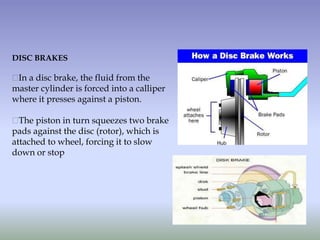
DISC BRAKES
In a disc brake, the fluid from the
master cylinder is forced into a calliper
where it presses against a piston.
The piston in turn squeezes two brake
pads against the disc (rotor), which is
attached to wheel, forcing it to slow
down or stop
WORKING OF HYDRAULIC DISC BRAKE
To do this, various components within the brake system must convert
vehicle’s moving energy into heat. This is done by using friction
.Friction is the resistance to movement exerted by two objects on each
other. Two forms of friction play a part in controlling a vehicle kinetic
or moving, and static or stationary.
The amount of friction or resistance to movement depends upon the
type of material in contact the smoothness of their rubbing surfaces
and the pressure holding them together .Thus , in a nutshell a car brake
works by applying a static surface to a moving surface of a vehicle, thus
causing friction and converting kinetic energy into heat energy.
As the brakes on a moving automobile
are put into motion, rough-textures
brake pads or brake shoes are pressed
against the rotating parts of vehicle,
be it disc or drum. The kinetic energy or
momentum of the vehicle is then
converted into heat energy by kinetic
friction of the rubbing surfaces and the
car or truck slows down.
Then vehicle comes to stop, it is held in
place by static friction. The friction
between surfaces of brakes as well as
the friction between tires and roads
resists any movement. To overcome the
static friction that holds the car
motionless, brakes are released. The
heat energy of combustion of in engine
is converted into kinetic energy by
transmission and drive train, and the
vehicle moves.
ADVANTAGES OF HYDRAULIC BRAKES
Equal braking effort to all the four wheels. The disc brake inertia is small,
fraction, high sensitivity and adjustable braking torque
Less rate of wear (due to absence of joints compared to mechanical brakes).
These brakes are not sticky.
Force multiplication (or divisions) very easily just by changing the size of
one piston and cylinder relative to other
DISADVANTAGES OF HYDRAULIC BRAKES
Even slight leakage of air into the breaking system makes it useless.
The brake shoes are liable to get ruined if the brake fluid leaks.
APPLICATIION
Many trucks and buses are equipped with hydraulic
actuated disc brakes. These brakes are not sticky.
The disc brakes have been widely used in cars and trucks,
especially in the premium sedan. The disc brakes on the new
mine hoist brake.
Used primarily in motor vehicles, tanks, but also in
machinery and equipment, and aircraft, bicycles, carriages
and railways
Thank you
?

Hydraulic disc brake

  • 1.
    Ambalika Institute OfTechnology &Management
  • 2.
    Introdution on Brake Abrake is a mechanical device which inhibits motion TYPES OF BRAKES MECHANICAL BRAKES •DRUM BRAKES •DISC BRAKES HYDRAULIC BRAKES POWER BRAKES •AIR BRAKES •AIR HYDRAULIC BRAKES •VACCUM BRAKES •ELECTRIC BRAKES
  • 3.
    HYDRAULIC BRAKES Hydraulics isthe use of a liquid under pressure to transfer force or motion, or to increase an applied force. The pressure on a liquid is called HYRAULIC PRESSURE. And the brakes which are operated by means of hydraulic pressure are called HYDRAULIC BRAKES. These brakes are based on the principle of Pascal’s law. PASCAL’S LAW The pressure exerted anywhere in a mass of confined liquid is transmitted undiminished in all directions throughout the liquid. Applied in hydraulic lifts, hydraulic brakes etc
  • 5.
    MASTER CYLINDER INACTION When we press the brake pedal, it pushes on primary piston through a linkage. Pressure is built in the cylinder and the lines as the brake pedal is depressed further. The pressure between the primary and secondary piston forces the secondary piston to compress the fluid in its circuit. If the brakes are operating properly, the pressure wIll be same in both the circuits. If there is a leak in one of the circuits, that circuit will not be able to maintain pressure.
  • 6.
    DISC BRAKES In adisc brake, the fluid from the master cylinder is forced into a calliper where it presses against a piston. The piston in turn squeezes two brake pads against the disc (rotor), which is attached to wheel, forcing it to slow down or stop
  • 7.
    WORKING OF HYDRAULICDISC BRAKE To do this, various components within the brake system must convert vehicle’s moving energy into heat. This is done by using friction .Friction is the resistance to movement exerted by two objects on each other. Two forms of friction play a part in controlling a vehicle kinetic or moving, and static or stationary. The amount of friction or resistance to movement depends upon the type of material in contact the smoothness of their rubbing surfaces and the pressure holding them together .Thus , in a nutshell a car brake works by applying a static surface to a moving surface of a vehicle, thus causing friction and converting kinetic energy into heat energy.
  • 8.
    As the brakeson a moving automobile are put into motion, rough-textures brake pads or brake shoes are pressed against the rotating parts of vehicle, be it disc or drum. The kinetic energy or momentum of the vehicle is then converted into heat energy by kinetic friction of the rubbing surfaces and the car or truck slows down. Then vehicle comes to stop, it is held in place by static friction. The friction between surfaces of brakes as well as the friction between tires and roads resists any movement. To overcome the static friction that holds the car motionless, brakes are released. The heat energy of combustion of in engine is converted into kinetic energy by transmission and drive train, and the vehicle moves.
  • 9.
    ADVANTAGES OF HYDRAULICBRAKES Equal braking effort to all the four wheels. The disc brake inertia is small, fraction, high sensitivity and adjustable braking torque Less rate of wear (due to absence of joints compared to mechanical brakes). These brakes are not sticky. Force multiplication (or divisions) very easily just by changing the size of one piston and cylinder relative to other DISADVANTAGES OF HYDRAULIC BRAKES Even slight leakage of air into the breaking system makes it useless. The brake shoes are liable to get ruined if the brake fluid leaks.
  • 10.
    APPLICATIION Many trucks andbuses are equipped with hydraulic actuated disc brakes. These brakes are not sticky. The disc brakes have been widely used in cars and trucks, especially in the premium sedan. The disc brakes on the new mine hoist brake. Used primarily in motor vehicles, tanks, but also in machinery and equipment, and aircraft, bicycles, carriages and railways
  • 11.