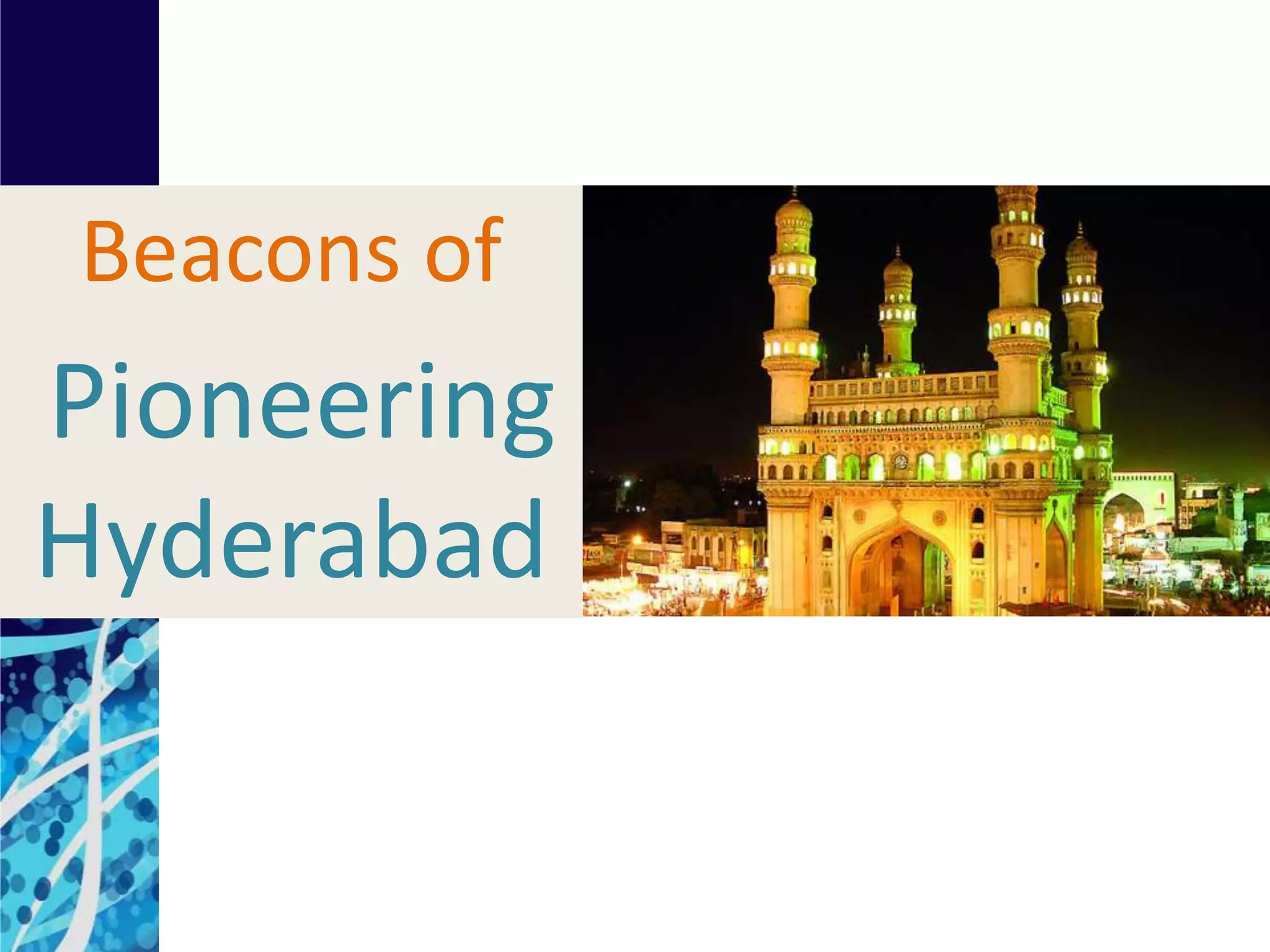



Beacons of 
Pioneering 
Hyderabad
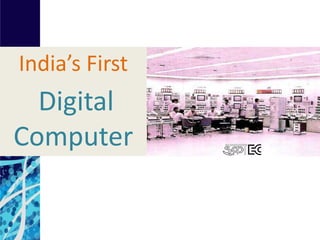
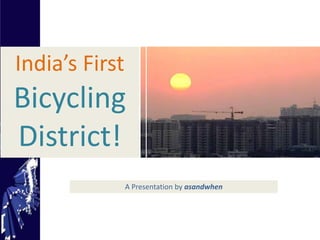
India’s First 
Digital 
Computer
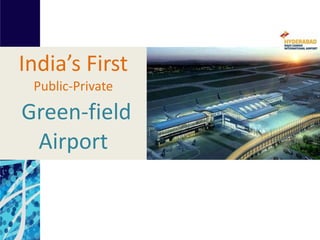
India’s First 
Public-Private 
Green-field 
Airport
India’s First 
state-of-the-art 
Biotech 
Zone
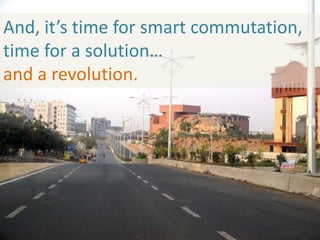
And, it’s time for smart commutation, 
time for a solution… 
and a revolution.
India’s First 
Bicycling 
District! 
A Presentation by asandwhen
The 
Bicycling 
District
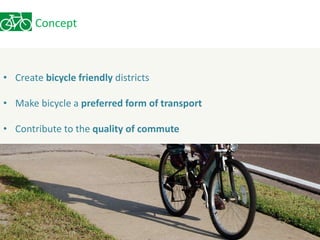
Concept 
• Create bicycle friendly districts 
• Make bicycle a preferred form of transport 
• Contribute to the quality of commute
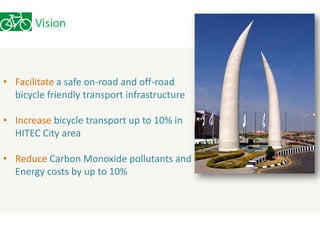
Vision 
• Facilitate a safe on-road and off-road 
bicycle friendly transport infrastructure 
• Increase bicycle transport up to 10% in 
HITEC City area 
• Reduce Carbon Monoxide pollutants and 
Energy costs by up to 10%
Objective 
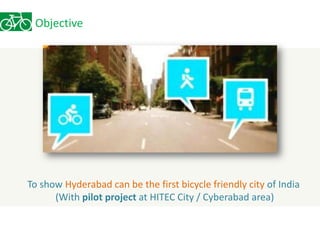
To show Hyderabad can be the first bicycle friendly city of India 
(With pilot project at HITEC City / Cyberabad area)
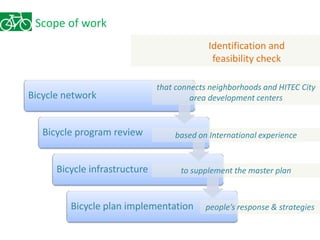
Scope of work 
Bicycle network 
Bicycle program review 
Bicycle infrastructure 
Bicycle plan implementation 
Identification and 
feasibility check 
that connects neighborhoods and HITEC City 
area development centers 
based on International experience 
to supplement the master plan 
people’s response & strategies
Bicycle 
Transport & 
The Global Trends
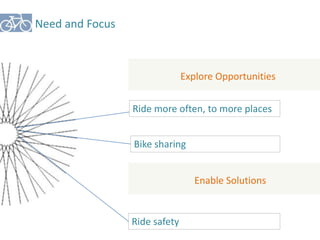
Need and Focus 
Ride more often, to more places 
Bike sharing 
Ride safety 
Explore Opportunities 
Enable Solutions
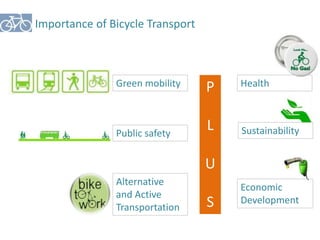
Importance of Bicycle Transport 
Green mobility 
Public safety 
Alternative 
and Active 
Transportation 
Health 
Sustainability 
P 
L 
U 
S 
Economic 
Development
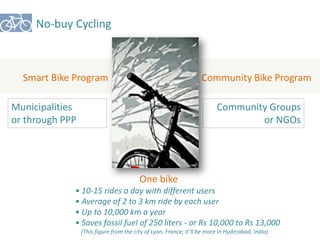
No-buy Cycling 
Community Bike Program 
Smart Bike Program 
Community Groups 
or NGOs 
Municipalities 
or through PPP 
One bike 
• 10-15 rides a day with different users 
• Average of 2 to 3 km ride by each user 
• Up to 10,000 km a year 
• Saves fossil fuel of 250 liters - or Rs 10,000 to Rs 13,000 
(This figure from the city of Lyon, France; it’ll be more in Hyderabad, India)
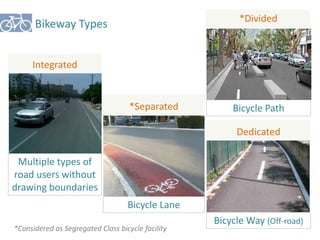
Bikeway Types 
*Divided 
Bicycle Path 
*Separated 
Bicycle Lane 
Integrated 
Multiple types of 
road users without 
drawing boundaries 
Dedicated 
Bicycle Way (Off-road) 
*Considered as Segregated Class bicycle facility
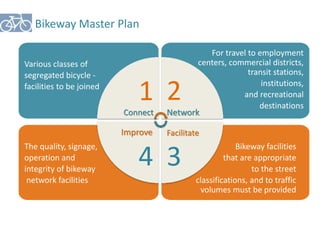
Bikeway Master Plan 
Bikeway facilities 
that are appropriate 
to the street 
classifications, and to traffic 
volumes must be provided 
The quality, signage, 
operation and 
integrity of bikeway 
network facilities 
For travel to employment 
centers, commercial districts, 
transit stations, 
institutions, 
and recreational 
destinations 
Various classes of 
segregated bicycle - 
facilities to be joined 1 
Connect 
2 
Network 
Facilitate 
3 
Improve 
4
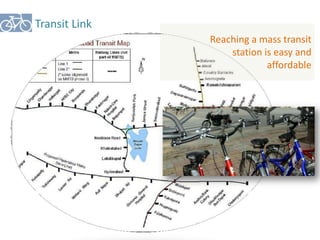
Transit Link 
Reaching a mass transit 
station is easy and 
affordable
Major Difficulties 
Making a Bikeway 
Implementation 
• Narrowing existing travel lanes 
• Removing a travel lane 
• Removing parking, except 
where it is essential 
• Shoulder widening. 
• Sometimes, at the cost of 
natural environment 
• Severe topographical 
constraints 
• Traffic congestion due to 
elimination of travel lanes 
or lane width reduction
International Bicycling Program: At a glance 
Paris, France 
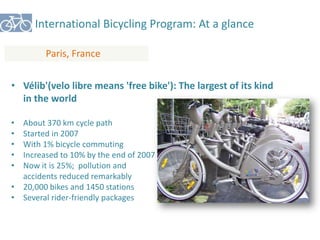
• Vélib'(velo libre means 'free bike'): The largest of its kind 
in the world 
• About 370 km cycle path 
• Started in 2007 
• With 1% bicycle commuting 
• Increased to 10% by the end of 2007 
• Now it is 25%; pollution and 
accidents reduced remarkably 
• 20,000 bikes and 1450 stations 
• Several rider-friendly packages
International Bicycling Program: At a glance 
Lyon, France 
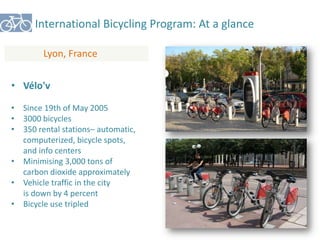
• Vélo'v 
• Since 19th of May 2005 
• 3000 bicycles 
• 350 rental stations– automatic, 
computerized, bicycle spots, 
and info centers 
• Minimising 3,000 tons of 
carbon dioxide approximately 
• Vehicle traffic in the city 
is down by 4 percent 
• Bicycle use tripled
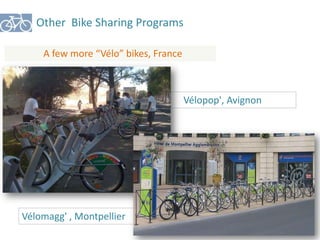
Other Bike Sharing Programs 
Vélopop', Avignon 
A few more “Vélo” bikes, France 
Vélomagg' , Montpellier
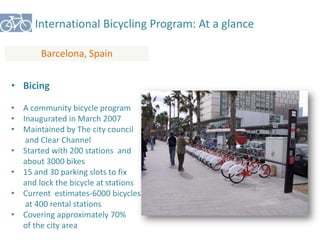
International Bicycling Program: At a glance 
Barcelona, Spain 
• Bicing 
• A community bicycle program 
• Inaugurated in March 2007 
• Maintained by The city council 
and Clear Channel 
• Started with 200 stations and 
about 3000 bikes 
• 15 and 30 parking slots to fix 
and lock the bicycle at stations 
• Current estimates-6000 bicycles 
at 400 rental stations 
• Covering approximately 70% 
of the city area
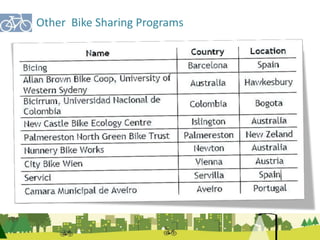
Other Bike Sharing Programs
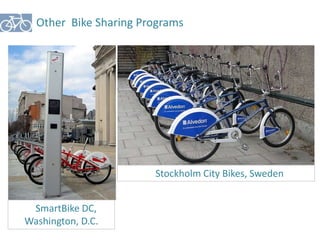
Other Bike Sharing Programs 
SmartBike DC, 
Washington, D.C. 
Stockholm City Bikes, Sweden
Other Bike Sharing Programs 
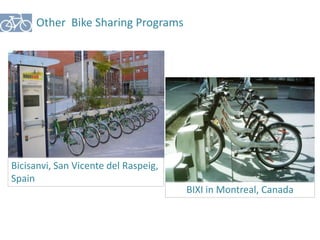
BIXI in Montreal, Canada 
Bicisanvi, San Vicente del Raspeig, 
Spain
Other Bike Sharing Programs 
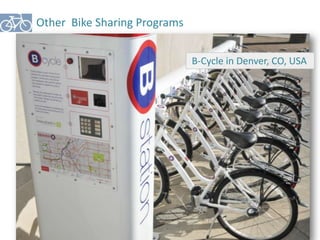
B-Cycle in Denver, CO, USA
International Bicycling Program: At a glance 
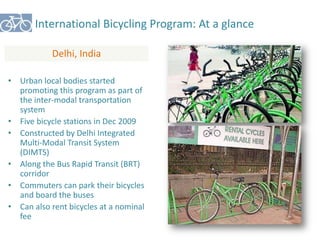
Delhi, India 
• Urban local bodies started 
promoting this program as part of 
the inter-modal transportation 
system 
• Five bicycle stations in Dec 2009 
• Constructed by Delhi Integrated 
Multi-Modal Transit System 
(DIMTS) 
• Along the Bus Rapid Transit (BRT) 
corridor 
• Commuters can park their bicycles 
and board the buses 
• Can also rent bicycles at a nominal 
fee
Infosys Pedaling Community 
Model Bicycle Program - 
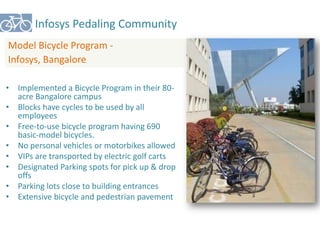
Infosys, Bangalore 
• Implemented a Bicycle Program in their 80- 
acre Bangalore campus 
• Blocks have cycles to be used by all 
employees 
• Free-to-use bicycle program having 690 
basic-model bicycles. 
• No personal vehicles or motorbikes allowed 
• VIPs are transported by electric golf carts 
• Designated Parking spots for pick up & drop 
offs 
• Parking lots close to building entrances 
• Extensive bicycle and pedestrian pavement
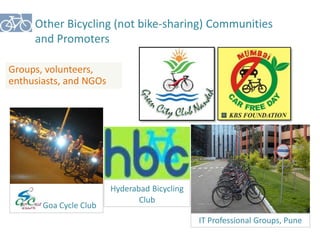
Other Bicycling (not bike-sharing) Communities 
and Promoters 
Goa Cycle Club 
Hyderabad Bicycling 
Club 
IT Professional Groups, Pune 
Groups, volunteers, 
enthusiasts, and NGOs
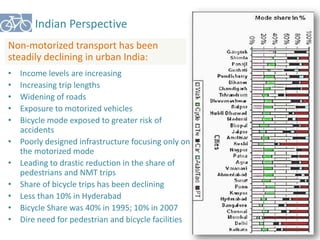
Indian Perspective 
Non-motorized transport has been 
steadily declining in urban India: 
• Income levels are increasing 
• Increasing trip lengths 
• Widening of roads 
• Exposure to motorized vehicles 
• Bicycle mode exposed to greater risk of 
accidents 
• Poorly designed infrastructure focusing only on 
the motorized mode 
• Leading to drastic reduction in the share of 
pedestrians and NMT trips 
• Share of bicycle trips has been declining 
• Less than 10% in Hyderabad 
• Bicycle Share was 40% in 1995; 10% in 2007 
• Dire need for pedestrian and bicycle facilities
How about 
Hyderabad? 
The Change Factors
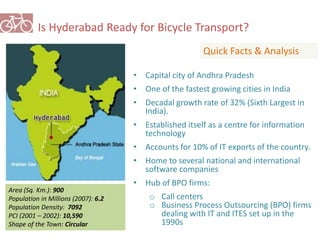
Is Hyderabad Ready for Bicycle Transport? 
Quick Facts & Analysis 
Area (Sq. Km.): 900 
Population in Millions (2007): 6.2 
Population Density: 7092 
PCI (2001 – 2002): 10,590 
Shape of the Town: Circular 
• Capital city of Andhra Pradesh 
• One of the fastest growing cities in India 
• Decadal growth rate of 32% (Sixth Largest in 
India). 
• Established itself as a centre for information 
technology 
• Accounts for 10% of IT exports of the country. 
• Home to several national and international 
software companies 
• Hub of BPO firms: 
o Call centers 
o Business Process Outsourcing (BPO) firms 
dealing with IT and ITES set up in the 
1990s
Is Hyderabad Ready for Bicycle Transport? 
Geography and weather 
• Located on the Deccan Plateau in the 
southern part of India 
• At an altitude of 500 meters above sea level 
(1640 ft) 
• Most of the area has a rocky terrain and 
some areas are hilly. 
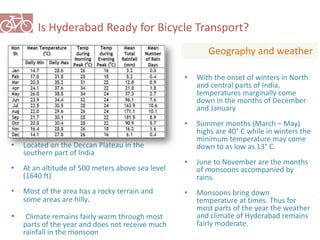
• Climate remains fairly warm through most 
parts of the year and does not receive much 
rainfall in the monsoon 
• With the onset of winters in North 
and central parts of India, 
temperatures marginally come 
down in the months of December 
and January 
• Summer months (March – May) 
highs are 40° C while in winters the 
minimum temperature may come 
down to as low as 13° C. 
• June to November are the months 
of monsoons accompanied by 
rains. 
• Monsoons bring down 
temperature at times. Thus for 
most parts of the year the weather 
and climate of Hyderabad remains 
fairly moderate.
Is Hyderabad Ready for Bicycle Transport? 
Transport 
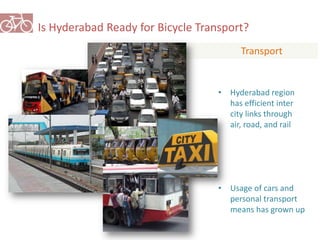
• Hyderabad region 
has efficient inter 
city links through 
air, road, and rail 
• Usage of cars and 
personal transport 
means has grown up
Is Hyderabad Ready for Bicycle Transport? 
Transport 
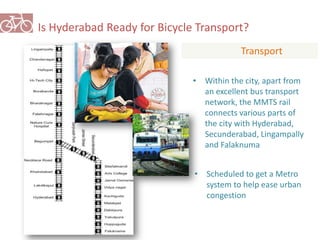
• Within the city, apart from 
an excellent bus transport 
network, the MMTS rail 
connects various parts of 
the city with Hyderabad, 
Secunderabad, Lingampally 
and Falaknuma 
• Scheduled to get a Metro 
system to help ease urban 
congestion
Is Hyderabad Ready for Bicycle Transport? 
Vehicles 
• 68 lakh registered vehicles 
in Andhra Pradesh 
• 22 lakh plus vehicles in 
Hyderabad 
• 16.8 lakh two wheelers 
• 1.67 lakh cars 
• 1.5 auto-rikshaws 
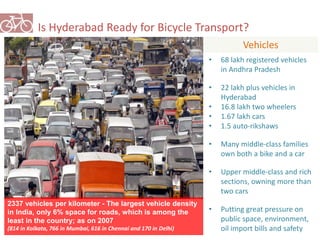
• Many middle-class families 
own both a bike and a car 
• Upper middle-class and rich 
sections, owning more than 
two cars 
• Putting great pressure on 
public space, environment, 
oil import bills and safety 
2337 vehicles per kilometer - The largest vehicle density 
in India, only 6% space for roads, which is among the 
least in the country; as on 2007 
(814 in Kolkata, 766 in Mumbai, 616 in Chennai and 170 in Delhi)
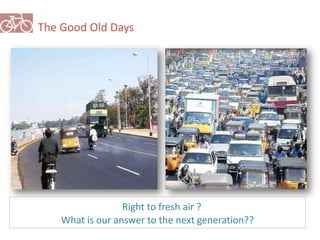
The Good Old Days 
Right to fresh air ? 
What is our answer to the next generation??
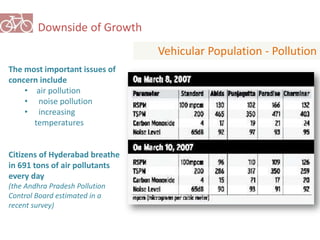
Downside of Growth 
The most important issues of 
concern include 
• air pollution 
• noise pollution 
• increasing 
temperatures 
Citizens of Hyderabad breathe 
in 691 tons of air pollutants 
every day 
(the Andhra Pradesh Pollution 
Control Board estimated in a 
recent survey) 
Vehicular Population - Pollution
Downside of Growth 
Vehicle density, pollution, and solution 
Problem: Vehicles Density and pollution 
The rising levels of air pollution can be 
attributed mainly due to 
1. motor vehicles are ground 
level sources and thus have 
the maximum impact on the 
general population 
2. 2337 vehicles per km, with 6% 
road space! 
Solution: To prevent vehicular pollution 
1. Decrease 
Number of motorized vehicles 
2. Encourage 
Non-motorized Vehicles 
3. Improve 
Public Transport means 
4. Increase road space 
Road space is woefully 
inadequate: ideally, road space 
should be closer to 30 percent of 
city area 
5. Promote 
Vehicles with alternate fuel 
Solution No.2 is easily adoptable, effective, and affordable
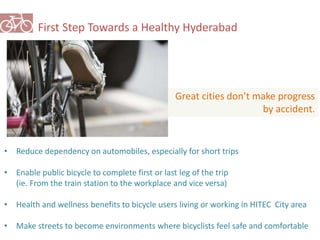
First Step Towards a Healthy Hyderabad 
Great cities don’t make progress 
• Reduce dependency on automobiles, especially for short trips 
• Enable public bicycle to complete first or last leg of the trip 
(ie. From the train station to the workplace and vice versa) 
by accident. 
• Health and wellness benefits to bicycle users living or working in HITEC City area 
• Make streets to become environments where bicyclists feel safe and comfortable
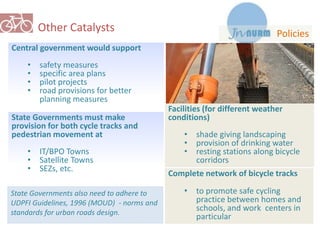
Policies Other Catalysts 
Facilities (for different weather 
conditions) 
• shade giving landscaping 
• provision of drinking water 
• resting stations along bicycle 
corridors 
Central government would support 
• safety measures 
• specific area plans 
• pilot projects 
• road provisions for better 
planning measures 
State Governments must make 
provision for both cycle tracks and 
pedestrian movement at 
• IT/BPO Towns 
• Satellite Towns 
• SEZs, etc. 
State Governments also need to adhere to 
UDPFI Guidelines, 1996 (MOUD) - norms and 
standards for urban roads design. 
Complete network of bicycle tracks 
• to promote safe cycling 
practice between homes and 
schools, and work centers in 
particular
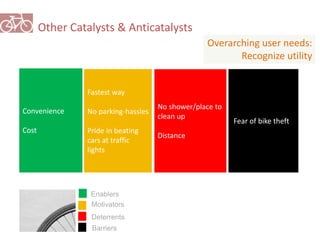
Other Catalysts & Anticatalysts 
Overarching user needs: 
Recognize utility 
Fastest way 
No parking-hassles 
Pride in beating 
cars at traffic 
lights 
Convenience 
Cost 
No shower/place to 
clean up 
Distance 
Fear of bike theft 
Enablers 
Motivators 
Deterrents 
Barriers
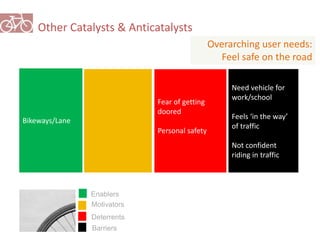
Other Catalysts & Anticatalysts 
Overarching user needs: 
Feel safe on the road 
Bikeways/Lane 
Fear of getting 
doored 
Personal safety 
Need vehicle for 
work/school 
Feels ‘in the way’ 
of traffic 
Not confident 
riding in traffic 
Enablers 
Motivators 
Deterrents 
Barriers
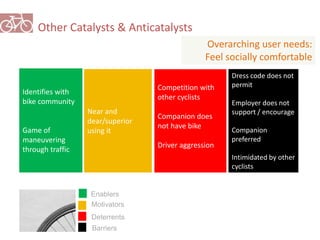
Other Catalysts & Anticatalysts 
Overarching user needs: 
Feel socially comfortable 
Near and 
dear/superior 
using it 
Identifies with 
bike community 
Game of 
maneuvering 
through traffic 
Competition with 
other cyclists 
Companion does 
not have bike 
Driver aggression 
Dress code does not 
permit 
Employer does not 
support / encourage 
Companion 
preferred 
Intimidated by other 
cyclists 
Enablers 
Motivators 
Deterrents 
Barriers
Other Catalysts & Anticatalysts 
Overarching user needs: 
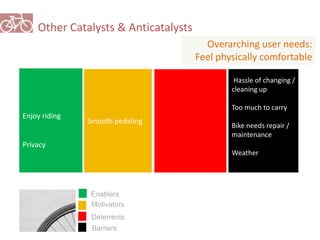
Feel physically comfortable 
Smooth pedaling 
Enjoy riding 
Privacy 
Hassle of changing / 
cleaning up 
Too much to carry 
Bike needs repair / 
maintenance 
Weather 
Enablers 
Motivators 
Deterrents 
Barriers
Other Catalysts & Anticatalysts 
Overarching user needs: 
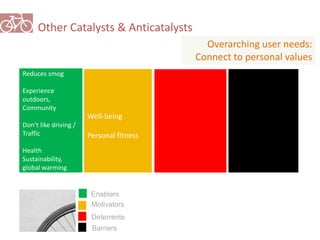
Connect to personal values 
Well-being 
Personal fitness 
Reduces smog 
Experience 
outdoors, 
Community 
Don’t like driving / 
Traffic 
Health 
Sustainability, 
global warming 
Enablers 
Motivators 
Deterrents 
Barriers
Bicycle 
Action Plan 
HITEC City
HITEC City & Vicinity 
Overview 
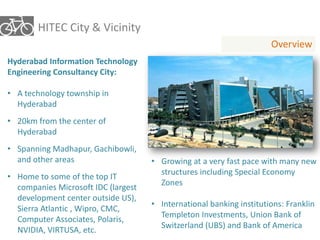
Hyderabad Information Technology 
Engineering Consultancy City: 
• A technology township in 
Hyderabad 
• 20km from the center of 
Hyderabad 
• Spanning Madhapur, Gachibowli, 
and other areas 
• Home to some of the top IT 
companies Microsoft IDC (largest 
development center outside US), 
Sierra Atlantic , Wipro, CMC, 
Computer Associates, Polaris, 
NVIDIA, VIRTUSA, etc. 
• Growing at a very fast pace with many new 
structures including Special Economy 
Zones 
• International banking institutions: Franklin 
Templeton Investments, Union Bank of 
Switzerland (UBS) and Bank of America
Land Use & Urban Development 
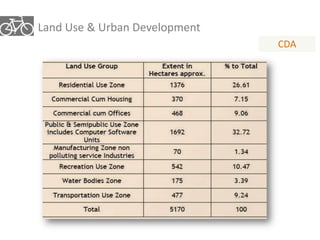
CDA 
HITEC City 
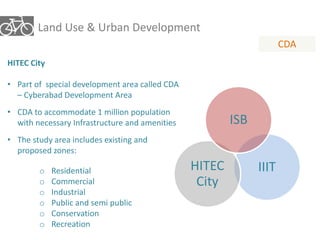
• Part of special development area called CDA 
– Cyberabad Development Area 
• CDA to accommodate 1 million population 
with necessary Infrastructure and amenities 
• The study area includes existing and 
proposed zones: 
o Residential 
o Commercial 
o Industrial 
o Public and semi public 
o Conservation 
o Recreation 
ISB 
HITEC IIIT 
City
Land Use & Urban Development 
CDA
Demography 
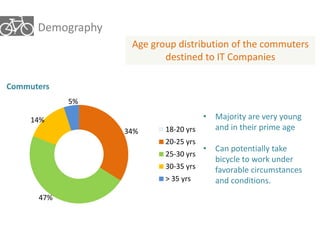
Age group distribution of the commuters 
destined to IT Companies 
34% 
14% 
47% 
5% 
Commuters 
18-20 yrs 
20-25 yrs 
25-30 yrs 
30-35 yrs 
> 35 yrs 
• Majority are very young 
and in their prime age 
• Can potentially take 
bicycle to work under 
favorable circumstances 
and conditions.
Population & Density 
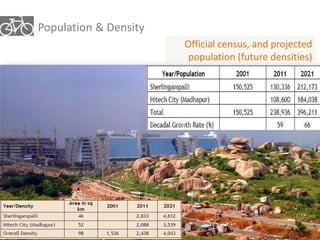
Official census, and projected 
population (future densities)
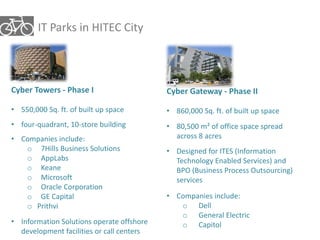
IT Parks in HITEC City 
Cyber Gateway - Phase II 
• 860,000 Sq. ft. of built up space 
• 80,500 m² of office space spread 
across 8 acres 
• Designed for ITES (Information 
Technology Enabled Services) and 
BPO (Business Process Outsourcing) 
services 
• Companies include: 
o Dell 
o General Electric 
o Capitol 
Cyber Towers - Phase I 
• 550,000 Sq. ft. of built up space 
• four-quadrant, 10-store building 
• Companies include: 
o 7Hills Business Solutions 
o AppLabs 
o Keane 
o Microsoft 
o Oracle Corporation 
o GE Capital 
o Prithvi 
• Information Solutions operate offshore 
development facilities or call centers
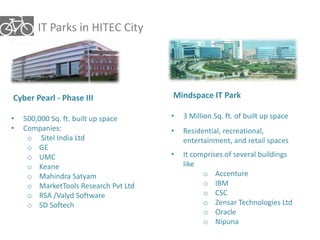
IT Parks in HITEC City 
Mindspace IT Park 
• 3 Million Sq. ft. of built up space 
• Residential, recreational, 
entertainment, and retail spaces 
• It comprises of several buildings 
like 
o Accenture 
o IBM 
o CSC 
o Zensar Technologies Ltd 
o Oracle 
o Nipuna 
Cyber Pearl - Phase III 
• 500,000 Sq. ft. built up space 
• Companies: 
o Sitel India Ltd 
o GE 
o UMC 
o Keane 
o Mahindra Satyam 
o MarketTools Research Pvt Ltd 
o RSA /Valyd Software 
o SD Softech
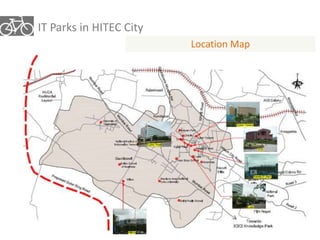
IT Parks in HITEC City 
Location Map
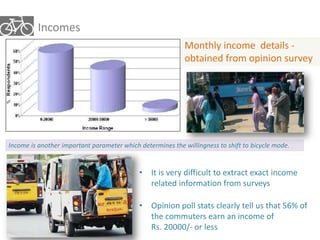
Incomes 
Monthly income details - 
obtained from opinion survey 
Income is another important parameter which determines the willingness to shift to bicycle mode. 
• It is very difficult to extract exact income 
related information from surveys 
• Opinion poll stats clearly tell us that 56% of 
the commuters earn an income of 
Rs. 20000/- or less
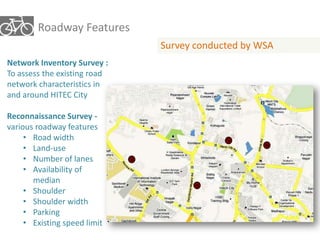
Roadway Features 
Survey conducted by WSA 
Network Inventory Survey : 
To assess the existing road 
network characteristics in 
and around HITEC City 
Reconnaissance Survey - 
various roadway features 
• Road width 
• Land-use 
• Number of lanes 
• Availability of 
median 
• Shoulder 
• Shoulder width 
• Parking 
• Existing speed limit
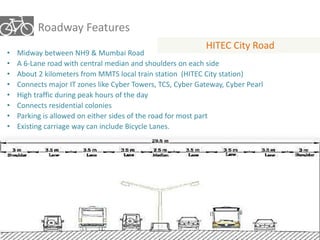
Roadway Features 
HITEC City Road 
• Midway between NH9 & Mumbai Road 
• A 6-Lane road with central median and shoulders on each side 
• About 2 kilometers from MMTS local train station (HITEC City station) 
• Connects major IT zones like Cyber Towers, TCS, Cyber Gateway, Cyber Pearl 
• High traffic during peak hours of the day 
• Connects residential colonies 
• Parking is allowed on either sides of the road for most part 
• Existing carriage way can include Bicycle Lanes.
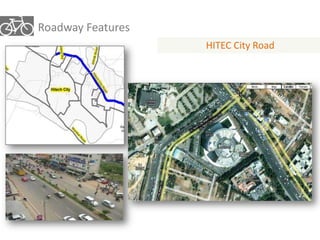
Roadway Features 
HITEC City Road
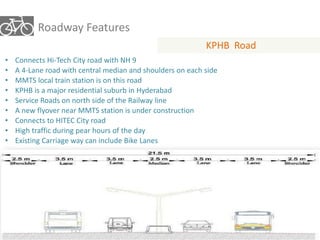
Roadway Features 
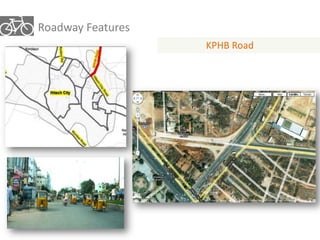
KPHB Road 
• Connects Hi-Tech City road with NH 9 
• A 4-Lane road with central median and shoulders on each side 
• MMTS local train station is on this road 
• KPHB is a major residential suburb in Hyderabad 
• Service Roads on north side of the Railway line 
• A new flyover near MMTS station is under construction 
• Connects to HITEC City road 
• High traffic during pear hours of the day 
• Existing Carriage way can include Bike Lanes
Roadway Features 
KPHB Road
Roadway Features 
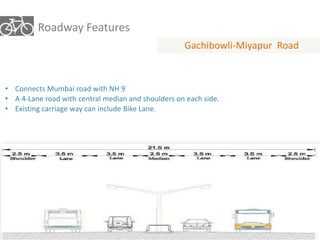
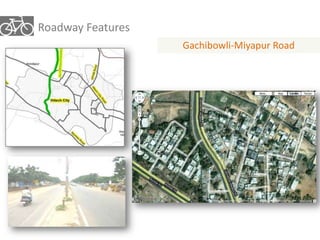
Gachibowli-Miyapur Road 
• Connects Mumbai road with NH 9 
• A 4-Lane road with central median and shoulders on each side. 
• Existing carriage way can include Bike Lane.
Roadway Features 
Gachibowli-Miyapur Road
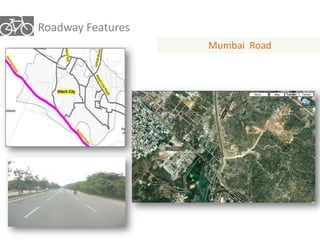
Roadway Features 
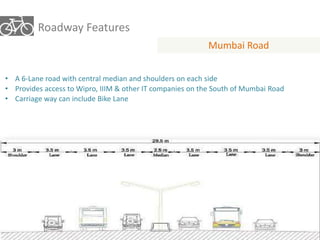
Mumbai Road 
• A 6-Lane road with central median and shoulders on each side 
• Provides access to Wipro, IIIM & other IT companies on the South of Mumbai Road 
• Carriage way can include Bike Lane
Roadway Features 
Mumbai Road
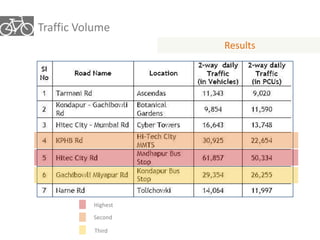
Traffic Volume 
Results 
Highest 
Second 
Third
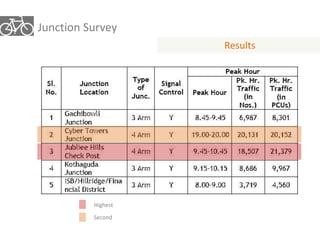
Junction Survey 
Results 
Highest 
Second
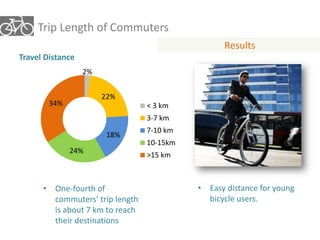
Trip Length of Commuters 
Results 
2% 
22% 
18% 
Travel Distance 
24% 
34% 
< 3 km 
3-7 km 
7-10 km 
10-15km 
>15 km 
• One-fourth of 
commuters’ trip length 
is about 7 km to reach 
their destinations 
• Easy distance for young 
bicycle users.
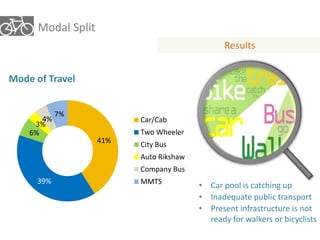
Modal Split 
Results 
41% 
Mode of Travel 
4% 
3% 
6% 
39% 
7% 
Car/Cab 
Two Wheeler 
City Bus 
Auto Rikshaw 
Company Bus 
MMTS • Car pool is catching up 
• Inadequate public transport 
• Present infrastructure is not 
ready for walkers or bicyclists
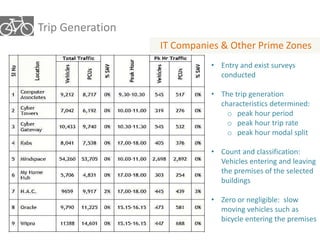
Trip Generation 
IT Companies & Other Prime Zones 
• Entry and exist surveys 
conducted 
• The trip generation 
characteristics determined: 
o peak hour period 
o peak hour trip rate 
o peak hour modal split 
• Count and classification: 
Vehicles entering and leaving 
the premises of the selected 
buildings 
• Zero or negligible: slow 
moving vehicles such as 
bicycle entering the premises
Bicycle Action Plan 
(Micro Analysis) 
HITEC City
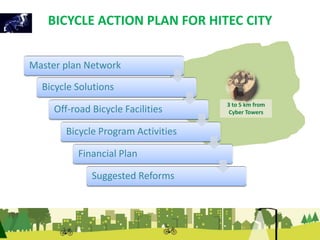
BICYCLE ACTION PLAN FOR HITEC CITY 
Master plan Network 
Bicycle Solutions 
Off-road Bicycle Facilities 
Bicycle Program Activities 
Financial Plan 
Suggested Reforms 
3 to 5 km from 
Cyber Towers
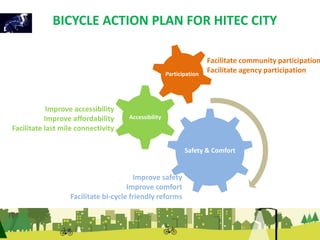
BICYCLE ACTION PLAN FOR HITEC CITY 
Safety & Comfort 
Accessibility 
Participation 
Facilitate community participation 
Facilitate agency participation 
Improve accessibility 
Improve affordability 
Facilitate last mile connectivity 
Improve safety 
Improve comfort 
Facilitate bi-cycle friendly reforms
BICYCLE SOLUTIONS 
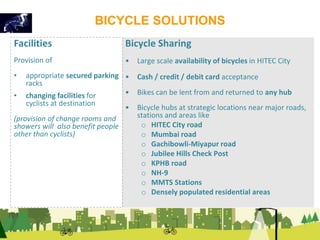
Bicycle Sharing 
• Large scale availability of bicycles in HITEC City 
• Cash / credit / debit card acceptance 
• Bikes can be lent from and returned to any hub 
• Bicycle hubs at strategic locations near major roads, 
stations and areas like 
o HITEC City road 
o Mumbai road 
o Gachibowli-Miyapur road 
o Jubilee Hills Check Post 
o KPHB road 
o NH-9 
o MMTS Stations 
o Densely populated residential areas 
Facilities 
Provision of 
• appropriate secured parking 
racks 
• changing facilities for 
cyclists at destination 
(provision of change rooms and 
showers will also benefit people 
other than cyclists)
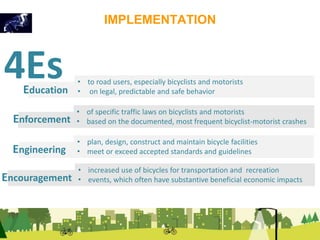
IMPLEMENTATION 
4Es • to road users, especially bicyclists and motorists 
• on Education legal, predictable and safe behavior 
Enforcement 
• of specific traffic laws on bicyclists and motorists 
• based on the documented, most frequent bicyclist-motorist crashes 
Engineering 
• plan, design, construct and maintain bicycle facilities 
• meet or exceed accepted standards and guidelines 
Encouragement 
• increased use of bicycles for transportation and recreation 
• events, which often have substantive beneficial economic impacts
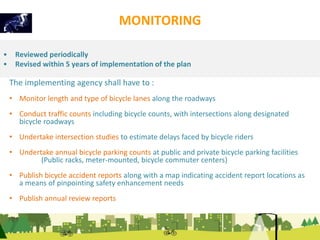
MONITORING 
• Reviewed periodically 
• Revised within 5 years of implementation of the plan 
The implementing agency shall have to : 
• Monitor length and type of bicycle lanes along the roadways 
• Conduct traffic counts including bicycle counts, with intersections along designated 
bicycle roadways 
• Undertake intersection studies to estimate delays faced by bicycle riders 
• Undertake annual bicycle parking counts at public and private bicycle parking facilities 
(Public racks, meter-mounted, bicycle commuter centers) 
• Publish bicycle accident reports along with a map indicating accident report locations as 
a means of pinpointing safety enhancement needs 
• Publish annual review reports
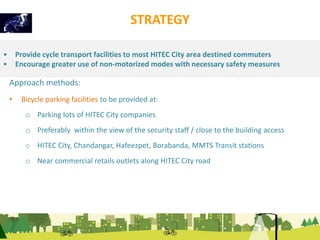
STRATEGY 
• Provide cycle transport facilities to most HITEC City area destined commuters 
• Encourage greater use of non-motorized modes with necessary safety measures 
Approach methods: 
• Bicycle parking facilities to be provided at: 
o Parking lots of HITEC City companies 
o Preferably within the view of the security staff / close to the building access 
o HITEC City, Chandangar, Hafeezpet, Borabanda, MMTS Transit stations 
o Near commercial retails outlets along HITEC City road
INSTITUTIONS AND REFORM 
• Enforcement program: reviewing and modifying laws and policies affecting bicyclists 
• Amendment program/Bicycle laws: To address the deficiencies of MVA in respect to 
bicycles and bicycle users state or other local governing agencies 
• Most of the available laws and regulations overlook important bicyclist or pedestrian 
issues 
• Immediate need of an update or correction 
• Present MVA does not consider bicycle as part of the vehicle 
• Develop HITEC City enforcement program: 
o Educates roadway users about the traffic laws that govern them 
o Serves as periodic reminders to obey traffic rules 
o Encourages safer behaviors
INSTITUTIONS AND REFORM 
• Enforcement program: reviewing and modifying laws and policies affecting bicyclists 
• Amendment program/Bicycle laws: To address the deficiencies of MVA in respect to 
bicycles and bicycle users state or other local governing agencies 
• Most of the available laws and regulations overlook important bicyclist or pedestrian 
issues 
• Immediate need of an update or correction 
• Present MVA does not consider bicycle as part of the vehicle 
• Develop HITEC City enforcement program: 
o Educates roadway users about the traffic laws that govern them 
o Serves as periodic reminders to obey traffic rules 
o Encourages safer behaviors
FINANCING PLAN 
• A strong financial operation plan is required for making the HITEC City bicycle plan exercise 
into a sustained and coordinated campaign. 
• The required financing can be worked out by way of JNNURM funds, dedicated State and 
Local Government funds , and private funding. 
The JNNURM Program Private Sector 
The JNNURM program, an important 
impetus: 
• providing dedicated funding for 
bicycle facilities 
• requiring consideration of bicycling 
in transportation master plans 
Large potential for private players in 
generating funds for the program 
This is likely to spur the development of 
bicycle network and other related facilities in 
several urban areas.
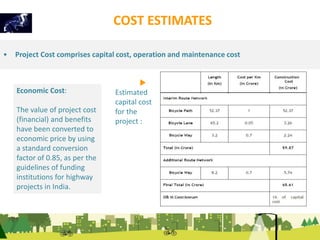
COST ESTIMATES 
• Block costs and approximate bill of quantities is developed 
• Approximately Rs. 66 Crore (660 Million Rupees) 
• The approximate costs for each phase (Interim & Final Phase) are estimated, after 
estimating costs for individual recommendations: 
o Interim Phase: (INR 59,87,00,000) Rupees Fifty Nine Crore Eighty Seven Lakhs only 
o Final Phase: (INR 5,74,00,000) Rupees Five Crore Seventy Four Lakhs only 
o The total cost for executing improvements in all the phases: (INR 65,61,00,000) 
Rupees Sixty Five Crore and Sixty One Lakhs only 
• These estimates are only an indication for scale of investments needed. 
• However, for implementation of each component of the project, a detailed cost estimate 
has to be prepared.
Economic Cost: 
The value of project cost 
(financial) and benefits 
have been converted to 
economic price by using 
a standard conversion 
factor of 0.85, as per the 
guidelines of funding 
institutions for highway 
projects in India. 
COST ESTIMATES 
• Project Cost comprises capital cost, operation and maintenance cost 
Estimated 
capital cost 
for the 
project :
ECONOMIC ANALYSIS 
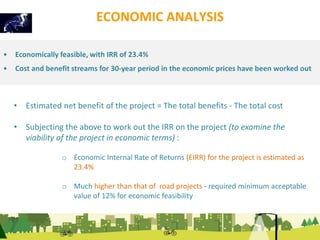
• Economically feasible, with IRR of 23.4% 
• Cost and benefit streams for 30-year period in the economic prices have been worked out 
• Estimated net benefit of the project = The total benefits - The total cost 
• Subjecting the above to work out the IRR on the project (to examine the 
viability of the project in economic terms) : 
o Economic Internal Rate of Returns (EIRR) for the project is estimated as 
23.4% 
o Much higher than that of road projects - required minimum acceptable 
value of 12% for economic feasibility
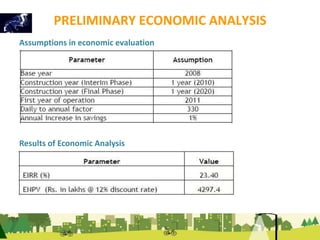
PRELIMINARY ECONOMIC ANALYSIS 
Assumptions in economic evaluation 
Results of Economic Analysis
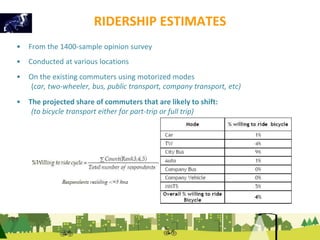
RIDERSHIP ESTIMATES 
• From the 1400-sample opinion survey 
• Conducted at various locations 
• On the existing commuters using motorized modes 
(car, two-wheeler, bus, public transport, company transport, etc) 
• The projected share of commuters that are likely to shift: 
(to bicycle transport either for part-trip or full trip)
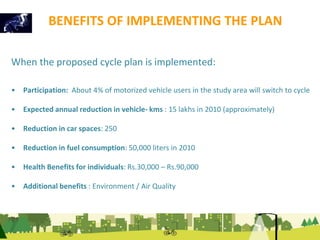
BENEFITS OF IMPLEMENTING THE PLAN 
When the proposed cycle plan is implemented: 
• Participation: About 4% of motorized vehicle users in the study area will switch to cycle 
• Expected annual reduction in vehicle- kms : 15 lakhs in 2010 (approximately) 
• Reduction in car spaces: 250 
• Reduction in fuel consumption: 50,000 liters in 2010 
• Health Benefits for individuals: Rs.30,000 – Rs.90,000 
• Additional benefits : Environment / Air Quality
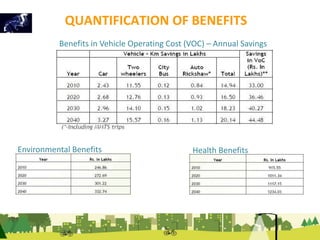
QUANTIFICATION OF BENEFITS 
Benefits in Vehicle Operating Cost (VOC) – Annual Savings 
Environmental Benefits Health Benefits
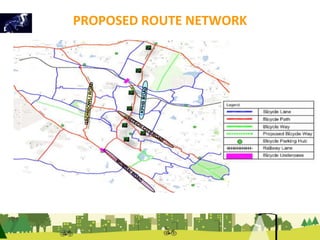
PROPOSED ROUTE NETWORK
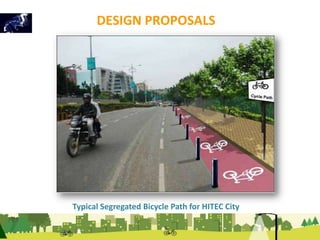
DESIGN PROPOSALS 
Typical Segregated Bicycle Path for HITEC City
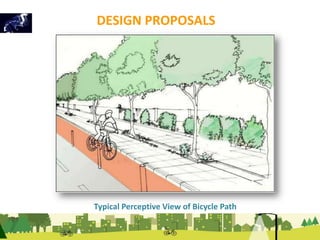
DESIGN PROPOSALS 
Typical Perceptive View of Bicycle Path
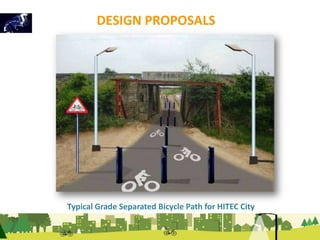
DESIGN PROPOSALS 
Typical Grade Separated Bicycle Path for HITEC City
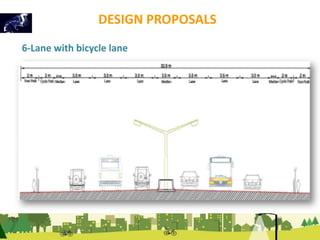
DESIGN PROPOSALS 
6-Lane with bicycle lane
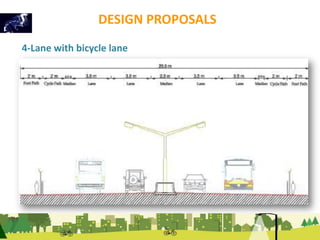
DESIGN PROPOSALS 
4-Lane with bicycle lane
CONCLUSIONS 
A bicycle plan specially focusing on HITEC City area approximately 3 to 5 km 
from Cyber Towers is developed. 
Bicycle program consisting of the following is developed: 
• Master plan network 
• Bicycle solutions 
• Off road bicycle facilities 
• Bicycle program activities 
• Financial Plan 
• Suggested reforms
CONCLUSIONS 
1. A bicycle network containing segregated and shared right of way on the major 
thoroughfares within the HITEC City area is developed. 
2. As part of the solutions to improve safe and economic access to bicycling a HITEC City 
bicycle sharing program along the lines off the Velib-like international program is 
developed. 
3. This would include developing bicycle hubs at various strategic locations and other 
facilities such as parking racks. 
4. As part of the off-road facilities various parking racks are suggested to be installed at the 
trip destinations such as employment centers, shopping malls, etc. 
5. To encourage and educate the bicycling in HITEC City various activities are suggested as 
part of the bicycle program implementation. 
6. As part of the Master Plan it is anticipated that with full and integrated implementation 
of the master plan approximately 4% of motorized vehicle users in the study area are 
likely to shift to bicycling from their current mode.
FINAL WORD 
• A preliminary economic evaluation of the suggested master plan resulted in the 
EIRR for the project to be approximately 23%. 
• The bicycle project can be expected to be economically feasible
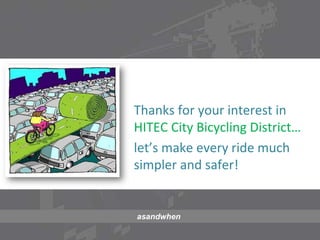
Thanks for your interest in 
HITEC City Bicycling District… 
let’s make every ride much 
simpler and safer! 
asandwhen
ANNEXURE 
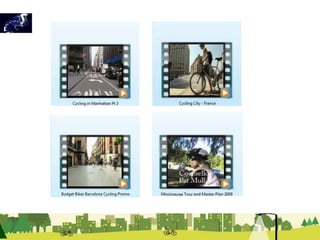
Bicycle Friendly Cities 
Sample Videos
Hyderabad Bicycle District_PPP_asandwhen 2009

Hyderabad Bicycle District_PPP_asandwhen 2009

  • 1.
  • 2.
  • 3.
    India’s First Public-Private Green-field Airport
  • 4.
  • 5.
    And, it’s timefor smart commutation, time for a solution… and a revolution.
  • 6.
    India’s First Bicycling District! A Presentation by asandwhen
  • 7.
  • 8.
    Concept • Createbicycle friendly districts • Make bicycle a preferred form of transport • Contribute to the quality of commute
  • 9.
    Vision • Facilitatea safe on-road and off-road bicycle friendly transport infrastructure • Increase bicycle transport up to 10% in HITEC City area • Reduce Carbon Monoxide pollutants and Energy costs by up to 10%
  • 10.
    Objective To showHyderabad can be the first bicycle friendly city of India (With pilot project at HITEC City / Cyberabad area)
  • 11.
    Scope of work Bicycle network Bicycle program review Bicycle infrastructure Bicycle plan implementation Identification and feasibility check that connects neighborhoods and HITEC City area development centers based on International experience to supplement the master plan people’s response & strategies
  • 12.
    Bicycle Transport & The Global Trends
  • 13.
    Need and Focus Ride more often, to more places Bike sharing Ride safety Explore Opportunities Enable Solutions
  • 14.
    Importance of BicycleTransport Green mobility Public safety Alternative and Active Transportation Health Sustainability P L U S Economic Development
  • 15.
    No-buy Cycling CommunityBike Program Smart Bike Program Community Groups or NGOs Municipalities or through PPP One bike • 10-15 rides a day with different users • Average of 2 to 3 km ride by each user • Up to 10,000 km a year • Saves fossil fuel of 250 liters - or Rs 10,000 to Rs 13,000 (This figure from the city of Lyon, France; it’ll be more in Hyderabad, India)
  • 16.
    Bikeway Types *Divided Bicycle Path *Separated Bicycle Lane Integrated Multiple types of road users without drawing boundaries Dedicated Bicycle Way (Off-road) *Considered as Segregated Class bicycle facility
  • 17.
    Bikeway Master Plan Bikeway facilities that are appropriate to the street classifications, and to traffic volumes must be provided The quality, signage, operation and integrity of bikeway network facilities For travel to employment centers, commercial districts, transit stations, institutions, and recreational destinations Various classes of segregated bicycle - facilities to be joined 1 Connect 2 Network Facilitate 3 Improve 4
  • 18.
    Transit Link Reachinga mass transit station is easy and affordable
  • 19.
    Major Difficulties Makinga Bikeway Implementation • Narrowing existing travel lanes • Removing a travel lane • Removing parking, except where it is essential • Shoulder widening. • Sometimes, at the cost of natural environment • Severe topographical constraints • Traffic congestion due to elimination of travel lanes or lane width reduction
  • 20.
    International Bicycling Program:At a glance Paris, France • Vélib'(velo libre means 'free bike'): The largest of its kind in the world • About 370 km cycle path • Started in 2007 • With 1% bicycle commuting • Increased to 10% by the end of 2007 • Now it is 25%; pollution and accidents reduced remarkably • 20,000 bikes and 1450 stations • Several rider-friendly packages
  • 21.
    International Bicycling Program:At a glance Lyon, France • Vélo'v • Since 19th of May 2005 • 3000 bicycles • 350 rental stations– automatic, computerized, bicycle spots, and info centers • Minimising 3,000 tons of carbon dioxide approximately • Vehicle traffic in the city is down by 4 percent • Bicycle use tripled
  • 22.
    Other Bike SharingPrograms Vélopop', Avignon A few more “Vélo” bikes, France Vélomagg' , Montpellier
  • 23.
    International Bicycling Program:At a glance Barcelona, Spain • Bicing • A community bicycle program • Inaugurated in March 2007 • Maintained by The city council and Clear Channel • Started with 200 stations and about 3000 bikes • 15 and 30 parking slots to fix and lock the bicycle at stations • Current estimates-6000 bicycles at 400 rental stations • Covering approximately 70% of the city area
  • 24.
  • 25.
    Other Bike SharingPrograms SmartBike DC, Washington, D.C. Stockholm City Bikes, Sweden
  • 26.
    Other Bike SharingPrograms BIXI in Montreal, Canada Bicisanvi, San Vicente del Raspeig, Spain
  • 27.
    Other Bike SharingPrograms B-Cycle in Denver, CO, USA
  • 28.
    International Bicycling Program:At a glance Delhi, India • Urban local bodies started promoting this program as part of the inter-modal transportation system • Five bicycle stations in Dec 2009 • Constructed by Delhi Integrated Multi-Modal Transit System (DIMTS) • Along the Bus Rapid Transit (BRT) corridor • Commuters can park their bicycles and board the buses • Can also rent bicycles at a nominal fee
  • 29.
    Infosys Pedaling Community Model Bicycle Program - Infosys, Bangalore • Implemented a Bicycle Program in their 80- acre Bangalore campus • Blocks have cycles to be used by all employees • Free-to-use bicycle program having 690 basic-model bicycles. • No personal vehicles or motorbikes allowed • VIPs are transported by electric golf carts • Designated Parking spots for pick up & drop offs • Parking lots close to building entrances • Extensive bicycle and pedestrian pavement
  • 30.
    Other Bicycling (notbike-sharing) Communities and Promoters Goa Cycle Club Hyderabad Bicycling Club IT Professional Groups, Pune Groups, volunteers, enthusiasts, and NGOs
  • 31.
    Indian Perspective Non-motorizedtransport has been steadily declining in urban India: • Income levels are increasing • Increasing trip lengths • Widening of roads • Exposure to motorized vehicles • Bicycle mode exposed to greater risk of accidents • Poorly designed infrastructure focusing only on the motorized mode • Leading to drastic reduction in the share of pedestrians and NMT trips • Share of bicycle trips has been declining • Less than 10% in Hyderabad • Bicycle Share was 40% in 1995; 10% in 2007 • Dire need for pedestrian and bicycle facilities
  • 32.
    How about Hyderabad? The Change Factors
  • 33.
    Is Hyderabad Readyfor Bicycle Transport? Quick Facts & Analysis Area (Sq. Km.): 900 Population in Millions (2007): 6.2 Population Density: 7092 PCI (2001 – 2002): 10,590 Shape of the Town: Circular • Capital city of Andhra Pradesh • One of the fastest growing cities in India • Decadal growth rate of 32% (Sixth Largest in India). • Established itself as a centre for information technology • Accounts for 10% of IT exports of the country. • Home to several national and international software companies • Hub of BPO firms: o Call centers o Business Process Outsourcing (BPO) firms dealing with IT and ITES set up in the 1990s
  • 34.
    Is Hyderabad Readyfor Bicycle Transport? Geography and weather • Located on the Deccan Plateau in the southern part of India • At an altitude of 500 meters above sea level (1640 ft) • Most of the area has a rocky terrain and some areas are hilly. • Climate remains fairly warm through most parts of the year and does not receive much rainfall in the monsoon • With the onset of winters in North and central parts of India, temperatures marginally come down in the months of December and January • Summer months (March – May) highs are 40° C while in winters the minimum temperature may come down to as low as 13° C. • June to November are the months of monsoons accompanied by rains. • Monsoons bring down temperature at times. Thus for most parts of the year the weather and climate of Hyderabad remains fairly moderate.
  • 35.
    Is Hyderabad Readyfor Bicycle Transport? Transport • Hyderabad region has efficient inter city links through air, road, and rail • Usage of cars and personal transport means has grown up
  • 36.
    Is Hyderabad Readyfor Bicycle Transport? Transport • Within the city, apart from an excellent bus transport network, the MMTS rail connects various parts of the city with Hyderabad, Secunderabad, Lingampally and Falaknuma • Scheduled to get a Metro system to help ease urban congestion
  • 37.
    Is Hyderabad Readyfor Bicycle Transport? Vehicles • 68 lakh registered vehicles in Andhra Pradesh • 22 lakh plus vehicles in Hyderabad • 16.8 lakh two wheelers • 1.67 lakh cars • 1.5 auto-rikshaws • Many middle-class families own both a bike and a car • Upper middle-class and rich sections, owning more than two cars • Putting great pressure on public space, environment, oil import bills and safety 2337 vehicles per kilometer - The largest vehicle density in India, only 6% space for roads, which is among the least in the country; as on 2007 (814 in Kolkata, 766 in Mumbai, 616 in Chennai and 170 in Delhi)
  • 38.
    The Good OldDays Right to fresh air ? What is our answer to the next generation??
  • 39.
    Downside of Growth The most important issues of concern include • air pollution • noise pollution • increasing temperatures Citizens of Hyderabad breathe in 691 tons of air pollutants every day (the Andhra Pradesh Pollution Control Board estimated in a recent survey) Vehicular Population - Pollution
  • 40.
    Downside of Growth Vehicle density, pollution, and solution Problem: Vehicles Density and pollution The rising levels of air pollution can be attributed mainly due to 1. motor vehicles are ground level sources and thus have the maximum impact on the general population 2. 2337 vehicles per km, with 6% road space! Solution: To prevent vehicular pollution 1. Decrease Number of motorized vehicles 2. Encourage Non-motorized Vehicles 3. Improve Public Transport means 4. Increase road space Road space is woefully inadequate: ideally, road space should be closer to 30 percent of city area 5. Promote Vehicles with alternate fuel Solution No.2 is easily adoptable, effective, and affordable
  • 41.
    First Step Towardsa Healthy Hyderabad Great cities don’t make progress • Reduce dependency on automobiles, especially for short trips • Enable public bicycle to complete first or last leg of the trip (ie. From the train station to the workplace and vice versa) by accident. • Health and wellness benefits to bicycle users living or working in HITEC City area • Make streets to become environments where bicyclists feel safe and comfortable
  • 42.
    Policies Other Catalysts Facilities (for different weather conditions) • shade giving landscaping • provision of drinking water • resting stations along bicycle corridors Central government would support • safety measures • specific area plans • pilot projects • road provisions for better planning measures State Governments must make provision for both cycle tracks and pedestrian movement at • IT/BPO Towns • Satellite Towns • SEZs, etc. State Governments also need to adhere to UDPFI Guidelines, 1996 (MOUD) - norms and standards for urban roads design. Complete network of bicycle tracks • to promote safe cycling practice between homes and schools, and work centers in particular
  • 43.
    Other Catalysts &Anticatalysts Overarching user needs: Recognize utility Fastest way No parking-hassles Pride in beating cars at traffic lights Convenience Cost No shower/place to clean up Distance Fear of bike theft Enablers Motivators Deterrents Barriers
  • 44.
    Other Catalysts &Anticatalysts Overarching user needs: Feel safe on the road Bikeways/Lane Fear of getting doored Personal safety Need vehicle for work/school Feels ‘in the way’ of traffic Not confident riding in traffic Enablers Motivators Deterrents Barriers
  • 45.
    Other Catalysts &Anticatalysts Overarching user needs: Feel socially comfortable Near and dear/superior using it Identifies with bike community Game of maneuvering through traffic Competition with other cyclists Companion does not have bike Driver aggression Dress code does not permit Employer does not support / encourage Companion preferred Intimidated by other cyclists Enablers Motivators Deterrents Barriers
  • 46.
    Other Catalysts &Anticatalysts Overarching user needs: Feel physically comfortable Smooth pedaling Enjoy riding Privacy Hassle of changing / cleaning up Too much to carry Bike needs repair / maintenance Weather Enablers Motivators Deterrents Barriers
  • 47.
    Other Catalysts &Anticatalysts Overarching user needs: Connect to personal values Well-being Personal fitness Reduces smog Experience outdoors, Community Don’t like driving / Traffic Health Sustainability, global warming Enablers Motivators Deterrents Barriers
  • 48.
  • 49.
    HITEC City &Vicinity Overview Hyderabad Information Technology Engineering Consultancy City: • A technology township in Hyderabad • 20km from the center of Hyderabad • Spanning Madhapur, Gachibowli, and other areas • Home to some of the top IT companies Microsoft IDC (largest development center outside US), Sierra Atlantic , Wipro, CMC, Computer Associates, Polaris, NVIDIA, VIRTUSA, etc. • Growing at a very fast pace with many new structures including Special Economy Zones • International banking institutions: Franklin Templeton Investments, Union Bank of Switzerland (UBS) and Bank of America
  • 50.
    Land Use &Urban Development CDA HITEC City • Part of special development area called CDA – Cyberabad Development Area • CDA to accommodate 1 million population with necessary Infrastructure and amenities • The study area includes existing and proposed zones: o Residential o Commercial o Industrial o Public and semi public o Conservation o Recreation ISB HITEC IIIT City
  • 51.
    Land Use &Urban Development CDA
  • 52.
    Demography Age groupdistribution of the commuters destined to IT Companies 34% 14% 47% 5% Commuters 18-20 yrs 20-25 yrs 25-30 yrs 30-35 yrs > 35 yrs • Majority are very young and in their prime age • Can potentially take bicycle to work under favorable circumstances and conditions.
  • 53.
    Population & Density Official census, and projected population (future densities)
  • 54.
    IT Parks inHITEC City Cyber Gateway - Phase II • 860,000 Sq. ft. of built up space • 80,500 m² of office space spread across 8 acres • Designed for ITES (Information Technology Enabled Services) and BPO (Business Process Outsourcing) services • Companies include: o Dell o General Electric o Capitol Cyber Towers - Phase I • 550,000 Sq. ft. of built up space • four-quadrant, 10-store building • Companies include: o 7Hills Business Solutions o AppLabs o Keane o Microsoft o Oracle Corporation o GE Capital o Prithvi • Information Solutions operate offshore development facilities or call centers
  • 55.
    IT Parks inHITEC City Mindspace IT Park • 3 Million Sq. ft. of built up space • Residential, recreational, entertainment, and retail spaces • It comprises of several buildings like o Accenture o IBM o CSC o Zensar Technologies Ltd o Oracle o Nipuna Cyber Pearl - Phase III • 500,000 Sq. ft. built up space • Companies: o Sitel India Ltd o GE o UMC o Keane o Mahindra Satyam o MarketTools Research Pvt Ltd o RSA /Valyd Software o SD Softech
  • 56.
    IT Parks inHITEC City Location Map
  • 57.
    Incomes Monthly incomedetails - obtained from opinion survey Income is another important parameter which determines the willingness to shift to bicycle mode. • It is very difficult to extract exact income related information from surveys • Opinion poll stats clearly tell us that 56% of the commuters earn an income of Rs. 20000/- or less
  • 58.
    Roadway Features Surveyconducted by WSA Network Inventory Survey : To assess the existing road network characteristics in and around HITEC City Reconnaissance Survey - various roadway features • Road width • Land-use • Number of lanes • Availability of median • Shoulder • Shoulder width • Parking • Existing speed limit
  • 59.
    Roadway Features HITECCity Road • Midway between NH9 & Mumbai Road • A 6-Lane road with central median and shoulders on each side • About 2 kilometers from MMTS local train station (HITEC City station) • Connects major IT zones like Cyber Towers, TCS, Cyber Gateway, Cyber Pearl • High traffic during peak hours of the day • Connects residential colonies • Parking is allowed on either sides of the road for most part • Existing carriage way can include Bicycle Lanes.
  • 60.
  • 61.
    Roadway Features KPHBRoad • Connects Hi-Tech City road with NH 9 • A 4-Lane road with central median and shoulders on each side • MMTS local train station is on this road • KPHB is a major residential suburb in Hyderabad • Service Roads on north side of the Railway line • A new flyover near MMTS station is under construction • Connects to HITEC City road • High traffic during pear hours of the day • Existing Carriage way can include Bike Lanes
  • 62.
  • 63.
    Roadway Features Gachibowli-MiyapurRoad • Connects Mumbai road with NH 9 • A 4-Lane road with central median and shoulders on each side. • Existing carriage way can include Bike Lane.
  • 64.
  • 65.
    Roadway Features MumbaiRoad • A 6-Lane road with central median and shoulders on each side • Provides access to Wipro, IIIM & other IT companies on the South of Mumbai Road • Carriage way can include Bike Lane
  • 66.
  • 67.
    Traffic Volume Results Highest Second Third
  • 68.
    Junction Survey Results Highest Second
  • 69.
    Trip Length ofCommuters Results 2% 22% 18% Travel Distance 24% 34% < 3 km 3-7 km 7-10 km 10-15km >15 km • One-fourth of commuters’ trip length is about 7 km to reach their destinations • Easy distance for young bicycle users.
  • 70.
    Modal Split Results 41% Mode of Travel 4% 3% 6% 39% 7% Car/Cab Two Wheeler City Bus Auto Rikshaw Company Bus MMTS • Car pool is catching up • Inadequate public transport • Present infrastructure is not ready for walkers or bicyclists
  • 71.
    Trip Generation ITCompanies & Other Prime Zones • Entry and exist surveys conducted • The trip generation characteristics determined: o peak hour period o peak hour trip rate o peak hour modal split • Count and classification: Vehicles entering and leaving the premises of the selected buildings • Zero or negligible: slow moving vehicles such as bicycle entering the premises
  • 72.
    Bicycle Action Plan (Micro Analysis) HITEC City
  • 73.
    BICYCLE ACTION PLANFOR HITEC CITY Master plan Network Bicycle Solutions Off-road Bicycle Facilities Bicycle Program Activities Financial Plan Suggested Reforms 3 to 5 km from Cyber Towers
  • 74.
    BICYCLE ACTION PLANFOR HITEC CITY Safety & Comfort Accessibility Participation Facilitate community participation Facilitate agency participation Improve accessibility Improve affordability Facilitate last mile connectivity Improve safety Improve comfort Facilitate bi-cycle friendly reforms
  • 75.
    BICYCLE SOLUTIONS BicycleSharing • Large scale availability of bicycles in HITEC City • Cash / credit / debit card acceptance • Bikes can be lent from and returned to any hub • Bicycle hubs at strategic locations near major roads, stations and areas like o HITEC City road o Mumbai road o Gachibowli-Miyapur road o Jubilee Hills Check Post o KPHB road o NH-9 o MMTS Stations o Densely populated residential areas Facilities Provision of • appropriate secured parking racks • changing facilities for cyclists at destination (provision of change rooms and showers will also benefit people other than cyclists)
  • 76.
    IMPLEMENTATION 4Es •to road users, especially bicyclists and motorists • on Education legal, predictable and safe behavior Enforcement • of specific traffic laws on bicyclists and motorists • based on the documented, most frequent bicyclist-motorist crashes Engineering • plan, design, construct and maintain bicycle facilities • meet or exceed accepted standards and guidelines Encouragement • increased use of bicycles for transportation and recreation • events, which often have substantive beneficial economic impacts
  • 77.
    MONITORING • Reviewedperiodically • Revised within 5 years of implementation of the plan The implementing agency shall have to : • Monitor length and type of bicycle lanes along the roadways • Conduct traffic counts including bicycle counts, with intersections along designated bicycle roadways • Undertake intersection studies to estimate delays faced by bicycle riders • Undertake annual bicycle parking counts at public and private bicycle parking facilities (Public racks, meter-mounted, bicycle commuter centers) • Publish bicycle accident reports along with a map indicating accident report locations as a means of pinpointing safety enhancement needs • Publish annual review reports
  • 78.
    STRATEGY • Providecycle transport facilities to most HITEC City area destined commuters • Encourage greater use of non-motorized modes with necessary safety measures Approach methods: • Bicycle parking facilities to be provided at: o Parking lots of HITEC City companies o Preferably within the view of the security staff / close to the building access o HITEC City, Chandangar, Hafeezpet, Borabanda, MMTS Transit stations o Near commercial retails outlets along HITEC City road
  • 79.
    INSTITUTIONS AND REFORM • Enforcement program: reviewing and modifying laws and policies affecting bicyclists • Amendment program/Bicycle laws: To address the deficiencies of MVA in respect to bicycles and bicycle users state or other local governing agencies • Most of the available laws and regulations overlook important bicyclist or pedestrian issues • Immediate need of an update or correction • Present MVA does not consider bicycle as part of the vehicle • Develop HITEC City enforcement program: o Educates roadway users about the traffic laws that govern them o Serves as periodic reminders to obey traffic rules o Encourages safer behaviors
  • 80.
    INSTITUTIONS AND REFORM • Enforcement program: reviewing and modifying laws and policies affecting bicyclists • Amendment program/Bicycle laws: To address the deficiencies of MVA in respect to bicycles and bicycle users state or other local governing agencies • Most of the available laws and regulations overlook important bicyclist or pedestrian issues • Immediate need of an update or correction • Present MVA does not consider bicycle as part of the vehicle • Develop HITEC City enforcement program: o Educates roadway users about the traffic laws that govern them o Serves as periodic reminders to obey traffic rules o Encourages safer behaviors
  • 81.
    FINANCING PLAN •A strong financial operation plan is required for making the HITEC City bicycle plan exercise into a sustained and coordinated campaign. • The required financing can be worked out by way of JNNURM funds, dedicated State and Local Government funds , and private funding. The JNNURM Program Private Sector The JNNURM program, an important impetus: • providing dedicated funding for bicycle facilities • requiring consideration of bicycling in transportation master plans Large potential for private players in generating funds for the program This is likely to spur the development of bicycle network and other related facilities in several urban areas.
  • 82.
    COST ESTIMATES •Block costs and approximate bill of quantities is developed • Approximately Rs. 66 Crore (660 Million Rupees) • The approximate costs for each phase (Interim & Final Phase) are estimated, after estimating costs for individual recommendations: o Interim Phase: (INR 59,87,00,000) Rupees Fifty Nine Crore Eighty Seven Lakhs only o Final Phase: (INR 5,74,00,000) Rupees Five Crore Seventy Four Lakhs only o The total cost for executing improvements in all the phases: (INR 65,61,00,000) Rupees Sixty Five Crore and Sixty One Lakhs only • These estimates are only an indication for scale of investments needed. • However, for implementation of each component of the project, a detailed cost estimate has to be prepared.
  • 83.
    Economic Cost: Thevalue of project cost (financial) and benefits have been converted to economic price by using a standard conversion factor of 0.85, as per the guidelines of funding institutions for highway projects in India. COST ESTIMATES • Project Cost comprises capital cost, operation and maintenance cost Estimated capital cost for the project :
  • 84.
    ECONOMIC ANALYSIS •Economically feasible, with IRR of 23.4% • Cost and benefit streams for 30-year period in the economic prices have been worked out • Estimated net benefit of the project = The total benefits - The total cost • Subjecting the above to work out the IRR on the project (to examine the viability of the project in economic terms) : o Economic Internal Rate of Returns (EIRR) for the project is estimated as 23.4% o Much higher than that of road projects - required minimum acceptable value of 12% for economic feasibility
  • 85.
    PRELIMINARY ECONOMIC ANALYSIS Assumptions in economic evaluation Results of Economic Analysis
  • 86.
    RIDERSHIP ESTIMATES •From the 1400-sample opinion survey • Conducted at various locations • On the existing commuters using motorized modes (car, two-wheeler, bus, public transport, company transport, etc) • The projected share of commuters that are likely to shift: (to bicycle transport either for part-trip or full trip)
  • 87.
    BENEFITS OF IMPLEMENTINGTHE PLAN When the proposed cycle plan is implemented: • Participation: About 4% of motorized vehicle users in the study area will switch to cycle • Expected annual reduction in vehicle- kms : 15 lakhs in 2010 (approximately) • Reduction in car spaces: 250 • Reduction in fuel consumption: 50,000 liters in 2010 • Health Benefits for individuals: Rs.30,000 – Rs.90,000 • Additional benefits : Environment / Air Quality
  • 88.
    QUANTIFICATION OF BENEFITS Benefits in Vehicle Operating Cost (VOC) – Annual Savings Environmental Benefits Health Benefits
  • 89.
  • 90.
    DESIGN PROPOSALS TypicalSegregated Bicycle Path for HITEC City
  • 91.
    DESIGN PROPOSALS TypicalPerceptive View of Bicycle Path
  • 92.
    DESIGN PROPOSALS TypicalGrade Separated Bicycle Path for HITEC City
  • 93.
    DESIGN PROPOSALS 6-Lanewith bicycle lane
  • 94.
    DESIGN PROPOSALS 4-Lanewith bicycle lane
  • 95.
    CONCLUSIONS A bicycleplan specially focusing on HITEC City area approximately 3 to 5 km from Cyber Towers is developed. Bicycle program consisting of the following is developed: • Master plan network • Bicycle solutions • Off road bicycle facilities • Bicycle program activities • Financial Plan • Suggested reforms
  • 96.
    CONCLUSIONS 1. Abicycle network containing segregated and shared right of way on the major thoroughfares within the HITEC City area is developed. 2. As part of the solutions to improve safe and economic access to bicycling a HITEC City bicycle sharing program along the lines off the Velib-like international program is developed. 3. This would include developing bicycle hubs at various strategic locations and other facilities such as parking racks. 4. As part of the off-road facilities various parking racks are suggested to be installed at the trip destinations such as employment centers, shopping malls, etc. 5. To encourage and educate the bicycling in HITEC City various activities are suggested as part of the bicycle program implementation. 6. As part of the Master Plan it is anticipated that with full and integrated implementation of the master plan approximately 4% of motorized vehicle users in the study area are likely to shift to bicycling from their current mode.
  • 97.
    FINAL WORD •A preliminary economic evaluation of the suggested master plan resulted in the EIRR for the project to be approximately 23%. • The bicycle project can be expected to be economically feasible
  • 98.
    Thanks for yourinterest in HITEC City Bicycling District… let’s make every ride much simpler and safer! asandwhen
  • 99.
    ANNEXURE Bicycle FriendlyCities Sample Videos