52 vivacity magazine • july 2011 www.vivacitymagazines.com 53july 2011 • vivacity magazinewww.vivacitymagazines.com
Arun Khanna
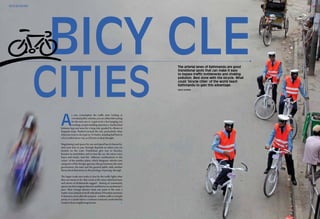
The arterial lanes of Kathmandu are good
transitional spots that can make it easy
to bypass traffic bottlenecks and choking
pollution. Best done with the bicycle. What
could ‘bicycle cities’ of the world teach
Kathmandu to gain this advantage.
eco echoes
A
s you contemplate the traffic jams looking at
crowdedpublicvehicles,youareeitherleftwaiting
for the next one or it gets to be a bar hanging, toe
crushing, armpit smelling experience. Sandwiched
between legs and arms for a long ride, goaded by elbows at
frequent stops. Pushed towards the exit, particularly when
what you want to do is get in. Or better, standing half bent in
a low roofed micro van, as if frozen in deep thought.
Negotiating road spaces by size and speed has its hierarchy.
And your turn to pass through depends on where you are
located on the scale. Pedestrians give way to bicycles,
bicycles to motorbikes and in turn the car, the micro vans,
buses and trucks. And the different combinations to the
colors of the number plates, which designate vehicles into
categories of the foreign agencies, the government, the semi
government, the taxis and the general public adds another
hierarchical dimension to the privelege of passing through.
The larger roads sure make it clear by the traffic lights what
they are meant to be. But a look at the inner inherited lanes
and streets of Kathmandu suggest - sharing of community
spaceswastheiroriginalobjectiveandthattooatapedestrian’s
pace. Their average distance from one point to the next, a
matter of an unhurried stroll with plenty of breather junctions
in between, most often the purpose - a sedate walk to a temple
porch, or a causal visit to a common courtyard, overlooked by
windows from neighboring houses.
54 vivacity magazine • july 2011 www.vivacitymagazines.com
of Amsterdam’s traffic is bicycle. The city has a
population of over
40%750000
Today these pretty lanes are bottlenecks clogged by
cacophony, particularly on days when traffic on the
larger roads spills inwards - commuters trying to find
a way out. The buildup of traffic in the lanes not only
transforms the physical spaces but the social fabric, the
traditional continuation that the arterial city streets
were supposed to give to households, work & worship
routines and ethnicity of neighborhoods. But everyone
needstoreachsomewhere.Theselanesarenotgoingto
getwidened.Theleastintrudingofallformsoftransport
seems to be the bicycle. Imagine if the lanes could be
bicycle lanes. The speed would match the layout, the
cacophony would subside, and even pedestrians could
getbacktosomerightfulwalking.
‘Sharing the road’ is a part of commuting program of
many cities of the world today. And the bicycle takes
a fair share of it, making them the Bicycle Cities.
A glance at some is a source of getting inspired
anytime.
40 percent of Amsterdam’s traffic is bicycle. The city
has a population of over 750000.
In Denmark practically everybody has a bike, and for
many years Copenhagen - population 1.8 million -
has been known as ‘the city of bicycles’. Currently
32 percent of inhabitants bicycle to work and 50
percent of them say they do so because it is fast and
easy. The city plans to double its spending on biking
infrastructure over the next three years.
Portland, in USA, saw its bicycle network expanded
from 60 to 260 miles since the early 1990s. Bicycle
use has quadrupled over the same period without
any increase in traffic accidents. Its success story is,
connectivity of urban neighborhoods by by-passing
auto commuting roads.
Barcelona, Spain, has an engaging bike-hiring
program; the ring road surrounding the core urban
area is intermittently marked with over 100 different
bike stations giving riders the option to hire a bicycle
on a point-to point basis.
eco echoes
56 vivacity magazine • july 2011 www.vivacitymagazines.com 57july 2011 • vivacity magazinewww.vivacitymagazines.com
‘Sharing the road’ is
a part of commuting
program of many cities
of the world today. and
the bicycle takes a fair
share of it, making them
the Bicycle cities.
bicycles and
5,000
today the program provides over
stations in
montreal
alone.
400
And some cities like Bogota, Columbia, just gain the
bicycle advantage by default. Only about thirteen
percent of residents own cars. Every week the city
closes over 70 miles of streets to vehicle traffic,
allowing only bicycles, pedestrians & skaters to
enjoy freedom of movement.
Montreal, Canada, has inspired bicycle cities
everywhere in the world with Bixi - an innovative
bicycle rental program. In 2008, Bixi got ranked 19th
in Time Magazine’s “50 Best Inventions of
theYear”.Todaytheprogramprovidesover
5,000 bicycles and 400 stations in Montreal
alone.  Having made its mark in cities like
London, Melbourne & Washington D.C.
Bixi the word, comes from “bike” and
“taxi”, implying its public transport utility.
Designers claim their bikes for Bixi are
theft proof. Equipped with a GPS chip,
if not returned in time they slow down,
gradually, automatically locking the
brakes. Located at self service docking
stations the bicycles can be undocked
by paying with a credit card or if one is a
subscriber to the service, one gets a Bixi
key, a number, to unlock the bicycle.
Self-service kiosks print an access number for a 24-
hour day user’s pass, which releases the bicycle from
its stand. After use the bicycle can be returned to any
Bixi bike station in the city. Every first 30 minutes of
use is free, so if docked into a rental center within
the half hour, the rider has to wait only a couple
of minutes before taking it out again for a free 30
minutes! Beyond this limited use, annual, monthly
and daily rental comes at a fee. One pays less than 80
dollars for a year’s use.
With over half a million motor vehicles in
Kathmandu valley, not just driving but parking asks
for space. Some of the ‘bicycle city’ schemes could
do well to the valley’s health and mobility with a
growing population of workers, students, businesses
and expatriates. This spurt of urban exodus started
back in the 70s with urban population growing at 8.4
percent, all moving into Kathmandu.
Perhaps schemes for rental could be operated at
community level in designated areas. A network
of Bicycle sheds & rental services at major transit
points such as bus parks, shopping malls and office
spaces could be a starter. The bicycle could be
hired at one point and deposited closer to point of
destination, something like the Bixi in some western
countries. Tourists could be the first trial groups.
Hotels and hospitality sectors could offer discounts
and schemes for bicycle users pedaling in. Wishful
thinking? Tell it happens.
Often a culture comprises of habits, and images
that provoke them. Simplicity of the bike can be its
attitude; can be chic, street-smart and something
more with the right projection from media platforms
and promotions. Given a style factor, along with
the health advantages, perhaps youth could be the
second target group to be encouraged towards
the use of the bicycle through campus programs.
eco echoes
With over half a million
motor vehicles in
Kathmandu valley, not
just driving but parking
asks for space.
700
500
One hour of bicycling
at 12 mph burns about
calories. half hours
twice a day would
probably burn
at least.
Recently the valley traffic police and the high school
associations seem to be reaching an understanding
to ban two wheel moterbikes for students in school
campuses. This could be a time to inject the bicycle
idea as a replacement, at least for some.
In 2005 a decision on making a 44 km long bicycle
track in Kathmandu Metropolitan City was initiated
when Nepal signed the Velo Mondial Charter and
“ActionPlanforBicycleFriendlyCommunities”This
soon encouraged a group of Kathmandu University
students to start a campaign called Kathmandu
Cycle City 2020 for making the capital, Kathmandu,
a cycle friendly city by 2020.
The Government of Nepal has asked Chinese
Government to extend support for the development
of cycle infrastructures in Kathmandu Valley
Many countries have gone in for encouraging
workers to come to work on a bicycle. Infact
Kathmandu has seen some initiative on similar lines.
A year back Chain, a bike company, launced “Bike
Friday, a once a week cycling day in association
with Laxmi Bank. The result - employees of Laxmi
Bank bicycle to office every Friday. Chain went on
to take the program to schools and other bussiness
concerns. Big Mart, Moksh, Himlayan Java and
Gyanodaya School took up the program. It might
not be easy to switch everyone targeted, into the
program, but the idea has been put into motion. Sure
enough bicycle culture cannot mean the opposition
to automobile travelling, but a balanced use of the
bicycle as an advantage.
Above all bicycles are low polluting and cost
effective. Faster when arterial lanes are available
- and Kathmandu has many - which make it easier
to accommodate the cyclist in the transitional areas.
These could be designated as exclusive bicycle zones,
and take the traffic fizz out of the bottlenecks.
Bicycles can easily shrug off the shooting prices of
fuel and regain independence from the dictates of
mile long ques stretching for several hours both sides
of a fuel station.
And can the health benefits be ignored? One hour of
bicycling at 12 mph burns about 700 calories. Half
hours twice a day would probably burn 500 at least.
With the price anywhere from 20,000 to 75,000
rupees, bicycles are not a cheap investemnt yet, but
companies like Chain offer easy purchase options,
on instalemnts and discounts.

Bicycle cities, vivacity 3

  • 1.
    52 vivacity magazine• july 2011 www.vivacitymagazines.com 53july 2011 • vivacity magazinewww.vivacitymagazines.com Arun Khanna The arterial lanes of Kathmandu are good transitional spots that can make it easy to bypass traffic bottlenecks and choking pollution. Best done with the bicycle. What could ‘bicycle cities’ of the world teach Kathmandu to gain this advantage. eco echoes A s you contemplate the traffic jams looking at crowdedpublicvehicles,youareeitherleftwaiting for the next one or it gets to be a bar hanging, toe crushing, armpit smelling experience. Sandwiched between legs and arms for a long ride, goaded by elbows at frequent stops. Pushed towards the exit, particularly when what you want to do is get in. Or better, standing half bent in a low roofed micro van, as if frozen in deep thought. Negotiating road spaces by size and speed has its hierarchy. And your turn to pass through depends on where you are located on the scale. Pedestrians give way to bicycles, bicycles to motorbikes and in turn the car, the micro vans, buses and trucks. And the different combinations to the colors of the number plates, which designate vehicles into categories of the foreign agencies, the government, the semi government, the taxis and the general public adds another hierarchical dimension to the privelege of passing through. The larger roads sure make it clear by the traffic lights what they are meant to be. But a look at the inner inherited lanes and streets of Kathmandu suggest - sharing of community spaceswastheiroriginalobjectiveandthattooatapedestrian’s pace. Their average distance from one point to the next, a matter of an unhurried stroll with plenty of breather junctions in between, most often the purpose - a sedate walk to a temple porch, or a causal visit to a common courtyard, overlooked by windows from neighboring houses.
  • 2.
    54 vivacity magazine• july 2011 www.vivacitymagazines.com of Amsterdam’s traffic is bicycle. The city has a population of over 40%750000 Today these pretty lanes are bottlenecks clogged by cacophony, particularly on days when traffic on the larger roads spills inwards - commuters trying to find a way out. The buildup of traffic in the lanes not only transforms the physical spaces but the social fabric, the traditional continuation that the arterial city streets were supposed to give to households, work & worship routines and ethnicity of neighborhoods. But everyone needstoreachsomewhere.Theselanesarenotgoingto getwidened.Theleastintrudingofallformsoftransport seems to be the bicycle. Imagine if the lanes could be bicycle lanes. The speed would match the layout, the cacophony would subside, and even pedestrians could getbacktosomerightfulwalking. ‘Sharing the road’ is a part of commuting program of many cities of the world today. And the bicycle takes a fair share of it, making them the Bicycle Cities. A glance at some is a source of getting inspired anytime. 40 percent of Amsterdam’s traffic is bicycle. The city has a population of over 750000. In Denmark practically everybody has a bike, and for many years Copenhagen - population 1.8 million - has been known as ‘the city of bicycles’. Currently 32 percent of inhabitants bicycle to work and 50 percent of them say they do so because it is fast and easy. The city plans to double its spending on biking infrastructure over the next three years. Portland, in USA, saw its bicycle network expanded from 60 to 260 miles since the early 1990s. Bicycle use has quadrupled over the same period without any increase in traffic accidents. Its success story is, connectivity of urban neighborhoods by by-passing auto commuting roads. Barcelona, Spain, has an engaging bike-hiring program; the ring road surrounding the core urban area is intermittently marked with over 100 different bike stations giving riders the option to hire a bicycle on a point-to point basis. eco echoes
  • 3.
    56 vivacity magazine• july 2011 www.vivacitymagazines.com 57july 2011 • vivacity magazinewww.vivacitymagazines.com ‘Sharing the road’ is a part of commuting program of many cities of the world today. and the bicycle takes a fair share of it, making them the Bicycle cities. bicycles and 5,000 today the program provides over stations in montreal alone. 400 And some cities like Bogota, Columbia, just gain the bicycle advantage by default. Only about thirteen percent of residents own cars. Every week the city closes over 70 miles of streets to vehicle traffic, allowing only bicycles, pedestrians & skaters to enjoy freedom of movement. Montreal, Canada, has inspired bicycle cities everywhere in the world with Bixi - an innovative bicycle rental program. In 2008, Bixi got ranked 19th in Time Magazine’s “50 Best Inventions of theYear”.Todaytheprogramprovidesover 5,000 bicycles and 400 stations in Montreal alone.  Having made its mark in cities like London, Melbourne & Washington D.C. Bixi the word, comes from “bike” and “taxi”, implying its public transport utility. Designers claim their bikes for Bixi are theft proof. Equipped with a GPS chip, if not returned in time they slow down, gradually, automatically locking the brakes. Located at self service docking stations the bicycles can be undocked by paying with a credit card or if one is a subscriber to the service, one gets a Bixi key, a number, to unlock the bicycle. Self-service kiosks print an access number for a 24- hour day user’s pass, which releases the bicycle from its stand. After use the bicycle can be returned to any Bixi bike station in the city. Every first 30 minutes of use is free, so if docked into a rental center within the half hour, the rider has to wait only a couple of minutes before taking it out again for a free 30 minutes! Beyond this limited use, annual, monthly and daily rental comes at a fee. One pays less than 80 dollars for a year’s use. With over half a million motor vehicles in Kathmandu valley, not just driving but parking asks for space. Some of the ‘bicycle city’ schemes could do well to the valley’s health and mobility with a growing population of workers, students, businesses and expatriates. This spurt of urban exodus started back in the 70s with urban population growing at 8.4 percent, all moving into Kathmandu. Perhaps schemes for rental could be operated at community level in designated areas. A network of Bicycle sheds & rental services at major transit points such as bus parks, shopping malls and office spaces could be a starter. The bicycle could be hired at one point and deposited closer to point of destination, something like the Bixi in some western countries. Tourists could be the first trial groups. Hotels and hospitality sectors could offer discounts and schemes for bicycle users pedaling in. Wishful thinking? Tell it happens. Often a culture comprises of habits, and images that provoke them. Simplicity of the bike can be its attitude; can be chic, street-smart and something more with the right projection from media platforms and promotions. Given a style factor, along with the health advantages, perhaps youth could be the second target group to be encouraged towards the use of the bicycle through campus programs. eco echoes With over half a million motor vehicles in Kathmandu valley, not just driving but parking asks for space. 700 500 One hour of bicycling at 12 mph burns about calories. half hours twice a day would probably burn at least. Recently the valley traffic police and the high school associations seem to be reaching an understanding to ban two wheel moterbikes for students in school campuses. This could be a time to inject the bicycle idea as a replacement, at least for some. In 2005 a decision on making a 44 km long bicycle track in Kathmandu Metropolitan City was initiated when Nepal signed the Velo Mondial Charter and “ActionPlanforBicycleFriendlyCommunities”This soon encouraged a group of Kathmandu University students to start a campaign called Kathmandu Cycle City 2020 for making the capital, Kathmandu, a cycle friendly city by 2020. The Government of Nepal has asked Chinese Government to extend support for the development of cycle infrastructures in Kathmandu Valley Many countries have gone in for encouraging workers to come to work on a bicycle. Infact Kathmandu has seen some initiative on similar lines. A year back Chain, a bike company, launced “Bike Friday, a once a week cycling day in association with Laxmi Bank. The result - employees of Laxmi Bank bicycle to office every Friday. Chain went on to take the program to schools and other bussiness concerns. Big Mart, Moksh, Himlayan Java and Gyanodaya School took up the program. It might not be easy to switch everyone targeted, into the program, but the idea has been put into motion. Sure enough bicycle culture cannot mean the opposition to automobile travelling, but a balanced use of the bicycle as an advantage. Above all bicycles are low polluting and cost effective. Faster when arterial lanes are available - and Kathmandu has many - which make it easier to accommodate the cyclist in the transitional areas. These could be designated as exclusive bicycle zones, and take the traffic fizz out of the bottlenecks. Bicycles can easily shrug off the shooting prices of fuel and regain independence from the dictates of mile long ques stretching for several hours both sides of a fuel station. And can the health benefits be ignored? One hour of bicycling at 12 mph burns about 700 calories. Half hours twice a day would probably burn 500 at least. With the price anywhere from 20,000 to 75,000 rupees, bicycles are not a cheap investemnt yet, but companies like Chain offer easy purchase options, on instalemnts and discounts.