Accepted by the Graduate Faculty, Indiana University, in partial fulfillment of the require-
ments for the degree of Master of Science.
Hossein Hakimzadeh, Ph.D.
Liguo Yu, Ph.D.
Michael R Scheessele, Ph.D.
Yu Song, Ph.D.
May 18, 2009
IU–ADVISE: A WEB BASED ADVISING
TOOL FOR ACADEMIC ADVISORS AND
STUDENTS
Truong Quoc Hung
Submitted to the faculty of the University Graduate School
in partial fulfillment of the requirements
for the degree of
Master of Science
in the Department of Computer and Information Science
Indiana University
May 18, 2009
Copyright 2009
Truong Quoc Hung
ALL RIGHTS RESERVED
i
Abstract
Academic advising is an important activity of an academic institution. It guides the stu-
dents to explore potential careers, academic disciplines and opportunities in the college
environment. An accurate and full featured advising system can be an effective tool to both
students and faculty advisors. The dynamic nature of academic programs, especially in
regards to changes in the general education and other degree requirements, poses a con-
tinuous challenge to faculty advisors to remain up-to-date. The goal of this thesis is to
implement a web-based advising system which facilitates academic advisors in their ef-
forts to providing quality, accurate and consistent advising services to their students. The
proposed system was implemented using a set of open source software packages to create
a low cost, flexible, and customizable system.
ii
Acknowledgements
In the completing of this graduate project I have been fortunate to have the help, support and
encouragement from many people. I would like to acknowledge them for their cooperation.
I wish to express deep heart-felt gratitude to my project advisor, Dr. Hossein Hakimzadeh,
Ph.D., Director of Informatics, for guiding and assisting me through every step of the pro-
cess with helpful knowledge and support.
I would like to thank Dr. Liguo Yu, Dr. Yu Song and Dr. Michael R Scheessele,
my thesis committee members, who showed immense patience and understanding through
detailed review and suggestions.
I am grateful to Dr. Robert Batzinger, Ph.D., Informatics Lab Supervisor, for explaining
difficult aspects of PHP, web programming and LATEX.
I owe my most sincere gratitude to all staffs and my friends who helped me during my
studies and work at IU South Bend.
I would like to thank my grandmother, uncles, aunts, and cousins who have been con-
stantly provided me with various forms of support since the first day I came to the United
States.
I owe my loving thanks to Huong Xuan Hoang Thi and her family for their encourage-
ment and understanding.
Lastly and most importantly, I wish to thank my parents and brother, Dieu Hien Thi
Nguyen, Thi Truong and Dung Truong. Their support and love that helped me overcome
difficulties, enjoy my studies and achieve my goals.
iii
Contents
List of Tables . . . . . . . . . . . . . . . . . . . . . . . . . . . . . . . . . . . . . . . . . . . . . . . . . . . . . . . . . . . . v
List of Figures . . . . . . . . . . . . . . . . . . . . . . . . . . . . . . . . . . . . . . . . . . . . . . . . . . . . . . . . . . . vii
1. Introduction . . . . . . . . . . . . . . . . . . . . . . . . . . . . . . . . . . . . . . . . . . . . . . . . . . . . . . . . . 1
2. Literature Review . . . . . . . . . . . . . . . . . . . . . . . . . . . . . . . . . . . . . . . . . . . . . . . . . . . . 3
3. Project Design . . . . . . . . . . . . . . . . . . . . . . . . . . . . . . . . . . . . . . . . . . . . . . . . . . . . . . . 7
3.1. Privacy Policy . . . . . . . . . . . . . . . . . . . . . . . . . . . . . . . . . . . . . . . . . . . . . . . . . . 7
3.2. Data Model . . . . . . . . . . . . . . . . . . . . . . . . . . . . . . . . . . . . . . . . . . . . . . . . . . . . 8
3.3. Database Design . . . . . . . . . . . . . . . . . . . . . . . . . . . . . . . . . . . . . . . . . . . . . . . . 10
3.4. Process Model . . . . . . . . . . . . . . . . . . . . . . . . . . . . . . . . . . . . . . . . . . . . . . . . . 34
3.5. User Interface . . . . . . . . . . . . . . . . . . . . . . . . . . . . . . . . . . . . . . . . . . . . . . . . . . 62
4. Implementation Technologies . . . . . . . . . . . . . . . . . . . . . . . . . . . . . . . . . . . . . . . . . . 80
4.1. Application Architecture . . . . . . . . . . . . . . . . . . . . . . . . . . . . . . . . . . . . . . . . . 80
4.2. Ajax . . . . . . . . . . . . . . . . . . . . . . . . . . . . . . . . . . . . . . . . . . . . . . . . . . . . . . . . . . 82
4.3. Apache Web Server . . . . . . . . . . . . . . . . . . . . . . . . . . . . . . . . . . . . . . . . . . . . . 85
4.4. Server-Side Scripting with PHP . . . . . . . . . . . . . . . . . . . . . . . . . . . . . . . . . . . 87
4.5. MySQL . . . . . . . . . . . . . . . . . . . . . . . . . . . . . . . . . . . . . . . . . . . . . . . . . . . . . . . 90
4.6. Design Patterns . . . . . . . . . . . . . . . . . . . . . . . . . . . . . . . . . . . . . . . . . . . . . . . . . 94
4.7. MVC in Zend Framework Implementation . . . . . . . . . . . . . . . . . . . . . . . . . . 97
5. Conclusion. . . . . . . . . . . . . . . . . . . . . . . . . . . . . . . . . . . . . . . . . . . . . . . . . . . . . . . . . . 100
Appendix A. Zend Framework . . . . . . . . . . . . . . . . . . . . . . . . . . . . . . . . . . . . . . . . . . . . 102
A.1. MVC Implementation Classes . . . . . . . . . . . . . . . . . . . . . . . . . . . . . . . . . . . . 103
A.2. Useful Classes from Zend Framework . . . . . . . . . . . . . . . . . . . . . . . . . . . . . 113
Bibliography . . . . . . . . . . . . . . . . . . . . . . . . . . . . . . . . . . . . . . . . . . . . . . . . . . . . . . . . . . . . 118
iv
List of Tables
Table 3.1. SQL table structure for campus . . . . . . . . . . . . . . . . . 10
Table 3.2. SQL table structure for campus_reqs . . . . . . . . . . . . . . . 11
Table 3.3. SQL table structure for admin_role . . . . . . . . . . . . . . . . 12
Table 3.4. SQL table structure for admin_personnel . . . . . . . . . . . . . . 13
Table 3.5. SQL table structure for college . . . . . . . . . . . . . . . . . . 14
Table 3.6. SQL table structure for college_reqs . . . . . . . . . . . . . . . 15
Table 3.7. SQL table structure for course_relationship . . . . . . . . . . . . . 16
Table 3.8. SQL table structure for pre_co_req . . . . . . . . . . . . . . . . 16
Table 3.9. SQL table structure for degree_type . . . . . . . . . . . . . . . . 17
Table 3.10. SQL table structure for department . . . . . . . . . . . . . . . 18
Table 3.11. SQL table structure for communication_type . . . . . . . . . . . . 19
Table 3.12. SQL table structure for access_level . . . . . . . . . . . . . . . 19
Table 3.13. SQL table structure for course . . . . . . . . . . . . . . . . . 20
Table 3.14. SQL table structure for academic_program . . . . . . . . . . . . 21
Table 3.15. SQL table structure for advisor . . . . . . . . . . . . . . . . . 22
Table 3.16. SQL table structure for advise . . . . . . . . . . . . . . . . . 23
Table 3.17. SQL table structure for advisor_remark . . . . . . . . . . . . . . 24
Table 3.18. SQL table structure for enrollment . . . . . . . . . . . . . . . . 25
Table 3.19. SQL table structure for satisfied_by . . . . . . . . . . . . . . . 26
Table 3.20. SQL table structure for detailed_requirement . . . . . . . . . . . 27
Table 3.21. SQL table structure for requirements . . . . . . . . . . . . . . . 28
Table 3.22. SQL table structure for degree_req_categories . . . . . . . . . . . 29
Table 3.23. SQL table structure for declared_program . . . . . . . . . . . . . 30
Table 3.24. SQL table structure for student . . . . . . . . . . . . . . . . . 31
Table 3.25. SQL table structure for completion_method . . . . . . . . . . . . 32
Table 3.26. SQL table structure for semester . . . . . . . . . . . . . . . . 32
Table 3.27. SQL table structure for actionlog . . . . . . . . . . . . . . . . 33
v
Table 4.1. MVC implementations for different languages . . . . . . . . . . . . 97
vi
List of Figures
Figure 2.1. SIS introduction page . . . . . . . . . . . . . . . . . . . . . 4
Figure 2.2. Part of a SIS unofficial transcript page . . . . . . . . . . . . . . 5
Figure 2.3. Part of a SIS what-if report . . . . . . . . . . . . . . . . . . . 5
Figure 3.1. ER Diagram of IU Advisee . . . . . . . . . . . . . . . . . . . 9
Figure 3.2. Functional Decomposition Diagram . . . . . . . . . . . . . . . 35
Figure 3.3. Context Data Flow Diagram of IU-Advise system . . . . . . . . . . 37
Figure 3.4. Student - View Degree Audit Context DFD . . . . . . . . . . . . 38
Figure 3.5. Student - View Degree Audit Detailed DFD . . . . . . . . . . . . 39
Figure 3.6. Student - View Unofficial Transcript Context DFD . . . . . . . . . 40
Figure 3.7. Student - View Unofficial Transcript Detailed DFD . . . . . . . . . 41
Figure 3.8. Student - View Grades Context DFD . . . . . . . . . . . . . . . 42
Figure 3.9. Student - View Grades Detailed DFD . . . . . . . . . . . . . . . 43
Figure 3.10. Student - View Advisor Remarks Context DFD . . . . . . . . . . 44
Figure 3.11. Student - View Advisor Remarks Detailed DFD . . . . . . . . . . 45
Figure 3.12. Advisor - View Advisor Remarks Context DFD . . . . . . . . . . 46
Figure 3.13. Advisor - View Advisor Remarks Detailed DFD . . . . . . . . . . 47
Figure 3.14. Advisor - View Degree Audit Context DFD . . . . . . . . . . . . 48
Figure 3.15. Advisor - View Degree Audit Detailed DFD . . . . . . . . . . . 49
Figure 3.16. Advisor - View Unofficial Transcript Context DFD . . . . . . . . . 51
Figure 3.17. Advisor - View Unofficial Transcript Detailed DFD . . . . . . . . 52
Figure 3.18. Advisor - View Grades Context DFD . . . . . . . . . . . . . . 53
Figure 3.19. Advisor - View Grades Detailed DFD . . . . . . . . . . . . . . 54
Figure 3.20. Advisor - Create Advisor Remark Context DFD . . . . . . . . . . 55
Figure 3.21. Advisor - Create Advisor Remark Detailed DFD . . . . . . . . . . 56
Figure 3.22. Advisor - Modify Advisor Remark Context DFD . . . . . . . . . 58
Figure 3.23. Advisor - Modify Advisor Remark Detailed DFD . . . . . . . . . 59
Figure 3.24. Advisor - Remove Advisor Remark Context DFD . . . . . . . . . 60
vii
Figure 3.25. Advisor - Remove Advisor Remark Detailed DFD . . . . . . . . . 61
Figure 3.26. Chosen role screen for IU-Advise . . . . . . . . . . . . . . . . 62
Figure 3.27. Login form for an advisor . . . . . . . . . . . . . . . . . . . 63
Figure 3.28. Server validation message . . . . . . . . . . . . . . . . . . . 63
Figure 3.29. Client validation message . . . . . . . . . . . . . . . . . . . 63
Figure 3.30. Advisor index page . . . . . . . . . . . . . . . . . . . . . 64
Figure 3.31. Advisor information tab . . . . . . . . . . . . . . . . . . . 64
Figure 3.32. Student demographic information tab . . . . . . . . . . . . . . 65
Figure 3.33. Latest admission information tab . . . . . . . . . . . . . . . . 66
Figure 3.34. Test out information tab . . . . . . . . . . . . . . . . . . . 66
Figure 3.35. Advisor remark list . . . . . . . . . . . . . . . . . . . . . 67
Figure 3.36. Personal advisor remark list . . . . . . . . . . . . . . . . . . 68
Figure 3.37. Add new advisor remark form . . . . . . . . . . . . . . . . . 68
Figure 3.38. Choose a user advisor remark . . . . . . . . . . . . . . . . . 69
Figure 3.39. Load data into form . . . . . . . . . . . . . . . . . . . . . 70
Figure 3.40. Choose multiple user advisor remark . . . . . . . . . . . . . . 70
Figure 3.41. Only list valid records . . . . . . . . . . . . . . . . . . . . 71
Figure 3.42. Chosen records for activating or deactivating . . . . . . . . . . . 71
Figure 3.43. Degree audit result . . . . . . . . . . . . . . . . . . . . . 72
Figure 3.44. Degree audit detail tab . . . . . . . . . . . . . . . . . . . . 72
Figure 3.45. Input for producing degree what-if report . . . . . . . . . . . . . 73
Figure 3.46. Degree what-if report details . . . . . . . . . . . . . . . . . . 74
Figure 3.47. Excluded courses report . . . . . . . . . . . . . . . . . . . 74
Figure 3.48. Advisor view grades . . . . . . . . . . . . . . . . . . . . . 75
Figure 3.49. Unofficial transcript detail . . . . . . . . . . . . . . . . . . . 76
Figure 3.50. Student index page . . . . . . . . . . . . . . . . . . . . . 76
Figure 3.51. Student advisor remark list . . . . . . . . . . . . . . . . . . 77
Figure 3.52. Student degree audit . . . . . . . . . . . . . . . . . . . . . 77
Figure 3.53. Student degree audit details . . . . . . . . . . . . . . . . . . 78
Figure 3.54. Student degree what-if report . . . . . . . . . . . . . . . . . 78
viii
Figure 3.55. Student view grade report . . . . . . . . . . . . . . . . . . . 79
Figure 3.56. Student view unofficial transcript . . . . . . . . . . . . . . . . 79
Figure 4.1. Architecture of the proposed system . . . . . . . . . . . . . . . 81
Figure 4.2. AJAX (right) and traditional model (left) . . . . . . . . . . . . . 83
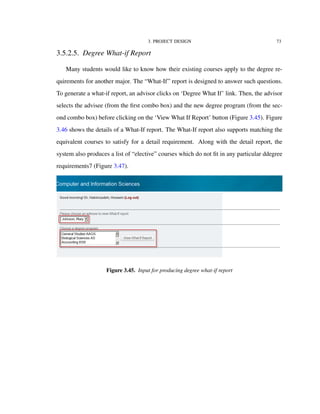
Figure 4.3. AJAX (bottom) and traditional model (top) . . . . . . . . . . . . 84
Figure 4.4. Server Share among the Million Busiest Sites, March 2009 . . . . . . 86
Figure 4.5. Structure of MVC model . . . . . . . . . . . . . . . . . . . . 95
Figure 4.6. Structure of Student class . . . . . . . . . . . . . . . . . . . 95
Figure 4.7. Zend implementation of MVC design pattern . . . . . . . . . . . 98
Figure A.1. Dispatching cycle of Zend Framework . . . . . . . . . . . . . 103
Figure A.2. Logical model of Factory design pattern . . . . . . . . . . . . 108
ix
1. Introduction
The main objective of academic advising is to guide, motivate and support students
as they explore their potential and make precise academic choices in order to satisfy stu-
dents’ needs and comply with academic policies [1]. To achieve these objectives, IU South
Bend employs the direct communication between advisors and students as the main ad-
vising system. Advisors are typically faculty or professional advisors employed by an
academic unit. A normal advising session consists of meetings between an advisor and a
student. On the basis of these meetings, the student makes decisions about class schedules,
choosing an academic major or minor, planning for graduation and many other academic
related activities. These important decisions are made based on information about previ-
ously completed courses, degree requirements, academic policies, and offered courses in
the upcoming semester provided by advisors balanced against the student’s work schedule
and other interests or commitments.
The current academic advising system, however, has encountered some problems [2].
Among these, there are some noticeable points. First, academic advisors serve as ma-
jor and comprehensive resources for students to utilize, and therefore need to spend time
understanding and updating their knowledge about degree requirements and academic poli-
cies as well as familiarizing themselves with students’ progress toward academic degrees
prior to any advising period. This is a time-consuming task for any advisor especially when
students far outnumber their advisors. Second, a faculty advisor may not be able to keep
up with new academic policies, programs and/or degree requirements as they may have
several duties during an advising period adding to the difficulties in updating information.
This situation can lead to inconsistent information among advisors. Third, most of the time,
advisors answer recurrent questions about trivial class scheduling. In fact, these questions
could be answered easily by students themselves, if useful information about class sched-
ules and previously completed courses were available and easy to access. Accordingly,
1
1. INTRODUCTION 2
there should be a tool for helping students to take advantage of authorized part of academic
information before coming to their advisors. Finally, computer-literate students would fre-
quently like to have more electronic interaction for advising. This is an important factor
that needs to be taken into consideration because the students are customers of the services
both directly and indirectly [3].
Although there are some problems in the current advising system, faculty mentors and
advisors cannot be replaced completely by a computer-based system. The reason is that
the academic advising process requires professional knowledge of academic disciplines
to satisfy questions about a specific course structure, teaching methods, etc. Moreover,
the students do not come to the advisors’ offices for only course selection, but also for
recommendation while they decide their majors and careers. For these types of questions,
an academic advisor with intensive and proficient knowledge about a specific field of study
is the best source of valuable information in this regard. However, this information cannot
be stored and interpreted from static data held in a database.
This thesis attempts to implement a web-based advising system known as “IU-Advise”.
The system supports following activities for an authenticated and authorized student or
advisor:
• View or print an unofficial transcript;
• View or print degree audit that shows the progress toward a degree and identifies
unmet requirements;
• View or print students’ advising records;
• Add or modify advising information;
• View the degree requirements for a given program in a given academic year;
• View what-if report which shows how previously completed courses would fit into
a new degree program;
It is hoped that the proposed system would become a useful tool for both advisors and
students and will facilitate the advising process.
2. Literature Review
Many universities and colleges are applying computer technology to create useful tools
and complete systems that improve the traditional academic advising system. There have
been many levels and means for applying computer technology. The basic level is to de-
velop a simple tool that can produce reports or cover a simple task of the advising process.
The higher level is the complete software system that supports the complete advising pro-
cess.
For the basic level, one useful and common tool is a degree audit reporting system
(DARS). DARS, which was developed by Miami University in 1985 [4], produces a degree
audit which shows all the requirements of a specific academic degree, the courses that sat-
isfy those requirements and the progress of a student toward the degree. This is a small and
effective tool for both advisors and students in the advising process. DARS has been pur-
chased and adapted by many academic institutions such as Ohio University [5], University
of San Diego[6], University of Missouri - St. Louis [7] and etc.
In the higher level, the AdvisorTrac of RedRock Software [8] is a commercial soft-
ware that supports scheduling, reviewing, cancelling advising appointments, storing demo-
graphic records and keeping track of advising records. AdvisorTrac is currently being used
by a number of universities, among of which are the University of Louisville[9], Western
Kentucky University[10], Indiana University-Purdue University Fort Wayne [11] and other
colleges.
At the software system level, redLatern, an auxiliary of Miami University [12], developed
a commercial software solution based on the DARS for both students and advisors. The
solution includes 3 components: u.select, u.direct, and u.achieve. This education software
solution provides tools for most advising activities, such as planning courses, selecting
courses, keeping track of grades, generating degree audits, and other common advising
tasks with unified and consistent information throughout an academic institution.
3
2. LITERATURE REVIEW 4
In addition to these specialized software solutions, most comprehensive administrative
software systems such as PeopleSoft, SCT Banner and Oracle also have an academic ad-
visement module. The current OneStart application portal of IU South Bend provides an
access to Student Self Service. Student Self Service, based on PeopleSoft’s Human Re-
source Management System (HRMS) and Student Information System (SIS), provides two
advising services: View My Advisors and View My Advisement Reports [13]. Figures 2.1,
2.2 and 2.3 show some of current SIS reports. The View My Advisement Reports function
allows a student to view a degree audit with or without a unofficial transcript. It also pro-
duces a what-if report that shows how current enrolled courses could be applied to a new
major when a student wants to change his or her major. A course list what-if report of this
service determines if selected courses fit into any requirement of a given degree program.
These two reports need to be polished and reorganized in order to provide more useful
information than the current version. The View My Advisor offers a list of advisors of a
given student and allows the student to notify one or many advisors.
Figure 2.1. SIS introduction page
2. LITERATURE REVIEW 5
Figure 2.2. Part of a SIS unofficial transcript page
Figure 2.3. Part of a SIS what-if report
A commercial software package is not the only way to meet the needs of improving
the quality of advising services. There are many computer software systems developed in
- house. In 1999, the Department of Computer Science and Engineering (CSE) of Florida
Atlantic University (FAU) started working on a project of a web-based advising system.
This system is composed of three components [2]:
2. LITERATURE REVIEW 6
• The FAQ component archives and presents the most common questions that can be
answered without intensive knowledge about policies, requirements and courses.
• The Course component is used by advisors and administrators to maintain course
information.
• The Advising component captures all the information of the advising appoint-
ments between advisors and students. It then combines with the data in the data-
base to produce a final result of advising.
In the same manner, Indiana University developed and used Indiana Student Information
Transaction Environment [2, 14] - INSITE on some Indiana University campuses before
OneStart [2, 14] was employed. INSITE offered the following features:
• Producing an advising report for a student’s current major;
• Producing an advising report for a different major;
• Producing an advising report for a special purpose program;
• Viewing how in-progress courses would apply to a student’s advising report;
• Adding future courses, grades, and hours to determine affects on the advising
report;
3. Project Design
In order to develop an application, a conceptual design was produced and reviewed
carefully. A conceptual design included two components: the data model and the process
model. The data model determined what information was needed, how it was to be or-
ganized and stored. For IU-Advise, we use Entity-Relationship model for organizing and
storing data. The process model was used to convey the structure of an application, how its
components operate and interact with each other. It also shows how data flows among pro-
cesses to get the final result. In addition to these conceptual models, the designing process
was used to develop a layout for the user interface model which represents the interaction
of users with the system. The designs of these models and the information privacy policy
for sharing advisor remarks among advisors will be the topics for the remainder of this
chapter.
3.1. Privacy Policy
Privacy is always the an important concern of users. Sharing advisor remarks among
advisors help advisors understand the personal ne eds of a student. However, information
sharing without proper controls could lead to the violation of privacy policies, regulations
or laws. Therefore, it is important to have a mechanism for restricting access to advisor
remarks as well as promoting information sharing. In order to maintain the privacy of
students and advisors, the IU-Advise system provides three privacy levels which can be
applied to advisor remarks. These levels are Advisor, Advisor Group and Public.
• Advisor level: advisor remarks belonging to this type can only be viewed and
manipulated by its owner or the creator. The user can delete and edit his or her
own private remark;
• Advisor Group level: advisor remarks in this group can be viewed and shared
among advisors but not students. Only the owner or creator of an advisor remark
7
3. PROJECT DESIGN 8
can deactivate or activate it. When an advisor remark is deactivated, it is not
deleted. It is just invisible to other advisors;
• Public level: these remarks can be viewed by both students and advisors using the
system. Similar to Advisor Group type advisor remarks, these remarks can only
be activated and deactivated by the owner or creator of the adviso remark;
These levels ensure that advisor remarks are only disclosed in a way that do not violate
user’s privacy or create unexpected difficulties for either students or advisors.
3.2. Data Model
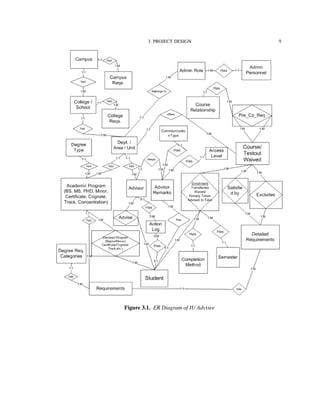
Figure 3.1 shows the conceptual data model for the IU-Advise project [15]. We use an
Entity-Relationship Diagram (ERD) for modeling the entities (or objects) and relationships
among these entities in the application’s domain. In the ERD notation, a rectangle sym-
bolizes a data source or data table in the physical implementation. A diamond symbolizes
a relationship between two entities. A diamond wrapped by a rectangle indicates that a
relationship has its own identification information and is promoted to a data table in the
implementing phase. The Entity-Relationship Diagram provides the layout for implemen-
tation of the database.
3. PROJECT DESIGN 9
Figure 3.1. ER Diagram of IU Advisee
3. PROJECT DESIGN 10
3.3. Database Design
This section lists all the tables in the database implementation. As mentioned in the
previous section, these tables present essential entities and relationships among them in
the IU-Advise system as shown in Figure 3.1. In the section belows, each table is defined
with its location and relationships with other tables highlighted in the Entity-Relationship
Diagram.
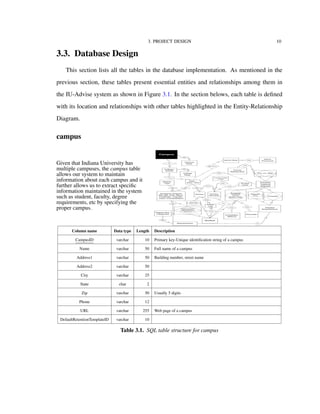
campus
Given that Indiana University has
multiple campuses, the campus table
allows our system to maintain
information about each campus and it
further allows us to extract specific
information maintained in the system
such as student, faculty, degree
requirements, etc by specifying the
proper campus.
Column name Data type Length Description
CampusID varchar 10 Primary key-Unique identification string of a campus
Name varchar 50 Full name of a campus
Address1 varchar 50 Building number, street name
Address2 varchar 50
City varchar 25
State char 2
Zip varchar 50 Usually 5 digits
Phone varchar 12
URL varchar 255 Web page of a campus
DefaultRetentionTemplateID varchar 10
Table 3.1. SQL table structure for campus
3. PROJECT DESIGN 11
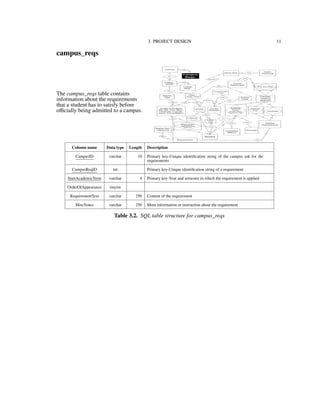
campus_reqs
The campus_reqs table contains
information about the requirements
that a student has to satisfy before
officially being admitted to a campus.
Column name Data type Length Description
CampusID varchar 10 Primary key-Unique identification string of the campus ask for the
requirements
CampusReqID int Primary key-Unique identification string of a requirement
StartAcademicTerm varchar 4 Primary key-Year and semester in which the requirement is applied
OrderOfAppearance tinyint
RequirementText varchar 250 Content of the requirement
MiscNotes varchar 250 More information or instruction about the requirement
Table 3.2. SQL table structure for campus_reqs
3. PROJECT DESIGN 12
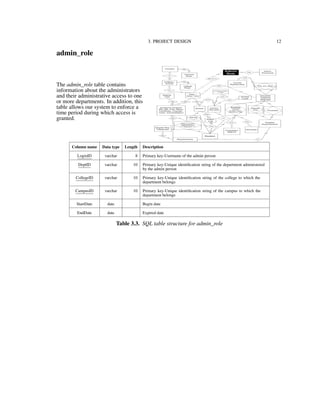
admin_role
The admin_role table contains
information about the administrators
and their administrative access to one
or more departments. In addition, this
table allows our system to enforce a
time period during which access is
granted.
Column name Data type Length Description
LoginID varchar 8 Primary key-Username of the admin person
DeptID varchar 10 Primary key-Unique identification string of the department administered
by the admin person
CollegeID varchar 10 Primary key-Unique identification string of the college to which the
department belongs
CampusID varchar 10 Primary key-Unique identification string of the campus to which the
department belongs
StartDate date Begin date
EndDate date Expired date
Table 3.3. SQL table structure for admin_role
3. PROJECT DESIGN 13
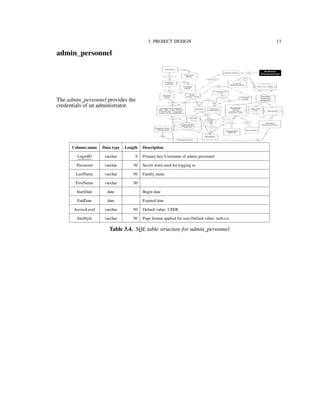
admin_personnel
The admin_personnel provides the
credentials of an administrator.
Column name Data type Length Description
LoginID varchar 8 Primary key-Username of admin personnel
Password varchar 50 Secret word used for logging in
LastName varchar 50 Family name
FirstName varchar 50
StartDate date Begin date
EndDate date Expired date
AccessLevel varchar 50 Default value: USER
SiteStyle varchar 50 Page format applied for user-Default value: iusb.css
Table 3.4. SQL table structure for admin_personnel
3. PROJECT DESIGN 14
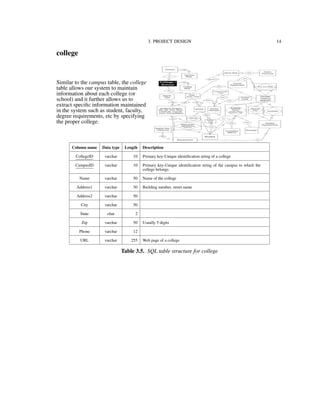
college
Similar to the campus table, the college
table allows our system to maintain
information about each college (or
school) and it further allows us to
extract specific information maintained
in the system such as student, faculty,
degree requirements, etc by specifying
the proper college.
Column name Data type Length Description
CollegeID varchar 10 Primary key-Unique identification string of a college
CampusID varchar 10 Primary key-Unique identification string of the campus to which the
college belongs
Name varchar 50 Name of the college
Address1 varchar 50 Building number, street name
Address2 varchar 50
City varchar 50
State char 2
Zip varchar 50 Usually 5 digits
Phone varchar 12
URL varchar 255 Web page of a college
Table 3.5. SQL table structure for college
3. PROJECT DESIGN 15
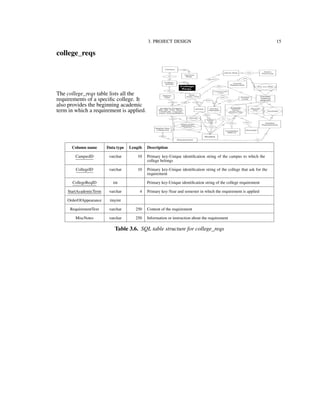
college_reqs
The college_reqs table lists all the
requirements of a specific college. It
also provides the beginning academic
term in which a requirement is applied.
Column name Data type Length Description
CampusID varchar 10 Primary key-Unique identification string of the campus to which the
college belongs
CollegeID varchar 10 Primary key-Unique identification string of the college that ask for the
requirement
CollegeReqID int Primary key-Unique identification string of the college requirement
StartAcademicTerm varchar 4 Primary key-Year and semester in which the requirement is applied
OrderOfAppearance tinyint
RequirementText varchar 250 Content of the requirement
MiscNotes varchar 250 Information or instruction about the requirement
Table 3.6. SQL table structure for college_reqs
3. PROJECT DESIGN 16
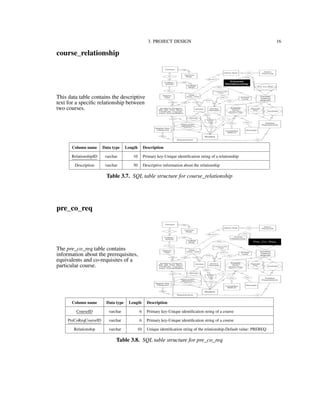
course_relationship
This data table contains the descriptive
text for a specific relationship between
two courses.
Column name Data type Length Description
RelationshipID varchar 10 Primary key-Unique identification string of a relationship
Description varchar 50 Descriptive information about the relationship
Table 3.7. SQL table structure for course_relationship
pre_co_req
The pre_co_req table contains
information about the prerequisites,
equivalents and co-requisites of a
particular course.
Column name Data type Length Description
CourseID varchar 6 Primary key-Unique identification string of a course
PreCoReqCourseID varchar 6 Primary key-Unique identification string of a course
Relationship varchar 10 Unique identification string of the relationship-Default value: PREREQ
Table 3.8. SQL table structure for pre_co_req
3. PROJECT DESIGN 17
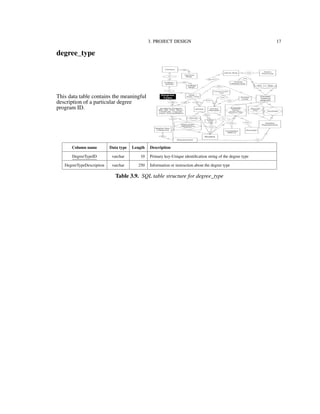
degree_type
This data table contains the meaningful
description of a particular degree
program ID.
Column name Data type Length Description
DegreeTypeID varchar 10 Primary key-Unique identification string of the degree type
DegreeTypeDescription varchar 250 Information or instruction about the degree type
Table 3.9. SQL table structure for degree_type
3. PROJECT DESIGN 18
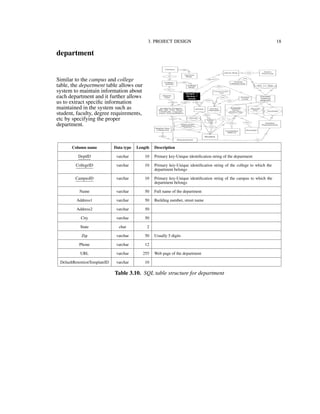
department
Similar to the campus and college
table, the department table allows our
system to maintain information about
each department and it further allows
us to extract specific information
maintained in the system such as
student, faculty, degree requirements,
etc by specifying the proper
department.
Column name Data type Length Description
DeptID varchar 10 Primary key-Unique identification string of the department
CollegeID varchar 10 Primary key-Unique identification string of the college to which the
department belongs
CampusID varchar 10 Primary key-Unique identification string of the campus to which the
department belongs
Name varchar 50 Full name of the department
Address1 varchar 50 Building number, street name
Address2 varchar 50
City varchar 50
State char 2
Zip varchar 50 Usually 5 digits
Phone varchar 12
URL varchar 255 Web page of the department
DefaultRetentionTemplateID varchar 10
Table 3.10. SQL table structure for department
3. PROJECT DESIGN 19
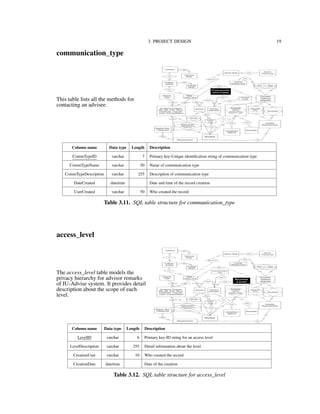
communication_type
This table lists all the methods for
contacting an advisee.
Column name Data type Length Description
CommTypeID varchar 7 Primary key-Unique identification string of communication type
CommTypeName varchar 50 Name of communication type
CommTypeDescription varchar 255 Description of communication type
DateCreated datetime Date and time of the record creation
UserCreated varchar 50 Who created the record
Table 3.11. SQL table structure for communication_type
access_level
The access_level table models the
privacy hierarchy for advisor remarks
of IU-Advise system. It provides detail
description about the scope of each
level.
Column name Data type Length Description
LevelID varchar 6 Primary key-ID string for an access level
LevelDescription varchar 255 Detail information about the level
CreationUser varchar 10 Who created the record
CreationDate datetime Date of the creation
Table 3.12. SQL table structure for access_level
3. PROJECT DESIGN 20
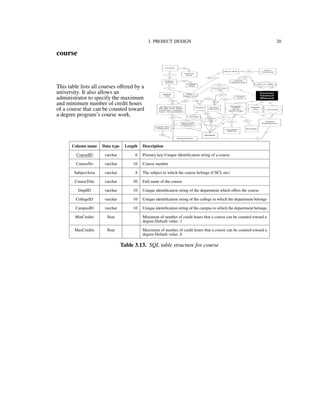
course
This table lists all courses offered by a
university. It also allows an
administrator to specify the maximum
and minimum number of credit hours
of a course that can be counted toward
a degree program’s course work.
Column name Data type Length Description
CourseID varchar 6 Primary key-Unique identification string of a course
CourseNo varchar 10 Course number
SubjectArea varchar 8 The subject to which the course belongs (CSCI, etc)
CourseTitle varchar 50 Full name of the course
DeptID varchar 10 Unique identification string of the department which offers the course
CollegeID varchar 10 Unique identification string of the college to which the department belongs
CampusID varchar 10 Unique identification string of the campus to which the department belongs
MinCredits float Minimum of number of credit hours that a course can be counted toward a
degree-Default value: 1
MaxCredits float Maximum of number of credit hours that a course can be counted toward a
degree-Default value: 6
Table 3.13. SQL table structure for course
3. PROJECT DESIGN 21
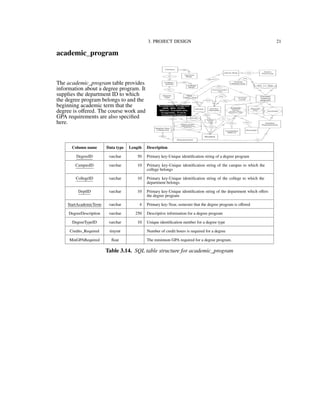
academic_program
The academic_program table provides
information about a degree program. It
supplies the department ID to which
the degree program belongs to and the
beginning academic term that the
degree is offered. The course work and
GPA requirements are also specified
here.
Column name Data type Length Description
DegreeID varchar 50 Primary key-Unique identification string of a degree program
CampusID varchar 10 Primary key-Unique identification string of the campus to which the
college belongs
CollegeID varchar 10 Primary key-Unique identification string of the college to which the
department belongs
DeptID varchar 10 Primary key-Unique identification string of the department which offers
the degree program
StartAcademicTerm varchar 4 Primary key-Year, semester that the degree program is offered
DegreeDescription varchar 250 Descriptive information for a degree program
DegreeTypeID varchar 10 Unique identification number for a degree type
Credits_Required tinyint Number of credit hours is required for a degree
MinGPARequired float The minimum GPA required for a degree program.
Table 3.14. SQL table structure for academic_program
3. PROJECT DESIGN 22
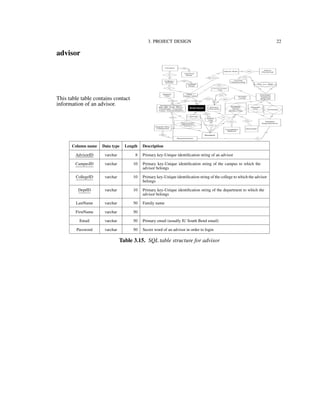
advisor
This table table contains contact
information of an advisor.
Column name Data type Length Description
AdvisorID varchar 8 Primary key-Unique identification string of an advisor
CampusID varchar 10 Primary key-Unique identification string of the campus to which the
advisor belongs
CollegeID varchar 10 Primary key-Unique identification string of the college to which the advisor
belongs
DeptID varchar 10 Primary key-Unique identification string of the department to which the
advisor belongs
LastName varchar 50 Family name
FirstName varchar 50
Email varchar 50 Primary email (usually IU South Bend email)
Password varchar 50 Secret word of an advisor in order to login
Table 3.15. SQL table structure for advisor
3. PROJECT DESIGN 23
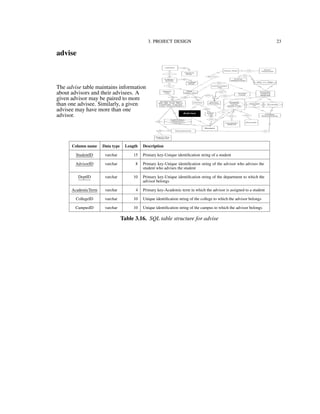
advise
The advise table maintains information
about advisors and their advisees. A
given advisor may be paired to more
than one advisee. Similarly, a given
advisee may have more than one
advisor.
Column name Data type Length Description
StudentID varchar 15 Primary key-Unique identification string of a student
AdvisorID varchar 8 Primary key-Unique identification string of the advisor who advises the
student who advises the student
DeptID varchar 10 Primary key-Unique identification string of the department to which the
advisor belongs
AcademicTerm varchar 4 Primary key-Academic term in which the advisor is assigned to a student
CollegeID varchar 10 Unique identification string of the college to which the advisor belongs
CampusID varchar 10 Unique identification string of the campus to which the advisor belongs
Table 3.16. SQL table structure for advise
3. PROJECT DESIGN 24
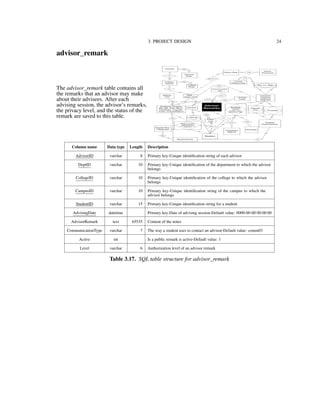
advisor_remark
The advisor_remark table contains all
the remarks that an advisor may make
about their advisees. After each
advising session, the advisor’s remarks,
the privacy level, and the status of the
remark are saved to this table.
Column name Data type Length Description
AdvisorID varchar 8 Primary key-Unique identification string of each advisor
DeptID varchar 10 Primary key-Unique identification of the department to which the advisor
belongs
CollegeID varchar 10 Primary key-Unique identification of the college to which the advisor
belongs
CampusID varchar 10 Primary key-Unique identification string of the campus to which the
advisor belongs
StudentID varchar 15 Primary key-Unique identification string for a student
AdvisingDate datetime Primary key-Date of advising session-Default value: 0000-00-00 00:00:00
AdvisorRemark text 65535 Content of the notes
CommunicationType varchar 7 The way a student uses to contact an advisor-Default value: comm03
Active int Is a public remark is active-Default value: 1
Level varchar 6 Authorization level of an advisor remark
Table 3.17. SQL table structure for advisor_remark
3. PROJECT DESIGN 25
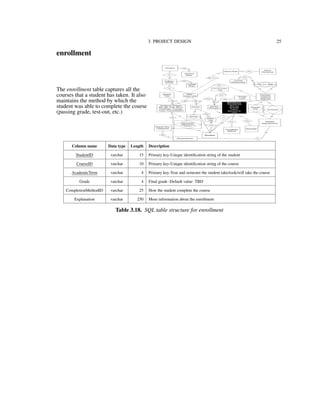
enrollment
The enrollment table captures all the
courses that a student has taken. It also
maintains the method by which the
student was able to complete the course
(passing grade, test-out, etc.)
Column name Data type Length Description
StudentID varchar 15 Primary key-Unique identification string of the student
CourseID varchar 10 Primary key-Unique identification string of the course
AcademicTerm varchar 4 Primary key-Year and semester the student take/took/will take the course
Grade varchar 4 Final grade -Default value: TBD
CompletionMethodID varchar 25 How the student complete the course
Explanation varchar 250 More information about the enrollment
Table 3.18. SQL table structure for enrollment
3. PROJECT DESIGN 26
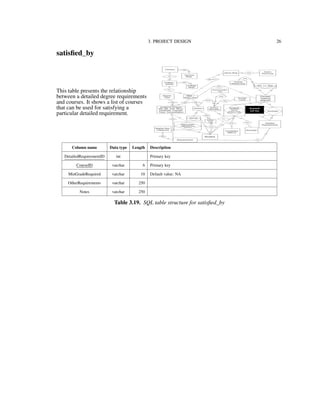
satisfied_by
This table presents the relationship
between a detailed degree requirements
and courses. It shows a list of courses
that can be used for satisfying a
particular detailed requirement.
Column name Data type Length Description
DetailedRequirementID int Primary key
CourseID varchar 6 Primary key
MinGradeRequired varchar 10 Default value: NA
OtherRequirements varchar 250
Notes varchar 250
Table 3.19. SQL table structure for satisfied_by
3. PROJECT DESIGN 27
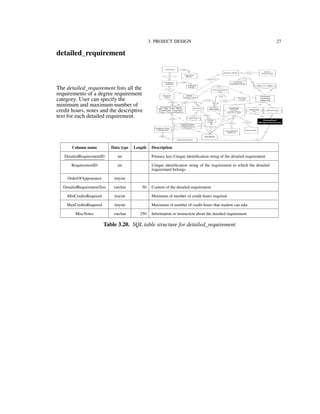
detailed_requirement
The detailed_requirement lists all the
requirements of a degree requirement
category. User can specify the
minimum and maximum number of
credit hours, notes and the descriptive
text for each detailed requirement.
Column name Data type Length Description
DetailedRequirementID int Primary key-Unique identification string of the detailed requirement
RequirementID int Unique identification string of the requirement to which the detailed
requirement belongs
OrderOfAppearance tinyint
DetailedRequirementText varchar 50 Content of the detailed requirement
MinCreditsRequired tinyint Minimum of number of credit hours required
MaxCreditsRequired tinyint Maximum of number of credit hours that student can take
MiscNotes varchar 250 Information or instruction about the detailed requirement
Table 3.20. SQL table structure for detailed_requirement
3. PROJECT DESIGN 28
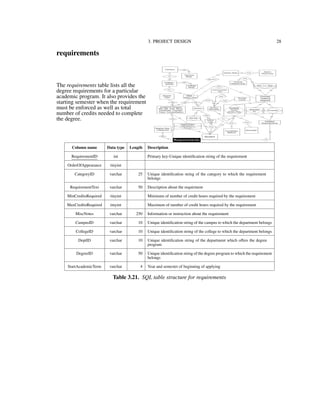
requirements
The requirements table lists all the
degree requirements for a particular
academic program. It also provides the
starting semester when the requirement
must be enforced as well as total
number of credits needed to complete
the degree.
Column name Data type Length Description
RequirementID int Primary key-Unique identification string of the requirement
OrderOfAppearance tinyint
CategoryID varchar 25 Unique identification string of the category to which the requirement
belongs
RequirementText varchar 50 Description about the requirment
MinCreditsRequired tinyint Minimum of number of credit hours required by the requirement
MaxCreditsRequired tinyint Maximum of number of credit hours required by the requirement
MiscNotes varchar 250 Information or instruction about the requirement
CampusID varchar 10 Unique identification string of the campus to which the department belongs
CollegeID varchar 10 Unique identification string of the college to which the department belongs
DeptID varchar 10 Unique identification string of the department which offers the degree
program
DegreeID varchar 50 Unique identification string of the degree program to which the requirement
belongs
StartAcademicTerm varchar 4 Year and semester of beginning of applying
Table 3.21. SQL table structure for requirements
3. PROJECT DESIGN 29
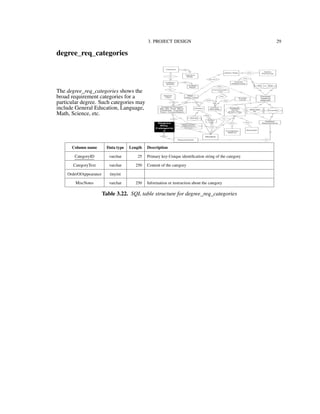
degree_req_categories
The degree_req_categories shows the
broad requirement categories for a
particular degree. Such categories may
include General Education, Language,
Math, Science, etc.
Column name Data type Length Description
CategoryID varchar 25 Primary key-Unique identification string of the category
CategoryText varchar 250 Content of the category
OrderOfAppearance tinyint
MiscNotes varchar 250 Information or instruction about the category
Table 3.22. SQL table structure for degree_req_categories
3. PROJECT DESIGN 30
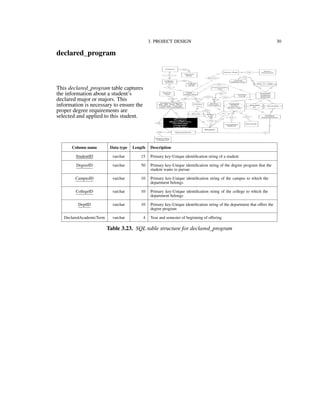
declared_program
This declared_program table captures
the information about a student’s
declared major or majors. This
information is necessary to ensure the
proper degree requirements are
selected and applied to this student.
Column name Data type Length Description
StudentID varchar 15 Primary key-Unique identification string of a student
DegreeID varchar 50 Primary key-Unique identification string of the degree program that the
student wants to pursue
CampusID varchar 10 Primary key-Unique identification string of the campus to which the
department belongs
CollegeID varchar 10 Primary key-Unique identification string of the college to which the
department belongs
DeptID varchar 10 Primary key-Unique identification string of the department that offers the
degree program
DeclaredAcademicTerm varchar 4 Year and semester of beginning of offering
Table 3.23. SQL table structure for declared_program
3. PROJECT DESIGN 31
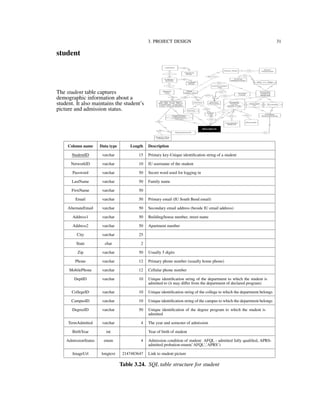
student
The student table captures
demographic information about a
student. It also maintains the student’s
picture and admission status.
Column name Data type Length Description
StudentID varchar 15 Primary key-Unique identification string of a student
NetworkID varchar 10 IU username of the student
Password varchar 50 Secret word used for logging in
LastName varchar 50 Family name
FirstName varchar 50
Email varchar 50 Primary email (IU South Bend email)
AlternateEmail varchar 50 Secondary email address (beside IU email address)
Address1 varchar 50 Building/house number, street name
Address2 varchar 50 Apartment number
City varchar 25
State char 2
Zip varchar 50 Usually 5 digits
Phone varchar 12 Primary phone number (usually home phone)
MobilePhone varchar 12 Cellular phone number
DeptID varchar 10 Unique identification string of the department to which the student is
admitted to (it may differ from the department of declared program)
CollegeID varchar 10 Unique identification string of the college to which the department belongs
CampusID varchar 10 Unique identification string of the campus to which the department belongs
DegreeID varchar 50 Unique identification of the degree program to which the student is
admitted
TermAdmitted varchar 4 The year and semester of admission
BirthYear int Year of birth of student
AdmissionStatus enum 4 Admission condition of student: AFQL - admitted fully qualified, APRS-
admitted probation-enum(’AFQL’,’APRS’)
ImageUrl longtext 2147483647 Link to student picture
Table 3.24. SQL table structure for student
3. PROJECT DESIGN 32
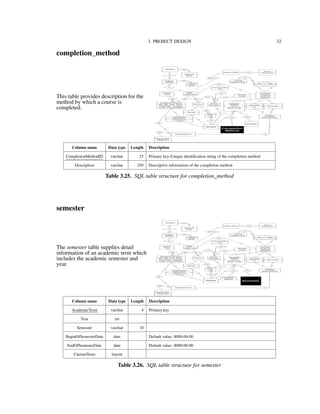
completion_method
This table provides description for the
method by which a course is
completed.
Column name Data type Length Description
CompletionMethodID varchar 25 Primary key-Unique identification string of the completion method
Description varchar 250 Descriptive information of the completion method
Table 3.25. SQL table structure for completion_method
semester
The semester table supplies detail
information of an academic term which
includes the academic semester and
year.
Column name Data type Length Description
AcademicTerm varchar 4 Primary key
Year int
Semester varchar 10
BeginOfSemesterDate date Default value: 0000-00-00
EndOfSemesterDate date Default value: 0000-00-00
CurrentTerm tinyint
Table 3.26. SQL table structure for semester
3. PROJECT DESIGN 33
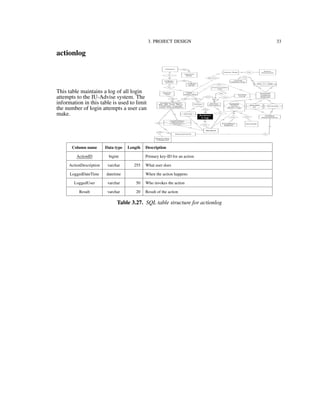
actionlog
This table maintains a log of all login
attempts to the IU-Advise system. The
information in this table is used to limit
the number of login attempts a user can
make.
Column name Data type Length Description
ActionID bigint Primary key-ID for an action
ActionDescription varchar 255 What user does
LoggedDateTime datetime When the action happens
LoggedUser varchar 50 Who invokes the action
Result varchar 20 Result of the action
Table 3.27. SQL table structure for actionlog
3. PROJECT DESIGN 34
3.4. Process Model
3.4.1. Functional Decomposition Diagram
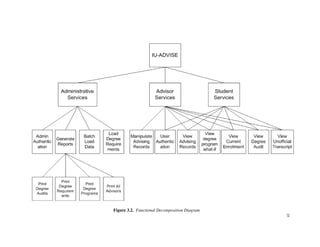
Figure 3.2 shows the functionalities supported by the IU-Advise system [15]. The
system is divided into three subsystems: Student services, Advisor services, and Admin-
istrative services. The scope of this thesis is limited to the functionalities provided under
advisor and student services.
Before providing accesses to functionalities, a user must be authenticated and granted
a valid role and privileges. Once the user is authenticated and authorized as a student, he
or she has access to degree audit, unofficial transcript, and current enrollment information
reports. The user can use the “what-if” report feature to determine how his or her current
courses fit with other degree requirements. An authenticated advisor has similar access,
however, advisors have additional capability to create and store advisor remarks.
In the following sections, we will look into how these functionalities are decomposed
and implemented by developing a series of data flow diagrams (DFD).
3.PROJECTDESIGN35
Figure 3.2. Functional Decomposition Diagram
3. PROJECT DESIGN 36
3.4.2. Data Flow Diagrams
To model the functionalities of the system, we use data flow diagrams (DFD). In a data
flow diagram, a rectangle represents an external agent (such a user) that interacts with sys-
tem. The parallel lines represent the data stores (such as data tables in the database) from
which a process retrieves and stores information. An oval represents a process (such as
a code module). There are two types of diagrams: context and detailed DFD. A context
diagram represents the entire system as one single abstract process. It also shows the inter-
action of the system with external agents, other processes and data stores. A detailed DFD
decomposes the abstract process in the context level into subprocesses. At this level, the
DFD diagram shows how subprocesses interrelate to each others and how data is modified
while flowing through the internal processes. All the data stores in the detailed DFD are
matched with those in the context DFD.
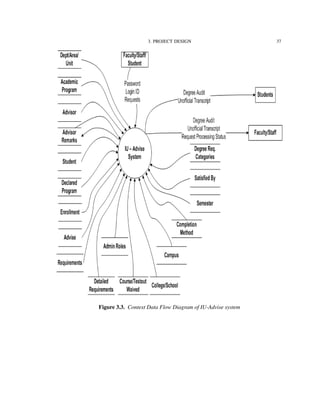
Figure 3.3 shows the overall context level data flow diagram of the IU-Advise system.
Students, faculty and staff are the main constituents of the IU-Advise system. Figure 3.3
also shows which data tables are used for data processing. Once the overall interaction of
the system with its environment is identified, we can decompose and discuss its constituent
parts. In the following section (from page 37-58 and Figure 3.4 to Figure 3.25) we will
systematically decompose, display and describe each subsystem using a context level and
detailed level data flow diagram.
3. PROJECT DESIGN 37
Figure 3.3. Context Data Flow Diagram of IU-Advise system
3. PROJECT DESIGN 38
3.4.2.1. Student Functionality
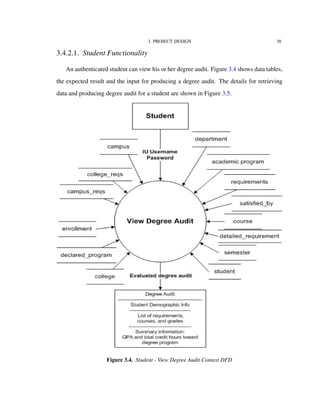
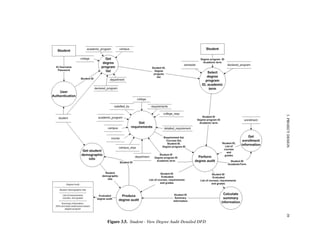
An authenticated student can view his or her degree audit. Figure 3.4 shows data tables,
the expected result and the input for producing a degree audit. The details for retrieving
data and producing degree audit for a student are shown in Figure 3.5.
Figure 3.4. Student - View Degree Audit Context DFD
3.PROJECTDESIGN39
Figure 3.5. Student - View Degree Audit Detailed DFD
3. PROJECT DESIGN 40
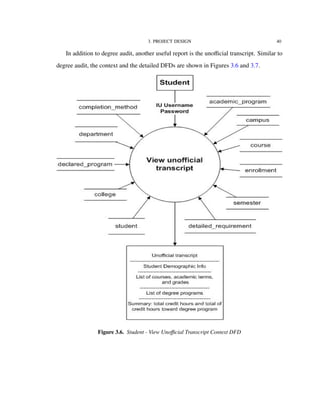
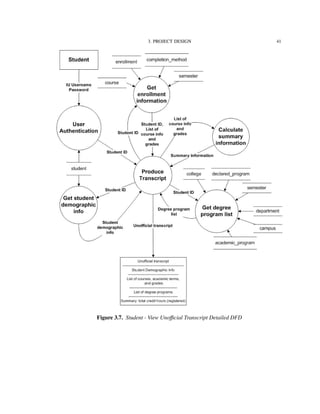
In addition to degree audit, another useful report is the unofficial transcript. Similar to
degree audit, the context and the detailed DFDs are shown in Figures 3.6 and 3.7.
Figure 3.6. Student - View Unofficial Transcript Context DFD
3. PROJECT DESIGN 41
Figure 3.7. Student - View Unofficial Transcript Detailed DFD
3. PROJECT DESIGN 42
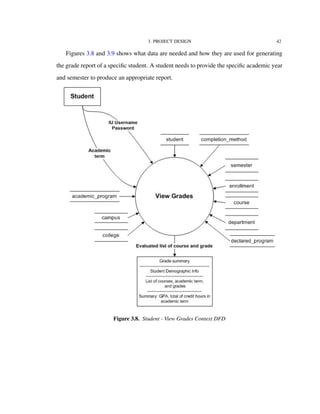
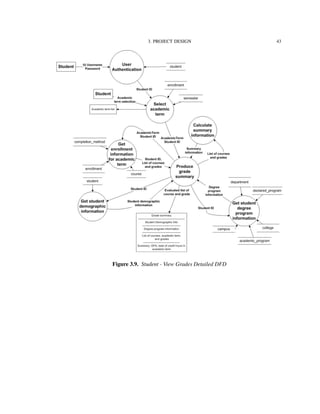
Figures 3.8 and 3.9 shows what data are needed and how they are used for generating
the grade report of a specific student. A student needs to provide the specific academic year
and semester to produce an appropriate report.
Figure 3.8. Student - View Grades Context DFD
3. PROJECT DESIGN 43
Figure 3.9. Student - View Grades Detailed DFD
3. PROJECT DESIGN 44
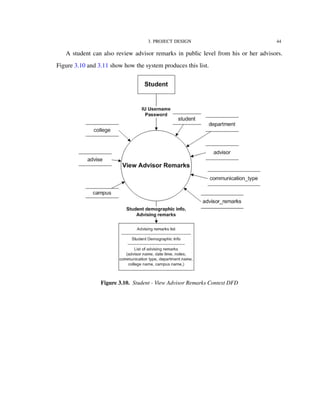
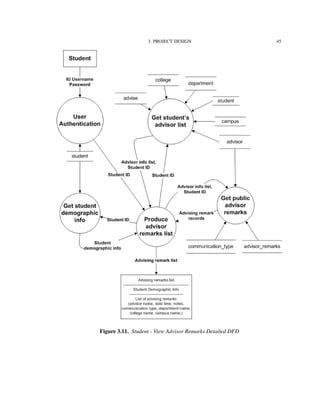
A student can also review advisor remarks in public level from his or her advisors.
Figure 3.10 and 3.11 show how the system produces this list.
Figure 3.10. Student - View Advisor Remarks Context DFD
3. PROJECT DESIGN 45
Figure 3.11. Student - View Advisor Remarks Detailed DFD
3. PROJECT DESIGN 46
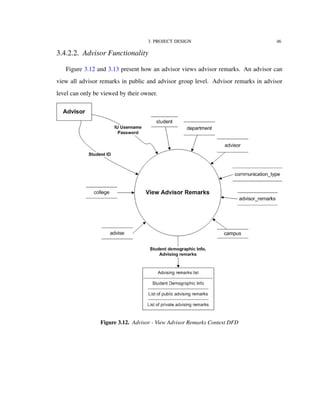
3.4.2.2. Advisor Functionality
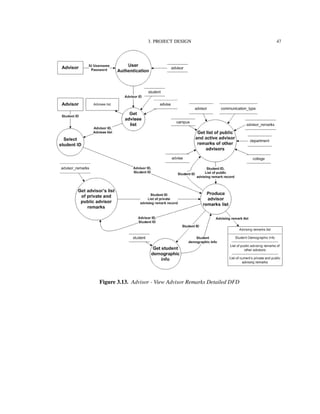
Figure 3.12 and 3.13 present how an advisor views advisor remarks. An advisor can
view all advisor remarks in public and advisor group level. Advisor remarks in advisor
level can only be viewed by their owner.
Figure 3.12. Advisor - View Advisor Remarks Context DFD
3. PROJECT DESIGN 47
Figure 3.13. Advisor - View Advisor Remarks Detailed DFD
3. PROJECT DESIGN 48
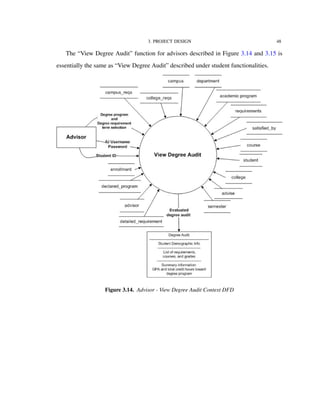
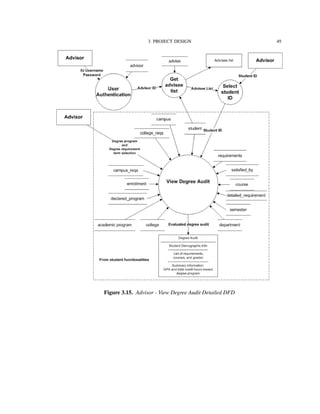
The “View Degree Audit” function for advisors described in Figure 3.14 and 3.15 is
essentially the same as “View Degree Audit” described under student functionalities.
Figure 3.14. Advisor - View Degree Audit Context DFD
3. PROJECT DESIGN 49
Figure 3.15. Advisor - View Degree Audit Detailed DFD
3. PROJECT DESIGN 50
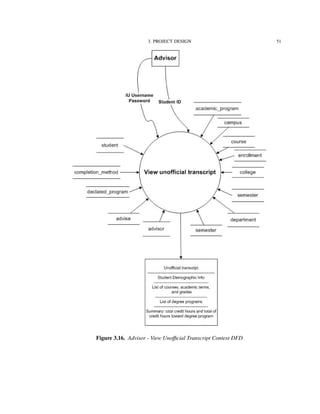
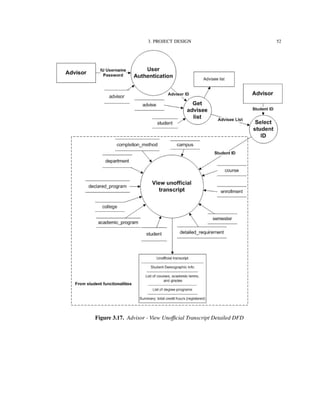
An advisor can view the “Unofficial Transcript” of a specified student. The process in
Figure 3.16 and 3.17 makes use the same procedure described under student’s functionali-
ties.
3. PROJECT DESIGN 51
Figure 3.16. Advisor - View Unofficial Transcript Context DFD
3. PROJECT DESIGN 52
Figure 3.17. Advisor - View Unofficial Transcript Detailed DFD
3. PROJECT DESIGN 53
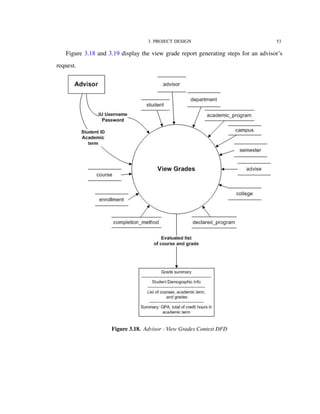
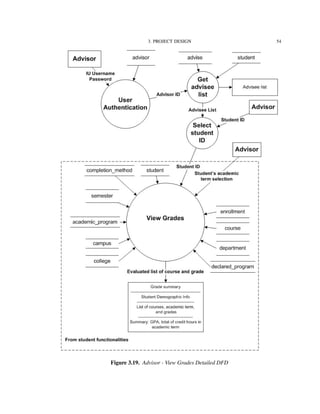
Figure 3.18 and 3.19 display the view grade report generating steps for an advisor’s
request.
Figure 3.18. Advisor - View Grades Context DFD
3. PROJECT DESIGN 54
Figure 3.19. Advisor - View Grades Detailed DFD
3. PROJECT DESIGN 55
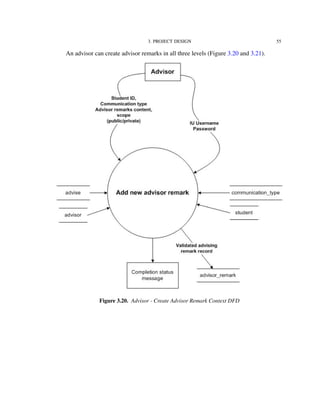
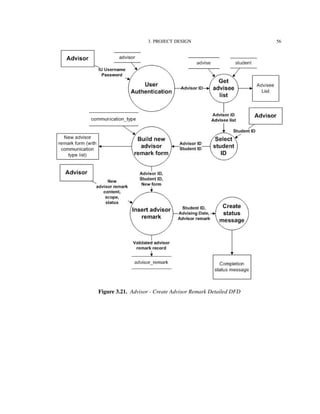
An advisor can create advisor remarks in all three levels (Figure 3.20 and 3.21).
Figure 3.20. Advisor - Create Advisor Remark Context DFD
3. PROJECT DESIGN 56
Figure 3.21. Advisor - Create Advisor Remark Detailed DFD
3. PROJECT DESIGN 57
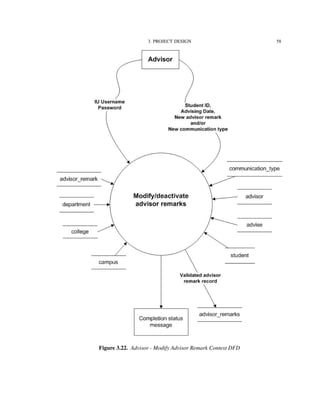
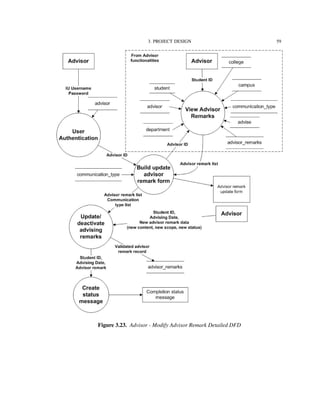
An advisor can only edit the content, change the access level or communication type of
a remark, if he or she is its owner (Figure 3.22 and 3.23). The advisor can only make such
modifications to non-public remarks.
3. PROJECT DESIGN 58
Figure 3.22. Advisor - Modify Advisor Remark Context DFD
3. PROJECT DESIGN 59
Figure 3.23. Advisor - Modify Advisor Remark Detailed DFD
3. PROJECT DESIGN 60
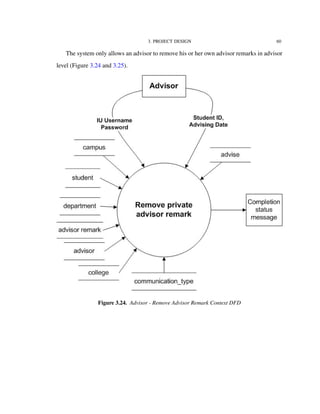
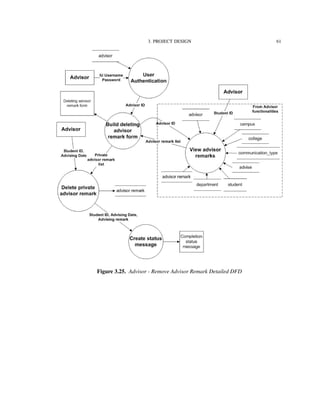
The system only allows an advisor to remove his or her own advisor remarks in advisor
level (Figure 3.24 and 3.25).
Figure 3.24. Advisor - Remove Advisor Remark Context DFD
3. PROJECT DESIGN 61
Figure 3.25. Advisor - Remove Advisor Remark Detailed DFD
3. PROJECT DESIGN 62
3.5. User Interface
3.5.1. Home Page
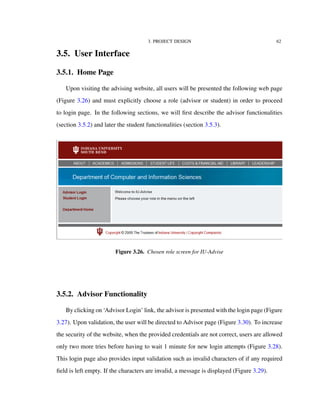
Upon visiting the advising website, all users will be presented the following web page
(Figure 3.26) and must explicitly choose a role (advisor or student) in order to proceed
to login page. In the following sections, we will first describe the advisor functionalities
(section 3.5.2) and later the student functionalities (section 3.5.3).
Figure 3.26. Chosen role screen for IU-Advise
3.5.2. Advisor Functionality
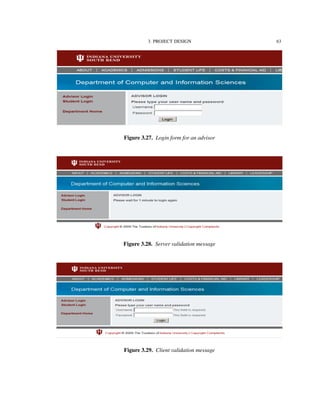
By clicking on ‘Advisor Login’ link, the advisor is presented with the login page (Figure
3.27). Upon validation, the user will be directed to Advisor page (Figure 3.30). To increase
the security of the website, when the provided credentials are not correct, users are allowed
only two more tries before having to wait 1 minute for new login attempts (Figure 3.28).
This login page also provides input validation such as invalid characters of if any required
field is left empty. If the characters are invalid, a message is displayed (Figure 3.29).
3. PROJECT DESIGN 63
Figure 3.27. Login form for an advisor
Figure 3.28. Server validation message
Figure 3.29. Client validation message
3. PROJECT DESIGN 64
3.5.2.1. Advisor Page
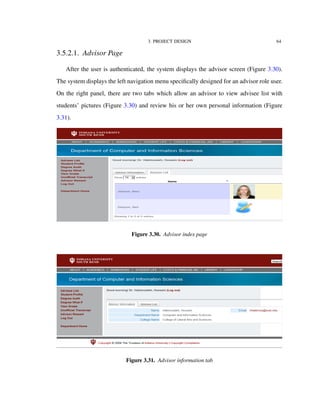
After the user is authenticated, the system displays the advisor screen (Figure 3.30).
The system displays the left navigation menu specifically designed for an advisor role user.
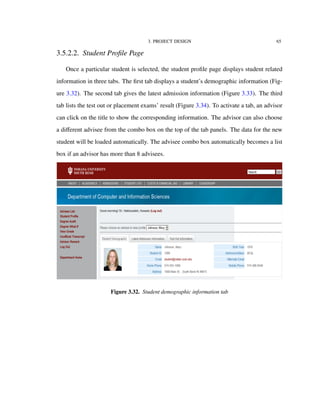
On the right panel, there are two tabs which allow an advisor to view advisee list with
students’ pictures (Figure 3.30) and review his or her own personal information (Figure
3.31).
Figure 3.30. Advisor index page
Figure 3.31. Advisor information tab
3. PROJECT DESIGN 65
3.5.2.2. Student Profile Page
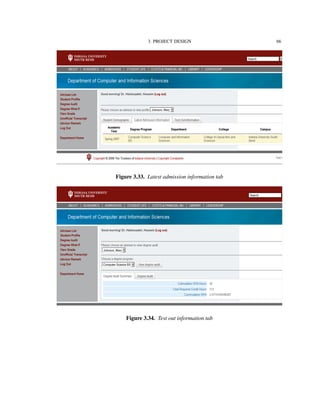
Once a particular student is selected, the student profile page displays student related
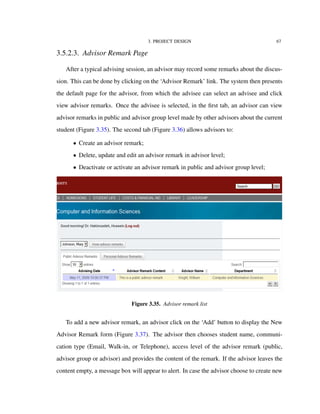
information in three tabs. The first tab displays a student’s demographic information (Fig-
ure 3.32). The second tab gives the latest admission information (Figure 3.33). The third
tab lists the test out or placement exams’ result (Figure 3.34). To activate a tab, an advisor
can click on the title to show the corresponding information. The advisor can also choose
a different advisee from the combo box on the top of the tab panels. The data for the new
student will be loaded automatically. The advisee combo box automatically becomes a list
box if an advisor has more than 8 advisees.
Figure 3.32. Student demographic information tab
3. PROJECT DESIGN 66
Figure 3.33. Latest admission information tab
Figure 3.34. Test out information tab
3. PROJECT DESIGN 67
3.5.2.3. Advisor Remark Page
After a typical advising session, an advisor may record some remarks about the discus-
sion. This can be done by clicking on the ‘Advisor Remark’ link. The system then presents
the default page for the advisor, from which the advisee can select an advisee and click
view advisor remarks. Once the advisee is selected, in the first tab, an advisor can view
advisor remarks in public and advisor group level made by other advisors about the current
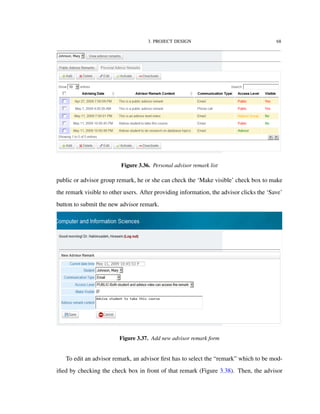
student (Figure 3.35). The second tab (Figure 3.36) allows advisors to:
• Create an advisor remark;
• Delete, update and edit an advisor remark in advisor level;
• Deactivate or activate an advisor remark in public and advisor group level;
Figure 3.35. Advisor remark list
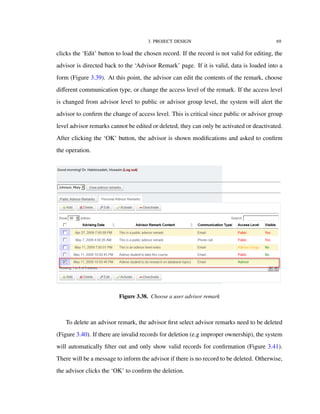
To add a new advisor remark, an advisor click on the ‘Add’ button to display the New
Advisor Remark form (Figure 3.37). The advisor then chooses student name, communi-
cation type (Email, Walk-in, or Telephone), access level of the advisor remark (public,
advisor group or advisor) and provides the content of the remark. If the advisor leaves the
content empty, a message box will appear to alert. In case the advisor choose to create new
3. PROJECT DESIGN 68
Figure 3.36. Personal advisor remark list
public or advisor group remark, he or she can check the ‘Make visible’ check box to make
the remark visible to other users. After providing information, the advisor clicks the ‘Save’
button to submit the new advisor remark.
Figure 3.37. Add new advisor remark form
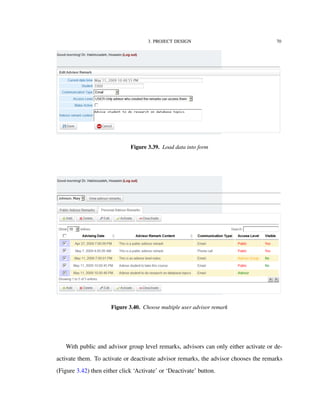
To edit an advisor remark, an advisor first has to select the “remark” which to be mod-
ified by checking the check box in front of that remark (Figure 3.38). Then, the advisor
3. PROJECT DESIGN 69
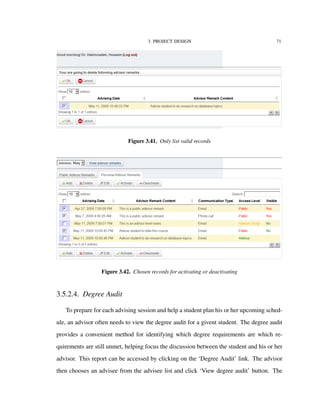
clicks the ‘Edit’ button to load the chosen record. If the record is not valid for editing, the
advisor is directed back to the ‘Advisor Remark’ page. If it is valid, data is loaded into a
form (Figure 3.39). At this point, the advisor can edit the contents of the remark, choose
different communication type, or change the access level of the remark. If the access level
is changed from advisor level to public or advisor group level, the system will alert the
advisor to confirm the change of access level. This is critical since public or advisor group
level advisor remarks cannot be edited or deleted, they can only be activated or deactivated.
After clicking the ‘OK’ button, the advisor is shown modifications and asked to confirm
the operation.
Figure 3.38. Choose a user advisor remark
To delete an advisor remark, the advisor first select advisor remarks need to be deleted
(Figure 3.40). If there are invalid records for deletion (e.g improper ownership), the system
will automatically filter out and only show valid records for confirmation (Figure 3.41).
There will be a message to inform the advisor if there is no record to be deleted. Otherwise,
the advisor clicks the ‘OK’ to confirm the deletion.
3. PROJECT DESIGN 70
Figure 3.39. Load data into form
Figure 3.40. Choose multiple user advisor remark
With public and advisor group level remarks, advisors can only either activate or de-
activate them. To activate or deactivate advisor remarks, the advisor chooses the remarks
(Figure 3.42) then either click ‘Activate’ or ‘Deactivate’ button.
3. PROJECT DESIGN 71
Figure 3.41. Only list valid records
Figure 3.42. Chosen records for activating or deactivating
3.5.2.4. Degree Audit
To prepare for each advising session and help a student plan his or her upcoming sched-
ule, an advisor often needs to view the degree audit for a givent student. The degree audit
provides a convenient method for identifying which degree requirements are which re-
quirements are still unmet, helping focus the discussion between the student and his or her
advisor. This report can be accessed by clicking on the ‘Degree Audit’ link. The advisor
then chooses an advisee from the advisee list and click ‘View degree audit’ button. The
3. PROJECT DESIGN 72
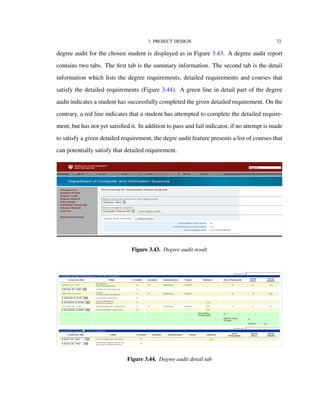
degree audit for the chosen student is displayed as in Figure 3.43. A degree audit report
contains two tabs. The first tab is the summary information. The second tab is the detail
information which lists the degree requirements, detailed requirements and courses that
satisfy the detailed requirements (Figure 3.44). A green line in detail part of the degree
audit indicates a student has successfully completed the given detailed requirement. On the
contrary, a red line indicates that a student has attempted to complete the detailed require-
ment, but has not yet satisfied it. In addition to pass and fail indicator, if no attempt is made
to satisfy a given detailed requirement, the degre audit feature presents a list of courses that
can potentially satisfy that detailed requirement.
Figure 3.43. Degree audit result
Figure 3.44. Degree audit detail tab
3. PROJECT DESIGN 73
3.5.2.5. Degree What-if Report
Many students would like to know how their existing courses apply to the degree re-
quirements for another major. The “What-If” report is designed to answer such questions.
To generate a what-if report, an advisor clicks on ‘Degree What If’ link. Then, the advisor
selects the advisee (from the first combo box) and the new degree program (from the sec-
ond combo box) before clicking on the ‘View What If Report’ button (Figure 3.45). Figure
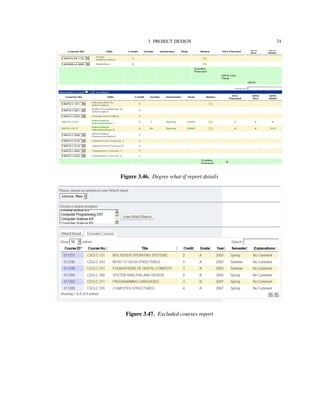
3.46 shows the details of a What-If report. The What-If report also supports matching the
equivalent courses to satisfy for a detail requirement. Along with the detail report, the
system also produces a list of “elective” courses which do not fit in any particular ddegree
requirements7 (Figure 3.47).
Figure 3.45. Input for producing degree what-if report
3. PROJECT DESIGN 74
Figure 3.46. Degree what-if report details
Figure 3.47. Excluded courses report
3. PROJECT DESIGN 75
3.5.2.6. View Grade
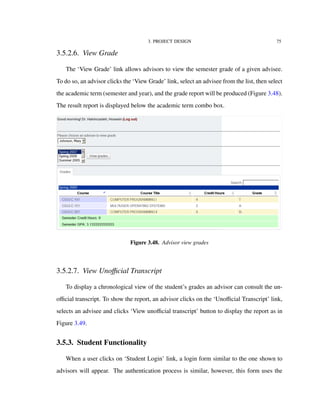
The ‘View Grade’ link allows advisors to view the semester grade of a given advisee.
To do so, an advisor clicks the ‘View Grade’ link, select an advisee from the list, then select
the academic term (semester and year), and the grade report will be produced (Figure 3.48).
The result report is displayed below the academic term combo box.
Figure 3.48. Advisor view grades
3.5.2.7. View Unofficial Transcript
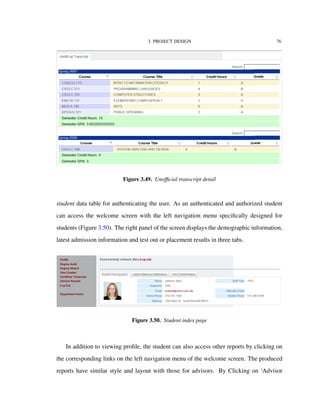
To display a chronological view of the student’s grades an advisor can consult the un-
official transcript. To show the report, an advisor clicks on the ‘Unofficial Transcript’ link,
selects an advisee and clicks ‘View unofficial transcript’ button to display the report as in
Figure 3.49.
3.5.3. Student Functionality
When a user clicks on ‘Student Login’ link, a login form similar to the one shown to
advisors will appear. The authentication process is similar, however, this form uses the
3. PROJECT DESIGN 76
Figure 3.49. Unofficial transcript detail
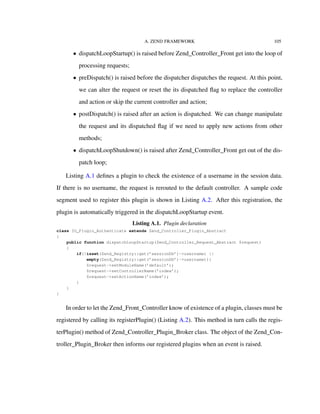
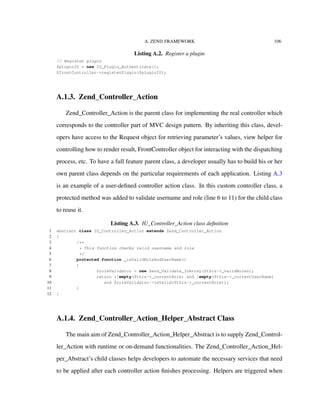
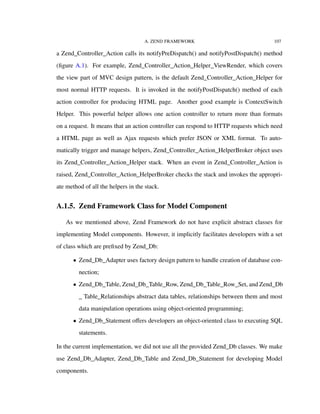
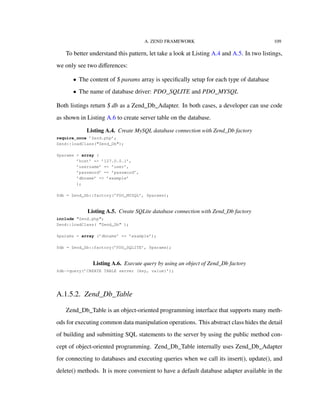
student data table for authenticating the user. As an authenticated and authorized student
can access the welcome screen with the left navigation menu specifically designed for
students (Figure 3.50). The right panel of the screen displays the demographic information,
latest admission information and test out or placement results in three tabs.
Figure 3.50. Student index page
In addition to viewing profile, the student can also access other reports by clicking on
the corresponding links on the left navigation menu of the welcome screen. The produced
reports have similar style and layout with those for advisors. By Clicking on ‘Advisor
3. PROJECT DESIGN 77
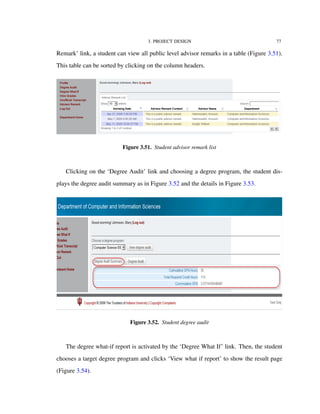
Remark’ link, a student can view all public level advisor remarks in a table (Figure 3.51).
This table can be sorted by clicking on the column headers.
Figure 3.51. Student advisor remark list
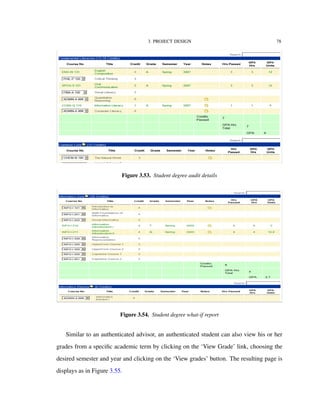
Clicking on the ‘Degree Audit’ link and choosing a degree program, the student dis-
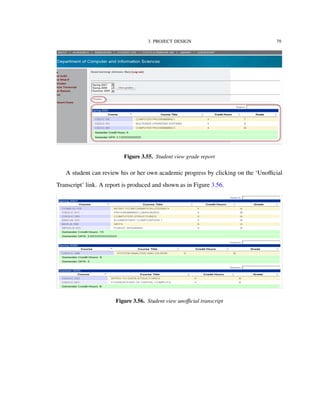
plays the degree audit summary as in Figure 3.52 and the details in Figure 3.53.
Figure 3.52. Student degree audit
The degree what-if report is activated by the ‘Degree What If’ link. Then, the student
chooses a target degree program and clicks ‘View what if report’ to show the result page
(Figure 3.54).
3. PROJECT DESIGN 78
Figure 3.53. Student degree audit details
Figure 3.54. Student degree what-if report
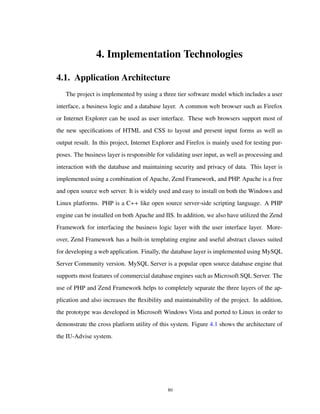
Similar to an authenticated advisor, an authenticated student can also view his or her
grades from a specific academic term by clicking on the ‘View Grade’ link, choosing the
desired semester and year and clicking on the ‘View grades’ button. The resulting page is
displays as in Figure 3.55.
3. PROJECT DESIGN 79
Figure 3.55. Student view grade report
A student can review his or her own academic progress by clicking on the ‘Unofficial
Transcript’ link. A report is produced and shown as in Figure 3.56.
Figure 3.56. Student view unofficial transcript
4. Implementation Technologies
4.1. Application Architecture
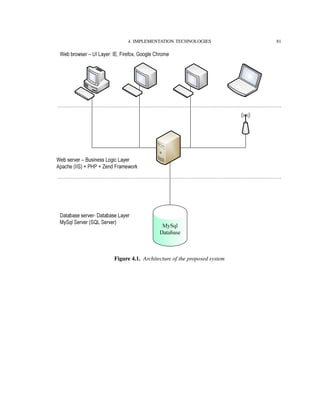
The project is implemented by using a three tier software model which includes a user
interface, a business logic and a database layer. A common web browser such as Firefox
or Internet Explorer can be used as user interface. These web browsers support most of
the new specifications of HTML and CSS to layout and present input forms as well as
output result. In this project, Internet Explorer and Firefox is mainly used for testing pur-
poses. The business layer is responsible for validating user input, as well as processing and
interaction with the database and maintaining security and privacy of data. This layer is
implemented using a combination of Apache, Zend Framework, and PHP. Apache is a free
and open source web server. It is widely used and easy to install on both the Windows and
Linux platforms. PHP is a C++ like open source server-side scripting language. A PHP
engine can be installed on both Apache and IIS. In addition, we also have utilized the Zend
Framework for interfacing the business logic layer with the user interface layer. More-
over, Zend Framework has a built-in templating engine and useful abstract classes suited
for developing a web application. Finally, the database layer is implemented using MySQL
Server Community version. MySQL Server is a popular open source database engine that
supports most features of commercial database engines such as Microsoft SQL Server. The
use of PHP and Zend Framework helps to completely separate the three layers of the ap-
plication and also increases the flexibility and maintainability of the project. In addition,
the prototype was developed in Microsoft Windows Vista and ported to Linux in order to
demonstrate the cross platform utility of this system. Figure 4.1 shows the architecture of
the IU-Advise system.
80
4. IMPLEMENTATION TECHNOLOGIES 81
Figure 4.1. Architecture of the proposed system
4. IMPLEMENTATION TECHNOLOGIES 82
4.2. Ajax
In addition to above tools, Ajax, which is a new web programming model, is also used
in IU-Advise to build a friendlier and dynamic user interface. This section describes our
research and use of this model within IU-Advise.
Ajax stands for Asynchronous JavaScript and XML [16]. This phrase was defined by
Jesses James Garrett in [16] and is not considered to be an acronym. Ajax is not composed
by one single technology. In fact, it includes:
• XHTML and/or CSS-for controlling appearance of a HTML page;
• Document Object Model (DOM)-for interacting and manipulating elements in a
HTML page;
• XML or JSON-for transmitting data between server and client;
• JavaScript-for developers to work with above technologies;
These technologies are available in most of modern web browsers and can be used to pro-
vide better functionality, more dynamic and rich user interface to web applications
Before presenting the ideas behind Ajax, we will examine the traditional web applica-
tion development model. In traditional model, a web browser submits a HTTP request in
form of HTTP packets to a web server. The server processes this request, produces and
sends an HTML page along with CSS and JavaScript files back to client’s web browser
(the left column of Figure 4.2). The web browser loads or reloads all the files from the
server to display a new page. This model is called synchronous because each user inter-
action always corresponds with a server processing (top portion of Figure 4.3) [16]. The
traditional model perfectly works in the point of view of developers and matches the nature
of hypertext medium. It, however, does not provide a dynamic and friendly user interaction
since the users have to wait for the new results while the server is processing and resend-
ing the information back to the browser. This model requires large network bandwidth for
transmitting data since each transmission usually includes unnecessary duplicated data that
4. IMPLEMENTATION TECHNOLOGIES 83
Figure 4.2. AJAX (right) and traditional model (left) [16]
has not been changed. These limitations make web applications less favorable than desktop
applications.
In contrast to the traditional web model, the Ajax model introduces an Ajax engine.
This component is written in JavaScript, loaded when the web browser starts up and typ-
ically hidden from users. A user interaction then generates a JavaScript call to this Ajax
engine (the right column of Figure 4.2). The engine then handles the request on its own
if it is simple such as checking to see if a required field is not empty. For more complex
requests that require server-side processing, it will generate a HTTP request to the server
(e.g. user interaction requires inserting new record into database.) The server will respond
4. IMPLEMENTATION TECHNOLOGIES 84
Figure 4.3. AJAX (bottom) and traditional model (top) [16]
to the request by sending a message in XML or JSON format. The browser then decodes
data via the Ajax engine which updates components in the user interface. Since each user
interaction does not need to be matched by a server processing (bottom portion of Figure
4.3) to update the user interface, this model is call asynchronous [16]. By using Ajax, users
4. IMPLEMENTATION TECHNOLOGIES 85
do not have to wait for HTTP packets to be sent to the server, and for the result to come
back in order to indicate that user input misses required fields or has included an invalid
character. This feature makes web applications responsive and friendlier to users by the
instant response from the Ajax engine. Ajax model also offers effective bandwidth usage
since only needed data is transmitted between client and server. This flexibility enables
developers to create richer web applications that can compete with desktop applications.
Although providing foundation for richer web application, Ajax has one important dis-
advantage. Ajax requires users to enable JavaScript in their browser. However, not all
the users want to turn on this feature because of the potential risk of bad and dangerous
JavaScript execution. In addition to this, some devices such as mobile phones, PDAs, etc
may not completely support JavaScript.
Generally, the combination of mature Ajax model, cross platform operation and rich
graphical user interface make web applications a more popular choice for developers. It,
however, requires a careful attention to security issues in order to make sure that using Ajax
does not make the application or the client system becomes vulnerable.
4.3. Apache Web Server
Apache HTTP Server Project is a part of Apache Software Foundation whose objective
is to create full-feature and open source implementation of an HTTP (web) server [17].
The Apache web server was initially created by Robert McCool and started as a patch to an
old server known as NCSA HTTPd [18]. Today, the project is maintained by contributions
from programmers and developers around the world.
The latest version of Apache is 2.2. Apache is quite popular and provides configurable,
modular design, supporting multiple scripting languages (Perl, PHP, etc) and operating
cross-platform from UNIX-based to Microsoft Window servers [19]. Figure 4.4 compares
the number of servers running Apache to other web servers.
4. IMPLEMENTATION TECHNOLOGIES 86
Figure 4.4. Server Share among the Million Busiest Sites, March 2009 [20]
In the latest version, Apache provides web masters and web developers a comprehen-
sive environment and tool for managing and building web application which includes:
• Supporting new features of latest standards
– HTTP 1.1 and also backward compatible with HTTP 1.0
– Common Gateway Interface (CGI), FastCGI for non-Perl CGI
– Secure Socket Layer (SSL)
– Java Servlet
– Server Side Include (SSI)
• Simple and efficient file-based configuration: configuring and changing Apache
behavior with the primary configuration file httpd.conf. We can also tell Apache to
handle more than one domain name by using only simple text editor like Notepad.
Apache can determine virtual hosts either by IP (IP-based) or name (name-based)
monitoring.
• Supporting PHP, Perl and many other scripting language with modular design.
This allows Apache to host most open source software packages of web develop-
ment and makes it favorable to businesses for saving expenses. Modular design
makes Apache extensible to accommodate new technology.
4. IMPLEMENTATION TECHNOLOGIES 87
• Flexbile and customizable logs and server status. These feature allows web master
to easily monitor websites with their own specifications. They can quickly track
down problems to source when a failure occurs.
• Implementing message-digest-based authentication: basic HTTP authentication
for web servers.
4.4. Server-Side Scripting with PHP
4.4.1. Server-side Scripting
Server-side scripting is a web technology in which a web page is dynamically and
programmatically generated by executing a script on a web server based on requests from
users. These scripts often submit queries to one or many backend databases on server side,
assemble the results into HTML documents and send them back to clients. Security for
client and server is the main advantage of server-side scripting language. A server-side
script file is always executed by the server and generates a HTML response that is sent
back to clients. Since no code needs to be executed at the client side, the developers have
minimized the risk of illegally running dangerous codes. The client program (web browser)
cannot view the source code which produces the web page. Therefore, it cannot retrieve any
information about the underlying resources or about the server such as database structure,
application configuration, etc. It is also convenient for web browsers which only receives
and renders HTML. Browsers consequently do not need to support the different server-side
scripting languages. In conclusion, server-side scripting is an good way for delivering web
services as well as protecting web applications.
4. IMPLEMENTATION TECHNOLOGIES 88
4.4.2. PHP
PHP stands for Hypertext Preprocessor. PHP is a widely-used open source scripting
language. PHP gains its popularity by offering wide variety of features and compatibility
with many platforms [21]:
• A server-side scripting language: PHP collects form data, generates HTML web
pages, sets and retrieves cookies, and communicates with a web server. It also can
produce PDF file or stream data such as Flash video on the fly;
• A useful command line scripting: PHP is packed with useful text processing func-
tions which include regular expression processing and XML document parsing;
• A cross-platform programming language: PHP independently operates on major
platforms such as Microsoft Windows, Linux, Mac OS X, Solaris, etc. PHP is also
supported by most popular web servers. Microsoft Information Internet Services
and Apache are two well-known web servers that provide PHP support;
• Comprehensive database abstraction extensions: PHP provides object-oriented
classes that encapsulate the complexity of interacting with MySQL, Microsoft
SQL Server, Microsoft Access, Oracles, and many databases, making PHP a pop-
ular tool for application development;
• PHP can also communicates with mail services by using POP3, LDAP, IMAP,
SNMP and other protocols;
• With the use of PHP-GTK, PHP can be used to develop desktop applications;
Despite of the emergence of new server-side scripting languages such as Ruby, Groovy
and the commercial competitors such as ASP.NET, PHP is remains a popular tool for web
developers. According to Tiobe Programming Community Index of May 2009 [22], it is
the fourth popular programming language after Java, C and C++.
4. IMPLEMENTATION TECHNOLOGIES 89
4.4.3. Standard PHP Library (SPL) and Auto Loading
4.4.3.1. Standard PHP Library
The Standard PHP Library is a set of object-oriented facilities, standard data structures
for resolving standard and general problems of handling exceptions, collection iteration,
automatically loading classes and physical file accessing jobs. SPL tries to bring the ad-
vantages of object-oriented principals to increase the productivity of PHP coding. The
following list presents some important features of SPL [23]:
• Standard data structures: SplDoublyLinkedList, SplStack, SplQueue, etc
• For collection iteration: ArrayIterator, CachingIterator, DirectoryIterator, Sim-
pleXMLIterator, etc
• Exception handling: BadFunctionCallException, BadMethodCallException, Out-
OfBoundsException, OutOfRangeException, OverflowException, etc
• Auto loading: class_implements, spl_autoload, spl_autoload_register, etc
• File handling: SplFileInfo class
In the above list, the spl_autoload and spl_autoload_register are the key components that
allow an application in order to load classes on the fly to handle requests and process data.
4.4.3.2. Auto Loading
In PHP language, auto loading is an advanced mechanism for dynamically instantiat-
ing objects of classes without explicitly using include, include_once, require, require_once.
spl_autoload is called whenever a class is called in a PHP script. When a class is called for
the first time, spl_autoload loads the source code file of the class based on the include path
and the extensions registered with PHP. PHP allows developers to define and register their
own auto load function for user-defined classes by using spl_autoload_register. Besides
freeing our code from large sections of include statements, this dynamic loading allows us
to load a requested class, instantiate objects and execute their methods on demand rather
4. IMPLEMENTATION TECHNOLOGIES 90
than loading all the source files at start up. This mechanism has given use to the engine
of web applications which is developed using a dynamic design pattern. Such applications
may have many code modules which are organized in a large number of source code files.
Without dynamic loading of files, loading all of these source code files at once consumes
server resources and impacts the server performance significantly. Dynamic loading pre-
vents wasteful heavy loads on the server because not all the functions are needed in most
common scenarios.
4.5. MySQL
The IU-Advise system uses MySQL Community version 5.1.34 as the backend data-
base engine. MySQL is an open source relational database management system (RDBMS)
which is used for managing and manipulating relational databases. MySQL is owned and
financed by MySQL AB, a subsidiary of Sun Microsystems and Oracle Corp. The SQL-92
standard compatibility, high availability for wide range of operating systems on different
computer architectures and low total cost of ownership are the key features that spread
MySQL all over the software industry world. Currently, there are two types of MySQL
versions provided [24, 25]:
• Community: a free version that is intended for users or organizations that are
comfortable with installing, configuring, managing and securing databases with
standard documentations and support;
• Enterprise: is a paid version bundled with many first-class support services which
include:
– Automated notification for updates and new versions
– Technical advice for installing, configuring, etc
– Fast response time resolution for technical problems
4. IMPLEMENTATION TECHNOLOGIES 91
Both versions of MySQL provide a programming API for Java, .NET, C++, PHP, Ruby,
and Python. This capability provides flexibility to developers to select their programming
language and framework for building applications. As a RDBMS, MySQL provides de-
velopers facilities for organizing, querying and manipulating data. If referential integrity
is desired, the developers can use the INNODB engine for data tables. Views and stored
routines are offered for optimizing query performance. Constraints and triggers are in-
cluded for automating data consistency checking. In addition to offering tools to develop-
ers, MySQL also has a built-in tool to secure database objects, control and authorize data
access through Access Privilege System and User Account Management. Administrators
also are equipped with wide variety backup and recovery strategies.
4.5.1. Views
Views (prewritten queries) are composed of multiple data tables. Data columns or fields
in a view can be aliased in a more meaningful way. This feature makes the data in view
more convenient to be used by the developers. By using views, developers can perform
complex data manipulation without needing to be database or SQL experts. Starting with
MySQL version 5.0, a view under certain conditions can update, insert and delete records in
underlying data tables which define it. Views also are good tools for hiding the structure of
a database from unauthorized developers. Below is an example of a view which combines
data from enrollment, completion_method, and student into a single and convenient view
named student_testout_view.
Listing 4.1. A view definition
CREATE OR REPLACE
ALGORITHM=UNDEFINED
DEFINER=‘root‘@‘localhost‘
SQL SECURITY DEFINER VIEW ‘student_testout_view‘ AS
SELECT
‘completion_method‘.‘Description‘ AS ‘Description‘,
4. IMPLEMENTATION TECHNOLOGIES 92
‘student‘.‘StudentID‘ AS ‘StudentID‘,
‘enrollment‘.‘Explanation‘ AS ‘Explanation‘,
‘enrollment‘.‘Grade‘ AS ‘Grade‘
FROM ((‘enrollment‘ JOIN ‘completion_method‘ ON
((‘enrollment‘.‘CompletionMethodID‘ = ‘completion_method‘.‘CompletionMethodID‘)))
JOIN ‘student‘ ON
((‘enrollment‘.‘StudentID‘ = ‘student‘.‘StudentID‘)))
WHERE ((‘completion_method‘.‘CompletionMethodID‘ = ’TESTOUT’) AND
((NOT((‘enrollment‘.‘Grade‘ LIKE ’%A%’)))
OR (NOT((‘enrollment‘.‘Grade‘ LIKE ’%B%’)))
OR (NOT((‘enrollment‘.‘Grade‘ LIKE ’%C%’)))
OR (NOT((‘enrollment‘.‘Grade‘ LIKE ’%D%’)))
OR (NOT((‘enrollment‘.‘Grade‘ LIKE ’%F%’)))))
4.5.2. Stored Routines
A stored routine is a set of SQL statements that are stored in a database server to query
or manipulate database objects. MySQL categorizes stored routines into two types: stored
procedures and functions. A stored procedure has parameter list and return result either as
set of data rows or a single value. It also accepts output parameters which can be used for
returning value. A stored procedure can return a set of data rows and multiple single values
by output parameters at the same time. Similarly, a function also have parameter list but
its parameters are always input parameters. Another restriction on a function is that it can
only returns a single value.
Stored routines offer some advantages in data accessing performance and cross platform
execution. First, a stored routine is only compiled the first time it is called. No compilation
is necessary in the subsequent calls to the procedure unless its content or properties are
changed. This characteristic provides improved performance for recurring queries. Sub-
mitting a SQL statement to MySQL has lower performance because a SQL statement has
to be parsed, optimized and compiled each time it is submitted to a MySQL server. Sec-
ond, a stored routine can be invoked by using its name and passing parameters. This syntax
4. IMPLEMENTATION TECHNOLOGIES 93
usually is shorter than the content of SQL statements that actually performs the process-
ing. Therefore, bandwidth requirement is reduced. Third, as stored routines are stored in
database server and written in SQL syntax, they can be executed by different programming
languages and platforms. Platform independence makes stored routines reusable and pro-
motes consistency. Finally, stored routines can be used as security mechanism to insure
that developers can only access to authorized information. Using stored routines, however,
increases the load on server since most of the processing is done on the server. As the
result, a busy server can be flooded with multiple long runtime stored routines.
Listing 4.2 is a definition of a stored procedure. This stored procedure accepts two
VARCHAR input parameters and uses them in the WHERE clause to retrieve all the advisor
remarks of an advisor (pAdvisorID) about the given student (pStudentNetworkId).
Listing 4.2. A stored procedure definition
CREATE DEFINER=‘root‘@‘localhost‘
PROCEDURE ‘get_all_advisor_remarks_by_advisor_student_sp‘(
IN pStudentNetworkID VARCHAR(10),
IN pAdvisorId VARCHAR(8))
BEGIN
SELECT
communication_type.CommTypeName, advisor_remark.AdvisorRemark,
advisor_remark.AdvisingDate, campus.Name AS CampusName,
college.Name AS CollegeName, department.Name AS DeptName,
advisor.LastName AS AdvisorLastName, advisor.FirstName AS AdvisorFirstName,
advisor_remark.Active, advisor_remark.Level,
advisor_remark.StudentID, advisor_remark.AdvisorID,
advisor_remark.CollegeID, advisor_remark.CampusID,
advisor_remark.DeptID
FROM
communication_type
INNER JOIN advisor_remark ON
(communication_type.CommTypeID = advisor_remark.CommunicationType)
INNER JOIN student ON (advisor_remark.StudentID = student.StudentID)
4. IMPLEMENTATION TECHNOLOGIES 94
INNER JOIN advisor ON (advisor_remark.AdvisorID = advisor.AdvisorID)
AND (advisor_remark.DeptID = advisor.DeptID)
AND (advisor_remark.CollegeID = advisor.CollegeID)
AND (advisor_remark.CampusID = advisor.CampusID)
INNER JOIN department ON (advisor.DeptID = department.DeptID)
AND (advisor.CollegeID = department.CollegeID)
AND (advisor.CampusID = department.CampusID)
INNER JOIN college ON (department.CollegeID = college.CollegeID)
AND (department.CampusID = college.CampusID)
INNER JOIN campus ON (college.CampusID = campus.CampusID)
WHERE student.NetworkId = pStudentNetworkID
AND advisor_remark.AdvisorID = pAdvisorID;
END
4.6. Design Patterns
4.6.1. Model-View-Controller (MVC)
4.6.1.1. Introduction
MVC or "Model-View-Controller" [26] is a software design pattern which was first
implemented in user interface framework of Smalltalk-80 v2.0 library of Xerox PARC.
MVC in Smalltalk-80 was used to solve the problem of generating multiple views based
one computer model. This pattern decomposes an application into three main components
[27]:
• A model that queries and manipulates data of an application;
• A view receives the data and the model’s states to render corresponding presenta-
tion and update user interface;
• A controller which catches user input such as keystrokes, mouse activities, etc.
It then translates them into command to alert the model for processing data and
choose the appropriate view for rendering;
4. IMPLEMENTATION TECHNOLOGIES 95
Figure 4.5. Structure of MVC model
4.6.1.2. Basic Concepts
Models [28, 27] are data structures that present data. Models usually include business
rules/logics and information which is used for making decisions about changing data and
changing the state of the models themselves. In procedural programming paradigm, a set of
procedures or sub-routines can be used to form a model. For object-oriented programming
paradigm, classes are usually applied to building models. A class Student, for instance, like
in Figure 4.6 can be a model that governs data about a student.
Figure 4.6. Structure of Student class
4. IMPLEMENTATION TECHNOLOGIES 96
The components produce a form presentation to visualize the states of models based on
data retrieved from models are called views. In a web application, views generate HTML
files or any requested type of files to respond to users.
The controllers directly handle user inputs such as keystrokes, HTTP requests, etc and
translate them into commands to manipulate the model and view components. Users only
interact with the application through the controllers.
4.6.1.3. Communication between MVC components in a web application
The control flow of an web application designed by applying MVC pattern starts with
the controller receiving a HTTP request. The controller has to parse the HTTP request
into an understandable form to the web application which includes named variable. The
controller then retrieves certain parameters to determine the model (application logic) that
needs to be notified for data processing and the view (user interface) that need to be ren-
dered. After getting the necessary information, the controller hands the request to the cho-
sen model. The chosen model queries and manipulates data from the back-end database.
The model also changes its state if required. Finally, the processing result is passed to the
view for rendering appropriate presentation or updating user interface.
4.6.2. Centralized controller - Front Controller Pattern
A complex web application may contain services that are used by all of components.
Authentication and authorization, for example, are common processes need to be per-
formed before allowing the users to access a service. With a large application, it is required
to have a mechanism to manage these components so that programmers can maintain and
extend the functionalities of these kind of services without worrying of forgetting to update
new changes in all segments of codes that use them. This is also a problem of an MVC
web application since it has many controllers to accept user input. Therefore, the common
services described above need to be applied in each controller by including the same file.
4. IMPLEMENTATION TECHNOLOGIES 97
In a large web application correctly managing this replication is a non trivial task. More-
over, a web application is less secure with multiple entry points. Therefore, having one
central gateway that provides uniform access mechanism to all services is a good solution
to overcome those disadvantages. This approach also more secure and maintainable since
we redirect all user requests to one centralized controller for preprocessing requirements
such as authentication and authorization. The centralized front controller helps to secure
applications, reduce redundancy and maintenance cost.
4.7. MVC in Zend Framework Implementation
The concept of MVC is applied in many frameworks for developing web applications.
Table 4.1 lists major and well-known frameworks that utilize MVC design pattern.
Language Frameworks
PHP Zend Framework, CakePHP, CodeIgniter,
Drupal, Symfony Framework, PureMVC
Ruby Ruby on Rails
C#.NET and VB.NET ASP.NET MVC Framework
Table 4.1. MVC implementations for different languages
Zend Framework implements the MVC through a set of abstract classes which includes:
• The Controller component of MVC design pattern is modeled by Zend_Control-
ler_Action. In addition to this class, Zend_Controller_Dispatcher_Abstract, Zend
_Controller_Plugin_Abstract, Zend_Controller_Request_Abstract, Zend_Control-
ler_Response_Abstract, and Zend_Controller_Router_Abstract automate the rout-
ing and information interchange among controllers;
• The View Helper, derived from Zend_Controller_Action_Helper_Abstract class,
corresponds to the View component of MVC design pattern;
4. IMPLEMENTATION TECHNOLOGIES 98
• The Model component of MVC design pattern does not have an explicit corre-
spondence class in Zend Framework. Zend Framework, however, provides set of
Zend_Db prefixed class to meet all the requirements of developers in implement-
ing Model components.
Figure 4.7. Zend implementation of MVC design pattern
Figure 4.7 presents the implementation of Zend Framework for modeling MVC de-
sign pattern. As a HTTP request comes to a web application, it first is processed by the
Front Controller. At the Front Controller, the URL is parsed to determine the name of
the specialized controller and action to generate responds. For example, the Student con-
troller has DegreeAudit action to produce the degree audit report. The Front Controller
also packed all the parameters into the HTTP Request. Having the specialized controller
and action’s names, the Front Controller dispatches the HTTP Request and Response ob-
jects to the specified Action Controller. The Action Controller then retrieves parameters
from the HTTP Request. It then requests data from one or more Models which communi-
cate and manipulate with the back-end database. When all the inputs are ready, the Action
Controller executes the processing steps, specify the view script name and send processing
result to the View component. View component uses the view script name to invoke the
code for generating the output for sending back to the users.
4. IMPLEMENTATION TECHNOLOGIES 99
In addition these abstract classes, Zend Framework also offers a wide variety of com-
ponents to facilitate web developers manage application configuration, implement security
solutions, and meet the complex requirements of web applications. These classes are listed
with brief overviews in the Appendix. Developers can also communicate with popular
web services of Yahoo, Google, Amazon, Delicious, Twitter, etc. to provide rich featured
applications using Zend Framework.
Zend Framework is a really useful tool for server-side web developers. Advantages
of this powerful and professional object-oriented programming library can be realized re-
gardless of the whether MVC pattern is used. Classes used in this thesis are just a subset
of the whole framework. Further potential use and benefits from using Zend Framework
need more careful investigation. In general, Zend Framework brings PHP applications to
a professional level that competes with commercial web applications. The use of PHP and
Zend Framework allow the current system to be customized, maintained and expanded to
accommodate changes and new requirements in the future.
5. Conclusion
Academic advising plays an important role in creating a friendly and relevant educa-
tional environment for college students. At the same time, advising can be a complex and
time consuming process for academic advisors especially with the dynamic nature of the
degree programs and degree requirements within educational institutions. Despite these
challenges, academic advisors always try to do their best to offer accurate, up-to-date and
consistent advising information to their students. The goal of this thesis is to explore the
design and implementation of a computerized tool to facilitate this process. IU-Advise was
designed to assist advisors in their efforts to provide quality academic advising services to
students.
Upon proper authentication, students are able to view their own grades for a specified
semester, unofficial transcript, advising history and degree audit which shows a student’s
progress toward a degree. Similarly, advisors can select a particular advisee from a list
and view their progress, conduct advising information and record notes to themselves and
other advisors or to the students. Special attention has been given to managing the privacy
of the advising history and advisor comments. The system is implemented using PHP,
Zend Framework, Apache, and MySQL and has been tested with Microsoft Windows Vista
and Fedora 10. These open source software packages not only cut down the expenses but
also offer a set of professional tools for developing a customizable, flexible and reliable
application. The use of MVC design pattern and Zend Framework make the system more
adaptable to new changes and requirements. These tools also increase the reusability of
components in IU-Advise system. MySQL database objects such as stored routines and
views enable the reusability of backend database. To manage security threats on server
side, Zend Framework provides useful classes for automating common security procedures
such as validating user inputs, removing unexpected tags, authenticating with a data table
100
5. CONCLUSION 101
in a database and authorizing users with a flexible but powerful data structures. The Ajax
model is applied for improving the user interaction with web applications.
This project helps in understanding the implementation of Zend Framework, principals
of MVC design pattern and PHP. This project exposes the author to the challenges of de-
signing and developing reusable software components. The implementation of this project
also equipped the author with deeper understandings of developing a web application at the
professional level. The thesis provides a foundation for additional exploration of applying
design patterns and using frameworks in the development of web applications. Additional
area which could be explored but was outside the scope of this thesis includes the im-
plementation of administrative subsystem. This subsystem provides a friendly user inter-
face to the university administrators as they attempt to add new information to the system.
Such new information includes new programs, courses, student information, prerequisite
requirements, advisor assignments and degree requirements. Another feature which can be
helpful would be to store tentative advising information such as course selections for future
semesters in database. This functionality allows an advisor to check if his or her advisee is
following previously agreed upon schedule.
Appendix A.
Zend Framework
102
A. ZEND FRAMEWORK 103
A.1. MVC Implementation Classes
A.1.1. Zend_Controller_Front and The Dispatching Loop
Figure A.1 shows how a request is received by the Zend Framework, how it is dis-
patched and handled by the proper Action Controller. Zend_Controller_Front is the main
component that controls the whole process of processing request from parsing HTTP from
user to sending responses to the clients. The Zend_Controller_Front also instantiates a
Zend_Controller_Response_Http object for sending response to clients.
Figure A.1. Dispatching cycle of Zend Framework
A. ZEND FRAMEWORK 104
To be more specific, the dispatching process needs to determine the controller and the
action needed to process requests. This sub process is called "Routing". To resolve the
controller and action name from the URL, the Zend_Front_Controller instantiate an ob-
ject of Zend_Controller_Router_Rewrite. This router contains all the declared routes to
controllers and actions in a web application. We can load these routes by using a config-
uration file and Zend_Config class. This router, however, always adds the default route
automatically to IndexController and IndexAction which are required for MVC applica-
tion. At the end of this Routing process, the router calls private method _setRequest-
Params() on the current Request object to set the module, controller, and action name.
The actual controller is then instantiate and the action is called in the dispatching loop by
an object of Zend_Controller_Dispatcher_Standard class. In figure A.1, we have two in-
ternal steps in the dispatch() call. The first step is the dynamic instantiation of the con-
troller we want to work with. This step is completed in the dispatch() method of the
Zend_Controller_Dispatcher_Standard object. In second step, the control is transferred
to the requested controller’s code in order to execute the action.
Finally, the controller checks to see if it needs to return the Response object to the caller
or directly send the response to clients.
A.1.2. Zend_Controller_Plugin_Abstract Class
Plugins are user code segments that are executed when a certain event is raised in the
scope of Zend_Front_Controller execution (figure A.1). They are useful complements to
Zend_Front_Controller for implementing common services that needs to be applied for all
controllers. To implement a plugin, we extend (inherit) Zend_Controller_Plugin_Abstract
class. We have to provide code for one or more of the following event method in our class:
• routeStartup() is raised before Zend_Front_Controller calls the router to determine
the controller and action to process the request;
• routeShutdown() is raised after the router finishes routing the request;
A. ZEND FRAMEWORK 105
• dispatchLoopStartup() is raised before Zend_Controller_Front get into the loop of
processing requests;
• preDispatch() is raised before the dispatcher dispatches the request. At this point,
we can alter the request or reset the its dispatched flag to replace the controller
and action or skip the current controller and action;
• postDispatch() is raised after an action is dispatched. We can change manipulate
the request and its dispatched flag if we need to apply new actions from other
methods;
• dispatchLoopShutdown() is raised after Zend_Controller_Front get out of the dis-
patch loop;
Listing A.1 defines a plugin to check the existence of a username in the session data.
If there is no username, the request is rerouted to the default controller. A sample code
segment used to register this plugin is shown in Listing A.2. After this registration, the
plugin is automatically triggered in the dispatchLoopStartup event.
Listing A.1. Plugin declaration
class IU_Plugin_Authenticate extends Zend_Controller_Plugin_Abstract
{
public function dispatchLoopStartup(Zend_Controller_Request_Abstract $request)
{
if(!isset(Zend_Registry::get(’sessionDb’)->username) ||
empty(Zend_Registry::get(’sessionDb’)->username)){
$request->setModuleName(’default’);
$request->setControllerName(’index’);
$request->setActionName(’index’);
}
}
}
In order to let the Zend_Front_Controller know of existence of a plugin, classes must be
registered by calling its registerPlugin() (Listing A.2). This method in turn calls the regis-
terPlugin() method of Zend_Controller_Plugin_Broker class. The object of the Zend_Con-
troller_Plugin_Broker then informs our registered plugins when an event is raised.
A. ZEND FRAMEWORK 106
Listing A.2. Register a plugin
// Register plugin
$pluginIU = new IU_Plugin_Authenticate();
$frontController->registerPlugin($pluginIU);
A.1.3. Zend_Controller_Action
Zend_Controller_Action is the parent class for implementing the real controller which
corresponds to the controller part of MVC design pattern. By inheriting this class, devel-
opers have access to the Request object for retrieving parameter’s values, view helper for
controlling how to render result, FrontController object for interacting with the dispatching
process, etc. To have a full feature parent class, a developer usually has to build his or her
own parent class depends on the particular requirements of each application. Listing A.3
is an example of a user-defined controller action class. In this custom controller class, a
protected method was added to validate username and role (line 6 to 11) for the child class
to reuse it.
Listing A.3. IU_Controller_Action class definition
1 abstract class IU_Controller_Action extends Zend_Controller_Action
2 {
3 /**
4 * This function checks valid username and role
5 */
6 protected function _isValidRoleAndUserName()
7 {
8 $roleValidator = new Zend_Validate_InArray($this->_validRoles);
9 return (!empty($this->_currentRole) and !empty($this->_currentUserName)
10 and $roleValidator->isValid($this->_currentRole));
11 }
12 }
A.1.4. Zend_Controller_Action_Helper_Abstract Class
The main aim of Zend_Controller_Action_Helper_Abstract is to supply Zend_Control-
ler_Action with runtime or on-demand functionalities. The Zend_Controller_Action_Hel-
per_Abstract’s child classes helps developers to automate the necessary services that need
to be applied after each controller action finishes processing. Helpers are triggered when
A. ZEND FRAMEWORK 107
a Zend_Controller_Action calls its notifyPreDispatch() and notifyPostDispatch() method
(figure A.1). For example, Zend_Controller_Action_Helper_ViewRender, which covers
the view part of MVC design pattern, is the default Zend_Controller_Action_Helper for
most normal HTTP requests. It is invoked in the notifyPostDispatch() method of each
action controller for producing HTML page. Another good example is ContextSwitch
Helper. This powerful helper allows one action controller to return more than formats
on a request. It means that an action controller can respond to HTTP requests which need
a HTML page as well as Ajax requests which prefer JSON or XML format. To auto-
matically trigger and manage helpers, Zend_Controller_Action_HelperBroker object uses
its Zend_Controller_Action_Helper stack. When an event in Zend_Controller_Action is
raised, Zend_Controller_Action_HelperBroker checks the stack and invokes the appropri-
ate method of all the helpers in the stack.
A.1.5. Zend Framework Class for Model Component
As we mentioned above, Zend Framework do not have explicit abstract classes for
implementing Model components. However, it implicitly facilitates developers with a set
of class which are prefixed by Zend_Db:
• Zend_Db_Adapter uses factory design pattern to handle creation of database con-
nection;
• Zend_Db_Table, Zend_Db_Table_Row, Zend_Db_Table_Row_Set, and Zend_Db
_ Table_Relationships abstract data tables, relationships between them and most
data manipulation operations using object-oriented programming;
• Zend_Db_Statement offers developers an object-oriented class to executing SQL
statements.
In the current implementation, we did not use all the provided Zend_Db classes. We make
use Zend_Db_Adapter, Zend_Db_Table and Zend_Db_Statement for developing Model
components.
A. ZEND FRAMEWORK 108
A.1.5.1. Zend_Db_Adapter and Factory design pattern
Nowadays, many relational database management system (RDBMS) are being offered
to developers, vendors and businesses. Developers can choose between the commercial
products like Oracle, Microsoft SQL Server and MySQL (Enterprise version) or from open
source solution like SQLite, PostgreSQL or compact version of MS SQL Server. In ad-
dition to these popular RDBMS, Microsoft Access of Microsoft Office Suite and Base of
Open Office Suite also contribute to richness of RDBMS market. With wide variety of
options, developers need to produce an application that can interact with more than one. To
meet this crucial need, PHP offers vendor-specific extensions for working most of popular
RDBMS. Although these extensions satisfy the developers’ desires, they make applications
less flexible because the differences in programming interfaces. Therefore, consolidating
the programming interfaces of different extensions is critical to increasing the flexibility of
developing and deploying web applications.
To overcome this challenge, we have to build an abstract class that does not only ac-
commodate the differences between extensions’ programming interfaces but also produces
standardize objects based on the configuration set up by developers. This type of poly-
morphic development can be achieved by applying Factory design pattern [29]. Figure A.2
presents the logical model of Factory design pattern [30]. In this design pattern, the client
factor does not create directly create an instance of the requested product. Instead it setups
and provides information to the factory factor which uses this to instantiate the appropriate
object and return it to the client.
Figure A.2. Logical model of Factory design pattern
A. ZEND FRAMEWORK 109
To better understand this pattern, let take a look at Listing A.4 and A.5. In two listings,
we only see two differences:
• The content of $ params array is specifically setup for each type of database
• The name of database driver: PDO_SQLITE and PDO_MYSQL
Both listings return $ db as a Zend_Db_Adapter. In both cases, a developer can use code
as shown in Listing A.6 to create server table on the database.
Listing A.4. Create MySQL database connection with Zend_Db factory
require_once ’Zend.php’;
Zend::loadClass("Zend_Db");
$params = array (
’host’ => ’127.0.0.1’,
’username’ => ’user’,
’password’ => ’password’,
’dbname’ => ’example’
);
$db = Zend_Db::factory(’PDO_MYSQL’, $params);
Listing A.5. Create SQLite database connection with Zend_Db factory
include "Zend.php";
Zend::loadClass( "Zend_Db" );
$params = array (’dbname’ => ’example’);
$db = Zend_Db::factory(’PDO_SQLITE’, $params);
Listing A.6. Execute query by using an object of Zend_Db factory
$db->query(’CREATE TABLE server (key, value)’);
A.1.5.2. Zend_Db_Table
Zend_Db_Table is an object-oriented programming interface that supports many meth-
ods for executing common data manipulation operations. This abstract class hides the detail
of building and submitting SQL statements to the server by using the public method con-
cept of object-oriented programming. Zend_Db_Table internally uses Zend_Db_Adapter
for connecting to databases and executing queries when we call its insert(), update(), and
delete() methods. It is more convenient to have a default database adapter available in the
A. ZEND FRAMEWORK 110
Zend_Db_Table_Abstract class since all our classes extends Zend_Db_Table and inherits
all protected members from it. To set a default Zend_Db_Adapter, we can use listing A.7
with $ dbAdapter created by using one of above code segment
Listing A.7. Set default database adapter
Zend_Db_Table_Abstract::setDefaultAdapter($dbAdapter);
After setting up the database adapter, the Zend_Db_Table class can be extended to
declare a customized class. In simple case, we only need to provide the table name that
matches with the one in database (Listing A.8).
Listing A.8. Zend_Db_Table definition
class Model_DbTable_AdvisorRemarks extends Zend_Db_Table
{
protected $_name = ’advisor_remark’;
}
By using the declaration from Listing A.8, we can insert a record to advisor_remark
table with following code segment:
Listing A.9. Zend_Db_Table insert() method
1 public function save(array $data)
2 {
3 $table = $this->_table;
4 $fields = $table->info(Zend_Db_Table_Abstract::COLS);
5
6 foreach ($data as $field => $value) {
7 if (!in_array($field, $fields)) {
8 unset($data[$field]);
9 }
10 }
11 return $table->insert($data);
12 }
Listing A.9 first retrieves the field list of current table by using the static property COLS
of Zend_Db_Table_Abstract class. The foreach loop from line 6 to 10 removes any field
that is not in the field list. Finally, it inserts the new record to database.
The procedure of deleting a record with Zend_Db_Table object includes building the
WHERE clause to determine the record need to be removed and a call to the delete() method
with this WHERE clause. The WHERE is usually built based on the primary key of a table.
In the constructing process of the WHERE clause (line 8 to 18), it is recommended to use
A. ZEND FRAMEWORK 111
the quoteInto() method of the Zend_Db_Adapter in order to make sure that we always have
correct quoted string and date. The database adapter retrieves this quoting information
based on the vendor-specific extension being used. This WHERE clause is actually an array
composed of many single statements. These statements are combined by AND operator by
default in the final SQL statement.
Listing A.10. Zend_Db_Table delete() method
1 public function deleteRows($pDataRows)
2 {
3 $currentAdapter = $this->_table->getAdapter();
4 $deletedCount = 0;
5
6 foreach($pDataRows as $currentRow){
7 // Build where clause
8 $whereStatement = array();
9 $whereStatement[] = $currentAdapter->quoteInto(’AdvisingDate = ?’,
10 $currentRow[’AdvisingDate’]);
11 $whereStatement[] = $currentAdapter->quoteInto(’AdvisorID = ?’,
12 $currentRow[’AdvisorID’]);
13 $whereStatement[] = $currentAdapter->quoteInto(’CollegeID = ?’,
14 $currentRow[’CollegeID’]);
15 $whereStatement[] = $currentAdapter->quoteInto(’DeptID = ?’,
16 $currentRow[’DeptID’]);
17 $whereStatement[] = $currentAdapter->quoteInto(’CampusID = ?’,
18 $currentRow[’CampusID’]);
19 $deletedCount += $this->_table->delete($whereStatement);
20 }
21 return $deletedCount;
22 }
Similar to the deleting procedure, the updating function in Listing A.11 has the equiva-
lent structure with WHERE clause constructing followed by a call to update method. How-
ever, there is a difference in parameter list of update() method. This method requires two
parameters. The first parameter is the new values in form an array of key ⇒ value elements.
The key is the field or column name and value is the new value for the field. The WHERE
clause is used as the second parameter.
Listing A.11. Zend_Db_Table update() method
1 public function updateRows($pDataRows)
2 {
3 $currentAdapter = $this->_table->getAdapter();
4 $updatedCount = 0;
5 foreach($pDataRows as $currentRow){
6 // Build data
7 $newData = $currentRow[’NewData’];
A. ZEND FRAMEWORK 112
8 $whereStatement = array();
9 // Build where clause
10 $whereStatement[] = $currentAdapter->quoteInto(’AdvisingDate = ?’,
11 $currentRow[’AdvisingDate’]);
12 $whereStatement[] = $currentAdapter->quoteInto(’AdvisorID = ?’,
13 $currentRow[’AdvisorID’]);
14 $whereStatement[] = $currentAdapter->quoteInto(’CollegeID = ?’,
15 $currentRow[’CollegeID’]);
16 $whereStatement[] = $currentAdapter->quoteInto(’DeptID = ?’,
17 $currentRow[’DeptID’]);
18 $whereStatement[] = $currentAdapter->quoteInto(’CampusID = ?’,
19 $currentRow[’CampusID’]);
20 $updatedCount += $this->_table->update($newData, $whereStatement);
21 }
22 return $updatedCount;
23 }
A.1.5.3. Zend_Db_Statement
Zend_Db_Statement brings the convenience for developers with intensive knowledge
of SQL programming. It allows programmers to execute user-generated SQL statements,
call stored routines or complex queries that cannot be captured by Zend_Db class. By
providing this class, Zend Framework free developers from the time consuming process of
declaring Zend_Db_Table classes and defining relationships among them using Zend_Db_
Table_Relationship in order to make use of all the functionalities of Zend_Db. Zend_Db
_Statement is usually not created directly. In most scenarios, we use the query() method of
Zend_Db_Adapter to execute a statement for returning a Zend_Db_Statement object. List-
ing A.12 makes a call to degree_audit stored procedure and use the Zend_Db_Statement to
fetch the result of the processing.
Listing A.12. Example of Zend_Db_Statement object
// Get current database adapter
$currentDbAdapter = Zend_Registry::get(’dbAdapter’);
$degreeAuditStatement = $currentDbAdapter->query(’CALL degree_audit’);
$this->_degreeAuditDbStatement = $degreeAuditStatement->fetchAll();
A. ZEND FRAMEWORK 113
A.2. Useful Classes from Zend Framework
Although MVC implementation is the key feature of Zend Framework, it is not the only
gem in this functional programming framework. Zend Framework is not only shipped with
MVC idea but also packed in it all the best practices of object-oriented programming and
developing web programming of the web developer community.
A.2.1. Application Configuration with Zend_Config
Zend_Config provides an easy-to-use programming interface for accessing and man-
aging configuration data within an application. It helps developers deal with the troubles
caused by the dynamic nature of an application’s operation environment. A web appli-
cation is opened to all users. Therefore, its working environment is not always the same
and can be affected by a simple user interaction. Moreover, database configuration is not
the only data that a web application needs. A web application also has to provide the rich
and friendly graphical user interface for any user that interacts with it. This requirement
requires the application to support wide variety of languages and change the user interface
to match users’ cultural characteristics. These internationalization requirements require a
flexible mechanism to keep the application operating properly and developers from deal-
ing with unnecessary details of graphical presentation in developing process. Zend_Config
make sure that applications are flexible to change database configuration in case of a server
failure with least amount of coding effort or to have a new theme for web pages without
having to modify each single page. It can also boost the application deployment by us-
ing a staging hierarchy. This hierarchy allows developers to switch from developing to
production environment with the same configuration set.
Zend_Config supports three configuration file formats. We can use a native PHP INI
file, a XML or a simple PHP array for providing configuration data.This is an example of
PHP INI configuration file for an application. This configuration file includes three sections
correspond to three operational stage of the application. All three stages share the same
A. ZEND FRAMEWORK 114
database driver and database name. The application, however, uses different username and
password as a developer change the operational stage.
[production]
database.adapter = "PDO_MYSQL"
database.params.dbname = "advise-4"
database.params.username = "root"
database.params.hostname = "localhost"
[development : production]
;; Do not use "root" username for connecting to database
database.params.username = "developer"
database.params.password = "develop"
[testing : production]
database.params.username = "tester"
database.params.password = "test"
Listing A.13 shows the example of using Zend_Config object to retrieve configuration
data. Line 2 to 3 defines a global variable which sets the operational stage to ’development’.
Then, we use this global variable to tell the Zend_Config object to read the development
section of the above configuration file in line 6 to 8. Finally, line 11 to 14 demonstrates
how we access the value of each configuration key in the above configuration file.
Listing A.13. Example of using Zend_Config object
1 // Specify the operational stage
2 defined(’APPLICATION_ENVIRONMENT’)
3 or define(’APPLICATION_ENVIRONMENT’, ’development’);
4 // Instantiate Zend_Config object
5 $configuration = new Zend_Config_Ini(
6 APPLICATION_PATH . ’/config/app.ini’,
7 APPLICATION_ENVIRONMENT
8 );
9 // Retrieve configuration data
10 $dbName = $configuration->database->params->dbname;
11 $dbLoginName = $configuration->database->params->username;
12 $dbPassword = $configuration->database->params->password;
13 $dbHostName = $configuration->database->params->hostname;
14 $dbAdapterName = $configuration->database->adapter;
A. ZEND FRAMEWORK 115
A.2.2. Application Security with Zend Framework
Since assisting web developers to rapid deliver consistent, friendly, and rich feature
web applications is the ultimate goal of Zend Framework, Zend Framework also provides
tools for programmers on server-side to secure applications from common type web attacks.
One basic step to protect applications from common web attacks is properly validating and
filtering users input before using them. For this purpose, Zend_Validate and Zend_Filter are
good developers’ companions. Zend_Db_Adapter’s quoteInto is a recommended method
to prevent SQL injection. Zend Framework also equips programmers with Zend_Acl and
Zend_Auth for implementing security using software mechanism.
Zend_Validate
Zend_Validate is stocked with a set of common needed validation functions. Develop-
ers can use single validator or building a chain of multiple validators to apply on single user
input on the order specified by users. Listing A.14 illustrates the use of Zend_Validate class
as a single validator. Listing A.15 is the validator chain definition which includes multiple
rules.
Listing A.14. Example of using Zend_Validate object
protected function _isValidRoleAndUserName()
{
$roleValidator = new Zend_Validate_InArray($this->_validRoles);
return (!empty($this->_currentRole) and !empty($this->_currentUserName)
and $roleValidator->isValid($this->_currentRole));
}
Listing A.15. Example of using Zend_Filter object
private function getValidators($minLength, $maxLength)
{
$validatorArray = array(array(’Alnum’, true), array(’NotEmpty’, true),
array(’StringLength’, true, $minLength, $maxLength));
return $validatorArray;
}
A. ZEND FRAMEWORK 116
Zend_Filter
Zend_Filter removes unwanted characters from untrusted user input. Similar to Zend
_Validate, Zend_Filter supports both single use and chaining modes. The filter array in
Listing A.16 removes whitespaces, tags, new line characters and HTML entities from the
input.
Listing A.16. Example of using Zend_Config object
private function getFilters()
{
$filterArray = array(’StringTrim’, ’StripTags’, ’HTMLEntities’,
’StripNewlines’);
return $filterArray;
}
Zend_Auth
Zend_Auth is used to establish identity based on a set of predefined credentials for
common scenarios. Currently, Zend_Auth supports database table, digest, HTTP, LDAP,
and Open ID authentication. Listing A.17 is an illustration of database table authentication.
Listing A.17. Example of using Zend_Auth object
// Create authentication adapter
$authAdapter = new Zend_Auth_Adapter_DbTable($dbAdapter);
// Set authentication table information
$authAdapter->setTableName($arrayTable[$pRoleName][0])
->setIdentityColumn($arrayTable[$pRoleName][1])
->setCredentialColumn($arrayTable[$pRoleName][2]);
// Set authentication information to check
$authAdapter->setIdentity($pUsername);
$authAdapter->setCredential($pPassword);
// Authenticate user information
$authResult = $authAdapter->authenticate();
if ($authResult->isValid()){
return TRUE;
}else{
return FALSE;
}
A. ZEND FRAMEWORK 117
Zend_Acl
Zend_Acl is a lightweight and flexible access control list to deploy a privileges man-
agement system. Developers has full control on defining roles, resources and authorization
with the use of classes of Zend_Acl. To use this control access list, users first defines roles
and resources. Then, this information needs to be register with a Zend_Acl object. After
everything is setup, programmers call the isValid() method of Zend_Acl to test the autho-
rization. Zend_Acl also supports inheritance between roles. Developers inform Zend_Acl
about this by providing the parent role for a new role in addRole() method. Listing A.18
defines the ‘advisor’ role, ‘Advisee List’ resource and allows the ‘advisor’ role to view
‘Advisee List’.
Listing A.18. Example of using Zend_Acl
defined(’RESOURCE_ADVISEE_LIST’)
or define(’RESOURCE_ADVISEE_LIST’, ’Advisee List’);
// Access control list definition
$zendAcl = new Zend_Acl();
// Setup role definition
$advisorRole = new Zend_Acl_Role(’advisor’);
$zendAcl->addRole($advisorRole)
// Setup resource definition
$zendAcl->add(new Zend_Acl_Resource(RESOURCE_ADVISEE_LIST))
// Allow an advisor to view advisee list
$zendAcl->allow(’advisor’, RESOURCE_ADVISEE_LIST, RESOURCE_CONTROL_VIEW);
Bibliography
[1] Joan F. Marques. Hitting and Missing the Jackpot: The NACADA 2005 National Conference. The
Mentor: An Academic Advising Journal, March 2006.
[2] O. Marques, Xundong Ding, and S. Hsu. Design and development of a web-based academic advising
system. Frontiers in Education Conference, 2001. 31st Annual, 3:S3C–6–10 vol.3, 2001.
[3] R. J. Multari. Integrating Technology into Advisement Services. The Mentor:An Academic Advising
Journal, May 2004.
[4] redLANTERN. History. redLANTERN, 2009. online at http://www.redlanternu.com/
content.jsp?articleId=80.
[5] Ohio University. DARS Online. Ohio University, 2006. Online at http://www.ohio.edu/
registrar/darsonline.cfm.
[6] University of San Diego. USD: DARS. University of San Diego, 2006. Online at http://www.
sandiego.edu/dars/.
[7] University of Missouri St. Louis. UMSL DARS - Degree Audit Reporting System. University of Mis-
souri - St. Louis. Online at http://www.umsl.edu/services/dars/.
[8] RedRock Software Corporation. AdvisorTrac. RedRock Software Corporation. Online at http://
www.advisortrac.net/.
[9] Unversity of Louisville. Undergraduate Academic Advising. Unversity of
Louisville. Online at http://louisville.edu/advising/advisortrac/
schedule-an-appointment-with-advisortrac.html.
[10] Western Kentucky University. Academic Advising and Retention Center. Unversity of Louisville, 2008.
Online at http://www.wku.edu/advising/index.php?page=advisortrac.
[11] Indiana University-Purdue University Fort Wayne. Advising and Academics. Indiana University-Purdue
University Fort Wayne. Online at http://www.ipfw.edu/as/advising/advisortrac.
shtml.
[12] redLANTERN. About Us. redLANTERN, 2003. Online at http://www.redlanternu.com/
about.
[13] Rosemary Pleva Flynn. OneStart/EDEN– A Description of IU’s Transaction Processing/Recordkeeping
Environment. Electronic Records Project Archivist, September 2001.
118
BIBLIOGRAPHY 119
[14] Office of the Registrar Bloomington Campus. Exploring Innovative Methods of Student Ser-
vice Delivery, 1998. http://www.wiche.edu/telecom/Resources/publications/
guide1003/guide/{82%C44D64-CA7A-11D3-9309-005004AD2ACC}_2200_1784.
htm.
[15] CSCI C442/A510 Database System, 2007. Online at http://mypage.iusb.edu/~hhakimza/
IU-ADVISE/.
[16] Jesse James Garrett. Ajax: A New Approach to Web Applications. Online at http://www.
adaptivepath.com/ideas/essays/archives/000385.php.
[17] Apache Software Foundation. Apache HTTP Server Project. Online at http://httpd.apache.
org/ABOUT_APACHE.html.
[18] Wikipedia. Robert McCool. Online at http://en.wikipedia.org/wiki/Robert_McCool.
[19] Mohammed J. Kabir. Apache Server 2 Bible. Hungry Minds, Inc, 909 Third Avenue, New York, NY
10022, 2002.
[20] Netcraft. April 2009 Web Server Survey. Online at http://news.netcraft.com/archives/
web_server_survey.html.
[21] PHP.net. What Can PHP Do. Online at http://us2.php.net/manual/en/
intro-whatcando.php.
[22] Tiobe Software The Coding Standard Company. TIOBE Programming Community Index for
May 2009. Online at http://www.tiobe.com/index.php/content/paperinfo/tpci/
index.html.
[23] PHP.net. SPL Introduction. Online at http://us2.php.net/manual/en/ref.spl.php.
[24] MySQL. MySQL Downloads. Online at http://dev.mysql.com/downloads/.
[25] W. Jason Gilmore. Beginning PHP and MySQL: From Novice to Professional, Third Edition. Apress,
2855 Telegraph Avenue, Suite 600, Berkeley, CA 94705, third edition, 2008.
[26] Steve Burbeck. Applications Programming in Smalltalk-80(TM):How to use Model-View-Controller
(MVC). Online at http://st-www.cs.uiuc.edu/users/smarch/st-docs/mvc.html.
[27] Sun Microsystems. Java BluePrints Model-View-Controller. Java BluePrints. Online at http://
java.sun.com/blueprints/patterns/MVC-detailed.html.
[28] Microsoft. Model-View-Controller. MSDN. Online at http://msdn.microsoft.com/en-us/
library/ms978748.aspx.
BIBLIOGRAPHY 120
[29] Kevin McArthur. Pro PHP: Pattenrs, Frameworks, Testing and more. Apress, 2855 Telegraph Avenue,
Suite 600, Berkeley, CA 94705, 2008.
[30] Doug Purdy. Exploring the Factory Design Pattern. Online at http://msdn.microsoft.com/
en-us/library/ms954600.aspx#factopattern_topic1.

Hung_thesis

  • 1.
    Accepted by theGraduate Faculty, Indiana University, in partial fulfillment of the require- ments for the degree of Master of Science. Hossein Hakimzadeh, Ph.D. Liguo Yu, Ph.D. Michael R Scheessele, Ph.D. Yu Song, Ph.D. May 18, 2009
  • 2.
    IU–ADVISE: A WEBBASED ADVISING TOOL FOR ACADEMIC ADVISORS AND STUDENTS Truong Quoc Hung Submitted to the faculty of the University Graduate School in partial fulfillment of the requirements for the degree of Master of Science in the Department of Computer and Information Science Indiana University May 18, 2009
  • 3.
    Copyright 2009 Truong QuocHung ALL RIGHTS RESERVED i
  • 4.
    Abstract Academic advising isan important activity of an academic institution. It guides the stu- dents to explore potential careers, academic disciplines and opportunities in the college environment. An accurate and full featured advising system can be an effective tool to both students and faculty advisors. The dynamic nature of academic programs, especially in regards to changes in the general education and other degree requirements, poses a con- tinuous challenge to faculty advisors to remain up-to-date. The goal of this thesis is to implement a web-based advising system which facilitates academic advisors in their ef- forts to providing quality, accurate and consistent advising services to their students. The proposed system was implemented using a set of open source software packages to create a low cost, flexible, and customizable system. ii
  • 5.
    Acknowledgements In the completingof this graduate project I have been fortunate to have the help, support and encouragement from many people. I would like to acknowledge them for their cooperation. I wish to express deep heart-felt gratitude to my project advisor, Dr. Hossein Hakimzadeh, Ph.D., Director of Informatics, for guiding and assisting me through every step of the pro- cess with helpful knowledge and support. I would like to thank Dr. Liguo Yu, Dr. Yu Song and Dr. Michael R Scheessele, my thesis committee members, who showed immense patience and understanding through detailed review and suggestions. I am grateful to Dr. Robert Batzinger, Ph.D., Informatics Lab Supervisor, for explaining difficult aspects of PHP, web programming and LATEX. I owe my most sincere gratitude to all staffs and my friends who helped me during my studies and work at IU South Bend. I would like to thank my grandmother, uncles, aunts, and cousins who have been con- stantly provided me with various forms of support since the first day I came to the United States. I owe my loving thanks to Huong Xuan Hoang Thi and her family for their encourage- ment and understanding. Lastly and most importantly, I wish to thank my parents and brother, Dieu Hien Thi Nguyen, Thi Truong and Dung Truong. Their support and love that helped me overcome difficulties, enjoy my studies and achieve my goals. iii
  • 6.
    Contents List of Tables. . . . . . . . . . . . . . . . . . . . . . . . . . . . . . . . . . . . . . . . . . . . . . . . . . . . . . . . . . . . v List of Figures . . . . . . . . . . . . . . . . . . . . . . . . . . . . . . . . . . . . . . . . . . . . . . . . . . . . . . . . . . . vii 1. Introduction . . . . . . . . . . . . . . . . . . . . . . . . . . . . . . . . . . . . . . . . . . . . . . . . . . . . . . . . . 1 2. Literature Review . . . . . . . . . . . . . . . . . . . . . . . . . . . . . . . . . . . . . . . . . . . . . . . . . . . . 3 3. Project Design . . . . . . . . . . . . . . . . . . . . . . . . . . . . . . . . . . . . . . . . . . . . . . . . . . . . . . . 7 3.1. Privacy Policy . . . . . . . . . . . . . . . . . . . . . . . . . . . . . . . . . . . . . . . . . . . . . . . . . . 7 3.2. Data Model . . . . . . . . . . . . . . . . . . . . . . . . . . . . . . . . . . . . . . . . . . . . . . . . . . . . 8 3.3. Database Design . . . . . . . . . . . . . . . . . . . . . . . . . . . . . . . . . . . . . . . . . . . . . . . . 10 3.4. Process Model . . . . . . . . . . . . . . . . . . . . . . . . . . . . . . . . . . . . . . . . . . . . . . . . . 34 3.5. User Interface . . . . . . . . . . . . . . . . . . . . . . . . . . . . . . . . . . . . . . . . . . . . . . . . . . 62 4. Implementation Technologies . . . . . . . . . . . . . . . . . . . . . . . . . . . . . . . . . . . . . . . . . . 80 4.1. Application Architecture . . . . . . . . . . . . . . . . . . . . . . . . . . . . . . . . . . . . . . . . . 80 4.2. Ajax . . . . . . . . . . . . . . . . . . . . . . . . . . . . . . . . . . . . . . . . . . . . . . . . . . . . . . . . . . 82 4.3. Apache Web Server . . . . . . . . . . . . . . . . . . . . . . . . . . . . . . . . . . . . . . . . . . . . . 85 4.4. Server-Side Scripting with PHP . . . . . . . . . . . . . . . . . . . . . . . . . . . . . . . . . . . 87 4.5. MySQL . . . . . . . . . . . . . . . . . . . . . . . . . . . . . . . . . . . . . . . . . . . . . . . . . . . . . . . 90 4.6. Design Patterns . . . . . . . . . . . . . . . . . . . . . . . . . . . . . . . . . . . . . . . . . . . . . . . . . 94 4.7. MVC in Zend Framework Implementation . . . . . . . . . . . . . . . . . . . . . . . . . . 97 5. Conclusion. . . . . . . . . . . . . . . . . . . . . . . . . . . . . . . . . . . . . . . . . . . . . . . . . . . . . . . . . . 100 Appendix A. Zend Framework . . . . . . . . . . . . . . . . . . . . . . . . . . . . . . . . . . . . . . . . . . . . 102 A.1. MVC Implementation Classes . . . . . . . . . . . . . . . . . . . . . . . . . . . . . . . . . . . . 103 A.2. Useful Classes from Zend Framework . . . . . . . . . . . . . . . . . . . . . . . . . . . . . 113 Bibliography . . . . . . . . . . . . . . . . . . . . . . . . . . . . . . . . . . . . . . . . . . . . . . . . . . . . . . . . . . . . 118 iv
  • 7.
    List of Tables Table3.1. SQL table structure for campus . . . . . . . . . . . . . . . . . 10 Table 3.2. SQL table structure for campus_reqs . . . . . . . . . . . . . . . 11 Table 3.3. SQL table structure for admin_role . . . . . . . . . . . . . . . . 12 Table 3.4. SQL table structure for admin_personnel . . . . . . . . . . . . . . 13 Table 3.5. SQL table structure for college . . . . . . . . . . . . . . . . . . 14 Table 3.6. SQL table structure for college_reqs . . . . . . . . . . . . . . . 15 Table 3.7. SQL table structure for course_relationship . . . . . . . . . . . . . 16 Table 3.8. SQL table structure for pre_co_req . . . . . . . . . . . . . . . . 16 Table 3.9. SQL table structure for degree_type . . . . . . . . . . . . . . . . 17 Table 3.10. SQL table structure for department . . . . . . . . . . . . . . . 18 Table 3.11. SQL table structure for communication_type . . . . . . . . . . . . 19 Table 3.12. SQL table structure for access_level . . . . . . . . . . . . . . . 19 Table 3.13. SQL table structure for course . . . . . . . . . . . . . . . . . 20 Table 3.14. SQL table structure for academic_program . . . . . . . . . . . . 21 Table 3.15. SQL table structure for advisor . . . . . . . . . . . . . . . . . 22 Table 3.16. SQL table structure for advise . . . . . . . . . . . . . . . . . 23 Table 3.17. SQL table structure for advisor_remark . . . . . . . . . . . . . . 24 Table 3.18. SQL table structure for enrollment . . . . . . . . . . . . . . . . 25 Table 3.19. SQL table structure for satisfied_by . . . . . . . . . . . . . . . 26 Table 3.20. SQL table structure for detailed_requirement . . . . . . . . . . . 27 Table 3.21. SQL table structure for requirements . . . . . . . . . . . . . . . 28 Table 3.22. SQL table structure for degree_req_categories . . . . . . . . . . . 29 Table 3.23. SQL table structure for declared_program . . . . . . . . . . . . . 30 Table 3.24. SQL table structure for student . . . . . . . . . . . . . . . . . 31 Table 3.25. SQL table structure for completion_method . . . . . . . . . . . . 32 Table 3.26. SQL table structure for semester . . . . . . . . . . . . . . . . 32 Table 3.27. SQL table structure for actionlog . . . . . . . . . . . . . . . . 33 v
  • 8.
    Table 4.1. MVCimplementations for different languages . . . . . . . . . . . . 97 vi
  • 9.
    List of Figures Figure2.1. SIS introduction page . . . . . . . . . . . . . . . . . . . . . 4 Figure 2.2. Part of a SIS unofficial transcript page . . . . . . . . . . . . . . 5 Figure 2.3. Part of a SIS what-if report . . . . . . . . . . . . . . . . . . . 5 Figure 3.1. ER Diagram of IU Advisee . . . . . . . . . . . . . . . . . . . 9 Figure 3.2. Functional Decomposition Diagram . . . . . . . . . . . . . . . 35 Figure 3.3. Context Data Flow Diagram of IU-Advise system . . . . . . . . . . 37 Figure 3.4. Student - View Degree Audit Context DFD . . . . . . . . . . . . 38 Figure 3.5. Student - View Degree Audit Detailed DFD . . . . . . . . . . . . 39 Figure 3.6. Student - View Unofficial Transcript Context DFD . . . . . . . . . 40 Figure 3.7. Student - View Unofficial Transcript Detailed DFD . . . . . . . . . 41 Figure 3.8. Student - View Grades Context DFD . . . . . . . . . . . . . . . 42 Figure 3.9. Student - View Grades Detailed DFD . . . . . . . . . . . . . . . 43 Figure 3.10. Student - View Advisor Remarks Context DFD . . . . . . . . . . 44 Figure 3.11. Student - View Advisor Remarks Detailed DFD . . . . . . . . . . 45 Figure 3.12. Advisor - View Advisor Remarks Context DFD . . . . . . . . . . 46 Figure 3.13. Advisor - View Advisor Remarks Detailed DFD . . . . . . . . . . 47 Figure 3.14. Advisor - View Degree Audit Context DFD . . . . . . . . . . . . 48 Figure 3.15. Advisor - View Degree Audit Detailed DFD . . . . . . . . . . . 49 Figure 3.16. Advisor - View Unofficial Transcript Context DFD . . . . . . . . . 51 Figure 3.17. Advisor - View Unofficial Transcript Detailed DFD . . . . . . . . 52 Figure 3.18. Advisor - View Grades Context DFD . . . . . . . . . . . . . . 53 Figure 3.19. Advisor - View Grades Detailed DFD . . . . . . . . . . . . . . 54 Figure 3.20. Advisor - Create Advisor Remark Context DFD . . . . . . . . . . 55 Figure 3.21. Advisor - Create Advisor Remark Detailed DFD . . . . . . . . . . 56 Figure 3.22. Advisor - Modify Advisor Remark Context DFD . . . . . . . . . 58 Figure 3.23. Advisor - Modify Advisor Remark Detailed DFD . . . . . . . . . 59 Figure 3.24. Advisor - Remove Advisor Remark Context DFD . . . . . . . . . 60 vii
  • 10.
    Figure 3.25. Advisor- Remove Advisor Remark Detailed DFD . . . . . . . . . 61 Figure 3.26. Chosen role screen for IU-Advise . . . . . . . . . . . . . . . . 62 Figure 3.27. Login form for an advisor . . . . . . . . . . . . . . . . . . . 63 Figure 3.28. Server validation message . . . . . . . . . . . . . . . . . . . 63 Figure 3.29. Client validation message . . . . . . . . . . . . . . . . . . . 63 Figure 3.30. Advisor index page . . . . . . . . . . . . . . . . . . . . . 64 Figure 3.31. Advisor information tab . . . . . . . . . . . . . . . . . . . 64 Figure 3.32. Student demographic information tab . . . . . . . . . . . . . . 65 Figure 3.33. Latest admission information tab . . . . . . . . . . . . . . . . 66 Figure 3.34. Test out information tab . . . . . . . . . . . . . . . . . . . 66 Figure 3.35. Advisor remark list . . . . . . . . . . . . . . . . . . . . . 67 Figure 3.36. Personal advisor remark list . . . . . . . . . . . . . . . . . . 68 Figure 3.37. Add new advisor remark form . . . . . . . . . . . . . . . . . 68 Figure 3.38. Choose a user advisor remark . . . . . . . . . . . . . . . . . 69 Figure 3.39. Load data into form . . . . . . . . . . . . . . . . . . . . . 70 Figure 3.40. Choose multiple user advisor remark . . . . . . . . . . . . . . 70 Figure 3.41. Only list valid records . . . . . . . . . . . . . . . . . . . . 71 Figure 3.42. Chosen records for activating or deactivating . . . . . . . . . . . 71 Figure 3.43. Degree audit result . . . . . . . . . . . . . . . . . . . . . 72 Figure 3.44. Degree audit detail tab . . . . . . . . . . . . . . . . . . . . 72 Figure 3.45. Input for producing degree what-if report . . . . . . . . . . . . . 73 Figure 3.46. Degree what-if report details . . . . . . . . . . . . . . . . . . 74 Figure 3.47. Excluded courses report . . . . . . . . . . . . . . . . . . . 74 Figure 3.48. Advisor view grades . . . . . . . . . . . . . . . . . . . . . 75 Figure 3.49. Unofficial transcript detail . . . . . . . . . . . . . . . . . . . 76 Figure 3.50. Student index page . . . . . . . . . . . . . . . . . . . . . 76 Figure 3.51. Student advisor remark list . . . . . . . . . . . . . . . . . . 77 Figure 3.52. Student degree audit . . . . . . . . . . . . . . . . . . . . . 77 Figure 3.53. Student degree audit details . . . . . . . . . . . . . . . . . . 78 Figure 3.54. Student degree what-if report . . . . . . . . . . . . . . . . . 78 viii
  • 11.
    Figure 3.55. Studentview grade report . . . . . . . . . . . . . . . . . . . 79 Figure 3.56. Student view unofficial transcript . . . . . . . . . . . . . . . . 79 Figure 4.1. Architecture of the proposed system . . . . . . . . . . . . . . . 81 Figure 4.2. AJAX (right) and traditional model (left) . . . . . . . . . . . . . 83 Figure 4.3. AJAX (bottom) and traditional model (top) . . . . . . . . . . . . 84 Figure 4.4. Server Share among the Million Busiest Sites, March 2009 . . . . . . 86 Figure 4.5. Structure of MVC model . . . . . . . . . . . . . . . . . . . . 95 Figure 4.6. Structure of Student class . . . . . . . . . . . . . . . . . . . 95 Figure 4.7. Zend implementation of MVC design pattern . . . . . . . . . . . 98 Figure A.1. Dispatching cycle of Zend Framework . . . . . . . . . . . . . 103 Figure A.2. Logical model of Factory design pattern . . . . . . . . . . . . 108 ix
  • 12.
    1. Introduction The mainobjective of academic advising is to guide, motivate and support students as they explore their potential and make precise academic choices in order to satisfy stu- dents’ needs and comply with academic policies [1]. To achieve these objectives, IU South Bend employs the direct communication between advisors and students as the main ad- vising system. Advisors are typically faculty or professional advisors employed by an academic unit. A normal advising session consists of meetings between an advisor and a student. On the basis of these meetings, the student makes decisions about class schedules, choosing an academic major or minor, planning for graduation and many other academic related activities. These important decisions are made based on information about previ- ously completed courses, degree requirements, academic policies, and offered courses in the upcoming semester provided by advisors balanced against the student’s work schedule and other interests or commitments. The current academic advising system, however, has encountered some problems [2]. Among these, there are some noticeable points. First, academic advisors serve as ma- jor and comprehensive resources for students to utilize, and therefore need to spend time understanding and updating their knowledge about degree requirements and academic poli- cies as well as familiarizing themselves with students’ progress toward academic degrees prior to any advising period. This is a time-consuming task for any advisor especially when students far outnumber their advisors. Second, a faculty advisor may not be able to keep up with new academic policies, programs and/or degree requirements as they may have several duties during an advising period adding to the difficulties in updating information. This situation can lead to inconsistent information among advisors. Third, most of the time, advisors answer recurrent questions about trivial class scheduling. In fact, these questions could be answered easily by students themselves, if useful information about class sched- ules and previously completed courses were available and easy to access. Accordingly, 1
  • 13.
    1. INTRODUCTION 2 thereshould be a tool for helping students to take advantage of authorized part of academic information before coming to their advisors. Finally, computer-literate students would fre- quently like to have more electronic interaction for advising. This is an important factor that needs to be taken into consideration because the students are customers of the services both directly and indirectly [3]. Although there are some problems in the current advising system, faculty mentors and advisors cannot be replaced completely by a computer-based system. The reason is that the academic advising process requires professional knowledge of academic disciplines to satisfy questions about a specific course structure, teaching methods, etc. Moreover, the students do not come to the advisors’ offices for only course selection, but also for recommendation while they decide their majors and careers. For these types of questions, an academic advisor with intensive and proficient knowledge about a specific field of study is the best source of valuable information in this regard. However, this information cannot be stored and interpreted from static data held in a database. This thesis attempts to implement a web-based advising system known as “IU-Advise”. The system supports following activities for an authenticated and authorized student or advisor: • View or print an unofficial transcript; • View or print degree audit that shows the progress toward a degree and identifies unmet requirements; • View or print students’ advising records; • Add or modify advising information; • View the degree requirements for a given program in a given academic year; • View what-if report which shows how previously completed courses would fit into a new degree program; It is hoped that the proposed system would become a useful tool for both advisors and students and will facilitate the advising process.
  • 14.
    2. Literature Review Manyuniversities and colleges are applying computer technology to create useful tools and complete systems that improve the traditional academic advising system. There have been many levels and means for applying computer technology. The basic level is to de- velop a simple tool that can produce reports or cover a simple task of the advising process. The higher level is the complete software system that supports the complete advising pro- cess. For the basic level, one useful and common tool is a degree audit reporting system (DARS). DARS, which was developed by Miami University in 1985 [4], produces a degree audit which shows all the requirements of a specific academic degree, the courses that sat- isfy those requirements and the progress of a student toward the degree. This is a small and effective tool for both advisors and students in the advising process. DARS has been pur- chased and adapted by many academic institutions such as Ohio University [5], University of San Diego[6], University of Missouri - St. Louis [7] and etc. In the higher level, the AdvisorTrac of RedRock Software [8] is a commercial soft- ware that supports scheduling, reviewing, cancelling advising appointments, storing demo- graphic records and keeping track of advising records. AdvisorTrac is currently being used by a number of universities, among of which are the University of Louisville[9], Western Kentucky University[10], Indiana University-Purdue University Fort Wayne [11] and other colleges. At the software system level, redLatern, an auxiliary of Miami University [12], developed a commercial software solution based on the DARS for both students and advisors. The solution includes 3 components: u.select, u.direct, and u.achieve. This education software solution provides tools for most advising activities, such as planning courses, selecting courses, keeping track of grades, generating degree audits, and other common advising tasks with unified and consistent information throughout an academic institution. 3
  • 15.
    2. LITERATURE REVIEW4 In addition to these specialized software solutions, most comprehensive administrative software systems such as PeopleSoft, SCT Banner and Oracle also have an academic ad- visement module. The current OneStart application portal of IU South Bend provides an access to Student Self Service. Student Self Service, based on PeopleSoft’s Human Re- source Management System (HRMS) and Student Information System (SIS), provides two advising services: View My Advisors and View My Advisement Reports [13]. Figures 2.1, 2.2 and 2.3 show some of current SIS reports. The View My Advisement Reports function allows a student to view a degree audit with or without a unofficial transcript. It also pro- duces a what-if report that shows how current enrolled courses could be applied to a new major when a student wants to change his or her major. A course list what-if report of this service determines if selected courses fit into any requirement of a given degree program. These two reports need to be polished and reorganized in order to provide more useful information than the current version. The View My Advisor offers a list of advisors of a given student and allows the student to notify one or many advisors. Figure 2.1. SIS introduction page
  • 16.
    2. LITERATURE REVIEW5 Figure 2.2. Part of a SIS unofficial transcript page Figure 2.3. Part of a SIS what-if report A commercial software package is not the only way to meet the needs of improving the quality of advising services. There are many computer software systems developed in - house. In 1999, the Department of Computer Science and Engineering (CSE) of Florida Atlantic University (FAU) started working on a project of a web-based advising system. This system is composed of three components [2]:
  • 17.
    2. LITERATURE REVIEW6 • The FAQ component archives and presents the most common questions that can be answered without intensive knowledge about policies, requirements and courses. • The Course component is used by advisors and administrators to maintain course information. • The Advising component captures all the information of the advising appoint- ments between advisors and students. It then combines with the data in the data- base to produce a final result of advising. In the same manner, Indiana University developed and used Indiana Student Information Transaction Environment [2, 14] - INSITE on some Indiana University campuses before OneStart [2, 14] was employed. INSITE offered the following features: • Producing an advising report for a student’s current major; • Producing an advising report for a different major; • Producing an advising report for a special purpose program; • Viewing how in-progress courses would apply to a student’s advising report; • Adding future courses, grades, and hours to determine affects on the advising report;
  • 18.
    3. Project Design Inorder to develop an application, a conceptual design was produced and reviewed carefully. A conceptual design included two components: the data model and the process model. The data model determined what information was needed, how it was to be or- ganized and stored. For IU-Advise, we use Entity-Relationship model for organizing and storing data. The process model was used to convey the structure of an application, how its components operate and interact with each other. It also shows how data flows among pro- cesses to get the final result. In addition to these conceptual models, the designing process was used to develop a layout for the user interface model which represents the interaction of users with the system. The designs of these models and the information privacy policy for sharing advisor remarks among advisors will be the topics for the remainder of this chapter. 3.1. Privacy Policy Privacy is always the an important concern of users. Sharing advisor remarks among advisors help advisors understand the personal ne eds of a student. However, information sharing without proper controls could lead to the violation of privacy policies, regulations or laws. Therefore, it is important to have a mechanism for restricting access to advisor remarks as well as promoting information sharing. In order to maintain the privacy of students and advisors, the IU-Advise system provides three privacy levels which can be applied to advisor remarks. These levels are Advisor, Advisor Group and Public. • Advisor level: advisor remarks belonging to this type can only be viewed and manipulated by its owner or the creator. The user can delete and edit his or her own private remark; • Advisor Group level: advisor remarks in this group can be viewed and shared among advisors but not students. Only the owner or creator of an advisor remark 7
  • 19.
    3. PROJECT DESIGN8 can deactivate or activate it. When an advisor remark is deactivated, it is not deleted. It is just invisible to other advisors; • Public level: these remarks can be viewed by both students and advisors using the system. Similar to Advisor Group type advisor remarks, these remarks can only be activated and deactivated by the owner or creator of the adviso remark; These levels ensure that advisor remarks are only disclosed in a way that do not violate user’s privacy or create unexpected difficulties for either students or advisors. 3.2. Data Model Figure 3.1 shows the conceptual data model for the IU-Advise project [15]. We use an Entity-Relationship Diagram (ERD) for modeling the entities (or objects) and relationships among these entities in the application’s domain. In the ERD notation, a rectangle sym- bolizes a data source or data table in the physical implementation. A diamond symbolizes a relationship between two entities. A diamond wrapped by a rectangle indicates that a relationship has its own identification information and is promoted to a data table in the implementing phase. The Entity-Relationship Diagram provides the layout for implemen- tation of the database.
  • 20.
    3. PROJECT DESIGN9 Figure 3.1. ER Diagram of IU Advisee
  • 21.
    3. PROJECT DESIGN10 3.3. Database Design This section lists all the tables in the database implementation. As mentioned in the previous section, these tables present essential entities and relationships among them in the IU-Advise system as shown in Figure 3.1. In the section belows, each table is defined with its location and relationships with other tables highlighted in the Entity-Relationship Diagram. campus Given that Indiana University has multiple campuses, the campus table allows our system to maintain information about each campus and it further allows us to extract specific information maintained in the system such as student, faculty, degree requirements, etc by specifying the proper campus. Column name Data type Length Description CampusID varchar 10 Primary key-Unique identification string of a campus Name varchar 50 Full name of a campus Address1 varchar 50 Building number, street name Address2 varchar 50 City varchar 25 State char 2 Zip varchar 50 Usually 5 digits Phone varchar 12 URL varchar 255 Web page of a campus DefaultRetentionTemplateID varchar 10 Table 3.1. SQL table structure for campus
  • 22.
    3. PROJECT DESIGN11 campus_reqs The campus_reqs table contains information about the requirements that a student has to satisfy before officially being admitted to a campus. Column name Data type Length Description CampusID varchar 10 Primary key-Unique identification string of the campus ask for the requirements CampusReqID int Primary key-Unique identification string of a requirement StartAcademicTerm varchar 4 Primary key-Year and semester in which the requirement is applied OrderOfAppearance tinyint RequirementText varchar 250 Content of the requirement MiscNotes varchar 250 More information or instruction about the requirement Table 3.2. SQL table structure for campus_reqs
  • 23.
    3. PROJECT DESIGN12 admin_role The admin_role table contains information about the administrators and their administrative access to one or more departments. In addition, this table allows our system to enforce a time period during which access is granted. Column name Data type Length Description LoginID varchar 8 Primary key-Username of the admin person DeptID varchar 10 Primary key-Unique identification string of the department administered by the admin person CollegeID varchar 10 Primary key-Unique identification string of the college to which the department belongs CampusID varchar 10 Primary key-Unique identification string of the campus to which the department belongs StartDate date Begin date EndDate date Expired date Table 3.3. SQL table structure for admin_role
  • 24.
    3. PROJECT DESIGN13 admin_personnel The admin_personnel provides the credentials of an administrator. Column name Data type Length Description LoginID varchar 8 Primary key-Username of admin personnel Password varchar 50 Secret word used for logging in LastName varchar 50 Family name FirstName varchar 50 StartDate date Begin date EndDate date Expired date AccessLevel varchar 50 Default value: USER SiteStyle varchar 50 Page format applied for user-Default value: iusb.css Table 3.4. SQL table structure for admin_personnel
  • 25.
    3. PROJECT DESIGN14 college Similar to the campus table, the college table allows our system to maintain information about each college (or school) and it further allows us to extract specific information maintained in the system such as student, faculty, degree requirements, etc by specifying the proper college. Column name Data type Length Description CollegeID varchar 10 Primary key-Unique identification string of a college CampusID varchar 10 Primary key-Unique identification string of the campus to which the college belongs Name varchar 50 Name of the college Address1 varchar 50 Building number, street name Address2 varchar 50 City varchar 50 State char 2 Zip varchar 50 Usually 5 digits Phone varchar 12 URL varchar 255 Web page of a college Table 3.5. SQL table structure for college
  • 26.
    3. PROJECT DESIGN15 college_reqs The college_reqs table lists all the requirements of a specific college. It also provides the beginning academic term in which a requirement is applied. Column name Data type Length Description CampusID varchar 10 Primary key-Unique identification string of the campus to which the college belongs CollegeID varchar 10 Primary key-Unique identification string of the college that ask for the requirement CollegeReqID int Primary key-Unique identification string of the college requirement StartAcademicTerm varchar 4 Primary key-Year and semester in which the requirement is applied OrderOfAppearance tinyint RequirementText varchar 250 Content of the requirement MiscNotes varchar 250 Information or instruction about the requirement Table 3.6. SQL table structure for college_reqs
  • 27.
    3. PROJECT DESIGN16 course_relationship This data table contains the descriptive text for a specific relationship between two courses. Column name Data type Length Description RelationshipID varchar 10 Primary key-Unique identification string of a relationship Description varchar 50 Descriptive information about the relationship Table 3.7. SQL table structure for course_relationship pre_co_req The pre_co_req table contains information about the prerequisites, equivalents and co-requisites of a particular course. Column name Data type Length Description CourseID varchar 6 Primary key-Unique identification string of a course PreCoReqCourseID varchar 6 Primary key-Unique identification string of a course Relationship varchar 10 Unique identification string of the relationship-Default value: PREREQ Table 3.8. SQL table structure for pre_co_req
  • 28.
    3. PROJECT DESIGN17 degree_type This data table contains the meaningful description of a particular degree program ID. Column name Data type Length Description DegreeTypeID varchar 10 Primary key-Unique identification string of the degree type DegreeTypeDescription varchar 250 Information or instruction about the degree type Table 3.9. SQL table structure for degree_type
  • 29.
    3. PROJECT DESIGN18 department Similar to the campus and college table, the department table allows our system to maintain information about each department and it further allows us to extract specific information maintained in the system such as student, faculty, degree requirements, etc by specifying the proper department. Column name Data type Length Description DeptID varchar 10 Primary key-Unique identification string of the department CollegeID varchar 10 Primary key-Unique identification string of the college to which the department belongs CampusID varchar 10 Primary key-Unique identification string of the campus to which the department belongs Name varchar 50 Full name of the department Address1 varchar 50 Building number, street name Address2 varchar 50 City varchar 50 State char 2 Zip varchar 50 Usually 5 digits Phone varchar 12 URL varchar 255 Web page of the department DefaultRetentionTemplateID varchar 10 Table 3.10. SQL table structure for department
  • 30.
    3. PROJECT DESIGN19 communication_type This table lists all the methods for contacting an advisee. Column name Data type Length Description CommTypeID varchar 7 Primary key-Unique identification string of communication type CommTypeName varchar 50 Name of communication type CommTypeDescription varchar 255 Description of communication type DateCreated datetime Date and time of the record creation UserCreated varchar 50 Who created the record Table 3.11. SQL table structure for communication_type access_level The access_level table models the privacy hierarchy for advisor remarks of IU-Advise system. It provides detail description about the scope of each level. Column name Data type Length Description LevelID varchar 6 Primary key-ID string for an access level LevelDescription varchar 255 Detail information about the level CreationUser varchar 10 Who created the record CreationDate datetime Date of the creation Table 3.12. SQL table structure for access_level
  • 31.
    3. PROJECT DESIGN20 course This table lists all courses offered by a university. It also allows an administrator to specify the maximum and minimum number of credit hours of a course that can be counted toward a degree program’s course work. Column name Data type Length Description CourseID varchar 6 Primary key-Unique identification string of a course CourseNo varchar 10 Course number SubjectArea varchar 8 The subject to which the course belongs (CSCI, etc) CourseTitle varchar 50 Full name of the course DeptID varchar 10 Unique identification string of the department which offers the course CollegeID varchar 10 Unique identification string of the college to which the department belongs CampusID varchar 10 Unique identification string of the campus to which the department belongs MinCredits float Minimum of number of credit hours that a course can be counted toward a degree-Default value: 1 MaxCredits float Maximum of number of credit hours that a course can be counted toward a degree-Default value: 6 Table 3.13. SQL table structure for course
  • 32.
    3. PROJECT DESIGN21 academic_program The academic_program table provides information about a degree program. It supplies the department ID to which the degree program belongs to and the beginning academic term that the degree is offered. The course work and GPA requirements are also specified here. Column name Data type Length Description DegreeID varchar 50 Primary key-Unique identification string of a degree program CampusID varchar 10 Primary key-Unique identification string of the campus to which the college belongs CollegeID varchar 10 Primary key-Unique identification string of the college to which the department belongs DeptID varchar 10 Primary key-Unique identification string of the department which offers the degree program StartAcademicTerm varchar 4 Primary key-Year, semester that the degree program is offered DegreeDescription varchar 250 Descriptive information for a degree program DegreeTypeID varchar 10 Unique identification number for a degree type Credits_Required tinyint Number of credit hours is required for a degree MinGPARequired float The minimum GPA required for a degree program. Table 3.14. SQL table structure for academic_program
  • 33.
    3. PROJECT DESIGN22 advisor This table table contains contact information of an advisor. Column name Data type Length Description AdvisorID varchar 8 Primary key-Unique identification string of an advisor CampusID varchar 10 Primary key-Unique identification string of the campus to which the advisor belongs CollegeID varchar 10 Primary key-Unique identification string of the college to which the advisor belongs DeptID varchar 10 Primary key-Unique identification string of the department to which the advisor belongs LastName varchar 50 Family name FirstName varchar 50 Email varchar 50 Primary email (usually IU South Bend email) Password varchar 50 Secret word of an advisor in order to login Table 3.15. SQL table structure for advisor
  • 34.
    3. PROJECT DESIGN23 advise The advise table maintains information about advisors and their advisees. A given advisor may be paired to more than one advisee. Similarly, a given advisee may have more than one advisor. Column name Data type Length Description StudentID varchar 15 Primary key-Unique identification string of a student AdvisorID varchar 8 Primary key-Unique identification string of the advisor who advises the student who advises the student DeptID varchar 10 Primary key-Unique identification string of the department to which the advisor belongs AcademicTerm varchar 4 Primary key-Academic term in which the advisor is assigned to a student CollegeID varchar 10 Unique identification string of the college to which the advisor belongs CampusID varchar 10 Unique identification string of the campus to which the advisor belongs Table 3.16. SQL table structure for advise
  • 35.
    3. PROJECT DESIGN24 advisor_remark The advisor_remark table contains all the remarks that an advisor may make about their advisees. After each advising session, the advisor’s remarks, the privacy level, and the status of the remark are saved to this table. Column name Data type Length Description AdvisorID varchar 8 Primary key-Unique identification string of each advisor DeptID varchar 10 Primary key-Unique identification of the department to which the advisor belongs CollegeID varchar 10 Primary key-Unique identification of the college to which the advisor belongs CampusID varchar 10 Primary key-Unique identification string of the campus to which the advisor belongs StudentID varchar 15 Primary key-Unique identification string for a student AdvisingDate datetime Primary key-Date of advising session-Default value: 0000-00-00 00:00:00 AdvisorRemark text 65535 Content of the notes CommunicationType varchar 7 The way a student uses to contact an advisor-Default value: comm03 Active int Is a public remark is active-Default value: 1 Level varchar 6 Authorization level of an advisor remark Table 3.17. SQL table structure for advisor_remark
  • 36.
    3. PROJECT DESIGN25 enrollment The enrollment table captures all the courses that a student has taken. It also maintains the method by which the student was able to complete the course (passing grade, test-out, etc.) Column name Data type Length Description StudentID varchar 15 Primary key-Unique identification string of the student CourseID varchar 10 Primary key-Unique identification string of the course AcademicTerm varchar 4 Primary key-Year and semester the student take/took/will take the course Grade varchar 4 Final grade -Default value: TBD CompletionMethodID varchar 25 How the student complete the course Explanation varchar 250 More information about the enrollment Table 3.18. SQL table structure for enrollment
  • 37.
    3. PROJECT DESIGN26 satisfied_by This table presents the relationship between a detailed degree requirements and courses. It shows a list of courses that can be used for satisfying a particular detailed requirement. Column name Data type Length Description DetailedRequirementID int Primary key CourseID varchar 6 Primary key MinGradeRequired varchar 10 Default value: NA OtherRequirements varchar 250 Notes varchar 250 Table 3.19. SQL table structure for satisfied_by
  • 38.
    3. PROJECT DESIGN27 detailed_requirement The detailed_requirement lists all the requirements of a degree requirement category. User can specify the minimum and maximum number of credit hours, notes and the descriptive text for each detailed requirement. Column name Data type Length Description DetailedRequirementID int Primary key-Unique identification string of the detailed requirement RequirementID int Unique identification string of the requirement to which the detailed requirement belongs OrderOfAppearance tinyint DetailedRequirementText varchar 50 Content of the detailed requirement MinCreditsRequired tinyint Minimum of number of credit hours required MaxCreditsRequired tinyint Maximum of number of credit hours that student can take MiscNotes varchar 250 Information or instruction about the detailed requirement Table 3.20. SQL table structure for detailed_requirement
  • 39.
    3. PROJECT DESIGN28 requirements The requirements table lists all the degree requirements for a particular academic program. It also provides the starting semester when the requirement must be enforced as well as total number of credits needed to complete the degree. Column name Data type Length Description RequirementID int Primary key-Unique identification string of the requirement OrderOfAppearance tinyint CategoryID varchar 25 Unique identification string of the category to which the requirement belongs RequirementText varchar 50 Description about the requirment MinCreditsRequired tinyint Minimum of number of credit hours required by the requirement MaxCreditsRequired tinyint Maximum of number of credit hours required by the requirement MiscNotes varchar 250 Information or instruction about the requirement CampusID varchar 10 Unique identification string of the campus to which the department belongs CollegeID varchar 10 Unique identification string of the college to which the department belongs DeptID varchar 10 Unique identification string of the department which offers the degree program DegreeID varchar 50 Unique identification string of the degree program to which the requirement belongs StartAcademicTerm varchar 4 Year and semester of beginning of applying Table 3.21. SQL table structure for requirements
  • 40.
    3. PROJECT DESIGN29 degree_req_categories The degree_req_categories shows the broad requirement categories for a particular degree. Such categories may include General Education, Language, Math, Science, etc. Column name Data type Length Description CategoryID varchar 25 Primary key-Unique identification string of the category CategoryText varchar 250 Content of the category OrderOfAppearance tinyint MiscNotes varchar 250 Information or instruction about the category Table 3.22. SQL table structure for degree_req_categories
  • 41.
    3. PROJECT DESIGN30 declared_program This declared_program table captures the information about a student’s declared major or majors. This information is necessary to ensure the proper degree requirements are selected and applied to this student. Column name Data type Length Description StudentID varchar 15 Primary key-Unique identification string of a student DegreeID varchar 50 Primary key-Unique identification string of the degree program that the student wants to pursue CampusID varchar 10 Primary key-Unique identification string of the campus to which the department belongs CollegeID varchar 10 Primary key-Unique identification string of the college to which the department belongs DeptID varchar 10 Primary key-Unique identification string of the department that offers the degree program DeclaredAcademicTerm varchar 4 Year and semester of beginning of offering Table 3.23. SQL table structure for declared_program
  • 42.
    3. PROJECT DESIGN31 student The student table captures demographic information about a student. It also maintains the student’s picture and admission status. Column name Data type Length Description StudentID varchar 15 Primary key-Unique identification string of a student NetworkID varchar 10 IU username of the student Password varchar 50 Secret word used for logging in LastName varchar 50 Family name FirstName varchar 50 Email varchar 50 Primary email (IU South Bend email) AlternateEmail varchar 50 Secondary email address (beside IU email address) Address1 varchar 50 Building/house number, street name Address2 varchar 50 Apartment number City varchar 25 State char 2 Zip varchar 50 Usually 5 digits Phone varchar 12 Primary phone number (usually home phone) MobilePhone varchar 12 Cellular phone number DeptID varchar 10 Unique identification string of the department to which the student is admitted to (it may differ from the department of declared program) CollegeID varchar 10 Unique identification string of the college to which the department belongs CampusID varchar 10 Unique identification string of the campus to which the department belongs DegreeID varchar 50 Unique identification of the degree program to which the student is admitted TermAdmitted varchar 4 The year and semester of admission BirthYear int Year of birth of student AdmissionStatus enum 4 Admission condition of student: AFQL - admitted fully qualified, APRS- admitted probation-enum(’AFQL’,’APRS’) ImageUrl longtext 2147483647 Link to student picture Table 3.24. SQL table structure for student
  • 43.
    3. PROJECT DESIGN32 completion_method This table provides description for the method by which a course is completed. Column name Data type Length Description CompletionMethodID varchar 25 Primary key-Unique identification string of the completion method Description varchar 250 Descriptive information of the completion method Table 3.25. SQL table structure for completion_method semester The semester table supplies detail information of an academic term which includes the academic semester and year. Column name Data type Length Description AcademicTerm varchar 4 Primary key Year int Semester varchar 10 BeginOfSemesterDate date Default value: 0000-00-00 EndOfSemesterDate date Default value: 0000-00-00 CurrentTerm tinyint Table 3.26. SQL table structure for semester
  • 44.
    3. PROJECT DESIGN33 actionlog This table maintains a log of all login attempts to the IU-Advise system. The information in this table is used to limit the number of login attempts a user can make. Column name Data type Length Description ActionID bigint Primary key-ID for an action ActionDescription varchar 255 What user does LoggedDateTime datetime When the action happens LoggedUser varchar 50 Who invokes the action Result varchar 20 Result of the action Table 3.27. SQL table structure for actionlog
  • 45.
    3. PROJECT DESIGN34 3.4. Process Model 3.4.1. Functional Decomposition Diagram Figure 3.2 shows the functionalities supported by the IU-Advise system [15]. The system is divided into three subsystems: Student services, Advisor services, and Admin- istrative services. The scope of this thesis is limited to the functionalities provided under advisor and student services. Before providing accesses to functionalities, a user must be authenticated and granted a valid role and privileges. Once the user is authenticated and authorized as a student, he or she has access to degree audit, unofficial transcript, and current enrollment information reports. The user can use the “what-if” report feature to determine how his or her current courses fit with other degree requirements. An authenticated advisor has similar access, however, advisors have additional capability to create and store advisor remarks. In the following sections, we will look into how these functionalities are decomposed and implemented by developing a series of data flow diagrams (DFD).
  • 46.
  • 47.
    3. PROJECT DESIGN36 3.4.2. Data Flow Diagrams To model the functionalities of the system, we use data flow diagrams (DFD). In a data flow diagram, a rectangle represents an external agent (such a user) that interacts with sys- tem. The parallel lines represent the data stores (such as data tables in the database) from which a process retrieves and stores information. An oval represents a process (such as a code module). There are two types of diagrams: context and detailed DFD. A context diagram represents the entire system as one single abstract process. It also shows the inter- action of the system with external agents, other processes and data stores. A detailed DFD decomposes the abstract process in the context level into subprocesses. At this level, the DFD diagram shows how subprocesses interrelate to each others and how data is modified while flowing through the internal processes. All the data stores in the detailed DFD are matched with those in the context DFD. Figure 3.3 shows the overall context level data flow diagram of the IU-Advise system. Students, faculty and staff are the main constituents of the IU-Advise system. Figure 3.3 also shows which data tables are used for data processing. Once the overall interaction of the system with its environment is identified, we can decompose and discuss its constituent parts. In the following section (from page 37-58 and Figure 3.4 to Figure 3.25) we will systematically decompose, display and describe each subsystem using a context level and detailed level data flow diagram.
  • 48.
    3. PROJECT DESIGN37 Figure 3.3. Context Data Flow Diagram of IU-Advise system
  • 49.
    3. PROJECT DESIGN38 3.4.2.1. Student Functionality An authenticated student can view his or her degree audit. Figure 3.4 shows data tables, the expected result and the input for producing a degree audit. The details for retrieving data and producing degree audit for a student are shown in Figure 3.5. Figure 3.4. Student - View Degree Audit Context DFD
  • 50.
    3.PROJECTDESIGN39 Figure 3.5. Student- View Degree Audit Detailed DFD
  • 51.
    3. PROJECT DESIGN40 In addition to degree audit, another useful report is the unofficial transcript. Similar to degree audit, the context and the detailed DFDs are shown in Figures 3.6 and 3.7. Figure 3.6. Student - View Unofficial Transcript Context DFD
  • 52.
    3. PROJECT DESIGN41 Figure 3.7. Student - View Unofficial Transcript Detailed DFD
  • 53.
    3. PROJECT DESIGN42 Figures 3.8 and 3.9 shows what data are needed and how they are used for generating the grade report of a specific student. A student needs to provide the specific academic year and semester to produce an appropriate report. Figure 3.8. Student - View Grades Context DFD
  • 54.
    3. PROJECT DESIGN43 Figure 3.9. Student - View Grades Detailed DFD
  • 55.
    3. PROJECT DESIGN44 A student can also review advisor remarks in public level from his or her advisors. Figure 3.10 and 3.11 show how the system produces this list. Figure 3.10. Student - View Advisor Remarks Context DFD
  • 56.
    3. PROJECT DESIGN45 Figure 3.11. Student - View Advisor Remarks Detailed DFD
  • 57.
    3. PROJECT DESIGN46 3.4.2.2. Advisor Functionality Figure 3.12 and 3.13 present how an advisor views advisor remarks. An advisor can view all advisor remarks in public and advisor group level. Advisor remarks in advisor level can only be viewed by their owner. Figure 3.12. Advisor - View Advisor Remarks Context DFD
  • 58.
    3. PROJECT DESIGN47 Figure 3.13. Advisor - View Advisor Remarks Detailed DFD
  • 59.
    3. PROJECT DESIGN48 The “View Degree Audit” function for advisors described in Figure 3.14 and 3.15 is essentially the same as “View Degree Audit” described under student functionalities. Figure 3.14. Advisor - View Degree Audit Context DFD
  • 60.
    3. PROJECT DESIGN49 Figure 3.15. Advisor - View Degree Audit Detailed DFD
  • 61.
    3. PROJECT DESIGN50 An advisor can view the “Unofficial Transcript” of a specified student. The process in Figure 3.16 and 3.17 makes use the same procedure described under student’s functionali- ties.
  • 62.
    3. PROJECT DESIGN51 Figure 3.16. Advisor - View Unofficial Transcript Context DFD
  • 63.
    3. PROJECT DESIGN52 Figure 3.17. Advisor - View Unofficial Transcript Detailed DFD
  • 64.
    3. PROJECT DESIGN53 Figure 3.18 and 3.19 display the view grade report generating steps for an advisor’s request. Figure 3.18. Advisor - View Grades Context DFD
  • 65.
    3. PROJECT DESIGN54 Figure 3.19. Advisor - View Grades Detailed DFD
  • 66.
    3. PROJECT DESIGN55 An advisor can create advisor remarks in all three levels (Figure 3.20 and 3.21). Figure 3.20. Advisor - Create Advisor Remark Context DFD
  • 67.
    3. PROJECT DESIGN56 Figure 3.21. Advisor - Create Advisor Remark Detailed DFD
  • 68.
    3. PROJECT DESIGN57 An advisor can only edit the content, change the access level or communication type of a remark, if he or she is its owner (Figure 3.22 and 3.23). The advisor can only make such modifications to non-public remarks.
  • 69.
    3. PROJECT DESIGN58 Figure 3.22. Advisor - Modify Advisor Remark Context DFD
  • 70.
    3. PROJECT DESIGN59 Figure 3.23. Advisor - Modify Advisor Remark Detailed DFD
  • 71.
    3. PROJECT DESIGN60 The system only allows an advisor to remove his or her own advisor remarks in advisor level (Figure 3.24 and 3.25). Figure 3.24. Advisor - Remove Advisor Remark Context DFD
  • 72.
    3. PROJECT DESIGN61 Figure 3.25. Advisor - Remove Advisor Remark Detailed DFD
  • 73.
    3. PROJECT DESIGN62 3.5. User Interface 3.5.1. Home Page Upon visiting the advising website, all users will be presented the following web page (Figure 3.26) and must explicitly choose a role (advisor or student) in order to proceed to login page. In the following sections, we will first describe the advisor functionalities (section 3.5.2) and later the student functionalities (section 3.5.3). Figure 3.26. Chosen role screen for IU-Advise 3.5.2. Advisor Functionality By clicking on ‘Advisor Login’ link, the advisor is presented with the login page (Figure 3.27). Upon validation, the user will be directed to Advisor page (Figure 3.30). To increase the security of the website, when the provided credentials are not correct, users are allowed only two more tries before having to wait 1 minute for new login attempts (Figure 3.28). This login page also provides input validation such as invalid characters of if any required field is left empty. If the characters are invalid, a message is displayed (Figure 3.29).
  • 74.
    3. PROJECT DESIGN63 Figure 3.27. Login form for an advisor Figure 3.28. Server validation message Figure 3.29. Client validation message
  • 75.
    3. PROJECT DESIGN64 3.5.2.1. Advisor Page After the user is authenticated, the system displays the advisor screen (Figure 3.30). The system displays the left navigation menu specifically designed for an advisor role user. On the right panel, there are two tabs which allow an advisor to view advisee list with students’ pictures (Figure 3.30) and review his or her own personal information (Figure 3.31). Figure 3.30. Advisor index page Figure 3.31. Advisor information tab
  • 76.
    3. PROJECT DESIGN65 3.5.2.2. Student Profile Page Once a particular student is selected, the student profile page displays student related information in three tabs. The first tab displays a student’s demographic information (Fig- ure 3.32). The second tab gives the latest admission information (Figure 3.33). The third tab lists the test out or placement exams’ result (Figure 3.34). To activate a tab, an advisor can click on the title to show the corresponding information. The advisor can also choose a different advisee from the combo box on the top of the tab panels. The data for the new student will be loaded automatically. The advisee combo box automatically becomes a list box if an advisor has more than 8 advisees. Figure 3.32. Student demographic information tab
  • 77.
    3. PROJECT DESIGN66 Figure 3.33. Latest admission information tab Figure 3.34. Test out information tab
  • 78.
    3. PROJECT DESIGN67 3.5.2.3. Advisor Remark Page After a typical advising session, an advisor may record some remarks about the discus- sion. This can be done by clicking on the ‘Advisor Remark’ link. The system then presents the default page for the advisor, from which the advisee can select an advisee and click view advisor remarks. Once the advisee is selected, in the first tab, an advisor can view advisor remarks in public and advisor group level made by other advisors about the current student (Figure 3.35). The second tab (Figure 3.36) allows advisors to: • Create an advisor remark; • Delete, update and edit an advisor remark in advisor level; • Deactivate or activate an advisor remark in public and advisor group level; Figure 3.35. Advisor remark list To add a new advisor remark, an advisor click on the ‘Add’ button to display the New Advisor Remark form (Figure 3.37). The advisor then chooses student name, communi- cation type (Email, Walk-in, or Telephone), access level of the advisor remark (public, advisor group or advisor) and provides the content of the remark. If the advisor leaves the content empty, a message box will appear to alert. In case the advisor choose to create new
  • 79.
    3. PROJECT DESIGN68 Figure 3.36. Personal advisor remark list public or advisor group remark, he or she can check the ‘Make visible’ check box to make the remark visible to other users. After providing information, the advisor clicks the ‘Save’ button to submit the new advisor remark. Figure 3.37. Add new advisor remark form To edit an advisor remark, an advisor first has to select the “remark” which to be mod- ified by checking the check box in front of that remark (Figure 3.38). Then, the advisor
  • 80.
    3. PROJECT DESIGN69 clicks the ‘Edit’ button to load the chosen record. If the record is not valid for editing, the advisor is directed back to the ‘Advisor Remark’ page. If it is valid, data is loaded into a form (Figure 3.39). At this point, the advisor can edit the contents of the remark, choose different communication type, or change the access level of the remark. If the access level is changed from advisor level to public or advisor group level, the system will alert the advisor to confirm the change of access level. This is critical since public or advisor group level advisor remarks cannot be edited or deleted, they can only be activated or deactivated. After clicking the ‘OK’ button, the advisor is shown modifications and asked to confirm the operation. Figure 3.38. Choose a user advisor remark To delete an advisor remark, the advisor first select advisor remarks need to be deleted (Figure 3.40). If there are invalid records for deletion (e.g improper ownership), the system will automatically filter out and only show valid records for confirmation (Figure 3.41). There will be a message to inform the advisor if there is no record to be deleted. Otherwise, the advisor clicks the ‘OK’ to confirm the deletion.
  • 81.
    3. PROJECT DESIGN70 Figure 3.39. Load data into form Figure 3.40. Choose multiple user advisor remark With public and advisor group level remarks, advisors can only either activate or de- activate them. To activate or deactivate advisor remarks, the advisor chooses the remarks (Figure 3.42) then either click ‘Activate’ or ‘Deactivate’ button.
  • 82.
    3. PROJECT DESIGN71 Figure 3.41. Only list valid records Figure 3.42. Chosen records for activating or deactivating 3.5.2.4. Degree Audit To prepare for each advising session and help a student plan his or her upcoming sched- ule, an advisor often needs to view the degree audit for a givent student. The degree audit provides a convenient method for identifying which degree requirements are which re- quirements are still unmet, helping focus the discussion between the student and his or her advisor. This report can be accessed by clicking on the ‘Degree Audit’ link. The advisor then chooses an advisee from the advisee list and click ‘View degree audit’ button. The
  • 83.
    3. PROJECT DESIGN72 degree audit for the chosen student is displayed as in Figure 3.43. A degree audit report contains two tabs. The first tab is the summary information. The second tab is the detail information which lists the degree requirements, detailed requirements and courses that satisfy the detailed requirements (Figure 3.44). A green line in detail part of the degree audit indicates a student has successfully completed the given detailed requirement. On the contrary, a red line indicates that a student has attempted to complete the detailed require- ment, but has not yet satisfied it. In addition to pass and fail indicator, if no attempt is made to satisfy a given detailed requirement, the degre audit feature presents a list of courses that can potentially satisfy that detailed requirement. Figure 3.43. Degree audit result Figure 3.44. Degree audit detail tab
  • 84.
    3. PROJECT DESIGN73 3.5.2.5. Degree What-if Report Many students would like to know how their existing courses apply to the degree re- quirements for another major. The “What-If” report is designed to answer such questions. To generate a what-if report, an advisor clicks on ‘Degree What If’ link. Then, the advisor selects the advisee (from the first combo box) and the new degree program (from the sec- ond combo box) before clicking on the ‘View What If Report’ button (Figure 3.45). Figure 3.46 shows the details of a What-If report. The What-If report also supports matching the equivalent courses to satisfy for a detail requirement. Along with the detail report, the system also produces a list of “elective” courses which do not fit in any particular ddegree requirements7 (Figure 3.47). Figure 3.45. Input for producing degree what-if report
  • 85.
    3. PROJECT DESIGN74 Figure 3.46. Degree what-if report details Figure 3.47. Excluded courses report
  • 86.
    3. PROJECT DESIGN75 3.5.2.6. View Grade The ‘View Grade’ link allows advisors to view the semester grade of a given advisee. To do so, an advisor clicks the ‘View Grade’ link, select an advisee from the list, then select the academic term (semester and year), and the grade report will be produced (Figure 3.48). The result report is displayed below the academic term combo box. Figure 3.48. Advisor view grades 3.5.2.7. View Unofficial Transcript To display a chronological view of the student’s grades an advisor can consult the un- official transcript. To show the report, an advisor clicks on the ‘Unofficial Transcript’ link, selects an advisee and clicks ‘View unofficial transcript’ button to display the report as in Figure 3.49. 3.5.3. Student Functionality When a user clicks on ‘Student Login’ link, a login form similar to the one shown to advisors will appear. The authentication process is similar, however, this form uses the
  • 87.
    3. PROJECT DESIGN76 Figure 3.49. Unofficial transcript detail student data table for authenticating the user. As an authenticated and authorized student can access the welcome screen with the left navigation menu specifically designed for students (Figure 3.50). The right panel of the screen displays the demographic information, latest admission information and test out or placement results in three tabs. Figure 3.50. Student index page In addition to viewing profile, the student can also access other reports by clicking on the corresponding links on the left navigation menu of the welcome screen. The produced reports have similar style and layout with those for advisors. By Clicking on ‘Advisor
  • 88.
    3. PROJECT DESIGN77 Remark’ link, a student can view all public level advisor remarks in a table (Figure 3.51). This table can be sorted by clicking on the column headers. Figure 3.51. Student advisor remark list Clicking on the ‘Degree Audit’ link and choosing a degree program, the student dis- plays the degree audit summary as in Figure 3.52 and the details in Figure 3.53. Figure 3.52. Student degree audit The degree what-if report is activated by the ‘Degree What If’ link. Then, the student chooses a target degree program and clicks ‘View what if report’ to show the result page (Figure 3.54).
  • 89.
    3. PROJECT DESIGN78 Figure 3.53. Student degree audit details Figure 3.54. Student degree what-if report Similar to an authenticated advisor, an authenticated student can also view his or her grades from a specific academic term by clicking on the ‘View Grade’ link, choosing the desired semester and year and clicking on the ‘View grades’ button. The resulting page is displays as in Figure 3.55.
  • 90.
    3. PROJECT DESIGN79 Figure 3.55. Student view grade report A student can review his or her own academic progress by clicking on the ‘Unofficial Transcript’ link. A report is produced and shown as in Figure 3.56. Figure 3.56. Student view unofficial transcript
  • 91.
    4. Implementation Technologies 4.1.Application Architecture The project is implemented by using a three tier software model which includes a user interface, a business logic and a database layer. A common web browser such as Firefox or Internet Explorer can be used as user interface. These web browsers support most of the new specifications of HTML and CSS to layout and present input forms as well as output result. In this project, Internet Explorer and Firefox is mainly used for testing pur- poses. The business layer is responsible for validating user input, as well as processing and interaction with the database and maintaining security and privacy of data. This layer is implemented using a combination of Apache, Zend Framework, and PHP. Apache is a free and open source web server. It is widely used and easy to install on both the Windows and Linux platforms. PHP is a C++ like open source server-side scripting language. A PHP engine can be installed on both Apache and IIS. In addition, we also have utilized the Zend Framework for interfacing the business logic layer with the user interface layer. More- over, Zend Framework has a built-in templating engine and useful abstract classes suited for developing a web application. Finally, the database layer is implemented using MySQL Server Community version. MySQL Server is a popular open source database engine that supports most features of commercial database engines such as Microsoft SQL Server. The use of PHP and Zend Framework helps to completely separate the three layers of the ap- plication and also increases the flexibility and maintainability of the project. In addition, the prototype was developed in Microsoft Windows Vista and ported to Linux in order to demonstrate the cross platform utility of this system. Figure 4.1 shows the architecture of the IU-Advise system. 80
  • 92.
    4. IMPLEMENTATION TECHNOLOGIES81 Figure 4.1. Architecture of the proposed system
  • 93.
    4. IMPLEMENTATION TECHNOLOGIES82 4.2. Ajax In addition to above tools, Ajax, which is a new web programming model, is also used in IU-Advise to build a friendlier and dynamic user interface. This section describes our research and use of this model within IU-Advise. Ajax stands for Asynchronous JavaScript and XML [16]. This phrase was defined by Jesses James Garrett in [16] and is not considered to be an acronym. Ajax is not composed by one single technology. In fact, it includes: • XHTML and/or CSS-for controlling appearance of a HTML page; • Document Object Model (DOM)-for interacting and manipulating elements in a HTML page; • XML or JSON-for transmitting data between server and client; • JavaScript-for developers to work with above technologies; These technologies are available in most of modern web browsers and can be used to pro- vide better functionality, more dynamic and rich user interface to web applications Before presenting the ideas behind Ajax, we will examine the traditional web applica- tion development model. In traditional model, a web browser submits a HTTP request in form of HTTP packets to a web server. The server processes this request, produces and sends an HTML page along with CSS and JavaScript files back to client’s web browser (the left column of Figure 4.2). The web browser loads or reloads all the files from the server to display a new page. This model is called synchronous because each user inter- action always corresponds with a server processing (top portion of Figure 4.3) [16]. The traditional model perfectly works in the point of view of developers and matches the nature of hypertext medium. It, however, does not provide a dynamic and friendly user interaction since the users have to wait for the new results while the server is processing and resend- ing the information back to the browser. This model requires large network bandwidth for transmitting data since each transmission usually includes unnecessary duplicated data that
  • 94.
    4. IMPLEMENTATION TECHNOLOGIES83 Figure 4.2. AJAX (right) and traditional model (left) [16] has not been changed. These limitations make web applications less favorable than desktop applications. In contrast to the traditional web model, the Ajax model introduces an Ajax engine. This component is written in JavaScript, loaded when the web browser starts up and typ- ically hidden from users. A user interaction then generates a JavaScript call to this Ajax engine (the right column of Figure 4.2). The engine then handles the request on its own if it is simple such as checking to see if a required field is not empty. For more complex requests that require server-side processing, it will generate a HTTP request to the server (e.g. user interaction requires inserting new record into database.) The server will respond
  • 95.
    4. IMPLEMENTATION TECHNOLOGIES84 Figure 4.3. AJAX (bottom) and traditional model (top) [16] to the request by sending a message in XML or JSON format. The browser then decodes data via the Ajax engine which updates components in the user interface. Since each user interaction does not need to be matched by a server processing (bottom portion of Figure 4.3) to update the user interface, this model is call asynchronous [16]. By using Ajax, users
  • 96.
    4. IMPLEMENTATION TECHNOLOGIES85 do not have to wait for HTTP packets to be sent to the server, and for the result to come back in order to indicate that user input misses required fields or has included an invalid character. This feature makes web applications responsive and friendlier to users by the instant response from the Ajax engine. Ajax model also offers effective bandwidth usage since only needed data is transmitted between client and server. This flexibility enables developers to create richer web applications that can compete with desktop applications. Although providing foundation for richer web application, Ajax has one important dis- advantage. Ajax requires users to enable JavaScript in their browser. However, not all the users want to turn on this feature because of the potential risk of bad and dangerous JavaScript execution. In addition to this, some devices such as mobile phones, PDAs, etc may not completely support JavaScript. Generally, the combination of mature Ajax model, cross platform operation and rich graphical user interface make web applications a more popular choice for developers. It, however, requires a careful attention to security issues in order to make sure that using Ajax does not make the application or the client system becomes vulnerable. 4.3. Apache Web Server Apache HTTP Server Project is a part of Apache Software Foundation whose objective is to create full-feature and open source implementation of an HTTP (web) server [17]. The Apache web server was initially created by Robert McCool and started as a patch to an old server known as NCSA HTTPd [18]. Today, the project is maintained by contributions from programmers and developers around the world. The latest version of Apache is 2.2. Apache is quite popular and provides configurable, modular design, supporting multiple scripting languages (Perl, PHP, etc) and operating cross-platform from UNIX-based to Microsoft Window servers [19]. Figure 4.4 compares the number of servers running Apache to other web servers.
  • 97.
    4. IMPLEMENTATION TECHNOLOGIES86 Figure 4.4. Server Share among the Million Busiest Sites, March 2009 [20] In the latest version, Apache provides web masters and web developers a comprehen- sive environment and tool for managing and building web application which includes: • Supporting new features of latest standards – HTTP 1.1 and also backward compatible with HTTP 1.0 – Common Gateway Interface (CGI), FastCGI for non-Perl CGI – Secure Socket Layer (SSL) – Java Servlet – Server Side Include (SSI) • Simple and efficient file-based configuration: configuring and changing Apache behavior with the primary configuration file httpd.conf. We can also tell Apache to handle more than one domain name by using only simple text editor like Notepad. Apache can determine virtual hosts either by IP (IP-based) or name (name-based) monitoring. • Supporting PHP, Perl and many other scripting language with modular design. This allows Apache to host most open source software packages of web develop- ment and makes it favorable to businesses for saving expenses. Modular design makes Apache extensible to accommodate new technology.
  • 98.
    4. IMPLEMENTATION TECHNOLOGIES87 • Flexbile and customizable logs and server status. These feature allows web master to easily monitor websites with their own specifications. They can quickly track down problems to source when a failure occurs. • Implementing message-digest-based authentication: basic HTTP authentication for web servers. 4.4. Server-Side Scripting with PHP 4.4.1. Server-side Scripting Server-side scripting is a web technology in which a web page is dynamically and programmatically generated by executing a script on a web server based on requests from users. These scripts often submit queries to one or many backend databases on server side, assemble the results into HTML documents and send them back to clients. Security for client and server is the main advantage of server-side scripting language. A server-side script file is always executed by the server and generates a HTML response that is sent back to clients. Since no code needs to be executed at the client side, the developers have minimized the risk of illegally running dangerous codes. The client program (web browser) cannot view the source code which produces the web page. Therefore, it cannot retrieve any information about the underlying resources or about the server such as database structure, application configuration, etc. It is also convenient for web browsers which only receives and renders HTML. Browsers consequently do not need to support the different server-side scripting languages. In conclusion, server-side scripting is an good way for delivering web services as well as protecting web applications.
  • 99.
    4. IMPLEMENTATION TECHNOLOGIES88 4.4.2. PHP PHP stands for Hypertext Preprocessor. PHP is a widely-used open source scripting language. PHP gains its popularity by offering wide variety of features and compatibility with many platforms [21]: • A server-side scripting language: PHP collects form data, generates HTML web pages, sets and retrieves cookies, and communicates with a web server. It also can produce PDF file or stream data such as Flash video on the fly; • A useful command line scripting: PHP is packed with useful text processing func- tions which include regular expression processing and XML document parsing; • A cross-platform programming language: PHP independently operates on major platforms such as Microsoft Windows, Linux, Mac OS X, Solaris, etc. PHP is also supported by most popular web servers. Microsoft Information Internet Services and Apache are two well-known web servers that provide PHP support; • Comprehensive database abstraction extensions: PHP provides object-oriented classes that encapsulate the complexity of interacting with MySQL, Microsoft SQL Server, Microsoft Access, Oracles, and many databases, making PHP a pop- ular tool for application development; • PHP can also communicates with mail services by using POP3, LDAP, IMAP, SNMP and other protocols; • With the use of PHP-GTK, PHP can be used to develop desktop applications; Despite of the emergence of new server-side scripting languages such as Ruby, Groovy and the commercial competitors such as ASP.NET, PHP is remains a popular tool for web developers. According to Tiobe Programming Community Index of May 2009 [22], it is the fourth popular programming language after Java, C and C++.
  • 100.
    4. IMPLEMENTATION TECHNOLOGIES89 4.4.3. Standard PHP Library (SPL) and Auto Loading 4.4.3.1. Standard PHP Library The Standard PHP Library is a set of object-oriented facilities, standard data structures for resolving standard and general problems of handling exceptions, collection iteration, automatically loading classes and physical file accessing jobs. SPL tries to bring the ad- vantages of object-oriented principals to increase the productivity of PHP coding. The following list presents some important features of SPL [23]: • Standard data structures: SplDoublyLinkedList, SplStack, SplQueue, etc • For collection iteration: ArrayIterator, CachingIterator, DirectoryIterator, Sim- pleXMLIterator, etc • Exception handling: BadFunctionCallException, BadMethodCallException, Out- OfBoundsException, OutOfRangeException, OverflowException, etc • Auto loading: class_implements, spl_autoload, spl_autoload_register, etc • File handling: SplFileInfo class In the above list, the spl_autoload and spl_autoload_register are the key components that allow an application in order to load classes on the fly to handle requests and process data. 4.4.3.2. Auto Loading In PHP language, auto loading is an advanced mechanism for dynamically instantiat- ing objects of classes without explicitly using include, include_once, require, require_once. spl_autoload is called whenever a class is called in a PHP script. When a class is called for the first time, spl_autoload loads the source code file of the class based on the include path and the extensions registered with PHP. PHP allows developers to define and register their own auto load function for user-defined classes by using spl_autoload_register. Besides freeing our code from large sections of include statements, this dynamic loading allows us to load a requested class, instantiate objects and execute their methods on demand rather
  • 101.
    4. IMPLEMENTATION TECHNOLOGIES90 than loading all the source files at start up. This mechanism has given use to the engine of web applications which is developed using a dynamic design pattern. Such applications may have many code modules which are organized in a large number of source code files. Without dynamic loading of files, loading all of these source code files at once consumes server resources and impacts the server performance significantly. Dynamic loading pre- vents wasteful heavy loads on the server because not all the functions are needed in most common scenarios. 4.5. MySQL The IU-Advise system uses MySQL Community version 5.1.34 as the backend data- base engine. MySQL is an open source relational database management system (RDBMS) which is used for managing and manipulating relational databases. MySQL is owned and financed by MySQL AB, a subsidiary of Sun Microsystems and Oracle Corp. The SQL-92 standard compatibility, high availability for wide range of operating systems on different computer architectures and low total cost of ownership are the key features that spread MySQL all over the software industry world. Currently, there are two types of MySQL versions provided [24, 25]: • Community: a free version that is intended for users or organizations that are comfortable with installing, configuring, managing and securing databases with standard documentations and support; • Enterprise: is a paid version bundled with many first-class support services which include: – Automated notification for updates and new versions – Technical advice for installing, configuring, etc – Fast response time resolution for technical problems
  • 102.
    4. IMPLEMENTATION TECHNOLOGIES91 Both versions of MySQL provide a programming API for Java, .NET, C++, PHP, Ruby, and Python. This capability provides flexibility to developers to select their programming language and framework for building applications. As a RDBMS, MySQL provides de- velopers facilities for organizing, querying and manipulating data. If referential integrity is desired, the developers can use the INNODB engine for data tables. Views and stored routines are offered for optimizing query performance. Constraints and triggers are in- cluded for automating data consistency checking. In addition to offering tools to develop- ers, MySQL also has a built-in tool to secure database objects, control and authorize data access through Access Privilege System and User Account Management. Administrators also are equipped with wide variety backup and recovery strategies. 4.5.1. Views Views (prewritten queries) are composed of multiple data tables. Data columns or fields in a view can be aliased in a more meaningful way. This feature makes the data in view more convenient to be used by the developers. By using views, developers can perform complex data manipulation without needing to be database or SQL experts. Starting with MySQL version 5.0, a view under certain conditions can update, insert and delete records in underlying data tables which define it. Views also are good tools for hiding the structure of a database from unauthorized developers. Below is an example of a view which combines data from enrollment, completion_method, and student into a single and convenient view named student_testout_view. Listing 4.1. A view definition CREATE OR REPLACE ALGORITHM=UNDEFINED DEFINER=‘root‘@‘localhost‘ SQL SECURITY DEFINER VIEW ‘student_testout_view‘ AS SELECT ‘completion_method‘.‘Description‘ AS ‘Description‘,
  • 103.
    4. IMPLEMENTATION TECHNOLOGIES92 ‘student‘.‘StudentID‘ AS ‘StudentID‘, ‘enrollment‘.‘Explanation‘ AS ‘Explanation‘, ‘enrollment‘.‘Grade‘ AS ‘Grade‘ FROM ((‘enrollment‘ JOIN ‘completion_method‘ ON ((‘enrollment‘.‘CompletionMethodID‘ = ‘completion_method‘.‘CompletionMethodID‘))) JOIN ‘student‘ ON ((‘enrollment‘.‘StudentID‘ = ‘student‘.‘StudentID‘))) WHERE ((‘completion_method‘.‘CompletionMethodID‘ = ’TESTOUT’) AND ((NOT((‘enrollment‘.‘Grade‘ LIKE ’%A%’))) OR (NOT((‘enrollment‘.‘Grade‘ LIKE ’%B%’))) OR (NOT((‘enrollment‘.‘Grade‘ LIKE ’%C%’))) OR (NOT((‘enrollment‘.‘Grade‘ LIKE ’%D%’))) OR (NOT((‘enrollment‘.‘Grade‘ LIKE ’%F%’))))) 4.5.2. Stored Routines A stored routine is a set of SQL statements that are stored in a database server to query or manipulate database objects. MySQL categorizes stored routines into two types: stored procedures and functions. A stored procedure has parameter list and return result either as set of data rows or a single value. It also accepts output parameters which can be used for returning value. A stored procedure can return a set of data rows and multiple single values by output parameters at the same time. Similarly, a function also have parameter list but its parameters are always input parameters. Another restriction on a function is that it can only returns a single value. Stored routines offer some advantages in data accessing performance and cross platform execution. First, a stored routine is only compiled the first time it is called. No compilation is necessary in the subsequent calls to the procedure unless its content or properties are changed. This characteristic provides improved performance for recurring queries. Sub- mitting a SQL statement to MySQL has lower performance because a SQL statement has to be parsed, optimized and compiled each time it is submitted to a MySQL server. Sec- ond, a stored routine can be invoked by using its name and passing parameters. This syntax
  • 104.
    4. IMPLEMENTATION TECHNOLOGIES93 usually is shorter than the content of SQL statements that actually performs the process- ing. Therefore, bandwidth requirement is reduced. Third, as stored routines are stored in database server and written in SQL syntax, they can be executed by different programming languages and platforms. Platform independence makes stored routines reusable and pro- motes consistency. Finally, stored routines can be used as security mechanism to insure that developers can only access to authorized information. Using stored routines, however, increases the load on server since most of the processing is done on the server. As the result, a busy server can be flooded with multiple long runtime stored routines. Listing 4.2 is a definition of a stored procedure. This stored procedure accepts two VARCHAR input parameters and uses them in the WHERE clause to retrieve all the advisor remarks of an advisor (pAdvisorID) about the given student (pStudentNetworkId). Listing 4.2. A stored procedure definition CREATE DEFINER=‘root‘@‘localhost‘ PROCEDURE ‘get_all_advisor_remarks_by_advisor_student_sp‘( IN pStudentNetworkID VARCHAR(10), IN pAdvisorId VARCHAR(8)) BEGIN SELECT communication_type.CommTypeName, advisor_remark.AdvisorRemark, advisor_remark.AdvisingDate, campus.Name AS CampusName, college.Name AS CollegeName, department.Name AS DeptName, advisor.LastName AS AdvisorLastName, advisor.FirstName AS AdvisorFirstName, advisor_remark.Active, advisor_remark.Level, advisor_remark.StudentID, advisor_remark.AdvisorID, advisor_remark.CollegeID, advisor_remark.CampusID, advisor_remark.DeptID FROM communication_type INNER JOIN advisor_remark ON (communication_type.CommTypeID = advisor_remark.CommunicationType) INNER JOIN student ON (advisor_remark.StudentID = student.StudentID)
  • 105.
    4. IMPLEMENTATION TECHNOLOGIES94 INNER JOIN advisor ON (advisor_remark.AdvisorID = advisor.AdvisorID) AND (advisor_remark.DeptID = advisor.DeptID) AND (advisor_remark.CollegeID = advisor.CollegeID) AND (advisor_remark.CampusID = advisor.CampusID) INNER JOIN department ON (advisor.DeptID = department.DeptID) AND (advisor.CollegeID = department.CollegeID) AND (advisor.CampusID = department.CampusID) INNER JOIN college ON (department.CollegeID = college.CollegeID) AND (department.CampusID = college.CampusID) INNER JOIN campus ON (college.CampusID = campus.CampusID) WHERE student.NetworkId = pStudentNetworkID AND advisor_remark.AdvisorID = pAdvisorID; END 4.6. Design Patterns 4.6.1. Model-View-Controller (MVC) 4.6.1.1. Introduction MVC or "Model-View-Controller" [26] is a software design pattern which was first implemented in user interface framework of Smalltalk-80 v2.0 library of Xerox PARC. MVC in Smalltalk-80 was used to solve the problem of generating multiple views based one computer model. This pattern decomposes an application into three main components [27]: • A model that queries and manipulates data of an application; • A view receives the data and the model’s states to render corresponding presenta- tion and update user interface; • A controller which catches user input such as keystrokes, mouse activities, etc. It then translates them into command to alert the model for processing data and choose the appropriate view for rendering;
  • 106.
    4. IMPLEMENTATION TECHNOLOGIES95 Figure 4.5. Structure of MVC model 4.6.1.2. Basic Concepts Models [28, 27] are data structures that present data. Models usually include business rules/logics and information which is used for making decisions about changing data and changing the state of the models themselves. In procedural programming paradigm, a set of procedures or sub-routines can be used to form a model. For object-oriented programming paradigm, classes are usually applied to building models. A class Student, for instance, like in Figure 4.6 can be a model that governs data about a student. Figure 4.6. Structure of Student class
  • 107.
    4. IMPLEMENTATION TECHNOLOGIES96 The components produce a form presentation to visualize the states of models based on data retrieved from models are called views. In a web application, views generate HTML files or any requested type of files to respond to users. The controllers directly handle user inputs such as keystrokes, HTTP requests, etc and translate them into commands to manipulate the model and view components. Users only interact with the application through the controllers. 4.6.1.3. Communication between MVC components in a web application The control flow of an web application designed by applying MVC pattern starts with the controller receiving a HTTP request. The controller has to parse the HTTP request into an understandable form to the web application which includes named variable. The controller then retrieves certain parameters to determine the model (application logic) that needs to be notified for data processing and the view (user interface) that need to be ren- dered. After getting the necessary information, the controller hands the request to the cho- sen model. The chosen model queries and manipulates data from the back-end database. The model also changes its state if required. Finally, the processing result is passed to the view for rendering appropriate presentation or updating user interface. 4.6.2. Centralized controller - Front Controller Pattern A complex web application may contain services that are used by all of components. Authentication and authorization, for example, are common processes need to be per- formed before allowing the users to access a service. With a large application, it is required to have a mechanism to manage these components so that programmers can maintain and extend the functionalities of these kind of services without worrying of forgetting to update new changes in all segments of codes that use them. This is also a problem of an MVC web application since it has many controllers to accept user input. Therefore, the common services described above need to be applied in each controller by including the same file.
  • 108.
    4. IMPLEMENTATION TECHNOLOGIES97 In a large web application correctly managing this replication is a non trivial task. More- over, a web application is less secure with multiple entry points. Therefore, having one central gateway that provides uniform access mechanism to all services is a good solution to overcome those disadvantages. This approach also more secure and maintainable since we redirect all user requests to one centralized controller for preprocessing requirements such as authentication and authorization. The centralized front controller helps to secure applications, reduce redundancy and maintenance cost. 4.7. MVC in Zend Framework Implementation The concept of MVC is applied in many frameworks for developing web applications. Table 4.1 lists major and well-known frameworks that utilize MVC design pattern. Language Frameworks PHP Zend Framework, CakePHP, CodeIgniter, Drupal, Symfony Framework, PureMVC Ruby Ruby on Rails C#.NET and VB.NET ASP.NET MVC Framework Table 4.1. MVC implementations for different languages Zend Framework implements the MVC through a set of abstract classes which includes: • The Controller component of MVC design pattern is modeled by Zend_Control- ler_Action. In addition to this class, Zend_Controller_Dispatcher_Abstract, Zend _Controller_Plugin_Abstract, Zend_Controller_Request_Abstract, Zend_Control- ler_Response_Abstract, and Zend_Controller_Router_Abstract automate the rout- ing and information interchange among controllers; • The View Helper, derived from Zend_Controller_Action_Helper_Abstract class, corresponds to the View component of MVC design pattern;
  • 109.
    4. IMPLEMENTATION TECHNOLOGIES98 • The Model component of MVC design pattern does not have an explicit corre- spondence class in Zend Framework. Zend Framework, however, provides set of Zend_Db prefixed class to meet all the requirements of developers in implement- ing Model components. Figure 4.7. Zend implementation of MVC design pattern Figure 4.7 presents the implementation of Zend Framework for modeling MVC de- sign pattern. As a HTTP request comes to a web application, it first is processed by the Front Controller. At the Front Controller, the URL is parsed to determine the name of the specialized controller and action to generate responds. For example, the Student con- troller has DegreeAudit action to produce the degree audit report. The Front Controller also packed all the parameters into the HTTP Request. Having the specialized controller and action’s names, the Front Controller dispatches the HTTP Request and Response ob- jects to the specified Action Controller. The Action Controller then retrieves parameters from the HTTP Request. It then requests data from one or more Models which communi- cate and manipulate with the back-end database. When all the inputs are ready, the Action Controller executes the processing steps, specify the view script name and send processing result to the View component. View component uses the view script name to invoke the code for generating the output for sending back to the users.
  • 110.
    4. IMPLEMENTATION TECHNOLOGIES99 In addition these abstract classes, Zend Framework also offers a wide variety of com- ponents to facilitate web developers manage application configuration, implement security solutions, and meet the complex requirements of web applications. These classes are listed with brief overviews in the Appendix. Developers can also communicate with popular web services of Yahoo, Google, Amazon, Delicious, Twitter, etc. to provide rich featured applications using Zend Framework. Zend Framework is a really useful tool for server-side web developers. Advantages of this powerful and professional object-oriented programming library can be realized re- gardless of the whether MVC pattern is used. Classes used in this thesis are just a subset of the whole framework. Further potential use and benefits from using Zend Framework need more careful investigation. In general, Zend Framework brings PHP applications to a professional level that competes with commercial web applications. The use of PHP and Zend Framework allow the current system to be customized, maintained and expanded to accommodate changes and new requirements in the future.
  • 111.
    5. Conclusion Academic advisingplays an important role in creating a friendly and relevant educa- tional environment for college students. At the same time, advising can be a complex and time consuming process for academic advisors especially with the dynamic nature of the degree programs and degree requirements within educational institutions. Despite these challenges, academic advisors always try to do their best to offer accurate, up-to-date and consistent advising information to their students. The goal of this thesis is to explore the design and implementation of a computerized tool to facilitate this process. IU-Advise was designed to assist advisors in their efforts to provide quality academic advising services to students. Upon proper authentication, students are able to view their own grades for a specified semester, unofficial transcript, advising history and degree audit which shows a student’s progress toward a degree. Similarly, advisors can select a particular advisee from a list and view their progress, conduct advising information and record notes to themselves and other advisors or to the students. Special attention has been given to managing the privacy of the advising history and advisor comments. The system is implemented using PHP, Zend Framework, Apache, and MySQL and has been tested with Microsoft Windows Vista and Fedora 10. These open source software packages not only cut down the expenses but also offer a set of professional tools for developing a customizable, flexible and reliable application. The use of MVC design pattern and Zend Framework make the system more adaptable to new changes and requirements. These tools also increase the reusability of components in IU-Advise system. MySQL database objects such as stored routines and views enable the reusability of backend database. To manage security threats on server side, Zend Framework provides useful classes for automating common security procedures such as validating user inputs, removing unexpected tags, authenticating with a data table 100
  • 112.
    5. CONCLUSION 101 ina database and authorizing users with a flexible but powerful data structures. The Ajax model is applied for improving the user interaction with web applications. This project helps in understanding the implementation of Zend Framework, principals of MVC design pattern and PHP. This project exposes the author to the challenges of de- signing and developing reusable software components. The implementation of this project also equipped the author with deeper understandings of developing a web application at the professional level. The thesis provides a foundation for additional exploration of applying design patterns and using frameworks in the development of web applications. Additional area which could be explored but was outside the scope of this thesis includes the im- plementation of administrative subsystem. This subsystem provides a friendly user inter- face to the university administrators as they attempt to add new information to the system. Such new information includes new programs, courses, student information, prerequisite requirements, advisor assignments and degree requirements. Another feature which can be helpful would be to store tentative advising information such as course selections for future semesters in database. This functionality allows an advisor to check if his or her advisee is following previously agreed upon schedule.
  • 113.
  • 114.
    A. ZEND FRAMEWORK103 A.1. MVC Implementation Classes A.1.1. Zend_Controller_Front and The Dispatching Loop Figure A.1 shows how a request is received by the Zend Framework, how it is dis- patched and handled by the proper Action Controller. Zend_Controller_Front is the main component that controls the whole process of processing request from parsing HTTP from user to sending responses to the clients. The Zend_Controller_Front also instantiates a Zend_Controller_Response_Http object for sending response to clients. Figure A.1. Dispatching cycle of Zend Framework
  • 115.
    A. ZEND FRAMEWORK104 To be more specific, the dispatching process needs to determine the controller and the action needed to process requests. This sub process is called "Routing". To resolve the controller and action name from the URL, the Zend_Front_Controller instantiate an ob- ject of Zend_Controller_Router_Rewrite. This router contains all the declared routes to controllers and actions in a web application. We can load these routes by using a config- uration file and Zend_Config class. This router, however, always adds the default route automatically to IndexController and IndexAction which are required for MVC applica- tion. At the end of this Routing process, the router calls private method _setRequest- Params() on the current Request object to set the module, controller, and action name. The actual controller is then instantiate and the action is called in the dispatching loop by an object of Zend_Controller_Dispatcher_Standard class. In figure A.1, we have two in- ternal steps in the dispatch() call. The first step is the dynamic instantiation of the con- troller we want to work with. This step is completed in the dispatch() method of the Zend_Controller_Dispatcher_Standard object. In second step, the control is transferred to the requested controller’s code in order to execute the action. Finally, the controller checks to see if it needs to return the Response object to the caller or directly send the response to clients. A.1.2. Zend_Controller_Plugin_Abstract Class Plugins are user code segments that are executed when a certain event is raised in the scope of Zend_Front_Controller execution (figure A.1). They are useful complements to Zend_Front_Controller for implementing common services that needs to be applied for all controllers. To implement a plugin, we extend (inherit) Zend_Controller_Plugin_Abstract class. We have to provide code for one or more of the following event method in our class: • routeStartup() is raised before Zend_Front_Controller calls the router to determine the controller and action to process the request; • routeShutdown() is raised after the router finishes routing the request;
  • 116.
    A. ZEND FRAMEWORK105 • dispatchLoopStartup() is raised before Zend_Controller_Front get into the loop of processing requests; • preDispatch() is raised before the dispatcher dispatches the request. At this point, we can alter the request or reset the its dispatched flag to replace the controller and action or skip the current controller and action; • postDispatch() is raised after an action is dispatched. We can change manipulate the request and its dispatched flag if we need to apply new actions from other methods; • dispatchLoopShutdown() is raised after Zend_Controller_Front get out of the dis- patch loop; Listing A.1 defines a plugin to check the existence of a username in the session data. If there is no username, the request is rerouted to the default controller. A sample code segment used to register this plugin is shown in Listing A.2. After this registration, the plugin is automatically triggered in the dispatchLoopStartup event. Listing A.1. Plugin declaration class IU_Plugin_Authenticate extends Zend_Controller_Plugin_Abstract { public function dispatchLoopStartup(Zend_Controller_Request_Abstract $request) { if(!isset(Zend_Registry::get(’sessionDb’)->username) || empty(Zend_Registry::get(’sessionDb’)->username)){ $request->setModuleName(’default’); $request->setControllerName(’index’); $request->setActionName(’index’); } } } In order to let the Zend_Front_Controller know of existence of a plugin, classes must be registered by calling its registerPlugin() (Listing A.2). This method in turn calls the regis- terPlugin() method of Zend_Controller_Plugin_Broker class. The object of the Zend_Con- troller_Plugin_Broker then informs our registered plugins when an event is raised.
  • 117.
    A. ZEND FRAMEWORK106 Listing A.2. Register a plugin // Register plugin $pluginIU = new IU_Plugin_Authenticate(); $frontController->registerPlugin($pluginIU); A.1.3. Zend_Controller_Action Zend_Controller_Action is the parent class for implementing the real controller which corresponds to the controller part of MVC design pattern. By inheriting this class, devel- opers have access to the Request object for retrieving parameter’s values, view helper for controlling how to render result, FrontController object for interacting with the dispatching process, etc. To have a full feature parent class, a developer usually has to build his or her own parent class depends on the particular requirements of each application. Listing A.3 is an example of a user-defined controller action class. In this custom controller class, a protected method was added to validate username and role (line 6 to 11) for the child class to reuse it. Listing A.3. IU_Controller_Action class definition 1 abstract class IU_Controller_Action extends Zend_Controller_Action 2 { 3 /** 4 * This function checks valid username and role 5 */ 6 protected function _isValidRoleAndUserName() 7 { 8 $roleValidator = new Zend_Validate_InArray($this->_validRoles); 9 return (!empty($this->_currentRole) and !empty($this->_currentUserName) 10 and $roleValidator->isValid($this->_currentRole)); 11 } 12 } A.1.4. Zend_Controller_Action_Helper_Abstract Class The main aim of Zend_Controller_Action_Helper_Abstract is to supply Zend_Control- ler_Action with runtime or on-demand functionalities. The Zend_Controller_Action_Hel- per_Abstract’s child classes helps developers to automate the necessary services that need to be applied after each controller action finishes processing. Helpers are triggered when
  • 118.
    A. ZEND FRAMEWORK107 a Zend_Controller_Action calls its notifyPreDispatch() and notifyPostDispatch() method (figure A.1). For example, Zend_Controller_Action_Helper_ViewRender, which covers the view part of MVC design pattern, is the default Zend_Controller_Action_Helper for most normal HTTP requests. It is invoked in the notifyPostDispatch() method of each action controller for producing HTML page. Another good example is ContextSwitch Helper. This powerful helper allows one action controller to return more than formats on a request. It means that an action controller can respond to HTTP requests which need a HTML page as well as Ajax requests which prefer JSON or XML format. To auto- matically trigger and manage helpers, Zend_Controller_Action_HelperBroker object uses its Zend_Controller_Action_Helper stack. When an event in Zend_Controller_Action is raised, Zend_Controller_Action_HelperBroker checks the stack and invokes the appropri- ate method of all the helpers in the stack. A.1.5. Zend Framework Class for Model Component As we mentioned above, Zend Framework do not have explicit abstract classes for implementing Model components. However, it implicitly facilitates developers with a set of class which are prefixed by Zend_Db: • Zend_Db_Adapter uses factory design pattern to handle creation of database con- nection; • Zend_Db_Table, Zend_Db_Table_Row, Zend_Db_Table_Row_Set, and Zend_Db _ Table_Relationships abstract data tables, relationships between them and most data manipulation operations using object-oriented programming; • Zend_Db_Statement offers developers an object-oriented class to executing SQL statements. In the current implementation, we did not use all the provided Zend_Db classes. We make use Zend_Db_Adapter, Zend_Db_Table and Zend_Db_Statement for developing Model components.
  • 119.
    A. ZEND FRAMEWORK108 A.1.5.1. Zend_Db_Adapter and Factory design pattern Nowadays, many relational database management system (RDBMS) are being offered to developers, vendors and businesses. Developers can choose between the commercial products like Oracle, Microsoft SQL Server and MySQL (Enterprise version) or from open source solution like SQLite, PostgreSQL or compact version of MS SQL Server. In ad- dition to these popular RDBMS, Microsoft Access of Microsoft Office Suite and Base of Open Office Suite also contribute to richness of RDBMS market. With wide variety of options, developers need to produce an application that can interact with more than one. To meet this crucial need, PHP offers vendor-specific extensions for working most of popular RDBMS. Although these extensions satisfy the developers’ desires, they make applications less flexible because the differences in programming interfaces. Therefore, consolidating the programming interfaces of different extensions is critical to increasing the flexibility of developing and deploying web applications. To overcome this challenge, we have to build an abstract class that does not only ac- commodate the differences between extensions’ programming interfaces but also produces standardize objects based on the configuration set up by developers. This type of poly- morphic development can be achieved by applying Factory design pattern [29]. Figure A.2 presents the logical model of Factory design pattern [30]. In this design pattern, the client factor does not create directly create an instance of the requested product. Instead it setups and provides information to the factory factor which uses this to instantiate the appropriate object and return it to the client. Figure A.2. Logical model of Factory design pattern
  • 120.
    A. ZEND FRAMEWORK109 To better understand this pattern, let take a look at Listing A.4 and A.5. In two listings, we only see two differences: • The content of $ params array is specifically setup for each type of database • The name of database driver: PDO_SQLITE and PDO_MYSQL Both listings return $ db as a Zend_Db_Adapter. In both cases, a developer can use code as shown in Listing A.6 to create server table on the database. Listing A.4. Create MySQL database connection with Zend_Db factory require_once ’Zend.php’; Zend::loadClass("Zend_Db"); $params = array ( ’host’ => ’127.0.0.1’, ’username’ => ’user’, ’password’ => ’password’, ’dbname’ => ’example’ ); $db = Zend_Db::factory(’PDO_MYSQL’, $params); Listing A.5. Create SQLite database connection with Zend_Db factory include "Zend.php"; Zend::loadClass( "Zend_Db" ); $params = array (’dbname’ => ’example’); $db = Zend_Db::factory(’PDO_SQLITE’, $params); Listing A.6. Execute query by using an object of Zend_Db factory $db->query(’CREATE TABLE server (key, value)’); A.1.5.2. Zend_Db_Table Zend_Db_Table is an object-oriented programming interface that supports many meth- ods for executing common data manipulation operations. This abstract class hides the detail of building and submitting SQL statements to the server by using the public method con- cept of object-oriented programming. Zend_Db_Table internally uses Zend_Db_Adapter for connecting to databases and executing queries when we call its insert(), update(), and delete() methods. It is more convenient to have a default database adapter available in the
  • 121.
    A. ZEND FRAMEWORK110 Zend_Db_Table_Abstract class since all our classes extends Zend_Db_Table and inherits all protected members from it. To set a default Zend_Db_Adapter, we can use listing A.7 with $ dbAdapter created by using one of above code segment Listing A.7. Set default database adapter Zend_Db_Table_Abstract::setDefaultAdapter($dbAdapter); After setting up the database adapter, the Zend_Db_Table class can be extended to declare a customized class. In simple case, we only need to provide the table name that matches with the one in database (Listing A.8). Listing A.8. Zend_Db_Table definition class Model_DbTable_AdvisorRemarks extends Zend_Db_Table { protected $_name = ’advisor_remark’; } By using the declaration from Listing A.8, we can insert a record to advisor_remark table with following code segment: Listing A.9. Zend_Db_Table insert() method 1 public function save(array $data) 2 { 3 $table = $this->_table; 4 $fields = $table->info(Zend_Db_Table_Abstract::COLS); 5 6 foreach ($data as $field => $value) { 7 if (!in_array($field, $fields)) { 8 unset($data[$field]); 9 } 10 } 11 return $table->insert($data); 12 } Listing A.9 first retrieves the field list of current table by using the static property COLS of Zend_Db_Table_Abstract class. The foreach loop from line 6 to 10 removes any field that is not in the field list. Finally, it inserts the new record to database. The procedure of deleting a record with Zend_Db_Table object includes building the WHERE clause to determine the record need to be removed and a call to the delete() method with this WHERE clause. The WHERE is usually built based on the primary key of a table. In the constructing process of the WHERE clause (line 8 to 18), it is recommended to use
  • 122.
    A. ZEND FRAMEWORK111 the quoteInto() method of the Zend_Db_Adapter in order to make sure that we always have correct quoted string and date. The database adapter retrieves this quoting information based on the vendor-specific extension being used. This WHERE clause is actually an array composed of many single statements. These statements are combined by AND operator by default in the final SQL statement. Listing A.10. Zend_Db_Table delete() method 1 public function deleteRows($pDataRows) 2 { 3 $currentAdapter = $this->_table->getAdapter(); 4 $deletedCount = 0; 5 6 foreach($pDataRows as $currentRow){ 7 // Build where clause 8 $whereStatement = array(); 9 $whereStatement[] = $currentAdapter->quoteInto(’AdvisingDate = ?’, 10 $currentRow[’AdvisingDate’]); 11 $whereStatement[] = $currentAdapter->quoteInto(’AdvisorID = ?’, 12 $currentRow[’AdvisorID’]); 13 $whereStatement[] = $currentAdapter->quoteInto(’CollegeID = ?’, 14 $currentRow[’CollegeID’]); 15 $whereStatement[] = $currentAdapter->quoteInto(’DeptID = ?’, 16 $currentRow[’DeptID’]); 17 $whereStatement[] = $currentAdapter->quoteInto(’CampusID = ?’, 18 $currentRow[’CampusID’]); 19 $deletedCount += $this->_table->delete($whereStatement); 20 } 21 return $deletedCount; 22 } Similar to the deleting procedure, the updating function in Listing A.11 has the equiva- lent structure with WHERE clause constructing followed by a call to update method. How- ever, there is a difference in parameter list of update() method. This method requires two parameters. The first parameter is the new values in form an array of key ⇒ value elements. The key is the field or column name and value is the new value for the field. The WHERE clause is used as the second parameter. Listing A.11. Zend_Db_Table update() method 1 public function updateRows($pDataRows) 2 { 3 $currentAdapter = $this->_table->getAdapter(); 4 $updatedCount = 0; 5 foreach($pDataRows as $currentRow){ 6 // Build data 7 $newData = $currentRow[’NewData’];
  • 123.
    A. ZEND FRAMEWORK112 8 $whereStatement = array(); 9 // Build where clause 10 $whereStatement[] = $currentAdapter->quoteInto(’AdvisingDate = ?’, 11 $currentRow[’AdvisingDate’]); 12 $whereStatement[] = $currentAdapter->quoteInto(’AdvisorID = ?’, 13 $currentRow[’AdvisorID’]); 14 $whereStatement[] = $currentAdapter->quoteInto(’CollegeID = ?’, 15 $currentRow[’CollegeID’]); 16 $whereStatement[] = $currentAdapter->quoteInto(’DeptID = ?’, 17 $currentRow[’DeptID’]); 18 $whereStatement[] = $currentAdapter->quoteInto(’CampusID = ?’, 19 $currentRow[’CampusID’]); 20 $updatedCount += $this->_table->update($newData, $whereStatement); 21 } 22 return $updatedCount; 23 } A.1.5.3. Zend_Db_Statement Zend_Db_Statement brings the convenience for developers with intensive knowledge of SQL programming. It allows programmers to execute user-generated SQL statements, call stored routines or complex queries that cannot be captured by Zend_Db class. By providing this class, Zend Framework free developers from the time consuming process of declaring Zend_Db_Table classes and defining relationships among them using Zend_Db_ Table_Relationship in order to make use of all the functionalities of Zend_Db. Zend_Db _Statement is usually not created directly. In most scenarios, we use the query() method of Zend_Db_Adapter to execute a statement for returning a Zend_Db_Statement object. List- ing A.12 makes a call to degree_audit stored procedure and use the Zend_Db_Statement to fetch the result of the processing. Listing A.12. Example of Zend_Db_Statement object // Get current database adapter $currentDbAdapter = Zend_Registry::get(’dbAdapter’); $degreeAuditStatement = $currentDbAdapter->query(’CALL degree_audit’); $this->_degreeAuditDbStatement = $degreeAuditStatement->fetchAll();
  • 124.
    A. ZEND FRAMEWORK113 A.2. Useful Classes from Zend Framework Although MVC implementation is the key feature of Zend Framework, it is not the only gem in this functional programming framework. Zend Framework is not only shipped with MVC idea but also packed in it all the best practices of object-oriented programming and developing web programming of the web developer community. A.2.1. Application Configuration with Zend_Config Zend_Config provides an easy-to-use programming interface for accessing and man- aging configuration data within an application. It helps developers deal with the troubles caused by the dynamic nature of an application’s operation environment. A web appli- cation is opened to all users. Therefore, its working environment is not always the same and can be affected by a simple user interaction. Moreover, database configuration is not the only data that a web application needs. A web application also has to provide the rich and friendly graphical user interface for any user that interacts with it. This requirement requires the application to support wide variety of languages and change the user interface to match users’ cultural characteristics. These internationalization requirements require a flexible mechanism to keep the application operating properly and developers from deal- ing with unnecessary details of graphical presentation in developing process. Zend_Config make sure that applications are flexible to change database configuration in case of a server failure with least amount of coding effort or to have a new theme for web pages without having to modify each single page. It can also boost the application deployment by us- ing a staging hierarchy. This hierarchy allows developers to switch from developing to production environment with the same configuration set. Zend_Config supports three configuration file formats. We can use a native PHP INI file, a XML or a simple PHP array for providing configuration data.This is an example of PHP INI configuration file for an application. This configuration file includes three sections correspond to three operational stage of the application. All three stages share the same
  • 125.
    A. ZEND FRAMEWORK114 database driver and database name. The application, however, uses different username and password as a developer change the operational stage. [production] database.adapter = "PDO_MYSQL" database.params.dbname = "advise-4" database.params.username = "root" database.params.hostname = "localhost" [development : production] ;; Do not use "root" username for connecting to database database.params.username = "developer" database.params.password = "develop" [testing : production] database.params.username = "tester" database.params.password = "test" Listing A.13 shows the example of using Zend_Config object to retrieve configuration data. Line 2 to 3 defines a global variable which sets the operational stage to ’development’. Then, we use this global variable to tell the Zend_Config object to read the development section of the above configuration file in line 6 to 8. Finally, line 11 to 14 demonstrates how we access the value of each configuration key in the above configuration file. Listing A.13. Example of using Zend_Config object 1 // Specify the operational stage 2 defined(’APPLICATION_ENVIRONMENT’) 3 or define(’APPLICATION_ENVIRONMENT’, ’development’); 4 // Instantiate Zend_Config object 5 $configuration = new Zend_Config_Ini( 6 APPLICATION_PATH . ’/config/app.ini’, 7 APPLICATION_ENVIRONMENT 8 ); 9 // Retrieve configuration data 10 $dbName = $configuration->database->params->dbname; 11 $dbLoginName = $configuration->database->params->username; 12 $dbPassword = $configuration->database->params->password; 13 $dbHostName = $configuration->database->params->hostname; 14 $dbAdapterName = $configuration->database->adapter;
  • 126.
    A. ZEND FRAMEWORK115 A.2.2. Application Security with Zend Framework Since assisting web developers to rapid deliver consistent, friendly, and rich feature web applications is the ultimate goal of Zend Framework, Zend Framework also provides tools for programmers on server-side to secure applications from common type web attacks. One basic step to protect applications from common web attacks is properly validating and filtering users input before using them. For this purpose, Zend_Validate and Zend_Filter are good developers’ companions. Zend_Db_Adapter’s quoteInto is a recommended method to prevent SQL injection. Zend Framework also equips programmers with Zend_Acl and Zend_Auth for implementing security using software mechanism. Zend_Validate Zend_Validate is stocked with a set of common needed validation functions. Develop- ers can use single validator or building a chain of multiple validators to apply on single user input on the order specified by users. Listing A.14 illustrates the use of Zend_Validate class as a single validator. Listing A.15 is the validator chain definition which includes multiple rules. Listing A.14. Example of using Zend_Validate object protected function _isValidRoleAndUserName() { $roleValidator = new Zend_Validate_InArray($this->_validRoles); return (!empty($this->_currentRole) and !empty($this->_currentUserName) and $roleValidator->isValid($this->_currentRole)); } Listing A.15. Example of using Zend_Filter object private function getValidators($minLength, $maxLength) { $validatorArray = array(array(’Alnum’, true), array(’NotEmpty’, true), array(’StringLength’, true, $minLength, $maxLength)); return $validatorArray; }
  • 127.
    A. ZEND FRAMEWORK116 Zend_Filter Zend_Filter removes unwanted characters from untrusted user input. Similar to Zend _Validate, Zend_Filter supports both single use and chaining modes. The filter array in Listing A.16 removes whitespaces, tags, new line characters and HTML entities from the input. Listing A.16. Example of using Zend_Config object private function getFilters() { $filterArray = array(’StringTrim’, ’StripTags’, ’HTMLEntities’, ’StripNewlines’); return $filterArray; } Zend_Auth Zend_Auth is used to establish identity based on a set of predefined credentials for common scenarios. Currently, Zend_Auth supports database table, digest, HTTP, LDAP, and Open ID authentication. Listing A.17 is an illustration of database table authentication. Listing A.17. Example of using Zend_Auth object // Create authentication adapter $authAdapter = new Zend_Auth_Adapter_DbTable($dbAdapter); // Set authentication table information $authAdapter->setTableName($arrayTable[$pRoleName][0]) ->setIdentityColumn($arrayTable[$pRoleName][1]) ->setCredentialColumn($arrayTable[$pRoleName][2]); // Set authentication information to check $authAdapter->setIdentity($pUsername); $authAdapter->setCredential($pPassword); // Authenticate user information $authResult = $authAdapter->authenticate(); if ($authResult->isValid()){ return TRUE; }else{ return FALSE; }
  • 128.
    A. ZEND FRAMEWORK117 Zend_Acl Zend_Acl is a lightweight and flexible access control list to deploy a privileges man- agement system. Developers has full control on defining roles, resources and authorization with the use of classes of Zend_Acl. To use this control access list, users first defines roles and resources. Then, this information needs to be register with a Zend_Acl object. After everything is setup, programmers call the isValid() method of Zend_Acl to test the autho- rization. Zend_Acl also supports inheritance between roles. Developers inform Zend_Acl about this by providing the parent role for a new role in addRole() method. Listing A.18 defines the ‘advisor’ role, ‘Advisee List’ resource and allows the ‘advisor’ role to view ‘Advisee List’. Listing A.18. Example of using Zend_Acl defined(’RESOURCE_ADVISEE_LIST’) or define(’RESOURCE_ADVISEE_LIST’, ’Advisee List’); // Access control list definition $zendAcl = new Zend_Acl(); // Setup role definition $advisorRole = new Zend_Acl_Role(’advisor’); $zendAcl->addRole($advisorRole) // Setup resource definition $zendAcl->add(new Zend_Acl_Resource(RESOURCE_ADVISEE_LIST)) // Allow an advisor to view advisee list $zendAcl->allow(’advisor’, RESOURCE_ADVISEE_LIST, RESOURCE_CONTROL_VIEW);
  • 129.
    Bibliography [1] Joan F.Marques. Hitting and Missing the Jackpot: The NACADA 2005 National Conference. The Mentor: An Academic Advising Journal, March 2006. [2] O. Marques, Xundong Ding, and S. Hsu. Design and development of a web-based academic advising system. Frontiers in Education Conference, 2001. 31st Annual, 3:S3C–6–10 vol.3, 2001. [3] R. J. Multari. Integrating Technology into Advisement Services. The Mentor:An Academic Advising Journal, May 2004. [4] redLANTERN. History. redLANTERN, 2009. online at http://www.redlanternu.com/ content.jsp?articleId=80. [5] Ohio University. DARS Online. Ohio University, 2006. Online at http://www.ohio.edu/ registrar/darsonline.cfm. [6] University of San Diego. USD: DARS. University of San Diego, 2006. Online at http://www. sandiego.edu/dars/. [7] University of Missouri St. Louis. UMSL DARS - Degree Audit Reporting System. University of Mis- souri - St. Louis. Online at http://www.umsl.edu/services/dars/. [8] RedRock Software Corporation. AdvisorTrac. RedRock Software Corporation. Online at http:// www.advisortrac.net/. [9] Unversity of Louisville. Undergraduate Academic Advising. Unversity of Louisville. Online at http://louisville.edu/advising/advisortrac/ schedule-an-appointment-with-advisortrac.html. [10] Western Kentucky University. Academic Advising and Retention Center. Unversity of Louisville, 2008. Online at http://www.wku.edu/advising/index.php?page=advisortrac. [11] Indiana University-Purdue University Fort Wayne. Advising and Academics. Indiana University-Purdue University Fort Wayne. Online at http://www.ipfw.edu/as/advising/advisortrac. shtml. [12] redLANTERN. About Us. redLANTERN, 2003. Online at http://www.redlanternu.com/ about. [13] Rosemary Pleva Flynn. OneStart/EDEN– A Description of IU’s Transaction Processing/Recordkeeping Environment. Electronic Records Project Archivist, September 2001. 118
  • 130.
    BIBLIOGRAPHY 119 [14] Officeof the Registrar Bloomington Campus. Exploring Innovative Methods of Student Ser- vice Delivery, 1998. http://www.wiche.edu/telecom/Resources/publications/ guide1003/guide/{82%C44D64-CA7A-11D3-9309-005004AD2ACC}_2200_1784. htm. [15] CSCI C442/A510 Database System, 2007. Online at http://mypage.iusb.edu/~hhakimza/ IU-ADVISE/. [16] Jesse James Garrett. Ajax: A New Approach to Web Applications. Online at http://www. adaptivepath.com/ideas/essays/archives/000385.php. [17] Apache Software Foundation. Apache HTTP Server Project. Online at http://httpd.apache. org/ABOUT_APACHE.html. [18] Wikipedia. Robert McCool. Online at http://en.wikipedia.org/wiki/Robert_McCool. [19] Mohammed J. Kabir. Apache Server 2 Bible. Hungry Minds, Inc, 909 Third Avenue, New York, NY 10022, 2002. [20] Netcraft. April 2009 Web Server Survey. Online at http://news.netcraft.com/archives/ web_server_survey.html. [21] PHP.net. What Can PHP Do. Online at http://us2.php.net/manual/en/ intro-whatcando.php. [22] Tiobe Software The Coding Standard Company. TIOBE Programming Community Index for May 2009. Online at http://www.tiobe.com/index.php/content/paperinfo/tpci/ index.html. [23] PHP.net. SPL Introduction. Online at http://us2.php.net/manual/en/ref.spl.php. [24] MySQL. MySQL Downloads. Online at http://dev.mysql.com/downloads/. [25] W. Jason Gilmore. Beginning PHP and MySQL: From Novice to Professional, Third Edition. Apress, 2855 Telegraph Avenue, Suite 600, Berkeley, CA 94705, third edition, 2008. [26] Steve Burbeck. Applications Programming in Smalltalk-80(TM):How to use Model-View-Controller (MVC). Online at http://st-www.cs.uiuc.edu/users/smarch/st-docs/mvc.html. [27] Sun Microsystems. Java BluePrints Model-View-Controller. Java BluePrints. Online at http:// java.sun.com/blueprints/patterns/MVC-detailed.html. [28] Microsoft. Model-View-Controller. MSDN. Online at http://msdn.microsoft.com/en-us/ library/ms978748.aspx.
  • 131.
    BIBLIOGRAPHY 120 [29] KevinMcArthur. Pro PHP: Pattenrs, Frameworks, Testing and more. Apress, 2855 Telegraph Avenue, Suite 600, Berkeley, CA 94705, 2008. [30] Doug Purdy. Exploring the Factory Design Pattern. Online at http://msdn.microsoft.com/ en-us/library/ms954600.aspx#factopattern_topic1.