University of Twente
Master Thesis
Ranking Factors for Web Search : Case
Study in the Netherlands
Author:
Tesfay Aregay
(s1272616)
Supervisor:
Dr. ir. Djoerd Hiemstra
Dr. ir. Robin Aly
Roy Sterken
A thesis submitted in fulfillment of the requirements
for the degree of Master of Science
in the
Information and Software Engineering
Department of Computer Science
Faculty of Electrical Engineering, Mathematics and Computer Science
July 2014
Preface
This master thesis defines the research conducted to complete my master study ”Com-
puter Science” with a specialization of ”Information and Software Engineering” at the
University of Twente1. It also marks the end of my time as a student, which I enjoyed
very much and from which I gained knowledge and experience both in a personal and a
professional way.
The research has been established in cooperation with Indenty2, an online marketing
company located in Enschede, The Netherlands. Indenty provides Search Engine Opti-
mization (SEO) and Search Engine Marketing (SEM) tools and services in The Nether-
lands. At Indenty, I worked closely with the experts of the tooling department, who
helped me very much in discussing the interesting issues, as well as in solving the chal-
lenges encountered through out the whole period.
This work would not have been possible without the help, guidance and feedback of
several individuals. I would like to take the opportunity to express my sincere gratitude
towards them. First, I would like to thank my university supervisors Dr. ir. Djoerd
Hiemstra and Dr. ir. Robin Aly for their support. They were able to bring me back to
the right track when I was lost in a problem and their critical feedback has improved
the scientific value of this work.
Furthermore, I would like to thank Indenty for making this project possible, and for
giving me a full freedom to make necessary changes on the initial plan whenever needed.
I would really like to thank Roy Sterken for his supervision, enthusiasm, and for all the
inspiring discussions we had. I would also like to say ”thank you” to Piet Schrijver,
Daan Nijkamp and Dr. Despina Davoudani who was very involved and assisted me
whenever I run into technical problems. In-addition, I would like to thank the colleagues
from InnovadisGroep3 for making me feel welcome, for all the fun we had and for their
interesting insights on the project. Finally, I would like to express my gratitude to my
family and friends, who were always by my side during the good and difficult times.
It is my sincere wish that you like reading this thesis, and Indenty as well as others finds
a way to benefit from the results of this research.
1
http://www.utwente.nl/
2
http://www.indenty.nl/
3
http://www.innovadis.com/
i
”It is the journey that brings us happiness, not the destination.”
Dan Millman
UNIVERSITY OF TWENTE
Abstract
Faculty of Electrical Engineering, Mathematics and Computer Science
Department of Computer Science
Master of Science
Ranking Factors for Web Search : Case Study in the Netherlands
by Tesfay Aregay
(s1272616)
It is essential for search engines to constantly adjust ranking function to satisfy their
users, at the same time SEO companies and SEO specialists are observed trying to keep
track of the factors prioritized by these ranking functions. In this thesis, the problem
of identifying highly influential ranking factors for better ranking on search engines
is examined in detail, looking at two different approaches currently in use and their
limitations. The first approach is, to calculate correlation coefficient (e.g. Spearman
rank) between a factor and the rank of it’s corresponding webpages (ranked document in
general) on a particular search engine. The second approach is, to train a ranking model
using machine learning techniques, on datasets and select the features that contributed
most for a better performing ranker.
We present results that show whether or not combining the two approaches of feature
selection can lead to a significantly better set of factors that improve the rank of webpages
on search engines.
We also provide results that show calculating correlation coefficients between values of
ranking factors and a webpage’s rank gives stronger result if a dataset that contains a
combination of top few and least few ranked pages is used. In addition list of rank-
ing factors that have higher contribution to well-ranking webpages, for the Dutch web
dataset(our case study) and LETOR dataset are provided.
Contents
Preface i
Abstract iii
Contents iv
List of Figures vii
List of Tables ix
Abbreviations x
1 Introduction 1
1.1 Background . . . . . . . . . . . . . . . . . . . . . . . . . . . . . . . . . . . 1
1.2 Objective . . . . . . . . . . . . . . . . . . . . . . . . . . . . . . . . . . . . 6
1.3 Research Questions . . . . . . . . . . . . . . . . . . . . . . . . . . . . . . . 6
1.4 Approach . . . . . . . . . . . . . . . . . . . . . . . . . . . . . . . . . . . . 7
1.5 Contributions . . . . . . . . . . . . . . . . . . . . . . . . . . . . . . . . . . 10
1.6 Document Structure . . . . . . . . . . . . . . . . . . . . . . . . . . . . . . 11
2 Background : Web Search and Ranking 12
2.1 Web Search . . . . . . . . . . . . . . . . . . . . . . . . . . . . . . . . . . . 12
2.2 Web Search Engine . . . . . . . . . . . . . . . . . . . . . . . . . . . . . . . 13
2.3 Search Engine Results Page (SERP) . . . . . . . . . . . . . . . . . . . . . 14
2.4 Search Term . . . . . . . . . . . . . . . . . . . . . . . . . . . . . . . . . . . 15
2.5 Search Engine Optimization (SEO) . . . . . . . . . . . . . . . . . . . . . . 15
2.6 Ranking Factors . . . . . . . . . . . . . . . . . . . . . . . . . . . . . . . . 15
2.7 Webpage Ranking . . . . . . . . . . . . . . . . . . . . . . . . . . . . . . . 16
2.8 Learning to Rank (LETOR) . . . . . . . . . . . . . . . . . . . . . . . . . . 17
2.9 Summary . . . . . . . . . . . . . . . . . . . . . . . . . . . . . . . . . . . . 18
3 Related Work 19
3.1 Machine Learning Based Studies . . . . . . . . . . . . . . . . . . . . . . . 19
3.2 Rank Correlations Based Studies . . . . . . . . . . . . . . . . . . . . . . . 21
3.3 Data Analysis Based Study . . . . . . . . . . . . . . . . . . . . . . . . . . 27
3.4 Previously Analyzed Ranking Factors . . . . . . . . . . . . . . . . . . . . 27
3.5 Learning to Rank Benchmark Datasets . . . . . . . . . . . . . . . . . . . . 34
iv
Contents v
3.6 Summary . . . . . . . . . . . . . . . . . . . . . . . . . . . . . . . . . . . . 34
4 Datasets and Ranking Factors 36
4.1 Data Gathering . . . . . . . . . . . . . . . . . . . . . . . . . . . . . . . . . 36
4.2 Extracting Ranking Factors . . . . . . . . . . . . . . . . . . . . . . . . . . 40
4.3 Summary . . . . . . . . . . . . . . . . . . . . . . . . . . . . . . . . . . . . 51
5 Algorithms and System Design 53
5.1 Correlation Coefficients . . . . . . . . . . . . . . . . . . . . . . . . . . . . 53
5.2 System Design . . . . . . . . . . . . . . . . . . . . . . . . . . . . . . . . . 61
5.3 Technical Challenges . . . . . . . . . . . . . . . . . . . . . . . . . . . . . . 65
5.4 Summary . . . . . . . . . . . . . . . . . . . . . . . . . . . . . . . . . . . . 65
6 Results 66
6.1 Introduction . . . . . . . . . . . . . . . . . . . . . . . . . . . . . . . . . . . 66
6.2 Correlation Results : DUTCH WEB Dataset . . . . . . . . . . . . . . . . 67
6.3 Correlation Results : LETOR4.0 Dataset . . . . . . . . . . . . . . . . . . 70
6.4 Summary . . . . . . . . . . . . . . . . . . . . . . . . . . . . . . . . . . . . 73
7 Evaluation 74
7.1 Rank-Based Evaluation Measures . . . . . . . . . . . . . . . . . . . . . . . 74
7.2 Evaluation Strategies . . . . . . . . . . . . . . . . . . . . . . . . . . . . . . 76
7.3 Summary . . . . . . . . . . . . . . . . . . . . . . . . . . . . . . . . . . . . 84
8 Conclusion and Future Work 85
8.1 Conclusions . . . . . . . . . . . . . . . . . . . . . . . . . . . . . . . . . . . 85
8.2 Future Work . . . . . . . . . . . . . . . . . . . . . . . . . . . . . . . . . . 87
A LETOR Dataset 90
A.1 LETOR . . . . . . . . . . . . . . . . . . . . . . . . . . . . . . . . . . . . . 90
B Correlation Coefficients Vs Weights 92
B.1 NDCG Calculation Example . . . . . . . . . . . . . . . . . . . . . . . . . . 92
B.2 Training on LETOR4.0 Dataset . . . . . . . . . . . . . . . . . . . . . . . . 93
B.3 Training on DUTCH WEB Dataset . . . . . . . . . . . . . . . . . . . . . . 95
C Statistics of DUTCH WEB Dataset 100
C.1 Introduction . . . . . . . . . . . . . . . . . . . . . . . . . . . . . . . . . . . 100
C.2 URL Protocol Type . . . . . . . . . . . . . . . . . . . . . . . . . . . . . . 101
C.3 Public Suffixes . . . . . . . . . . . . . . . . . . . . . . . . . . . . . . . . . 105
C.4 Social Media Links On Page . . . . . . . . . . . . . . . . . . . . . . . . . . 107
C.5 EMD and PMD . . . . . . . . . . . . . . . . . . . . . . . . . . . . . . . . . 109
C.6 Top Domain Names . . . . . . . . . . . . . . . . . . . . . . . . . . . . . . 110
C.7 Backlinks . . . . . . . . . . . . . . . . . . . . . . . . . . . . . . . . . . . . 112
C.8 List of All Ranking Factors . . . . . . . . . . . . . . . . . . . . . . . . . . 113
Contents vi
Bibliography 115
List of Figures
2.1 Ranking inside search engine . . . . . . . . . . . . . . . . . . . . . . . . . 14
2.2 A general paradigm of learning to rank for IR. . . . . . . . . . . . . . . . 18
3.1 Fictitious data to help explain the concepts and equations in this chapter
referring to this table . . . . . . . . . . . . . . . . . . . . . . . . . . . . . . 22
4.1 Data gathering process flow. . . . . . . . . . . . . . . . . . . . . . . . . . . 37
4.2 Illustration of current search engines worldwide share made by Search-
Metrics . . . . . . . . . . . . . . . . . . . . . . . . . . . . . . . . . . . . . 39
4.3 The structure of SEO friendly URL . . . . . . . . . . . . . . . . . . . . . . 42
4.4 The structure of old dynamic URL. . . . . . . . . . . . . . . . . . . . . . . 42
5.1 Webpage Downloader . . . . . . . . . . . . . . . . . . . . . . . . . . . . . 63
6.1 Mean of Spearman-Biserial and Mean of Kendall-Biserial rank correlation
coefficients of ranking factors (see Section 4.2) computed on Google.nl,
2014 (DUTCH WEB dataset). . . . . . . . . . . . . . . . . . . . . . . . . 68
6.2 Mean of Spearman rank correlation coefficient of each feature computed
for LETOR4.0-MQ2008-list dataset using top 40, combination of top
40 + least 40, and all ranked pages. . . . . . . . . . . . . . . . . . . . . 71
7.1 Weights of features assigned by Coordinate Ascent sorted in descend-
ing order (highest weight assigned 1st rank) versus corresponding mean
Spearman rank correlation coefficients of features, computed for
LETOR4.0 - MQ2008-list(A) and DUTCH WEB(B) datasets, each point
is labeled with (x,y). . . . . . . . . . . . . . . . . . . . . . . . . . . . . 79
7.2 Features ordered according to their Spearman/Biserial rank correlation
coefficient (Descending), divided into 6 sets, used to train a ranking
model with LambdaMART (LM) and Coordinate Ascent (CA) on the
LETOR4.0-MQ2008-list(A) and DUTCH WEB(B) datasets, the NDCG@10
measurement on the training data (NDCG@10-T) and the validation data
(NDCG@10-V) is presented in this two graphs. . . . . . . . . . . . . . . . 81
7.3 Features of the DUTCH WEB dataset ordered according to their Spear-
man/Biserial rank correlation coefficient (Descending), divided into 6 sets,
used to train a ranking model with LambdaMART (LM) and Coordinate
Ascent (CA), the ERR@10 measurement on the test data (ERR@10-
TEST) is presented in this graph. . . . . . . . . . . . . . . . . . . . . . . . 83
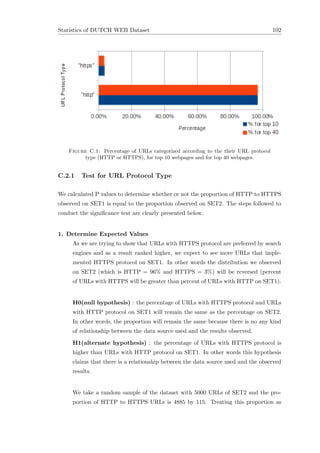
C.1 Percentage of URLs categorized according to the their URL protocol type
(HTTP or HTTPS), for top 10 webpages and for top 40 webpages. . . . . 102
vii
List of Figures viii
C.2 Top 25 eTLDs found in our dataset, both for top 10 and top 40 ranked
webpages. . . . . . . . . . . . . . . . . . . . . . . . . . . . . . . . . . . . . 106
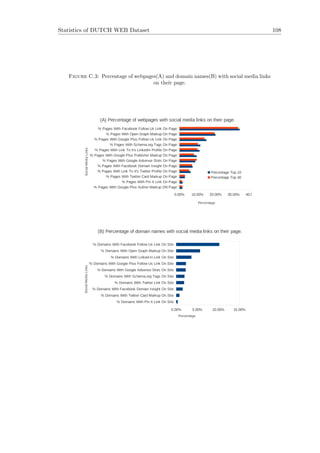
C.3 Percentage of webpages(A) and domain names(B) with social media links
on their page. . . . . . . . . . . . . . . . . . . . . . . . . . . . . . . . . . . 108
C.4 Percentage of search terms which have exact math and partial match with
domain name of ranked webpages (EMD and PMD). . . . . . . . . . . . . 109
C.5 Percentage of top 20 domains in SET2. . . . . . . . . . . . . . . . . . . . . 111
C.6 Table description of raking factors database table. . . . . . . . . . . . . . 114
List of Tables
1.1 List of ”Related Searches” suggestion given for a search term ”Jaguar”
on Google.nl and Google.com . . . . . . . . . . . . . . . . . . . . . . . . . 5
3.1 Basic statistics on the dataset used by Bifet et al. [1], Su et al. [2] and [3] 28
3.2 Comparing the factors used by Bifet et al. [1], Su et al. [2] and Evans [3]
in their study. . . . . . . . . . . . . . . . . . . . . . . . . . . . . . . . . . . 28
3.3 Basic statistics on the dataset used by SearchMetrics, Moz and Netmark . 32
3.4 Comparison of the top 10 factors suggested by SearchMetrics, Moz and
Netmark for Google.com in 2013 . . . . . . . . . . . . . . . . . . . . . . . 33
3.5 Characteristics of publicly available benchmark datasets for learning to
rank . . . . . . . . . . . . . . . . . . . . . . . . . . . . . . . . . . . . . . . 34
4.1 Count of search terms grouped by the number of words they contain . . . 38
4.2 On-page factors, content related . . . . . . . . . . . . . . . . . . . . . . . 49
4.3 Backlinks and outlinks related factors . . . . . . . . . . . . . . . . . . . . 51
5.1 Example of calculating Spearman rho on sample data. . . . . . . . . . . . 54
5.2 Example of calculating Rank Biserial correlation coefficient on sample data. 57
5.3 Example of handling NaN and tie occurrences on input data. . . . . . . . 60
6.1 Basic statistics on the final dataset used in this research . . . . . . . . . . 66
B.1 Example of NDCG calculation explained. . . . . . . . . . . . . . . . . . . 92
B.2 Mean of Spearman Rank Correlation Coefficient Vs Coordinate Ascent
Feature Weight, LETOR4.0-MQ2008-list . . . . . . . . . . . . . . . . . . . 94
B.3 Mean of Spearman Rank Correlation Coefficient Vs Coordinate Ascent
Feature Weight, DUTCH-WEB Dataset . . . . . . . . . . . . . . . . . . . 96
C.1 Basic statistics on the SET1 and SET2 sets . . . . . . . . . . . . . . . . . 100
C.2 Backlink related data . . . . . . . . . . . . . . . . . . . . . . . . . . . . . . 112
ix
Abbreviations
SEO Search Engine Optimization
SEA Search Engine Advertising
SERP Search Engine Results Page
ROI Return On Investment
LETOR LEarning TO Rank
Ads Advertisement
RQ Research Question
SRQ SubRsearch Question
BL Backlinks
ST Search Term
FB Facebook
GP Google Plus
REF Referring
URL Uniform Resource Locater
API Application Program Interface
NaN Not a Number
x
Chapter 1
Introduction
In this chapter, an introduction to the research carried out will be presented. Once this
is done the reasons that motivated this research and main objective will be outlined.
Furthermore, main research questions are formulated and sub questions are defined to
aid in answering the main research questions. Finally a short structure of the report is
given to guide the reader. Since the detailed explanation for most of the key terms used
in this chapter are located in other chapters, a reference to the exact section is given for
each of them.
1.1 Background
It is a continuous battle between, on the one end giant search engines (see Section 2.2)
like Google continuously updating their ranking algorithms aiming to weed out lower-
quality websites from their search result pages (see Section 2.3) to satisfy searchers,
on the other end SEO1 companies and SEO (see Section 2.5) specialists, researchers
tirelessly digging to find the secrecy of how exactly these search engines evaluate websites
to ultimately determine which site to show for which search term2(see Section 2.4). This
makes it hard task for the later one to keeping track of the algorithms and the ranking
factors(see Section 2.6).
Generally there are two approaches to come up with set of ranking factors (also referred
as factor or feature) that have higher influence in well-ranking.
The first approach is, calculating correlation coefficient (e.g. Spearman) between a
factor and the rank of it’s corresponding webpages (ranked document in general) on a
1
Search Engine Optimization
2
In this document we use ’search term’, ’search query’, ’query’ and ’keywords’ interchangeably
1
Chapter 1. Introduction 2
particular search engine. There are several companies, that follow this approach and
produce analysis[4] [5] [6] on SEO and SEM3 to provide advice on which ranking factors
should be used, and how it should be implemented. Similarly there are a number of
commercial and free SEO tools4567 that help website owners look into their websites
and identify elements of a site that search engines deem as important.
The best example for such tools is the Webmaster Tools, which is a free service offered
by Google that helps you monitor and maintain your site’s presence in Google Search
results. This tool helps to monitor your website traffic, optimize your ranking, and
make informed decisions about the appearance of your site’s search results[7]. Similarly
Indenty, has built a tool called LeadQualifier8 that perform initial analysis on a website
by quickly scanning several online marketing elements. Although they are few in number,
the factors checked by the LeadQualifier lie into different categories (technical, content,
popularity and social signal) of ranking factors. Some of the checks the tool makes are :
• It checks if a website is accessible to search engines by checking the setting on the
Robots.txt file.
• It checks if a website has a sitemap.
• It checks if a website is built with/without frames and flash components.
• It checks if a website has an associated Facebook fan page.
• It also checks the popularity of a website using Google’s PageRank9 and the num-
ber of Backlinks10 it has.
The second approach is, to train a ranking model(also referred as ranker and ranking
function) using machine learning techniques, on datasets and select the features that
contributed most for a better performing ranker. In the area of machine learning feature
selection is the task of selecting a subset of factors to be considered by the learner. This
is important since learning with too many features is wasteful and even worse, learning
from the wrong features will make the resulting learner less effective[8]. Learning to rank
(see Section 2.8) is a relatively new field of study aiming to learn a ranking function
from a set of training data with relevance labels [9]. Dang and Croft [8] conducted
3
Search Engine Marketing
4
http://moz.com/
5
http://www.screamingfrog.co.uk/seo-spider/
6
https://chrome.google.com/webstore/detail/check-my-links/ojkcdipcgfaekbeaelaapakgnjflfglf?
hl=en-GB
7
http://offers.hubspot.com/
8
http://www.leadqualifier.nl/
9
http://en.wikipedia.org/wiki/PageRank
10
Currently LeadQualifier gets the Backlinks for a website from other service provider.
Chapter 1. Introduction 3
an experiment on the LETOR learning to rank dataset with different learning to rank
algorithms aiming to select the most important features for document ranking.
The motivation for this research comes from the problems and drawbacks we observed in
both of these two approaches. We observe some common limitations with the LeadQual-
ifier in particular and most of the other SEO tools we came across in general. Likewise
we have identified a number of limitations regarding the SEO analysis which are pub-
lished by SEO companies and the dataset used to generate their reports. In-addition,
we have noted some drawbacks of the datasets used in learning to rank to train ranking
systems . The limitations are discussed below, categorized in to three topics.
1. Limitations of SEO Tools :
(a) The LeadQualifier needs to implement a check for more factors to give a better
advice on how to improve a website’s search engines visibility, currently it
has implemented less than 20 checks. There are over 200 different factors (or
signals) used by Google[10] to rank webpages, although it is not known what
these factors are.
(b) The most important factors should be given a priority when performing the
checks, therefore knowing which factors are more important is necessary.
(c) The LeadQualifier should be less dependent on external tools such as the
PageRank. Google used to have a publicly available SOAP API to retrieve the
PageRank of URL but not any more. As a result there is a growing concern
that the PageRank may cease to exist eventually, leaving the LeadQualifier
and other similar SEO tools at risk.
2. Limitations of SEO Companies’ Analysis :
(a) There is huge difference among the claims being made by different parties
concerning which factors are the most influential ones for ranking better on
search engines.
(b) There is no guarantee that the ranking factors suggested by different SEO
companies (e.g. SearchMetrics11, Moz12) and experts are valid since most of
them are not scientifically supported rather are based on survey, on a non-
representative sample dataset analysis and experience.
(c) Moreover, there is no enough research carried out to approve or disapprove
that the generic ranking factors suggested by experts and SEO companies
are applicable to searches originating from specific region. For instance we
11
http://www.searchmetrics.com/en/
12
http://moz.com/
Chapter 1. Introduction 4
are not sure if the ranking factors suggested by NetMark[5] are applicable for
search quires submitted on The Netherlands version of Google(i.e. Google.nl).
Sometimes search results of same search query on Google.nl and Google.com is
different. We found it very interesting, to see the different ”Related Searches”
suggestion Google provided for exactly same query (i.e. ”Jaguar”13 submitted
to Google.nl and Google.com at the same time. Table 1.1 shows, out of the 8
suggestion only one (i.e ”jaguar f type”) was suggested by both Google.nl and
Google.com as a ”Related Searches” for the query ”Jaguar”. This implicates
that the ranking algorithm used in one data center is subtly different from
the ranking algorithm used in another, thus the factors used might also be
different.
(d) Some previous studies on Google’s ranking algorithm have not concluded
whether or not correlation is causal. For instance SearchMetrics have clearly
pointed out that : correlation = causation . Which means higher correlation
does not necessary show that, having that particular factor will bring a lead on
search results. Instead a correlation should be interpreted as a characteristics
of well ranked pages.
(e) SEO Companies are too reluctant to clearly define the methodology they
follow while producing their correlation studies, and only few of them have
provided the full dataset (query, url, feature) openly for the public.
3. Limitations of the Learning To Rank Datasets:
(a) Most of the common learning to rank benchmark datasets do not disclose the
set of queries, documents, factors they used (e.g. Microsoft and Yahoo!).
13
Jaguar : Jaguar Cars is a brand of Jaguar Land Rover, a British multinational car manufacturer
(http://en.wikipedia.org/wiki/Jaguar_Cars, July 04, 2014). At the same time Jaguar is a big cat,
a feline in the Panthera genus, and is the only Panthera species found in the Americas (http://en.
wikipedia.org/wiki/Jaguar, July 04, 2014).
Chapter 1. Introduction 5
Table 1.1: List of ”Related Searches” suggestion given for a search term ”Jaguar” on
Google.nl and Google.com
Google.nl Google.com
jaguar animal jaguar parts
jaguar price atari jaguar
jaguar mining jaguar forum
jaguar fittings used jaguar
jaguar f type jaguar xf
jaguar bathroom fittings jaguar f type
jaguar land rover jaguar e type
jaguar xk jaguar xke
It is important for the reader to understand that we do not intend to solve all the limi-
tations listed above in this research. To begin with, as a partial solution for limitation
2(a), we have identified 70 factors and decide to include them in the research. Also we
aim that, by calculating correlation values for each factors, we will know which factors
are more important than others, which gives an answer to limitation 1(b). Although
it is not part of this research, we believe it is possible to calculate PageRank for web-
pages/websites by analyzing large corpus of webpages like the CommonCrawl14 data,
which could partially solve the limitation mentioned on 1(c).
Limitations 2(a), 2(b) and 2(c) can be regarded as the core problems that initiated
this research. As mentioned in 1(a) the different (sometimes colliding) claims released
by SEO companies, which are broadly discussed in Chapter 3 Section 3.4, were quite
alarming to conduct our own investigation on the issue. While performing the intensive
background research, we observe that, there are ranking factor analysis white-paper
publications based on datasets optimized to the USA, Germany, France, Italy and UK,
on search engines such Bing, and Google. To our knowledge there is none such study
conducted mainly for The Netherlands, so we figured to make the case study of this
research to The Netherlands, which will help us answer the problem mentioned on 2(c).
When it comes to choosing a dataset suitable to the goals of our research, we had
two possible options. The first one was to search for a publicly available dataset that
is constructed for similar research. So, we began by looking into the raw data re-
leased by Moz which was used in their analysis on the U.S. search results from Google
search engine(can be retrieved from this link http://d2eeipcrcdle6.cloudfront.net/
search-ranking-factors/2013/ranking_factors_2013_all_data.tsv.zip). How-
ever, this conflicted with our wish to do analysis on the Dutch web. Then we discovered
the learning to rank benchmark datasets such as LETOR4.0 (see Section 3.5). These
14
http://commoncrawl.org/
Chapter 1. Introduction 6
benchmark datasets are very well constructed for multiple purposes, but as mentioned
on 3(a) they do not suit to be used as dataset on our research, because most of them
do not disclose the set of queries, documents (webpages in our case) and factors used.
All this lead us to the second option, which was to collect/prepare our own dataset
which contains query, url and factors (this set is also referred as ”DUTCH WEB” in
this document) and perform experimental analysis, at the same time give an answers to
the limitation mentioned on 2(c) and 3(a).
The other thing is, as pointed out in 2(d) there is no clear knowledge on how to interpret
the previously published (mainly white-papers) correlation result on similar researches.
It is therefore our wish to answer this limitation by training a ranking model based on
the collected dataset, extract the weight of the factors used in the model and compare
it with their relative correlation result. Another possible approach would be to re-rank
a test dataset using the trained ranking model and compare the rank with Google’s
position/rank of each webpages, this way the correlation results could be evaluated.
Finally, the researcher wish to publicly release a clear definition of the methodology
followed while producing the results of this thesis and the datasets collected and con-
structed for this purpose. As mentioned in 2(e) such resources can encourage fellow
researchers to perform more analysis on the web particularly the Dutch web and play
their role in solving problems similar to the ones discussed here.
Concluding, the challenge of this research is confined to, finding highly influential factors
to well-ranking webpages by integrating the two approaches introduced above, using
DUTCH WEB and LETOR datasets. At same time compare, complement, evaluate
results of the first approach by the second approach, in order to achieve scientifically
supported and reliable result.
1.2 Objective
Formally the main objective of this research can be defined as follows:
Design and conduct an empirical research, to come up with scientifically evaluated list of
ranking factors that are highly influential (factors that have higher contribution to well
ranked webpages), using the DUTCH WEB and LETOR4.0 datasets.
1.3 Research Questions
In this section the general problem discussed above is refined into a clearly formulated
research questions and some sub-questions.
Chapter 1. Introduction 7
The fundamentals of this research are based on the following three main research ques-
tions(RQ). To be able answer the main research questions, we break them down into
sub research questions (SRQ).
• RQ-1: Which ranking factors influence organic search results(see Section 2.3)?
– SRQ-1.1: Which techniques exist to identify the most important factors for
ranking well on search engines?
– SRQ-1.2: Which ranking factors have been studied in previous researches?
• RQ-2: Is it better to use only the top well ranked pages (e.g top 40) while com-
puting correlation coefficients instead of using all ranked pages per search term?
• RQ-3: How can we evaluate the importance of ranking factors?
– SRQ-3.1: Is there any sensible relationship between the calculated correlation
coefficient of a ranking factor (first approach) and it’s corresponding weight
assigned by a ranker(second approach)?
– SRQ-3.2: Does considering highly correlated ranking factors give a better
performing ranker, compared to using the whole set of ranking factors?
1.4 Approach
In this section a high level view to the approach followed to conduct this research is
presented. We reviewed similar works from the academia and the SEO industry, to
learn the techniques used, the features analyzed and the results obtained.
We conduct our research on two different datasets, the LETOR and DUTCH WEB
datasets. To construct the DUTCH WEB dataset, we pull a total of 10,000 Dutch
search terms from local database of Indenty. As it will be explained in Chapter 3, it is
a common practice to use search terms of approximately 10,000 for correlation analysis,
hence we believe that using a sample of this size can represent all search terms. Then,
we fetched a maximum of top 40 webpages for each search term from the search result
page of Google.nl. From each webpage 52 factors are extracted to build the full DUTCH
WEB dataset which contains (query, factors and document). More about the datasets,
and how they were collected, cleaned etc is discussed in Chapter 4.
For the DUTCH WEB dataset we calculate Rank-Biserial and both Spearman Rank
and Kendall Tau correlation coefficients for dichotomous and continuous ranking factors
respectively. The reasons for choosing these correlation coefficients will become more
Chapter 1. Introduction 8
clear in Chapter 3 and Chapter 5. Similarly we computed Spearman Rank correlation
between the features of the LETOR dataset and the ground-truth of each ranked web-
page. For the DUTCH WEB dataset we also performed additional statistical analysis,
and presented the results in percentage.
Later the DUTCH WEB dataset was used to construct another LETOR like dataset in
the SVMLight format for the purpose of training a ranking model. This new LETOR
like dataset was further divided into three subsets ”TRAIN SUBSET” 60%, ”VALIDA-
TION SUBSET” 20% and ”TEST SUBSET” 20%. Two listwise approaches of learning
to rank algorithms namely Coordinate Ascent, and LambdaMART are used to train
ranking models using the ”TRAIN SUBSET” and ”VALIDATION SUBSET”. Later, to
determine how well the trained models perform we conducted an evaluation using the
unseen and untouched ”TEST SUBSET”. We used ERR@10 and NDCG@10 to mea-
sure the performance of the models. A similar model is again trained using the LETOR
dataset. We unpack the trained models, and look into the weight of the factors assigned
by the trained models. Comparing the weight of these factors with their previously
calculated correlation coefficient enabled us to answer the core question of this research.
The evaluation process and techniques utilized are broadly discussed in Chapter 7.
The flow diagram below depict the whole process flow of tasks involved in this research.
Some of the task names used in the diagram will be more clear in the coming chapters.
Chapter 1. Introduction 10
1.5 Contributions
1.5.1 Theoretical
This thesis provides results to show that, considering few from the bottom and few
from the top (40 for each in our case) of the ranked webpages gives stronger correlation
coefficient. Additionally, we deduced indirectly that strong positive (if not just positive)
correlation is not always a cause for well ranking.
1.5.2 Algorithmic
To conduct the research, it was necessary to write our own algorithms for some of the
correlations, particularly Rank-Biserial Correlation and Spearman Rank Correlation. In-
addition, an algorithm that produce score (relevance judgment) out of Google’s position,
and an algorithm for converting position into natural ranking were written. Details about
algorithms and the over all methodology is broadly discussed in Chapter 5.
1.5.3 Percentage and Correlation Results
As mentioned earlier the main goal of the research is finding a list of ranking factors
that have a higher influence on well ranking, given that it also provides some statistical
(percentage) results that show insights to the DUTCH WEB.
1.5.4 Prototype
The system developed to gather the dataset, extract the factors and the algorithms
implemented to calculate correlations, and to construct dataset for learning to rank
algorithms can be taken as prototype, to build commercial tool.
1.5.5 Dataset
Unlike previous studies done with similar goal as this research, the content of the datasets
analyzed in this research is mainly composed in Dutch language. Therefore it is our
belief that this datasets are unique, useful assets and we consider them as part of the
contribution of this research. This datasets (listed below) are gathered, cleaned, filtered
and constructed in certain format to fit the goal of the research. Yet, they can be re-used
to conduct similar researches. Details of the datasets is provided in Chapter 4
Chapter 1. Introduction 11
1. Dataset of nearly 7568 Dutch search terms, which passed necessary cleaning and
filters.
2. Raw data (i.e. downloaded webpages), approximately 21.6 GB size, which could
be re-used to conduct similar researches.
3. Dataset that contains 52 factors along with their values for around 300639 (=7568x40)
webpages.
4. Dataset constructed in SVMLight format for the purpose of training a ranking
model using learning to rank techniques.
1.6 Document Structure
This document is structured as follow: Chapter 1 (this chapter) provides an introduc-
tion to the thesis. Chapter 2 provides preliminary knowledge about the key terms and
concepts which are discussed through out the rest of this document. Chapter 3 discusses
previous researches conducted related to the topic, both from academia and from the
SEO industry including companies and experts. Chapter 4 discusses the process of the
data gathering, factor extraction other basic information about the dataset which was
used to conduct this research. Chapter 5 presents the methodology used to conduct this
research, algorithms developed, and high level design of the prototype system developed.
Chapter 6 presents correlation graphs for the DUTCH WEB, and LETOR datasets and
discusses the results. In Chapter 7 we talk about our evaluation measures, evaluation
strategies and discusses the evaluation results using learning to rank algorithms. Chap-
ter 8 gives the conclusion, recommendation and future studies. Basic information on
the LETOR dataset can be found in Appendix A. Appendix B contains, the raw data
used to make the graphs in Chapter 7 plus terminal commands and parameter settings
used to train models are provided. Further analysis results about the DUTCH WEB
are provided in Appendix C.
Chapter 2
Background : Web Search and
Ranking
The main goal of this chapter is to provide a background knowledge related to web search
and ranking. It includes the definition and explanation of the key aspects and concepts
that are discussed through out the rest of the document. This chapter is supposed to
help reader define the key terms, so that he/she can have a clear picture of the intention
of the research.
2.1 Web Search
Web search is the act of looking for webpages on search engines such as Google or
Bing. Webpages are web documents which can be located by an identifier called a uni-
form resource locator (URL) for example: http://www.utwente.nl/onderzoek/ (see
Section 4.2.1). Webpages are usually grouped into websites, sets of pages published
together for example: http://www.utwente.nl[11]. The entire collection of all inter-
linked webpages located around the planet is called the Web, also known as the World
Wide Web (WWW)1. In 2014, Google announced2 the web is made up of 60 trillion
(60,000,000,000,000) individual pages with makes an index of over 100 million giga-
bytes, and it is constantly growing. According to WorldWideWebSize.Com3 the Dutch
indexed web alone is estimated to be at least 204.36 million pages until 05 June, 2014.
When someone perform a web search on search engines he will get back a list of hyper-
links to prospective webpages. This list may have a hundred or more links. They are
1
http://en.wikipedia.org/wiki/World_Wide_Web(01,May,2014)
2
http://www.google.com/insidesearch/howsearchworks/thestory/(05,June,2014)
3
http://worldwidewebsize.com/index.php?lang=NL(05,June,2014)
12
Chapter 2. Background : Web Search and Ranking 13
often divided up into a number of SERPs(see Section 2.3). From a SERP, he can decide
which link he should try and see if it contains what he is looking for.
2.2 Web Search Engine
Web search engines are very important tools to discover any information in World Wide
Web[12]. When Internet users want to work on something they usually start with search
engines 88% of the time4.
To explain what a search engine is we like to use a real world analogy. Search engines
such as Google and Bing are like a librarian, not a normal one but a librarian for every
book in the world. People depend on the librarian every day to find the exact book they
need. To do this efficiently the librarian needs a system, and he needs to know what is
inside every book and how books relate to each other. He could gather information about
the books by reading the books’ titles, categories, abstracts etc. His system needs to
take in the gathered information, process it and spit out the best answer for a reader’s
question. Similarly search engines are librarians of the Internet, their system collect
information about every page on the web so that they can help people find exactly what
they are looking for. And every search engine has a secret algorithm which is like a
recipe for turning all that information in to useful organic or paid search5.
Search engines such as Google and Bing provide a service for searching billions of indexed
webpages for free. The result search engines display for every search query submitted is
composed of free (none ads6) and paid (ads) webpages. The naturally ranked webpages
also known as organic search are webpages determined by search engine algorithms for
free, and can be optimized with various SEO practices. In contrast, paid search allows
website owners to pay to have their website displayed on the search engine results page
when search engine users type in specific keywords or phrases7. The figure below [Figure
2.1] depicts the elements inside search engines and flow of the process.
4
http://www.nngroup.com/articles/search-engines-become-answer-engines/(05,June,2014)
5
http://www.goldcoast.qld.gov.au/library/documents/search_engine_optimisation.pdf
6
Advertisement
7
http://offers.hubspot.com/organic-vs-paid-search
Chapter 2. Background : Web Search and Ranking 14
Figure 2.1: Ranking inside search engine
2.3 Search Engine Results Page (SERP)
A search engine results page is the listing of results returned by a search engine in
response to a keyword query8. The results normally include a list of items with titles, a
reference to the full version, and a short description showing where the keywords have
matched content within the page. If we see into Google’s SERP, the elements / listings
included in a SERP are growing in number and in type. Some of the elements of a SERP
are :
• Organic Results : Organic SERP listing are natural results generated by search
engines after measuring many factors, and calculating their relevance in relational
to the triggering search term. In Google’s term, organic search results are web-
pages from a website that are showing in Google’s free organic search listings9.
As mentioned above only organic search results are affected by search engine op-
timization, not paid or ”sponsored” results such as Google AdWords[10].
• Paid Results : Paid also know as ”Sponsored” search results, are listing on the
SERP that are displayed by search engines for paying customers (website owners)
which are set to be triggered by particular search term (e.g. Google Adwords)10.
• Knowledge Graph : The Knowledge Graph is a relatively newer SERP element
observed on search engines particularly Google used to display a block of informa-
tion about a subject11. This listing also shows an answer for fact questions such
as ”King Willem Alexander Birthday” or ”Martin Luther King Jr Assassination”.
8
http://en.wikipedia.org/wiki/Search_engine_results_page
9
https://support.google.com/adwords/answer/3097241?hl=en(June 11, 2014)
10
http://serpbox.org/blog/what-does-serp-mean/
11
http://moz.com/blog/mega-serp-a-visual-guide-to-google
Chapter 2. Background : Web Search and Ranking 15
• Related Searches : This part of the SERP is where search engines provide
suggestion on related search terms to the one submitted.
2.4 Search Term
Billions of people all around the world conduct search each day by submitting search
terms on popular search engines and social networking websites. A search term also
know as keyword is the textual query submitted to search engines by users.
Note : In this document search term, keyword, and query will be used interchangeably,
therefore the reader should regard them as synonymous.
2.5 Search Engine Optimization (SEO)
For companies, or individuals who own a website search results matter, when their
page have higher ranking it helps people find them. E-commerce companies are very
interested and curious on how the ranking is done. This is due to the fact that being
found on the Internet for a given search term is continuously becoming major factor to
maximize ROI12.
The key to higher ranking is making sure the website has the ingredients also known as
”raking factors” search engines need for their algorithm that we refer as recipe on the
previous sub section, and this process is called Search Engine Optimization (SEO). In
other words Search Engine Optimization is often about making small modifications on
your website such as the content and code. When viewed individually, these changes
might seem like incremental improvements but they could have a noticeable impact on
your site’s user experience and performance in organic search results[10].
2.6 Ranking Factors
Ranking factors also known as ranking criteria are the factors used by search engines in
evaluating the order of relevance of a webpage when someone searches for a particular
word or phrase13. It is almost obvious that the ranking factors have different weight
assigned to them. For instance according to SearchMetrics white paper SEO guideline
made for Bing USA 2013[4], ”the existence of keyword on domain” is still one of the
major ranking factor probably with the highest weight.
12
Return on Investment
13
http://marketinglion.co.uk/learning-lab/search-marketing-dictionary
Chapter 2. Background : Web Search and Ranking 16
Although different entities(companies, individuals) independently suggest various fac-
tors for ranking well on search results, there are some basic SEO practices. To give a
sense of what these practices are, we will discuss some of them here. First, words used
in the content of a webpage matter, search engine account for every word on the web,
this way when someone search for ”shoe repair” the search engine can narrow results
to only the pages that are about those words. Second, titles matter, each page on the
web has an official title, users may not see it because it is in the code. Search engine
pay a lot of attention to titles because they often summarize the page like a book’s
title. Third, links between websites matter, when one webpage links to another it is
usually a recommendation telling readers this site has good information. A webpage
with a lot of links coming to it can look good to search engines but some people try to
fool the search engine by creating or buying bogus links all over the web that points to
their own website. This phenomenon is called Search Engine Persuasion (SEP) or Web
Spamming [13]. Usually search engines can detect when a site has a lot of them, and
they account for it by giving links from trustworthy site more weight in their ranking
algorithm14. Fourth, the words that are used in links also know as anchor text matter
too, if your webpage says ”Amazon has lots of books” and the word ”books” is linked,
search engine can establish that amazon.com is related to the word ”books”, this way
when some one search ”books” that site will rank well. Lastly, search engines care about
reputation, sites with consistent record of fresh, engaging content and growing number
of quality links may be considered rising stars and do well in search rankings. These are
just the basics and search engine algorithms are fined and changed all the time which
makes chasing the algorithms of giant search engines such as Google always difficult.
Apparently, good SEO is not just about chasing the algorithm but making sure that a
website is built with all the factors search engines need for their algorithms15.
Note : In this document ranking factor, ranking criteria, and feature will be used inter-
changeably, therefore the reader should regard them as synonymous.
2.7 Webpage Ranking
Ranking is sorting objects based on certain factors[14]: given a query, candidates doc-
uments have to be ranked according to their relevance to the query[15]. Traditionally,
webpage ranking on search engines was done using a manually designed ranking func-
tion such as BM25, which is based on the probabilistic retrieval framework. Where as
now, as it will be discussed in Section 2.8, webpage ranking is consider as a problem of
Learning to rank.
14
http://searchengineland.com/guide/what-is-seo
15
http://sbrc.centurylink.com/videos/marketing/digital-marketing/
search-engine-optimization-seo/
Chapter 2. Background : Web Search and Ranking 17
2.8 Learning to Rank (LETOR)
The task of ”learning to rank” abbreviated as LETOR has emerged as an active and
growing area of research both in information retrieval and machine learning. The goal
is to design and apply methods to automatically learn a function from training data,
such that the function can sort objects (e.g., documents) according to their degrees
of relevance, preference, or importance as defined in a specific application16. The steps
followed when learning to rank if it is applied to a collection of documents (i.e. webpages
in our case) are :
1. A number of queries or search terms are accumulated to make a training model;
each search terms are linked to set of documents(webpages).
2. Certain factors are extracted for each query-document pair, to make a feature
vector(i.e. list of factor id and with their relative value).
3. A relevance judgments (e.g. perfect, excellent,good, fair or bad), which indicates
the degree of relevance of each document to its corresponding query, are included
in the data.
4. Ranking function also know as ranking model is created by providing the training
data to a machine learning algorithms, so that it can accurately predict the rank
of the documents.
5. In testing, the ranking function will be used to re-rank the list of documents when
a new search term is submitted[16].
6. To measure how well the ranking function did the prediction, evaluation metrics
like Discounted Cumulative Gain(DCG)[17] or Normalized Discounted Cumulative
Gain(NDCG)[18] are required.
Figure 2.2 precisely shows the process flow of learning to rank and the components
involved[19].
Generally there are three types of learning to rank approaches, these are :
• Pointwise Approach : The pointwise approach regards a single document as its
input in learning and defines its loss function based on individual documents[20].
• Pairwise Approach : The pairwise approach takes document pairs as instances
in learning, formalizes as document A is more relevant than document B with
respect to query q.
16
http://research.microsoft.com/en-us/um/beijing/events/lr4ir-2008/
Chapter 2. Background : Web Search and Ranking 18
Figure 2.2: A general paradigm of learning to rank for IR[19].
• Listwise Approach : Listwise learning to rank operates on complete result
rankings. These approaches take as input the n-dimensional feature vectors of all
m candidate documents for a given query and learn to predict either the scores
for all candidate documents, or complete permutations of documents[20]. Some of
listwise models are : AdaRank, ListNet,LambdaMART, Coordinate Ascent.
Note : In this document ranking model, ranking function, and ranker will be used inter-
changeably, therefore the reader should regard them as synonymous.
2.9 Summary
The naturally ranked webpages also known as organic search are webpages determined
by search engine algorithms for free, and can be optimized with various SEO practices.
Search Engine Optimization (SEO) is often about making small modifications on your
website such as the content and code to get higher ranking on search engines.
Chapter 3
Related Work
This chapter will present a review of previous and continuing researches that are related
to the topic of this thesis. The review was conducted with an intent to answer the ques-
tion SRQ-1.2 :”Which techniques exist to identify the most important factors for ranking
well on search engines?”. In chapter 1 we mentioned that there are two approaches that
are currently followed to identify important ranking factor, and here we review previous
works for both approaches. Along side, we assess the ranking factors analyzed in these
researches, and present a summarized review to answer SRQ-1.2 :”Which ranking factors
have been studied in previous researches ?”.
A concise result on the search carried out to discover what benchmark datasets exist,
how are they constructed/prepared to conduct similar researches is also included in this
chapter. At last it gives a comparison tables on the ranking factors analyzed by different
SEO companies, as well as the academia, and sum up with a summary.
3.1 Machine Learning Based Studies
The works reviewed here utilized different machine learning techniques to conduct their
researches. As introduced in previous chapters, one way of coming up with set of impor-
tant ranking factors for well ranking is : to train a ranking model using machine learning
techniques (ranking algorithms), on datasets and select the factors that contributed most
for a better performing ranker. Here, we include two previous works conducted with
the same basic approach but different end goal (e.g. reverse engineer Google’s ranking
algorithm).
The first work, is a research by Su et al. [2], they tried to predict the search results
of Google. First they identified 17 ranking factors (see Table 3.4), then prepared a
19
Chapter 2. Related Work 20
dataset of 60 search terms, scanned top 100 ranked webpages from Google.com, download
webpages from the original website and extract the ranking factors from the pages. Then
they train different models on a training subset (15 search terms) and later predict ranks
of webpages on Google for a test subset (45 search terms). They experimented on linear
programming algorithm which makes a pairwise comparison between two documents in
a given dataset. Given a set of documents, pre-defined Google’s ranking, and a ranking
algorithm A, their goal was to find a set of weights that makes the ranking algorithm re-
produce Google ranking with minimum errors. Inaddition, they experimented on linear
and polynomial implementations of SVM-rank, which also makes a pairwise comparison
between a pair of documents. They showed results that indicate linear learning models,
coupled with a recursive partitioning ranking scheme, are capable of reverse engineering
Google’s ranking algorithm with high accuracy. More interestingly, they analyzed the
relative importance of the ranking factors towards contributing to the overall ranking of a
page by looking into the weights of the ranking factors assigned by trained ranking models.
Based on their experiments, they consistently identified PageRank as the most dominate
factor. Keyword in hostname, and keyword in title tag, keyword in meta description
tag and keyword in URL path are also among their leading factors. Unfortunately,
the general validity of this paper’s result made us a bit skeptical due to the limited
dataset that was used in the experiments. On top of that, this paper experimented on
webpages that are composed in English. However, despite this disclaimer, we used the
methodologies of this paper as a foundation to formulate our approach.
A similar research by Bifet et al. [1] tried to approximate the underlying ranking func-
tions of Google by analyzing query results. First they gathered numeric values of ob-
served features from every query result, thus converting webpages in to vectors. Then,
they trained their models on the difference vectors between documents at different ranks.
They used three machine learning techniques (binary classification, logistic regression
and support vector machines) along with the features to build their models. With the
binary classification model, they formulate their problem as pairwise comparison : given
a pair of webpages they try to predict which one is ranked above the other, hence the
model do not give a full ranking. With the models from logistic regression and support
vector machines, they were able to get full ranking of the webpages. Their main goal was
to obtain an estimation function f for the scoring function of a search engine, and then
to compare their predicted rankings with the actual rankings of Google. To analyze the
importance of the features they computed precision values obtained using only individual
features to predict the ranking. The authors used a dataset containing keywords from 4
different categories (Arts, States, Spam, Multiple) each holding 12 keywords. These 12
search terms are further divided into three disjoint sets (7 training terms, 2 validation
terms and 3 test terms). However, the search terms they selected sounds arbitrary, and
Chapter 2. Related Work 21
fail to represent the typical user query both qualitatively and quantitatively. For each
query the top 100 result webpages are downloaded. Using the Google API 5 inlinks
for each URLs of each result webpages are retrieved and they considered only HTML
pages on their experiment. When we see to their outcome, the models only marginally
outperformed the strongest individual feature (i.e., the feature with the most predictive
power) for a given keyword category. Based on this result, the authors concluded that
Google uses numerous ranking factors that are “hidden” (i.e., not directly observable
outside of Google).
Bifet et al. [1] indicated few interesting points as reasons for not performing well. Some
of them are, in certain countries search engines voluntarily cooperate with the authorities
to exclude certain webpages for legal reasons from the results. It appears that certain
webpages are pushed up or down on queries for reasons related to advertisement or other
agreements. Another interesting idea pointed out on this paper is that it is possible that
search engines take user profile and geographic location of query initiators into account.
For example someone in a third world country with very slow Internet connection might
be interested in result pages totally different than someone in first world country with
better connection speed. Their paper also mentioned some room for improvements,
the best precision achieved was only 65% for all the features, datasets and methods
considered. Better precision can be obtained on the prediction by making substantial
change on the features and dataset used.
To summarize, from these works we learn how machine learning techniques could be
used to discover the influence of ranking factors in search engines. One of the common
shortcomings we observed from these works is : the fact that their results are based on
a small and non-representative dataset analysis.
3.2 Rank Correlations Based Studies
An other approach to identify the influence of factors on ranking is to calculate rank
correlation coefficients between feature values and rank of webpages on certain search
engine. There are many companies which follow this approach, however the review here
elaborates works from three of the leading SEO companies currently on the business
namely SearchMetrics1, SEOMoz2, and NetMark3. In this section, brief discussion about
the methodology they use and findings of these companies will be presented. The figure
below [Figure3.1] is used to elaborate how the correlation coefficients are calculated in
the next sections.
1
http://www.searchmetrics.com/en/white-paper/ranking-factors-bing/
2
http://moz.com/blog/ranking-factors-2013/
3
http://www.netmark.com/google-ranking-factors
Chapter 2. Related Work 22
Figure 3.1: Fictitious data to help explain the concepts and equations in this chapter
which are referring to this table
3.2.1 Spearman Rank Correlation
In statistics, Spearman’s rank correlation coefficient is a nonparametric measure of sta-
tistical dependence between two variables4. A high positive correlation coefficient occurs
for a factor if higher ranking pages have that feature / or more of that feature, while
lower ranking pages do not / or have less of that feature. SearchMetrics produces a
number of white papers and guidelines focusing on the definition and evaluation of most
important factors that have high rank correlation with top organic search results of sev-
eral search engines. Recently they have released evaluation white paper for Bing.com in
the USA for the year 2013 [4], similarly they have published white papers optimized for
Google.co.uk, Google.fr, Google.it etc.. They use Spearman correlation to assesses how
well the relationship between rank of a webpage and a particular ranking factor is. Ac-
cording to their study technical site structure and good content are basic requirements
for ranking well. Also social signals have a clear positive correlation to higher ranking,
with Google+ leading the rest of the social medias.
SearchMetrics analyses are based on search results for a very large keyword set of 10,000
search terms from Bing USA. The first three pages of organic search results(SERPs)
(i.e. maximum of 30 webpages) were always used as a data pool for each search term,
which sums up to a maximum of 30*10,000 = 30,0000 webpages in total.
Even though, SearchMetrics’s reports are the most recent and detailed analysis on SEO
ranking factors (to our knowledge), some SEO experts5 criticizes SearchMetrics for re-
leasing confusing reports such as saying ”keywords in title have 0 correlation coefficient”.
Another limitation of SearchMetric’s reports is the fact that they have not conducted
an analysis optimized for Google Netherlands yet.
Similarly Moz [6] runs a ranking factors study to determine which attributes of pages and
sites have the strongest association with ranking highly in Google. Their study consists
of two parts: a survey of professional SEOs and a large Spearman correlation based
analysis. On their most recent study Moz surveyed over 120 leading search marketers
who provided expert opinions on over 80 ranking factors. For their correlation study,
4
http://en.wikipedia.org/wiki/Spearman’s_rank_correlation_coefficient
5
http://www.clicksandclients.com/2013-rank-correlation-report/
Chapter 2. Related Work 23
since they had a wide variety of factors and factor distributions (many of which are
not Gaussian), they preferred Spearman correlation than the more familiar Pearson
correlation (as Pearson correlation assumes the variables are Gaussian)6. The dataset
they used contains a list of 14,641 queries, and collected the top 50 search results for
each of the queries on the query list from Google’s U.S. search engine.
Moz’s key findings include: Page Authority7 correlates higher than any other metric
they have measured. Social signals, especially Google +1s and Facebook shares are
highly correlated to Google’s ranking. Despite the updates (Google Panda8 and Google
Penguin9), anchor text correlations remain as strong as ever. On its report Moz made
it clear that the factors evaluated are not evidence of what search engines use to rank
websites, but simply show the characteristics of webpages that tend to rank higher.
With slightly different approach, Netmark [5] calculated mean Spearman rank correla-
tion by first calculating correlation coefficient for each keyword and then averaged the
results together. Their main reason for choosing mean Spearman rank correlation co-
efficient is to keep the queries independent from one another. Below is the formula for
Spearman rank correlation coefficient when no duplicates(ties) are expected[21].
ρ = 1 −
6Σd2
i
n(n2 − 1)
(3.1)
ρ = rho (the correlation coefficient)
di = the differences between the ranks (di = xi − yi)
n = the total number of observations
To explain how this formula (3.1) is used to calculate the mean Spearman correlation
coefficient an example is provided below :
Let’s say we want to find out how well Facebook shares of a particular website’s/webpage’s
fan page (x) are correlated to Google’s ranking (y) for given search term (see ’Position’
and ’Facebook Share’ columns from Figure 3.1 ). The first step is to sort the Google
results (i.e. the ranked pages) by their Facebook shares in descending order. Next, we
take the difference between the rank of Facebook share of a page and the rank of page’s
position on Google which gives us a the variable di = xi − yi. Now all the variables we
need for the above formula (3.1) are provided. To keep the search terms independent
6
http://moz.com/search-ranking-factors/methodology#survey
7
Page Authority is Moz’s calculated metric for how well a given webpage is likely to rank in
Google.com’s search results. It is based off data from the Mozscape web index and includes link counts,
MozRank, MozTrust, and dozens of other factors.(http://moz.com/learn/seo/page-authority, July
10, 2014)
8
http://en.wikipedia.org/wiki/Google_Panda
9
http://en.wikipedia.org/wiki/Google_Penguin
Chapter 2. Related Work 24
from each other, Spearchman rank correlation coefficient is calculated for each search
term, and then averaged across all the search terms for the final result (mean Spearman
rank correlation coefficient).
3.2.2 Kendall Rank Correlation
The Kendall (1955) rank correlation coefficient evaluates the degree of similarity between
two sets of ranks given to a same set of objects[22]. Similar to Spearman, Kendall rank
correlation coefficient is another correlation measure for non-parametric data10 as it
compares the rankings of the variables instead of the variables themselves, although by
nature Kendall’s results usually show weaker correlations [5]. Below is the formula used
by Netmark to calculate the Kendall rank correlation.
τ =
C − D
1
2n(n − 1)
(3.2)
τ = tau (the Kendall rank correlation coefficient)
C = the number of concordant pairs
D = the number of discordant pairs
n = the total number of observations
To explain how the above equation (3.2) is utilized for this analysis : let’s say we decided
to compare Google’s result(x) against the total number of Backlinks(y) of the ranked
pages(see ’Position’ and ’Backlinks’ columns from Figure 3.1). When moving down the
list, any pair of observations (xi, yi) and (xj, yj) are said to be concordant ( C in
equation 3.2 ) if the ranks for both elements agree: that is, if both xi > xj and yi > yj
or if both xi < xj and yi < yj. They are said to be discordant (D in equation 3.2), if
xi > xj and yi < yj or if xi < xj and yi > yj. If xi = xj or yi = yj, the pair is neither
concordant nor discordant. Now we have all the variables needed for equation 3.2, after
computing Kendall correlation for each search query we average across all results to
come up with the final result (mean Kendall correlation).
3.2.3 Rank Biserial Correlation
Biserial correlation refers to an association between a random variable X which takes
on only two values(for convenience 0 and 1), and a random variable Y measured on
a continuum [23]. Netmark performed an analysis based on Spearman and Biserial
correlation. On their report [5] they argue that, for variables that are binomial in
10
In statistics, the term non-parametric statistics refers to statistics that do not assume the data or
population have any characteristic structure or parameters
Chapter 2. Related Work 25
nature (meaning only one of two results) the Rank-Biserial correlation coefficient is a
preferred method of analysis. For example (see ’Position’ and ’Search Term = Domain’
columns from Figure 3.1), to compare Google’s result (Y ) with whether or not domain
name (i.e. domain name of the raked pages) is an exact match of the search term (X)
: the first step is to take the average rank of all observations that have X set to ’1’
(Y1), next subtract the average rank of all observations that have X set to ’0’ (Y2).
Then the results are inserted into equation (3.3) to calculate Rank-Biserial correlation
coefficient for each search term. Finally, the final result (mean Rank-Biserial correlation
coefficient) is calculated by averaging across all search terms Rank-Biserial correlation
coefficients.
rrb =
2(Y1 − Y2)
n
(3.3)
rrb = Rank-Biserial correlation coefficient
Y1 = the Y score mean for data pairs with an X score of 1
Y2 = the Y score mean for data pairs with an X score of 0
n = the total number of data pairs
Their study is conducted on 939 search engine queries with 30 Google results pulled per
keyword and 491 variables analysed per result. And it shows that off-page factors still
have a much more higher correlation to ranking on Google than on-page factors. It also
shows that there is still strong correlation between exact match of domain to the search
query and ranking.
3.2.4 Variable Ratios
In mathematics, a ratio is a relationship between two numbers of the same kind(e.g.,
objects, persons, students, spoonfuls, units of whatever identical dimension), usually
expressed as ”a to b” or a:b, sometimes expressed arithmetically as a dimensionless
quotient of the two that explicitly indicates how many times the first number contains
the second (not necessarily an integer)11.
To determine whether Google uses several filters for detecting unnatural12 Backlinks
and social profiles of webpages and websites, Netmark performed ratio analysis on dif-
ferent variables and compare those ratios to Google’s search engine results. First they
calculated the ratios by taking a variable as denominator ( e.g. Page Authority) and
several other variable as numerator (e.g. Number of Page Facebook Likes).
11
http://en.wikipedia.org/wiki/Ratio_analysis
12
Google defines unnatural links as “Any links intended to manipulate a site’s ranking in Google
search results. This includes any behavior that manipulates links to your site, or outgoing links from
your site.
Chapter 2. Related Work 26
PageAuthorityRatio = NumberofPageFacebookLikes
PageAuthority
Then they used the resulting ratios to calculate Spearman correlation with Google’s
search rankings.
3.2.5 Normalization
In statistics, an outlier is an observation point that is distant from other observations.
An outlier may be due to variability in the measurement or it may indicate experimental
error; the latter are sometimes excluded from the dataset[24]. When computing correla-
tion coefficients[5] it is a common practice to normalize the raw data before averaging.
In statistics, normalization means adjusting values measured on different scales to a
notionally common scale, often prior to averaging13.
If two variables are compared with a different order of magnitudes, a common way
to standardize those variables is by computing a z-score for each observation[5]. The
mathematical equation to do this is:
z =
(x − µ)
σ
(3.4)
z = the standardized score
x = raw data to standardize
µ = the mean
σ = the standard deviation
3.2.6 P Value
In statistical significance testing, the p-value is the probability of obtaining a test statistic
result at least as extreme as the one that was actually observed, assuming that the null
hypothesis is true[25].
A researcher will often ”reject the null hypothesis” when the p-value turns out to be less
than a predetermined significance level, often 0.05[26] or 0.01. Such a result indicates
that the observed result would be highly unlikely under the null hypothesis.
P value is a statistical measure that helps scientists determine whether or not their
hypotheses are correct. P values are usually found on a reference table by first calculating
a chi square value.
13
http://en.wikipedia.org/wiki/Normalization_(statistics)
Chapter 2. Related Work 27
3.2.7 Chi Square
Chi Square(written x2) is a numerical value that measures the difference between an
experiment’s expected and observed values14. Netmark used chi square to calculate
the correlation of factors that are categorized as limited, such as the Top-Level Do-
mains(TLD). The equation for chi square is:
x2
= Σ(
(o − e)2
e
) (3.5)
Where ”o” is the observed value and ”e” is the expected value.
3.3 Data Analysis Based Study
Evans [3] tried to identify the most popular techniques used to rank a webpage high in
Google. The paper presents the results of a study on 50 highly optimized webpages that
were created as part of a Search Engine Optimization competition. The study focuses
on the most popular techniques that were used to rank highest in this competition,
and includes an analysis on the use of PageRank, number of pages, number of in-links,
domain age and the use of third party sites such as directories and social bookmarking
sites. A separate study was made on 50 non-optimized webpages for comparison. This
paper provides insight into the techniques that successful Search Engine Optimizers use
to ensure that a page ranks high in Google. This work also recognizes the importance
of PageRank and links as well as directories and social bookmarking sites.
Evans pointed out that the limitation of his work is that it only analyzed the top 50
web sites for a specific query (i.e. ”V7ndotcom Elursrebmem”). Analyzing more web
sites and comparing with similar studies in different competition would provide more
concrete results. His study only analyzed 6 off-page factors, analyzing more factors and
considering on-page factors could give more solid outcome.
3.4 Previously Analyzed Ranking Factors
In this section we present tables that summarizes the ranking factors analyzed by the
academic papers and white papers reviewed in previous sections. In addition we give
basic information about the datasets utilized in these researches.
14
http://www.wikihow.com/Calculate-P-Value
Chapter 2. Related Work 28
Table 3.1: Basic statistics on the dataset used by Bifet et al. [1], Su et al. [2] and [3]
INFO Bifet (2005) Su(2010 ) Evans(2007)
Search Terms 48 60 1
Webpages per Search Term Top 100 Top 100 Top 50
Factors per Webpage 22 17 6
Search Engine Google Google Google
3.4.1 Academic Papers
To help the reader get a quick glimpse on the amount of search terms, webpages and
ranking factors analyzed by the papers reviewed we prepared table 3.1. Consequently,
table 3.4.1 is prepared to show the similarity and disparity of the factors analyzed in
these papers ( Bifet et al. [1], Su et al. [2] and Evans [3]). To help the reader compare,
factors that are similar are filled with same background color(non-white) and ordered
accordingly. Only one factor is included in all there (i.e. PageRank), four matching
factors used by [1] and [2], one matching factor used by [2] and [3] and two between [1]
and [3].
Table 3.2: Comparing the factors used by Bifet et al. [1], Su et al. [2] and Evans [3]
in their study.
# Bifet (2005 ) Su(2010 ) Evans(2007)
1 PageRank of the page,
or the approximation of
the PageRank in a 0-
10 scale obtained from
Google’s toolbar
PageRank score PageRank of a web site
2 Fraction of terms in the
documents which can
not be found in an En-
glish dictionary
Age of the web site’s domain
(in years)
Age of the web site’s do-
main name
3 Term is in the page’s
URL or not
Keyword appear in hostname
(boolean)
Number of webpages in
a site indexed by search
engine
4 Number of pages
linking to a page, in-
degree approximated
using Google API link:
queries
Keyword in the path segment
of url (boolean)
Number of in-links to a
web site
Continued on next page
Chapter 2. Related Work 29
Table 3.2 – continued from previous page
# Bifet (2005) Su(2010) Evans(2007)
5 Term is listed in a web
directory or not
Size of the web site’s do-
main(number of characters)
Listing in Yahoo and
DMoz directories
6 Term as an at-
tribute value (ele-
ment/@attribute):
IMG/@ALT,
IMG@TITLE(N)
Keyword in image tag
(boolean)
Number of pages listed
in Del.icio.us
7 Term in the meta key-
words or description
Keyword in meta-keyword tag
(boolean)
–
8 Term in a special doc-
ument zone including
HTML tags: B, I,
U, FONT, BIG, H1-H6,
A,LI and TITLE
Keyword in the title tag of
HTML header (boolean)
–
9 Average position of the
query terms in the doc-
ument = 1 at the begin-
ning, 0 if at the end and
in-between in the mid-
dle.
Keyword in meta-description
tag (boolean)
–
10 Average matches of the
query terms
Keyword density (percentage) –
11 Closeness of terms in
the query in the web-
page (distance in num-
ber of terms , smallest
windows containing all
of them)
Keyword in h1 tag (boolean) –
12 Anchor text term fre-
quency
Keyword in h2 tag (boolean) –
Continued on next page
Chapter 2. Related Work 30
Table 3.2 – continued from previous page
# Bifet (2005) Su(2010) Evans(2007)
13 Similarity of the term to
the document, in terms
of vector space model.
We compute it using
the frequency of terms
in documents and the
inverse document fre-
quency of each term.
Keyword in h3 tag (boolean) –
14 Average term length Keyword in h4 tag (boolean) –
15 Term frequency of
query term = Number
of occurrences of the
query term (averaged
over the different query
terms)
Keyword in h5 tag (boolean) –
16 Term in capitals in the
page
Keyword in anchor text
(boolean)
–
17 Number of bytes of text
in the original docu-
ment
Age of the webpage (in years) –
18 Number of different
terms of the document
– –
19 Number of out-links in
the page
– –
20 Fraction of out-links to
external Web sites
– –
21 Number of bytes of the
original document
– –
22 Relative frequency of
the more frequent term,
i.e.: term frequency.
If a document has 3
words and the most fre-
quent word repeats 2
times,then this is 2/3
– –
Chapter 2. Related Work 31
Chapter 2. Related Work 32
Table 3.3: Basic statistics on the dataset used by SearchMetrics, Moz and Netmark
INFO SearchMetrics(2013) Moz(2013) Netmark(2013)
Search Terms 10,000 14,641 939
Webpages per Search Term Top 30 Top 100 Top 30
Factors per Webpage >44 >80 491
Search Engine Bing US Google Google
3.4.2 White Papers
The companies mentioned above make their own white papers of ranking factors based
on their own study, and summarized information about search terms and webpages
analyzed is provided on table 3.3. The table bellow shows the top 10 factors suggested
by SearchMetrics, Moz and Netmark aiming to clarify the similarity and disparity of
the ranking factors. 8 of the factors from SearchMetrics lay under the category of social
signal where as Moz do not have any social signal on it’s top 10. When we look at
Netmark most of the factors on the top 10 are related to Backlink, and have one social
signal on the 5th place. Having Google+1 page is suggested by both SearchMetrics and
Netmark as a major factor, other than that there are no matching factors between them.
Chapter 2. Related Work 33
Table 3.4: Comparison of the top 10 factors suggested by SearchMetrics, Moz and
Netmark for Google.com in 2013
# SearchMetrics Moz Netmark
1 Google +1 Keyword in title Exact Match Domain
2 Facebook Shares Organic anchor text distribu-
tion
Keyword Anchor Text
Links from Domains to
Page
3 Number of BackLinks Number of Links Domains to
page
Keyword Anchor Text
Links to Page
4 Facebook Total Keywords on page Page Authority
5 Facebook Comments Number of Links Domains to
domains
Page Google+1s
6 Facebook Likes Linking page relevance Linking Domains to
Page
7 Pinterest Domain Trust Linking Sub-domains to
Page
8 Tweets PageRank “No Text” Anchor Text
Links from Domains to
Page
9 Percentage of Back-
Links with rel=nofollow
Number of Links with with
partial match
External Links to Page
10 SEO-Visibility of back-
linking URL
Link type diversity “No Text” Anchor Text
Links to Page
Chapter 2. Related Work 34
3.5 Learning to Rank Benchmark Datasets
In an effort to understand the format of the datasets that are widely used for learning
to rank studies, we reviewed 3 of the most popular benchmark datasets nowadays. The
datasets are namely LETOR, Yahoo and Microsoft datasets. All the datasets contains a
set of query-document pairs, represented by 46 up to 700 ranking features, and relevance
judgments is provided by professional annotators.
Table 3.5 provides a summarized information on the number of queries, documents,
relevance levels, features and year of release of each dataset.
Table 3.5: Characteristics of publicly available benchmark datasets for learning to
rank
Dataset Queries Doc. Rel. Feat. Year
LETOR 4.0 2,476 85 k 3 46 2009
Yahoo 36,251 883 k 5 700 2010
Microsoft 31,531 3,771 k 5 136 2010
As mentioned in Chapter 1, the common problem observed on all these datasets is that,
the queries and URLs are not disclosed, instead these informations are represented by id.
The LETOR dataset includes the list of features where as Yahoo has not disclosed the
features, similarly Microsoft has only provided a high level description of the features
category. The main reason for keeping the features closed is : since features are major
component of any learning to rank system, it is important for search engines like Yahoo
and Bing to keep the features secrete. Similarly disclosing the queries and URLs could
also lead to a risk of reverse engineering the features used by their ranking system
which then will be used by SEO community to weaken the effectiveness of the ranking
system[15].
We found LETOR4.0-MQ2008-list version of the LETOR dataset very convenient for our
study. The main reason for selecting this dataset is the availability of clear definition of
the feature sets. In addition this dataset is constructed particularly to train models using
listwise learning to rank techniques, which is a perfect fit to our goal. Details regarding
how this particular dataset is constructed are briefly presented in Appendix A.
3.6 Summary
To sum up we have reviewed 3 academic papers published focusing on identifying ranking
factors that have high correlation with well ranking webpages. In addition to that we
Chapter 2. Related Work 35
tried to review studies from 3 companies on the SEO industry, one is survey based and
the other two are empirical researches. Overall, from this review we learn that, the
suggestions made by academic researchers and SEO experts on the issue related to the
topic is conflicting, which makes it confusing for Webmasters to implement one. What is
more frustrating is that the Internet marketing advice we hear often is not substantiated
with any empirical evidence. Another weakness is none of these studies have conducted
a similar research which is optimized to The Netherlands. Which tells us there is a gap
to be filled, and we believe it deserves a self standing research.
Chapter 4
Datasets and Ranking Factors
In this chapter we discuss the search engine, ranking factors and data source selected
for the research. First details about the data gathering is provided, then rules and pro-
cedures followed to extract the required factors is elaborated. The goal is to give fellow
researchers insights on how to repeat the data gathering, feature extraction process,
what challenges to expect and the infrastructures required.
4.1 Data Gathering
The flow diagram on figure 4.1 depict the activities and data involved while making
DUTCH WEB dataset. Each major activities and data are discussed in detail next to
that.
36
Chapter 4. Datasets and Ranking Factors 37
Figure 4.1: Data gathering process flow.
Chapter 4. Datasets and Ranking Factors 38
Table 4.1: Count of search terms grouped by the number of words they contain
# WORDS COUNT EXAMPLE
1 2009 slaapboek
2 3589 vacature automotive
3 1507 zwarte woud wandelen
4 370 50 jarig huwelijksfeest schip
5 75 appartement te koop de panne
6 12 wat zit er in een pijp
7 5 finanacial controller jobs in english in netherlands
9 1 financial jobs for italian native speaker in the netherlands
Total 7568
4.1.1 Collecting Search Terms
Since the case study of this research is focused on The Netherlands, the first step is to
collect Dutch search terms. Initially a total of 10,000 unique Dutch search terms are
fetched from an existing proprietorial repository at Indenty. This repository contains
Dutch search terms that were collected from campaigns of customers’ websites in more
than 10 years. After removing duplicates by using exact string matching and some
additional data cleaning we end up with 7568 unique search terms. The table 4.1 shows
the count of search terms grouped by the number of words they contain. For instance
the first row shows search terms that contain only one word are 2009. As mentioned
early the search term dataset is mainly of Dutch language, but very few English search
term like the last two rows from the table above are also included in it.
Chapter 4. Datasets and Ranking Factors 39
4.1.2 Selecting Search Engine
After collecting the necessary search terms, the next step was to choose a search engine,
to submit the queries in to. Once again since the case study of this research is for The
Netherlands, the main criteria was to find a search engine that is focused on search
queries originating from this region. The second criteria was popularity of the search
engine. Last, the proprietary ”Ranking Scanner” at Indenty (see Section 4.1.3) should
have already implemented a search result page scrapper for the search engine.
We choose Google.nl, the Google version for The Netherlands, because it is dedicated to
handle search queries originating from this region. Most importantly, Google is by far
the largest search engine, and that’s not only the case in the U.S., but worldwide[4]. The
illustration on figure 4.2 was made by SearchMetrics in 2012, and shows that Google
still holds an approximate share of 78% among other search engines. In addition the
”Ranking Scanner” already supports scrapping search result pages from Google.nl.
Figure 4.2: Illustration of current search engines worldwide share made by Search-
Metrics.
4.1.3 Scan SERPs and Fetch Ranked Pages
We used Indenty’s proprietorial crawler called ”Ranking Scanner” to fetch the ranked
webpages on the first 4 SERPs (top 40 pages) of every search query. On Google a single
SERP often lists 10 organic search results, but sometimes this number could be lower
Chapter 4. Datasets and Ranking Factors 40
for brand searches. The crawler gathered URLs of exactly top 40 ranked webpages for
93% of the search terms. Search terms with less than 40 ranked pages are removed from
the dataset to keep it simple and to avoid possible bias.
4.1.4 Download Webpages
To conduct this research it was necessary to download the ranked webpages on specific
period of time. It is also possible to extract the desired factors from the ranked web-
pages online, however the web is so dynamic and the content of webpages and their
rank changes instantly. For this reason, we downloaded the top 40 ranked webpages
(i.e. the first 4 consecutive SERPs each with maximum of 10 results) for a total 7568
unique Dutch search terms over a period of one month ( from 01 to 30 February, 2014).
The final dataset contains approximately 302720 webpages with 21.6 GB size. As men-
tioned previously, this dataset is referred as DUTCH WEB dataset in this document.
It must be noted that similar results from other SEO companies such as SearchMetrics
reports cannot be compared on a perfectly common basis because the data gathering
was executed at different times.
4.2 Extracting Ranking Factors
Here we give specifics of how the ranking factors used in this research are computed. In
addition brief definition of some key terms and concepts are provided.
Although Google claims to use 200 features, we analyzed a set of only 52 factors. The
intention is to find out the relationship between these identified factors and the well
ranked pages on Google’s search result page. The process of selecting these factors
involves gathering ranking factors suggested by the top three SEO companies at this
time(SearchMetrics, SEOMoz, and NetMark), and previous academic researches. In
addition some factors suggested by experts in the field are also added to the list. After
mixing up all and removing duplicates the final list contains 52 unique factors.
For clarity purpose the factors are categorized in to two main streams: on-page and
off-page factors. On-page factors are further grouped in to content and coding factors.
Ranking factors related to coding of the webpage are not investigated in this research,
because we believe that search engines are not looking into technical quality any more
since most websites are using a highly optimized frameworks such as WordPress. The
off-page factors are also split in to backlink and social signal.
Chapter 4. Datasets and Ranking Factors 41
Before going further, several general remarks need to be outlined. First, most of the
factors are computed at the webpage level, but some of them are computed at domain
level. Second, some count factors (Continuous variables) are aggregated in a sensible
way. For instance, instead of counting the existence of search term in <B>, <I>, and
<Strong>tags separately we compute sum of the counts and form a new composite
feature.
Note that, not every factor that is included in this research is discussed here. Factors that
are very common and repetitive are not discussed to avoid duplication in the document.
Another remark is, since all factors cannot be measured with one method, we have
classified them into three categories.
• Limited Factors : Limited factors are variables that can take one out of fixed
number of possible values. For example the TLD extension of a domain can be eu,
nl, net or com.
• Dichotomous Factors : Dichotomous factors also known as binary factors are vari-
ables that can take either yes or no for a value. Example EMD and PMD can take
yes or no.
• Unlimited Factors : Unlimited factors also known as continuous factors are vari-
ables that can take value from 0 upto infinity. For example the number of times a
search term appear inside the text between <Body>tags is unlimited.
4.2.1 URL Related Factors
URL related factors are factors that are extracted from the URL of each webpage. A
total of 12 variables are extracted for each URL on the DUTCH WEB dataset. A
detailed description of all the 12 variables will be presented in this section. Earlier to
that some terms which are used in the context are briefly discussed.
What is Uniform Resource Locater ?
A uniform resource locater, abbreviated as URL (also known as web address, particularly
when used with HTTP), is a specific character string that constitutes a reference to a re-
source. An example of a typical URL would be ”http://www.utwente.nl/onderwijs/
websites_opleidingen/”. A URL is technically a type of Uniform Resource Identifier
(URI). URLs are commonly used for webpages (HTTP), but can also be used for file
transfer (ftp), email (mailto) and many other applications[27]. Before discussing the
Chapter 4. Datasets and Ranking Factors 42
factors related to URL, it is important to understand the basic parts that make up a
URL. Some of the basic parts of URL are described below:
Figure 4.3: The structure of SEO friendly URL
Figure 4.4: The structure of old dynamic URL.
• Protocol : Each URI begins with a protocol identifier and ends by a colon and two
forward slashes. The protocol identifier indicates the name of the protocol to be
used to fetch the resource. For example Hypertext Transfer Protocol (HTTP) is
typically used protocol to serve up hypertext documents. HTTP is just one of many
different protocols used to access different types of resources on the net. Other
protocols include Hypertext Transfer Protocol Secure (HTTPS), File Transfer Pro-
tocol (FTP), Gopher, File, and News 1. Although protocols are case insensitive,
the canonical form is lowercase[27]. An implementation should accept uppercase
letters as equivalent to lowercase in protocol identifiers (e.g., allow ”HTTP” as
well as ”http”).
• Domain Name : Domain names serve as more easily memorable names for Internet
resources such as computers, networks, and services. A domain name consists of
one or more parts, technically called labels, that are conventionally concatenated,
and delimited by dots, such as example.com. The only valid characters for a
domain name are letters, numbers and a hyphen ”-”. Other special characters like
1
http://docs.oracle.com/javase/tutorial/networking/urls/definition.html
Chapter 4. Datasets and Ranking Factors 43
the underscore or an exclamation mark are NOT permitted. For example: your_
name.com is incorrect because it contain underscore, where as your-name.com is
a correct domain name.
• Top-Level Domain : The top-level domains (TLDs) such as com, net and org
are the highest level of domain names of the Internet. The right-most label of
every domain name conveys the top-level domain; for example, the domain name
www.example.com belongs to the top-level domain com. In other words, every
domain name ends with a top-level domain label. The list below summarizes this:
– URL: http://www.example.net/index.html
– Top-level domain name: net
– Second-level domain name: example.net
– Hostname: www.example.net
• Second-Level and Lower Level Domains : Below the top-level domains in the
domain name hierarchy are the second-level domain (SLD) names. These are the
names directly to the left of .com, .net, and the other top-level domains. As an
example, in the domain example.co.uk, co is the second-level domain. There can
be third, fourth, fifth-level domains, and so on, with virtually no limitation.
• Subdomain : The hierarchy of domains descends from the right to the left label
in the name; each label to the left specifies a subdivision, or subdomain of the
domain to the right. For example: example.com is a subdomain of the com do-
main, and in www.example.com www is a subdomain of example.com. The full
domain name may not exceed a total length of 253 ASCII characters in its textual
representation[28].
• Hostname : A hostname is a domain name that has at least one associated IP
address. For example, the domain names www.example.com and example.com are
also hostnames, whereas the com domain is not. However, other top-level domains,
particularly country code top-level domains, may indeed have an IP address, and
if so, they are also hostnames. Hostnames impose restrictions on the characters
allowed in the corresponding domain name. A valid hostname is also a valid domain
name, but a valid domain name may not necessarily be valid as a hostname.
• Path/Folders : The path or folder (see Figure 4.3) component contains data,
usually organized in hierarchical form, that, along with data in the non-hierarchical
query component serves to identify a resource within URI. The path is terminated
by the first question mark (”?”) or number sign (”#”) character, or by the end of
the URI. A path consists of a sequence of path segments separated by a slash(”/”)
character.
Chapter 4. Datasets and Ranking Factors 44
• Query : The query (see Figure 4.4) component contains non-hierarchical data that,
along with data in the path component serves to identify a resource within the
scope of the URI. The query component is indicated by the first question mark
(”?”) character and terminated by a number sign (”#”) character or by the end of
the URI. The characters slash (”/”) and question mark (”?”) may also represent
data within the query component.
• Fragment/Named Anchor : The fragment identifier component also know as ‘Named
Anchor‘ by SEO experts (see Figure 4.3) is indicated by the presence of a number
sign (”#”) character and terminated by the end of the URI.
• Public Suffix : A public suffix also know as eTLD2 is one under which Internet
users can directly register names. Some examples of public suffixes are .com, .co.uk
and pvt.k12.ma.us. With Mozilla’s initiative we now have a publicly open database
of top-level domains (TLDs) including the respective registry’s policies on domain
registrations at different levels3, named the Public Suffix List(PSL). This list helps
in finding the highest level at which a domain may be registered for a particular
top-level domain.
There is a major confusion between ”TLD” and ”Public Suffix”. The source of
this confusion is that people tend to say ”TLD” when they mean ”public suffix”.
However, these are independent concepts. So, for example,
– uk is a TLD, but not a public suffix
– co.uk is a public suffix, but not a TLD
– squerf is neither a TLD nor a public suffix
– com is both a TLD and a public suffix
Below, we discuss URL related factors extracted with example and the constraints con-
sidered.
1. URL EXACT MATCH TO DOMAIN : One of the latest changes to the Google
search algorithm is something known as Exact Match Domain (also known as
Keyword Domains) abbreviated as EMD. Exact Match Domain (will be referred
as EMD from here below) imply to the use of a possible search term for your
website’s domain. For instance, if www.restaurantsinenschede.nl is a website’s
domain, ”Restaurants In Enschede” is an exact phrase that visitors might type
into Google.nl when looking for restaurants around Enschede. While it might not
2
Effective Top-Level Domain (eTLD) is a deprecated synonym of Public Suffix
3
https://wiki.mozilla.org/Gecko:Effective_TLD_List
Chapter 4. Datasets and Ranking Factors 45
be deliberate, there are companies out there that name their website’s domain to
match a certain search term in order to get a better ranking on search engines, even
though they have poor content. Google sees this as unfair advantage over other
sites that offer legitimate content without using this practice. In 2013 Google
announced that they have updated their algorithm with EMD to penalize low
quality websites. We wanted to see how Google’s EMD update is affecting the
Dutch web on our dataset by analyzing the ”URL EXACT MATCH TO DOMAIN”
dichotomous factor.
The string matching we used for this factor is quite strict. We set the EMD factor
as ”true” only if all the words in a search term are also found on the domain
name of the ranked webpages, concatenated in the same order, with or without a
hyphen ”-”, and case insensitive string matching. Below, some examples of EMD
are given:
(a) If search term = ”iphone” and domain = www.iphone.com then this is an
EMD.
(b) If search term = ”t mobile” and domain = www.t-mobile.com then this is
an EMD.
(c) If search term = ”q able” and domain = q-able.com/ then this is an EMD.
2. URL PARTIAL MATCH TO DOMAIN : Partial Match to Domain abbreviated
as PMD is a domain name combined of search term and other extra information (
e.g. business name, location etc). The string matching we used for EMD is quite
strict, so we decided to check the PMD with more flexible string matching rules.
For instance if the search term contains two words, and the domain name contains
at least one of these words, then we say there is a partial match between the search
term and the domain name. The following examples elaborate PMD :
(a) search term : ”iphone” , domain : www.iphoneclub.com : this is a PMD.
(b) search term : ”iphone house” , domain : www.phonehouse.nl : this is a
PMD.
Percentage of URLs in the DUTCH WEB dataset which have ”true” value for
EMD and PMD is provided in Appendix C.5.
3. URL HAS PUBLIC SUFFIX : As mentioned earlier it is useful to determine
whether a given domain name might represent an actual domain on the Internet.
For this purpose, we use data from the Public Suffix List (PSL). More precisely,
if domain.hasPublicSuffix() returns ”true”, then the domain might correspond
to a real Internet address otherwise, it almost certainly does not relate to ac-
tual domain. For example, URLs which have IP address as domain name (e.g.
Chapter 4. Datasets and Ranking Factors 46
http://195.193.209.12/subdomain/document.pdf) often return ”false” for this
check. Similarly URLs which are pointing to pages with error (e.g. ”HTTP 404 :
Page Not Found”) or simply invalid URLs also returned ”false” for this check.
4. URL DOMAIN IS VALID : Indicates whether the domain is a syntactically valid
domain name using lenient validation. Specifically, validation against RFC 3490
4 (”Internationalizing Domain Names in Applications”) is skipped. Some URLs,
even if they does not have a valid public suffix happen to have a valid domain (i.e.
URL DOMAIN IS VALID was set to ”true”). On the other hand all URLs with
invalid domain were immediately treated as if they don’t have public suffix (i.e.
URL HAS PUBLIC SUFFIX was set to ”false”).
5. URL SEARCH TERM OCCURRENCE COUNT IN URL PATH : This factor sim-
ply contains the number of occurrences of a search term in the URL’s path part.
This particular URL’s path from our dataset (/technology-built-environment/
electrotechnology/welcome_electrotechnology/welcome_electrotechnology_
home.cfm) contains the search term ”electrotechnology” 3 times. The string
matching is configured both for exact match and partial match.
6. URL DEPTH : Depth of a URL is determined by counting the number of ”/” in
it’s path part. The following two URLs have URL DEPTH of 1 : http://www.
youtube.com/playlist?list=PLxzMZI, and http://www.sub-domain.com/. While
the following has a URL DEPTH of 2 : http://nl.wikipedia.org/wiki/seo.
7. URL PROTOCOL : HTTP (HyperText Transfer Protocol) is the basic transport
protocol of the Web. The Web is a client/server system and some mechanism
needs to exist to move data between servers and clients. HTTP provides that
mechanism. Most Web browsers also uses other protocols, such as FTP, but the
vast majority of Web traffic is moved by HTTP. On the other hand nearly all secure
web communication takes place over HTTPS including online banking, e-mail, and
e-commerce transactions[29]. As of 2013-09-02, 24.6% of the Internet’s 168088
most popular web sites have a secure implementation of HTTPS[30]. In addition,
Google’s Matt Cutts5 said he would like to give ranking boost to websites that
have implemented SSL6. All these indicate that website security is still a hot topic :
and we suspect that search engines might prefer webpages that have implemented
HTTPS, and rank them on the top. Motivated by this, we conducted an analysis
to find out if there is any kind of relationship between URLs protocol (HTTP or
HTTPS) and it’s rank and the result are presented in Appendix C.2.1.
4
http://www.ietf.org/rfc/rfc3490.txt
5
http://www.mattcutts.com/blog/(Jun10,2014)
6
http://www.seroundtable.com/google-ssl-ranking-18256.html(June 10, 2014)
Chapter 4. Datasets and Ranking Factors 47
8. URL PUBLIC SUFFIX : This factor holds the public suffix of each URL.
9. URL TOP PRIVATE DOMAIN : This factor holds the TLD of each URL. The
top 25 most abundant TLDs as well as eTLDs are given in Appendix C.3.
4.2.2 Social Media Links On Page
This section provides details about factors which are related to social media in the
DUTCH WED dataset. We give a special emphasis to the social media influence on
webpage’s ranking because of the fact that the number of social media activity has been
growing rapidly in recent years. Visitors like to share and recommend contents with
their own network. This makes it important to have ”Share”, ”Like Us”, ”Recommend”
etc links/buttons on company’s websites and blogs. All the factors included in this
category are on-page factors : which are features that can be found and extracted from
the content and coding of webpages. It was not feasible to collect all the factor that
was initially planned, mainly because of technical barriers and partially due to time
limitation. We checked links for Facebook fan page, Google Plus fun page, Twitter
page, LinkedIn page etc. Since the factors are extracted in a similar fashion only one of
them is discussed below.
1. FACEBOOK FOLLOW US LINK ON SITE : It is no secret that Facebook has
become a major traffic driver for all types of websites. And we believe there are
Facebook ”Like” and ”Recommend” widgets on almost every website. We wanted
to see the relationship between this factor and a webpage’s position on Googl.nl.
Gathering links from a website that are pointing to the websites’s Facebook fun
page is bit tricky. First of all, the plugin code for the ”Like” or ”Follow Us” widgets
come in HTML5, XFBML, IFRAME and URL formats. Hence, a check for all the
formats is implemented, then duplicated and black listed links are removed. The
following box shows the checks implemented for different format of the ”Like”
button on a website using Jsoup in Java.
HTML5 : doc.select("[data-href*=www.facebook.com]")
XFBML : doc.select("[href*=www.facebook.com]")
IFRAME : doc.select("iframe[title*=Facebook][src*=www.facebook.com]")
4.2.3 Markups
Some of the markup related factors we extracted are briefly discussed here.
Chapter 4. Datasets and Ranking Factors 48
1. GOOGLE PLUS PUBLISHER MARKUP ON SITE : One advantage of having
this markup on a website is that when branded search queries are made in Google,
the Knowledge Graph (see Section 2.3) for that query should display a widget
for that brand’s corresponding Google+ page which includes: the name of the
Google+ page, number of followers of the page, last update from the page and an
option to follow the page for logged in users. Checking for this markup on the
page source of a website was pretty much straight forward as it is implemented
only in the following two formats.
<link href="[Google+ Page URL]" rel=publisher />
<a href="[Google+ Page URL]" rel="publisher">Google+</a>
2. TWITTER CARD MARKUP ON SITE : With Twitter Cards, one can attach
rich photos, videos and media experience to Tweets that drive traffic to his/her
website. By adding a few lines of HTML to a webpage, users who Tweet links
to the content of that webpage will have a ”Card” added to the Tweet that is
visible to all of their followers. The following snippet shows how we extracted this
markup from the page source of a website using Jsoup in Java.
doc.select("meta[name=twitter:card]")
3. FACEBOOK OPEN GRAPH MARKUP ON SITE : Facebook’s Open Graph pro-
tocol allows for web developers to turn their websites into Facebook ”graph” ob-
jects, allowing a certain level of customization over how information is carried over
from a non-Facebook website to Facebook when a page is ”recommended”, ”liked”,
or just generally shared. All of Facebook’s Open Graph META tags are prefixed
with og : then continued with the specific property to be set.
4. NO FOLLOW MARKUP ON SITE : This markup provides a way for webmasters
to tell search engines ”Do not follow links on this page”7. More importantly,
instead of telling search engines and bots not to follow any links on the page, it
lets webmasters to easily instruct robots not to crawl a specific link. For example:
<a href="signin.php" rel="nofollow">sign in</a>
Would it affect ranking if too many of this markup are discovered on the links in a
webpage. To answer this question we analyzed this factor by counting the number
of times it occurred in a page.
7
https://support.google.com/webmasters/answer/96569?hl=en
Chapter 4. Datasets and Ranking Factors 49
4.2.4 Content Related Factors
We performed two fundamental investigation on the scraped content of the ranked pages
for a given search query. First we check the existence of the search keyword or phrase
on different tags and then count the total number of words with in these tags. Below is
a table with the full list of content related factors and their description.
Table 4.2: On-page factors, content related
# Factor Category Description
1 Title word count Unlimited number of words with in <title>tag.
2 Body word count Unlimited number of words with in
<body>tag.
3 Meta description word count Unlimited number of words with in <meta
name=”description”>tag.
4 Meta keyword word count Unlimited number of words with in <meta
name=”keywords”>tag.
5 Sum word count in <b>,
<i>and <strong>
Unlimited number of words with in
<b>,<i>and <strong>tags.
6 Search term in <title>tag Dichotomous a boolean that is set to true if the
search term exists with in the <ti-
tle>tag.
7 Search term in <body>tag Dichotomous a boolean that is set to true if
the search term exists with in the
<body>tag.
8 Search term in meta descrip-
tion tag
Dichotomous a boolean that is set to true if the
search term exists with in the meta
description tag.
9 Search term in meta keyword
tag
Dichotomous a boolean that is set to true if the
search term exists with in the meta
keyword tag.
10 Search term in <p>tag Dichotomous a boolean that is set to true if
the search term exists with in the
<p>tag.
11 Search term in <a>tag Dichotomous a boolean that is set to true if
the search term exists with in the
<a>tag.
Continued on next page
Chapter 4. Datasets and Ranking Factors 50
Table 4.2 – continued from previous page
# Factor Category Description
12 Search term in <ul >or <ol
>tags
Dichotomous a boolean that is set to true if
the search term exists with in the
<ul>or <ol>tags.
13 Search term in the <b>or
<i>or <strong>tags
Dichotomous a boolean that is set to true if
the search term exists with in the
<b>or <i>or <strong>tags.
14 Search term in image alt tag Dichotomous a boolean that is set to true if the
search term exists with in the alt im-
age tag.
15 Search term in <h1>tag Dichotomous a boolean that is set to true if
the search term exists with in the
<h1>tag.
16 Search term in <h2>tag Dichotomous a boolean that is set to true if
the search term exists with in the
<h2>tag.
17 Search term in the <h3>tag Dichotomous a boolean that is set to true if
the search term exists with in the
<h3>tag.
18 Search term in the <h4>tag Dichotomous is a boolean that is set to true if
the search term exists with in the
<h4>tag.
19 Search term in the <h5>tag Dichotomous is a boolean that is set to true if
the search term exists with in the
<h5>tag.
20 Search term in the <h6>tag Dichotomous is a boolean that is set to true if
the search term exists with in the
<h6>tag.
4.2.5 Backlinks and Outlinks Related Factors
This type of factors tries to determine the quality or the popularity of a webpage/website
based on its connectivity in the web. The factors we managed to collect are backlinks
and outlinks. Backlinks, also known as incoming links, inbound links or inlinks are
incoming links to website or webpage. Backlinks are what Kleinberg called Authority
Chapter 4. Datasets and Ranking Factors 51
on his HITS algorithm[31], a good authority represented a page that was linked by many
different hubs. MajesticSEO api allow access to several Backlink related information.
It is almost disappointing that we are not able to gather the famous PageRank, for
understandable reasons (see Chapter 5).
For outlinks, we extracted three factors : links pointing to internal pages (i.e. with same
domain name), links pointing to external pages, and total number of all links found in
page.
Table 4.3: Backlinks and outlinks related factors
# Factor Category Description
1 Number of Backlinks Unlimited the total number of inbound links of
the website.
2 Indexed URLs Unlimited the total number of indexed URLs
of the website
3 Referring IP addresses Unlimited the total number of IP addresses re-
ferring to the website. This factor
is good to have to avoid link spam
farms.
4 Referring domains Unlimited the total number of unique domains
referring to the website.
5 Internal Links on Page Unlimited number of links found on a page
that point to internal pages (pages
of same website).
6 External Links on Page Unlimited number of links found on a page that
point to other websites.
7 All Links on Page Unlimited total number of links found on a
page.
4.3 Summary
To sum up this part of this document is written to report the data gathering and fea-
ture extraction process followed. A total number of 7568 unique Dutch search terms are
considered in this research. Top 40 ranked webpages for each search term on Google.nl
Chapter 4. Datasets and Ranking Factors 52
are scanned and 52 factors are extracted from each webpages. The majority of the rank-
ing factors extracted are on-page factors, and few off-page factors. We have extracted
URL related factors, social media links related factors, markup related factors, and
backlink/outlink related factors. We discussed in detail the motivation for extracting a
certain factor, and provide enough information to repeat the process.
Chapter 5
Algorithms and System Design
The goal of this chapter is, first to clearly present the mathematical definition of the
rank correlation coefficient equations utilized in this research. Then, to discuss the
algorithms designed to implement these equations and the constraints considered. Lastly,
to briefly discuss the high level system design, the technologies used and the challenges
encountered.
5.1 Correlation Coefficients
When ever there is a need to know if two variables are related to each other, we usually
compute a correlation coefficient. The “correlation coefficient” was coined by Karl Pear-
son in 1896. Accordingly, this statistic is over a century old, and is still going strong.
It is one of the most used statistics today, second to the mean[32]. The correlation co-
efficient, denoted by r, measures the strength and the direction of a linear relationship
between two variables.
The following points are the accepted guidelines for interpreting the correlation coeffi-
cient:
• Range : Theoretically r can be any value in the interval between +1 and -1,
including the end values ±1.
• Positive correlation : A positive coefficient indicates that two variables systemati-
cally vary in the same direction : as one variable increases in its values, the other
variable also increases in its values. When the value of r is closer to +1, it means
stronger positive association.
53
Chapter 5. Algorithms and System Design 54
• Negative correlation : A negative coefficient indicates that two variables system-
atically vary in opposite directions: as one variable increases in its values, the
other variable decreases in its values. When the value of r is closer to -1, it means
stronger negative association.
• No correlation : If value of r is 0 then it indicates no linear relationship. In other
words, there is random, nonlinear relationship between the two variables.
• Perfect correlation : A perfect correlation of ±1 occurs only when all data points
lie exactly on a straight line. If r = +1, the slope of this line is positive. If r = -1,
the slope of this line is negative.
5.1.1 Spearman Rank Correlation
Spearman’s rho yields a correlation coefficient between two ordinal, or ranked,variables1.
The equation for Spearman rank correlation denoted by ρ is given as follow.
ρ = 1 −
6Σd2
i
n(n2 − 1)
(5.1)
ρ = rho (the correlation coefficient)
di = the differences between the ranks (di = xi − yi)
n = the total number of observations.
the number ”6” is a constant.
Suppose we want to compute the relationship of a webpage’s position (SET A) on
Google.nl and it’s total number of backlinks (SET B) by calculating Spearman rank
correlation coefficient. The first step is to compute a relative natural rank for each
position (RANK A) and same for the backlinks (RANK B). Then we compute the
difference between the ranks(d), square the differences(d2), sum the squares(Σd2) and
substitute into equation 5.1. The table below summarizes the process.
Table 5.1: Example of calculating Spearman rho on sample data.
SET A RANK A SET B RANK B d d2
1 5 2314450 4 1 1
2 4 3416540 3 1 1
3 3 1234120 5 2 4
4 2 12341434 2 0 0
5 1 23453445 1 0 0
1
http://www.napce.org/documents/research-design-yount/22_correlation_4th.pdf
Chapter 5. Algorithms and System Design 55
ρ = 1 − 6(1+1+4+0+0)
5(25−1) = 0.7
In this example, the position of each webpage is directly used in the calculation however
this approach is wrong. Position of webpages is often sorted in ascending order: the
most relevant page gets position 1, the least relevant page gets a position equal to the
total number of ranked pages. Spearman ranker on the other hand, only considers the
magnitude of a number and it assigns the highest rank(i.e. 1st) to the largest number:
in the example the page at position 5 is assigned the first rank. Therefore, a rank for
each webpage is calculated using the position of the page on Googl.nl before feeding it
to equation 5.1 : in the table above 1st column (SET A) will be replaced by the 2nd
(RANK A) and vise versa. In that case the result of the above example would be the
exact negative (i.e. -0.7).
Algorithm
The implementation of algorithm 1 performs a rank transformation on the input data
and then computes Pearson’s Correlation on the ranked data, which yields exactly same
result as equation 5.1. By default, ranks are computed using natural ranking(see Sec-
tion 5.1.5) with default strategies for handling NaNs and ties in the data (NaNs maximal,
ties averaged). It takes input arrays which holds, position of the webapages and value
of a particular feature for every webpage. The size of the both arrays must be equal,
at same time greater or equal to minimum number of ranked webpages(MIN PAGES)
and less than or equal to maximum number of ranked pages(MAX PAGES). If the
NaN strategy is set to REMOVE, then all of NaN elements in both arrays are removed.
Then a natural rank for each element of both arrays is computed using rank() function
before invoking the PearsonsCorrelation() method.
Chapter 5. Algorithms and System Design 56
Algorithm 1 Spearman Rank correlation algorithm
1: procedure SpearmanRank(xArray[], yArray[]) xArray holds rank, yArray
holds feature value
2: nx ← xArray.length
3: ny ← yArray.length
4: if nx = ny then
5: throw error dimension mismatch exception
6: else if nx < MIN PAGES nx > MAX PAGES then
7: throw error insufficient dimension exception
8: else
9: if NaNStrategy = REMOV E then
10: nanPositions ← getNaNPositions(xArray, yArray)
11: xArray ← removeV alues(xArray, nanPositions)
12: yArray ← removeV alues(yArray, nanPositions)
13: end if
14: return PearsonsCorrelation(rank(xArray), rank(yArray))
15: end if
16: end procedure
5.1.2 Rank Biserial Correlation
The rank biserial correlation coefficient is computed between one continuous (also re-
ferred as ordinal) and one dichotomous(also referred as binary) variable [23]. The term
“biserial” refers to the fact that there are two groups(Y= 0,1) being observed on the
continuous variable(X). This coefficient, denoted as rrb, is used to measures degree of
relationship between a dichotomous feature(1,0) and the rank of a webpage from which
the feature was extracted. The formula for rank biserial correlation is given below:
rrb =
2(Y1 − Y0)
n
(5.2)
rrb = Rank Biserial correlation coefficient
Y1 = the Y score mean for data pairs with an X score of 1
Y0 = the Y score mean for data pairs with an X score of 0
n = the total number of data pairs
Assume we want to calculate the correlation between a page’s rank(SET A holds rank
instead of position) on Google.nl and the presence of link to the page’s Facebook fan page
on the site(SET B) using rank biserial correlation. The first step is compute the natural
rank of each element in SET A to produce RAKE A, then collect values of RANK A
into to SET Y1 if they have the link or to SET Y0 otherwise. After that, calculate the
mean of the two sets, SET Y1 and SET Y0, to produce Y1 and Y0 respectively, subtract
the second from the first, divide the result by the total number of elements (size of SET
Y1 plus size of SET Y0) to get the coefficient rrb.
Chapter 5. Algorithms and System Design 57
Table 5.2: Example of calculating Rank Biserial correlation coefficient on sample
data.
SET A RANK A SET B SET Y1 SET Y0
1 5 0 5
2 4 1 4
4 3 1 3
5 2 1 2
7 1 0 1
Y1 = 4+3+2
3 = 3
Y0 = 5+1
2 = 3
rrb = 2(3−3)
5 = 0
The biserial correlation coefficient of this example is 0.0, which is interpreted as there is
no correlation between these two variables.
Algorithm
As one can see, algorithm 2 is straight forward implementation of equation 5.2, hence
the example provide for it can well summarize it. In this algorithm, when the values are
all 0, Y1 will be 0/0 which gives undefined result, and the formula doesn’t give direction
what to do in such cases. Hence, we decided to check the total numbers of zeros in the
second array against a constant MAX ZERO TOLERANCE in addition to the other
two constraints discussed in the previous algorithm.
Chapter 5. Algorithms and System Design 58
Algorithm 2 Rank Biserial correlation algorithm
1: procedure RankBiserial(xArray[], yArray[]) xArray holds rank, yArray holds
feature value
2: nx ← xArray.length
3: ny ← yArray.length
4: if nx = ny then
5: throw error dimension mismatch exception
6: else if nx < MIN PAGES nx > MAX PAGES then
7: throw error insufficient dimension exception
8: else
9: j ← 0
10: k ← 0
11: Y0 ← []
12: Y1 ← []
13: for i ← 0, nx − 1 do split the ranks based on their factor values
14: if yArray[i] = 0 then
15: Y0[j] ← xArray[i]
16: j ← j + 1
17: else
18: Y1[k] ← xArray[i]
19: k ← k + 1
20: end if
21: end for
22: if Y0.length < MAX ZERO TOLERANCE then
23: throw error # 0 exceed maximum tolerance
24: end if
25: meanY0 ← 0.0
26: meanY0 ← 0.0
27: meanY0 ← Mean(Y0[]) calculate mean of the ranks
28: meanY1 ← Mean(Y1[])
29: rbc ← 2 ∗ (meanY1 − meanY0)/nx
30: return rbc rbc is the rank biserial correlation coefficient
31: end if
32: end procedure
5.1.3 Generate Rank From Position
As mentioned in the Spearman correlation example, rank is computed by sorting the
position of the webpages per query in descending order and taking the index of each in
the array (starting from 1), after NaN and tie values are handled, using algorithm 3.
Algorithm
Chapter 5. Algorithms and System Design 59
Algorithm 3 Generate Rank from Position
1: procedure GenerateRank(xArray[]) xArray holds position
2: nx ← xArray.length
3: j ← 0
4: Rank ← []
5: for i ← 0, nx − 1 do
6: Rank[j] ← nx + 1 − xArray[i]
7: end for
8: return Rank[] Rank[] holds the new generated rank
9: end procedure
5.1.4 Mean Correlation
To keep the correlation coefficient independent of the search term, we computed an
average correlation value of each factor over all search terms. While computing the
mean, search term that happen to yield NaN correlation value for a feature are removed
first. Algorithm 4 summarizes the mean computation.
Algorithm
Algorithm 4 Calculate Mean Correlation
1: procedure MeanCorrelation(xArray[]) xArray holds correlation coefficients
of a feature for each search term
2: nx ← xArray.length
3: for i ← 0, nx − 1 do
4: if xArray[i] = NaN then
5: remove(xArray[i])
6: end if
7: end for
8: return Mean(xArray[])
9: end procedure
Chapter 5. Algorithms and System Design 60
5.1.5 Natural Ranking Algorithm
Natural ranking algorithm is used for ranking based on the natural ordering on doubles 2.
In this algorithm NaNs are treated according to the configured NaN Strategy and ties
are handled using the selected Ties Strategy. The following example elaborates with
sample input data.
Input data: (20, 17, 30, 42.3, 17, 50, Double.NaN, Double.NEGATIVE INFINITY, 17)
Table 5.3: Example of handling NaN and tie occurrences on input data.
NaNStrategy TiesStrategy rank(data)
default (NaNs maximal) default (ties averaged) (5, 3, 6, 7, 3, 8, 9, 1, 3)
default (NaNs maximal) MINIMUM (5, 2, 6, 7, 2, 8, 9, 1, 2)
MINIMAL default (ties averaged) (6, 4, 7, 8, 4, 9, 1.5, 1.5,
4)
REMOVED SEQUENTIAL (5, 2, 6, 7, 3, 8, 1, 4)
MINIMAL MAXIMUM (6, 5, 7, 8, 5, 9, 2, 2, 5)
2
http://commons.apache.org/proper/commons-math/apidocs/org/apache/commons/math3/stat/
ranking/NaturalRanking.html(July 14, 2014)
Chapter 5. Algorithms and System Design 61
5.2 System Design
From high level view, the system developed while conducting this research contains
four major components. These are : webpage downloader, ranking factor extractor,
correlation calculators and the database. The correlation calculators are basically the
implementation of the algorithms discussed above, so we will not talk about it here. The
rest three are briefly discussed in this section.
5.2.1 Webpage Downloader
For loading and downloading the pages we had three different tools to choose from.
These tools are briefly introduced below.
• PhantomJS : PhantomJS is a headless WebKit scriptable with a JavaScript API.
It has fast and native support for various web standards: DOM handling, CSS
selector, JSON, Canvas, and SVG3. Because PhantomJS can load and manipulate
a webpage, it is perfect to use it for downloading.
A webpage can be loaded, analyzed, and rendered by creating a webpage object.
The following script demonstrates the simplest use of page object. It loads exam-
ple.com and then saves it as an image, example.png.
var page = require(’webpage’).create();
page.open(’http://example.com’, function() {
page.render(’example.png’);
phantom.exit();
});
• Wget : GNU Wget is a free utility for non-interactive download of files from the
Web. It supports HTTP, HTTPS, and FTP protocols, as well as retrieval through
HTTP proxies4.
By default, Wget is very simple to invoke. The basic syntax is:
$ wget [option]... [URL]...
Wget will simply download all the URLs specified on the command line without
interacting, however it does not execute JavaScript scripts on a webpage, and some
pages use JavaScript to load their content. For this reason the pages that were
3
http://phantomjs.org/
4
http://www.gnu.org/software/wget/manual/wget.html#Overview
Chapter 5. Algorithms and System Design 62
downloaded with Wget didn’t contain all the content the actual page would display
when opened with browser.
• Selenium WebDriver : Is a tool for automating web application testing, and in
particular to verify that they work as expected5. Selenium-WebDriver provides a
handy unified interface that works with a large number of browsers, it works by
making direct calls to the browser using each browser’s native support for automa-
tion. How these direct calls are made, and the features they support depends on
the browser being used.
Selenium-WebDriver allows you to write tests in almost every language you can
imagine (Java in our case). The easiest way to set up a Selenium 2.0 Java project
is to use Maven. Maven will download the Java bindings (the Selenium 2.0 Java
client library) and all its dependencies, and will create the project, using a maven
pom.xml (project configuration) file.
As mentioned earlier Selenium WebDriver can work with many different browsers,
such as Firefox and Internet Explorer. For Firefox, the WebDriver named Fire-
foxDriver, is implemented as an extension. The content of the page might not be
the same if JavaScript is disable when it loads, so it is very important to execute
JavaScript. Since the Firefox driver support Javascript, we choose Selenium Web-
Driver along with FirefoxDriver over the two other options. On top of that, we
find it very easy to set many different preferences using FirefoxDriver. The snippet
code below shows how FirefoxDriver was used to load page source of a webpage
using URL.
...
WebDriver driver = new FirefoxDriver();
driver.manage().timeouts().pageLoadTimeout(180, TimeUnit.SECONDS);
driver.get("http://www.utwente.nl");
String pageSource = driver.getPageSource();
...
The webpage downloader is written in Java with Selenium WebDriver. It reads URL of a
webpage from database, load the page with FirefoxDriver, and store it in local disk with
certain file format. The diagram below [Figure 5.1] depicts the webpage downloading
process.
5
http://docs.seleniumhq.org/docs/03_webdriver.jsp#introducing-webdriver
Chapter 5. Algorithms and System Design 63
Figure 5.1: Webpage Downloader
The pages are stored with .html extension in following file name format.
[PageId]-[SearchTerm]-[UniqueNumber].html
To speed up the download process it was necessary to create a profile for the Firefox-
Driver and set prefrences. Typing (about : config) on Firefox browser’s address (or
URL) bar displays all possible Firefox preferences, with their status, type and value.
Out of these preferences, options that ignore parts of the page such as CSS, images
while loading are set to make the process faster. Regardless, some exceptional pages
are downloaded with their image and CSS because the images and CSS had full path
on the page’s code. In addition preference such as browser on disk caching, browser on
memory caching, browser offline caching and network caching are also disabled to limit
the browsers memory usage. We also set a preference to limit the wait time and just
skip pages if they’re taking too long to load. For example, I navigate to Google and it
takes like 5 seconds. But then I navigate to some random site 30 seconds passes and the
server still hasn’t responded. To solve such exception, the program catch the timeout
exception and quit the FirefoxDriver and restart it. The maximum load time is set to
180 seconds, if a page can’t be loaded in this time the driver will throw exception. We
keep a log of such pages to try them later.
Another important setting in the webpage downloader is limiting the memory consumed
on FirefoxDriver by plugin-container. A plugin is a piece of software that displays
Internet content that Firefox is not designed to display6. Some common plugins we
encountered in the pages are Adobe Flash, Quicktime, and Silverlight. Each plugin are
loaded separately from Firefox in a plugin-container process, allowing the main Firefox
process to stay open if a plugin crashes. There are as many plugin-container processes
6
https://support.mozilla.org/en-US/kb/What%20is%20plugin-container
Chapter 5. Algorithms and System Design 64
as plugins launched since the Firefox session startup. If not limited this can create a
memory over usage by the browser instance, therefore we set the maximum number of
plugin that can be cached in the plugin-container to 2, which is 10 by default.
FirefoxDriver launches the browser and load the page and then download it. Even
though we programmatically tried to avoid downloading pdf and doc files, we still get
”Save File” pop-up. The reason for this is, our program identifies such files by the
extension of the URL ( e.g. http://www.example.com/file.pdf) but some URLs are
a direct link to a PDF or a Doc file and launches the ”Save As” pop-up. Other pop-ups
like ”Print”, ”Send Email” were also encountered but these pop-ups didn’t affect the
download process. We found it very handy to use Selinium WebDriver (FirefoxDriver)
for loading and downloading the webpages because we were able to see the page getting
loaded on the browser and notice if something is wrong with page while loading. For
instance we encountered some ”404 page not found” errors, and some unresponsive pages
which took longer to be loaded.
The downloader (two instances) was downloading 55 webpages per minute on average
(including the time needed to write to file and to database). Based on this calculation,
it download 79200 pages per day (24 hours).
5.2.2 Ranking Factors Extractor
We write Java code to extract each factor from the webpages. As explained in Chapter 4
we used JSoup Java library for extracting and manipulating data from the webpages.
JSoup parses the HTML of each page into DOM tree, from that we extract all the tags
we need, then analyze attributes of the tags if required. For the URL related factors our
Java-based extractor rely on the Guava7 project which contains several of Google’s core
libraries. Particularly, we took advantage of a useful tool called InternetDomainName
from Guava library, for parsing and manipulating domain names. The example below
shows, how to fetch the Wikipedia homepage, parse it to a DOM, and select the headlines
from the news section into a list of Elements using JSoup.
Document doc = Jsoup.connect("http://en.wikipedia.org/").get();
Elements newsHeadlines = doc.select("#mp-itn b a");
5.2.3 Database
The system makes use of database tables to store all the data. Several tables are used to
store intermediate and final result of the feature extraction process. Our factor extractor
7
https://code.google.com/p/guava-libraries/
Chapter 5. Algorithms and System Design 65
uses the Spring framework which takes care of all the low-level details of JDBC to access
the database tables. Description of the table used to store the final result is provided in
Appendix C.
5.3 Technical Challenges
We have tried many things to the get the number of +1s of a Google plus page/account
but could not find a working API. As a workaround, we tried to fetch it directly from a
page that have +1 button. To avoid blocking by Google+ we used proxies. Unfortunately
this all did not help, because the process consumed longer time than expected. Similarly,
on our trial to collect Facebook signals of fan pages using their graph API, we repeatedly
get error message ”Application request limit reached” for making burst calls. Because of
this basic technical difficulty we restrained our factor extractor to work on the on-page
factors only.
5.4 Summary
The position of webpages in our input data is converted to rank by sorting the position
of the webpages per query in descending order and taking the index of each in the array
(starting from 1). Spearman rank correlation and rank biserial correlation coefficient
equations do not tell what to do in some special cases, therefore we have introduced some
additional constraints such as maximum number of zeros, minimum/maximum number
of webpages etc. in our algorithms. The algorithms performs a rank transformation on
the input data, by handling NaN and tie occurrences based on the required strategies.
Selinium WebDriver (FirefoxDriver) is used for loading and downloading the webpages,
and each page is parsed to DOM tree using JSoup Java library.
Chapter 6
Results
This chapter discusses the correlation results and explains which factors are positively
correlated, not correlated (with no linear correlation), and which are negatively corre-
lated on both the DUTCH WEB and LETOR4.0 datasets. In addition, this chapter
provides an answer to the research question RQ-2: ”Is it better to use only the top well
ranked pages (e.g top 40) while computing correlation coefficients instead of using all
ranked pages per search term?”.
6.1 Introduction
Correlation results for the DUTCH WEB dataset is presented and discussed first, sub-
sequently correlation results for the LETOR dataset are discussed. Prior to that basic
statistics about the DUTCH WEB dataset used to calculate the results and draw the
conclusions which are reported in this chapter is given on table 6.1. Similar information
about the LETOR dataset is given in Appendix A.
Table 6.1: Basic statistics on the final dataset used in this research
INFO VALUE
Total keywords (search engine queries) used 7568
Total Google results pulled per keyword 40
Total factors (variables) analyzed per result 52
Total data points 15741440
66
Chapter 6. Results 67
6.2 Correlation Results : DUTCH WEB Dataset
The graph on figure 6.1 shows correlation of 29 factors extracted from ranked webpages
and their rank (calculated from position of each page on Google.nl). X-axis shows
correlation coefficients of Spearman and Kendall (for continuous factors) or Biserial (for
dichotomous factors). Y-axis shows the factor’s name in a self explanatory way. The
coefficients range from 1 to -1, 1 indicates a strong positive correlation where as -1
shows a strong negative correlation. When the coefficient lie at 0, it means there is not
any linear relationship between the two variables (see Section 5.1). We compute both
Spearman and Kendall rank correlation coefficients for continuous factors for comparison
purpose. As expected the result shows that Kendall tau is smaller than Spearman rho in
all cases, which gives us a confidence on the validity of the calculation.
We have collected different results of correlation by varying argument values on the cor-
relation algorithms. One of the observation is that when Total Number of Webpages Per
Search Term is decreased (e.g. consider only top 10 pages) the correlation gets weaker,
which indicates using larger dataset to compute correlation gives stronger result. An-
other one is, when the Maximum Zero Tolerance is decreased (e.g. to 20) the correlation
gets stronger. Although we have many results, here we discuss only one result which is
computed based on following configuration.
• NaN Strategy = FIXED (when NaN is encountered in the dataset, the algorithm
takes the position of the NaN element in the array).
• Tie strategy = MINIMAL (when there is a tie, two or more elements have same
assigned rank, then the algorithm takes the minimum possible rank)
• Maximum Zero Tolerance = 40 (a factor can have up to 40 zeros in it’s value per
search term)
• Minimum Ranked Pages Per Search Term = 30 (if a search term have less than 30
ranked pages then no correlation is calculated for it)
• Maximum Number of Ranked Pages Per Search Term = 40
• Total Number of Unique Search Terms = 7568
An example to elaborate these strategies and constraints is provided in Section 5.1.5.
Chapter 6. Results 68
Figure 6.1: Mean of Spearman-Biserial and Mean of Kendall-Biserial rank correlation
coefficients of ranking factors (see Section 4.2) computed on Google.nl, 2014 (DUTCH
WEB dataset).
URL_DEPTH
CONTENT_FB_DOMAIN_INSIGHT_ON_PAGE
CONTENT_TWITTER_LINK_ON_PAGE
CONTENT_NO_FOLLOW_COUNT
CONTENT_ST_IN_UL_OL
CONTENT_LINKEDIN_LINK_ON_PAGE
GP_PLUSONE_BUTTON_ON_SITE
CONTENT_ST_IN_H1
CONTENT_ST_IN_A
CONTENT_ST_IN_TITLE
CONTNET_SHEMADOTORG_ON_PAGE
CONTENT_OPEN_GRAPH_MARKUP_ON_PAGE
GP_PUBLISHER_MARKUP_ON_SITE
CONTENT_TITLE_WORD_COUNT
CONTENT_META_KEYWORD_WORD_COUNT
CONTENT_EXTERNAL_LINK_COUNT
CONTENT_ST_IN_BODY
FB_FOLLOW_US_LINK_ON_SITE
CONTENT_B_I_STRONG_WORD_COUNT
BL_NUMBER_OF_INDEXED_URLS
GP_FOLLOW_LINK_ON_SITE
CONTENT_BODY_WORD_COUNT
CONTENT_META_DESC_WORD_COUNT
CONTENT_IMAG_TAGS_COUNT
CONTENT_ALL_LINKS_COUNT
CONTENT_INTERNAL_LINK_COUNT
BL_NUMBER_OF_EXTERNAL_LINKS
BL_NUMBER_OF_REF_DOMAINIS
BL_NUMBER_OF_REF_IP
-0.20-0.15-0.10-0.05 0.00 0.05 0.10 0.15
-0.15
-0.14
-0.14
-0.13
-0.13
-0.11
-0.09
-0.08
-0.08
-0.05
-0.05
-0.03
-0.02
0.01
0.01
0.02
0.02
0.02
0.04
0.04
0.05
0.05
0.05
0.06
0.06
0.07
0.08
0.10
0.10
-0.14
-0.14
-0.14
-0.13
-0.13
-0.11
-0.09
-0.08
-0.08
-0.05
-0.05
-0.03
-0.02
0.00
0.01
0.01
0.02
0.02
0.03
0.03
0.05
0.04
0.04
0.04
0.04
0.05
0.06
0.07
0.07
Mean
Spearman/Biserial
Correlation
Mean Kendall /
Biserial Correlation
Correlation coefficient ( -1 = strong negative correlation, 0 = no linear correlation, 1 = strong positive correlation)
RankingFactors
Chapter 6. Results 69
As shown in the graph1 on Figure 6.1, backlink related factors, such as total number of
unique IP referring to domain of a webpage, total number of unique domains referring
to domain, total number of indexed pages per domain, and total number of backlinks
come out on the top of the chart with relatively stronger positive correlation. Some
social signals are also our highest correlated factors, with Google+ (i.e. having link to
Google+ page on site) edging out Facebook (i.e. having link to Facebook fan page on
site), even though LinkedIn and Twitter turn out to be negatively correlated. Similarly
having more internal links, as well as links that point to other websites shows a positive
correlation to well ranking. Not only does the number of URLs (links) in page affects
ranking, but also the length of the URL (URL depth) itself seems to have negative
correlation with well ranking, and we advise Webmasters to regard it as bad practice of
URL structuring. Out of the 16 positively correlated (weakly correlated) factors 13 are
continuous and 3 are dichotomous variables.
The feature ”word count in text” is correlated positively with well ranked pages on
Google.nl. Pages that contain more words in the description meta tag, image tag, bold,
strong and italic as well as body tag seems to have a better correlation. Although
not strong it was surprising to see positive correlation between number of words in the
keyword meta tag and Google’s ranking, which basically indicates the more keywords
you put in this tag the higher you rank.
Looking at the chart shows a marginally negative correlation for the presence of search
term in title, therefore there is no correlation (if not weak correlation) for this factor.
Similarly existence of keyword in anchor tag, ordered list, unordered list and headings
show weak negative correlation to well ranking. Although not included in this graph,
the EMD (i.e exact match of search term to URL domain) and PMD (i.e. partial
match of search term to URL domain) resulted with significantly low correlation value
(negative correlation), this leads as to conclude that Google seems to be much better
at distinguishing irrelevant ranked EMD and PMD pages. Counter to our expectation
the presence of different markup tags such as publisher markup, Schema.org markup,
author markup and open graph markup seems to have no (if not negative) influence on
well ranking.
To summarize, on a larger scale, the statistics (see Appendix C) and correlation results
on the DUTCH WEB dataset do not show strange looking results compared to similar
studies reviewed in Chapter 3. In the statistics, even though it is almost obvious, it was
interesting to see very large majority of the ranked webpages are with .nl TLD. The
statistics also shows there is still much to do regarding to SSL implementation on the
1
The reader is advised to refer to the following abbreviations: BL denotes Backlink, FB denotes
Facebook, GP denotes Google Plus, ST denotes Search term.
Chapter 6. Results 70
Dutch web, since only 3% of URLs use HTTPS. Our correlation result shows building
huge number of backlinks towards a webpage is immensely important for achieving top
ranking on Google.nl, thus it should get a primary focus. The majority of websites
ranked among the top 40 tends, to a certain extent, to have more text, therefore putting
enough and well contented text on body, description, and image tags of a website is still
part of the SEO basics. As expected, Google.nl does not seem to give any emphasis to
EMD and PMD websites, although most of the EMDs and PMDs are more abundant
on top 10 set compare to top 40 set. In addition, linking from a site to it’s Google+ and
Facebook fan pages shows positive correlation to well ranking on Google.nl.
Note : It must be noted that similar results from other SEO companies such as MOZ
cannot be compared on a perfectly common basis to the results presented here, because
the data gathering was executed at different times.
6.3 Correlation Results : LETOR4.0 Dataset
Here we present the results obtained in an effort to answer the question RQ-2: ”Is it
better to use only the top well ranked pages (e.g top 40) while computing correlation coef-
ficients instead of using all ranked pages per search term?”. We suspect that considering
only the top 40 or top 100 like most other similar studies, might introduce some bias
because it ignores the low ranked pages. Gathering all ranked webpages for a particular
search term from search engines is often impractical and challenging. As a common
practice in Information Retrieval, given a query, only some “possibly” relevant docu-
ments are selected for judgment[20]. The LETOR4.0 dataset contains relatively large
number of ”possibly” relevant documents per search term2, which gives us a chance to
experiment by varying the amount of documents in our input data while computing
correlation coefficients.
We first computed Spearman rank correlation coefficient of each feature (46 features) and
the rank of all webpages (i.e. ground-truth) on the MQ2008-list dataset (computation of
the features is discussed in [33][20]). In order to keep the correlation independent from
each query, we computed the average (mean) over all queries, for each feature. The next
step was to compute the mean Spearman rank correlation coefficient same way but this
time by analyzing only the top 40 ranked webpages. Lastly we repeat same procedure by
analyzing a dataset that contain a combination of top 40 and least 40 ranked webpages.
2
To construct the LETOR dataset, they used the BM25 model to rank all the documents with respect
to each query, then selected the top 1000 documents for each query for feature extraction.
Chapter 6. Results 71
Figure 6.2: Mean of Spearman rank correlation coefficient of each feature computed
for LETOR4.0-MQ2008-list dataset using top 40, combination of top 40 + least 40,
and all ranked pages.
PageRank
DL of URL
Inlink number
DL of title
Number of slash in URL
Length of URL
DL(Document length) of body
DL of whole document
Number of child page
DL of anchor
TF of URL
TF*IDF of URL
LMIR.DIR of title
LMIR.DIR of whole document
LMIR.DIR of URL
LMIR.JM of body
TF of title
TF*IDF of title
LMIR.ABS of URL
LMIR.ABS of whole document
LMIR.DIR of body
LMIR.DIR of anchor
TF of anchor
TF*IDF of anchor
BM25 of whole document
LMIR.ABS of body
LMIR.ABS of anchor
LMIR.ABS of title
TF(Term frequency) of body
TF of whole document
TF*IDF of body
TF*IDF of whole document
BM25 of body
LMIR.JM of anchor
BM25 of anchor
BM25 of URL
LMIR.JM of title
LMIR.JM of whole document
BM25 of title
LMIR.JM of URL
IDF(Inverse document frequency) of body
IDF of anchor
IDF of title
IDF of URL
IDF of whole document
Outlink number
-0.2 0 0.2 0.4 0.6 0.8 1
0
-0.06
-0.04
0.02
0.04
0.04
0
0
0.02
0.02
0.08
0.08
0.08
0.08
0.08
0.08
0.1
0.1
0.16
0.18
0.34
0.34
0.34
0.32
0.34
0.34
0.36
0.38
-0.06
-0.04
-0.04
0
0.02
0.02
0.04
0.04
0.04
0.06
0.1
0.1
0.1
0.1
0.1
0.1
0.12
0.12
0.12
0.12
0.12
0.12
0.16
0.16
0.16
0.16
0.16
0.16
0.32
0.32
0.44
0.44
0.72
0.72
0.78
0.78
0.78
0.78
0.82
0.82
-0.08
-0.1
-0.1
0.12
0.1
0.12
0.12
0.12
0.16
0.14
0.1
0.1
0.1
0.1
0.22
0.22
0.22
0.22
0.22
0.22
0.44
0.44
0.48
0.48
0.76
0.76
0.78
0.78
0.78
0.78
0.78
0.78
Mean of Spearman Rank Correlation
Coefficient, Top 40 Pages Per Query
Mean of Spearman Rank Correlation
Coefficient, All Pages Per Query
Mean of Spearman Rank Correlation
Coefficient, Top 40 + Least 40 Pages
Per Query
Mean of Spearman rank correlation coefficient [-1 , 1]
FeatureName
Chapter 6. Results 72
The graph on figure 6.2 illustrates, overall the correlation gets weaker when using top 40
instead of all ranked pages. For most features a relatively stronger correlation is obtained
with set that contains the top 40 and least 40 ranked pages. Also, it is clear by looking at
the graph that, the correlation decreases from top to bottom with slight inconsistency for
all cases. Except for 3 features which shows weak negative correlation and the features
with NaN values, the rest are positively correlated to their ground-truth. Further more
it was surprising to see absolute consistency in the sign of the coefficient (negative or
positive) for all cases : a feature’s correlation sign remained same for all three cases (e.g.
PageRank shows negative correlation in all cases).
At the top of the chart, 5 features which are related to IDF (Inverse Document Fre-
quency), yield mean correlation coefficient equal to NaN. Since these features are query
dependent (or document independent), they are the same for all ranked pages under
a query with normalized value of 0.0. Another feature called ”Outlink number” which
happed to have a normalized value of 0.0 for all queries also give NaN. In the middle
of the chart, 8 features show result (not NaN) only when all pages are considered. For
the other two cases, these futures give a mean correlation coefficient equal to NaN, be-
cause these feature are not found on the top 40 and least 40 ranked pages. The graph
also seems to indicate that certain features related to two weighting schemes : LMIR3
calculated according to [34] and BM254 calculated according to [20] have the highest
correlation with well ranking in all cases. Factors related BM25 are positively strongly
correlated, probably because the relevant documents (≤ 1000) are selected by rank-
ing all documents with BM25 model when making this benchmark dataset. What is
even more interesting is, to see the Pagerank and number of Inlinks, factors which are
widely believed as important ranking factors, are weakly negatively correlated with their
ground-truth in this result. In contrast to a finding in our analysis with the DUTCH
WEB, we see a positive correlation between the depth of a URL (i.e. Number of slashes
in URL) and well ranking on the LETOR4.0 dataset.
To sum up, we can evidently concluded that, the strongest correlation coefficient between
a feature value and the rank of relevant webpages per query, is obtained when a dataset
that contain a combination of top few and least few ranked pages is utilized. That being
said, the number of features which yield NaN correlation coefficient decreases when
larger amount (if not all) ranked pages are considered.
3
LMIR stands for Language Model for Information Retrieval, JM stands for Jelinek-Mercer, DIR
stands for Dirichlet prior and ABS stands for absolute discounting
4
BM25 weighting scheme (BM stands Best Match) is used to measure term weights, recent TREC
tests have shown BM25 to be the best of the known probabilistic weighting schemes.(http://xapian.
org/docs/bm25.html, July 29, 2014)
Chapter 6. Results 73
6.4 Summary
With the DUTCH WEB dataset, we have showed that backlink related factors yield
relatively stronger positive correlation. Similarly links pointing to social media fan
pages, internal links, and links that point to other websites shows a positive correlation
to well ranking. The length of the URL seems to have negative correlation with well
ranking, and should be regarded as bad practice of URL structuring. With the LETOR
dataset, we have mainly showed that, relatively stronger correlation coefficient between
features and ranking is achieved when a dataset that contain webpages from the upper
and lower part of a search result is used as input data.
Chapter 7
Evaluation
In this chapter we provide the evaluation measures used, our proposed strategies and
results found while answering two core question of this research: SRQ-3.1: ”Is there any
sensible relationship between the calculated correlation coefficient of a ranking factor
(first approach) and it’s corresponding weight assigned by a ranker (second approach)?”
and SRQ-3.2: ”Does considering highly correlated ranking factors give a better perform-
ing ranker, compared to using the whole set of ranking factors?”
7.1 Rank-Based Evaluation Measures
The evaluation measures used in our experiment expects system’s (trained ranker) out-
put in the form of ranked documents derived by scoring function[35]. We used NDCG@K
(NDCG@10) to optimize the training data for both the LETOR4.0 and DUTCH WEB
datasets. The metric used to evaluate on the test data is ERR@K (ERR@10). Both
this two metrics as well as other rank based measurements are briefly explained next:
• Normalized Discounted Cumulative Gain (NDCG) : Valizadegan et al.
[9] defines NDCG as follow, suppose that we have a list of n queries for train-
ing, denoted by Q = {q1, ..., qn}. For each query qk, we have a list of mk
documents Dk = {dk
i , i = 1, ..., mk}, whose relevance to qk is given by a vec-
tor rk = (rk
1, ..., rk
mk
) ∈ Zmk . The ranking function denoted by F(d, q) takes a
document-query pair (d, q) and outputs a real number score. jk
i denotes the rank
of document dk
i within the collection Dk for query qk. The NDCG value for ranking
function F(d, q) is then computed as follow:
74
Chapter 7. Evaluation 75
L(Q, F) =
1
n
n
k=1
1
Zk
mk
i=1
2rk
i
log 1 + jk
i
(7.1)
Where Zk is the normalization factor. NDCG at position k for query q is computed
as follow (explanatory example is provided at APPENDIX B.1):
NDCG@k = Zk
k
j=1
(2c(j))
log 1 + j
(7.2)
• Expected Reciprocal Rank (ERR) : This metric is defined as the expected
reciprocal length of time that the user will take to find a relevant document.
The metric supports graded relevance judgments and assumes a cascade browsing
model. In this way, the metric quantifies the usefulness of a document at rank i
conditioned on the degree of relevance of the items at ranks less than i[36].
ERR =
n
r=1
1
r
P (7.3)
Where n is the number of documents in the ranking. P is the probability of the
user stopping at position r.
• Winner Take All (WTA) : For query q, if top ranked document is relevant:
WTA(q) = 1; otherwise WTA(q) = 0. It do not care about other documents,
averaged over all queries1.
• Mean Reciprocal Rank (MRR) : For query q, rank position of the first
relevant document is denoted as R(q), documents ranked below R(q) are not con-
sidered.
1
R(q)
is used as the measure for query q and averaged over all queries2.
• Mean Average Precision (MAP) : It is precision at position n for query q3
P@n =
#relevant : documents : in : top : n : results
n
(7.4)
Average precision for query q:
AP =
ΣP@n ∗ I(document : n : in : relevant)
#relevant : documents
(7.5)
1
http://en.wikipedia.org/wiki/Winner-take-all
2
http://web.stanford.edu/class/cs276/handouts/EvaluationNew.ppt
3
https://www.kaggle.com/wiki/MeanAveragePrecision
Chapter 7. Evaluation 76
7.2 Evaluation Strategies
Here, we present our two proposed evaluation strategies, the steps followed to execute
them and the results obtained.
Strategy-1 : Relationship Between Correlation and Weight
The objective of this evaluation strategy is to show if there is sensible relationship
between the correlation coefficients of features to their ground-truth/Google rank AND
corresponding weight assigned to features by ranking function. Formally, we intend to
answer SRQ-3.1: ”Is there any sensible relationship between the calculated correlation
coefficient of a ranking factor (first approach) and it’s corresponding weight assigned by
a ranker (second approach)?”. We hypothesize that there is a linear relationship between
the correlation coefficients and weight of a certain factor. In other words, we wish to
see that highly correlated features also have higher assigned weight by trained ranker.
The strategy is executed based on the following basic approach : Given a set of web-
pages P = (p1, p2, ..., pn), factors extracted from each webpage i Fi = (f1, f2, ..., fn),
pre-calculated Google ranking G = (1, 2, ..., n) for the DUTCH WEB dataset (or pre-
calculated ground-truth for the LETOR dataset) and a listwise ranking algorithm A,
the goal is to find a set of weights W = (w1, w2, ..., wm) that are assigned by the ranking
algorithm to ranking factors, and compare it to the set of pre-calculated Spearman rank
correlation coefficients of ranking factors S = (s1, s2..., sn).
A set of correlation coefficients S is calculated and discussed in chapter 6, hence below we
only discuss the steps we pass through while training a ranking function on the DUTCH
WEB dataset and the LETOR4.0 dataset particularly the MQ2008-list version4 to get
a set W of weights assigned for each ranking factor.
First, the ranking algorithm we worked on uses listwise approach of learning to rank,
therefore we had to make our dataset suitable by finding a way to add ground-truth to
the query-document pairs. In a similar situation, Cao et al. [16] on their experiment of
listwise methods (i.e. ListNet) with different datasets such as TREC5 and OHSUMED6,
simply used the ’rank’ of related documents to obtain the ground truth (i.e., the ranking
list of true scores) for each query. In the same way, since we do not have relevance
judgment for DUTCH WEB dataset, we made an assumption that, the ranked list of
webpages fetched from Google.nl are ordered according to their relevance value, with
4
The MQ2008-list dataset can be fetched from this link : http://research.microsoft.com/en-us/
um/beijing/projects/letor/LETOR4.0/Data/MQ2008-list.rar(June 10, 2014)
5
A dataset obtained from web track of TREC 2003
6
A benchmark dataset for document retrieval
Chapter 7. Evaluation 77
most relevant page on the top. Therefore we calculated a set G that contains rank of
every ranked webpages per search term generated from their position on Google.nl using
algorithm 3 and consider it as our ground-truth.
Second, it was necessary to choose an algorithm A such that it is easier to extract the
weight of each factor from the trained model after training is completed. We first ex-
periment with LambdaMART which is the boosted tree version of LambdaRank. This
method has proven to be successful algorithm for solving ranking problems, by woning
Track 1 of the 2010 Yahoo! Learning to Rank Challenge [37]. It worked perfect with
the DUTCH WEB as well as the LETOR4.0 datasets, but the trained model is build
in tree format, which made it hard to select single weight assigned for each feature.
Later, we discovered that Coordinate Ascent gives an optimized single weight for each
feature which fits to our goal. The relative value of each feature implies to the relative
importance of the features. Coordinate ascent has been used for the purpose of feature
selection for its characteristics of optimizing multivariate objective function by sequen-
tially doing optimization in one dimension at a time. It cycles through each parameter
and optimizes over it while fixing all the others. Dang and Croft [8] proposed feature
selection that uses Coordinate Ascent to combine subset feature into single feature.
Similarly, Metzler and Croft [38] have proposed a listwise linear model for information
retrieval which uses Coordinate Ascent to optimize the model’s parameter.
Third, the RankLib7 package requires maximum number of ground-truth (which is 4 by
default) to be inputed as argument in order compute the ERR@10 metric. However we
could not find any information regarding this, so we wrote small script to extract the
maximum number of ground-truth used in the dataset which was : 1831. The maximum
ground-truth value per query-document pairs varies from query id to query id.
Fourth, we trained five models using five-fold cross validation on the MQ2008-list dataset.
Each fold contains the whole dataset divided into 60% (471 queries : 540679 documents)
training subset, 20% (157 queries : 180664 documents) validation subset and 20% (156
queries : 180877 documents) test subset. After training five different models using
the training subsets, we select the model that yielded the highest NDCG@10 on the
validation set. It was then evaluated using the test set and the performance was mea-
sured with ERR@10. We set different general and algorithm specific parameters. As
mentioned earlier the algorithm used is Coordinate Ascent and the whole feature set is
utilized. Zscore is used to normalize the data before using it for training. For computing
ERR@10, the largest ground-truth value in listwise approach was set to 1831. We set
the number random restarts to 5 to avoid local extrema. The number of iterations to
7
RankLib is a library of learning to rank algorithms. Currently it has implemented 8 popular
algorithms, among them 4 are listwise approaches (AdaRank, ListNet, Coordinate Ascent and Lamb-
daMART)
Chapter 7. Evaluation 78
search in each direction was set to 25. We train the ranker until observing a drop on the
NDCG@10 between two consecutive iteration that is below a tolerance value of 0.001
(see Appendix B for details).
Fifth, the final step was to plot a graph [Figure 7.1(A)] with the mean Spearman rank
correlation coefficients of each feature on Y-axis (i.e. S), against the ranks of weights
of the features obtained from the previous step on X-axis (i.e. rank(W), highest weight
= 1st rank). A single dot represents the intersection of X-Y pair of a single feature and
is labeled by (x,y) values. We plot the rank of a feature’s weight instead of the actual
value in order to improve the readability of the graph. Since 6 features turn out to have
NaN correlation coefficient the graph shows only 40 dots. Full list of feature id, mean
Spearman rank correlation coefficient, Coordinate Ascent feature weight is provided on
Appendix B.
The steps discussed above are repeated on the DUTCH WEB dataset, and the results
are provide on Figure 7.1(B).
Chapter 7. Evaluation 79
Figure 7.1: Weights of features assigned by Coordinate Ascent sorted in descending
order (highest weight assigned 1st
rank) versus corresponding mean Spearman rank
correlation coefficients of features, computed for LETOR4.0 - MQ2008-list(A) and
DUTCH WEB(B) datasets, each point is labeled with (x,y).
0 5 10 15 20 25 30 35 40 45 50
-0.2
0
0.2
0.4
0.6
0.8
1
(1,0.04)(2,0.82)(3,0.32)(4,0.06)(5,-0.06)(6,0.16)(7,0.1)(8,0.12)(9,0.16)(10,0.44)(11,0.02)(12,0.82)(13,0.12)(14,0.1)(15,0.78)(16,0.12)(17,0.12)(18,0.78)(19,-0.04)(20,0.78)(21,0.16)(22,0.16)(23,0.44)(24,0.1)(25,0.02)(26,0)(27,0.12)(28,0.1)(29,0.1)(30,0.12)(31,-0.04)(32,0.1)(33,0.16)
(39,0.16)(40,0.78)
(42,0.72)(43,0.72)(44,0.04)(45,0.32)(46,0.04)
A. LETOR4.0-MQ2008-list Dataset
Weight rank
Correlationcoefficient[-1,1]
0 10 20 30 40 50 60
-1.5
-1.0
-0.5
0.0
0.5
1.0
1.5
(1,-1.00)
(2,-0.13)
(3,-0.96)
(4,-0.94)
(5,-0.72)
(6,-0.27)
(7,-0.19)
(8,-0.36)
(9,-0.29)
(10,-0.89)
(11,-0.49)
(12,0.04)
(13,-0.65)
(14,-0.02)
(15,0.04)
(16,-0.60)
(17,-0.03)
(18,-0.05)
(19,-0.08)
(20,-0.32)
(21,0.05)
(22,-0.18)
(23,-0.08)
(24,0.08)
(25,-0.68)
(26,0.02)
(27,0.01)
(28,-0.14)
(29,-1.00)
(30,-0.09)
(31,-0.30)
(32,0.02)
(33,0.06)
(34,0.07)
(35,0.05)
(36,0.01)
(37,0.10)
(38,0.10)
(39,-0.11)
(40,-0.14)
(41,-0.05)
(42,0.05)
(43,0.06)
(44,-0.13)
(45,-0.36)
(46,-0.15)
(47,0.02)
(48,-0.96)
(49,-0.18)
(50,1.00)
(51,-0.68)
(52,1.00)
B. DUTCH WEB Dataset
Weight rank
Correlationcoefficient[-1,1]
Chapter 7. Evaluation 80
In general it appears that for the LETOR4.0 dataset, the correlation as well as the weight
is positive for most features. For the DUTCH WEB on the other hand, the intersection
of X-Y pair for most of the features lie under zero line. In addition the graph from
the LETOR4.0 dataset analysis shows, only one feature (i.e. LMIR.JM of URL) which
have very strong positive correlation is also assigned a weight which ranked 2nd (i.e. the
dot labeled (2,0.82)). On the opposite, three features which have very strong positive
correlation (LMIR.JM of title = 0.78, LMIR.JM of anchor = 0.72 and BM25 of body
= 0.72) are assigned weights that ranked very low (40, 42 and 43 respectively). In
the middle, four features with approximately same positive strong correlation coefficient
are matched with weights that rank in between 12 and 20. When we look into the
DUTCH WEB graph, a feature with a perfect negative correlation (i.e -1) happen to
have the highest weight. In contrary to this, two features that showed a perfect positive
correlation (i.e. +1) with Google.nl’s ranking are assigned the smallest weight in the
Coordinate Ascent trained model (see Appendix B for the exact values of weights).
Based on this graphs we do not have enough evidence to draw strong conclusion on
the matter. However, one can clearly see that, strong positive and strong negative
correlated features does not necessarily get highest and lowest weight respectively on
trained ranker particularly Coordinate Ascent. Hence, since features with high weight are
the most contributing factors for well ranking, we can deduce to some degree that strong
correlation is not always a cause for well ranking, in other words the result provides
a proof for the theory : correlation = causation. Further more, we believe a more
conclusive result could be obtained by carefully choosing the correlation technique as
well as the learning algorithm.
Strategy-2 : Performance of Rankers Trained On Various Subsets of Features
On this part of the evaluation, we provide an answer to SRQ-3.2: ”Does considering
highly correlated ranking factors give a better performing ranker, compared to using the
whole set of ranking factors?”.
To answer this question, we train 6 rankers for LambdaMART and Coordinate Ascent
each on the LETOR4.0-MQ2008-list dataset. The configuration of the training is con-
ducted by utilizing different set of features. The total feature sets are categorized into 6
subsets after ordering them in descending order according to their mean Spearman rank
correlation. Note that the NDCG@10 values are normalized for presentation purpose.
Chapter 7. Evaluation 81
Figure 7.2: Features ordered according to their Spearman/Biserial rank correla-
tion coefficient (Descending), divided into 6 sets, used to train a ranking model with
LambdaMART (LM) and Coordinate Ascent (CA) on the LETOR4.0-MQ2008-list(A)
and DUTCH WEB(B) datasets, the NDCG@10 measurement on the training data
(NDCG@10-T) and the validation data (NDCG@10-V) is presented in this two graphs.
TOP5 TOP10 TOP20 TOP30 TOP40 TOP46
0
0.1
0.2
0.3
0.4
0.5
0.6
0.7
0.8
0.9
A. LETOR4.0-MQ2008-list Dataset
CA-NDCG@10-T
CA-NDCG@10-V
LM-NDCG@10-T
LM-NDCG@10-V
Feature Sets
NDCG@10
TOP5 TOP10 TOP20 TOP30 TOP40 TOP52
0
0.1
0.2
0.3
0.4
0.5
0.6
0.7
0.8
B. DUTCH WEB Dataset
CA-NDCG@10-T
CA-NDCG@10-V
LM-NDCG@10-T
LM-NDCG@10-V
Feature Sets
NDCG@10
Chapter 7. Evaluation 82
As overall trend, the graph on figure 7.2(A) shows the value NDCG@10 on the vali-
dation data (i.e. NDCG@10-V) for both Coordinate Ascent and LambdaMART does
not really vary in consistent manner as expected. If we look into NCDG@10 value of
Coordinate Ascent (i.e. CA-NDCG@10-V) it first raises from TOP5 to TOP10, then it
drops with TOP20, later it starts to increment with TOP30,TOP40 and TOP46 feature
sets. Whereas for LambdaMART (i.e. LM-NDCG@10-V) it falls down when the feature
set changes from TOP5 to TOP10 and remained approximately same with TOP20 and
TOP30 before incrementing on the TOP40 and TOP46 feature sets. The change in the
value of NDCG@10 with the different feature sets in LambdaMART is more steady com-
pared to Coordinate Ascent, each perform best when using TOP5 and TOP10 feature
sets respectively.
Unlike the results on the LETOR4.0 dataset, the value of NDCG@10 with the DUTCH
WEB dataset, as shown on figure 7.2(B), remained roughly constant on different feature
sets with Coordinate Ascent. With LambdaMART however, it fist slowly grows from
TOP5 to it’s peak value at TOP30 and then falls back with TOP40 and TOP52 feature
sets.
Chapter 7. Evaluation 83
Figure 7.3: Features of the DUTCH WEB dataset ordered according to their Spear-
man/Biserial rank correlation coefficient (Descending), divided into 6 sets, used to train
a ranking model with LambdaMART (LM) and Coordinate Ascent (CA), the ERR@10
measurement on the test data (ERR@10-TEST) is presented in this graph.
TOP5 TOP10 TOP20 TOP30 TOP40 TOP52
0.0000
0.0001
0.0002
0.0003
0.0004
0.0005
0.0006
0.0007
0.0008
0.0009
CA-ERR@10-TEST
LM-ERR@10-TEST
Feature Sets
ERR@10
Chapter 7. Evaluation 84
The bar graph on Figure 7.3 shows the performance of the models trained on the DUTCH
WEB dataset, evaluated on the test data measured with ERR@10. For Coordinate
Ascent the ERR@10 value remained same except for the TOP40 and TOP52 feature
sets which gives lower value. On the other hand, with LambdaMART it gives same
value for TOP5 and TOP10, and a bit higher value for the rest feature sets.
Concluding, pre-filtering feature sets according to their mean Spearman/Biserial corre-
lation coefficient indeed give a better performing ranker when performance is measured
with ERR@10 in Coordinate Ascent. Where as for LambdaMART, a better performing
ranker is achieved by using the whole set of features. Therefore the answer to the ques-
tion asked earlier on this section is : it is dependent on the learning to rank algorithm
used for training.
7.3 Summary
In this chapter we have discussed evaluation measures as well as suitable learning to
rank algorithms that can be utilized to conduct such experiment. Most appealing, we
have showed in our result that strong correlation does not always establish well ranking
which goes in line to the theory of correlation = causation. Moreover, we have provided
a basic proof that demonstrate, pre-filtering feature sets according to their correlation
coefficients to improve performance of a ranker is heavily dependent on the learning to
rank algorithm applied.
Chapter 8
Conclusion and Future Work
8.1 Conclusions
In this thesis, we presented work related to ”Identifying the most influential ranking
factors for well ranking on search engines”. Broadly, we investigated on the DUTCH
WEB and LETOR dataset and presented the correlation results of identified factors and
ranking. We focus on two approaches that are used to select set of ranking factors that
have higher influence in well ranking. The first approach is, to calculate correlation
coefficient (e.g. Spearman rank) between a factor and the rank of it’s corresponding
webpages (ranked document in general) on a particular search engine. The second
approach is, to train a ranking model using machine learning techniques, on datasets
and select the features that contributed most for a better performing ranker.
8.1.1 Main Contribution
Using the results obtained from previous chapters, we presented the main contribution
of this research in Chapter 6 and Chapter 7. Three core research questions are addressed
in these two chapters.
As an answer to RQ-1: Which ranking factors influence organic search results?, we
recommend Webmasters to give primary focus to the following list of points.
1. Backlink related factors yield relatively stronger positive correlation, hence we
encourage Webmasters to continuously build backlinks.
2. Putting more content (text) on various tags(such as body, description tags etc.)
of a page is well associated to high ranked webpages on Google.nl.
85
Chapter 6. Conclusion and Future Work 86
3. Linking from a site to it’s Google+ and Facebook fan pages shows positive corre-
lation to well ranking on Google.nl.
4. The length of a URL has negative correlation with well ranking, and should be
regarded as bad practice of URL structuring.
5. Pagerank turns out to be negatively correlated to well ranked pages on the LETOR
dataset, this could be an indication that Pagerank should not be the primary focus.
6. Optimizing textual content in different tags (body, title, anchor) could benefit from
weighting schemes such as BM251 ans LMIR.
More specifically to the LeadQualifier.nl we recommend the following improvement ideas.
1. The LeadQualifier should add checks for more ranking factors to give a better
advice on how to improve a website’s visibility on search engines.
2. The LeadQualifier should revise it’s score calculation for a webpage.
3. The LeadQualifier should be less dependent on external tools to gather factors
such as the Pagerank and Backlinks. We suggest these factors should be produced
internally.
To address the research question RQ-2: Is it better to use only the top well ranked pages
(e.g top 40) while computing correlation coefficients instead of using all ranked pages per
search term?, we computed Spearman rank correlation over the LETOR dataset, a
dataset with relatively larger number of ranked relevant documents, and showed on our
results that considering few from the bottom and few from the top (40 for each in our
case) of the ranked webpages gives stronger correlation coefficient. This could bring a
huge difference on the SEO today: assume a Webmaster decides to implement ranking
factors which showed a correlation coefficient of 0.5 and above, more factors will make
through his filter if the correlation coefficients are stronger. Therefore, we urge SEO
companies which are publishing correlation studies regarding ”ranking factors and well
ranking” to reconsider their methodologies which only utilizes the top few ranked pages.
• SRQ-3.1: Is there any sensible relationship between the calculated correlation co-
efficient of a ranking factor (first approach) and it’s corresponding weight assigned
by a ranker(second approach)?
1
BM25 weighting scheme (BM stands Best Match) is used to measure term weights, recent TREC
tests have shown BM25 to be the best of the known probabilistic weighting schemes.(http://xapian.
org/docs/bm25.html, July 29, 2014)
Chapter 6. Conclusion and Future Work 87
• SRQ-3.2: Does considering highly correlated ranking factors give a better per-
forming ranker, compared to using the whole set of ranking factors?
Sub research question SRQ-3.1 and SRQ-3.2 are formulated to find an answer for
the third research question RQ-3: How can we evaluate the importance of ranking
factors?. We are not able to answer SRQ-3.1 affirmatively, regardless we have deduced
indirectly that strong positive (if not just positive) correlation is not always a cause for
well ranking. By showing performance of rankers trained on Coordinate Ascent and
LambdaMART, we are able to answer SRQ-3.1 conditionally. We concluded that pre-
filtering feature sets according to their mean Spearman/Biserial correlation coefficients
might improve performance of trained ranker depending on the learning to rank algorithm
used for training.
8.2 Future Work
In this section of the chapter, we will present some possible research area that could
be conducted, by extending this research or independently. Some of the research ideas
included here were part of this research, but excluded later for various reasons.
8.2.1 Local Search Ranking Factors
We believe identifying ranking factors that influence local search is something that re-
quires separate and further investigation. From the perspective of a business owner,
Local Search is about being found online when people are looking for their company
or services they offer. On the other hand, Local Search is mostly used to refer to get-
ting businesses to rank in the listings that appear in the Search Engine Results Pages
(SERPs) accompanied by Map pins2. Users usually expect to see local results, i.e. results
that are optimized to their geographical location (neighbourhood, city, county, state)3.
One example is when people search for ”Amsterdam boot” which means ”Amsterdam
boat” they should be presented with result of boat rentals located in Amsterdam. Moz
published major factors for local search ranking, the author of the blog pointed out that
the primary factors for local search ranking seem to have remained largely the same for
the past couple of years4. It would be very interesting to see similar research focused in
The Netherlands by taking the results of this thesis as starting point.
2
http://localu.org/blog/what-is-local-search/
3
http://www.ngsmarketing.com/
4
http://moz.com/blog/local-search-ranking-factors-2013
Chapter 6. Conclusion and Future Work 88
8.2.2 Long-Tail Keywords
As described in Chapter 4 a majority of the search terms used in this research contains
two or three words (keywords). A similar research could be conducted by constructing set
of search terms which are long-tail, with a goal of discovering a relationship between long-
tail search terms and the ranking factors used in well ranked pages on a certain search
engine. Long-tail keywords are longer, more specific keywords that are less common,
individually, but add up to account for the majority of search-driven traffic5. Long-tail
keywords are the opposite of ”head” terms, which are more popular or more frequently
searched on. For example, ”fish tanks” is a head term, but ”compare prices whisper
aquarium filters” is a long-tail keyword. Long-tail keywords can offer incredible ROI6
because they are less competitive to rank well on organic search result and less expensive
to bid on for Pay Per Click (PPC).
8.2.3 Social Signals
Social signals also know as social metrics are measurement tools that can be used to
define and articulate social value, social outcomes and the results generated by invest-
ment and activities in the social sector [39]. In other words social metric is an indicator
that measures the social media activities of a website. For instance the number of likes
on Facebook fan page of a given company is a good example of social signals. Social
indicators that can be extracted from the site of a webpage such as existence of a link
to Facebook fan page from a webpage, are included in this research. However social
metrics that are external to the page were ignored, because it was difficult to collect
the data. It would be nice to see a result that shows any direct/indirect relationship
between these social signals and well ranking webpages.
8.2.4 Ground-Truth
While constructing a dataset suitable for LETOR we made an assumption and use the
position of each webpage on Google.nl as ground-truth. It would be nice to see a research
that finds a way to avoid this assumption and come up with more concrete result.
5
http://www.wordstream.com/long-tail-keywords
6
Return Over Investment
Chapter 6. Conclusion and Future Work 89
8.2.5 Special Sample
Considering only the top 40 search results (i.e. the approach of this research) of every
search query could introduce some bias on the conclusion to be drawn from the experi-
ment as it does not contemplate the pages ranking low on the result list. To avoid this,
we suggest next researchers to collect a special dataset containing search terms with total
number of search result in a defined range (e.g. in a range of 100 to 125 search terms).
For instance, the search terms could be constructed based on the following scheme :
search terms = ”restaurants in” + [Netherlands city name]
e.g. ”restaurants in Enschede”, ”restaurants in Hengelo”, ”restaurants in Lochem” etc..
The main reason to follow this scheme for constructing the search terms is based on the
following assumptions and criteria:
• Most cities have restaurants, therefore result is expected for all queries.
• Restaurants are very well engaged with social media activities, which suits with
the desire to investigate on social media activities and ranking.
• A total of 143 cities (small, medium-sized and big cities78 ) from 12 provinces
could be included in the dataset .
• An ”exact match” search could be used to narrow down the search results, therefore
analyze all ranking pages. Based on our quick search on Google.com, the search
term ”restaurants in Amsterdam” gives 149 results.
N.B. The number of results Google display on the first result page is an estimation
which is normally way bigger than the actual number. To see actual number of
results found on a particular query, one should go to the very last of the result
pages.
7
The general consensus is that a city constitutes a population of more than 30,000-50,000 inhabitants.
Cities with between 100,000 and 250,000 inhabitants are mostly called ’middelgrote steden’ (medium-
sized cities), while the use of ’grote steden’ (big cities) is usually reserved for Amsterdam, Rotterdam,
The Hague and Utrecht
8
http://nl.wikipedia.org/wiki/Nederlandse_gemeente
Appendix A
LETOR Dataset
A.1 LETOR
LETOR 1 is a package of benchmark datasets for research on LEarning TO Rank, which
contains standard features, relevance judgments, data partitioning, evaluation tools, and
several baselines.
A.1.1 Documents
LETOR4.0 is the latest release of LETOR package and it uses the Gov2 webpage collec-
tion (25M pages) and two query sets from Million Query track of TREC 2007 (MQ2007)
and TREC 2008(MQ2008).
A.1.2 Queries
There are about 1700 queries in MQ2007 with labeled documents and about 800 queries
in MQ2008 with labeled documents.
A.1.3 Features
A query-document pair is represented by a 46-dimensional feature vector. Full list of
the features is provided in Appendix B.
1
http://research.microsoft.com/en-us/um/beijing/projects/letor/letor4dataset.aspx
90
LETOR Dataset 91
A.1.4 Dataset Format
The dataset is formated according to SVMLight format, which is shown below.
<line> .=. <relevance> qid:<qid> <feature>:<value> ... <feature>:<value>
<relevance> .=. 0 | 1 | 2 | 3 | 4
<qid> .=. <positive integer>
<feature> .=. <positive integer>
<value> .=. <float>
Each row is a query-document pair. In following example, the first column is relevance
label of this pair, the second column is query id, the following columns are features, and
the end of the row is comment about the pair, including id of the document.
1 qid:10 1:0.004356 2:0.080000 3:0.036364 4:0.000000 ... 46:0.000000 #docid =
GX057-59-4044939 inc = 1 prob = 0.698286
A.1.5 Relevance Judgment/Ground-Truth
The relevance of each document to the query has been judged by a professional editor
who could give one of the 5 relevance labels of set (1). Each of these relevance labels
is then converted to an integer ranging from 0 (for bad) to 4 (for perfect). There are
some specific guidelines given to the editors instructing them how to perform these
relevance judgments. However, in the listwise version of LETOR4.0 the ground truth is
a permutation for a query instead of multiple level relevance judgments. As shown in the
following example, the first column is the relevance degree of a document in ground truth
permutation. Large value of the relevance degree means top position of the document
in the permutation. The other columns are the same as that in the setting of supervised
ranking.
1008 qid:10 1:0.004356 2:0.080000 3:0.036364 4:0.000000 ... 46:0.000000 #docid
= GX057-59-4044939 inc = 1 prob = 0.698286
A.1.6 Data Partition
The 5-fold cross validation strategy is adopted and the 5-fold partitions are included in
the package. In each fold, there are three subsets for learning: training set, validation
set and testing set.
Appendix B
Correlation Coefficients Vs
Weights
B.1 NDCG Calculation Example
Assume the the search term is Query = abc, then the NDCG is calculated as shown on
the table1.
Table B.1: Example of NDCG calculation explained.
# URL Gain DCG Max
DCG
NDCG
1 http://abc.go.com/ Perfect:
31=25-1
31 31 1 = 31/31
2 http://www.abcteach.com/ Fair:
3=22-1
32.9 40.5 0.81=32.9/40.5
3 http://abcnews.go.com/sections/ Excellent:
15=24-1
40.4 48.0 0.84=40.4/48.0
4 http://www.abc.net.au/ Excellent:
15
46.9 54.5 0.86=46.9/54.5
5 http://abcnews.go.com/ Excellent:
15
52.7 60.4 0.87=52.7/60.4
1
http://research.microsoft.com/en-us/people/tyliu/learning_to_rank_tutorial_-_www_-_
2008.pdf
92
Appendix B. Correlation Coefficients Vs Weights 93
B.2 Training on LETOR4.0 Dataset
Linux Terminal Command :
$java -jar RankLib-2.3.jar -train MQ2008-list/Fold1/train.txt -test
MQ2008-list/Fold1/test.txt -validate MQ2008-list/Fold1/vali.txt -ranker 4
-metric2t NDCG@10 -metric2T ERR@10 -gmax 1831 -norm zscore -save
MQ2008-list/Fold1/Coordinate-Ascent-LETOR-FOLD1-MODEL.txt
General Parameters:
Training data: MQ2008-list/Fold1/train.txt
Test data: MQ2008-list/Fold1/test.txt
Validation data: MQ2008-list/Fold1/vali.txt
Feature vector representation: Dense.
Ranking method: Coordinate Ascent
Feature description file: Unspecified. All features will be used.
Train metric: NDCG@10
Test metric: ERR@10
Highest relevance label (to compute ERR): 1831
Feature normalization: zscore
Model file: Coordinate-Ascent-LETOR-FOLD1-MODEL.txt
Coordinate Ascent’s Parameters:
No. of random restarts: 5
No. of iterations to search in each direction: 25
Tolerance: 0.001
Regularization: No
Training file : 471 ranked lists, 540679 entries
Validation file : 157 ranked lists, 180664 entries
Test file : 156 ranked lists, 180877 entries
NDCG@10 on training data: 89932.6968
NDCG@10 on validation data: 57694.4007
Appendix B. Correlation Coefficients Vs Weights 94
Table B.2: Mean of Spearman Rank Correlation Coefficient Vs Coordinate Ascent
Feature Weight, LETOR4.0-MQ2008-list
Feature
Id
Mean
Spear-
man
Rank
Corre-
lation
Coeffi-
cient
Weight
Rank
Coordinate Ascent
Feature Weight
Feature Description
1 0.32 3 0.00074842260518108800 TF(Term frequency) of body
2 0.16 21 0.00000745482014089923 TF of anchor
3 0.12 17 0.00001457753149420800 TF of title
4 0.1 24 0.00000454607800768632 TF of URL
5 0.32 45 -0.19316287010457300000 TF of whole document
6 NaN 34 0.00000169788160884643 IDF(Inverse document fre-
quency) of body
7 NaN 35 0.00000169788160884643 IDF of anchor
8 NaN 36 0.00000169788160884643 IDF of title
9 NaN 37 0.00000169788160884643 IDF of URL
10 NaN 38 0.00000169788160884643 IDF of whole document
11 0.44 10 0.00004733269455061640 TF*IDF of body
12 0.16 6 0.00019766829638811900 TF*IDF of anchor
13 0.12 8 0.00011352500239933000 TF*IDF of title
14 0.1 28 0.00000229214017194268 TF*IDF of URL
15 0.44 23 0.00000704620867671269 TF*IDF of whole document
16 0.04 44 -0.01716329632794800000 DL(Document length) of
body
17 0.06 4 0.00044433870539862900 DL of anchor
18 0 26 0.00000268988227135771 DL of title
19 -0.04 19 0.00001104047516152390 DL of URL
20 0.04 46 -0.77589986883533300000 DL of whole document
21 0.72 43 -0.00000859382534984109 BM25 of body
22 0.78 15 0.00001684723026377870 BM25 of anchor
23 0.82 12 0.00003839830683167090 BM25 of title
24 0.78 20 0.00001059065367712920 BM25 of URL
Continued on next page
Appendix B. Correlation Coefficients Vs Weights 95
Table B.2 – continued from previous page
25 0.16 9 0.00008854452590134140 BM25 of whole document
26 0.16 33 0.00000178277568928875 LMIR.ABS of body
27 0.16 39 0.00000169788160884643 LMIR.ABS of anchor
28 0.16 22 0.00000739851911054832 LMIR.ABS of title
29 0.12 27 0.00000263596119773408 LMIR.ABS of URL
30 0.12 30 0.00000195256385017340 LMIR.ABS of whole docu-
ment
31 0.12 13 0.00002334587212163840 LMIR.DIR of body
32 0.12 16 0.00001684723026377870 LMIR.DIR of anchor
33 0.1 29 0.00000226907503828958 LMIR.DIR of title
34 0.1 7 0.00011495082962292600 LMIR.DIR of URL
35 0.1 32 0.00000178277568928875 LMIR.DIR of whole docu-
ment
36 0.1 14 0.00002161403250964790 LMIR.JM of body
37 0.72 42 0.00000107816079119115 LMIR.JM of anchor
38 0.78 40 0.00000169788160884643 LMIR.JM of title
39 0.82 2 0.00139251760149540000 LMIR.JM of URL
40 0.78 18 0.00001335931217524360 LMIR.JM of whole document
41 -0.06 5 0.00020975301036626300 PageRank
42 -0.04 31 0.00000195256385017340 Inlink number
43 NaN 41 0.00000169788160884643 Outlink number
44 0.02 11 0.00004033352842567750 Number of slash in URL
45 0.02 25 0.00000392953474847396 Length of URL
46 0.04 1 0.01013896935046290000 Number of child page
B.3 Training on DUTCH WEB Dataset
Linux Terminal Command :
$java -jar RankLib-2.3.jar -train TRAIN.txt -test TEST.txt -validate
VALIDATION.txt -ranker 4 -metric2t NDCG@10 -metric2T ERR@10 -gmax 39 -norm
zscore -save Coordinate-Ascent-DUTCH_WEB-Dataset-Model.txt
General Parameters:
Training data: TRAIN.txt
Appendix B. Correlation Coefficients Vs Weights 96
Test data: TEST.txt
Validation data: VALIDATION.txt
Feature vector representation: Dense.
Ranking method: Coordinate Ascent
Feature description file: Unspecified. All features will be used.
Train metric: NDCG@10
Test metric: ERR@10
Highest relevance label (to compute ERR): 39
Feature normalization: zscore
Model file: Coordinate-Ascent-Our-Dataset-Model.txt
Coordinate Ascent’s Parameters:
No. of random restarts: 5
No. of iterations to search in each direction: 25
Tolerance: 0.001
Regularization: No
Training file : 4541 ranked lists, 180389 entries
Validation file : 1513 ranked lists, 60103 entries
Test file : 1514 ranked lists, 60147 entries
Table B.3: Mean of Spearman Rank Correlation Coefficient Vs Coordinate Ascent
Feature Weight, DUTCH-WEB Dataset
Feature
Id
Mean
Spear-
man
Rank
Corre-
lation
Coeffi-
cient
Weight
Rank
Coordinate Ascent
Feature Weight
Feature Description
1 0.06 43 0.00018829836110803100 ALL LINKS COUNT ON
PAGE
2 0.04 15 0.00108117989466699000 B, I, STRONG WORD
COUNT ON PAGE
3 0.05 42 0.00029250150463424000 BODY WORD COUNT ON
PAGE
4 0.02 32 0.00034248642913522300 EXTERNAL LINK COUNT
ON PAGE
Continued on next page
Appendix B. Correlation Coefficients Vs Weights 97
Table B.3 – continued from previous page
5 0.06 33 0.00034248642913522300 IMAG TAGS COUNT ON
PAGE
6 0.07 34 0.00034248642913522300 INTERNAL LINK COUNT
ON PAGE
7 0.05 35 0.00034248642913522300 META DESC WORD
COUNT ON PAGE
8 0.01 36 0.00034248642913522300 META KEYWORD WORD
COUNT ON PAGE
9 -0.13 44 0.00004318878525543400 NO FOLLOW COUNT ON
PAGE
10 0.01 27 0.00035961075059198500 TITLE WORD COUNT ON
PAGE
11 -0.15 46 -0.00012454434460463300 URL DEPTH
12 0.08 24 0.00039385939350550700 BACKLINKS, NUMBER OF
EXTERNAL LINKS
13 0.04 12 0.00163451648304785000 BACKLINKS, NUMBER OF
INDEXED URLS
14 0.10 37 0.00034248642913522300 BACKLINKS, NUMBER OF
REFFERING IP
15 0.10 38 0.00034248642913522300 BACKLINKS, NUMBER OF
REFFERING DOMAINIS
16 -0.14 28 0.00035961075059198500 FACEBOOK, DOMAIN IN-
SIGHT ON PAGE
17 -0.18 49 -0.00105051139872602000 GOOGLE ADSENSE SLOTS
ON PAGE
18 -1.00 29 0.00035961075059198500 GOOGLE ANALYTICS
TRACKING CODE ON
PAGE
19 -0.11 39 0.00034248642913522300 LINKEDIN LINK ON PAGE
21 -0.03 17 0.00069203100617059800 OPEN GRAPH MARKUP
ON PAGE
21 -0.68 25 0.00039385939350550700 PIN IT LINK ON PAGE
22 -0.08 19 0.00058621047480875900 SEARCH TERM IN <A>
23 -0.30 31 0.00035961075059198400 SEARCH TERM IN <B>OR
<I>OR <STRONG>
Continued on next page
Appendix B. Correlation Coefficients Vs Weights 98
Table B.3 – continued from previous page
24 0.02 26 0.00037759128812158400 SEARCH TERM IN
<BODY>
25 -0.08 23 0.00041355236318078200 SEARCH TERM IN <H1>
26 -0.29 9 0.00316865002644975000 SEARCH TERM IN <H2>
27 -0.49 11 0.00203043413544997000 SEARCH TERM IN <H3>
28 -0.68 51 -0.00631156192996317000 SEARCH TERM IN <H4>
29 -0.89 10 0.00222701800545179000 SEARCH TERM IN <H5>
30 -0.96 3 0.13096169079702800000 SEARCH TERM IN <H6>
31 -0.32 20 0.00053171018123243400 SEARCH TERM IN IMAGE
ALT
32 -0.19 7 0.02318718746852750000 SEARCH TERM IN META
DESC
33 -0.27 6 0.02343494084036740000 SEARCH TERM IN META
KEYWORD
34 -0.18 22 0.00041629439515404600 SEARCH TERM IN <P>
35 -0.05 18 0.00059935125098664100 SEARCH TERM IN <TI-
TLE>
36 -0.13 2 0.16669697775609000000 SEARCH TERM IN
<UL>OR <OL>
37 -0.36 45 0.00000727917629081841 TWITTER CARD
MARKUP ON PAGE
38 -0.14 40 0.00034248642913522300 TWITTER LINK ON PAGE
39 -0.05 41 0.00034248642913522300 SHEMA.ORG ON PAGE
40 0.02 47 -0.00040040649618066900 FACEBOOK, FOLLOW US
LINK ON SITE
41 -0.65 13 0.00120619439261061000 GOOGLE PLUS, AUTHOR
MARKUP ON SITE
42 -1.00 1 0.17186148750055900000 GOOGLE PLUS, COMMU-
NITIES LINK ON SITE
43 0.05 21 0.00050974823896413800 GOOGLE PLUS, FOLLOW
LINK ON SITE
44 -0.96 48 -0.00077435223063660400 GOOGLE PLUS, PHOTO
LINK ON SITE
45 -0.09 30 0.00035961075059198400 GOOGLE PLUS PLUSONE
BUTTON ON SITE
Continued on next page
Appendix B. Correlation Coefficients Vs Weights 99
Table B.3 – continued from previous page
46 -0.02 14 0.00110203356227410000 GOOGLE PLUS, PUB-
LISHER MARKUP ON
SITE
47 -0.72 5 0.04850178368068210000 GOOGLE PLUS, SHARE
LINK ON SITE
48 -0.60 16 0.00072920170912033800 GOOGLE PLUS, USER
PROFILE LINK ON SITE
49 -0.94 4 0.07739991164603140000 URL EXACT MATCH TO
DOMAIN
49 1.00 50 -0.00419888345201863000 URL DOMAIN IS VALID
51 1.00 52 -0.31797042121401600000 URL HAS PUBLIC SUFFIX
52 -0.36 8 0.00327771717826669000 URL PARTIAL MATCH TO
DOMAIN
Appendix C
Statistics of DUTCH WEB
Dataset
C.1 Introduction
To give the reader a more deeper view of the DUTCH WEB dataset, we conducted this
analysis by considering two subsets of it. As summarized in table C.1 the first set, named
SET1, contains the top 10 ranked webpages for each search term, while the second set,
named SET2 is just the whole dataset which contains top 40 ranked webpages for each
search term. The reason for conducting the analysis this way is discussed in chapter 6. It
should also be noted that, sometimes we present analysis results based on larger dataset
(the original dataset before cleaning).
Table C.1: Basic statistics on the SET1 and SET2 sets
SET # WEBPAGES DESCRIPTION
SET1 75280 Prepared by taking the top 10 ranked web-
pages for each search term.
SET2 300639 Is just the whole dataset which contains
top 40 ranked webpages for each search
term.
100
Statistics of DUTCH WEB Dataset 101
In order to help the reader quickly see and understand the results depicted on bar graphs
through out this section we provide the following information:
Legend: The percentage (maximum 100%) is plotted on the X-axis, which measures
size/share/count of a particular factor in the analyzed dataset. On left side of the Y-
axis, the name of each factor is written in a descriptive way. The length of the bar
represents the percentage of a particular factor (with the longer the best). The bars are
sorted in descending order, with the longer bar on the top.
Color Code: In each bar graphs which depicts two independent bars for each factors,
the blue bar always represents value from SET1 and the red bar always represents value
from SET2. However, the color code is not applicable for bar graphs which depicts only
one bar for each factor.
C.2 URL Protocol Type
Based on the motivation elaborated in Section 4.2.1, in this section we discuses the survey
result of of SSL implementation of the Dutch websites. We analyze URL protocol type
used by websites on our dataset and find that the distribution is heavily skewed towards
HTTP. First we used SET2 and the statistics shows that over 96% of the URLs uses
HTTP protocol, and the rest 3% have implemented HTTPS. We wondered if this would
change when we use SET1, unfortunately the results was same as the results from SET2
with only a negligible difference. It was striking to see almost similar proportion in
both the sets, hence we performed statistical significance test which is presented in the
next section. Then we wanted to see how many of the URLs with HTTPS protocol was
ranked at position 1 on Google.nl (for SET1) and found out 2.99% got position 1.
The graph on Figure C.1 shows the distribution of URL protocol usage in our dataset,
both for top 40 and top 10 ranked webpages of the search terms used on Google.nl.
Statistics of DUTCH WEB Dataset 102
Figure C.1: Percentage of URLs categorized according to the their URL protocol
type (HTTP or HTTPS), for top 10 webpages and for top 40 webpages.
C.2.1 Test for URL Protocol Type
We calculated P values to determine whether or not the proportion of HTTP to HTTPS
observed on SET1 is equal to the proportion observed on SET2. The steps followed to
conduct the significance test are clearly presented below.
1. Determine Expected Values
As we are trying to show that URLs with HTTPS protocol are preferred by search
engines and as a result ranked higher, we expect to see more URLs that imple-
mented HTTPS protocol on SET1. In other words the distribution we observed
on SET2 (which is HTTP = 96% and HTTPS = 3%) will be reversed (percent
of URLs with HTTPS will be greater than percent of URLs with HTTP on SET1).
H0(null hypothesis) : the percentage of URLs with HTTPS protocol and URLs
with HTTP protocol on SET1 will remain the same as the percentage on SET2.
In other words, the proportion will remain the same because there is no any kind
of relationship between the data source used and the results observed.
H1(alternate hypothesis) : the percentage of URLs with HTTPS protocol is
higher than URLs with HTTP protocol on SET1. In other words this hypothesis
claims that there is a relationship between the data source used and the observed
results.
We take a random sample of the dataset with 5000 URLs of SET2 and the pro-
portion of HTTP to HTTPS URLs is 4885 by 115. Treating this proportion as
Statistics of DUTCH WEB Dataset 103
expected value, we wish to see same proportion on another random sample of the
same size taken from SET1.
2. Determine Observed Result
Next we analyze the proportion of HTTP to HTTPS on another sample of the same
size (5000 URLs) take from SET1. That will give us our actual (or ”observed”)
values. Since we have changed the data source, the observed results might differ
from the expected results. There are two possibilities to explain this: either this
happened by chance, or changing the data source caused the difference.
We randomly select 5000 URLs from SET1. We find that 4867 were HTTP and 133
were HTTPS. These differ from our expected results of 4885 and 115, respectively.
P value will help us determine whether our experimental manipulation (in this
case, changing the source of our data from SET2 to SET1) cause this change in
results, or is this a negligible difference and we’re just observing a chance variation?
3. Determine Degrees of Freedom
The equation for degrees of freedom is DegreesofFreedom = n − 1 , where n is
the number of categories or variables being analyzed in our analysis. Our analysis
has two categories of results: URLs with HTTP protocol and URLs with HTTPS
protocol. Thus, we have 2-1 = 1 degree of freedom.
4. Calculate Chi Square
We calculated chi square to get the difference between the observed and expected
values of the analysis. The formula for chi square is provided in Section 3.2.7.
Putting the values we found in to the formula [3.5] we will get a chi square value
of 2.88. x2 = ((4867 − 4885)2/4885) + (133 − 115)2/115) = 2.88.
5. Determine the Significance Level
As explained in previous chapter(Section 3.2.6) significance level is a measure
of how confident we want to be with our result. For our analysis we choose a
significance level of 0.05. Which means there is a 5% probability that the difference
occurred was due to pure chance. In other words, there is 95% probability that
the difference in the result was caused by the data source used rather than chance.
6. Calculate the P Value
We used chi square distribution table provided by Medcal.org1, and the degree of
freedom (i.e. 1) to approximate the P value. According to this read, the P value
lie between 0.05 and 0.1.
7. Decision
Our P value is between 0.05 and 0.1 which is greater than our significance level
1
http://www.medcalc.org/manual/chi-square-table.php
Statistics of DUTCH WEB Dataset 104
(i.e. 0.05), in this case we can’t reject the null hypothesis were we claimed there is
no significant relationship between the data source used and the observed results.
This leads as to make the following decision : at the 5% significance level the data
do provide sufficient evidence to conclude that there is no noticeable relationship
between the type of protocol implemented in a URL (HTTP or HTTPS) and it’s
rank on our dataset.
Statistics of DUTCH WEB Dataset 105
C.3 Public Suffixes
The graph on Figure C.2 depicts the distribution of public suffixes also know as effective
top-level domains(eTLDs) in the DUTCH WEB dataset, both for SET1 and SET2. The
.nl TLD was found to be the most abundant in both SET1 and SET2, with 76% and
73% coverage respectively. The second most abundant TLD is .com with 14% share on
SET1 and 16% share on SET2. The remaining percent, for both sets, is shared among
other different TLDs and eTLDs, all of them holding less than 2.5% share.
Statistics of DUTCH WEB Dataset 106
Figure C.2: Top 25 eTLDs found in our dataset, both for top 10 and top 40 ranked
webpages.
it
at
ie
co.za
dk
la
ca
se
ch
gov
edu
biz
com.au
co.nl
fr
co.uk
nu
info
eu
de
net
be
org
com
nl
0.00% 10.00% 20.00% 30.00% 40.00% 50.00% 60.00% 70.00% 80.00%
Percentage Top 10
Percentage Top 40
Percentage
PublicSuffixes
Statistics of DUTCH WEB Dataset 107
C.4 Social Media Links On Page
We extracted several social media links from each of the webpages that was downloaded,
but only 12 factors are deemed as important and presented here. For instance Figure
C.3(A) shows, on average 33% of the webpages (for both SET1 and SET2) have a ”Follow
Us On Facebook” link on their page. Separate analysis is conducted to find out how
many of the websites (based on domain name) have a link to their profile/company pages
of major social media sites like Facebook, Linkedin, Twitter etc. As depicted on Figure
C.3(B) the percentage of domain names with a ”Follow Us On Facebook” link is the
largest (around 10%) coverage. It is important to note that the percentages displayed in
this bar graphs do not add up to 100%, because the factors are analyzed independently.
Statistics of DUTCH WEB Dataset 108
Figure C.3: Percentage of webpages(A) and domain names(B) with social media links
on their page.
% Pages With Google Plus Author Markup ON Page
% Pages With Pin It Link On Page
% Pages With Twitter Card Markup On Page
% Pages With Link To It's Twitter Profile On Page
% Pages With Facebook Domain Insight On Page
% Pages With Google Adsense Slots On Page
% Pages With Google Plus Publisher Markup On Page
% Pages With Link To It's LinkedIn Profile On Page
% Pages With Schema.org Tags On Page
% Pages With Google Plus Follow Us Link On Page
% Pages With Open Graph Markup On Page
% Pages With Facebook Follow Us Link On Page
0.00% 10.00% 20.00% 30.00% 40.00%
(A) Percentage of webpages with social media links on their page.
Percentage Top 10
Percentage Top 40
Percentage
SocialMediaLinks
% Domains With Pin It Link On Site
% Domains With Twitter Card Markup On Site
% Domains With Facebook Domain Insight On Site
% Domains With Twitter Link On Site
% Domains With Schema.org Tags On Site
% Domains With Google Adsense Slots On Site
% Domains With Google Plus Follow Us Link On Site
% Domains With Linked-In Link On Site
% Domains With Open Graph Markup On Site
% Domains With Facebook Follow Us Link On Site
0.00% 5.00% 10.00% 15.00%
(B) Percentage of domain names with social media links on their page.
Percentage
SocialMediaLinks
Statistics of DUTCH WEB Dataset 109
Figure C.4: Percentage of search terms which have either exact math or partial match
with domain name of ranked webpages (EMD and PMD).
C.5 EMD and PMD
The rules used to determine whether or not a URL is EMD or PMD is clearly explained
in Chapter 4, Figure C.4 we show the percentage of search terms which have either EMD
or PMD.
Statistics of DUTCH WEB Dataset 110
C.6 Top Domain Names
Figure C.5 depicts the top 20 domain names in the DUTCH WEB dataset. The
www.marktplaats.nl comes first on our dataset, similarly Alexa.com2 puts this site as
the most visited Dutch originated website in The Netherlands. Inaddition, 12 of the
domains are with .nl TLDs.
2
http://www.alexa.com/topsites(June 19, 2014)
Statistics of DUTCH WEB Dataset 111
Figure C.5: Percentage of top 20 domains in the TOP40 set.
www.mijnwoordenboek.nl
www.goeievraag.nl
en.wikipedia.org
twitter.com
drimble.nl
www.facebook.com
www.vacatures.nl
www.encyclo.nl
www.indeed.nl
forum.fok.nl
nl.linkedin.com
www.bol.com
nl.aliexpress.com
nl-nl.facebook.com
www.beslist.nl
www.telefoonboek.nl
nl.wikipedia.org
www.detelefoongids.nl
www.youtube.com
www.marktplaats.nl
0.00% 0.20% 0.40% 0.60% 0.80% 1.00% 1.20% 1.40%
Percentage
DomainNames
Statistics of DUTCH WEB Dataset 112
Table C.2: Backlink related data
FACTORS AVG MAX # WEBPAGES
External Backlinks to a Page 221364987 29374101965 300639
Referring IPs to a Page 29656 2087209 300639
Referring Domains to a Page 175925 16151331 300639
Indexed URLs per Domain of a Page 17954677 2944202343 300639
C.7 Backlinks
Table C.2 shows, the maximum number of backlinks for a webpage found in our dataset
is around 29 billion. The average number of pages index per domain is around 18 million,
which reflect the influence of the globally popular websites.
Statistics of DUTCH WEB Dataset 113
C.8 List of All Ranking Factors
Description of a database table storing all ranking factors analyzed in this research is
given in the table below. The reader should be reminded of the abbreviations provided
in the beginning of this document:
Statistics of DUTCH WEB Dataset 114
Figure C.6: Table description of raking factors database table
Bibliography
[1] Albert Bifet, Carlos Castillo, Paul-Alexandru Chirita, and Ingmar Weber. An
analysis of factors used in search engine ranking. In First International Workshop
on Adversarial Information Retrieval on the Web, April 2005.
[2] Ao-Jan Su, Y Charlie Hu, Aleksandar Kuzmanovic, and Cheng-Kok Koh. How to
improve your google ranking: Myths and reality. In Web Intelligence and Intelligent
Agent Technology (WI-IAT), 2010 IEEE/WIC/ACM International Conference on,
volume 1, pages 50–57. IEEE, August 2010.
[3] Michael P Evans. Analysing google rankings through search engine optimization
data. Internet research, 17(1):21–37, 2007.
[4] Marcus Tober, Dr. Leonhard Hennig, and Daniel Furch. Seo ranking factors – rank
correlation 2013 bing usa. SEO Ranking Factors – Rank Correlation 2013 Bing
USA, 1(1), August 2013.
[5] Netmark.com. Google search engine rankings correlational study.
June 2013. URL http://www.netmark.com/google-ranking-factors/
google-ranking-factors-methodology.
[6] Matthew Peters. 2013 search engine ranking factors @ONLINE, July 2013. URL
http://moz.com/blog/ranking-factors-2013.
[7] Google. What is webmaster tools? @ONLINE, 2014. URL https://support.
google.com/webmasters/answer/4559176?hl=en&ref_topic=3309469.
[8] V Dang and W Bruce Croft. Feature selection for document ranking using best first
search and coordinate ascent. In Sigir workshop on feature generation and selection
for information retrieval, 2010.
[9] Hamed Valizadegan, Rong Jin, Ruofei Zhang, and Jianchang Mao. Learning to
rank by optimizing ndcg measure. In NIPS, volume 22, pages 1883–1891, 2009.
[10] Google Inc. Search engine optimization starter guide. 2010.
115
Bibliography 116
[11] Nick Craswell and David Hawking. Web information retrieval. In Ayse G¨oker and
John Davies, editors, Information Retrieval: Searching in the 21st Century, pages
85–101. Wiley, UK, 2009.
[12] Junaidah Mohamed Kassim and Mahathir Rahmany. Introduction to semantic
search engine. In Electrical Engineering and Informatics, 2009. ICEEI’09. Inter-
national Conference on, volume 2, pages 380–386. IEEE, 2009.
[13] Zoltan Gyongyi and Hector Garcia-Molina. Web spam taxonomy. In First inter-
national workshop on adversarial information retrieval on the web (AIRWeb 2005),
2005.
[14] Fen Xia and Jue Wang. Listwise approach to learning to rank - theory and algo-
rithm. Analysis, pages 1192–1199, 2008. URL http://portal.acm.org/citation.
cfm?id=1390306.
[15] Olivier Chapelle. Yahoo ! learning to rank challenge overview. 14:1–24, 2011.
[16] Zhe Cao, Tao Qin, Tie-Yan Liu, Ming-Feng Tsai, and Hang Li. Learning to rank:
from pairwise approach to listwise approach. In Proceedings of the 24th international
conference on Machine learning, pages 129–136. ACM, 2007.
[17] Kalervo J¨arvelin and Jaana Kek¨al¨ainen. Cumulated gain-based evaluation of ir
techniques. ACM Transactions on Information Systems (TOIS), 20(4):422–446,
2002.
[18] Yining Wang, Wang Liwei, Yuanzhi Li, Di He, Wei Chen, and Tie-Yan Liu. A the-
oretical analysis of ndcg ranking measures. In 26th Annual Conference on Learning
Theory, 2013.
[19] Jen-yuan Yeh, Jung-yi Lin, Hao-ren Ke, and Wei-pang Yang. Learning to rank for
information retrieval using genetic programming. (2).
[20] Tao Qin, Tie-Yan Liu, Jun Xu, and Hang Li. Letor: A benchmark collection for
research on learning to rank for information retrieval. Information Retrieval, 13
(4):346–374, 2010. ISSN 1386-4564. doi: 10.1007/s10791-009-9123-y. URL http:
//dx.doi.org/10.1007/s10791-009-9123-y.
[21] Jerrold H Zar. Significance testing of the spearman rank correlation co-
efficient. Journal of the American Statistical Association, 67(339):578–
580, 1972. URL http://www.jstor.org/discover/10.2307/2284441?uid=
3738736&uid=2&uid=4&sid=21103350012761.
[22] Herv´e Abdi. The kendall rank correlation coefficient. Encyclopedia of Measurement
and Statistics. Sage, Thousand Oaks, CA, pages 508–510, 2007.
Bibliography 117
[23] Helena Chmura Kraemer. Biserial Correlation. John Wiley and Sons, Inc., 2004.
ISBN 9780471667193. doi: 10.1002/0471667196.ess0153.
[24] Peter J Huber. Robust statistics. Springer, 2011.
[25] Steven N. Goodman. Toward evidence-based medical statistics. 1: The p
value fallacy. Annals of Internal Medicine, 130(12):995–1004, 1999. doi: 10.
7326/0003-4819-130-12-199906150-00008. URL http://dx.doi.org/10.7326/
0003-4819-130-12-199906150-00008.
[26] Stephen Stigler. Fisher and the 5 CHANCE, 21(4):12–12, 2008. ISSN 0933-
2480. doi: 10.1007/s00144-008-0033-3. URL http://dx.doi.org/10.1007/
s00144-008-0033-3.
[27] Larry Masinter, Tim Berners-Lee, and Roy T Fielding. Uniform resource identifier
(uri): Generic syntax. 2005.
[28] Paul V Mockapetris. Domain names: Implementation specification. 1983.
[29] Zakir Durumeric, James Kasten, Michael Bailey, and J Alex Halderman. Analysis
of the https certificate ecosystem. In Internet Measurement Conference, 2013.
[30] Trustworthy internet movement @ONLINE, May 2014. URL https://www.
trustworthyinternet.org/ssl-pulse/. Last Checked : May 19, 2014.
[31] Jon M. Kleinberg. Authoritative sources in a hyperlinked environment. In Proceed-
ings of the Nineth Annual ACM-SIAM Symposium on Discrete Algorithms., 1(1),
May 1998.
[32] Bruce Ratner. Statistical and machine-learning data mining: Techniques for better
predictive modeling and analysis of big data. CRC Press, 2011.
[33] Introducing Letor Datasets, Tao Qin, and Tie-yan Liu. Introducing LETOR 4.0
Datasets. 2009.
[34] Chengxiang Zhai and John Lafferty. A Study of Smoothing Methods for Language
Models Applied to Information Retrieval. 22(2):0–33, 2004.
[35] Stephen Robertson and Hugo Zaragoza. On rank-based effectiveness measures and
optimization. Information Retrieval, 10(3):321–339, 2007.
[36] Olivier Chapelle, Donald Metlzer, Ya Zhang, and Pierre Grinspan. Expected re-
ciprocal rank for graded relevance. In Proceedings of the 18th ACM conference on
Information and knowledge management, pages 621–630. ACM, 2009.
Bibliography 118
[37] Christopher JC Burges. From ranknet to lambdarank to lambdamart: An overview.
Learning, 11:23–581, 2010.
[38] Donald Metzler and W Bruce Croft. Linear feature-based models for information
retrieval. Information Retrieval, 10(3):257–274, 2007.
[39] Tessa Hebb. Report on social metrics : Key informant interviews. April 2011.

Aregay_Msc_EEMCS

  • 1.
    University of Twente MasterThesis Ranking Factors for Web Search : Case Study in the Netherlands Author: Tesfay Aregay (s1272616) Supervisor: Dr. ir. Djoerd Hiemstra Dr. ir. Robin Aly Roy Sterken A thesis submitted in fulfillment of the requirements for the degree of Master of Science in the Information and Software Engineering Department of Computer Science Faculty of Electrical Engineering, Mathematics and Computer Science July 2014
  • 2.
    Preface This master thesisdefines the research conducted to complete my master study ”Com- puter Science” with a specialization of ”Information and Software Engineering” at the University of Twente1. It also marks the end of my time as a student, which I enjoyed very much and from which I gained knowledge and experience both in a personal and a professional way. The research has been established in cooperation with Indenty2, an online marketing company located in Enschede, The Netherlands. Indenty provides Search Engine Opti- mization (SEO) and Search Engine Marketing (SEM) tools and services in The Nether- lands. At Indenty, I worked closely with the experts of the tooling department, who helped me very much in discussing the interesting issues, as well as in solving the chal- lenges encountered through out the whole period. This work would not have been possible without the help, guidance and feedback of several individuals. I would like to take the opportunity to express my sincere gratitude towards them. First, I would like to thank my university supervisors Dr. ir. Djoerd Hiemstra and Dr. ir. Robin Aly for their support. They were able to bring me back to the right track when I was lost in a problem and their critical feedback has improved the scientific value of this work. Furthermore, I would like to thank Indenty for making this project possible, and for giving me a full freedom to make necessary changes on the initial plan whenever needed. I would really like to thank Roy Sterken for his supervision, enthusiasm, and for all the inspiring discussions we had. I would also like to say ”thank you” to Piet Schrijver, Daan Nijkamp and Dr. Despina Davoudani who was very involved and assisted me whenever I run into technical problems. In-addition, I would like to thank the colleagues from InnovadisGroep3 for making me feel welcome, for all the fun we had and for their interesting insights on the project. Finally, I would like to express my gratitude to my family and friends, who were always by my side during the good and difficult times. It is my sincere wish that you like reading this thesis, and Indenty as well as others finds a way to benefit from the results of this research. 1 http://www.utwente.nl/ 2 http://www.indenty.nl/ 3 http://www.innovadis.com/ i
  • 3.
    ”It is thejourney that brings us happiness, not the destination.” Dan Millman
  • 4.
    UNIVERSITY OF TWENTE Abstract Facultyof Electrical Engineering, Mathematics and Computer Science Department of Computer Science Master of Science Ranking Factors for Web Search : Case Study in the Netherlands by Tesfay Aregay (s1272616) It is essential for search engines to constantly adjust ranking function to satisfy their users, at the same time SEO companies and SEO specialists are observed trying to keep track of the factors prioritized by these ranking functions. In this thesis, the problem of identifying highly influential ranking factors for better ranking on search engines is examined in detail, looking at two different approaches currently in use and their limitations. The first approach is, to calculate correlation coefficient (e.g. Spearman rank) between a factor and the rank of it’s corresponding webpages (ranked document in general) on a particular search engine. The second approach is, to train a ranking model using machine learning techniques, on datasets and select the features that contributed most for a better performing ranker. We present results that show whether or not combining the two approaches of feature selection can lead to a significantly better set of factors that improve the rank of webpages on search engines. We also provide results that show calculating correlation coefficients between values of ranking factors and a webpage’s rank gives stronger result if a dataset that contains a combination of top few and least few ranked pages is used. In addition list of rank- ing factors that have higher contribution to well-ranking webpages, for the Dutch web dataset(our case study) and LETOR dataset are provided.
  • 5.
    Contents Preface i Abstract iii Contentsiv List of Figures vii List of Tables ix Abbreviations x 1 Introduction 1 1.1 Background . . . . . . . . . . . . . . . . . . . . . . . . . . . . . . . . . . . 1 1.2 Objective . . . . . . . . . . . . . . . . . . . . . . . . . . . . . . . . . . . . 6 1.3 Research Questions . . . . . . . . . . . . . . . . . . . . . . . . . . . . . . . 6 1.4 Approach . . . . . . . . . . . . . . . . . . . . . . . . . . . . . . . . . . . . 7 1.5 Contributions . . . . . . . . . . . . . . . . . . . . . . . . . . . . . . . . . . 10 1.6 Document Structure . . . . . . . . . . . . . . . . . . . . . . . . . . . . . . 11 2 Background : Web Search and Ranking 12 2.1 Web Search . . . . . . . . . . . . . . . . . . . . . . . . . . . . . . . . . . . 12 2.2 Web Search Engine . . . . . . . . . . . . . . . . . . . . . . . . . . . . . . . 13 2.3 Search Engine Results Page (SERP) . . . . . . . . . . . . . . . . . . . . . 14 2.4 Search Term . . . . . . . . . . . . . . . . . . . . . . . . . . . . . . . . . . . 15 2.5 Search Engine Optimization (SEO) . . . . . . . . . . . . . . . . . . . . . . 15 2.6 Ranking Factors . . . . . . . . . . . . . . . . . . . . . . . . . . . . . . . . 15 2.7 Webpage Ranking . . . . . . . . . . . . . . . . . . . . . . . . . . . . . . . 16 2.8 Learning to Rank (LETOR) . . . . . . . . . . . . . . . . . . . . . . . . . . 17 2.9 Summary . . . . . . . . . . . . . . . . . . . . . . . . . . . . . . . . . . . . 18 3 Related Work 19 3.1 Machine Learning Based Studies . . . . . . . . . . . . . . . . . . . . . . . 19 3.2 Rank Correlations Based Studies . . . . . . . . . . . . . . . . . . . . . . . 21 3.3 Data Analysis Based Study . . . . . . . . . . . . . . . . . . . . . . . . . . 27 3.4 Previously Analyzed Ranking Factors . . . . . . . . . . . . . . . . . . . . 27 3.5 Learning to Rank Benchmark Datasets . . . . . . . . . . . . . . . . . . . . 34 iv
  • 6.
    Contents v 3.6 Summary. . . . . . . . . . . . . . . . . . . . . . . . . . . . . . . . . . . . 34 4 Datasets and Ranking Factors 36 4.1 Data Gathering . . . . . . . . . . . . . . . . . . . . . . . . . . . . . . . . . 36 4.2 Extracting Ranking Factors . . . . . . . . . . . . . . . . . . . . . . . . . . 40 4.3 Summary . . . . . . . . . . . . . . . . . . . . . . . . . . . . . . . . . . . . 51 5 Algorithms and System Design 53 5.1 Correlation Coefficients . . . . . . . . . . . . . . . . . . . . . . . . . . . . 53 5.2 System Design . . . . . . . . . . . . . . . . . . . . . . . . . . . . . . . . . 61 5.3 Technical Challenges . . . . . . . . . . . . . . . . . . . . . . . . . . . . . . 65 5.4 Summary . . . . . . . . . . . . . . . . . . . . . . . . . . . . . . . . . . . . 65 6 Results 66 6.1 Introduction . . . . . . . . . . . . . . . . . . . . . . . . . . . . . . . . . . . 66 6.2 Correlation Results : DUTCH WEB Dataset . . . . . . . . . . . . . . . . 67 6.3 Correlation Results : LETOR4.0 Dataset . . . . . . . . . . . . . . . . . . 70 6.4 Summary . . . . . . . . . . . . . . . . . . . . . . . . . . . . . . . . . . . . 73 7 Evaluation 74 7.1 Rank-Based Evaluation Measures . . . . . . . . . . . . . . . . . . . . . . . 74 7.2 Evaluation Strategies . . . . . . . . . . . . . . . . . . . . . . . . . . . . . . 76 7.3 Summary . . . . . . . . . . . . . . . . . . . . . . . . . . . . . . . . . . . . 84 8 Conclusion and Future Work 85 8.1 Conclusions . . . . . . . . . . . . . . . . . . . . . . . . . . . . . . . . . . . 85 8.2 Future Work . . . . . . . . . . . . . . . . . . . . . . . . . . . . . . . . . . 87 A LETOR Dataset 90 A.1 LETOR . . . . . . . . . . . . . . . . . . . . . . . . . . . . . . . . . . . . . 90 B Correlation Coefficients Vs Weights 92 B.1 NDCG Calculation Example . . . . . . . . . . . . . . . . . . . . . . . . . . 92 B.2 Training on LETOR4.0 Dataset . . . . . . . . . . . . . . . . . . . . . . . . 93 B.3 Training on DUTCH WEB Dataset . . . . . . . . . . . . . . . . . . . . . . 95 C Statistics of DUTCH WEB Dataset 100 C.1 Introduction . . . . . . . . . . . . . . . . . . . . . . . . . . . . . . . . . . . 100 C.2 URL Protocol Type . . . . . . . . . . . . . . . . . . . . . . . . . . . . . . 101 C.3 Public Suffixes . . . . . . . . . . . . . . . . . . . . . . . . . . . . . . . . . 105 C.4 Social Media Links On Page . . . . . . . . . . . . . . . . . . . . . . . . . . 107 C.5 EMD and PMD . . . . . . . . . . . . . . . . . . . . . . . . . . . . . . . . . 109 C.6 Top Domain Names . . . . . . . . . . . . . . . . . . . . . . . . . . . . . . 110 C.7 Backlinks . . . . . . . . . . . . . . . . . . . . . . . . . . . . . . . . . . . . 112 C.8 List of All Ranking Factors . . . . . . . . . . . . . . . . . . . . . . . . . . 113
  • 7.
  • 8.
    List of Figures 2.1Ranking inside search engine . . . . . . . . . . . . . . . . . . . . . . . . . 14 2.2 A general paradigm of learning to rank for IR. . . . . . . . . . . . . . . . 18 3.1 Fictitious data to help explain the concepts and equations in this chapter referring to this table . . . . . . . . . . . . . . . . . . . . . . . . . . . . . . 22 4.1 Data gathering process flow. . . . . . . . . . . . . . . . . . . . . . . . . . . 37 4.2 Illustration of current search engines worldwide share made by Search- Metrics . . . . . . . . . . . . . . . . . . . . . . . . . . . . . . . . . . . . . 39 4.3 The structure of SEO friendly URL . . . . . . . . . . . . . . . . . . . . . . 42 4.4 The structure of old dynamic URL. . . . . . . . . . . . . . . . . . . . . . . 42 5.1 Webpage Downloader . . . . . . . . . . . . . . . . . . . . . . . . . . . . . 63 6.1 Mean of Spearman-Biserial and Mean of Kendall-Biserial rank correlation coefficients of ranking factors (see Section 4.2) computed on Google.nl, 2014 (DUTCH WEB dataset). . . . . . . . . . . . . . . . . . . . . . . . . 68 6.2 Mean of Spearman rank correlation coefficient of each feature computed for LETOR4.0-MQ2008-list dataset using top 40, combination of top 40 + least 40, and all ranked pages. . . . . . . . . . . . . . . . . . . . . 71 7.1 Weights of features assigned by Coordinate Ascent sorted in descend- ing order (highest weight assigned 1st rank) versus corresponding mean Spearman rank correlation coefficients of features, computed for LETOR4.0 - MQ2008-list(A) and DUTCH WEB(B) datasets, each point is labeled with (x,y). . . . . . . . . . . . . . . . . . . . . . . . . . . . . 79 7.2 Features ordered according to their Spearman/Biserial rank correlation coefficient (Descending), divided into 6 sets, used to train a ranking model with LambdaMART (LM) and Coordinate Ascent (CA) on the LETOR4.0-MQ2008-list(A) and DUTCH WEB(B) datasets, the NDCG@10 measurement on the training data (NDCG@10-T) and the validation data (NDCG@10-V) is presented in this two graphs. . . . . . . . . . . . . . . . 81 7.3 Features of the DUTCH WEB dataset ordered according to their Spear- man/Biserial rank correlation coefficient (Descending), divided into 6 sets, used to train a ranking model with LambdaMART (LM) and Coordinate Ascent (CA), the ERR@10 measurement on the test data (ERR@10- TEST) is presented in this graph. . . . . . . . . . . . . . . . . . . . . . . . 83 C.1 Percentage of URLs categorized according to the their URL protocol type (HTTP or HTTPS), for top 10 webpages and for top 40 webpages. . . . . 102 vii
  • 9.
    List of Figuresviii C.2 Top 25 eTLDs found in our dataset, both for top 10 and top 40 ranked webpages. . . . . . . . . . . . . . . . . . . . . . . . . . . . . . . . . . . . . 106 C.3 Percentage of webpages(A) and domain names(B) with social media links on their page. . . . . . . . . . . . . . . . . . . . . . . . . . . . . . . . . . . 108 C.4 Percentage of search terms which have exact math and partial match with domain name of ranked webpages (EMD and PMD). . . . . . . . . . . . . 109 C.5 Percentage of top 20 domains in SET2. . . . . . . . . . . . . . . . . . . . . 111 C.6 Table description of raking factors database table. . . . . . . . . . . . . . 114
  • 10.
    List of Tables 1.1List of ”Related Searches” suggestion given for a search term ”Jaguar” on Google.nl and Google.com . . . . . . . . . . . . . . . . . . . . . . . . . 5 3.1 Basic statistics on the dataset used by Bifet et al. [1], Su et al. [2] and [3] 28 3.2 Comparing the factors used by Bifet et al. [1], Su et al. [2] and Evans [3] in their study. . . . . . . . . . . . . . . . . . . . . . . . . . . . . . . . . . . 28 3.3 Basic statistics on the dataset used by SearchMetrics, Moz and Netmark . 32 3.4 Comparison of the top 10 factors suggested by SearchMetrics, Moz and Netmark for Google.com in 2013 . . . . . . . . . . . . . . . . . . . . . . . 33 3.5 Characteristics of publicly available benchmark datasets for learning to rank . . . . . . . . . . . . . . . . . . . . . . . . . . . . . . . . . . . . . . . 34 4.1 Count of search terms grouped by the number of words they contain . . . 38 4.2 On-page factors, content related . . . . . . . . . . . . . . . . . . . . . . . 49 4.3 Backlinks and outlinks related factors . . . . . . . . . . . . . . . . . . . . 51 5.1 Example of calculating Spearman rho on sample data. . . . . . . . . . . . 54 5.2 Example of calculating Rank Biserial correlation coefficient on sample data. 57 5.3 Example of handling NaN and tie occurrences on input data. . . . . . . . 60 6.1 Basic statistics on the final dataset used in this research . . . . . . . . . . 66 B.1 Example of NDCG calculation explained. . . . . . . . . . . . . . . . . . . 92 B.2 Mean of Spearman Rank Correlation Coefficient Vs Coordinate Ascent Feature Weight, LETOR4.0-MQ2008-list . . . . . . . . . . . . . . . . . . . 94 B.3 Mean of Spearman Rank Correlation Coefficient Vs Coordinate Ascent Feature Weight, DUTCH-WEB Dataset . . . . . . . . . . . . . . . . . . . 96 C.1 Basic statistics on the SET1 and SET2 sets . . . . . . . . . . . . . . . . . 100 C.2 Backlink related data . . . . . . . . . . . . . . . . . . . . . . . . . . . . . . 112 ix
  • 11.
    Abbreviations SEO Search EngineOptimization SEA Search Engine Advertising SERP Search Engine Results Page ROI Return On Investment LETOR LEarning TO Rank Ads Advertisement RQ Research Question SRQ SubRsearch Question BL Backlinks ST Search Term FB Facebook GP Google Plus REF Referring URL Uniform Resource Locater API Application Program Interface NaN Not a Number x
  • 12.
    Chapter 1 Introduction In thischapter, an introduction to the research carried out will be presented. Once this is done the reasons that motivated this research and main objective will be outlined. Furthermore, main research questions are formulated and sub questions are defined to aid in answering the main research questions. Finally a short structure of the report is given to guide the reader. Since the detailed explanation for most of the key terms used in this chapter are located in other chapters, a reference to the exact section is given for each of them. 1.1 Background It is a continuous battle between, on the one end giant search engines (see Section 2.2) like Google continuously updating their ranking algorithms aiming to weed out lower- quality websites from their search result pages (see Section 2.3) to satisfy searchers, on the other end SEO1 companies and SEO (see Section 2.5) specialists, researchers tirelessly digging to find the secrecy of how exactly these search engines evaluate websites to ultimately determine which site to show for which search term2(see Section 2.4). This makes it hard task for the later one to keeping track of the algorithms and the ranking factors(see Section 2.6). Generally there are two approaches to come up with set of ranking factors (also referred as factor or feature) that have higher influence in well-ranking. The first approach is, calculating correlation coefficient (e.g. Spearman) between a factor and the rank of it’s corresponding webpages (ranked document in general) on a 1 Search Engine Optimization 2 In this document we use ’search term’, ’search query’, ’query’ and ’keywords’ interchangeably 1
  • 13.
    Chapter 1. Introduction2 particular search engine. There are several companies, that follow this approach and produce analysis[4] [5] [6] on SEO and SEM3 to provide advice on which ranking factors should be used, and how it should be implemented. Similarly there are a number of commercial and free SEO tools4567 that help website owners look into their websites and identify elements of a site that search engines deem as important. The best example for such tools is the Webmaster Tools, which is a free service offered by Google that helps you monitor and maintain your site’s presence in Google Search results. This tool helps to monitor your website traffic, optimize your ranking, and make informed decisions about the appearance of your site’s search results[7]. Similarly Indenty, has built a tool called LeadQualifier8 that perform initial analysis on a website by quickly scanning several online marketing elements. Although they are few in number, the factors checked by the LeadQualifier lie into different categories (technical, content, popularity and social signal) of ranking factors. Some of the checks the tool makes are : • It checks if a website is accessible to search engines by checking the setting on the Robots.txt file. • It checks if a website has a sitemap. • It checks if a website is built with/without frames and flash components. • It checks if a website has an associated Facebook fan page. • It also checks the popularity of a website using Google’s PageRank9 and the num- ber of Backlinks10 it has. The second approach is, to train a ranking model(also referred as ranker and ranking function) using machine learning techniques, on datasets and select the features that contributed most for a better performing ranker. In the area of machine learning feature selection is the task of selecting a subset of factors to be considered by the learner. This is important since learning with too many features is wasteful and even worse, learning from the wrong features will make the resulting learner less effective[8]. Learning to rank (see Section 2.8) is a relatively new field of study aiming to learn a ranking function from a set of training data with relevance labels [9]. Dang and Croft [8] conducted 3 Search Engine Marketing 4 http://moz.com/ 5 http://www.screamingfrog.co.uk/seo-spider/ 6 https://chrome.google.com/webstore/detail/check-my-links/ojkcdipcgfaekbeaelaapakgnjflfglf? hl=en-GB 7 http://offers.hubspot.com/ 8 http://www.leadqualifier.nl/ 9 http://en.wikipedia.org/wiki/PageRank 10 Currently LeadQualifier gets the Backlinks for a website from other service provider.
  • 14.
    Chapter 1. Introduction3 an experiment on the LETOR learning to rank dataset with different learning to rank algorithms aiming to select the most important features for document ranking. The motivation for this research comes from the problems and drawbacks we observed in both of these two approaches. We observe some common limitations with the LeadQual- ifier in particular and most of the other SEO tools we came across in general. Likewise we have identified a number of limitations regarding the SEO analysis which are pub- lished by SEO companies and the dataset used to generate their reports. In-addition, we have noted some drawbacks of the datasets used in learning to rank to train ranking systems . The limitations are discussed below, categorized in to three topics. 1. Limitations of SEO Tools : (a) The LeadQualifier needs to implement a check for more factors to give a better advice on how to improve a website’s search engines visibility, currently it has implemented less than 20 checks. There are over 200 different factors (or signals) used by Google[10] to rank webpages, although it is not known what these factors are. (b) The most important factors should be given a priority when performing the checks, therefore knowing which factors are more important is necessary. (c) The LeadQualifier should be less dependent on external tools such as the PageRank. Google used to have a publicly available SOAP API to retrieve the PageRank of URL but not any more. As a result there is a growing concern that the PageRank may cease to exist eventually, leaving the LeadQualifier and other similar SEO tools at risk. 2. Limitations of SEO Companies’ Analysis : (a) There is huge difference among the claims being made by different parties concerning which factors are the most influential ones for ranking better on search engines. (b) There is no guarantee that the ranking factors suggested by different SEO companies (e.g. SearchMetrics11, Moz12) and experts are valid since most of them are not scientifically supported rather are based on survey, on a non- representative sample dataset analysis and experience. (c) Moreover, there is no enough research carried out to approve or disapprove that the generic ranking factors suggested by experts and SEO companies are applicable to searches originating from specific region. For instance we 11 http://www.searchmetrics.com/en/ 12 http://moz.com/
  • 15.
    Chapter 1. Introduction4 are not sure if the ranking factors suggested by NetMark[5] are applicable for search quires submitted on The Netherlands version of Google(i.e. Google.nl). Sometimes search results of same search query on Google.nl and Google.com is different. We found it very interesting, to see the different ”Related Searches” suggestion Google provided for exactly same query (i.e. ”Jaguar”13 submitted to Google.nl and Google.com at the same time. Table 1.1 shows, out of the 8 suggestion only one (i.e ”jaguar f type”) was suggested by both Google.nl and Google.com as a ”Related Searches” for the query ”Jaguar”. This implicates that the ranking algorithm used in one data center is subtly different from the ranking algorithm used in another, thus the factors used might also be different. (d) Some previous studies on Google’s ranking algorithm have not concluded whether or not correlation is causal. For instance SearchMetrics have clearly pointed out that : correlation = causation . Which means higher correlation does not necessary show that, having that particular factor will bring a lead on search results. Instead a correlation should be interpreted as a characteristics of well ranked pages. (e) SEO Companies are too reluctant to clearly define the methodology they follow while producing their correlation studies, and only few of them have provided the full dataset (query, url, feature) openly for the public. 3. Limitations of the Learning To Rank Datasets: (a) Most of the common learning to rank benchmark datasets do not disclose the set of queries, documents, factors they used (e.g. Microsoft and Yahoo!). 13 Jaguar : Jaguar Cars is a brand of Jaguar Land Rover, a British multinational car manufacturer (http://en.wikipedia.org/wiki/Jaguar_Cars, July 04, 2014). At the same time Jaguar is a big cat, a feline in the Panthera genus, and is the only Panthera species found in the Americas (http://en. wikipedia.org/wiki/Jaguar, July 04, 2014).
  • 16.
    Chapter 1. Introduction5 Table 1.1: List of ”Related Searches” suggestion given for a search term ”Jaguar” on Google.nl and Google.com Google.nl Google.com jaguar animal jaguar parts jaguar price atari jaguar jaguar mining jaguar forum jaguar fittings used jaguar jaguar f type jaguar xf jaguar bathroom fittings jaguar f type jaguar land rover jaguar e type jaguar xk jaguar xke It is important for the reader to understand that we do not intend to solve all the limi- tations listed above in this research. To begin with, as a partial solution for limitation 2(a), we have identified 70 factors and decide to include them in the research. Also we aim that, by calculating correlation values for each factors, we will know which factors are more important than others, which gives an answer to limitation 1(b). Although it is not part of this research, we believe it is possible to calculate PageRank for web- pages/websites by analyzing large corpus of webpages like the CommonCrawl14 data, which could partially solve the limitation mentioned on 1(c). Limitations 2(a), 2(b) and 2(c) can be regarded as the core problems that initiated this research. As mentioned in 1(a) the different (sometimes colliding) claims released by SEO companies, which are broadly discussed in Chapter 3 Section 3.4, were quite alarming to conduct our own investigation on the issue. While performing the intensive background research, we observe that, there are ranking factor analysis white-paper publications based on datasets optimized to the USA, Germany, France, Italy and UK, on search engines such Bing, and Google. To our knowledge there is none such study conducted mainly for The Netherlands, so we figured to make the case study of this research to The Netherlands, which will help us answer the problem mentioned on 2(c). When it comes to choosing a dataset suitable to the goals of our research, we had two possible options. The first one was to search for a publicly available dataset that is constructed for similar research. So, we began by looking into the raw data re- leased by Moz which was used in their analysis on the U.S. search results from Google search engine(can be retrieved from this link http://d2eeipcrcdle6.cloudfront.net/ search-ranking-factors/2013/ranking_factors_2013_all_data.tsv.zip). How- ever, this conflicted with our wish to do analysis on the Dutch web. Then we discovered the learning to rank benchmark datasets such as LETOR4.0 (see Section 3.5). These 14 http://commoncrawl.org/
  • 17.
    Chapter 1. Introduction6 benchmark datasets are very well constructed for multiple purposes, but as mentioned on 3(a) they do not suit to be used as dataset on our research, because most of them do not disclose the set of queries, documents (webpages in our case) and factors used. All this lead us to the second option, which was to collect/prepare our own dataset which contains query, url and factors (this set is also referred as ”DUTCH WEB” in this document) and perform experimental analysis, at the same time give an answers to the limitation mentioned on 2(c) and 3(a). The other thing is, as pointed out in 2(d) there is no clear knowledge on how to interpret the previously published (mainly white-papers) correlation result on similar researches. It is therefore our wish to answer this limitation by training a ranking model based on the collected dataset, extract the weight of the factors used in the model and compare it with their relative correlation result. Another possible approach would be to re-rank a test dataset using the trained ranking model and compare the rank with Google’s position/rank of each webpages, this way the correlation results could be evaluated. Finally, the researcher wish to publicly release a clear definition of the methodology followed while producing the results of this thesis and the datasets collected and con- structed for this purpose. As mentioned in 2(e) such resources can encourage fellow researchers to perform more analysis on the web particularly the Dutch web and play their role in solving problems similar to the ones discussed here. Concluding, the challenge of this research is confined to, finding highly influential factors to well-ranking webpages by integrating the two approaches introduced above, using DUTCH WEB and LETOR datasets. At same time compare, complement, evaluate results of the first approach by the second approach, in order to achieve scientifically supported and reliable result. 1.2 Objective Formally the main objective of this research can be defined as follows: Design and conduct an empirical research, to come up with scientifically evaluated list of ranking factors that are highly influential (factors that have higher contribution to well ranked webpages), using the DUTCH WEB and LETOR4.0 datasets. 1.3 Research Questions In this section the general problem discussed above is refined into a clearly formulated research questions and some sub-questions.
  • 18.
    Chapter 1. Introduction7 The fundamentals of this research are based on the following three main research ques- tions(RQ). To be able answer the main research questions, we break them down into sub research questions (SRQ). • RQ-1: Which ranking factors influence organic search results(see Section 2.3)? – SRQ-1.1: Which techniques exist to identify the most important factors for ranking well on search engines? – SRQ-1.2: Which ranking factors have been studied in previous researches? • RQ-2: Is it better to use only the top well ranked pages (e.g top 40) while com- puting correlation coefficients instead of using all ranked pages per search term? • RQ-3: How can we evaluate the importance of ranking factors? – SRQ-3.1: Is there any sensible relationship between the calculated correlation coefficient of a ranking factor (first approach) and it’s corresponding weight assigned by a ranker(second approach)? – SRQ-3.2: Does considering highly correlated ranking factors give a better performing ranker, compared to using the whole set of ranking factors? 1.4 Approach In this section a high level view to the approach followed to conduct this research is presented. We reviewed similar works from the academia and the SEO industry, to learn the techniques used, the features analyzed and the results obtained. We conduct our research on two different datasets, the LETOR and DUTCH WEB datasets. To construct the DUTCH WEB dataset, we pull a total of 10,000 Dutch search terms from local database of Indenty. As it will be explained in Chapter 3, it is a common practice to use search terms of approximately 10,000 for correlation analysis, hence we believe that using a sample of this size can represent all search terms. Then, we fetched a maximum of top 40 webpages for each search term from the search result page of Google.nl. From each webpage 52 factors are extracted to build the full DUTCH WEB dataset which contains (query, factors and document). More about the datasets, and how they were collected, cleaned etc is discussed in Chapter 4. For the DUTCH WEB dataset we calculate Rank-Biserial and both Spearman Rank and Kendall Tau correlation coefficients for dichotomous and continuous ranking factors respectively. The reasons for choosing these correlation coefficients will become more
  • 19.
    Chapter 1. Introduction8 clear in Chapter 3 and Chapter 5. Similarly we computed Spearman Rank correlation between the features of the LETOR dataset and the ground-truth of each ranked web- page. For the DUTCH WEB dataset we also performed additional statistical analysis, and presented the results in percentage. Later the DUTCH WEB dataset was used to construct another LETOR like dataset in the SVMLight format for the purpose of training a ranking model. This new LETOR like dataset was further divided into three subsets ”TRAIN SUBSET” 60%, ”VALIDA- TION SUBSET” 20% and ”TEST SUBSET” 20%. Two listwise approaches of learning to rank algorithms namely Coordinate Ascent, and LambdaMART are used to train ranking models using the ”TRAIN SUBSET” and ”VALIDATION SUBSET”. Later, to determine how well the trained models perform we conducted an evaluation using the unseen and untouched ”TEST SUBSET”. We used ERR@10 and NDCG@10 to mea- sure the performance of the models. A similar model is again trained using the LETOR dataset. We unpack the trained models, and look into the weight of the factors assigned by the trained models. Comparing the weight of these factors with their previously calculated correlation coefficient enabled us to answer the core question of this research. The evaluation process and techniques utilized are broadly discussed in Chapter 7. The flow diagram below depict the whole process flow of tasks involved in this research. Some of the task names used in the diagram will be more clear in the coming chapters.
  • 21.
    Chapter 1. Introduction10 1.5 Contributions 1.5.1 Theoretical This thesis provides results to show that, considering few from the bottom and few from the top (40 for each in our case) of the ranked webpages gives stronger correlation coefficient. Additionally, we deduced indirectly that strong positive (if not just positive) correlation is not always a cause for well ranking. 1.5.2 Algorithmic To conduct the research, it was necessary to write our own algorithms for some of the correlations, particularly Rank-Biserial Correlation and Spearman Rank Correlation. In- addition, an algorithm that produce score (relevance judgment) out of Google’s position, and an algorithm for converting position into natural ranking were written. Details about algorithms and the over all methodology is broadly discussed in Chapter 5. 1.5.3 Percentage and Correlation Results As mentioned earlier the main goal of the research is finding a list of ranking factors that have a higher influence on well ranking, given that it also provides some statistical (percentage) results that show insights to the DUTCH WEB. 1.5.4 Prototype The system developed to gather the dataset, extract the factors and the algorithms implemented to calculate correlations, and to construct dataset for learning to rank algorithms can be taken as prototype, to build commercial tool. 1.5.5 Dataset Unlike previous studies done with similar goal as this research, the content of the datasets analyzed in this research is mainly composed in Dutch language. Therefore it is our belief that this datasets are unique, useful assets and we consider them as part of the contribution of this research. This datasets (listed below) are gathered, cleaned, filtered and constructed in certain format to fit the goal of the research. Yet, they can be re-used to conduct similar researches. Details of the datasets is provided in Chapter 4
  • 22.
    Chapter 1. Introduction11 1. Dataset of nearly 7568 Dutch search terms, which passed necessary cleaning and filters. 2. Raw data (i.e. downloaded webpages), approximately 21.6 GB size, which could be re-used to conduct similar researches. 3. Dataset that contains 52 factors along with their values for around 300639 (=7568x40) webpages. 4. Dataset constructed in SVMLight format for the purpose of training a ranking model using learning to rank techniques. 1.6 Document Structure This document is structured as follow: Chapter 1 (this chapter) provides an introduc- tion to the thesis. Chapter 2 provides preliminary knowledge about the key terms and concepts which are discussed through out the rest of this document. Chapter 3 discusses previous researches conducted related to the topic, both from academia and from the SEO industry including companies and experts. Chapter 4 discusses the process of the data gathering, factor extraction other basic information about the dataset which was used to conduct this research. Chapter 5 presents the methodology used to conduct this research, algorithms developed, and high level design of the prototype system developed. Chapter 6 presents correlation graphs for the DUTCH WEB, and LETOR datasets and discusses the results. In Chapter 7 we talk about our evaluation measures, evaluation strategies and discusses the evaluation results using learning to rank algorithms. Chap- ter 8 gives the conclusion, recommendation and future studies. Basic information on the LETOR dataset can be found in Appendix A. Appendix B contains, the raw data used to make the graphs in Chapter 7 plus terminal commands and parameter settings used to train models are provided. Further analysis results about the DUTCH WEB are provided in Appendix C.
  • 23.
    Chapter 2 Background :Web Search and Ranking The main goal of this chapter is to provide a background knowledge related to web search and ranking. It includes the definition and explanation of the key aspects and concepts that are discussed through out the rest of the document. This chapter is supposed to help reader define the key terms, so that he/she can have a clear picture of the intention of the research. 2.1 Web Search Web search is the act of looking for webpages on search engines such as Google or Bing. Webpages are web documents which can be located by an identifier called a uni- form resource locator (URL) for example: http://www.utwente.nl/onderzoek/ (see Section 4.2.1). Webpages are usually grouped into websites, sets of pages published together for example: http://www.utwente.nl[11]. The entire collection of all inter- linked webpages located around the planet is called the Web, also known as the World Wide Web (WWW)1. In 2014, Google announced2 the web is made up of 60 trillion (60,000,000,000,000) individual pages with makes an index of over 100 million giga- bytes, and it is constantly growing. According to WorldWideWebSize.Com3 the Dutch indexed web alone is estimated to be at least 204.36 million pages until 05 June, 2014. When someone perform a web search on search engines he will get back a list of hyper- links to prospective webpages. This list may have a hundred or more links. They are 1 http://en.wikipedia.org/wiki/World_Wide_Web(01,May,2014) 2 http://www.google.com/insidesearch/howsearchworks/thestory/(05,June,2014) 3 http://worldwidewebsize.com/index.php?lang=NL(05,June,2014) 12
  • 24.
    Chapter 2. Background: Web Search and Ranking 13 often divided up into a number of SERPs(see Section 2.3). From a SERP, he can decide which link he should try and see if it contains what he is looking for. 2.2 Web Search Engine Web search engines are very important tools to discover any information in World Wide Web[12]. When Internet users want to work on something they usually start with search engines 88% of the time4. To explain what a search engine is we like to use a real world analogy. Search engines such as Google and Bing are like a librarian, not a normal one but a librarian for every book in the world. People depend on the librarian every day to find the exact book they need. To do this efficiently the librarian needs a system, and he needs to know what is inside every book and how books relate to each other. He could gather information about the books by reading the books’ titles, categories, abstracts etc. His system needs to take in the gathered information, process it and spit out the best answer for a reader’s question. Similarly search engines are librarians of the Internet, their system collect information about every page on the web so that they can help people find exactly what they are looking for. And every search engine has a secret algorithm which is like a recipe for turning all that information in to useful organic or paid search5. Search engines such as Google and Bing provide a service for searching billions of indexed webpages for free. The result search engines display for every search query submitted is composed of free (none ads6) and paid (ads) webpages. The naturally ranked webpages also known as organic search are webpages determined by search engine algorithms for free, and can be optimized with various SEO practices. In contrast, paid search allows website owners to pay to have their website displayed on the search engine results page when search engine users type in specific keywords or phrases7. The figure below [Figure 2.1] depicts the elements inside search engines and flow of the process. 4 http://www.nngroup.com/articles/search-engines-become-answer-engines/(05,June,2014) 5 http://www.goldcoast.qld.gov.au/library/documents/search_engine_optimisation.pdf 6 Advertisement 7 http://offers.hubspot.com/organic-vs-paid-search
  • 25.
    Chapter 2. Background: Web Search and Ranking 14 Figure 2.1: Ranking inside search engine 2.3 Search Engine Results Page (SERP) A search engine results page is the listing of results returned by a search engine in response to a keyword query8. The results normally include a list of items with titles, a reference to the full version, and a short description showing where the keywords have matched content within the page. If we see into Google’s SERP, the elements / listings included in a SERP are growing in number and in type. Some of the elements of a SERP are : • Organic Results : Organic SERP listing are natural results generated by search engines after measuring many factors, and calculating their relevance in relational to the triggering search term. In Google’s term, organic search results are web- pages from a website that are showing in Google’s free organic search listings9. As mentioned above only organic search results are affected by search engine op- timization, not paid or ”sponsored” results such as Google AdWords[10]. • Paid Results : Paid also know as ”Sponsored” search results, are listing on the SERP that are displayed by search engines for paying customers (website owners) which are set to be triggered by particular search term (e.g. Google Adwords)10. • Knowledge Graph : The Knowledge Graph is a relatively newer SERP element observed on search engines particularly Google used to display a block of informa- tion about a subject11. This listing also shows an answer for fact questions such as ”King Willem Alexander Birthday” or ”Martin Luther King Jr Assassination”. 8 http://en.wikipedia.org/wiki/Search_engine_results_page 9 https://support.google.com/adwords/answer/3097241?hl=en(June 11, 2014) 10 http://serpbox.org/blog/what-does-serp-mean/ 11 http://moz.com/blog/mega-serp-a-visual-guide-to-google
  • 26.
    Chapter 2. Background: Web Search and Ranking 15 • Related Searches : This part of the SERP is where search engines provide suggestion on related search terms to the one submitted. 2.4 Search Term Billions of people all around the world conduct search each day by submitting search terms on popular search engines and social networking websites. A search term also know as keyword is the textual query submitted to search engines by users. Note : In this document search term, keyword, and query will be used interchangeably, therefore the reader should regard them as synonymous. 2.5 Search Engine Optimization (SEO) For companies, or individuals who own a website search results matter, when their page have higher ranking it helps people find them. E-commerce companies are very interested and curious on how the ranking is done. This is due to the fact that being found on the Internet for a given search term is continuously becoming major factor to maximize ROI12. The key to higher ranking is making sure the website has the ingredients also known as ”raking factors” search engines need for their algorithm that we refer as recipe on the previous sub section, and this process is called Search Engine Optimization (SEO). In other words Search Engine Optimization is often about making small modifications on your website such as the content and code. When viewed individually, these changes might seem like incremental improvements but they could have a noticeable impact on your site’s user experience and performance in organic search results[10]. 2.6 Ranking Factors Ranking factors also known as ranking criteria are the factors used by search engines in evaluating the order of relevance of a webpage when someone searches for a particular word or phrase13. It is almost obvious that the ranking factors have different weight assigned to them. For instance according to SearchMetrics white paper SEO guideline made for Bing USA 2013[4], ”the existence of keyword on domain” is still one of the major ranking factor probably with the highest weight. 12 Return on Investment 13 http://marketinglion.co.uk/learning-lab/search-marketing-dictionary
  • 27.
    Chapter 2. Background: Web Search and Ranking 16 Although different entities(companies, individuals) independently suggest various fac- tors for ranking well on search results, there are some basic SEO practices. To give a sense of what these practices are, we will discuss some of them here. First, words used in the content of a webpage matter, search engine account for every word on the web, this way when someone search for ”shoe repair” the search engine can narrow results to only the pages that are about those words. Second, titles matter, each page on the web has an official title, users may not see it because it is in the code. Search engine pay a lot of attention to titles because they often summarize the page like a book’s title. Third, links between websites matter, when one webpage links to another it is usually a recommendation telling readers this site has good information. A webpage with a lot of links coming to it can look good to search engines but some people try to fool the search engine by creating or buying bogus links all over the web that points to their own website. This phenomenon is called Search Engine Persuasion (SEP) or Web Spamming [13]. Usually search engines can detect when a site has a lot of them, and they account for it by giving links from trustworthy site more weight in their ranking algorithm14. Fourth, the words that are used in links also know as anchor text matter too, if your webpage says ”Amazon has lots of books” and the word ”books” is linked, search engine can establish that amazon.com is related to the word ”books”, this way when some one search ”books” that site will rank well. Lastly, search engines care about reputation, sites with consistent record of fresh, engaging content and growing number of quality links may be considered rising stars and do well in search rankings. These are just the basics and search engine algorithms are fined and changed all the time which makes chasing the algorithms of giant search engines such as Google always difficult. Apparently, good SEO is not just about chasing the algorithm but making sure that a website is built with all the factors search engines need for their algorithms15. Note : In this document ranking factor, ranking criteria, and feature will be used inter- changeably, therefore the reader should regard them as synonymous. 2.7 Webpage Ranking Ranking is sorting objects based on certain factors[14]: given a query, candidates doc- uments have to be ranked according to their relevance to the query[15]. Traditionally, webpage ranking on search engines was done using a manually designed ranking func- tion such as BM25, which is based on the probabilistic retrieval framework. Where as now, as it will be discussed in Section 2.8, webpage ranking is consider as a problem of Learning to rank. 14 http://searchengineland.com/guide/what-is-seo 15 http://sbrc.centurylink.com/videos/marketing/digital-marketing/ search-engine-optimization-seo/
  • 28.
    Chapter 2. Background: Web Search and Ranking 17 2.8 Learning to Rank (LETOR) The task of ”learning to rank” abbreviated as LETOR has emerged as an active and growing area of research both in information retrieval and machine learning. The goal is to design and apply methods to automatically learn a function from training data, such that the function can sort objects (e.g., documents) according to their degrees of relevance, preference, or importance as defined in a specific application16. The steps followed when learning to rank if it is applied to a collection of documents (i.e. webpages in our case) are : 1. A number of queries or search terms are accumulated to make a training model; each search terms are linked to set of documents(webpages). 2. Certain factors are extracted for each query-document pair, to make a feature vector(i.e. list of factor id and with their relative value). 3. A relevance judgments (e.g. perfect, excellent,good, fair or bad), which indicates the degree of relevance of each document to its corresponding query, are included in the data. 4. Ranking function also know as ranking model is created by providing the training data to a machine learning algorithms, so that it can accurately predict the rank of the documents. 5. In testing, the ranking function will be used to re-rank the list of documents when a new search term is submitted[16]. 6. To measure how well the ranking function did the prediction, evaluation metrics like Discounted Cumulative Gain(DCG)[17] or Normalized Discounted Cumulative Gain(NDCG)[18] are required. Figure 2.2 precisely shows the process flow of learning to rank and the components involved[19]. Generally there are three types of learning to rank approaches, these are : • Pointwise Approach : The pointwise approach regards a single document as its input in learning and defines its loss function based on individual documents[20]. • Pairwise Approach : The pairwise approach takes document pairs as instances in learning, formalizes as document A is more relevant than document B with respect to query q. 16 http://research.microsoft.com/en-us/um/beijing/events/lr4ir-2008/
  • 29.
    Chapter 2. Background: Web Search and Ranking 18 Figure 2.2: A general paradigm of learning to rank for IR[19]. • Listwise Approach : Listwise learning to rank operates on complete result rankings. These approaches take as input the n-dimensional feature vectors of all m candidate documents for a given query and learn to predict either the scores for all candidate documents, or complete permutations of documents[20]. Some of listwise models are : AdaRank, ListNet,LambdaMART, Coordinate Ascent. Note : In this document ranking model, ranking function, and ranker will be used inter- changeably, therefore the reader should regard them as synonymous. 2.9 Summary The naturally ranked webpages also known as organic search are webpages determined by search engine algorithms for free, and can be optimized with various SEO practices. Search Engine Optimization (SEO) is often about making small modifications on your website such as the content and code to get higher ranking on search engines.
  • 30.
    Chapter 3 Related Work Thischapter will present a review of previous and continuing researches that are related to the topic of this thesis. The review was conducted with an intent to answer the ques- tion SRQ-1.2 :”Which techniques exist to identify the most important factors for ranking well on search engines?”. In chapter 1 we mentioned that there are two approaches that are currently followed to identify important ranking factor, and here we review previous works for both approaches. Along side, we assess the ranking factors analyzed in these researches, and present a summarized review to answer SRQ-1.2 :”Which ranking factors have been studied in previous researches ?”. A concise result on the search carried out to discover what benchmark datasets exist, how are they constructed/prepared to conduct similar researches is also included in this chapter. At last it gives a comparison tables on the ranking factors analyzed by different SEO companies, as well as the academia, and sum up with a summary. 3.1 Machine Learning Based Studies The works reviewed here utilized different machine learning techniques to conduct their researches. As introduced in previous chapters, one way of coming up with set of impor- tant ranking factors for well ranking is : to train a ranking model using machine learning techniques (ranking algorithms), on datasets and select the factors that contributed most for a better performing ranker. Here, we include two previous works conducted with the same basic approach but different end goal (e.g. reverse engineer Google’s ranking algorithm). The first work, is a research by Su et al. [2], they tried to predict the search results of Google. First they identified 17 ranking factors (see Table 3.4), then prepared a 19
  • 31.
    Chapter 2. RelatedWork 20 dataset of 60 search terms, scanned top 100 ranked webpages from Google.com, download webpages from the original website and extract the ranking factors from the pages. Then they train different models on a training subset (15 search terms) and later predict ranks of webpages on Google for a test subset (45 search terms). They experimented on linear programming algorithm which makes a pairwise comparison between two documents in a given dataset. Given a set of documents, pre-defined Google’s ranking, and a ranking algorithm A, their goal was to find a set of weights that makes the ranking algorithm re- produce Google ranking with minimum errors. Inaddition, they experimented on linear and polynomial implementations of SVM-rank, which also makes a pairwise comparison between a pair of documents. They showed results that indicate linear learning models, coupled with a recursive partitioning ranking scheme, are capable of reverse engineering Google’s ranking algorithm with high accuracy. More interestingly, they analyzed the relative importance of the ranking factors towards contributing to the overall ranking of a page by looking into the weights of the ranking factors assigned by trained ranking models. Based on their experiments, they consistently identified PageRank as the most dominate factor. Keyword in hostname, and keyword in title tag, keyword in meta description tag and keyword in URL path are also among their leading factors. Unfortunately, the general validity of this paper’s result made us a bit skeptical due to the limited dataset that was used in the experiments. On top of that, this paper experimented on webpages that are composed in English. However, despite this disclaimer, we used the methodologies of this paper as a foundation to formulate our approach. A similar research by Bifet et al. [1] tried to approximate the underlying ranking func- tions of Google by analyzing query results. First they gathered numeric values of ob- served features from every query result, thus converting webpages in to vectors. Then, they trained their models on the difference vectors between documents at different ranks. They used three machine learning techniques (binary classification, logistic regression and support vector machines) along with the features to build their models. With the binary classification model, they formulate their problem as pairwise comparison : given a pair of webpages they try to predict which one is ranked above the other, hence the model do not give a full ranking. With the models from logistic regression and support vector machines, they were able to get full ranking of the webpages. Their main goal was to obtain an estimation function f for the scoring function of a search engine, and then to compare their predicted rankings with the actual rankings of Google. To analyze the importance of the features they computed precision values obtained using only individual features to predict the ranking. The authors used a dataset containing keywords from 4 different categories (Arts, States, Spam, Multiple) each holding 12 keywords. These 12 search terms are further divided into three disjoint sets (7 training terms, 2 validation terms and 3 test terms). However, the search terms they selected sounds arbitrary, and
  • 32.
    Chapter 2. RelatedWork 21 fail to represent the typical user query both qualitatively and quantitatively. For each query the top 100 result webpages are downloaded. Using the Google API 5 inlinks for each URLs of each result webpages are retrieved and they considered only HTML pages on their experiment. When we see to their outcome, the models only marginally outperformed the strongest individual feature (i.e., the feature with the most predictive power) for a given keyword category. Based on this result, the authors concluded that Google uses numerous ranking factors that are “hidden” (i.e., not directly observable outside of Google). Bifet et al. [1] indicated few interesting points as reasons for not performing well. Some of them are, in certain countries search engines voluntarily cooperate with the authorities to exclude certain webpages for legal reasons from the results. It appears that certain webpages are pushed up or down on queries for reasons related to advertisement or other agreements. Another interesting idea pointed out on this paper is that it is possible that search engines take user profile and geographic location of query initiators into account. For example someone in a third world country with very slow Internet connection might be interested in result pages totally different than someone in first world country with better connection speed. Their paper also mentioned some room for improvements, the best precision achieved was only 65% for all the features, datasets and methods considered. Better precision can be obtained on the prediction by making substantial change on the features and dataset used. To summarize, from these works we learn how machine learning techniques could be used to discover the influence of ranking factors in search engines. One of the common shortcomings we observed from these works is : the fact that their results are based on a small and non-representative dataset analysis. 3.2 Rank Correlations Based Studies An other approach to identify the influence of factors on ranking is to calculate rank correlation coefficients between feature values and rank of webpages on certain search engine. There are many companies which follow this approach, however the review here elaborates works from three of the leading SEO companies currently on the business namely SearchMetrics1, SEOMoz2, and NetMark3. In this section, brief discussion about the methodology they use and findings of these companies will be presented. The figure below [Figure3.1] is used to elaborate how the correlation coefficients are calculated in the next sections. 1 http://www.searchmetrics.com/en/white-paper/ranking-factors-bing/ 2 http://moz.com/blog/ranking-factors-2013/ 3 http://www.netmark.com/google-ranking-factors
  • 33.
    Chapter 2. RelatedWork 22 Figure 3.1: Fictitious data to help explain the concepts and equations in this chapter which are referring to this table 3.2.1 Spearman Rank Correlation In statistics, Spearman’s rank correlation coefficient is a nonparametric measure of sta- tistical dependence between two variables4. A high positive correlation coefficient occurs for a factor if higher ranking pages have that feature / or more of that feature, while lower ranking pages do not / or have less of that feature. SearchMetrics produces a number of white papers and guidelines focusing on the definition and evaluation of most important factors that have high rank correlation with top organic search results of sev- eral search engines. Recently they have released evaluation white paper for Bing.com in the USA for the year 2013 [4], similarly they have published white papers optimized for Google.co.uk, Google.fr, Google.it etc.. They use Spearman correlation to assesses how well the relationship between rank of a webpage and a particular ranking factor is. Ac- cording to their study technical site structure and good content are basic requirements for ranking well. Also social signals have a clear positive correlation to higher ranking, with Google+ leading the rest of the social medias. SearchMetrics analyses are based on search results for a very large keyword set of 10,000 search terms from Bing USA. The first three pages of organic search results(SERPs) (i.e. maximum of 30 webpages) were always used as a data pool for each search term, which sums up to a maximum of 30*10,000 = 30,0000 webpages in total. Even though, SearchMetrics’s reports are the most recent and detailed analysis on SEO ranking factors (to our knowledge), some SEO experts5 criticizes SearchMetrics for re- leasing confusing reports such as saying ”keywords in title have 0 correlation coefficient”. Another limitation of SearchMetric’s reports is the fact that they have not conducted an analysis optimized for Google Netherlands yet. Similarly Moz [6] runs a ranking factors study to determine which attributes of pages and sites have the strongest association with ranking highly in Google. Their study consists of two parts: a survey of professional SEOs and a large Spearman correlation based analysis. On their most recent study Moz surveyed over 120 leading search marketers who provided expert opinions on over 80 ranking factors. For their correlation study, 4 http://en.wikipedia.org/wiki/Spearman’s_rank_correlation_coefficient 5 http://www.clicksandclients.com/2013-rank-correlation-report/
  • 34.
    Chapter 2. RelatedWork 23 since they had a wide variety of factors and factor distributions (many of which are not Gaussian), they preferred Spearman correlation than the more familiar Pearson correlation (as Pearson correlation assumes the variables are Gaussian)6. The dataset they used contains a list of 14,641 queries, and collected the top 50 search results for each of the queries on the query list from Google’s U.S. search engine. Moz’s key findings include: Page Authority7 correlates higher than any other metric they have measured. Social signals, especially Google +1s and Facebook shares are highly correlated to Google’s ranking. Despite the updates (Google Panda8 and Google Penguin9), anchor text correlations remain as strong as ever. On its report Moz made it clear that the factors evaluated are not evidence of what search engines use to rank websites, but simply show the characteristics of webpages that tend to rank higher. With slightly different approach, Netmark [5] calculated mean Spearman rank correla- tion by first calculating correlation coefficient for each keyword and then averaged the results together. Their main reason for choosing mean Spearman rank correlation co- efficient is to keep the queries independent from one another. Below is the formula for Spearman rank correlation coefficient when no duplicates(ties) are expected[21]. ρ = 1 − 6Σd2 i n(n2 − 1) (3.1) ρ = rho (the correlation coefficient) di = the differences between the ranks (di = xi − yi) n = the total number of observations To explain how this formula (3.1) is used to calculate the mean Spearman correlation coefficient an example is provided below : Let’s say we want to find out how well Facebook shares of a particular website’s/webpage’s fan page (x) are correlated to Google’s ranking (y) for given search term (see ’Position’ and ’Facebook Share’ columns from Figure 3.1 ). The first step is to sort the Google results (i.e. the ranked pages) by their Facebook shares in descending order. Next, we take the difference between the rank of Facebook share of a page and the rank of page’s position on Google which gives us a the variable di = xi − yi. Now all the variables we need for the above formula (3.1) are provided. To keep the search terms independent 6 http://moz.com/search-ranking-factors/methodology#survey 7 Page Authority is Moz’s calculated metric for how well a given webpage is likely to rank in Google.com’s search results. It is based off data from the Mozscape web index and includes link counts, MozRank, MozTrust, and dozens of other factors.(http://moz.com/learn/seo/page-authority, July 10, 2014) 8 http://en.wikipedia.org/wiki/Google_Panda 9 http://en.wikipedia.org/wiki/Google_Penguin
  • 35.
    Chapter 2. RelatedWork 24 from each other, Spearchman rank correlation coefficient is calculated for each search term, and then averaged across all the search terms for the final result (mean Spearman rank correlation coefficient). 3.2.2 Kendall Rank Correlation The Kendall (1955) rank correlation coefficient evaluates the degree of similarity between two sets of ranks given to a same set of objects[22]. Similar to Spearman, Kendall rank correlation coefficient is another correlation measure for non-parametric data10 as it compares the rankings of the variables instead of the variables themselves, although by nature Kendall’s results usually show weaker correlations [5]. Below is the formula used by Netmark to calculate the Kendall rank correlation. τ = C − D 1 2n(n − 1) (3.2) τ = tau (the Kendall rank correlation coefficient) C = the number of concordant pairs D = the number of discordant pairs n = the total number of observations To explain how the above equation (3.2) is utilized for this analysis : let’s say we decided to compare Google’s result(x) against the total number of Backlinks(y) of the ranked pages(see ’Position’ and ’Backlinks’ columns from Figure 3.1). When moving down the list, any pair of observations (xi, yi) and (xj, yj) are said to be concordant ( C in equation 3.2 ) if the ranks for both elements agree: that is, if both xi > xj and yi > yj or if both xi < xj and yi < yj. They are said to be discordant (D in equation 3.2), if xi > xj and yi < yj or if xi < xj and yi > yj. If xi = xj or yi = yj, the pair is neither concordant nor discordant. Now we have all the variables needed for equation 3.2, after computing Kendall correlation for each search query we average across all results to come up with the final result (mean Kendall correlation). 3.2.3 Rank Biserial Correlation Biserial correlation refers to an association between a random variable X which takes on only two values(for convenience 0 and 1), and a random variable Y measured on a continuum [23]. Netmark performed an analysis based on Spearman and Biserial correlation. On their report [5] they argue that, for variables that are binomial in 10 In statistics, the term non-parametric statistics refers to statistics that do not assume the data or population have any characteristic structure or parameters
  • 36.
    Chapter 2. RelatedWork 25 nature (meaning only one of two results) the Rank-Biserial correlation coefficient is a preferred method of analysis. For example (see ’Position’ and ’Search Term = Domain’ columns from Figure 3.1), to compare Google’s result (Y ) with whether or not domain name (i.e. domain name of the raked pages) is an exact match of the search term (X) : the first step is to take the average rank of all observations that have X set to ’1’ (Y1), next subtract the average rank of all observations that have X set to ’0’ (Y2). Then the results are inserted into equation (3.3) to calculate Rank-Biserial correlation coefficient for each search term. Finally, the final result (mean Rank-Biserial correlation coefficient) is calculated by averaging across all search terms Rank-Biserial correlation coefficients. rrb = 2(Y1 − Y2) n (3.3) rrb = Rank-Biserial correlation coefficient Y1 = the Y score mean for data pairs with an X score of 1 Y2 = the Y score mean for data pairs with an X score of 0 n = the total number of data pairs Their study is conducted on 939 search engine queries with 30 Google results pulled per keyword and 491 variables analysed per result. And it shows that off-page factors still have a much more higher correlation to ranking on Google than on-page factors. It also shows that there is still strong correlation between exact match of domain to the search query and ranking. 3.2.4 Variable Ratios In mathematics, a ratio is a relationship between two numbers of the same kind(e.g., objects, persons, students, spoonfuls, units of whatever identical dimension), usually expressed as ”a to b” or a:b, sometimes expressed arithmetically as a dimensionless quotient of the two that explicitly indicates how many times the first number contains the second (not necessarily an integer)11. To determine whether Google uses several filters for detecting unnatural12 Backlinks and social profiles of webpages and websites, Netmark performed ratio analysis on dif- ferent variables and compare those ratios to Google’s search engine results. First they calculated the ratios by taking a variable as denominator ( e.g. Page Authority) and several other variable as numerator (e.g. Number of Page Facebook Likes). 11 http://en.wikipedia.org/wiki/Ratio_analysis 12 Google defines unnatural links as “Any links intended to manipulate a site’s ranking in Google search results. This includes any behavior that manipulates links to your site, or outgoing links from your site.
  • 37.
    Chapter 2. RelatedWork 26 PageAuthorityRatio = NumberofPageFacebookLikes PageAuthority Then they used the resulting ratios to calculate Spearman correlation with Google’s search rankings. 3.2.5 Normalization In statistics, an outlier is an observation point that is distant from other observations. An outlier may be due to variability in the measurement or it may indicate experimental error; the latter are sometimes excluded from the dataset[24]. When computing correla- tion coefficients[5] it is a common practice to normalize the raw data before averaging. In statistics, normalization means adjusting values measured on different scales to a notionally common scale, often prior to averaging13. If two variables are compared with a different order of magnitudes, a common way to standardize those variables is by computing a z-score for each observation[5]. The mathematical equation to do this is: z = (x − µ) σ (3.4) z = the standardized score x = raw data to standardize µ = the mean σ = the standard deviation 3.2.6 P Value In statistical significance testing, the p-value is the probability of obtaining a test statistic result at least as extreme as the one that was actually observed, assuming that the null hypothesis is true[25]. A researcher will often ”reject the null hypothesis” when the p-value turns out to be less than a predetermined significance level, often 0.05[26] or 0.01. Such a result indicates that the observed result would be highly unlikely under the null hypothesis. P value is a statistical measure that helps scientists determine whether or not their hypotheses are correct. P values are usually found on a reference table by first calculating a chi square value. 13 http://en.wikipedia.org/wiki/Normalization_(statistics)
  • 38.
    Chapter 2. RelatedWork 27 3.2.7 Chi Square Chi Square(written x2) is a numerical value that measures the difference between an experiment’s expected and observed values14. Netmark used chi square to calculate the correlation of factors that are categorized as limited, such as the Top-Level Do- mains(TLD). The equation for chi square is: x2 = Σ( (o − e)2 e ) (3.5) Where ”o” is the observed value and ”e” is the expected value. 3.3 Data Analysis Based Study Evans [3] tried to identify the most popular techniques used to rank a webpage high in Google. The paper presents the results of a study on 50 highly optimized webpages that were created as part of a Search Engine Optimization competition. The study focuses on the most popular techniques that were used to rank highest in this competition, and includes an analysis on the use of PageRank, number of pages, number of in-links, domain age and the use of third party sites such as directories and social bookmarking sites. A separate study was made on 50 non-optimized webpages for comparison. This paper provides insight into the techniques that successful Search Engine Optimizers use to ensure that a page ranks high in Google. This work also recognizes the importance of PageRank and links as well as directories and social bookmarking sites. Evans pointed out that the limitation of his work is that it only analyzed the top 50 web sites for a specific query (i.e. ”V7ndotcom Elursrebmem”). Analyzing more web sites and comparing with similar studies in different competition would provide more concrete results. His study only analyzed 6 off-page factors, analyzing more factors and considering on-page factors could give more solid outcome. 3.4 Previously Analyzed Ranking Factors In this section we present tables that summarizes the ranking factors analyzed by the academic papers and white papers reviewed in previous sections. In addition we give basic information about the datasets utilized in these researches. 14 http://www.wikihow.com/Calculate-P-Value
  • 39.
    Chapter 2. RelatedWork 28 Table 3.1: Basic statistics on the dataset used by Bifet et al. [1], Su et al. [2] and [3] INFO Bifet (2005) Su(2010 ) Evans(2007) Search Terms 48 60 1 Webpages per Search Term Top 100 Top 100 Top 50 Factors per Webpage 22 17 6 Search Engine Google Google Google 3.4.1 Academic Papers To help the reader get a quick glimpse on the amount of search terms, webpages and ranking factors analyzed by the papers reviewed we prepared table 3.1. Consequently, table 3.4.1 is prepared to show the similarity and disparity of the factors analyzed in these papers ( Bifet et al. [1], Su et al. [2] and Evans [3]). To help the reader compare, factors that are similar are filled with same background color(non-white) and ordered accordingly. Only one factor is included in all there (i.e. PageRank), four matching factors used by [1] and [2], one matching factor used by [2] and [3] and two between [1] and [3]. Table 3.2: Comparing the factors used by Bifet et al. [1], Su et al. [2] and Evans [3] in their study. # Bifet (2005 ) Su(2010 ) Evans(2007) 1 PageRank of the page, or the approximation of the PageRank in a 0- 10 scale obtained from Google’s toolbar PageRank score PageRank of a web site 2 Fraction of terms in the documents which can not be found in an En- glish dictionary Age of the web site’s domain (in years) Age of the web site’s do- main name 3 Term is in the page’s URL or not Keyword appear in hostname (boolean) Number of webpages in a site indexed by search engine 4 Number of pages linking to a page, in- degree approximated using Google API link: queries Keyword in the path segment of url (boolean) Number of in-links to a web site Continued on next page
  • 40.
    Chapter 2. RelatedWork 29 Table 3.2 – continued from previous page # Bifet (2005) Su(2010) Evans(2007) 5 Term is listed in a web directory or not Size of the web site’s do- main(number of characters) Listing in Yahoo and DMoz directories 6 Term as an at- tribute value (ele- ment/@attribute): IMG/@ALT, IMG@TITLE(N) Keyword in image tag (boolean) Number of pages listed in Del.icio.us 7 Term in the meta key- words or description Keyword in meta-keyword tag (boolean) – 8 Term in a special doc- ument zone including HTML tags: B, I, U, FONT, BIG, H1-H6, A,LI and TITLE Keyword in the title tag of HTML header (boolean) – 9 Average position of the query terms in the doc- ument = 1 at the begin- ning, 0 if at the end and in-between in the mid- dle. Keyword in meta-description tag (boolean) – 10 Average matches of the query terms Keyword density (percentage) – 11 Closeness of terms in the query in the web- page (distance in num- ber of terms , smallest windows containing all of them) Keyword in h1 tag (boolean) – 12 Anchor text term fre- quency Keyword in h2 tag (boolean) – Continued on next page
  • 41.
    Chapter 2. RelatedWork 30 Table 3.2 – continued from previous page # Bifet (2005) Su(2010) Evans(2007) 13 Similarity of the term to the document, in terms of vector space model. We compute it using the frequency of terms in documents and the inverse document fre- quency of each term. Keyword in h3 tag (boolean) – 14 Average term length Keyword in h4 tag (boolean) – 15 Term frequency of query term = Number of occurrences of the query term (averaged over the different query terms) Keyword in h5 tag (boolean) – 16 Term in capitals in the page Keyword in anchor text (boolean) – 17 Number of bytes of text in the original docu- ment Age of the webpage (in years) – 18 Number of different terms of the document – – 19 Number of out-links in the page – – 20 Fraction of out-links to external Web sites – – 21 Number of bytes of the original document – – 22 Relative frequency of the more frequent term, i.e.: term frequency. If a document has 3 words and the most fre- quent word repeats 2 times,then this is 2/3 – –
  • 42.
  • 43.
    Chapter 2. RelatedWork 32 Table 3.3: Basic statistics on the dataset used by SearchMetrics, Moz and Netmark INFO SearchMetrics(2013) Moz(2013) Netmark(2013) Search Terms 10,000 14,641 939 Webpages per Search Term Top 30 Top 100 Top 30 Factors per Webpage >44 >80 491 Search Engine Bing US Google Google 3.4.2 White Papers The companies mentioned above make their own white papers of ranking factors based on their own study, and summarized information about search terms and webpages analyzed is provided on table 3.3. The table bellow shows the top 10 factors suggested by SearchMetrics, Moz and Netmark aiming to clarify the similarity and disparity of the ranking factors. 8 of the factors from SearchMetrics lay under the category of social signal where as Moz do not have any social signal on it’s top 10. When we look at Netmark most of the factors on the top 10 are related to Backlink, and have one social signal on the 5th place. Having Google+1 page is suggested by both SearchMetrics and Netmark as a major factor, other than that there are no matching factors between them.
  • 44.
    Chapter 2. RelatedWork 33 Table 3.4: Comparison of the top 10 factors suggested by SearchMetrics, Moz and Netmark for Google.com in 2013 # SearchMetrics Moz Netmark 1 Google +1 Keyword in title Exact Match Domain 2 Facebook Shares Organic anchor text distribu- tion Keyword Anchor Text Links from Domains to Page 3 Number of BackLinks Number of Links Domains to page Keyword Anchor Text Links to Page 4 Facebook Total Keywords on page Page Authority 5 Facebook Comments Number of Links Domains to domains Page Google+1s 6 Facebook Likes Linking page relevance Linking Domains to Page 7 Pinterest Domain Trust Linking Sub-domains to Page 8 Tweets PageRank “No Text” Anchor Text Links from Domains to Page 9 Percentage of Back- Links with rel=nofollow Number of Links with with partial match External Links to Page 10 SEO-Visibility of back- linking URL Link type diversity “No Text” Anchor Text Links to Page
  • 45.
    Chapter 2. RelatedWork 34 3.5 Learning to Rank Benchmark Datasets In an effort to understand the format of the datasets that are widely used for learning to rank studies, we reviewed 3 of the most popular benchmark datasets nowadays. The datasets are namely LETOR, Yahoo and Microsoft datasets. All the datasets contains a set of query-document pairs, represented by 46 up to 700 ranking features, and relevance judgments is provided by professional annotators. Table 3.5 provides a summarized information on the number of queries, documents, relevance levels, features and year of release of each dataset. Table 3.5: Characteristics of publicly available benchmark datasets for learning to rank Dataset Queries Doc. Rel. Feat. Year LETOR 4.0 2,476 85 k 3 46 2009 Yahoo 36,251 883 k 5 700 2010 Microsoft 31,531 3,771 k 5 136 2010 As mentioned in Chapter 1, the common problem observed on all these datasets is that, the queries and URLs are not disclosed, instead these informations are represented by id. The LETOR dataset includes the list of features where as Yahoo has not disclosed the features, similarly Microsoft has only provided a high level description of the features category. The main reason for keeping the features closed is : since features are major component of any learning to rank system, it is important for search engines like Yahoo and Bing to keep the features secrete. Similarly disclosing the queries and URLs could also lead to a risk of reverse engineering the features used by their ranking system which then will be used by SEO community to weaken the effectiveness of the ranking system[15]. We found LETOR4.0-MQ2008-list version of the LETOR dataset very convenient for our study. The main reason for selecting this dataset is the availability of clear definition of the feature sets. In addition this dataset is constructed particularly to train models using listwise learning to rank techniques, which is a perfect fit to our goal. Details regarding how this particular dataset is constructed are briefly presented in Appendix A. 3.6 Summary To sum up we have reviewed 3 academic papers published focusing on identifying ranking factors that have high correlation with well ranking webpages. In addition to that we
  • 46.
    Chapter 2. RelatedWork 35 tried to review studies from 3 companies on the SEO industry, one is survey based and the other two are empirical researches. Overall, from this review we learn that, the suggestions made by academic researchers and SEO experts on the issue related to the topic is conflicting, which makes it confusing for Webmasters to implement one. What is more frustrating is that the Internet marketing advice we hear often is not substantiated with any empirical evidence. Another weakness is none of these studies have conducted a similar research which is optimized to The Netherlands. Which tells us there is a gap to be filled, and we believe it deserves a self standing research.
  • 47.
    Chapter 4 Datasets andRanking Factors In this chapter we discuss the search engine, ranking factors and data source selected for the research. First details about the data gathering is provided, then rules and pro- cedures followed to extract the required factors is elaborated. The goal is to give fellow researchers insights on how to repeat the data gathering, feature extraction process, what challenges to expect and the infrastructures required. 4.1 Data Gathering The flow diagram on figure 4.1 depict the activities and data involved while making DUTCH WEB dataset. Each major activities and data are discussed in detail next to that. 36
  • 48.
    Chapter 4. Datasetsand Ranking Factors 37 Figure 4.1: Data gathering process flow.
  • 49.
    Chapter 4. Datasetsand Ranking Factors 38 Table 4.1: Count of search terms grouped by the number of words they contain # WORDS COUNT EXAMPLE 1 2009 slaapboek 2 3589 vacature automotive 3 1507 zwarte woud wandelen 4 370 50 jarig huwelijksfeest schip 5 75 appartement te koop de panne 6 12 wat zit er in een pijp 7 5 finanacial controller jobs in english in netherlands 9 1 financial jobs for italian native speaker in the netherlands Total 7568 4.1.1 Collecting Search Terms Since the case study of this research is focused on The Netherlands, the first step is to collect Dutch search terms. Initially a total of 10,000 unique Dutch search terms are fetched from an existing proprietorial repository at Indenty. This repository contains Dutch search terms that were collected from campaigns of customers’ websites in more than 10 years. After removing duplicates by using exact string matching and some additional data cleaning we end up with 7568 unique search terms. The table 4.1 shows the count of search terms grouped by the number of words they contain. For instance the first row shows search terms that contain only one word are 2009. As mentioned early the search term dataset is mainly of Dutch language, but very few English search term like the last two rows from the table above are also included in it.
  • 50.
    Chapter 4. Datasetsand Ranking Factors 39 4.1.2 Selecting Search Engine After collecting the necessary search terms, the next step was to choose a search engine, to submit the queries in to. Once again since the case study of this research is for The Netherlands, the main criteria was to find a search engine that is focused on search queries originating from this region. The second criteria was popularity of the search engine. Last, the proprietary ”Ranking Scanner” at Indenty (see Section 4.1.3) should have already implemented a search result page scrapper for the search engine. We choose Google.nl, the Google version for The Netherlands, because it is dedicated to handle search queries originating from this region. Most importantly, Google is by far the largest search engine, and that’s not only the case in the U.S., but worldwide[4]. The illustration on figure 4.2 was made by SearchMetrics in 2012, and shows that Google still holds an approximate share of 78% among other search engines. In addition the ”Ranking Scanner” already supports scrapping search result pages from Google.nl. Figure 4.2: Illustration of current search engines worldwide share made by Search- Metrics. 4.1.3 Scan SERPs and Fetch Ranked Pages We used Indenty’s proprietorial crawler called ”Ranking Scanner” to fetch the ranked webpages on the first 4 SERPs (top 40 pages) of every search query. On Google a single SERP often lists 10 organic search results, but sometimes this number could be lower
  • 51.
    Chapter 4. Datasetsand Ranking Factors 40 for brand searches. The crawler gathered URLs of exactly top 40 ranked webpages for 93% of the search terms. Search terms with less than 40 ranked pages are removed from the dataset to keep it simple and to avoid possible bias. 4.1.4 Download Webpages To conduct this research it was necessary to download the ranked webpages on specific period of time. It is also possible to extract the desired factors from the ranked web- pages online, however the web is so dynamic and the content of webpages and their rank changes instantly. For this reason, we downloaded the top 40 ranked webpages (i.e. the first 4 consecutive SERPs each with maximum of 10 results) for a total 7568 unique Dutch search terms over a period of one month ( from 01 to 30 February, 2014). The final dataset contains approximately 302720 webpages with 21.6 GB size. As men- tioned previously, this dataset is referred as DUTCH WEB dataset in this document. It must be noted that similar results from other SEO companies such as SearchMetrics reports cannot be compared on a perfectly common basis because the data gathering was executed at different times. 4.2 Extracting Ranking Factors Here we give specifics of how the ranking factors used in this research are computed. In addition brief definition of some key terms and concepts are provided. Although Google claims to use 200 features, we analyzed a set of only 52 factors. The intention is to find out the relationship between these identified factors and the well ranked pages on Google’s search result page. The process of selecting these factors involves gathering ranking factors suggested by the top three SEO companies at this time(SearchMetrics, SEOMoz, and NetMark), and previous academic researches. In addition some factors suggested by experts in the field are also added to the list. After mixing up all and removing duplicates the final list contains 52 unique factors. For clarity purpose the factors are categorized in to two main streams: on-page and off-page factors. On-page factors are further grouped in to content and coding factors. Ranking factors related to coding of the webpage are not investigated in this research, because we believe that search engines are not looking into technical quality any more since most websites are using a highly optimized frameworks such as WordPress. The off-page factors are also split in to backlink and social signal.
  • 52.
    Chapter 4. Datasetsand Ranking Factors 41 Before going further, several general remarks need to be outlined. First, most of the factors are computed at the webpage level, but some of them are computed at domain level. Second, some count factors (Continuous variables) are aggregated in a sensible way. For instance, instead of counting the existence of search term in <B>, <I>, and <Strong>tags separately we compute sum of the counts and form a new composite feature. Note that, not every factor that is included in this research is discussed here. Factors that are very common and repetitive are not discussed to avoid duplication in the document. Another remark is, since all factors cannot be measured with one method, we have classified them into three categories. • Limited Factors : Limited factors are variables that can take one out of fixed number of possible values. For example the TLD extension of a domain can be eu, nl, net or com. • Dichotomous Factors : Dichotomous factors also known as binary factors are vari- ables that can take either yes or no for a value. Example EMD and PMD can take yes or no. • Unlimited Factors : Unlimited factors also known as continuous factors are vari- ables that can take value from 0 upto infinity. For example the number of times a search term appear inside the text between <Body>tags is unlimited. 4.2.1 URL Related Factors URL related factors are factors that are extracted from the URL of each webpage. A total of 12 variables are extracted for each URL on the DUTCH WEB dataset. A detailed description of all the 12 variables will be presented in this section. Earlier to that some terms which are used in the context are briefly discussed. What is Uniform Resource Locater ? A uniform resource locater, abbreviated as URL (also known as web address, particularly when used with HTTP), is a specific character string that constitutes a reference to a re- source. An example of a typical URL would be ”http://www.utwente.nl/onderwijs/ websites_opleidingen/”. A URL is technically a type of Uniform Resource Identifier (URI). URLs are commonly used for webpages (HTTP), but can also be used for file transfer (ftp), email (mailto) and many other applications[27]. Before discussing the
  • 53.
    Chapter 4. Datasetsand Ranking Factors 42 factors related to URL, it is important to understand the basic parts that make up a URL. Some of the basic parts of URL are described below: Figure 4.3: The structure of SEO friendly URL Figure 4.4: The structure of old dynamic URL. • Protocol : Each URI begins with a protocol identifier and ends by a colon and two forward slashes. The protocol identifier indicates the name of the protocol to be used to fetch the resource. For example Hypertext Transfer Protocol (HTTP) is typically used protocol to serve up hypertext documents. HTTP is just one of many different protocols used to access different types of resources on the net. Other protocols include Hypertext Transfer Protocol Secure (HTTPS), File Transfer Pro- tocol (FTP), Gopher, File, and News 1. Although protocols are case insensitive, the canonical form is lowercase[27]. An implementation should accept uppercase letters as equivalent to lowercase in protocol identifiers (e.g., allow ”HTTP” as well as ”http”). • Domain Name : Domain names serve as more easily memorable names for Internet resources such as computers, networks, and services. A domain name consists of one or more parts, technically called labels, that are conventionally concatenated, and delimited by dots, such as example.com. The only valid characters for a domain name are letters, numbers and a hyphen ”-”. Other special characters like 1 http://docs.oracle.com/javase/tutorial/networking/urls/definition.html
  • 54.
    Chapter 4. Datasetsand Ranking Factors 43 the underscore or an exclamation mark are NOT permitted. For example: your_ name.com is incorrect because it contain underscore, where as your-name.com is a correct domain name. • Top-Level Domain : The top-level domains (TLDs) such as com, net and org are the highest level of domain names of the Internet. The right-most label of every domain name conveys the top-level domain; for example, the domain name www.example.com belongs to the top-level domain com. In other words, every domain name ends with a top-level domain label. The list below summarizes this: – URL: http://www.example.net/index.html – Top-level domain name: net – Second-level domain name: example.net – Hostname: www.example.net • Second-Level and Lower Level Domains : Below the top-level domains in the domain name hierarchy are the second-level domain (SLD) names. These are the names directly to the left of .com, .net, and the other top-level domains. As an example, in the domain example.co.uk, co is the second-level domain. There can be third, fourth, fifth-level domains, and so on, with virtually no limitation. • Subdomain : The hierarchy of domains descends from the right to the left label in the name; each label to the left specifies a subdivision, or subdomain of the domain to the right. For example: example.com is a subdomain of the com do- main, and in www.example.com www is a subdomain of example.com. The full domain name may not exceed a total length of 253 ASCII characters in its textual representation[28]. • Hostname : A hostname is a domain name that has at least one associated IP address. For example, the domain names www.example.com and example.com are also hostnames, whereas the com domain is not. However, other top-level domains, particularly country code top-level domains, may indeed have an IP address, and if so, they are also hostnames. Hostnames impose restrictions on the characters allowed in the corresponding domain name. A valid hostname is also a valid domain name, but a valid domain name may not necessarily be valid as a hostname. • Path/Folders : The path or folder (see Figure 4.3) component contains data, usually organized in hierarchical form, that, along with data in the non-hierarchical query component serves to identify a resource within URI. The path is terminated by the first question mark (”?”) or number sign (”#”) character, or by the end of the URI. A path consists of a sequence of path segments separated by a slash(”/”) character.
  • 55.
    Chapter 4. Datasetsand Ranking Factors 44 • Query : The query (see Figure 4.4) component contains non-hierarchical data that, along with data in the path component serves to identify a resource within the scope of the URI. The query component is indicated by the first question mark (”?”) character and terminated by a number sign (”#”) character or by the end of the URI. The characters slash (”/”) and question mark (”?”) may also represent data within the query component. • Fragment/Named Anchor : The fragment identifier component also know as ‘Named Anchor‘ by SEO experts (see Figure 4.3) is indicated by the presence of a number sign (”#”) character and terminated by the end of the URI. • Public Suffix : A public suffix also know as eTLD2 is one under which Internet users can directly register names. Some examples of public suffixes are .com, .co.uk and pvt.k12.ma.us. With Mozilla’s initiative we now have a publicly open database of top-level domains (TLDs) including the respective registry’s policies on domain registrations at different levels3, named the Public Suffix List(PSL). This list helps in finding the highest level at which a domain may be registered for a particular top-level domain. There is a major confusion between ”TLD” and ”Public Suffix”. The source of this confusion is that people tend to say ”TLD” when they mean ”public suffix”. However, these are independent concepts. So, for example, – uk is a TLD, but not a public suffix – co.uk is a public suffix, but not a TLD – squerf is neither a TLD nor a public suffix – com is both a TLD and a public suffix Below, we discuss URL related factors extracted with example and the constraints con- sidered. 1. URL EXACT MATCH TO DOMAIN : One of the latest changes to the Google search algorithm is something known as Exact Match Domain (also known as Keyword Domains) abbreviated as EMD. Exact Match Domain (will be referred as EMD from here below) imply to the use of a possible search term for your website’s domain. For instance, if www.restaurantsinenschede.nl is a website’s domain, ”Restaurants In Enschede” is an exact phrase that visitors might type into Google.nl when looking for restaurants around Enschede. While it might not 2 Effective Top-Level Domain (eTLD) is a deprecated synonym of Public Suffix 3 https://wiki.mozilla.org/Gecko:Effective_TLD_List
  • 56.
    Chapter 4. Datasetsand Ranking Factors 45 be deliberate, there are companies out there that name their website’s domain to match a certain search term in order to get a better ranking on search engines, even though they have poor content. Google sees this as unfair advantage over other sites that offer legitimate content without using this practice. In 2013 Google announced that they have updated their algorithm with EMD to penalize low quality websites. We wanted to see how Google’s EMD update is affecting the Dutch web on our dataset by analyzing the ”URL EXACT MATCH TO DOMAIN” dichotomous factor. The string matching we used for this factor is quite strict. We set the EMD factor as ”true” only if all the words in a search term are also found on the domain name of the ranked webpages, concatenated in the same order, with or without a hyphen ”-”, and case insensitive string matching. Below, some examples of EMD are given: (a) If search term = ”iphone” and domain = www.iphone.com then this is an EMD. (b) If search term = ”t mobile” and domain = www.t-mobile.com then this is an EMD. (c) If search term = ”q able” and domain = q-able.com/ then this is an EMD. 2. URL PARTIAL MATCH TO DOMAIN : Partial Match to Domain abbreviated as PMD is a domain name combined of search term and other extra information ( e.g. business name, location etc). The string matching we used for EMD is quite strict, so we decided to check the PMD with more flexible string matching rules. For instance if the search term contains two words, and the domain name contains at least one of these words, then we say there is a partial match between the search term and the domain name. The following examples elaborate PMD : (a) search term : ”iphone” , domain : www.iphoneclub.com : this is a PMD. (b) search term : ”iphone house” , domain : www.phonehouse.nl : this is a PMD. Percentage of URLs in the DUTCH WEB dataset which have ”true” value for EMD and PMD is provided in Appendix C.5. 3. URL HAS PUBLIC SUFFIX : As mentioned earlier it is useful to determine whether a given domain name might represent an actual domain on the Internet. For this purpose, we use data from the Public Suffix List (PSL). More precisely, if domain.hasPublicSuffix() returns ”true”, then the domain might correspond to a real Internet address otherwise, it almost certainly does not relate to ac- tual domain. For example, URLs which have IP address as domain name (e.g.
  • 57.
    Chapter 4. Datasetsand Ranking Factors 46 http://195.193.209.12/subdomain/document.pdf) often return ”false” for this check. Similarly URLs which are pointing to pages with error (e.g. ”HTTP 404 : Page Not Found”) or simply invalid URLs also returned ”false” for this check. 4. URL DOMAIN IS VALID : Indicates whether the domain is a syntactically valid domain name using lenient validation. Specifically, validation against RFC 3490 4 (”Internationalizing Domain Names in Applications”) is skipped. Some URLs, even if they does not have a valid public suffix happen to have a valid domain (i.e. URL DOMAIN IS VALID was set to ”true”). On the other hand all URLs with invalid domain were immediately treated as if they don’t have public suffix (i.e. URL HAS PUBLIC SUFFIX was set to ”false”). 5. URL SEARCH TERM OCCURRENCE COUNT IN URL PATH : This factor sim- ply contains the number of occurrences of a search term in the URL’s path part. This particular URL’s path from our dataset (/technology-built-environment/ electrotechnology/welcome_electrotechnology/welcome_electrotechnology_ home.cfm) contains the search term ”electrotechnology” 3 times. The string matching is configured both for exact match and partial match. 6. URL DEPTH : Depth of a URL is determined by counting the number of ”/” in it’s path part. The following two URLs have URL DEPTH of 1 : http://www. youtube.com/playlist?list=PLxzMZI, and http://www.sub-domain.com/. While the following has a URL DEPTH of 2 : http://nl.wikipedia.org/wiki/seo. 7. URL PROTOCOL : HTTP (HyperText Transfer Protocol) is the basic transport protocol of the Web. The Web is a client/server system and some mechanism needs to exist to move data between servers and clients. HTTP provides that mechanism. Most Web browsers also uses other protocols, such as FTP, but the vast majority of Web traffic is moved by HTTP. On the other hand nearly all secure web communication takes place over HTTPS including online banking, e-mail, and e-commerce transactions[29]. As of 2013-09-02, 24.6% of the Internet’s 168088 most popular web sites have a secure implementation of HTTPS[30]. In addition, Google’s Matt Cutts5 said he would like to give ranking boost to websites that have implemented SSL6. All these indicate that website security is still a hot topic : and we suspect that search engines might prefer webpages that have implemented HTTPS, and rank them on the top. Motivated by this, we conducted an analysis to find out if there is any kind of relationship between URLs protocol (HTTP or HTTPS) and it’s rank and the result are presented in Appendix C.2.1. 4 http://www.ietf.org/rfc/rfc3490.txt 5 http://www.mattcutts.com/blog/(Jun10,2014) 6 http://www.seroundtable.com/google-ssl-ranking-18256.html(June 10, 2014)
  • 58.
    Chapter 4. Datasetsand Ranking Factors 47 8. URL PUBLIC SUFFIX : This factor holds the public suffix of each URL. 9. URL TOP PRIVATE DOMAIN : This factor holds the TLD of each URL. The top 25 most abundant TLDs as well as eTLDs are given in Appendix C.3. 4.2.2 Social Media Links On Page This section provides details about factors which are related to social media in the DUTCH WED dataset. We give a special emphasis to the social media influence on webpage’s ranking because of the fact that the number of social media activity has been growing rapidly in recent years. Visitors like to share and recommend contents with their own network. This makes it important to have ”Share”, ”Like Us”, ”Recommend” etc links/buttons on company’s websites and blogs. All the factors included in this category are on-page factors : which are features that can be found and extracted from the content and coding of webpages. It was not feasible to collect all the factor that was initially planned, mainly because of technical barriers and partially due to time limitation. We checked links for Facebook fan page, Google Plus fun page, Twitter page, LinkedIn page etc. Since the factors are extracted in a similar fashion only one of them is discussed below. 1. FACEBOOK FOLLOW US LINK ON SITE : It is no secret that Facebook has become a major traffic driver for all types of websites. And we believe there are Facebook ”Like” and ”Recommend” widgets on almost every website. We wanted to see the relationship between this factor and a webpage’s position on Googl.nl. Gathering links from a website that are pointing to the websites’s Facebook fun page is bit tricky. First of all, the plugin code for the ”Like” or ”Follow Us” widgets come in HTML5, XFBML, IFRAME and URL formats. Hence, a check for all the formats is implemented, then duplicated and black listed links are removed. The following box shows the checks implemented for different format of the ”Like” button on a website using Jsoup in Java. HTML5 : doc.select("[data-href*=www.facebook.com]") XFBML : doc.select("[href*=www.facebook.com]") IFRAME : doc.select("iframe[title*=Facebook][src*=www.facebook.com]") 4.2.3 Markups Some of the markup related factors we extracted are briefly discussed here.
  • 59.
    Chapter 4. Datasetsand Ranking Factors 48 1. GOOGLE PLUS PUBLISHER MARKUP ON SITE : One advantage of having this markup on a website is that when branded search queries are made in Google, the Knowledge Graph (see Section 2.3) for that query should display a widget for that brand’s corresponding Google+ page which includes: the name of the Google+ page, number of followers of the page, last update from the page and an option to follow the page for logged in users. Checking for this markup on the page source of a website was pretty much straight forward as it is implemented only in the following two formats. <link href="[Google+ Page URL]" rel=publisher /> <a href="[Google+ Page URL]" rel="publisher">Google+</a> 2. TWITTER CARD MARKUP ON SITE : With Twitter Cards, one can attach rich photos, videos and media experience to Tweets that drive traffic to his/her website. By adding a few lines of HTML to a webpage, users who Tweet links to the content of that webpage will have a ”Card” added to the Tweet that is visible to all of their followers. The following snippet shows how we extracted this markup from the page source of a website using Jsoup in Java. doc.select("meta[name=twitter:card]") 3. FACEBOOK OPEN GRAPH MARKUP ON SITE : Facebook’s Open Graph pro- tocol allows for web developers to turn their websites into Facebook ”graph” ob- jects, allowing a certain level of customization over how information is carried over from a non-Facebook website to Facebook when a page is ”recommended”, ”liked”, or just generally shared. All of Facebook’s Open Graph META tags are prefixed with og : then continued with the specific property to be set. 4. NO FOLLOW MARKUP ON SITE : This markup provides a way for webmasters to tell search engines ”Do not follow links on this page”7. More importantly, instead of telling search engines and bots not to follow any links on the page, it lets webmasters to easily instruct robots not to crawl a specific link. For example: <a href="signin.php" rel="nofollow">sign in</a> Would it affect ranking if too many of this markup are discovered on the links in a webpage. To answer this question we analyzed this factor by counting the number of times it occurred in a page. 7 https://support.google.com/webmasters/answer/96569?hl=en
  • 60.
    Chapter 4. Datasetsand Ranking Factors 49 4.2.4 Content Related Factors We performed two fundamental investigation on the scraped content of the ranked pages for a given search query. First we check the existence of the search keyword or phrase on different tags and then count the total number of words with in these tags. Below is a table with the full list of content related factors and their description. Table 4.2: On-page factors, content related # Factor Category Description 1 Title word count Unlimited number of words with in <title>tag. 2 Body word count Unlimited number of words with in <body>tag. 3 Meta description word count Unlimited number of words with in <meta name=”description”>tag. 4 Meta keyword word count Unlimited number of words with in <meta name=”keywords”>tag. 5 Sum word count in <b>, <i>and <strong> Unlimited number of words with in <b>,<i>and <strong>tags. 6 Search term in <title>tag Dichotomous a boolean that is set to true if the search term exists with in the <ti- tle>tag. 7 Search term in <body>tag Dichotomous a boolean that is set to true if the search term exists with in the <body>tag. 8 Search term in meta descrip- tion tag Dichotomous a boolean that is set to true if the search term exists with in the meta description tag. 9 Search term in meta keyword tag Dichotomous a boolean that is set to true if the search term exists with in the meta keyword tag. 10 Search term in <p>tag Dichotomous a boolean that is set to true if the search term exists with in the <p>tag. 11 Search term in <a>tag Dichotomous a boolean that is set to true if the search term exists with in the <a>tag. Continued on next page
  • 61.
    Chapter 4. Datasetsand Ranking Factors 50 Table 4.2 – continued from previous page # Factor Category Description 12 Search term in <ul >or <ol >tags Dichotomous a boolean that is set to true if the search term exists with in the <ul>or <ol>tags. 13 Search term in the <b>or <i>or <strong>tags Dichotomous a boolean that is set to true if the search term exists with in the <b>or <i>or <strong>tags. 14 Search term in image alt tag Dichotomous a boolean that is set to true if the search term exists with in the alt im- age tag. 15 Search term in <h1>tag Dichotomous a boolean that is set to true if the search term exists with in the <h1>tag. 16 Search term in <h2>tag Dichotomous a boolean that is set to true if the search term exists with in the <h2>tag. 17 Search term in the <h3>tag Dichotomous a boolean that is set to true if the search term exists with in the <h3>tag. 18 Search term in the <h4>tag Dichotomous is a boolean that is set to true if the search term exists with in the <h4>tag. 19 Search term in the <h5>tag Dichotomous is a boolean that is set to true if the search term exists with in the <h5>tag. 20 Search term in the <h6>tag Dichotomous is a boolean that is set to true if the search term exists with in the <h6>tag. 4.2.5 Backlinks and Outlinks Related Factors This type of factors tries to determine the quality or the popularity of a webpage/website based on its connectivity in the web. The factors we managed to collect are backlinks and outlinks. Backlinks, also known as incoming links, inbound links or inlinks are incoming links to website or webpage. Backlinks are what Kleinberg called Authority
  • 62.
    Chapter 4. Datasetsand Ranking Factors 51 on his HITS algorithm[31], a good authority represented a page that was linked by many different hubs. MajesticSEO api allow access to several Backlink related information. It is almost disappointing that we are not able to gather the famous PageRank, for understandable reasons (see Chapter 5). For outlinks, we extracted three factors : links pointing to internal pages (i.e. with same domain name), links pointing to external pages, and total number of all links found in page. Table 4.3: Backlinks and outlinks related factors # Factor Category Description 1 Number of Backlinks Unlimited the total number of inbound links of the website. 2 Indexed URLs Unlimited the total number of indexed URLs of the website 3 Referring IP addresses Unlimited the total number of IP addresses re- ferring to the website. This factor is good to have to avoid link spam farms. 4 Referring domains Unlimited the total number of unique domains referring to the website. 5 Internal Links on Page Unlimited number of links found on a page that point to internal pages (pages of same website). 6 External Links on Page Unlimited number of links found on a page that point to other websites. 7 All Links on Page Unlimited total number of links found on a page. 4.3 Summary To sum up this part of this document is written to report the data gathering and fea- ture extraction process followed. A total number of 7568 unique Dutch search terms are considered in this research. Top 40 ranked webpages for each search term on Google.nl
  • 63.
    Chapter 4. Datasetsand Ranking Factors 52 are scanned and 52 factors are extracted from each webpages. The majority of the rank- ing factors extracted are on-page factors, and few off-page factors. We have extracted URL related factors, social media links related factors, markup related factors, and backlink/outlink related factors. We discussed in detail the motivation for extracting a certain factor, and provide enough information to repeat the process.
  • 64.
    Chapter 5 Algorithms andSystem Design The goal of this chapter is, first to clearly present the mathematical definition of the rank correlation coefficient equations utilized in this research. Then, to discuss the algorithms designed to implement these equations and the constraints considered. Lastly, to briefly discuss the high level system design, the technologies used and the challenges encountered. 5.1 Correlation Coefficients When ever there is a need to know if two variables are related to each other, we usually compute a correlation coefficient. The “correlation coefficient” was coined by Karl Pear- son in 1896. Accordingly, this statistic is over a century old, and is still going strong. It is one of the most used statistics today, second to the mean[32]. The correlation co- efficient, denoted by r, measures the strength and the direction of a linear relationship between two variables. The following points are the accepted guidelines for interpreting the correlation coeffi- cient: • Range : Theoretically r can be any value in the interval between +1 and -1, including the end values ±1. • Positive correlation : A positive coefficient indicates that two variables systemati- cally vary in the same direction : as one variable increases in its values, the other variable also increases in its values. When the value of r is closer to +1, it means stronger positive association. 53
  • 65.
    Chapter 5. Algorithmsand System Design 54 • Negative correlation : A negative coefficient indicates that two variables system- atically vary in opposite directions: as one variable increases in its values, the other variable decreases in its values. When the value of r is closer to -1, it means stronger negative association. • No correlation : If value of r is 0 then it indicates no linear relationship. In other words, there is random, nonlinear relationship between the two variables. • Perfect correlation : A perfect correlation of ±1 occurs only when all data points lie exactly on a straight line. If r = +1, the slope of this line is positive. If r = -1, the slope of this line is negative. 5.1.1 Spearman Rank Correlation Spearman’s rho yields a correlation coefficient between two ordinal, or ranked,variables1. The equation for Spearman rank correlation denoted by ρ is given as follow. ρ = 1 − 6Σd2 i n(n2 − 1) (5.1) ρ = rho (the correlation coefficient) di = the differences between the ranks (di = xi − yi) n = the total number of observations. the number ”6” is a constant. Suppose we want to compute the relationship of a webpage’s position (SET A) on Google.nl and it’s total number of backlinks (SET B) by calculating Spearman rank correlation coefficient. The first step is to compute a relative natural rank for each position (RANK A) and same for the backlinks (RANK B). Then we compute the difference between the ranks(d), square the differences(d2), sum the squares(Σd2) and substitute into equation 5.1. The table below summarizes the process. Table 5.1: Example of calculating Spearman rho on sample data. SET A RANK A SET B RANK B d d2 1 5 2314450 4 1 1 2 4 3416540 3 1 1 3 3 1234120 5 2 4 4 2 12341434 2 0 0 5 1 23453445 1 0 0 1 http://www.napce.org/documents/research-design-yount/22_correlation_4th.pdf
  • 66.
    Chapter 5. Algorithmsand System Design 55 ρ = 1 − 6(1+1+4+0+0) 5(25−1) = 0.7 In this example, the position of each webpage is directly used in the calculation however this approach is wrong. Position of webpages is often sorted in ascending order: the most relevant page gets position 1, the least relevant page gets a position equal to the total number of ranked pages. Spearman ranker on the other hand, only considers the magnitude of a number and it assigns the highest rank(i.e. 1st) to the largest number: in the example the page at position 5 is assigned the first rank. Therefore, a rank for each webpage is calculated using the position of the page on Googl.nl before feeding it to equation 5.1 : in the table above 1st column (SET A) will be replaced by the 2nd (RANK A) and vise versa. In that case the result of the above example would be the exact negative (i.e. -0.7). Algorithm The implementation of algorithm 1 performs a rank transformation on the input data and then computes Pearson’s Correlation on the ranked data, which yields exactly same result as equation 5.1. By default, ranks are computed using natural ranking(see Sec- tion 5.1.5) with default strategies for handling NaNs and ties in the data (NaNs maximal, ties averaged). It takes input arrays which holds, position of the webapages and value of a particular feature for every webpage. The size of the both arrays must be equal, at same time greater or equal to minimum number of ranked webpages(MIN PAGES) and less than or equal to maximum number of ranked pages(MAX PAGES). If the NaN strategy is set to REMOVE, then all of NaN elements in both arrays are removed. Then a natural rank for each element of both arrays is computed using rank() function before invoking the PearsonsCorrelation() method.
  • 67.
    Chapter 5. Algorithmsand System Design 56 Algorithm 1 Spearman Rank correlation algorithm 1: procedure SpearmanRank(xArray[], yArray[]) xArray holds rank, yArray holds feature value 2: nx ← xArray.length 3: ny ← yArray.length 4: if nx = ny then 5: throw error dimension mismatch exception 6: else if nx < MIN PAGES nx > MAX PAGES then 7: throw error insufficient dimension exception 8: else 9: if NaNStrategy = REMOV E then 10: nanPositions ← getNaNPositions(xArray, yArray) 11: xArray ← removeV alues(xArray, nanPositions) 12: yArray ← removeV alues(yArray, nanPositions) 13: end if 14: return PearsonsCorrelation(rank(xArray), rank(yArray)) 15: end if 16: end procedure 5.1.2 Rank Biserial Correlation The rank biserial correlation coefficient is computed between one continuous (also re- ferred as ordinal) and one dichotomous(also referred as binary) variable [23]. The term “biserial” refers to the fact that there are two groups(Y= 0,1) being observed on the continuous variable(X). This coefficient, denoted as rrb, is used to measures degree of relationship between a dichotomous feature(1,0) and the rank of a webpage from which the feature was extracted. The formula for rank biserial correlation is given below: rrb = 2(Y1 − Y0) n (5.2) rrb = Rank Biserial correlation coefficient Y1 = the Y score mean for data pairs with an X score of 1 Y0 = the Y score mean for data pairs with an X score of 0 n = the total number of data pairs Assume we want to calculate the correlation between a page’s rank(SET A holds rank instead of position) on Google.nl and the presence of link to the page’s Facebook fan page on the site(SET B) using rank biserial correlation. The first step is compute the natural rank of each element in SET A to produce RAKE A, then collect values of RANK A into to SET Y1 if they have the link or to SET Y0 otherwise. After that, calculate the mean of the two sets, SET Y1 and SET Y0, to produce Y1 and Y0 respectively, subtract the second from the first, divide the result by the total number of elements (size of SET Y1 plus size of SET Y0) to get the coefficient rrb.
  • 68.
    Chapter 5. Algorithmsand System Design 57 Table 5.2: Example of calculating Rank Biserial correlation coefficient on sample data. SET A RANK A SET B SET Y1 SET Y0 1 5 0 5 2 4 1 4 4 3 1 3 5 2 1 2 7 1 0 1 Y1 = 4+3+2 3 = 3 Y0 = 5+1 2 = 3 rrb = 2(3−3) 5 = 0 The biserial correlation coefficient of this example is 0.0, which is interpreted as there is no correlation between these two variables. Algorithm As one can see, algorithm 2 is straight forward implementation of equation 5.2, hence the example provide for it can well summarize it. In this algorithm, when the values are all 0, Y1 will be 0/0 which gives undefined result, and the formula doesn’t give direction what to do in such cases. Hence, we decided to check the total numbers of zeros in the second array against a constant MAX ZERO TOLERANCE in addition to the other two constraints discussed in the previous algorithm.
  • 69.
    Chapter 5. Algorithmsand System Design 58 Algorithm 2 Rank Biserial correlation algorithm 1: procedure RankBiserial(xArray[], yArray[]) xArray holds rank, yArray holds feature value 2: nx ← xArray.length 3: ny ← yArray.length 4: if nx = ny then 5: throw error dimension mismatch exception 6: else if nx < MIN PAGES nx > MAX PAGES then 7: throw error insufficient dimension exception 8: else 9: j ← 0 10: k ← 0 11: Y0 ← [] 12: Y1 ← [] 13: for i ← 0, nx − 1 do split the ranks based on their factor values 14: if yArray[i] = 0 then 15: Y0[j] ← xArray[i] 16: j ← j + 1 17: else 18: Y1[k] ← xArray[i] 19: k ← k + 1 20: end if 21: end for 22: if Y0.length < MAX ZERO TOLERANCE then 23: throw error # 0 exceed maximum tolerance 24: end if 25: meanY0 ← 0.0 26: meanY0 ← 0.0 27: meanY0 ← Mean(Y0[]) calculate mean of the ranks 28: meanY1 ← Mean(Y1[]) 29: rbc ← 2 ∗ (meanY1 − meanY0)/nx 30: return rbc rbc is the rank biserial correlation coefficient 31: end if 32: end procedure 5.1.3 Generate Rank From Position As mentioned in the Spearman correlation example, rank is computed by sorting the position of the webpages per query in descending order and taking the index of each in the array (starting from 1), after NaN and tie values are handled, using algorithm 3. Algorithm
  • 70.
    Chapter 5. Algorithmsand System Design 59 Algorithm 3 Generate Rank from Position 1: procedure GenerateRank(xArray[]) xArray holds position 2: nx ← xArray.length 3: j ← 0 4: Rank ← [] 5: for i ← 0, nx − 1 do 6: Rank[j] ← nx + 1 − xArray[i] 7: end for 8: return Rank[] Rank[] holds the new generated rank 9: end procedure 5.1.4 Mean Correlation To keep the correlation coefficient independent of the search term, we computed an average correlation value of each factor over all search terms. While computing the mean, search term that happen to yield NaN correlation value for a feature are removed first. Algorithm 4 summarizes the mean computation. Algorithm Algorithm 4 Calculate Mean Correlation 1: procedure MeanCorrelation(xArray[]) xArray holds correlation coefficients of a feature for each search term 2: nx ← xArray.length 3: for i ← 0, nx − 1 do 4: if xArray[i] = NaN then 5: remove(xArray[i]) 6: end if 7: end for 8: return Mean(xArray[]) 9: end procedure
  • 71.
    Chapter 5. Algorithmsand System Design 60 5.1.5 Natural Ranking Algorithm Natural ranking algorithm is used for ranking based on the natural ordering on doubles 2. In this algorithm NaNs are treated according to the configured NaN Strategy and ties are handled using the selected Ties Strategy. The following example elaborates with sample input data. Input data: (20, 17, 30, 42.3, 17, 50, Double.NaN, Double.NEGATIVE INFINITY, 17) Table 5.3: Example of handling NaN and tie occurrences on input data. NaNStrategy TiesStrategy rank(data) default (NaNs maximal) default (ties averaged) (5, 3, 6, 7, 3, 8, 9, 1, 3) default (NaNs maximal) MINIMUM (5, 2, 6, 7, 2, 8, 9, 1, 2) MINIMAL default (ties averaged) (6, 4, 7, 8, 4, 9, 1.5, 1.5, 4) REMOVED SEQUENTIAL (5, 2, 6, 7, 3, 8, 1, 4) MINIMAL MAXIMUM (6, 5, 7, 8, 5, 9, 2, 2, 5) 2 http://commons.apache.org/proper/commons-math/apidocs/org/apache/commons/math3/stat/ ranking/NaturalRanking.html(July 14, 2014)
  • 72.
    Chapter 5. Algorithmsand System Design 61 5.2 System Design From high level view, the system developed while conducting this research contains four major components. These are : webpage downloader, ranking factor extractor, correlation calculators and the database. The correlation calculators are basically the implementation of the algorithms discussed above, so we will not talk about it here. The rest three are briefly discussed in this section. 5.2.1 Webpage Downloader For loading and downloading the pages we had three different tools to choose from. These tools are briefly introduced below. • PhantomJS : PhantomJS is a headless WebKit scriptable with a JavaScript API. It has fast and native support for various web standards: DOM handling, CSS selector, JSON, Canvas, and SVG3. Because PhantomJS can load and manipulate a webpage, it is perfect to use it for downloading. A webpage can be loaded, analyzed, and rendered by creating a webpage object. The following script demonstrates the simplest use of page object. It loads exam- ple.com and then saves it as an image, example.png. var page = require(’webpage’).create(); page.open(’http://example.com’, function() { page.render(’example.png’); phantom.exit(); }); • Wget : GNU Wget is a free utility for non-interactive download of files from the Web. It supports HTTP, HTTPS, and FTP protocols, as well as retrieval through HTTP proxies4. By default, Wget is very simple to invoke. The basic syntax is: $ wget [option]... [URL]... Wget will simply download all the URLs specified on the command line without interacting, however it does not execute JavaScript scripts on a webpage, and some pages use JavaScript to load their content. For this reason the pages that were 3 http://phantomjs.org/ 4 http://www.gnu.org/software/wget/manual/wget.html#Overview
  • 73.
    Chapter 5. Algorithmsand System Design 62 downloaded with Wget didn’t contain all the content the actual page would display when opened with browser. • Selenium WebDriver : Is a tool for automating web application testing, and in particular to verify that they work as expected5. Selenium-WebDriver provides a handy unified interface that works with a large number of browsers, it works by making direct calls to the browser using each browser’s native support for automa- tion. How these direct calls are made, and the features they support depends on the browser being used. Selenium-WebDriver allows you to write tests in almost every language you can imagine (Java in our case). The easiest way to set up a Selenium 2.0 Java project is to use Maven. Maven will download the Java bindings (the Selenium 2.0 Java client library) and all its dependencies, and will create the project, using a maven pom.xml (project configuration) file. As mentioned earlier Selenium WebDriver can work with many different browsers, such as Firefox and Internet Explorer. For Firefox, the WebDriver named Fire- foxDriver, is implemented as an extension. The content of the page might not be the same if JavaScript is disable when it loads, so it is very important to execute JavaScript. Since the Firefox driver support Javascript, we choose Selenium Web- Driver along with FirefoxDriver over the two other options. On top of that, we find it very easy to set many different preferences using FirefoxDriver. The snippet code below shows how FirefoxDriver was used to load page source of a webpage using URL. ... WebDriver driver = new FirefoxDriver(); driver.manage().timeouts().pageLoadTimeout(180, TimeUnit.SECONDS); driver.get("http://www.utwente.nl"); String pageSource = driver.getPageSource(); ... The webpage downloader is written in Java with Selenium WebDriver. It reads URL of a webpage from database, load the page with FirefoxDriver, and store it in local disk with certain file format. The diagram below [Figure 5.1] depicts the webpage downloading process. 5 http://docs.seleniumhq.org/docs/03_webdriver.jsp#introducing-webdriver
  • 74.
    Chapter 5. Algorithmsand System Design 63 Figure 5.1: Webpage Downloader The pages are stored with .html extension in following file name format. [PageId]-[SearchTerm]-[UniqueNumber].html To speed up the download process it was necessary to create a profile for the Firefox- Driver and set prefrences. Typing (about : config) on Firefox browser’s address (or URL) bar displays all possible Firefox preferences, with their status, type and value. Out of these preferences, options that ignore parts of the page such as CSS, images while loading are set to make the process faster. Regardless, some exceptional pages are downloaded with their image and CSS because the images and CSS had full path on the page’s code. In addition preference such as browser on disk caching, browser on memory caching, browser offline caching and network caching are also disabled to limit the browsers memory usage. We also set a preference to limit the wait time and just skip pages if they’re taking too long to load. For example, I navigate to Google and it takes like 5 seconds. But then I navigate to some random site 30 seconds passes and the server still hasn’t responded. To solve such exception, the program catch the timeout exception and quit the FirefoxDriver and restart it. The maximum load time is set to 180 seconds, if a page can’t be loaded in this time the driver will throw exception. We keep a log of such pages to try them later. Another important setting in the webpage downloader is limiting the memory consumed on FirefoxDriver by plugin-container. A plugin is a piece of software that displays Internet content that Firefox is not designed to display6. Some common plugins we encountered in the pages are Adobe Flash, Quicktime, and Silverlight. Each plugin are loaded separately from Firefox in a plugin-container process, allowing the main Firefox process to stay open if a plugin crashes. There are as many plugin-container processes 6 https://support.mozilla.org/en-US/kb/What%20is%20plugin-container
  • 75.
    Chapter 5. Algorithmsand System Design 64 as plugins launched since the Firefox session startup. If not limited this can create a memory over usage by the browser instance, therefore we set the maximum number of plugin that can be cached in the plugin-container to 2, which is 10 by default. FirefoxDriver launches the browser and load the page and then download it. Even though we programmatically tried to avoid downloading pdf and doc files, we still get ”Save File” pop-up. The reason for this is, our program identifies such files by the extension of the URL ( e.g. http://www.example.com/file.pdf) but some URLs are a direct link to a PDF or a Doc file and launches the ”Save As” pop-up. Other pop-ups like ”Print”, ”Send Email” were also encountered but these pop-ups didn’t affect the download process. We found it very handy to use Selinium WebDriver (FirefoxDriver) for loading and downloading the webpages because we were able to see the page getting loaded on the browser and notice if something is wrong with page while loading. For instance we encountered some ”404 page not found” errors, and some unresponsive pages which took longer to be loaded. The downloader (two instances) was downloading 55 webpages per minute on average (including the time needed to write to file and to database). Based on this calculation, it download 79200 pages per day (24 hours). 5.2.2 Ranking Factors Extractor We write Java code to extract each factor from the webpages. As explained in Chapter 4 we used JSoup Java library for extracting and manipulating data from the webpages. JSoup parses the HTML of each page into DOM tree, from that we extract all the tags we need, then analyze attributes of the tags if required. For the URL related factors our Java-based extractor rely on the Guava7 project which contains several of Google’s core libraries. Particularly, we took advantage of a useful tool called InternetDomainName from Guava library, for parsing and manipulating domain names. The example below shows, how to fetch the Wikipedia homepage, parse it to a DOM, and select the headlines from the news section into a list of Elements using JSoup. Document doc = Jsoup.connect("http://en.wikipedia.org/").get(); Elements newsHeadlines = doc.select("#mp-itn b a"); 5.2.3 Database The system makes use of database tables to store all the data. Several tables are used to store intermediate and final result of the feature extraction process. Our factor extractor 7 https://code.google.com/p/guava-libraries/
  • 76.
    Chapter 5. Algorithmsand System Design 65 uses the Spring framework which takes care of all the low-level details of JDBC to access the database tables. Description of the table used to store the final result is provided in Appendix C. 5.3 Technical Challenges We have tried many things to the get the number of +1s of a Google plus page/account but could not find a working API. As a workaround, we tried to fetch it directly from a page that have +1 button. To avoid blocking by Google+ we used proxies. Unfortunately this all did not help, because the process consumed longer time than expected. Similarly, on our trial to collect Facebook signals of fan pages using their graph API, we repeatedly get error message ”Application request limit reached” for making burst calls. Because of this basic technical difficulty we restrained our factor extractor to work on the on-page factors only. 5.4 Summary The position of webpages in our input data is converted to rank by sorting the position of the webpages per query in descending order and taking the index of each in the array (starting from 1). Spearman rank correlation and rank biserial correlation coefficient equations do not tell what to do in some special cases, therefore we have introduced some additional constraints such as maximum number of zeros, minimum/maximum number of webpages etc. in our algorithms. The algorithms performs a rank transformation on the input data, by handling NaN and tie occurrences based on the required strategies. Selinium WebDriver (FirefoxDriver) is used for loading and downloading the webpages, and each page is parsed to DOM tree using JSoup Java library.
  • 77.
    Chapter 6 Results This chapterdiscusses the correlation results and explains which factors are positively correlated, not correlated (with no linear correlation), and which are negatively corre- lated on both the DUTCH WEB and LETOR4.0 datasets. In addition, this chapter provides an answer to the research question RQ-2: ”Is it better to use only the top well ranked pages (e.g top 40) while computing correlation coefficients instead of using all ranked pages per search term?”. 6.1 Introduction Correlation results for the DUTCH WEB dataset is presented and discussed first, sub- sequently correlation results for the LETOR dataset are discussed. Prior to that basic statistics about the DUTCH WEB dataset used to calculate the results and draw the conclusions which are reported in this chapter is given on table 6.1. Similar information about the LETOR dataset is given in Appendix A. Table 6.1: Basic statistics on the final dataset used in this research INFO VALUE Total keywords (search engine queries) used 7568 Total Google results pulled per keyword 40 Total factors (variables) analyzed per result 52 Total data points 15741440 66
  • 78.
    Chapter 6. Results67 6.2 Correlation Results : DUTCH WEB Dataset The graph on figure 6.1 shows correlation of 29 factors extracted from ranked webpages and their rank (calculated from position of each page on Google.nl). X-axis shows correlation coefficients of Spearman and Kendall (for continuous factors) or Biserial (for dichotomous factors). Y-axis shows the factor’s name in a self explanatory way. The coefficients range from 1 to -1, 1 indicates a strong positive correlation where as -1 shows a strong negative correlation. When the coefficient lie at 0, it means there is not any linear relationship between the two variables (see Section 5.1). We compute both Spearman and Kendall rank correlation coefficients for continuous factors for comparison purpose. As expected the result shows that Kendall tau is smaller than Spearman rho in all cases, which gives us a confidence on the validity of the calculation. We have collected different results of correlation by varying argument values on the cor- relation algorithms. One of the observation is that when Total Number of Webpages Per Search Term is decreased (e.g. consider only top 10 pages) the correlation gets weaker, which indicates using larger dataset to compute correlation gives stronger result. An- other one is, when the Maximum Zero Tolerance is decreased (e.g. to 20) the correlation gets stronger. Although we have many results, here we discuss only one result which is computed based on following configuration. • NaN Strategy = FIXED (when NaN is encountered in the dataset, the algorithm takes the position of the NaN element in the array). • Tie strategy = MINIMAL (when there is a tie, two or more elements have same assigned rank, then the algorithm takes the minimum possible rank) • Maximum Zero Tolerance = 40 (a factor can have up to 40 zeros in it’s value per search term) • Minimum Ranked Pages Per Search Term = 30 (if a search term have less than 30 ranked pages then no correlation is calculated for it) • Maximum Number of Ranked Pages Per Search Term = 40 • Total Number of Unique Search Terms = 7568 An example to elaborate these strategies and constraints is provided in Section 5.1.5.
  • 79.
    Chapter 6. Results68 Figure 6.1: Mean of Spearman-Biserial and Mean of Kendall-Biserial rank correlation coefficients of ranking factors (see Section 4.2) computed on Google.nl, 2014 (DUTCH WEB dataset). URL_DEPTH CONTENT_FB_DOMAIN_INSIGHT_ON_PAGE CONTENT_TWITTER_LINK_ON_PAGE CONTENT_NO_FOLLOW_COUNT CONTENT_ST_IN_UL_OL CONTENT_LINKEDIN_LINK_ON_PAGE GP_PLUSONE_BUTTON_ON_SITE CONTENT_ST_IN_H1 CONTENT_ST_IN_A CONTENT_ST_IN_TITLE CONTNET_SHEMADOTORG_ON_PAGE CONTENT_OPEN_GRAPH_MARKUP_ON_PAGE GP_PUBLISHER_MARKUP_ON_SITE CONTENT_TITLE_WORD_COUNT CONTENT_META_KEYWORD_WORD_COUNT CONTENT_EXTERNAL_LINK_COUNT CONTENT_ST_IN_BODY FB_FOLLOW_US_LINK_ON_SITE CONTENT_B_I_STRONG_WORD_COUNT BL_NUMBER_OF_INDEXED_URLS GP_FOLLOW_LINK_ON_SITE CONTENT_BODY_WORD_COUNT CONTENT_META_DESC_WORD_COUNT CONTENT_IMAG_TAGS_COUNT CONTENT_ALL_LINKS_COUNT CONTENT_INTERNAL_LINK_COUNT BL_NUMBER_OF_EXTERNAL_LINKS BL_NUMBER_OF_REF_DOMAINIS BL_NUMBER_OF_REF_IP -0.20-0.15-0.10-0.05 0.00 0.05 0.10 0.15 -0.15 -0.14 -0.14 -0.13 -0.13 -0.11 -0.09 -0.08 -0.08 -0.05 -0.05 -0.03 -0.02 0.01 0.01 0.02 0.02 0.02 0.04 0.04 0.05 0.05 0.05 0.06 0.06 0.07 0.08 0.10 0.10 -0.14 -0.14 -0.14 -0.13 -0.13 -0.11 -0.09 -0.08 -0.08 -0.05 -0.05 -0.03 -0.02 0.00 0.01 0.01 0.02 0.02 0.03 0.03 0.05 0.04 0.04 0.04 0.04 0.05 0.06 0.07 0.07 Mean Spearman/Biserial Correlation Mean Kendall / Biserial Correlation Correlation coefficient ( -1 = strong negative correlation, 0 = no linear correlation, 1 = strong positive correlation) RankingFactors
  • 80.
    Chapter 6. Results69 As shown in the graph1 on Figure 6.1, backlink related factors, such as total number of unique IP referring to domain of a webpage, total number of unique domains referring to domain, total number of indexed pages per domain, and total number of backlinks come out on the top of the chart with relatively stronger positive correlation. Some social signals are also our highest correlated factors, with Google+ (i.e. having link to Google+ page on site) edging out Facebook (i.e. having link to Facebook fan page on site), even though LinkedIn and Twitter turn out to be negatively correlated. Similarly having more internal links, as well as links that point to other websites shows a positive correlation to well ranking. Not only does the number of URLs (links) in page affects ranking, but also the length of the URL (URL depth) itself seems to have negative correlation with well ranking, and we advise Webmasters to regard it as bad practice of URL structuring. Out of the 16 positively correlated (weakly correlated) factors 13 are continuous and 3 are dichotomous variables. The feature ”word count in text” is correlated positively with well ranked pages on Google.nl. Pages that contain more words in the description meta tag, image tag, bold, strong and italic as well as body tag seems to have a better correlation. Although not strong it was surprising to see positive correlation between number of words in the keyword meta tag and Google’s ranking, which basically indicates the more keywords you put in this tag the higher you rank. Looking at the chart shows a marginally negative correlation for the presence of search term in title, therefore there is no correlation (if not weak correlation) for this factor. Similarly existence of keyword in anchor tag, ordered list, unordered list and headings show weak negative correlation to well ranking. Although not included in this graph, the EMD (i.e exact match of search term to URL domain) and PMD (i.e. partial match of search term to URL domain) resulted with significantly low correlation value (negative correlation), this leads as to conclude that Google seems to be much better at distinguishing irrelevant ranked EMD and PMD pages. Counter to our expectation the presence of different markup tags such as publisher markup, Schema.org markup, author markup and open graph markup seems to have no (if not negative) influence on well ranking. To summarize, on a larger scale, the statistics (see Appendix C) and correlation results on the DUTCH WEB dataset do not show strange looking results compared to similar studies reviewed in Chapter 3. In the statistics, even though it is almost obvious, it was interesting to see very large majority of the ranked webpages are with .nl TLD. The statistics also shows there is still much to do regarding to SSL implementation on the 1 The reader is advised to refer to the following abbreviations: BL denotes Backlink, FB denotes Facebook, GP denotes Google Plus, ST denotes Search term.
  • 81.
    Chapter 6. Results70 Dutch web, since only 3% of URLs use HTTPS. Our correlation result shows building huge number of backlinks towards a webpage is immensely important for achieving top ranking on Google.nl, thus it should get a primary focus. The majority of websites ranked among the top 40 tends, to a certain extent, to have more text, therefore putting enough and well contented text on body, description, and image tags of a website is still part of the SEO basics. As expected, Google.nl does not seem to give any emphasis to EMD and PMD websites, although most of the EMDs and PMDs are more abundant on top 10 set compare to top 40 set. In addition, linking from a site to it’s Google+ and Facebook fan pages shows positive correlation to well ranking on Google.nl. Note : It must be noted that similar results from other SEO companies such as MOZ cannot be compared on a perfectly common basis to the results presented here, because the data gathering was executed at different times. 6.3 Correlation Results : LETOR4.0 Dataset Here we present the results obtained in an effort to answer the question RQ-2: ”Is it better to use only the top well ranked pages (e.g top 40) while computing correlation coef- ficients instead of using all ranked pages per search term?”. We suspect that considering only the top 40 or top 100 like most other similar studies, might introduce some bias because it ignores the low ranked pages. Gathering all ranked webpages for a particular search term from search engines is often impractical and challenging. As a common practice in Information Retrieval, given a query, only some “possibly” relevant docu- ments are selected for judgment[20]. The LETOR4.0 dataset contains relatively large number of ”possibly” relevant documents per search term2, which gives us a chance to experiment by varying the amount of documents in our input data while computing correlation coefficients. We first computed Spearman rank correlation coefficient of each feature (46 features) and the rank of all webpages (i.e. ground-truth) on the MQ2008-list dataset (computation of the features is discussed in [33][20]). In order to keep the correlation independent from each query, we computed the average (mean) over all queries, for each feature. The next step was to compute the mean Spearman rank correlation coefficient same way but this time by analyzing only the top 40 ranked webpages. Lastly we repeat same procedure by analyzing a dataset that contain a combination of top 40 and least 40 ranked webpages. 2 To construct the LETOR dataset, they used the BM25 model to rank all the documents with respect to each query, then selected the top 1000 documents for each query for feature extraction.
  • 82.
    Chapter 6. Results71 Figure 6.2: Mean of Spearman rank correlation coefficient of each feature computed for LETOR4.0-MQ2008-list dataset using top 40, combination of top 40 + least 40, and all ranked pages. PageRank DL of URL Inlink number DL of title Number of slash in URL Length of URL DL(Document length) of body DL of whole document Number of child page DL of anchor TF of URL TF*IDF of URL LMIR.DIR of title LMIR.DIR of whole document LMIR.DIR of URL LMIR.JM of body TF of title TF*IDF of title LMIR.ABS of URL LMIR.ABS of whole document LMIR.DIR of body LMIR.DIR of anchor TF of anchor TF*IDF of anchor BM25 of whole document LMIR.ABS of body LMIR.ABS of anchor LMIR.ABS of title TF(Term frequency) of body TF of whole document TF*IDF of body TF*IDF of whole document BM25 of body LMIR.JM of anchor BM25 of anchor BM25 of URL LMIR.JM of title LMIR.JM of whole document BM25 of title LMIR.JM of URL IDF(Inverse document frequency) of body IDF of anchor IDF of title IDF of URL IDF of whole document Outlink number -0.2 0 0.2 0.4 0.6 0.8 1 0 -0.06 -0.04 0.02 0.04 0.04 0 0 0.02 0.02 0.08 0.08 0.08 0.08 0.08 0.08 0.1 0.1 0.16 0.18 0.34 0.34 0.34 0.32 0.34 0.34 0.36 0.38 -0.06 -0.04 -0.04 0 0.02 0.02 0.04 0.04 0.04 0.06 0.1 0.1 0.1 0.1 0.1 0.1 0.12 0.12 0.12 0.12 0.12 0.12 0.16 0.16 0.16 0.16 0.16 0.16 0.32 0.32 0.44 0.44 0.72 0.72 0.78 0.78 0.78 0.78 0.82 0.82 -0.08 -0.1 -0.1 0.12 0.1 0.12 0.12 0.12 0.16 0.14 0.1 0.1 0.1 0.1 0.22 0.22 0.22 0.22 0.22 0.22 0.44 0.44 0.48 0.48 0.76 0.76 0.78 0.78 0.78 0.78 0.78 0.78 Mean of Spearman Rank Correlation Coefficient, Top 40 Pages Per Query Mean of Spearman Rank Correlation Coefficient, All Pages Per Query Mean of Spearman Rank Correlation Coefficient, Top 40 + Least 40 Pages Per Query Mean of Spearman rank correlation coefficient [-1 , 1] FeatureName
  • 83.
    Chapter 6. Results72 The graph on figure 6.2 illustrates, overall the correlation gets weaker when using top 40 instead of all ranked pages. For most features a relatively stronger correlation is obtained with set that contains the top 40 and least 40 ranked pages. Also, it is clear by looking at the graph that, the correlation decreases from top to bottom with slight inconsistency for all cases. Except for 3 features which shows weak negative correlation and the features with NaN values, the rest are positively correlated to their ground-truth. Further more it was surprising to see absolute consistency in the sign of the coefficient (negative or positive) for all cases : a feature’s correlation sign remained same for all three cases (e.g. PageRank shows negative correlation in all cases). At the top of the chart, 5 features which are related to IDF (Inverse Document Fre- quency), yield mean correlation coefficient equal to NaN. Since these features are query dependent (or document independent), they are the same for all ranked pages under a query with normalized value of 0.0. Another feature called ”Outlink number” which happed to have a normalized value of 0.0 for all queries also give NaN. In the middle of the chart, 8 features show result (not NaN) only when all pages are considered. For the other two cases, these futures give a mean correlation coefficient equal to NaN, be- cause these feature are not found on the top 40 and least 40 ranked pages. The graph also seems to indicate that certain features related to two weighting schemes : LMIR3 calculated according to [34] and BM254 calculated according to [20] have the highest correlation with well ranking in all cases. Factors related BM25 are positively strongly correlated, probably because the relevant documents (≤ 1000) are selected by rank- ing all documents with BM25 model when making this benchmark dataset. What is even more interesting is, to see the Pagerank and number of Inlinks, factors which are widely believed as important ranking factors, are weakly negatively correlated with their ground-truth in this result. In contrast to a finding in our analysis with the DUTCH WEB, we see a positive correlation between the depth of a URL (i.e. Number of slashes in URL) and well ranking on the LETOR4.0 dataset. To sum up, we can evidently concluded that, the strongest correlation coefficient between a feature value and the rank of relevant webpages per query, is obtained when a dataset that contain a combination of top few and least few ranked pages is utilized. That being said, the number of features which yield NaN correlation coefficient decreases when larger amount (if not all) ranked pages are considered. 3 LMIR stands for Language Model for Information Retrieval, JM stands for Jelinek-Mercer, DIR stands for Dirichlet prior and ABS stands for absolute discounting 4 BM25 weighting scheme (BM stands Best Match) is used to measure term weights, recent TREC tests have shown BM25 to be the best of the known probabilistic weighting schemes.(http://xapian. org/docs/bm25.html, July 29, 2014)
  • 84.
    Chapter 6. Results73 6.4 Summary With the DUTCH WEB dataset, we have showed that backlink related factors yield relatively stronger positive correlation. Similarly links pointing to social media fan pages, internal links, and links that point to other websites shows a positive correlation to well ranking. The length of the URL seems to have negative correlation with well ranking, and should be regarded as bad practice of URL structuring. With the LETOR dataset, we have mainly showed that, relatively stronger correlation coefficient between features and ranking is achieved when a dataset that contain webpages from the upper and lower part of a search result is used as input data.
  • 85.
    Chapter 7 Evaluation In thischapter we provide the evaluation measures used, our proposed strategies and results found while answering two core question of this research: SRQ-3.1: ”Is there any sensible relationship between the calculated correlation coefficient of a ranking factor (first approach) and it’s corresponding weight assigned by a ranker (second approach)?” and SRQ-3.2: ”Does considering highly correlated ranking factors give a better perform- ing ranker, compared to using the whole set of ranking factors?” 7.1 Rank-Based Evaluation Measures The evaluation measures used in our experiment expects system’s (trained ranker) out- put in the form of ranked documents derived by scoring function[35]. We used NDCG@K (NDCG@10) to optimize the training data for both the LETOR4.0 and DUTCH WEB datasets. The metric used to evaluate on the test data is ERR@K (ERR@10). Both this two metrics as well as other rank based measurements are briefly explained next: • Normalized Discounted Cumulative Gain (NDCG) : Valizadegan et al. [9] defines NDCG as follow, suppose that we have a list of n queries for train- ing, denoted by Q = {q1, ..., qn}. For each query qk, we have a list of mk documents Dk = {dk i , i = 1, ..., mk}, whose relevance to qk is given by a vec- tor rk = (rk 1, ..., rk mk ) ∈ Zmk . The ranking function denoted by F(d, q) takes a document-query pair (d, q) and outputs a real number score. jk i denotes the rank of document dk i within the collection Dk for query qk. The NDCG value for ranking function F(d, q) is then computed as follow: 74
  • 86.
    Chapter 7. Evaluation75 L(Q, F) = 1 n n k=1 1 Zk mk i=1 2rk i log 1 + jk i (7.1) Where Zk is the normalization factor. NDCG at position k for query q is computed as follow (explanatory example is provided at APPENDIX B.1): NDCG@k = Zk k j=1 (2c(j)) log 1 + j (7.2) • Expected Reciprocal Rank (ERR) : This metric is defined as the expected reciprocal length of time that the user will take to find a relevant document. The metric supports graded relevance judgments and assumes a cascade browsing model. In this way, the metric quantifies the usefulness of a document at rank i conditioned on the degree of relevance of the items at ranks less than i[36]. ERR = n r=1 1 r P (7.3) Where n is the number of documents in the ranking. P is the probability of the user stopping at position r. • Winner Take All (WTA) : For query q, if top ranked document is relevant: WTA(q) = 1; otherwise WTA(q) = 0. It do not care about other documents, averaged over all queries1. • Mean Reciprocal Rank (MRR) : For query q, rank position of the first relevant document is denoted as R(q), documents ranked below R(q) are not con- sidered. 1 R(q) is used as the measure for query q and averaged over all queries2. • Mean Average Precision (MAP) : It is precision at position n for query q3 P@n = #relevant : documents : in : top : n : results n (7.4) Average precision for query q: AP = ΣP@n ∗ I(document : n : in : relevant) #relevant : documents (7.5) 1 http://en.wikipedia.org/wiki/Winner-take-all 2 http://web.stanford.edu/class/cs276/handouts/EvaluationNew.ppt 3 https://www.kaggle.com/wiki/MeanAveragePrecision
  • 87.
    Chapter 7. Evaluation76 7.2 Evaluation Strategies Here, we present our two proposed evaluation strategies, the steps followed to execute them and the results obtained. Strategy-1 : Relationship Between Correlation and Weight The objective of this evaluation strategy is to show if there is sensible relationship between the correlation coefficients of features to their ground-truth/Google rank AND corresponding weight assigned to features by ranking function. Formally, we intend to answer SRQ-3.1: ”Is there any sensible relationship between the calculated correlation coefficient of a ranking factor (first approach) and it’s corresponding weight assigned by a ranker (second approach)?”. We hypothesize that there is a linear relationship between the correlation coefficients and weight of a certain factor. In other words, we wish to see that highly correlated features also have higher assigned weight by trained ranker. The strategy is executed based on the following basic approach : Given a set of web- pages P = (p1, p2, ..., pn), factors extracted from each webpage i Fi = (f1, f2, ..., fn), pre-calculated Google ranking G = (1, 2, ..., n) for the DUTCH WEB dataset (or pre- calculated ground-truth for the LETOR dataset) and a listwise ranking algorithm A, the goal is to find a set of weights W = (w1, w2, ..., wm) that are assigned by the ranking algorithm to ranking factors, and compare it to the set of pre-calculated Spearman rank correlation coefficients of ranking factors S = (s1, s2..., sn). A set of correlation coefficients S is calculated and discussed in chapter 6, hence below we only discuss the steps we pass through while training a ranking function on the DUTCH WEB dataset and the LETOR4.0 dataset particularly the MQ2008-list version4 to get a set W of weights assigned for each ranking factor. First, the ranking algorithm we worked on uses listwise approach of learning to rank, therefore we had to make our dataset suitable by finding a way to add ground-truth to the query-document pairs. In a similar situation, Cao et al. [16] on their experiment of listwise methods (i.e. ListNet) with different datasets such as TREC5 and OHSUMED6, simply used the ’rank’ of related documents to obtain the ground truth (i.e., the ranking list of true scores) for each query. In the same way, since we do not have relevance judgment for DUTCH WEB dataset, we made an assumption that, the ranked list of webpages fetched from Google.nl are ordered according to their relevance value, with 4 The MQ2008-list dataset can be fetched from this link : http://research.microsoft.com/en-us/ um/beijing/projects/letor/LETOR4.0/Data/MQ2008-list.rar(June 10, 2014) 5 A dataset obtained from web track of TREC 2003 6 A benchmark dataset for document retrieval
  • 88.
    Chapter 7. Evaluation77 most relevant page on the top. Therefore we calculated a set G that contains rank of every ranked webpages per search term generated from their position on Google.nl using algorithm 3 and consider it as our ground-truth. Second, it was necessary to choose an algorithm A such that it is easier to extract the weight of each factor from the trained model after training is completed. We first ex- periment with LambdaMART which is the boosted tree version of LambdaRank. This method has proven to be successful algorithm for solving ranking problems, by woning Track 1 of the 2010 Yahoo! Learning to Rank Challenge [37]. It worked perfect with the DUTCH WEB as well as the LETOR4.0 datasets, but the trained model is build in tree format, which made it hard to select single weight assigned for each feature. Later, we discovered that Coordinate Ascent gives an optimized single weight for each feature which fits to our goal. The relative value of each feature implies to the relative importance of the features. Coordinate ascent has been used for the purpose of feature selection for its characteristics of optimizing multivariate objective function by sequen- tially doing optimization in one dimension at a time. It cycles through each parameter and optimizes over it while fixing all the others. Dang and Croft [8] proposed feature selection that uses Coordinate Ascent to combine subset feature into single feature. Similarly, Metzler and Croft [38] have proposed a listwise linear model for information retrieval which uses Coordinate Ascent to optimize the model’s parameter. Third, the RankLib7 package requires maximum number of ground-truth (which is 4 by default) to be inputed as argument in order compute the ERR@10 metric. However we could not find any information regarding this, so we wrote small script to extract the maximum number of ground-truth used in the dataset which was : 1831. The maximum ground-truth value per query-document pairs varies from query id to query id. Fourth, we trained five models using five-fold cross validation on the MQ2008-list dataset. Each fold contains the whole dataset divided into 60% (471 queries : 540679 documents) training subset, 20% (157 queries : 180664 documents) validation subset and 20% (156 queries : 180877 documents) test subset. After training five different models using the training subsets, we select the model that yielded the highest NDCG@10 on the validation set. It was then evaluated using the test set and the performance was mea- sured with ERR@10. We set different general and algorithm specific parameters. As mentioned earlier the algorithm used is Coordinate Ascent and the whole feature set is utilized. Zscore is used to normalize the data before using it for training. For computing ERR@10, the largest ground-truth value in listwise approach was set to 1831. We set the number random restarts to 5 to avoid local extrema. The number of iterations to 7 RankLib is a library of learning to rank algorithms. Currently it has implemented 8 popular algorithms, among them 4 are listwise approaches (AdaRank, ListNet, Coordinate Ascent and Lamb- daMART)
  • 89.
    Chapter 7. Evaluation78 search in each direction was set to 25. We train the ranker until observing a drop on the NDCG@10 between two consecutive iteration that is below a tolerance value of 0.001 (see Appendix B for details). Fifth, the final step was to plot a graph [Figure 7.1(A)] with the mean Spearman rank correlation coefficients of each feature on Y-axis (i.e. S), against the ranks of weights of the features obtained from the previous step on X-axis (i.e. rank(W), highest weight = 1st rank). A single dot represents the intersection of X-Y pair of a single feature and is labeled by (x,y) values. We plot the rank of a feature’s weight instead of the actual value in order to improve the readability of the graph. Since 6 features turn out to have NaN correlation coefficient the graph shows only 40 dots. Full list of feature id, mean Spearman rank correlation coefficient, Coordinate Ascent feature weight is provided on Appendix B. The steps discussed above are repeated on the DUTCH WEB dataset, and the results are provide on Figure 7.1(B).
  • 90.
    Chapter 7. Evaluation79 Figure 7.1: Weights of features assigned by Coordinate Ascent sorted in descending order (highest weight assigned 1st rank) versus corresponding mean Spearman rank correlation coefficients of features, computed for LETOR4.0 - MQ2008-list(A) and DUTCH WEB(B) datasets, each point is labeled with (x,y). 0 5 10 15 20 25 30 35 40 45 50 -0.2 0 0.2 0.4 0.6 0.8 1 (1,0.04)(2,0.82)(3,0.32)(4,0.06)(5,-0.06)(6,0.16)(7,0.1)(8,0.12)(9,0.16)(10,0.44)(11,0.02)(12,0.82)(13,0.12)(14,0.1)(15,0.78)(16,0.12)(17,0.12)(18,0.78)(19,-0.04)(20,0.78)(21,0.16)(22,0.16)(23,0.44)(24,0.1)(25,0.02)(26,0)(27,0.12)(28,0.1)(29,0.1)(30,0.12)(31,-0.04)(32,0.1)(33,0.16) (39,0.16)(40,0.78) (42,0.72)(43,0.72)(44,0.04)(45,0.32)(46,0.04) A. LETOR4.0-MQ2008-list Dataset Weight rank Correlationcoefficient[-1,1] 0 10 20 30 40 50 60 -1.5 -1.0 -0.5 0.0 0.5 1.0 1.5 (1,-1.00) (2,-0.13) (3,-0.96) (4,-0.94) (5,-0.72) (6,-0.27) (7,-0.19) (8,-0.36) (9,-0.29) (10,-0.89) (11,-0.49) (12,0.04) (13,-0.65) (14,-0.02) (15,0.04) (16,-0.60) (17,-0.03) (18,-0.05) (19,-0.08) (20,-0.32) (21,0.05) (22,-0.18) (23,-0.08) (24,0.08) (25,-0.68) (26,0.02) (27,0.01) (28,-0.14) (29,-1.00) (30,-0.09) (31,-0.30) (32,0.02) (33,0.06) (34,0.07) (35,0.05) (36,0.01) (37,0.10) (38,0.10) (39,-0.11) (40,-0.14) (41,-0.05) (42,0.05) (43,0.06) (44,-0.13) (45,-0.36) (46,-0.15) (47,0.02) (48,-0.96) (49,-0.18) (50,1.00) (51,-0.68) (52,1.00) B. DUTCH WEB Dataset Weight rank Correlationcoefficient[-1,1]
  • 91.
    Chapter 7. Evaluation80 In general it appears that for the LETOR4.0 dataset, the correlation as well as the weight is positive for most features. For the DUTCH WEB on the other hand, the intersection of X-Y pair for most of the features lie under zero line. In addition the graph from the LETOR4.0 dataset analysis shows, only one feature (i.e. LMIR.JM of URL) which have very strong positive correlation is also assigned a weight which ranked 2nd (i.e. the dot labeled (2,0.82)). On the opposite, three features which have very strong positive correlation (LMIR.JM of title = 0.78, LMIR.JM of anchor = 0.72 and BM25 of body = 0.72) are assigned weights that ranked very low (40, 42 and 43 respectively). In the middle, four features with approximately same positive strong correlation coefficient are matched with weights that rank in between 12 and 20. When we look into the DUTCH WEB graph, a feature with a perfect negative correlation (i.e -1) happen to have the highest weight. In contrary to this, two features that showed a perfect positive correlation (i.e. +1) with Google.nl’s ranking are assigned the smallest weight in the Coordinate Ascent trained model (see Appendix B for the exact values of weights). Based on this graphs we do not have enough evidence to draw strong conclusion on the matter. However, one can clearly see that, strong positive and strong negative correlated features does not necessarily get highest and lowest weight respectively on trained ranker particularly Coordinate Ascent. Hence, since features with high weight are the most contributing factors for well ranking, we can deduce to some degree that strong correlation is not always a cause for well ranking, in other words the result provides a proof for the theory : correlation = causation. Further more, we believe a more conclusive result could be obtained by carefully choosing the correlation technique as well as the learning algorithm. Strategy-2 : Performance of Rankers Trained On Various Subsets of Features On this part of the evaluation, we provide an answer to SRQ-3.2: ”Does considering highly correlated ranking factors give a better performing ranker, compared to using the whole set of ranking factors?”. To answer this question, we train 6 rankers for LambdaMART and Coordinate Ascent each on the LETOR4.0-MQ2008-list dataset. The configuration of the training is con- ducted by utilizing different set of features. The total feature sets are categorized into 6 subsets after ordering them in descending order according to their mean Spearman rank correlation. Note that the NDCG@10 values are normalized for presentation purpose.
  • 92.
    Chapter 7. Evaluation81 Figure 7.2: Features ordered according to their Spearman/Biserial rank correla- tion coefficient (Descending), divided into 6 sets, used to train a ranking model with LambdaMART (LM) and Coordinate Ascent (CA) on the LETOR4.0-MQ2008-list(A) and DUTCH WEB(B) datasets, the NDCG@10 measurement on the training data (NDCG@10-T) and the validation data (NDCG@10-V) is presented in this two graphs. TOP5 TOP10 TOP20 TOP30 TOP40 TOP46 0 0.1 0.2 0.3 0.4 0.5 0.6 0.7 0.8 0.9 A. LETOR4.0-MQ2008-list Dataset CA-NDCG@10-T CA-NDCG@10-V LM-NDCG@10-T LM-NDCG@10-V Feature Sets NDCG@10 TOP5 TOP10 TOP20 TOP30 TOP40 TOP52 0 0.1 0.2 0.3 0.4 0.5 0.6 0.7 0.8 B. DUTCH WEB Dataset CA-NDCG@10-T CA-NDCG@10-V LM-NDCG@10-T LM-NDCG@10-V Feature Sets NDCG@10
  • 93.
    Chapter 7. Evaluation82 As overall trend, the graph on figure 7.2(A) shows the value NDCG@10 on the vali- dation data (i.e. NDCG@10-V) for both Coordinate Ascent and LambdaMART does not really vary in consistent manner as expected. If we look into NCDG@10 value of Coordinate Ascent (i.e. CA-NDCG@10-V) it first raises from TOP5 to TOP10, then it drops with TOP20, later it starts to increment with TOP30,TOP40 and TOP46 feature sets. Whereas for LambdaMART (i.e. LM-NDCG@10-V) it falls down when the feature set changes from TOP5 to TOP10 and remained approximately same with TOP20 and TOP30 before incrementing on the TOP40 and TOP46 feature sets. The change in the value of NDCG@10 with the different feature sets in LambdaMART is more steady com- pared to Coordinate Ascent, each perform best when using TOP5 and TOP10 feature sets respectively. Unlike the results on the LETOR4.0 dataset, the value of NDCG@10 with the DUTCH WEB dataset, as shown on figure 7.2(B), remained roughly constant on different feature sets with Coordinate Ascent. With LambdaMART however, it fist slowly grows from TOP5 to it’s peak value at TOP30 and then falls back with TOP40 and TOP52 feature sets.
  • 94.
    Chapter 7. Evaluation83 Figure 7.3: Features of the DUTCH WEB dataset ordered according to their Spear- man/Biserial rank correlation coefficient (Descending), divided into 6 sets, used to train a ranking model with LambdaMART (LM) and Coordinate Ascent (CA), the ERR@10 measurement on the test data (ERR@10-TEST) is presented in this graph. TOP5 TOP10 TOP20 TOP30 TOP40 TOP52 0.0000 0.0001 0.0002 0.0003 0.0004 0.0005 0.0006 0.0007 0.0008 0.0009 CA-ERR@10-TEST LM-ERR@10-TEST Feature Sets ERR@10
  • 95.
    Chapter 7. Evaluation84 The bar graph on Figure 7.3 shows the performance of the models trained on the DUTCH WEB dataset, evaluated on the test data measured with ERR@10. For Coordinate Ascent the ERR@10 value remained same except for the TOP40 and TOP52 feature sets which gives lower value. On the other hand, with LambdaMART it gives same value for TOP5 and TOP10, and a bit higher value for the rest feature sets. Concluding, pre-filtering feature sets according to their mean Spearman/Biserial corre- lation coefficient indeed give a better performing ranker when performance is measured with ERR@10 in Coordinate Ascent. Where as for LambdaMART, a better performing ranker is achieved by using the whole set of features. Therefore the answer to the ques- tion asked earlier on this section is : it is dependent on the learning to rank algorithm used for training. 7.3 Summary In this chapter we have discussed evaluation measures as well as suitable learning to rank algorithms that can be utilized to conduct such experiment. Most appealing, we have showed in our result that strong correlation does not always establish well ranking which goes in line to the theory of correlation = causation. Moreover, we have provided a basic proof that demonstrate, pre-filtering feature sets according to their correlation coefficients to improve performance of a ranker is heavily dependent on the learning to rank algorithm applied.
  • 96.
    Chapter 8 Conclusion andFuture Work 8.1 Conclusions In this thesis, we presented work related to ”Identifying the most influential ranking factors for well ranking on search engines”. Broadly, we investigated on the DUTCH WEB and LETOR dataset and presented the correlation results of identified factors and ranking. We focus on two approaches that are used to select set of ranking factors that have higher influence in well ranking. The first approach is, to calculate correlation coefficient (e.g. Spearman rank) between a factor and the rank of it’s corresponding webpages (ranked document in general) on a particular search engine. The second approach is, to train a ranking model using machine learning techniques, on datasets and select the features that contributed most for a better performing ranker. 8.1.1 Main Contribution Using the results obtained from previous chapters, we presented the main contribution of this research in Chapter 6 and Chapter 7. Three core research questions are addressed in these two chapters. As an answer to RQ-1: Which ranking factors influence organic search results?, we recommend Webmasters to give primary focus to the following list of points. 1. Backlink related factors yield relatively stronger positive correlation, hence we encourage Webmasters to continuously build backlinks. 2. Putting more content (text) on various tags(such as body, description tags etc.) of a page is well associated to high ranked webpages on Google.nl. 85
  • 97.
    Chapter 6. Conclusionand Future Work 86 3. Linking from a site to it’s Google+ and Facebook fan pages shows positive corre- lation to well ranking on Google.nl. 4. The length of a URL has negative correlation with well ranking, and should be regarded as bad practice of URL structuring. 5. Pagerank turns out to be negatively correlated to well ranked pages on the LETOR dataset, this could be an indication that Pagerank should not be the primary focus. 6. Optimizing textual content in different tags (body, title, anchor) could benefit from weighting schemes such as BM251 ans LMIR. More specifically to the LeadQualifier.nl we recommend the following improvement ideas. 1. The LeadQualifier should add checks for more ranking factors to give a better advice on how to improve a website’s visibility on search engines. 2. The LeadQualifier should revise it’s score calculation for a webpage. 3. The LeadQualifier should be less dependent on external tools to gather factors such as the Pagerank and Backlinks. We suggest these factors should be produced internally. To address the research question RQ-2: Is it better to use only the top well ranked pages (e.g top 40) while computing correlation coefficients instead of using all ranked pages per search term?, we computed Spearman rank correlation over the LETOR dataset, a dataset with relatively larger number of ranked relevant documents, and showed on our results that considering few from the bottom and few from the top (40 for each in our case) of the ranked webpages gives stronger correlation coefficient. This could bring a huge difference on the SEO today: assume a Webmaster decides to implement ranking factors which showed a correlation coefficient of 0.5 and above, more factors will make through his filter if the correlation coefficients are stronger. Therefore, we urge SEO companies which are publishing correlation studies regarding ”ranking factors and well ranking” to reconsider their methodologies which only utilizes the top few ranked pages. • SRQ-3.1: Is there any sensible relationship between the calculated correlation co- efficient of a ranking factor (first approach) and it’s corresponding weight assigned by a ranker(second approach)? 1 BM25 weighting scheme (BM stands Best Match) is used to measure term weights, recent TREC tests have shown BM25 to be the best of the known probabilistic weighting schemes.(http://xapian. org/docs/bm25.html, July 29, 2014)
  • 98.
    Chapter 6. Conclusionand Future Work 87 • SRQ-3.2: Does considering highly correlated ranking factors give a better per- forming ranker, compared to using the whole set of ranking factors? Sub research question SRQ-3.1 and SRQ-3.2 are formulated to find an answer for the third research question RQ-3: How can we evaluate the importance of ranking factors?. We are not able to answer SRQ-3.1 affirmatively, regardless we have deduced indirectly that strong positive (if not just positive) correlation is not always a cause for well ranking. By showing performance of rankers trained on Coordinate Ascent and LambdaMART, we are able to answer SRQ-3.1 conditionally. We concluded that pre- filtering feature sets according to their mean Spearman/Biserial correlation coefficients might improve performance of trained ranker depending on the learning to rank algorithm used for training. 8.2 Future Work In this section of the chapter, we will present some possible research area that could be conducted, by extending this research or independently. Some of the research ideas included here were part of this research, but excluded later for various reasons. 8.2.1 Local Search Ranking Factors We believe identifying ranking factors that influence local search is something that re- quires separate and further investigation. From the perspective of a business owner, Local Search is about being found online when people are looking for their company or services they offer. On the other hand, Local Search is mostly used to refer to get- ting businesses to rank in the listings that appear in the Search Engine Results Pages (SERPs) accompanied by Map pins2. Users usually expect to see local results, i.e. results that are optimized to their geographical location (neighbourhood, city, county, state)3. One example is when people search for ”Amsterdam boot” which means ”Amsterdam boat” they should be presented with result of boat rentals located in Amsterdam. Moz published major factors for local search ranking, the author of the blog pointed out that the primary factors for local search ranking seem to have remained largely the same for the past couple of years4. It would be very interesting to see similar research focused in The Netherlands by taking the results of this thesis as starting point. 2 http://localu.org/blog/what-is-local-search/ 3 http://www.ngsmarketing.com/ 4 http://moz.com/blog/local-search-ranking-factors-2013
  • 99.
    Chapter 6. Conclusionand Future Work 88 8.2.2 Long-Tail Keywords As described in Chapter 4 a majority of the search terms used in this research contains two or three words (keywords). A similar research could be conducted by constructing set of search terms which are long-tail, with a goal of discovering a relationship between long- tail search terms and the ranking factors used in well ranked pages on a certain search engine. Long-tail keywords are longer, more specific keywords that are less common, individually, but add up to account for the majority of search-driven traffic5. Long-tail keywords are the opposite of ”head” terms, which are more popular or more frequently searched on. For example, ”fish tanks” is a head term, but ”compare prices whisper aquarium filters” is a long-tail keyword. Long-tail keywords can offer incredible ROI6 because they are less competitive to rank well on organic search result and less expensive to bid on for Pay Per Click (PPC). 8.2.3 Social Signals Social signals also know as social metrics are measurement tools that can be used to define and articulate social value, social outcomes and the results generated by invest- ment and activities in the social sector [39]. In other words social metric is an indicator that measures the social media activities of a website. For instance the number of likes on Facebook fan page of a given company is a good example of social signals. Social indicators that can be extracted from the site of a webpage such as existence of a link to Facebook fan page from a webpage, are included in this research. However social metrics that are external to the page were ignored, because it was difficult to collect the data. It would be nice to see a result that shows any direct/indirect relationship between these social signals and well ranking webpages. 8.2.4 Ground-Truth While constructing a dataset suitable for LETOR we made an assumption and use the position of each webpage on Google.nl as ground-truth. It would be nice to see a research that finds a way to avoid this assumption and come up with more concrete result. 5 http://www.wordstream.com/long-tail-keywords 6 Return Over Investment
  • 100.
    Chapter 6. Conclusionand Future Work 89 8.2.5 Special Sample Considering only the top 40 search results (i.e. the approach of this research) of every search query could introduce some bias on the conclusion to be drawn from the experi- ment as it does not contemplate the pages ranking low on the result list. To avoid this, we suggest next researchers to collect a special dataset containing search terms with total number of search result in a defined range (e.g. in a range of 100 to 125 search terms). For instance, the search terms could be constructed based on the following scheme : search terms = ”restaurants in” + [Netherlands city name] e.g. ”restaurants in Enschede”, ”restaurants in Hengelo”, ”restaurants in Lochem” etc.. The main reason to follow this scheme for constructing the search terms is based on the following assumptions and criteria: • Most cities have restaurants, therefore result is expected for all queries. • Restaurants are very well engaged with social media activities, which suits with the desire to investigate on social media activities and ranking. • A total of 143 cities (small, medium-sized and big cities78 ) from 12 provinces could be included in the dataset . • An ”exact match” search could be used to narrow down the search results, therefore analyze all ranking pages. Based on our quick search on Google.com, the search term ”restaurants in Amsterdam” gives 149 results. N.B. The number of results Google display on the first result page is an estimation which is normally way bigger than the actual number. To see actual number of results found on a particular query, one should go to the very last of the result pages. 7 The general consensus is that a city constitutes a population of more than 30,000-50,000 inhabitants. Cities with between 100,000 and 250,000 inhabitants are mostly called ’middelgrote steden’ (medium- sized cities), while the use of ’grote steden’ (big cities) is usually reserved for Amsterdam, Rotterdam, The Hague and Utrecht 8 http://nl.wikipedia.org/wiki/Nederlandse_gemeente
  • 101.
    Appendix A LETOR Dataset A.1LETOR LETOR 1 is a package of benchmark datasets for research on LEarning TO Rank, which contains standard features, relevance judgments, data partitioning, evaluation tools, and several baselines. A.1.1 Documents LETOR4.0 is the latest release of LETOR package and it uses the Gov2 webpage collec- tion (25M pages) and two query sets from Million Query track of TREC 2007 (MQ2007) and TREC 2008(MQ2008). A.1.2 Queries There are about 1700 queries in MQ2007 with labeled documents and about 800 queries in MQ2008 with labeled documents. A.1.3 Features A query-document pair is represented by a 46-dimensional feature vector. Full list of the features is provided in Appendix B. 1 http://research.microsoft.com/en-us/um/beijing/projects/letor/letor4dataset.aspx 90
  • 102.
    LETOR Dataset 91 A.1.4Dataset Format The dataset is formated according to SVMLight format, which is shown below. <line> .=. <relevance> qid:<qid> <feature>:<value> ... <feature>:<value> <relevance> .=. 0 | 1 | 2 | 3 | 4 <qid> .=. <positive integer> <feature> .=. <positive integer> <value> .=. <float> Each row is a query-document pair. In following example, the first column is relevance label of this pair, the second column is query id, the following columns are features, and the end of the row is comment about the pair, including id of the document. 1 qid:10 1:0.004356 2:0.080000 3:0.036364 4:0.000000 ... 46:0.000000 #docid = GX057-59-4044939 inc = 1 prob = 0.698286 A.1.5 Relevance Judgment/Ground-Truth The relevance of each document to the query has been judged by a professional editor who could give one of the 5 relevance labels of set (1). Each of these relevance labels is then converted to an integer ranging from 0 (for bad) to 4 (for perfect). There are some specific guidelines given to the editors instructing them how to perform these relevance judgments. However, in the listwise version of LETOR4.0 the ground truth is a permutation for a query instead of multiple level relevance judgments. As shown in the following example, the first column is the relevance degree of a document in ground truth permutation. Large value of the relevance degree means top position of the document in the permutation. The other columns are the same as that in the setting of supervised ranking. 1008 qid:10 1:0.004356 2:0.080000 3:0.036364 4:0.000000 ... 46:0.000000 #docid = GX057-59-4044939 inc = 1 prob = 0.698286 A.1.6 Data Partition The 5-fold cross validation strategy is adopted and the 5-fold partitions are included in the package. In each fold, there are three subsets for learning: training set, validation set and testing set.
  • 103.
    Appendix B Correlation CoefficientsVs Weights B.1 NDCG Calculation Example Assume the the search term is Query = abc, then the NDCG is calculated as shown on the table1. Table B.1: Example of NDCG calculation explained. # URL Gain DCG Max DCG NDCG 1 http://abc.go.com/ Perfect: 31=25-1 31 31 1 = 31/31 2 http://www.abcteach.com/ Fair: 3=22-1 32.9 40.5 0.81=32.9/40.5 3 http://abcnews.go.com/sections/ Excellent: 15=24-1 40.4 48.0 0.84=40.4/48.0 4 http://www.abc.net.au/ Excellent: 15 46.9 54.5 0.86=46.9/54.5 5 http://abcnews.go.com/ Excellent: 15 52.7 60.4 0.87=52.7/60.4 1 http://research.microsoft.com/en-us/people/tyliu/learning_to_rank_tutorial_-_www_-_ 2008.pdf 92
  • 104.
    Appendix B. CorrelationCoefficients Vs Weights 93 B.2 Training on LETOR4.0 Dataset Linux Terminal Command : $java -jar RankLib-2.3.jar -train MQ2008-list/Fold1/train.txt -test MQ2008-list/Fold1/test.txt -validate MQ2008-list/Fold1/vali.txt -ranker 4 -metric2t NDCG@10 -metric2T ERR@10 -gmax 1831 -norm zscore -save MQ2008-list/Fold1/Coordinate-Ascent-LETOR-FOLD1-MODEL.txt General Parameters: Training data: MQ2008-list/Fold1/train.txt Test data: MQ2008-list/Fold1/test.txt Validation data: MQ2008-list/Fold1/vali.txt Feature vector representation: Dense. Ranking method: Coordinate Ascent Feature description file: Unspecified. All features will be used. Train metric: NDCG@10 Test metric: ERR@10 Highest relevance label (to compute ERR): 1831 Feature normalization: zscore Model file: Coordinate-Ascent-LETOR-FOLD1-MODEL.txt Coordinate Ascent’s Parameters: No. of random restarts: 5 No. of iterations to search in each direction: 25 Tolerance: 0.001 Regularization: No Training file : 471 ranked lists, 540679 entries Validation file : 157 ranked lists, 180664 entries Test file : 156 ranked lists, 180877 entries NDCG@10 on training data: 89932.6968 NDCG@10 on validation data: 57694.4007
  • 105.
    Appendix B. CorrelationCoefficients Vs Weights 94 Table B.2: Mean of Spearman Rank Correlation Coefficient Vs Coordinate Ascent Feature Weight, LETOR4.0-MQ2008-list Feature Id Mean Spear- man Rank Corre- lation Coeffi- cient Weight Rank Coordinate Ascent Feature Weight Feature Description 1 0.32 3 0.00074842260518108800 TF(Term frequency) of body 2 0.16 21 0.00000745482014089923 TF of anchor 3 0.12 17 0.00001457753149420800 TF of title 4 0.1 24 0.00000454607800768632 TF of URL 5 0.32 45 -0.19316287010457300000 TF of whole document 6 NaN 34 0.00000169788160884643 IDF(Inverse document fre- quency) of body 7 NaN 35 0.00000169788160884643 IDF of anchor 8 NaN 36 0.00000169788160884643 IDF of title 9 NaN 37 0.00000169788160884643 IDF of URL 10 NaN 38 0.00000169788160884643 IDF of whole document 11 0.44 10 0.00004733269455061640 TF*IDF of body 12 0.16 6 0.00019766829638811900 TF*IDF of anchor 13 0.12 8 0.00011352500239933000 TF*IDF of title 14 0.1 28 0.00000229214017194268 TF*IDF of URL 15 0.44 23 0.00000704620867671269 TF*IDF of whole document 16 0.04 44 -0.01716329632794800000 DL(Document length) of body 17 0.06 4 0.00044433870539862900 DL of anchor 18 0 26 0.00000268988227135771 DL of title 19 -0.04 19 0.00001104047516152390 DL of URL 20 0.04 46 -0.77589986883533300000 DL of whole document 21 0.72 43 -0.00000859382534984109 BM25 of body 22 0.78 15 0.00001684723026377870 BM25 of anchor 23 0.82 12 0.00003839830683167090 BM25 of title 24 0.78 20 0.00001059065367712920 BM25 of URL Continued on next page
  • 106.
    Appendix B. CorrelationCoefficients Vs Weights 95 Table B.2 – continued from previous page 25 0.16 9 0.00008854452590134140 BM25 of whole document 26 0.16 33 0.00000178277568928875 LMIR.ABS of body 27 0.16 39 0.00000169788160884643 LMIR.ABS of anchor 28 0.16 22 0.00000739851911054832 LMIR.ABS of title 29 0.12 27 0.00000263596119773408 LMIR.ABS of URL 30 0.12 30 0.00000195256385017340 LMIR.ABS of whole docu- ment 31 0.12 13 0.00002334587212163840 LMIR.DIR of body 32 0.12 16 0.00001684723026377870 LMIR.DIR of anchor 33 0.1 29 0.00000226907503828958 LMIR.DIR of title 34 0.1 7 0.00011495082962292600 LMIR.DIR of URL 35 0.1 32 0.00000178277568928875 LMIR.DIR of whole docu- ment 36 0.1 14 0.00002161403250964790 LMIR.JM of body 37 0.72 42 0.00000107816079119115 LMIR.JM of anchor 38 0.78 40 0.00000169788160884643 LMIR.JM of title 39 0.82 2 0.00139251760149540000 LMIR.JM of URL 40 0.78 18 0.00001335931217524360 LMIR.JM of whole document 41 -0.06 5 0.00020975301036626300 PageRank 42 -0.04 31 0.00000195256385017340 Inlink number 43 NaN 41 0.00000169788160884643 Outlink number 44 0.02 11 0.00004033352842567750 Number of slash in URL 45 0.02 25 0.00000392953474847396 Length of URL 46 0.04 1 0.01013896935046290000 Number of child page B.3 Training on DUTCH WEB Dataset Linux Terminal Command : $java -jar RankLib-2.3.jar -train TRAIN.txt -test TEST.txt -validate VALIDATION.txt -ranker 4 -metric2t NDCG@10 -metric2T ERR@10 -gmax 39 -norm zscore -save Coordinate-Ascent-DUTCH_WEB-Dataset-Model.txt General Parameters: Training data: TRAIN.txt
  • 107.
    Appendix B. CorrelationCoefficients Vs Weights 96 Test data: TEST.txt Validation data: VALIDATION.txt Feature vector representation: Dense. Ranking method: Coordinate Ascent Feature description file: Unspecified. All features will be used. Train metric: NDCG@10 Test metric: ERR@10 Highest relevance label (to compute ERR): 39 Feature normalization: zscore Model file: Coordinate-Ascent-Our-Dataset-Model.txt Coordinate Ascent’s Parameters: No. of random restarts: 5 No. of iterations to search in each direction: 25 Tolerance: 0.001 Regularization: No Training file : 4541 ranked lists, 180389 entries Validation file : 1513 ranked lists, 60103 entries Test file : 1514 ranked lists, 60147 entries Table B.3: Mean of Spearman Rank Correlation Coefficient Vs Coordinate Ascent Feature Weight, DUTCH-WEB Dataset Feature Id Mean Spear- man Rank Corre- lation Coeffi- cient Weight Rank Coordinate Ascent Feature Weight Feature Description 1 0.06 43 0.00018829836110803100 ALL LINKS COUNT ON PAGE 2 0.04 15 0.00108117989466699000 B, I, STRONG WORD COUNT ON PAGE 3 0.05 42 0.00029250150463424000 BODY WORD COUNT ON PAGE 4 0.02 32 0.00034248642913522300 EXTERNAL LINK COUNT ON PAGE Continued on next page
  • 108.
    Appendix B. CorrelationCoefficients Vs Weights 97 Table B.3 – continued from previous page 5 0.06 33 0.00034248642913522300 IMAG TAGS COUNT ON PAGE 6 0.07 34 0.00034248642913522300 INTERNAL LINK COUNT ON PAGE 7 0.05 35 0.00034248642913522300 META DESC WORD COUNT ON PAGE 8 0.01 36 0.00034248642913522300 META KEYWORD WORD COUNT ON PAGE 9 -0.13 44 0.00004318878525543400 NO FOLLOW COUNT ON PAGE 10 0.01 27 0.00035961075059198500 TITLE WORD COUNT ON PAGE 11 -0.15 46 -0.00012454434460463300 URL DEPTH 12 0.08 24 0.00039385939350550700 BACKLINKS, NUMBER OF EXTERNAL LINKS 13 0.04 12 0.00163451648304785000 BACKLINKS, NUMBER OF INDEXED URLS 14 0.10 37 0.00034248642913522300 BACKLINKS, NUMBER OF REFFERING IP 15 0.10 38 0.00034248642913522300 BACKLINKS, NUMBER OF REFFERING DOMAINIS 16 -0.14 28 0.00035961075059198500 FACEBOOK, DOMAIN IN- SIGHT ON PAGE 17 -0.18 49 -0.00105051139872602000 GOOGLE ADSENSE SLOTS ON PAGE 18 -1.00 29 0.00035961075059198500 GOOGLE ANALYTICS TRACKING CODE ON PAGE 19 -0.11 39 0.00034248642913522300 LINKEDIN LINK ON PAGE 21 -0.03 17 0.00069203100617059800 OPEN GRAPH MARKUP ON PAGE 21 -0.68 25 0.00039385939350550700 PIN IT LINK ON PAGE 22 -0.08 19 0.00058621047480875900 SEARCH TERM IN <A> 23 -0.30 31 0.00035961075059198400 SEARCH TERM IN <B>OR <I>OR <STRONG> Continued on next page
  • 109.
    Appendix B. CorrelationCoefficients Vs Weights 98 Table B.3 – continued from previous page 24 0.02 26 0.00037759128812158400 SEARCH TERM IN <BODY> 25 -0.08 23 0.00041355236318078200 SEARCH TERM IN <H1> 26 -0.29 9 0.00316865002644975000 SEARCH TERM IN <H2> 27 -0.49 11 0.00203043413544997000 SEARCH TERM IN <H3> 28 -0.68 51 -0.00631156192996317000 SEARCH TERM IN <H4> 29 -0.89 10 0.00222701800545179000 SEARCH TERM IN <H5> 30 -0.96 3 0.13096169079702800000 SEARCH TERM IN <H6> 31 -0.32 20 0.00053171018123243400 SEARCH TERM IN IMAGE ALT 32 -0.19 7 0.02318718746852750000 SEARCH TERM IN META DESC 33 -0.27 6 0.02343494084036740000 SEARCH TERM IN META KEYWORD 34 -0.18 22 0.00041629439515404600 SEARCH TERM IN <P> 35 -0.05 18 0.00059935125098664100 SEARCH TERM IN <TI- TLE> 36 -0.13 2 0.16669697775609000000 SEARCH TERM IN <UL>OR <OL> 37 -0.36 45 0.00000727917629081841 TWITTER CARD MARKUP ON PAGE 38 -0.14 40 0.00034248642913522300 TWITTER LINK ON PAGE 39 -0.05 41 0.00034248642913522300 SHEMA.ORG ON PAGE 40 0.02 47 -0.00040040649618066900 FACEBOOK, FOLLOW US LINK ON SITE 41 -0.65 13 0.00120619439261061000 GOOGLE PLUS, AUTHOR MARKUP ON SITE 42 -1.00 1 0.17186148750055900000 GOOGLE PLUS, COMMU- NITIES LINK ON SITE 43 0.05 21 0.00050974823896413800 GOOGLE PLUS, FOLLOW LINK ON SITE 44 -0.96 48 -0.00077435223063660400 GOOGLE PLUS, PHOTO LINK ON SITE 45 -0.09 30 0.00035961075059198400 GOOGLE PLUS PLUSONE BUTTON ON SITE Continued on next page
  • 110.
    Appendix B. CorrelationCoefficients Vs Weights 99 Table B.3 – continued from previous page 46 -0.02 14 0.00110203356227410000 GOOGLE PLUS, PUB- LISHER MARKUP ON SITE 47 -0.72 5 0.04850178368068210000 GOOGLE PLUS, SHARE LINK ON SITE 48 -0.60 16 0.00072920170912033800 GOOGLE PLUS, USER PROFILE LINK ON SITE 49 -0.94 4 0.07739991164603140000 URL EXACT MATCH TO DOMAIN 49 1.00 50 -0.00419888345201863000 URL DOMAIN IS VALID 51 1.00 52 -0.31797042121401600000 URL HAS PUBLIC SUFFIX 52 -0.36 8 0.00327771717826669000 URL PARTIAL MATCH TO DOMAIN
  • 111.
    Appendix C Statistics ofDUTCH WEB Dataset C.1 Introduction To give the reader a more deeper view of the DUTCH WEB dataset, we conducted this analysis by considering two subsets of it. As summarized in table C.1 the first set, named SET1, contains the top 10 ranked webpages for each search term, while the second set, named SET2 is just the whole dataset which contains top 40 ranked webpages for each search term. The reason for conducting the analysis this way is discussed in chapter 6. It should also be noted that, sometimes we present analysis results based on larger dataset (the original dataset before cleaning). Table C.1: Basic statistics on the SET1 and SET2 sets SET # WEBPAGES DESCRIPTION SET1 75280 Prepared by taking the top 10 ranked web- pages for each search term. SET2 300639 Is just the whole dataset which contains top 40 ranked webpages for each search term. 100
  • 112.
    Statistics of DUTCHWEB Dataset 101 In order to help the reader quickly see and understand the results depicted on bar graphs through out this section we provide the following information: Legend: The percentage (maximum 100%) is plotted on the X-axis, which measures size/share/count of a particular factor in the analyzed dataset. On left side of the Y- axis, the name of each factor is written in a descriptive way. The length of the bar represents the percentage of a particular factor (with the longer the best). The bars are sorted in descending order, with the longer bar on the top. Color Code: In each bar graphs which depicts two independent bars for each factors, the blue bar always represents value from SET1 and the red bar always represents value from SET2. However, the color code is not applicable for bar graphs which depicts only one bar for each factor. C.2 URL Protocol Type Based on the motivation elaborated in Section 4.2.1, in this section we discuses the survey result of of SSL implementation of the Dutch websites. We analyze URL protocol type used by websites on our dataset and find that the distribution is heavily skewed towards HTTP. First we used SET2 and the statistics shows that over 96% of the URLs uses HTTP protocol, and the rest 3% have implemented HTTPS. We wondered if this would change when we use SET1, unfortunately the results was same as the results from SET2 with only a negligible difference. It was striking to see almost similar proportion in both the sets, hence we performed statistical significance test which is presented in the next section. Then we wanted to see how many of the URLs with HTTPS protocol was ranked at position 1 on Google.nl (for SET1) and found out 2.99% got position 1. The graph on Figure C.1 shows the distribution of URL protocol usage in our dataset, both for top 40 and top 10 ranked webpages of the search terms used on Google.nl.
  • 113.
    Statistics of DUTCHWEB Dataset 102 Figure C.1: Percentage of URLs categorized according to the their URL protocol type (HTTP or HTTPS), for top 10 webpages and for top 40 webpages. C.2.1 Test for URL Protocol Type We calculated P values to determine whether or not the proportion of HTTP to HTTPS observed on SET1 is equal to the proportion observed on SET2. The steps followed to conduct the significance test are clearly presented below. 1. Determine Expected Values As we are trying to show that URLs with HTTPS protocol are preferred by search engines and as a result ranked higher, we expect to see more URLs that imple- mented HTTPS protocol on SET1. In other words the distribution we observed on SET2 (which is HTTP = 96% and HTTPS = 3%) will be reversed (percent of URLs with HTTPS will be greater than percent of URLs with HTTP on SET1). H0(null hypothesis) : the percentage of URLs with HTTPS protocol and URLs with HTTP protocol on SET1 will remain the same as the percentage on SET2. In other words, the proportion will remain the same because there is no any kind of relationship between the data source used and the results observed. H1(alternate hypothesis) : the percentage of URLs with HTTPS protocol is higher than URLs with HTTP protocol on SET1. In other words this hypothesis claims that there is a relationship between the data source used and the observed results. We take a random sample of the dataset with 5000 URLs of SET2 and the pro- portion of HTTP to HTTPS URLs is 4885 by 115. Treating this proportion as
  • 114.
    Statistics of DUTCHWEB Dataset 103 expected value, we wish to see same proportion on another random sample of the same size taken from SET1. 2. Determine Observed Result Next we analyze the proportion of HTTP to HTTPS on another sample of the same size (5000 URLs) take from SET1. That will give us our actual (or ”observed”) values. Since we have changed the data source, the observed results might differ from the expected results. There are two possibilities to explain this: either this happened by chance, or changing the data source caused the difference. We randomly select 5000 URLs from SET1. We find that 4867 were HTTP and 133 were HTTPS. These differ from our expected results of 4885 and 115, respectively. P value will help us determine whether our experimental manipulation (in this case, changing the source of our data from SET2 to SET1) cause this change in results, or is this a negligible difference and we’re just observing a chance variation? 3. Determine Degrees of Freedom The equation for degrees of freedom is DegreesofFreedom = n − 1 , where n is the number of categories or variables being analyzed in our analysis. Our analysis has two categories of results: URLs with HTTP protocol and URLs with HTTPS protocol. Thus, we have 2-1 = 1 degree of freedom. 4. Calculate Chi Square We calculated chi square to get the difference between the observed and expected values of the analysis. The formula for chi square is provided in Section 3.2.7. Putting the values we found in to the formula [3.5] we will get a chi square value of 2.88. x2 = ((4867 − 4885)2/4885) + (133 − 115)2/115) = 2.88. 5. Determine the Significance Level As explained in previous chapter(Section 3.2.6) significance level is a measure of how confident we want to be with our result. For our analysis we choose a significance level of 0.05. Which means there is a 5% probability that the difference occurred was due to pure chance. In other words, there is 95% probability that the difference in the result was caused by the data source used rather than chance. 6. Calculate the P Value We used chi square distribution table provided by Medcal.org1, and the degree of freedom (i.e. 1) to approximate the P value. According to this read, the P value lie between 0.05 and 0.1. 7. Decision Our P value is between 0.05 and 0.1 which is greater than our significance level 1 http://www.medcalc.org/manual/chi-square-table.php
  • 115.
    Statistics of DUTCHWEB Dataset 104 (i.e. 0.05), in this case we can’t reject the null hypothesis were we claimed there is no significant relationship between the data source used and the observed results. This leads as to make the following decision : at the 5% significance level the data do provide sufficient evidence to conclude that there is no noticeable relationship between the type of protocol implemented in a URL (HTTP or HTTPS) and it’s rank on our dataset.
  • 116.
    Statistics of DUTCHWEB Dataset 105 C.3 Public Suffixes The graph on Figure C.2 depicts the distribution of public suffixes also know as effective top-level domains(eTLDs) in the DUTCH WEB dataset, both for SET1 and SET2. The .nl TLD was found to be the most abundant in both SET1 and SET2, with 76% and 73% coverage respectively. The second most abundant TLD is .com with 14% share on SET1 and 16% share on SET2. The remaining percent, for both sets, is shared among other different TLDs and eTLDs, all of them holding less than 2.5% share.
  • 117.
    Statistics of DUTCHWEB Dataset 106 Figure C.2: Top 25 eTLDs found in our dataset, both for top 10 and top 40 ranked webpages. it at ie co.za dk la ca se ch gov edu biz com.au co.nl fr co.uk nu info eu de net be org com nl 0.00% 10.00% 20.00% 30.00% 40.00% 50.00% 60.00% 70.00% 80.00% Percentage Top 10 Percentage Top 40 Percentage PublicSuffixes
  • 118.
    Statistics of DUTCHWEB Dataset 107 C.4 Social Media Links On Page We extracted several social media links from each of the webpages that was downloaded, but only 12 factors are deemed as important and presented here. For instance Figure C.3(A) shows, on average 33% of the webpages (for both SET1 and SET2) have a ”Follow Us On Facebook” link on their page. Separate analysis is conducted to find out how many of the websites (based on domain name) have a link to their profile/company pages of major social media sites like Facebook, Linkedin, Twitter etc. As depicted on Figure C.3(B) the percentage of domain names with a ”Follow Us On Facebook” link is the largest (around 10%) coverage. It is important to note that the percentages displayed in this bar graphs do not add up to 100%, because the factors are analyzed independently.
  • 119.
    Statistics of DUTCHWEB Dataset 108 Figure C.3: Percentage of webpages(A) and domain names(B) with social media links on their page. % Pages With Google Plus Author Markup ON Page % Pages With Pin It Link On Page % Pages With Twitter Card Markup On Page % Pages With Link To It's Twitter Profile On Page % Pages With Facebook Domain Insight On Page % Pages With Google Adsense Slots On Page % Pages With Google Plus Publisher Markup On Page % Pages With Link To It's LinkedIn Profile On Page % Pages With Schema.org Tags On Page % Pages With Google Plus Follow Us Link On Page % Pages With Open Graph Markup On Page % Pages With Facebook Follow Us Link On Page 0.00% 10.00% 20.00% 30.00% 40.00% (A) Percentage of webpages with social media links on their page. Percentage Top 10 Percentage Top 40 Percentage SocialMediaLinks % Domains With Pin It Link On Site % Domains With Twitter Card Markup On Site % Domains With Facebook Domain Insight On Site % Domains With Twitter Link On Site % Domains With Schema.org Tags On Site % Domains With Google Adsense Slots On Site % Domains With Google Plus Follow Us Link On Site % Domains With Linked-In Link On Site % Domains With Open Graph Markup On Site % Domains With Facebook Follow Us Link On Site 0.00% 5.00% 10.00% 15.00% (B) Percentage of domain names with social media links on their page. Percentage SocialMediaLinks
  • 120.
    Statistics of DUTCHWEB Dataset 109 Figure C.4: Percentage of search terms which have either exact math or partial match with domain name of ranked webpages (EMD and PMD). C.5 EMD and PMD The rules used to determine whether or not a URL is EMD or PMD is clearly explained in Chapter 4, Figure C.4 we show the percentage of search terms which have either EMD or PMD.
  • 121.
    Statistics of DUTCHWEB Dataset 110 C.6 Top Domain Names Figure C.5 depicts the top 20 domain names in the DUTCH WEB dataset. The www.marktplaats.nl comes first on our dataset, similarly Alexa.com2 puts this site as the most visited Dutch originated website in The Netherlands. Inaddition, 12 of the domains are with .nl TLDs. 2 http://www.alexa.com/topsites(June 19, 2014)
  • 122.
    Statistics of DUTCHWEB Dataset 111 Figure C.5: Percentage of top 20 domains in the TOP40 set. www.mijnwoordenboek.nl www.goeievraag.nl en.wikipedia.org twitter.com drimble.nl www.facebook.com www.vacatures.nl www.encyclo.nl www.indeed.nl forum.fok.nl nl.linkedin.com www.bol.com nl.aliexpress.com nl-nl.facebook.com www.beslist.nl www.telefoonboek.nl nl.wikipedia.org www.detelefoongids.nl www.youtube.com www.marktplaats.nl 0.00% 0.20% 0.40% 0.60% 0.80% 1.00% 1.20% 1.40% Percentage DomainNames
  • 123.
    Statistics of DUTCHWEB Dataset 112 Table C.2: Backlink related data FACTORS AVG MAX # WEBPAGES External Backlinks to a Page 221364987 29374101965 300639 Referring IPs to a Page 29656 2087209 300639 Referring Domains to a Page 175925 16151331 300639 Indexed URLs per Domain of a Page 17954677 2944202343 300639 C.7 Backlinks Table C.2 shows, the maximum number of backlinks for a webpage found in our dataset is around 29 billion. The average number of pages index per domain is around 18 million, which reflect the influence of the globally popular websites.
  • 124.
    Statistics of DUTCHWEB Dataset 113 C.8 List of All Ranking Factors Description of a database table storing all ranking factors analyzed in this research is given in the table below. The reader should be reminded of the abbreviations provided in the beginning of this document:
  • 125.
    Statistics of DUTCHWEB Dataset 114 Figure C.6: Table description of raking factors database table
  • 126.
    Bibliography [1] Albert Bifet,Carlos Castillo, Paul-Alexandru Chirita, and Ingmar Weber. An analysis of factors used in search engine ranking. In First International Workshop on Adversarial Information Retrieval on the Web, April 2005. [2] Ao-Jan Su, Y Charlie Hu, Aleksandar Kuzmanovic, and Cheng-Kok Koh. How to improve your google ranking: Myths and reality. In Web Intelligence and Intelligent Agent Technology (WI-IAT), 2010 IEEE/WIC/ACM International Conference on, volume 1, pages 50–57. IEEE, August 2010. [3] Michael P Evans. Analysing google rankings through search engine optimization data. Internet research, 17(1):21–37, 2007. [4] Marcus Tober, Dr. Leonhard Hennig, and Daniel Furch. Seo ranking factors – rank correlation 2013 bing usa. SEO Ranking Factors – Rank Correlation 2013 Bing USA, 1(1), August 2013. [5] Netmark.com. Google search engine rankings correlational study. June 2013. URL http://www.netmark.com/google-ranking-factors/ google-ranking-factors-methodology. [6] Matthew Peters. 2013 search engine ranking factors @ONLINE, July 2013. URL http://moz.com/blog/ranking-factors-2013. [7] Google. What is webmaster tools? @ONLINE, 2014. URL https://support. google.com/webmasters/answer/4559176?hl=en&ref_topic=3309469. [8] V Dang and W Bruce Croft. Feature selection for document ranking using best first search and coordinate ascent. In Sigir workshop on feature generation and selection for information retrieval, 2010. [9] Hamed Valizadegan, Rong Jin, Ruofei Zhang, and Jianchang Mao. Learning to rank by optimizing ndcg measure. In NIPS, volume 22, pages 1883–1891, 2009. [10] Google Inc. Search engine optimization starter guide. 2010. 115
  • 127.
    Bibliography 116 [11] NickCraswell and David Hawking. Web information retrieval. In Ayse G¨oker and John Davies, editors, Information Retrieval: Searching in the 21st Century, pages 85–101. Wiley, UK, 2009. [12] Junaidah Mohamed Kassim and Mahathir Rahmany. Introduction to semantic search engine. In Electrical Engineering and Informatics, 2009. ICEEI’09. Inter- national Conference on, volume 2, pages 380–386. IEEE, 2009. [13] Zoltan Gyongyi and Hector Garcia-Molina. Web spam taxonomy. In First inter- national workshop on adversarial information retrieval on the web (AIRWeb 2005), 2005. [14] Fen Xia and Jue Wang. Listwise approach to learning to rank - theory and algo- rithm. Analysis, pages 1192–1199, 2008. URL http://portal.acm.org/citation. cfm?id=1390306. [15] Olivier Chapelle. Yahoo ! learning to rank challenge overview. 14:1–24, 2011. [16] Zhe Cao, Tao Qin, Tie-Yan Liu, Ming-Feng Tsai, and Hang Li. Learning to rank: from pairwise approach to listwise approach. In Proceedings of the 24th international conference on Machine learning, pages 129–136. ACM, 2007. [17] Kalervo J¨arvelin and Jaana Kek¨al¨ainen. Cumulated gain-based evaluation of ir techniques. ACM Transactions on Information Systems (TOIS), 20(4):422–446, 2002. [18] Yining Wang, Wang Liwei, Yuanzhi Li, Di He, Wei Chen, and Tie-Yan Liu. A the- oretical analysis of ndcg ranking measures. In 26th Annual Conference on Learning Theory, 2013. [19] Jen-yuan Yeh, Jung-yi Lin, Hao-ren Ke, and Wei-pang Yang. Learning to rank for information retrieval using genetic programming. (2). [20] Tao Qin, Tie-Yan Liu, Jun Xu, and Hang Li. Letor: A benchmark collection for research on learning to rank for information retrieval. Information Retrieval, 13 (4):346–374, 2010. ISSN 1386-4564. doi: 10.1007/s10791-009-9123-y. URL http: //dx.doi.org/10.1007/s10791-009-9123-y. [21] Jerrold H Zar. Significance testing of the spearman rank correlation co- efficient. Journal of the American Statistical Association, 67(339):578– 580, 1972. URL http://www.jstor.org/discover/10.2307/2284441?uid= 3738736&uid=2&uid=4&sid=21103350012761. [22] Herv´e Abdi. The kendall rank correlation coefficient. Encyclopedia of Measurement and Statistics. Sage, Thousand Oaks, CA, pages 508–510, 2007.
  • 128.
    Bibliography 117 [23] HelenaChmura Kraemer. Biserial Correlation. John Wiley and Sons, Inc., 2004. ISBN 9780471667193. doi: 10.1002/0471667196.ess0153. [24] Peter J Huber. Robust statistics. Springer, 2011. [25] Steven N. Goodman. Toward evidence-based medical statistics. 1: The p value fallacy. Annals of Internal Medicine, 130(12):995–1004, 1999. doi: 10. 7326/0003-4819-130-12-199906150-00008. URL http://dx.doi.org/10.7326/ 0003-4819-130-12-199906150-00008. [26] Stephen Stigler. Fisher and the 5 CHANCE, 21(4):12–12, 2008. ISSN 0933- 2480. doi: 10.1007/s00144-008-0033-3. URL http://dx.doi.org/10.1007/ s00144-008-0033-3. [27] Larry Masinter, Tim Berners-Lee, and Roy T Fielding. Uniform resource identifier (uri): Generic syntax. 2005. [28] Paul V Mockapetris. Domain names: Implementation specification. 1983. [29] Zakir Durumeric, James Kasten, Michael Bailey, and J Alex Halderman. Analysis of the https certificate ecosystem. In Internet Measurement Conference, 2013. [30] Trustworthy internet movement @ONLINE, May 2014. URL https://www. trustworthyinternet.org/ssl-pulse/. Last Checked : May 19, 2014. [31] Jon M. Kleinberg. Authoritative sources in a hyperlinked environment. In Proceed- ings of the Nineth Annual ACM-SIAM Symposium on Discrete Algorithms., 1(1), May 1998. [32] Bruce Ratner. Statistical and machine-learning data mining: Techniques for better predictive modeling and analysis of big data. CRC Press, 2011. [33] Introducing Letor Datasets, Tao Qin, and Tie-yan Liu. Introducing LETOR 4.0 Datasets. 2009. [34] Chengxiang Zhai and John Lafferty. A Study of Smoothing Methods for Language Models Applied to Information Retrieval. 22(2):0–33, 2004. [35] Stephen Robertson and Hugo Zaragoza. On rank-based effectiveness measures and optimization. Information Retrieval, 10(3):321–339, 2007. [36] Olivier Chapelle, Donald Metlzer, Ya Zhang, and Pierre Grinspan. Expected re- ciprocal rank for graded relevance. In Proceedings of the 18th ACM conference on Information and knowledge management, pages 621–630. ACM, 2009.
  • 129.
    Bibliography 118 [37] ChristopherJC Burges. From ranknet to lambdarank to lambdamart: An overview. Learning, 11:23–581, 2010. [38] Donald Metzler and W Bruce Croft. Linear feature-based models for information retrieval. Information Retrieval, 10(3):257–274, 2007. [39] Tessa Hebb. Report on social metrics : Key informant interviews. April 2011.