02/14/2025 1
Human Resource Management
Presented By:
Pabitra Pandey
02/14/2025 2
Table of Contents
• Introduction
• Objective of HRM
• Function of HRM
• Job Analysis
• Human Resource Selection Process
• Socializing the New Employees
• Labor Welfare Schemes
• Accidents and Safety Measures
02/14/2025 3
02/14/2025 4
Introduction
• Human: refer to the skilled workforce in the organization.
• Resource: refer to limited availability or scarce.
• Management: refer to maximize or proper utilization and
make best use of limited and a scarce resource.
• Human Resource (HR) refers to all the people who work in an
organization
• According to Decenzo and Robbins, “HRM is concerned with the
people dimension” in management.
• Human resource management is the function performed in
organizations’ that facilitate the most effective use of people
(employees) to achieve organizational and individual goals”
• Human resource management is a systematic process of managing
people working in the organization
02/14/2025 5
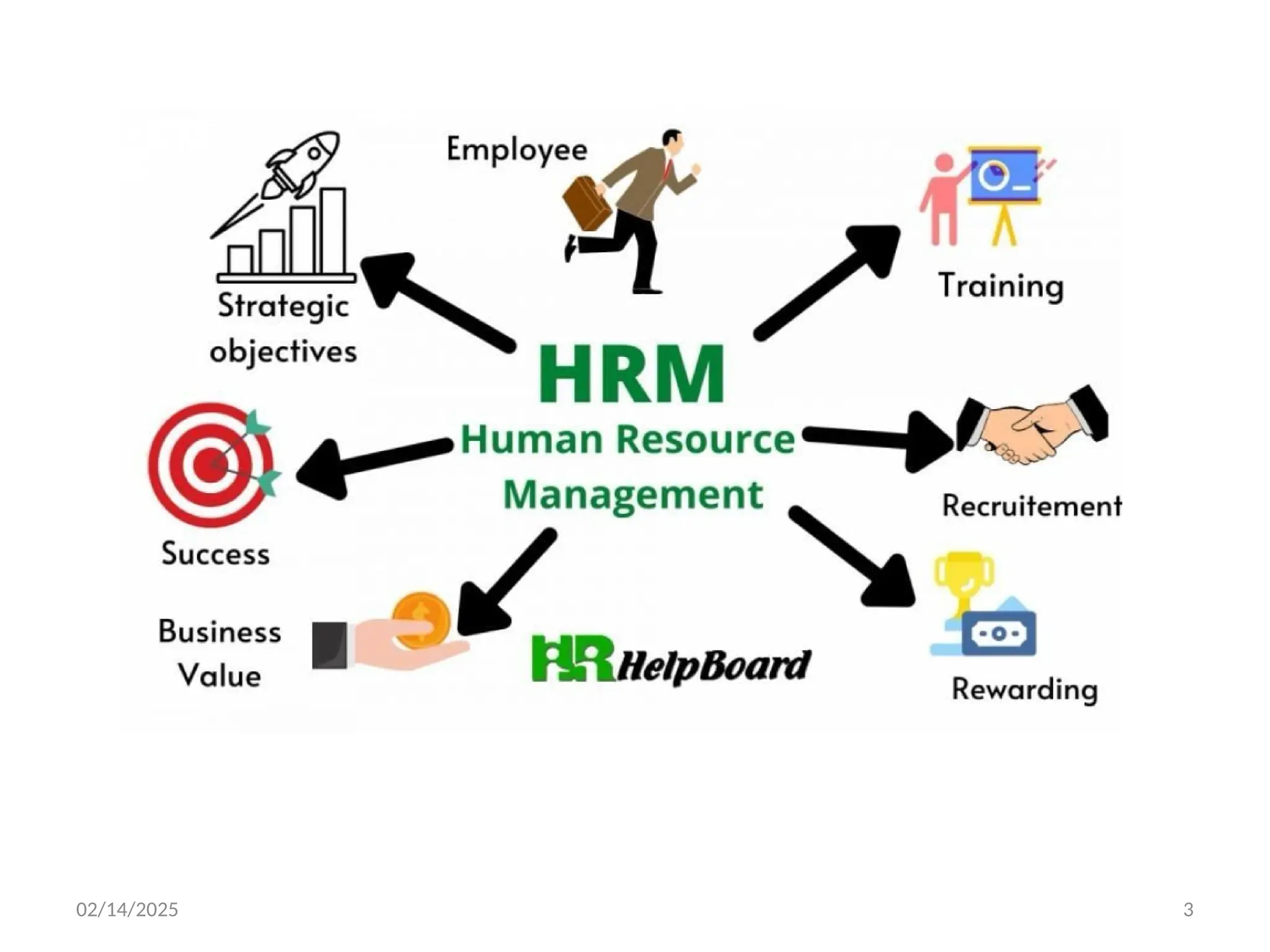
 Human Resource Management (HRM) is a management
function that deals with recruiting, selecting, training and
developing human resource in an organization.
 Human Resource Management (HRM) is a strategic
method that firms use to efficiently manage their
workforce
 It is concerned with the development of a highly
motivated and smooth functioning workforce
 It also includes planning, acquiring, developing, utilizing
and maintaining ‘human resources’ in the achievement of
organizational goals
 It attracts and selects capable men, organizes them in
productive groups, develops their potential, gives them
necessary motivation and maintains their high morale.
02/14/2025 6
02/14/2025 7
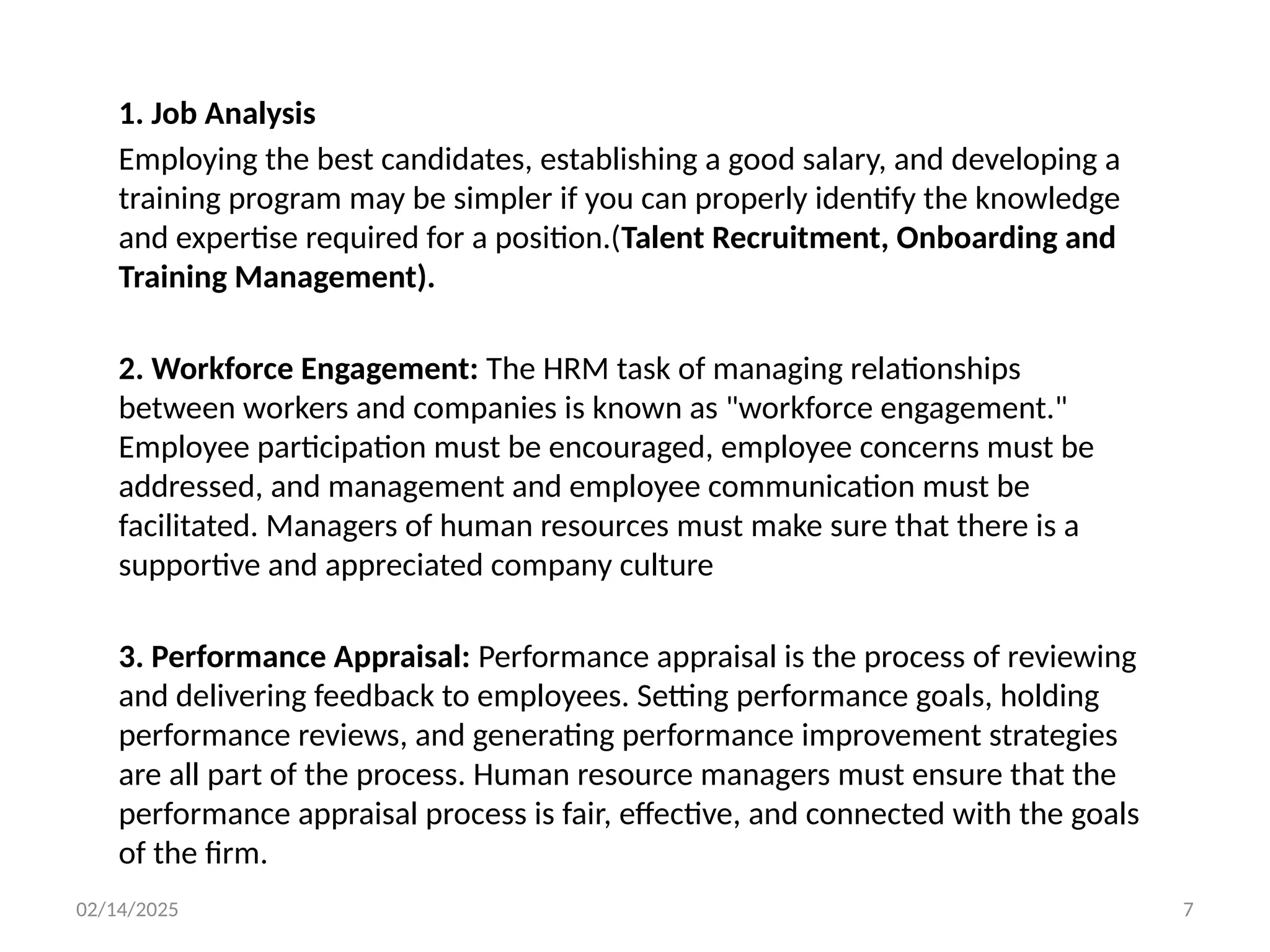
1. Job Analysis
Employing the best candidates, establishing a good salary, and developing a
training program may be simpler if you can properly identify the knowledge
and expertise required for a position.(Talent Recruitment, Onboarding and
Training Management).
2. Workforce Engagement: The HRM task of managing relationships
between workers and companies is known as "workforce engagement."
Employee participation must be encouraged, employee concerns must be
addressed, and management and employee communication must be
facilitated. Managers of human resources must make sure that there is a
supportive and appreciated company culture
3. Performance Appraisal: Performance appraisal is the process of reviewing
and delivering feedback to employees. Setting performance goals, holding
performance reviews, and generating performance improvement strategies
are all part of the process. Human resource managers must ensure that the
performance appraisal process is fair, effective, and connected with the goals
of the firm.
02/14/2025 8
4. Incentive Schemes
Acknowledging accomplishments and rewarding the best
employees with incentives and other benefits is a tried-
and-true strategy for encouraging staff to take
responsibility for company goals.
5. Professional Advancement
It occurs through employee training, which ranges from
orientation to higher educational workshops, and helps
to increase productivity, lower turnover, and lessen the
need for supervisor
02/14/2025 9
1.Social Objectives: These refer to actions taken in response to the social and
ethical demands or difficulties the business and its staff faces. This covers
judicial matters like equal opportunity and compensation for equal effort.
2.Organizational Objectives: It includes steps performed to guarantee the
effectiveness of the organization. This involves training, hiring qualified
candidates, or maintaining high employee retention rates.
3.Functional Objectives: These are requirements for maintaining good HR
operations throughout the whole organization. Making sure that HR's abilities
are fully utilized to their greatest potential is necessary to achieve this.
4.Personal Objectives: These methods are used to help each employee achieve
their individual goals. This involves preserving employee happiness and
providing education or professional advancement opportunities.
02/14/2025 10
• Job analysis is the process of gathering and analyzing
information about the content and the human requirements of
jobs, as well as, the context in which jobs are performed. This
process is used to determine placement of jobs.
• Job analysis provides information to organizations which helps
to determine which employees are best fit for specific jobs.
• Through job analysis, the analyst needs to understand what
the important tasks of the job are, how they are carried out,
and the necessary human qualities needed to complete the job
successfully.
• The process of job analysis involves the analyst describing the
duties of the incumbent, then the nature and conditions of
work, and finally some basic qualifications.
Job analysis in human resource management
02/14/2025 11
Job analysis is broadly bifurcated into two components i.e. job description and
job specification. Both these together give a complete understanding about job
title, position, location, qualification, skills, duties, responsibilities, skills etc.
02/14/2025 12
• Job analysis is the process of thoroughly understanding a particular
job role requirement along with the key skills, roles, responsibilities,
workplace processes, organizational hierarchy etc. after conducting a
research to produce a relevant job description.
• Job analysis involves collecting job related information and
highlighting the basic requirements needed by an employee to
successfully fulfill the role & profile in order to achieve the goals &
objectives set by the company. The analysis also gives an overview on
the physical, emotional & related human qualities required to
execute the job successfully.
• OPM (United States Office of Personnel Management) describes job
analysis as “a systematic procedure for gathering, documenting,
and analyzing information about the content, context, and
requirements of the job
02/14/2025 13
Job Analysis Methods
The process of collecting information for job analysis has to be very thorough
and completed with accurate research. Some methods which can be used to
collect job related information is given below:
1. Observation
Attributes like workplace environment, physical activities, techniques & skills
required etc. can all be covered by simply observing existing or similar jobs
2. Interview
Interviewing employees helps in understanding the challenges, difficulties,
emotional requirements, complications, deliverables etc.
3. Questionnaire
Questionnaires helps in obtaining large volumes of data and this data can be
quantified & analyzed to understand the job requirements in a much better
way
02/14/2025 14
Advantages of Job Analysis
Some of the benefits of having a job analysis are mentioned below:
• It helps HR managers to have a systematic plan for recruitment and
selection
• Job analysis clearly defines the description & specification, which highlights
the job requirements, skills, incentives etc.
• It becomes easier for employees to understand their goals & objectives
• HR managers can use job analysis information as a benchmark to evaluate
performance of employees and perform their appraisal / promotions
accordingly
• It helps in maintaining the organizational structure by having information
related to reporting manager, job position, title, location etc.
02/14/2025 15
The selection process can be defined as the process of selection and
shortlisting of the right candidates with the necessary qualifications
and skill set to fill the vacancies in an organisation. The selection
process varies from industry to industry, company to company and
even amongst departments of the same company.
Selection methods or screening devices include application forms,
employment interviews, aptitude tests, and personality test.
Every organisation creates a selection process because they have
their own requirements. Although, the main steps remain the same.
So, let’s understand in brief how the selection process works.
Human Resource Selection Process
02/14/2025 16
Human Resource Selection Process
02/14/2025 17
Preliminary Interview:
This is a very general and basic interview conducted so as to eliminate the candidates
who are completely unfit to work in the organisation. This leaves the organisation
with a full of potentially fit employees to fill their vacancies.
Receiving Applications
Potential employees apply for a job by sending applications to the organisation. The
application gives the interviewers information about the candidates like their bio-data,
work experience, hobbies and interests.
Screening Applications
Once the applications are received, they are screened by a special screening
committee who choose candidates from the applications to call for an interview.
Applicants may be selected on special criteria like qualifications, work experience etc.
Human Resource Selection Process
02/14/2025 18
Employment Tests
Before an organisation decides a suitable job for any individual, they have to gauge their
talents and skills. This is done through various employment tests like intelligence tests,
aptitude tests, proficiency tests, personality tests etc.
Employment Interview
The next step in the selection process is the employee interview. Employment
interviews are done to identify a candidate’s skill set and ability to work in an
organisation in detail. Purpose of an employment interview is to find out the suitability
of the candidate and to give him an idea about the work profile and what is expected of
the potential employee. An employment interview is critical for the selection of the right
people for the right jobs.
Checking References
The person who gives the reference of a potential employee is also a very important
source of information. The referee can provide info about the person’s capabilities,
experience in the previous companies and leadership and managerial skills. The
information provided by the referee is meant to kept confidential with the HR
department.
Manpower Selection Process
02/14/2025 19
Medical Examination
The medical exam is also a very important step in the selection process. Medical
exams help the employers know if any of the potential candidates are physically
and mentally fit to perform their duties in their jobs. A good system of medical
check-ups ensures that the employee standards of health are higher and there are
fewer cases of absenteeism, accidents and employee turnover.
Final Selection and Appointment Letter
This is the final step in the selection process. After the candidate has successfully
passed all written tests, interviews and medical examination, the employee is sent
or emailed an appointment letter, confirming his selection to the job. The
appointment letter contains all the details of the job like working hours, salary,
leave allowance etc. Often, employees are hired on a conditional basis where they
are hired permanently after the employees are satisfied with their performance.
Manpower selection process
02/14/2025 20
Organizational socialization is also known as employee or learning the ropes.
Socialization is generally defined as “a process in which an individual acquires the
attitudes, behaviours and knowledge needed to successfully participate as an
organizational member” (Van Maanen & Schein, 1979).
Learning the organizational values, norms, and behaviour patterns which include:
• The basic goals of the organization.
• The preferred means by which these goals should be achieved.
• The basic responsibilities of the member in the role which is being granted to
him by the organization.
• The behaviour patterns which are required for effective performance in the role.
• A set of rules or principles which pertain to the upkeep of the identity and
integrity of the organization (Schein, 1988).
Socializing The New Employees
02/14/2025 21
Socializing The New Employees
• The process of adaptation of new job.
• The action or practice of participating in social activities
or mixing socially with others.
• Socialization strongly influences employee performance
and organizational stability
• Provides information on how to do job and ensuring
organizational fit
• New members suffer from anxiety which motivates them
to learn the values and norms of the organization.
02/14/2025 22
Stage of Socialization Process
02/14/2025 23
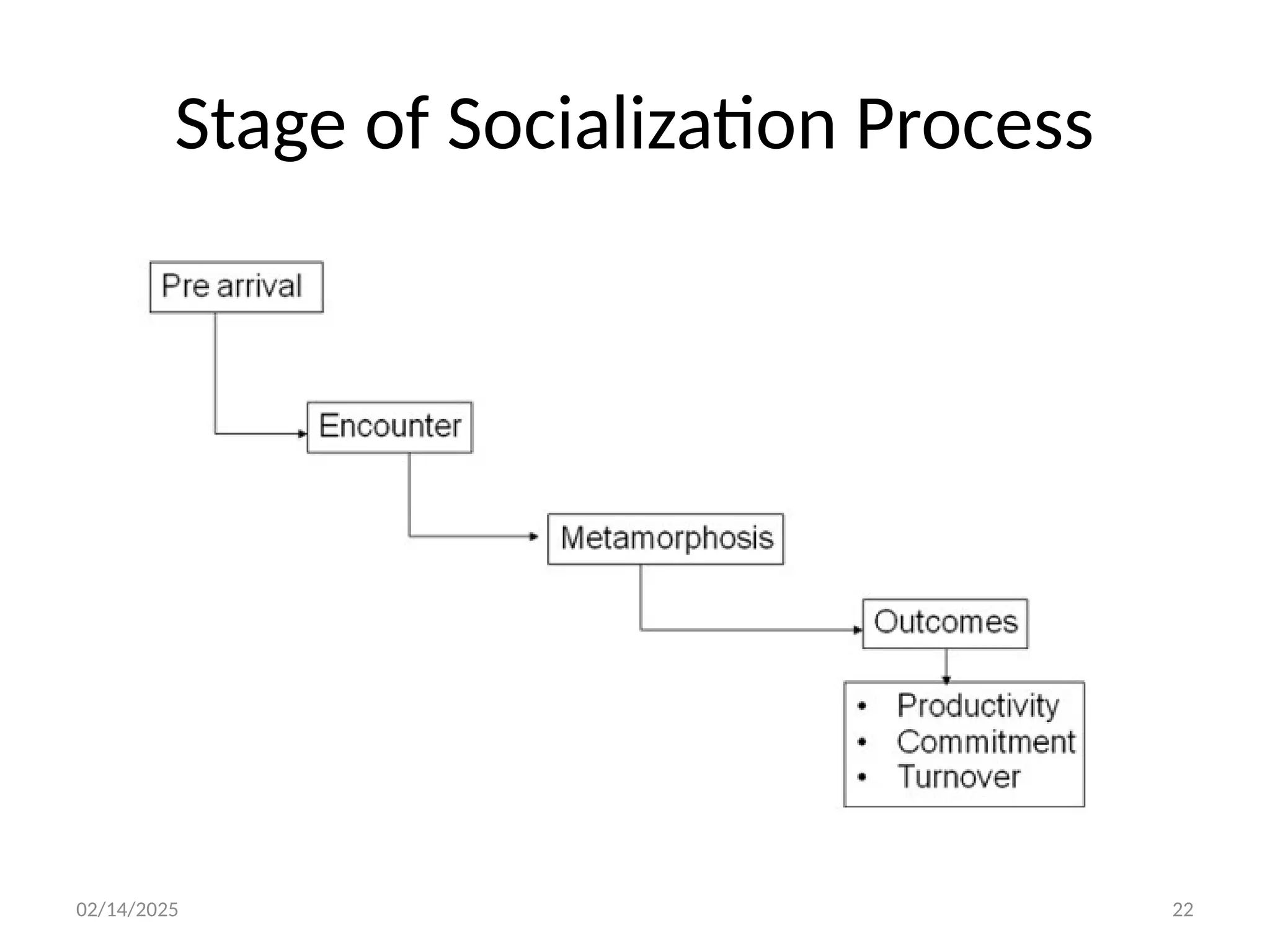
1. Prearrival Stage
The prearrival stage is the period before the new employee officially starts their job.
It involves the expectations and perceptions that the employee brings to the
organization based on prior experiences, education, and pre-employment
interactions.
2. Encounter Stage
The encounter stage begins when the new employee actually starts their job. This
stage involves the direct confrontation between the employee’s expectations (from
the prearrival stage) and the reality of the organizational culture and work
environment.
3. Metamorphosis Stage
The metamorphosis stage is the period when the new employee starts to fully
integrate into the organization. They begin to identify with the company culture,
establish relationships, and gain competence in their role.
4. Outcome Stage
The outcome stage refers to the long-term effects of the socialization process. The
employee’s experience and success during the earlier stages (prearrival, encounter,
and metamorphosis) ultimately influence the final outcomes in terms of job
performance, job satisfaction, commitment to the organization, and retention.
02/14/2025 24
Employee welfare includes anything that is done for the comfort and improvement of
employees and is provided over and above the wages. Welfare helps in keeping the
morale and motivation of the employees high so as to retain the employees for longer
duration. The welfare measures need not be in monetary terms only but in any
kind/forms. Employee welfare includes monitoring of working conditions, creation of
industrial harmony through infrastructure for health, industrial relations and insurance
against disease, accident and unemployment for the workers and their families.
Labour welfare entails all those activities of employer, which are directed towards
providing the employees with certain facilities and services in addition to wages or
salaries.
Labour welfare has the following objectives:
(i) To provide better life and health to the labour force.
(ii) To make the workers happy, satisfied and efficient.
(iii) To improve intellectual, cultural and material conditions of living of the labour and
to relieve them from industrial fatigue.
Labor welfare Schemes
02/14/2025 25
1. Drinking Water: At all the working places safe hygienic drinking water should be provided.
2. Facilities for sitting: In every organization, especially factories, suitable seating arrangements are to be
provided.
3. First aid appliances: First aid appliances are to be provided and should be readily assessable so that in case of
any minor accident initial medication can be provided to the needed employee.
4. Latrines and Urinals: A sufficient number of latrines and urinals are to be provided in the office and factory
premises and are also to be maintained in a neat and clean condition.
5. Canteen facilities: Cafeteria or canteens are to be provided by the employer so as to provide hygienic and
nutritious food to the employees.
6. Spittoons: In every work place, such as ware houses, store places, in the dock area and office premises
spittoons are to be provided in convenient places and same are to be maintained in a hygienic condition.
7. Lighting: Proper and sufficient lights are to be provided for employees so that they can work safely during the
night shifts.
8. Washing places: Adequate washing places such as bathrooms, wash basins with tap and tap on the stand pipe
are provided in the port area in the vicinity of the work places.
9. Changing rooms: Adequate changing rooms are to be provided for workers to change their cloth in the factory
area and office premises. Adequate lockers are also provided to the workers to keep their clothes and belongings.
10. Rest rooms: Adequate numbers of restrooms are provided to the workers with provisions of water supply,
wash basins, toilets, bathrooms, etc.
Welfare Schemes
02/14/2025 26
02/14/2025 27
Accidents and safety measures
• In Human Resource Management (HRM),
accidents and safety measures are critical
components of ensuring a healthy, secure, and
productive workplace. The role of HRM is not
only to manage employee relations,
recruitment, and performance but also to
enforce safety protocols that minimize
accidents and protect the health and well-
being of employees.
02/14/2025 28
Types of Workplace Accidents:
• Physical Accidents:
– Slips, trips, and falls: Often caused by wet floors, uneven surfaces, or obstacles.
– Machinery accidents: Injuries involving heavy machinery, tools, or vehicles used in the
workplace.
– Vehicle-related accidents: Involving forklifts, trucks, or company cars.
– Overexertion injuries: Lifting, carrying, or pulling heavy objects improperly.
• Chemical and Environmental Accidents:
– Exposure to hazardous chemicals: Accidents involving toxic or flammable substances.
– Environmental hazards: Extreme temperatures, poor ventilation, or hazardous working
conditions.
• Ergonomic Injuries:
– Repetitive strain injuries (RSIs): Resulting from repetitive motions or improper posture
over time, often associated with desk jobs or assembly line work.
• Psychosocial Accidents:
– Stress-related injuries: Mental health issues that can result from high pressure,
harassment, or poor work-life balance.
02/14/2025 29
Role of HRM in Preventing Accidents and
Ensuring Safety
1. Developing and Implementing Safety Policies
General Safety Guidelines, Department-Specific Safety Rules, Emergency
Procedures
2. Employee Training and Education
Onboarding and Orientation, Ongoing Safety Training, First Aid
3. Conducting Risk Assessments
Routine Safety Inspections, Job Hazard Analysis (JHA),
4. Safety Culture Promotion
Encouraging Open Communication, Safety Committees, Recognizing Safe
Practices
5. Implementing Health and Wellness Programs
6. Accident Reporting and Investigation
9. Emergency Preparedness and Response
02/14/2025 30
Some of the practices commonly used to achieve accident prevention in the workplace :
• Workers and supervisors must be informed and be aware of the dangers and potential
hazards (e.g. through education)
• Workers must be motivated to function safely. This is accomplished through certification
procedure, training and education.
• The personal working environment should be safe and healthy through the use of
administrative or engineering controls, substitution of less hazardous materials or
conditions, or by the use of personal protective equipment.
• Equipment, machinery and objects must function safely for their intended use with
operating controls designed to human capabilities.
• Provisions should be made for appropriate emergency response in order to limit the
consequences of accidents, incidents and injuries.
Accident Prevention
02/14/2025 31

Human Resource Management (Principal of Management)

  • 1.
    02/14/2025 1 Human ResourceManagement Presented By: Pabitra Pandey
  • 2.
    02/14/2025 2 Table ofContents • Introduction • Objective of HRM • Function of HRM • Job Analysis • Human Resource Selection Process • Socializing the New Employees • Labor Welfare Schemes • Accidents and Safety Measures
  • 3.
  • 4.
    02/14/2025 4 Introduction • Human:refer to the skilled workforce in the organization. • Resource: refer to limited availability or scarce. • Management: refer to maximize or proper utilization and make best use of limited and a scarce resource. • Human Resource (HR) refers to all the people who work in an organization • According to Decenzo and Robbins, “HRM is concerned with the people dimension” in management. • Human resource management is the function performed in organizations’ that facilitate the most effective use of people (employees) to achieve organizational and individual goals” • Human resource management is a systematic process of managing people working in the organization
  • 5.
    02/14/2025 5  HumanResource Management (HRM) is a management function that deals with recruiting, selecting, training and developing human resource in an organization.  Human Resource Management (HRM) is a strategic method that firms use to efficiently manage their workforce  It is concerned with the development of a highly motivated and smooth functioning workforce  It also includes planning, acquiring, developing, utilizing and maintaining ‘human resources’ in the achievement of organizational goals  It attracts and selects capable men, organizes them in productive groups, develops their potential, gives them necessary motivation and maintains their high morale.
  • 6.
  • 7.
    02/14/2025 7 1. JobAnalysis Employing the best candidates, establishing a good salary, and developing a training program may be simpler if you can properly identify the knowledge and expertise required for a position.(Talent Recruitment, Onboarding and Training Management). 2. Workforce Engagement: The HRM task of managing relationships between workers and companies is known as "workforce engagement." Employee participation must be encouraged, employee concerns must be addressed, and management and employee communication must be facilitated. Managers of human resources must make sure that there is a supportive and appreciated company culture 3. Performance Appraisal: Performance appraisal is the process of reviewing and delivering feedback to employees. Setting performance goals, holding performance reviews, and generating performance improvement strategies are all part of the process. Human resource managers must ensure that the performance appraisal process is fair, effective, and connected with the goals of the firm.
  • 8.
    02/14/2025 8 4. IncentiveSchemes Acknowledging accomplishments and rewarding the best employees with incentives and other benefits is a tried- and-true strategy for encouraging staff to take responsibility for company goals. 5. Professional Advancement It occurs through employee training, which ranges from orientation to higher educational workshops, and helps to increase productivity, lower turnover, and lessen the need for supervisor
  • 9.
    02/14/2025 9 1.Social Objectives:These refer to actions taken in response to the social and ethical demands or difficulties the business and its staff faces. This covers judicial matters like equal opportunity and compensation for equal effort. 2.Organizational Objectives: It includes steps performed to guarantee the effectiveness of the organization. This involves training, hiring qualified candidates, or maintaining high employee retention rates. 3.Functional Objectives: These are requirements for maintaining good HR operations throughout the whole organization. Making sure that HR's abilities are fully utilized to their greatest potential is necessary to achieve this. 4.Personal Objectives: These methods are used to help each employee achieve their individual goals. This involves preserving employee happiness and providing education or professional advancement opportunities.
  • 10.
    02/14/2025 10 • Jobanalysis is the process of gathering and analyzing information about the content and the human requirements of jobs, as well as, the context in which jobs are performed. This process is used to determine placement of jobs. • Job analysis provides information to organizations which helps to determine which employees are best fit for specific jobs. • Through job analysis, the analyst needs to understand what the important tasks of the job are, how they are carried out, and the necessary human qualities needed to complete the job successfully. • The process of job analysis involves the analyst describing the duties of the incumbent, then the nature and conditions of work, and finally some basic qualifications. Job analysis in human resource management
  • 11.
    02/14/2025 11 Job analysisis broadly bifurcated into two components i.e. job description and job specification. Both these together give a complete understanding about job title, position, location, qualification, skills, duties, responsibilities, skills etc.
  • 12.
    02/14/2025 12 • Jobanalysis is the process of thoroughly understanding a particular job role requirement along with the key skills, roles, responsibilities, workplace processes, organizational hierarchy etc. after conducting a research to produce a relevant job description. • Job analysis involves collecting job related information and highlighting the basic requirements needed by an employee to successfully fulfill the role & profile in order to achieve the goals & objectives set by the company. The analysis also gives an overview on the physical, emotional & related human qualities required to execute the job successfully. • OPM (United States Office of Personnel Management) describes job analysis as “a systematic procedure for gathering, documenting, and analyzing information about the content, context, and requirements of the job
  • 13.
    02/14/2025 13 Job AnalysisMethods The process of collecting information for job analysis has to be very thorough and completed with accurate research. Some methods which can be used to collect job related information is given below: 1. Observation Attributes like workplace environment, physical activities, techniques & skills required etc. can all be covered by simply observing existing or similar jobs 2. Interview Interviewing employees helps in understanding the challenges, difficulties, emotional requirements, complications, deliverables etc. 3. Questionnaire Questionnaires helps in obtaining large volumes of data and this data can be quantified & analyzed to understand the job requirements in a much better way
  • 14.
    02/14/2025 14 Advantages ofJob Analysis Some of the benefits of having a job analysis are mentioned below: • It helps HR managers to have a systematic plan for recruitment and selection • Job analysis clearly defines the description & specification, which highlights the job requirements, skills, incentives etc. • It becomes easier for employees to understand their goals & objectives • HR managers can use job analysis information as a benchmark to evaluate performance of employees and perform their appraisal / promotions accordingly • It helps in maintaining the organizational structure by having information related to reporting manager, job position, title, location etc.
  • 15.
    02/14/2025 15 The selectionprocess can be defined as the process of selection and shortlisting of the right candidates with the necessary qualifications and skill set to fill the vacancies in an organisation. The selection process varies from industry to industry, company to company and even amongst departments of the same company. Selection methods or screening devices include application forms, employment interviews, aptitude tests, and personality test. Every organisation creates a selection process because they have their own requirements. Although, the main steps remain the same. So, let’s understand in brief how the selection process works. Human Resource Selection Process
  • 16.
  • 17.
    02/14/2025 17 Preliminary Interview: Thisis a very general and basic interview conducted so as to eliminate the candidates who are completely unfit to work in the organisation. This leaves the organisation with a full of potentially fit employees to fill their vacancies. Receiving Applications Potential employees apply for a job by sending applications to the organisation. The application gives the interviewers information about the candidates like their bio-data, work experience, hobbies and interests. Screening Applications Once the applications are received, they are screened by a special screening committee who choose candidates from the applications to call for an interview. Applicants may be selected on special criteria like qualifications, work experience etc. Human Resource Selection Process
  • 18.
    02/14/2025 18 Employment Tests Beforean organisation decides a suitable job for any individual, they have to gauge their talents and skills. This is done through various employment tests like intelligence tests, aptitude tests, proficiency tests, personality tests etc. Employment Interview The next step in the selection process is the employee interview. Employment interviews are done to identify a candidate’s skill set and ability to work in an organisation in detail. Purpose of an employment interview is to find out the suitability of the candidate and to give him an idea about the work profile and what is expected of the potential employee. An employment interview is critical for the selection of the right people for the right jobs. Checking References The person who gives the reference of a potential employee is also a very important source of information. The referee can provide info about the person’s capabilities, experience in the previous companies and leadership and managerial skills. The information provided by the referee is meant to kept confidential with the HR department. Manpower Selection Process
  • 19.
    02/14/2025 19 Medical Examination Themedical exam is also a very important step in the selection process. Medical exams help the employers know if any of the potential candidates are physically and mentally fit to perform their duties in their jobs. A good system of medical check-ups ensures that the employee standards of health are higher and there are fewer cases of absenteeism, accidents and employee turnover. Final Selection and Appointment Letter This is the final step in the selection process. After the candidate has successfully passed all written tests, interviews and medical examination, the employee is sent or emailed an appointment letter, confirming his selection to the job. The appointment letter contains all the details of the job like working hours, salary, leave allowance etc. Often, employees are hired on a conditional basis where they are hired permanently after the employees are satisfied with their performance. Manpower selection process
  • 20.
    02/14/2025 20 Organizational socializationis also known as employee or learning the ropes. Socialization is generally defined as “a process in which an individual acquires the attitudes, behaviours and knowledge needed to successfully participate as an organizational member” (Van Maanen & Schein, 1979). Learning the organizational values, norms, and behaviour patterns which include: • The basic goals of the organization. • The preferred means by which these goals should be achieved. • The basic responsibilities of the member in the role which is being granted to him by the organization. • The behaviour patterns which are required for effective performance in the role. • A set of rules or principles which pertain to the upkeep of the identity and integrity of the organization (Schein, 1988). Socializing The New Employees
  • 21.
    02/14/2025 21 Socializing TheNew Employees • The process of adaptation of new job. • The action or practice of participating in social activities or mixing socially with others. • Socialization strongly influences employee performance and organizational stability • Provides information on how to do job and ensuring organizational fit • New members suffer from anxiety which motivates them to learn the values and norms of the organization.
  • 22.
    02/14/2025 22 Stage ofSocialization Process
  • 23.
    02/14/2025 23 1. PrearrivalStage The prearrival stage is the period before the new employee officially starts their job. It involves the expectations and perceptions that the employee brings to the organization based on prior experiences, education, and pre-employment interactions. 2. Encounter Stage The encounter stage begins when the new employee actually starts their job. This stage involves the direct confrontation between the employee’s expectations (from the prearrival stage) and the reality of the organizational culture and work environment. 3. Metamorphosis Stage The metamorphosis stage is the period when the new employee starts to fully integrate into the organization. They begin to identify with the company culture, establish relationships, and gain competence in their role. 4. Outcome Stage The outcome stage refers to the long-term effects of the socialization process. The employee’s experience and success during the earlier stages (prearrival, encounter, and metamorphosis) ultimately influence the final outcomes in terms of job performance, job satisfaction, commitment to the organization, and retention.
  • 24.
    02/14/2025 24 Employee welfareincludes anything that is done for the comfort and improvement of employees and is provided over and above the wages. Welfare helps in keeping the morale and motivation of the employees high so as to retain the employees for longer duration. The welfare measures need not be in monetary terms only but in any kind/forms. Employee welfare includes monitoring of working conditions, creation of industrial harmony through infrastructure for health, industrial relations and insurance against disease, accident and unemployment for the workers and their families. Labour welfare entails all those activities of employer, which are directed towards providing the employees with certain facilities and services in addition to wages or salaries. Labour welfare has the following objectives: (i) To provide better life and health to the labour force. (ii) To make the workers happy, satisfied and efficient. (iii) To improve intellectual, cultural and material conditions of living of the labour and to relieve them from industrial fatigue. Labor welfare Schemes
  • 25.
    02/14/2025 25 1. DrinkingWater: At all the working places safe hygienic drinking water should be provided. 2. Facilities for sitting: In every organization, especially factories, suitable seating arrangements are to be provided. 3. First aid appliances: First aid appliances are to be provided and should be readily assessable so that in case of any minor accident initial medication can be provided to the needed employee. 4. Latrines and Urinals: A sufficient number of latrines and urinals are to be provided in the office and factory premises and are also to be maintained in a neat and clean condition. 5. Canteen facilities: Cafeteria or canteens are to be provided by the employer so as to provide hygienic and nutritious food to the employees. 6. Spittoons: In every work place, such as ware houses, store places, in the dock area and office premises spittoons are to be provided in convenient places and same are to be maintained in a hygienic condition. 7. Lighting: Proper and sufficient lights are to be provided for employees so that they can work safely during the night shifts. 8. Washing places: Adequate washing places such as bathrooms, wash basins with tap and tap on the stand pipe are provided in the port area in the vicinity of the work places. 9. Changing rooms: Adequate changing rooms are to be provided for workers to change their cloth in the factory area and office premises. Adequate lockers are also provided to the workers to keep their clothes and belongings. 10. Rest rooms: Adequate numbers of restrooms are provided to the workers with provisions of water supply, wash basins, toilets, bathrooms, etc. Welfare Schemes
  • 26.
  • 27.
    02/14/2025 27 Accidents andsafety measures • In Human Resource Management (HRM), accidents and safety measures are critical components of ensuring a healthy, secure, and productive workplace. The role of HRM is not only to manage employee relations, recruitment, and performance but also to enforce safety protocols that minimize accidents and protect the health and well- being of employees.
  • 28.
    02/14/2025 28 Types ofWorkplace Accidents: • Physical Accidents: – Slips, trips, and falls: Often caused by wet floors, uneven surfaces, or obstacles. – Machinery accidents: Injuries involving heavy machinery, tools, or vehicles used in the workplace. – Vehicle-related accidents: Involving forklifts, trucks, or company cars. – Overexertion injuries: Lifting, carrying, or pulling heavy objects improperly. • Chemical and Environmental Accidents: – Exposure to hazardous chemicals: Accidents involving toxic or flammable substances. – Environmental hazards: Extreme temperatures, poor ventilation, or hazardous working conditions. • Ergonomic Injuries: – Repetitive strain injuries (RSIs): Resulting from repetitive motions or improper posture over time, often associated with desk jobs or assembly line work. • Psychosocial Accidents: – Stress-related injuries: Mental health issues that can result from high pressure, harassment, or poor work-life balance.
  • 29.
    02/14/2025 29 Role ofHRM in Preventing Accidents and Ensuring Safety 1. Developing and Implementing Safety Policies General Safety Guidelines, Department-Specific Safety Rules, Emergency Procedures 2. Employee Training and Education Onboarding and Orientation, Ongoing Safety Training, First Aid 3. Conducting Risk Assessments Routine Safety Inspections, Job Hazard Analysis (JHA), 4. Safety Culture Promotion Encouraging Open Communication, Safety Committees, Recognizing Safe Practices 5. Implementing Health and Wellness Programs 6. Accident Reporting and Investigation 9. Emergency Preparedness and Response
  • 30.
    02/14/2025 30 Some ofthe practices commonly used to achieve accident prevention in the workplace : • Workers and supervisors must be informed and be aware of the dangers and potential hazards (e.g. through education) • Workers must be motivated to function safely. This is accomplished through certification procedure, training and education. • The personal working environment should be safe and healthy through the use of administrative or engineering controls, substitution of less hazardous materials or conditions, or by the use of personal protective equipment. • Equipment, machinery and objects must function safely for their intended use with operating controls designed to human capabilities. • Provisions should be made for appropriate emergency response in order to limit the consequences of accidents, incidents and injuries. Accident Prevention
  • 31.