03/10/2025 1
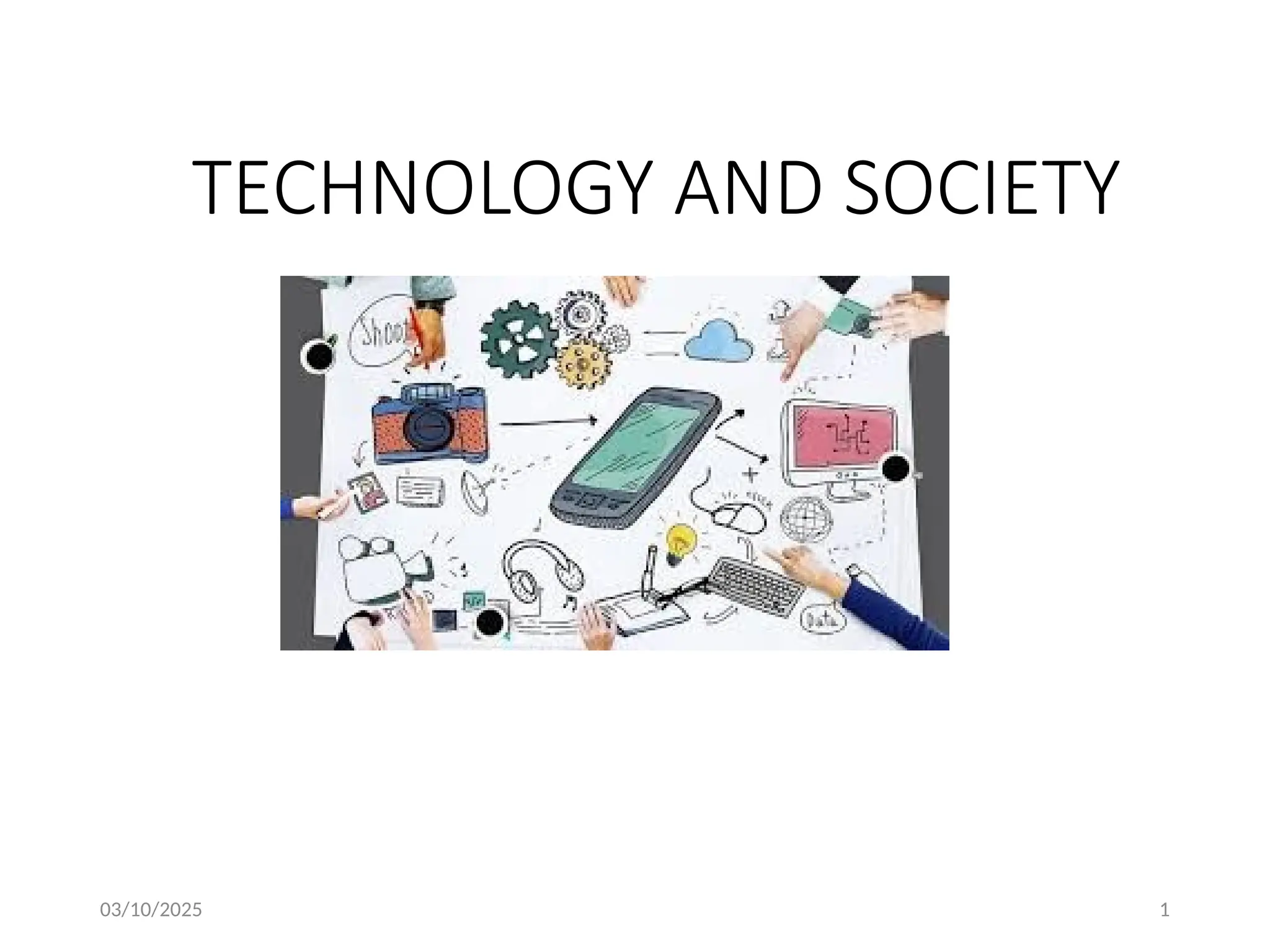
TECHNOLOGY AND SOCIETY
03/10/2025 2
Environment and Technology
• Environmental technology is also known as ‘green’ or ‘clean’
technology and refers to the development of new technologies which
aim to conserve, monitor or reduce the negative impact of technology
on the environment and the consumption of resources.
• Environmental technologies aim to protect the environment. They
offer ways of consuming which are less polluting or do so in a
sustainable manner, and often provide new ways to avoid depletion of
natural resources altogether. Prominent examples include solar and
wind energy, water desalination (the removal of salt or other minerals
from saline water), electric vehicles, and pyrolysis (thermochemical
decomposition of organic material).
03/10/2025 3
Why We Need Green Technology
1. Reduces carbon emissions
In the UK alone, the transportation sector produces 28 percent of the
country’s greenhouse gas emissions, and it is the largest contributor of
harmful gases.
2. Offers a greener energy source
3. Provides clean water
• Although the earth is surrounded mostly by water, only 1.2 per cent of
water is drinkable. As freshwater consumption increases, it’s estimated
that 1.8 billion people will lack drinking water by 2025. Green
technologies resolve this crisis through innovations like the SunSpring
Hybrid which filters and turns dirty water into safe drinking water.
• In fact, the SunSpring Hybrid can turn over 20,000 litres of dirty
water from rivers or wells into drinking water per day.
03/10/2025 4
Solar Energy
• Approximately 80% of the total amount of energy used
globally each year comes from fossil fuels like petroleum,
natural gas and coal
• If we do not reduce consumption, we will runout of them,
very quickly
• According to World meter, we will run out of oil in 47 years,
natural gas in 52 years and coal in 133 years
• New research from Harvard University found that more than
8 million people died in 2018 from fossil fuel pollution,
meaning that air pollution from burning fossil fuels like coal
and diesel was responsible for about 1 in 5 death worldwide.
03/10/2025 5
Emerging Environmental Technologies
Wasteful energy policies, overuse of resources, water supply shortages, global
climate change, and deforestation are just some of the issues experts say need to be
addressed for humans to achieve sustainable living on this planet. By the year 2025,
an additional 2.9 billion people will strain tightening water supplies, and the world's
energy needs will go up 60 percent by 2030, according to the United Nations.
The positive impact of technology on the environment as a result of the development
of environmental technology are
 renewable energy
 smart technology
 electric vehicles
 carbon dioxide removal
03/10/2025 6
Emerging Environmental
Technologies
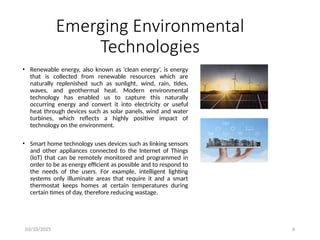
• Renewable energy, also known as ‘clean energy’, is energy
that is collected from renewable resources which are
naturally replenished such as sunlight, wind, rain, tides,
waves, and geothermal heat. Modern environmental
technology has enabled us to capture this naturally
occurring energy and convert it into electricity or useful
heat through devices such as solar panels, wind and water
turbines, which reflects a highly positive impact of
technology on the environment.
• Smart home technology uses devices such as linking sensors
and other appliances connected to the Internet of Things
(IoT) that can be remotely monitored and programmed in
order to be as energy efficient as possible and to respond to
the needs of the users. For example, intelligent lighting
systems only illuminate areas that require it and a smart
thermostat keeps homes at certain temperatures during
certain times of day, therefore reducing wastage.
03/10/2025 7
Emerging Environmental Technologies
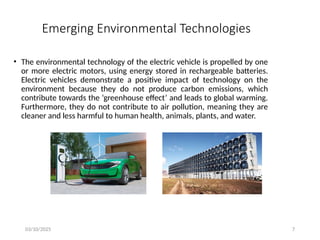
• The environmental technology of the electric vehicle is propelled by one
or more electric motors, using energy stored in rechargeable batteries.
Electric vehicles demonstrate a positive impact of technology on the
environment because they do not produce carbon emissions, which
contribute towards the ‘greenhouse effect’ and leads to global warming.
Furthermore, they do not contribute to air pollution, meaning they are
cleaner and less harmful to human health, animals, plants, and water.
03/10/2025 8
Advance Developments in Technology:
1. Artificial Intelligence (AI)
Artificial Intelligence (AI) refers to the simulation of human intelligence processes by machines,
particularly computer systems. These processes include learning, reasoning, problem-solving,
perception, and language understanding. AI is a multidisciplinary field that draws from computer
science, mathematics, psychology, neuroscience, and other disciplines to build systems that can mimic
or surpass human cognitive abilities in certain tasks.
2. 5G Technology
The introduction of 5G technology is a major turning point for the telecom industry. 5G offers speeds
up to 100 times faster than 4G, making it possible to connect seamlessly and enable the Internet of
Things (IoT). Communication has been completely transformed by this technology, which also makes
real-time data transfer possible and promotes the growth of smart cities. Autonomous vehicles,
augmented reality, and remote healthcare will all be impacted by the widespread deployment of 5G,
which will also bring in a period of unprecedented innovation and connectedness
03/10/2025 9
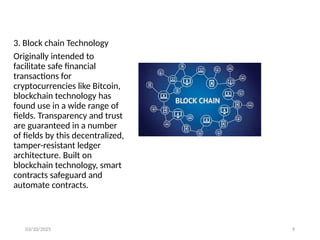
3. Block chain Technology
Originally intended to
facilitate safe financial
transactions for
cryptocurrencies like Bitcoin,
blockchain technology has
found use in a wide range of
fields. Transparency and trust
are guaranteed in a number
of fields by this decentralized,
tamper-resistant ledger
architecture. Built on
blockchain technology, smart
contracts safeguard and
automate contracts.
03/10/2025 10
Advantages of Technology in
Society
1. Improved Communication
• Technology, particularly the internet and mobile devices,
allows people to communicate instantly across the globe.
• Social media platforms, video conferencing tools, and
messaging apps have made personal and professional
connections easier, bridging cultural and geographical gaps.
• The internet provides vast amounts of information at our
fingertips, empowering individuals to learn, research, and
access knowledge like never before.
• This has contributed to improved education and awareness.
03/10/2025 11
2. Increased Efficiency and Productivity
• Machines, robots, and artificial intelligence have revolutionized industries,
streamlining repetitive tasks, and increasing productivity. This has made
businesses more efficient, reduced costs, and increased output in sectors
ranging from manufacturing to services.
• Software and digital platforms, such as project management tools, cloud
computing, and data analytics, help individuals and businesses work more
effectively, collaborate remotely, and manage complex tasks with ease.
3. Advancements in Healthcare
• Technologies like telemedicine, robotic surgeries, wearable health devices,
and AI-driven diagnostics are transforming healthcare by improving patient
care, enabling early diagnosis, and making medical services more
accessible, especially in underserved areas.
• Technology accelerates research in biology and medicine, helping scientists
discover new treatments, vaccines, and drugs. For instance, the rapid
development of COVID-19 vaccines was made possible through
advancements in biotechnology and data analytics.
03/10/2025 12
4. Enhancing Education
• Technology has democratized access to education. Platforms like Coursera, Khan
Academy, and edX have made learning accessible to millions worldwide, allowing
people to gain knowledge without attending traditional institutions.
• AI and data-driven tools allow for personalized learning experiences that cater to
individual needs, helping students progress at their own pace and improving
educational outcomes.
5. Economic Growth and New Opportunities
• Although automation has reduced certain jobs, technology has also created new
industries and roles (e.g., in software development, cybersecurity, data science,
and digital marketing). The tech sector itself has become a major driver of
economic growth.
• Technology has enabled businesses to reach global markets easily, leading to the
rise of e-commerce giants like Amazon, Alibaba, and eBay. This has created new
business models and opportunities for entrepreneurs.
03/10/2025 13
Disadvantages of Technology in Society
1. Job Displacement and Inequality
• As machines and artificial intelligence take over repetitive tasks, many jobs in
sectors like manufacturing, customer service, and retail are at risk of being
automated. This can lead to unemployment, especially for low-skilled workers.
• While technology creates new job opportunities, these often require advanced
skills. Those without access to education or training in technology may face
economic exclusion, exacerbating income inequality and creating a digital divide.
2. Privacy Concerns and Security Risks
• The widespread collection and analysis of personal data by tech companies and
governments raise concerns about privacy. Many people are unaware of how
their data is being used, leading to fears of surveillance and exploitation.
• As more people and businesses move online, they become targets for
cyberattacks. Data breaches, identity theft, and ransomware attacks are
becoming more common, compromising sensitive information and causing
financial losses.
03/10/2025 14
3. Social Isolation and Mental Health Issues
• While social media helps people stay connected, it can also lead to feelings of
isolation, anxiety, and depression. Constant exposure to curated content can foster
unrealistic comparisons, body image issues, and the fear of missing out (FOMO).
• The rise of digital communication has led to a decline in face-to-face social
interactions, which are essential for building deep, meaningful relationships. This
can contribute to loneliness and social disconnection.
4. Ethical Issues with AI and Automation
• AI systems can inherit biases from their training data, leading to discriminatory
outcomes in areas like hiring, law enforcement, and credit scoring. These biases
can perpetuate societal inequalities.
• As AI takes on more decision-making roles, it becomes difficult to determine who
is responsible when things go wrong. This raises concerns about accountability in
areas such as healthcare, criminal justice, and autonomous driving.
03/10/2025 15
5. Environmental Impact
• The rapid pace of technological innovation leads to significant
amounts of electronic waste (e-waste). Disposing of old devices
like smartphones, computers, and TVs creates environmental
hazards, as many of these devices contain toxic substances.
• Data centers, cryptocurrency mining operations, and other tech
infrastructure consume vast amounts of energy. Despite advances
in energy efficiency, the carbon footprint of the tech industry is a
growing concern, especially as demand for technology increases.
03/10/2025 16

Emerging Technology and its Impact in Society

  • 1.
  • 2.
    03/10/2025 2 Environment andTechnology • Environmental technology is also known as ‘green’ or ‘clean’ technology and refers to the development of new technologies which aim to conserve, monitor or reduce the negative impact of technology on the environment and the consumption of resources. • Environmental technologies aim to protect the environment. They offer ways of consuming which are less polluting or do so in a sustainable manner, and often provide new ways to avoid depletion of natural resources altogether. Prominent examples include solar and wind energy, water desalination (the removal of salt or other minerals from saline water), electric vehicles, and pyrolysis (thermochemical decomposition of organic material).
  • 3.
    03/10/2025 3 Why WeNeed Green Technology 1. Reduces carbon emissions In the UK alone, the transportation sector produces 28 percent of the country’s greenhouse gas emissions, and it is the largest contributor of harmful gases. 2. Offers a greener energy source 3. Provides clean water • Although the earth is surrounded mostly by water, only 1.2 per cent of water is drinkable. As freshwater consumption increases, it’s estimated that 1.8 billion people will lack drinking water by 2025. Green technologies resolve this crisis through innovations like the SunSpring Hybrid which filters and turns dirty water into safe drinking water. • In fact, the SunSpring Hybrid can turn over 20,000 litres of dirty water from rivers or wells into drinking water per day.
  • 4.
    03/10/2025 4 Solar Energy •Approximately 80% of the total amount of energy used globally each year comes from fossil fuels like petroleum, natural gas and coal • If we do not reduce consumption, we will runout of them, very quickly • According to World meter, we will run out of oil in 47 years, natural gas in 52 years and coal in 133 years • New research from Harvard University found that more than 8 million people died in 2018 from fossil fuel pollution, meaning that air pollution from burning fossil fuels like coal and diesel was responsible for about 1 in 5 death worldwide.
  • 5.
    03/10/2025 5 Emerging EnvironmentalTechnologies Wasteful energy policies, overuse of resources, water supply shortages, global climate change, and deforestation are just some of the issues experts say need to be addressed for humans to achieve sustainable living on this planet. By the year 2025, an additional 2.9 billion people will strain tightening water supplies, and the world's energy needs will go up 60 percent by 2030, according to the United Nations. The positive impact of technology on the environment as a result of the development of environmental technology are  renewable energy  smart technology  electric vehicles  carbon dioxide removal
  • 6.
    03/10/2025 6 Emerging Environmental Technologies •Renewable energy, also known as ‘clean energy’, is energy that is collected from renewable resources which are naturally replenished such as sunlight, wind, rain, tides, waves, and geothermal heat. Modern environmental technology has enabled us to capture this naturally occurring energy and convert it into electricity or useful heat through devices such as solar panels, wind and water turbines, which reflects a highly positive impact of technology on the environment. • Smart home technology uses devices such as linking sensors and other appliances connected to the Internet of Things (IoT) that can be remotely monitored and programmed in order to be as energy efficient as possible and to respond to the needs of the users. For example, intelligent lighting systems only illuminate areas that require it and a smart thermostat keeps homes at certain temperatures during certain times of day, therefore reducing wastage.
  • 7.
    03/10/2025 7 Emerging EnvironmentalTechnologies • The environmental technology of the electric vehicle is propelled by one or more electric motors, using energy stored in rechargeable batteries. Electric vehicles demonstrate a positive impact of technology on the environment because they do not produce carbon emissions, which contribute towards the ‘greenhouse effect’ and leads to global warming. Furthermore, they do not contribute to air pollution, meaning they are cleaner and less harmful to human health, animals, plants, and water.
  • 8.
    03/10/2025 8 Advance Developmentsin Technology: 1. Artificial Intelligence (AI) Artificial Intelligence (AI) refers to the simulation of human intelligence processes by machines, particularly computer systems. These processes include learning, reasoning, problem-solving, perception, and language understanding. AI is a multidisciplinary field that draws from computer science, mathematics, psychology, neuroscience, and other disciplines to build systems that can mimic or surpass human cognitive abilities in certain tasks. 2. 5G Technology The introduction of 5G technology is a major turning point for the telecom industry. 5G offers speeds up to 100 times faster than 4G, making it possible to connect seamlessly and enable the Internet of Things (IoT). Communication has been completely transformed by this technology, which also makes real-time data transfer possible and promotes the growth of smart cities. Autonomous vehicles, augmented reality, and remote healthcare will all be impacted by the widespread deployment of 5G, which will also bring in a period of unprecedented innovation and connectedness
  • 9.
    03/10/2025 9 3. Blockchain Technology Originally intended to facilitate safe financial transactions for cryptocurrencies like Bitcoin, blockchain technology has found use in a wide range of fields. Transparency and trust are guaranteed in a number of fields by this decentralized, tamper-resistant ledger architecture. Built on blockchain technology, smart contracts safeguard and automate contracts.
  • 10.
    03/10/2025 10 Advantages ofTechnology in Society 1. Improved Communication • Technology, particularly the internet and mobile devices, allows people to communicate instantly across the globe. • Social media platforms, video conferencing tools, and messaging apps have made personal and professional connections easier, bridging cultural and geographical gaps. • The internet provides vast amounts of information at our fingertips, empowering individuals to learn, research, and access knowledge like never before. • This has contributed to improved education and awareness.
  • 11.
    03/10/2025 11 2. IncreasedEfficiency and Productivity • Machines, robots, and artificial intelligence have revolutionized industries, streamlining repetitive tasks, and increasing productivity. This has made businesses more efficient, reduced costs, and increased output in sectors ranging from manufacturing to services. • Software and digital platforms, such as project management tools, cloud computing, and data analytics, help individuals and businesses work more effectively, collaborate remotely, and manage complex tasks with ease. 3. Advancements in Healthcare • Technologies like telemedicine, robotic surgeries, wearable health devices, and AI-driven diagnostics are transforming healthcare by improving patient care, enabling early diagnosis, and making medical services more accessible, especially in underserved areas. • Technology accelerates research in biology and medicine, helping scientists discover new treatments, vaccines, and drugs. For instance, the rapid development of COVID-19 vaccines was made possible through advancements in biotechnology and data analytics.
  • 12.
    03/10/2025 12 4. EnhancingEducation • Technology has democratized access to education. Platforms like Coursera, Khan Academy, and edX have made learning accessible to millions worldwide, allowing people to gain knowledge without attending traditional institutions. • AI and data-driven tools allow for personalized learning experiences that cater to individual needs, helping students progress at their own pace and improving educational outcomes. 5. Economic Growth and New Opportunities • Although automation has reduced certain jobs, technology has also created new industries and roles (e.g., in software development, cybersecurity, data science, and digital marketing). The tech sector itself has become a major driver of economic growth. • Technology has enabled businesses to reach global markets easily, leading to the rise of e-commerce giants like Amazon, Alibaba, and eBay. This has created new business models and opportunities for entrepreneurs.
  • 13.
    03/10/2025 13 Disadvantages ofTechnology in Society 1. Job Displacement and Inequality • As machines and artificial intelligence take over repetitive tasks, many jobs in sectors like manufacturing, customer service, and retail are at risk of being automated. This can lead to unemployment, especially for low-skilled workers. • While technology creates new job opportunities, these often require advanced skills. Those without access to education or training in technology may face economic exclusion, exacerbating income inequality and creating a digital divide. 2. Privacy Concerns and Security Risks • The widespread collection and analysis of personal data by tech companies and governments raise concerns about privacy. Many people are unaware of how their data is being used, leading to fears of surveillance and exploitation. • As more people and businesses move online, they become targets for cyberattacks. Data breaches, identity theft, and ransomware attacks are becoming more common, compromising sensitive information and causing financial losses.
  • 14.
    03/10/2025 14 3. SocialIsolation and Mental Health Issues • While social media helps people stay connected, it can also lead to feelings of isolation, anxiety, and depression. Constant exposure to curated content can foster unrealistic comparisons, body image issues, and the fear of missing out (FOMO). • The rise of digital communication has led to a decline in face-to-face social interactions, which are essential for building deep, meaningful relationships. This can contribute to loneliness and social disconnection. 4. Ethical Issues with AI and Automation • AI systems can inherit biases from their training data, leading to discriminatory outcomes in areas like hiring, law enforcement, and credit scoring. These biases can perpetuate societal inequalities. • As AI takes on more decision-making roles, it becomes difficult to determine who is responsible when things go wrong. This raises concerns about accountability in areas such as healthcare, criminal justice, and autonomous driving.
  • 15.
    03/10/2025 15 5. EnvironmentalImpact • The rapid pace of technological innovation leads to significant amounts of electronic waste (e-waste). Disposing of old devices like smartphones, computers, and TVs creates environmental hazards, as many of these devices contain toxic substances. • Data centers, cryptocurrency mining operations, and other tech infrastructure consume vast amounts of energy. Despite advances in energy efficiency, the carbon footprint of the tech industry is a growing concern, especially as demand for technology increases.
  • 16.