Understanding Of Hr Analytics
SlideMake.com
1
Introduction to HR Analytics
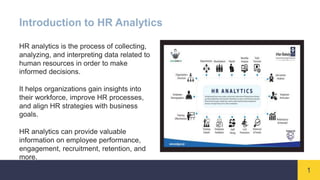
HR analytics is the process of collecting,
analyzing, and interpreting data related to
human resources in order to make
informed decisions.
It helps organizations gain insights into
their workforce, improve HR processes,
and align HR strategies with business
goals.
HR analytics can provide valuable
information on employee performance,
engagement, recruitment, retention, and
more.
2
Benefits of HR Analytics
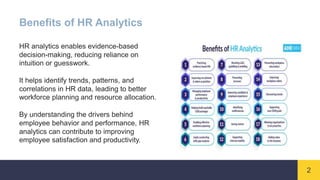
HR analytics enables evidence-based
decision-making, reducing reliance on
intuition or guesswork.
It helps identify trends, patterns, and
correlations in HR data, leading to better
workforce planning and resource allocation.
By understanding the drivers behind
employee behavior and performance, HR
analytics can contribute to improving
employee satisfaction and productivity.
3
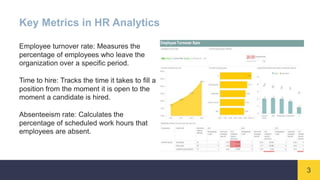
Key Metrics in HR Analytics
Employee turnover rate: Measures the
percentage of employees who leave the
organization over a specific period.
Time to hire: Tracks the time it takes to fill a
position from the moment it is open to the
moment a candidate is hired.
Absenteeism rate: Calculates the
percentage of scheduled work hours that
employees are absent.
4
Data Collection for HR Analytics
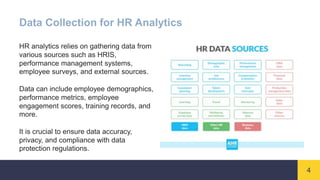
HR analytics relies on gathering data from
various sources such as HRIS,
performance management systems,
employee surveys, and external sources.
Data can include employee demographics,
performance metrics, employee
engagement scores, training records, and
more.
It is crucial to ensure data accuracy,
privacy, and compliance with data
protection regulations.
5
Data Analysis Techniques
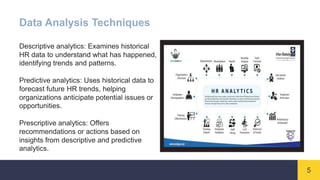
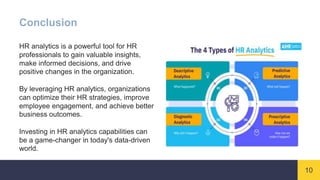
Descriptive analytics: Examines historical
HR data to understand what has happened,
identifying trends and patterns.
Predictive analytics: Uses historical data to
forecast future HR trends, helping
organizations anticipate potential issues or
opportunities.
Prescriptive analytics: Offers
recommendations or actions based on
insights from descriptive and predictive
analytics.
6
Data Visualization in HR Analytics
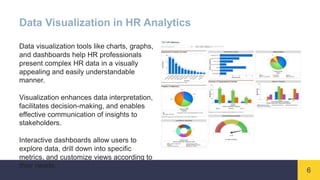
Data visualization tools like charts, graphs,
and dashboards help HR professionals
present complex HR data in a visually
appealing and easily understandable
manner.
Visualization enhances data interpretation,
facilitates decision-making, and enables
effective communication of insights to
stakeholders.
Interactive dashboards allow users to
explore data, drill down into specific
metrics, and customize views according to
their needs.
7
Challenges of HR Analytics
Data quality and availability: Ensuring
accurate and complete data can be
challenging, especially if data is stored in
different systems or formats.
Privacy and ethical considerations: HR
analytics deals with sensitive employee
data, requiring strict adherence to privacy
regulations and ethical practices.
Building analytics capabilities:
Organizations may face challenges in
acquiring the necessary skills, technology,
and infrastructure to implement HR
analytics effectively.
8
Best Practices in HR Analytics
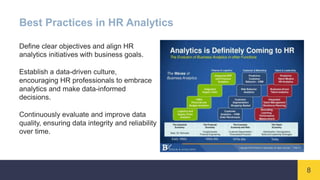
Define clear objectives and align HR
analytics initiatives with business goals.
Establish a data-driven culture,
encouraging HR professionals to embrace
analytics and make data-informed
decisions.
Continuously evaluate and improve data
quality, ensuring data integrity and reliability
over time.
9
HR Analytics Case Study
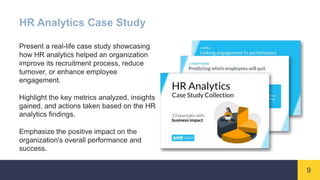
Present a real-life case study showcasing
how HR analytics helped an organization
improve its recruitment process, reduce
turnover, or enhance employee
engagement.
Highlight the key metrics analyzed, insights
gained, and actions taken based on the HR
analytics findings.
Emphasize the positive impact on the
organization's overall performance and
success.
10
Conclusion
HR analytics is a powerful tool for HR
professionals to gain valuable insights,
make informed decisions, and drive
positive changes in the organization.
By leveraging HR analytics, organizations
can optimize their HR strategies, improve
employee engagement, and achieve better
business outcomes.
Investing in HR analytics capabilities can
be a game-changer in today's data-driven
world.

Understanding Of Hr Analytics.pptx

  • 1.
    Understanding Of HrAnalytics SlideMake.com
  • 2.
    1 Introduction to HRAnalytics HR analytics is the process of collecting, analyzing, and interpreting data related to human resources in order to make informed decisions. It helps organizations gain insights into their workforce, improve HR processes, and align HR strategies with business goals. HR analytics can provide valuable information on employee performance, engagement, recruitment, retention, and more.
  • 3.
    2 Benefits of HRAnalytics HR analytics enables evidence-based decision-making, reducing reliance on intuition or guesswork. It helps identify trends, patterns, and correlations in HR data, leading to better workforce planning and resource allocation. By understanding the drivers behind employee behavior and performance, HR analytics can contribute to improving employee satisfaction and productivity.
  • 4.
    3 Key Metrics inHR Analytics Employee turnover rate: Measures the percentage of employees who leave the organization over a specific period. Time to hire: Tracks the time it takes to fill a position from the moment it is open to the moment a candidate is hired. Absenteeism rate: Calculates the percentage of scheduled work hours that employees are absent.
  • 5.
    4 Data Collection forHR Analytics HR analytics relies on gathering data from various sources such as HRIS, performance management systems, employee surveys, and external sources. Data can include employee demographics, performance metrics, employee engagement scores, training records, and more. It is crucial to ensure data accuracy, privacy, and compliance with data protection regulations.
  • 6.
    5 Data Analysis Techniques Descriptiveanalytics: Examines historical HR data to understand what has happened, identifying trends and patterns. Predictive analytics: Uses historical data to forecast future HR trends, helping organizations anticipate potential issues or opportunities. Prescriptive analytics: Offers recommendations or actions based on insights from descriptive and predictive analytics.
  • 7.
    6 Data Visualization inHR Analytics Data visualization tools like charts, graphs, and dashboards help HR professionals present complex HR data in a visually appealing and easily understandable manner. Visualization enhances data interpretation, facilitates decision-making, and enables effective communication of insights to stakeholders. Interactive dashboards allow users to explore data, drill down into specific metrics, and customize views according to their needs.
  • 8.
    7 Challenges of HRAnalytics Data quality and availability: Ensuring accurate and complete data can be challenging, especially if data is stored in different systems or formats. Privacy and ethical considerations: HR analytics deals with sensitive employee data, requiring strict adherence to privacy regulations and ethical practices. Building analytics capabilities: Organizations may face challenges in acquiring the necessary skills, technology, and infrastructure to implement HR analytics effectively.
  • 9.
    8 Best Practices inHR Analytics Define clear objectives and align HR analytics initiatives with business goals. Establish a data-driven culture, encouraging HR professionals to embrace analytics and make data-informed decisions. Continuously evaluate and improve data quality, ensuring data integrity and reliability over time.
  • 10.
    9 HR Analytics CaseStudy Present a real-life case study showcasing how HR analytics helped an organization improve its recruitment process, reduce turnover, or enhance employee engagement. Highlight the key metrics analyzed, insights gained, and actions taken based on the HR analytics findings. Emphasize the positive impact on the organization's overall performance and success.
  • 11.
    10 Conclusion HR analytics isa powerful tool for HR professionals to gain valuable insights, make informed decisions, and drive positive changes in the organization. By leveraging HR analytics, organizations can optimize their HR strategies, improve employee engagement, and achieve better business outcomes. Investing in HR analytics capabilities can be a game-changer in today's data-driven world.

Editor's Notes

  • #3 Image source: https://excelguru.pk/product/hr-analytics-using-power-bi/
  • #4 Image source: https://www.aihr.com/blog/benefits-of-hr-analytics/
  • #5 Image source: http://www.datapower.vn/bi-hr.html
  • #6 Image source: https://www.rplusplus.com/blog/l-analyse-de-donnees-rh
  • #7 Image source: https://excelguru.pk/product/hr-analytics-using-power-bi/
  • #8 Image source: https://www.helphealth.co/2021/06/health-metrics.html
  • #9 Image source: https://www.slidemake.com
  • #10 Image source: http://www.slideshare.net/jbersin/bigdata-in-human-resources-making-it-happen/13-Analytics_is_Definitely_Coming_to
  • #11 Image source: http://webapi.bu.edu/hrm-case-study-examples.php
  • #12 Image source: https://www.aihr.com/blog/types-of-hr-analytics/