The document proposes a method for face recognition using deep learning and data augmentation. It cleans and pre-processes existing face datasets to remove noise and extracts faces. It then uses image processing techniques to add masks to the faces to create a new masked face dataset. An Inception Resnet-v1 model is trained on the new dataset. The method is applied to build a face recognition application for employee timekeeping that achieves high accuracy even when faces are masked.
![Face Recognition based on Deep Learning and
Data Augmentation
Lam Duc Vu Nguyen1,2
, Van Van Chau1,2
, Sinh Van Nguyen1,2
1
School of Computer Science and Engineering
International University, Ho Chi Minh City, Vietnam
2
Vietnam National University, Ho Chi Minh City, Vietnam
Corresponding author: nvsinh@hcmiu.edu.vn
Abstract. Face recognition is one of the most popular applications in
video surveillance systems and computer vision. The researches of face
recognition in recent years have been shown that their applications are
widely used in practice. Particularly, during the pandemic of Covid-19,
there were a lot of researches relating to face recognition with and with-
out mask. The accuracy of the face recognition algorithms is depended on
technical issues, implemented solutions and models of data processing.
In this paper, we propose an improved method for face recognition based
on deep learning techniques and data augmentation. Our contribution of
the proposed method is focused on the following steps: (1) obtaining and
pre-processing data for training dataset based on image processing tech-
niques (i.e. noise removal, mask wearing). (2) Creating a trained model
of new dataset based on the Inception Resnet-v1. (3) Building an ap-
plication for face recognition in timekeeping of a company. We use the
two popular face datasets which are open source and publicity available:
Casia-WebFace [1] for training and LFW [2] for validation. Comparing
the several methods, the accuracy of our method is higher in case with
mask and the processing time is very fast in the real time.
Keywords: Face Detection, Face Recognition, Deep Learning, CNN
Models, Inception-Resnet Data Augmentation.
1 Introduction
The research and application of computer vision, computer graphics, image
processing and machine learning in recent years brings us a lot of advantages
[3,4,5,6]. They are applied in many fields like 3D simulation, game industry,
medical diagnostics or digital heritages. These knowledge and solutions are also
popular and widely used in the systems of security, access control, check-in and
check-out, objects tracking and monitoring, identify verification services, etc.,
and proved usefully and efficiently. The researches in face recognition system
have been becoming popular along with development of artificial intelligence
and deep learning techniques [7,8]. A facial recognition system is an application
capable of matching a human face from a digital image or a video frame of a](https://image.slidesharecdn.com/paper3-221015035846-b37609b4/85/Paper_3-pdf-1-320.jpg)
![Face Recognition based on Deep Learning and
Data Augmentation
Lam Duc Vu Nguyen1,2
, Van Van Chau1,2
, Sinh Van Nguyen1,2
1
School of Computer Science and Engineering
International University, Ho Chi Minh City, Vietnam
2
Vietnam National University, Ho Chi Minh City, Vietnam
Corresponding author: nvsinh@hcmiu.edu.vn
Abstract. Face recognition is one of the most popular applications in
video surveillance systems and computer vision. The researches of face
recognition in recent years have been shown that their applications are
widely used in practice. Particularly, during the pandemic of Covid-19,
there were a lot of researches relating to face recognition with and with-
out mask. The accuracy of the face recognition algorithms is depended on
technical issues, implemented solutions and models of data processing.
In this paper, we propose an improved method for face recognition based
on deep learning techniques and data augmentation. Our contribution of
the proposed method is focused on the following steps: (1) obtaining and
pre-processing data for training dataset based on image processing tech-
niques (i.e. noise removal, mask wearing). (2) Creating a trained model
of new dataset based on the Inception Resnet-v1. (3) Building an ap-
plication for face recognition in timekeeping of a company. We use the
two popular face datasets which are open source and publicity available:
Casia-WebFace [1] for training and LFW [2] for validation. Comparing
the several methods, the accuracy of our method is higher in case with
mask and the processing time is very fast in the real time.
Keywords: Face Detection, Face Recognition, Deep Learning, CNN
Models, Inception-Resnet Data Augmentation.
1 Introduction
The research and application of computer vision, computer graphics, image
processing and machine learning in recent years brings us a lot of advantages
[3,4,5,6]. They are applied in many fields like 3D simulation, game industry,
medical diagnostics or digital heritages. These knowledge and solutions are also
popular and widely used in the systems of security, access control, check-in and
check-out, objects tracking and monitoring, identify verification services, etc.,
and proved usefully and efficiently. The researches in face recognition system
have been becoming popular along with development of artificial intelligence
and deep learning techniques [7,8]. A facial recognition system is an application
capable of matching a human face from a digital image or a video frame of a](https://image.slidesharecdn.com/paper3-221015035846-b37609b4/75/Paper_3-pdf-1-2048.jpg)
![2 Nguyen et al.
camera with a given image in the database system. Using the machine learn-
ing methods and deep learning techniques are best solutions to obtain the high
accuracy and adapt real time processing. Transfer learning and image augmen-
tation are additional techniques in image processing and machine learning that
can help improving precision of the face recognition systems.
The existing identify systems like fingerprints, palm recognition, ID and pass-
words, etc., are developed and widely used in practice. However, these methods
existed limitations such as fake images of fingers and palms, or missing the user
name and password to check-in. Therefore, the needs for using face recognition
system is increasing recent years because of its accuracy and necessary in both
security system and objects monitoring system. In order to build a facial recog-
nition system, the training dataset plays an important role in implementation of
the system. Numerous facial datasets have been published online so that anyone
can download them for free testing. These datasets are very huge, containing
millions of images of various peoples. Therefore, researchers can skip the data
collection phase and concentrate on training the model. The computer hardware
is also getting more and more powerful to be able to train models. Wearing a
face mask is now commonly used as part of standard to prevent infection during
the pandemic of COVID-19. This is requirements for us in public spaces or on
the means of transportation. Therefore, a system that recognizes people with
face mask is necessary in any organizations or companies.
The system ought to be real-time and robotized. One suitable solution for these
requirements is deep learning. This technology can help us recognize people with
face mask automatically. Although the numerous facial datasets are available
and free for accessing in the several researches. However, the facial dataset with
mask is not available at present. In this research, we apply the image processing
techniques to wear a mask on each face of the existing facial data. The dataset
is then used for training data of our model. After reviewing the state-of-the-art
methods, we propose a method for face recognition in both mask and without
mask. Our contribution focus on data creation and data augmentation. The im-
proved points have been shown the accuracy in face recognition with mask.
The remainder of the paper is structured as follows. Section 2 presents the state-
of-the-art methods, several applications, tools and techniques for building appli-
cation in practice. Section 3 describes in detail our proposed method including
system design of the application. We present the implementation and obtained
results in section 4. Section 5 includes discussion and evaluation. The last section
is our conclusion and future work.
2 Related works
In this section, we explore the several methods for face recognition and its ap-
plication in practice. The two important points that researchers want to obtain
are accuracy and time processing. In order to improve accuracy of image classi-
fication, Alex Krizhevsky et. al. [9] (called AlexNet) presented a new CNN ar-
chitecture model based on increasing layers with the support of computational](https://image.slidesharecdn.com/paper3-221015035846-b37609b4/85/Paper_3-pdf-2-320.jpg)
![Face Recognition based on Deep Learning and Data Augmentation 3
power. The advantage of this CNN architecture is that the model can extract
more features from each layer. After that, they are combined to enrich informa-
tion of the object for prediction step. Moreover, the activation function ReLU is
used as an additional computation step to speed-up the training process of the
model compared to sigmoid function. However, the limitation come from size
selection (11 x 11) of the first convolutional layer that can be difficult to deal
with smaller size of pictures in practice. Karen et.al. [10] proposed an idea to
build templates using blocks . The VGG Block includes three parts: a convolu-
tional layer, an activation function, and a pooling layer. The order and number
of the block are optional. At the end, a fully connected layer and SoftMax is
inserted to make prediction. Unlike AlexNet [9], that model use 3 x 3 filters to
help reduce computation, which reduces time and parameters. In contrast, they
increase the depth of CNN that lead to increase accuracy of the network model.
In the traditional approach, the neural nework layers are stacked together as
thickly as possible to create a model that can learn complex rules. However, a
very deep neural network can cause the problem of overfitting. Another problem
is vanishing gradient: the gradient is too small, that make it impossible for layers
to learn in backpropagation. Furthermore, since the picture’s information area
changes with each image, choosing the optimal kernel size is crucial. Szegedy et
al. [11] suggested a new solution for building neural networks. Instead of being
“deeper,” the network would become “wider.” Different kernels operate on the
same input. Then, to form block output, all kernel’s output are concatenated
along the channel dimension. For example, a block includes four parallel paths.
To extract information from different spatial sizes, the first three paths used
different convolutional layers from 1 x 1, 3 x 3, and 5 x 5. The max pooling
layer (3 x 3) is used in the last path. All output must be the same size across
the fourth paths, which is a requirement for the concatenation step. Each layer
must have appropriate padding. The neural network (as previously indicated) is
consuming cost. Therefore, the authors include an extra layer 1 x 1 convolution
before 3 x 3 and 5 x 5 convolutions to reduce the number of input channels.
Kaiming et.al. [12] presented another solution (namely residual block) to defeat
the vanishing/exploding gradient. Instead of making the network wider, this ap-
proach introduces a technique called skip connection. It let data skip several
layers and connect directly to the output. The implementation of this block is
simple. Input x and f(x) are directly added together to create an output of block.
This kind of architecture requires x and f (x) to have the same shape. If the result
x + f (x) approximates x (can be assumed as x + f (x) = x), the residual block
is easy to learn (it means all weights and bias of the layer will be pushed to 0).
Christian et.al. [11] presented a method for improving inception deep learning
model for image classification. With numerous variants of the inception network
were established, each of later versions is better compared to the previous one.
In the next research project [13], authors suggested a solution to improve the
accuracy and reduction of the computational complexity. Instead of using large
filters (e.g. 5 x 5 or 7 x 7), it can be expensive in computation, authors suggested
to decompose them into smaller filters.](https://image.slidesharecdn.com/paper3-221015035846-b37609b4/85/Paper_3-pdf-3-320.jpg)
![4 Nguyen et al.
Considering the spatial factorization, the researchers can continue to factorize
n x n kernel into a combination of 1 x n and n x 1 kernels. When the number
of filters is the same, 1 x n and n x 1 kernels are (1 x n + n x 1)/n2
= 2/n
cost of n x n kernel. Therefore, this combination is 1 − 2/n cheaper than the
original kernel. For instance, a 3 x 3 convolution is divided into 1 x 3 convolution
followed by a 3 x 1 convolution. They found this method is 1−2/n = 0.3 cheaper
than the single 3 x 3 convolution. In practice, they figured out that this factor-
ization does not work on early layer, but it produces incredibly good results on
the grid of medium size. In order to reduce the grid size, Christian [13] use a
pooling layer and a convolutional layer to process and combine them to produce
the output of block. From these improvements, many architectural models had
been introduced: Inceptionv1, Inceptionv2, Inceptionv3, Inceptionv4. The model
in this research is based on Inception Resnet v1. The inception-resnet v1 is in-
troduced in [14]. It is a hybrid network insprired by the inception model and
residual model. This combination increases the number of layers while keeping
the accuracy and performance. Another research namely FaceNet is introduced
by Florian et.al. [15]. The purpose is to represent faces in Euclidean space,
where the distance can used to compare similarity. The architecture of FaceNet
is described as follows. A batch of images fed into a deep architecture (this
architecture is designed to turn images into vectors). These vectors are then
normalized to unit vectors using the L2 method. The pictures (as vector form)
is then processed through triplet loss to distributed embedding the notation of
similarity and dissimilarity. To the face-mask recognition, Warot Moungsouy et
al. [16] proposed a method based on residual inception networks. Authors intro-
duced a masked-face dataset based on the Casia-WebFace dataset [1]. It consists
of 2236161 masked-face images. Then, both Casia-WebFace dataset and new
dataset are combined to train the model. The proposed method was based on
FaceNet using Inception-Resnet-v1 architecture. They test with several model
and the best model was the fine-tuned FaceNet with the retrain Inception Block
A on the new dataset. This model achieved 99.2% accuracy on masked-face test
dataset. They also figure out that adding masked-face image into training data,
it improve the accuracy of the model 0.6%
Besides, the transfer learning is known as a machine learning form where a model
is built for a specific task and then reused on a second task as the starting point
to be modified. It is used in deep learning as a pre-trained model in computer
vision and natural language processing tasks to develop neural network models
on these problems. The transfer learning is very useful in deep learning prob-
lems because most real-world problems usually have billions of labeled data, and
this requires complex models. It is an effective technique for optimization, time
saving and achieving better performance. Developers can use transfer learning
to merge different applications into one. They can quickly train new models
for complex applications. Moreover, transfer learning is a good tool to improve
the accuracy of computer vision models. At the end of this research work, we
present a facial recognition application for attendance system based on a deep
learning model. We utilize transfer learning by using three pre-trained convo-](https://image.slidesharecdn.com/paper3-221015035846-b37609b4/85/Paper_3-pdf-4-320.jpg)
![Face Recognition based on Deep Learning and Data Augmentation 5
lution neural networks and train them on our data which contains 10 different
classes where each class includes 20 facial images. The three networks showed
very high performance in terms of high prediction accuracy and reasonable train-
ing time. Therefore, face recognition based on deep learning can greatly improve
the recognition speed and accuracy. The last and not lead, many existing API,
Libraries, tools and techniques can help us to implement our application like
OpenCV, TensorFlow, PyTorch.
3 Our proposed method
3.1 Overview
This section present our proposed method. We create an effective model for
both recognizing masked faces and without masked faces. As mentioned in the
Introduction, the method consist of three steps. In the first step, we obtain the
datasets from the publish sources Casia-WebFace [1] and LFW [2]. They are the
face images without face masks. Therefore, after pre-processing these data (i.e.
noise removal) we use the image processing techniques to wear a mask on each
face. In the second step, we use the new datasets for building our training data
model based on inception resnet-v1. The last step is creating an application for
testing our face recognition system. The detail of each step is described in the
following sections.
3.2 Pre-processing data
Cleaning data: The dataset Casia-WebFace [1] is used for face verification and
face identification tasks including 494414 face images of 10575 peoples. Each
image has a size of 250 x 250 x 3 (width x height x channel) and saved as a jpg
file. To avoid any noise in the image, an algorithm iterates through all images
and detects face coordinates. Thus, the face in the image will be extracted from
the background. In this section, the MTCNN model is used for face detection.
This model includes three nets: P-Net, R-Net and O-Net to process and obtain
the coordinates of the bounding box as a rectangle. Finally, we apply an image
processing method to format, resize image to have a uniform of width and height,
change the color to RGB and save image into a new folder (see Fig.1) The
algorithm (Algorithm 1) below is proposed to clear data.
Creating mask: After cleaning process, a new dataset of faces is created,
however these faces do not have masks. Thus, we now create a mask on each
face image. Firstly, a list of mask images will be retrieved from the internet that
contain ten different mask images. All of them are processed by using an edited
photo application to filter out the background. The purpose is to randomly select
masks, thereby creating diverse images when feeding them into the model. The
functions of application allows process the picture. Using a certain threshold to
enable the mask separated from the background and obtain a mask image. In](https://image.slidesharecdn.com/paper3-221015035846-b37609b4/85/Paper_3-pdf-5-320.jpg)
![6 Nguyen et al.
Fig. 1. Using MTCNN to clean data
Algorithm 1 Algorithm for clearing dataset
Input: the dataset from Casia-WebFace [1]
Output: Our new dataset
1: for each image in the dataset do
2: image = openImage(each file)
3: list face coordinates = MTCNN.detect faces(image)
4: if length(list face coordinates) == 1 then
5: [xmin, ymin, xmax, ymax] = list face coordinates[0]
6: face image = image[ymin:ymax, xmin:xmax]
7: face image = resize(image)
8: save(face image)
9: else
10: print(the number of faces is incorrect)
11: continue
12: end if
13: end for](https://image.slidesharecdn.com/paper3-221015035846-b37609b4/85/Paper_3-pdf-6-320.jpg)
![Face Recognition based on Deep Learning and Data Augmentation 7
order to determine the coordinates points on the face for processing, a technique
called facial landmark [17,18] is used. This technique will mark important points
of the face according to sixty-eight coordinates. We based on this information
to wear mask on the face. Many solutions can be applied to cover a mask on the
face like determining points around mouth, nose or chin, etc.
In this case, we map the mask to corresponding points on the face using the
homography algorithm. Each face has different features and situation, applying
this algorithm gives us a better result because the mask is rotated and resized
based on the shape of face. We want to overlay both cheeks and nose with a mask,
so the corresponding points in this case from 1 to 15 and 29. Figure 2 illustrates
how the points on the face and the mask are connected. If the coordinates of the
face change, the coordinates of the mask also change, so the mask will fit more
close to the face (see Fig.2) The next algorithm (Algorithm 2) show the way to
Fig. 2. Creating a mask for the face
wear a mask on the face:
3.3 Creating trained model
In this section, we apply the FaceNet concept to create our model. As mentioned
in [15], the picture is converted into 128-D embedding using triplet loss function.
In the very first model, triplet loss function is used to train the model, but
the result is bad. The loss value decreases gradually and the model eventually
corrupts. The problems come from batch size and the label of each batch. The
Casia-WebFace dataset has 10575 labels with a batch size of 512. Therefore,
there is a small chance for images of the same person to exist in one batch, while
triplet loss function requires triplets (anchor, positive, and negative). For this
reason, we apply the FaceNet concept to convert image into embedding; but other
factors like loss function and model architecture will be changed. After training,](https://image.slidesharecdn.com/paper3-221015035846-b37609b4/85/Paper_3-pdf-7-320.jpg)
![8 Nguyen et al.
Algorithm 2 Algorithm for wearing a mask on the face
Input: The data without mask
Output: The data with mask
1: for each face image in the dataset do
2: image = openImage(each file)
3: xminM, xmaxM, yminM, ymaxM //M: mouth
4: landmarks = detect 68 landmarks and mouth(image)
5: if (landmarks is not null) and (len(landmarks) = 68) then
6: coord points face = ([point[0], point[1]] for points in landmarks[1:16])
7: coord points face.append(landmarks[29][0], landmarks[29][1])
8: mask image = choose a random mask()
9: coord points mask = get coord points mask()
10: matrix HG = findHG(coord points mask, coord points face)
11: mask image HG = cv2.warpPerspective(mask image,matrix HG,imageSize)
12: image with mask = wear mask HG(image, mask image HG)
13: save(image with mask)
14: else
15: mask image = choose a random mask()
16: mask image = resize(xmaxM - xminM, ymaxM - yminM)
17: image&mask = wear mask default(image, mask image, xminM, yminM)
18: save(image&mask)
19: end if
20: end for
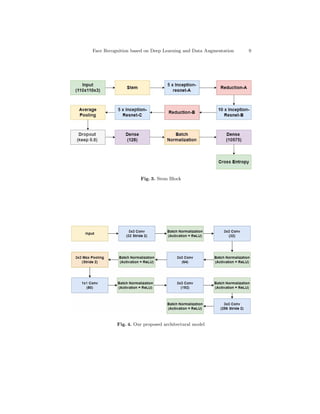
we will remove the last layer (dense net 10575) and add an l2 normalizer to
the model. The final model for embedding is described as in Fig.3. We use the
Inception-resnet-v1 [14] to train our model. The model is added more Batch
Normalization Layers to normalize input data and modify the last layer to get
the 128-element embedding. This model is a stack of Stem, Inception-Resnet-A,
Reduction A, Inception-Resnet-B, Reduction-B, Inception-Resnet-C. The cross-
entropy is chosen to train the model, so the last layer must encode the image into
an n-number vector, where n is equal to the number of people in the dataset.
Due to the requirement of cross entropy, dense net has 10575 units before going
to loss function because there are 10575 different persons in the dataset and one
image belongs to only one person. But we do not want to classify 10575 people
in a dataset or train again each time we add a new person. Therefore, we keep a
dense net with 128 units to learn the features of the face before going to a dense
net of 10575 (see Fig.4).
Training process Although the dataset has 10575 people, but the image num-
ber of each person are not the same that lead to generate noise. To solve this
problem, for each epoch, a training dataset must be created in which each person
has the same number of images. After that, each person includes fifteen images
are chosen from the ”no mask” dataset and fifteen images are chosen from the
”mask” dataset. We apply processing techniques to augment the data. This will
help the model predict better in different conditions (e.g. angle, light, size). Be-](https://image.slidesharecdn.com/paper3-221015035846-b37609b4/85/Paper_3-pdf-8-320.jpg)
![Face Recognition based on Deep Learning and Data Augmentation 11
4 Implementation & results
In this section, we implement our proposed method and application for face
recognition system. We perform our method by using Python, TensorFlow. The
model and data are trained on Google Collab Pro. The application is then built
based on our model to describe how it is used in the face recognition system.
We implement all functions based on Python API to process data, to augment
images, to train the training data. The Inception-Resnet v1 is implemented us-
ing Keras. To wear a mask on each face image, we use the API “FacialMask-
DataSet.py”. The output of this step is presented as follows: The face detection
Fig. 6. Wearing a mask on each face image [1]
is performed by using existing source code in [19]. The obtained result is matched
with data in the database (see Fig.6 and Fig.7)
Fig. 7. Face recognition is worked well with both masked face and non-masked face](https://image.slidesharecdn.com/paper3-221015035846-b37609b4/85/Paper_3-pdf-11-320.jpg)
![12 Nguyen et al.
5 Discussion and evaluation
In order to evaluate our model, we test and run with many times of epochs.
After running 49 epochs (see Fig.8a), The loss value decrease dramatically in
the first ten epochs; after that, this value decreases slowly and is stable from
35 to 49. The goal is to evaluate how our model can process both the face with
Fig. 8. Evaluation of the stable and accuracy of our model
and without mask. We combine the “no mask LFW” and “mask LFW” into one
dataset. The obtained result is plotted in Fig.8b. The accuracy increases after
each epoch. Starting from the epoch twenty, accuracy increase insignificantly,
staying around 90%.
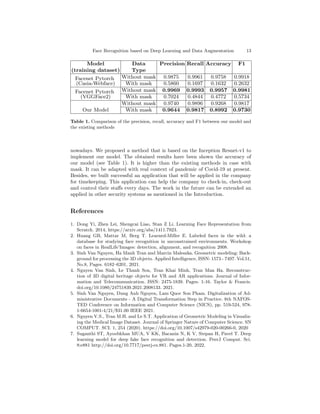
To compare with the existing method, the FaceNet-PyTorch [20] in python li-
brary includes several versions of the FaceNet model. In this research work, we
use the Casia-Webface version. This model is trained with the same dataset that
we used. The dataset LFW and its variants will be reused in this experiment.
Our model will be the model at epoch 49, which is the latest model. At first,
two models will convert images from the “no mask LFW” dataset into database
embedding. Each label will have only one embedding. Then two models will
predict data in two cases: LFW (with mask) and LFW (without mask). In this
test we do not use a threshold to maximize the accuracy of two models, so the
unknown answer will be zero (see Table 1). Comparing to other models, the
accuracy of our model is better in case with mask and a little lower in case
without mask. In order to improve for both cases (with and without mask),
we can increase the number of epochs to run until meet the accuracy of our
expectation.
6 Conclusion and future work
In this research work, we explore the several methods for face recognition and
their application in practice. The methods are based on machine learning tech-
niques are very popular and suitable for almost cases in practical applications](https://image.slidesharecdn.com/paper3-221015035846-b37609b4/85/Paper_3-pdf-12-320.jpg)
![14 Nguyen et al.
8. KH Teoh, RC Ismail, SZM Naziri, R Hussin, MNM Isa and MSSM Basir. Face
Recognition and Identification using Deep Learning Approach. Journal of Physic:
Conference Series, 1755 012006, 2021
9. Alex Krizhevsky, Ilya Sutskever, Geoffrey E.Hinton. ImageNet Classification with
Deep Convolutional. Journal of Communications of the ACM, Vol.60 Issue. 6, Pages.
84–90, https://doi.org/10.1145/3065386, 2017.
10. Karen Simonyan and Andrew Zisserman. Very Deep Convolutional Networks for
Large-Scale Image Recognition. International Conference on Learning Representa-
tions. http://arxiv.org/abs/1409.1556. 2015.
11. Christian Szegedy, Wei Liu, Yangqing Jia, Pierre Sermanet, Scott Reed,
Dragomir Anguelov, Dumitru Erhan, Vincent Vanhoucke, Andrew Rabinovich.
https://doi.org/10.48550/arXiv.1409.4842. Going deeper with convolutions, 2014.
12. Kaiming He, Xiangyu Zhang, Shaoqing Ren, Jian Sun. Deep Residual Learning for
Image Recognition. IEEE Conference on Computer Vision and Pattern Recognition
(CVPR 2016). Pages. 770-778, 2016.
13. Christian Szegedy, Vincent Vanhoucke, Sergey Ioffe, Jon Shlens and Zbigniew Wo-
jna,. Rethinking the Inception Architecture for Computer Vision. IEEE Conference
on Computer Vision and Pattern Recognition (CVPR), 2016, pp. 2818-2826, doi:
10.1109/CVPR.2016.308.
14. Christian Szegedy, Sergey Ioffe, Vincent Vanhouke, Alexander A. Alemi. Inception-
v4, inception-ResNet and the impact of residual connections on learning. AAAI’17
Proceedings of the Thirty-First AAAI Conference on Artificial Intelligence, 2017,
pp.4278-4284.
15. Florian Schroff, Dmitry Kalenichenko and James Philbin. FaceNet: A uni-
fied embedding for face recognition and clustering. 2015 IEEE Conference on
Computer Vision and Pattern Recognition (CVPR), 2015, pp. 815-823, doi:
10.1109/CVPR.2015.7298682.
16. Warot Moungsouy, Thanawat Tawanbunjerd, Nutcha Liamsomboon and Wora-
pan Kusakunniran. Face recognition under mask-wearing based on residual incep-
tion networks. Applied Computing and Informatics, 2022, doi: 10.1108/ACI-09-
2021-0256. Scene Recognition from Image Using Convolutional Neural Network.
Journal of Procedia Computer Science, Vol.167,Pages. 1005-1012, ISSN 1877-0509,
https://doi.org/10.1016/j.procs.2020.03.400.
17. Ke Sun, Zhao Yang, Jiang Borui, Cheng Tianheng, Xiao Bin, Liu Dong, Mu
Yadong, Wang Xinggang, Liu Wenyu and Wang Jingdong. High-Resolution Rep-
resentations for Labeling Pixels and Regions. arXiv:1904.04514v1 [cs.CV] 2019.
18. LIANG Sen, ZHOU Zhi-ze, GUO Yu-dong, GAO Xuan, ZHANG Ju-yong, BAO
Hu-jun. Facial landmark disentangled network with variational autoencoder. Jour-
nal of Appl Math. Vol. 37(2). Pages. 290-305, 2022
19. AIZOOTECH, ”Github FaceMaskDetection”. Online Access, July 2022.
https://github.com/AIZOOTech/FaceMaskDetection.
20. Timesler, Facenet-pytorch [Online]. Available: https://github.com/timesler/facenet-
pytorch.](https://image.slidesharecdn.com/paper3-221015035846-b37609b4/85/Paper_3-pdf-14-320.jpg)


![Polymer [ बहुलक ] Chemistry Notes PDF - Irfanullah Mehar - JJ Sir Chemistry.pdf](https://cdn.slidesharecdn.com/ss_thumbnails/polymerchemistrynotespdf-irfanullahmehar-jjsirchemistry-260210172118-3f9b37f7-thumbnail.jpg?width=640&height=640&fit=bounds)


