HUMAN HEALTH AND chromosomal
disorders
 Greeks like Hippocrates and Indian Ayurveda system
.
HEALTH-STATE OF BODY AND MIND
HUMAN HEALTH
 Humour-Body fluids.
 Any alteration in body fluid-causes
disease.
 Eg:-
Normal green colour of bile
changes to black- Development of
Fever
CHARACTERISTICS OF GOOD HEALTH
 Free from sickness and diseases.
 Free from social and psychological
tensions.
 Ability to work efficiently
 Free from unnecessary anxiety.
 Self confidence.
 Feeling joy in living.
 Physical fitness.
CHROMOSOMAL DISORDERS
 Thread like structures in which DNA is tightly packed within the
nucleus..
 The centromere is located at the cell’s constriction point ,which
may not be the centre of the chromosomes
 Chromosomal Anomalies=Missing,extra or irregular portion of
chromosomal DNA.
 Most foetus with some chromosomal abnormality do not survive.
 Affects approximately 1 out of 200 of new borns.
 Chromosomal anomalies can be detected via Karyotype testing.
 Abnormalities depends on type of chromosome affected due to
non-disjunction chromosomes.
DEFINITION AND PREVALANCE
PATAU SYNDROME
An additional chromosome 13 resulting from
non-disjunction during meiosis.
Incidence-1 in 10,000-20,000 live births.
More than 80% die within the first year of life.
Anomalities can be seen:
 Intellectual disability.
 Microcephaly.
 Cleft palate
 Low-set ears.
 Ventricular septate defect.
 Polydactyly.
EDWARD’S SYNDROME
 An additional chromosome 18 resulting from non-disjunction
during meiosis.
 INCIDENCE=1 in 6000-8000 live births.
 Majority of foetus-with this syndrome die before but >90% dead
in 1st year.
 80% affected were females.
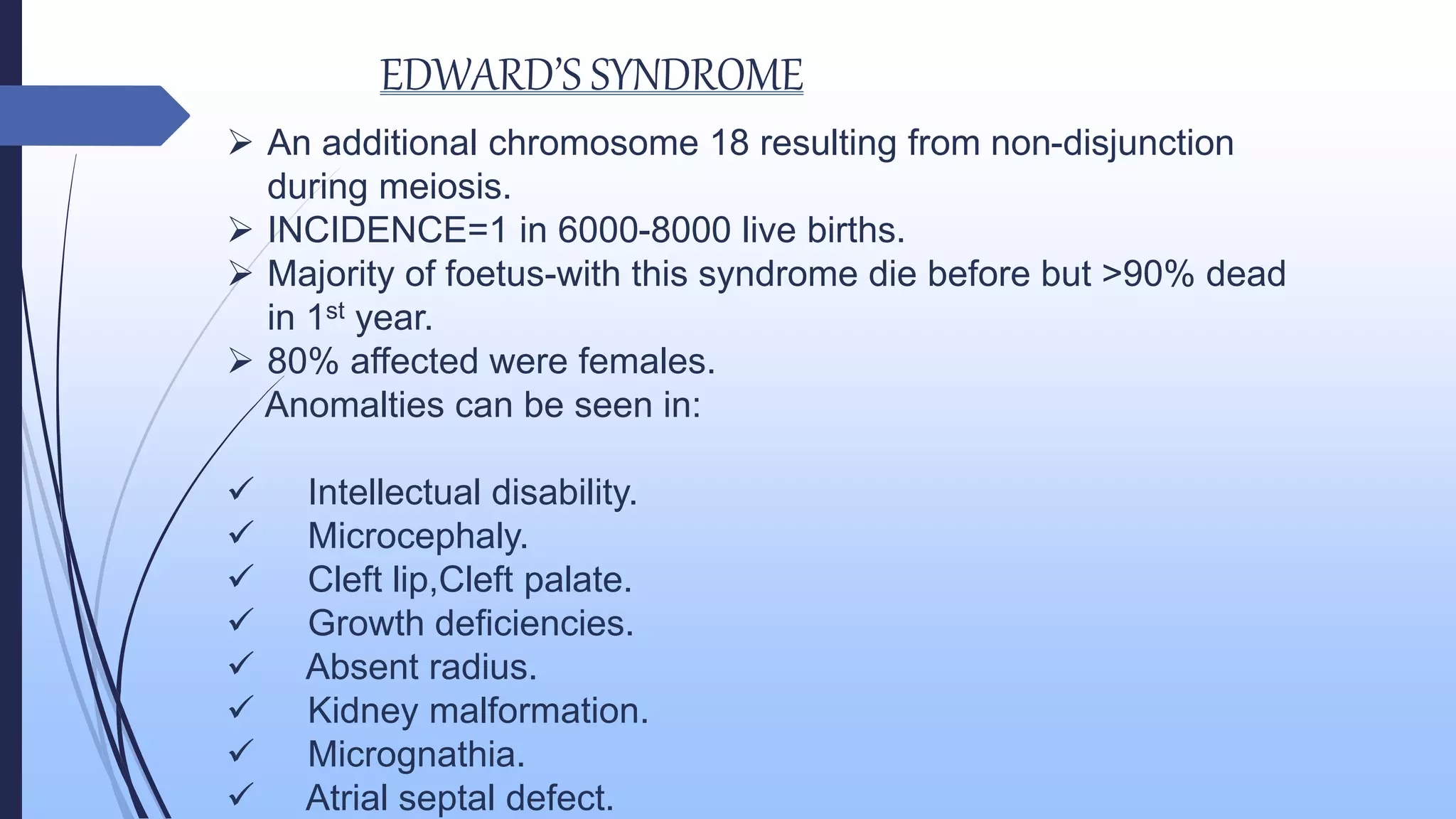
Anomalties can be seen in:
 Intellectual disability.
 Microcephaly.
 Cleft lip,Cleft palate.
 Growth deficiencies.
 Absent radius.
 Kidney malformation.
 Micrognathia.
 Atrial septal defect.
DOWN’S SYNDROME
An additional chromosome 21 resulting from nondisjunction during
meiosis(extra chromsome 21 in every cell of the body)
John Langdon Down(The British physician) who described the syndrome
in 1886.
Karyotype=47,XX +21 or 47,XY +21
Anomalies can be seen in:-
 Short stature.
 Mental impairment.
 Umblical hernia.
 Flat head.
 Large tongue.
 Abnormal outer ears.
TURNER SYNDROME
 Sex chromosome monosomy(45,XO)
 INCIDENCE=1 n 2000-5000
Anomalies can be seen in:-
 Skeletal disorders(osteoporosis)
 Webbed neck.
 Broad shoulders.
 Amenorrhoea.
 Thyroid problems.
 Cubitus valgus.
 Shortened metacarpal IV
KLINEFELTER’S SYNDROME
Two or more X chromosome..
Due to non-disjunction of X-chromosome
during meiosis.
47,44XXY (male)syndrome.
INCIDENCE=1 in 500 live male births.
Anomalies can be seen in:-
 Broader hips.
 Little body hair.
 Tall stature.
 IQ is normal.
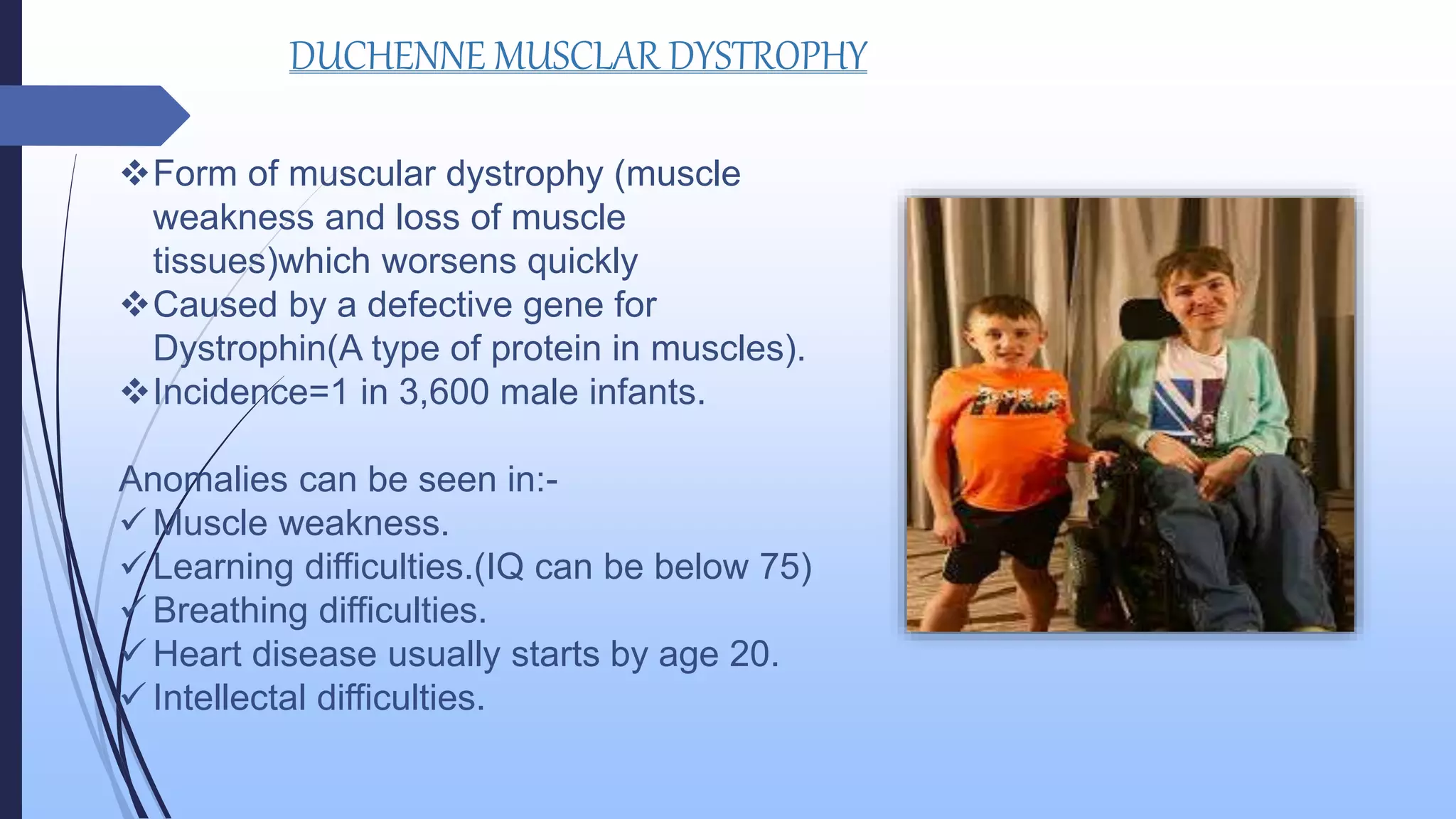
DUCHENNE MUSCLAR DYSTROPHY
Form of muscular dystrophy (muscle
weakness and loss of muscle
tissues)which worsens quickly
Caused by a defective gene for
Dystrophin(A type of protein in muscles).
Incidence=1 in 3,600 male infants.
Anomalies can be seen in:-
 Muscle weakness.
 Learning difficulties.(IQ can be below 75)
 Breathing difficulties.
 Heart disease usually starts by age 20.
 Intellectal difficulties.
Human health and Chromosomal Disorders

Human health and Chromosomal Disorders

  • 1.
    HUMAN HEALTH ANDchromosomal disorders
  • 2.
     Greeks likeHippocrates and Indian Ayurveda system . HEALTH-STATE OF BODY AND MIND HUMAN HEALTH
  • 3.
     Humour-Body fluids. Any alteration in body fluid-causes disease.  Eg:- Normal green colour of bile changes to black- Development of Fever
  • 4.
    CHARACTERISTICS OF GOODHEALTH  Free from sickness and diseases.  Free from social and psychological tensions.  Ability to work efficiently  Free from unnecessary anxiety.  Self confidence.  Feeling joy in living.  Physical fitness.
  • 6.
    CHROMOSOMAL DISORDERS  Threadlike structures in which DNA is tightly packed within the nucleus..  The centromere is located at the cell’s constriction point ,which may not be the centre of the chromosomes
  • 7.
     Chromosomal Anomalies=Missing,extraor irregular portion of chromosomal DNA.  Most foetus with some chromosomal abnormality do not survive.  Affects approximately 1 out of 200 of new borns.  Chromosomal anomalies can be detected via Karyotype testing.  Abnormalities depends on type of chromosome affected due to non-disjunction chromosomes. DEFINITION AND PREVALANCE
  • 8.
    PATAU SYNDROME An additionalchromosome 13 resulting from non-disjunction during meiosis. Incidence-1 in 10,000-20,000 live births. More than 80% die within the first year of life. Anomalities can be seen:  Intellectual disability.  Microcephaly.  Cleft palate  Low-set ears.  Ventricular septate defect.  Polydactyly.
  • 10.
    EDWARD’S SYNDROME  Anadditional chromosome 18 resulting from non-disjunction during meiosis.  INCIDENCE=1 in 6000-8000 live births.  Majority of foetus-with this syndrome die before but >90% dead in 1st year.  80% affected were females. Anomalties can be seen in:  Intellectual disability.  Microcephaly.  Cleft lip,Cleft palate.  Growth deficiencies.  Absent radius.  Kidney malformation.  Micrognathia.  Atrial septal defect.
  • 12.
    DOWN’S SYNDROME An additionalchromosome 21 resulting from nondisjunction during meiosis(extra chromsome 21 in every cell of the body) John Langdon Down(The British physician) who described the syndrome in 1886. Karyotype=47,XX +21 or 47,XY +21 Anomalies can be seen in:-  Short stature.  Mental impairment.  Umblical hernia.  Flat head.  Large tongue.  Abnormal outer ears.
  • 13.
    TURNER SYNDROME  Sexchromosome monosomy(45,XO)  INCIDENCE=1 n 2000-5000 Anomalies can be seen in:-  Skeletal disorders(osteoporosis)  Webbed neck.  Broad shoulders.  Amenorrhoea.  Thyroid problems.  Cubitus valgus.  Shortened metacarpal IV
  • 14.
    KLINEFELTER’S SYNDROME Two ormore X chromosome.. Due to non-disjunction of X-chromosome during meiosis. 47,44XXY (male)syndrome. INCIDENCE=1 in 500 live male births. Anomalies can be seen in:-  Broader hips.  Little body hair.  Tall stature.  IQ is normal.
  • 15.
    DUCHENNE MUSCLAR DYSTROPHY Formof muscular dystrophy (muscle weakness and loss of muscle tissues)which worsens quickly Caused by a defective gene for Dystrophin(A type of protein in muscles). Incidence=1 in 3,600 male infants. Anomalies can be seen in:-  Muscle weakness.  Learning difficulties.(IQ can be below 75)  Breathing difficulties.  Heart disease usually starts by age 20.  Intellectal difficulties.