States of Matter Chemistry The Four States of Matter Chumbler - Properties of Matter
States of Matter The Four States of Matter Four States Solid Liquid Gas Plasma Chumbler - Properties of Matter
States of Matter The Four States of Matter Basis of Classification of the Four Types Based upon particle arrangement Based upon energy of particles Based upon distance between particles Chumbler - Properties of Matter
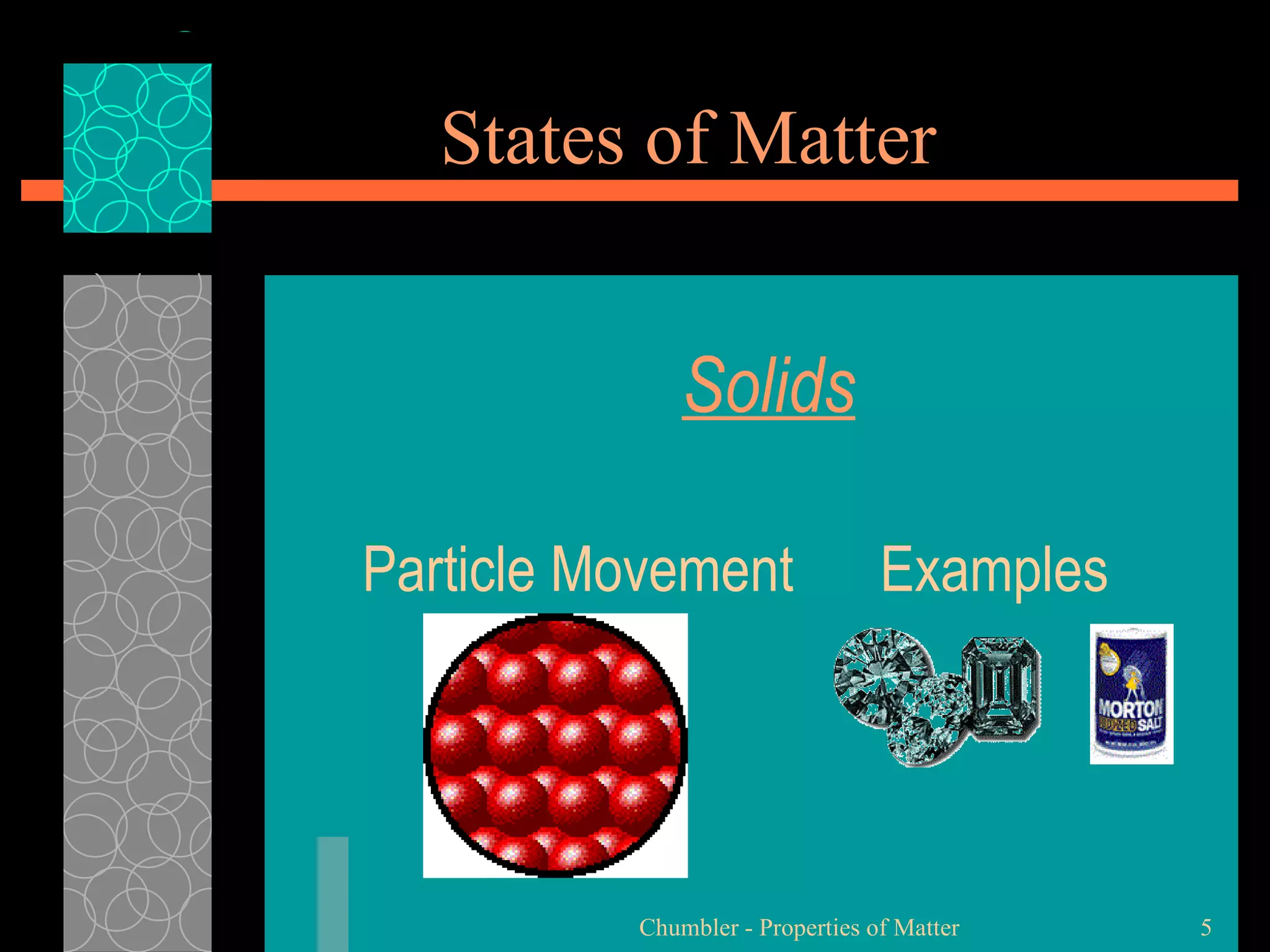
States of Matter Solids Particles of solids are tightly packed, vibrating about a fixed position.  Solids have a definite shape and a definite volume.  Solids have an infinite number of free surfaces. Chumbler - Properties of Matter
States of Matter Solids Particle Movement  Examples Chumbler - Properties of Matter
States of Matter Liquids Particles of liquids are tightly packed, but are far enough apart to slide over one another.  Liquids have an indefinite shape and a definite volume.  Liquids have one free surface. Chumbler - Properties of Matter
States of Matter Liquids Particle Movement  Examples Chumbler - Properties of Matter
States of Matter Gases Particles of gases are very far apart and move freely.  Gases have an indefinite shape and an indefinite volume.  Gases have no free surfaces. Chumbler - Properties of Matter
Gases Particle Movement  Examples Chumbler - Properties of Matter States of Matter
States of Matter Plasma A plasma is an ionized gas. A plasma is a very good conductor of electricity and is affected by magnetic fields. Plasma, like gases have an indefinite shape and an indefinite volume.  Chumbler - Properties of Matter
States of Matter Plasma Particles The negatively charged electrons (yellow) are freely streaming through the positively charged ions (blue ). Chumbler - Properties of Matter
States of Matter Plasma Examples Chumbler - Properties of Matter
States of Matter Microscopic Explanation for Properties of Solids Solids have a definite shape and a definite volume because the particles are locked into place  Solids are not easily compressible because there is little free space between particles  Solids do not flow easily because the particles cannot move/slide past one another  Chumbler - Properties of Matter
States of Matter Microscopic Explanation for Properties of Liquids Liquids have an indefinite shape because the particles can slide past one another.  Liquids are not easily compressible and have a definite volume because there is little free space between particles.  Liquids flow easily because the particles can move/slide past one another.  Chumbler - Properties of Matter
Microscopic Explanation for Properties of Gases Gases have an indefinite shape and an indefinite volume because the particles can move past one another.  Gases are easily compressible because there is a great deal of free space between particles.  Gases flow very easily because the particles randomly move past one another.  Chumbler - Properties of Matter States of Matter
States of Matter Microscopic Explanation for Properties of Plasmas Plasmas have an indefinite shape and an indefinite volume because the particles can move past one another.  Plasmas are easily compressible because there is a great deal of free space between particles.  Plasmas are good conductors of electricity and are affected by magnetic fields because they are composed of ions (negatively charged electrons and positively charged nuclei).  Chumbler - Properties of Matter
States of Matter The Four States of Matter The Classification and Properties of Matter Depend Upon Microscopic Structure Particle arrangement Particle energy Particle to particle distance Chumbler - Properties of Matter

Hsjchumbler

  • 1.
    States of MatterChemistry The Four States of Matter Chumbler - Properties of Matter
  • 2.
    States of MatterThe Four States of Matter Four States Solid Liquid Gas Plasma Chumbler - Properties of Matter
  • 3.
    States of MatterThe Four States of Matter Basis of Classification of the Four Types Based upon particle arrangement Based upon energy of particles Based upon distance between particles Chumbler - Properties of Matter
  • 4.
    States of MatterSolids Particles of solids are tightly packed, vibrating about a fixed position. Solids have a definite shape and a definite volume. Solids have an infinite number of free surfaces. Chumbler - Properties of Matter
  • 5.
    States of MatterSolids Particle Movement Examples Chumbler - Properties of Matter
  • 6.
    States of MatterLiquids Particles of liquids are tightly packed, but are far enough apart to slide over one another. Liquids have an indefinite shape and a definite volume. Liquids have one free surface. Chumbler - Properties of Matter
  • 7.
    States of MatterLiquids Particle Movement Examples Chumbler - Properties of Matter
  • 8.
    States of MatterGases Particles of gases are very far apart and move freely. Gases have an indefinite shape and an indefinite volume. Gases have no free surfaces. Chumbler - Properties of Matter
  • 9.
    Gases Particle Movement Examples Chumbler - Properties of Matter States of Matter
  • 10.
    States of MatterPlasma A plasma is an ionized gas. A plasma is a very good conductor of electricity and is affected by magnetic fields. Plasma, like gases have an indefinite shape and an indefinite volume. Chumbler - Properties of Matter
  • 11.
    States of MatterPlasma Particles The negatively charged electrons (yellow) are freely streaming through the positively charged ions (blue ). Chumbler - Properties of Matter
  • 12.
    States of MatterPlasma Examples Chumbler - Properties of Matter
  • 13.
    States of MatterMicroscopic Explanation for Properties of Solids Solids have a definite shape and a definite volume because the particles are locked into place Solids are not easily compressible because there is little free space between particles Solids do not flow easily because the particles cannot move/slide past one another Chumbler - Properties of Matter
  • 14.
    States of MatterMicroscopic Explanation for Properties of Liquids Liquids have an indefinite shape because the particles can slide past one another. Liquids are not easily compressible and have a definite volume because there is little free space between particles. Liquids flow easily because the particles can move/slide past one another. Chumbler - Properties of Matter
  • 15.
    Microscopic Explanation forProperties of Gases Gases have an indefinite shape and an indefinite volume because the particles can move past one another. Gases are easily compressible because there is a great deal of free space between particles. Gases flow very easily because the particles randomly move past one another. Chumbler - Properties of Matter States of Matter
  • 16.
    States of MatterMicroscopic Explanation for Properties of Plasmas Plasmas have an indefinite shape and an indefinite volume because the particles can move past one another. Plasmas are easily compressible because there is a great deal of free space between particles. Plasmas are good conductors of electricity and are affected by magnetic fields because they are composed of ions (negatively charged electrons and positively charged nuclei). Chumbler - Properties of Matter
  • 17.
    States of MatterThe Four States of Matter The Classification and Properties of Matter Depend Upon Microscopic Structure Particle arrangement Particle energy Particle to particle distance Chumbler - Properties of Matter

Editor's Notes

  • #2 Matter can be defined as anything that takes up space, has mass, and has inertia. Chemistry is the study of matter and its interactions. This is an introduction to the most basic categories of matter.