PRESENTATION
ON
HR ACCOUNTING &
BARS
PRESENTED BY
SANDIP A. KURIL
PRESENTED TO
RTM-Nagpur University
( MBA )
Subject : Human Resources Management
INTRODUCTION
HUMAN RESOURCE ACCOUNTING
HR-ACOUNTING & BARS
DEFINITON OF HR-ACCOUNTING
American Accounting Association (1980) has
defined human resource accounting as follows:
“Human resource accounting is the process of
identifying and measuring data about human
resources and communicating this information to
interested parties”
According to Flameouts,
“Human resources accounting is the
measurement of costs and value of the people for
the organization”
HR-ACOUNTING & BARS
OBJECTIVES
OF HR- ACCOUNTING….(1)
HR-ACOUNTING & BARS
3) Consider people as its asset
1) Provides cost value information
2) Improve management by
analyzing investment in HR
OBJECTIVES
OF HR- ACCOUNTING….(2)
4) Attract and retain qualified people
5) Enable management of the organization to
effectively monitor the use of human
resources.
6) To aid in the development of management
principles and proper decision making for
the future.
HR-ACOUNTING & BARS
METHODS OF HR-ACCOUNTING
1. Historical Cost
Method.
2. Replacement Cost
Method.
3. Opportunity Cost
Method.
4. Return On Efforts Employed Method.
5. Reward Valuation Method.
HR-ACOUNTING & BARS
NEED & IMPORTANCE
HR-ACCOUNTING
 Managerial Decision Making
 Enhances Quality of
Management
 Helps the Efficient Allocation
of Resources
 Increases Human asset
Productivity
 Improves Morale, Cooperation,
Job Satisfaction
 Human Asset Control
HR-ACOUNTING & BARS
DISADVANTEGES OF HR-
ACCOUNTING
1. No availability of standard
2. Opposition of trade union
3. Expenditure on HRA
4. Variety of method create
confusion
5. Uncertainty about continuance
of employees
6. Lack of perfect knowledge about
future earning of HR
HR-ACOUNTING & BARS
INTRODUCTION OF BARS
( Behaviorally Anchored Rating Scale )
Meaning of BARS :
Behaviorally Anchored Rating scales (BARS) are
scales used to rate performance for employees.
It was developed by ‘Smith’ and ‘Kendall’ to
provide a better methods of
rating employees. It differs
from “ standard ” rating scales in
one central respect, in that it
focuses on employee performance
HR-ACOUNTING & BARS
INTRODUCTION OF BARS
( Behaviorally Anchored Rating Scale )
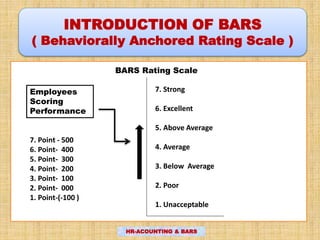
7. Strong
6. Excellent
5. Above Average
4. Average
3. Below Average
2. Poor
1. Unacceptable
BARS Rating Scale
7. Point - 500
6. Point- 400
5. Point- 300
4. Point- 200
3. Point- 100
2. Point- 000
1. Point-(-100 )
Employees
Scoring
Performance
HR-ACOUNTING & BARS
IMPORTANT OF BARS
( Behaviorally Anchored Rating Scale )
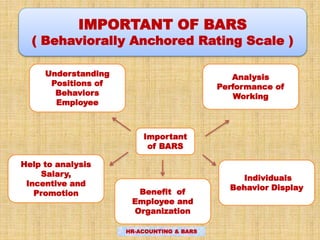
Important
of BARS
Analysis
Performance of
Working
Understanding
Positions of
Behaviors
Employee
Individuals
Behavior Display
Benefit of
Employee and
Organization
Help to analysis
Salary,
Incentive and
Promotion
HR-ACOUNTING & BARS
HR-ACOUNTING & BARS

Hrm ppt

  • 1.
    PRESENTATION ON HR ACCOUNTING & BARS PRESENTEDBY SANDIP A. KURIL PRESENTED TO RTM-Nagpur University ( MBA ) Subject : Human Resources Management
  • 2.
  • 3.
    DEFINITON OF HR-ACCOUNTING AmericanAccounting Association (1980) has defined human resource accounting as follows: “Human resource accounting is the process of identifying and measuring data about human resources and communicating this information to interested parties” According to Flameouts, “Human resources accounting is the measurement of costs and value of the people for the organization” HR-ACOUNTING & BARS
  • 4.
    OBJECTIVES OF HR- ACCOUNTING….(1) HR-ACOUNTING& BARS 3) Consider people as its asset 1) Provides cost value information 2) Improve management by analyzing investment in HR
  • 5.
    OBJECTIVES OF HR- ACCOUNTING….(2) 4)Attract and retain qualified people 5) Enable management of the organization to effectively monitor the use of human resources. 6) To aid in the development of management principles and proper decision making for the future. HR-ACOUNTING & BARS
  • 6.
    METHODS OF HR-ACCOUNTING 1.Historical Cost Method. 2. Replacement Cost Method. 3. Opportunity Cost Method. 4. Return On Efforts Employed Method. 5. Reward Valuation Method. HR-ACOUNTING & BARS
  • 7.
    NEED & IMPORTANCE HR-ACCOUNTING Managerial Decision Making  Enhances Quality of Management  Helps the Efficient Allocation of Resources  Increases Human asset Productivity  Improves Morale, Cooperation, Job Satisfaction  Human Asset Control HR-ACOUNTING & BARS
  • 8.
    DISADVANTEGES OF HR- ACCOUNTING 1.No availability of standard 2. Opposition of trade union 3. Expenditure on HRA 4. Variety of method create confusion 5. Uncertainty about continuance of employees 6. Lack of perfect knowledge about future earning of HR HR-ACOUNTING & BARS
  • 9.
    INTRODUCTION OF BARS (Behaviorally Anchored Rating Scale ) Meaning of BARS : Behaviorally Anchored Rating scales (BARS) are scales used to rate performance for employees. It was developed by ‘Smith’ and ‘Kendall’ to provide a better methods of rating employees. It differs from “ standard ” rating scales in one central respect, in that it focuses on employee performance HR-ACOUNTING & BARS
  • 10.
    INTRODUCTION OF BARS (Behaviorally Anchored Rating Scale ) 7. Strong 6. Excellent 5. Above Average 4. Average 3. Below Average 2. Poor 1. Unacceptable BARS Rating Scale 7. Point - 500 6. Point- 400 5. Point- 300 4. Point- 200 3. Point- 100 2. Point- 000 1. Point-(-100 ) Employees Scoring Performance HR-ACOUNTING & BARS
  • 11.
    IMPORTANT OF BARS (Behaviorally Anchored Rating Scale ) Important of BARS Analysis Performance of Working Understanding Positions of Behaviors Employee Individuals Behavior Display Benefit of Employee and Organization Help to analysis Salary, Incentive and Promotion HR-ACOUNTING & BARS
  • 12.