Human Resource Management
Vedi Goenka
Visiting Faculty, SLS
Before we start…
Let’s talk about….
What is HR?
What is HRM?
Whose job is it?
Give it a thought for three to five minutes and
report back to class.
Fundamental characteristics of HRM
Human resources –
People are not human resources.… independent agents who
possess human resources, which are the talents that they can deploy
and develop at work and which they take with them when they leave
an organisation (Boxall and Purcell, 2016, p.4)
Human resource management –
‘all those activities associated with the management of employment
relationships in the firm’ Boxall and Purcell (2003, p. 1) .
HRM is the managerial utilisation of the efforts, knowledge,
capabilities and committed behaviours that people contribute to an
authoritatively co-ordinated human enterprise as part of an
employment exchange (or more temporary contractual arrangement)
to carry out work tasks in a way that enables the enterprise to
continue into the future (Watson, 2010, p. 919)
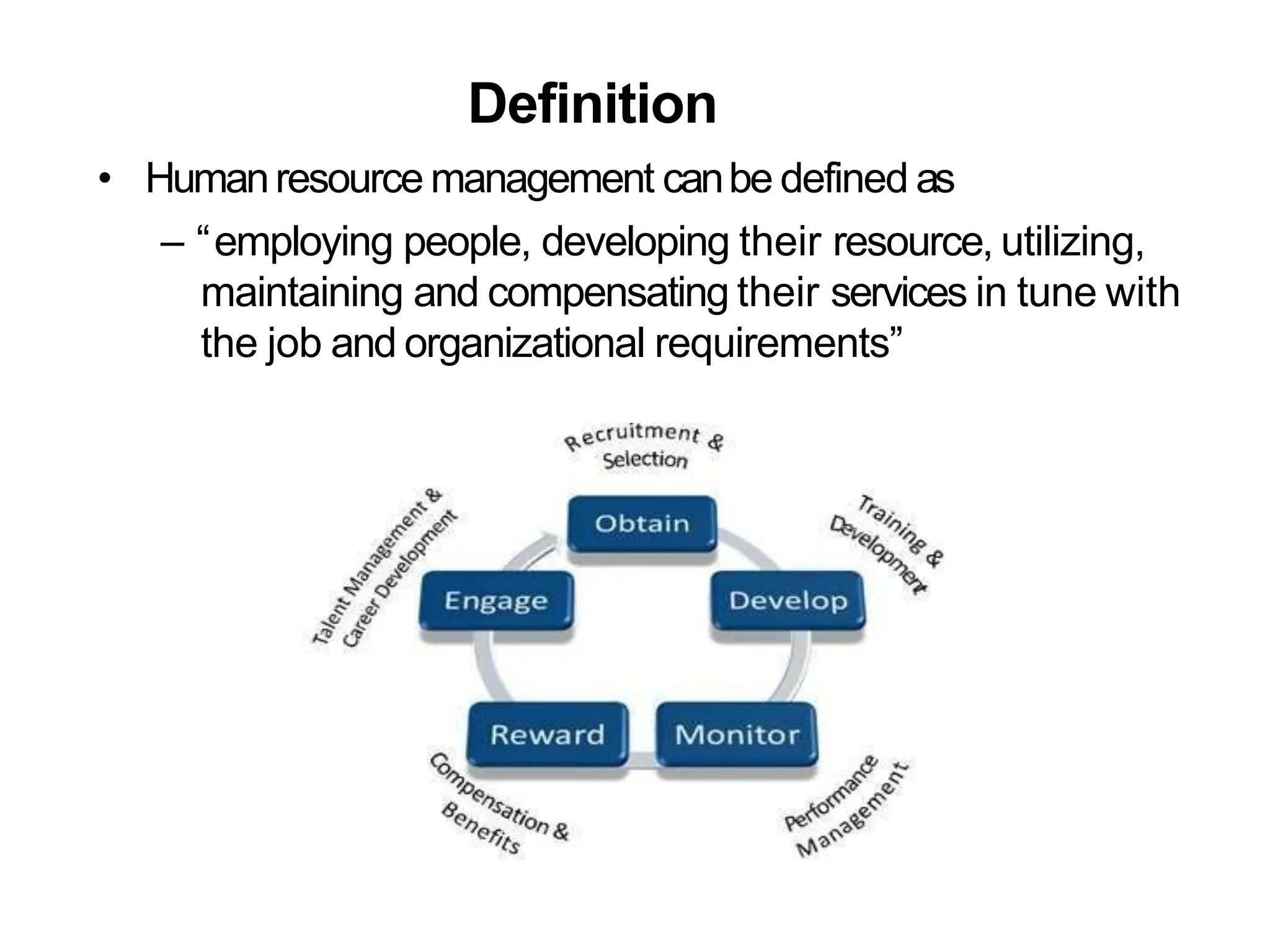
Definition
• Humanresource management canbe defined as
– “employing people, developing their resource, utilizing,
maintaining and compensating their services in tune with
the job and organizational requirements”
Definition 1 - Integration
• HRM is a series of integrated decisions that form the
employment relationships; their quality contributes to the
ability of the organizations and the employees to achieve
their objectives
Definition 2 - Influencing
 HRM is concerned with the people dimensions
management. Since every organization is made up of
people, acquiring their services, developing their skills ,
motivating them to higher levels of performance and
ensuring that they continue to maintain their
commitment to the organization are essential to
achieving organizational objectives.
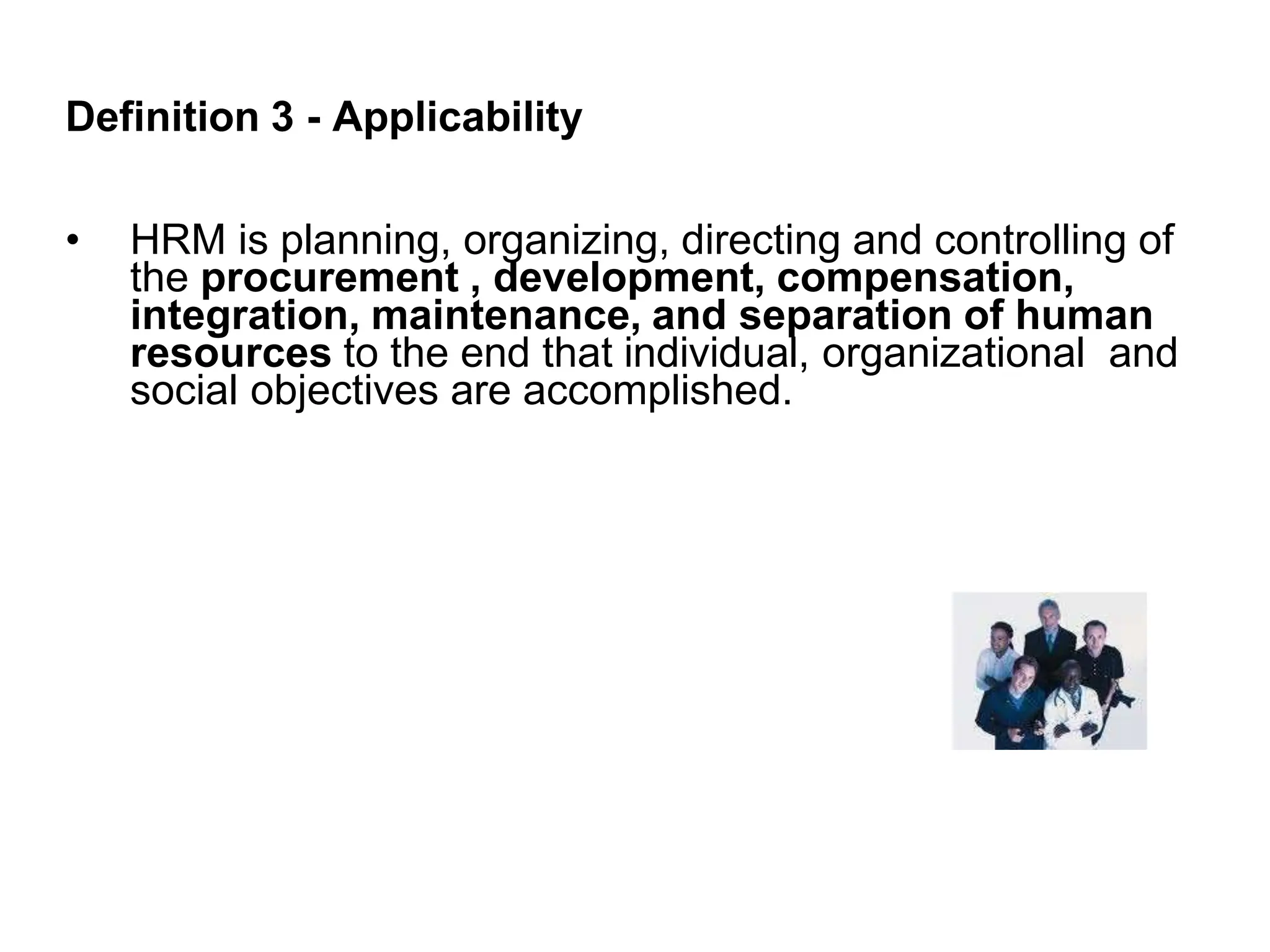
Definition 3 - Applicability
• HRM is planning, organizing, directing and controlling of
the procurement , development, compensation,
integration, maintenance, and separation of human
resources to the end that individual, organizational and
social objectives are accomplished.
Core Elements of HRM
• Organizations
• People
• Management
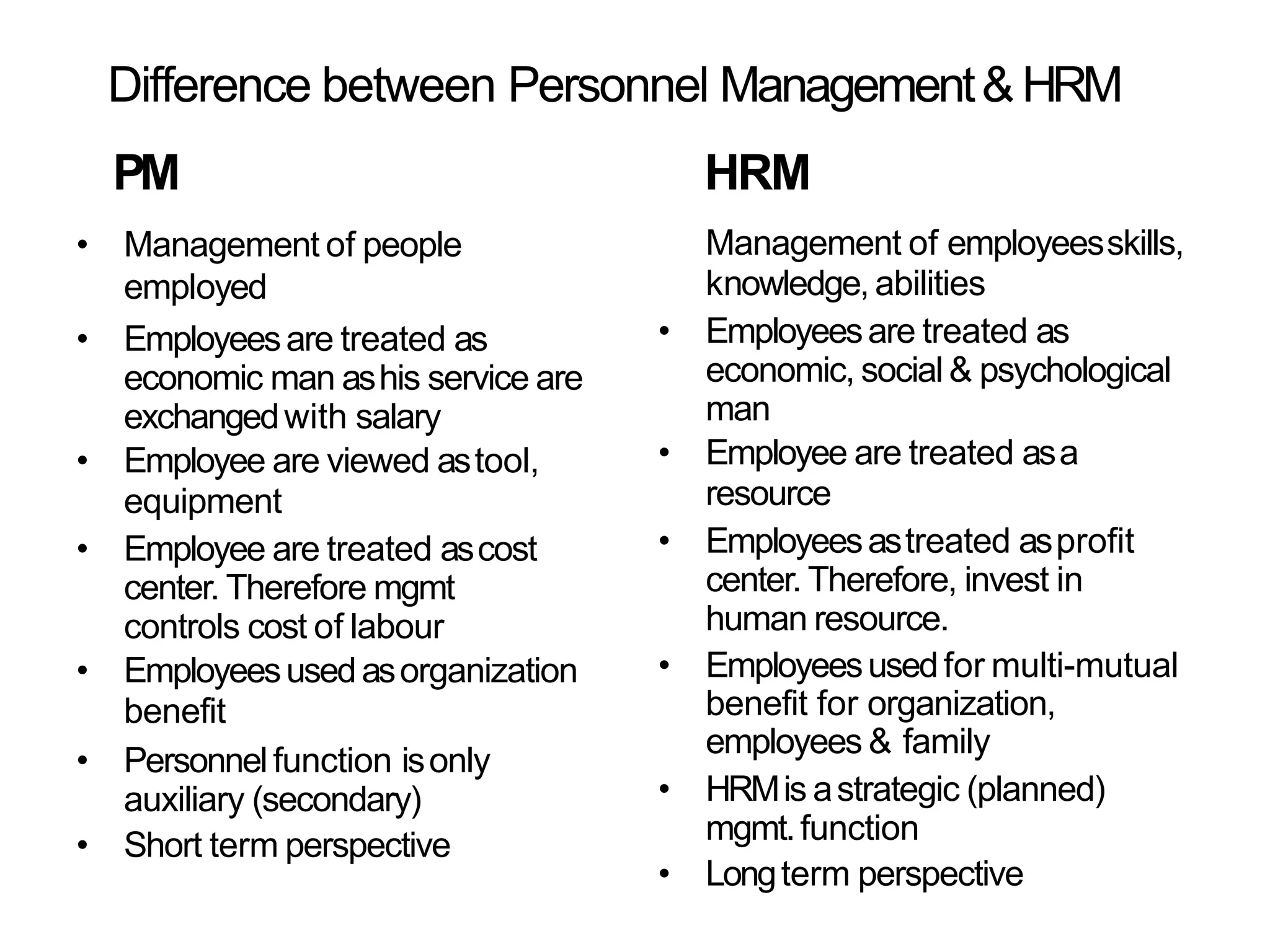
Difference between Personnel Management&HRM
• Employeesare treated as
economic man ashis service are
exchangedwith salary
• Employee are viewed astool,
equipment
• Employee are treated ascost
center. Therefore mgmt
controls cost of labour
• Employeesusedasorganization
benefit
• Personnelfunction isonly
auxiliary (secondary)
• Short term perspective
PM HRM
• Management of people
employed
Management of employeesskills,
knowledge, abilities
• Employeesare treated as
economic, social & psychological
man
• Employee are treated asa
resource
• Employeesastreated asprofit
center. Therefore, invest in
human resource.
• Employeesusedfor multi-mutual
benefit for organization,
employees & family
• HRMis astrategic (planned)
mgmt.function
• Longterm perspective
Nature of HRM
1. Inherent part of management- selecting people, training, motivating, appraising their
performance for improving theirquality.
2. Pervasivefunction- present in all levels of management in an organization.
3. Actionoriented- solve problem through rational (balanced) policies rather than record
keeping.
4. Peopleoriented- HRM is all about people at work. Assignjobs, produce results, reward,
motivate them towards improvements inproductivity.
5. Futureoriented- Effective HRMhelps organization meet its goals.
6. Developmentoriented- HRM developsfull potential of employees throughreward, training,
job rotation.
7. Integrating mechanism-HRMmaintains cordial relationship between people working
at various levels inorganization.
8. Comprehensivefunction- Workforce signifies people working at all levels. HRM differs with
form & shapebut the basic objective of effective utilization of human resource remains the
same.
9. Continuousfunction- HRMis not aone shot deal it requires constantawareness
and alertness of human relations in everyday operation.
10. Basedonhumanrelation- Everyperson hasdifferent need, perception and
expectations. Themanger should givedue attention to thesefactors.
Objectives of HRM
1. T
ohelp the organization reachits goal
2. T
o provide the organization with well trained & well motivated employees
3. T
oemploy the skills and abilities of the workforceefficiently
4. T
oincreaseemployeesjob satisfaction and self actualization (stimulate
employeesto realize theirpotential)
5. T
odevelop & maintain aquality of worklife.
6. T
ocommunicate HRpolicies to allemployees.
7. T
obe ethically & socially responsiveto the needsof the society(ensuring
compliancewith legal & ethicalstandards)
8. T
oprovide anopportunity for expression& voice inmanagement
9. T
oprovide fair, acceptable & efficient leadership
10. T
oestablish soundorganizational structure & desirable working relationships.
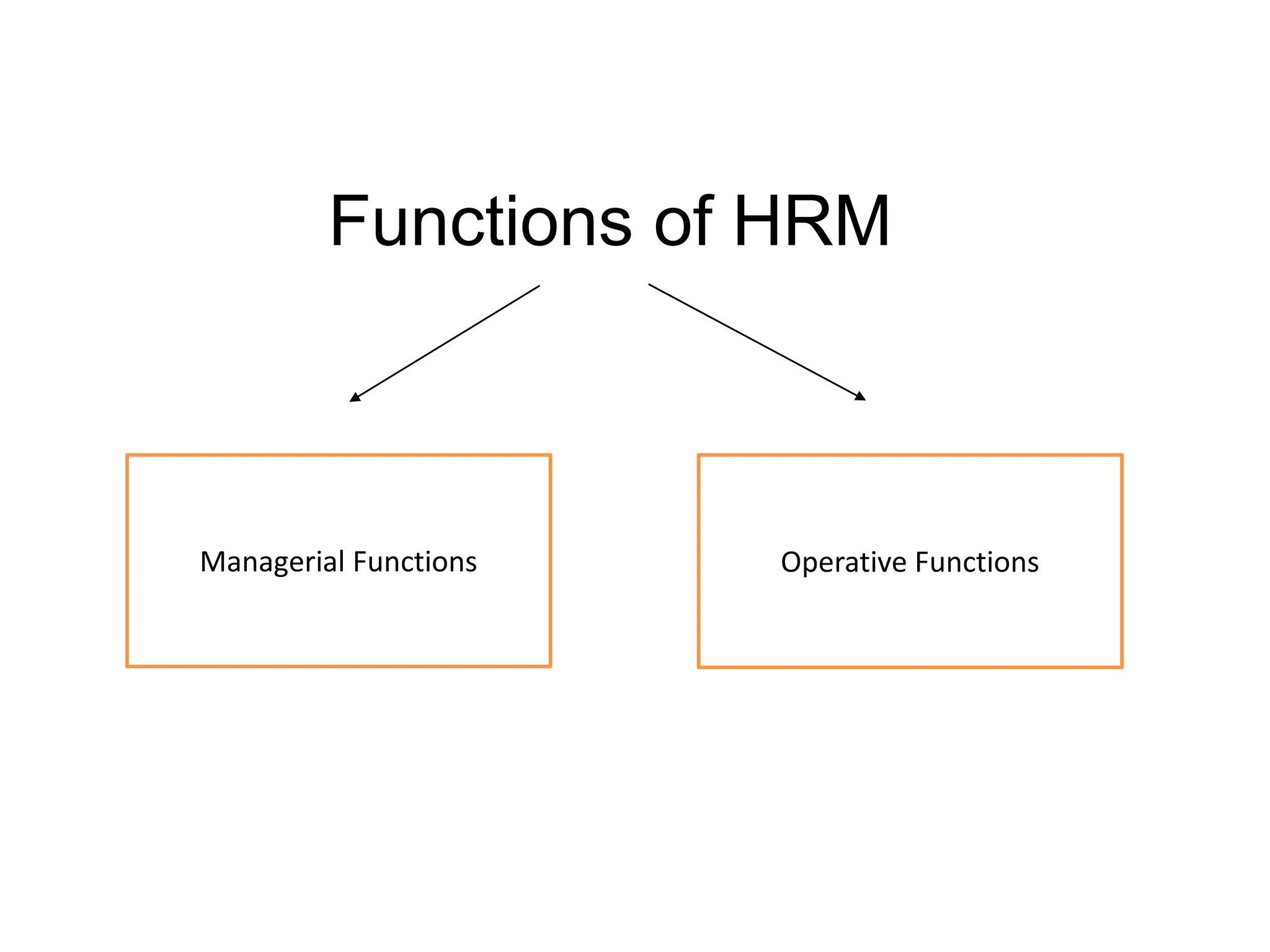
Functions of HRM
Managerial Functions Operative Functions
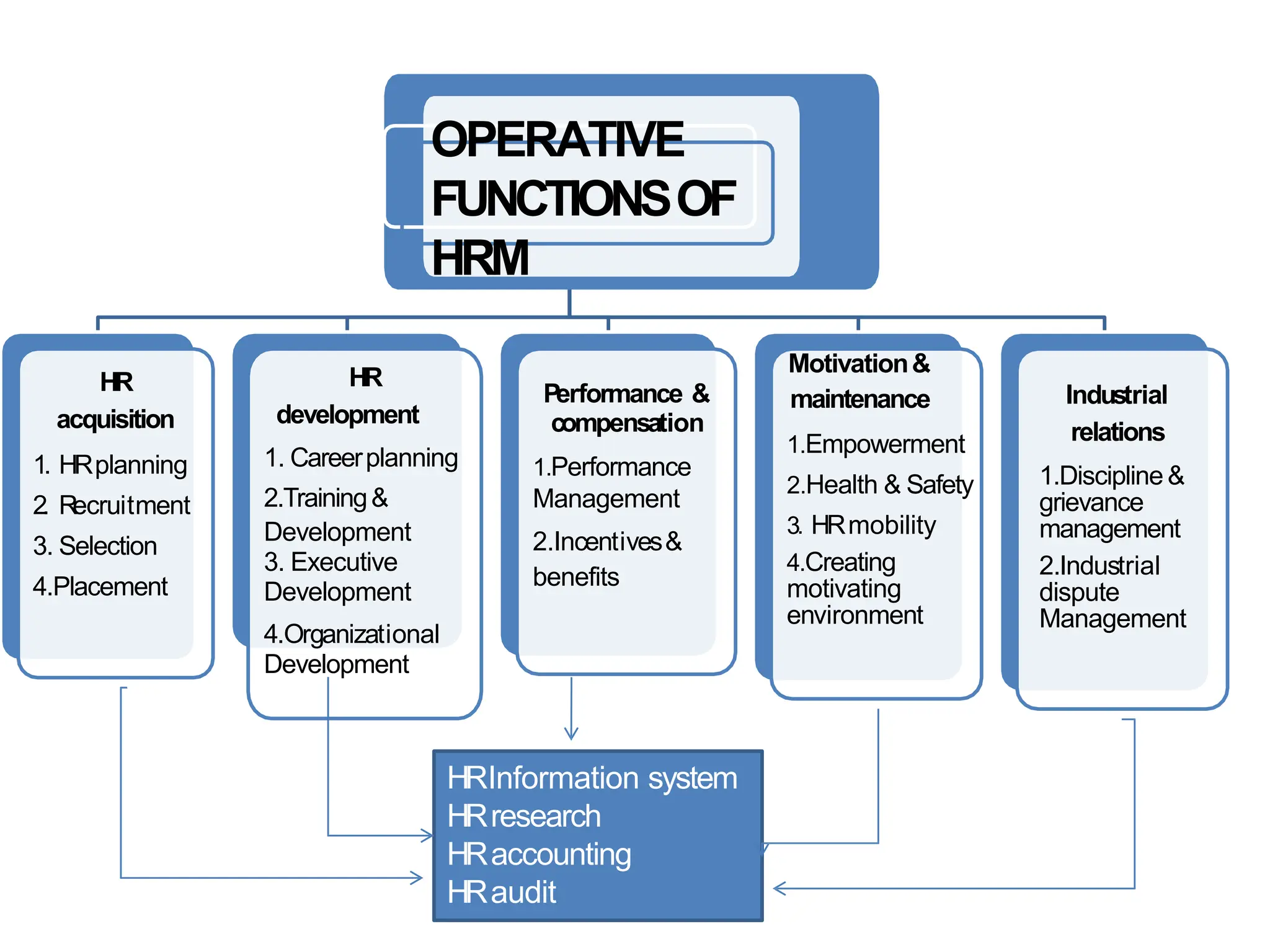
OPERATIVE
FUNCTIONSOF
HRM
HR
acquisition
1. HRplanning
2. R
ecruitment
3. Selection
4.Placement
HR
development
1. Careerplanning
2.Training&
Development
3. Executive
Development
4.Organizational
Development
Performance &
compensation
1.Performance
Management
2.Incentives&
benefits
Motivation&
maintenance
1.Empowerment
2.Health & Safety
3. HRmobility
4.Creating
motivating
environment
Industrial
relations
1.Discipline&
grievance
management
2.Industrial
dispute
Management
HRInformation system
HRresearch
HRaccounting
HRaudit
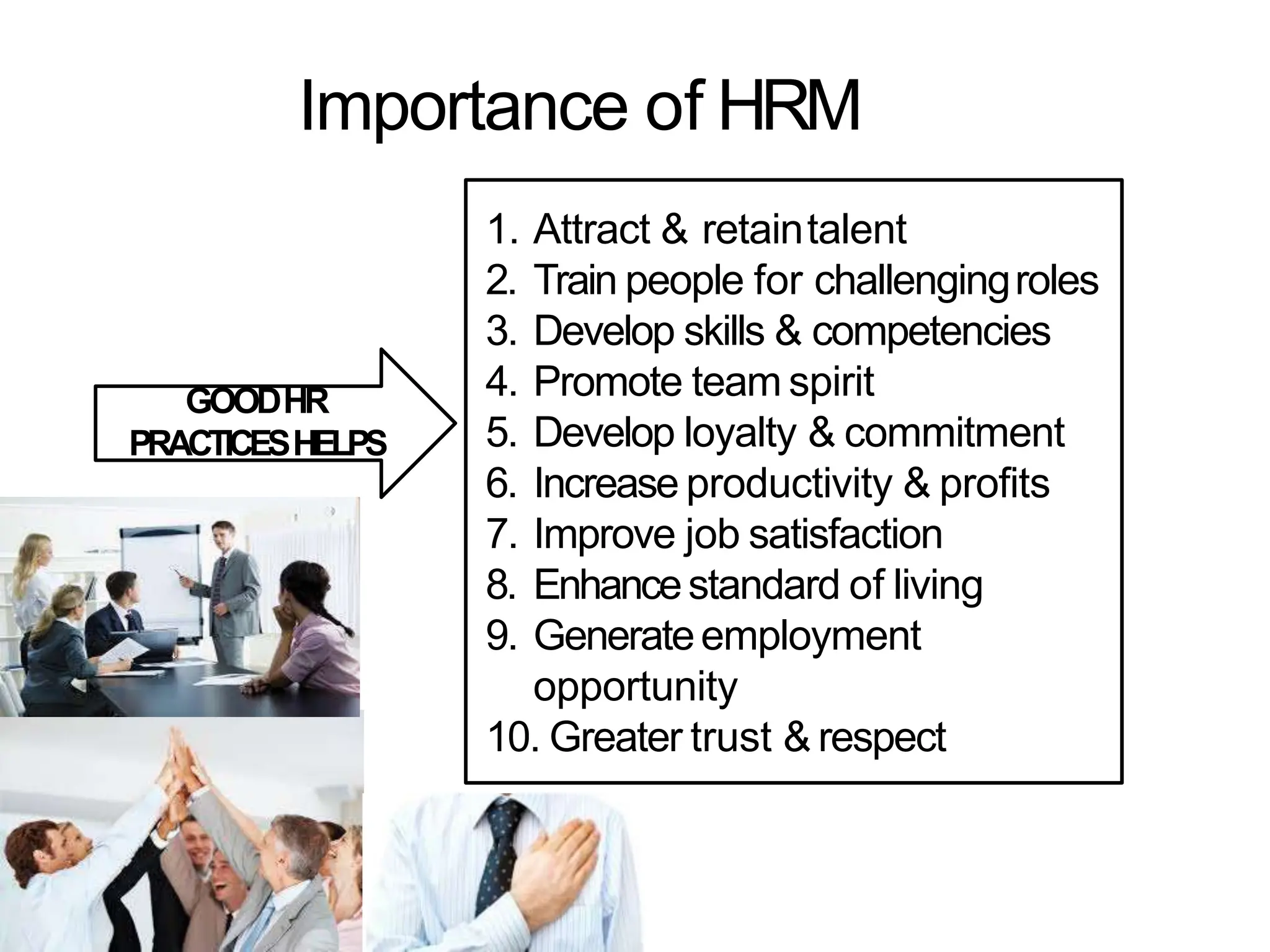
Importance of HRM
GOODHR
PRACTICESHELPS
1. Attract & retaintalent
2. Train people for challengingroles
3. Develop skills & competencies
4. Promote team spirit
5. Develop loyalty & commitment
6. Increase productivity & profits
7. Improve job satisfaction
8. Enhancestandard of living
9. Generateemployment
opportunity
10. Greater trust & respect
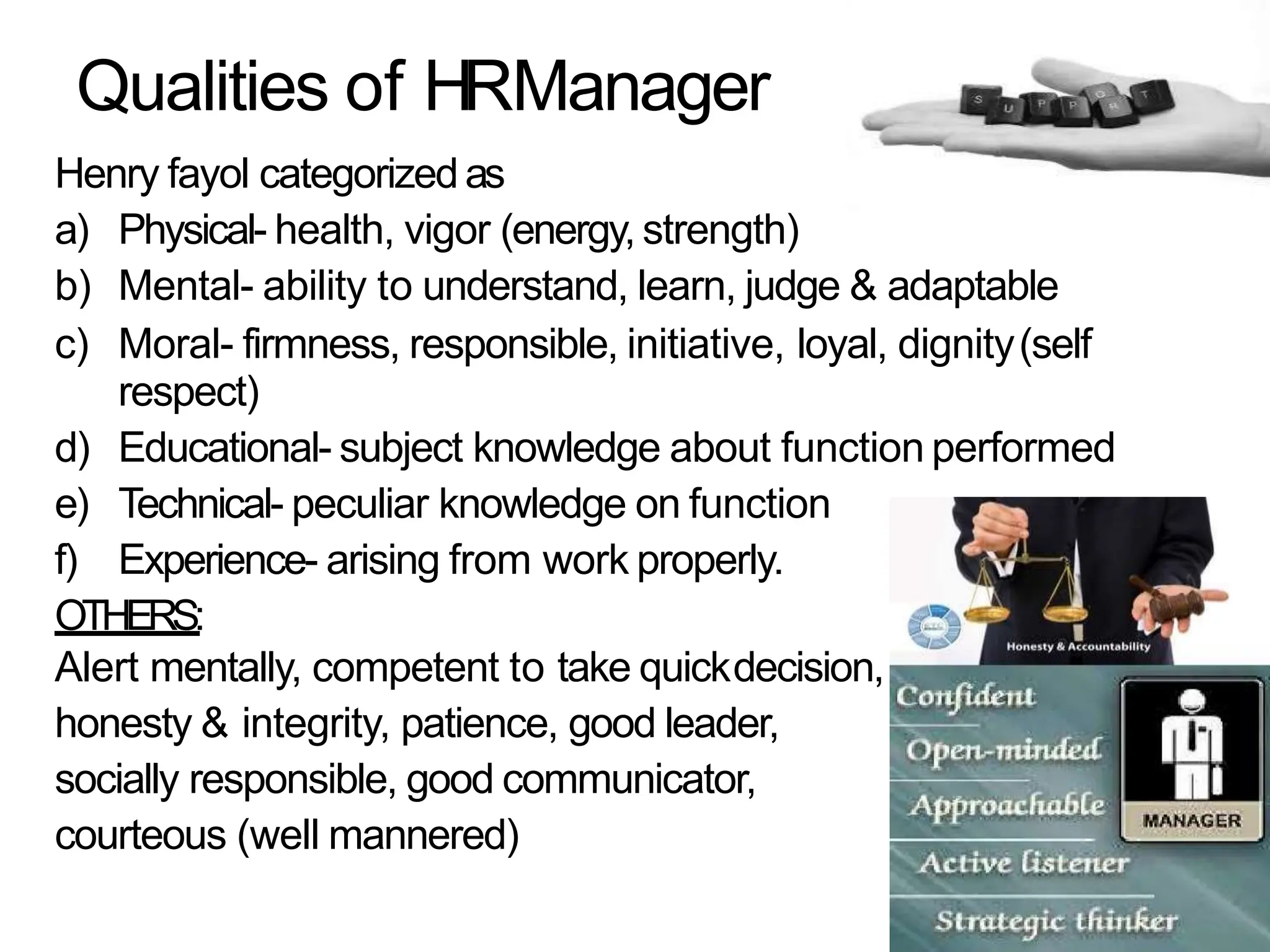
Qualities of HRManager
Henry fayol categorized as
a) Physical- health, vigor (energy, strength)
b) Mental- ability to understand, learn, judge & adaptable
c) Moral- firmness, responsible, initiative, loyal, dignity(self
respect)
d) Educational- subject knowledge about function performed
e) Technical- peculiar knowledge on function
f) Experience- arising from work properly.
OTHERS:
Alert mentally, competent to take quickdecision,
honesty & integrity, patience, good leader,
socially responsible, good communicator,
courteous (well mannered)
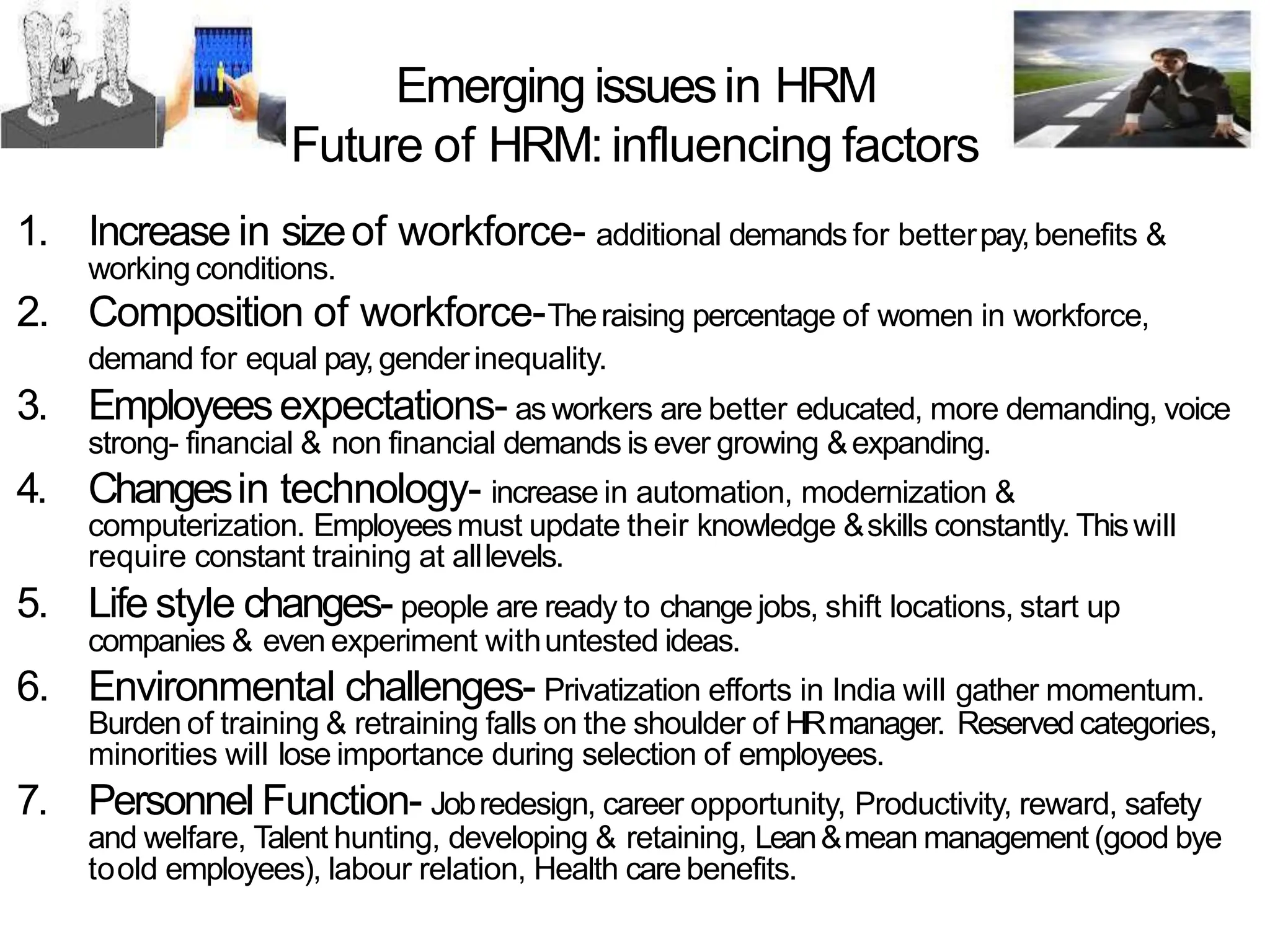
Emerging issuesin HRM
Future of HRM: influencing factors
1. Increase in sizeof workforce- additional demands for betterpay,benefits &
working conditions.
2. Composition of workforce-Theraising percentage of women in workforce,
demand for equal pay,genderinequality.
3. Employeesexpectations- as workers are better educated, more demanding, voice
strong- financial & non financial demands is ever growing &expanding.
4. Changesin technology- increase in automation, modernization &
computerization. Employeesmust update their knowledge &skills constantly. Thiswill
require constant training at alllevels.
5. Life style changes- people are ready to change jobs, shift locations, start up
companies & even experiment withuntested ideas.
6. Environmental challenges- Privatization efforts in India will gather momentum.
Burden of training & retraining falls on the shoulder of HRmanager. Reservedcategories,
minorities will lose importance during selection of employees.
7. Personnel Function- Jobredesign, career opportunity, Productivity, reward, safety
and welfare, Talent hunting, developing & retaining, Lean&mean management (good bye
toold employees), labour relation, Health care benefits.
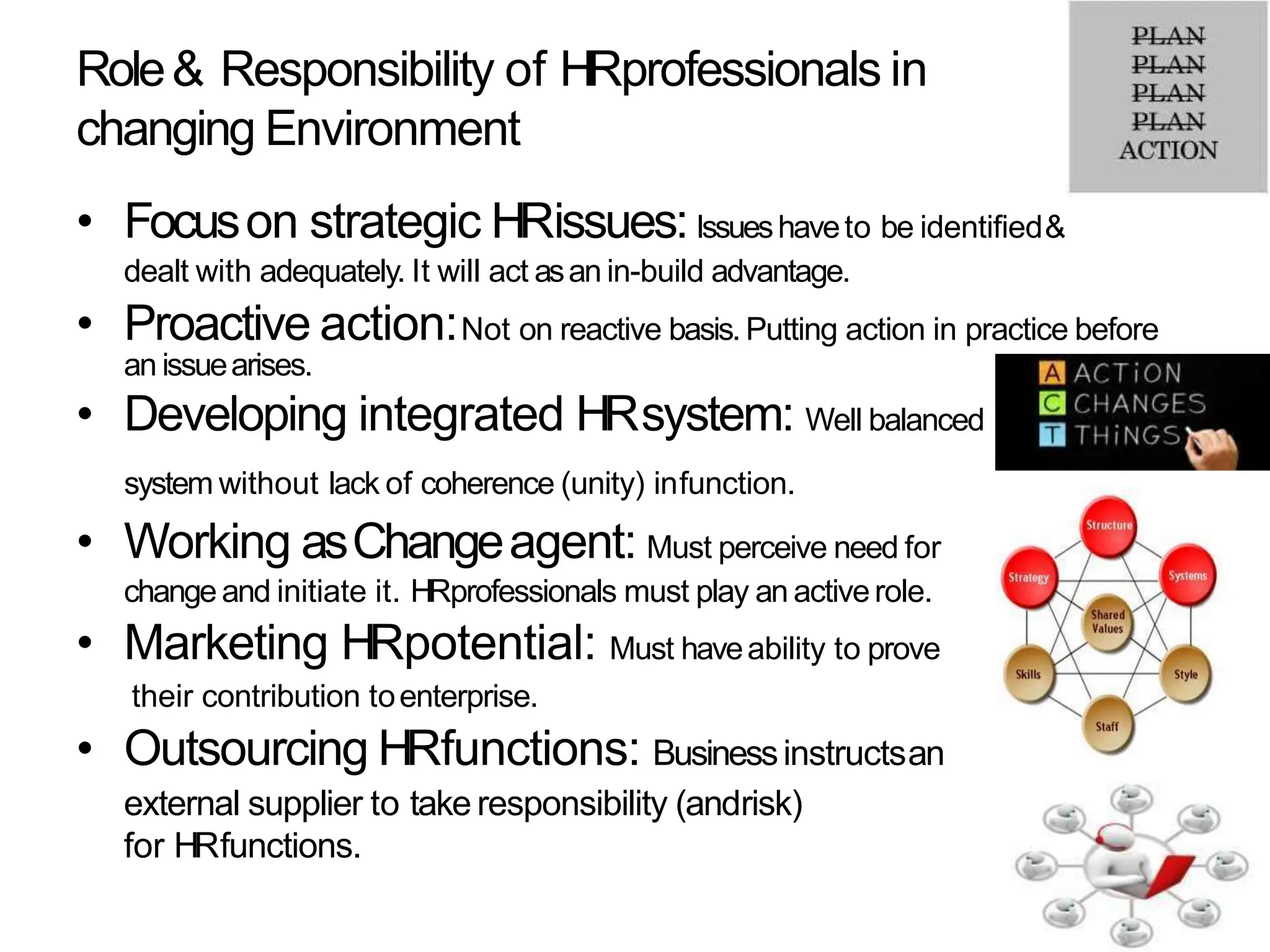
Role& Responsibility of HRprofessionals in
changing Environment
• Focuson strategic HRissues:Issueshaveto be identified&
dealt with adequately. It will act asan in-build advantage.
• Proactive action:Not on reactive basis. Putting action in practice before
an issuearises.
• Developing integrated HRsystem: Well balanced
system without lack of coherence (unity) infunction.
• Working asChangeagent: Must perceive need for
changeand initiate it. HRprofessionals must play an activerole.
• Marketing HRpotential: Must haveability to prove
their contribution toenterprise.
• Outsourcing HRfunctions: Businessinstructsan
external supplier to take responsibility (andrisk)
for HRfunctions.
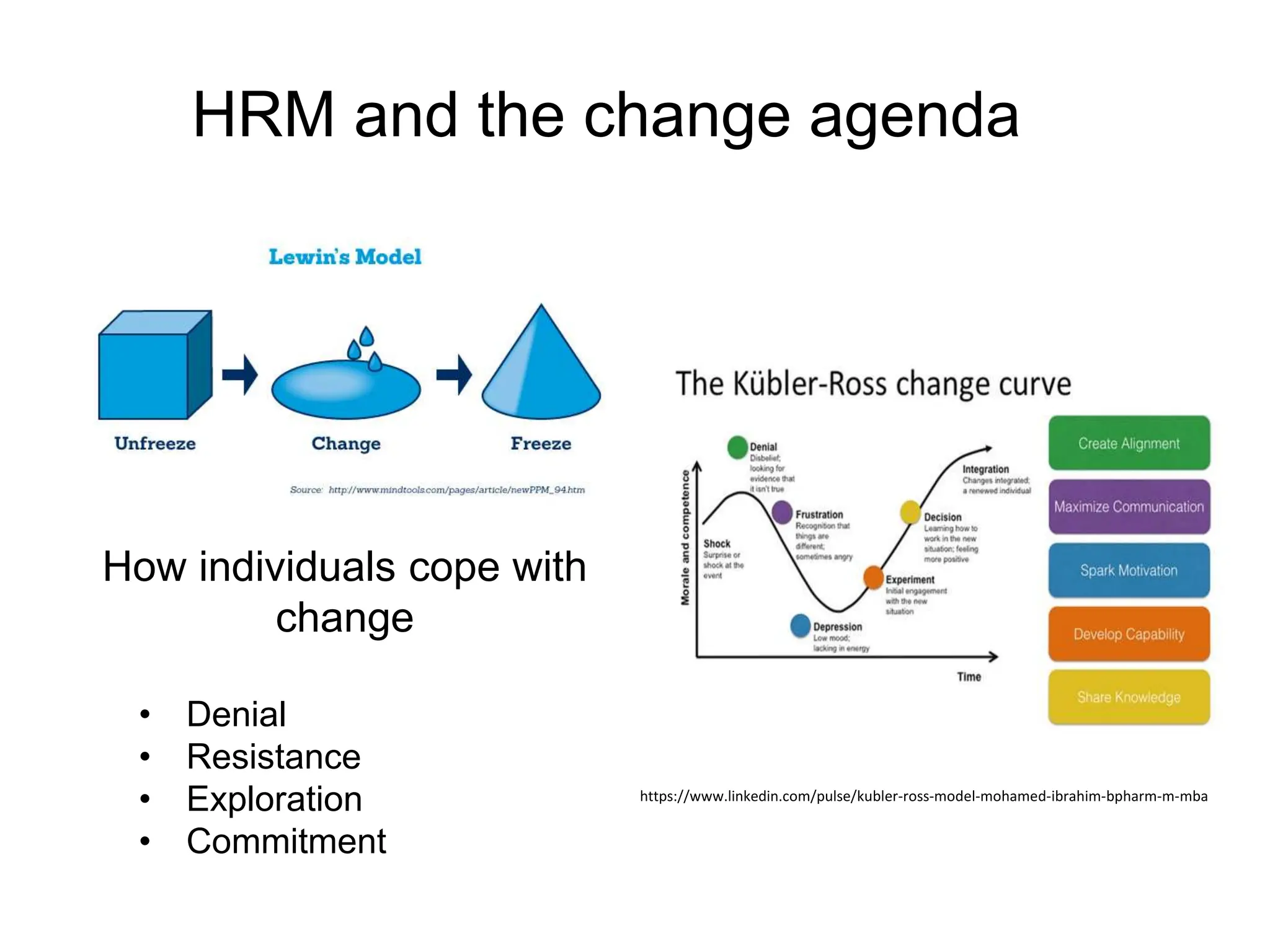
HRM and the change agenda
How individuals cope with
change
• Denial
• Resistance
• Exploration
• Commitment
https://www.linkedin.com/pulse/kubler-ross-model-mohamed-ibrahim-bpharm-m-mba
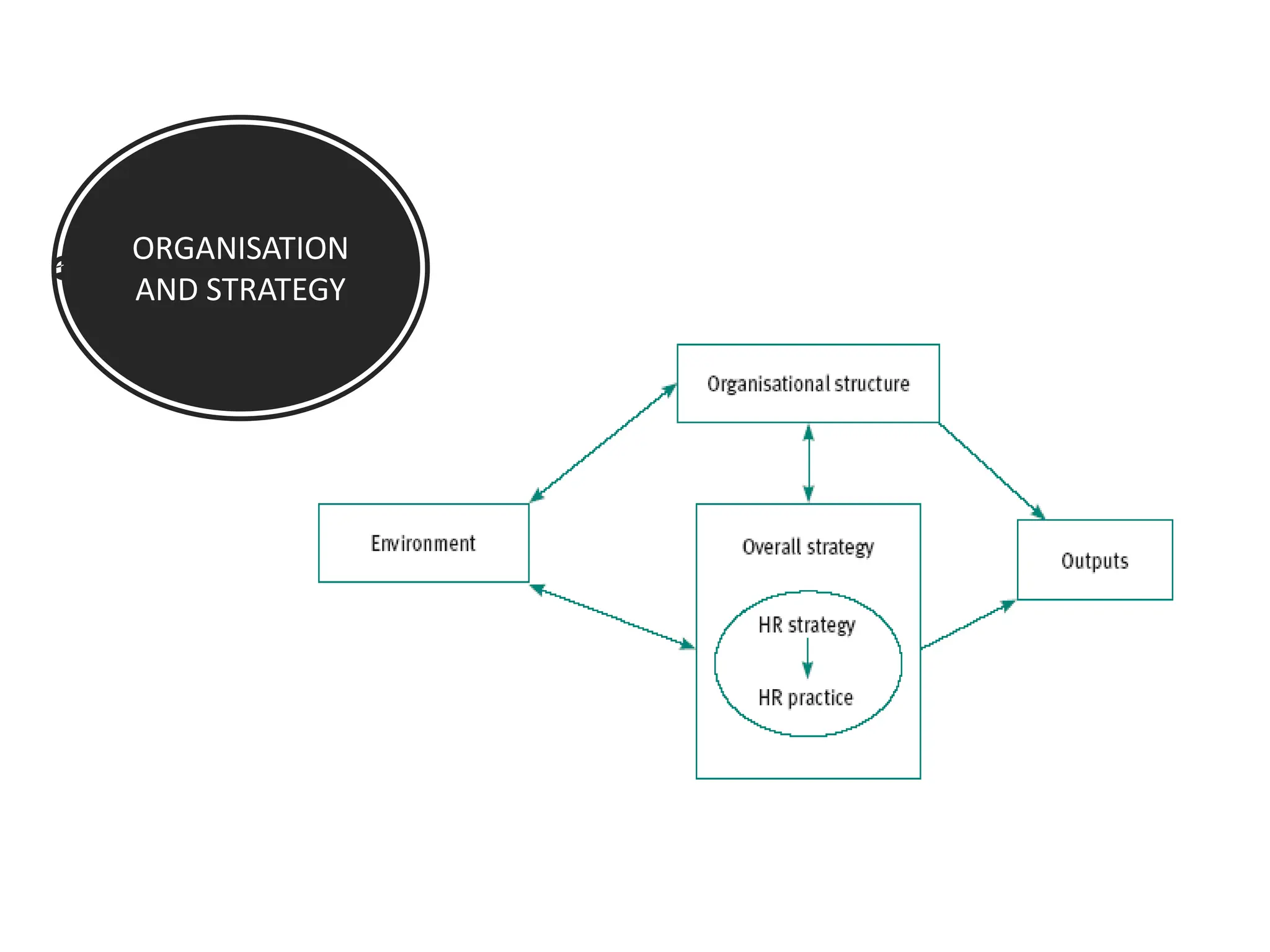
ORGANISATION
AND STRATEGY
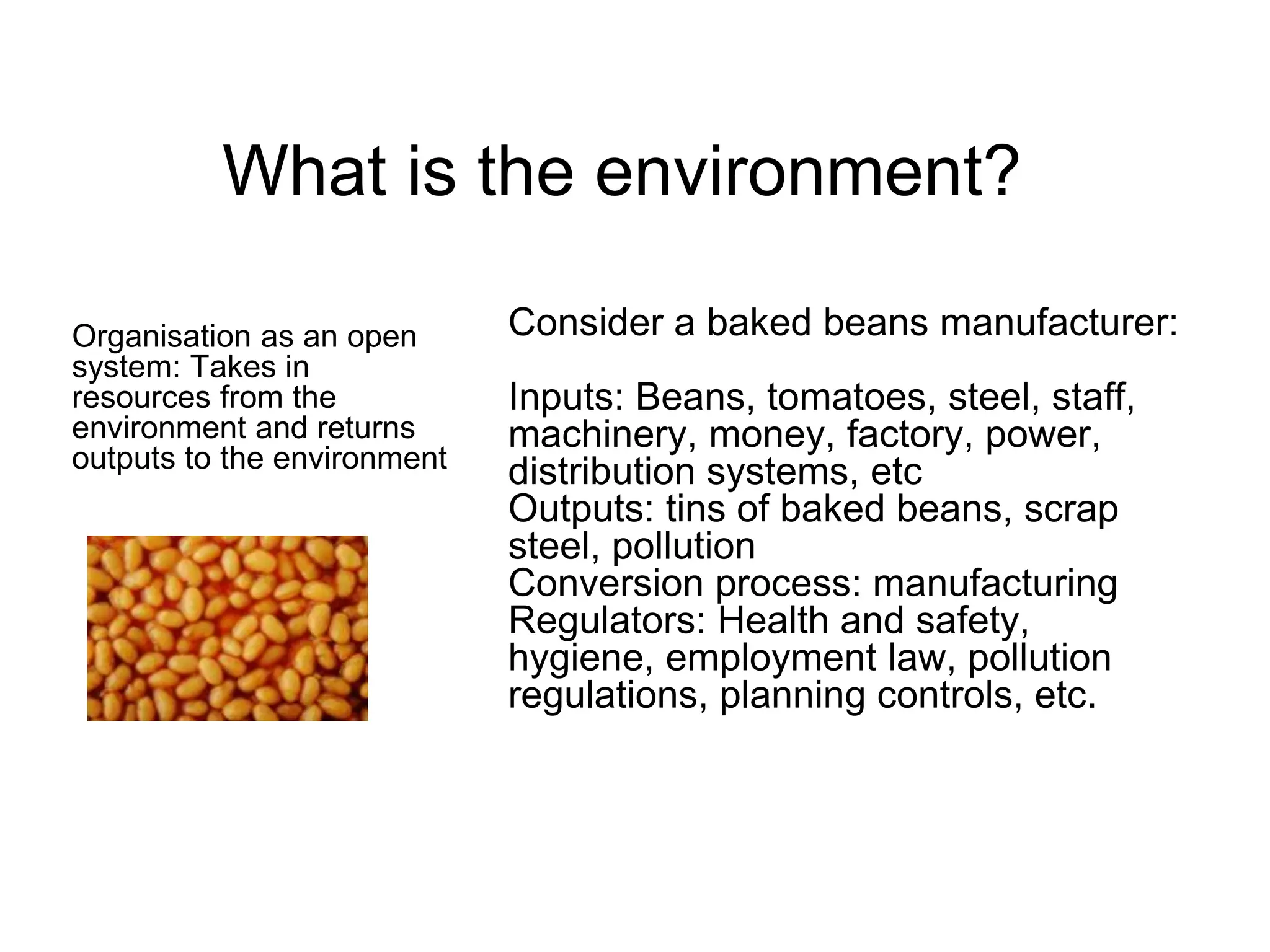
What is the environment?
Organisation as an open
system: Takes in
resources from the
environment and returns
outputs to the environment
Consider a baked beans manufacturer:
Inputs: Beans, tomatoes, steel, staff,
machinery, money, factory, power,
distribution systems, etc
Outputs: tins of baked beans, scrap
steel, pollution
Conversion process: manufacturing
Regulators: Health and safety,
hygiene, employment law, pollution
regulations, planning controls, etc.
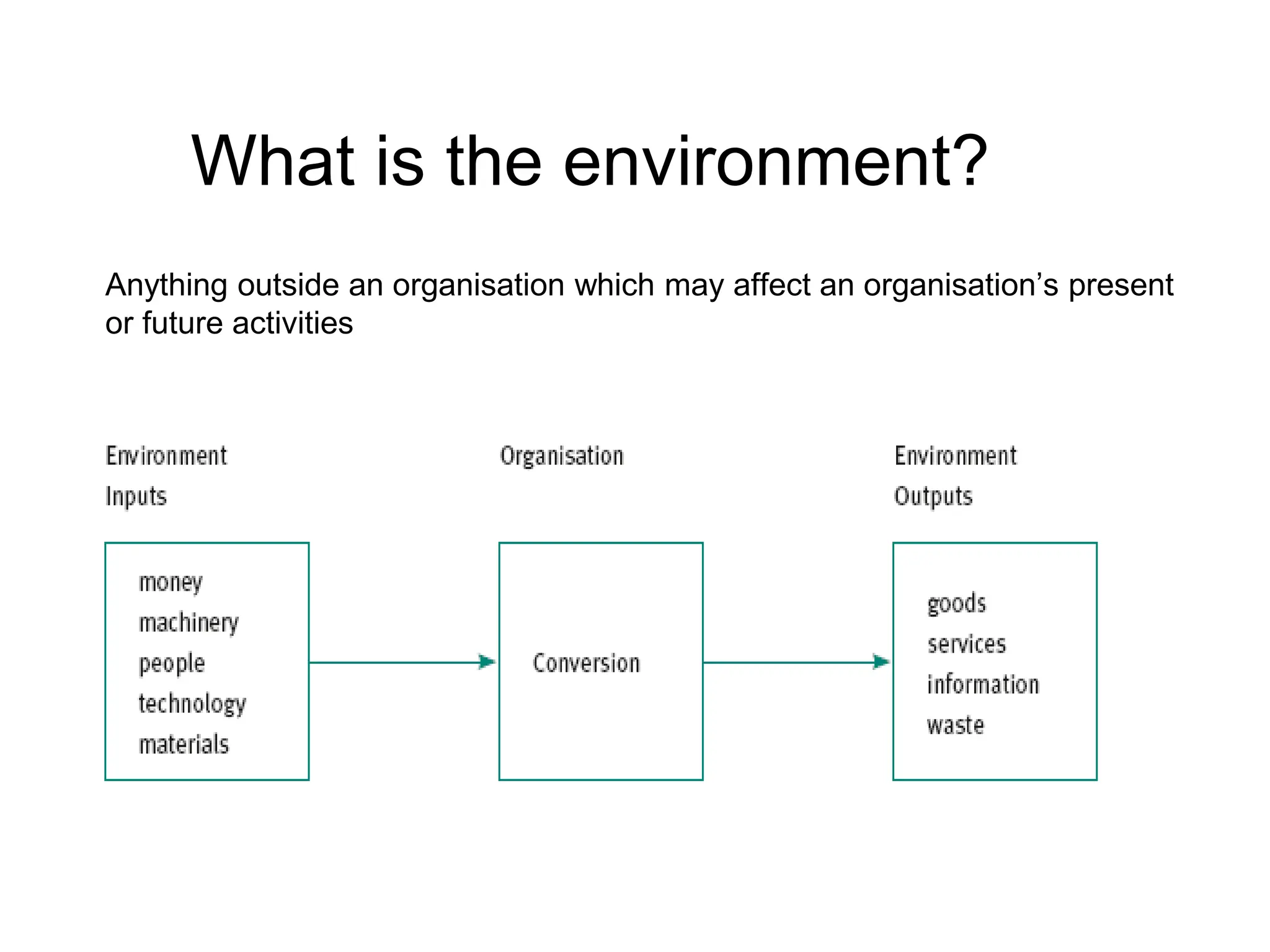
What is the environment?
Anything outside an organisation which may affect an organisation’s present
or future activities

hrm class notes and important topic from india

  • 1.
    Human Resource Management VediGoenka Visiting Faculty, SLS
  • 2.
    Before we start… Let’stalk about…. What is HR? What is HRM? Whose job is it? Give it a thought for three to five minutes and report back to class.
  • 3.
    Fundamental characteristics ofHRM Human resources – People are not human resources.… independent agents who possess human resources, which are the talents that they can deploy and develop at work and which they take with them when they leave an organisation (Boxall and Purcell, 2016, p.4) Human resource management – ‘all those activities associated with the management of employment relationships in the firm’ Boxall and Purcell (2003, p. 1) . HRM is the managerial utilisation of the efforts, knowledge, capabilities and committed behaviours that people contribute to an authoritatively co-ordinated human enterprise as part of an employment exchange (or more temporary contractual arrangement) to carry out work tasks in a way that enables the enterprise to continue into the future (Watson, 2010, p. 919)
  • 4.
    Definition • Humanresource managementcanbe defined as – “employing people, developing their resource, utilizing, maintaining and compensating their services in tune with the job and organizational requirements”
  • 5.
    Definition 1 -Integration • HRM is a series of integrated decisions that form the employment relationships; their quality contributes to the ability of the organizations and the employees to achieve their objectives Definition 2 - Influencing  HRM is concerned with the people dimensions management. Since every organization is made up of people, acquiring their services, developing their skills , motivating them to higher levels of performance and ensuring that they continue to maintain their commitment to the organization are essential to achieving organizational objectives.
  • 6.
    Definition 3 -Applicability • HRM is planning, organizing, directing and controlling of the procurement , development, compensation, integration, maintenance, and separation of human resources to the end that individual, organizational and social objectives are accomplished.
  • 7.
    Core Elements ofHRM • Organizations • People • Management
  • 8.
    Difference between PersonnelManagement&HRM • Employeesare treated as economic man ashis service are exchangedwith salary • Employee are viewed astool, equipment • Employee are treated ascost center. Therefore mgmt controls cost of labour • Employeesusedasorganization benefit • Personnelfunction isonly auxiliary (secondary) • Short term perspective PM HRM • Management of people employed Management of employeesskills, knowledge, abilities • Employeesare treated as economic, social & psychological man • Employee are treated asa resource • Employeesastreated asprofit center. Therefore, invest in human resource. • Employeesusedfor multi-mutual benefit for organization, employees & family • HRMis astrategic (planned) mgmt.function • Longterm perspective
  • 9.
    Nature of HRM 1.Inherent part of management- selecting people, training, motivating, appraising their performance for improving theirquality. 2. Pervasivefunction- present in all levels of management in an organization. 3. Actionoriented- solve problem through rational (balanced) policies rather than record keeping. 4. Peopleoriented- HRM is all about people at work. Assignjobs, produce results, reward, motivate them towards improvements inproductivity. 5. Futureoriented- Effective HRMhelps organization meet its goals. 6. Developmentoriented- HRM developsfull potential of employees throughreward, training, job rotation. 7. Integrating mechanism-HRMmaintains cordial relationship between people working at various levels inorganization. 8. Comprehensivefunction- Workforce signifies people working at all levels. HRM differs with form & shapebut the basic objective of effective utilization of human resource remains the same. 9. Continuousfunction- HRMis not aone shot deal it requires constantawareness and alertness of human relations in everyday operation. 10. Basedonhumanrelation- Everyperson hasdifferent need, perception and expectations. Themanger should givedue attention to thesefactors.
  • 10.
    Objectives of HRM 1.T ohelp the organization reachits goal 2. T o provide the organization with well trained & well motivated employees 3. T oemploy the skills and abilities of the workforceefficiently 4. T oincreaseemployeesjob satisfaction and self actualization (stimulate employeesto realize theirpotential) 5. T odevelop & maintain aquality of worklife. 6. T ocommunicate HRpolicies to allemployees. 7. T obe ethically & socially responsiveto the needsof the society(ensuring compliancewith legal & ethicalstandards) 8. T oprovide anopportunity for expression& voice inmanagement 9. T oprovide fair, acceptable & efficient leadership 10. T oestablish soundorganizational structure & desirable working relationships.
  • 11.
    Functions of HRM ManagerialFunctions Operative Functions
  • 12.
    OPERATIVE FUNCTIONSOF HRM HR acquisition 1. HRplanning 2. R ecruitment 3.Selection 4.Placement HR development 1. Careerplanning 2.Training& Development 3. Executive Development 4.Organizational Development Performance & compensation 1.Performance Management 2.Incentives& benefits Motivation& maintenance 1.Empowerment 2.Health & Safety 3. HRmobility 4.Creating motivating environment Industrial relations 1.Discipline& grievance management 2.Industrial dispute Management HRInformation system HRresearch HRaccounting HRaudit
  • 13.
    Importance of HRM GOODHR PRACTICESHELPS 1.Attract & retaintalent 2. Train people for challengingroles 3. Develop skills & competencies 4. Promote team spirit 5. Develop loyalty & commitment 6. Increase productivity & profits 7. Improve job satisfaction 8. Enhancestandard of living 9. Generateemployment opportunity 10. Greater trust & respect
  • 14.
    Qualities of HRManager Henryfayol categorized as a) Physical- health, vigor (energy, strength) b) Mental- ability to understand, learn, judge & adaptable c) Moral- firmness, responsible, initiative, loyal, dignity(self respect) d) Educational- subject knowledge about function performed e) Technical- peculiar knowledge on function f) Experience- arising from work properly. OTHERS: Alert mentally, competent to take quickdecision, honesty & integrity, patience, good leader, socially responsible, good communicator, courteous (well mannered)
  • 15.
    Emerging issuesin HRM Futureof HRM: influencing factors 1. Increase in sizeof workforce- additional demands for betterpay,benefits & working conditions. 2. Composition of workforce-Theraising percentage of women in workforce, demand for equal pay,genderinequality. 3. Employeesexpectations- as workers are better educated, more demanding, voice strong- financial & non financial demands is ever growing &expanding. 4. Changesin technology- increase in automation, modernization & computerization. Employeesmust update their knowledge &skills constantly. Thiswill require constant training at alllevels. 5. Life style changes- people are ready to change jobs, shift locations, start up companies & even experiment withuntested ideas. 6. Environmental challenges- Privatization efforts in India will gather momentum. Burden of training & retraining falls on the shoulder of HRmanager. Reservedcategories, minorities will lose importance during selection of employees. 7. Personnel Function- Jobredesign, career opportunity, Productivity, reward, safety and welfare, Talent hunting, developing & retaining, Lean&mean management (good bye toold employees), labour relation, Health care benefits.
  • 16.
    Role& Responsibility ofHRprofessionals in changing Environment • Focuson strategic HRissues:Issueshaveto be identified& dealt with adequately. It will act asan in-build advantage. • Proactive action:Not on reactive basis. Putting action in practice before an issuearises. • Developing integrated HRsystem: Well balanced system without lack of coherence (unity) infunction. • Working asChangeagent: Must perceive need for changeand initiate it. HRprofessionals must play an activerole. • Marketing HRpotential: Must haveability to prove their contribution toenterprise. • Outsourcing HRfunctions: Businessinstructsan external supplier to take responsibility (andrisk) for HRfunctions.
  • 17.
    HRM and thechange agenda How individuals cope with change • Denial • Resistance • Exploration • Commitment https://www.linkedin.com/pulse/kubler-ross-model-mohamed-ibrahim-bpharm-m-mba
  • 18.
  • 19.
    What is theenvironment? Organisation as an open system: Takes in resources from the environment and returns outputs to the environment Consider a baked beans manufacturer: Inputs: Beans, tomatoes, steel, staff, machinery, money, factory, power, distribution systems, etc Outputs: tins of baked beans, scrap steel, pollution Conversion process: manufacturing Regulators: Health and safety, hygiene, employment law, pollution regulations, planning controls, etc.
  • 20.
    What is theenvironment? Anything outside an organisation which may affect an organisation’s present or future activities

Editor's Notes

  • #7 HRM is a tool that helps managers to plan, recruit, select, train, develop, remunerate, motivate and make maximum utilization of human and non human resources for the organization and society at large.
  • #11 1. Psychological Contract and physical well-being 2. Provide training as a way to develop skills 3. To plan employee benefit schemes 4. Act as a liaison between top management and employees