A
REPORT ON
LABOUR ABSENTEEISM BASED ON
EMPLOYEE MOTIVATION
With reference to
COROMANDEL INTERNATIONAL LIIMITED
VISAKHAPATNAM
A Report Submitted in Partial Fulfillment of the Requirements
of the Award of the Degree
of
MASTER OFBUSINESS ADMINISTRATION
SUBMITTED BY
SINDHUJA.V
REGISTER NUMBER: 726015631027
Under the guidance
of
MS.NANDHINI.R
ASSISTANT PROFESSOR
DEPARTMENT OF MANAGEMENT STUDIES
SRI VENKATESWARA INSTITUTE OF INFORMATION TECHNOLOGY
AND MANAGEMENT,COIMBATORE
ANNA UNIVERSITY,CHENNAI
2
3
SRI VENKATESWARA INSTITUTE OF INFORMATION TECHNOLOGY
AND MANAGEMENT
COIMBATORE - 641 112.
Department of Management Studies
This is to certify that internship training entitled
LABOUR ABSENTISEEM BASED ON
EMPLOYEE MOTIVATION
AT
COROMANDEL INTERNATIONAL LIIMITED
VISAKHAPATNAM
is the bonafide record of internship work done by
SINDHUJA.V
REGISTER NUMBER: 726015631027
of Master of Business Administration during 2016-2017
Submitted for the Project Viva-Voice Examination held on _________________.
------------------------- --------------------
Project Guide Internal Examiner
4
DECLARATION
I affirm that the record titled “LABOUR ABSENTISEEM BASED ON
EMPLOYEE MOTIVATION AT COROMANDEL INTERNATIONAL
LIIMITED VISAKHAPATNAM” being submitted in partial fulfillment for the
award MASTER OF BUSINESS ADMINISTRATION is original work carried out
by me. It has not formed the part of any other project work submitted for the award of
any degree or diploma, either in this or any other university.
I certify that the declaration made above by the candidate is true
MS.NANDHINI.R
ASSISTANT PROFESSOR
DEPARTMENT OF MANAGEMENT STUDIES
PLACE: COIMBATORE V.SINDHUJA
DATE: REG.NO 723015631027
5
ACKNOWLEDGEMENT
“The success of the project would have not been possible without the help and guidance of
many people. I wish to express my sincere and heart full thanks to these personalities”.
First, I extend my heart-felt gratitude to the management of SRI VENKATESWARA
GROUP OF INSTITUTIONS, Commander K.VELU, FOUNDER, TRUSTEE AND
CHAIRMAN and Mrs. MEHALA VELU, SECRETARY for providing us with all sorts of
support in completion of the project.
I thank our director academics DR.J.P.RENIN for his valuable support.
I thank my guide Assistant professor MS.R.NANDHINI for his valuable support.
I reverently thank Mr. Mr. S.V SUDHAKAR (Head-human resource, Coromandel
International Limited ,Visakhapatnam) for providing me this opportunity.
I take this opportunity to express my deep regards to Ms.ANITHA PATNAIK – Asst.
manager HR (Coromandel International Limited ,Visakhapatnam).
I thank Mr.K.KRISHNA MURTY, Head Technical training at Coromandel International
Limited ,Visakhapatnam
SUBMISSION DATE: (SINDHUJA.V)
PLACE :
6
TABLE OF CONTENTS
Content Page
CHAPTER-I
o Introduction
o Background of the study
o State of the problem
o Objective of the study
o Needfor the study
o Scope of the study
o Limitations of the study
CHAPTER-II
o Company Profile
o Industry Profile
CHAPTER-III
o Methodology
o ResearchDesign
o Literature Review
o Data Analysis and Interpretation
CHAPTER-IV
o Findings
o Summary
o Recommendations
CHAPTER-V
o Conclusion
o Bibliography and annexure
o Questionnaire
7
CHAPTER-I
8
INTRODUCTION
HRM is the study of activities regarding people working in an organization. It is a
managerial function that tries to match an organization‘s needs to the skills and abilities of its
employees.
Definitions of HRM
Human resources management (HRM) is a management function concerned with hiring,
motivating and maintaining people in an organization. It focuses on people in organizations.
Human resource management is designing management systems to ensure that human talent is
used effectively and efficiently to accomplish organizational goals.
HRM is the personnel function which is concerned with procurement, development,
compensation, integration and maintenance of the personnel of an organization for the purpose of
contributing towards the accomplishments of the organization‘s objectives. Therefore, personnel
management is the planning, organizing, directing, and controlling of the performance of those
operative functions (Edward B. Philippo).
According to the Invancevich and Glueck, ―HRM is concerned with the most effective
use of people to achieve organizational and individual goals. It is the way of managing people at
work, so that they give their best to the organization‖.
According to Dessler (2008) the policies and practices involved in carrying out the ―people‖ or
human resource aspects of a management position, including recruiting, screening, training,
rewarding, and appraising comprises of HRM.
9
Nature of HRM
HRM is a management function that helps manager‘s to recruit, select, train and develop
members for an organization. HRM is concerned with people‘s dimension in organizations. The
following constitute the core of HRM
HRM Involves the Application of Management Functions and Principles. The
functions and principles are applied to acquiring, developing, maintaining and providing
remuneration to employees in organization.
Decision Relating to Employees must be Integrated. Decisions on different aspects of
employees must be consistent with other human resource (HR) decisions.
Decisions Made Influence the Effectiveness of an Organization. Effectiveness of an
organization will result in betterment of services to customers in the form of high quality products
supplied at reasonable costs.
HRM Functions are not Confined to Business Establishments Only but applicable to
non business organizations such as education, health care, recreation and like. HRM refers to a set
of programmes, functions and activities designed and carried out in order to maximize both
employee as well as organizational effectiveness.
Features of HRM or characteristics or nature
1. HRM involves management functions like planning, organizing, directing and controlling
2. It involves procurement, development, maintenance of human resource
3. It helps to achieve individual, organizational and social objectives
4. HRM is a mighty disciplinary subject. It includes the study of management psychology
communication, economics and sociology.
5. It involves team spirit and team work.
10
Significance/importance/need of HRM
HRM becomes significant for business organization due to the following reasons.
1. Objective :-
HRM helps a company to achieve its objective from time to time by creating a
positive attitude among workers. Reducing wastage and making maximum use of
resources etc.
2. Facilitates professional growth :-
Due to proper HR policies employees are trained well and this takes them
ready for future promotions. Their talent can be utilized not only in the company in
which they are currently working but also in other companies which the employees
may join in the future.
3. Better relations between union and management :-
Healthy HRM practices can help the organization to maintain co-ordinal
relationship with the unions. Union members start realizing that the company is also
interested in the workers and will not go against them therefore chances of going on
strike are greatly reduced.
4. Helps an individual to work in a team/group :-
Effective HR practices teach individuals team work and adjustment. The
individuals are now very comfortable while working in team thus team work improves.
5. Identifies person for the future :-
Since employees are constantly trained, they are ready to meet the job
requirements. The company is also able to identify potential employees who can be
promoted in the future for the top level jobs. Thus one of the advantages of HRM is
eparing people for the future.
6. Allocating the jobs to the right person :-
If proper recruitment and selection methods are followed, the company will be
able to select the right people for the right job. When this happens the number of people
leaving the job will reduce as the will be satisfied with their job leading to decrease in
labour turnover.
11
7. Improves the economy:-
Effective HR practices lead to higher profits and better performance by
companies due to this the company achieves a chance to enter into new business
and start new ventured thus industrial development increases and the economy
improves.
Scope of HRM
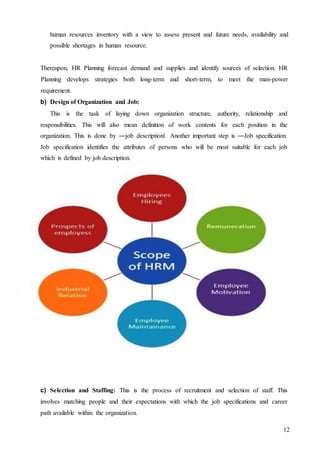
The major HRM activities include HR planning, job analysis, job design, employee hiring,
employee and executive remuneration, employee motivation, employee maintenance, industrial
relations and prospects of HRM.
The scope of Human Resources Management extends to:
 All the decisions, strategies, factors, principles, operations, practices, functions, activities
and methods related to the management of people as employees in any type of organization.
 All the dimensions related to people in their employment relationships, and all the dynamics
that flow from it.
The scope of HRM is really vast. All major activities n the working life of a worker – from the
time of his or her entry into an organization until he or she leaves it comes under the purview of
HRM. American Society for Training and Development (ASTD) conducted fairly an exhaustive
study in this field and identified nine broad areas of activities of HRM.
These are given below:
• Human Resource Planning
• Design of the Organization and Job
• Selection and Staffing
• Training and Development
• Organizational Development
• Compensation and Benefits
• Employee Assistance
• Union/Labour Relations
• Personnel Research and Information System
a) Human Resource Planning: The objective of HR Planning is to ensure that the
organization has the right types of persons at the right time at the right place. It prepares
12
human resources inventory with a view to assess present and future needs, availability and
possible shortages in human resource.
Thereupon, HR Planning forecast demand and supplies and identify sources of selection. HR
Planning develops strategies both long-term and short-term, to meet the man-power
requirement.
b) Design of Organization and Job:
This is the task of laying down organization structure, authority, relationship and
responsibilities. This will also mean definition of work contents for each position in the
organization. This is done by ―job description‖. Another important step is ―Job specification.
Job specification identifies the attributes of persons who will be most suitable for each job
which is defined by job description.
c) Selection and Staffing: This is the process of recruitment and selection of staff. This
involves matching people and their expectations with which the job specifications and career
path available within the organization.
13
d) Training and Development: This involves an organized attempt to find out training needs of
the individuals to meet the knowledge and skill which is needed not only to perform current
job but also to fulfil the future needs of the organization.
e) Organizational Development: This is an important aspect whereby ―Synergetic effect‖ is
generated in an organization i.e. healthy interpersonal and inter-group relationship within the
organization.
f) Compensation and Benefits: This is the area of wages and salaries administration where
wages and compensations are fixed scientifically to meet fairness and equity criteria. In
addition labour welfare measures are involved which include benefits and services.
g) Employee Assistance: Each employee is unique in character, personality, expectation and
temperament. By and large each one of them faces problems everyday. Some are personal
some are official. In their case he or she remains worried. Such worries must be removed to
make him or her more productive and happy.
h) Union-Labour Relations: Healthy Industrial and Labour relations are very important for
enhancing peace and productivity in an organization. This is one of the areas of HRM.
i) Personnel Research and Information System: Knowledge on behavioral science and
industrial psychology throws better insight into the workers expectations, aspirations and
behaviour.Advancement of technology of product and production methods have created
working environment which are much different from the past. Globalization of economy has
increased competition many fold. Science of ergonomics gives better ideas of doing a work
more conveniently by an employee. Thus, continuous research in HR areas is an unavoidable
requirement. It must also take special care for improving exchange of information through
effective communication systems on a continuous basis especially on moral and motivation.
Objectives of HRM
The primary objective of HRM is to ensure the availability of competent and willing workforce
to an organization. The specific objectives include the following:
1) Human capital: assisting the organization in obtaining the right number and types of
employees to fulfill its strategic and operational goals.
2) Developing organizational climate: helping to create a climate in which employees are
encouraged to develop and utilize their skills to the fullest and to employ the skills and
abilities of the workforce efficiently.
3) Helping to maintain performance standards and increase productivity through effective job
design: providing adequate orientation, training and development; providing
performancerelated feedback; and ensuring effective two-way communication.
14
4) Helping to establish and maintain a harmonious employer/employee relationship
5) Helping to create and maintain a safe and healthy work environment
6) Developing programs to meet the economic, psychological, and social needs of the
employees and helping the organization to retain the productive employees
7) Ensuring that the organization is in compliance with provincial/territorial and federal laws
affecting the workplace (such as human rights, employment equity, occupational health and
safety, employment standards, and labour relations legislation). To help the organization to
reach its goals
8) To provide organization with well-trained and well-motivated employees
9) To increase the employees satisfaction and self-actualization
10)To develop and maintain the quality of work life
11) To communicate HR policies to all employees.
12) To help maintain ethical polices and behavior.
Objectives of HRM
1) Societal Objectives: seek to ensure that the organization becomes socially responsible to the
needs and challenges of the society while minimizing the negative impact of such demands
upon the organization. The failure of the organizations to use their resources for the society‘s
benefit in ethical ways may lead to restriction.
2) Organizational Objectives: it recognizes the role of HRM in bringing about organizational
effectiveness. It makes sure that HRM is not a standalone department, but rather a means to
assist the organization with its primary objectives. The HR department exists to serve the rest of
the organization.
3) Functional Objectives: is to maintain the department‘s contribution at a level appropriate to
the organization‘s needs. Human resources are to be adjusted to suit the organization‘s
demands. The department‘s value should not become too expensive at the cost of the
organization it serves.
4) Personnel Objectives: it is to assist employees in achieving their personal goals, at least as far
as these goals enhance the individual‘s contribution to the organization. Personal objectives of
employees must be met if they are to be maintained, retained and motivated. Otherwise
employee performance and satisfaction may decline giving rise to employee turnover.
Functions of HRM
Human Resources management has an important role to play in equipping organizations to
meet the challenges of an expanding and increasingly competitive sector. Increase in staff
15
numbers, contractual diversification and changes in demographic profile which compel the HR
managers to reconfigure the role and significance of human resources management. The
functions are responsive to current staffing needs, but can be proactive in reshaping
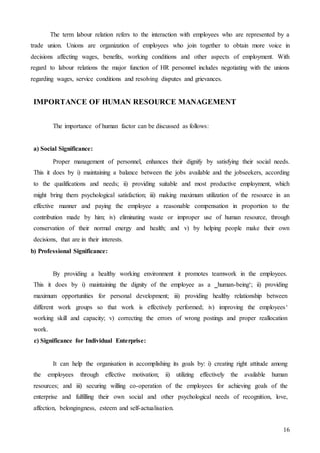
organizational objectives. All the functions of HRM are correlated with the core objectives of
HRM (Table 1.1). For example personal objectives is sought to be realized through functions
like remuneration, assessment etc.
Employee and Labor Relations: The relationship between managers and their employees must be
handled legally and effectively. Employer and employee rights must be addressed. It is important to
develop, communicate, and update HR policies and procedures so that managers and employees
alike know what is expected. In some organizations, union/management relations must be
addressed as well.
16
The term labour relation refers to the interaction with employees who are represented by a
trade union. Unions are organization of employees who join together to obtain more voice in
decisions affecting wages, benefits, working conditions and other aspects of employment. With
regard to labour relations the major function of HR personnel includes negotiating with the unions
regarding wages, service conditions and resolving disputes and grievances.
IMPORTANCE OF HUMAN RESOURCE MANAGEMENT
The importance of human factor can be discussed as follows:
a) Social Significance:
Proper management of personnel, enhances their dignify by satisfying their social needs.
This it does by i) maintaining a balance between the jobs available and the jobseekers, according
to the qualifications and needs; ii) providing suitable and most productive employment, which
might bring them psychological satisfaction; iii) making maximum utilization of the resource in an
effective manner and paying the employee a reasonable compensation in proportion to the
contribution made by him; iv) eliminating waste or improper use of human resource, through
conservation of their normal energy and health; and v) by helping people make their own
decisions, that are in their interests.
b) Professional Significance:
By providing a healthy working environment it promotes teamwork in the employees.
This it does by i) maintaining the dignity of the employee as a ‗human-being‘; ii) providing
maximum opportunities for personal development; iii) providing healthy relationship between
different work groups so that work is effectively performed; iv) improving the employees‘
working skill and capacity; v) correcting the errors of wrong postings and proper reallocation
work.
c) Significance for Individual Enterprise:
It can help the organisation in accomplishing its goals by: i) creating right attitude among
the employees through effective motivation; ii) utilizing effectively the available human
resources; and iii) securing willing co-operation of the employees for achieving goals of the
enterprise and fulfilling their own social and other psychological needs of recognition, love,
affection, belongingness, esteem and self-actualisation.
17
Dynamic and growth-oriented organisations do require effective management of people in
a fast-changing environment. Organisations flourish only through the efforts and competencies of
their human resources. Employee capabilities must continuously be acquired, sharpened and used.
Any organisation will have proper human resource management i) to improve the
capabilities of an individual; ii) to develop team spirit of an individual and the department; and iii)
to obtain necessary cooperation from the employees to promote organisational effectiveness.
It is the human resource, which is of paramount importance in the success of any
organisation, because most of the problems in organisational settings are human and social rather
than physical, technical or economic. Failure to reorganize this fact causes immense loss to the
nation, enterprise and the individual. In the words of Oliver Sheldon, ―No industry can be
rendered efficient so long as the basic fact remain unrecognized that it is principally human. It is
not a mass of machines and technical processes, but a body of men. It is not a complex matter, but
a complex of humanity. It fulfills its function not by virtue of some impersonal force, but a human
energy. Its body is not an intricate maze of mechanical devices but a magnified nervous system‖.
‗People at work‘ comprise a large number of individuals of different sex, age, socio-
religious group and different educational or literacy standards. These individuals in the work place
exhibit not only similar behaviour patterns and characteristics to a certain degree, but they also
show dissimilarity. Each individual who works has his own set of needs, drives, goals and
experiences. Each has his own physical and psychological traits. Each human being is not only a
product of his biological inheritance but also a result of interactions with his environment. Family
relationships, religious influences, racial or caste backgrounds, educational accomplishment, the
application of technological innovations, and many other environmental- experimental influences
affect the individual as he works.
People come to work with certain specific motives to earn money, to get employment, to
have better prospect in future, to be treated as a human being while at the place of work. They sell
their labour for reasonable wage / salary and other benefits. It is these people who provide the
knowledge and much of the energy through which organisational objectives are
accomplished.
The management must, therefore, be aware not only of the organisational but also employee needs.
None of these can be ignored.
18
MOTIVATION:
Motivation is the word derived from the word ’motive’ which means needs, desires, wants
or drives within the individuals. It is the process of stimulating people to actions to accomplish the
goals. In the work goal context the psychological factors stimulating the people’s behaviour can be -
 desire for money
 success
 recognition
 job-satisfaction
 team work, etc
One of the most important functions of management is to create willingness amongst the employees
to perform in the best of their abilities. Therefore the role of a leader is to arouse interest in
performance of employees in their jobs. The process of motivation consists of three stages:-
1. A felt need or drive
2. A stimulus in which needs have to be aroused
3. When needs are satisfied, the satisfaction or accomplishment of goals.
Therefore, we can say that motivation is a psychological phenomenon which means needs and
wants of the individuals have to be tackled by framing an incentive plan.
19
 Background of the study
The study focused on what motivated the employees the most. Hence the main subject to be
focused on was Employee Motivation or Motivation in general. Motivation is the ability to change
behavior. It is a drive that compels one to act because human behavior is directed toward some goal.
Motivation is intrinsic (internal) when it comes from within based on personal interests, desires, and
need for fulfillment. However, extrinsic (external) factors such as rewards, praise, and promotions
also influence motivation. As defined by Daft (1997), motivation refers to "the forces either within
or external to a person that arouse enthusiasm and persistence to pursue a certain course of action."
People who are committed to achieving organizational objectives generally outperform those who
are not committed. Those who are intrinsically rewarded by accomplishments in the workplace are
satisfied with their jobs and are individuals with high self-esteem. Therefore, an important part of
management is to help make work more satisfying and rewarding for employees and to keep
employee motivation consistent with organizational objectives.
From a manager's perspective, it is important to understand what prompts people, what influences
them, and why they persist in particular actions. By getting to know what motivates employees, the
management can design policies, procedures, functions and systems that can create a workforce of
happy and motivated employees who in turn would be more than willing to move the organisation
forward.
 Statement of the problem
The project was undertaken to find out what motivated employees the most and how it was
correlated to their respective age and experience. For this purpose a questionnaire was formulated
and administered to the employees. The results will help the management in knowing what
motivated employees the most so that they can concentrate on designing policies and systems that
would manage and support a motivated workforce.
20
 The Objective of the Study
The purpose of this project report is to determine the factor that motivates an employee the
most and the motivational profile each employee belonged to with regards to age. This project
report is meant provide information about the relationship between an employee's age and his/her
key motivator.
 Need for the study
The findings of the project would provide the management with information about the
employees’ key motivating factors so that they could accordingly design policies and procedures
that would lead to a constantly motivated employee workforce.
 Scope of the study
The study covered a sample of a hundred employees of Sourcebits Technologies. The study
sought to determine the key factor that motivated employees the most and to also determine their
motivational profiles with regards to their age. The study would benefit the organisation in a way of
providing information on what factor motivated its employees the most.
LIMITATIONS OF THE STUDY
21
 The sample size was limited and thereby could not take into account all the employees of
the organization for the study.
 With the presence of a neutral answer choice, it was difficult to gauge the attitude and
profile of certain respondents.
 Contradictions were found in a few responses
 A few respondents had chosen multiple options where only one option was required
according to the question.
22
CHAPTER-II
23
INDUSTRYPROFILE
 INTRODUCTION
Indian fertilizer industry is one of the efficient industries. The industry relies heavily on
imports for its requirement of raw material. Hence any devaluation of the rupee could inflate its
import bill. Since the nitrogen based fertilizers are protected by the retention price system (so far),
the increased costs will affect phosphorus and potassium fertilizer manufacturers. Glauber
developed the first complete mineral fertilizer, which was a mixture of saltpeter, lime, phosphoric
acid, nitrogen, and potash. As scientific chemical theories developed, the chemical needs of plants
were discovered, which led to improved fertilizer compositions.
 BACKGROUND
Fertilizer is a substance added to soil to improve plants’ growth and yield. First used by
ancient farmers, fertilizer technology developed significantly as the chemical needs of growing
plants were discovered. Modern synthetic fertilizer are composed mainly of nitrogen, phosphorous,
and potassium compounds with secondary nutrients added. The used of synthetic fertilizers has
significantly improved the quality and quantity of the food available today, although their long-term
use is debated by environmentalists.
Like all living organisms, plants are made up of cells. Within these cells occur numerous
metabolic chemical reactions that are responsible for growth and reproduction. Since plants do not
eat food like animals, they depend on nutrients in the soil to provide the basic chemicals for these
metabolic reactions. The supply of these components in soil is limited, however, and as plants are
harvested, it dwindles, causing a reduction in the quality and yield of plants.
Fertilizer replace the chemical components that are taken from the soil by growing plants.
However, they are also designed to improve the growing potential of soil. And fertilizers can create
a better growing environment than natural soil. They can also be tailored to suit the type of crop that
is being grown. Typically, fertilizers are composed of nitrogen, phosphorus, and potassium
compounds. They also contain trace elements that improve the growth of plants.
The primary components in fertilizers are nutrients which are vital for plant growth. Plants use
nitrogen in the synthesis of proteins, nucleic acids, and hormones. When plants are nitrogen
24
deficient, they are marked by reduced growth and yellowing of leaves. Plants also need phosphorus,
a component of nucleic acids, phospholipids, and several proteins. It is also necessary to provide the
energy to drive metabolic chemical reactions. Without enough phosphorus, plant growth is reduced.
Potassium is another major substance that plants get from the soil. It is used in protein synthesis and
other key plant processes. Yellowing, spots of dead tissue, and weak stems and roots are all
indicative of plants that lack enough potassium. Calcium, magnesium, and sulfur are also important
materials in plant growth. They are only included in fertilizers in small amounts, however, since
most soils naturally contain enough of these components. Other materials are needed in relatively
small amounts for plant growth. These micronutrients include iron, chlorine, copper, manganese,
zinc, molybdenum, and boron, which primarily function as cofactors in enzymatic reactions. While
they may be present in small amounts, these compounds are no less important to growth, and
without them plants can die.
Many different substances are used to provide the essential nutrients needed for an effective
fertilizers. These compounds can be mined or isolated from naturally occurring sources. Examples
include sodium nitrate, seaweed, bones, guano, potash, and phosphate rock. Compounds can also be
chemically synthesized from basic raw materials. These would include such things as ammonia,
urea, nitric acid, and ammonium phosphate. Since these compounds exist in a number of physical
states, fertilizers can be sold as solids, liquids, or slurries.
 HISTORY OF CIL VISAKHAPATNAM
The process of adding substances to soil to improve its growing capacity was developed in
the early days of agriculture. Ancient farmers knew that the first yields on a plot of land were much
better than those of subsequent years. This caused them to move to new, uncultivated areas, which
again showed the same pattern of reduced yields over time. Eventually it was discovered that plant
growth on a plot of land could be improved by spreading animal manure throughout the soil.
Over time, fertilizers technology became more refined. New substances that improved the
growth of plants were discovered. The Egyptians are known to have added ashes from burned
weeds to soil. Ancient Greek and roman writings indicate that various animal excrements were
used, depending on the type of soil or plant grown. It was also known by this time that growing
leguminous plants on plots prior to growing wheat was beneficial. Other types of materials added
include sea-shells, clay, vegetable waste, waste from different manufacturing processes, and other
assorted trash.
25
Organized research into fertilizer technology began in the early seventeenth century. Early
scientists such as Francis Bacon and Johann Glauber describe the beneficial effects of the addition
of saltpeter to soil. Glauber developed the first complete mineral fertilizer, which was a mixture of
saltpeter, lime, phosphoric acid, nitrogen, and potash. As scientific chemical theories lime,
developed, the chemical needs of plants were discovered, which led to improved fertilizer
compositions. Organic chemist Justus von liebig demonstrated that plants need mineral elements
such as nitrogen and phosphorous in order to grow. The chemical fertilizer industry could be said to
have its beginnings with a patent issued to sir john lawes, which outlined a method for producing a
form of phosphate that was an effective fertilizer. The synthetic fertilizer industry experience
significant growth after the first world war, when facilities that had produced ammonia and
synthetic nitrates for explosives were converted to the production of nitrogen-based fertilizers.
 DEVELOPMENT & GROWTH OF FERTILISER INDUSTRY
At present, there are 66 large sized fertilizer plants in the country manufacturing a wide
range of nitrogenous, phosphoric and complex fertilizers. Of these, 29 units produce urea, 20 units
are of DAP and complex fertilizers, 7 units produce low analysis straight nitrogenous fertilizers and
remaining 9 manufacture ammonium sulphate as bi product.
Beside, there are about 74 small and medium scale plants in operation producing single
super phosphate (SSP). The total installed capacity of fertilizer production, which was 120.58lakh
MT of nitrogen and 52.31 lakh MT of phosphate as on 31.03.2003 has marginally reduced to
119.98lakh MT of nitrogen and 53.60 lakh MT has raised to 54.20.
As of 2000, installed capacity in nitrogen –based nutrients was 11 million tons and in
phosphate-based nutrients, 3.6million tons. Potassium based nutrients must all be imported. Since
1992 the government has been gradually decontrolling the price of fertilizers. The prices of urea are
scheduled to be completely decontrolled by 2009/07.
 ROLE OF FERTILIZER IN AGRICULTURE WITH REFERENCE TO INDIAN
AGRICULTURE.
Agriculture is very vital sector of India’ economy, it accounts for of the country’s GDP
provides employment to of the work force and earns OD the India’s foreign exchange. Growth of
26
agriculture is an indicator of health of the overall economy. The most important factor that
contributes to the growth of agriculture is the use of fertilizer.
 The development of fertilizer industry in India has been synonymous with rapidly growing
agriculture
 About 50% increasing in crop productivity in recent times can be credited to the use of
fertilizers
 Indian has different kinds of soils and climatic regions. Centers of cropping and inadequate
manure have left the Indian soil largely developed of plant nutrients.
 To advice and educate the farmers about the use of fertilizer and insure the supply of
qualitative products, a number of soil testing laboratories have been setup this helped the
former in judicious use of fertilizers. The consumption of fertilizers is directly related to
have availability of sub soil and surface water for irrigation and on the vagaries of the
weather.
 The Indian economic growth largely depends an agriculture health of the fertilizers industry
indicates the trends of economic upturn and or recession.
 Earlier the govt. used introduced a retention price scheme for nitrogenous fertilizers, which
was later, to other fertilizers.
 To make adequate of fertilizers available to farmers in timer, Govt., also gave a freight
subsidy, which covered the movement of fertilizers to the blockhead quarters.
 Due to ample mishandling, political interference, Govt., gave up all these plants and gave
permissions for decontrol of phosphate and potassium fertilizers from august 25, 1992 and
adore subsidies on indigenous phosphate fertilizers.
 TECHNOLOGICAL ADVANCEMENT
To meet the demand of fertilizers in the country through indigenous production, self-reliance
in design engineering and execution of fertilizer projects is very crucial. This requires a strong
indigenous technological base in planning, development of process know-how, detailed engineering
and expertise in project management and executing of projects. With the continuing support of the
government for research and development as well as for design engineering activities over the
years, Indian consultancy organizations in the filed of fertilizers, project and development India
Ltd., (PDIL) & FACT Engineering and Design organization (FEDO) have grown steadily in tandem
with the fertilizer industry. These consultancy organizations are today in a position to undertake
execution of fertilizers projects starting from concept/designing to commissioning of fertilizers
plants in India and abroad.
27
A concept has been developed to carry out research and development/basic research work by
mutual understanding between industry and academic institutions, and the department of fertilizers
has sponsored research and development projects through the Indian institutes of technology, Delhi
and kharagpur under the science and technology activity for the development of research/basic
research in the filed of fertilizer industry. Action to widen the sphere of research and development
to encompass areas of fertilizers usage etc is also under consideration.
The fertilizers plant operators have now fully absorbed and assimilated the latest
technological developments, incorporating environmental friendly process technologies, and are in
a position to operate and maintain the plants at their optimum levels without any foreign assistance
and on international standards in terms of capacity utilization, specific energy consumption &
pollution standards. The average performance of gas-based plants in the today is amongst the best in
the world.
The fertilizers industry is also carrying out de-bottlenecking and energy saving schemes in
their existing plants and to enhance the capacity and reduce the specific energy consumption per ton
of product. Companies are also planning to convert their existing Naphtha-based fertilizer plant to
liquefied Natural Gas (LNG).
The country has also developed expertise for fabrication and supply of major and critical
equipment such as high-pressure vessels, static and rotating equipment, distributed control system
(DCS), heat exchangers and hydrolyser for fertilizer projects. The indigenous vendors are now in a
position to compete and secure orders for such equipment both in India & abroad under
international competitive bidding (ICB) procedure. Presently, about 70% of the equipment required
for a major domestic fertilizer plant are designed and manufactured indigenously.
A significant development /advancement has also been made in the country in the field of
manufacturing of catalysts of various ranges by our catalyst manufacturing organization like PDIL.
PDIL is implementing the schemes for enhancement of capacity and technological up gradation in
their existing catalyst plant and other utilities at sindri to complete in the international market.
 STRATEGY FOR GROWTH
The fertilizer industry has adopted the following strategy to increase fertilizer production
 Expansion/ revamping of existing fertilizers plants.
 Setting up joint venture projects in countries having abundant and cheaper raw material
resources.
28
 Working out the possibility of adopting alternative sources like liquefied natural gas to
overcome the constraints in the domestic availability of natural gas.
 JOINT VENTURES ABROAD
Due to constraints in the availability of gas and the near total dependence of the country on
imported raw materials for production of phosphoric fertilizers, the Government has been
encouraging Indian companies to establish joint venture production facilities, with buy back
arrangement, in other countries, which have rich reserve of natural gas and rock phosphate.
The Government of India, Indian Farmers Fertilizers (Cooperative Ltd). (IFFCO) and
southern petro-chemicals industries Corporation Ltd. (spic), are equity partners and are collectively
holding 25.57% of the share in the joint venture company in Senegal named ’Industries Chimiques
do Senegal (ICS). The company produces phosphoric acid and finished phosphoric fertilizers in its
plant located at Dorou and M’ Bao in Senegal. It started production in 1984 and after
debottlenecking, attained an installed capacity of 3.5 Lakh MT of phosphoric acid per annum.
During the year 2000, the company produced 2.95 lakh MT of phosphoric acid in terms of P2O5,
achieving 89.4%, capacity utilization. The supplies of phosphoric acid to India from this venture
during the year 2001 was around 3.16 lakh MT.
Since 1.196, campaign Senegalese phosphates de Taiba(CSPT), a mining company which
supplied rock phosphate to ICS, has been merged with ICS. ICS has commissioned a project for
doubling the production capacity of its phosphate mines at a cost of about US$ 20 million. IFFCO’s
equity participation in the expansion project is USS$ 20 million against the total equity of US$ 100
million. IFFCO and ICS, have entered in a buy back agreement from the expansion and existing
plant under which IFFCO will receive around 5.5 lakh MT of P2O5 from ICS with a quantity rebate
ranging from 1% to 2%.
A joint venture project in Jorden to produce 2.24 lakh MT of phosphoric acid per annum
jointly implemented by SPIC and Jorden phosphate Mines Company Limited has been in
production since May, 1997.
A joint venture between office cherifien Des phosphates, Morocco and Chambal fertilizers &
chemicals Lt., (CFCL) to produce 3.30 lakh MT’s of phosphoric acid at a cost of US $ 228 million
has been set up in Morocco.
CFCL holds 50% equity in the JV. The project is under operation since October 1999.
29
 MAJOR PLAYERS
 Coromandel Fertilizers Limited – Visakhapatnam, Ennore, Ranipet, Navi Mumbai.
 National Fertilizers limited (NFL) – Madhya Pradesh, Haryana, Punjab.
 Fertilizers & chemicals Travancore of India Ltd., (FACT)-Kerala.
 Hindustan fertilizers corporation limited (HFCL)-West Bengal, Bihar.
 The Fertilizer corporation of India limited (FCIL) – Orissa, Jarkhand, Uttar Pradesh.
 India farmers fertilizers Corporative limited (IFFCO) – Gujarat, Uttar Pradesh.
 Deepak Fertilizers& Petrochemicals Limited – Maharashtra.
 Nagarjuna Fertilizers& Chemicals Limited – Kakinada.
 Steel Authority of India limited (SAIL)- Rourkela Steel Plant.
 Brahmaputra Valley Fertilizer Corporation Limited – Assam.
 Zuari Industries Limited – Fertilizer limited – Goa
 Duncans Industries limited – Kanpur.
 Southern petrochemicals Inds. Corpn. Ltd, - Tuticorin.
 Mangalore chemicals & Fertilizers Limited – Punambur, Mangalore.
 Gujarat Narmada Valley Fertilizers Co. Ltd. – Bharuch, Gujarat.
 Indo – Gulf Fertilizers& chemicals corporation limited – Uttar Pradesh
 Sriram Fertilizers and chemicals – Kota, Rajasthan.
 Krishak Bharati Cooperative Limited (KRIBHCO) – Gujarat.
 INDUSTRY SCENARIO
India economy registered a strong growth rate of about 8% during the year. What is
gratifying is the growing awareness of the need to reverse the declining growth trend in agriculture
and in turn, farm income. Keeping in view the dependence of the majority of the Indian population
upon agriculture and rural activities, 4% annual growth in agriculture is a necessary condition for
achieving the target growth of 8% CAGR in total GDP on sustained basis.
During the year 2005-06, the Indian agriculture sector reversed the negative trend recorded in the
previous 3 years and is expected to end up with a growth rate of about , 5. Water availability has significant
impact on the agriculture activity and farm input consumption. The recent move to focus on investment in
irrigation projects in many states will provide base or more consistent and broad based growth.
30
The use of chemical fertilizers continue to play an important role in increasing agricultural
production. Productivity and farm income equally important is that the higher doses fertilizers are required to
replenish the nutrient that is removed by the crops to prevent soil degradation. There is considerable scope
for increasing fertilizer consumption in India. It is reported that only 74% and 54% of the farmers use
fertilizers during kharif and Rabi seasons respectively. Fertilizers consumption per hectare arable land
significantly lower compared to most countries including neighboring countries. In this context, CFL has
taken up project covering more than 500 villages spread over three districts o Andhra Pradesh and Orissa for
educating the farmers on the need for increasing fertilizers consumption to improve the farm yield from the
fields and maintain soil health.
A heartening development is increasing emphasis on balanced and integrated use of plant nutrients
including secondary and micro nutrients. The fertilizers industry on its part can play a significant role in
these efforts.
Timely and normal rainfall and good in flow in to the major reservoirs during the year and increases in
irrigated acreage in the companies primary markets of Andhra Pradesh, Orissa and Karnataka provided
imputes to cropping and supported and higher consumption of fertilizers. The Phosphoric fertilizers recorded
growth of 6% during the year mainly driven by complex fertilizers.
The production of complex registered growth of about 30% over the previous year while there was a
decline in the production of DAP.
During the year price of the key raw materials such as ammonia, phosphoric acid and potash increase
significantly. Sulphur price has also remained high although during the last quarter of the year showed signs
of softening. Thanks to the long term agreements that the company has entered into with global players, the
company could secure its requirements of all the key raw materials including ammonia, rock phosphate,
sulphur and phosphoric acid on a continuous basis without any disruption.
Pesticides form an integrated part of the agricultural activity in protecting crops from pests and
diseases thereby reducing yield losses and helping crops realize their yield potential. The industry is
characterized by MNC dominance in new molecules, large number o generic players, higher working capital
requirements, price wars and vagaries of monsoon/pest occurrence.
Pesticide industry comprise of three major product group viz. herbicides, fungicides and insecticides
continue to form the total pesticides market in India with a share of 67%.
31
During the year, the pesticides consumption was significantly affected by a combination of untimely
heavy rains and low pest load in certain major crop segments leading to stock build up and intense price
consumption. Increase in BT cotton acreage also impacted the consumption adversely.
Indian industry recorded a negative growth of about 13% during the year. However business by
shifting business focus to non-cotton segments especially paddy and by continuing focus on specialties, CFL
could achieve a marginal turnover growth. In experts, India is developing as a hub for sourcing off- patented
pesticide and has become the second largest producer and exporter of pesticide in Asia.
 PRESENT TRENDS:
During the 8th
plan in 1992-1998, production came very close to 1000
10 capacity utilization in
inspite of the problems of spite of the problems of sickness and raw material constraints. There would have
been a short fall in production during 8th
plan but for the failure of planned capacity addition of seven lakh
tones for nitrogen and two lakh tones for phosphate due to feed stock supply constraints (natural gas).
Incase of phosphate fertilizer which depends wholly on imported raw material only a small capacity
addition was included in the 8th
plan with the adoption of pipe reactor technology in the existing plans to
enable them to achieve a production increase of 25-30%. This did not help the units because of the policy
changes in 1992 resulting in decontrol of phosphate fertilizers.
The major objective of 9th
plan (1999-2000) strategy, is to frame long tern feed stock and price
policies for fertilizers and steady tapering off of subsidies. It also aims to encourage inflow of fresh
investments and bring about an increase in fertilizer consumption. To realize optimum application, the large
price disparity between the different nutrients to realize optimum application will also have to be corrected.
Infrastructure will have to be strengthened to ensure smooth rail movement of fertilizers and post handling of
imported nutrients.
The lack of coherent fertilizer policy made difficult by the political uncertainties created by
coalition compulsions at the center, in the health of this vital industry through production wise it has
had a better year in 1997-98 than in the previous year. This underline the need for a comprehensive
fertilizer policy .as a response to this, a high power committee recommended scrapping of unit wise
retention price cum subsidies scheme for both urea and complex fertilizers to facilitate balanced
application by farmers. The pricing methodology was based on long-range marginal cost principle
to enhance production efficiency. This pricing formula Urea also proposed to increase new
investments and efficient use of feed stock.
32
Fertilizer association of India welcomed the suggestions to bring the price of DAP and
other complex fertilizer in line with the selling of Urea to minimize in balance in price retention and
promote balance fertilizers use.
COMPANY PROFILE
Coromandel international limited is located spreading over 464 acres of land (which is
leased from Visakhapatnam port trust on renewal basis) at Visakhapatnam, at 5 kms far from
Visakhapatnam port on the east coast of India. The CIL was set as a private Ltd company on 16th
October 1961, with a capital investment of Rs. 50 crores. Then it was converted in to public ltd
company. CIL was jointly promoted by international minerals and chemicals corporation and (IMC)
and chevron chemical company, two well-known U.S corporation and E.I.D. parry (India) limited.
In 1981 EID parry was taken over by MURUGAPPA group holds 79% of share market. Indian
financial 13% and Indian public hold 8% of share market of CIL producing high analysis of
fertilizers like urea ammonium phosphate 28:28:0, 14:35:14 NPK, as well as low analysis fertilizers
like 20:20:0:15 under the brand name of “GROMOR” CIL is originally an integrated fertilizer
33
complex plant where some of the required raw material such as urea, ammonia, sulfuric acid &
phosphoric acid were manufactured at high capacity.
At present ammonia & urea plants were closed down as its production cost is incompatible
with the lower international market rates, so we are importing ammonia from gulf countries and
urea from local fertilizer industries. We are also importing sulfur & rock phosphate (from foreign
countries like Japan, Senegal etc) for the production of sulfuric acid & phosphoric acid respectively.
CIL installed ammonia importation facility consisting of 5.2 Km length pipeline in the year 1999.
Urea required for the manufacture of 28:28:0 is being procured from various producers of urea
fertilizer in India.
 COMPANY HISTORY
1959: Independent India realized that its largely agrarian economy needed a thrust in the right
direction for its people to benefit and prosper. Prime Minister Jawaharlal Nehru invited the Ford
Foundation to carry out a comprehensive study of Indian agriculture and give its recommendations.
The study revealed a crucial need to produce indigenous chemical fertilizers to increase agricultural
output to meet the country’s ever-increasing food demand.
1961: An industrial license was granted to three companies –IMC (the world’s largest producer
of fertilizers then), chevron chemical company (a major American player in fertilizers/ industrial
chemicals) and E.I.D. Parry (India) Limited (India’s largest private fertilizer producer with 60
years’ standing) – to set up a giant chemical fertilizer complex.
The first Board of Directors was constituted on October 16, with H V R Lengar as its
Chairman. Others on the Board included J Q cope, Charles Dennison, J K John, Dr L Bharat Ram,
A W Horton, J T Gibson, S C Dholakia, V K Rao and Raja RameswarRao, L L Powell and P J
Davies were the first Company Director and Dy. Managing Direct respectively. Donald I Meikle
was the first company Secretary.
1962: Market development commence in the form of a “seeding programme”. E.I.D. Parry
was appointed CIL’s principal sales agent in India for our product aptly name “GROMOR”
epitomizing the idea of growing more food for the nation.
34
A 483.5 acres site was identified at Visakhapatnam along the “Coromandel” coast (India’s
east coast), from where the company derived its name. the land, taken under a 50- year lease from
Visakhapatnam port Trust, has a private jetty just 5 km from the plant site. With a capital
investment of Rs. 50 crores, Lumus Company undertook construction of the plant.
1967: On December 10, Mr. Morarji Desai, the then Deputy Prime Minister of India,
dedicated the fertilizer plant to the nation, in the presence of Mr. Kasu Brahmananda Reddy, the
Chief Minister of Andhra Pradesh. Grandhi Ramamurthy, a local farmer, was given the honor of
cutting the ribbon. The 245 ft high Urea pill tower was one of the tallest industrial structures in
India then. Through not operational today, it still presents a formidable sight, towering against the
skyline, recalling old memories for those who were associated with its operation.
1970: the “GROMOR farmer” was developed as a marketing symbol and introduced on our
bags to spread the message of “higher yields, bigger profits”. Today, farmer households across our
addressable markets identify CIL’s brand by this symbol.
1971: The “Coromandel Lecture” was instituted to provide a forum for thinkers, economists,
social and agricultural research scientists around the world to share their thoughts on issues of
global concern such as food security, environment and extension activity.
The “Borlaug Award”, instituted in honor of Nobel Laureate Dr Norman Borlaug (father of
the wheat revolution), honors eminent men of science and industry for their distinctive contribution
to the cause of agriculture. This reflects CIL’s concern to develop a symbiotic interaction between
agriculture, industry and academia.
1976: Our fertilizer retail outlet at secunderabad got a boost with garden lovers fervently
seeking small quantities of fertilizers for bigger and richer blooms and fruit.
1977: CIL completed a decade of participation in augmenting agricultural production for the
nation. Its vital role covered soil nourishment, sharing agronomic expertise, supporting agricultural
education and rewarding research – all of which had progressively grown in width and depth during
the decade.
1980 – 90: Plans to diversify were afoot. A “groundbreaking” ceremony was performed in
November 1980 at chilamkur (Andhra Pradesh), which is rich in limestone deposits, to set up a one
million tone cement plant. The fully computerized plant (designed by world-renowned cement
35
manufacturer Krupp Polybius of west Germany) was commissioned in 1984. It was later sold to
India cements in 19903.
1995-99: chevron chemical company divested its stake in favor of E.I.D. Parry (I) Limited
in 1995, followed by IMC in 1999. E.I.D. Parry (I) Limited acquired majority shareholding in CIL,
making it a part of the Murugappa Group, a highly reputed industrial conglomerate.
2000: CIL’s growth over the years has been punctuated with several path-breaking
modernizations/ up gradation programs. Begun in 1975, the program gathered momentum in 1992-
95, when the sulphuric Acid, phosphoric Acid and complex Granulation plants were
debottlenecked. Production capacity wends up from the original 247,000 MT to 400,000 MT. on
September 29, Mr. N Chandrababu Naidu, the then Chief Minister of Andhra Pradesh, inaugurated
a new complex granulation train. This further augmented capacity to 600,000 MT, A boon to the
entire farming community.
2003: on July 12, CIL consolidated its business by acquiring controlling stake in Godavari
fertilizers & Chemicals limited (GFCL) to optimize synergy of operations in the group, the farm
inputs division of E.I.D Parry (I) Limited was merged with CIL on December 1.
2004: Mr. V. Ravichandran took over as president & WTD on January 22. Mr. A. Vellayan
took over as Chairman on September I and other Directors on the Board are Mr. J.Jayaraman,
Mr.M.M.Murugappan, Mr. T.M.M Nambiar, Mr. M.K.Tandon, Mr. D.E.Udwadia, Mr.
S.Viswanathan and Mr. K.A.Nair. The first post-merger AGM of the Company was held on July 15.
2005: CIL signs a Business Assistance Agreement with Foskor Limited, South Africa
coromandel linked a business Assistance Agreement with Foskor Pty. Ltd., South Africa, to provide
managerial and technical assistance to Foskor. A joint venture agreement was signed between
coromandel, group Chimique Tunisien, Tunisia and Gujarat state Fertilizer corporation.
2009: plant protection Business expands coromandel acquired FICOM Organics Ltd.,
2010:Innovation in Retail Marketing Coromandel Launched its retail business to serve the
rural markets. Today, coromandel has a chain of over 400 outlets in rural Andhra Pradesh.
2011: Product Innovation: Coromandel’s Specialist Nutrient range including Micro-
Nutrients and water soluble products are launched a new line of organic fertilizers.
36
2012: JV with Sociedad Quimicay Minera (SQM) A JV was signed on May 26 with
Soquimich European Holdings, B.V., the Netherlands (a Subsidiary of SQM, Chille) a world leader
in Specialty plant Nutrition business to set up a manufacturing facility at Kakinada to produce WSF
NPK grades. The 50:50 JV Company, Coromandel SQM (India) Pvt. Ltd was incorporated on 09-
01-2012. New brand Identity and Logo: 25th of August the name of the Company was changed to
Coromandel International Limited and the new logo unveiled.
 ORGANIZATION STRUCTURE OF CIL, VISAKHAPATNAM
Coromandel Fertilizer’s Limited (CIL), a leading manufacturer of farm inputs comprising of
phosphoric fertilizers and pesticides, is a constituent of the Murugappa Group and is a subsidiary of
EID Parry (India) Limited (EIDP), which holds. 69.05% of the equity of CIL, consequent to the
acquisition of 25% of the equity holding in Godavari Fertilizers’ and Chemicals Limited. (GFCL)
by the company from IFFCO in April 2010 and the open offer made to the shareholders as per the
SEBI guidelines, the company. Currently holds 74.92% of the equity in GFCL, another leading
manufacturer of phosphoric fertilizers in the state of Andhra Pradesh. During the year 2009-07, the
company acquired Ficom Organics Limited, a technical grade pesticides manufacturing company
based at Ankaleswar, Gujarat and the same has been merged with CIL effective April 1, 2009 with
necessary statutory approvals as required. The company has 6 manufacturing/formulation units
located in the states of Andhra Pradesh, Tamil Nadu, Maharashtra and Gujarat. The company is also
setting up a pesticides formulation unit at Jammu. The company’s products are marketed through 14
marketing offices and a network of about 8,000 dealers, who act as an interface between the
company and the ultimate consumers, viz. farmers.
The company’s Farm inputs Business comprise of three main divisions viz.
-Phosphoric Fertilizers’:
-Pesticides: and
-Speciality Nutrients.
The Management Discussion and Analysis given below discusses the key issues concerning each of
the divisions.
 LOCATION
37
Coromandel’s corporate office is located at Secunderabad in Andhra Pradesh. The
Company’s manufacturing facilities and marketing branches are spread across India.
 FERTILIZER PLANTS AT
 Kakinada &Visakhapatnam in Andhra Pradesh
 Ennore &Ranipet in Tamil Nadu.
 CROP PROTECTION PLANTS AT
 Ranipet in Tamil Nadu
 Navi Mumbai in Maharashtra
 Ankleshwar in Gujarat
 Jammu in J & K.
 COROMANDEL’S MARKETING BRANCHES SERVICING THE FARMING
COMMUNITY ACROSS INDIA ARE LOCATED AT
 Hyderabad, Kurnool, Vijayawada and Visakhapatnam in Andhra Pradesh.
 Bangalore and Raichur in Karnataka.
 Trichy in Tamil Nadu
 Aurangabad in Maharashtra
 Ahmadabad in Gujarat
 Indore in Madhya Pradesh
 Raipur in Chhattisgarh
 Bhubaneswar in Orissa
 Kolkata in west Bengal
 Gaziabad in Uttar Pradesh
 Bhatinda in Punjab
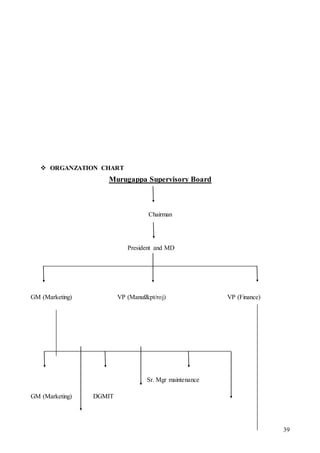
The supervisory board of Murugappa group supervises the organization if coromandel
fertilizer limited. Top most authority of the CIL is administered and controlled by the president and
managing director. The main registered office of CIL is located at Hyderabad. The present president
of CIL is Mr. Nanda. The Visakhapatnam plant is headed by the vice who at present is Mr. K.A
Nair who undertakes the charge of all the levels of departmental in the organization. A
diagrammatic representation of the authority and the subordination of the position of each
38
employee in the organization and the relationship he has others in the organization are called the
organization chart.
 ORGANIZATIONAL CHART
Board of directors manages the organization of coromandel International limited. President
and MD acts as Chief Executive of the entire setup and stationed at its registered office located at
Chennai, Tamil Nadu. View president overseas the CIL plant at Visakhapatnam.
MANAGEMENT TEAM:
Name Designation
Kapil Mehan Managing director
P. Naga Rajan Chief Financial officer
G. Ravi Prasad Sr. Vice President-Sales
P.GopalKrishana Sr. Vice President- Retail
Harish Malhotra Sr. Vice President-commercial
G. VeeraBhadram Sr. Vice President – Plant Protection
Arun Leslie Geroge Sr. Vice President – HR
S.Govindarajan Sr. Vice President- Manufacturing
39
 ORGANZATION CHART
Murugappa Supervisory Board
Chairman
President and MD
GM (Marketing) VP (Manuf&pt/roj) VP (Finance)
Sr. Mgr maintenance
GM (Marketing) DGMIT
40
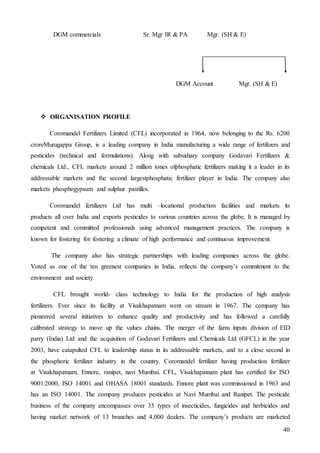
DGM commercials Sr. Mgr IR & PA Mgr. (SH & E)
DGM Account Mgr. (SH & E)
 ORGANISATION PROFILE
Coromandel Fertilizers Limited (CFL) incorporated in 1964, now belonging to the Rs. 6200
croreMurugappa Group, is a leading company in India manufacturing a wide range of fertilizers and
pesticides (technical and formulations). Along with subsidiary company Godavari Fertilizers &
chemicals Ltd., CFL markets around 2 million tones ofphosphatic fertilizers making it a leader in its
addressable markets and the second largestphosphatic fertilizer player in India. The company also
markets phosphogypsum and sulphur pastilles.
Coromandel fertilizers Ltd has multi –locational production facilities and markets its
products all over India and exports pesticides to various countries across the globe. It is managed by
competent and committed professionals using advanced management practices. The company is
known for fostering for fostering a climate of high performance and continuous improvement.
The company also has strategic partnerships with leading companies across the globe.
Voted as one of the ten greenest companies in India, reflects the company’s commitment to the
environment and society.
CFL brought world- class technology to India for the production of high analysis
fertilizers. Ever since its facility at Visakhapatnam went on stream in 1967. The company has
pioneered several initiatives to enhance quality and productivity and has followed a carefully
calibrated strategy to move up the values chains. The merger of the farm inputs division of EID
parry (India) Ltd and the acquisition of Godavari Fertilizers and Chemicals Ltd (GFCL) in the year
2003, have catapulted CFL to leadership status in its addressable markets, and to a close second in
the phosphoric fertilizer industry in the country. Coromandel fertilizer having production fertilizer
at Visakhapatnam, Ennore, ranipet, navi Mumbai. CFL, Visakhapatnam plant has certified for ISO
9001:2000, ISO 14001 and OHASA 18001 standards. Ennore plant was commissioned in 1963 and
has an ISO 14001. The company produces pesticides at Navi Mumbai and Ranipet. The pesticide
business of the company encompasses over 35 types of insecticides, fungicides and herbicides and
having market network of 13 branches and 4,000 dealers. The company’s products are marketed
41
through 13 marketing offices and a net work of over 7,000 dealers, who act as an interface between
the company and the company and the ultimate consumers, viz. farmers.
The company’s vision is to be the leader in the phosphatic fertilizer industry, producing high
quality fertilizers at low cost and giving satisfaction to all stakeholders.
Location of the coromandel fertilizers ltd.
Coromandel fertilizers is situated at sriharipuram in Visakhapatnam
 OUT LOOK
With increased water storage levels in the reservoirs and also better ground water
availability, the demand for phosphatic fertilizers is expected to go up further in the coming year.
There is also an increase in the area under irrigation in CFL’s addressable markets. The shift in
cropping pattern in the country from traditional food grains to crops such as maize sugarcane,
pulses, oil seeds etc., besides increased usage of BT seeds, will also lead to increased fertilizer
consumption. While there will be an increase in the country’s domestic production of phosphatic
fertilizers, this will be absorbed by the increased demand. It is also expected that there will be an
increase in the usage and demand for micronutrients like sulphur.
The availability of phosphoric acid will be a critical factor with no phosphoric acid
production capacity coming up and production/supply constraint in some producing countries. CFL
expects to make progress in respect of its joint venture in Tunisia for manufacture of phosphoric
acid for which an MOD has been concluded during 2005-2009.As regards the pesticides operations,
CFL will continue to focus on marketing of specialty products in domestic markets and aggressive
market expansion in the export market esp. for phenthonate and profenofos.In this context, the
proposed acquisition of equity stakes in Ficomorganics Limited will help in expending the product
range and strengthening the customer base.
In domestic market, the company will continue to introduce new molecules in growing
product segments like fungicides and herbicides to reduce its dependence on generic products.
Thorough co-marketing tie-ups and alternate source registrations, CFL has built a portfolio of
specialties and this will remain the focus in the future years also.
42
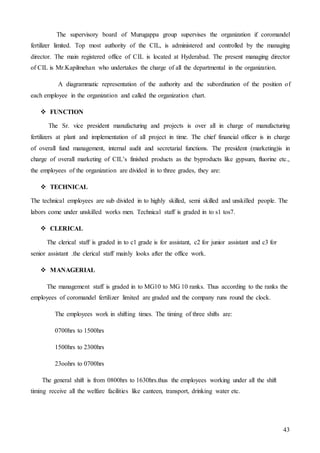
ORGANIZATION STRUCTURE OF COROMANDEL INTERNATIONAL LTD
 ORGANIZATIONAL STRUCTURE OF CIL:
BOARD OF DIRECTORS
PRESIDENT & MANAGING
DIRECTOR
Sr.
vice
preside
nt
(HR)
Sr. vice
presiden
t
(finance)
Sr. vice
president
(Marketing
)
Sr. vice
president
(fertilisres
)
Sr. vice
president
(pesticides
)
General
Mgr
(Project
)
General
manger
(plant)
Sr. vice
president
(Retail)
Sr. vice
president
(Material
project)
Sr. vice
president
(Finance
)
Vice
president
(Marketin
g)
Sr. vice
president
(Tech
services).
Chief
Engr.
DGM
(TSD)
DGM
(Comme
rcial)
DGM
(operation
s)
Sr.Mgr.
(instrum
entation
)
DGM
(Project)
DGM
(Elec./power
)
DGM
(Fin)
DGM
(Materials)
DGM
(Qlty
assurance
&devlp.)
43
The supervisory board of Murugappa group supervises the organization if coromandel
fertilizer limited. Top most authority of the CIL, is administered and controlled by the managing
director. The main registered office of CIL is located at Hyderabad. The present managing director
of CIL is Mr.Kapilmehan who undertakes the charge of all the departmental in the organization.
A diagrammatic representation of the authority and the subordination of the position of
each employee in the organization and called the organization chart.
 FUNCTION
The Sr. vice president manufacturing and projects is over all in charge of manufacturing
fertilizers at plant and implementation of all project in time. The chief financial officer is in charge
of overall fund management, internal audit and secretarial functions. The president (marketing)is in
charge of overall marketing of CIL’s finished products as the byproducts like gypsum, fluorine etc.,
the employees of the organization are divided in to three grades, they are:
 TECHNICAL
The technical employees are sub divided in to highly skilled, semi skilled and unskilled people. The
labors come under unskilled works men. Technical staff is graded in to s1 tos7.
 CLERICAL
The clerical staff is graded in to c1 grade is for assistant, c2 for junior assistant and c3 for
senior assistant .the clerical staff mainly looks after the office work.
 MANAGERIAL
The management staff is graded in to MG10 to MG 10 ranks. Thus according to the ranks the
employees of coromandel fertilizer limited are graded and the company runs round the clock.
The employees work in shifting times. The timing of three shifts are:
0700hrs to 1500hrs
1500hrs to 2300hrs
23oohrs to 0700hrs
The general shift is from 0800hrs to 1630hrs.thus the employees working under all the shift
timing receive all the welfare facilities like canteen, transport, drinking water etc.
44
 PHOSPHATIC FERTILIZERS
(a)BUSINESS
CIL is one of the leading producers of complex fertilizers’ in India. It produces and sells
complex fertilizers of different grades and single super phosphate (SSP). The company also trades
in potash, another key plant nutrient. These products are sold under well-established brand names
“Gromor”, ”Paramfos”, ”Parry Gold” and “Parry Super”. CIL has a strong market presence and
dealer network in Andhra Pradesh, Orissa, Chhattisgarh, Tamilnadu, Karnataka, parts of Madhya
Pradesh and west Bengal. The company’s fertilizer plants are located at Visakhapatnam (Andhra
Pradesh), Ennore and ranipet (both in tamilnadu) and has a combined production capacity of 11.75
lakh tones of complex fertilizer and 1.32 lakh tones of SSP.
(b) INDUSTRY SCENARIO
The Indian economy has registered a growth rate of 9.2% during 2009-07, although, The
agriculture sector with which your company is associated is expected to achieve growth rate of only
2.7%. The average growth of the agriculture sector during the Tenth plan period is estimated at only
2.3% and is below the desired level of 4% per year, which is necessary for achieving the target
growth of 8% CAGR in total GDP on a ‘sustained basis’. In the recent Economic Survey released
by Government of India, it has been acknowledged that the low yield per unit area across almost all
the crops has become a regular feature of Indian Agriculture. It is also admitted that imbalanced
fertilizer use is one of the major factors resulting in the lackluster performance of the agricultural
sector. The survey emphasizes on the urgent need for taking agriculture to a 4% annual growth
through various reforms aimed at efficient use of resources and conservation of soil, water and
ecology on a sustainable basis and in a holistic framework. The recent moves to focus on large
investment in major and medium irrigation projects as well as for renovation and restoration of
water bodies directly linked to agriculture is expected to provide a strong base for more consistent
and broad based growth.
The use of chemical fertilizers plays an important role in increasing agricultural production,
productivity and farm income. Equally important is the fact that higher doses of fertilizers are
required to replenish the nutrients that are removed by the crops to prevent soil degradation. There
is considerable scope for further increasing fertilizer consumption especially phosphatic fertilizers,
though there has been reasonably good increase in the consumption of phosphatic fertilizers during
the last 3 years. In this context, CIL has been working on a project covering more than 1200 low
fertilizers consuming villages spread over several districts of Andhra Pradesh and Orissa for
educating the farmers on the need for increasing fertilizer consumption and provide balanced
45
nutrition to the crops in order to improve the farm yields and maintain soil health. A heartening
development is the realization amongst policy makers on the need for balanced and integrated use
of plant nutrients including secondary and micronutrients to Obtain optimum yields from all the
crops.
Timely and normal rainfall and good inflow into the major reservoirs especially during Kharif
season of 2009-10, and increase in irrigated acreage in the Company’s primary markets of Andhra
Pradesh, Orissa and Karnataka provided impetus to cropping pattern 10 coromandel Fertilizer’
Limited and supported higher consumption of fertilizers. The phosphatic fertilizer industry recorded
a growth of 6% during the year driven by complex fertilizers whose production registered a growth
of about 7% over the previous year.
The prices of key raw materials, such as ammonia, Sulphur etc. have increased sharply
during the last quarter of the year. There is also an uncertainty on the likely price of phosphoric
Acid and potash for next year. But thanks to the long term arrangements that the company has
entered into with global players, the company could secure its requirement of all the key raw
materials including ammonia, rock phosphate, sulphur and phosphoric acid on a continuous basis
without any disruption and this is expected to continue in the coming year.
(c) GOVERNMENT POLICIES
The subsidy policy of the government continues to remain both uncertain and un-favorable
for the domestic producers. The rise in subsidy bill is directly linked to the rise in the cost of raw
materials and unchanged MRP. It is to be noted that increase in freight and other costs and impact
of various taxes and duties are not fully compensated under the subsidy formula and this together
with the undue delay in disbursement of subsidy dues for more than 6 months has affected the
viability of the industry and has rendered fresh investment unattractive. The government has also
not notified the subsidy rates form July 2009 and it is not clear whether the Government will follow
Prof. AbhijitSen Committee recommendation for determination of the compensation for Phosphoric
Acid based on price of the Imported DAP on normative basis. The Government has recently asked
the Tariff Commission to make a ‘Cost Price’ study of the phosphatic Fertilizers’ and Potash and
make its recommendation with respect to the delivered price of these fertilizers. It appears that
further developments on the subsidy front will have to wait till the recommendations of the Tariff
Commission is received and considered by Government of India.
 COMPANY’S PERFORMANCE
46
For the fourth year in succession, CIL improved on its performance and delivered better
results. This has been possible due to significant increase in production and sales, improved
productivity, reduction in conversion and other costs the overall turnover of the Company registered
a 12% growth over the previous year and touched a new high of Rs. 2065 crore for the year. The
total complex fertilizer production during the year was 12.38 lakh tones compared to 11.89 lakh
tones in the previous year. Both the Visak and Ennore plants recorded all time high production
levels. The sale of complex fertilizers was a record at 12.23 lakh tones compared to 11.67 lakh
tones in the previous year. The company also sold 1.29 lakh tones of SSP and 1.03 lakh tones of
imported MOP.
Continuous cost reduction efforts yielded considerable reduction in the conversion cost at its
Visak plant. Besides, distribution and marketing costs were also contained though various initiatives
such as increased direct despatches to dealers/customers etc. his was despite a steep increase in the
freight cost-both rail and road during the year. The performance of pesticides business improved on
the overall volume of technical sales compared to the previous year, the increase coming mainly on
the export front. There was a drop in the volume of the formulation sales mainly due to increased
acreage of BT cotton, although the increased focus on specialties enabled the company to maintain
its profitability from the formulation sales. The company also improved on its performance in the
Specialty Nutrient segment. During the yare, a higher quantity of pantomime Sulphur was sold and
a beginning was made with respect to water Soluble Fertilizers’ (WSF) the sale of which was
launched in December.
 STRENGTHS AND OPPORTUNITIES
CIL’s leadership position is based upon its efficient cost structure and the credibility of its
product quality amongst the consumers. The company will continue to focus on improving the
infrastructure and supply chain management in order to reduce the costs further. The tie-ups with
M/s. Foskor, South Africa and M/s. Group Chimique Tunisian, Tunisia and other major raw
material suppliers would enable the Company to maximize the production of Complex fertilizers
from its existing plants. To support the higher volumes, the Company is expanding its
infrastructural facilities including product handling equipments, raw material storage facilities etc.
The Company also continued its efforts at brand building and expanded its retail network and
developed relationship with “Self-Help Groups” (SHG) to strengthen the distribution channel. The
Company has opened its first branded agri retail sales and service centre, ‘ManaGromor’ in Guntur
district, Andhra Pradesh in April 2010. Apart from selling agri inputs like. Fertilizers’, Pesticides
etc., the retail centre would offer training to farmers on soil conditioning, water management, crop
47
timing and optimum input use. Each centre will be equipped with a soil testing laboratory to
analyze soil samples collected by trained personnel from field. More such centers will be opened in
the coming year in order to be closer to the farmers and provide ‘One stop Solution’ to them. With
the acquisition of Ficom Organics, the company has a wide range of products in the pesticides
business and has made entry into public health business segment.
The company has also developed a strong dedicated team of marketing professionals for the
pesticides business. As per the terms of the ‘Business Assistance Agreement’ signed with M/s.
Foskor, South Africa, the Company has deputed a number of its senior technical and management
executives to that company to assist them in improving their operations and increase the production
of phosphoric acid. This has proved to be mutually beneficial.
 RISK MANAGEMENT
The company recognizes that there are several risks that impact the business. The company
has constituted a risk management committee headed by the CEO and comprising of the senior
management personnel. The committee meets periodically and reviews the various risks associated
with the business and the effectiveness of the mitigation measures. The report of the committee is
presented to the board of directors for its review.
 CORPORATE VISION
To be one of the leaders in fertilizers industry with an all India presence it has to go through:
 High quality products and brand image
 Modem, cost effective and energy efficient manufacturing facility
 Profitable operations
 High level of satisfactory to stake holders
 VALUES AND BELIEFS
The following are the values and belief of the company
 ADHERE : To ethical norms in all dealings with shareholders, employees, customers,
suppliers, financial and government.
 PROVIDE : Value for money to customers –through quality products and services.
 TREAT : Our people with respect and concern provide opportunities to learn, contribute
and advance, recognize and reward initiative, innovativeness and creativity.
 MAINTAIN : An organizational climate conducive to trust, open communication and team
spirit a style of operation, benefiting our size, but reflecting moderation and humility.
48
 MANAGE : Environment effectively for harnessing opportunities
 DISCHARGE : Responsibilities to various sections of society and preserve environment
 GROW : In an accelerated manner, consistent with values and beliefs, by continuous
organization renewal.
 STENGTHS OF COROMANDEL FERTILIZER’S LIMITED
 CIL is promoted by two internally renowned US multinationals dealing in fertilizers and
petrochemicals.
 Good manpower, productivity and industrial relations.
 Low capital cost hence cost of productivity is low.
 Excellent maintenance practices and timely planned replacement decreasing
 Down time in plant.
 Reliable supply of raw materials, long time contract with suppliers for supply of raw
materials.
 Well located in respect of raw materials and market.
 Own berthing facilities for handling imported rock phosphate and sulphur in shiploads: these
facilities can be offered to outsiders by giving scope for income generation to the company.
 Adequate storage at the factory.
 Company enjoys a good brand image and value.
 Good revenue form by-products such as gypsum, fluorine etc.
 PRINICIPLES OF COROMANDEL FERTLIIZERS’ LIMITED
 To propagate and adhere the group values and beliefs.
 To achieve cost effective operations through profitable funds management and efficient
financial control.
 To create cost and quality consciousness at all levels.
 To increase levels of employee motivation, commitment and sense of belonging
 To strictly adhere to all statutory norms on environmental protection, pollution control and
ensure total safety to employee and neighborhoods.
 PRODUCTS
Gromor 14-35-14
49
 Contains nitrogen phosphate and potash.
 Highest total nutrients content (63%)
 N&P ratio same as DAP. But 14-35-14 has extra 14% potash.
 Highest in phosphate (35%)
 Best for cotton, groundnut, chilly, soya beans, potato etc.,
 Not suitable for tobacco and grapes.
Gromor 28-28-0
 Complex with highest N&P in 1:1 ratio
 Unique granulation by coating pilled urea with ammonium phosphate layer.
 Such granule configuration ensures efficient utilization for nutrients.
 Highly suitable for paddy, wheat.
Gromor 20-20-0-15
 Ammonium phosphate sulphate with N&P1:1 ratio.
 Its special feature is 13%sulphur which is not available in most other fertilizers.
 The response to the sulphur has been very encouraging in many crops, particularly oil seeds
in sulphur deficient soil.
Gromor 10-26-26
 A high analysis complex fertilizer containing all three major nutrients nitrogen, phosphate
and potash, was launched by CIL in March 2003.
 This complex contains phosphate and Potash in the ration of 1:1, the highest among the
NPK fertilizers. Its unique features beings:
Paramfos 16-20-0-13
 Ammonium phosphate sulphate containing Nitrogen, phosphate and Sulphur.
 It is the most preferred fertilizer in drill-sown areas.
Parry Super (Single Super Phosphate)
 First chemical fertilizer to be manufactured in India.
 Favored fertilizer for dry land areas.
 Controls acidity in soil and increase productivity.
50
Parry Gold
 Ammonium phosphate Sulphate containing Nitrogen and Phosphate in 1:1 ration
 It is an ideal fertilizer for all corps grown in sulphur deficient soils.
 QUALITY MANAGEMENT SYSTEM
On line with the company mission of becoming leading supplier of quality phosphoric
complex fertilizer in the world CIL implemented the quality management system conforming to
ISO 9002-1194 stands and has received the certification from DetnorskeVerotas, an international
organization. The company is now the process of changing over to 9002 – 2000 version.
 ACCOUNTING POLICIES
The accounts have been prepared primarily on the historical cost convention and in
accordance with the mandatory accounting standards. The significant accounting policies followed
by the company are stated below.
1. Fixed Assets: Fixed Assets are shown at cost or valuation less depreciation. Cost comprises the
purchases price and other attribute expenses. Fixed assets other than leasehold land/improvement.
Office equipment, furniture fitting, certain vehicles and roads had been revalued on 31st March
1991, based on a valuation by an approved value. The indices, if any used are not stated in the
valuation.
2. Depreciation on Fixed Assets: Depreciation has been provided on straight line method.
Depreciation on all assets (except those revalued and certain and vehicle and equipment) has been
provided over the useful lives of the assets derived from the rates prescribed in schedule – XIV of
the companies act, 1956 or at the rates given in the schedule. Certain vehicles and equipment are
depreciated at 20% per in certain equipment (incl. material handling equipment) or depreciated at
12.5% or 20% per annum. Depreciation on assets revalued as at 31st March 2011 is provided on the
basis of the residual technical life as ascertained by the value. Leasehold hold is being amortized
over the lease period.
3. Foreign Currency Transactions: Transactions made during the years in foreign currency are
recorded at the exchange rate prevailing at the time of transactions. Assets and Liabilities related to
foreign currency transactions remaining unsettled at the year end are translated at contract rates,
when covered by foreign exchange contracts and at year end rates in other assets.
51
4. Investments: Investments are valued at cost of acquisition and related expenses.
5. Inventories: Stores and spares are valued at monthly weighed average cost. Other inventories are
valued at lower of cost and net realized value. The method of determination of cost of various
categories of inventory is as follows:
a. Raw Material – first in first out method. Cost includes purchase cost and attributable expenses.
b. Finished goods and work-in – process – Weighted average cost of production which comprises of
direct material costs, direct wages and appropriate overheads.
c. goods for resale – Weighted average cost.
6. Sundry Debtors and Advances: Specific debts and advances identified as irrecoverable and
doubtful are written off or provided for respectively.
7. Revenue Recognition:
a. sale of goods recognized at the point dispatch to customers. Sales exclude amount recovered
excise duty and sales tax.
b. dividend income from investments is accounted for when declared
c. subsidies : credit for government subsidies has been taken on the basis actual sales made by the
company.
 MANUFACTURING PROCESS
(a)SULPHURIC ACID PLANT
We are operating 1700 tons per day capacity sulphuric acid plant designed and constructed
by Miss. Simon carves (India). Sulphuric acid is used as in acidulated in the phosphoric acid plan
and is therefore only an intermediate production. Solid Sulphur is melted and filtered then sent to
the combustion chamber where it reacts with oxygen in the air. In the combustion chamber sulphur
Dioxide is formed from where hot gases are converter containing four beds of vanadium pent oxide
(v20s) catalyst. The euphoric dioxide is observed is converted to sulphur trioxide is observed in the
water in the final absorption tower to give sulphuric acid at a concentration of 93%. The sulphuric
52
acid generated in the inter absorption tower and final absorption tower is routed to sulphuric acid
storage tanks from where it is fawn for the use in the manufacture of phosphoric acid.
(b) PHOSPHORIC ACID PLANT
The phosphoric acid plant was designed and constructed by M/s. Dorr Oliver USA. The
original capacity of the plant was 255 tons per day which was increased to 325 per day during
years, the plant mow produced on an average above 500 tons of phosphoric acid per day. Rock
phosphate containing calcium phosphate is ground a fine powder and reacted with Sulphuric acid in
reactor slurry of phosphoric acid gypsum. The reactor slurry is filtered on a rotary tilting pan type
filter to separate the acid from gypsum.
The gypsum form the filter is washed down to gypsum pond. The phosphoric acid is
recovered at 28% p205 acid is concentrated in a two stage evaporation process to given 485 p205
acids drawn form use in complex plant. The off gases from evaporation section are subscribed in
fluorine recovery plant of produce 13mt per day of hydrofluoric acid. The effluents form the reactor
and evaporation stages are treated in an effluent treatment plant. Reduce the fluorine phosphorus
levels to appropriate low values as foxed by the central pollution control board.
(c) COMPLEX PLANT
The plant was designed and constructed by M/s. Wellman lord company USA. The complex
plant utilizes ammonia and phosphoric acid and urea to make urea ammonium phosphate 28-28-0.
Whereas for manufacturing complex NPK 14-35-14, ammonia and phosphoric acid are used along
with potash, which is a ought out raw material. Mixed with other feed stocks in the complex plant in
case of manufacturer of 16-20-,20-20-0
Ammonia phosphoric acid and sulphuric acid are used as feeds. Ammonia and phosphoric
acid are first reacted. The wet granules from the granulator are then dried in a rotary drier using hot
air derived from a furnace. The drier output is a screened the proper size of granules is recovered as
product. The product granules are cooled in a cooling drum and sent to the product storage area or
to the bagging plant the product material is a bagged in 50kg bags and are dispatched by rail/road to
various parts in India.
 CORPORATE SOCIAL RESPONSIBILITY
Coromandel’s business interest is not limited to commercial profit alone. Its corporate
responsibility does not stop with merely increasing shareholder value. Coromandel associates with
53
various community development activities in the communities around its manufacturing facilities as
well as in the markets in which it operates.
 MARKETING ACTIVITIES
The company sells the finished product mainly in the four states of India, Andhra Pradesh,
Orissa, west Bengal and Madhya Pradesh the sale is through EID (parry) one of the promoters of
the company that belongs to the Murugappa group. There the selling agents of the company. The
distribution pointed located at various centers across the country.
As far as the pricing of the fertilizers is concerned, until the pre 1992 economic scenario the
government allowed subsidy on the process of the fertilized under the retention price scheme. In the
past 1992 scenario the pricing of the fertilizers underwent a sea change. The fertilizer industries
were allowed to compete in the opine market. The p205 is presently to the extent of 465 in DAP.
 CIL AND ITS LOGO
CIL emblem depicts the farmer with a branch of seven leaves on one hand whom the
company strives to serve providing them the fertilizers to ensure that this crop grows better and
more abundantly. The registered trademark “GROMOR” is a catch work depicting the company’s
intention to grow more food. The coromandel farmer appears on all the packages of the company as
well as in the media of sales promotion. The color chosen is GREEN representing the green
revolution in agriculture. After acquisition of shareholding by M/S. EID parry (India) ltd. CIL
formed a part in the Murugappa group of companies whose logo is “PEACOCK” Murugappa group
has varied business batches both nationally and internationally starting from a chocolate cycle
infilling unit to big manufacture. Out or the 12 companies Murugappa group in holding CIL claims
first in revenue earnings and hence it has been rightly placed in the plumage of the peacock symbol.
 SAFETY MEASURES
Our company as a responsible corporate citizen has always ensured that “safety” is given foremost
priority. As a policy, the company aims at achieving high standards of personal safety, makes every
effort to create a healthy work environment for its employees and neighboring communities, and
ensures protection to the company’s property from loss or accidents. Coromandel has never
compromised on safety awareness and safety consciousness at all times-24 hours a day and 365
days. Our safety record are mo mean a achievement.
 SAFETY POLICY
54
It is the policy of COROMANDEL FERTILIZERS LTD to conduct its activities in manner
which ensure health work Environment and safety to its employees.
Management has the responsibilities to ensure that all process, equipment and facilities are
designed, constructed, operated and maintained in safe condition. Cost considerations or the
demands of production and operations must not overshadow safety considerations. It is the
obligation of every employee to KNOW and FOLLW our safety rules and procedures; to TEACH
what we know to others to REPORT promptly hazardous or unsafe practices and conditions to
concerned department head; to protect the company properly from the loss or accident and to
PERFORM his or her tasks to ensure the health and safety of themselves, fellow employees and the
neighboring communities. At one time plant secured the first place on the international fertilizer
industries sectional contest among 162 participating companies. In june 1998 CIL won a five star
rating form the British safety council for its safety management systems for year 1995-96 CIL won
the “BEST PERFORMANCE OF A PHOSPHORIC ACID PLANT” and “BEST ENVIRONMENT
PROTECTION AMONG PHOSPHERIC FERTILIZER PLANT”.
 PROCESS SAFETY MANAGEMENT SYSTEM
CIL has implemented process safety Management (PSMS) developed on OSHA standard,
USA which proactively helps avoid accident that releases hazardous chemical and protects the
environment, safety and health of all the employees, PSMS is in operation at CIL.PSMS has helped
in avoiding potential incidents in hazardous chemical (ammonia) handling and storage. The system
provides for continual improvement in process safety by regular compliance audits and incidents
investigations, and increased preparedness for emergency response. All the safety critical
equipments are maintained in proper condition thus avoiding incidents. The major benefit derived
out of PSMS implementation is improved technical awareness of process hazards and safety
systems contributing to safe work behavior and the safety records of the company are testimony to
this fact. The company as a next step proposes to implement Occupational Safety & Health
Administration (OSHAS) 18001 standard, which encompasses all systems relating to safety, health
and environment.
 CONCERN FOR ENVIRONMENT
CIL demonstrates keen concern towards environment and other pollution control methods
and has implements several measures from time to time by adopting the latest technologies viz
switching over to DCDA process in sulphuric acid plant; total recycling of effluents installation of
fluorine recovery unit and installation of bag fitters in phosphoric acid plant etc. the fluorine
recovery unit convert the pollutant gases into a useful by-product called HYDROFLUOSILICIC
55
ACID which is sold to a neighboring ancillary unit. Therefore this unite not only reduces pollution
but saves the lime treatments cost of effluents and gives value addition as well. CIL believes that
environmental protection and pollution control is a continuous process and always looks forward to
adapt new system. The company has since obtained the ISO 14001 certificate for its environmental
management.
 RECENTLY WON AWARDS
 Received certificate of merit for fertilizers sector for the year 2002-2003 in the national
ENCON a word contest conducted by Bureau of Energy Efficiency.
 Received the National ENCON A ward for 2004 from the Ministry of power.
 Received F AI award for best phosphaticacid production performance for the year 2004.
 Received commendation award from CII for leadership and excellence in SHE practices for
2004.
 Received certificate of merit for implementation of ISO 18001 from Ministry of Labour,
Govt. of A.P.
The pesticides business of the company turned in a satisfactory performance registering an
increase of about 12% in technical production. The improved sale of technical in the domestic
market more than compensated for the sluggishness in the export markets. The sale of the
formulation was maintained at the same level as in the previous year. The strategy of focusing on
specialties continues to yield good results in volume and profit terms.
 NON-FERTILIZER ACTIVITIES
 Sale of intermediates, such as Sulphuric acid, phosphoric acid and Hydrofluosillic acid.
 Sale of fertilizer raw material such as sulphur, rock phosphate, potash etc.,
 Sale of by-product, viz., gypsum and carbon dioxide.
 Handling of other cargo at our berth.
 MISSION OF THE COROMANDEL FERTILIZERS COMPANY
To enhance the prosperity of farmer the supply of quality farm inputs and services to ensure
value for money.
56
 VISION OF THE COROMANDEL FERTILIZERS COMPANY
To be the leader in the phosphoric fertilizer industry, production high quality fertilizers at
low cost and giving satisfaction to all stake holders.
 ACHIEVEMENTS
 The first India to commercially manufacture high analysis compiled fertilizers UPA 23.28.0
with the highest nitrogen and phosphoric content in 1:1 ratio.
 The first in India to setup a large sulphuric Acid plant based on DCDA technology to totally
control and minimize So2 emission.
 The first in India to implement total recycling of sea water for its effluent recirculation
system attaché to phosphoric acid plant there by eliminating the use of fresh water.
 The first in India to install molten sulphur terminal for handling liquid sulphur in an
environment friendly and safe form.
57
CHAPTER-III
58
METHODOLOGY
The project consisted of finding out that factor which motivates the employees the most. The
most appropriate means to ascertain such information was to conduct a motivation survey. The
research undertaken was a descriptive research as it sought to describe the characteristics of a small
sample of employees with regards to what motivated them the most and also classifying them into
personality driven motivational profiles. The project consisted of three stages.
STAGE 1 – Gathering information and inputs to frame the necessary questions for the
survey.
STAGE 2 – Collecting data using the survey method, by getting the sample employees fill
the questionnaire.
STAGE 3 – Analysing and interpreting the primary data collected from the survey responses.
Research Methodology : -
 Problem definition – To ascertain what factor motivated the employees the most according
to them and also determine their intrinsic motivational profiles.
 Objectives – To conduct a motivation survey by framing and administering a questionnaire
to sample respondents.
 Methodology – Descriptive research
59
RESEARCHDESIGN
A research design is a framework or blueprint for conducting a research project. The
research design used for this project is a descriptive research design as it is used in describing facts
and characteristics of a sample population under observation. In this project, it is used to describe
the key motivator of individual employees and to determine their various motivational profiles.
For the fulfillment of this purpose, primary data had to be collected through a questionnaire
that was to be filled by a sample of employees.
Sample Size – 100 respondents
Questionnaire formulation – The questionnaire consisted of 22 statements based on the
Likert scale and 1 Multiple Choice Question.
Sampling Technique – Simple random sampling
Data Collection – The data collection method used for the project was the survey method.
The survey method of collecting data involves questioning employees for their responses. The
employees were asked questions in the form of statements to which they agreed, disagreed or were
neutral based on the 5 choice Likert scale. They were asked a variety of questions regarding their
attitudes, intentions and preferences in the light of situations and circumstances given in the
statements. The questionnaire designed for this project also consisted of a multiple choice question
to ascertain the factor that motivated the employees the most.
60
LITERATURE REVIEW
At one time, employees were considered just another input into the production of goods and
services. What perhaps changed this way of thinking about employees was research, referred to as
the Hawthorne Studies, conducted by Elton Mayo from 1924 to 1932. This study found that
employees are not motivated solely by money and that employee behavior is linked to their
attitudes. The Hawthorne Studies began the human relations approach to management, whereby the
needs and motivation of employees become the primary focus of managers.
Motivation Defined
Many contemporary authors have also defined the concept of motivation. Motivation has
been defined as the psychological process that gives behavior purpose and direction; a
predisposition to behave in a purposive manner to achieve specific, unmet needs an internal drive to
satisfy an unsatisfied need and the will to achieve.
Motivation is the activation or energization of goal-orientated behavior. It is the
psychological feature that stirs a human being to action towards a desired goal, the reason for that
action. Employee motivation is the process of boosting the morale of employees to encourage them
to willingly give their best in accomplishing assigned tasks. Employee motivation is the key to
achieving extraordinary results. One cannot succeed at leadership if the employees are demotivated
or disgruntled. There are broadly two kinds of motivation. Intrinsic and extrinsic motivation.
Intrinsic motivation refers to motivation that comes from within an individual rather than from the
external environmental factors such as good working conditions, salary, compensation, benefits,
financial rewards and recognition. Extrinsic motivation is exactly the opposite of intrinsic
motivation where in which motivation comes from external factors as mentioned above. This
project seeks to determine both intrinsic and extrinsic factors that motivated employees.
61
The Role of Motivation
Why do we need motivated employees? The answer is survival. Motivated employees are
needed in our rapidly changing workplaces. Motivated employees help organizations survive.
Motivated employees are more productive. To be effective, managers need to understand what
motivates employees within the context of the roles they perform and their age. Of all the functions
a manager performs, motivating employees is arguably the most complex. This is due, in part, to the
fact that what motivates employees changes constantly. For example, research suggests that as
employees' income increases, money becomes less of a motivator. Also, as employees get older,
interesting work becomes more of a motivator.
Motivation Theories
Understanding what motivated employees and how they were motivated was the focus of
many researchers following the publication of the Hawthorne Study results. Five major approaches
that have led to our understanding of motivation are Maslow's need-hierarchy theory, Herzberg's
two- factor theory, Vroom's expectancy theory, Adams' equity theory, and Skinner's reinforcement
theory.
According to Maslow, employees have five levels of needs: physiological, safety, social,
ego, and self- actualizing. Maslow argued that lower level needs had to be satisfied before the next
higher level need would motivate employees. Herzberg's work categorized motivation into two
factors: motivators and hygienes. Motivator or intrinsic factors, such as achievement and
recognition, produce job satisfaction. Hygiene or extrinsic factors, such as pay and job security,
produce job dissatisfaction.
Vroom's theory is based on the belief that employee effort will lead to performance and
performance will lead to rewards. Rewards may be either positive or negative. The more positive
the reward the more likely the employee will be highly motivated. Conversely, the more negative
the reward the less likely the employee will be motivated.
Adams' theory states that employees strive for equity between themselves and other workers.
Equity is achieved when the ratio of employee outcomes over inputs is equal to other employee
outcomes over inputs.
62
Skinner's theory simply states those employees' behaviors that lead to positive outcomes will
be repeated and behaviors that lead to negative outcomes will not be repeated. Managers should
positively reinforce employee behaviors that lead to positive outcomes. Managers should negatively
reinforce employee behavior that leads to negative outcomes.
However the following motivation theory called McClelland's Theory of Acquired Needs was
used as a base for formulating the questionnaire and aiding the purpose of the project.
McClelland's Theory of Acquired Needs
In his acquired-needs theory, David McClelland proposed that an individual's specific needs
are acquired over time and are shaped by one's life experiences. Most of these needs can be classed
as achievement, affiliation, or power. A person's motivation and effectiveness in certain job
functions are influenced by these three needs. McClelland's theory sometimes is referred to as the
three need theory or as the learned needs theory.
Achievement
People with a high need for achievement (nAch) seek to excel and thus tend to avoid both
low-risk and high-risk situations. Achievers avoid low-risk situations because the easily attained
success is not a genuine achievement. In high-risk projects, achievers see the outcome as one of
chance rather than one's own effort. High nAch individuals prefer work that has a moderate
probability of success, ideally a 50% chance. Achievers need regular feedback in order to monitor
the progress of their achievements. They prefer either to work alone or with other high achievers.
Affiliation
Those with a high need for affiliation (nAff) need harmonious relationships with other
people and need to feel accepted by other people. They tend to conform to the norms of their work
group. High nAff individuals prefer work that provides significant personal interaction. They
perform well in customer service and client interaction situations.
Power
63
A person's need for power (nPow) can be one of two types - personal and institutional.
Those who need personal power want to direct others, and this need often is perceived as
undesirable. Persons who need institutional power (also known as social power) want to organize
the efforts of others to further the goals of the organization. Managers with a high need for
institutional power tend to be more effective than those with a high need for personal power.
General Implications for Management
People with different needs are motivated differently
 High achievers should be given challenging projects with reachable goals. They should be
provided frequent feedback. While money is not an important motivator, it is an effective
form of feedback.
 Employees with a high affiliation need perform best in a cooperative environment.
 Management should provide power seekers the opportunity to manage others.
DATAANALYSIS AND INTERPRETATION
64
Overall Analysis
Statement 1 - I feel that my superior/team leader always recognises the work done by me.
58% of the employee's feel that their superiors recognise the work done by them. 19% strongly
agree, 22% are neutral and only 1% disagrees with the statement.
Most of the employees are happy of the fact that their superior/team leader recognizes the work
done by them.
Statement 2 – I feel that the job I do gives me a good status.
54% of the employees feel their job gives them a good status. 19% strongly feel their job gives them
a good status. Whereas 19% are neutral about it and 2% disagree with the statement.
The employees enjoy the good status their job gives them.
Statement 4 - Visibility with the top management is important to me.
Agree Disagree Neutral SA
0
10
20
30
40
50
60
70
Agree Disagree Neutral SA
0
10
20
30
40
50
60
Agree Disagree Neutral SA SD
0
10
20
30
40
50
65
47% of the employees consider their visibility with the top management to be important. 23%
strongly agree and 28% are neutral about the importance. 1% disagrees and another 1% strongly
disagrees.
The employees want to be seen with and recognized by the top management.
Statement 5 - There is a fair amount of team spirit in the organisation.
50% of the employees find that there is a fair amount of team spirit in the organisation. 9% strongly
agree, 33% are neutral, 5% disagree and 3% strongly feel there is no team spirit in the
organisation.
The employees are contented with the amount of team spirit in the organization.
Statement 8 – I want to be the best at my job.
Agree Disagree Neutral SA SD
0
10
20
30
40
50
60
66
59% strongly agree that they want to be the best at their jobs. 38% agree and 2% are neutral about
the statement. None of the employees disagree.
The employees want to perform to their fullest at their job and hence want to be the best at their
job.
Statement 9 – I find opportunities for advancement in the organisation.
52% find opportunities for advancement in the organisation. 25% are neutral about the statement.
7% disagree and 16% strongly disagree.
Most employees find opportunities for growth and career advancement in the organisation.
Statement 10 - You feel the need to make sure that things around you are working in tandem with
company goals.
Agree Neutral SA
0
10
20
30
40
50
60
70
Agree Disagree Neutral SA
0
10
20
30
40
50
60
67
56% feel the need to make sure that things around them are working in tandem with company goals.
12% strongly agree with the statement. 28% are neutral about it. 3% disagree and 1% strongly
disagrees with the statement.
Most employees feel the need to control things around them and make sure that everything is
working in the best interest of the company.
Statement 11 - You seek to have a certain amount of control over the working and performance of
your colleagues regardless of position.
48% of the employees seek to have a certain amount of control over the working and performance
of their colleagues regardless of their position. 7% strongly feel the same. 31% are neutral. 10%
don't seek to have control and 3% strongly disagree with the statement
Most employees seek to have a certain amount of control over their colleagues.
Statement 12 - You generally tend to seek guidance from your colleagues, seniors and/or your
leader.
Agree Disagree Neutral SA SD
0
10
20
30
40
50
60
Agree Disagree Neutral SA SD
0
10
20
30
40
50
60
68
53% of the employees tend to seek guidance from their colleagues and seniors. 25% strongly tend to
seek guidance. 20% think neutrally and 2% don't tend to seek any sort of guidance.
Employees are highly dependent on others for guidance.
Statement 13 - You always tend to work with a sense of direction.
71% of the employees always tend to work with a sense of direction. 23% strongly agree. 5% are
neutral when it comes to working with a sense of direction and 1% doesn’t tend to work with a sense
of direction.
All employees are direction oriented and focused when they are working.
Statement 14 - You feel the need to belong to a team or a work group.
Agree Disagree Neutral SA
0
10
20
30
40
50
60
Agree Disagree Neutral SA
0
10
20
30
40
50
60
70
80
69
53% of the employees feel the need to belong to a team or a work group and 31% of them strongly
feel that need. 15% are neutral about the statement and 1% do feel the need to belong to any team
or work group.
Employees have a high need for affiliation and relationships.
Statement 15 - You are motivated when working with others rather than when working individually.
38% of the employees find themselves motivated when working with others rather than when
working individually. 29% strongly feel motivated when working with others. Just below 28% are
neutral about the statement. Only 4% are motivated while working individually and 1% is strongly
motivated working by themselves.
Most employees were very team oriented and hence they were motivated working with others.
Statement 16 - You value relationships at the workplace.
Agree Disagree Neutral SA
0
10
20
30
40
50
60
Agree Disagree Neutral SA SD
0
5
10
15
20
25
30
35
40
70
41% of the employees strongly value relationships at the workplace and 37% agree with valuing
relationships at the workplace. 13% are neutral about the statement. But 6% disagree and 3%
strongly disagree.
The employees seem to highly regard and value their relationship with others.
Statement 17 - You prefer to work independently.
22% of the employees agree and 7% strongly agree that they prefer working independently. A
majority 55% are neutral about the statement while 13% disagree and 3% strongly disagree with
the statement.
For most employees working independently and not working independently does not matter.
Statement 18 - You tend to plan and schedule your own work/task without supervision.
Agree Disagree Neutral SA SD
0
5
10
15
20
25
30
35
40
45
Agree Disagree Neutral SA SD
0
10
20
30
40
50
60
71
47% of the employees tend to plan and schedule their own work without supervision. 26% are
neutral towards the statement. 14% and 13% disagree and strongly disagree implying that they are
dependent when it comes to planning and scheduling their work.
Employees are independent when it comes to planning and scheduling their own task.
Statement 19 - You normally do not take help or advice from colleagues and seniors.
A majority of 47% of the employees disagree with the statement implying that they do take help or
advice from colleagues and seniors. 17% and 12% agree and strongly agree to the statement
implying they do not normally take any help or advice. 24% are neutral towards to the statement.
Employees do take help and advice from colleagues and seniors implying that they are dependent
to an extent.
Statement 20 - Being comfortable is more important to you than getting ahead.
Agree Disagree Neutral SA
0
10
20
30
40
50
Agree Disagree Neutral SA
0
10
20
30
40
50
72
37% of the employees agree and 9% strongly agree with the statement. 32% are neutral towards the
statement. 17% and 5% disagree and strongly disagree with the statement respectively.
Being comfortable and getting ahead are equally important for employees.
Statement 21 - You are satisfied to be no more better than your colleagues at work.
37% of the employees disagree and 14% strongly disagree to the statement implying that they are
keen on being better than their colleagues. 33% of the employees are neutral and only 1% agree
with the statement.
Employees are highly competitive at work.
Statement 22 – I sometimes try to achieve more than what is required from my target.
Agree Disagree Neutral SA SD
0
5
10
15
20
25
30
35
40
Agree Disagree Neutral SA SD
0
5
10
15
20
25
30
35
40
73
More than half of the employees agree and 28% strongly agree that they try to achieve more than
what is required from their target. 10% are neutral about the statement while 4% and 1% disagree
and strongly disagree with the statement respectively.
Employees are highly achievement oriented and have a need for achievement.
Factor that motivates you the most
For a majority of 45% of the employees, Career development was their most motivating factor
while 23% of the employees found the financial incentives to be the most motivating factor for them.
8% chose rewards and recognition, 7% showed a mixed response by chose more than one factor.
6% chose job security. 4 % of the employees did not respond while 2% were motivated by
competition. 1% chose activities and training to be most motivating while another 1% was most
motivated by fringe benefits. However 3% chose other motivating factors. What motivated 3% of the
employees was the fact that they were working for the best company in the industry.
Employees are generally motivated by growth and career development opportunities provided
by the organisation.
Agree Disagree Neutral SA SD
0
10
20
30
40
50
60
74
Age wise Sub Analysis based on motivation profiles
RECOGNITION
AGE 21-25 A D N SA SD
Q1 52 --- 26 22 ---
Q2 56 2 24 18 ---
Q4 50 2 32 16 ---
AGE 26-30
Q1 62 2 19 17 ---
Q2 51 2 28 19 ---
Q4 45 25 28 2 ---
It can be noted that among employees belonging to both the age groups, a majority of them had
agreed to statements that highlight a sense of recognition implying that most of the employees
under age groups 21-25 and 26-30 were very likely to be inherently motivated by a sense of
recognition. Under age group 21-25, 74%, 74% and 66% agreed to statements 1, 2 and 4
respectively. Under age group 26-30, 79%, 70% and 73% agreed to statements 1, 2 and 4 as against
only 2% for disagreeing to the same statements.
All employees are motivated by being recognized by their colleagues and superiors.
AFFILIATION
AGE 21-25 A D N SA SD
Q5 54 4 32 6 4
Q14 50 --- 12 38 ---
Q15 34 2 32 32 ---
75
It is evident from the table that among employees belonging to both the age groups, a vast majority
of them had agreed to statements that highlight a sense of affiliation and belonging implying that
most of the employees under age groups 21-25 and 26-30 were inherently motivated by having a
sense of affiliation and belonging within the organisation, department or team. Under age group 21-
25, a majority of 60%, 78%, 64% and 68% agreed to statements 5, 14, 15 and 16 as against only
8%, 0%, 2% and 12% disagreeing to the same statements.
Employees regardless of age group valued relationships at the workplace and had a high need for
affiliation.
Q16 28 6 20 40 6
AGE 26-30
Q5 47 6 34 13 ---
Q14 53 2 20 25 ---
Q15 42 6 24 26 2
Q16 48 6 6 40 ---
ACHEIVEMENT/COMPETITION
AGE 21-25 A D N SA SD
Q8 40 --- 2 58 ---
Q9 60 6 22 12 ---
Q20 40 14 28 12 6
Q21 16 32 36 2 14
Q22 6 4 10 26 ---
AGE 26-30
76
According to the responses mentioned in the table, employees belonging to both the age groups are
high on a need for achievement and are equally motivated by a sense of competition. For example
statement 21 states “You are satisfied to be no more better than your colleagues at work” to which a
majority of 55% of the employees under age group 26-30 agree as against only 13% disagreeing
implying that those 13% of the employees maybe high on achievement but at the same time not so
competitive. Similar findings are recorded for the employees under 21-25.
All employees wanted to achieve by performing better and being the best at their job.
According to the data derived from the table, although most employees under both age groups
agreed to statements 10 and 11 that highlight the need to control, employees under age 26-30
Q8 38 --- 5 57 ---
Q9 42 8 30 20 ---
Q20 34 18 38 6 4
Q21 13 42 32 13 ---
Q22 54 4 8 32 2
CONTROL
AGE 21-25 A D N SA SD
Q10 60 2 26 10 2
Q11 44 10 34 6 6
AGE 26-30
Q10 53 4 32 11 ---
Q11 51 11 30 6 2
77
seemed to exhibit more need for control when compared to responses pertaining to employees under
age group 21-26
Older and more experienced employees felt the need to control. This indicates that as people in
the organisation grow older, their general need to maintain or exert control increases by certain
degrees.
Working with a sense of direction is a priority for almost all employees under both the age groups.
All the employees almost equally find it important to work with a sense of direction, seeking some
form of guidance from colleagues and superiors at the same time. Under age group 21-25, 24% and
6% of employees have a neutral attitude towards statements 12 and 13. Under age group 26-30,
18% and 4% of employees show a neutral response towards a sense of direction and guidance.
Most employees worked with focus and direction receiving guidance from time to time.
DIRECTION
AGE 21-25 A D N SA SD
Q12 46 2 24 28 ---
Q13 72 2 6 20 ---
AGE 26-30
Q12 57 2 18 23 ---
Q13 72 --- 4 24 ---
INDEPENDENCE/AUTONOMY
AGE 21-25 A D N SA SD
Q17 18 14 54 10 4
Q18 48 18 26 8 ---
Q19 22 42 24 12 ---
AGE 26-30
Q17 23 14 57 4 2
Q18 47 10 28 15 ---
78
For statement 17 which highlights work independence as a preference, employees under both age
groups show similar results where a majority 54 and 57% are neutral about working independently.
For statement 18 which highlights work autonomy and scheduling, employees under the group 26-
30 seem to be more in favour of work autonomy than employees under the age group 21-25. For
statement 19, the employees under age group 21-25 are more in favour of not taking help from
colleagues or seniors whereas only 11% of employees between age group 26-30 agreed to the
statement. This meant that work autonomy was high among employees between the age group 26-
30 and work independence was slightly high among younger employees.
Older employees tend to plan and schedule their work whereas the younger employees generally
prefer working independently
Key motivators for age group 21-25
Q19 11 53 23 13 ---
79
50% of the employees between the age group 21-25 chose career development opportunities as their
major motivating factor. 22% of the respondents found financial incentives as their key motivating
factor. The 3rd majority of the group, that is 8% of the group found the job security factor motivating
them. 6% were motivated by rewards and recognition. Another 6% had chosen multiple motivating
factors. 2% were motivated by fringe benefits and another 2% were motivated by other factors. 4%
of the employees didn't respond.
Employees were motivated more by career growth and development opportunities provided by the
company.
Key motivators for age group 26-30
50%
22%
2%
8%
6%
4%
6% 2%
Career development
Financial incentives
Fringe benefits
Job security
Rew ards and recognition
No responses
Mixed
Other
80
The data appears to be the same for employees between age group 26-30 as it for employees
belonging to the age group 21-25. Majority of the employees that is 38% were motivated by career
development opportunities while 25% of the employees were motivated by financial incentives.
Rewards and recognition gained 3rd place with 11% of the respondents being motivated by them. 5%
were motivated by job security and another 5% were motivated by competition while only 2% of the
employees were motivated by employee and training sessions etc. 6% chose multiple motivating
factors and 5% of the employees for were motivated by other factors. 4% didn't respond.
Older employees were motivated less by career development opportunities and more by financial
incentives.
37%
25%
2%
5%
5%
11%
4%
6%
5%
Career development
Financial incentives
Activities/Training
Competition
Job security
Rew ards and recognition
No responses
Mixed
Other
81
CHAPTER-IV
FINDINGS
 Career development opportunities was the most motivating factor for a majority of the
employees.
82
 A second majority of employees were most motivated by the financial incentives provided
by the company.
 All the employees were motivated by being recognised and having a sense of achievement
and competition.
 Employees valued relationships at the workplace and were motivated working in teams
implying that they had a high need for affiliation.
 All employees regardless of age sought some guidance from colleagues and superiors.
 Employees within the age group 21-25 tend to be more dependent at the workplace
 Employees within the age group 26-30 tend to be more independent and self-autonomous at
work
SUMMARY
From the age-based analysis and interpretation, it can be found that employees belonging to both
age groups 21-25 and 26-30 are driven by a sense of recognition in the workplace and they also feel
that it is a very important and an integral part of their motivation. This result directly corresponds
with the results pertaining to the achievement/competition factor because the same employees who
were driven by a sense of recognition showed a tendency to achieve or be competitive at their
workplace. Almost all of the respondents wanted to be best at their jobs and also found
83
opportunities for advancement on the organization thereby indicating that a combination of a sense
of recognition and achievement/competition automatically led them to be optimistic about their
growth and advancement in the organization. While majority of employees under both age groups
always tried to achieve more than what was required from their job target, surprisingly for most
employees, being comfortable was more important than getting ahead implying that although they
wanted to achieve, they didn’t prefer to do it at the cost of the comfort they perceived was
important. Almost all the employees wanted to be better than their colleagues at the workplace.
From the interpretation of the responses from employees, it can be proved that having a sense of
recognition and the need to achieve and be competitive were interrelated and that even if some
employees are not motivated by achievement and competition, they are certainly motivated by a
sense of recognition. The sense of recognition is linked with Maslow’s Social Needs which must be
fulfilled so that one can move on to having self-esteem.
When it comes to the need for power and the desire to control, the findings suggest that the older
employees between the age group 26-30 seek have to have some amount of control over the
working and performance of their colleagues regardless of their position and also felt the need to
monitor and make sure that things around them were working in tandem with company goals. Only
a few employees between the age group 21-25 had some desire to control implying that the more
experienced and older an employee in the organization is, the more would be his/her need and
desire to control.
When it comes to working with a sense of direction, all employees under both age groups always
worked with a sense of direction. But when it came to seeking guidance from colleagues, seniors or
leaders, more number of the older employees agreed to seeking guidance from either colleagues,
seniors or their leaders while some of the younger employees were neutral about seeking any sort of
guidance from others. What can be inferred is that working with direction and guidance is important
regardless of whether a person had the need to control or didn’t seek a need to control. What can
also be seen is that almost all younger employee’s sought guidance from others in the workplace
which proves the fact that even if an employee receives recognition or has a high sense of
achievement and competition, an individual employee will continue to seek guidance in order to
achieve their purpose as a contributor and an asset of the organization.
More than half of the employees from both age groups were neutral about working independently
suggesting that work independence or dependence didn’t matter much to them but this contradicts
84
the fact that the employees between age group 21-25 did not plan and schedule their own work or
task and always depended on their leader or superior to give them tasks. However the older
employees between age group 26-30 showed a parallel response as most of them tended to plan and
schedule their own work and task without supervision. Almost all employees under both the age
groups took help or advice from colleagues and seniors. What can be generally inferred is that
regardless of age, all the employees showed signs of dependence in the workplace and needed
someone to govern, mentor and guide them while performing their task. An employee may receive
recognition for his/her work, may want to achieve above his/her target or may want to always
perform better than his/her colleagues but may still tend to seek guidance, help and governance
from other employees in the workplace simply because he may not have yet reached a stage of
employment where independence and self-autonomy come naturally with certain factors like age
and experience. According to the results of the study, financial incentives is the second most core
factor that motivated employees, so it just proves that unless passion for work replaces monetary
benefits as a core motivator, an employee may still find himself seeking guidance, help and
governance in every aspect of his job.
One trend to be noted is that all the employees regardless of age have a high sense of affiliation.
They all valued relationships at the workplace and were also motivated when working with others
rather than working by themselves individually. So the paramount inference that can be drawn from
the results is that the employees are typical high achievers who are recognized, want to be
recognized for their work and who also want to compete to perform better than their colleagues, but
at the same time they also want to be directed, guided and helped by their superiors or leaders in
every aspect of their work proving that they are dependent to a major extent and cannot self-direct
themselves. This is mainly due to the fact that most of the employees in the study were young
freshmen with little or not as much experience as that of the older and experienced employees in the
organisation. According to McGregor’s theory Y, people are inherently motivated to perform better
and hence they did not need much coaxing or correction which is the case here but for theory Y
employees, to reach the top of Maslow’s pyramid i.e. in this case reaching a level of self
dependence and autonomy would come with age, experience and a strong passion for the work.
A majority i.e. 45% of the employees were most motivated by career development opportunities
while the 2nd majority where most motivated by financial incentives. 8% of the employees were
motivated by the job security they perceived. However a key thing to be noted is that 2% of the
employees were motivated by the fact that they were working for the best company in the industry.
85
Employees within the age group 21-25 were motivated by career development opportunities by
13% more than employees under age group 26-30. This implies that career development
opportunities are preferred by young employees because they are at a stage in the career
development life cycle where they see the importance of growth and therefore need career growth
in order to fulfill their career objectives and survive as healthy and motivated employees. But as an
employee grows with age and job experience thereby reaching a certain desired pedestal, the desire
for growth gradually levels off with career development opportunities not being the core motivating
factor.
These results can be justified by the fact that the Web/Mobile application development industry
recently came into being and is still growing at an increasing rate with major clients such as
Apple, Google’s Android and Facebook seeking talented young individuals to contribute to
technology and society through intelligent and smart web and mobile based applications.
Sourcebits Technologies is considered be one of the top leaders in the iPhone and Game
development industry and therefore it is instinctive for young and talented employees to seek for
growth and career development opportunities as developers in a company like Sourcebits. The
employees of the organisation are divided into teams based on their role, task and expertise thus
every employee is part of a team that works towards the completion of set goals. This justifies the
fact that according to the study all employees had a need for affiliation hence they valued
relationships and were motivated working with others rather than working individually.
RECOMMENDATIONS
The following are some of the recommendations that can be used to motivate employees.
 Recognizing teams or work groups for their joint effort rather than individual contributors.
 Teams with similar tasks or projects can compete with each other for the faster completion
of projects.
 Teams can have an informal retreat or an off site meeting where members get to know each
86
other and also set goals and develop plans.
 A one day sporting event or picnic can be used as a simple breather from everyday work
making the employees happier.
 Encouraging employees to write a short testimonial of how they could enhance their skills
and put their talent to creative use only because of the opportunities the company gave them.
 Exposing the employees to international job or short term project opportunities for
development and knowledge sharing.
 Having employees set their career goals and expectations so that a career counselor can
guide them in drafting a development plan or blueprint helping them focus on projects that
will take them in the direction which will facilitate long-term success.
 Implementing certain methods or techniques that would create of feeling of oneness with the
company in the minds of the employees.
CHAPTER-V
87
CONCLUSION
In the light of the results and findings, it is noted that most of the employees are motivated
by the career development opportunities provided by the company and a second majority of
employees are motivated by financial incentives. Most of the employees who were motivated by
career development opportunities were between the age group 21-25 implying that young
employees with little or no work experience were driven more by the career development
opportunities provided by the company whereas for the older employees with some amount of work
experience career development opportunities were not the paramount motivator. Hence as an
employee grows in age and experience within an organization, he is motivated more by certain
other factors that can also include the demands of the job itself.
All the employees in the organization were motivated by being recognized by colleagues
88
and superiors and also having a need for achievement and a sense of competition. At the same time
they were dependent on other colleagues and superiors and always sought some guidance from
them. The reason for them being dependent may be due to the fact that they all were team oriented
and showed a high need for affiliation so depending on other fellow employees came naturally to
them.
Employees must be allowed to work together in teams in order to collectively achieve their
group targets which ultimately lead to the fulfillment of company goals. Absence of such teams may
lead to unhealthy competition and power conflicts between individual employees ultimately causing
employees to be demotivated. Since a majority of the employees in the organization are young, the
management must focus on creating opportunities that would aid in the growth and development of
an employee’s career thereby maintaining and nurturing a motivated employee workforce.
BIBLIOGRAPHY
 www.sourcebits.com
 www.articlebase.com
 www.articlesnatch.com
 www.google.com
89
A STUDY ON EMPLOYEE MOTIVATION IN COROMANDEL
INTERNATIONAL PVT LTD
VIZAG
QUESTIONNAIRE
PERSONAL DATA:
Name: (optional)
Age:
Gender:
Marital status:
Designation:
Department:
Number of years of service:
Educational qualification:
Monthly income (Rs):
<20 21 - 30 31 - 40 41 - 50 >51
Male Female
Married Bachelor
Manager Officer Technician
<10 11 -20 21 - 30 > 31
ITI Diploma Degree PG Others
<10000 <20000 <40000 >40000
90
ANSWER THE FOLLOWING QUESTIONS BY THE ORDER GIVEN
Strongly Agree -SA
Agree - A
Neutral - N
Disagree - Z
Strongly Disagree - SD
91
SA A N Z
SD
(1) Salary increments given to me motivates me.
(2) Financial incentives motivates me more than non financial
incentives.
(3) I am satisfied with the salary I draw at present.
(4) I am satisfied with the lunch break, rest breaks and
leaves givenin the organization.
(5) Good physical working conditions are provided in the organization.
(6) As an employee in the organization I feel secured in my
job.
(7) The medical benefits & retirement benefits provided in the
organization are satisfactory.
(8) Visibility with top management is important to me.
(9) I feel that my superior always recognizes the work done
by me.
(10) I feel that the job I do gives me a good social standing.
(11) I am satisfied with the roles & responsibilities in my job
(12) In this organization there is fair amount of team spirit.
(13) I feel motivated while participating in activities done
here like dedication day, gromor mela,energy hour etc..
(14) I generally like to schedule my own work and to make
job-related decisions with minimum supervision.
(15) I find opportunities for growth in this organization.
92

Employee Motivation

  • 1.
    A REPORT ON LABOUR ABSENTEEISMBASED ON EMPLOYEE MOTIVATION With reference to COROMANDEL INTERNATIONAL LIIMITED VISAKHAPATNAM A Report Submitted in Partial Fulfillment of the Requirements of the Award of the Degree of MASTER OFBUSINESS ADMINISTRATION SUBMITTED BY SINDHUJA.V REGISTER NUMBER: 726015631027 Under the guidance of MS.NANDHINI.R ASSISTANT PROFESSOR DEPARTMENT OF MANAGEMENT STUDIES SRI VENKATESWARA INSTITUTE OF INFORMATION TECHNOLOGY AND MANAGEMENT,COIMBATORE ANNA UNIVERSITY,CHENNAI
  • 2.
  • 3.
    3 SRI VENKATESWARA INSTITUTEOF INFORMATION TECHNOLOGY AND MANAGEMENT COIMBATORE - 641 112. Department of Management Studies This is to certify that internship training entitled LABOUR ABSENTISEEM BASED ON EMPLOYEE MOTIVATION AT COROMANDEL INTERNATIONAL LIIMITED VISAKHAPATNAM is the bonafide record of internship work done by SINDHUJA.V REGISTER NUMBER: 726015631027 of Master of Business Administration during 2016-2017 Submitted for the Project Viva-Voice Examination held on _________________. ------------------------- -------------------- Project Guide Internal Examiner
  • 4.
    4 DECLARATION I affirm thatthe record titled “LABOUR ABSENTISEEM BASED ON EMPLOYEE MOTIVATION AT COROMANDEL INTERNATIONAL LIIMITED VISAKHAPATNAM” being submitted in partial fulfillment for the award MASTER OF BUSINESS ADMINISTRATION is original work carried out by me. It has not formed the part of any other project work submitted for the award of any degree or diploma, either in this or any other university. I certify that the declaration made above by the candidate is true MS.NANDHINI.R ASSISTANT PROFESSOR DEPARTMENT OF MANAGEMENT STUDIES PLACE: COIMBATORE V.SINDHUJA DATE: REG.NO 723015631027
  • 5.
    5 ACKNOWLEDGEMENT “The success ofthe project would have not been possible without the help and guidance of many people. I wish to express my sincere and heart full thanks to these personalities”. First, I extend my heart-felt gratitude to the management of SRI VENKATESWARA GROUP OF INSTITUTIONS, Commander K.VELU, FOUNDER, TRUSTEE AND CHAIRMAN and Mrs. MEHALA VELU, SECRETARY for providing us with all sorts of support in completion of the project. I thank our director academics DR.J.P.RENIN for his valuable support. I thank my guide Assistant professor MS.R.NANDHINI for his valuable support. I reverently thank Mr. Mr. S.V SUDHAKAR (Head-human resource, Coromandel International Limited ,Visakhapatnam) for providing me this opportunity. I take this opportunity to express my deep regards to Ms.ANITHA PATNAIK – Asst. manager HR (Coromandel International Limited ,Visakhapatnam). I thank Mr.K.KRISHNA MURTY, Head Technical training at Coromandel International Limited ,Visakhapatnam SUBMISSION DATE: (SINDHUJA.V) PLACE :
  • 6.
    6 TABLE OF CONTENTS ContentPage CHAPTER-I o Introduction o Background of the study o State of the problem o Objective of the study o Needfor the study o Scope of the study o Limitations of the study CHAPTER-II o Company Profile o Industry Profile CHAPTER-III o Methodology o ResearchDesign o Literature Review o Data Analysis and Interpretation CHAPTER-IV o Findings o Summary o Recommendations CHAPTER-V o Conclusion o Bibliography and annexure o Questionnaire
  • 7.
  • 8.
    8 INTRODUCTION HRM is thestudy of activities regarding people working in an organization. It is a managerial function that tries to match an organization‘s needs to the skills and abilities of its employees. Definitions of HRM Human resources management (HRM) is a management function concerned with hiring, motivating and maintaining people in an organization. It focuses on people in organizations. Human resource management is designing management systems to ensure that human talent is used effectively and efficiently to accomplish organizational goals. HRM is the personnel function which is concerned with procurement, development, compensation, integration and maintenance of the personnel of an organization for the purpose of contributing towards the accomplishments of the organization‘s objectives. Therefore, personnel management is the planning, organizing, directing, and controlling of the performance of those operative functions (Edward B. Philippo). According to the Invancevich and Glueck, ―HRM is concerned with the most effective use of people to achieve organizational and individual goals. It is the way of managing people at work, so that they give their best to the organization‖. According to Dessler (2008) the policies and practices involved in carrying out the ―people‖ or human resource aspects of a management position, including recruiting, screening, training, rewarding, and appraising comprises of HRM.
  • 9.
    9 Nature of HRM HRMis a management function that helps manager‘s to recruit, select, train and develop members for an organization. HRM is concerned with people‘s dimension in organizations. The following constitute the core of HRM HRM Involves the Application of Management Functions and Principles. The functions and principles are applied to acquiring, developing, maintaining and providing remuneration to employees in organization. Decision Relating to Employees must be Integrated. Decisions on different aspects of employees must be consistent with other human resource (HR) decisions. Decisions Made Influence the Effectiveness of an Organization. Effectiveness of an organization will result in betterment of services to customers in the form of high quality products supplied at reasonable costs. HRM Functions are not Confined to Business Establishments Only but applicable to non business organizations such as education, health care, recreation and like. HRM refers to a set of programmes, functions and activities designed and carried out in order to maximize both employee as well as organizational effectiveness. Features of HRM or characteristics or nature 1. HRM involves management functions like planning, organizing, directing and controlling 2. It involves procurement, development, maintenance of human resource 3. It helps to achieve individual, organizational and social objectives 4. HRM is a mighty disciplinary subject. It includes the study of management psychology communication, economics and sociology. 5. It involves team spirit and team work.
  • 10.
    10 Significance/importance/need of HRM HRMbecomes significant for business organization due to the following reasons. 1. Objective :- HRM helps a company to achieve its objective from time to time by creating a positive attitude among workers. Reducing wastage and making maximum use of resources etc. 2. Facilitates professional growth :- Due to proper HR policies employees are trained well and this takes them ready for future promotions. Their talent can be utilized not only in the company in which they are currently working but also in other companies which the employees may join in the future. 3. Better relations between union and management :- Healthy HRM practices can help the organization to maintain co-ordinal relationship with the unions. Union members start realizing that the company is also interested in the workers and will not go against them therefore chances of going on strike are greatly reduced. 4. Helps an individual to work in a team/group :- Effective HR practices teach individuals team work and adjustment. The individuals are now very comfortable while working in team thus team work improves. 5. Identifies person for the future :- Since employees are constantly trained, they are ready to meet the job requirements. The company is also able to identify potential employees who can be promoted in the future for the top level jobs. Thus one of the advantages of HRM is eparing people for the future. 6. Allocating the jobs to the right person :- If proper recruitment and selection methods are followed, the company will be able to select the right people for the right job. When this happens the number of people leaving the job will reduce as the will be satisfied with their job leading to decrease in labour turnover.
  • 11.
    11 7. Improves theeconomy:- Effective HR practices lead to higher profits and better performance by companies due to this the company achieves a chance to enter into new business and start new ventured thus industrial development increases and the economy improves. Scope of HRM The major HRM activities include HR planning, job analysis, job design, employee hiring, employee and executive remuneration, employee motivation, employee maintenance, industrial relations and prospects of HRM. The scope of Human Resources Management extends to:  All the decisions, strategies, factors, principles, operations, practices, functions, activities and methods related to the management of people as employees in any type of organization.  All the dimensions related to people in their employment relationships, and all the dynamics that flow from it. The scope of HRM is really vast. All major activities n the working life of a worker – from the time of his or her entry into an organization until he or she leaves it comes under the purview of HRM. American Society for Training and Development (ASTD) conducted fairly an exhaustive study in this field and identified nine broad areas of activities of HRM. These are given below: • Human Resource Planning • Design of the Organization and Job • Selection and Staffing • Training and Development • Organizational Development • Compensation and Benefits • Employee Assistance • Union/Labour Relations • Personnel Research and Information System a) Human Resource Planning: The objective of HR Planning is to ensure that the organization has the right types of persons at the right time at the right place. It prepares
  • 12.
    12 human resources inventorywith a view to assess present and future needs, availability and possible shortages in human resource. Thereupon, HR Planning forecast demand and supplies and identify sources of selection. HR Planning develops strategies both long-term and short-term, to meet the man-power requirement. b) Design of Organization and Job: This is the task of laying down organization structure, authority, relationship and responsibilities. This will also mean definition of work contents for each position in the organization. This is done by ―job description‖. Another important step is ―Job specification. Job specification identifies the attributes of persons who will be most suitable for each job which is defined by job description. c) Selection and Staffing: This is the process of recruitment and selection of staff. This involves matching people and their expectations with which the job specifications and career path available within the organization.
  • 13.
    13 d) Training andDevelopment: This involves an organized attempt to find out training needs of the individuals to meet the knowledge and skill which is needed not only to perform current job but also to fulfil the future needs of the organization. e) Organizational Development: This is an important aspect whereby ―Synergetic effect‖ is generated in an organization i.e. healthy interpersonal and inter-group relationship within the organization. f) Compensation and Benefits: This is the area of wages and salaries administration where wages and compensations are fixed scientifically to meet fairness and equity criteria. In addition labour welfare measures are involved which include benefits and services. g) Employee Assistance: Each employee is unique in character, personality, expectation and temperament. By and large each one of them faces problems everyday. Some are personal some are official. In their case he or she remains worried. Such worries must be removed to make him or her more productive and happy. h) Union-Labour Relations: Healthy Industrial and Labour relations are very important for enhancing peace and productivity in an organization. This is one of the areas of HRM. i) Personnel Research and Information System: Knowledge on behavioral science and industrial psychology throws better insight into the workers expectations, aspirations and behaviour.Advancement of technology of product and production methods have created working environment which are much different from the past. Globalization of economy has increased competition many fold. Science of ergonomics gives better ideas of doing a work more conveniently by an employee. Thus, continuous research in HR areas is an unavoidable requirement. It must also take special care for improving exchange of information through effective communication systems on a continuous basis especially on moral and motivation. Objectives of HRM The primary objective of HRM is to ensure the availability of competent and willing workforce to an organization. The specific objectives include the following: 1) Human capital: assisting the organization in obtaining the right number and types of employees to fulfill its strategic and operational goals. 2) Developing organizational climate: helping to create a climate in which employees are encouraged to develop and utilize their skills to the fullest and to employ the skills and abilities of the workforce efficiently. 3) Helping to maintain performance standards and increase productivity through effective job design: providing adequate orientation, training and development; providing performancerelated feedback; and ensuring effective two-way communication.
  • 14.
    14 4) Helping toestablish and maintain a harmonious employer/employee relationship 5) Helping to create and maintain a safe and healthy work environment 6) Developing programs to meet the economic, psychological, and social needs of the employees and helping the organization to retain the productive employees 7) Ensuring that the organization is in compliance with provincial/territorial and federal laws affecting the workplace (such as human rights, employment equity, occupational health and safety, employment standards, and labour relations legislation). To help the organization to reach its goals 8) To provide organization with well-trained and well-motivated employees 9) To increase the employees satisfaction and self-actualization 10)To develop and maintain the quality of work life 11) To communicate HR policies to all employees. 12) To help maintain ethical polices and behavior. Objectives of HRM 1) Societal Objectives: seek to ensure that the organization becomes socially responsible to the needs and challenges of the society while minimizing the negative impact of such demands upon the organization. The failure of the organizations to use their resources for the society‘s benefit in ethical ways may lead to restriction. 2) Organizational Objectives: it recognizes the role of HRM in bringing about organizational effectiveness. It makes sure that HRM is not a standalone department, but rather a means to assist the organization with its primary objectives. The HR department exists to serve the rest of the organization. 3) Functional Objectives: is to maintain the department‘s contribution at a level appropriate to the organization‘s needs. Human resources are to be adjusted to suit the organization‘s demands. The department‘s value should not become too expensive at the cost of the organization it serves. 4) Personnel Objectives: it is to assist employees in achieving their personal goals, at least as far as these goals enhance the individual‘s contribution to the organization. Personal objectives of employees must be met if they are to be maintained, retained and motivated. Otherwise employee performance and satisfaction may decline giving rise to employee turnover. Functions of HRM Human Resources management has an important role to play in equipping organizations to meet the challenges of an expanding and increasingly competitive sector. Increase in staff
  • 15.
    15 numbers, contractual diversificationand changes in demographic profile which compel the HR managers to reconfigure the role and significance of human resources management. The functions are responsive to current staffing needs, but can be proactive in reshaping organizational objectives. All the functions of HRM are correlated with the core objectives of HRM (Table 1.1). For example personal objectives is sought to be realized through functions like remuneration, assessment etc. Employee and Labor Relations: The relationship between managers and their employees must be handled legally and effectively. Employer and employee rights must be addressed. It is important to develop, communicate, and update HR policies and procedures so that managers and employees alike know what is expected. In some organizations, union/management relations must be addressed as well.
  • 16.
    16 The term labourrelation refers to the interaction with employees who are represented by a trade union. Unions are organization of employees who join together to obtain more voice in decisions affecting wages, benefits, working conditions and other aspects of employment. With regard to labour relations the major function of HR personnel includes negotiating with the unions regarding wages, service conditions and resolving disputes and grievances. IMPORTANCE OF HUMAN RESOURCE MANAGEMENT The importance of human factor can be discussed as follows: a) Social Significance: Proper management of personnel, enhances their dignify by satisfying their social needs. This it does by i) maintaining a balance between the jobs available and the jobseekers, according to the qualifications and needs; ii) providing suitable and most productive employment, which might bring them psychological satisfaction; iii) making maximum utilization of the resource in an effective manner and paying the employee a reasonable compensation in proportion to the contribution made by him; iv) eliminating waste or improper use of human resource, through conservation of their normal energy and health; and v) by helping people make their own decisions, that are in their interests. b) Professional Significance: By providing a healthy working environment it promotes teamwork in the employees. This it does by i) maintaining the dignity of the employee as a ‗human-being‘; ii) providing maximum opportunities for personal development; iii) providing healthy relationship between different work groups so that work is effectively performed; iv) improving the employees‘ working skill and capacity; v) correcting the errors of wrong postings and proper reallocation work. c) Significance for Individual Enterprise: It can help the organisation in accomplishing its goals by: i) creating right attitude among the employees through effective motivation; ii) utilizing effectively the available human resources; and iii) securing willing co-operation of the employees for achieving goals of the enterprise and fulfilling their own social and other psychological needs of recognition, love, affection, belongingness, esteem and self-actualisation.
  • 17.
    17 Dynamic and growth-orientedorganisations do require effective management of people in a fast-changing environment. Organisations flourish only through the efforts and competencies of their human resources. Employee capabilities must continuously be acquired, sharpened and used. Any organisation will have proper human resource management i) to improve the capabilities of an individual; ii) to develop team spirit of an individual and the department; and iii) to obtain necessary cooperation from the employees to promote organisational effectiveness. It is the human resource, which is of paramount importance in the success of any organisation, because most of the problems in organisational settings are human and social rather than physical, technical or economic. Failure to reorganize this fact causes immense loss to the nation, enterprise and the individual. In the words of Oliver Sheldon, ―No industry can be rendered efficient so long as the basic fact remain unrecognized that it is principally human. It is not a mass of machines and technical processes, but a body of men. It is not a complex matter, but a complex of humanity. It fulfills its function not by virtue of some impersonal force, but a human energy. Its body is not an intricate maze of mechanical devices but a magnified nervous system‖. ‗People at work‘ comprise a large number of individuals of different sex, age, socio- religious group and different educational or literacy standards. These individuals in the work place exhibit not only similar behaviour patterns and characteristics to a certain degree, but they also show dissimilarity. Each individual who works has his own set of needs, drives, goals and experiences. Each has his own physical and psychological traits. Each human being is not only a product of his biological inheritance but also a result of interactions with his environment. Family relationships, religious influences, racial or caste backgrounds, educational accomplishment, the application of technological innovations, and many other environmental- experimental influences affect the individual as he works. People come to work with certain specific motives to earn money, to get employment, to have better prospect in future, to be treated as a human being while at the place of work. They sell their labour for reasonable wage / salary and other benefits. It is these people who provide the knowledge and much of the energy through which organisational objectives are accomplished. The management must, therefore, be aware not only of the organisational but also employee needs. None of these can be ignored.
  • 18.
    18 MOTIVATION: Motivation is theword derived from the word ’motive’ which means needs, desires, wants or drives within the individuals. It is the process of stimulating people to actions to accomplish the goals. In the work goal context the psychological factors stimulating the people’s behaviour can be -  desire for money  success  recognition  job-satisfaction  team work, etc One of the most important functions of management is to create willingness amongst the employees to perform in the best of their abilities. Therefore the role of a leader is to arouse interest in performance of employees in their jobs. The process of motivation consists of three stages:- 1. A felt need or drive 2. A stimulus in which needs have to be aroused 3. When needs are satisfied, the satisfaction or accomplishment of goals. Therefore, we can say that motivation is a psychological phenomenon which means needs and wants of the individuals have to be tackled by framing an incentive plan.
  • 19.
    19  Background ofthe study The study focused on what motivated the employees the most. Hence the main subject to be focused on was Employee Motivation or Motivation in general. Motivation is the ability to change behavior. It is a drive that compels one to act because human behavior is directed toward some goal. Motivation is intrinsic (internal) when it comes from within based on personal interests, desires, and need for fulfillment. However, extrinsic (external) factors such as rewards, praise, and promotions also influence motivation. As defined by Daft (1997), motivation refers to "the forces either within or external to a person that arouse enthusiasm and persistence to pursue a certain course of action." People who are committed to achieving organizational objectives generally outperform those who are not committed. Those who are intrinsically rewarded by accomplishments in the workplace are satisfied with their jobs and are individuals with high self-esteem. Therefore, an important part of management is to help make work more satisfying and rewarding for employees and to keep employee motivation consistent with organizational objectives. From a manager's perspective, it is important to understand what prompts people, what influences them, and why they persist in particular actions. By getting to know what motivates employees, the management can design policies, procedures, functions and systems that can create a workforce of happy and motivated employees who in turn would be more than willing to move the organisation forward.  Statement of the problem The project was undertaken to find out what motivated employees the most and how it was correlated to their respective age and experience. For this purpose a questionnaire was formulated and administered to the employees. The results will help the management in knowing what motivated employees the most so that they can concentrate on designing policies and systems that would manage and support a motivated workforce.
  • 20.
    20  The Objectiveof the Study The purpose of this project report is to determine the factor that motivates an employee the most and the motivational profile each employee belonged to with regards to age. This project report is meant provide information about the relationship between an employee's age and his/her key motivator.  Need for the study The findings of the project would provide the management with information about the employees’ key motivating factors so that they could accordingly design policies and procedures that would lead to a constantly motivated employee workforce.  Scope of the study The study covered a sample of a hundred employees of Sourcebits Technologies. The study sought to determine the key factor that motivated employees the most and to also determine their motivational profiles with regards to their age. The study would benefit the organisation in a way of providing information on what factor motivated its employees the most. LIMITATIONS OF THE STUDY
  • 21.
    21  The samplesize was limited and thereby could not take into account all the employees of the organization for the study.  With the presence of a neutral answer choice, it was difficult to gauge the attitude and profile of certain respondents.  Contradictions were found in a few responses  A few respondents had chosen multiple options where only one option was required according to the question.
  • 22.
  • 23.
    23 INDUSTRYPROFILE  INTRODUCTION Indian fertilizerindustry is one of the efficient industries. The industry relies heavily on imports for its requirement of raw material. Hence any devaluation of the rupee could inflate its import bill. Since the nitrogen based fertilizers are protected by the retention price system (so far), the increased costs will affect phosphorus and potassium fertilizer manufacturers. Glauber developed the first complete mineral fertilizer, which was a mixture of saltpeter, lime, phosphoric acid, nitrogen, and potash. As scientific chemical theories developed, the chemical needs of plants were discovered, which led to improved fertilizer compositions.  BACKGROUND Fertilizer is a substance added to soil to improve plants’ growth and yield. First used by ancient farmers, fertilizer technology developed significantly as the chemical needs of growing plants were discovered. Modern synthetic fertilizer are composed mainly of nitrogen, phosphorous, and potassium compounds with secondary nutrients added. The used of synthetic fertilizers has significantly improved the quality and quantity of the food available today, although their long-term use is debated by environmentalists. Like all living organisms, plants are made up of cells. Within these cells occur numerous metabolic chemical reactions that are responsible for growth and reproduction. Since plants do not eat food like animals, they depend on nutrients in the soil to provide the basic chemicals for these metabolic reactions. The supply of these components in soil is limited, however, and as plants are harvested, it dwindles, causing a reduction in the quality and yield of plants. Fertilizer replace the chemical components that are taken from the soil by growing plants. However, they are also designed to improve the growing potential of soil. And fertilizers can create a better growing environment than natural soil. They can also be tailored to suit the type of crop that is being grown. Typically, fertilizers are composed of nitrogen, phosphorus, and potassium compounds. They also contain trace elements that improve the growth of plants. The primary components in fertilizers are nutrients which are vital for plant growth. Plants use nitrogen in the synthesis of proteins, nucleic acids, and hormones. When plants are nitrogen
  • 24.
    24 deficient, they aremarked by reduced growth and yellowing of leaves. Plants also need phosphorus, a component of nucleic acids, phospholipids, and several proteins. It is also necessary to provide the energy to drive metabolic chemical reactions. Without enough phosphorus, plant growth is reduced. Potassium is another major substance that plants get from the soil. It is used in protein synthesis and other key plant processes. Yellowing, spots of dead tissue, and weak stems and roots are all indicative of plants that lack enough potassium. Calcium, magnesium, and sulfur are also important materials in plant growth. They are only included in fertilizers in small amounts, however, since most soils naturally contain enough of these components. Other materials are needed in relatively small amounts for plant growth. These micronutrients include iron, chlorine, copper, manganese, zinc, molybdenum, and boron, which primarily function as cofactors in enzymatic reactions. While they may be present in small amounts, these compounds are no less important to growth, and without them plants can die. Many different substances are used to provide the essential nutrients needed for an effective fertilizers. These compounds can be mined or isolated from naturally occurring sources. Examples include sodium nitrate, seaweed, bones, guano, potash, and phosphate rock. Compounds can also be chemically synthesized from basic raw materials. These would include such things as ammonia, urea, nitric acid, and ammonium phosphate. Since these compounds exist in a number of physical states, fertilizers can be sold as solids, liquids, or slurries.  HISTORY OF CIL VISAKHAPATNAM The process of adding substances to soil to improve its growing capacity was developed in the early days of agriculture. Ancient farmers knew that the first yields on a plot of land were much better than those of subsequent years. This caused them to move to new, uncultivated areas, which again showed the same pattern of reduced yields over time. Eventually it was discovered that plant growth on a plot of land could be improved by spreading animal manure throughout the soil. Over time, fertilizers technology became more refined. New substances that improved the growth of plants were discovered. The Egyptians are known to have added ashes from burned weeds to soil. Ancient Greek and roman writings indicate that various animal excrements were used, depending on the type of soil or plant grown. It was also known by this time that growing leguminous plants on plots prior to growing wheat was beneficial. Other types of materials added include sea-shells, clay, vegetable waste, waste from different manufacturing processes, and other assorted trash.
  • 25.
    25 Organized research intofertilizer technology began in the early seventeenth century. Early scientists such as Francis Bacon and Johann Glauber describe the beneficial effects of the addition of saltpeter to soil. Glauber developed the first complete mineral fertilizer, which was a mixture of saltpeter, lime, phosphoric acid, nitrogen, and potash. As scientific chemical theories lime, developed, the chemical needs of plants were discovered, which led to improved fertilizer compositions. Organic chemist Justus von liebig demonstrated that plants need mineral elements such as nitrogen and phosphorous in order to grow. The chemical fertilizer industry could be said to have its beginnings with a patent issued to sir john lawes, which outlined a method for producing a form of phosphate that was an effective fertilizer. The synthetic fertilizer industry experience significant growth after the first world war, when facilities that had produced ammonia and synthetic nitrates for explosives were converted to the production of nitrogen-based fertilizers.  DEVELOPMENT & GROWTH OF FERTILISER INDUSTRY At present, there are 66 large sized fertilizer plants in the country manufacturing a wide range of nitrogenous, phosphoric and complex fertilizers. Of these, 29 units produce urea, 20 units are of DAP and complex fertilizers, 7 units produce low analysis straight nitrogenous fertilizers and remaining 9 manufacture ammonium sulphate as bi product. Beside, there are about 74 small and medium scale plants in operation producing single super phosphate (SSP). The total installed capacity of fertilizer production, which was 120.58lakh MT of nitrogen and 52.31 lakh MT of phosphate as on 31.03.2003 has marginally reduced to 119.98lakh MT of nitrogen and 53.60 lakh MT has raised to 54.20. As of 2000, installed capacity in nitrogen –based nutrients was 11 million tons and in phosphate-based nutrients, 3.6million tons. Potassium based nutrients must all be imported. Since 1992 the government has been gradually decontrolling the price of fertilizers. The prices of urea are scheduled to be completely decontrolled by 2009/07.  ROLE OF FERTILIZER IN AGRICULTURE WITH REFERENCE TO INDIAN AGRICULTURE. Agriculture is very vital sector of India’ economy, it accounts for of the country’s GDP provides employment to of the work force and earns OD the India’s foreign exchange. Growth of
  • 26.
    26 agriculture is anindicator of health of the overall economy. The most important factor that contributes to the growth of agriculture is the use of fertilizer.  The development of fertilizer industry in India has been synonymous with rapidly growing agriculture  About 50% increasing in crop productivity in recent times can be credited to the use of fertilizers  Indian has different kinds of soils and climatic regions. Centers of cropping and inadequate manure have left the Indian soil largely developed of plant nutrients.  To advice and educate the farmers about the use of fertilizer and insure the supply of qualitative products, a number of soil testing laboratories have been setup this helped the former in judicious use of fertilizers. The consumption of fertilizers is directly related to have availability of sub soil and surface water for irrigation and on the vagaries of the weather.  The Indian economic growth largely depends an agriculture health of the fertilizers industry indicates the trends of economic upturn and or recession.  Earlier the govt. used introduced a retention price scheme for nitrogenous fertilizers, which was later, to other fertilizers.  To make adequate of fertilizers available to farmers in timer, Govt., also gave a freight subsidy, which covered the movement of fertilizers to the blockhead quarters.  Due to ample mishandling, political interference, Govt., gave up all these plants and gave permissions for decontrol of phosphate and potassium fertilizers from august 25, 1992 and adore subsidies on indigenous phosphate fertilizers.  TECHNOLOGICAL ADVANCEMENT To meet the demand of fertilizers in the country through indigenous production, self-reliance in design engineering and execution of fertilizer projects is very crucial. This requires a strong indigenous technological base in planning, development of process know-how, detailed engineering and expertise in project management and executing of projects. With the continuing support of the government for research and development as well as for design engineering activities over the years, Indian consultancy organizations in the filed of fertilizers, project and development India Ltd., (PDIL) & FACT Engineering and Design organization (FEDO) have grown steadily in tandem with the fertilizer industry. These consultancy organizations are today in a position to undertake execution of fertilizers projects starting from concept/designing to commissioning of fertilizers plants in India and abroad.
  • 27.
    27 A concept hasbeen developed to carry out research and development/basic research work by mutual understanding between industry and academic institutions, and the department of fertilizers has sponsored research and development projects through the Indian institutes of technology, Delhi and kharagpur under the science and technology activity for the development of research/basic research in the filed of fertilizer industry. Action to widen the sphere of research and development to encompass areas of fertilizers usage etc is also under consideration. The fertilizers plant operators have now fully absorbed and assimilated the latest technological developments, incorporating environmental friendly process technologies, and are in a position to operate and maintain the plants at their optimum levels without any foreign assistance and on international standards in terms of capacity utilization, specific energy consumption & pollution standards. The average performance of gas-based plants in the today is amongst the best in the world. The fertilizers industry is also carrying out de-bottlenecking and energy saving schemes in their existing plants and to enhance the capacity and reduce the specific energy consumption per ton of product. Companies are also planning to convert their existing Naphtha-based fertilizer plant to liquefied Natural Gas (LNG). The country has also developed expertise for fabrication and supply of major and critical equipment such as high-pressure vessels, static and rotating equipment, distributed control system (DCS), heat exchangers and hydrolyser for fertilizer projects. The indigenous vendors are now in a position to compete and secure orders for such equipment both in India & abroad under international competitive bidding (ICB) procedure. Presently, about 70% of the equipment required for a major domestic fertilizer plant are designed and manufactured indigenously. A significant development /advancement has also been made in the country in the field of manufacturing of catalysts of various ranges by our catalyst manufacturing organization like PDIL. PDIL is implementing the schemes for enhancement of capacity and technological up gradation in their existing catalyst plant and other utilities at sindri to complete in the international market.  STRATEGY FOR GROWTH The fertilizer industry has adopted the following strategy to increase fertilizer production  Expansion/ revamping of existing fertilizers plants.  Setting up joint venture projects in countries having abundant and cheaper raw material resources.
  • 28.
    28  Working outthe possibility of adopting alternative sources like liquefied natural gas to overcome the constraints in the domestic availability of natural gas.  JOINT VENTURES ABROAD Due to constraints in the availability of gas and the near total dependence of the country on imported raw materials for production of phosphoric fertilizers, the Government has been encouraging Indian companies to establish joint venture production facilities, with buy back arrangement, in other countries, which have rich reserve of natural gas and rock phosphate. The Government of India, Indian Farmers Fertilizers (Cooperative Ltd). (IFFCO) and southern petro-chemicals industries Corporation Ltd. (spic), are equity partners and are collectively holding 25.57% of the share in the joint venture company in Senegal named ’Industries Chimiques do Senegal (ICS). The company produces phosphoric acid and finished phosphoric fertilizers in its plant located at Dorou and M’ Bao in Senegal. It started production in 1984 and after debottlenecking, attained an installed capacity of 3.5 Lakh MT of phosphoric acid per annum. During the year 2000, the company produced 2.95 lakh MT of phosphoric acid in terms of P2O5, achieving 89.4%, capacity utilization. The supplies of phosphoric acid to India from this venture during the year 2001 was around 3.16 lakh MT. Since 1.196, campaign Senegalese phosphates de Taiba(CSPT), a mining company which supplied rock phosphate to ICS, has been merged with ICS. ICS has commissioned a project for doubling the production capacity of its phosphate mines at a cost of about US$ 20 million. IFFCO’s equity participation in the expansion project is USS$ 20 million against the total equity of US$ 100 million. IFFCO and ICS, have entered in a buy back agreement from the expansion and existing plant under which IFFCO will receive around 5.5 lakh MT of P2O5 from ICS with a quantity rebate ranging from 1% to 2%. A joint venture project in Jorden to produce 2.24 lakh MT of phosphoric acid per annum jointly implemented by SPIC and Jorden phosphate Mines Company Limited has been in production since May, 1997. A joint venture between office cherifien Des phosphates, Morocco and Chambal fertilizers & chemicals Lt., (CFCL) to produce 3.30 lakh MT’s of phosphoric acid at a cost of US $ 228 million has been set up in Morocco. CFCL holds 50% equity in the JV. The project is under operation since October 1999.
  • 29.
    29  MAJOR PLAYERS Coromandel Fertilizers Limited – Visakhapatnam, Ennore, Ranipet, Navi Mumbai.  National Fertilizers limited (NFL) – Madhya Pradesh, Haryana, Punjab.  Fertilizers & chemicals Travancore of India Ltd., (FACT)-Kerala.  Hindustan fertilizers corporation limited (HFCL)-West Bengal, Bihar.  The Fertilizer corporation of India limited (FCIL) – Orissa, Jarkhand, Uttar Pradesh.  India farmers fertilizers Corporative limited (IFFCO) – Gujarat, Uttar Pradesh.  Deepak Fertilizers& Petrochemicals Limited – Maharashtra.  Nagarjuna Fertilizers& Chemicals Limited – Kakinada.  Steel Authority of India limited (SAIL)- Rourkela Steel Plant.  Brahmaputra Valley Fertilizer Corporation Limited – Assam.  Zuari Industries Limited – Fertilizer limited – Goa  Duncans Industries limited – Kanpur.  Southern petrochemicals Inds. Corpn. Ltd, - Tuticorin.  Mangalore chemicals & Fertilizers Limited – Punambur, Mangalore.  Gujarat Narmada Valley Fertilizers Co. Ltd. – Bharuch, Gujarat.  Indo – Gulf Fertilizers& chemicals corporation limited – Uttar Pradesh  Sriram Fertilizers and chemicals – Kota, Rajasthan.  Krishak Bharati Cooperative Limited (KRIBHCO) – Gujarat.  INDUSTRY SCENARIO India economy registered a strong growth rate of about 8% during the year. What is gratifying is the growing awareness of the need to reverse the declining growth trend in agriculture and in turn, farm income. Keeping in view the dependence of the majority of the Indian population upon agriculture and rural activities, 4% annual growth in agriculture is a necessary condition for achieving the target growth of 8% CAGR in total GDP on sustained basis. During the year 2005-06, the Indian agriculture sector reversed the negative trend recorded in the previous 3 years and is expected to end up with a growth rate of about , 5. Water availability has significant impact on the agriculture activity and farm input consumption. The recent move to focus on investment in irrigation projects in many states will provide base or more consistent and broad based growth.
  • 30.
    30 The use ofchemical fertilizers continue to play an important role in increasing agricultural production. Productivity and farm income equally important is that the higher doses fertilizers are required to replenish the nutrient that is removed by the crops to prevent soil degradation. There is considerable scope for increasing fertilizer consumption in India. It is reported that only 74% and 54% of the farmers use fertilizers during kharif and Rabi seasons respectively. Fertilizers consumption per hectare arable land significantly lower compared to most countries including neighboring countries. In this context, CFL has taken up project covering more than 500 villages spread over three districts o Andhra Pradesh and Orissa for educating the farmers on the need for increasing fertilizers consumption to improve the farm yield from the fields and maintain soil health. A heartening development is increasing emphasis on balanced and integrated use of plant nutrients including secondary and micro nutrients. The fertilizers industry on its part can play a significant role in these efforts. Timely and normal rainfall and good in flow in to the major reservoirs during the year and increases in irrigated acreage in the companies primary markets of Andhra Pradesh, Orissa and Karnataka provided imputes to cropping and supported and higher consumption of fertilizers. The Phosphoric fertilizers recorded growth of 6% during the year mainly driven by complex fertilizers. The production of complex registered growth of about 30% over the previous year while there was a decline in the production of DAP. During the year price of the key raw materials such as ammonia, phosphoric acid and potash increase significantly. Sulphur price has also remained high although during the last quarter of the year showed signs of softening. Thanks to the long term agreements that the company has entered into with global players, the company could secure its requirements of all the key raw materials including ammonia, rock phosphate, sulphur and phosphoric acid on a continuous basis without any disruption. Pesticides form an integrated part of the agricultural activity in protecting crops from pests and diseases thereby reducing yield losses and helping crops realize their yield potential. The industry is characterized by MNC dominance in new molecules, large number o generic players, higher working capital requirements, price wars and vagaries of monsoon/pest occurrence. Pesticide industry comprise of three major product group viz. herbicides, fungicides and insecticides continue to form the total pesticides market in India with a share of 67%.
  • 31.
    31 During the year,the pesticides consumption was significantly affected by a combination of untimely heavy rains and low pest load in certain major crop segments leading to stock build up and intense price consumption. Increase in BT cotton acreage also impacted the consumption adversely. Indian industry recorded a negative growth of about 13% during the year. However business by shifting business focus to non-cotton segments especially paddy and by continuing focus on specialties, CFL could achieve a marginal turnover growth. In experts, India is developing as a hub for sourcing off- patented pesticide and has become the second largest producer and exporter of pesticide in Asia.  PRESENT TRENDS: During the 8th plan in 1992-1998, production came very close to 1000 10 capacity utilization in inspite of the problems of spite of the problems of sickness and raw material constraints. There would have been a short fall in production during 8th plan but for the failure of planned capacity addition of seven lakh tones for nitrogen and two lakh tones for phosphate due to feed stock supply constraints (natural gas). Incase of phosphate fertilizer which depends wholly on imported raw material only a small capacity addition was included in the 8th plan with the adoption of pipe reactor technology in the existing plans to enable them to achieve a production increase of 25-30%. This did not help the units because of the policy changes in 1992 resulting in decontrol of phosphate fertilizers. The major objective of 9th plan (1999-2000) strategy, is to frame long tern feed stock and price policies for fertilizers and steady tapering off of subsidies. It also aims to encourage inflow of fresh investments and bring about an increase in fertilizer consumption. To realize optimum application, the large price disparity between the different nutrients to realize optimum application will also have to be corrected. Infrastructure will have to be strengthened to ensure smooth rail movement of fertilizers and post handling of imported nutrients. The lack of coherent fertilizer policy made difficult by the political uncertainties created by coalition compulsions at the center, in the health of this vital industry through production wise it has had a better year in 1997-98 than in the previous year. This underline the need for a comprehensive fertilizer policy .as a response to this, a high power committee recommended scrapping of unit wise retention price cum subsidies scheme for both urea and complex fertilizers to facilitate balanced application by farmers. The pricing methodology was based on long-range marginal cost principle to enhance production efficiency. This pricing formula Urea also proposed to increase new investments and efficient use of feed stock.
  • 32.
    32 Fertilizer association ofIndia welcomed the suggestions to bring the price of DAP and other complex fertilizer in line with the selling of Urea to minimize in balance in price retention and promote balance fertilizers use. COMPANY PROFILE Coromandel international limited is located spreading over 464 acres of land (which is leased from Visakhapatnam port trust on renewal basis) at Visakhapatnam, at 5 kms far from Visakhapatnam port on the east coast of India. The CIL was set as a private Ltd company on 16th October 1961, with a capital investment of Rs. 50 crores. Then it was converted in to public ltd company. CIL was jointly promoted by international minerals and chemicals corporation and (IMC) and chevron chemical company, two well-known U.S corporation and E.I.D. parry (India) limited. In 1981 EID parry was taken over by MURUGAPPA group holds 79% of share market. Indian financial 13% and Indian public hold 8% of share market of CIL producing high analysis of fertilizers like urea ammonium phosphate 28:28:0, 14:35:14 NPK, as well as low analysis fertilizers like 20:20:0:15 under the brand name of “GROMOR” CIL is originally an integrated fertilizer
  • 33.
    33 complex plant wheresome of the required raw material such as urea, ammonia, sulfuric acid & phosphoric acid were manufactured at high capacity. At present ammonia & urea plants were closed down as its production cost is incompatible with the lower international market rates, so we are importing ammonia from gulf countries and urea from local fertilizer industries. We are also importing sulfur & rock phosphate (from foreign countries like Japan, Senegal etc) for the production of sulfuric acid & phosphoric acid respectively. CIL installed ammonia importation facility consisting of 5.2 Km length pipeline in the year 1999. Urea required for the manufacture of 28:28:0 is being procured from various producers of urea fertilizer in India.  COMPANY HISTORY 1959: Independent India realized that its largely agrarian economy needed a thrust in the right direction for its people to benefit and prosper. Prime Minister Jawaharlal Nehru invited the Ford Foundation to carry out a comprehensive study of Indian agriculture and give its recommendations. The study revealed a crucial need to produce indigenous chemical fertilizers to increase agricultural output to meet the country’s ever-increasing food demand. 1961: An industrial license was granted to three companies –IMC (the world’s largest producer of fertilizers then), chevron chemical company (a major American player in fertilizers/ industrial chemicals) and E.I.D. Parry (India) Limited (India’s largest private fertilizer producer with 60 years’ standing) – to set up a giant chemical fertilizer complex. The first Board of Directors was constituted on October 16, with H V R Lengar as its Chairman. Others on the Board included J Q cope, Charles Dennison, J K John, Dr L Bharat Ram, A W Horton, J T Gibson, S C Dholakia, V K Rao and Raja RameswarRao, L L Powell and P J Davies were the first Company Director and Dy. Managing Direct respectively. Donald I Meikle was the first company Secretary. 1962: Market development commence in the form of a “seeding programme”. E.I.D. Parry was appointed CIL’s principal sales agent in India for our product aptly name “GROMOR” epitomizing the idea of growing more food for the nation.
  • 34.
    34 A 483.5 acressite was identified at Visakhapatnam along the “Coromandel” coast (India’s east coast), from where the company derived its name. the land, taken under a 50- year lease from Visakhapatnam port Trust, has a private jetty just 5 km from the plant site. With a capital investment of Rs. 50 crores, Lumus Company undertook construction of the plant. 1967: On December 10, Mr. Morarji Desai, the then Deputy Prime Minister of India, dedicated the fertilizer plant to the nation, in the presence of Mr. Kasu Brahmananda Reddy, the Chief Minister of Andhra Pradesh. Grandhi Ramamurthy, a local farmer, was given the honor of cutting the ribbon. The 245 ft high Urea pill tower was one of the tallest industrial structures in India then. Through not operational today, it still presents a formidable sight, towering against the skyline, recalling old memories for those who were associated with its operation. 1970: the “GROMOR farmer” was developed as a marketing symbol and introduced on our bags to spread the message of “higher yields, bigger profits”. Today, farmer households across our addressable markets identify CIL’s brand by this symbol. 1971: The “Coromandel Lecture” was instituted to provide a forum for thinkers, economists, social and agricultural research scientists around the world to share their thoughts on issues of global concern such as food security, environment and extension activity. The “Borlaug Award”, instituted in honor of Nobel Laureate Dr Norman Borlaug (father of the wheat revolution), honors eminent men of science and industry for their distinctive contribution to the cause of agriculture. This reflects CIL’s concern to develop a symbiotic interaction between agriculture, industry and academia. 1976: Our fertilizer retail outlet at secunderabad got a boost with garden lovers fervently seeking small quantities of fertilizers for bigger and richer blooms and fruit. 1977: CIL completed a decade of participation in augmenting agricultural production for the nation. Its vital role covered soil nourishment, sharing agronomic expertise, supporting agricultural education and rewarding research – all of which had progressively grown in width and depth during the decade. 1980 – 90: Plans to diversify were afoot. A “groundbreaking” ceremony was performed in November 1980 at chilamkur (Andhra Pradesh), which is rich in limestone deposits, to set up a one million tone cement plant. The fully computerized plant (designed by world-renowned cement
  • 35.
    35 manufacturer Krupp Polybiusof west Germany) was commissioned in 1984. It was later sold to India cements in 19903. 1995-99: chevron chemical company divested its stake in favor of E.I.D. Parry (I) Limited in 1995, followed by IMC in 1999. E.I.D. Parry (I) Limited acquired majority shareholding in CIL, making it a part of the Murugappa Group, a highly reputed industrial conglomerate. 2000: CIL’s growth over the years has been punctuated with several path-breaking modernizations/ up gradation programs. Begun in 1975, the program gathered momentum in 1992- 95, when the sulphuric Acid, phosphoric Acid and complex Granulation plants were debottlenecked. Production capacity wends up from the original 247,000 MT to 400,000 MT. on September 29, Mr. N Chandrababu Naidu, the then Chief Minister of Andhra Pradesh, inaugurated a new complex granulation train. This further augmented capacity to 600,000 MT, A boon to the entire farming community. 2003: on July 12, CIL consolidated its business by acquiring controlling stake in Godavari fertilizers & Chemicals limited (GFCL) to optimize synergy of operations in the group, the farm inputs division of E.I.D Parry (I) Limited was merged with CIL on December 1. 2004: Mr. V. Ravichandran took over as president & WTD on January 22. Mr. A. Vellayan took over as Chairman on September I and other Directors on the Board are Mr. J.Jayaraman, Mr.M.M.Murugappan, Mr. T.M.M Nambiar, Mr. M.K.Tandon, Mr. D.E.Udwadia, Mr. S.Viswanathan and Mr. K.A.Nair. The first post-merger AGM of the Company was held on July 15. 2005: CIL signs a Business Assistance Agreement with Foskor Limited, South Africa coromandel linked a business Assistance Agreement with Foskor Pty. Ltd., South Africa, to provide managerial and technical assistance to Foskor. A joint venture agreement was signed between coromandel, group Chimique Tunisien, Tunisia and Gujarat state Fertilizer corporation. 2009: plant protection Business expands coromandel acquired FICOM Organics Ltd., 2010:Innovation in Retail Marketing Coromandel Launched its retail business to serve the rural markets. Today, coromandel has a chain of over 400 outlets in rural Andhra Pradesh. 2011: Product Innovation: Coromandel’s Specialist Nutrient range including Micro- Nutrients and water soluble products are launched a new line of organic fertilizers.
  • 36.
    36 2012: JV withSociedad Quimicay Minera (SQM) A JV was signed on May 26 with Soquimich European Holdings, B.V., the Netherlands (a Subsidiary of SQM, Chille) a world leader in Specialty plant Nutrition business to set up a manufacturing facility at Kakinada to produce WSF NPK grades. The 50:50 JV Company, Coromandel SQM (India) Pvt. Ltd was incorporated on 09- 01-2012. New brand Identity and Logo: 25th of August the name of the Company was changed to Coromandel International Limited and the new logo unveiled.  ORGANIZATION STRUCTURE OF CIL, VISAKHAPATNAM Coromandel Fertilizer’s Limited (CIL), a leading manufacturer of farm inputs comprising of phosphoric fertilizers and pesticides, is a constituent of the Murugappa Group and is a subsidiary of EID Parry (India) Limited (EIDP), which holds. 69.05% of the equity of CIL, consequent to the acquisition of 25% of the equity holding in Godavari Fertilizers’ and Chemicals Limited. (GFCL) by the company from IFFCO in April 2010 and the open offer made to the shareholders as per the SEBI guidelines, the company. Currently holds 74.92% of the equity in GFCL, another leading manufacturer of phosphoric fertilizers in the state of Andhra Pradesh. During the year 2009-07, the company acquired Ficom Organics Limited, a technical grade pesticides manufacturing company based at Ankaleswar, Gujarat and the same has been merged with CIL effective April 1, 2009 with necessary statutory approvals as required. The company has 6 manufacturing/formulation units located in the states of Andhra Pradesh, Tamil Nadu, Maharashtra and Gujarat. The company is also setting up a pesticides formulation unit at Jammu. The company’s products are marketed through 14 marketing offices and a network of about 8,000 dealers, who act as an interface between the company and the ultimate consumers, viz. farmers. The company’s Farm inputs Business comprise of three main divisions viz. -Phosphoric Fertilizers’: -Pesticides: and -Speciality Nutrients. The Management Discussion and Analysis given below discusses the key issues concerning each of the divisions.  LOCATION
  • 37.
    37 Coromandel’s corporate officeis located at Secunderabad in Andhra Pradesh. The Company’s manufacturing facilities and marketing branches are spread across India.  FERTILIZER PLANTS AT  Kakinada &Visakhapatnam in Andhra Pradesh  Ennore &Ranipet in Tamil Nadu.  CROP PROTECTION PLANTS AT  Ranipet in Tamil Nadu  Navi Mumbai in Maharashtra  Ankleshwar in Gujarat  Jammu in J & K.  COROMANDEL’S MARKETING BRANCHES SERVICING THE FARMING COMMUNITY ACROSS INDIA ARE LOCATED AT  Hyderabad, Kurnool, Vijayawada and Visakhapatnam in Andhra Pradesh.  Bangalore and Raichur in Karnataka.  Trichy in Tamil Nadu  Aurangabad in Maharashtra  Ahmadabad in Gujarat  Indore in Madhya Pradesh  Raipur in Chhattisgarh  Bhubaneswar in Orissa  Kolkata in west Bengal  Gaziabad in Uttar Pradesh  Bhatinda in Punjab The supervisory board of Murugappa group supervises the organization if coromandel fertilizer limited. Top most authority of the CIL is administered and controlled by the president and managing director. The main registered office of CIL is located at Hyderabad. The present president of CIL is Mr. Nanda. The Visakhapatnam plant is headed by the vice who at present is Mr. K.A Nair who undertakes the charge of all the levels of departmental in the organization. A diagrammatic representation of the authority and the subordination of the position of each
  • 38.
    38 employee in theorganization and the relationship he has others in the organization are called the organization chart.  ORGANIZATIONAL CHART Board of directors manages the organization of coromandel International limited. President and MD acts as Chief Executive of the entire setup and stationed at its registered office located at Chennai, Tamil Nadu. View president overseas the CIL plant at Visakhapatnam. MANAGEMENT TEAM: Name Designation Kapil Mehan Managing director P. Naga Rajan Chief Financial officer G. Ravi Prasad Sr. Vice President-Sales P.GopalKrishana Sr. Vice President- Retail Harish Malhotra Sr. Vice President-commercial G. VeeraBhadram Sr. Vice President – Plant Protection Arun Leslie Geroge Sr. Vice President – HR S.Govindarajan Sr. Vice President- Manufacturing
  • 39.
    39  ORGANZATION CHART MurugappaSupervisory Board Chairman President and MD GM (Marketing) VP (Manuf&pt/roj) VP (Finance) Sr. Mgr maintenance GM (Marketing) DGMIT
  • 40.
    40 DGM commercials Sr.Mgr IR & PA Mgr. (SH & E) DGM Account Mgr. (SH & E)  ORGANISATION PROFILE Coromandel Fertilizers Limited (CFL) incorporated in 1964, now belonging to the Rs. 6200 croreMurugappa Group, is a leading company in India manufacturing a wide range of fertilizers and pesticides (technical and formulations). Along with subsidiary company Godavari Fertilizers & chemicals Ltd., CFL markets around 2 million tones ofphosphatic fertilizers making it a leader in its addressable markets and the second largestphosphatic fertilizer player in India. The company also markets phosphogypsum and sulphur pastilles. Coromandel fertilizers Ltd has multi –locational production facilities and markets its products all over India and exports pesticides to various countries across the globe. It is managed by competent and committed professionals using advanced management practices. The company is known for fostering for fostering a climate of high performance and continuous improvement. The company also has strategic partnerships with leading companies across the globe. Voted as one of the ten greenest companies in India, reflects the company’s commitment to the environment and society. CFL brought world- class technology to India for the production of high analysis fertilizers. Ever since its facility at Visakhapatnam went on stream in 1967. The company has pioneered several initiatives to enhance quality and productivity and has followed a carefully calibrated strategy to move up the values chains. The merger of the farm inputs division of EID parry (India) Ltd and the acquisition of Godavari Fertilizers and Chemicals Ltd (GFCL) in the year 2003, have catapulted CFL to leadership status in its addressable markets, and to a close second in the phosphoric fertilizer industry in the country. Coromandel fertilizer having production fertilizer at Visakhapatnam, Ennore, ranipet, navi Mumbai. CFL, Visakhapatnam plant has certified for ISO 9001:2000, ISO 14001 and OHASA 18001 standards. Ennore plant was commissioned in 1963 and has an ISO 14001. The company produces pesticides at Navi Mumbai and Ranipet. The pesticide business of the company encompasses over 35 types of insecticides, fungicides and herbicides and having market network of 13 branches and 4,000 dealers. The company’s products are marketed
  • 41.
    41 through 13 marketingoffices and a net work of over 7,000 dealers, who act as an interface between the company and the company and the ultimate consumers, viz. farmers. The company’s vision is to be the leader in the phosphatic fertilizer industry, producing high quality fertilizers at low cost and giving satisfaction to all stakeholders. Location of the coromandel fertilizers ltd. Coromandel fertilizers is situated at sriharipuram in Visakhapatnam  OUT LOOK With increased water storage levels in the reservoirs and also better ground water availability, the demand for phosphatic fertilizers is expected to go up further in the coming year. There is also an increase in the area under irrigation in CFL’s addressable markets. The shift in cropping pattern in the country from traditional food grains to crops such as maize sugarcane, pulses, oil seeds etc., besides increased usage of BT seeds, will also lead to increased fertilizer consumption. While there will be an increase in the country’s domestic production of phosphatic fertilizers, this will be absorbed by the increased demand. It is also expected that there will be an increase in the usage and demand for micronutrients like sulphur. The availability of phosphoric acid will be a critical factor with no phosphoric acid production capacity coming up and production/supply constraint in some producing countries. CFL expects to make progress in respect of its joint venture in Tunisia for manufacture of phosphoric acid for which an MOD has been concluded during 2005-2009.As regards the pesticides operations, CFL will continue to focus on marketing of specialty products in domestic markets and aggressive market expansion in the export market esp. for phenthonate and profenofos.In this context, the proposed acquisition of equity stakes in Ficomorganics Limited will help in expending the product range and strengthening the customer base. In domestic market, the company will continue to introduce new molecules in growing product segments like fungicides and herbicides to reduce its dependence on generic products. Thorough co-marketing tie-ups and alternate source registrations, CFL has built a portfolio of specialties and this will remain the focus in the future years also.
  • 42.
    42 ORGANIZATION STRUCTURE OFCOROMANDEL INTERNATIONAL LTD  ORGANIZATIONAL STRUCTURE OF CIL: BOARD OF DIRECTORS PRESIDENT & MANAGING DIRECTOR Sr. vice preside nt (HR) Sr. vice presiden t (finance) Sr. vice president (Marketing ) Sr. vice president (fertilisres ) Sr. vice president (pesticides ) General Mgr (Project ) General manger (plant) Sr. vice president (Retail) Sr. vice president (Material project) Sr. vice president (Finance ) Vice president (Marketin g) Sr. vice president (Tech services). Chief Engr. DGM (TSD) DGM (Comme rcial) DGM (operation s) Sr.Mgr. (instrum entation ) DGM (Project) DGM (Elec./power ) DGM (Fin) DGM (Materials) DGM (Qlty assurance &devlp.)
  • 43.
    43 The supervisory boardof Murugappa group supervises the organization if coromandel fertilizer limited. Top most authority of the CIL, is administered and controlled by the managing director. The main registered office of CIL is located at Hyderabad. The present managing director of CIL is Mr.Kapilmehan who undertakes the charge of all the departmental in the organization. A diagrammatic representation of the authority and the subordination of the position of each employee in the organization and called the organization chart.  FUNCTION The Sr. vice president manufacturing and projects is over all in charge of manufacturing fertilizers at plant and implementation of all project in time. The chief financial officer is in charge of overall fund management, internal audit and secretarial functions. The president (marketing)is in charge of overall marketing of CIL’s finished products as the byproducts like gypsum, fluorine etc., the employees of the organization are divided in to three grades, they are:  TECHNICAL The technical employees are sub divided in to highly skilled, semi skilled and unskilled people. The labors come under unskilled works men. Technical staff is graded in to s1 tos7.  CLERICAL The clerical staff is graded in to c1 grade is for assistant, c2 for junior assistant and c3 for senior assistant .the clerical staff mainly looks after the office work.  MANAGERIAL The management staff is graded in to MG10 to MG 10 ranks. Thus according to the ranks the employees of coromandel fertilizer limited are graded and the company runs round the clock. The employees work in shifting times. The timing of three shifts are: 0700hrs to 1500hrs 1500hrs to 2300hrs 23oohrs to 0700hrs The general shift is from 0800hrs to 1630hrs.thus the employees working under all the shift timing receive all the welfare facilities like canteen, transport, drinking water etc.
  • 44.
    44  PHOSPHATIC FERTILIZERS (a)BUSINESS CILis one of the leading producers of complex fertilizers’ in India. It produces and sells complex fertilizers of different grades and single super phosphate (SSP). The company also trades in potash, another key plant nutrient. These products are sold under well-established brand names “Gromor”, ”Paramfos”, ”Parry Gold” and “Parry Super”. CIL has a strong market presence and dealer network in Andhra Pradesh, Orissa, Chhattisgarh, Tamilnadu, Karnataka, parts of Madhya Pradesh and west Bengal. The company’s fertilizer plants are located at Visakhapatnam (Andhra Pradesh), Ennore and ranipet (both in tamilnadu) and has a combined production capacity of 11.75 lakh tones of complex fertilizer and 1.32 lakh tones of SSP. (b) INDUSTRY SCENARIO The Indian economy has registered a growth rate of 9.2% during 2009-07, although, The agriculture sector with which your company is associated is expected to achieve growth rate of only 2.7%. The average growth of the agriculture sector during the Tenth plan period is estimated at only 2.3% and is below the desired level of 4% per year, which is necessary for achieving the target growth of 8% CAGR in total GDP on a ‘sustained basis’. In the recent Economic Survey released by Government of India, it has been acknowledged that the low yield per unit area across almost all the crops has become a regular feature of Indian Agriculture. It is also admitted that imbalanced fertilizer use is one of the major factors resulting in the lackluster performance of the agricultural sector. The survey emphasizes on the urgent need for taking agriculture to a 4% annual growth through various reforms aimed at efficient use of resources and conservation of soil, water and ecology on a sustainable basis and in a holistic framework. The recent moves to focus on large investment in major and medium irrigation projects as well as for renovation and restoration of water bodies directly linked to agriculture is expected to provide a strong base for more consistent and broad based growth. The use of chemical fertilizers plays an important role in increasing agricultural production, productivity and farm income. Equally important is the fact that higher doses of fertilizers are required to replenish the nutrients that are removed by the crops to prevent soil degradation. There is considerable scope for further increasing fertilizer consumption especially phosphatic fertilizers, though there has been reasonably good increase in the consumption of phosphatic fertilizers during the last 3 years. In this context, CIL has been working on a project covering more than 1200 low fertilizers consuming villages spread over several districts of Andhra Pradesh and Orissa for educating the farmers on the need for increasing fertilizer consumption and provide balanced
  • 45.
    45 nutrition to thecrops in order to improve the farm yields and maintain soil health. A heartening development is the realization amongst policy makers on the need for balanced and integrated use of plant nutrients including secondary and micronutrients to Obtain optimum yields from all the crops. Timely and normal rainfall and good inflow into the major reservoirs especially during Kharif season of 2009-10, and increase in irrigated acreage in the Company’s primary markets of Andhra Pradesh, Orissa and Karnataka provided impetus to cropping pattern 10 coromandel Fertilizer’ Limited and supported higher consumption of fertilizers. The phosphatic fertilizer industry recorded a growth of 6% during the year driven by complex fertilizers whose production registered a growth of about 7% over the previous year. The prices of key raw materials, such as ammonia, Sulphur etc. have increased sharply during the last quarter of the year. There is also an uncertainty on the likely price of phosphoric Acid and potash for next year. But thanks to the long term arrangements that the company has entered into with global players, the company could secure its requirement of all the key raw materials including ammonia, rock phosphate, sulphur and phosphoric acid on a continuous basis without any disruption and this is expected to continue in the coming year. (c) GOVERNMENT POLICIES The subsidy policy of the government continues to remain both uncertain and un-favorable for the domestic producers. The rise in subsidy bill is directly linked to the rise in the cost of raw materials and unchanged MRP. It is to be noted that increase in freight and other costs and impact of various taxes and duties are not fully compensated under the subsidy formula and this together with the undue delay in disbursement of subsidy dues for more than 6 months has affected the viability of the industry and has rendered fresh investment unattractive. The government has also not notified the subsidy rates form July 2009 and it is not clear whether the Government will follow Prof. AbhijitSen Committee recommendation for determination of the compensation for Phosphoric Acid based on price of the Imported DAP on normative basis. The Government has recently asked the Tariff Commission to make a ‘Cost Price’ study of the phosphatic Fertilizers’ and Potash and make its recommendation with respect to the delivered price of these fertilizers. It appears that further developments on the subsidy front will have to wait till the recommendations of the Tariff Commission is received and considered by Government of India.  COMPANY’S PERFORMANCE
  • 46.
    46 For the fourthyear in succession, CIL improved on its performance and delivered better results. This has been possible due to significant increase in production and sales, improved productivity, reduction in conversion and other costs the overall turnover of the Company registered a 12% growth over the previous year and touched a new high of Rs. 2065 crore for the year. The total complex fertilizer production during the year was 12.38 lakh tones compared to 11.89 lakh tones in the previous year. Both the Visak and Ennore plants recorded all time high production levels. The sale of complex fertilizers was a record at 12.23 lakh tones compared to 11.67 lakh tones in the previous year. The company also sold 1.29 lakh tones of SSP and 1.03 lakh tones of imported MOP. Continuous cost reduction efforts yielded considerable reduction in the conversion cost at its Visak plant. Besides, distribution and marketing costs were also contained though various initiatives such as increased direct despatches to dealers/customers etc. his was despite a steep increase in the freight cost-both rail and road during the year. The performance of pesticides business improved on the overall volume of technical sales compared to the previous year, the increase coming mainly on the export front. There was a drop in the volume of the formulation sales mainly due to increased acreage of BT cotton, although the increased focus on specialties enabled the company to maintain its profitability from the formulation sales. The company also improved on its performance in the Specialty Nutrient segment. During the yare, a higher quantity of pantomime Sulphur was sold and a beginning was made with respect to water Soluble Fertilizers’ (WSF) the sale of which was launched in December.  STRENGTHS AND OPPORTUNITIES CIL’s leadership position is based upon its efficient cost structure and the credibility of its product quality amongst the consumers. The company will continue to focus on improving the infrastructure and supply chain management in order to reduce the costs further. The tie-ups with M/s. Foskor, South Africa and M/s. Group Chimique Tunisian, Tunisia and other major raw material suppliers would enable the Company to maximize the production of Complex fertilizers from its existing plants. To support the higher volumes, the Company is expanding its infrastructural facilities including product handling equipments, raw material storage facilities etc. The Company also continued its efforts at brand building and expanded its retail network and developed relationship with “Self-Help Groups” (SHG) to strengthen the distribution channel. The Company has opened its first branded agri retail sales and service centre, ‘ManaGromor’ in Guntur district, Andhra Pradesh in April 2010. Apart from selling agri inputs like. Fertilizers’, Pesticides etc., the retail centre would offer training to farmers on soil conditioning, water management, crop
  • 47.
    47 timing and optimuminput use. Each centre will be equipped with a soil testing laboratory to analyze soil samples collected by trained personnel from field. More such centers will be opened in the coming year in order to be closer to the farmers and provide ‘One stop Solution’ to them. With the acquisition of Ficom Organics, the company has a wide range of products in the pesticides business and has made entry into public health business segment. The company has also developed a strong dedicated team of marketing professionals for the pesticides business. As per the terms of the ‘Business Assistance Agreement’ signed with M/s. Foskor, South Africa, the Company has deputed a number of its senior technical and management executives to that company to assist them in improving their operations and increase the production of phosphoric acid. This has proved to be mutually beneficial.  RISK MANAGEMENT The company recognizes that there are several risks that impact the business. The company has constituted a risk management committee headed by the CEO and comprising of the senior management personnel. The committee meets periodically and reviews the various risks associated with the business and the effectiveness of the mitigation measures. The report of the committee is presented to the board of directors for its review.  CORPORATE VISION To be one of the leaders in fertilizers industry with an all India presence it has to go through:  High quality products and brand image  Modem, cost effective and energy efficient manufacturing facility  Profitable operations  High level of satisfactory to stake holders  VALUES AND BELIEFS The following are the values and belief of the company  ADHERE : To ethical norms in all dealings with shareholders, employees, customers, suppliers, financial and government.  PROVIDE : Value for money to customers –through quality products and services.  TREAT : Our people with respect and concern provide opportunities to learn, contribute and advance, recognize and reward initiative, innovativeness and creativity.  MAINTAIN : An organizational climate conducive to trust, open communication and team spirit a style of operation, benefiting our size, but reflecting moderation and humility.
  • 48.
    48  MANAGE :Environment effectively for harnessing opportunities  DISCHARGE : Responsibilities to various sections of society and preserve environment  GROW : In an accelerated manner, consistent with values and beliefs, by continuous organization renewal.  STENGTHS OF COROMANDEL FERTILIZER’S LIMITED  CIL is promoted by two internally renowned US multinationals dealing in fertilizers and petrochemicals.  Good manpower, productivity and industrial relations.  Low capital cost hence cost of productivity is low.  Excellent maintenance practices and timely planned replacement decreasing  Down time in plant.  Reliable supply of raw materials, long time contract with suppliers for supply of raw materials.  Well located in respect of raw materials and market.  Own berthing facilities for handling imported rock phosphate and sulphur in shiploads: these facilities can be offered to outsiders by giving scope for income generation to the company.  Adequate storage at the factory.  Company enjoys a good brand image and value.  Good revenue form by-products such as gypsum, fluorine etc.  PRINICIPLES OF COROMANDEL FERTLIIZERS’ LIMITED  To propagate and adhere the group values and beliefs.  To achieve cost effective operations through profitable funds management and efficient financial control.  To create cost and quality consciousness at all levels.  To increase levels of employee motivation, commitment and sense of belonging  To strictly adhere to all statutory norms on environmental protection, pollution control and ensure total safety to employee and neighborhoods.  PRODUCTS Gromor 14-35-14
  • 49.
    49  Contains nitrogenphosphate and potash.  Highest total nutrients content (63%)  N&P ratio same as DAP. But 14-35-14 has extra 14% potash.  Highest in phosphate (35%)  Best for cotton, groundnut, chilly, soya beans, potato etc.,  Not suitable for tobacco and grapes. Gromor 28-28-0  Complex with highest N&P in 1:1 ratio  Unique granulation by coating pilled urea with ammonium phosphate layer.  Such granule configuration ensures efficient utilization for nutrients.  Highly suitable for paddy, wheat. Gromor 20-20-0-15  Ammonium phosphate sulphate with N&P1:1 ratio.  Its special feature is 13%sulphur which is not available in most other fertilizers.  The response to the sulphur has been very encouraging in many crops, particularly oil seeds in sulphur deficient soil. Gromor 10-26-26  A high analysis complex fertilizer containing all three major nutrients nitrogen, phosphate and potash, was launched by CIL in March 2003.  This complex contains phosphate and Potash in the ration of 1:1, the highest among the NPK fertilizers. Its unique features beings: Paramfos 16-20-0-13  Ammonium phosphate sulphate containing Nitrogen, phosphate and Sulphur.  It is the most preferred fertilizer in drill-sown areas. Parry Super (Single Super Phosphate)  First chemical fertilizer to be manufactured in India.  Favored fertilizer for dry land areas.  Controls acidity in soil and increase productivity.
  • 50.
    50 Parry Gold  Ammoniumphosphate Sulphate containing Nitrogen and Phosphate in 1:1 ration  It is an ideal fertilizer for all corps grown in sulphur deficient soils.  QUALITY MANAGEMENT SYSTEM On line with the company mission of becoming leading supplier of quality phosphoric complex fertilizer in the world CIL implemented the quality management system conforming to ISO 9002-1194 stands and has received the certification from DetnorskeVerotas, an international organization. The company is now the process of changing over to 9002 – 2000 version.  ACCOUNTING POLICIES The accounts have been prepared primarily on the historical cost convention and in accordance with the mandatory accounting standards. The significant accounting policies followed by the company are stated below. 1. Fixed Assets: Fixed Assets are shown at cost or valuation less depreciation. Cost comprises the purchases price and other attribute expenses. Fixed assets other than leasehold land/improvement. Office equipment, furniture fitting, certain vehicles and roads had been revalued on 31st March 1991, based on a valuation by an approved value. The indices, if any used are not stated in the valuation. 2. Depreciation on Fixed Assets: Depreciation has been provided on straight line method. Depreciation on all assets (except those revalued and certain and vehicle and equipment) has been provided over the useful lives of the assets derived from the rates prescribed in schedule – XIV of the companies act, 1956 or at the rates given in the schedule. Certain vehicles and equipment are depreciated at 20% per in certain equipment (incl. material handling equipment) or depreciated at 12.5% or 20% per annum. Depreciation on assets revalued as at 31st March 2011 is provided on the basis of the residual technical life as ascertained by the value. Leasehold hold is being amortized over the lease period. 3. Foreign Currency Transactions: Transactions made during the years in foreign currency are recorded at the exchange rate prevailing at the time of transactions. Assets and Liabilities related to foreign currency transactions remaining unsettled at the year end are translated at contract rates, when covered by foreign exchange contracts and at year end rates in other assets.
  • 51.
    51 4. Investments: Investmentsare valued at cost of acquisition and related expenses. 5. Inventories: Stores and spares are valued at monthly weighed average cost. Other inventories are valued at lower of cost and net realized value. The method of determination of cost of various categories of inventory is as follows: a. Raw Material – first in first out method. Cost includes purchase cost and attributable expenses. b. Finished goods and work-in – process – Weighted average cost of production which comprises of direct material costs, direct wages and appropriate overheads. c. goods for resale – Weighted average cost. 6. Sundry Debtors and Advances: Specific debts and advances identified as irrecoverable and doubtful are written off or provided for respectively. 7. Revenue Recognition: a. sale of goods recognized at the point dispatch to customers. Sales exclude amount recovered excise duty and sales tax. b. dividend income from investments is accounted for when declared c. subsidies : credit for government subsidies has been taken on the basis actual sales made by the company.  MANUFACTURING PROCESS (a)SULPHURIC ACID PLANT We are operating 1700 tons per day capacity sulphuric acid plant designed and constructed by Miss. Simon carves (India). Sulphuric acid is used as in acidulated in the phosphoric acid plan and is therefore only an intermediate production. Solid Sulphur is melted and filtered then sent to the combustion chamber where it reacts with oxygen in the air. In the combustion chamber sulphur Dioxide is formed from where hot gases are converter containing four beds of vanadium pent oxide (v20s) catalyst. The euphoric dioxide is observed is converted to sulphur trioxide is observed in the water in the final absorption tower to give sulphuric acid at a concentration of 93%. The sulphuric
  • 52.
    52 acid generated inthe inter absorption tower and final absorption tower is routed to sulphuric acid storage tanks from where it is fawn for the use in the manufacture of phosphoric acid. (b) PHOSPHORIC ACID PLANT The phosphoric acid plant was designed and constructed by M/s. Dorr Oliver USA. The original capacity of the plant was 255 tons per day which was increased to 325 per day during years, the plant mow produced on an average above 500 tons of phosphoric acid per day. Rock phosphate containing calcium phosphate is ground a fine powder and reacted with Sulphuric acid in reactor slurry of phosphoric acid gypsum. The reactor slurry is filtered on a rotary tilting pan type filter to separate the acid from gypsum. The gypsum form the filter is washed down to gypsum pond. The phosphoric acid is recovered at 28% p205 acid is concentrated in a two stage evaporation process to given 485 p205 acids drawn form use in complex plant. The off gases from evaporation section are subscribed in fluorine recovery plant of produce 13mt per day of hydrofluoric acid. The effluents form the reactor and evaporation stages are treated in an effluent treatment plant. Reduce the fluorine phosphorus levels to appropriate low values as foxed by the central pollution control board. (c) COMPLEX PLANT The plant was designed and constructed by M/s. Wellman lord company USA. The complex plant utilizes ammonia and phosphoric acid and urea to make urea ammonium phosphate 28-28-0. Whereas for manufacturing complex NPK 14-35-14, ammonia and phosphoric acid are used along with potash, which is a ought out raw material. Mixed with other feed stocks in the complex plant in case of manufacturer of 16-20-,20-20-0 Ammonia phosphoric acid and sulphuric acid are used as feeds. Ammonia and phosphoric acid are first reacted. The wet granules from the granulator are then dried in a rotary drier using hot air derived from a furnace. The drier output is a screened the proper size of granules is recovered as product. The product granules are cooled in a cooling drum and sent to the product storage area or to the bagging plant the product material is a bagged in 50kg bags and are dispatched by rail/road to various parts in India.  CORPORATE SOCIAL RESPONSIBILITY Coromandel’s business interest is not limited to commercial profit alone. Its corporate responsibility does not stop with merely increasing shareholder value. Coromandel associates with
  • 53.
    53 various community developmentactivities in the communities around its manufacturing facilities as well as in the markets in which it operates.  MARKETING ACTIVITIES The company sells the finished product mainly in the four states of India, Andhra Pradesh, Orissa, west Bengal and Madhya Pradesh the sale is through EID (parry) one of the promoters of the company that belongs to the Murugappa group. There the selling agents of the company. The distribution pointed located at various centers across the country. As far as the pricing of the fertilizers is concerned, until the pre 1992 economic scenario the government allowed subsidy on the process of the fertilized under the retention price scheme. In the past 1992 scenario the pricing of the fertilizers underwent a sea change. The fertilizer industries were allowed to compete in the opine market. The p205 is presently to the extent of 465 in DAP.  CIL AND ITS LOGO CIL emblem depicts the farmer with a branch of seven leaves on one hand whom the company strives to serve providing them the fertilizers to ensure that this crop grows better and more abundantly. The registered trademark “GROMOR” is a catch work depicting the company’s intention to grow more food. The coromandel farmer appears on all the packages of the company as well as in the media of sales promotion. The color chosen is GREEN representing the green revolution in agriculture. After acquisition of shareholding by M/S. EID parry (India) ltd. CIL formed a part in the Murugappa group of companies whose logo is “PEACOCK” Murugappa group has varied business batches both nationally and internationally starting from a chocolate cycle infilling unit to big manufacture. Out or the 12 companies Murugappa group in holding CIL claims first in revenue earnings and hence it has been rightly placed in the plumage of the peacock symbol.  SAFETY MEASURES Our company as a responsible corporate citizen has always ensured that “safety” is given foremost priority. As a policy, the company aims at achieving high standards of personal safety, makes every effort to create a healthy work environment for its employees and neighboring communities, and ensures protection to the company’s property from loss or accidents. Coromandel has never compromised on safety awareness and safety consciousness at all times-24 hours a day and 365 days. Our safety record are mo mean a achievement.  SAFETY POLICY
  • 54.
    54 It is thepolicy of COROMANDEL FERTILIZERS LTD to conduct its activities in manner which ensure health work Environment and safety to its employees. Management has the responsibilities to ensure that all process, equipment and facilities are designed, constructed, operated and maintained in safe condition. Cost considerations or the demands of production and operations must not overshadow safety considerations. It is the obligation of every employee to KNOW and FOLLW our safety rules and procedures; to TEACH what we know to others to REPORT promptly hazardous or unsafe practices and conditions to concerned department head; to protect the company properly from the loss or accident and to PERFORM his or her tasks to ensure the health and safety of themselves, fellow employees and the neighboring communities. At one time plant secured the first place on the international fertilizer industries sectional contest among 162 participating companies. In june 1998 CIL won a five star rating form the British safety council for its safety management systems for year 1995-96 CIL won the “BEST PERFORMANCE OF A PHOSPHORIC ACID PLANT” and “BEST ENVIRONMENT PROTECTION AMONG PHOSPHERIC FERTILIZER PLANT”.  PROCESS SAFETY MANAGEMENT SYSTEM CIL has implemented process safety Management (PSMS) developed on OSHA standard, USA which proactively helps avoid accident that releases hazardous chemical and protects the environment, safety and health of all the employees, PSMS is in operation at CIL.PSMS has helped in avoiding potential incidents in hazardous chemical (ammonia) handling and storage. The system provides for continual improvement in process safety by regular compliance audits and incidents investigations, and increased preparedness for emergency response. All the safety critical equipments are maintained in proper condition thus avoiding incidents. The major benefit derived out of PSMS implementation is improved technical awareness of process hazards and safety systems contributing to safe work behavior and the safety records of the company are testimony to this fact. The company as a next step proposes to implement Occupational Safety & Health Administration (OSHAS) 18001 standard, which encompasses all systems relating to safety, health and environment.  CONCERN FOR ENVIRONMENT CIL demonstrates keen concern towards environment and other pollution control methods and has implements several measures from time to time by adopting the latest technologies viz switching over to DCDA process in sulphuric acid plant; total recycling of effluents installation of fluorine recovery unit and installation of bag fitters in phosphoric acid plant etc. the fluorine recovery unit convert the pollutant gases into a useful by-product called HYDROFLUOSILICIC
  • 55.
    55 ACID which issold to a neighboring ancillary unit. Therefore this unite not only reduces pollution but saves the lime treatments cost of effluents and gives value addition as well. CIL believes that environmental protection and pollution control is a continuous process and always looks forward to adapt new system. The company has since obtained the ISO 14001 certificate for its environmental management.  RECENTLY WON AWARDS  Received certificate of merit for fertilizers sector for the year 2002-2003 in the national ENCON a word contest conducted by Bureau of Energy Efficiency.  Received the National ENCON A ward for 2004 from the Ministry of power.  Received F AI award for best phosphaticacid production performance for the year 2004.  Received commendation award from CII for leadership and excellence in SHE practices for 2004.  Received certificate of merit for implementation of ISO 18001 from Ministry of Labour, Govt. of A.P. The pesticides business of the company turned in a satisfactory performance registering an increase of about 12% in technical production. The improved sale of technical in the domestic market more than compensated for the sluggishness in the export markets. The sale of the formulation was maintained at the same level as in the previous year. The strategy of focusing on specialties continues to yield good results in volume and profit terms.  NON-FERTILIZER ACTIVITIES  Sale of intermediates, such as Sulphuric acid, phosphoric acid and Hydrofluosillic acid.  Sale of fertilizer raw material such as sulphur, rock phosphate, potash etc.,  Sale of by-product, viz., gypsum and carbon dioxide.  Handling of other cargo at our berth.  MISSION OF THE COROMANDEL FERTILIZERS COMPANY To enhance the prosperity of farmer the supply of quality farm inputs and services to ensure value for money.
  • 56.
    56  VISION OFTHE COROMANDEL FERTILIZERS COMPANY To be the leader in the phosphoric fertilizer industry, production high quality fertilizers at low cost and giving satisfaction to all stake holders.  ACHIEVEMENTS  The first India to commercially manufacture high analysis compiled fertilizers UPA 23.28.0 with the highest nitrogen and phosphoric content in 1:1 ratio.  The first in India to setup a large sulphuric Acid plant based on DCDA technology to totally control and minimize So2 emission.  The first in India to implement total recycling of sea water for its effluent recirculation system attaché to phosphoric acid plant there by eliminating the use of fresh water.  The first in India to install molten sulphur terminal for handling liquid sulphur in an environment friendly and safe form.
  • 57.
  • 58.
    58 METHODOLOGY The project consistedof finding out that factor which motivates the employees the most. The most appropriate means to ascertain such information was to conduct a motivation survey. The research undertaken was a descriptive research as it sought to describe the characteristics of a small sample of employees with regards to what motivated them the most and also classifying them into personality driven motivational profiles. The project consisted of three stages. STAGE 1 – Gathering information and inputs to frame the necessary questions for the survey. STAGE 2 – Collecting data using the survey method, by getting the sample employees fill the questionnaire. STAGE 3 – Analysing and interpreting the primary data collected from the survey responses. Research Methodology : -  Problem definition – To ascertain what factor motivated the employees the most according to them and also determine their intrinsic motivational profiles.  Objectives – To conduct a motivation survey by framing and administering a questionnaire to sample respondents.  Methodology – Descriptive research
  • 59.
    59 RESEARCHDESIGN A research designis a framework or blueprint for conducting a research project. The research design used for this project is a descriptive research design as it is used in describing facts and characteristics of a sample population under observation. In this project, it is used to describe the key motivator of individual employees and to determine their various motivational profiles. For the fulfillment of this purpose, primary data had to be collected through a questionnaire that was to be filled by a sample of employees. Sample Size – 100 respondents Questionnaire formulation – The questionnaire consisted of 22 statements based on the Likert scale and 1 Multiple Choice Question. Sampling Technique – Simple random sampling Data Collection – The data collection method used for the project was the survey method. The survey method of collecting data involves questioning employees for their responses. The employees were asked questions in the form of statements to which they agreed, disagreed or were neutral based on the 5 choice Likert scale. They were asked a variety of questions regarding their attitudes, intentions and preferences in the light of situations and circumstances given in the statements. The questionnaire designed for this project also consisted of a multiple choice question to ascertain the factor that motivated the employees the most.
  • 60.
    60 LITERATURE REVIEW At onetime, employees were considered just another input into the production of goods and services. What perhaps changed this way of thinking about employees was research, referred to as the Hawthorne Studies, conducted by Elton Mayo from 1924 to 1932. This study found that employees are not motivated solely by money and that employee behavior is linked to their attitudes. The Hawthorne Studies began the human relations approach to management, whereby the needs and motivation of employees become the primary focus of managers. Motivation Defined Many contemporary authors have also defined the concept of motivation. Motivation has been defined as the psychological process that gives behavior purpose and direction; a predisposition to behave in a purposive manner to achieve specific, unmet needs an internal drive to satisfy an unsatisfied need and the will to achieve. Motivation is the activation or energization of goal-orientated behavior. It is the psychological feature that stirs a human being to action towards a desired goal, the reason for that action. Employee motivation is the process of boosting the morale of employees to encourage them to willingly give their best in accomplishing assigned tasks. Employee motivation is the key to achieving extraordinary results. One cannot succeed at leadership if the employees are demotivated or disgruntled. There are broadly two kinds of motivation. Intrinsic and extrinsic motivation. Intrinsic motivation refers to motivation that comes from within an individual rather than from the external environmental factors such as good working conditions, salary, compensation, benefits, financial rewards and recognition. Extrinsic motivation is exactly the opposite of intrinsic motivation where in which motivation comes from external factors as mentioned above. This project seeks to determine both intrinsic and extrinsic factors that motivated employees.
  • 61.
    61 The Role ofMotivation Why do we need motivated employees? The answer is survival. Motivated employees are needed in our rapidly changing workplaces. Motivated employees help organizations survive. Motivated employees are more productive. To be effective, managers need to understand what motivates employees within the context of the roles they perform and their age. Of all the functions a manager performs, motivating employees is arguably the most complex. This is due, in part, to the fact that what motivates employees changes constantly. For example, research suggests that as employees' income increases, money becomes less of a motivator. Also, as employees get older, interesting work becomes more of a motivator. Motivation Theories Understanding what motivated employees and how they were motivated was the focus of many researchers following the publication of the Hawthorne Study results. Five major approaches that have led to our understanding of motivation are Maslow's need-hierarchy theory, Herzberg's two- factor theory, Vroom's expectancy theory, Adams' equity theory, and Skinner's reinforcement theory. According to Maslow, employees have five levels of needs: physiological, safety, social, ego, and self- actualizing. Maslow argued that lower level needs had to be satisfied before the next higher level need would motivate employees. Herzberg's work categorized motivation into two factors: motivators and hygienes. Motivator or intrinsic factors, such as achievement and recognition, produce job satisfaction. Hygiene or extrinsic factors, such as pay and job security, produce job dissatisfaction. Vroom's theory is based on the belief that employee effort will lead to performance and performance will lead to rewards. Rewards may be either positive or negative. The more positive the reward the more likely the employee will be highly motivated. Conversely, the more negative the reward the less likely the employee will be motivated. Adams' theory states that employees strive for equity between themselves and other workers. Equity is achieved when the ratio of employee outcomes over inputs is equal to other employee outcomes over inputs.
  • 62.
    62 Skinner's theory simplystates those employees' behaviors that lead to positive outcomes will be repeated and behaviors that lead to negative outcomes will not be repeated. Managers should positively reinforce employee behaviors that lead to positive outcomes. Managers should negatively reinforce employee behavior that leads to negative outcomes. However the following motivation theory called McClelland's Theory of Acquired Needs was used as a base for formulating the questionnaire and aiding the purpose of the project. McClelland's Theory of Acquired Needs In his acquired-needs theory, David McClelland proposed that an individual's specific needs are acquired over time and are shaped by one's life experiences. Most of these needs can be classed as achievement, affiliation, or power. A person's motivation and effectiveness in certain job functions are influenced by these three needs. McClelland's theory sometimes is referred to as the three need theory or as the learned needs theory. Achievement People with a high need for achievement (nAch) seek to excel and thus tend to avoid both low-risk and high-risk situations. Achievers avoid low-risk situations because the easily attained success is not a genuine achievement. In high-risk projects, achievers see the outcome as one of chance rather than one's own effort. High nAch individuals prefer work that has a moderate probability of success, ideally a 50% chance. Achievers need regular feedback in order to monitor the progress of their achievements. They prefer either to work alone or with other high achievers. Affiliation Those with a high need for affiliation (nAff) need harmonious relationships with other people and need to feel accepted by other people. They tend to conform to the norms of their work group. High nAff individuals prefer work that provides significant personal interaction. They perform well in customer service and client interaction situations. Power
  • 63.
    63 A person's needfor power (nPow) can be one of two types - personal and institutional. Those who need personal power want to direct others, and this need often is perceived as undesirable. Persons who need institutional power (also known as social power) want to organize the efforts of others to further the goals of the organization. Managers with a high need for institutional power tend to be more effective than those with a high need for personal power. General Implications for Management People with different needs are motivated differently  High achievers should be given challenging projects with reachable goals. They should be provided frequent feedback. While money is not an important motivator, it is an effective form of feedback.  Employees with a high affiliation need perform best in a cooperative environment.  Management should provide power seekers the opportunity to manage others. DATAANALYSIS AND INTERPRETATION
  • 64.
    64 Overall Analysis Statement 1- I feel that my superior/team leader always recognises the work done by me. 58% of the employee's feel that their superiors recognise the work done by them. 19% strongly agree, 22% are neutral and only 1% disagrees with the statement. Most of the employees are happy of the fact that their superior/team leader recognizes the work done by them. Statement 2 – I feel that the job I do gives me a good status. 54% of the employees feel their job gives them a good status. 19% strongly feel their job gives them a good status. Whereas 19% are neutral about it and 2% disagree with the statement. The employees enjoy the good status their job gives them. Statement 4 - Visibility with the top management is important to me. Agree Disagree Neutral SA 0 10 20 30 40 50 60 70 Agree Disagree Neutral SA 0 10 20 30 40 50 60 Agree Disagree Neutral SA SD 0 10 20 30 40 50
  • 65.
    65 47% of theemployees consider their visibility with the top management to be important. 23% strongly agree and 28% are neutral about the importance. 1% disagrees and another 1% strongly disagrees. The employees want to be seen with and recognized by the top management. Statement 5 - There is a fair amount of team spirit in the organisation. 50% of the employees find that there is a fair amount of team spirit in the organisation. 9% strongly agree, 33% are neutral, 5% disagree and 3% strongly feel there is no team spirit in the organisation. The employees are contented with the amount of team spirit in the organization. Statement 8 – I want to be the best at my job. Agree Disagree Neutral SA SD 0 10 20 30 40 50 60
  • 66.
    66 59% strongly agreethat they want to be the best at their jobs. 38% agree and 2% are neutral about the statement. None of the employees disagree. The employees want to perform to their fullest at their job and hence want to be the best at their job. Statement 9 – I find opportunities for advancement in the organisation. 52% find opportunities for advancement in the organisation. 25% are neutral about the statement. 7% disagree and 16% strongly disagree. Most employees find opportunities for growth and career advancement in the organisation. Statement 10 - You feel the need to make sure that things around you are working in tandem with company goals. Agree Neutral SA 0 10 20 30 40 50 60 70 Agree Disagree Neutral SA 0 10 20 30 40 50 60
  • 67.
    67 56% feel theneed to make sure that things around them are working in tandem with company goals. 12% strongly agree with the statement. 28% are neutral about it. 3% disagree and 1% strongly disagrees with the statement. Most employees feel the need to control things around them and make sure that everything is working in the best interest of the company. Statement 11 - You seek to have a certain amount of control over the working and performance of your colleagues regardless of position. 48% of the employees seek to have a certain amount of control over the working and performance of their colleagues regardless of their position. 7% strongly feel the same. 31% are neutral. 10% don't seek to have control and 3% strongly disagree with the statement Most employees seek to have a certain amount of control over their colleagues. Statement 12 - You generally tend to seek guidance from your colleagues, seniors and/or your leader. Agree Disagree Neutral SA SD 0 10 20 30 40 50 60 Agree Disagree Neutral SA SD 0 10 20 30 40 50 60
  • 68.
    68 53% of theemployees tend to seek guidance from their colleagues and seniors. 25% strongly tend to seek guidance. 20% think neutrally and 2% don't tend to seek any sort of guidance. Employees are highly dependent on others for guidance. Statement 13 - You always tend to work with a sense of direction. 71% of the employees always tend to work with a sense of direction. 23% strongly agree. 5% are neutral when it comes to working with a sense of direction and 1% doesn’t tend to work with a sense of direction. All employees are direction oriented and focused when they are working. Statement 14 - You feel the need to belong to a team or a work group. Agree Disagree Neutral SA 0 10 20 30 40 50 60 Agree Disagree Neutral SA 0 10 20 30 40 50 60 70 80
  • 69.
    69 53% of theemployees feel the need to belong to a team or a work group and 31% of them strongly feel that need. 15% are neutral about the statement and 1% do feel the need to belong to any team or work group. Employees have a high need for affiliation and relationships. Statement 15 - You are motivated when working with others rather than when working individually. 38% of the employees find themselves motivated when working with others rather than when working individually. 29% strongly feel motivated when working with others. Just below 28% are neutral about the statement. Only 4% are motivated while working individually and 1% is strongly motivated working by themselves. Most employees were very team oriented and hence they were motivated working with others. Statement 16 - You value relationships at the workplace. Agree Disagree Neutral SA 0 10 20 30 40 50 60 Agree Disagree Neutral SA SD 0 5 10 15 20 25 30 35 40
  • 70.
    70 41% of theemployees strongly value relationships at the workplace and 37% agree with valuing relationships at the workplace. 13% are neutral about the statement. But 6% disagree and 3% strongly disagree. The employees seem to highly regard and value their relationship with others. Statement 17 - You prefer to work independently. 22% of the employees agree and 7% strongly agree that they prefer working independently. A majority 55% are neutral about the statement while 13% disagree and 3% strongly disagree with the statement. For most employees working independently and not working independently does not matter. Statement 18 - You tend to plan and schedule your own work/task without supervision. Agree Disagree Neutral SA SD 0 5 10 15 20 25 30 35 40 45 Agree Disagree Neutral SA SD 0 10 20 30 40 50 60
  • 71.
    71 47% of theemployees tend to plan and schedule their own work without supervision. 26% are neutral towards the statement. 14% and 13% disagree and strongly disagree implying that they are dependent when it comes to planning and scheduling their work. Employees are independent when it comes to planning and scheduling their own task. Statement 19 - You normally do not take help or advice from colleagues and seniors. A majority of 47% of the employees disagree with the statement implying that they do take help or advice from colleagues and seniors. 17% and 12% agree and strongly agree to the statement implying they do not normally take any help or advice. 24% are neutral towards to the statement. Employees do take help and advice from colleagues and seniors implying that they are dependent to an extent. Statement 20 - Being comfortable is more important to you than getting ahead. Agree Disagree Neutral SA 0 10 20 30 40 50 Agree Disagree Neutral SA 0 10 20 30 40 50
  • 72.
    72 37% of theemployees agree and 9% strongly agree with the statement. 32% are neutral towards the statement. 17% and 5% disagree and strongly disagree with the statement respectively. Being comfortable and getting ahead are equally important for employees. Statement 21 - You are satisfied to be no more better than your colleagues at work. 37% of the employees disagree and 14% strongly disagree to the statement implying that they are keen on being better than their colleagues. 33% of the employees are neutral and only 1% agree with the statement. Employees are highly competitive at work. Statement 22 – I sometimes try to achieve more than what is required from my target. Agree Disagree Neutral SA SD 0 5 10 15 20 25 30 35 40 Agree Disagree Neutral SA SD 0 5 10 15 20 25 30 35 40
  • 73.
    73 More than halfof the employees agree and 28% strongly agree that they try to achieve more than what is required from their target. 10% are neutral about the statement while 4% and 1% disagree and strongly disagree with the statement respectively. Employees are highly achievement oriented and have a need for achievement. Factor that motivates you the most For a majority of 45% of the employees, Career development was their most motivating factor while 23% of the employees found the financial incentives to be the most motivating factor for them. 8% chose rewards and recognition, 7% showed a mixed response by chose more than one factor. 6% chose job security. 4 % of the employees did not respond while 2% were motivated by competition. 1% chose activities and training to be most motivating while another 1% was most motivated by fringe benefits. However 3% chose other motivating factors. What motivated 3% of the employees was the fact that they were working for the best company in the industry. Employees are generally motivated by growth and career development opportunities provided by the organisation. Agree Disagree Neutral SA SD 0 10 20 30 40 50 60
  • 74.
    74 Age wise SubAnalysis based on motivation profiles RECOGNITION AGE 21-25 A D N SA SD Q1 52 --- 26 22 --- Q2 56 2 24 18 --- Q4 50 2 32 16 --- AGE 26-30 Q1 62 2 19 17 --- Q2 51 2 28 19 --- Q4 45 25 28 2 --- It can be noted that among employees belonging to both the age groups, a majority of them had agreed to statements that highlight a sense of recognition implying that most of the employees under age groups 21-25 and 26-30 were very likely to be inherently motivated by a sense of recognition. Under age group 21-25, 74%, 74% and 66% agreed to statements 1, 2 and 4 respectively. Under age group 26-30, 79%, 70% and 73% agreed to statements 1, 2 and 4 as against only 2% for disagreeing to the same statements. All employees are motivated by being recognized by their colleagues and superiors. AFFILIATION AGE 21-25 A D N SA SD Q5 54 4 32 6 4 Q14 50 --- 12 38 --- Q15 34 2 32 32 ---
  • 75.
    75 It is evidentfrom the table that among employees belonging to both the age groups, a vast majority of them had agreed to statements that highlight a sense of affiliation and belonging implying that most of the employees under age groups 21-25 and 26-30 were inherently motivated by having a sense of affiliation and belonging within the organisation, department or team. Under age group 21- 25, a majority of 60%, 78%, 64% and 68% agreed to statements 5, 14, 15 and 16 as against only 8%, 0%, 2% and 12% disagreeing to the same statements. Employees regardless of age group valued relationships at the workplace and had a high need for affiliation. Q16 28 6 20 40 6 AGE 26-30 Q5 47 6 34 13 --- Q14 53 2 20 25 --- Q15 42 6 24 26 2 Q16 48 6 6 40 --- ACHEIVEMENT/COMPETITION AGE 21-25 A D N SA SD Q8 40 --- 2 58 --- Q9 60 6 22 12 --- Q20 40 14 28 12 6 Q21 16 32 36 2 14 Q22 6 4 10 26 --- AGE 26-30
  • 76.
    76 According to theresponses mentioned in the table, employees belonging to both the age groups are high on a need for achievement and are equally motivated by a sense of competition. For example statement 21 states “You are satisfied to be no more better than your colleagues at work” to which a majority of 55% of the employees under age group 26-30 agree as against only 13% disagreeing implying that those 13% of the employees maybe high on achievement but at the same time not so competitive. Similar findings are recorded for the employees under 21-25. All employees wanted to achieve by performing better and being the best at their job. According to the data derived from the table, although most employees under both age groups agreed to statements 10 and 11 that highlight the need to control, employees under age 26-30 Q8 38 --- 5 57 --- Q9 42 8 30 20 --- Q20 34 18 38 6 4 Q21 13 42 32 13 --- Q22 54 4 8 32 2 CONTROL AGE 21-25 A D N SA SD Q10 60 2 26 10 2 Q11 44 10 34 6 6 AGE 26-30 Q10 53 4 32 11 --- Q11 51 11 30 6 2
  • 77.
    77 seemed to exhibitmore need for control when compared to responses pertaining to employees under age group 21-26 Older and more experienced employees felt the need to control. This indicates that as people in the organisation grow older, their general need to maintain or exert control increases by certain degrees. Working with a sense of direction is a priority for almost all employees under both the age groups. All the employees almost equally find it important to work with a sense of direction, seeking some form of guidance from colleagues and superiors at the same time. Under age group 21-25, 24% and 6% of employees have a neutral attitude towards statements 12 and 13. Under age group 26-30, 18% and 4% of employees show a neutral response towards a sense of direction and guidance. Most employees worked with focus and direction receiving guidance from time to time. DIRECTION AGE 21-25 A D N SA SD Q12 46 2 24 28 --- Q13 72 2 6 20 --- AGE 26-30 Q12 57 2 18 23 --- Q13 72 --- 4 24 --- INDEPENDENCE/AUTONOMY AGE 21-25 A D N SA SD Q17 18 14 54 10 4 Q18 48 18 26 8 --- Q19 22 42 24 12 --- AGE 26-30 Q17 23 14 57 4 2 Q18 47 10 28 15 ---
  • 78.
    78 For statement 17which highlights work independence as a preference, employees under both age groups show similar results where a majority 54 and 57% are neutral about working independently. For statement 18 which highlights work autonomy and scheduling, employees under the group 26- 30 seem to be more in favour of work autonomy than employees under the age group 21-25. For statement 19, the employees under age group 21-25 are more in favour of not taking help from colleagues or seniors whereas only 11% of employees between age group 26-30 agreed to the statement. This meant that work autonomy was high among employees between the age group 26- 30 and work independence was slightly high among younger employees. Older employees tend to plan and schedule their work whereas the younger employees generally prefer working independently Key motivators for age group 21-25 Q19 11 53 23 13 ---
  • 79.
    79 50% of theemployees between the age group 21-25 chose career development opportunities as their major motivating factor. 22% of the respondents found financial incentives as their key motivating factor. The 3rd majority of the group, that is 8% of the group found the job security factor motivating them. 6% were motivated by rewards and recognition. Another 6% had chosen multiple motivating factors. 2% were motivated by fringe benefits and another 2% were motivated by other factors. 4% of the employees didn't respond. Employees were motivated more by career growth and development opportunities provided by the company. Key motivators for age group 26-30 50% 22% 2% 8% 6% 4% 6% 2% Career development Financial incentives Fringe benefits Job security Rew ards and recognition No responses Mixed Other
  • 80.
    80 The data appearsto be the same for employees between age group 26-30 as it for employees belonging to the age group 21-25. Majority of the employees that is 38% were motivated by career development opportunities while 25% of the employees were motivated by financial incentives. Rewards and recognition gained 3rd place with 11% of the respondents being motivated by them. 5% were motivated by job security and another 5% were motivated by competition while only 2% of the employees were motivated by employee and training sessions etc. 6% chose multiple motivating factors and 5% of the employees for were motivated by other factors. 4% didn't respond. Older employees were motivated less by career development opportunities and more by financial incentives. 37% 25% 2% 5% 5% 11% 4% 6% 5% Career development Financial incentives Activities/Training Competition Job security Rew ards and recognition No responses Mixed Other
  • 81.
    81 CHAPTER-IV FINDINGS  Career developmentopportunities was the most motivating factor for a majority of the employees.
  • 82.
    82  A secondmajority of employees were most motivated by the financial incentives provided by the company.  All the employees were motivated by being recognised and having a sense of achievement and competition.  Employees valued relationships at the workplace and were motivated working in teams implying that they had a high need for affiliation.  All employees regardless of age sought some guidance from colleagues and superiors.  Employees within the age group 21-25 tend to be more dependent at the workplace  Employees within the age group 26-30 tend to be more independent and self-autonomous at work SUMMARY From the age-based analysis and interpretation, it can be found that employees belonging to both age groups 21-25 and 26-30 are driven by a sense of recognition in the workplace and they also feel that it is a very important and an integral part of their motivation. This result directly corresponds with the results pertaining to the achievement/competition factor because the same employees who were driven by a sense of recognition showed a tendency to achieve or be competitive at their workplace. Almost all of the respondents wanted to be best at their jobs and also found
  • 83.
    83 opportunities for advancementon the organization thereby indicating that a combination of a sense of recognition and achievement/competition automatically led them to be optimistic about their growth and advancement in the organization. While majority of employees under both age groups always tried to achieve more than what was required from their job target, surprisingly for most employees, being comfortable was more important than getting ahead implying that although they wanted to achieve, they didn’t prefer to do it at the cost of the comfort they perceived was important. Almost all the employees wanted to be better than their colleagues at the workplace. From the interpretation of the responses from employees, it can be proved that having a sense of recognition and the need to achieve and be competitive were interrelated and that even if some employees are not motivated by achievement and competition, they are certainly motivated by a sense of recognition. The sense of recognition is linked with Maslow’s Social Needs which must be fulfilled so that one can move on to having self-esteem. When it comes to the need for power and the desire to control, the findings suggest that the older employees between the age group 26-30 seek have to have some amount of control over the working and performance of their colleagues regardless of their position and also felt the need to monitor and make sure that things around them were working in tandem with company goals. Only a few employees between the age group 21-25 had some desire to control implying that the more experienced and older an employee in the organization is, the more would be his/her need and desire to control. When it comes to working with a sense of direction, all employees under both age groups always worked with a sense of direction. But when it came to seeking guidance from colleagues, seniors or leaders, more number of the older employees agreed to seeking guidance from either colleagues, seniors or their leaders while some of the younger employees were neutral about seeking any sort of guidance from others. What can be inferred is that working with direction and guidance is important regardless of whether a person had the need to control or didn’t seek a need to control. What can also be seen is that almost all younger employee’s sought guidance from others in the workplace which proves the fact that even if an employee receives recognition or has a high sense of achievement and competition, an individual employee will continue to seek guidance in order to achieve their purpose as a contributor and an asset of the organization. More than half of the employees from both age groups were neutral about working independently suggesting that work independence or dependence didn’t matter much to them but this contradicts
  • 84.
    84 the fact thatthe employees between age group 21-25 did not plan and schedule their own work or task and always depended on their leader or superior to give them tasks. However the older employees between age group 26-30 showed a parallel response as most of them tended to plan and schedule their own work and task without supervision. Almost all employees under both the age groups took help or advice from colleagues and seniors. What can be generally inferred is that regardless of age, all the employees showed signs of dependence in the workplace and needed someone to govern, mentor and guide them while performing their task. An employee may receive recognition for his/her work, may want to achieve above his/her target or may want to always perform better than his/her colleagues but may still tend to seek guidance, help and governance from other employees in the workplace simply because he may not have yet reached a stage of employment where independence and self-autonomy come naturally with certain factors like age and experience. According to the results of the study, financial incentives is the second most core factor that motivated employees, so it just proves that unless passion for work replaces monetary benefits as a core motivator, an employee may still find himself seeking guidance, help and governance in every aspect of his job. One trend to be noted is that all the employees regardless of age have a high sense of affiliation. They all valued relationships at the workplace and were also motivated when working with others rather than working by themselves individually. So the paramount inference that can be drawn from the results is that the employees are typical high achievers who are recognized, want to be recognized for their work and who also want to compete to perform better than their colleagues, but at the same time they also want to be directed, guided and helped by their superiors or leaders in every aspect of their work proving that they are dependent to a major extent and cannot self-direct themselves. This is mainly due to the fact that most of the employees in the study were young freshmen with little or not as much experience as that of the older and experienced employees in the organisation. According to McGregor’s theory Y, people are inherently motivated to perform better and hence they did not need much coaxing or correction which is the case here but for theory Y employees, to reach the top of Maslow’s pyramid i.e. in this case reaching a level of self dependence and autonomy would come with age, experience and a strong passion for the work. A majority i.e. 45% of the employees were most motivated by career development opportunities while the 2nd majority where most motivated by financial incentives. 8% of the employees were motivated by the job security they perceived. However a key thing to be noted is that 2% of the employees were motivated by the fact that they were working for the best company in the industry.
  • 85.
    85 Employees within theage group 21-25 were motivated by career development opportunities by 13% more than employees under age group 26-30. This implies that career development opportunities are preferred by young employees because they are at a stage in the career development life cycle where they see the importance of growth and therefore need career growth in order to fulfill their career objectives and survive as healthy and motivated employees. But as an employee grows with age and job experience thereby reaching a certain desired pedestal, the desire for growth gradually levels off with career development opportunities not being the core motivating factor. These results can be justified by the fact that the Web/Mobile application development industry recently came into being and is still growing at an increasing rate with major clients such as Apple, Google’s Android and Facebook seeking talented young individuals to contribute to technology and society through intelligent and smart web and mobile based applications. Sourcebits Technologies is considered be one of the top leaders in the iPhone and Game development industry and therefore it is instinctive for young and talented employees to seek for growth and career development opportunities as developers in a company like Sourcebits. The employees of the organisation are divided into teams based on their role, task and expertise thus every employee is part of a team that works towards the completion of set goals. This justifies the fact that according to the study all employees had a need for affiliation hence they valued relationships and were motivated working with others rather than working individually. RECOMMENDATIONS The following are some of the recommendations that can be used to motivate employees.  Recognizing teams or work groups for their joint effort rather than individual contributors.  Teams with similar tasks or projects can compete with each other for the faster completion of projects.  Teams can have an informal retreat or an off site meeting where members get to know each
  • 86.
    86 other and alsoset goals and develop plans.  A one day sporting event or picnic can be used as a simple breather from everyday work making the employees happier.  Encouraging employees to write a short testimonial of how they could enhance their skills and put their talent to creative use only because of the opportunities the company gave them.  Exposing the employees to international job or short term project opportunities for development and knowledge sharing.  Having employees set their career goals and expectations so that a career counselor can guide them in drafting a development plan or blueprint helping them focus on projects that will take them in the direction which will facilitate long-term success.  Implementing certain methods or techniques that would create of feeling of oneness with the company in the minds of the employees. CHAPTER-V
  • 87.
    87 CONCLUSION In the lightof the results and findings, it is noted that most of the employees are motivated by the career development opportunities provided by the company and a second majority of employees are motivated by financial incentives. Most of the employees who were motivated by career development opportunities were between the age group 21-25 implying that young employees with little or no work experience were driven more by the career development opportunities provided by the company whereas for the older employees with some amount of work experience career development opportunities were not the paramount motivator. Hence as an employee grows in age and experience within an organization, he is motivated more by certain other factors that can also include the demands of the job itself. All the employees in the organization were motivated by being recognized by colleagues
  • 88.
    88 and superiors andalso having a need for achievement and a sense of competition. At the same time they were dependent on other colleagues and superiors and always sought some guidance from them. The reason for them being dependent may be due to the fact that they all were team oriented and showed a high need for affiliation so depending on other fellow employees came naturally to them. Employees must be allowed to work together in teams in order to collectively achieve their group targets which ultimately lead to the fulfillment of company goals. Absence of such teams may lead to unhealthy competition and power conflicts between individual employees ultimately causing employees to be demotivated. Since a majority of the employees in the organization are young, the management must focus on creating opportunities that would aid in the growth and development of an employee’s career thereby maintaining and nurturing a motivated employee workforce. BIBLIOGRAPHY  www.sourcebits.com  www.articlebase.com  www.articlesnatch.com  www.google.com
  • 89.
    89 A STUDY ONEMPLOYEE MOTIVATION IN COROMANDEL INTERNATIONAL PVT LTD VIZAG QUESTIONNAIRE PERSONAL DATA: Name: (optional) Age: Gender: Marital status: Designation: Department: Number of years of service: Educational qualification: Monthly income (Rs): <20 21 - 30 31 - 40 41 - 50 >51 Male Female Married Bachelor Manager Officer Technician <10 11 -20 21 - 30 > 31 ITI Diploma Degree PG Others <10000 <20000 <40000 >40000
  • 90.
    90 ANSWER THE FOLLOWINGQUESTIONS BY THE ORDER GIVEN Strongly Agree -SA Agree - A Neutral - N Disagree - Z Strongly Disagree - SD
  • 91.
    91 SA A NZ SD (1) Salary increments given to me motivates me. (2) Financial incentives motivates me more than non financial incentives. (3) I am satisfied with the salary I draw at present. (4) I am satisfied with the lunch break, rest breaks and leaves givenin the organization. (5) Good physical working conditions are provided in the organization. (6) As an employee in the organization I feel secured in my job. (7) The medical benefits & retirement benefits provided in the organization are satisfactory. (8) Visibility with top management is important to me. (9) I feel that my superior always recognizes the work done by me. (10) I feel that the job I do gives me a good social standing. (11) I am satisfied with the roles & responsibilities in my job (12) In this organization there is fair amount of team spirit. (13) I feel motivated while participating in activities done here like dedication day, gromor mela,energy hour etc.. (14) I generally like to schedule my own work and to make job-related decisions with minimum supervision. (15) I find opportunities for growth in this organization.
  • 92.