
Webinar Presenter
John Merrell
EMPLOYMENT AND
LABOR LAW ATTORNEY
Ogletree Deakins
What’s Going On?
■ In April 2014, the NLRB granted review in
BFI (subcontractor situation)
● Asked for the public to submit briefs about
whether the joint employer standard should
be changed
■ Rather than wait for the NLRB, the GC
authorized complaints vs. McDonald’s
(franchisee situation), which were issued
in December 2014
● No basis for liability under current law
What Is a Joint Employer?
■ Not mentioned by Congress in NLRA
■ Created by the NLRB to reach
independent companies that:
● Share control/co-determine employment
terms of another company’s workers
● Exercise that control in a manner that is
“immediate and direct”
● Does not apply where the companies are
not legitimately separate legal entities
(“single employer” doctrine)
What Does It Mean to Be a Joint
Employer?
■ If you and another company are
“joint employers,” then each of you:
● Can be held liable for the other
company’s unfair labor practices
● Could be obligated to bargain with a
union representing the other company’s
employees
● Could lose “secondary boycott”
protection
What Relationships Could Give Rise to
a Joint Employer Finding?
■ Franchisor/franchisee
(like with McDonald’s)
■ Contractor/subcontractor
■ Primary employer and staffing
agency
The Current Standard
■ Laerco and TLI – cases from 1984 –
established the current standard
■ Legally separate entities are joint
employers ONLY when they actually
share the ability to control or co-
determine essential terms and
conditions of employment (hiring,
firing, discipline, supervision and
direction of employees)
■ Putative employer’s control must be
“direct and immediate”
The Current Standard
■ “Limited and routine” instruction
is not enough to make you a
joint employer
■ An employer may be able to tell
another company’s employees
what to do, but not how to do it
The Current Standard
■ “Immediate and direct” means
● Making personnel decisions, such as
■ Setting individual wages
■ Hiring, disciplining or discharging workers
■ Setting individual employees’ schedules
■ Resolving workers’ disputes
■ It does not mean:
● Pointing out issues with workers
● Setting operating hours
● Requiring particular attire or safety
equipment
● “Limited and routine” directions on
services to perform
Example: TLI, Inc.
No Joint Employment
■ TLI provided drivers to another company,
Crown, that directed the group of drivers to
make certain deliveries
● Drivers selected specific assignments based on
seniority
■ Drivers reported accidents to Crown
● TLI investigated and determined discipline
● If drivers’ conduct concerned Crown, it gave
incident reports to TLI; TLI conducted its own
investigation
■ Crown did not hire, fire or discipline
TLI drivers
Example: TLI, Inc.
No Joint Employment
■ Although Crown may have exercised
some control over the drivers, Crown did
not affect their terms and conditions of
employment to such a degree that it may
be deemed a joint employer.”
■ Crown’s daily supervision was not
“meaningful,” but rather, “limited and
routine”
BFI: The Case Before the Board
■ IBT petitioned for joint-employer unit of
BFI and Leadpoint at BFI Recyclery
● Sorting line operations outsourced to
Leadpoint
■ Leadpoint had 15 on-site supervisors
and an HR Representative to manage
its 200 employees
■ BFI not involved in hiring, supervising,
disciplining or discharging employees
BFI: The Case Before the Board
■ BUT:
● Cost-plus contract
● BFI owned building and equipment
● BFI determined hours sorting line
operated
● BFI provided “target” headcount estimates
● BFI occasionally observed employee
misconduct and reported it to Leadpoint
■ Leadpoint investigated and made
decisions
● BFI on (rare) occasions (allegedly) gave
directions to one or two employees
BFI: The Case Before the Board
■ ARD:
● BFI not a joint employer with Leadpoint
● Leadpoint solely controlled individual
employee decisions
■ Made all hiring, firing and discipline
decisions
● Leadpoint’s staff of supervisors
managed workers
● Any direction by BFI was “limited and
routine”
■ NLRB: We would like to see briefs
on whether we ought to reconsider
the existing standard
The GC’s (Proposed) New Standard
■ It’s really the pre-1984 standard
■ Focuses on “industrial realties”
■ Direct OR indirect control over terms
and conditions
● OR the unexercised potential to control
terms and conditions of employment
● Does the company impose operational
requirements and monitor and retain
effective control over those operations?
■ Based on the “totality of the
circumstances”
The NLRB GC’s Position Indicates What’s
Going On
■ Joint-employer status exists when,
“under the totality of the
circumstances, including the way the
separate entities have structured their
commercial relationship, the putative
joint employer wields sufficient
influence over the working conditions
of the other entity’s employees such
that meaningful bargaining could
not occur in its absence.”
How Will the NLRB Redefine Who is a
Joint Employer?
■ A few examples of “indicia of control”
that the GC has given:
● Tracking data on sales, inventory and labor
costs
● Calculating labor needs
● Setting and policing employee work
schedules
● Tracking wage reviews
● Tracking time needed for employees to fill
customer orders
● Retention of right to approve employees
● Requiring another company and employees
to follow safety rules
How Will the NLRB Redefine Who is a
Joint-Employer?
■ Any company that outsources on-
site operations to a third party
might be deemed a joint
employer of the third party’s
employees
■ Any company that closely
controls off-site operations of a
third party, like a franchisor, might
be a joint employer
■ Then, unions can effectively use
corporate campaign tactics to
organize
The GC’s Reasoning
■ The term “employer” was intended to be
construed broadly
■ Employers who use staffing companies
and subs are still influencing terms and
conditions of employment by influencing
price by controlling other variables
(“industrial realities”)
■ In this type of situation, employees don’t
have a chance to achieve better terms
and conditions through collective
bargaining
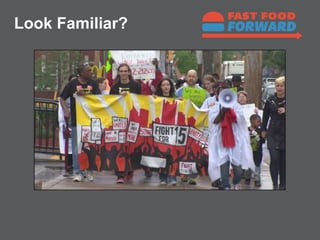
Where Is This Coming From?
SEIU
■ Spent more than $150 MILLION to re-
elect the president
■ Wants to organize fast food workers
■ But the workers do not seem to want to
be organized
■ Spent more than $15 MILLION since
January of this year on fast food worker
protests
Look Familiar?
SEIU Likes Corporate Campaigns, Not
Grass Roots Organizing
■ Takes a lot of energy to organize
local retail outlets unless employees
really want a union
■ Far easier to attack large companies
with PR campaigns, class action
lawsuits, and environmental
challenges to their development
plans
■ To get neutrality agreements
But, Many Employees Don’t Work for the
BIG Guy
■ They work for independent third
parties
● Sub-contractors
● Franchisees
● Business partners
■ BUT NOT IF THE NLRB
REDEFINES THE CONCEPT OF A
“JOINT EMPLOYER” UNDER THE
NLRA
So What’s an Employer to Do?
■ Follow current law
● Good possibility that radical expansion
of the joint employer standard would
not survive circuit court review
■ Still—current law: trap for unwary!
● State in agreements that sub-contractor
(or franchisee) makes all employment
decisions
■ And, stick to what you write!
■ NOTE: there is an exception for
franchisors to control product quality
and brand
● Give as much control to the third party
as you can accept
And, If You Can’t Beat ’Em . . .
■ Join ’em
● Embrace your new-found status as a joint
employer
■ Talk to your staffing company
● Draft protections into agreements
● Require compliance with laws
● Insulate yourself against union organizing
risks
The Perfect Storm?
■ The combination of the NLRB’s new
“Ambush Election Rules” (which went
into effect yesterday) and the potential
new joint employer rules could make
2015 scary for employers
■ 7-Day position statement requirement
● Can you gather the information in time?
■ Elections in as few as 10-21 days
● Where are your weak spots?
Q&A
John Merrell
EMPLOYMENT AND
LABOR LAW ATTORNEY
Ogletree Deakins

Joint Employer Liability: What It Means, Why All Employers Should Care and How a Change in the Law Could Affect the American Business Model

  • 2.
    Webinar Presenter John Merrell EMPLOYMENTAND LABOR LAW ATTORNEY Ogletree Deakins
  • 3.
    What’s Going On? ■In April 2014, the NLRB granted review in BFI (subcontractor situation) ● Asked for the public to submit briefs about whether the joint employer standard should be changed ■ Rather than wait for the NLRB, the GC authorized complaints vs. McDonald’s (franchisee situation), which were issued in December 2014 ● No basis for liability under current law
  • 4.
    What Is aJoint Employer? ■ Not mentioned by Congress in NLRA ■ Created by the NLRB to reach independent companies that: ● Share control/co-determine employment terms of another company’s workers ● Exercise that control in a manner that is “immediate and direct” ● Does not apply where the companies are not legitimately separate legal entities (“single employer” doctrine)
  • 5.
    What Does ItMean to Be a Joint Employer? ■ If you and another company are “joint employers,” then each of you: ● Can be held liable for the other company’s unfair labor practices ● Could be obligated to bargain with a union representing the other company’s employees ● Could lose “secondary boycott” protection
  • 6.
    What Relationships CouldGive Rise to a Joint Employer Finding? ■ Franchisor/franchisee (like with McDonald’s) ■ Contractor/subcontractor ■ Primary employer and staffing agency
  • 7.
    The Current Standard ■Laerco and TLI – cases from 1984 – established the current standard ■ Legally separate entities are joint employers ONLY when they actually share the ability to control or co- determine essential terms and conditions of employment (hiring, firing, discipline, supervision and direction of employees) ■ Putative employer’s control must be “direct and immediate”
  • 8.
    The Current Standard ■“Limited and routine” instruction is not enough to make you a joint employer ■ An employer may be able to tell another company’s employees what to do, but not how to do it
  • 9.
    The Current Standard ■“Immediate and direct” means ● Making personnel decisions, such as ■ Setting individual wages ■ Hiring, disciplining or discharging workers ■ Setting individual employees’ schedules ■ Resolving workers’ disputes ■ It does not mean: ● Pointing out issues with workers ● Setting operating hours ● Requiring particular attire or safety equipment ● “Limited and routine” directions on services to perform
  • 10.
    Example: TLI, Inc. NoJoint Employment ■ TLI provided drivers to another company, Crown, that directed the group of drivers to make certain deliveries ● Drivers selected specific assignments based on seniority ■ Drivers reported accidents to Crown ● TLI investigated and determined discipline ● If drivers’ conduct concerned Crown, it gave incident reports to TLI; TLI conducted its own investigation ■ Crown did not hire, fire or discipline TLI drivers
  • 11.
    Example: TLI, Inc. NoJoint Employment ■ Although Crown may have exercised some control over the drivers, Crown did not affect their terms and conditions of employment to such a degree that it may be deemed a joint employer.” ■ Crown’s daily supervision was not “meaningful,” but rather, “limited and routine”
  • 12.
    BFI: The CaseBefore the Board ■ IBT petitioned for joint-employer unit of BFI and Leadpoint at BFI Recyclery ● Sorting line operations outsourced to Leadpoint ■ Leadpoint had 15 on-site supervisors and an HR Representative to manage its 200 employees ■ BFI not involved in hiring, supervising, disciplining or discharging employees
  • 13.
    BFI: The CaseBefore the Board ■ BUT: ● Cost-plus contract ● BFI owned building and equipment ● BFI determined hours sorting line operated ● BFI provided “target” headcount estimates ● BFI occasionally observed employee misconduct and reported it to Leadpoint ■ Leadpoint investigated and made decisions ● BFI on (rare) occasions (allegedly) gave directions to one or two employees
  • 14.
    BFI: The CaseBefore the Board ■ ARD: ● BFI not a joint employer with Leadpoint ● Leadpoint solely controlled individual employee decisions ■ Made all hiring, firing and discipline decisions ● Leadpoint’s staff of supervisors managed workers ● Any direction by BFI was “limited and routine” ■ NLRB: We would like to see briefs on whether we ought to reconsider the existing standard
  • 15.
    The GC’s (Proposed)New Standard ■ It’s really the pre-1984 standard ■ Focuses on “industrial realties” ■ Direct OR indirect control over terms and conditions ● OR the unexercised potential to control terms and conditions of employment ● Does the company impose operational requirements and monitor and retain effective control over those operations? ■ Based on the “totality of the circumstances”
  • 16.
    The NLRB GC’sPosition Indicates What’s Going On ■ Joint-employer status exists when, “under the totality of the circumstances, including the way the separate entities have structured their commercial relationship, the putative joint employer wields sufficient influence over the working conditions of the other entity’s employees such that meaningful bargaining could not occur in its absence.”
  • 17.
    How Will theNLRB Redefine Who is a Joint Employer? ■ A few examples of “indicia of control” that the GC has given: ● Tracking data on sales, inventory and labor costs ● Calculating labor needs ● Setting and policing employee work schedules ● Tracking wage reviews ● Tracking time needed for employees to fill customer orders ● Retention of right to approve employees ● Requiring another company and employees to follow safety rules
  • 18.
    How Will theNLRB Redefine Who is a Joint-Employer? ■ Any company that outsources on- site operations to a third party might be deemed a joint employer of the third party’s employees ■ Any company that closely controls off-site operations of a third party, like a franchisor, might be a joint employer ■ Then, unions can effectively use corporate campaign tactics to organize
  • 19.
    The GC’s Reasoning ■The term “employer” was intended to be construed broadly ■ Employers who use staffing companies and subs are still influencing terms and conditions of employment by influencing price by controlling other variables (“industrial realities”) ■ In this type of situation, employees don’t have a chance to achieve better terms and conditions through collective bargaining
  • 20.
    Where Is ThisComing From?
  • 21.
    SEIU ■ Spent morethan $150 MILLION to re- elect the president ■ Wants to organize fast food workers ■ But the workers do not seem to want to be organized ■ Spent more than $15 MILLION since January of this year on fast food worker protests
  • 22.
  • 23.
    SEIU Likes CorporateCampaigns, Not Grass Roots Organizing ■ Takes a lot of energy to organize local retail outlets unless employees really want a union ■ Far easier to attack large companies with PR campaigns, class action lawsuits, and environmental challenges to their development plans ■ To get neutrality agreements
  • 24.
    But, Many EmployeesDon’t Work for the BIG Guy ■ They work for independent third parties ● Sub-contractors ● Franchisees ● Business partners ■ BUT NOT IF THE NLRB REDEFINES THE CONCEPT OF A “JOINT EMPLOYER” UNDER THE NLRA
  • 25.
    So What’s anEmployer to Do? ■ Follow current law ● Good possibility that radical expansion of the joint employer standard would not survive circuit court review ■ Still—current law: trap for unwary! ● State in agreements that sub-contractor (or franchisee) makes all employment decisions ■ And, stick to what you write! ■ NOTE: there is an exception for franchisors to control product quality and brand ● Give as much control to the third party as you can accept
  • 26.
    And, If YouCan’t Beat ’Em . . . ■ Join ’em ● Embrace your new-found status as a joint employer ■ Talk to your staffing company ● Draft protections into agreements ● Require compliance with laws ● Insulate yourself against union organizing risks
  • 27.
    The Perfect Storm? ■The combination of the NLRB’s new “Ambush Election Rules” (which went into effect yesterday) and the potential new joint employer rules could make 2015 scary for employers ■ 7-Day position statement requirement ● Can you gather the information in time? ■ Elections in as few as 10-21 days ● Where are your weak spots?
  • 28.
    Q&A John Merrell EMPLOYMENT AND LABORLAW ATTORNEY Ogletree Deakins